DESIGN OF AN UNDERWATER EXPLOSION SIMULATOR
by
LT. JOHN A. McMORRIS II, U.S. N.
SUBMITTED IN PARTIAL FLFILIMENT OF THE REQUIREMENTS
FOR THE DEGREE OF NAVAL ENGINEER
and
FOR THE DEGREE OF MASTER OF SCIENCE
IN NAVAL ARCHITECTURE AND MARINE ENGINEERING at the
MASSACHUSETTS INSTITUTE OF TECHNOLOGY
May-, 1963
THESIS SUPERVISOR: HAROLD E. EDGERTON, SC.D,, DENG.
DESIGN OF AN UNDERWATER EXPLOSION SIMULATOR
by
JOHN A. McMORRIS II, LIEUTENANT, U.S. NAVY B.S., U.S. Naval Academy
(1957)
SUBMITTED IN PARTIAL FULFILLMENT OF THE
REQUIREMENTS FOR THE DEGREE OF NAVAL ENGINEER
and
FOR THE DEGREE OF MASTER OF SCIENCE IN
NAVAL ARCHITECTURE AND MARINE ENGINEERING
at the
MASSACHUSETTS INSTITUTE OF TECHNOLOGY
May,
1963
Signature of Author:
,r
,
ra, + 4t PA
, 1hkr
.Accepted by:
Depfment of' Naval Architecture and
"'Mrin Engineering, May 17, 1963
Chairman, Departmental Committee
on Graduate Students
/
DESIGN OF AN UNDERWATER EXPLOSION SIMULATOR by LT. JOHN A. McMORRIS II, U.S.N.
Submitted
to the Department
of Naval Architecture
and Matine
Engineering on May 17, 1963, in partial fulfillment of the requirements for the Master of Science degree in Naval
Architecture and Marine Engineering and the Professional degree, Naval Engineer.
ABSTRACT
Desired characteristics of a hydraulic shock test facility
are discussed, and the relative merits of possible driver
configurations are examined. Primary emphasis is given to the
experimental development of a magnetically actuated hydraulic shock generator, based on the "boomer" developed by Dr. H. E. Edgerton of M. I. T. The results of systematic variation of
available design parameters are displayed in a series of plots, and these are used as the basis for a proposed design of an
underwater explosion simulator. Basically, it was found that any combination of parameters which resulted in an electrical
rise time of less than 50 microseconds resulted in an output pressure pulse with rise time less than 1 microsecond, for the
driver configurations investigated. Pulse amplitudes obtained
were computed to be approximately 1000 p.s.i., with an electrical input of 700 Joules. Additional test series are recommended
to verify performance of a driver-pressure chamber combination
suitable for use as a test facility.
Thesis Supervisor: Harold E. Edgerton, Sc.D., D.Eng. Title: Professor of Electrical Measurements
TABLE OF CONTENTS _ List of Figures ... List of Tables... Introduction... A. Background ... B. Characteristics C. Characteristics D. Objectives in Drive ... Procedure ... A. Preliminary Selection B. Investigation of Test · ·... .· ·. · * · . . . .. . . of an Unde: Desired of Development .· ... ... .. · ·· · · · . · · . . . · · · .e.... .. ... rwater Explosion Test Facility.. of Electrical ·.·... ··.. .·.·... . · .· of Me ' Driver Design.... dia ...
C. Investigation of Driver Characteristics...
D. Instrumentation ...
E. Summary of Test Series ...
Results ...
A. Electrical Performance ...
B. Pressure Pulse Characteristics ...
Discussion of Results ... A. Comparison of Liquids... B. Performance of Driver...
C. Proposed Design for Test Fability...
Conclusions ... Recommendations ... ... Appendix ... ... A. Tabulation of Data ... ... I II Page 4 5 6 6 7 10 12 14 14 17 20 27 28 33 33 36 46 46 48 55 59 61 62 III IV
V
VI 63TABLE OF CONTENTS (cont'd)
Page B. Power Supply Circuit Diagram ... 70
LIST OF FIGURES
Illustration of Pressure Waveforms... 5 1/4" Boome=... ...
Design of Test Instruments ...
Driver Arrangement for Test Series ...
Influence of L, C, Rise Time and Peal Influence of L, C,
Ring Frequency and
Influence of Vo or Influence of C on Influence of L, C, Pulse Amplitude an Influence of Vo on Influence of Plate and Duration... Influence on C on Suggested Driver Schematic of Propo
and Plate Thickness on
i Current ...
and Plate Thickness on
I Decay Time Constant...
Rise Time and Peak Current.... Rise Time and Peak Current...
and Plate Thickness on
id Duration ...
Pulse Amplitude and Duration.. Composition on Pulse Amplitude
... ·.. · e*...O.e..e·®@·. · .
Pulse Amplitude and Duration... )esign ... )sed Test Facility ...
Number II III IV
V
VI VII VIII IX X XI XII XIII XIV Page 8 21 29 32 34 35 37 3840
42 43 44 56 58 I I · · e... . . *I se *vLIST OF TABLES
Numbe r Page
I: Characteristics of Coils Used in Test Series... 26
II Pressure Pulse Characteristics of Water, Pentane,
and Glycerine ...
...
.. .. ... .. . .... 36III Comparison of Test Tanks ...-... 45
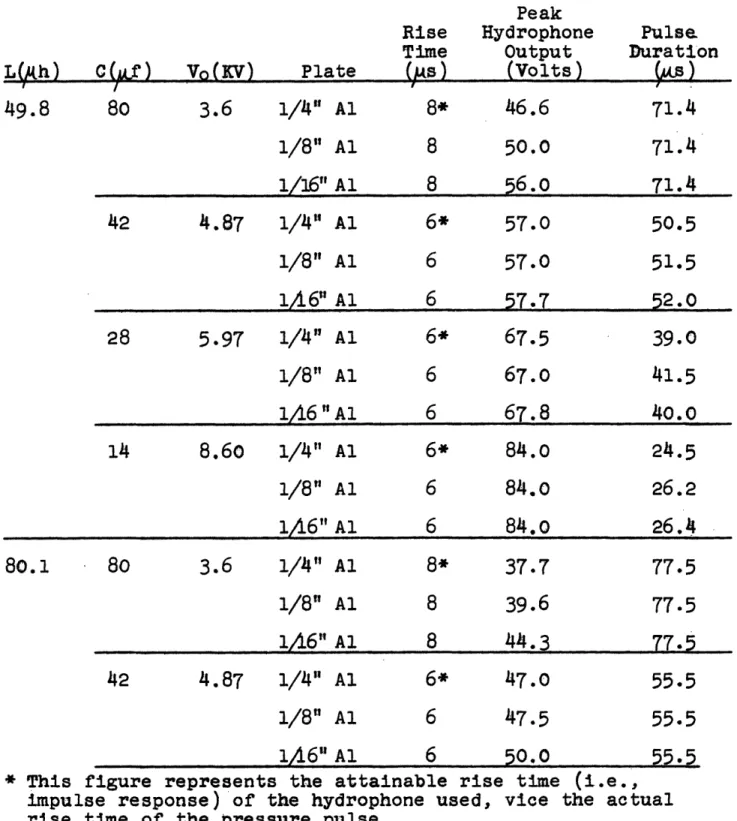
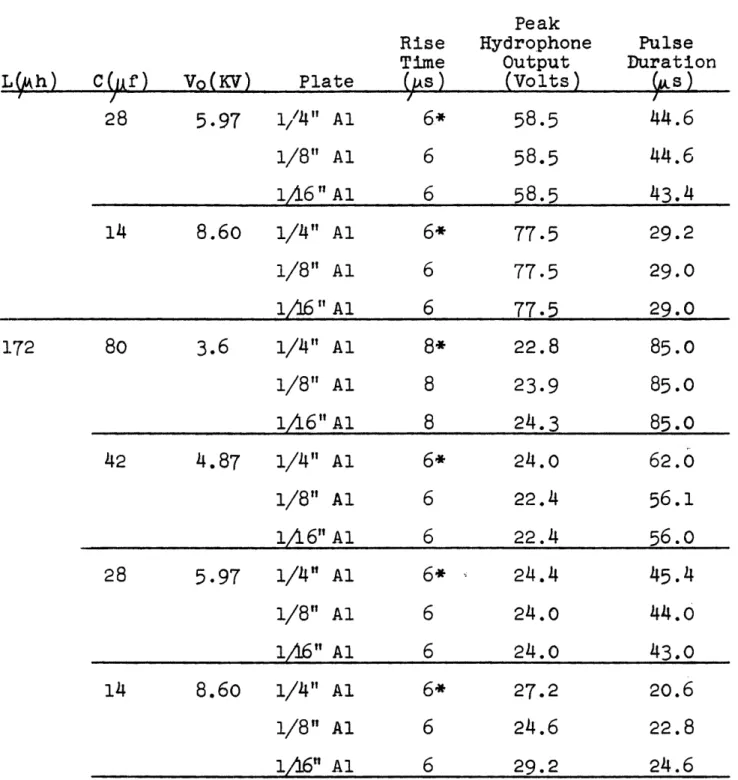
A-i Influence of Coil Inductance, Bank Capacitance
and Plate Thickness on Electrical Signature of
Driver with 500 Joule Input ... 63
A-II Influence of Initial Voltage on Electrical Signature
of Driver with Other Parameters Fixed ... 65
A-III Influence of Capacitance on Electrical Signature
of Driver with Other Parameters Fixed... .... 65
A-IV Influence of Coil Inductance, Bank Capacitance, and
Plate Thickness on Pressure Pulse with 500 Joule
Input... ... ... o. 66
A-V Influence of Initial Voltage on Pressure Pulse with
Other Parameters Fixed... 68
A-VI Influence of Plate Composition on Pressure Pulse
with Other Parameters Fixed ... ... .. 68
A-VII Influence of Capacitance on Pressure Pulse with
I. INTRODUCTION
A. Background
Within the last 20 years, considerable advances in the
methods and materials of naval architecture
have led to the
emergence of the deep diving submarine as a promising naval
weapons system.
In addition to the improved technology
re-quired for the design and fabrication of the pressure hull
of such a ship, basic design modifications
have been demanded
for nearly every fitting or device penetrating that hull or
mounted external
to it.
Each such modification must obviously
be subjected to thorough testing prior to its acceptance in
a final design: One facet of component testing is the
ver-ification
of hydrostatic
performance by subjecting each
com-ponent to a specified pressure level
n a pressure chamber.
A second is the examination for possible fatigue problems by
imposing a cyclic variation in pressure level over a period
of time. A third is the investigation of dynamic response to
a pressure pulse, such as might be generated by an underwater
explosion.
In fact, this last pressure test is of particular interest
to naval engineers.
Despite advances in the theory, response
to such dynamic loading is difficult
to predict analytically,
particularly
when the pulse is superimposed upon a given
hydro-static loading.
To date, precise knowledge has been contingent
upon explosive testing at depth. As this procedure is both
slow and expensive,
attempts have been made to artificially
produce the pressure history of an underwater explosion
with-in a pressure chamber. It is the purpose of this thesis to
examine the design considerations involved in the development of such a test facility, with particular emphasis on the design
of an electrically actuated "driver" to produce the desired
pulse.
B. Characteristics of an Underwater Explosion
Presumably, the first step in simulating an underwater explosion is to obtain a detailed description of the
phenom-enon which we desire to simulate. Accordingly, the pertinent characteristics as described by Keil (1)*, are summarized
be-low:
When a high explosive detonates underwater, the almost instantaneous release of energy produces a shock wave which propagates radially outward from the point of detonation.
Initially, the velocity of this pressure pulse is about three times the local speed of sound, but its velocity quickly drops to a value Just over the local speed of sound. The general profile of such a pulse is as indicated in Figure Ia. It is
characterized by an essentially vertical leading edge, and
an initial value p0 which is a function of the amount of
energy released (weight of charge) and standoff (distance of observer from explosion). The initial decay is expoential,
with time constant
r,
and the "hump'" shown occurs about one* Numbers in parenthesis refer to references tabulated in the
FIGURE I
ILLUSTRATION OF PRESSURE WAVEFORMS
P
F:
A.. PRESSURE HISTORY OF AN UNDERWATER EXPLOSION
p
t
time constant from the leading edge. (It is attributed to energy reflections within the gas bubble generated by the
explosion.) Specifically, the following empirical
relation-ships hold:
p0 = 21,600(W /R) psi (1)
= 58w /3(w /R) 22 sec (2)
where W is the equivalent charge weight in pounds of TNT ("one pound of pentolite releases as much energy as 1.3 pounds of TNT; one pound of HBX is equivalent to about 1.5 pounds of TNT, etc.), and R is the standoff in feet.
About half the energy of the explosion remains in the
gas bubble, which expands, overshoots its equilibrium size,
and collapses. Upon collapsing in a minimum, the bubble emits a second pressure pulse, about 1/10 the magnitude of
the first publse, and without the vertical leading edge characteristic of a shock front. Roughly, if T1 is the interval between the first and second pulses, and Pi is the peak pressure of the second pulse:
T1 = 4.36w/3/Z
5/
6sec
(3)
P1 = 2000W /3/R psi (4 )
whnce Zo is equal to the charge depth plus 33 feet.
The gas bubble continues to oscillate for some time after the explosion, but experience indicates that the
energy contained in the first two pulses generally accounts
C. Characterl.stics Desired of Test Facility
From an engineer's viewpoint, for test purposes it is neither necessary nor desirable to produce an exact duplicate
of' the rather complex pressure signal described above.
Per-haps, a minimum standard for a test facility might be the generation of a single pulse of "reasonably short" rise time and an "approximately exponential" decay. Just how
"reasonable" and how "approximate" one can be depends, ulti-mately, on what can be readily achieved, and upon the desired
degree of correlation between the outcome of laboratory tests
and actual explosive testing.
Ideally, equipment design must be based upon the
hypoth-esis of withstanding the explosion of a given weight of charge
at a given standoff, without serious damage. By contrast,
current test practice converts such a standard to the more
approximate specification that the equipment withstand a
given impulse--- that it, that the integral under the pressure-time curve as measured at the equipment be of a particular
value without resulting in serious damage--- and laboratory tests are conducted accordingly. Such a specification leaves the particular combination of peak pressure and decay rate used to realize the desired impulse a characteristic of the specified test facility, rather than a characteristic of
some hypothetical explosion. Again, Justification of such an
approximation is based strictly upon the results obtained.
Considering the above, it would seem advisable to base the evaluation of any proposed test device upon a comparison
with an operating test facility. Such a facility is located at the Portsmouth Naval Shipyard. It consists of a
cylin-drical pressure chamber of 8" internal diameter, about 20"
long, mounted vertically. The upper end of the chamber is
fitted with a piston, upon which a weight is dropped to
pro-duce the desired pressure pulse. The lower end of the
chamber is flanged to receive test specimens. Normally, the
chamber is filled with glycerine for test purposes.
According to Mr. C.J. Chwalek of the Impedance, Shock, and Vibration Test Section, Portsmouth Naval Shipyard, the
im-pact of the weight upon the piston produces a steep pressure pulse with a rise time of about 0.2 ms and a total duration of' about 0.4 ms. However, this pulse is reflected
re-peatedly from the ends of the chamber, so that a test specimen is struck by a series of overlapping pulses of decreasing
amplitude, with a repetition frequency of about 3 kc. The disturbance continues for a period of about 3 ms before dying out. The general appearance of this waveform is shown in Figure Ib. The suitability of this waveform as a "synthetic explosion" is based upon the hypothesis that,
providing all natural resonances of the equipment under
test occur well below 3 kc, the item under test does not respond to the individual pulses but rather to the mean en-velope of the overall waveform. Obvious problems can arise if the item under test does have a mechanical resonance near
or above 3 kc.
has several pertinent features, aside from the waveform pro-duced, which affect its suitability as a test instrument: For example, one can easily control magnitude of the im-pulse generated by varying the size of the weight or the height of drop. In addition, once the chamber has been brought to the desired hydrostatic pressure, it is possible to conduct repeated tests at various impulse levels on the same specimen without pausing to bleed down and empty the chamber between tests. This can result in a significant saving of time when a large number of tests have been
scheduled. Further, though the test facility is intended to
produce simulated underwater explosions, water is not used as a test medium. Obviously, other liquids may offer
advantages as regards the generation and propagation of
hydraulic shock. Finally, by restricting the cross
sectional area of the test chamber, it is possible to
pro-duce relatively intense pressure pulses with relatively
:Low energy input: thus, it is possible to simulate the
pressure history of a given explosion with much less total
energy than is released by an explosive charge. An obvious limit to the economics offered by a small chamber, however, is the contemplated size of specimens to be tested.
1). Objectives in Development of Electrical Drive
The basic motives for developing an electrically driven test facility are many and varied. First, it is anticipated that most or all of the operational advantages of the current
mechanical facility--- e.g., ease of adjustment, etc--- could
be retained, and second, there is the distinct possibility of
better control over the waveform generated. Specific items
of interest are faster rise time, better control of the shape of the envelope, provision for generating the second pulse described in the section on underwater explosion
characteristics, and, possibly, greater range of variation
II. PROCEDURE
A. Preliminary election of Driver Design
Although the energy level utilized to create an arti-ficial explosion i'hi a pressure chamber may be small compared to the energy eleassed by detonation of a large explosive charge, it is not small by rormal standards. The
d-iver
contemplated
fir
thji f',?.lity
.
nut
be capable of
... ::'" r'"
...
t)'~.~
IC,
l;st,ti.~: j ;.r'!es
or
more,
and ccupiing
th.s!i eng.:gy -;'h
r.i:~:nun attainable
rise time into the test medliin. Presumably, if an electrical
driver is used, a rapid discharge capacitor bank would be
the otimum means of storing the energy, pending its rapid release into the chamber. Selection of a device to
ccr-vert this electrical energy into pressure pulse energy is
not so obvious, however. There are relatively few devices
which are capable of operation at the indicated energy
levels, while still offering some promise of being adaptable
to an output rise time in the microsecond range. During
pre-liminary study of this problem, three devices were considered:
1. Exploding wires: Since the mid-1700's, it has
been recognized that if a large capacitor bank is discharged through a short length of fine wire, the wire will explode,
emitting a brilliant flash of light and a cylindrical shock wave. Chace (2) advances the theory that resistive heating
quickly raises the wire far above its boiling point, but that the absence of a container, (i.e., the lack of a
micro-scopically dirty surface at which vaporization can be initiated) causes the liquid-vapor transition to be de-layed for beyond equilibrium. He hypothesizes that when
finally "triggered", the transition occurs with explosive
violence. Conceivably, such a technique could be used to generate the desired test pulse.
Unfortunately, the use of exploding wires seems to involve three significant disadvantages for the application
considered: First, energy release occurs within a very small volume, a situation which is not conducive to the development
of planar pressure fronts within the short length of a
pressure chamber. Second, use of this technique might
pre-sent problems were it considered desirable to usea flam-mable liquid as the test medium. Finally, and perhaps, most
seriously, it would be necessary to replace the wire before a second pulse could be generated. As mentioned above, any requirement that the chamber be opened between "shots" would
comprise a serious operational drawback.
2. Electric arc: Given sufficiently high voltages, one
could dispense with the wire described above by striking an arc between two electrodes immersed in the test liquid. Normal electrode life should permit several tests before it became
necessary to reopen the chamber. (In fact, electrode life might be prolonged by the fact that the electrodes would
be liquid cooled.) However, this technique would still
suffer from the other disadvantages described above, and might present an even greater safety hazard if used in
con-junction with flammable liquids.
3. Sonar transducer: Finally, it might be possible
to "speed up" a conventional sonar transducer in which the
interaction
between electric
or mEgnetic fields and a
material
body are used to drive that body forcibly into a liquid medium, thereby creating a pressure signal. One advantage of such
a device is that the diameter of the driven element can be nearly as large as the internal diameter of the chamber,
thus simplifying the development of a planar wave front. Further, Dr. H.E. Edgerton of M.I.T. has recently pioneered
the development of a high-speed transducer (known as a "boomer")
which produces steep, high intensity pressure pulses for use
in oceanographic research (3,4!. The pulse characteristics of production model boomers are not dissimilar to those of the driven pulse of the Navy's mechanical test facility: i.e., rise time of about 0.2 ms, and duration of 0.4 to 0.5 ms.
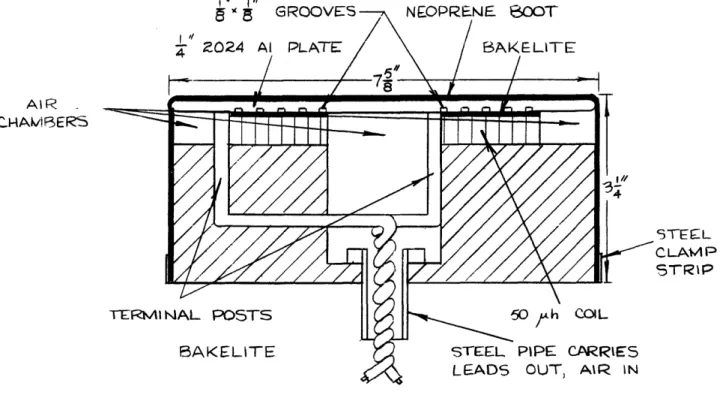
The major components of Dr. Edgerton's boomer are a
flat, spirally wound coil of ribbon wire (rectangular cross
section), and a flat, circular aluminum plate of slightly greater diameter than the coil. The coil is encapsulated in an epoxy pancake, and the plate is clamped to the coil with steel (or rubber) springs. When a capacitor bank is discharged through a triggered spark gap into the coil, the
rapid buildup of an intense magnetic field gives rise to
currents with the field gives rise to a force which tends to violently separate the plate and the coil. The springs limit the motion of the plate to about 3/4", then return it to rest against the coil.
Early models of the boomer were designed to operate in conjunction with a 500 to 1000 Joule capacitor bank, and had an efficiency of conversion of electrical to pressure pulse energy of about 12%. The demand for more powerful pulses has led to the development of models which utilize a 1:3,000 oule bank. To avoid coil damage in the
more powerful models, two coils are counted in series,
back-to-back, and a plate is mounted to the outer face of each coil. In this array, the front plate serves as the driver, while the rear plate serves primarily to develope a balance of forces, so that the coils will not be hurled backwards as violently as the plate is hurled forwards.
Inasmuch as the boomer has none of the disadvantages discussed for exploding wire or electric arc drivers, and offers promise of being adaptable to even shorter rise time than that cited above, it was tentatively selected as the driver for the contemplated test facility.
B. Investigation of Test Media
When a given quantity of energy is released at a given rate in a liquid medium, the rise time, peak magnitude, and duration of the resultant pressure pulse are a function of the physical parameters of that liquid. Theoretically, it
should be possible to compute the relationship between
these parameters and the desired pulse characteristics,
and thus determine the optimum liquid to use with a given
driver. Unfortunately (as pointed out by Dr. Donald Ross of the firm of Bolt, Beranek, and Newman), such calculation must be based on the high pressure equation of state of
the liquid under consideration: a relationship which, in
general, is unknown. Dr. A.H. Keil (currently Technical
Director, David Taylor Model Basin) verified the lack of theoretical groundwork as regards high pressure behavior
of real liquids, and further stated that very little experimental data was available for liquids other than
water. It would appear that there has been relatively
little motivation for research in this particular field. All the above notwithstanding, it is still apparent that not all liquids are equally suitable as test media.
Aside from the question of compatability with materials under test (e.g., neoprene seals, etc.), the most basic
problem governing choice of a particular liquid is probably
the relative ease of forming a pressure pulse which rises faster than the electrical input to the system. Certainly,
such behavior is a necessity if true shock fronts are to be
achieved. Further, at least qualitatively, two variables
are known to affect this facet of liquid response to a
given energy input: compressibility, and variation of acoustic velocity with pressure.
com-pressibility was the primary reason that glycerine was
selected as the test medium of the Portsmouth facility. He indicated that initial tests were conducted in water, but that glycerine was tried on an experimental basis and proved to yield higher peak pressures and shorter rise time for the same input. He also mentioned that the above
improve-ments in pulse characteristics vanish if even small
quan-tities of water contaminate the glycerine.
Variation of acoustic velocity with pressure--- spe-cifically, an increase in acoustic velocity with increasing
pressure--- is a characteristic which results in pulse
steepening as a pressure disturbance propagates through a
liquid. Keil (1) provides an empirical relationship valid for water at pressures up to 10,000 psi:
C = c(l + 6 x 10 p) ft/sec
where c is the local velocity of sound at one atmosphere. Swanson (5) plots data for several organic liquids in the
range 1-300 atmospheres. Swanson's data exhibit two inter-esting characteristics: first, all liquids tested exhibit
a linear relationship between acoustic velocity and pressure
within the range examined, and second, the slope of this
relationship is very nearly identical for all liquids tested except ethyl ether and pentane. The latter two exhibit a
slope approximately twice that of the others. Swanson
further plotted the relationship
for four liquids for which and were known as functions
of pressure over the range investigated. In each case,
the above relationship proved to be non-linear, and although
it did result in an increasing trend for C as a function
of p, it did not correlate well with experimental
obser-vations.
Considering the uncertainties indicated by the above
discussion, and the limitations on available time and
facilities, a simple three point check was conducted using available hardware to verify boomer performance driving into
different liquids: Specifically, tests were conducted in
water, as a reference standard, glycerine, and pentane. The
driver used was a small, two-plate model (of the type dis-cussed in the preceding section) illustrated in Figure II.
A commercially available boomer power supply was used as the energy source, adjusted for 500 watt-second electrical
input to the driver. Inasmuch as no improvement in
per-formance resulted from the use of glycerine or pentane
(see section on RESULTS for details), it was decided that all further tests would be conducted in water.
C. Investigation of Driver Characteristics
Analysis of the boomer is complicated by the fact that
the instrument is clearly a field-driven device, yet the geometries involved are sufficiently complex to preclude
mathematical analysis on the basis of field theory. Further, the dynamics of the problem are of sufficient import to
pre-FIGURE II
5
4"
4
BOCER
O
O
O
O
DRIVEN PLATE SACK PLAT0
INGb 3Sc lude the use of such static computational aids as a teledeltos analogue: the motion of the driven plate is sufficient to cause significant variation of the degree of coupling as a function of time. In short, the best analogue which has been found to cope with the behavior of the boorer is the device itself. Accordingly, an
experimental program was undertaken with two basic
objec-tives: First, to determine whether the boomer could be modified to produce true shock fronts--- or, failing that,
determine the minimum attainable rise time--- and second,
by systematic variation of the basic parameters of the device, to obtain a quantitative measure of the effect of such variation on the pressure pulse produced. It is hoped that such data can at least establish trends of use to
future designers.
Recognizing the limitations of available facilities, no
attempt was made to experiment at energy levels typical of a
full-scale test facility. Most tests were conducted with a
standard electrical input of 500 oules. The maximum input level for any test was 2100 oules. Within these limits,
experiments were conducted to determine the effect of vari-ation of the following parameters:
mass of the driven plate
conductance of the driven plate inductance of the driving coil
capacitance of the energy bank operating voltage
To begin with the first item listed above: however
complex its behavior, the boomer exhibits the terminal
characteristics of an underdamped RLC circuit. At the risk of oversimplification, it can be stated that to reduce the rise time of the pressure pulse, one need only reduce the electrical rise time of the driver circuit, and to reduce the rise time of the driver circuit, one need only reduce the
total inductance and capacitance as seen at the terminals. As mass is the mechanical analogue of capacitance, it follows
that some reduction of rise time might be realizeable by reduction of the mass of the driven plate.
Since production model boomers utilize an aluminum alloy plate roughly 20 inches in diameter, considerable reduction in mass would seem inevitable, all else remaining equal,
should one accept the concept of a driver which must fit within an 8 inch pressure chamber. It was presumed that
additional mass reduction could be effected by reducing plate thickness to the minimum capable of withstanding the stresses developed without permanent deformation*. To determine
whether or not such additional reduction would significantly improve the output pulse, and how much reduction might be
possible, a number of aluminum plates were prepared for testing.
* For oceanographic work, allowance for erosion by cavitation
has resulted in a driven plate somewhat thicker than might
otherwise be required. As these plates are readily machined, it is assumed that a shorter life cycle would be acceptable for a test facility, and thus erosion would be no problem.
All were approximately 8 inches in diameter and most were
of the higher strength aluminum alloys with a conductivity
in the range of 35% to 40% that of copper. Thicknesses
ranged from 1/4 inch down to 1/16 inch.
In the absence of any plate, one would presume the field
generated by a boomer coil would be toroidal in nature. The presence of a conducting plane (such as the plates described
above) adjacent to the coil distorts this field, excluding it from a particular region of space. In a sense, the force acting upon the driven plate can be attributed to this con-tainment or "bottling up" of the magnetic field. Two factors act to reduce the degree of such containment: the plate is driven away from the coil, and (since the plate is not a per-fect conductor), the field begins to penetrate the plate.
Pre-sumably, any change which would tend to nullify these factors would increase the impulse acting on the plate.
Unfortunately, as the first factor cited is also the
mech-anism by which energy is transferred to the liquid, little
could be profitably done to reduce it*. On the other hand,
use of a more highly conductive plate would obviously reduce
the rate at which the field penetrated the plate--- though at
the cost of added mass, considering such factors as yield
* A possible exception to this statement would be the use of
a less compressible liquid, provided that: 1) the driver and the liquid completely filled a constant-volume system, and 2) provision were made to exclude the liquid from the region between the plate and the coil.
strength and density of available metals. The effectiveness
of such a change would presumably depend upon the increase
in conductivity attainable and the relative importance of
the two factors cited.
To investigate the above considerations a second family
of plates was prepared. These plates were all approximately
8 inches in diameter by 1/i6 inch thick, but varied in
com-position from aluminum alloy, through various copper-aluminum
laminates to pure copper. (The laminated plates were prepared
by bonding various thicknesses of copper and aluminum with Emerson and Cuming ECCOSEAL W19 low viscosity epoxy.) Nat-urally, laminated plates were tested with the copper side
adjacent to the coil.
Coil inductance was one parameter which gave more direct
access to electrical rise time. The decision was made to return to a single layer coil, as contrasted with the
back-to-back series array,toreduce total inductance. The rear
plate was eliminated, and replaced with a rigid, insulating
backing material which firmly supported the coil to prevent
recoil.
Conceptually, at least, the upper lmnit of coil inductance
is set by the desire to achieve the shortest feasible electrical
rise time, and the lower limit is set by the higher peak
cur-rents which result from reduced impedance: eventually, more
energy would be consumed by resistance of the leads than
would be transferred to the plate. Practically, however, physical size--- which bears a direct relationship to
induct-ance--- is the determining factor. If the array is to fit
within an 8 inch pressure chamber, the maximum feasible coil diameter is something under that dimension. Further,
if the coil is to drive an 8 inch plate, the localized stresses resulting from the use of any coil appreciably smaller than that dimension create a serious structural
problem.
For experimental purposes, a series of three coils was
prepared to investigate the effects of varying inductance within the limits discussed above. Pertinent parameters are
summarized in Table I
below:
TABLE I
CHARACTERISTICS OF COILS USED IN TEST SERIES
Coil No. Ri Rd N L Q
1 2" 51/21 25 49.8Ah 11.7
2 2" 6 V4" 31 80. h 14. o
3
2"
7 8"
43
172. O0h
21.5
All coils described above were wound of 0.050" by 3.500"
rectangular, cloth wrapped copper wire. Coils were impregnated with ECCOSEAL W19 epoxy for insulation and structural strength.
In addition, a 1/16" bakelite sheet was bonded to that face
of the coil which contacted the metal plate for additional insulation.
The final item of the electrical circuit available for manipulation was the energy storage bank. Commercial boomers
bank for operation at an energy level of approximately 1000
watt seconds. Provision is made for disconnecting and
shorting half these capacitors for operation at 500 watt seconds, or for connecting additional storage banks of 2000
watt-second increments for operation at higher energy levels.
To produce pulses with a shorter rise time, the decision
was made to reduce capacitance while increasing voltage, thus remaining at a constant energy level. As a practical matter,
the range of such testing was limited by available facilities: The firm of Edgerton, Germeshausen and Grier loaned three
Sangamo Electric energy discharge capacitors, each rated at
14/jf, 20 KV. A power supply was constructed for use in
oonJunction with these capacitors which produced a half-wave
rectified output adjustable between 0 and 13 KV*. These factors established the limits of the test range.
D. Instrumentation
As the boomer is a high energy, magnetically driven
device, suitable instrumentation of the test series presented
some problems: Peak currents through the driver were found
to exceed 20,000 amperes. Coupled with a rise time well
under a millisecond, considerable experimentation was required to avoid inductive coupling with stray fields. Careful
attention to lead dress, shielding and positioning of
com-ponents was found to be mandatory. In addition, instruments
with a relatively high level output were found to have obvious
advantages over instruments with low level output.
Transients were displayed on a Tektronix Model 545
oscillo-scope with Type 53/54K fast-rise (.006Js) preamp, and recorded
by scope photography. In general, it was necessary to use a 10 - to - 1 attenuator in series with the scope input.
Current through the boomer coil was measured by placing
a 0.00275 ohm resistor between the coil and ground, and
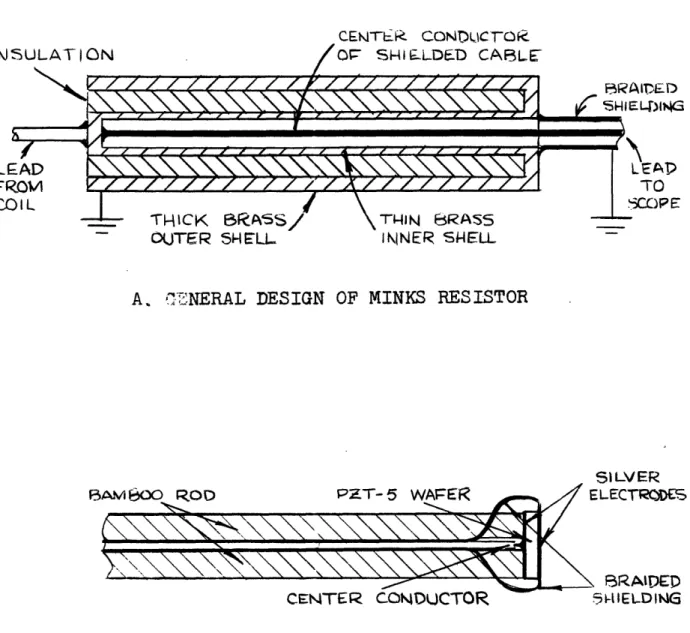
ob-serving voltages developed across the resistor. This resistor was designed and constructed by Floyd M. Minks (see Figure
IIIa). The major advantage of the design was that test leads were introJuced to the resistor in such fashion as to
be completely shielded from fields induced by current flow
through the resistor: thus, voltages observed must be
attrib-uted solely to the IR drop across the resistor.
Initially, pressure measurements were made with a
Che: :a eake instrument Model SB-154D "eight-ball" hydrophone.
As the minimum rise time of this device was found to be about
40ps, a series of replacement hydrophones were manufactured
and tested, culminating in the design shown in Figure IIIb. This device, which utilized a 0.400" by 0.060" PZT-5 wafer as
a pickup, was found to have a minimum rise time of about lus. In all tests, hydrophones were positioned 5" from the rest
position of the driven plate, centered with respect to the plate.
FIGURE III
DESIGN OF TEST INSTRUMENTS
CEFNLTE CONL.xlCrOak
LUvt: ZiMEUI=
A,. T,NERAL DESIGN OF MINKS RESISTOR
PZT- 5 WA.ER CENTER CONDUCTOR SILVER ELECTRAES BRAIDE 5 IELD ING
:. ESIGN OF PZT-5 WAFER PRESSURE PROBE
A.1AM OO ROD
_- - - _-
I
NNt. 3HELL
were conducted dring this investigation:
1. Test of existing hardware in water, glycerine,
pen-tane, and air.
2. Test of each of 3 coils described above with 1/4", 1/8" and 1/16" Al plates, 500 watt-second input, with supply
voltage corresponding to an energy bank capacitance of 80pf,
42f, 28f, and 14/f.
3. Test of 49.8,ph coil with 14/f energy bank, 1/4" Al plate at 2, 4, 6, 8, 10, and 11.4 KV.
4. Test of laminated plates with 49.8uh coil, 14Af
bank, at 10
KV.
5.
Test of 1/4" Al and 1/16" Cu plates at 10 KV with,
49. 8rh coil, 14 f, 28Af and 42 f bank.
6. Spot comparison of driver performance in large open tank and 10" cylinder.
Although most tests were conducted in a large, open tank, series 1 and 6 were run in a thin-walled, 10" diameter
metal cylinder. Again, availability of facilities was largely
the determing factor: while it was recognized that the pressure field produced by the unbaffled driver in an open tank differed vastly from that which would be produced in the hypothesized cylindrical test facility, it was felt that data obtained from open tank tests would suffice to establish a relative basis for comparision of the various driver configurations
tested.
The 10" cylinder described above was used as a means to
contemplated operating conditions. As it was feared that
this cylinder would not have sufficient structural strength
to withstand the complete test series contemplated, its use was restricted to the tests cited.
In series 2 through 6, the driving coil was supported
on a wooden platform, as shown in Figure IV, with the driven
plate rested atop the coil in the horizontal plane. In the interests of minimizing rise time, no springs or other
mechanical constraints were used: the plate was allowed to return to the coil under the action of gravity. As men-tioned above, hydrophones were posimen-tioned 5" above the rest position of the plate, on the centerline of the array.
FIGURE V
DRIVER ARRANGEMENT FOR TEST SERIES
PRESSUR E PROBE j I --I -J OAK PLATFORM =b
Ill, RESULTS~~~~~~~,,,:
A. Electrical performance
1. Comoarison of liquids: Changing the characteristics of the liquid used as the test medium had no discernible
effect upon the electrical signature of the boomer. Tests
were conducted in water, glycerine, pentane, and air, using the driver illustrated in Figure II in conjunction with an
80Q/, 500 watt second energy bank. In each case the electrical
circuit exhibited a rise time of 61/as, reaching a peak
cur-rent of about 7640 amperes. Once excited, the circuit
exhibited a ring frequency of about 3KC, with a decay time
constant of about 200s.
2. Variation of L, C, and plate thickness at onstant energy: The effect of varying bank capacitance and plate
thickness while holding energy input constant (at 500 joules)
is plotted, for each coil, in Figures V and VI. Figure V
shows variation of electrical rise time and peak current with the above parameters, while Figure VI shows variation of ring frequency and decay time constant. The latter two plots are, of course, approximate: the change in coupling between the coil and the plate cause these factors to vary with time.
Thus, the "ring frequency" plotted represents an average
over a number of cycles, while "decay time constant" is, in fact, the time required for the envelope of the waveform to decay from ]ia x to l/e times that value.
i.i.i... ... P ... . .. ... ... . . .. .. .. ... ... ... ... .... i i i i .. . ... .. .. . .. ... . .. .. .. .. .... .. .. I.l. l.i ... .. i,·.. ... !....-...,.. ...
::~~~~~~~~~~~~~~~~~~~~~~~~~~~~~~~~~~~~~
i ..Tl"~
-
3..
..
i....
... .. .. ... .. ... .. .. "'""' + *·t.... · · ·· · *·= · · ··(·· (··..:. · · ·· ·... :.i....h.·....~..i....
;.i.i.-. . '.. . ....
i.. ... ... ... '.. ... ... ... . . . . .......
I.. a a4 .4....4......t1:tf~
mbu~m~
~
+ ' ' i : ' ' ' ' ' ' ' . 4.. . ... .4..4..~~~~~~~~~~~~~~~~~~~~~~~~~~~~~~~. . ... . ... '. .... j-4.a..+ a ..." t ... .. .. .'. .... ....a a a~ ~ ~ ~ ~ ~ ~ ~ ~ ~ ~ ~ ~ ~ ~ ~~~~~~~~~.... .'.. ... .... ...-. .. ... .... ... . . . ... . .- . 4 .Tai'u~ AND PEAK...4.
4..j J. 4.-.4....
2.
...!.-
... . .. . iiiiiI.J.L
~.3...-i.,
33
i. a~~~~~~~~~~~~~~~~~~~~~~~~~~~~~~~~~~~
*.~~~~~~~~~~~~
...
f...
.4..
...
...
~.... i--,-''- .... . .. .. ... . 4 .
.... a.~lt~i ~ .. ... a ... T~f~~` .~ .... . 4 .~i.l j ... .-. i-T7f
L~"I`~``"~i
f.i.
....:... .. . i I . 4.4...... ... .. 4iwi ..a. ~ ... .a.a..l i i ' i i f~"'T"` ... 4~~~~~~~~I .. .... .... ... a...a.a ... ~ ... 4...4._~__~_lll~_~`~::P
... 1.4 ....1...4 ... ... .. .. ... ... ... .. ~ .. ...~ .. + . a a.aa {.. 3.. 4 ...
... ... ... ... .1...L .. . . .. .. . .. ... .. . ... .. ... . a.... V . 4~~~~~~~~~~~~~~~~~~~~~~..'..
. . . . .. .. . . . . .... a. a ... 3.
. .... ... a.. .
...
...-..
. a..
... .-. ...a..
4a~~ .
.4....4..4.-..----4i---.4...~~..... .... .... ... ...
{
a . a.... ... ... . ... ii , i II lii iii ':CYI ij I- jif
... ...
...
....
...
......
,.4....,,
4.4..4
.. ... ..
a
a
a.a
... ...
.4.
4...~
~.
..... . ... .. ... .. ... ..
....
[...i..-.*..-i.~~~~~~~~~~~~~~~~~~~~~~~~~~~~~~~~~~~~~~~~~~~~~~~~~~~~~~~~~~~~~..
~ a 4.4 4 4 . ..~...
..
... 4 4....4 4:'..4... a .3a:..
·...
4
.
.3....j.3..4..l...I..a..~ .. .4.
4
a
i I i T~~~~~~~~~~~~~~~~~~~~~~I~~~~II i i i 4 .iP I 4 1 i i i i ii! a4..4.i. -.3.43 .~. ,.4~ r .. -. ..... .. ... .-.- ..
...
'.-a...
a a f...i...i...L..L..I..4.L....44.4 a 4... 4.~~~~~~~
.,.~l.-i.--4...
....
.....
4.a.. i ....
.
4.4 ...
. f .. U-4-4 a..ii..
... ... ... 4.. i..4.... ... - ...-...-...
.
4...--...---..---....:'-.
.
a
.~,....,..
.
4...4..4.4.
.
...
4...
~
-4 .:4- -:-~i~i~i.:i~i~i...
~~~~~~~~~~~~~~~~~~~~~~~~~~~. 3. ~ a ~ ~ 4.4..4. . ....
....
.,.... .4.t- ~ 4 .aa .. . . .... 4- .... ... I..~.-..i .f.i.i.fl... ...-.. .~.4 ~.-4 ~-~~~~~~~~~~~~~~~~~~~~~~~~~~~.4---.-I 1 }Lr I l~niiiii ~~~~[~r~~ 1.-4--.:.-..-. .i ... 4 .. 4.a
...44.4.. 4~ af
j .4.4j... .-.7...4...'... . 4·. ... ... a.. .a:
i,' . ... .!...,a .I,4-..4--q.-., : i I .:.-'..*- ' ~IL_~ll .. __illl~ll9_1_I;i-'~ ... ..... ...L.I._i_~.L_.L~ f_~l_ I i i~f T~i~~T~-i~~T71~7 I i i i I rf I~...
'.. ...- ... ...---..
~.i.
14...
i-Liiiiiiii
4. ... ....
. 4 L." .. 4. 4 .43j
4...4...4...4. a a1..
4..4.'~ :ll-ll34
.... ...4~~~~..~~~~...4.~_..+..i
I4 .1 :.I412 4. . _L .i a---i-. P.. 4,~T ....4 -... aa a ., '
4..-4
:,...'a ... ... 4-'
1
::,-:: .
? 4 .... u.... a. 3-4a: a--4t~ .i. j. *~4.-4..- 4 a 44 .... . .. . ....4·~··/··-···f-j· 1.4i4..i~~i~...4~~..4j~ i~~~~ i~.;I.... 4~
a... .4. .... ... I 4 . . 3.. R V ... a . 4 I ... t~.-4 T~_ .a
...
..
...
....-
,,--.
i i i i i ii 1 I L ~ ~ ~ I 4 ... ... .. . ... .. Z 4 .4..4 .4...a....itLillI..I1 TT'~'TIr
...
...
...
...
..?
.
:---
7-;-4
±... .
..--.4...
.a
a at-t ...l...i..f..f.4.... 1 i i i i i i i i i i i i i i ii ~ ~ ~ ~ ~ ~ l~~~~~t~~~.~~~i~~i _~~~~i_~~~~l .... i i ii~~~~~~~~~~~~~~~~~~~~~~~ [..ia.
.... ... i...*..'" .. .... . .. . . ...
..
4.
.
,..!,.'...
...
4
....
...
,u~~~~~~~~~~~
ii..~.Lt
F _iil
__L
1
i
a 1' I i i i i i i i %~i-".- ....
:
~'..L.~.I
~~~~~~~~~~~~~.4.i..4.
MJ...L i
..
i.i...i.t ill~-
4!.-..
-i-~i~T~"f~Li""Tr'If~~~
. iill~~~~~ ~ ~ ~~~~~~~~~~~~~~~~~~~~~~~~~~~~~~~~~~~~~~~~~~~~~ I
i··.-4.,.i ... i...i..L,. r~*~r-4,-T---: ~ i~ ~l ~I~~TI~I ~~iiiiii i irii
r.~~-.4
.J..
...
I.~~~.
iTrji
:Iii
'-*-
ittt·i+ ...-.. t -Ft!|'-- .l.~...l...f..- ..:.ilLf
~ir
rl~r~r~7T;L7~....
. . ... ... ... . i :. .. .. .. .H.i... ... ...i
i'
''
i.'
-i t .. ..... i . t .. .. .. .. .. -... : i i ... .. .. .. ...- i..t ... ...' '
.- . ... ... ~ ~ ~ ~ ~ ~ ~ ~ ~ ~ ~ ~ ~ ~ ~ ~ ~ ~ ~ ~ ~ ~ ~ ~ ~ ~ ~ ~ ~ ~ ~ ~ .. ... .. ~ , L..::.'-:.*"'[
....
~~~~~~~~~~~~~~~~~~~~~~~~~~~~~~~~~~~~~~~~~~~~~~~~~~~~~~~~~~~~~~~.....
.t...t i... ... .. -_ 4 TF -F-- - -- *-_ .i_' 1L'-;'i..
...
i...i...
i--:..
e--
--.
:
.
i:
1 : : : : : i
: : : '
: :
:
:
I i i '=m.ii Wh :1_. : !: i i i i i i : i : i : : ) i i i i i i i i i I i i i i i i i i i I i i ~i~~~l ~ f`'~~~i~~~T"~".'"."'"r":'"i'".~'"i"'""4'" t-Bfi- ... +-Zt ... l:4 .. '+- - i i ... . .. ... .. ... ~~~~~~~~~~~~~~~~~~~~~~~. ... ... : .. ... : ... ... ... ... ... ... : ... . ... .. ... ... .. ... ... ... ` ... ... ... "``~"'l`f 'f 'T''i"~"~~`~"' .. . ... ... ... ..."`"`ff ""'~ f" r'...
t- i···.
4. ..
··
·--
l..f.. -',.i . .-
. ... l...i...f..l...l..i...f...l..·".*"'.:
....
..
..
...
i... . . ...
ii ii t~i ii i i i i i i i i I i i i i ii...
I~; K~~T~~T~~~... ... . ... .. b:...~~~~~~~~~~~~~~~~~~~~~~~~~~~~~~~~~~~~~~~~~~~~~~~~~~~~~~~~~~~~~~~~~~~~~~~~~~~~~~..4 ... .... ... ... ... . ... i i i I I i i... .... ... i'" '"
I
i·t··]-)
l·
i i- '~~~~~~~~~~~~~~~- -- -.--.. .
...
....
...
...~~~~ ~ ~~~~~~~~~~~~~~~~~~~~~~~~~~~~~~.... .... i.-4.--]---i: : ~ .... r~~r--A... i...i..f...i...i...i..!...i~..l. ... : : : : : : : : : : :.. i .. ... : :. ... '":"*.'":.'"r'?'r--~~~~~~~~~~~~~~~~~~~~~~~~~~~~~~~~~~~~~~~~~~~~~~~~~~. . .. . . . . .... .--'--..... .... ...
... l~i.:... ... .. ... 't' ... 4 . . . .... . ... .. .. ... .. ... .. ..... ...
i...f...l..i...g.~ i..
...
.. ..- i.. ..
...- -.. ......
....
i~~~l___~..L __~.I~_~_~i~l. ii~iriirir iirr~~r~~ r~s~~i~~~ ~....-*-` ] .... .-- i---'--
.~~~~... ... . .... .... :,-. .-.... .. -. . ~~~~~~~~~~~~~~~~~~~~~~~~~~~~~~~~~~~~~~~~~~~~~~~~~~~~~~~~...
...-
i' ... . ...- __...,, i...!...~,...j : i i i ! ! ] i i : : i : .. . .. ... ! : : : ... ... : . i : · : ::~
~~~~~~~~~~~~~~~~~~~~~~~~~~~~~~~
: :
:'
i 1~
b~~~~~~~~~~.b..-..i. . ...- H - .... ' ... :-' :- .... '...
...
~ . ...
...
...
[.-::: ... .. . .......:
...
.. ..
.,..-..
'...... ...
.b .......
" ~"~
t~~~~~~~~~~~~~~~~~~~~~~~~~~~~~~~~~~~~~~~~~~~~~~~~,...[-......
..
~~~~~~~~~~~~~~~~~~~~~~~~~~~~~~~~~~~~~~~~~~~~~~~~~~~~~~~~~~~...L'.
[~~~~~~~~~~~~~~~~~~~~~~
i
?-t-.--,---:---4-'-
~~~~~~~~~~~~~~~~~~~~~~~~~~~~~~~~~~~~~~~~~~~~~~.4...: ·:
.... ...
:i
::
:iI
:I
i
:r~~~~~~~..H...
...
...i~
~
~
~
~ ~
:..._i..
·
..
---
.'----.
'.'-.-..--..--.'
:'[..'
i.t'..4..4 l... '-'*- ' ' ' ~-~~~~~ ~ ~ . .. ..-...:-~'-.-i--.~
*
' ~,
...
~~~~~~~~~~~~~~~~~~~~~~~~~~~~~~~~~~~~~~~~~~~~~~~~~~~~... ... .-'.
... ,-4-... ... ...i~~~~~~~~~~~~~~~~~~~~~~~~~~~~~~~~~~~~~~~~~~~~~~~~~~~~~~~~~~
i : :
..
..
:..
i...~
.-- .
..
....
..~~~~~~~~~~~~~~~~' - - . :' .. 4....'.. . .. i.... .. .. - .. ..3. Variation of V: The changes in electrical rise time
and peak current which result from increasing energy input by variation of capacitor bank voltage with other parameters
fixed (L = 49.8iah, C = 14f) are shown in Figure VII.
4. Variation of C: The changes in electrical rise time
and peak current which result from increasing energy input by variation of energy bank capacitance with other parameters
fixed (L = 49.8,h, V = 10 KV) are shown in Figure VIII.
B. Pressure Pulse Characteristics
1. Comparison of liquids: the characteristics of the driven pulse* produced in each of the three liquids subjected
to comparative testing are summarized in Table
II
below.
Tests
were conducted in an open, 10" cylinder, using the driver
illustrated in Figure II, and a Chesapeake Instrument Model SB 154-D hydrophone.
TABLE II
PRESSURE PULSE CHARACTERISTICS OF WATER, PENTANE, AND GLYCERINE
Rise Time
Peak Hydrophone
Pulse Duration
Liquid
(9s)
Output (Volts)
(is)
water
75
450
170
pentane 75 352 168
glycerine 75 312 180
*The
first positive pulse produced by the driver. In general)the
subsequent history of the pressure signal proved to be a function
of overall system characteristics, in that it depicted
res-onances of the driven plate, the tank, and the hydrophone used in the test. As the system used did not closely resemble the
con-templated ficility, it is feared that relatively little useful
- --- --- --- -- - - -- --- --- --- --- - ---... .. ... .. .. .. ... ... ... ... ... ... .. ... ... ... ... ... .... ... ... ... ... .. ... ... .. ... .. .. .. ... .. ... -4 - ... .. ... ... ... ... ... ... .. ... ... . ... ... .. ... ... .. ... .4 i... .. ... ... ... ... ... ...4 ... ... .. ... .... ... ... ... ... .. ... ... .. ... ... ... .. .. ... .. .. ... .... .. ... .. ... ... .. ... .. .. .. .. ... .. .. ... .. ... ... ... ... .. ... .. ... ... . ... .... .... ... ... .. ... . .. ... .. ... ... ... ... .. ... ... ... ... ... ... .. ... ... ... ... ... ... .. .. .. ... .... ... ... ... .. .. ... ... ... ... ... ... ... ... .... ... .... ... .. . .. ... .... ... . ... ... .... ... ... .... .... ... ... ... ... . . ... ... .... ... ... ... .... ... ... ... ... ... -4 .. ... ... ... ... ... ... ... ... 4 . 4-- ... , 5i -- -- ---... .. ---... .. .. ---... .. ... ... .. ... ... ... .. ... .. .. ... .. ... ... .. . ... ... ... . ... ... .. ... .. . .. .. ... .. ... ... ... ... ... .. ... .. ... ... .. .. ... ... .. ... ... ... 4_4 ... ... . . ... .... ... ... .. ... .. ... ... ... .. ... ... .. ... .. ... ... .. . ... ... .. .. ... .. .... ... .. ... .. .... ... ... .... ... ... i 4.... ... . ... ... ... ... ... T... .. .. ... .. ... ... ... .... ... ... ... . ... ... . ... . ... . .. ... ... .. ... .. ... .. ... . ... .. ... . ... ... ... ... . ... .. .. ... ... ... .. . .... .... ... ... ... ... ... t... .. ... .. -4 .. ... .. ... .. . ... .. ... ... .... ... . ... . ... ... . ... .... ... . . ... ... ... ... .. ... I .... . .... r .. ... ... .. .. ... .. .. .. . ... ... .. .. ... ... ... ... . ... I...4 ... ... . . ... . .. - - --- ... 4 t J ... .... ... ... ... .... ... ... .. ... . ... ... . .. ... ... ... ... ... ... ... ... ... I 4 ... . ... .. ... ... ... ... ... . ... .. .... .... .... ... T - T ---. ---.---.---.---.---.---. ---.---.---. -44 -i_._4 i ... . ... ... ... ... . ... .. . ... . ...
..---: - t --- -- - --- --- -- t-'-t-' ' '--'-t-' ---t--'-'-'--t
t-'-4--'-
-'-'-t-t-
-------
4--
-- --- --- --- --:~~~~~~~~~~~~~~~~~~~~~~~~~~~~~~~~~~~~~~~~~~~. . .. .. ... ..1..'34; tt t '$ tt +-it tt'-'**
...
.. ..
-t -t-
4-' -'--3 --t-'*--'--~~~~~.
3 *--'---5 t-;-t 't -t t i '*---4-
t '*--'--
' 4 '-- *--'---1--'--t---B-'--'*- .. '...-'...'. -~~~~~~~~~~. ..-*--.--t..---.-.-.--...tt ....t ...-' ... ... ...-- ... -..----. tt-- ---t.--'4...''. ... +-'----*--- ... t -+t----t-t -t -t--t- ... ... ... ... . .... ----t-'----tt... ...ijtit.ii.i .. .. ... ... ... ..+-'-t ...-l- i- ---'' ---*---'---:-*-''i- i. ---.~~~~~~~~~~~~~..
..
-'-
...
..
-*---- -'----t
...
-i-
....
...
...
'*-i---i--l
i..
...
i :-
..
...
..
..
..
...
...
..
...
i.
'...
i--i*---L--4..s i . - ..- ..- .. ...- ... - -* --- ... A - -- 4 ... - ---- ... ... ... ... ... ... ... .. . .. 1 ,4-*- -i1 -... ; i W-t*t- ... t- i -t-t t l--- i *t *- -t X-t- ... **t.. .... .. i ... i t '
'...
'
'
-t'''t
4
.tt
t t -t t , ti
t , -t t t t t .t t t2
-t-, -t t ... Ft.
.'...
...
t...
.-
t-t t-t t-t t-t t-t t-t 4 t-t t-t t-t t ' -t- ' t 9-~~.4. . ... ... ... .. .. .. .. .. . . ... t . ... i4t- -t--' --t*i-+ _i +; ;- i t,... ... .... .... .. i- -+si ... ... ... ... ... * ; - i .. .. ' .!45..+ti--*4---4~~~~~~~~
...
t ...
..Hc
t
_5 . . . .-i--'.tt.:t.?... ..?... ... .?-.t. t....*--.. ..?- t.- .-t .-..t .t..t.--'-t-.t ..t--. ...t-- . . +. t t t i t-- i t --i.... t i t-t- j- t t t t -t i t t t t t t j -!j-t t t t t t ... t t 4 i ... -i...-t.-. .... .... .... .... .. .. .. .. .. .. .. .. ... ': ... S...- 4- ---t... ... .i.. ... .. ****isX. ... .. i ..-- ...i _i *- ...i_ -~~~~~~~~~~~~~~~~~~~~~~~~~~~~~. .. ... .. ..
~
... w-ist-twt* t*t-*--*-tbt-t* wtwt-*tw * -@t - *-*-*t*s**t*t*~**
-tF-- -@t~**9-t-t
.
l...
~~~~~~~~~~~~~~~~~~~~~~~~~~~~~~~~~~~~~~~~~~~~~~~~~~~~~
...
iF
..
'.-+1~~~~~~~~~~~~~~~~~~~~~~~~~~...:
..
.. .t
..
.+-'--
..
'-i- .. t.
...
.. .. .. ..
..
t..-...'-''---.. - - ' f __ ,
t
4' t--t t--t . '+' 4''-- g.
.1..4__
.t -,-,-* -g- t--* -,,,* ---- -t' t- --'- { g '-n--t--i-t--'--t--*-'
''_-4
'
4
-i---
--'
'
-'t-.i..'
--
tt-tt.--t
... ... ... '''t'.t.tt -- t4 4 t -'4-+t .. g-'-' --- .... -'t-4'-- .. :- 4 -- t'--t -4titt4t' t 4-4 g- t t -i''t'-t t-t i ---t--t-t tA t-t -i t- --'' -t-t--t''t''i'''t-t'--i ' t- i-t - -t } -t -' t ' '-t-t-t- 4 t- --' t--4 t 4-'-t 4-t- .. .~~~~~~~~.. .... ..
T[
3:I
i~..
' -;
t t
1
ti
i-tt
- *--4 -tt--4 -
K
t ''-'--tt- 't--'''t't''....---'-..'t.t.- --..'t.-
-t''.'t-t't-t.-'-8 t tt t 't ' tt t 't t tt | ,4 *> . -'fi- t-t-t"''.. ...- -tttt tt' -t'- etusr~~~~~~..
....
...
i--t-,--
,;4
,t
tt t't t t
titt
tt+
i-;44t 3 ' 4 ' ' § i ^' i: t i i t -t-t i- 3+ S t + t i i-t t 0 t --t4-4 .. ~~~~~~~~~~~~~~~~~~~~~~~~~~~~~~~~~~~~~~.. . . ... +...
;...
4- t -- -_--4-++-+..1+{
+i-i..+..;
;+' %- ... ....~~~~~~~~~~~~~~~~~.
...
Wt*+ .... -- ...-+at- -4.t , i tt_,, g ...g. ...b
t
' -..{. + j .s + i.~~~~~~
q
;
...
;W.4
t
+ v~~~l + i .;.~lt..i...i.. gi_4
4
i
vtr
i
'r
...
l
4
i
t
...
+.-.i
1
t4
+ + j i... t+. ;e ++
-- tt - - - tt - t t ~tt---"
' -"'-i'
.'''..-'...'''t...'
t '
Inasmuch as neither pentane nor glycerine offered any significant advantage over water, the decision was made to
use water as the test medium in all further tests.
2. Variation of L, C, and plate thickness at constant
energy: In terms of the pressure pulse, vice eectrtcal ignature,
the plot which corresponds to Figures V and VI is Figure IX, which depicts variation of eak hydrophone output and pulse duration (for a given variation in bank capacitance and plate
thickness) for each coil tested. As mentioned in PROCEDURE,
tests were conducted in a large, open tank: thus, test
results--- particularly, peak amplitude--- are not directly comparable to results anticipated under more favorable
con-ditions. (See Section 6 below.) Despite the above limitation, the data are of value in obtaining a relative assessment of
driver performance following a given change in basic
para-meters. In short, the data can be used to establish trends, which in turn will be of use in system design.
To emphasize that facet of test data which is presumed to be of most value, and to facilitate correlation of test
data recorded by various hydrophones, pressure pulse data
have been plotted on a normalized basis, with a 49.8)h,
14 pf, 500 watt second system with 1/4' Al driven plate taken as the reference standard for this series. The original,
unnormalized data are tabulated, for reference purposes, in tables A-IV through A-VII of Appendex A.
It is interesting to note that in all tests in the range 14 f C _ 42, f, observed rise time was pickup