TARA
POLICY BRIEF ON
BIOMASS BASED DDG PROJECTS
Village Electrification through Sustainable use of
Reviewers
Dr. Shirish Sinha, Swiss Agency for Development and Cooperation
Acknowledgment
We place on record our gratitude to the Swiss Agency for Development and Cooperation for providing the financial and institutional support, National Thermal Power Corporation (NTPC) and TARA field team for providing field support, local communities of the project villages, local NGOs for their untiring work and enabling us
to broaden our understanding of field realities.
Branding and Designing Guidance
Ranjeeta Ghosh, Jay Vikash, Development Alternatives Group
Disclaimer
The views, analysis, interpretations and conclusions expressed herein are those of the contributors and do not necessarily reflect the view of the Swiss Agency for Development and Cooperation (SDC) or NTPC. The information contained herein has been obtained from sources and consultations, which the Contributors believe to be reliable and accurate. The Contributors, editor and the supporting agency associated with the policy brief are not liable for any unintended errors or omissions, opinions expressed herein. The contents of this report may be used by anyone providing proper acknowledgement.
TARA STAGES IN SETTING UP A MINI/MICRO HYDEL PROJECT
TARA
POLICY BRIEF ON
BIOMASS BASED DDG PROJECTS
Symbiotec Research Associates
Village Electrification through Sustainable use of
Renewable Energy (VE-SuRE)
Contributor
S.C. Rajshekar, Symbiotec Research Associates
Reviewers
Dr. Shirish Sinha, Swiss Agency for Development and Cooperation
Acknowledgment
We place on record our gratitude to the Swiss Agency for Development and Cooperation for providing the financial and institutional support, National Thermal Power Corporation (NTPC) and TARA field team for providing field support, local communities of the project villages, local NGOs for their untiring work and enabling us
to broaden our understanding of field realities.
Branding and Designing Guidance
Ranjeeta Ghosh, Jay Vikash, Development Alternatives Group
Disclaimer
The views, analysis, interpretations and conclusions expressed herein are those of the contributors and do not necessarily reflect the view of the Swiss Agency for Development and Cooperation (SDC) or NTPC. The information contained herein has been obtained from sources and consultations, which the Contributors believe to be reliable and accurate. The Contributors, editor and the supporting agency associated with the policy brief are not liable for any unintended errors or omissions, opinions expressed herein. The contents of this report may be used by anyone providing proper acknowledgement.
TARA STAGES IN SETTING UP A MINI/MICRO HYDEL PROJECT
TARA
POLICY BRIEF ON
BIOMASS BASED DDG PROJECTS
Symbiotec Research Associates
Village Electrification through Sustainable use of
Renewable Energy (VE-SuRE)
SECTION 1
1.1 Background 3
1.2 Objective 3
1.3 Status of Electrification in India 4
1.4 Framing the Issues for the Study 6
SECTION 2
2.1 What is meant by DDG? 9
2.2 DDG within the Policy Framework 10
2.3 Implementation of DDG in India 12
SECTION 3
3.1 Performance of Biomass DDG Projects in India 19
3.2 Location of the Projects Analyzed 20
3.3 Technical Performance of Biomass DDG Projects 21 3.4 Financial Performance of Biomass DDG Projects 27 3.5 Managerial Performance of the Biomass DDG Projects 32 3.6 Institutional Arrangements in the Biomass DDG Projects 34 SECTION 4
4.1 Key Learnings 41
4.2 Proposal for Making DDG Viable for Village Electrification 43 4.3 Advantages of a Distribution Level Grid Connected DDG Plant 44
4.4 Issues Facing the Proposal 45
4.5 Building a Local and Sustainable Biomass Supply Solution 47
4.6 Next Steps 48
ANNEX 1: SUMMARY OF KEY DDG PROGRAMMES IN INDIA 53
ANNEX 2: PROFITABILITY OF VESP PROJECTS (BASE CASE) 54
ANNEX 3: PROFITABILITY OF VESP PROJECTS (BREAK-EVEN CASE) 54
SECTION 1
1.1 Background 3
1.2 Objective 3
1.3 Status of Electrification in India 4
1.4 Framing the Issues for the Study 6
SECTION 2
2.1 What is meant by DDG? 9
2.2 DDG within the Policy Framework 10
2.3 Implementation of DDG in India 12
SECTION 3
3.1 Performance of Biomass DDG Projects in India 19
3.2 Location of the Projects Analyzed 20
3.3 Technical Performance of Biomass DDG Projects 21 3.4 Financial Performance of Biomass DDG Projects 27 3.5 Managerial Performance of the Biomass DDG Projects 32 3.6 Institutional Arrangements in the Biomass DDG Projects 34 SECTION 4
4.1 Key Learnings 41
4.2 Proposal for Making DDG Viable for Village Electrification 43 4.3 Advantages of a Distribution Level Grid Connected DDG Plant 44
4.4 Issues Facing the Proposal 45
4.5 Building a Local and Sustainable Biomass Supply Solution 47
4.6 Next Steps 48
ANNEX 1: SUMMARY OF KEY DDG PROGRAMMES IN INDIA 53
ANNEX 2: PROFITABILITY OF VESP PROJECTS (BASE CASE) 54
ANNEX 3: PROFITABILITY OF VESP PROJECTS (BREAK-EVEN CASE) 54
ANNEX 4: PROFITABILITY OF HUSK POWER PROJECTS (BASE CASE) 55
Table 2.1: Lessons from VESP 12
Table 3.1: Classification of Biomass DDGS 17
Table 3.2: Sample of Biomass DDG Projects Studied 17
Table 3.3: Technical Performance of Biomass DDG Plants 20
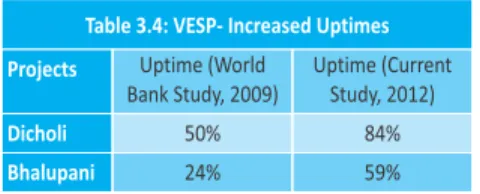
Table 3.4: Vesp- Increased Uptimes 21
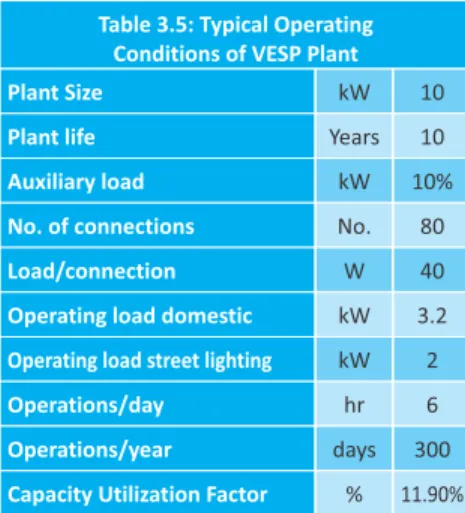
Table 3.5: Typical Operating Conditions of VESP Plant 26
Table 3.6: Investments, Operating Costs & Tariffs - VESP 26
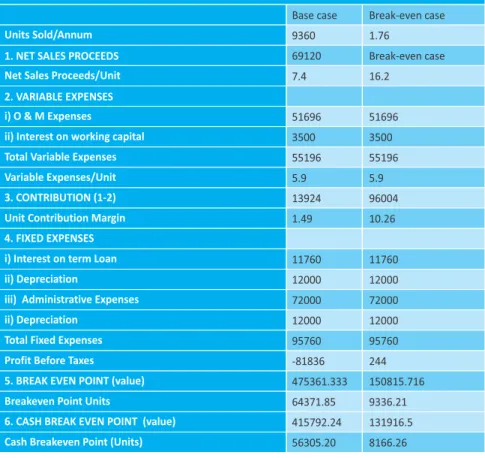
Table 3.7: Break-even Analysis for VESP DDG Plants 27
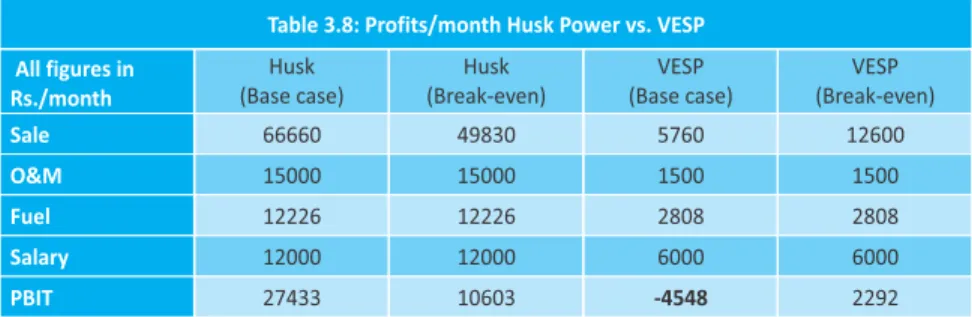
Table 3.8: Profits/month Husk Power Vs. VESP 28
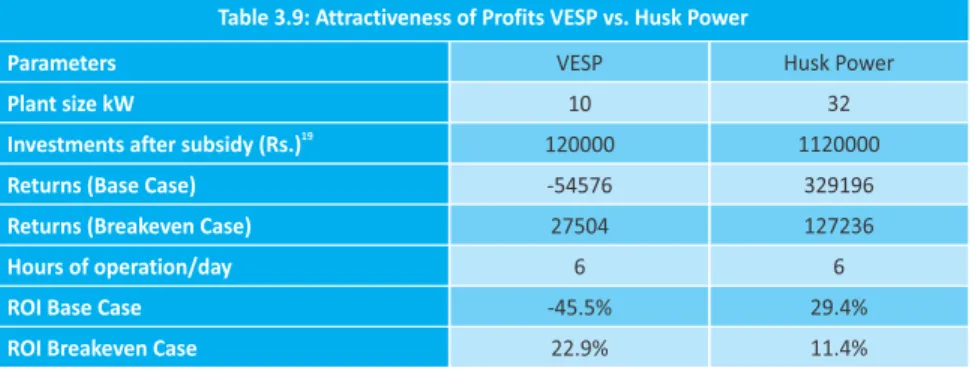
Table 3.9: Attractiveness of Profits VESP Vs. Husk Power 29
Table 4.1: Comparison of VESP, Husk Power & Beri Model of DDG 40
LIST OF FIGURES
Figure 1.1: Source-wise Installed Generation Capacity 2
Figure 2.1: Definitions of DDG 7
Figure 2.2: Ddg in Nep, 2005 & Rep, 2006 9
Figure 2.3: VESP Institutional Model 11
Figure 3.1: Dicholi - Remoteness, Inaccessibility & Commitment Defined 18 Figure 3.2: Motor Costs More Than Flour Mill - Chopan Vesp Project 21 Figure 3.3: Cost of Doing Simple Things in Remote Locations 22 Figure 3.4: Dedicated After Sales Service - Secret of Better Uptimes 23 Figure 3.5: Tree Based Farming - An Innovative Approach to Biomass Supply 24 Figure 3.6: Dicholi: Could You Not Have Just Given Us Solar Lights? 30
Figure 3.7: Feedback from Mr. Satheesh, Md, Enzen on DDGS 35
Figure 4.1: Schematic of Remote Area Electrification Thru Distribution Grid
Connected DDG 42
Figure 4.2: Public-private-panchayat Partnership for Biomass Supply 45
Section 1
•
Background to the policy brief paper
•
Objectives of the study
•
Status of electrification in India
LIST OF TABLES
Table 1.1: Installed Renewable Energy Capacity in India 3
Table 2.1: Lessons from VESP 12
Table 3.1: Classification of Biomass DDGS 17
Table 3.2: Sample of Biomass DDG Projects Studied 17
Table 3.3: Technical Performance of Biomass DDG Plants 20
Table 3.4: Vesp- Increased Uptimes 21
Table 3.5: Typical Operating Conditions of VESP Plant 26
Table 3.6: Investments, Operating Costs & Tariffs - VESP 26
Table 3.7: Break-even Analysis for VESP DDG Plants 27
Table 3.8: Profits/month Husk Power Vs. VESP 28
Table 3.9: Attractiveness of Profits VESP Vs. Husk Power 29
Table 4.1: Comparison of VESP, Husk Power & Beri Model of DDG 40
LIST OF FIGURES
Figure 1.1: Source-wise Installed Generation Capacity 2
Figure 2.1: Definitions of DDG 7
Figure 2.2: Ddg in Nep, 2005 & Rep, 2006 9
Figure 2.3: VESP Institutional Model 11
Figure 3.1: Dicholi - Remoteness, Inaccessibility & Commitment Defined 18 Figure 3.2: Motor Costs More Than Flour Mill - Chopan Vesp Project 21 Figure 3.3: Cost of Doing Simple Things in Remote Locations 22 Figure 3.4: Dedicated After Sales Service - Secret of Better Uptimes 23 Figure 3.5: Tree Based Farming - An Innovative Approach to Biomass Supply 24 Figure 3.6: Dicholi: Could You Not Have Just Given Us Solar Lights? 30
Figure 3.7: Feedback from Mr. Satheesh, Md, Enzen on DDGS 35
Figure 4.1: Schematic of Remote Area Electrification Thru Distribution Grid
Connected DDG 42
Figure 4.2: Public-private-panchayat Partnership for Biomass Supply 45
Section 1
•
Background to the policy brief paper
•
Objectives of the study
•
Status of electrification in India
1.1 Background
The Climate Change and Development Division, Embassy of Switzerland in partnership with the National Thermal Power Corporation (NTPC) aims to engage with the Government of India in a positive dialogue by supporting up renewable energy based off grid pilot projects for further up scaling through the through its “Village Electrification through Sustainable Use of Renewable Energy (VE-SuRE)” project. An outcome envisaged of this project is that decentralized, renewable power gains prominence in electricity policies and Rural Electricity Plans at the state and national level through experiences, lessons learnt and knowledge created through the project.
"Technology and Action for Rural Advancement" (TARA) has been identified as the “Project Management Unit" (PMU). The PMU is responsible for the overall project implementation and demonstration of sustainable Decentralised Distributed Generation (DDG) projects. The PMU commi-ssioned Symbiotec Research Associates (SRA) to carry out a study titled “Policy Brief on Management of biomass based generation projects for their commercial viability, including role of Franchisees as per the existing regulatory framework”. This report is based on the study carried out by Symbiotec Research Associates during February-July, 2012.
1.2 Objective
The Government of India, through the Ministry of Power has been implementing the Rajiv Gandhi Gramin Vidyuthikaran Yojana (RGGVY) to electrify unelectrified villages in the country. The RGGVY has a provision to support Decentralized Distributed Generation (DDG) projects to electrify a village. However, despite making available a capital subsidy of upto 90% of the project cost, there are hardly any entrepreneurs coming forward to take up such projects.
The objective of this paper is
• To understand why response from entrepre-neurs to biomass based DDG projects under RGGVY has been poor and
• To understand what possible solutions to make the venture more attractive to ensure that the vast potential for biomass based DDG projects in rural electrification is realized.
1.1 Background
The Climate Change and Development Division, Embassy of Switzerland in partnership with the National Thermal Power Corporation (NTPC) aims to engage with the Government of India in a positive dialogue by supporting up renewable energy based off grid pilot projects for further up scaling through the through its “Village Electrification through Sustainable Use of Renewable Energy (VE-SuRE)” project. An outcome envisaged of this project is that decentralized, renewable power gains prominence in electricity policies and Rural Electricity Plans at the state and national level through experiences, lessons learnt and knowledge created through the project.
"Technology and Action for Rural Advancement" (TARA) has been identified as the “Project Management Unit" (PMU). The PMU is responsible for the overall project implementation and demonstration of sustainable Decentralised Distributed Generation (DDG) projects. The PMU commi-ssioned Symbiotec Research Associates (SRA) to carry out a study titled “Policy Brief on Management of biomass based generation projects for their commercial viability, including role of Franchisees as per the existing regulatory framework”. This report is based on the study carried out by Symbiotec Research Associates during February-July, 2012.
1.2 Objective
The Government of India, through the Ministry of Power has been implementing the Rajiv Gandhi Gramin Vidyuthikaran Yojana (RGGVY) to electrify unelectrified villages in the country. The RGGVY has a provision to support Decentralized Distributed Generation (DDG) projects to electrify a village. However, despite making available a capital subsidy of upto 90% of the project cost, there are hardly any entrepreneurs coming forward to take up such projects.
The objective of this paper is
• To understand why response from entrepre-neurs to biomass based DDG projects under RGGVY has been poor and
• To understand what possible solutions to make the venture more attractive to ensure that the vast potential for biomass based DDG projects in rural electrification is realized.
1.3 Status of Electrification in India
th
India is the 5 largest generator of electricity in the world with a total
1
installed generation capacity of 214,679 MW as of February, 2013 . Thermal power generation accounts for 67% of the installed capacity followed by hydro (19%), renewable sources (12%) and nuclear energy (2%). Share of renewable energy sources in the generation mix has increased from a paltry 2% in 2002 to 12% in 2013. What is impressive is that this growth in share has happened even as the installed capacity in the country doubled during the same period growing from 105,046 MW in 2002 to 214,679 MW in 2013.
However, despite such impressive growth in installed capacity, all is not hunky dory on the electrifica-tion front in India. As of November, 2012, 94% of the 593,732 villages in India have been electrified and only 34,887
2
villages are yet to be connected to the grid . A majority of these villages are in Uttar Pradesh, Bihar and Odisha. However, a whopping 75 million rural and 6.5 million urban households had no access to grid electricity in the country. A further 33% faced under-electrification; just 50 units of power/household/ month were available to them. This transla-tes to just 10 units/capita/ month or an annual supply of 120units/capita as against
3
the national average of 746 units/ capita/ annum .
RES 25856 12% Nuclear 4780 2% Hydro 39499 19% Thermal 144544 67%
Source: Central Electricity Authority, 2013
Figure 1.1:Source-wise Installed Generation Capacity
1
http://www.cea.nic.in/reports/monthly/executive_rep/feb13/8.pdf 2
http://www.cea.nic.in/reports/monthly/dpd_div_rep/village_electrification.pdf 3
Even this is very low as compared to
To further compound matters, the country faces a peak demand deficit of 10.3% with many highly electrified states such as Maharashtra facing peak demand deficit of upto 22%. To manage this, most DISCOMs follow a policy of diverting power from rural areas to urban areas, leaving rural areas with even less reliable power. This implies that connection to an electric grid does not guarantee that a rural household would enjoy use of the electricity, simply because in many cases there may not be enough electricity to supply! There is a growing realization that decentralized distributed generation of electricity is the answer to ensure supply of electricity to rural households, especially for those that are at the tail-end of the grid. Renewable energy sources, especially solar PV and biomass-based technologies have been identified as being highly suitable for deployment as DDG. Further given the wide-spread suitability of the country in producing biomass, power generation technologies based on biomass have been assess-ed as having a very high potential in improving access to electricity for rural households in the country.
4
However, as Table 1.1 shows , the promise of biomass has been as yet largely unfulfilled. Only 15% of the total potential has been exploited so far as against 38% for wind and 24% for small hydro power..
Table1.1: Installed Renewable Energy Capacity in India
Wind power Resource
Small Hydro Power
Source: MNRE, 2013 Solar Power Bio Power (including cogen) Estimated Potential (MW) 48,500 15,000 23,700 2 20-30 per km Cumulative till February, 2013 18635 3552 3660 1447 4 http://mnre.gov.in/mission-and-vision-2/achievements/
Section 1
1.3 Status of Electrification in India
th
India is the 5 largest generator of electricity in the world with a total
1
installed generation capacity of 214,679 MW as of February, 2013 . Thermal power generation accounts for 67% of the installed capacity followed by hydro (19%), renewable sources (12%) and nuclear energy (2%). Share of renewable energy sources in the generation mix has increased from a paltry 2% in 2002 to 12% in 2013. What is impressive is that this growth in share has happened even as the installed capacity in the country doubled during the same period growing from 105,046 MW in 2002 to 214,679 MW in 2013.
However, despite such impressive growth in installed capacity, all is not hunky dory on the electrifica-tion front in India. As of November, 2012, 94% of the 593,732 villages in India have been electrified and only 34,887
2
villages are yet to be connected to the grid . A majority of these villages are in Uttar Pradesh, Bihar and Odisha. However, a whopping 75 million rural and 6.5 million urban households had no access to grid electricity in the country. A further 33% faced under-electrification; just 50 units of power/household/ month were available to them. This transla-tes to just 10 units/capita/ month or an annual supply of 120units/capita as against
3
the national average of 746 units/ capita/ annum .
RES 25856 12% Nuclear 4780 2% Hydro 39499 19% Thermal 144544 67%
Source: Central Electricity Authority, 2013
Figure 1.1:Source-wise Installed Generation Capacity
1
http://www.cea.nic.in/reports/monthly/executive_rep/feb13/8.pdf 2
http://www.cea.nic.in/reports/monthly/dpd_div_rep/village_electrification.pdf 3
Even this is very low as compared to
To further compound matters, the country faces a peak demand deficit of 10.3% with many highly electrified states such as Maharashtra facing peak demand deficit of upto 22%. To manage this, most DISCOMs follow a policy of diverting power from rural areas to urban areas, leaving rural areas with even less reliable power. This implies that connection to an electric grid does not guarantee that a rural household would enjoy use of the electricity, simply because in many cases there may not be enough electricity to supply! There is a growing realization that decentralized distributed generation of electricity is the answer to ensure supply of electricity to rural households, especially for those that are at the tail-end of the grid. Renewable energy sources, especially solar PV and biomass-based technologies have been identified as being highly suitable for deployment as DDG. Further given the wide-spread suitability of the country in producing biomass, power generation technologies based on biomass have been assess-ed as having a very high potential in improving access to electricity for rural households in the country.
4
However, as Table 1.1 shows , the promise of biomass has been as yet largely unfulfilled. Only 15% of the total potential has been exploited so far as against 38% for wind and 24% for small hydro power..
Section 1
Table1.1: Installed Renewable Energy Capacity in India
Wind power Resource
Small Hydro Power
Source: MNRE, 2013 Solar Power Bio Power (including cogen) Estimated Potential (MW) 48,500 15,000 23,700 2 20-30 per km Cumulative till February, 2013 18635 3552 3660 1447 4 http://mnre.gov.in/mission-and-vision-2/achievements/
1.4 Framing the Issues for the Study
Given that the problem to be addressed is:Despite the high potential assessed for biomass based DDGs and the high capital and operating subsidies offered under the RGGVY-DDG scheme, no biomass based DDGs have taken off. What are the reasons?
A priori, for entrepreneurs to make investments, a project must provide adequate and attractive returns on the investments, managerial efforts and the risks taken by the entrepreneurs. This is influenced by the performance of the project, the enabling or disabling environment created by policy and by institutional capacities needed to execute and sustain the project.
Accordingly, this paper examines issues that affect biomass based DDG projects at the policy, project and institutional level and presents a way forward. These findings and insights are based on desk review of policies, regulations and programmes of the Ministry of Power (MoP) and Ministry for New and Renewable Energy (MNRE) and extensive project level performance reviews and discussions with owners/ operators/facilitators
5
of selected biomass DDG plants .
5
The plants were selected largely from VESP (Village Energy Security Programme of MNRE). They also covered a UNDP-GEF supported tail-end DDG plant
Section 2
•
Definition of DDG
•
Policy context for DDG in India
•
Implementation of DDG through
schemes and programme by Govt. of
India
Section 1
1.4 Framing the Issues for the Study
Given that the problem to be addressed is:Despite the high potential assessed for biomass based DDGs and the high capital and operating subsidies offered under the RGGVY-DDG scheme, no biomass based DDGs have taken off. What are the reasons?
A priori, for entrepreneurs to make investments, a project must provide adequate and attractive returns on the investments, managerial efforts and the risks taken by the entrepreneurs. This is influenced by the performance of the project, the enabling or disabling environment created by policy and by institutional capacities needed to execute and sustain the project.
Accordingly, this paper examines issues that affect biomass based DDG projects at the policy, project and institutional level and presents a way forward. These findings and insights are based on desk review of policies, regulations and programmes of the Ministry of Power (MoP) and Ministry for New and Renewable Energy (MNRE) and extensive project level performance reviews and discussions with owners/ operators/facilitators
5
of selected biomass DDG plants .
5
The plants were selected largely from VESP (Village Energy Security Programme of MNRE). They also covered a UNDP-GEF supported tail-end DDG plant
Section 2
•
Definition of DDG
•
Policy context for DDG in India
•
Implementation of DDG through
schemes and programme by Govt. of
India
2.1 What is meant by DDG?
Decentralized Distributed Generation has been defined differently by
6
different people and entities. CIGRE (Interna-tional Council on Large Electricity Systems) defines distributed genera-tion as all generation units with a maximum capacity of 50 MW to 100 MW, that are usually connected to the distribution network and that are neither centrally planned nor dispatched.
The IEEE (Institute of Electronic and Electrical Engineers) defines distributed generation as the generation of electricity by facilities that are sufficiently smaller than central generating plants so as to allow interconn-ection at nearly any point in a power system.
7
Dondi et al define distributed generation as a small source of electric power generation or storage (typically ranging from less than a kW to tens of MW) that is not a part of a large central power system and is located close to the load.
Some common elements emerge from a reading of the above three definitions. DDG systems:
• Have a plant capacity range that is smaller than a central power generating plant
• A r e c o n n e c t e d t o t h e distribution network
• Closer to the load centre Figure 2-1 provides a definition that comprehensively includes all these fe at u re s a n d s e r ve s we l l a s a
8
working definition of DDG and will be used as such in this paper.
6
CIRED, 1999. Dispersed generation, Preliminary report of CIRED working group WG04, June, p. 9+Appendix (p.30). 7
Dondi et al. (2002) define distributed generation as a small source of electric power generation or storage (typically ranging from less than a kW to tens of MW) that is not a part of a large central power system and is located close to the load.
8
Ackermann, T., Andersson, G., Soder, L., 2001. Distributed generation: a definition. Electric Power Systems Research 57, 195–204.
Figure 2.1: Definitions of DDG
Ackermannetal. (2001), define distributed generation in terms of connection and location rather than in terms of generation capacity. They define a distributed generation source as an electric p o w e r g e n e r a t i o n s o u r c e c o n n e c t e d d i r e c t l y t o t h e distribution network or on the customer side of the meter.
Section 2
2.1 What is meant by DDG?
Decentralized Distributed Generation has been defined differently by
6
different people and entities. CIGRE (Interna-tional Council on Large Electricity Systems) defines distributed genera-tion as all generation units with a maximum capacity of 50 MW to 100 MW, that are usually connected to the distribution network and that are neither centrally planned nor dispatched.
The IEEE (Institute of Electronic and Electrical Engineers) defines distributed generation as the generation of electricity by facilities that are sufficiently smaller than central generating plants so as to allow interconn-ection at nearly any point in a power system.
7
Dondi et al define distributed generation as a small source of electric power generation or storage (typically ranging from less than a kW to tens of MW) that is not a part of a large central power system and is located close to the load.
Some common elements emerge from a reading of the above three definitions. DDG systems:
• Have a plant capacity range that is smaller than a central power generating plant
• A r e c o n n e c t e d t o t h e distribution network
• Closer to the load centre Figure 2-1 provides a definition that comprehensively includes all these fe at u re s a n d s e r ve s we l l a s a
8
working definition of DDG and will be used as such in this paper.
6
CIRED, 1999. Dispersed generation, Preliminary report of CIRED working group WG04, June, p. 9+Appendix (p.30). 7
Dondi et al. (2002) define distributed generation as a small source of electric power generation or storage (typically ranging from less than a kW to tens of MW) that is not a part of a large central power system and is located close to the load.
8
Ackermann, T., Andersson, G., Soder, L., 2001. Distributed generation: a definition. Electric Power Systems Research 57, 195–204.
Figure 2.1: Definitions of DDG
Ackermannetal. (2001), define distributed generation in terms of connection and location rather than in terms of generation capacity. They define a distributed generation source as an electric p o w e r g e n e r a t i o n s o u r c e c o n n e c t e d d i r e c t l y t o t h e distribution network or on the customer side of the meter.
2.2 DDG within the Policy Framework
The impetus for DDG comes from the enactment of the Electricity Act (EA), 2003 and the National Electricity Policy (NEP), 2005 and the Rural Electrification Policy (REP), 2006. Specifically, the EA, 2003 has the following legislative provisions to promote rural electrification:
• Section 6–which obligates the state government to supply electricity to all areas, including villages and hamlets.
• Section 13–which exempts the need for a distribution, transmiss-ion, and trading licence based on recommen-dation of the state government for local authority, Panchayath institution, co-operative society, or franchisees.
• Section 14–which exempts licence to a person who intends to generate and distribute electricity in a rural area notified by the state government. Furthermore, a person exempted under the 8th Proviso of Section 14 as above would also be free from purview of appropriate commissions in matters pertaining to determi-nation of tariffs.
• The retail tariffs for such exempted persons would be based on mutual agreements between such persons and the consumers. A reading of the above sections reveals that the EA, 2003 provides several enabling conditions to promote DDGs for rural electrification. However, while it allows the retail tariff to be mutually fixed between the generator and the consumers, at the ground level, such operators have to often compete with very low priced grid electricity, however unreliable the supply of power from the grid may be.
Grid tariffs for rural areas are set very low because they are cross subsidized by higher tariffs being charged for other customers using the grid, especially industrial and commercial users. Such an arrangement is usually, not available to DDG power plants therefore, their tariffs tend to be higher.
Further, as Figure 2-2 shows the NEP, 2005 (Section 5.1.2 (d)) and the REP, 2006 (Para 3.2) state that DDG plants are the preferred choice for rural electrification where grid extension (GE) is not technically feasible or economically viable. Typically, such villages tend to be in remote and inaccessible locations with low and scattered populations and very low level of economic activities. In short, DDG is the preferred choice where ESCOMs would not like to go because GE may not be techno-economically unattractive.
Such an approach leads to DDG plants that are tiny in scale and located in remote areas with very low demand for electricity other than for lighting. Indeed, “DDG” would draw up in most minds an image of a tiny plant (1-10kW) that is operating in a remote forest village or in an inaccessible mountainous area in a stand-alone mode. A review of the DDG programmes of the MNRE and the MoP show that policy makers have indeed, viewed and restricted DDG to “small-scale off-grid remote applications, run by local entities”.
Figure 2.2: DDG in NEP, 2005 & REP, 2006
“Wherever above is not feasible (it is neither cost effective nor the optimal solution to provide grid connectivity) decentralized distributed generation facilities together with local distribution network would be provided so that every household gets access to electricity.” NEP, 2005 5.1.2(d)
“For villages and habitations where grid connectivity would not be feasible or not cost-effective, off-grid solutions based on standalone systems may be taken up...” REP, 2006 Para 3.2
Section 2
2.2 DDG within the Policy Framework
The impetus for DDG comes from the enactment of the Electricity Act (EA), 2003 and the National Electricity Policy (NEP), 2005 and the Rural Electrification Policy (REP), 2006. Specifically, the EA, 2003 has the following legislative provisions to promote rural electrification:
• Section 6–which obligates the state government to supply electricity to all areas, including villages and hamlets.
• Section 13–which exempts the need for a distribution, transmiss-ion, and trading licence based on recommen-dation of the state government for local authority, Panchayath institution, co-operative society, or franchisees.
• Section 14–which exempts licence to a person who intends to generate and distribute electricity in a rural area notified by the state government. Furthermore, a person exempted under the 8th Proviso of Section 14 as above would also be free from purview of appropriate commissions in matters pertaining to determi-nation of tariffs.
• The retail tariffs for such exempted persons would be based on mutual agreements between such persons and the consumers. A reading of the above sections reveals that the EA, 2003 provides several enabling conditions to promote DDGs for rural electrification. However, while it allows the retail tariff to be mutually fixed between the generator and the consumers, at the ground level, such operators have to often compete with very low priced grid electricity, however unreliable the supply of power from the grid may be.
Grid tariffs for rural areas are set very low because they are cross subsidized by higher tariffs being charged for other customers using the grid, especially industrial and commercial users. Such an arrangement is usually, not available to DDG power plants therefore, their tariffs tend to be higher.
Section 2
Further, as Figure 2-2 shows the NEP, 2005 (Section 5.1.2 (d)) and the REP, 2006 (Para 3.2) state that DDG plants are the preferred choice for rural electrification where grid extension (GE) is not technically feasible or economically viable. Typically, such villages tend to be in remote and inaccessible locations with low and scattered populations and very low level of economic activities. In short, DDG is the preferred choice where ESCOMs would not like to go because GE may not be techno-economically unattractive.
Such an approach leads to DDG plants that are tiny in scale and located in remote areas with very low demand for electricity other than for lighting. Indeed, “DDG” would draw up in most minds an image of a tiny plant (1-10kW) that is operating in a remote forest village or in an inaccessible mountainous area in a stand-alone mode. A review of the DDG programmes of the MNRE and the MoP show that policy makers have indeed, viewed and restricted DDG to “small-scale off-grid remote applications, run by local entities”.
Figure 2.2: DDG in NEP, 2005 & REP, 2006
“Wherever above is not feasible (it is neither cost effective nor the optimal solution to provide grid connectivity) decentralized distributed generation facilities together with local distribution network would be provided so that every household gets access to electricity.” NEP, 2005 5.1.2(d)
“For villages and habitations where grid connectivity would not be feasible or not cost-effective, off-grid solutions based on standalone systems may be taken up...” REP, 2006 Para 3.2
2.3 Implementation of DDG in India
Policy orientation towards DDG described in the preceding section is amply demonstrated by the DDG programmes that have been / are being implemented by the MoP and the MNRE.
Remote Village Electrification (RVE) programme is being implemented by the MNRE in remote areas that have a population of <100. The programme aims to cover 10,000 villages. While the guidelines state that the most adequate technology would be used, >95% of all RVE installations have been Solar Home Lighting systems (SHLS). The programme is being implemented in each state through the State Nodal Agency (SNA). The RVE provides 90% subsidy on capital costs which also includes the cost of a 5 year Annual Maintenance Contract.
Village Energy Security Programme (VESP) was implemented by MNRE and covered all unelectrified remote villages that had 50-100 Households. The overall goal of the Programme was to provide energy to the villages through locally available biomass resources with full participation and ownership of the community and ensure enhanced livelihoods and improved quality of life. The emphasis of the VESP was on energy security at the village level with a further thrust on micro-enterprise development for enhancing employment opport-unity and economic viability of the Programme projects.
Based on a community-centred approach (see Fig 4-3), the Programme provided a one-time grant (up to 90 percent of the investment cost) to a village community (only in remote villages that are unlikely to be connected with grid electricity) for providing energy systems capable of meeting local energy demands. The villagers were expected to provide an equity contribution either in cash or kind. The Programme included several biomass based energy technologies of which biomass gasifier systems was the dominant application. VESP also mandated raising and managing dedicated planta-tions as feedstock in biomass gasifiers.
Figure 2.3 : VESP Institutional Model
MNRE=Ministry of New and Renewable Energy; OEM=original equipment manufacturer; DPR=detailed project report; TA=technical assistance; PIA=project implementing agency; VEC=village energy committee; O&M=operation and maintenance; IC=improved cookstoves
9
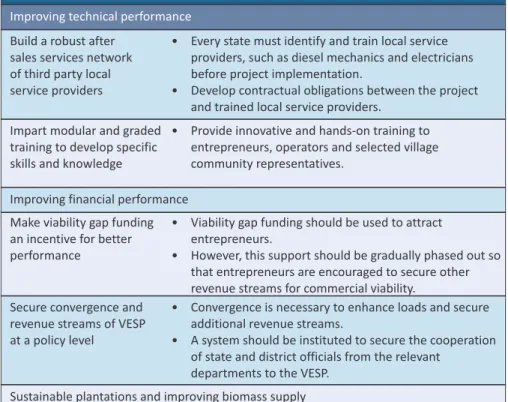
A World Bank study of the operations of VESP found that performance of VESP was largely mixed at the project level due to the following key reasons: the failure of the technology suppliers to provide prompt and reliable after sales services; inadequate training of local operators and non-payment of their salaries; lack of organized supply of fuel wood; and the lack of capacities and interest among the village communities to manage the day-to-day affairs of the power plant. The study also made the following recommendations for improving performance of VESP projects:
9
India: Biomass for Sustainable Development, Lessons for Decentralized Energy Delivery: Village Energy Security Programme, World Bank, 2010
MNRE (FUNDING) 90% CFA 10% by PIA/NGO or Bebeficiaries Power Plant OEM PIA Supply, Installation, Commissioning, AMC Rs Organize/From VEC System Engineering. System Qwner VEC • System custodian • O&M, line maintenance • Organize fuel supply • Project Management
VEC Mason
Fuel Supply & Tariff
Energy for cooking (IC & biogass) Consumers
(Dom & Com) Electricity
Consultant (DPR, system design, TA support)
Section 2
2.3 Implementation of DDG in India
Policy orientation towards DDG described in the preceding section is amply demonstrated by the DDG programmes that have been / are being implemented by the MoP and the MNRE.
Remote Village Electrification (RVE) programme is being implemented by the MNRE in remote areas that have a population of <100. The programme aims to cover 10,000 villages. While the guidelines state that the most adequate technology would be used, >95% of all RVE installations have been Solar Home Lighting systems (SHLS). The programme is being implemented in each state through the State Nodal Agency (SNA). The RVE provides 90% subsidy on capital costs which also includes the cost of a 5 year Annual Maintenance Contract.
Village Energy Security Programme (VESP) was implemented by MNRE and covered all unelectrified remote villages that had 50-100 Households. The overall goal of the Programme was to provide energy to the villages through locally available biomass resources with full participation and ownership of the community and ensure enhanced livelihoods and improved quality of life. The emphasis of the VESP was on energy security at the village level with a further thrust on micro-enterprise development for enhancing employment opport-unity and economic viability of the Programme projects.
Based on a community-centred approach (see Fig 4-3), the Programme provided a one-time grant (up to 90 percent of the investment cost) to a village community (only in remote villages that are unlikely to be connected with grid electricity) for providing energy systems capable of meeting local energy demands. The villagers were expected to provide an equity contribution either in cash or kind. The Programme included several biomass based energy technologies of which biomass gasifier systems was the dominant application. VESP also mandated raising and managing dedicated planta-tions as feedstock in biomass gasifiers.
Section 2
Figure 2.3 : VESP Institutional Model
MNRE=Ministry of New and Renewable Energy; OEM=original equipment manufacturer; DPR=detailed project report; TA=technical assistance; PIA=project implementing agency; VEC=village energy committee; O&M=operation and maintenance; IC=improved cookstoves
9
A World Bank study of the operations of VESP found that performance of VESP was largely mixed at the project level due to the following key reasons: the failure of the technology suppliers to provide prompt and reliable after sales services; inadequate training of local operators and non-payment of their salaries; lack of organized supply of fuel wood; and the lack of capacities and interest among the village communities to manage the day-to-day affairs of the power plant. The study also made the following recommendations for improving performance of VESP projects:
9
India: Biomass for Sustainable Development, Lessons for Decentralized Energy Delivery: Village Energy Security Programme, World Bank, 2010
MNRE (FUNDING) 90% CFA 10% by PIA/NGO or Bebeficiaries Power Plant OEM PIA Supply, Installation, Commissioning, AMC Rs Organize/From VEC System Engineering. System Qwner VEC • System custodian • O&M, line maintenance • Organize fuel supply • Project Management
VEC Mason
Fuel Supply & Tariff
Energy for cooking (IC & biogass) Consumers
(Dom & Com) Electricity
Consultant (DPR, system design, TA support)
Table 2.1: Lessons from VESP
Build a robust after sales services network of third party local service providers
• Every state must identify and train local service providers, such as diesel mechanics and electricians before project implementation.
• Develop contractual obligations between the project and trained local service providers.
Improving technical performance
Impart modular and graded training to develop specific skills and knowledge
• Provide innovative and hands-on training to entrepreneurs, operators and selected village community representatives.
Improving financial performance Make viability gap funding an incentive for better performance
• Viability gap funding should be used to attract entrepreneurs.
• However, this support should be gradually phased out so that entrepreneurs are encouraged to secure other revenue streams for commercial viability.
Secure convergence and revenue streams of VESP at a policy level
• Convergence is necessary to enhance loads and secure additional revenue streams.
• A system should be instituted to secure the cooperation of state and district officials from the relevant
departments to the VESP. Sustainable plantations and improving biomass supply
Monetize biomass supply • Voluntary contributions of biomass on a non-payment basis have not worked.
• Village level systems should be in place to provide a cash incentive to villagers who deliver biomass to the power plant.
Emphasize sustainable biomass plantations
• Every project should secure biomass supply by dedicated plantations on private and public lands, contracting with village forest committees and forest departments.
• At a policy level, central and state governments should promote incentives for biomass plantations in individual and community lands with assured buy-back and forge systematic and large-scale convergence with forest department programs.
Decentralized Distributed Generation (DDG) Scheme of the MoP is being
implemented under the RGGVY and tries to address several of the shortcomings found in the VESP. It is technology neutral and focuses only on providing electricity in remote villages (where grid would not be extended) with
100 or more households. The Project Implementing Agency could be SNAs/State Deptt./State Utilities/ Identified CPSUs. Ownership unlike other programmes will be vested with the state government. PIAs are expected to invite Project Developers (PD) to set up projects and run them for a period of 5 years and then hand them over to the state govt. PDs could be NGOs, Panchayaths, entrepreneurs, etc. Tariffs would be decided by the PIA and should not be lower than the grid tariff prevailing in adjoining areas. Although, the programme was launched in 2006-07, no significant progress has been recorded.
Jawaharlal Nehru National Solar Mission (JNNSM) is the latest programme of
MNRE which has a small component for off-grid generation through SPV technology. It provides capital subsidy of upto 30% and is being implemented through SNAs and Akshay Urja shops. The maximum capacity per site (for individual homes) is 100kWp and 250kWp for microgrid applications.
As can be seen from the preceding paragraphs, of the 4 programme that have
DDG as a key strategy for rural electrification, only one has biomass based DDGs as it dominant technology option, namely, VESP. Of the remaining, RGGVY-DDG is yet to progress while the other two are focused mainly on SPV lighting.
Further, all programmes have identified DDG for electrifying only remote,
inaccessible villages with small populations and as will be seen in the next section, tiny loads. The net result is that DDG has become restricted to “small-scale off-grid remote applicati-ons” as articulated in policy.
In contrast, many villages that have been electrified through grid extension
under RGGVY are yet to receive electricity supply because there is simply no power to supply! It is estimated that nearly 20,000MW of additional capacity
10
needs to be created to meet demand generated through RGGVY . DDG can be a potential solution!
Realignment of DDG policy to focus on tail-end generation will help to make
good use of the REDB (Rural Electricity Distribution Backbone) and the VEI (Village Electricity Infrastructure) that has been setup in RGGVY. In turn, this would unleash the potential for DDG and at the same time unpack the economic development of rural India which was the driving force for rolling out RGGVY.
10
Vidyasagar, K. (2007, July 15). Presentation: Universal Service Obligation in Rural Electrification - RGGVY. 14th Steering Committee Meeting, South Asia Forum for Infrastructure Regulation. New Delhi.
Section 2
Table 2.1: Lessons from VESP
Build a robust after sales services network of third party local service providers
• Every state must identify and train local service providers, such as diesel mechanics and electricians before project implementation.
• Develop contractual obligations between the project and trained local service providers.
Improving technical performance
Impart modular and graded training to develop specific skills and knowledge
• Provide innovative and hands-on training to entrepreneurs, operators and selected village community representatives.
Improving financial performance Make viability gap funding an incentive for better performance
• Viability gap funding should be used to attract entrepreneurs.
• However, this support should be gradually phased out so that entrepreneurs are encouraged to secure other revenue streams for commercial viability.
Secure convergence and revenue streams of VESP at a policy level
• Convergence is necessary to enhance loads and secure additional revenue streams.
• A system should be instituted to secure the cooperation of state and district officials from the relevant
departments to the VESP. Sustainable plantations and improving biomass supply
Monetize biomass supply • Voluntary contributions of biomass on a non-payment basis have not worked.
• Village level systems should be in place to provide a cash incentive to villagers who deliver biomass to the power plant.
Emphasize sustainable biomass plantations
• Every project should secure biomass supply by dedicated plantations on private and public lands, contracting with village forest committees and forest departments.
• At a policy level, central and state governments should promote incentives for biomass plantations in individual and community lands with assured buy-back and forge systematic and large-scale convergence with forest department programs.
Decentralized Distributed Generation (DDG) Scheme of the MoP is being
implemented under the RGGVY and tries to address several of the shortcomings found in the VESP. It is technology neutral and focuses only on providing electricity in remote villages (where grid would not be extended) with
Section 2
100 or more households. The Project Implementing Agency could be SNAs/State Deptt./State Utilities/ Identified CPSUs. Ownership unlike other programmes will be vested with the state government. PIAs are expected to invite Project Developers (PD) to set up projects and run them for a period of 5 years and then hand them over to the state govt. PDs could be NGOs, Panchayaths, entrepreneurs, etc. Tariffs would be decided by the PIA and should not be lower than the grid tariff prevailing in adjoining areas. Although, the programme was launched in 2006-07, no significant progress has been recorded.
Jawaharlal Nehru National Solar Mission (JNNSM) is the latest programme of
MNRE which has a small component for off-grid generation through SPV technology. It provides capital subsidy of upto 30% and is being implemented through SNAs and Akshay Urja shops. The maximum capacity per site (for individual homes) is 100kWp and 250kWp for microgrid applications.
As can be seen from the preceding paragraphs, of the 4 programme that have
DDG as a key strategy for rural electrification, only one has biomass based DDGs as it dominant technology option, namely, VESP. Of the remaining, RGGVY-DDG is yet to progress while the other two are focused mainly on SPV lighting.
Further, all programmes have identified DDG for electrifying only remote,
inaccessible villages with small populations and as will be seen in the next section, tiny loads. The net result is that DDG has become restricted to “small-scale off-grid remote applicati-ons” as articulated in policy.
In contrast, many villages that have been electrified through grid extension
under RGGVY are yet to receive electricity supply because there is simply no power to supply! It is estimated that nearly 20,000MW of additional capacity
10
needs to be created to meet demand generated through RGGVY . DDG can be a potential solution!
Realignment of DDG policy to focus on tail-end generation will help to make
good use of the REDB (Rural Electricity Distribution Backbone) and the VEI (Village Electricity Infrastructure) that has been setup in RGGVY. In turn, this would unleash the potential for DDG and at the same time unpack the economic development of rural India which was the driving force for rolling out RGGVY.
10
Vidyasagar, K. (2007, July 15). Presentation: Universal Service Obligation in Rural Electrification - RGGVY. 14th Steering Committee Meeting, South Asia Forum for Infrastructure Regulation. New Delhi.
Section 3
•
Commercial performance of
biomass-based DDGs
3 Description of sample
biomass-based DDGs selected for study
3 Performance analysis of sample
projects
n
Technical performance
n
Financial performance
n
Managerial performance
Section 3
•
Commercial performance of
biomass-based DDGs
3 Description of sample
biomass-based DDGs selected for study
3 Performance analysis of sample
projects
n
Technical performance
n
Financial performance
n
Managerial performance
3.1 Performance of Biomass DDG Projects in India
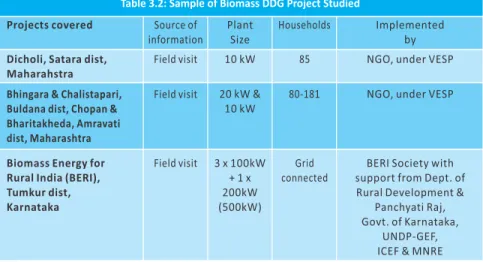
In the preceding sections we have seen how policy has restricted the scope for DDG. In this section we will look at biomass DDG projects in India and analyse their performance from an entrepreneurs/ commercial entities point of view. An entrepreneur takes risks in anticipation of adequate and attractive returns. Therefore, for entrepreneurs to invest their time and money in biomass DDG, the project must be attractive. Biomass DDG projects may be classified based on their location and connectivity to grid as shown in Table 3.1As a part of this study, the following projects were covered either through a field visit or through a review of secondary sources. Table 3.2 gives brief details of the sample chosen for study.
Grid Connected
Table 3.1: Classification of Biomass DDGs
DDG System Grid Area Off-Grid Area
Stand Alone
BERI Built for future gridconnectivity? Husk Power, Desi Power VESP Projects
Table 3.2: Sample of Biomass DDG Project Studied Projects covered Source of
information
Plant Size
Households Implemented by Dicholi, Satara dist,
Maharahstra
Field visit 10 kW 85 NGO, under VESP Bhingara & Chalistapari,
Buldana dist, Chopan & Bharitakheda, Amravati dist, Maharashtra
Field visit 20 kW & 10 kW
80-181 NGO, under VESP
Biomass Energy for Rural India (BERI), Tumkur dist, Karnataka Field visit 3 x 100kW + 1 x 200kW (500kW) Grid connected
BERI Society with support from Dept. of Rural Development &
Panchyati Raj, Govt. of Karnataka,
UNDP-GEF, ICEF & MNRE
3.1 Performance of Biomass DDG Projects in India
In the preceding sections we have seen how policy has restricted the scope for DDG. In this section we will look at biomass DDG projects in India and analyse their performance from an entrepreneurs/ commercial entities point of view. An entrepreneur takes risks in anticipation of adequate and attractive returns. Therefore, for entrepreneurs to invest their time and money in biomass DDG, the project must be attractive. Biomass DDG projects may be classified based on their location and connectivity to grid as shown in Table 3.1As a part of this study, the following projects were covered either through a field visit or through a review of secondary sources. Table 3.2 gives brief details of the sample chosen for study.
Grid Connected
Table 3.1: Classification of Biomass DDGs
DDG System Grid Area Off-Grid Area
Stand Alone
BERI Built for future gridconnectivity? Husk Power, Desi Power VESP Projects
Table 3.2: Sample of Biomass DDG Project Studied Projects covered Source of
information
Plant Size
Households Implemented by Dicholi, Satara dist,
Maharahstra
Field visit 10 kW 85 NGO, under VESP Bhingara & Chalistapari,
Buldana dist, Chopan & Bharitakheda, Amravati dist, Maharashtra
Field visit 20 kW & 10 kW
80-181 NGO, under VESP
Biomass Energy for Rural India (BERI), Tumkur dist, Karnataka Field visit 3 x 100kW + 1 x 200kW (500kW) Grid connected
BERI Society with support from Dept. of Rural Development &
Panchyati Raj, Govt. of Karnataka,
UNDP-GEF, ICEF & MNRE
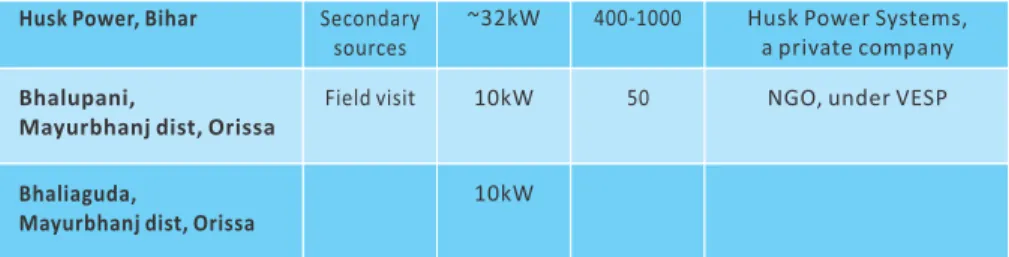
Husk Power, Bihar Secondary sources
~32kW 400-1000 Husk Power Systems, a private company Bhalupani,
Mayurbhanj dist, Orissa
Field visit 10kW 50 NGO, under VESP
Bhaliaguda,
Mayurbhanj dist, Orissa
10kW
The sample covers all categories of DDG projects mentioned in Table 4.1 except projects built for future grid connectivity in currently off-grid areas and thus is fairly representative of the current biomass DDG scenario in India.
3.2 Location of the Projects Analyzed
Remoteness and inaccessibility arekey site characteristics of a typical VESP project. Often, more than the distance from the nearest grid-connected village, it is the sheer physical remoten-ess due to huge geographical hurdles that has left these villages bereft of even simple infra structural services that can vastly improve the quality of their lives, if not, their economic status. The projects represen-ted a wide range of terrain: from deep dense forests (as in Bhalupani, Chopan & Bharita-kheda), to an island (as in Dicholi) and to inaccessible hill tops (as in Bhingara & Chalistapari). Thus, t h e s e p r o j e c t s a r e f a i r l y representative of what a typical VESP project is all about. This is what the World Bank report on VESP had to say about the difficulties of a VESP project:
Figure 3.1: Dicholi-Remot-eness, I n a c c e s s i b i l i t y & C o m m i t m e nt Defined
Dicholi is located in the backwa-ters of the Koyna dam. Ironically, while the dam produces electricity in thousands of mega watts, Dicholi does not receive any since it is an island and it is expensive to draw the grid across 10–15 km of water. Added to this, the village is situated on a hill, the way to which is through a dense forest and up a steep slope. Thus, the only way to reach the villages is by an hour-and-a-half motorboat ride followed by a steep climb of about 45–60 minutes. In Dicholi, when the gasifier engine arrived at Koyna town, the local community had to help the supplier to disassemble the engine and take it by boat to the boat jetty at Dicholi, from where each part was carried as a head load up the hill or slung from bamboo poles and carried on the shoulders of teams of 10–20 persons.
“All these villages become completely inaccessible during the monsoons when roads turn into slushy stretches and the only way to reach a village is on foot, that too when the weather permits. The degree of difficulty in installing, operating and servicing a biomass-based power plant in such locations can easily be visualized. Therefore, it needs fierce commitment,
11
great ingenuity and persistence to implement a VESP project.”
In contrast, both Husk Power Projects and the BERI are located in more easily accessi-ble location with none of the difficulties associated with VESP projects that are imposed due to terrain. BERI is located in Kabbiere village of Tumkur district about 120km from Bengaluru and is a connected to the 11kv grid line that comes from a substation that is about 5 km away. Thus, as long as the grid line is functional, the BERI project can pump power into it and is in turn purchased by the local ESCOM through a Power Purchase Agreement.
Husk Power Systems works mainly in Bihar and parts of Uttar Pradesh. It installs a 32kW gasifier based power system that works on rice husk. It is a standalone system that lays its own distribution lines and does not interact with the grid. It sells power to domestic and commercial (shops, petty businesses) customers.
3.3 Technical Performance of Biomass DDG Projects
3.3.1 UptimeRemoteness and inaccessibility are key site characteristics of a typical VESP project.
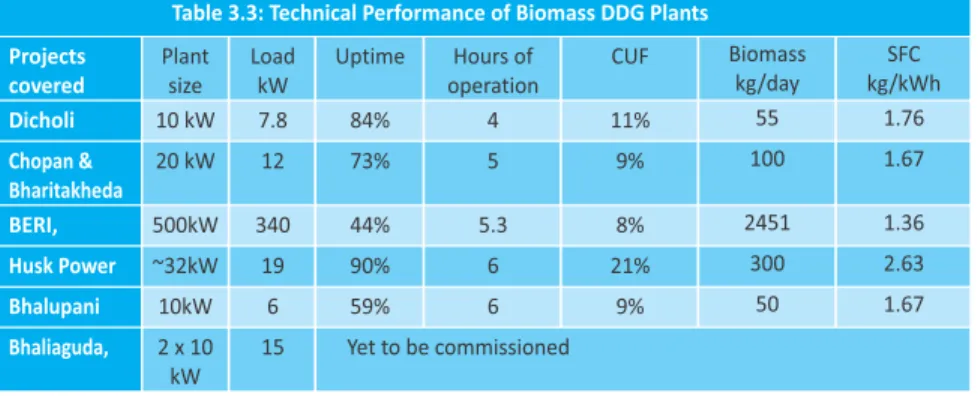
A key question to measure technical performance is, “Did the project supply the electricity that it was designed to supply? If yes, to what extent? ” This is measured by “Uptime” which is defined as:
11 Ibid 6
Uptime for the electricity generating system: This is the number of units of power actually supplied during a period of operation compared to the number of units estimated to be supplied in the village energy plan. This ratio is expressed as a percentage and is called 'uptime.
No. of units of power actually supplied in a period
Uptime = x 100 No. of units of power that the plant designed to supply during that period
Section 3
Husk Power, Bihar Secondary sources
~32kW 400-1000 Husk Power Systems, a private company Bhalupani,
Mayurbhanj dist, Orissa
Field visit 10kW 50 NGO, under VESP
Bhaliaguda,
Mayurbhanj dist, Orissa
10kW
The sample covers all categories of DDG projects mentioned in Table 4.1 except projects built for future grid connectivity in currently off-grid areas and thus is fairly representative of the current biomass DDG scenario in India.
3.2 Location of the Projects Analyzed
Remoteness and inaccessibility arekey site characteristics of a typical VESP project. Often, more than the distance from the nearest grid-connected village, it is the sheer physical remoten-ess due to huge geographical hurdles that has left these villages bereft of even simple infra structural services that can vastly improve the quality of their lives, if not, their economic status. The projects represen-ted a wide range of terrain: from deep dense forests (as in Bhalupani, Chopan & Bharita-kheda), to an island (as in Dicholi) and to inaccessible hill tops (as in Bhingara & Chalistapari). Thus, t h e s e p r o j e c t s a r e f a i r l y representative of what a typical VESP project is all about. This is what the World Bank report on VESP had to say about the difficulties of a VESP project:
Figure 3.1: Dicholi-Remot-eness, I n a c c e s s i b i l i t y & C o m m i t m e nt Defined
Dicholi is located in the backwa-ters of the Koyna dam. Ironically, while the dam produces electricity in thousands of mega watts, Dicholi does not receive any since it is an island and it is expensive to draw the grid across 10–15 km of water. Added to this, the village is situated on a hill, the way to which is through a dense forest and up a steep slope. Thus, the only way to reach the villages is by an hour-and-a-half motorboat ride followed by a steep climb of about 45–60 minutes. In Dicholi, when the gasifier engine arrived at Koyna town, the local community had to help the supplier to disassemble the engine and take it by boat to the boat jetty at Dicholi, from where each part was carried as a head load up the hill or slung from bamboo poles and carried on the shoulders of teams of 10–20 persons.
Section 3
“All these villages become completely inaccessible during the monsoons when roads turn into slushy stretches and the only way to reach a village is on foot, that too when the weather permits. The degree of difficulty in installing, operating and servicing a biomass-based power plant in such locations can easily be visualized. Therefore, it needs fierce commitment,
11
great ingenuity and persistence to implement a VESP project.”
In contrast, both Husk Power Projects and the BERI are located in more easily accessi-ble location with none of the difficulties associated with VESP projects that are imposed due to terrain. BERI is located in Kabbiere village of Tumkur district about 120km from Bengaluru and is a connected to the 11kv grid line that comes from a substation that is about 5 km away. Thus, as long as the grid line is functional, the BERI project can pump power into it and is in turn purchased by the local ESCOM through a Power Purchase Agreement.
Husk Power Systems works mainly in Bihar and parts of Uttar Pradesh. It installs a 32kW gasifier based power system that works on rice husk. It is a standalone system that lays its own distribution lines and does not interact with the grid. It sells power to domestic and commercial (shops, petty businesses) customers.
3.3 Technical Performance of Biomass DDG Projects
3.3.1 UptimeRemoteness and inaccessibility are key site characteristics of a typical VESP project.
A key question to measure technical performance is, “Did the project supply the electricity that it was designed to supply? If yes, to what extent? ” This is measured by “Uptime” which is defined as:
11 Ibid 6
Uptime for the electricity generating system: This is the number of units of power actually supplied during a period of operation compared to the number of units estimated to be supplied in the village energy plan. This ratio is expressed as a percentage and is called 'uptime.
No. of units of power actually supplied in a period
Uptime = x 100 No. of units of power that the plant designed to supply during that period