HAL Id: hal-02595023
https://hal.inrae.fr/hal-02595023
Submitted on 15 May 2020
HAL is a multi-disciplinary open access archive for the deposit and dissemination of sci-entific research documents, whether they are pub-lished or not. The documents may come from teaching and research institutions in France or abroad, or from public or private research centers.
L’archive ouverte pluridisciplinaire HAL, est destinée au dépôt et à la diffusion de documents scientifiques de niveau recherche, publiés ou non, émanant des établissements d’enseignement et de recherche français ou étrangers, des laboratoires publics ou privés.
Waste heat recovery potential analysis of tractor Diesel
engines
F. Baldi
To cite this version:
F. Baldi. Waste heat recovery potential analysis of tractor Diesel engines. Environmental Sciences. 2011. �hal-02595023�
FACOLTA’ DI INGEGNERIA
CORSO DI LAUREA SPECIALISTICA IN
INGEGNERIA ENERGETICA
DIEM
TESI DI LAUREA
in
Impiego Industriale dell'Energia e Cogenerazione LS
Waste heat recovery potential
analysis of tractor Diesel engines
CANDIDATO
RELATORE
Francesco Baldi
Chiar.mo Prof.
Michele Bianchi
CORRELATORE/CORRELATORI
Stéphanie Lacour
Anno Accademico 2009/10
Sessione III
CemOA : archive ouverte d'Irstea / CemagrefAbstract
Ce m OA : a rc hi ve o uv ert e d'I rs te a / C e ma gr efModerndieselenginesusedforagriculturalapplicationshavepeakbrake thermalefficienciesintherangeof40-42%forhigh-loadoperation with substantiallylowerefficienciesatroad-loadconditions. Someenergyand exergyanalysiscanbefoundinliteraturerevealingthatthelargestlosses fromtheseenginesareduetoheatlossandcombustionirreversibility,and anyimprovementinengineefficiencyrequiresreducingorrecoveringthese losses. Unfortunately, muchoftheenergylossese itheroccursatlowtem-peraturesresultinginlargeentropygeneration(suchasintheradiator),are transferredtolow-temperature ows(suchastheoilandenginecoolant),or aredirectlywastedtoenvironmentthroughradiationorconvection. While theopportunityofrecoveringpartoftheselossesforheavy-dutyapplications havealreadybeendemonstrated,thepotentialeffic iencyimprovementsde-rivingfromsuchastrategyforlight-dutyDieselapplicationsareunknown becauseoftransientoperation,thelowthermalqualityofexhaustgases attypicaldrivingconditions,andtheencumbranceoftheaddedrecovery system. Wehaveusedanexperimentalsetuptoperformaseriesoftestsin ordertoinvestigatethepotentialforeffic iencyimprovementthroughwaste-heatrecoveryfromtheexhaustgasandtheengineoilofatractor Diesel engine. Resultsfromsteady-stateandtransienttestsarepresented,andthe issuesconcerningwasteheatrecoverypotentialanditstransientbehavior arediscussedforbothengineoilandexhaustgas. Anadditionalexper i-mentalsetup,consistingoftwoheatexchangersplacedrespectivelyonthe engineoilandexhaustgas,allowedto makesomere ectionsaboutissues concerningtheheatexchange,itsinertia,anditsin uenceovertransient operations.
It would be impossible to cite here every single person who gave a contri-bution for me to have reached this far. Nevertheless, there are some people I would like to thank because of their special role in this speci c phase of my career.
First of all I would like to thank Stephanie Lacour, my tutor at Cema-gref, who have always been available to clarify my doubts, to discuss every problem and, most of all, who has always listened to what I told her and considered my opinion and my re ections as if they were made by a col-league. There is no doubt that I would not have achieved to complete this work without her.
A special thank is needed to M.George Descombes and M.Michele Bianchi. They have positively reacted to my strong desire to participate to this project, and they have always been available for anything I needed for the possibility to study in France and spend my energies on this work.
Marc Hocquel and Cristophe Burgun have had a special role in my work too. They helped me in every single moment, they give me all the information I needed and followed my work and my mistakes with patience. One of the main features of my experience is the technical part, and it is thanks to them that I could not get lost in something in which I had no experience at all.
Thanks a lot to Romain, Wided, Sylvain, Alice, Heloise, Florian, Simon, Alexandre, Morgane, Edoard, Lama, Samia, Fabien, Lela, Fran ~A§ois, Mi-cael, Salem, Alfred, Fran, Olivier, Jean-Marie, Maurice, Sonia, Joel, Nadjat, and everybody is missing. Six months are a long time, and it is thanks to them if I have been able to go through all the little crisis everybody expe-rience during a research project.
CemOA
: archive
ouverte
d'Irstea
A big, enormous thanks to all my friends. It is not possible to cite them all, but each of them, from the nearest to the farthest, played his role, gave me his contribution.
A nal, special thanks to my parents. I hope they will understand my need of nding my way through the impervious adult life.
CemOA
: archive
ouverte
d'Irstea
CemOA
: archive
Contents
1 Waste heat recovery for Diesel engines 1
1.1 Introduction . . . 1
1.2 Diesel engine . . . 2
1.3 Waste heat recovery . . . 3
1.4 Speci c features of agricultural applications . . . 5
1.5 In uence of heat exchange properties on recovery potential . . . 7
2 Exergy 9 2.1 First and second law of thermodynamics . . . 9
2.1.1 First law of thermodynamics: energy e ciency . . . 9
2.1.2 Second law of thermodynamics: entropy . . . 11
2.2 Combining First and second law together: exergy . . . 13
2.2.1 Exergy de nition . . . 13
2.2.2 Maximum work potential: connection between energy and Carnot cycle . . . 15
2.2.3 Entropic temperature . . . 17
2.3 Exergy analysis . . . 21
2.3.1 Limits to exergy use . . . 21
2.3.2 Exergy analysis domains . . . 23
2.3.3 Exergy analysis for Waste Heat Recovery . . . 24
3 Testing equipment 27 3.1 Tractor . . . 31 3.2 Sensors . . . 32 3.3 Heat exchangers . . . 33 CemOA : archive ouverte d'Irstea / Cemagref
3.3.1 Exhaust gas . . . 33
3.3.2 Engine oil . . . 35
4 Discussion 41 4.1 Steady state tests . . . 41
4.1.1 OCDE protocol . . . 42
4.1.2 ISO 8178 protocol . . . 42
4.2 Experimental measurements . . . 45
4.2.1 Exhaust gas experiments . . . 45
4.2.1.1 Temperature . . . 45
4.2.1.2 Mass ow . . . 46
4.2.2 Engine oil experiments . . . 46
4.2.2.1 Temperature . . . 46
4.2.2.2 Volumetric ow . . . 48
4.3 Steady state exergy potential evaluation . . . 48
4.3.1 Exhaust gas . . . 48
4.3.2 Engine oil . . . 54
4.4 Transient tests . . . 58
4.4.1 Exhaust gas . . . 61
4.4.2 Engine oil . . . 65
4.4.3 Test bench accuracy . . . 68
4.5 In uence of heat exchange properties on recovery potential . . . 72
4.5.1 Heat exchange exergy analysis . . . 72
4.5.2 Hot side . . . 73
4.5.3 Cold side . . . 75
5 Conclusions 79 6 Perspectives 81 6.1 Engine oil temperature evolution: engine thermal model . . . 81
6.2 Thermal exchange . . . 84
A Coefficients and parameters 85
B Results 87 CemOA : archive ouverte d'Irstea / Cemagref
CONTENTS
C Exhaust gas composition approximation 91
D Measurement accuracy 95
D.1 Temperatures . . . 95 D.2 Exhaust gas mass ow . . . 97
References 101 CemOA : archive ouverte d'Irstea / Cemagref
CemOA
: archive
ouverte
d'Irstea
1
Waste heat recovery for Diesel
engines
1.1
Introduction
Climate changing due to greenhouse e ect and pollution, both caused by human activi-ties, are subjects that concern the human kind more and more. The agricultural sector is responsible of a wide variety of emissions causing environmental problems: CITEPA report (3) pointed out that 14.2% of nitrogen oxides, 14.5% of VOCs (Volatile Organic Compounds) and 50.3% of PM10 are connected to agricultural activities, and in par-ticular to agricultural machinery. Greenhouse e ect emissions of CO2 have also to be
taken into account: this contribution, even if small (2.8%), has been growing over the entire 20th century and has raised up by 167% since 19601.
However, environmental concerns are not the only reason for which further research on Diesel engines for agricultural machinery is needed. The raise in oil prices, for example, is directly connected to petrol and Diesel fuel cost to consumers: as gure 1.1 shows, oil price can change dramatically in a phew years because of political and economical circumstances, and its tendency has been constantly increasing since 1998. It is clear that, if prices are not going down in a phew years, fuel consumption too will become a major economic output in the economic balance of agricultural activities.
1
Unfortunately, a part from the case of N Ox (62%), CITEPA report do not specify in what part
Diesel engines are responsible of these emissions. Still, chosen data refers to the typical pollution coming
from agricultural machinery. In the case of greenhouse emissions, in fact, only CO2 was brought as
example, since the largest contribution (methane emissions) almost entirely comes from husbandry
CemOA
: archive
ouverte
d'Irstea
Figure 1.1: Oil prices tendance during recent history: in blue the o cial price, in orange the price updated with reference to in ation (1)
These facts drive to increase e orts toward pollutant emissions and fuel consump-tion reducconsump-tion for agricultural machinery. Polluconsump-tion-based issues can be solved by the use of technological solutions specially conceived to reduce emissions, such as N Ox
catalyzed or non catalyzed reactors (SCR or SNCR), or lters for particulate matter. However, both pollution and fuel consumption can be reduced by increasing energetic performances of agricultural machineries, in particular with respect to Diesel engines.
1.2
Diesel engine
Invented at the end of XIXth century by Rudolf Diesel, a German engineer, the Diesel engine is an internal combustion engine.
Fuel ignition is the main feature distinguishing it from its petrol-fueled \brother". Diesel engines, in fact, make use of a compression ignition rather than a spark one. In a gasoline-engine, air and fuel enter the cylinder together during the intake stroke. This prevent a large increase in pression, since high temperatures attained in the cylinder would cause fuel auto-ignition, thus leading to incomplete combustion. In Diesel en-gines, instead, air enters the cylinder alone during intake stroke, which means that no matter what pressure is attained during compression, there will not be auto-ignition. This leads to the possibility to attain much higher pressures, which directly implies a higher e ciency. Fuel is injected when the compression phase has almost completed and the air has attained a temperatures of about 700-900°C, enabling fuel to go through a rapid vaporisation followed by an almost instant combustion. The possibility of de-creasing vaporisation time and enhancing air-fuel mixing in combustion chamber have
CemOA
: archive
ouverte
d'Irstea
1.3 Waste heat recovery
been, since Diesel engine invention, the most researched elds, and results of engineers e orts led to a large increase in Diesel performances.
As said, Diesel engine has a higher e ciency than its gasoline brother, even using a lower quality fuel. However, higher pressures imply a thicker structure and, as a consequence, heavier components and lower rotating speed. These features, typical of old Diesel engines, restricted their use rst to marine and railway applications, and than to large vehicles such as trucks and tractors. Furthermore, pollution connected to particulate matter emissions caused by incomplete combustion has always been a primary issue for Diesel engines, and its solution is coming to light only in last years.
Turbocharger is maybe the most important innovation in Diesel engine technology. It consists of a gas turbine recovering exhaust gas thermal and pressure energy content, and of a compressor bringing inlet air to a higher pressure level, thus increasing engine power{to{weight ratio. This invention, together with the increase in atomisation in fuel injection, allowed a strong enhancement in Diesel engine performances. Engine weight reduction and a faster response to user’s instructions thus allowed to spread its application to the enormous market of private cars.
1.3
Waste heat recovery
Still, Diesel engine is far from perfection. Researchers are still working hard in order to increase its performances.
In the context of the reduction of fuel consumption, waste heat recovery (WHR) is considered to be a possible strategy to achieve this result.
The second principle of thermodynamics states that every engine or thermodynamic cycle converting the thermal energy of a heat source into work must waste a certain amount of heat to its environment. Once the hot source and the renvironment tem-peratures are xed, the Carnot e ciency allows to estimate the maximum fraction of work that can be extracted from a given quantity of heat.
However, nowadays, engines and, more generally, devices for energy conversion performances are far away from Carnot e ciency. This means that, very simply, a lot of the available heat that could be converted into useful work is instead wasted.
In a Diesel engine there are several sources of waste heat: exhaust gases, engine oil, transmission uid, cooling water, intercooler, EGR, etc; several authors, such as
CemOA
: archive
ouverte
d'Irstea
Bourhis et al. (4), Edwards et al.(2), Junhong et al. (5), Gopal et al. (6), Srinisvan et al. (7), have already studied the possibilty of recovering a part of the wasted heat, concluding that WHR for Diesel engines is a possibility that is worthed for further inspection.
Before starting the project of a WHR system it is important to estimate the recovery potential of each of the available sources, in order to understand if some of them are more energetically and economically convenient to be exploited than others. But before starting with measures and calculations, a small summary should be made about the WHR sources that are to be taken into account.
Exhaust gas is normally the most valuable source of waste heat. In a Diesel engine combustion takes place inside the cylinder, and energy released pushes the piston up to the end of the cylinder. When the engine movement pulls back the piston, reducing combustion chamber dimensions, it drives exhaust gas through the exhaust valve out of the cylinder.
In a basic Diesel engine, the gas runs directly toward the exit of the exhaust pipe. However, in modern applications, a phew systems can be placed between the cylinder and the exit, such as pollution-reducing equipments. Anyway, no matter what is placed before its exit (in conventional engines), exhaust gas is still far from a state of thermal and mechanical equilibrium with environment, which means that a certain quantity of its energy content could still be recovered.
Exhaust gas outlet temperature, pressure and mass ow can widely change as a function of engine type, equipments and load factor. Just as a general consideration, the higher the engine e ciency, the lower its exhaust gas temperature.
As well as every industrial and technological applications, Diesel engines are pro-vided with several secondary system, whose nature and properties depend on engine type. However, for what concern this study, every Diesel engine is provided with a lubricating oil circuit.1
Engine oil is stocked in a vessel called \carter", placed under the engine. A pump takes the oil from the carter and drives it throughout a circuit eventually spraying it over moving parts, in order to lubricate and cool them. Engine oil temperature can
1
In standard applications, cooling liquid is not pure water but a mix of water and glycol, the objective of the latter addition being to give antifreeze capabilities to the fluid. However, from now, water-glycol mixture will be referred to simply as water
CemOA
: archive
ouverte
d'Irstea
1.4 Specific features of agricultural applications
reach very di erent values depending on engine type and operation, but generally it does not exceed 130°C, while its normal temperature stays around 110°C at full load operations. Oil cooling is assured by a heat exchanger placed on the water circuit.
1.4
Specific features of agricultural applications
As every technical application, Diesel engines for agricultural machinery have their own typical features, which have to be well known in order to understand the issues they are connected to.
The most typical feature of a tractor is the fact that, in several applications, power consumption is not strictly related to tractor displacement. During working operation, in fact, most of power absorption is related to the working equipment pulled by the tractor. This is possible thanks to a second shaft, directly connected to the engine and coaxial with tractor shaft, that transfers mechanical energy from the engine to the agricultural equipment. The two shaft movements are normally independent, which means that it is possible for the tractor to move while the equipment is not working, as well as the latter to do his job while the tractor is not moving. The shaft connection between the tractor and its equipment is generally placed beside the vehicle and it is called \power take-o " (PTO).
This feature is important in order to understand engine’s transient behavior. One of tractors speci c features is, in fact, their particular kind of transient opera-tions. Tractors are generally used alternatively for two di erent goals, each having its speci c features:
On the eld, for pulling and giving energy to agricultural equipments On the road or on the eld, for transporting goods
The main di erence lays clearly in load factor variation with time. In fact, normal operations of agricultural machines on the eld involve a periodical variation for engine load:
Full-load operation, when tractor is moving with its equipment working
Partial-load operation, typically in maneuvering operations, when equipment is not working CemOA : archive ouverte d'Irstea / Cemagref
Figure 1.2: Sample of load factor evolution over a simulated on- eld operation cycle
This is schematically shown in gure 1.2. However, this representation is not com-pletely veritable. In fact, even if full load conditions are well represented by a constant-load behavior, the same cannot be said for maneuvering operations, where evidence is shown of a very unsteady and unpredictable behavior. Concerning road transportation instead, load behavior is much more variable, more similar to that of cars. For such cases an example of engine speed changing with time, taken from Edwards’ paper (2), is shown in gure 1.3
Figure 1.3: Vehicle speed over a simulated warm UDDS drive cycle (2)
The two di erent components of standard real-life operations can mix in very dif-ferent ways, depending on several variables such as eld dimensions, kind of crop, and many more.
These features make agricultural machines behavior in transient operation very dif-ferent from other applications employing Diesel engines, such as cars, trucks, ships and trains. This reasoning leads to the idea driving this study; Diesel steady-state behavior
CemOA
: archive
ouverte
d'Irstea
1.5 Influence of heat exchange properties on recovery potential
do not change dramatically between di erent applications, being mainly related to some general features that could normally make possible to compare car, truck and tractor engines. The typical features in real-life operations are what really makes the di erence, involving variable load conditions and a strong in uence of transient behavior
It is therefore important to know what is the transients impact on WHR potential, in order to make a correct choice of all system parameters1.
1.5
Influence of heat exchange properties on recovery
po-tential
Heat recovery potential has been de ned, until now, as the energy content of some sources of heat dispersion to the environment for an engine. However, even if the technological side of this matter has still to be treated, there is one rst and important issue that need to be considered in order to give a correct evaluation of the real recovery potential of a heat source. Most of WHR strategies in fact need to transfer the energy content of a heat source to a new uid, speci cally meant for working in a recovery cycle. The matter of waste heat recovery is therefore directly connected to the subject of heat exchange properties of di erent uids and materials.
In the case of WHR recovery for a Diesel engine, this matter comes strongly to the point. It is well known in fact (and it will be proved in the following chapters of this work) that exhaust gas is the most valuable source of waste energy, both for quality and quantity, and its high temperature makes it a much stronger candidate than engine oil for waste heat recovery2. However, it is likewise well known that heat transfer properties are not the same for liquid and gas ows, the latter having a much lower attitude in heat exchanging. Exhaust gas, therefore, generally require higher exchange surfaces in order to recovery their energy content.
This reasoning lead to the need of studying the subject of heat exchange with deeper interest. In static applications, in fact, the only constraint is generally related to economic-related issues, since the larger the heat exchanger the more expensive it
1a strong influence of transient duration could, for example, be solved using a high thermal capacity
fluid for an intermediary cycle in order to increase system inertia
2As will be further explained in the following chapter, in fact, higher temperatures directly lead to
a higher potential in work production
CemOA
: archive
ouverte
d'Irstea
is.1 For moving applications, instead, other issues become important, mainly related
to exchanger’s weight and size. On a vehicle, in fact, room available is limited, and increasing the total weight has a direct in uence on its performances.
This is why two heat exchangers (whose features will better described further ahead) have been inserted, the hot ow being either the engine oil or the exhaust gas circuits, and the cold ow being water coming from aqueduct. For both of them the surface and the main features of the exchanger were kept, in order to limit the analysis to each ow heat exchange properties. Measuring the temperature di erence over the heat exchanger and the mass ow on both sides allows to have an experimental knowledge of heat exchange properties of both exhaust gas and engine oil, thus being able to insert these data to the rest of the analysis.
1
This is a general statement that largely simplifies the complex subject of heat exchanger choice. Lots of other parameters, such as the need of a pumping system, the attitude of fouling and, in general, lowering heat exchange properties with use, and many more, have an influence on the choice and the price of a heat exchanger
CemOA
: archive
ouverte
d'Irstea
2
Exergy
2.1
First and second law of thermodynamics
2.1.1 First law of thermodynamics: energy efficiency
Since their rst invention, systems for energy conversion have gone through an enor-mous growth in their use across all the industrialized countries. From steam engines to modern gas turbines, the possibility to produce useful work by burning speci c sub-stances has dramatically spread, both in terms of quantity and variety of applications. This discovery is among the basis of the modern society in which we all live.
Nevertheless, especially during last years, an increasing concern regarding climate changes, fossil fuel depletion, and, in general, sustainable development, led to spend more and more resources in order to improve these systems energy performances, thus cutting down their fuel consumption.
Historically, energy analysis has always been the most used strategy for estimating engines performances. It leads to the energy e ciency, a value that allows to estimate the amount of useful energy produced by a system compared to its primary energy consumption.
Energy analysis comes from a balance between inlet and outlet energy ow in a well-de ned system. The rst law of thermodynamics says in fact that energy cannot be created or destructed, but only exchanged or transformed. The following is an example of a balance equation for an open system:
(ep+ ek+ h)im_i+ (ep+ ek+ h)om_o+ X j _ Qj− _W = 0 (2.1) CemOA : archive ouverte d'Irstea / Cemagref
where ep is gravity potential energy, ek is kinetic energy end h is enthalpy1 2.
A rst possible de nition for energy e ciency can be obtained by considering every inlet quantity as an energy source (putting them at denominator) and every outlet quantity as an energy product (putting them at numerator). We can in this case get to the following equation:
ηen=
_
W + (ep+ ek+ h)om_o
(ep+ ek+ h)im_i+PjQ_j
(2.2)
In most part of technical applications for energy production, though, these hypoth-esis can be made:
Mechanical work is the only useful product. In most of application, in fact, the outlet ow has only a small amount of energy left, it is just rejected to the environment. and it is not considered to be a useful product3
Variations in gravity potential energy and kinetic energy can normally be ne-glected4
The system is supposed to be adiabatic, since this is often a good approximation that allows to simplify calculations
These hypothesis lead to the following expression for energy e ciency: ηen=
_ W him_i
(2.3) Equation 2.3 is used when a system is being considered in his integrity, where the inlet ow is a uid with high energy potential, such as a fuel or hot steam. However, if we want to focus on cycle e ciency and there is no need to give a de nition of the
1Every thermodynamic property mentioned above is written in minuscule letters in order to
repre-sent specific properties, as conventionally used
2
In this equation the thermodynamic convention was adopted by considering as positive quantities the work produced by the system and the heat received by the system
3
This is the case, for exemple, of exhaust gas of internal combustion engines, where combustion products leaving the cylinders are of no use and rejected in atmosphere. Some particular engines, such as plane gas turbine, do not match with this statement since, in this case, the exhaust gas kinetic energy is the useful product
4They become relevant only in some specific applications, such as in hydraulic turbines or in
turbo-gas jet engines
CemOA
: archive
ouverte
d'Irstea
2.1 First and second law of thermodynamics
heat source, a generic energy inlet (usually in the form of heat) can be considered. In this case energy e ciency is given by:
ηen= _ W _ Q1 (2.4) where _Q1 is the amount of heat pumped into the system per time unit.
Finally, energy e ciency gives very valuable information, quantifying what part of available energy can be transformed into useful energy 1.
2.1.2 Second law of thermodynamics: entropy
The energy analysis is interesting but, often, incomplete. The rst law of thermody-namics gives in fact information about quantities in energy exchanges, but does not show in which direction they naturally take place. As Mago says, \thermodynamics explain us that different kinds of energy are not the same"(9). This statement drives to look for other means to more e ectively evaluate energy systems performances. What is really needed, in fact, is a way for taking into account of the di erence in quality between di erent energy forms.
As said before, in fact, energy cannot be neither created nor destructed, but it can be exchanged and transformed among its di erent forms. For example, it is possible to get work from potential energy through an hydraulic turbine, or to have thermal energy from kinetic energy through a fan, etc.; it is only necessary to use the correct conversion system.
However, a form of energy exist that is di erent from others: thermal energy. Like every other form of energy, such as mechanical, kinetic, electric etc., thermal energy can be associated, at microscopic level, to particles movement. But unlike any other form, thermal energy movement is disorganized.
Thus, transforming thermal energy into any other energy form means converting a disorganized movement into an organized one (that is what take place, for exam-ple, in a turbine). This process lead to signi cant losses, that are directly connected
1Generally speaking, the most correct way to write the equation for energy efficiency is to put at
numerator what is considered to be a valuable product, and at denominator what is considered to be a valuable resource. Lior (8) makes reference to a more specific definition, where he considers as a product everything that has an economic value and as a resource everything which has to by paid for. However, this definition is very useful for an economic estimation of a system, but do not give enough information when we are interested in thermodynamic performances
CemOA
: archive
ouverte
d'Irstea
to the conversion process, which means that there is no way to get rid of them. A 100% conversion from thermal energy to, for example, mechanical energy is simply not achievable, even with ideal reversible engines.
This feature of thermal energy is resumed by the second law of thermodynamics; the Kelvin statement says that \No process is possible in which the sole result is the absorption of heat from a reservoir and its complete conversion into work ".1.
The equation de ning the second law involves the use of a new thermodynamic property: entropy, which is a measure of disorder at molecular level in a system:
dS =X
j
δQj
Tj
+ δS (2.5)
It is easy to notice that entropy, unlike energy, is not conserved. Every process leads to a creation of entropy (that is an increase in disorder of the system) that can be equal to 0 in the best and ideal case of reversible processes. This can lead to other statements of the second law, which say that \in an isolated system entropy can only increase" or, more dramatically \entropy of universe is increasing".
As can be seen in equation 2.5, entropy is a quantity strictly connected to heat exchanges. There are no modi cations in entropy when heat is not involved. Work, for example, involves only an organized particle movement, that as no in uence on the disorder of a system and, consequently, on its entropy.
The second law of thermodynamics establish a di erence in quality between thermal energy and other energy forms, explaining why some processes can take place naturally while others cannot. Temperature is the thermodynamic property of matter that is of particular interest in this context. It measures thermal equilibrium, that is the ability to determine which of two or more systems will experience an increase in disorder level if they come to the condition of being able to exchange energy.
Being capable to e ectively use entropy could be very helpful in energy system analysis, since it is able to quantify the irreversible e ects causing e ciency losses. However, entropy concept is quite di cult to manipulate in practical applications, since it is a rather abstract property and, what is more important, it is not directly connected to energy, that is actually what interest us the most.
1
The other original statement, the Clausius one, says that “No process is possible whose sole result is the transfer of heat from a body of lower temperature to a body of higher temperature”. The equivalence of the two statement can be demonstrated(10). In this study the Kelvin statement was chosen because it is directly related to the subject
CemOA
: archive
ouverte
d'Irstea
2.2 Combining First and second law together: exergy
2.2
Combining First and second law together: exergy
2.2.1 Exergy definition
In previous paragraphs, the two laws of thermodynamics have been introduced. Their content can be summarized as following:
The rst law says that \You can’t get something for nothing (11) (Conservation of energy)
The second law says that \You can’t even get all you pay for (11) (Entropy creation)
A question arises: if you cannot get all you pay for, how much can you actually get?
What we are looking for is a thermodynamic property, such as entropy or enthalpy, allowing to estimate the potential to produce work from a given quantity of energy in the light of the second law.
This property is called exergy, de ned as \The maximum theoretical work that can be extracted from a given entity when it is brought to equilibrium with its environment " One of most important exergy features that arises from this de nition is that the exergy content of a certain entity is not only connected to entity itself, but also to its environment. In his paper about exergy, Scott (12) gives a very simple but clear example: taking a cylinder full of air at atmospheric pressure and putting it anywhere on earth, its exergy content will be equal to 0. But if the same cylinder is brought on the moon or deep under the sea, even if its energy has not changed, its exergy has dramatically increased. Others examples, related to temperature, can be a glass of hot water or an ice cube: they both have way di erent exergy contents in summer and winter, which means depending on the environment state the system is surrounded by. Therefore, exergy can also be seen as a measure of departure from environment. The higher the di erence of temperature, pressure, altitude, velocity etc. between the system and its environment, the higher its exergy content.
Exergy can be very useful to estimate the performances of several industrial sys-tems, since it allows to compare di erent forms of energy, and to measure system’s e ciency with reference to the maximum obtainable value. Several authors, such as
CemOA
: archive
ouverte
d'Irstea
Rosen (13),(14),(15), Dincer (14), and Bejan (16), developed and used exergy analysis for this goal.
Time as come to pass to equations. Rosen (13) and Bejan (16) give a very proper demonstration of exergy concepts, that will be here reported.
Starting from balance equations for energy and entropy: him_i− hom_o+ X i _ Qj− _W = 0 (2.6) sim_i− som_o+ X j _ Qj Tj + _S = 0 (2.7)
the contribution of heat exchange with environment Q0 can be obtained from equation
2.7: _ Q0 = T0[som_o− sim_i− X j6=0 _ Qj Tj − _S]
This expression can be inserted into the energy balance equation: _ W = him_i− hom_o+ X j6=0 _ Qj + T0[som_o− sim_i− X j6=0 _ Qj Tj − _S] = (h − T0s)im_i− (h − T0s)om_o+ X j6=0 _ Qj(1 − T0 Tj ) − T0S_
This expression can be simpli ed thanks to the following reasoning:
As maximum work is the value we are looking for, reversible conditions have to be considered and thus entropy generation should be equal to 0
Outlet state is the state of equilibrium with environment, as settled by exergy de nition
Since we are looking for the work that can be extracted from a generic mass ow, the system should be considered to be adiabatic
The system is in steady state, which means that _mi = _mo
These hypothesis lead to the following expression: _ Wmax = (h − T0s) − (h − T0s)0 CemOA : archive ouverte d'Irstea / Cemagref
2.2 Combining First and second law together: exergy
That is:
_
ex = (h − h0) − T0(s − s0) (2.8)
This simple demonstration shows a very interesting aspect of energy. If only work is introduced into a system, exergy changes as following:
ex = W
If a given quantity of heat is introduced instead, exergy change is given by: ex = Qj(1 −
T0
Tj
)
where Tj is the temperature of the heat exchange Qj. The asymmetry between heat
and work, as well as between thermal and mechanical energy, is here quanti ed. In this sense, exergy put together energy and entropy concepts: while the rst gives information about quantity, but not quality and the second does the opposite, exergy is able to quantify energy quantity with an eye kept on its quality. Exergy analysis also explains, once again, that even the most e ective thermal engine cannot convert all the energy content of a given quantity of thermal energy into work. A part of it is always lost, despite engine quality, and it is called anergy.
2.2.2 Maximum work potential: connection between energy and Carnot
cycle
In classical thermodynamics maximum work potential is estimated using a Carnot cycle. However, in this case, this is not directly possible. In fact, since the goal is to evaluate the work potential of a given quantity of matter, this will necessarily involve a thermal exchange leading to an evolution in uid temperature, which is incompatible with a Carnot cycle.
Nevertheless, these two concepts must have something in common, since they are supposed to measure analogous quantities. That is what in fact happens, and this connection will be explained in the following paragraphs.
Consider a thermal exchange between two di erent ows. It is possible to suppose to divide the exchange in several smaller ones, each of them at a constant temperature (Fig. 2.1). Each of these exchanges can be considered as a Carnot cycle between exchange temperature and ambient temperature. Measuring the surface of the cycle
CemOA
: archive
ouverte
d'Irstea
Figure 2.1: Sub-division of a thermal exchange in smaller exchanges at constant temper-ature
Figure 2.2: Equivalent Carnot cycles
CemOA
: archive
ouverte
d'Irstea
2.2 Combining First and second law together: exergy
lead to an estimation of the amount of work that could have been harvested by the Carnot cycle (Fig. 2.2). Therefore, this value represents the work production potential (exergy) lost by the hot ow because of the heat exchange. So:
exl,j = ηCarnot,jδQ = (1 −
T0
Tj
)Tj s
where ηCarnot,j, Tj, and exl,j are respectively the Carnot e ciency, the temperature
and the exergy loss of the j-heat exchange. The total of exergy loss caused by heat exchange value is:
exl= X j exl,j = X j (1 −T0 Tj )Tj s
If the heat exchange subdivision is brought to an in nite number of smaller cycles, an integral expression is obtained:
exl= Z B A (1 −T0 T )T ds that is: exl= Q − T0(sB− sA)
Given that a heat exchange is being considered, where the only way for energy transfer is through heat exchanges, the result is the following:
exl= (hA− hB) − T0(sA− sB) (2.9)
This is the same expression as 2.8, obtained thanks to the estimation of the work of a Carnot cycle, thus making evidence of connection its with exergy.
2.2.3 Entropic temperature
The Carnot cycle is composed by 4 processes: Isentropic compression Isothermal heating Isentropic expansion Isothermal cooling CemOA : archive ouverte d'Irstea / Cemagref
Of course, the Carnot cycle is ideal. Performing an isentropic compression or expan-sion means having access to totally adiabatic components with no friction losses. It is to be noted, however, that these restraints are connected to technological imperfection. Isothermal heat exchanges, instead, are way more di cult to achieve. To make them possible, it has to be that:
The ow has an in nite thermal capacity
Flow pressure decreases in order to keep temperature constant Heat exchange takes place during phase transition
Having an in nite thermal capacity is clearly not possible1, and being able to decrease pressure precisely enough to keep a constant exchange temperature is not only di cult, but also unseemly. Instead, several industrial applications make use of transition-phase heat exchanges, for di erent reasons; however, this is only a particular case, that cannot be taken as the general one.
Therefore, in general, heat exchanges lead to temperature variations that do not t to a Carnot cycle. Therefore Carnot e ciency cannot simply be used as a reference of maximum e ciency, since it is needs to de ne precise temperature values for heat exchanges, that are not well de ned in common cycles.
However, it is possible to nd two equivalent temperatures, called entropic tem-peratures. The cycle resulting from this choice must respect two restraints face to the original cycle:
Same di erence in entropy
Same amount of heat injected into the cycle Same amount of heat rejected by the cycle
To make this possible, each entropic temperature must be equal to: Ten=
Q s
1having a very high thermal capacity face to the heat exchanged is indeed possible, but rarely useful
in industrial applications CemOA : archive ouverte d'Irstea / Cemagref
2.2 Combining First and second law together: exergy
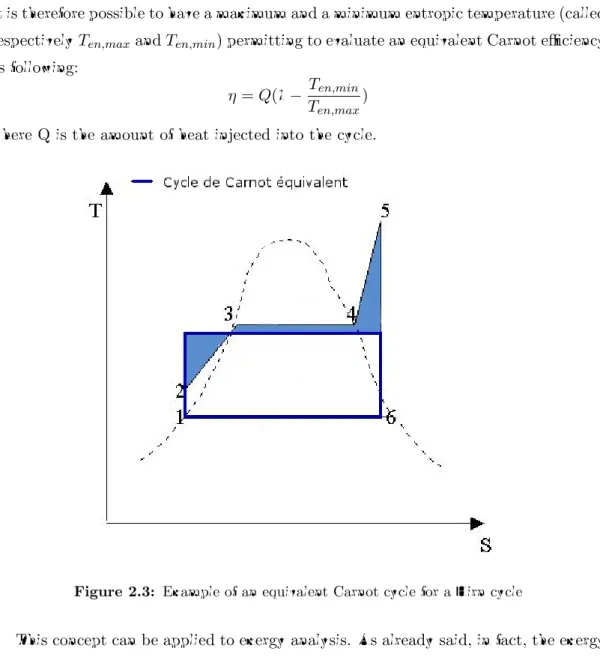
It is therefore possible to have a maximum and a minimum entropic temperature (called respectively Ten,max and Ten,min) permitting to evaluate an equivalent Carnot e ciency
as following:
η = Q(1 − Ten,min Ten,max
) where Q is the amount of heat injected into the cycle.
Figure 2.3: Example of an equivalent Carnot cycle for a Hirn cycle
This concept can be applied to exergy analysis. As already said, in fact, the exergy content of a given quantity of matter in a given state is the maximum work that can be harvested by bringing it to equilibrium with its environment. This can be seen as nothing more than a thermodynamic cycle between the initial state (1) and the equilibrium state (0). As every thermodynamic cycle, it can be associated with an equivalent Carnot cycle between two entropic temperatures. Given that exergy is the maximum amount of work that can be harvested, just like work produced by a Carnot cycle, this expression is obtained:
ex = (h − h0)(1 − T0 Ten,max ) (2.10) CemOA : archive ouverte d'Irstea / Cemagref
It easy to notice that this expression leads to the same result of equation 2.8. This can be seen by performing the calculation of entropic temperature in the ideal gas hypothesis. This leads to:
Ten = Q s = = cp(T − T0) cplnTT0 = = (T − T0) lnTT 0
that, when subsituted in equation 2.10, gives exactly the same result as equation 2.8.
Figure 2.4: T,s diagram showing the comparaison between the exergy content and the Carnot cycle associated to the entropic temperature of the cycle
In gure 2.4 the comparison between the two concepts is shown, highlighting the cycles’ output work. In gure 2.5 an example of an ideal cycle made for exergy es-timation is shown. This model, anyway, is only valid where state 1 is at the same pressure as its environment, since evidently a heat exchanger is not able to recovery pressure di erences. In this case exergy is calculated as the work produced by a Carnot engine working between ambient temperature and entropic temperature of the ther-mal exchanges bringing the considered mass ow from its original state to thermal equilibrium with environment.
CemOA
: archive
ouverte
d'Irstea
2.3 Exergy analysis
Figure 2.5: Cycle diagram showing the role of entropic temperature in exergy calculation
Therefore, entropic temperature can be a good system to estimate quality and quan-tity of energy, with respect to the second law, just as exergy is. Entropic temperature can be very useful because it is easier to understand and it allows to make a more direct comparaison between di erent heat sources.
2.3
Exergy analysis
In previous paragraphs exergy has been introduced, giving its de nition, explaining its meaning, and showing why other thermodynamic properties, such as energy and entropy, are adequate for estimating energy quantity and quality at the same time. Exergy, as said before, is helpful for making comparisons between thermal energy and other forms with respect to their quality.
However, one important remark need to be made. Exergy is not the ultimate solution for estimating energy quality, and its use needs to be restrained with respect to its limits.
2.3.1 Limits to exergy use
Firstly, exergy is strictly connected to heat exchanges and thermal energy. It allows to compare them with work and mechanical energy (as well as with other energy forms
CemOA
: archive
ouverte
d'Irstea
such as electrical or kinetic) with respect to their di erence in quality. This means that if a process makes no use of thermal energy, exergy analysis will not give any further information than a simple energy analysis. This can be the case of power plants such as hydro-electrical systems or wind turbines, where no heat exchange is involved. A good example of this issue is shown in Dincer’s paper entitled \Energy and exergy utilization in transportation sector of Saudi Arabia"(17). In this case kinetic energy is the nal product which is considered in the exergy analysis, where the chemical energy of the fuel is the inlet ow. Exergy and energy have identical values in both cases, leading to identical results for energy and exergy e ciency. Therefore, in this case, there is no point in using exergy e ciency. More interesting results would be obtained in the case of a thermodynamic study of engines: in this case, heat transfers come to light and an exergy analysis reveal interesting aspects of the system.1
Secondly, the fundamental principle of exergy analysis is the major value given to work as process consumption or product. This statement, that thermodynamically speaking is always true, can drive to incorrect conclusion from the technological and economical point of view. In fact, in the industrial sector, several processes only need heat at a certain temperature as process utility, which means that there is no point in comparing product quality with work potential. A very good example is given by house heating sector. If only the system for hot water production is considered, it is clear that a conventional boiler has an e ciency way higher than a heat pump, since it is theoretically capable to produce a hot stream at 300-400°C. But if the whole heating system is considered, in particular the nal part, it is also clear that a system combining a heat pump with radiant panels can be way more e ective than a conventional boiler provided with a radiator system. In this case, in fact, even if the exergy of the outlet ow is di erent, both systems manage to achieve the same result, and only inlet exergy consumption should be taken into account.
Thirdly, a very important aspect that should be taken into account is the choice of the environment state. A precise and proper de nition of the environment state is very important. When considering heating systems, for instance, the fact that external
1
The only difference in Dincer paper lies in the γ coefficient, representative of the ratio between HHV (Higher Heating Value) and LHV (Lower Heating Value) of considered fuel. This is simply due to different conventions: in energy analysis the energy content of a fuel is represented by the LHV, while in exergy analysis it is measured by the HHV
CemOA
: archive
ouverte
d'Irstea
2.3 Exergy analysis
temperature substantially changes throughout the year must be taken into account. Bibliography gives important examples of how results become very di erent whether a correct analysis of the environment state is performed or not. In Dincer’s paper entitled \Energy and exergy use in public and private sector of Saudi Arabia" (18) a very low exergetic e ciency is associated to the air conditioning sector. The issue here is strongly connected to the choice of the environment state: choosing a xed temperature of 10°C, as Dincer does with reference to previous papers, leads to a misunderstanding, since Saudi Arabia’s climate features much higher temperatures. This reasoning implies that the need of air conditioning at 20°C is connected to a \cold\ exergy rather than a \hot\ one. Choosing 10°C as reference temperature means that a ow of cold air at 20°C as a lower exergy content than one at 30°C, while the real condition is the opposite. A way more precise approach is used in Wall’s paper \Exergy conversion in the Swedish society" (19). In this case the author develops a quite simple model for estimating external temperature depending on the season and the moment of the day. This tool allows a very precise evaluation of heating system exergy content, that as said in previous sections strongly depends on the environment state. Le Go et al. (20) go into this subject in depth, explaining the existence of several strategies for de ning environment temperature and comparing their advantages and disadvantages. What is pointed out in this latter paper, is that the maximum e ciency of a generic energy system do not depend on its environment. This concept allows, however, to estimate maximum e ciency, while real e ciency depends, in fact, on environmental conditions, as pointed out in previous paragraphs.
2.3.2 Exergy analysis domains
It is therefore important to identify what domains exergy analysis is more suitable for. One of the analysis that could take most advantage of the exergy application is the study of systems energy consumption. In this case, in fact, we have often to face with complex processes that need di erent energy sources, such as electrical, thermal and mechanical energy, and a simple energy-based analysis of these di erent needs would be unfair. Even if this domain has been largely studied in the past and in present years, Szargut work \Exergy analysis of thermal, chemical, and metallurgical processes" (21) still remains the reference study. The main feature of this speci c analysis is that major attention is pointed on exergy consumption, where the goal is to minimize it for a given
CemOA
: archive
ouverte
d'Irstea
product. In this case, thus, the exergy content of entries rather than of products is generally taken into account.
Another possible use for exergy analysis comes from a secondary de nition. Exergy is in fact also representative of the \departure from environmental state", and several authors, such as Rosen, Dincer (22) and Lior (8), make reference to the use of exergy in environmental impact analysis. This concept can be very useful when considering thermal pollution, but also (considering the chemical part of exergy), for evaluating pollutants reactivity and its impact on the environment. In this case, however, it is important to notice that only the energy aspect is taken into account, while there is no mention of toxicity or other process by-products features. This means that this analysis, even if correct and useful, remains incomplete.
2.3.3 Exergy analysis for Waste Heat Recovery
In this study attention will be concentrated on exergy analysis applied to the evaluation of recovery potential in WHR systems where additional work is required. This is maybe the domain exergy analysis is best t for, since it allows an estimation of maximum work potential of a current, which is exactly what has to be evaluated to de ne the e ciency of this kind of WHR systems.
In fact, several authors followed this path. Concentrating on WHR from Diesel engines, which is the subject of this study, Aly (23), Bourhis et al.(4), and Edwards et al.(2) made use of exergy analysis, pointing out the di erences with reference to the energy analysis, in this eld.
In gure 2.6, taken from Edwards’ paper (2), these di erences become clear. What is easy to notice is that exergy recovery potential is much lower than energy one (In this study the author chose to take into account only EGR and exhaust gas recovery potential, without any interest in engine oil). This result becomes obvious under the light of previous sections: the second law of thermodynamics clearly explains that there is no way to convert all heat into work, and that the portion that can de nitely be converted depends on ow temperature and is quanti ed by exergy. In Edwards’ paper, for instance, it can be seen that the 69 kW of energy output in form of work keeps the same value in exergy analysis, while the 43 kW of energy output in form of waste heat (EGR and exhaust gas) become only 15 kW of exergy ow.
CemOA
: archive
ouverte
d'Irstea
2.3 Exergy analysis
Figure 2.6: Energy and exergy analysis results in Edwards’ paper
(2)
In Bourhis paper (4), instead, exergy and energy analysis are more detailed and the repartition between di erent waste ows is more complex (more contribution are explicitly evaluated, such as intercooler, oil, cooling water etc.). Anyway, results do not substantially change: several irreversible processes lead to exergy destruction (energy degradation), and only a small part of waste heat can be recovered.
Ending the chapter, there are a phew points on which further studies are necessary: The recovery potential, as well as thermodynamic properties that characterize mass ows (temperature, enthalpy, entropy, etc.) strongly depends on engine load operating point. This shows the need to investigate more on how much this actually concerns the possibility of waste heat recovering and in how transient operations can in uence the choice of the WHR system that should be adopted In Edwards’ paper, only EGR and exhaust gas waste heat was recovered in system
simulations. Other studies, instead, consider also the possibility to exploit energy content in cooling water or engine oil. This choice depends on several parameters, but one of major importance, that is often neglected, is the surface needed by
CemOA
: archive
ouverte
d'Irstea
heat exchangers. Further considerations have to be done in order to understand whether it is possible to conceive a recovery system on outlet ow that have a very low exchange coe cient, such as for exhaust gases, in a situation where space and weight are limited, such as on tractors.
Exergy analysis is not enough to make a complete evaluation on the convenience of a WHR system. In fact, apart from exergy content of an outlet ow (that is possible to estimate without reference to the WHR system), exergetic e ciency of the exchange has to be considered because of its large in uence on system per-formance. In this context, even low-exergy currents can be useful, for instance, in order to heat up the thermovector uid and thus to enhance the exergy e ciency of the heat exchange placed on higher-exergetic ows
CemOA
: archive
ouverte
d'Irstea
3
Testing equipment
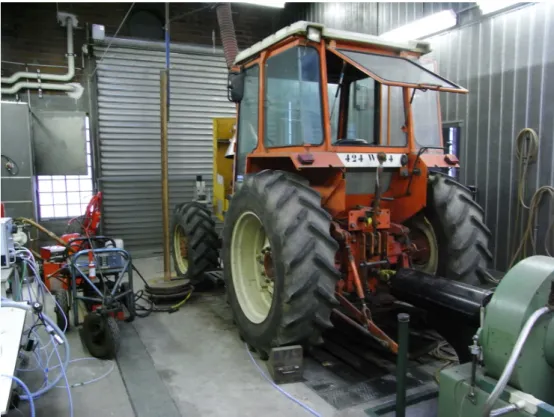
TSAN (Technologies for safety and performance of agricultural machinery) unit in Cemagref research center of Antony disposes of two test benchs for tractors.
Figure 3.1: Tractor rear view. Focus on the PTO shaft connection and the electric brake
Selected test bench, normally used for standard performance tests (OCDE), is pro-vided with a water cooled electric brake, based on Foucault currents, which is able to
CemOA
: archive
ouverte
d'Irstea
raise up to 400 kW of brake power. The connection between the electrical brake and the tractor’s engine is granted by a direct connection to the power take-o (PTO). A focus on the PTO shaft connection with the electric brake is shown in gure 3.1. Cooling water for the brake is circulated by a pump which drives it to two external heat exchanger, meant to cool it down if its temperature rises over 30°C.
Other test bench main features are listed below
Engine performance sensors for engine torque, speed and brake power Thermocouples for temperature measurements1
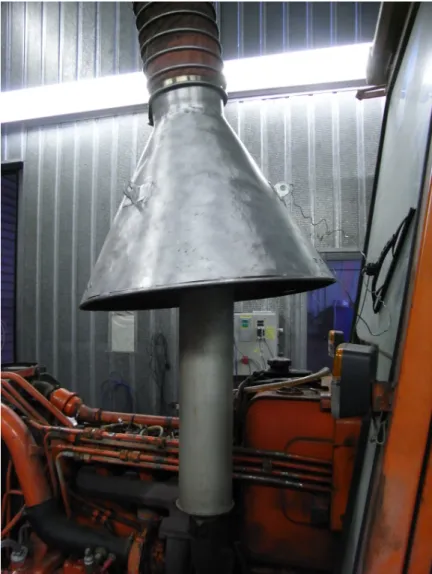
A gas aspiration system (Figure 3.2) allowing to power up the engine inside the test bench building without any danger for operators
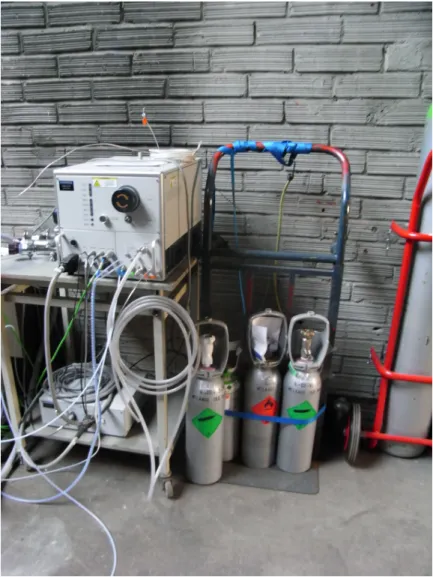
Control strategy: both direct online control and input- le control are available Interface: results are shown directly on the screen and saved on output les Test bench has been also recently provided with a gas-analyser, allowing an online measure of exhaust gas temperature, composition and pressure (Figure 3.3
Each sensor is connected to a main section (Figure 3.4) where all signals are chan-neled to the main processing unit. Each signal is treated in order to make it available to test controller, permitting a direct check on variables evolution with time.
Test bench is also equipped with an emergency stop system, connecting the tractor to test controller position. In case of any dangerous or unexpected system behavior, it is always possible to suddenly turn o the engine by simply pulling a metal wire.
Test bench software \duck" allows to command the tractor engine with a control over these parameters:
Torque
Rotating speed Throttle Power
1All thermocouples have been calibrated thanks to a calibrating system and a reference sensor.
This allowed to define linear correction coefficients for the sensors that needed
CemOA
: archive
ouverte
d'Irstea
Figure 3.2: Gas aspirations system CemOA : archive ouverte d'Irstea / Cemagref
Figure 3.3: Gas analyzer CemOA : archive ouverte d'Irstea / Cemagref
3.1 Tractor
Figure 3.4: Sensor box
Instructions are given by controlling two of these parameters at once, that are chosen depending on test needs. Every instruction over the variation of a parameter must be associated to a transient-duration instruction, that means telling the software how much time the engine must take to pass from the operational condition A to B.
3.1
Tractor
The tractor is a Renault 851-4 R 7664, shown in gure 3.5. It is provided with a 4-cylinder engine, of 4156 cm3 of volume (cylinder cross section: 105 cm2, stroke: 120 cm). It is provided with a turbo-compound system exploiting exhaust gas energy and it is automatically lubricated. Measures taken at the test bench gave the following results:
Nominal power : 57.5 kW
Speed at nominal power : 2350 rpm Torque at nominal power : 233.4 Maximum power : 57.5 kW Maximum speed : 2480 CemOA : archive ouverte d'Irstea / Cemagref
Maximum torque : 277 Nm
Figure 3.5: Renault 851-4 R 7664
3.2
Sensors
A certain number of standard measures are taken for every kind of test, therefore being available for this study too. It si the case of:
Temperatures : Ambient air Air lter Fuel Engine oil
Engine cooling liquid Mass flows : fuel
CemOA
: archive
ouverte
d'Irstea
3.3 Heat exchangers Engine parameters : Power Engine torque Brake torque Engine speed Brake speed
3.3
Heat exchangers
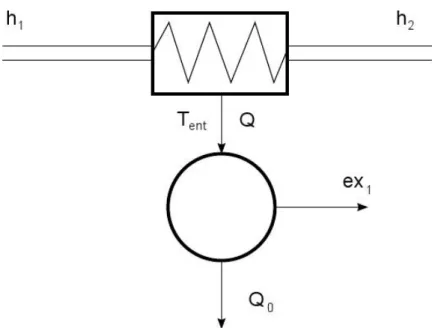
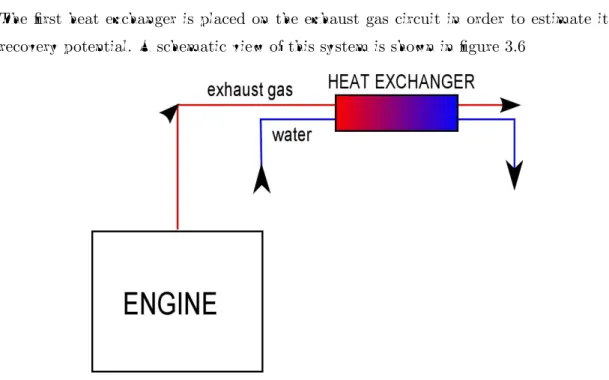
3.3.1 Exhaust gasThe rst heat exchanger is placed on the exhaust gas circuit in order to estimate its recovery potential. A schematic view of this system is shown in gure 3.6
Figure 3.6: Schematic model of the heat exchanger for exhaust gas experiments
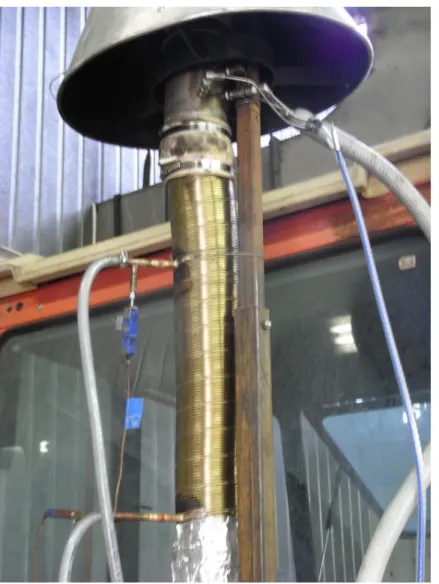
The heat exchanger is made of a copper pipe (diameter: 1 cm , length: 41 cm) concentric to the exhaust pipe, connected to a water circuit coming from the lab tap and leading to the waste drain. Inlet and outlet temperature for both the hot and the cold side are measured. Type K thermocouples (chromel - alumel) were used on the hot side, the temperature of the ow being able to reach more than 400°C, while normal
CemOA
: archive
ouverte
d'Irstea
type T (copper-constantan) thermocouples have been used for this circuit. Figure 3.7 shows a picture of the practical realization of this device
Figure 3.7: Heat exchanger and gas analyzer for exhaust gas experiments
For every measure other than temperature, such as pressure and mass ow, HORIBA OBS-2200 gas analyser was used, which allowed an online measurement and data up-loading, strictly necessary feature with respect to this study. It allowed in particular to measure gas mass ow, pressure and composition.
The OBS-2000 series, apart from measuring exhaust gas temperature, also calcu-lates mass emissions for CO, CO2 (NDIR analyzer without water extraction), THC (FID analyzer), NOx (CLD analyzer), and fuel consumption. OBS features include an
CemOA
: archive
ouverte
d'Irstea
3.3 Heat exchangers
exhaust ow meter, based on a Pitot tube, a GPS receiver for global positioning data and other sensors to monitor engine parameters and atmospheric conditions in real time. However, for this work, only temperature and mass ow measures were directly used, while data concerning exhaust gas composition were employed for a repeatability analysis.
For this exchanger, thermal insulation was very di cult. Exhaust gas temperature is too high to allow the use of a thermal coating, thus making it impossible to reduce the strong in uence of heat exchange with the environment.
3.3.2 Engine oil
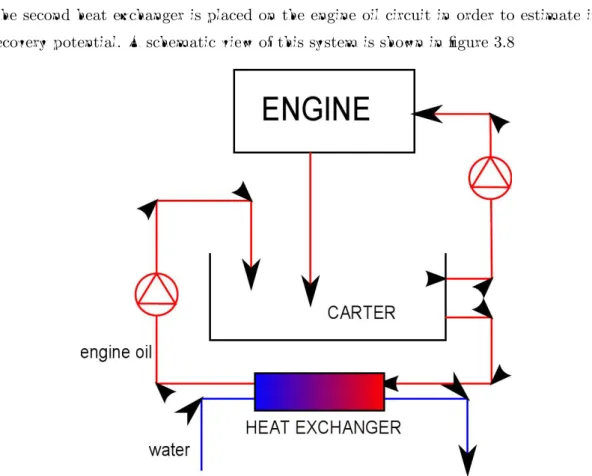
The second heat exchanger is placed on the engine oil circuit in order to estimate its recovery potential. A schematic view of this system is shown in gure 3.8
Figure 3.8: Schematic model of the heat exchanger for exhaust gas experiments
Oil is driven out of the carter toward the heat exchanger rst through a metal pipe, then through a rubber one. After passing through the heat exchanger, oil is then processed by a pump allowing him to go up to the top of the carter, where the uid
CemOA
: archive
ouverte
d'Irstea
is put back into the storage, closing the circuit. The pump is powered by a recti er at 20V DC rather than at its nominal voltage (24 V, DC) in order to reduce oil mass ow that would risk, otherwise, to empty the heat exchanger. Furthermore, if oil mass ow became too high, water ow would not be able to cool it, leading to no di erence between oil inlet and outlet temperatures. Water coming from the lab tab is driven through a rubber pipe to the heat exchanger, after which another rubber pipe drives it to the waste draining. For technical reasons the heat exchanger is set with a parallel-ow arrangement, despite its lparallel-ower exchange e ciency. Anyway the exchange surface and, thus, the heat exchanged is too low for this to have a real negative in uence on the matter.
Figure 3.9 shows the practical solution adopted for the engine oil heat exchanger Five thermocouples are placed on engine oil circuit:
Oil, temperature in the carter
Oil, heat exchanger inlet temperature, placed on the rubber pipe between carter exit and heat exchanger entrance 1
Oil, heat exchanger outlet temperature, placed on the rubber pipe between heat exchanger exit and pump
Water, heat exchanger inlet temperature, placed on the rubber pipe before the heat exchanger
Water, heat exchanger outlet temperature, placed on the rubber pipe after the heat exchanger
All thermocouples were calibrated with reference to a standard one, using a speci c device, in order to have the maximum available instrumental precision. Thermocouples of type T (copper-constantan) have been used for this circuit.
A value for engine oil mass ow is needed in order to correctly evaluate energy and exergy quantities. A mass ow measurement system is therefore necessary. For the engine oil circuit the sensor is placed just after the pump, and the result is directly
1
Originally, the thermocouple was directly placed on the metal pipe, without any use of rubber pipe in this part. The changement in system configuration was caused by the high thermal capacity of the metal pipe, that was remarked to influence oil temperature measurement
CemOA
: archive
ouverte
d'Irstea
3.3 Heat exchangers
Figure 3.9: Heat exchanger and oil pump
CemOA
: archive
ouverte
d'Irstea
shown on controller interface. Concerning the water circuit, the measure is taken at the end of the circuit, just before the waste draining1.
The variations measured in water mass ow led to adapting a di erent solution. Water circuit was equipped with an intermediary storing system, meant to increase system inertia and, thus, to reduce variations in water mass ow. The height at which the storing system was placed was of primary importance for de ning water ow. This parameter was set to a value allowing to have a mass ow low enough to see variations in temperature, but high enough to ll the pipe, thus making the exchange easier to be described analytically.
Water and engine oil mass ow setting was a quite important subject discussed at the beginning of the test series. This quantity should in fact be set to a value allowing to measure a temperature di erence between inlet and outlet ow high enough to get rid of measure incertitude. Thermocouples available at Cemagref test bench have, in fact, a measurement incertitude of about ± 1°C, which means that a di erence in temperature between inlet and outlet ow of less than approximatively 5 °C would be strongly a ected by measurement incertitude. At the same time, mass ow should be high enough to allow the uid to complete ll-up the pipe, since it would be otherwise impossible to give a correct estimation of the exchange surface. Moreover, decreasing the mass ow over a certain limit would cause troubles in its measurement.
First measurements led to a dramatically strong impact of the heat exchanger non-adiabatic behavior, making it very di cult to separate the two components. For this reason the heat exchanger, initially set with the con guration shown in gure 3.9, has been thermally insulated. Two di erent levels of thermal insulation were inserted:
A coat of a low-conductive material (normally used for heating pipes insulation), for reducing undesired heat exchanges due to conduction. The same material have been used for pipes insulation, in order to reduce as much as possible the temperature drop between the engine oil inside the carter and at the inlet of the exchanger
1This makes mass flow measures response quite slow. However, in normal operations no variation
in water mass flow should happen, which means that, theoretically, water mass flow measurement is inserted only for being able to initially set the flow, whose regulation is granted by manually opening a vane. However in real operations, variations in water mass flow have been measured during the tests. This can be caused by several phenomenons, first of all the stochastic variations caused by non-constant value of aqueduct pressure
CemOA
: archive
ouverte
d'Irstea
3.3 Heat exchangers
An external annular protection for reducing undesired convection. One of the most unexpected and undesired problems was, in fact, the strong forced-convective heat exchange cause by tractor fan. Air ow passing through the fan is, in fact, driven directly above the carter, where the heat exchanger is placed. This heat exchange has been reduced by a merely physical protection surrounding the ex-changer and, thus, preventing the air ow coming from the fan from directly impacting the exchanger
Figure 3.10 shows the heat exchanger after the insulation process.
Figure 3.10: Heat exchanger and oil pump
These arrangements, together with the e orts to approach the thermocouples as much as possible to the inlet and outlet sides of the exchanger (thus reducing the in uence of the heat exchange with air) made it possible to isolate the interesting phenomenon, that is the heat exchange between engine oil and water and the exchanger thermal inertia.
The other, strong issue related to the heat exchanger placed on the engine oil circuit is its thermal inertia. Firstly, in fact, engine oil itself tends to slowly react to variations in heat transfer. Furthermore tests results showed that the exchanger, whose external wall is made of a thick layer of cast iron, has a di erent inertia, making the modeling of the totality of the exchange even harder.
CemOA
: archive
ouverte
d'Irstea
CemOA
: archive
ouverte
d'Irstea
4
Discussion
Waste heat recovery potential of the engine of a tractor was the subject of this work. It will be structured in three main sections:
Steady state potential analysis : In the rst part, the steady state exergy potential of both engine oil and exhaust gas will be evaluated, in order to write a chart of engine speed and power dependence of this potential.
Transient potential analysis : In the second part, the transient behavior of the exergy potential will be evaluated. The comparaison between a simple steady-state analysis and a more exhaustive transient one will be performed, in order to have a better understanding of the unsteady phenomena in uence on heat recovery potential.
Heat exchange features : In the third and latter part of this project, heat exchange issues will be studied, and the in uence of the di erent heat exchange properties of the two ows will be evaluated
4.1
Steady state tests
The rst part of test series was meant to understand engine’s behavior for certain speci c operational points in steady state conditions. The analysis of these tests results allows to have a general knowledge of engine parameters dependence of its waste heat recovery potential. CemOA : archive ouverte d'Irstea / Cemagref
The operational points chosen for the tests are representative of all of the possible working points of the engine, starting from idle conditions to its maximum power. However, operational points belonging to two already existent procedures were tested: the OCDE and the ISO 8178 protocol.
4.1.1 OCDE protocol
The OCDE protocol is a standard series of 6 test points originally developed in order to give a substantial estimation of engine fuel consumption over its life operations, allowing comparisons among di erent tractors. Even if some studies, such as the Cemagref report \Energy consumption of tractors: Remarks over OCDE and ISO 8178 protocols"(24), proved the incomplete e ectiveness of this protocol, the operational conditions it takes into account are still an interesting starting point for de ning engine performances. These points are de ned as following:
1. 100% Pnom 2. 80% Pnom 3. 80% Pnom et 90% ωnom 4. 40% Pnom et 90% ωnom 5. 60% Pnom et 60% ωnom 6. 40% Pnom et 60% ωnom 4.1.2 ISO 8178 protocol
The ISO 8178 protocol is a second standard series of 8 points developed instead for pollutant emissions evaluation. It includes:
1. 100% Cnom et 100% ωnom 2. 75% Cnom et 100% ωnom 3. 50% Cnom et 100% ωnom 4. 10% Cnom et 100% ωnom CemOA : archive ouverte d'Irstea / Cemagref