HAL Id: hal-00298884
https://hal.archives-ouvertes.fr/hal-00298884
Submitted on 11 Sep 2007HAL is a multi-disciplinary open access
archive for the deposit and dissemination of sci-entific research documents, whether they are pub-lished or not. The documents may come from teaching and research institutions in France or abroad, or from public or private research centers.
L’archive ouverte pluridisciplinaire HAL, est destinée au dépôt et à la diffusion de documents scientifiques de niveau recherche, publiés ou non, émanant des établissements d’enseignement et de recherche français ou étrangers, des laboratoires publics ou privés.
Influence of summer and winter climate variability on
nitrogen wet deposition in Norway
L. R. Hole, H. A. de Wit, W. Aas
To cite this version:
L. R. Hole, H. A. de Wit, W. Aas. Influence of summer and winter climate variability on nitrogen wet deposition in Norway. Hydrology and Earth System Sciences Discussions, European Geosciences Union, 2007, 4 (5), pp.3087-3112. �hal-00298884�
HESSD
4, 3087–3112, 2007Influence of summer and winter climate
variability L. R. Hole et al. Title Page Abstract Introduction Conclusions References Tables Figures ◭ ◮ ◭ ◮ Back Close
Full Screen / Esc
Printer-friendly Version
Interactive Discussion
EGU
Hydrol. Earth Syst. Sci. Discuss., 4, 3087–3112, 2007 www.hydrol-earth-syst-sci-discuss.net/4/3087/2007/ © Author(s) 2007. This work is licensed
under a Creative Commons License.
Hydrology and Earth System Sciences Discussions
Papers published in Hydrology and Earth System Sciences Discussions are under open-access review for the journal Hydrology and Earth System Sciences
Influence of summer and winter climate
variability on nitrogen wet deposition in
Norway
L. R. Hole1, H. A. de Wit2, and W. Aas1
1
Norwegian Institute for Air Research (NILU), PO Box 100, 2027 Kjeller, Norway
2
Norwegian Institute for Water Research (NIVA), Gaustadall ´een 21, 0349 Oslo, Norway Received: 7 November 2006 – Accepted: 16 April 2007 – Published: 11 September 2007 Correspondence to: L. R. Hole ([email protected])
HESSD
4, 3087–3112, 2007Influence of summer and winter climate
variability L. R. Hole et al. Title Page Abstract Introduction Conclusions References Tables Figures ◭ ◮ ◭ ◮ Back Close
Full Screen / Esc
Printer-friendly Version
Interactive Discussion
EGU
Abstract
Dominating wind patterns around Norway may change due to climate warming. This could affect transport of polluted air masses and precipitation. Here, we study relations between reactive nitrogen wet deposition and air mass transport during summer and winter expressed in the form of climate indices, at seven sites in Southern Norway for
5
the period 1980–2005. Atmospheric nitrate concentrations decreased with 0 to 50% in the period, particularly at sites with little precipitation, and mostly during 1990–2005. For comparison, reported reductions in emissions of oxidised nitrogen in Europe in 1989–2003 were 23%. Climate indices explained up to 36% of the variation in winter nitrate deposition at the western and northern sites – and also explained 60% of the
10
variation in winter precipitation (R=0.77). This suggests that the variation in nitrate wet deposition is closely related to variation in precipitation, and that the climate in-dices seem to also partly control the variation in atmospheric nitrate concentrations (R=−0.45 at coastal sites). At the coastal sites, local air temperature was highly cor-related (R=0.84) with winter nitrate deposition, suggesting that warm, humid winter
15
weather results in increased wet nitrate deposition. For ammonia the pattern was sim-ilar, but this compound is more influenced by local sources. Expected severe increase in precipitation in western and northern regions as a consequence of climate change suggest that nitrogen deposition in these areas will increase under global warming if emissions are held constant.
20
1 Introduction
Long-range transported deposition of reactive nitrogen (Nr) has been an issue of con-cern Europe and North America for a long time. In 1983 the Convention on Long-Range Transboundary Air Pollution entered into force, while the Protocol concerning the Con-trol of Nitrogen Oxides or their Transboundary Fluxes was signed in 1988. While
mea-25
HESSD
4, 3087–3112, 2007Influence of summer and winter climate
variability L. R. Hole et al. Title Page Abstract Introduction Conclusions References Tables Figures ◭ ◮ ◭ ◮ Back Close
Full Screen / Esc
Printer-friendly Version
Interactive Discussion
EGU
more difficult to reduce (www.emep.int). Effects of N deposition on terrestrial ecosys-tems include surface water acidification (Stoddard, 1994) and reductions in biodiversity (Bobbink et al., 1998) while forest growth effects are more difficult to substantiate (Ti-etema et al., 1998; Emmett et al., 1998). Retention of N in many boreal and temperate ecosystems is usually high, which leads to soil N enrichment which in turn may lead to
5
‘N saturation’ of soils and increased leaching of N to surface waters, leading to water acidification (Stoddard, 1994). Recent studies indicate that climate change may affect the biogeochemical Nr cycle profoundly. Evidence is accumulating that interactions between N deposition and terrestrial processes are influenced by climate warming (i.e. De Wit et al., this issue).
10
There are few studies on the linkage between Nr deposition and climate variability in Northern Europe. By coupling of regional a climate model and the Mesoscale Chemical Transport (CTM) Model MATCH, Langner et al. (2005) showed that changes in the precipitation pattern in Europe have a substantial potential impact on deposition of oxidised nitrogen, with a global warming of 2.6 K reached in 2050–2070. Air mass
15
trajectories have been shown to be affected by climate warming and this may potentially lead to changes in N deposition. Fowler et al. (2005) were not able to establish a clear connection between Nr wet deposition in the UK and the North Atlantic Oscillation Index (NAOI), suggesting that a much more detailed approach with analysis of individual precipitation events and trajectory studies would have to be used in order to establish
20
relationships between Nr deposition trends and climate variation.
In Norway, Hole and Tørseth (2002) reported the total sulphur and nitrate deposi-tion in five-year periods from 1978–1982 to 1997–2001 by interpolating nadeposi-tional and EMEP station measurements to the EMEP 50×50 km grid. They found that the total (wet+dry) Nr deposition in the last period had been reduced with 16% compared to the
25
first period although the total precipitation had increased with 10% (Fig. 1). However the decline in deposition since the early 1980s is not steady since EMEP area NOx emissions reached a peak around 1990 and the period 1988–1992 was the wettest in Norway of the periods studied. Grid cell total deposition for NOx in the last period
HESSD
4, 3087–3112, 2007Influence of summer and winter climate
variability L. R. Hole et al. Title Page Abstract Introduction Conclusions References Tables Figures ◭ ◮ ◭ ◮ Back Close
Full Screen / Esc
Printer-friendly Version
Interactive Discussion
EGU
varied from 0.04 to 1.2 g N m−2 yr−1while corresponding numbers for NHy was 0.06 to 0.9 g N m−2 yr−1. The large regional gradients are partly caused by large variations in annual precipitation, which are about a factor of 10. Southwest Norway has relatively high precipitation in addition to being located closest to the main sources of N emis-sions and has consequently the highest deposition of entire Norway (up to 90% wet
5
deposition). Dry deposition dominates in the north and along the Swedish border. According to Hanssen-Bauer (2005) mean annual precipitation in Norway has creased in 9 of 13 climate regions into which Norway is divided, with a 15–20% in-crease in northwestern regions (between Bergen and Trondheim) in the last century. The same study shows that there is a correlation between the NAOI and winter air
10
temperature in all regions and a correlation between NAOI and winter precipitation in the western regions. However, this correlation varies with time. One explanation may be that the atmospheric circulation over Norway is not only dependent on NAOI but also the position of the Icelandic low. Consequently, in the present paper, we also in-vestigate the correlation between Nr wet deposition (nitrate and ammonia) and other
15
circulation indices.
The REGCLIM project (regclim.met.no) has recently published scenarios for the pe-riod 2071–2100 and suggests that the annual precipitation in Southern Norway can increase 0.2 to 19.6% while the winter precipitation can increase with 2.0 to 35.6%. This increase is associated with more westerlies, i.e. higher occurrence of positive
20
NAOI events.
In this paper, we explore relations between climate variability and wet N deposition at 7 locations in south Norway, including a range in annual precipitation and atmospheric Nr deposition. We have tested whether various climate indices are significantly cor-related with i) bulk concentrations of Nr in precipitation ii) monthly precipitation iii) Nr
25
deposition during summer and winter. Our main focus is deposition. We have sepa-rated summer and winter data in order to test whether there are seasonal differences in the correlations.
HESSD
4, 3087–3112, 2007Influence of summer and winter climate
variability L. R. Hole et al. Title Page Abstract Introduction Conclusions References Tables Figures ◭ ◮ ◭ ◮ Back Close
Full Screen / Esc
Printer-friendly Version
Interactive Discussion
EGU
2 Data description and methods
2.1 Measurement network
The seven deposition time series used in this study are taken from the national monitor-ing network of acid deposition, which as of 2005 consisted of 17 stations for monitormonitor-ing of main compounds in precipitation (Aas et al., 2006). They were selected partly
be-5
cause they are located in different climate zones in S Norway (Hanssen-Bauer, 2005 – Fig. 1) and partly because they are located close to water monitoring stations used in climate effect studies by NIVA. Langtjern is a NIVA-station located close to Gulsvik (January 1980–April 1997) and Brekkebygda(1997–2005) and the data for “Langtjern” is consequently a combination of data from these two stations. It is included here since
10
it represents a very dry, continental, climate region. Otherwise all stations have con-tinuous time series in the period studied (1980–2005), with very few gaps. Birkenes, K ˚arvatn, Skre ˚adalen and Tustervatn are also EMEP-stations. Some station character-istics are listed in Table 1. Treungen and Langtjern did not have complete time series for ammonia concentrations.
15
2.2 Climate indices
Different climate indices (Fig. 2) have been tested for correlation with Nr deposition, precipitation and Nr concentration in precipitation. In addition to the NAOI we have tested for the Arctic Oscillation Index (AOI), the European Blocking Index (EUI), the Scandinavian blocking Index (ScandI) and the East Atlantic Index (EAtlI).
20
The Arctic oscillation (AO) is the dominant pattern of non-seasonal sea-level pres-sure (SLP) variations north of 20 N, and it is characterized by SLP anomalies of one sign in the Arctic and anomalies of opposite sign centered about 37–45 N. The North Atlantic oscillation (NAOI) is a climatic phenomenon in the North Atlantic Ocean of fluctuations in the difference of sea-level pressure between Iceland and the Azores. It
25
HESSD
4, 3087–3112, 2007Influence of summer and winter climate
variability L. R. Hole et al. Title Page Abstract Introduction Conclusions References Tables Figures ◭ ◮ ◭ ◮ Back Close
Full Screen / Esc
Printer-friendly Version
Interactive Discussion
EGU
Atlantic and is a close relative of the AO (www.cpc.noaa.gov).
The European blocking index is based on observations of pentad (5-day average) wind over the region 15 W to 25 E and 35 N to 55 N. If the pentad zonal wind equals the climatological value for that time period, the index is zero. If the pentad zonal wind is less than average the index is positive (a blocking high pressure persist over
5
central Europe), while the opposite is true if the index is negative. Similarly, positive ScandI and EatlI are associated with blocking anticyclones over Scandinavia and the East Atlantic, respectively. Jet stream intensity and orientation at the storm track exit, and in the vicinity of Norway in particular, vary with the phase of these climate patterns. (Orsolini and Doblas-Reyes, 2003).
10
Time series of the climate indices are shown in Fig. 2. The winter of 1990 (which was warm and wet with prevailing westerlies in S Norway) is seen as a strong positive event in NAOI whilst the dry and cold winter of 1996 is seen as a prolonged negative event. It also appears that the NAOI and AOI behave similarly and they are also correlated, particularly in winter (Rsummer= 0.55, Rwinter= 0.81).
15
2.3 Statistical method
Precipitation data from seven monitoring stations are presented here as monthly values in winter (December–February) and summer (June–August). In this way we can see seasonal differences since strong anticyclones in the Atlantic with westerlies are par-ticularly common in winter during negative NAOI events. Precipitation concentrations
20
were weighted according to precipitation amount. Existence of a monotonic increas-ing or decreasincreas-ing trend in the time series 1980–2005 and 1990–2005 was tested with the nonparametric Mann-Kendall test at the 10% significance level as a two-tailed test (Gilbert, 1987). Some of the stations opened in the 1970s, but we choose to test for the same periods at all stations to be able to compare trends. An estimate for the slope
25
of a linear trend was calculated with the nonparametric Sen’s method (Sen, 1968). The Sen’s method is not greatly affected by data outliers, and it can be used when data are missing (Salmi et al., 2002).
HESSD
4, 3087–3112, 2007Influence of summer and winter climate
variability L. R. Hole et al. Title Page Abstract Introduction Conclusions References Tables Figures ◭ ◮ ◭ ◮ Back Close
Full Screen / Esc
Printer-friendly Version
Interactive Discussion
EGU
It is likely that significant trends in deposition are partly a result of changes in emis-sions. However, it is not obvious which emission areas contribute to deposition in Norway, even though a sector analysis has been carried out for parts of the period studied (Tørseth et al, 2001). The relative contribution could also vary from year to year depending on transport climate. Here, we have tested whether removing
signifi-5
cant trends in the data have any influence on the correlations we observe.
Source receptor analysis made for Norway (Fig. 6) is not specific for the different sites,
but valid for Norway as a whole. In Tørseth et al. (2001), the trends in SO2, SO4 and NO2at different Norwegian sites were studied. The NO2 trends for all the sites in
10
southern Norway are mostly influence by the emission reduction in the southern sector; but the reductions in east and west are also of significant importance. For the site at Tustervatn there is no big difference between the sectors, eastern sector is slightly more important than the others.
3 Results and discussion
15
3.1 Observed trends
Significant Sen slopes (10% level) in nitrate and ammonia deposition for 1980–2005 and 1990–2005 are shown in Figs. 3–4 and summarized in Tables 2 and 3 and together with significant trends in precipitation and concentration. Trends in nitrate concentra-tions since 1980 corresponds to a reduction of up to 50% at K ˚arvatn in summer (Aas
20
et al, 2006) and less at the other stations. For the longest period, there are negative trends (summer, winter or both) in nitrate wet deposition at five out of seven sites. For the shortest period there are negative trends in nitrate wet deposition at four of seven sites, including the most coastal site (Haukeland), where there is also a very strong increase in summer precipitation (32 mm/decade). For the longest period there are
25
HESSD
4, 3087–3112, 2007Influence of summer and winter climate
variability L. R. Hole et al. Title Page Abstract Introduction Conclusions References Tables Figures ◭ ◮ ◭ ◮ Back Close
Full Screen / Esc
Printer-friendly Version
Interactive Discussion
EGU
increasing precipitation in the period, although the data analysed here show significant increase in precipitation at only three sites. For 1990–2005 decreasing nitrate con-centration in precipitation is accompanied by decreasing nitrate wet deposition only at the driest site (Langtjern). The positive trend in ammonia wet deposition at Tustervatn could be caused by changes in local farming activity. We should keep in mind that the
5
25 year studied here is a very short time to detect climatic trends, since there is much variability on decadal scale (Hanssen-Bauer, 2005).
3.2 Climate indices and connection to concentrations, precipitation and deposition We considered to remove the trend in N deposition which was caused by trends in N emissions in order to be sure that correlations between climate indices and N
depo-10
sition were not in fact correlations between climate and N emissions. A first approxi-mation of detrended N deposition did not show any changes in correlation with climate indices, compared with the original data. From this, we concluded that removing the trend was not necessary for studying correlations with climate indices. Additionally, removal of the EMEP emission trends using a simplified source receptor analysis is
15
too crude and uncertain. A detailed sector analysis for the different sites would be necessary, but that is beyond the scope of this paper.
We first tested correlations between Nr concentrations and climate indices. For most stations there was no correlation. The strongest correlation found was R=−0.45 for nitrate concentration and NAOI at Haukeland in winter. Nitrate wet deposition at the
20
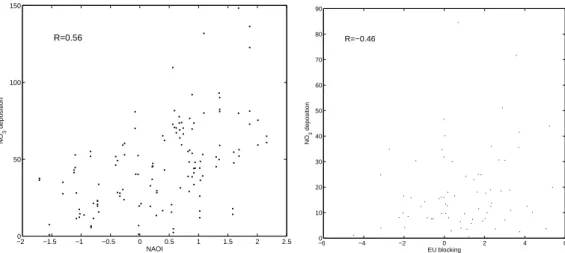
western sites (Haukeland and Skre ˚adalen) are well correlated with NAOI and strongest in winter (R=0.60 at Skre ˚adalen) (Table 4). A cluster analysis where the western sites are combined gives R=0.56 for the western sites in winter (Fig. 5a), and a much lower correlation (R=0.22) for the southern sites (Birkenes and Treungen). For precipitation the corresponding correlations coefficients are 0.75 and 0.38 respectively.
Interest-25
ingly AOI has a similar regional correlation pattern, but it has a higher correlation at the northern site Tustervatn (R = 0.47 in winter). This regional pattern reflexes the corre-lation with precipitation in Table 5 which again corresponds well with Hanssen-Bauer
HESSD
4, 3087–3112, 2007Influence of summer and winter climate
variability L. R. Hole et al. Title Page Abstract Introduction Conclusions References Tables Figures ◭ ◮ ◭ ◮ Back Close
Full Screen / Esc
Printer-friendly Version
Interactive Discussion
EGU
(2005). High correlations with NAOI and AOI in winter is not surprising since strong cyclonic systems in the Atlantic leads to high precipitation at the west coast. Local air temperature is also strongly correlated with winter nitrate wet deposition at the coastal sites (R=0.84), suggesting that mild, humid winter weather with strong transport from west and south-west (positive NAOI) brings high deposition, mostly as rain, and
trans-5
port from the UK. For the other sites R<0.2. The European blocking index is strongest (and negatively) correlated with winter deposition at the drier, eastern site, Langtjern, (Table 4, Fig. 5b). This suggests that a certain orientation of the isobars brings in pre-cipitation from the south at these sites. The other blocking indices do not show very high correlation with nitrate wet deposition. However, ScandI shows high correlation
10
(R=−0.49) with winter precipitation at Skre ˚adalen, although much lower than NAOI (R=0.77) and AOI (R=0.73). The pattern for ammonia wet deposition is similar and will not be discussed here.
3.3 Discussion
Reductions in nitrate wet deposition are probably a consequence of emission
reduc-15
tions in the EMEP area (EMEP, 2006). There has been a steady decrease in emissions in most of Europe since 1990 and looking at the trend 1980–2004 the decrease has been particularly strong in Eastern Europe. Ammonia emission estimates are highly uncertain since agriculture is the main source. Emissions seem to be rather steady in most areas, except in Eastern Europe where reductions have been up to 50% in
20
the 1990s. Sutton et al., (2003) studied trends in reduced nitrogen in different parts of Central Europe and the UK to assess the effectiveness of ammonia abatement. For a range of countries it was shown that atmospheric interactions complicate the expected changes, particularly since sulphur emissions have decreased steadily in the last two decades.
25
Precipitation is better correlated than deposition with NAOI and AO. This is an in-dication that deposition is depending more on precipitation amount than on transport sector. NAOI seems to also partly control the variation in atmospheric nitrate
concen-HESSD
4, 3087–3112, 2007Influence of summer and winter climate
variability L. R. Hole et al. Title Page Abstract Introduction Conclusions References Tables Figures ◭ ◮ ◭ ◮ Back Close
Full Screen / Esc
Printer-friendly Version
Interactive Discussion
EGU
trations (R =−0.45 at the coastal sites), i.e. westerly wind brings lower concentrations. It is already established that precipitation amounts, particularly on the west coast, are well correlated with NAOI (Hanssen-Bauer, 2005). On the other hand, it has been shown that transport from continental Europe in south and east is likely to result in higher concentration levels than transport from the Atlantic in west and north (Tørseth
5
et al., 2001). Probably since emissions trends for nitrate are relatively weak and con-tinuous (28% reduction from maximum in 1989 to 2003) it was not possible to establish a correlation between emissions in the EMEP area and wet deposition here.
Figure 6 shows the budget of NOx deposition in Norway calculated with the EMEP model (EMEP 1992, EMEP, 1997, EMEP, 2003). Note that for the year 2000, the model
10
run was Eulerian, for the other cases it was Lagrangian. The comparison using these two different models create some extra uncertainty in the trends. However the peak in 1990 is obvious, and it is also interesting that the according to the model, deposition in 2000 is much higher that in 1995. However these results are not entirely consistent with Hole and Tørseth (2002) who reported stable total Nr deposition levels
compar-15
ing 1992–1996 with 1997–2001. In the winter of 1990 NAOI was strongly positive and it is interesting to note that the relative contribution from Great Britain (transport from west) was high this year (Fig. 6), however the connection between Fig. 6 and the NAOI (Fig. 1) should be interpreted with care since Fig. 1 shows monthly data. Also, deposition calculations for 2000 is carried out with an Eulerian version of the EMEP
20
model, while the others are Lagrangian, so the reader should focus on the relative con-tributions for each year. Emission reductions are not evenly distributed in the EMEP countries. Only at the dryest site, Langtjern, a weak correlation was found with the total EMEP annual emissions (Rsummer=0.33 and Rwinter=0.18 in winter). At Birkenes Rsummer= 0.2. This could suggest that variability in deposition is determined by
variabil-25
ity in precipitation and transport pathways rather than emissions and also that Norway can be influenced by North American emissions which are not taken into account in Fig. 6.
HESSD
4, 3087–3112, 2007Influence of summer and winter climate
variability L. R. Hole et al. Title Page Abstract Introduction Conclusions References Tables Figures ◭ ◮ ◭ ◮ Back Close
Full Screen / Esc
Printer-friendly Version
Interactive Discussion
EGU
bring the highest concentrations at all sites. The negative correlation between nitrate wet deposition and precipitation amount is weakest at the driest sites (Treungen and Langtjern). In Norway high precipitation events are associated with weather systems with a S component, generally SW wind on the W coast and SE wind in E Norway. We would also expect that these directions with transport from UK and E Europe would
5
give the highest concentrations. Figure 6 suggests a dilution effect in rainy months. Modelling results in Hole and Enghardt (2007) also show that the severe increase in precipitation in W Norway expected in the coming decades (in the order of 50%) will indeed result in lower concentrations.
Because 1990 was the warmest (and consequently one of the wettest) year on
10
record in Norway, there are no significant trends in precipitation in 1990–2005 (Table 3) except for a strong increase in winter precipitation at K ˚arvatn. However, there are sig-nificant reductions in nitrate concentration in precipitation at several stations.
4 Conclusions
We have studied the connection between summer and winter climate variability,
de-15
scribed by climate indices, and nitrate and ammonia wet deposition at seven monitor-ing sites located in different climate zones in Norway in the periods 1980–2005 and 1990–2005.
36% of the variation in winter nitrate wet deposition is described by the North At-lantic Oscillation Index in coastal stations, while deposition at the inland station
Langt-20
jern seems to be more controlled by the European blocking index. The Arctic Oscilla-tion Index gives good correlaOscilla-tion at the northernmost staOscilla-tion in addiOscilla-tion to the coastal (western) stations. Local air temperature is highly correlated (R=0.84) with winter ni-trate deposition at the western stations, suggesting that warm, humid winter weather results in high wet deposition. For concentrations the best correlation was found for the
25
coastal station Haukeland in winter (R=−0.45). In addition, there was a tendency in the data that high precipitation resulted in lower Nr concentrations. Removing trends in the
HESSD
4, 3087–3112, 2007Influence of summer and winter climate
variability L. R. Hole et al. Title Page Abstract Introduction Conclusions References Tables Figures ◭ ◮ ◭ ◮ Back Close
Full Screen / Esc
Printer-friendly Version
Interactive Discussion
EGU
data did not have significant influence on the correlations observed. However, a careful sector analysis for each month and for each station could improve the understanding of the separate effects of emission variability and climate variability on the deposition.
Our results suggest that prediction of future Nr deposition for different climate sce-narios most of all need good predictions of precipitation amount and precipitation
distri-5
bution in space and time. Climate indices can be a tool to understand this connection. It is also likely that Nr emission reductions according to the Gothenburg protocol will not necessarily lead to the same relative reduction in Nr deposition due to increasing precipitation. This should motivate for further emission reductions in Europe.
Acknowledgements. The Software used for trend analysis was kindly provided by A. Grimvall
10
and C. Libiseller, Link ¨oping University, Sweden. All climate indices except for EUI were downloaded from NOAA Climate Prediction Center (www.cpc.noaa.gov). Y. Orsolini at NILU provided the EUI. The Norwegian Meteorological Institute provided meteorological data (local air temperature). This work was supported by the Norwegian Research Council through project no. 155826. The monitoring network is mainly sponsored by the Norwegian Pollution
15
Control Authority (www.sft.no). Edited by: P. Dillon and R. F. Wright
References
Aas, W., Solberg, S., Berg, T., Manø, S. and Yttri, K. E: Monitoring of long range transported
20
pollution in Norway, Atmospheric transport, 2005, (In Norwegian), Norwegian Pollution Con-trol Authority, Rapport 955/2006. TA-2180/2006. NILU OR 36/2006,www.nilu.no, 2006. Bobbink, R., Hornung, M., and Roelofs, J. G. M.: The effects of air-borne nitrogen pollutants on
species diversity in natural and semi-natural European vegetation, J. Ecol., 86(5), 717–738, 1998.
25
Delwiche, C. C: The nitrogen cycle, Sci. Am. 223, 137–146, 1970.
EMEP: Calculated budgets for airborne acidifying components in Europe 1985, 1987, 1988, 1989, 1990 and 1991, edited by: Sandnes, H. and Styve, H. The Norwegian Meteorological Insitute, Oslo, EMEP/MSC-W Report 1/92, 1992.
HESSD
4, 3087–3112, 2007Influence of summer and winter climate
variability L. R. Hole et al. Title Page Abstract Introduction Conclusions References Tables Figures ◭ ◮ ◭ ◮ Back Close
Full Screen / Esc
Printer-friendly Version
Interactive Discussion
EGU
EMEP: Transboundary Air Pollution in Europe. MSC-W Status Report 1997. Part 2; Numeri-cal Addendum. The Norwegian MeteorologiNumeri-cal Institute, Oslo, EMEP/MSC-W Report 1/97., 1997.
EMEP: Transboundary acidification, eutrophication and ground level ozone in Europe. Status Report PART III Source -Receptor Analysis. The Norwegian Meteorological Institute, Oslo,
5
EMEP/MSC-W Report 1/2003, 2003.
EMEP: Transboundary acidification, eutrophication and ground level ozone in Europe since 1990 to 2004. EMEP Status Report1/2006 The Norwegian Meteorological Institute, Oslo, EMEP/MSC-W Report 1/97., 1997.
Fowler, D., Smith, R. I., Muller, J. B. A., Hayman, G., and Vincent, K. J.: Changes in the
10
atmospheric deposition of acidifying compounds in the UK between 1986 and 2001, Env. Poll., 137(1), 15–25, 2006.
Galloway, J. N., Dentener, F. J., Capone, D. G., Boyer, E. W., Howarth, R. W., Seitzinger, S. P., Asner, G. P., Cleveland, C., Green, P., Holland, E., Karl, D. M., Michaels, A. F., Porter, J. H. Townsend, A., and V ¨or ¨osmarty, C.: Nitrogen Cycles: Past, Present and Future,
Biogeo-15
chemistry, 70, 153–226, 2004.
Gilbert, R. O.: Statistical methods for environmental pollution monitoring. Van Nostrand Rein-hold , New York, 1987.
Hanssen-Bauer, I.: Regional temperature and precipitation series for Norway: Analyses of time-series updated to 2004, Met.no report 15/2005,www.met.no, 2005.
20
Hole, L. R. and Enghardt, M.: Will future climate change affect nitrogen deposition in Northern Europe?, Subm. Ambio, 2007.
Hole, L. R. and Tørseth, K.: Deposition of major inorganic compounds in Norway 1978–1982 and 1997–2001: status and trends. Naturens t ˚alegrenser. Norwegian Pollution Control Au-thority. Report 115. NILU OR 61/2002, ISBN: 82-425-1410-0,www.nilu.no, 2002.
25
Langner, J., Bergstr ¨om, R., and Foltescu, V.: Impact of climate change on surface ozone and deposition of sulphur and nitrogen in Europe, Atm. Env., 39 (6), 1129–1141. , 2005.
Orsolini, Y. J. and Doblas-Reyes, F. J.: Ozone signatures of climate patterns over the Euro-Atlantic sector in the spring, Q. J. R. Meteorol. Soc., 129, 3251–3263, 2002.
Sen P. K.: Estimates of the regression coefficient based on Kendall’s tau, J. Am. Stat. Assoc,
30
63, 1379–1389, 1968.
Salmi, T., M ¨a ¨att ¨a, A., Anttila, P., Ruoho-Airola, T. and Amnell, T.: Detecting trends of annual values of atmospheric pollutants by the Mann-Kendall test and Sen’s slope estimates – the
HESSD
4, 3087–3112, 2007Influence of summer and winter climate
variability L. R. Hole et al. Title Page Abstract Introduction Conclusions References Tables Figures ◭ ◮ ◭ ◮ Back Close
Full Screen / Esc
Printer-friendly Version
Interactive Discussion
EGU
Excel template application MAKESENS, Publications on Air Quality, no. 31, FMI-AQ-31, FMI, Helsinki, Finland, 2002.
Stoddard, J. L.: Long-Term Changes In Watershed Retention Of Nitrogen - Its Causes And Aquatic Consequences, Adv. Chem. Ser., 237, 223–284, 1994.
Sutton, M. A., Asman, W. A. H., Ellermann, T., van Jaarsveld, J. A., Acker, K., Aneja, V., Duyzer,
5
J., Horvath, L., Paramonov, S., Mitosinkova, M., Tang, Y. S., Achtermann, B., Gauger, T., Bartniki, J., Neftel, A., and Erisma, J. W.: Establishing the link between ammonia emis-sion control and measurements of reduced nitrogen concentrations and deposition, Environ. Monit. Asessm., 82, 149–85, 2003.
Tietema, A., Boxman, A. W., Bredemeier, M., Emmett, B. A., Moldan F., Gundersen P., Schleppi,
10
P., and Wright, R. F.: Nitrogen saturation experiments (NITREX) in coniferous forest ecosys-tems in Europe: a summary of results, Environ Pollut, 102, 433–437, 1998.
Tørseth, K., Aas, W., and Solberg, S.: Trends in airborne sulphur and nitrogen compounds in Norway during 1985–1996 in relation to airmass origin, Water, Air and Soil. Poll., 130, 1493–1498, 2001.
HESSD
4, 3087–3112, 2007Influence of summer and winter climate
variability L. R. Hole et al. Title Page Abstract Introduction Conclusions References Tables Figures ◭ ◮ ◭ ◮ Back Close
Full Screen / Esc
Printer-friendly Version
Interactive Discussion
EGU
Table 1. Average summer and winter monthly characteristics 1980–2005 of the sites studied. Precipitation is measured at the sites, while air temperature is taken from the nearest climato-logical station (provided by met.no). Volume weighted averages.
Station name Precipitation [mm] NO3 concentration [mg l−1] NO3 wet deposition [mg m−2] NH4 concentration [mg l−1] NH4 wet deposition [mg m−2] Air temperature [◦C] Birkenes Winter 125 0.51 59.8 0.42 48.5 1.5 Summer 107 0.41 40.7 0.45 42.0 13.9 Treungen Winter 74 0.39 26.6 NA NA 0.7 Summer 88 0.30 26.0 NA NA 13.5 Langtjern Winter 44 0.45 18.1 NA NA –1.5 Summer 82 0.20 16.3 NA NA 13.3 K ˚arvatn Winter 141 0.06 6.0 0.05 7.1 –0.4 Summer 116 0.10 9.8 0.09 11.3 10.0 Haukeland Winter 398 0.15 48.5 0.14 45.7 0.8 Summer 190 0.20 33.4 0.40 64.7 11.3
Skre ˚adalen Winter 242 0.22 43.0 0.22 45.1 1.1
Summer 129 0.33 40.3 0.41 48.1 13.8
Tustervatn Winter 147 0.09 9.8 0.13 17.6 –4.5*
Summer 87 0.10 7.5 0.18 14.3 13.0*
HESSD
4, 3087–3112, 2007Influence of summer and winter climate
variability L. R. Hole et al. Title Page Abstract Introduction Conclusions References Tables Figures ◭ ◮ ◭ ◮ Back Close
Full Screen / Esc
Printer-friendly Version
Interactive Discussion
EGU
Table 2.Significant annual trends in monthly values 1980–2005. See Figs. 3–4.
Station name Monthly Precipita-tion [mm] NO3 concentration [mg l−1] NH4 concentration [mg l−1] NO3 wet deposition [mg m−2] NH4 wet deposition [mg m−2] Birkenes Winter −0.006 Summer −0.006 −0.01 Treungen Winter NA Summer −0.004 NA Langtjern Winter −0.005 NA Summer 1.3 −0.006 −0.5 NA K ˚arvatn Winter 3.0 Summer −0.002 Haukeland Winter −0.003 Summer 3.2 −0.01
Skre ˚adalen Winter 0.7
Summer
Tustervatn Winter 0.03 3.0 0.6
HESSD
4, 3087–3112, 2007Influence of summer and winter climate
variability L. R. Hole et al. Title Page Abstract Introduction Conclusions References Tables Figures ◭ ◮ ◭ ◮ Back Close
Full Screen / Esc
Printer-friendly Version
Interactive Discussion
EGU
Table 3. Significant annual trends in monthly values 1990–2005. See Figs. 3–4. NA=Not
Available. Station name Monthly Precipitation [mm] NO3 concentration [mg l−1] NH4 concentration [mg l−1] NO3 wet deposition [mg m−2] NH4 wet deposition [mg m−2] Birkenes Winter −2.7 −1.8 Summer −0.01 −0.01 Treungen Winter NA −1.4 NA Summer −0.008 NA NA Langtjern Winter −0.01 NA −0.6 NA Summer −0.01 NA −0.8 NA K ˚arvatn Winter 6.7 Summer Haukeland Winter −0.003 −0.02 −2.3 Summer −3.5
Skre ˚adalen Winter 0.006
Summer
Tustervatn Winter −0.3
HESSD
4, 3087–3112, 2007Influence of summer and winter climate
variability L. R. Hole et al. Title Page Abstract Introduction Conclusions References Tables Figures ◭ ◮ ◭ ◮ Back Close
Full Screen / Esc
Printer-friendly Version
Interactive Discussion
EGU
Table 4.Correlation coefficients, R, for nitrate deposition vs climate indices 1980–2005.
Station name NAOI AOI European blocking Scandinavian blocking East Atlantic blocking Birkenes 0.15 −0.01 −0.06 0.31 Summer Treungen 0.09 0 0.01 0.24 Langtjern 0.10 −0.03 −0.05 0.11 K ˚arvatn 0.20 0.21 −0.20 0.08 Haukeland 0.46 0.30 −0.18 0.13 Skre ˚adalen 0.38 0.21 −0.19 0.37 Tustervatn 0.11 0.14 0.19 −0.01 Birkenes 0.24 0.16 −0.45 0.25 0.24 Winter Treungen 0.25 0.13 −0.47 0.25 0.23 Langtjern 0.21 0.06 −0.46 0.23 0.32 K ˚arvatn 0.04 0.16 0.14 −0.27 −0.15 Haukeland 0.53 0.60 0.13 −0.20 0.20 Skre ˚adalen 0.60 0.57 −0.20 −0.22 0.39 Tustervatn 0.28 0.47 0.24 −0.12 0.22
HESSD
4, 3087–3112, 2007Influence of summer and winter climate
variability L. R. Hole et al. Title Page Abstract Introduction Conclusions References Tables Figures ◭ ◮ ◭ ◮ Back Close
Full Screen / Esc
Printer-friendly Version
Interactive Discussion
EGU
Table 5.Correlation coefficients, R, for precipitation vs climate indices 1980–2005.
Station name NAOI AOI European blocking Scandinavian blocking East Atlantic blocking Birkenes 0.07 −0.18 −0.06 0.33 Summer Treungen 0.04 −0.13 0.07 0.31 Langtjern 0.01 −0.14 0.06 0.28 K ˚arvatn 0.40 0.34 −0.50 0.09 Haukeland 0.68 0.47 −0.32 0.23 Skre ˚adalen 0.46 0.20 −0.23 0.48 Tustervatn 0.40 0.34 −0.13 0.02 Birkenes 0.40 0.31 −0.52 −0.01 0.36 Winter Treungen 0.35 0.26 −0.52 0.04 0.36 Langtjern 0.20 0.05 −0.48 0.14 0.43 K ˚arvatn 0.09 0.19 0.30 −0.57 −0.23 Haukeland 0.70 0.74 0.10 −0.52 0.10 Skre ˚adalen 0.77 0.73 −0.18 −0.51 0.29 Tustervatn 0.30 0.53 0.49 −0.52 0.10
HESSD
4, 3087–3112, 2007Influence of summer and winter climate
variability L. R. Hole et al. Title Page Abstract Introduction Conclusions References Tables Figures ◭ ◮ ◭ ◮ Back Close
Full Screen / Esc
Printer-friendly Version
Interactive Discussion
EGU
Fig. 1.Total deposition of nitrogen (oxidized + reduced) 1988–1992 (maximum total Nr depo-sition in the monitoring period) and 1997–2001 (minimum total Nr depodepo-sition in the monitoring period) in mainland Norway. The unit is mg N/m2 year. From Hole and Tørseth (2002). Precip-itation zones from Hanssen-Bauer (2005) are also indicated.
HESSD
4, 3087–3112, 2007Influence of summer and winter climate
variability L. R. Hole et al. Title Page Abstract Introduction Conclusions References Tables Figures ◭ ◮ ◭ ◮ Back Close
Full Screen / Esc
Printer-friendly Version
Interactive Discussion
EGU
Fig. 2.North Atlantic Oscillation Index (NAOI), Arctic Oscillation Index (AOI), European Blocing Index (EUI), the Scandinavian Blocking Index (ScandI) and the East Atlantic Blocking Index (EAtlI), 1980–2005.
HESSD
4, 3087–3112, 2007Influence of summer and winter climate
variability L. R. Hole et al. Title Page Abstract Introduction Conclusions References Tables Figures ◭ ◮ ◭ ◮ Back Close
Full Screen / Esc
Printer-friendly Version
Interactive Discussion
EGU
Fig. 3. Monthly average NO3 wet deposition summer and winter (mg/m 2
). Solid lines are 1990–2005 trends, dashed lines are 1980–2005 trends.
HESSD
4, 3087–3112, 2007Influence of summer and winter climate
variability L. R. Hole et al. Title Page Abstract Introduction Conclusions References Tables Figures ◭ ◮ ◭ ◮ Back Close
Full Screen / Esc
Printer-friendly Version
Interactive Discussion
EGU
Fig. 4. Monthly average NH4 wet deposition summer and winter (mg/m2). Solid lines are 1990–2005 trends, dashed lines are 1980–2005 trends.
HESSD
4, 3087–3112, 2007Influence of summer and winter climate
variability L. R. Hole et al. Title Page Abstract Introduction Conclusions References Tables Figures ◭ ◮ ◭ ◮ Back Close
Full Screen / Esc
Printer-friendly Version Interactive Discussion EGU −20 −1.5 −1 −0.5 0 0.5 1 1.5 2 2.5 50 100 150 NAOI NO 3 deposition R=0.56 −6 −4 −2 0 2 4 6 0 10 20 30 40 50 60 70 80 90 EU blocking NO 3 deposition R=−0.46
Fig. 5. Scatterplot of Nitrate deposition vs climate indices at coastal sites (a Haukeland and Skre ˚adalen) and the eastern site (b Langtjern).
HESSD
4, 3087–3112, 2007Influence of summer and winter climate
variability L. R. Hole et al. Title Page Abstract Introduction Conclusions References Tables Figures ◭ ◮ ◭ ◮ Back Close
Full Screen / Esc
Printer-friendly Version
Interactive Discussion
EGU
Fig. 6. Budget of NOx deposition in Norway based on the EMEP model. NO=Norway; NOS,
ATL = North Sea and Atlantic; GB = Great Britain; DD, DE, PL = Germany and Poland; DK, FI, SE = Denmark, Finland and Sweden. BE, NL, FR = Belgium, Netherlands and France.
HESSD
4, 3087–3112, 2007Influence of summer and winter climate
variability L. R. Hole et al. Title Page Abstract Introduction Conclusions References Tables Figures ◭ ◮ ◭ ◮ Back Close
Full Screen / Esc
Printer-friendly Version
Interactive Discussion
EGU
Fig. 7.Monthly average NO3concentration in precipitation (mg/l) vs monthly precipitation (mm)