Publisher’s version / Version de l'éditeur:
Engineering Journal, 42, 11, pp. 61-65, 1959-12-01
READ THESE TERMS AND CONDITIONS CAREFULLY BEFORE USING THIS WEBSITE. https://nrc-publications.canada.ca/eng/copyright
Vous avez des questions? Nous pouvons vous aider. Pour communiquer directement avec un auteur, consultez la première page de la revue dans laquelle son article a été publié afin de trouver ses coordonnées. Si vous n’arrivez pas à les repérer, communiquez avec nous à [email protected].
Questions? Contact the NRC Publications Archive team at
[email protected]. If you wish to email the authors directly, please see the first page of the publication for their contact information.
NRC Publications Archive
Archives des publications du CNRC
This publication could be one of several versions: author’s original, accepted manuscript or the publisher’s version. / La version de cette publication peut être l’une des suivantes : la version prépublication de l’auteur, la version acceptée du manuscrit ou la version de l’éditeur.
Access and use of this website and the material on it are subject to the Terms and Conditions set forth at
Precast concrete for winter building
Crocker, C. R.; Smith, A. W.
https://publications-cnrc.canada.ca/fra/droits
L’accès à ce site Web et l’utilisation de son contenu sont assujettis aux conditions présentées dans le site LISEZ CES CONDITIONS ATTENTIVEMENT AVANT D’UTILISER CE SITE WEB.
NRC Publications Record / Notice d'Archives des publications de CNRC:
https://nrc-publications.canada.ca/eng/view/object/?id=b055924a-fc6c-4cf2-8e55-639c38b718ca
https://publications-cnrc.canada.ca/fra/voir/objet/?id=b055924a-fc6c-4cf2-8e55-639c38b718ca
Ser
sru
N21t2
no. 82
e . 2
BIDG
NATIONAL RESEARCH COUNCIL
CANADA
DIVISION OF BUILDING RESEARCH
PRECAST
CONCRETE
FOR
WINTER BT]ILDINC
by
C. R. Crocker and A. W. Smith
A N A L Y Z E D
REPRINTED FROM
THE ENGINEERING JOURNAL
voL. 42, NO. u, NOVEMBER 1959, P.6l-65
TECHNICAL PAPER NO. 82
OF THE
DIVISION OF BUILDING RESEARCH
OTTAWA
DECEMBER 1959
"ut?flu"'''x
J.1N 4 1960
EtrloNAL xEsEnnc.n JoutcrrPRICE IO CENTS
NRC 5457
36caot8
This publication is being distributed by the Division of Building Research of the National Research Council as a contribution towards better building in Canada. It should not be reproduced in whole or in part, without permission of the original publisher. The Division would be glad to be of assistance in obtaining such permission.
Publications of the Division of Building Research may be obtained by mailing the appropriate remittance, (a Bank, Express, or Post Office Money Order or a cheque made payable at par in Ottawa, to the Receiver General of Canada, credit National Research Council) to the National Research Council, Ottawa. Stamps are not acceptable.
A coupon system has been introduced to make payments for publica-tions relatively simple. Coupons are available in denominapublica-tions of 5, 25, and 50 oents, and may be obtained by making a remittance as indicated above. These coupons may be used for the purchase of all National Research Council publications including specifications of the Canadian Government Specifica-tions Board.
PRECAST
CONCRETE
F'OR
WINTTR BUILDINC
C. R. Crocker, NI.E.LC., Senior Research Officer
A. W. Smith, Junior ResecLrch
Officer
Notional Reseorch Council, Ottuua 2, Ont.
Presentetl at tlte 73rd Annu.ul Cencral Meeting of Tlrc Engineering Institute of Canacla, Toronto, Ont., lune, 7959. P u p e r r c c e i a e d O c t o b e r 27,1959.
n NE OF THE PROBLE\iIS lacing \-, the Canadian constluction in-dustly in wintertime concelns the protection rvhich must be given flesLly placed concrete lo preverrt damage from frost action. This re-quirement fol temporary plotection incleases the cost of the concreting opelation. When added to the inI crersed cost of the conclete itself duling the winter months it may raise the ffnal cost in place as much as $5 pel yard. Thele is a natural decrease in labour efficiency if plotection is not provided, and a gleat deal of time can be lost in warming up, and sitting out bad storms.
It is common practice in Canada today to place heated ready-mixed conclete inside a temporary enclos-Fig. l. Thc all-important framework can be erected in any weather., and is im-mediately load - bearing. (Northview Ileight Collegiate Swimming Pool, To-ronto ).
rure coveled
"vith tarpaulins or plastic, but the whole operation can be very much simplified by mixing, placing, and curing the conclete under the same loof trnd then assembling the precast component5 on the site. Pro-tection on the site can then be con-fined to the joints between the pre-crst palts. It then becomes possible to achieve the valuable economies of factory production.
The use of plecast conclete manu-ftrctured in a factory can therefole plovide a solution to the problem of rvinter concreting and at the same time introduce a measure of quality contlol not usually associated with cast-in-place conclete. The speed with r,vhich it is possible to enclose a structure when large precast panels at'e used promises even further cost savrngs.
As a part of its research study of rvintel construction, the N.R.C. Divi-sion of Building Research decided to investigate the present status of pre-cast conclete in Canada and to assess the placticability of this plactice being more widely used than at present. In the coulse of this study, an extensive search of Amelican and Eulopean technical literature was undertaken followed by visits to engineers,
archi-tects, contlactors, manufacturers, and lesealch labolatolies in the United Kirrgdorn, the United States, and Canada.
Brief History
The practice of precasting concrete is nearly as old as the use of rein-forced concrete. Development was slow until World War I when, because of shortages of conventional materials, many nations investigated the possi-bility of precasting concrete on an industrial basis. By 1930, Germany was producing precast concrete frames, girdels, columns, sewels, blidges, fence-posts, lamp-posts, form-rvolk, paving block, and building block, and had already recognized tl-re advantages of precast concrete for' rvinter construction.
In the years following the revolu-tion, lnuch attention was given in the U.S.S R. to the manufacture and use of precast concrete. So convinced u'ele the authorities of the advantages of this system that by 1934 standard precast conclete structural units wele lequiled for irll commercial and in-dustlial buildings. By that time ple-crist units weighing l5 metric tons rverc being fabricated. In contrast to this lnpid development in other parts
The protection of freshly placed concrete is one of the problems facing Canadian
contractors engaged in winter building. One solution is to use precast concrete
rvhich, even in winter, can be manufactured under controlled conditions to ensure
maximum strength and durability. There is, however, little experience with such
units in Canada because production, although it is increasing rapidly, has been
limited. In Europe, on the other hand, precast conclete has been widely used for many years. Experience there indicates that precast concrete can be used in Canada
as an aid to winter construction. There are however some practical difficulties to be
solved before this practice can gain wide acceptance in the industry. The most
serious is that of making connections between members. Although a number of
a l ' : ' , ) l i r i : 1 1 i r . I
; ;
t i t l
of Europe, little early wolk was done in the United Kingdon'r or the United Sttrtes Precast floor systems had, how-ever, been developed and were quite widely used, and as early as 1906 American lailroads were usinq somc structural precast concrete btidge components. The erection of such large components was no problem to the railroads who could use their heavy wrecking cranes.
The construction industry genel'-ally had to wait for the development of the heavy-duty motor truck crane and towel crane before full use of precast building components was pos-sible. The steel short:rge blought about by the Second Wolld War' resulted in :r gleat increase in the use of reinfolced concrete. Much of it was cast in situ, b:ut with experience came the leahzation that precast con-crete offered a low cost, high quality material that could often reolace t r a d i t i o n a l r n a l e l i a l s . I n t l r e U n i t e d States the use of precast concrete frames for commercial and industlitrl buildings increased and large precast gildels, which had been used in eallier years, wer:e again used in bridge constluction. With the develop-ment of prestressing techniques and the introduction of heavy lifting equipment, plectrsting in the United States began to compete seriously rvith conventional materials.
Today much use is made of large flool and loofing slabs and tilt-up wall panels, precast on the site and put in place by special erection equip-ment. At the same time factory pre-casting is also widely used and has made possible the erection of one factory building at the rate of 7500 sq. ft. per day, with framing and
loof decking averaging 10,000 sq. ft. per day.
The precast, prestressed concrete i:dustry in the United States main-tains a yearly glowth in production of 200 to 300%. At present there are some 200 precast prestressed plants in operation, and a further I50 are under construction or being planned. Girders and beams of I, T, WF, and rectangular sections, roof and foor' slabs of double T and channel section, ioists of I and T section, rigid frames, tlusses, columns, poles, pilings, lin-tels, bleachers and wall panels are being produced in ever-increasing quantity.
Although the general adoption of concrete column-and-beam frame-r.vorks in Britain has been slower and is even today less widespread than in the othel countries of Europe, precast floors and rigid frames for single-story industrial buildings are now generally accepted as standard forms of construction. Some manufac-turers can produce precast concrete frames at the same price as unpro-tected steel and at half the price of fir'e-ploofed steel. In an effort to con-serve steel and provide schools as cheaply and quickly as possible, the British Ministry of Education spon-soled the development of a number of proprietary systems. Theil success may be illustrated by the fact that one contractor, using a system of precast units prestressed in place, has built between 40 and 50 schools in three years and is now enteling the commercial building field.
In the U.S.S.R. today, precast con-crete is being used almost exclusively for building construction. In Moscow and Leningrad alone, some 86,000
apartments to be built in this way are planned for 1959, mostly in five-story blocks. The finished buildings have a neat appealance both inside and out, but the precast products are roughly ffnished and are generally covered by plaster or brick facing. State con-trol and co-ordination of all construc-tion, and the resulting standardization throughout the country, has permitted the complete mechanization ,of even pretensioning operations, through the development of continuous wire wind-ing machines and rotatwind-ing castwind-ing beds.
Factory Manufacfure
Precasting does not automatically imply factory manufacture nor that it cannot be considered beyond the economical hauling distance fi'om an existing factory. On-site manufacture, however, is generally limited to heavier comp'onents that are too diffi-cult to transport, or to large jobs whele it is economically practicable to erect a temporary factory. A $300,000 job is regarded in Europe as the mini-mum size for on-site casting, because this will allow lecovery of the cost of plant, moulds, and planning during the course of that single 1'ob. On-site manufacture in Canada is generally left to the factory manufacturer who ctrn extend his operation in this way. At plesent, he has the necessary spe-cialized knowledge, and this situa-tion will probably continue until standard specifications fol precast con-clete ale available. Thele are excep-tions to this general rule, but these usually result from very close co-operation with an experienced alchi-tect-engineer At the present time building codes make virtually no Fig. 2. Precast concrete roof and frame provide the structural portion of a lightweight enclosure (University of Saskatchewan).
distinction between precast concrete nnd ordinary reinforced concrete cast-in-place, so that they give no indica-tion of the extra care required with precast work.
Factory production, whether in a permanent or a temporary factory, permits rigid control of mixing, plac-ing, and curplac-ing, as well as being completely independent of weather. Hence it is possible to produce high strengths running as high as g,000 to 10,000 psi, even with lightweight concretes. The central feafure of a precasting factory is the concrete mixing plant, operating on a weight batching principle, and similar in all respects to that commonly used in modern ready-mix concrete plants. Some are electronically controlled. In all cases there is stme form of continuous inspection and of random sampling, frequently by an independ-ent testing laboratory.
From the mixing plant the concrete is transferred to the casting bays, which frequently operate on L long-Iine principle. Here the forms aie assembled, the reinforcement olaced rrnd possibly prestressed, and thi con-crete compacted and cured. For smaller units and where rapid produc-tion is desired, steam or warm water ctling is used; with prestressed units. this permits stress release after as little as 12 hours. Larger units may be air cured, which permits stress release in three days. With either rnethod the side forms are stripped and r-e-used on a daily basis. For winter operation of outdoor casting bays eithei on the site or at factories, forms are heated by the circulation of steam, hot water, or hot oil.
The continual re-use of standard forms makes it possible to use steel
forms. Besides reducing form main-tenance costs and producing accurate castings, steel forms produce a smooth ffnished surface ready for painting. The savings involved in fu"tory pr6-duction of an integral surface'ffnish are very real and can reduce the con-struction time very considerably. The exposed face of a wa77 panel, for examplc. may be tiled. - trowelled smooth, brushed, polished, ,or treated with an acid solution or water sprav to expose the aggregate. lt is posiible to achieve almost any desired texture or colour, and at the same time to produce a finished surface that re-quires little or no maintenance. The application of special finishes of this type to a cast-in-place panel would be costly, if not impossible, and would require additional winter protection. The precast units are easily handled in the factory, usually with gantry cranes, Some factories that use a vacuum process to remove surplus water fi-om the compacted concrete also use a vacuum mat pick-up for handling precast components, parti-cularly wall panels. The ffnished units can be stored under cover if necessarv. and standard units can be stockpiled during periods of low demand so that factory production can be maintained at a uniform year-round level. Most units, however, are produced to order and stored until they have r-eached the required strength, which incidentally means that thel'have undergone most of their shrinkage. They cin be de-livered to the construction site in
crete may depend on solid ground conditions for heavy erection equip-ment; in this respect it is also mor.e suited to winter than to summer con-struction.
Simplification of Construction Operations The quality of precasl work and
ings, which can in tur-n r.educe build-ing costs considerably. The elimina-tion of framework on the construcelimina-tion site is a big factor in reducing costs. Forms must be used, of course, in the precasting plant, but through re-use their rrumber may be greatly reduced. The amount of formwork is also re-duced by casting the units in the most advantageous position. A concrete stairca_se, for example, is best cast up-side down in a horizontal form. A vertical wall panel with a double grid or reinforcement is a difficult s"ction to place on the job, but in a precasting plant the concrete can easily be placed in the open face of a simple horizontal form.
In Europe, savings of two to three hours per cubic yard have been recorded for panels of this type. The over-all saving made by using precast concrete for a French apartment building amounted to 50 pei cent of the formwork. or from t0- to 15 per cent of the total cost of the buildine. Construction times are commonly cut in half. One British contractoi has found that it pays to redesign cast-in-place buildings as precast structures simply to take advantage of modern methods and equioment. He has achieved such results as being seven months ahead on a 30-month rih"dul" with a job little more than half finished. Such time savings can gr.eatly reduce overhead expenses and interest on capital. They can result in earlier occupancy, and hence in earlier re-ceipt of rents. In the construction of an apartment building in Europe, four months were saved by using precast concrete instead of concrete cast-in-place. The resulting savings, together with the earlier receipt of rents, more than offsets the cost of 30,000 miles of trucking from factory to job-site and of importing and setting up a special clane to handle the precast units. In Canada, because of the lons winter season and the desire to close in buildings in the shortest possible time, saving of construction time is of great importance. Precasting avoids cold weather delays. It can eliminate Fig' 3' The lift slab method is an ideal winter construction method because the
concrete slabs can be placed with a single enclosure at grounJ 1"""i'td"rr"i"" University Arts Building, Ottawa).
the need for temporary enclosures of any kind and can provide, in itself, an immediate and permanent shell to shelter the work of sub-trades.
Although the labour force required to erect precast concrete is small, it must be highly skilled. In the United States a tlained crew of six men erected the flame of a two-stoly, 17,000-sq. ft. building in four 8-hour wolking dtrys. In another case, six men erected the frame of 64,000-sq. ft. single-story building in ten work-ing days. Factory processes make best use of less skilled labour and make it possible to build up expelienced teams thnt benefit from year round employ-nent. Experience in the U.S.S.R. has shown that the use of plecast concrete leads to an over-all labour savins of as much u 48% for the individual components, compared with mono-lithic members. In housing, where lnrge precast wall and flo'or panels are used, labour on the building site has been reduced by as much as 55%, compared with cast-in-place construc-tion.
Connections Between Precast Units The advantages of using plecast conclete are often offset by the diffi-culty of ploducing satisfactory con-nections between precast units. A number of special system5 of jointing have, however, been developed. Some are r.vell suited fol winter construction, but othels require cast-in-place con-crete which must then be protected by portable shelters or other means.
There are four main types of joint.s ln comflton use:
(1) Welded reinforcement joints; (2) Rigid metal joints;
(3) Plestressed joints: (4) Cast joints.
The welded joint connects re-inforcing bars which have been left exposed duling manufactule of the precast units. Only a small sptrce is left between units and this space i.s later grouted. Rigid metal joints are made by steel connectols consisting of short lengths of structur-al steel, ancholed into the ends of the units to be joired and tied into the rnain leinfolcing by welding. The joint is made by bolting, riveting, or welding the connectors.
Prestressed joints are made by pre-casting steel reinforcement which is anchored in both units beins con-nected or by using prestressed bolts. This system, which is considered by some experts to be the best one, gives rr joint which is able to resist the'bend-ing moments as well as the shearthe'bend-ing forces which must be c:rllied. Cast
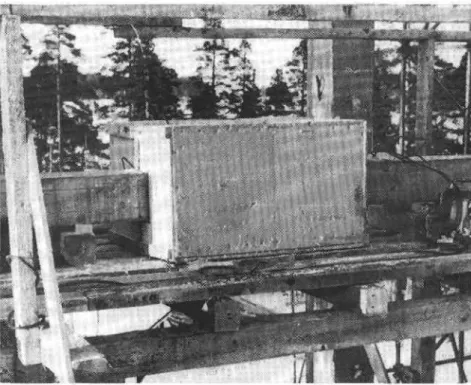
Fig. 4. Joints fibreboard box
m a d e could
with cast-in-place concrete require winter protection. This be heated with a single electric light bulb.
joints are made by splicing the ends to be joined with reinforced concrete rvhich is cast-in-place. In such a joint the compressive loads are carried by the concrete filling, while the tensile loads are transferled through the leinforcement which is spliced, or by bond between the reinfolced concrete splioe and the precast units.
An ideal joint design for precast concrete framing should satisfy three majol requirements:
(1) The joint should provide bend-ing moment strength to the maximum possible extent; (2) It should be economical, with
the least possible use of extra steel and labour; and
(3) The joint should allorv exact plumbing of a column after it htrs been elected.
\4irximum mornent resistance is pirr-ticular-ly desilable fol large ware-houses nnd industrial buildings, be-cause it is most often very difficult to obtain lateral stability in any other rvay than by fixing the columns to theil foundrrtions. To obtain this maximum rigidity, the reinfolcing steel ovel and under the joint should be mtrde continuous as far as possible. This is most easily achieved by means of rvelding; it is easier to obtain the desired quaiity when all of the steel leinforcement is marked accordinq to steel tlpe arrd vield strength.
To reduce the amount of extrl steel lequiled, footplates, for example,
should be made as thin as possible and should not be depended on to transfer bending stresses except in the initial stages before final welds ale made or filling concrete added. In wintertime, it is a definite advantage to have a rigid metal joint which is capable of taking the construction loads without the assistance of the filling concrete. This concrete can be added at a later m'ore convenient time after the build-ing is closed in. In most instances, the labour involved in making the joint is more significant than the extra rnatelial used. Erection time is very expensive and should be kept to an absolute minimum.
For most parts of Canada the rigid metal joint is the most attractive for winter construction projects, but it is also the most expensive. For this reason, one of the other joint systems is genelally used and provision made to ensure that no fi'ost damage occurs to the glout alound the joints. A good glouted joint is often harder to achieve than genelally believed. Frozen membels must be heated befole the grout is applied. Some engineers believe that porous members can absorb even the water reouired fol hydlation of the cement. Tempera-tule, shrinkage, and loading move-ments are often ignored. Early failures of grouted systems have been attri-buted to one or other of these condi-tions. Some designers ffnd it an advantage to use a cast-in-place core
for stability. This elirnilrates rny uncertainties about joints between the precast members, and has been shown to fft in particularly well with the genelal contractor''s opelirtion. Canadian Practice
There are approximately 20 manu-factulers in Canada who produce stluctulal precast and prestressed concrete. Over half of them ale to be found in or near M'ontreal or' Toronto. Although the greater part of their business is still done in hollow cored and double T floor and loof slabs, a few have now incleased theit' regulal production to stluctulal frame-lvorks, sandwich panel walls, and Iarge alchitectural {acing slabs. Some extend their field of ooelations by site-casting and post-tensioning out-side their own area. Precasting is now tr $25 million a yeal busiless. All the companies report thirt each year''s plo-duction is higher than that for the previous year. One company has in-creased its production six-fold in thlee years.
A lack of standardization has kept the industry fiom enjoying the full beneffts of factory precasting. Com-petition is keen, and because of this manufactulels are folced to work very close to design limits. These problems are recognized by the industry but there is some reluctance to establish standald sections on the gr'ounds that such action may restrict the
develop-ment of this relatively young, rapidly expanding industry.
Canadian designers confirm the ad-vantages of precast conqrete for winter construction. In older to make the best use of the precasting method, a designer should be able to co-ordinate architectule and structure. He should have a basic knowledge of the manu-facturing processes as well as the construction operations and the equip-ment used to handle precast compon-ents. Bettel than average supervision of the job must be provided. In short, all the problems facing architect, engineer, manufactuler, and contrac-tor must be considered in the very early design stages. This collabolation encoulages new thinking; in many cases the savings resulting from a new method of apploach have ex-ceeded those forecast for the pre-casting method itself.
Conclusion
The use of precasting czrn limit on-site concreting operations in win-teltime to the making of the foints between the precast parts. It can halve construction time and ensur-e top quality products. Not unnatulally its use is expanding rapidly in Can-ada. Much of the production of Cana-dian plants is still restricted to floor arrd roof panels. but to an incleasing extent structural membels such as beams, columns, arches, pullins, and Iotrd-bearing wall sections are being
produced. Full development of this new industry would seem to be le-stricted by the lack of information in the offices of engineers and archi-tects, and by some hesitation on thc prrrt of designers and contractors to full consideration of this new method arrd the necessal'y techniques.
As with all building materials, tl'rele is still a great deal to learn about Dre-cast concrete but this need has been recognized. The American Society of Civil Engineers and the American Concrete Institute have formed a joint committee to study it. One of the ffr'st projects to be undertaken by this new "Committee 772" will be an investi-gation of joint systems for use be-tween structulal precast members. Flom such studies, an increasing fund of knowledge will be accumulated for' the use of designers in this country. In the meantime, there is sufficient evidence already available to show that plecast concl'ete has aD import-trilt plag. il Canadian wintertime con-struction, a pltrce long established in northern Europe and Russia. Acknowledgements
The authors wish to express their' thanks to all the engineers, architects, contl'actors and manufacturers in Can-ada, the United States, and Great Blitain who gave so generously of theil time and experience in discus-sions and whose commenrs are sum-rn:rrized in this paper.
This paper is a contribution from the Diaision of Builditry Rcsearch, NatiorutL Researclt Coutu'il Ltf Carruda antl is prrlr lished u;ith th.e approoal of the Director of the Diaision.
Selected Bibliography
Barets, M. Heavy Prefabrication in France, Prefabrication and New Building, Vol. 3, No. 29: 219-225. 1956.
Billig, K. Precast Concrete. D. Van Nos-s t r a n d C o . I n c . N . Y . : 3 4 1 . 1 9 5 5 . Collborg, H. Mass Production of
Prestress-ed Structural Concrete in Sweden. Journ-al American Concrete Institute, Vol. 27, N o . 7 : 7 8 1 - 7 9 0 1 9 5 6 .
Collins, F. T Manual of Tilt-up Construc-tion. 4th Ed. 1955.
Crocker, C. R. Winter Construction Engi-neering Journal, Vol. 41, No. 2: 43-49. 1958.
Matthews, D. D. Trends in Structural Pre-Cast Concrete. Institution of Structural Enqineers, 50th Anniversary Conference, London, October 1958.
Piper. J. D. and W. H. Price. Russian Pro-g r e s s i n C o n c r e l e T e c h n o l o Pro-g y . J o u r n a l A m e r i c a n C o n - r e t e I n s t i t u t e . V o l . 3 0 , N o . 1 0 : 1 0 7 5 - 1 0 8 8 . 1 9 5 9 .
Precast Concrete-A Survey of Current U.S. Practice with Emphasis on Pre-stressing. Architectural Record, Vol. 119, N o . ? : 2 1 5 - 2 1 9 1 9 5 6 .
Rensaa, E. M. Precast Reinforced Concrete Ruilding I'rames. Engineering Journal,
V o t . 3 5 I N o . 5 : 4 ? 7 - 4 8 2 - . 1 9 5 2 .
-Fig. 5. Factory storage under cover avoids on-site storage ploblems in winter and allows complete curing in controlled conditions.