Discourse Topic and Gestural Form
The MIT Faculty has made this article openly available.
Please share
how this access benefits you. Your story matters.
Citation
Jacob Eisenstein, Regina Barzilay, and Randall Davis. 2008.
Discourse topic and gestural form. In Proceedings of the 23rd
national conference on Artificial intelligence - Volume 2 (AAAI'08),
Anthony Cohn (Ed.), Vol. 2. AAAI Press 836-841. © 2008, Association
for the Advancement of Artificial Intelligence
As Published
http://dl.acm.org/citation.cfm?id=1620163.1620202
Publisher
Association for Computing Machinery (ACM)
Version
Final published version
Citable link
http://hdl.handle.net/1721.1/87042
Terms of Use
Article is made available in accordance with the publisher's
policy and may be subject to US copyright law. Please refer to the
publisher's site for terms of use.
Discourse Topic and Gestural Form
Jacob Eisenstein and Regina Barzilay and Randall Davis
Computer Science and Artificial Intelligence LaboratoryMassachusetts Institute of Technology Cambridge, MA 02139
{jacobe,regina,davis}@csail.mit.edu
Abstract
Coverbal gesture provides a channel for the visual ex-pression of ideas. While some gestural emblems have culturally predefined forms (e.g., “thumbs up”), the re-lationship between gesture and meaning is, in general, not conventionalized. It is natural to ask whether such gestures can be interpreted in a speaker-independent way, or whether gestural form is determined by the speaker’s idiosyncratic view of the discourse topic. We address this question using an audiovisual dataset across multiple speakers and topics. Our analysis employs a hierarchical Bayesian author-topic model, in which gestural patterns are stochastically generated by a mix-ture of speaker-specific and topic-specific priors. These gestural patterns are characterized using automatically-extracted visual features, based on spatio-temporal in-terest points. This framework detects significant cross-speaker patterns in gesture that are governed by the dis-course topic, suggesting that even unstructured gesticu-lation can be interpreted across speakers. In addition, the success of this approach shows that the semantic characteristics of gesture can be detected via a low-level, interest point representation.
Introduction
Coverbal gesture supplements speech with a visual represen-tation of the underlying discourse semantics. While some gestural emblems have culturally predefined forms (e.g., “thumbs up”), the relationship between gesture and meaning is, in general, unstructured. In contrast to language, gesture is not organized grammatically and the majority of gesture patterns do not come from a predefined lexicon (McNeill 1992). Thus, it is natural to ask whether and how gestures reflect the topic of discourse.
While gesture conveys discourse information, its form may be idiosyncratic to the speaker. If multiple speakers employ their own distinct gestural patterns for a given topic, then it would be difficult to leverage gesture in a speaker-general way. Indeed, previous work on multimodal dis-course analysis has applied gesture in a speaker-specific fashion (e.g., Eisenstein and Davis 2007). The speaker-specificity of gesture has theoretical implications as well,
Copyright c 2008, Association for the Advancement of Artificial Intelligence (www.aaai.org). All rights reserved.
shedding light on the question of how human viewers ex-tract content from co-speech gesture. Empirical research finds that viewers are sensitive to the relationship between gesture and semantics (Kelly et al. 1999), suggesting either that gestural form is not entirely idiosyncratic, or that view-ers dynamically build a speaker-specific model of gesture over the course of a conversation. Our research attempts to quantify the topic- and speaker-dependence of gesture from automatically extracted visual features.
The relationship between gestural form and meaning is an open question in psychology and cognitive science. In-deed, the extent to which co-speech gesture affects listen-ers’ comprehension is a subject of debate (Kelly et al. 1999; Krauss 2001; McNeill 1992). Many researchers have fo-cused on a micro-scale study of individual gestures and their relationship to discourse structure and semantics (Quek et al. 2002). An important complementary approach would be to investigate this phenomenon across a broad range of speakers and discourse topics, which is possible only with automated methods that can easily be applied to multiple speakers and topics.
In this paper, we present an unsupervised technique for automatically quantifying the extent to which the gestu-ral forms in a dataset are shaped by speaker-specific and topic-specific factors. The approach is driven by a new characterization of gesture in terms of spatiotemporal in-terest points (Laptev 2005): a robust, low-level represen-tation that can be extracted from multiple videos without manual intervention. These interest points are then clustered into a lexicon of gestural “codewords,” and the distribution of codewords across speakers and topics forms the back-bone of our analysis. We employ a hierarchical Bayesian author-topic model, which learns a lexicon of gestural forms, while jointly learning to associate lexical items with specific speakers and topics.
We find that discourse topic exerts a consistent influence on gestural form, even across speakers. This finding is based on both the Bayesian model and traditional frequentist anal-ysis, using a corpus of 33 short videos in which multiple speakers describe each of five topics. Both tests indicate that a significant proportion of gestural features are produced in a topic-specific, speaker-general fashion.
Related Work
A large body of prior research addresses the relationship be-tween gesture and meaning. For instance, McNeill (1992) and Kendon (2004) explore the semantic relevance of in-dividual gestural forms, as described by human annotators. Automatically extracted visual features can also be used to aid such an analysis (Quek et al. 2002). However, we are aware of little prior work quantitatively comparing the dis-tribution of gesture forms across speakers and topics, though the literature contains a few relevant qualitative studies. Mc-Neill (1992) explores variability in gesture location and hand shape across six speakers, demonstrating significant inter-speaker variation. He also presents examples showing that the use of individual handshapes is motivated by the seman-tics of the utterance, suggesting that a given topic could be predisposed to specific gestural forms. Analyzing the rela-tionship between gestures and visual metaphors among four speakers, Webb (1996) finds commonalities in the gestu-ral expression of certain ideas. We extend this work with a quantitative analysis of the relationship between gestural form and topic.
Author-topic models
The Bayesian model that we employ is inspired by the author-topic model of Rosen-Zvi et al. (2004). In their model, each author induces a distribution of topics, which in turn induces a distribution over words. Rather than mod-eling the distribution of words, we model the distribution of gestural forms, which are organized into a lexicon in a joint clustering step. Another important difference is that for Rosen-Zvi et al., topics were hidden, while in our case they are known. Thus, in our model, both topics and authors induce distributions over codewords, and a hidden auxiliary variable determines the distribution from which each code-word is drawn, given the author and topic.
Spatiotemporal Interest Points for Gesture
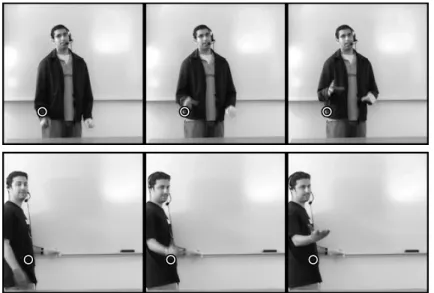
We employ visual features that describe motion at a sparse set of spatiotemporal interest points (Laptev 2005). Inter-est points are defined as high-contrast image regions – es-pecially corners and edges – that undergo complex motion. Two examples of interest points detected in our dataset are shown in Figure 1. Both show the hand moving up out of rest position against a black background; these two interest points are clustered together by our model, as described in the next section.At each detected interest point, the visual, spatial, and kinematic characteristics are concatenated into high-dimension feature vectors. Principal component analysis (PCA) is applied to reduce the dimensionality to a man-ageable size (Bishop 2006); the resulting transformed ture vectors comprise the final representation of gestural fea-tures.
This approach is motivated by techniques from the com-puter vision task of activity recognition (Efros et al. 2003). The goal of activity recognition is to classify video se-quences into semantic categories: e.g., walking, running, jumping. As a simple example, a classifier may learn that
a key difference between videos of walking and jumping is that walking is characterized by horizontal motion and jumping is characterized by vertical motion. Spurious verti-cal motion in a walking video is unlikely to confuse the clas-sifier as long as the large majority of interest points move horizontally. Our hypothesis is that just as such low-level movement features can be applied in a supervised fashion to distinguish activities, they can be applied in an unsuper-vised fashion to group co-speech gestures into perceptually meaningful clusters.
We apply the Activity Recognition Toolbox (Doll´ar et al. 2005)1to detect spatiotemporal interest points in our dataset. At each interest point, we consider a small space-time vol-ume of nearby pixels and take the brightness gradient in the temporal and spatial dimensions. This representation cap-tures local spatial and temporal characteristics of the mo-tion in the video. The spatial posimo-tion of the interest point is added to the feature vector, which is then reduced using PCA.
This visual feature representation is at a lower level of ab-straction than the usual descriptions of gesture form found in both the psychology and computer science literatures. For example, when manually annotating gesture, it is common to employ a taxonomy of hand shapes and trajectories, and to describe the location with respect to the body and head (Mc-Neill 1992; Martell 2005). A similar set of attributes is used in the formal semantics of gesture of Lascarides and Stone (2006). Working with automatic hand tracking, Quek et al. automatically compute perceptually-salient gesture features, such as holds (Bryll, Quek, & Esposito 2001) and oscillatory repetitions (Xiong & Quek 2006).
In contrast, our visual feature representation is a vector of continuous values and is not easily interpretable in terms of how the gesture actually appears. However, this low-level approach offers several important advantages. Most crit-ically, it requires no initialization and comparatively little tuning: it can be applied directly to any video with a still camera and static background. Second, it is robust: while image noise may cause a few spurious interest points, the majority will guide the system towards an appropriate char-acterization of the gesture. In contrast, hand tracking can become irrevocably lost, requiring manual resets (Gavrila 1999). Finally, the success of similar low-level interest point representations at the activity-recognition task provides rea-son for optimism that they may also be applicable to unsu-pervised gesture analysis.
Gestural Lexicon and Author-Topic Model
To assess the relative contributions of speaker and topic to the form of the gesture, we employ a hierarchical Bayesian model (Gelman et al. 2004). The model induces a clustering over gesture features and determines whether each feature is generated by the speaker or the topic. This determination is governed by a hidden parameter, whose value we infer in an unsupervised fashion.The model assumes a sparse representation, in which gesture is characterized by a set of spatiotemporal interest
1
Figure 1:The two rows show examples of interest points that were clustered together by our model; both show the hand moving up out of rest position against a dark background. The center column shows the frame in which the interest point is detected; the left and right columns are 5 frames (166 milliseconds) before and after, respectively.
points, each defined by a real-valued tuple. Each interest point is assumed to be generated from a mixture model. In-terest points that are generated by the same mixture compo-nent should be visually similar. These compocompo-nents serve as cluster centers and are called gestural “codewords” – Fig-ure 1 shows two examples of a single codeword, indicating upward motion against a dark background. The sufficient statistics of the mixture components are shared across all di-alogues; however, the component weights vary by both topic and speaker. In this way, the model learns a global lexicon of visual forms, while jointly learning a distribution of visual forms with respect to speaker and topic.
The distribution over components for each speaker and topic is represented by a multinomial distribution; a hid-den auxiliary variable decides whether each codeword is drawn from the speaker-specific or topic-specific distribu-tions. The parameter governing this hidden variable indi-cates the model’s assessment of the relative importance of speaker and topic for gestural form.
The plate diagram for the model is shown in Figure 2. Each of the D dialogues is characterized by Ndvisual fea-tures, which are written xd,i. Each visual feature vec-tor xd,i is generated from a multivariate Gaussian, xd,i ∼ N (µzd,i, σzd,i), where zd,i indicates the codeword and σ
is a diagonal covariance matrix. This induces a stan-dard Bayesian mixture model over gesture features (Bishop 2006). Each zd,i is drawn from either a speaker- or topic-specific multinomial, depending on the auxiliary variable cd,i. If cd,i = 0, then zd,i ∼ φsd, where sdis the identity
of the speaker for document d. If cd,i = 1, then zd,i ∼ θtd,
where tdis the topic of document d. The distribution of c is governed by a binomial distribution with parameter λ.
Weakly informative conjugate priors are employed for all model parameters (see Gelman et al., 2004). Specifically, the parameters µ and σ are drawn from a
Normal-Inverse-xd,i Nd D zd,i cd,i μj σj K sd td φs θt S T μ0 σ0 φ0 θ0 λ0 λ
Figure 2:A plate diagram showing the dependencies in our model. Filled circles indicate observed variables, empty circles indicate hidden variables, and rounded rectangles indicate priors.
Wishart distribution centered at the mean and variance of the observed data (Bishop 2006). The multinomials φ and θ are drawn from symmetric Dirichlet priors, with parameter φ0 = θ0 = .1. The binomial parameter λ is drawn from a weakly informative beta prior with parameters (.1, .1). As shown below, the use of conjugate priors ensures that stan-dard closed-form posteriors can be easily found.
Our goal is to learn the relative importance of speaker ver-sus topic, captured in the posterior distribution of the pa-rameter λ, given observed data x, s, d. We employ Gibbs sampling, a widely-used and easily-implemented technique for inference in hierarchical Bayesian models (Gelman et al. 2004), which successively samples over the posterior for each hidden variable with respect to the rest of the model configuration. After initializing the parameters ran-domly, Gibbs sampling is guaranteed in the limit to
con-verge to the true distribution over the hidden variables, p(z, c, µ, σ, λ, φ, θ|x, s, t). We can then use the set of sam-ples to construct Bayesian confidence intervals for λ.
Sampling Distributions
Gibbs sampling requires posterior sampling distributions for all of the hidden variables. Rao-Blackwellization(Bishop 2006) is used to reduce sampling variance by integrating out the parameters θ, φ, µ, σ and λ. This is possible through the use of conjugate priors. Thus we need sample only the hid-den variables z and c.
We write p(zd,i| . . .) to indicate the probability distribu-tion of zd,i given all the variables in the model; z−(d,i) denotes all z except zd,i. Finally, N (zd,i, td, cd,i) denotes the count of times the codeword zd,i was drawn from the topic-specific distribution for topic td. This is computed as P
d0≤Dδ(t0d, td)Pi0≤N
d0δ(zd
0,i0, zd,i)δ(cd0,i0, cd,i), where
the delta function takes the value one if the arguments are equal, and zero otherwise.
p(zd,i= j| . . .) ∝ p(xd,i|µ(j), σ(j))p(zd,i= j|cd,i, φ(sd), θ(td))
(1) p(zd,i= j|cd,i, φ (sd) , θ(td)) = ( φ(sd) j if cd,i= 0 θ(td) j if cd,i= 1,
where φ(sd)is the multinomial distribution indexed by the
speaker sd, and φ
(sd)
j is the entry for zd,i = j in that distri-bution. Integrating out the parameters µ and σ from the first part of equation 1, we obtain a student-T distribution, which may be approximated by a moment-matched Gaussian (Gel-man et al. 2004). Integrating out the parameters φ and θ, we obtain,
p(zd,i= j|cd,i, z−(d,i), sd, td, φ0, θ0) ∝
Z dφdθp(zd,i= j|cd,i, φ(sd), θ(td))× p(φ(sd)|z −(d,i), φ0)p(θ(td)|z−(d,i), θ0) = Z dφdθ(φ(sd) j δ(cd,i, 0) + θ (td) j δ(cd,i, 1))× p(φ(sd)|z −(d,i), φ0)p(θ(td)|z−(d,i), θ0) =δ(cd,i, 0) Z φ(sd) j p(φ (sd)|z −(d,i), φ0)dφ+ δ(cd,i, 1) Z θ(td) j p(θ (td)|z −(d,i), θ0)dθ (2) =δ(cd,i, 0) N (j, sd, cd,i= 0) + φ0 N (., sd, cd,i= 0) + Kφ0 + δ(cd,i, 1) N (j, td, cd,i= 1) + θ0 N (., td, cd,i= 1) + Kθ0 (3)
The derivation of line 3 from line 2 follows from standard Dirichlet-Multinomial conjugacy (Gelman et al. 2004), en-abling us to compute the posterior probability of zd,i in a ratio of counts. Sampling c is more straightforward:
p(cd,i|c−(d,i), zd,i, λ0) ∝
p(zd,i|cd,i, z−(d,i), td, sd, φ0, θ0)×
Z
p(cd,i|λ)p(λ|c−(d,i)λ0)dλ
The first part of the product is defined above. The integral can be handled analogously, as Beta-Binomial conjugacy is a special case of Dirichlet-Multinomial conjugacy,
Z
p(cd,i|λ)p(λ|c−(d,i)λ0)dλ =
N (cd,i) + λ0
N + 2λ0
. (4)
As both zd,iand cd,iare categorical variables, we can con-sider all possible pairs of values, thus sampling from z and c jointly. These parameters are tightly coupled, and sampling them together substantially speeds convergence. The joint sampling distribution is given by,
p(zd,i, cd,i| . . .) =
p(zd,i|cd,i, z−(d,i), sd, td, φ0, θ0)p(cd,i|c−(d,i), λ0),
where the first part of the product is defined in equation 3 and the second part is defined in equation 4.
Implementation Details
Our model includes four tunable parameters: the number of iterations of Gibbs sampling to run, the number of interest points to extract, the number of mixture components K, and the dimensionality of the gesture features after PCA.
Gibbs sampling is performed along five parallel runs for 15000 iterations each. The first 5000 iterations are consid-ered a “burn-in” period, and confidence intervals are esti-mated from the remaining 10000. The number of interest points extracted is set to 1/10 the number of frames in each video; on average, 390 interest points were extracted per video. The number of components was set to 100, and the dimensionality of the gesture features after PCA was set to 5. These parameter settings were determined before the ex-periments were run, and were chosen based on speed and memory availability. In general, these settings impact the gesture clustering and do not directly affect the assignment of codewords to the speaker or topic; however, alternative settings may be considered in future work.
Dataset
The dataset for our experiments includes 33 short videos of dialogues, in which fifteen speakers describe one of a total of five different topics. There were between one and three videos of each speaker. Speakers were recruited on a uni-versity campus, and ranged in age from 18 to 32. All were native or fluent speakers of English.
Dialogues were limited to three minutes in duration and consist of a conversation between friends; the experimenters were not present in the room. One participant, whom we will call A, was informed of the discourse topic in advance
and was required to explain it to participant B, who was later tested for comprehension. A was instructed to stand, while Bsat. Both participants were permitted to speak, but not to draw examples; other visual references were not provided. Participants were not instructed to gesture, though all did so.
The topics for discussion consisted of a short “Tom and Jerry” cartoon and simulations of four mechanical devices: a piston, a candy dispenser, a pinball machine, and a toy. Only participant A knew any details about the topic prior to the conversation. We chose to emphasize mechanical de-vices because it seemed likely that direct gestural metaphors emphasizing the structure and motion of the device would be shared across speakers. We believe that such concrete discourse topics represent a best case scenario for finding speaker-general gestural forms. Whether our results extend to topics in which the gestural metaphors may be more id-iosyncratic is an important question for future work.
Videos were recorded using camcorders; participants wore colored gloves, which were used in another study in-volving hand tracking, but not in this work. No video post-processing was performed. Only the video of participant A was used in our experiments here. The dataset is described in more detail by Eisenstein (2008).
Experimental Setup
The first experiment involves estimating the number of ges-tural features that are generated in a topic-specific manner, using the model described in the previous sections of the paper. We note that even if there were no topic-specific, speaker-general patterns in gesture in our corpus, the topic-specific model θ might be used to overfit the data. To ac-count for this, we ran five baseline conditions in which the topic indicators for the documents were randomly shuffled, with the goal of isolating the extent to which the topic-specific model can be used to overfit. We then assess whether the topic-specific model of gestural forms is used significantly more frequently in conjunction with the true document topics than with the random topic assignments.
Just as in text, lexical distributions are indicative of dis-course topic (Hearst 1994); thus, it may be profitable to ex-amine the distribution of gestural “codewords” across topics. Our model builds a lexicon of gestures by clustering gesture features; this is done jointly with the assignment of gesture features to speakers and topics. Such a joint model is advan-tageous because it is possible to integrate over uncertainty in the clustering, rather than propagating the effects of a bad clustering decision to the other stages. However, it is illus-trative to consider the maximum a posteriori (MAP) clus-tering induced by the model (Bishop 2006) and investigate how the distribution of cluster tokens varies by topic. To this end, our second experiment performs chi-squared anal-ysis of the distribution of cluster membership, with respect to both topic and speaker.
Results
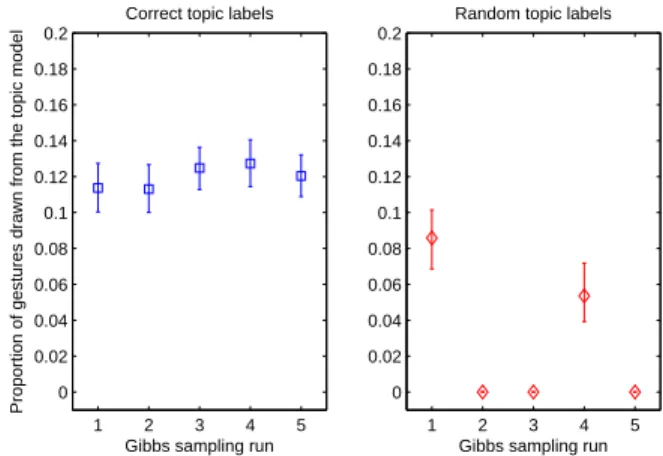
The results of the first experiment are shown in Table 1 and Figure 3. With the correct topic labels, 12% of gestures are
condition mean upper lower
true topic labels .120 .136 .103
random topic labels .0279 .0957 0
Table 1: Proportion of gestures assigned to the topic-specific model, with 95% confidence intervals
1 2 3 4 5 0 0.02 0.04 0.06 0.08 0.1 0.12 0.14 0.16 0.18 0.2
Proportion of gestures drawn from the topic model
Gibbs sampling run Correct topic labels
1 2 3 4 5 0 0.02 0.04 0.06 0.08 0.1 0.12 0.14 0.16 0.18 0.2
Gibbs sampling run Random topic labels
Figure 3: Proportion of gestures assigned to the topic model, per run.
classified as topic-specific. When the topic labels are cor-rupted, this average drops to less than 3%. Thus, the model uses the topic-specific codeword distributions mainly when the topic labels are actually informative, supporting the hy-pothesis of a connection between discourse topic and gestu-ral form that transcends individual speakers.
Bayesian confidence intervals constructed from the sam-ples show that these differences are robust. As indicated in Table 1, the confidence intervals for the randomized condi-tions is much larger. This is expected, as each randomiza-tion of topic labels varies from the true labels to a different extent. Figure 3 illustrates this situation, showing the con-fidence intervals from each randomized run. In the topic-randomized condition, there is substantial between-run vari-ance; in three of the runs, the topic exerts no influence what-soever. In contrast, in the condition with correct topic labels, the influence of the topic-specific model is consistently in the range of 12%.
Next, we analyze the influence of topic and speaker on gestural form using the classical chi-squared test. We find the maximum a posteriori (MAP) gesture feature clustering by selecting the iteration of Gibbs sampling with the high-est likelihood.2 The chi-squared test is used to determine whether the distribution of clusters differs significantly ac-cording to topic and speaker (De Groot & Schervish 2001).
2In sampling-based inference, MAP estimates are often found
by taking a mean or mode over multiple samples. However, in the case of estimating a clustering, this technique suffers from non-identifiability. For example, two data points may appear in many different clusters, though usually together. However, their modal cluster memberships may differ, causing them to be separated in the MAP estimate.
Strong effects were found for both topic and speaker. For topics, p < .01, χ2 = 1.12 ∗ 104, dof = 439.3 For speak-ers, p < .01, χ2 = 5.94 ∗ 104, dof = 1319. While the chi-squared values are not directly comparable – due to the different degrees of freedom – this experiment indicates an important effect from both the topic and speaker.
Discussion
The results support the existence of topic-specific gestural forms that are shared across speakers. The frequency of such shared gestural forms is likely influenced by both the popu-lation of speakers and the topics of discussion. The speakers in our dataset are all American residents and fluent speakers of English. The extent to which gestural forms are shared across cultures is a key topic for future research. We are also interested to study whether gestural forms are shared when the discourse topics are less concrete: do multiple speakers use similar gestures when talking about, say, their circle of friends, or their ideas on politics?
But while our dataset was designed to encourage speaker-general gestures, we believe that any automatic vision-based technique for gesture analysis is likely to overstate speaker-specific factors. This is because it is difficult, if not impossi-ble, to abstract away all features of the speaker’s appearance. The principal visual features that we leverage are brightness gradients and the location of movement. Brightness gradi-ents are influenced by the speaker’s skin tone and clothing; location of movement is influenced by anatomical factors such as the speaker’s height. Thus, the likelihood of such visual features being clustered in a speaker-dependent man-ner is artificially inflated. We believe that with the devel-opment of robust vision techniques that describe gesture’s visual form on a more abstract level, future work may show that topic exerts a greater influence than reported here.
Other extensions to the interest-point based characteriza-tion of gesture are possible. Our representacharacteriza-tion of gesture focuses on individual, local visual features. This is suffi-cient to describe a range of gestural forms, such as hand-shapes and paths of motion. However, it does not account for higher-level phenomena, such as when both hands move in a synchronized or anti-synchronized fashion. Rather than assigning codewords to individual, local visual features, it may be advantageous to consider sets of local features that frequently co-occur. Such an approach may result in a char-acterization of gesture that better coheres with human per-ception.
Finally, we consider this research to be an early example of a new methodology for studying the communicative role of gesture. Previous techniques relying on hand annotation have focused on close analysis of a small number of partic-ularly illustrative gestures. We believe that automated tech-niques, as described in this paper, offer a complementary ap-proach, potentially enabling the study of gesture across large populations under a variety of conditions. In the future, we hope to consider more fine-grained and structured
represen-3
Clusters with fewer than five examples were excluded, as the chi-squared text is not accurate for small bin values. Thus, the number of degrees of freedom is less than the expected KT − 1.
tations of dialogue semantics, which may shed further light on the interaction between gesture, speaker, and meaning.
References
Bishop, C. M. 2006. Pattern Recognition and Machine Learning. Springer.
Bryll, R.; Quek, F.; and Esposito, A. 2001. Automatic hand hold detection in natural conversation. In IEEE Workshop on Cues in Communication.
De Groot, M. H., and Schervish, M. J. 2001. Probability and Statistics. Addison Wesley.
Doll´ar, P.; Rabaud, V.; Cottrell, G.; and Belongie, S. 2005. Be-havior recognition via sparse spatio-temporal features. In ICCV VS-PETS.
Efros, A. A.; Berg, A. C.; Mori, G.; and Malik, J. 2003. Recog-nizing action at a distance. In Proceedings of ICCV, 726–733. Eisenstein, J., and Davis, R. 2007. Conditional modality fusion for coreference resolution. In Proceedings of ACL, 352–359. Eisenstein, J. 2008. Gesture in Automatic Discourse Processing. Ph.D. Dissertation, Massachusetts Institute of Technology. Gavrila, D. 1999. Visual analysis of human movement: A survey. Computer Vision and Image Understanding73(1):82–98. Gelman, A.; Carlin, J. B.; Stern, H. S.; and Rubin, D. B. 2004. Bayesian data analysis. Chapman and Hall/CRC.
Hearst, M. A. 1994. Multi-paragraph segmentation of expository text. In Proceedings of ACL.
Kelly, S.; Barr, D.; Church, R.; and Lynch, K. 1999. Offer-ing a Hand to Pragmatic UnderstandOffer-ing: The Role of Speech and Gesture in Comprehension and Memory. Journal of Memory and Language40(4):577–592.
Kendon, A. 2004. Gesture: Visible Action as Utterance. Cam-bridge University Press.
Krauss, R. 2001. Why do we gesture when we speak? Current Directions in Pschological Science7(54-59).
Laptev, I. 2005. On space-time interest points. International Journal of Computer Vision64(2-3):107–123.
Lascarides, A., and Stone, M. 2006. Formal Semantics for Iconic Gesture. In Proceedings of the 10th Workshop on the Semantics and Pragmatics of Dialogue (BRANDIAL), 64–71.
Martell, C. 2005. FORM: An experiment in the annotation of the kinematics of gesture. Ph.D. Dissertation, University of Pennsyl-vania.
McNeill, D. 1992. Hand and Mind. The University of Chicago Press.
Quek, F.; McNeill, D.; Bryll, R.; Duncan, S.; Ma, X.; Kirbas, C.; McCullough, K. E.; and Ansari, R. 2002. Multimodal human discourse: gesture and speech. ACM Transactions on Computer-Human Interaction9:3:171–193.
Rosen-Zvi, M.; Griffiths, T.; Steyvers, M.; and Smyth, P. 2004. The author-topic model for authors and documents. In Proceed-ings of Uncertainty in artificial intelligence (UAI), 487–494. Webb, R. 1996. Linguistic features of metaphoric gestures. Ph.D. Dissertation, University of Rochester.
Xiong, Y., and Quek, F. 2006. Hand Motion Gesture Frequency Properties and Multimodal Discourse Analysis. International Journal of Computer Vision69(3):353–371.