RURAL NOMADIC FULBE BOYS’ PRIMARY SCHOOLING: ASSESSING REPERTOIRES OF PRACTICE IN NIGERIA
LANTANA USMAN University of Northern British Columbia
ABSTRACT.In recent years, educational policies for boys have not been given
as much attention as those for girls in most countries in Sub-Saharan Africa. Rural Nigerian nomadic boys are especially disadvantaged, considering their livelihood is based on a pastoral economy that demands constant migration to interior grasslands in search of pasture. For a more inclusive approach, the federal government of Nigeria promulgated and implemented the Nomadic Educational Policy (NEP). Despite these accommodations, existing school practices affect the boys’ access, attendance, and completion of primary schools.
The article elucidates how and why Fulbe nomadic boys are still “left behind” at the primary education level despite specific educational policy developments. This discussion is based on analyzed data and past qualitative study with the boys, and re-situates the nomadic boys’ schooling experiences within some selected learning theories (Bandura, 1977; Maslow, 1971) and discussions of boys’ learning (Epstein, 1998; Gilbert & Gilbert, 1998). The paper concludes with suggestions for policy makers, teachers, and parents to minimize the challenges affecting boys in primary schools.
ÉDUCATION PRIMAIRE DES GARÇONS DU PEUPLE FULBE, NOMADES ET RURAUD : ESTIMATION DES RÉPERTOIRES DE PRATIQUE AU NIGERIA
RÉSUMÉ. Ces dernières années, les politiques d’éducation des garçons ne font
pas l’objet d’autant d’attention que celles touchant les filles en Afrique subsa-harienne. Les garçons nomades du Nigeria sont particulièrement désavantagés étant donné que leur mode de vie est fondé sur une économie pastorale qui exige une migration constante vers les terres des prairies de l’intérieur, à la recherche de pâturage. Pour mettre en place un système plus inclusif, le gou-vernement fédéral du Nigeria a adopté une politique d’éducation des peuples nomades. Malgré ces efforts, les pratiques des écoles ont une incidence néga-tive sur l’accès des garçons à la scolarisation, sur leur présence en classe et sur leur achèvement du cours primaire.
L’auteur explique pourquoi et comment les garçons du peuple nomade Fulbe ne reçoivent pas une éducation primaire convenable malgré les politiques qui
ont été mises en place à cette fin. Le débat se fonde sur les données analy-sées et sur d’anciennes études qualitatives. Il replace l’éducation des garçons nomades dans le contexte de certaines théories de l’apprentissage (Bandura, 1977; Maslow, 1971) et de certains propos sur l’apprentissage des garçons (Epstein, 1998; Gilbert et Gilbert, 1998). En conclusion, l’auteur formule des propositions pour les décideurs, les enseignants et les parents afin de réduire les défis que doivent relever les garçons à l’école primaire.
I
n most countries in Sub-Sahara Africa, the pre-schooling of children in urban and rural areas is not supported by the government, but depends upon community initiatives and parental support (FRN, 1993). Hence, in this region, primary education is officially considered the first level of education (Lloyd & Hewett, 2003). Despite government support, issues of imbalance regarding enrolment, completion, and achievement between boys and girls have been and are still subjects of debate and criticism directed toward educational policies (Hegelsson, 2001). Between the 1960s and late 1970s, states across Sub-Sahara Africa embarked on capacity building for primary schools with the financial support of multilateral organizations, such as UNESCO and the World Bank (UNESCO, 1971). Thirty years later, the outcome of such progressive initiatives revealed that few boys in the sub-region complete primary school level of education when compared with girls (Lloyd & Hewett, 2003, p. 16).Nigerian national primary school statistics from late 1980s to date reveal that boys from northern rural regions of the country are most affected by under-enrolment and non-completion (Bello, 2005; Bray, 1981; Francis, 1998). Recently, northern Nigerian indigenes and policy makers expressed concern in local newspapers (Ado-Kurawa, 2003) and websites (Ismail, 2005; Tilde, 2005) that boys are educationally left behind in the region. Other literature indicates that rural Muslim Hausa and Fulbe boys experience lower rates of enrolment and completion of primary education as compared to other ethnic tribes in rural and urban areas in the region (Adamu, 1973; Bray, 1981). The federal, state, and local governments’ negligence of boys’ primary school enrolment in northern Nigeria caught the attention of the World Bank in June 2005, with the visit of its president Mr. Wolfowitz to the northern part of Nigeria (Time Magazine, 2005). The aim of his visit was the inspection of renovated primary schools funded by the Bank. The visit revealed dis-turbing scenes, as most renovated classrooms had few male students (Time Magazine, 2005). Half of the public onlookers observing the president’s visit were primary school age boys in tattered clothes, with some holding begging bowls rather than being a part of the student population (Time Magazine, 2005). This scenario provoked debates and comments by some Northern Nigerian elites in online local newspapers regarding the need for almajiri [beggar boys] attending Islamic Koranic school system to be included in
the on-going Universal Basic Education primary system supported by the World Bank (Tahir, 2006). These northern elites argue that, by merging Koranic schools with the UBE primary school, Hausa and Fulbe (nomads and sedentary) boys in northern Nigeria will have increased chances to enroll and participate in at least the formal primary school level (Abubakar, 2005; FRN, 2000). The visit of the World Bank president to the primary school sites in the region was a disappointment to the donor agency and a statement on Nigeria’s weak educational, health, and social welfare policies for children and youth.
This article explores why Fulbe nomadic boys are still left behind in the primary education process despite the NEP, and considers the primary schooling practices that contribute to high dropout rates, low enrolment, poor attendance, and unsatisfactory academic achievement.
Research orientation
The data reported here come from a qualitative research study of the impact of the Nomadic Educational Policy on Fulbe women and girls (Usman, 2001). At the recommendation of their parents, community heads, and members of the academic heads of unit of the Nomadic Commission, I added the boys to the study using purposeful sampling, specifically the qualitative “snow balling” procedure, (Bodgan & Biklen, 2003; Creswell, 2005). The purpose of their inclusion was to gather the stories/learning experiences of boys as primary recipients of the Nomadic Educational Policy (FMN, 1987). Obliging the community request for the boys’ inclusion in the research sample has enabled me to recognize and respect ethnic sensitivity to gender differences; it has also provided equal opportunity to girls and boys in an ethnic group to express their opinions on the primary schooling experiences, a major ethical consideration emphasized in qualitative research studies (Creswell, 2005). In this research, I have adopted an ethnographic orientation to the social dynamics of children’s schooling in selected nomadic and multiethnic primary schools in northern Nigeria and the federal capital territory. This study was aimed at providing the boys a “voice” (Creswell, 2005), considering them not only as members of a long-marginalized ethnic minority group, but as “child labourers” who have been underrepresented in active participation and enrolment in primary schools throughout the history of education in Nigeria. The selected sample of boys ranged between 5-14 years of age, com-mensurate with the general delay of enrolment and completion of nomadic Fulbe boys in formal primary schools across the northern region (Ezeomah, 2002; Usman, 2001). Within this age range, the informal learning of boys is centered on identity and construction of masculinities as well as on tra-ditional roles as future heads of households (Helgelsson, 2001; Ismail, 2004; Riesman, 1984; Tilde, 2005).
Data collection entailed separate focus group and individual interviews for boys and girls in consideration of their cultural aspects of community socialization, as well as for ethical reasons. Other interview participants in each primary school site in five nomadic grazing zones included six male and six female parents, four male and female primary school teachers, and one school principal. With the permission of the Nomadic Commission, statisti-cal documents and related documented data were read and interpreted to further understand the enrolment and outcome of the boys’ primary school-ing. Data analysis involved categorization and theme generation derived from the interview data (Creswell, 2005). Major themes derived from the analyzed data were rephrased as sub-headings based on challenges and school practices encountered by the boys’ in their primary schooling. The textual data from such reports will provide a hermeneutic qualitative orientation for interpreting the language of documents and will enable holistic discussion of the challenges faced by boys in primary schools.
Theoretical framework and discussion
My theoretical approach is centered on Bandura’s Social Learning Theory (SLT) (1977). The SLT observational and imitational learning paradigm involves children and youth modeling significant others in the family and community. My chosen approach takes into account the impact of social and physical environments as agencies that guide the planned and unplanned learning of children and youth (Crain, 2000) as well as safety and security needs that motivate or impact learning (Maslow, 1971).
Boys’ learning discourses will be re-situated to provide a better understanding of the learning realities of Fulbe nomadic boys. This discussion relates not only to the practices that limit nomadic Fulbe boys’ educational enrolment, participation, and completion, but will also consider the challenges con-fronting the boys, parents, and teachers in the management of the Nomadic Educational Policy (1989).
The article will conclude with a consideration of educational reforms which may improve the primary schooling practices limiting these boys. Educational adaptations or reforms on Fulbe nomadic primary schooling may incite other African nations to address the educational barriers for nomadic rural boys, which may in turn attract further intervention by the UNESCO educational unit on gender and schooling of marginalized ethnic populations and facilitate global concern for nomadic boys in other countries.
BACKGROUND, FOUNDATIONS AND FORMAL PRIMARY SCHOOLING OF NOMADIC FULBE BOYS
Nomadic Fulbe/Peul boys are of the pastoral Fulbe Naturalis (Tilde, 2005), an ethnic group found within the western region of Sub-Saharan Africa
(Tahir, 1998). Fulbe nomadic boys experience similar educational setbacks as other nomadic boys, such as the Tuareg and the Bedouin in the North, the Randilles, Gokana, and the Massai in the East, and the Basarwa or Bush-men of Botswana (Nkinyangi, 1980). Studies by Ezeomah (2002) and Saad (2002) reveal that Fulbe nomadic boys are left behind in primary education attainment due to constant migration and compliance with male traditions. Informal animal husbandry knowledge and skills, from local veterinary to colloquial biology and environmental studies, are passed to them by male parents, elders, and siblings (Ibrahim, 1984; Reisman, 1984). They acquire knowledge and skills in non-formal vocational education contexts. However, they lag behind within formal education, which limits the holistic functional education required for national integration. Despite nomadic Fulbe parents’ acceptance of the Nomadic Education Policy (FME, 1987), a majority fear that the education process will force them into sedentary ways of life (Ismail, 2004; Saad, 2002), thereby stripping them of their herding culture and identity. In response to these concerns, the NEP Blueprint integrated aspects of Fulbe socio-economic life in curriculum policy and process and recognized Islamic schools attended by the boys as “formal” primary school levels (FME, 1987; FRN, 1993). The following section will examine Koranic schools and their limitations for these boys, as well as the establishment and participation of the boys in western primary schools in the region.
Koranic/Islamiyya “primary” schools
At the peak of British colonial occupation in 1919, there were about 25,000
Koranic schools in northern Nigeria. Since then, the number has increased
greatly, with many nomadic Fulbe boys in attendance. These schools, also
referred to as Koranic or makarantar Islamiyya (Saad, 2002), aim at providing the fundamentals of Islamic religion and “Islamic literacy” to the boys. Based on Nigeria’s National Education Policy (FRN, 1993), Islammiyya schools are officially recognized schools. Decisions regarding Fulbe nomadic boys’ enrolment and participation in such schools are facilitated by male heads of households. The boys are expected to complete or graduate from such schools to enable the transition to adolescence and, eventually, to more challenging roles as future heads of households (Hegelsson, 2001). Koranic schools within or outside Fulbe communities may be attended by the boys, depending on the decisions of male parents. Those that attend school outside their community may spend six months or more in school depending on the boys’ mastery levels. Often, Koranic schools outside the family environment regard the boys as almajiri(s) or scholars (Adamu, 1973; Tahir, 2006; Yewan, 2005). Generally, school attendance begins at five years of age. In all Islami-yya schools, boys are taught by male teachers or Malam(s), an extension of their traditional training or instructional leadership system.
Koranic or Islamiyya “primary schooling” is centered on spiritual and moral education for effective Muslim citizenship. Learning in these schools is centered on memorization of Qu’ranic verses for information processing, cognitive mapping, and metacognition. In addition, there is observational and imitation learning (Bandura, 1977), with the boys modeling after the Koranic teacher or Malam in oral recitation using a “sing-song” method. The affective and applicative aspects of learning demand the boys’ coordination of motor skills through the art of penmanship, using slates and bamboo pens as they write Arabic verses and poetry from the Qu’ran (the central textbook until graduation). The ultimate aim is to turn the boys into “master learn-ers.” The advantage of this schooling system is that boys’ religious identities and practices are shaped and supported. Their acquired moral education also supports their traditional moral socialization in pulaaku, a moral way of life of the Fulbe nomads (Tilde, 2005). Finally, the acquired writing skills promote their success in the formal western primary school system, as well as enable them to write letters to friends and relatives in Arabic (officially recognized in northern Nigeria) and Anjami (a fusion of Arabic with the Fulfulde language) (Saad, 2002).
The narrowness and rigidity of the Koranic curriculum (specifically its lack of critical thinking and creative learning opportunities) will provide the boys limited opportunities to maximize their acquired literacy skills in Nigeria’s diverse and competitive society. Acquiring such an education will limit the boys’ capacity for full integration into the work force at state and national levels, where career specialization is required for national integration across Nigerian ethnic groups. This non-inclusion will crush the hope of some boys interested in future careers as veterinary doctors, teachers, and other professionals (Saad, 2002). The recent implementation strategy of federal Universal Basic Education allows ministries of education and northern lo-cal school boards to integrate Koranic and formal primary schools. The aim of such parallel schooling is to increase and motivate boys’ enrolment and participation in and completion of primary schooling, as well as to increase their opportunities to further their education and acquire skills required to function effectively in their communities and in larger Nigerian society (Abubakar, 2005; Edukugho, 2005; FRN, 2000).
Universal primary education and the participation of Nomadic Fulbe boys.
The historic 1950 Universal Declaration of Human Rights asserted that everyone has a right to education and motivated the universalization of basic education. In Nigeria, universal primary education exploded in the 1970s and after (Francis, 1998). Enrollment increased from 6.2 million 1975/76 to 14.8 million in 1992 (Denga, 2000). Despite nation-wide enthusiasm for and acceptance of the policy, its impact was not felt among pastoral Fulbe children and their families in northern Nigeria. Nomadic boys in particular
were left behind as a result of faulty implementation strategies. Federal, state, and local educational units did not undertake effective rural publicity, community conscientization, or education of Fulbe nomadic parents and children regarding the aims and purpose of the educational scheme. This public awareness was required to motivate their acceptance of and partici-pation in the program. Nomadic Fulbe parents were also unhappy with the governments’ use of police and other enforcement agencies to abduct their boys from the fields to attend primary schools without their knowledge or consent. Parents considered this a violation of their rights to decide, protect, and advocate for their boys, as well as a denial of the importance of animal husbandry, which is central to the family’s sustenance. The few nomadic Fulbe male parents and their religious leaders with the temerity to challenge government agents through radio interviews not only verbalized their protest to this approach, but condemned the imprisonment of their kinsmen or parents by the police on behalf of the government (Nwabueze, 1995). Additionally, the majority of male tribe members belonging to the national political association Miyyetti Allah Cattle Breeders Association (MACABAN) besieged police stations in protest; unfortunately, they were also abducted and jailed. Such legal enforcement directed toward male Fulbe nomadic parents and elders not only temporarily separated them from their families, but cost them significant herding time. A registered and more visible anti-government protest by male heads of households of different grazing zones led to their migration in large numbers to the neighboring countries of Cameroon, Chad, and Niger Republic for succor and to escape further forceful enrolment of their boys or children (Nwabueze, 1995; Nwagu, 1976). Such Fulbe community and parental response is a natural and common ethnic minority reaction against an unfavorable political decision regarding their children’s education, a reaction similarly expressed through arson protests by parents and community members of the Doukhobors in the Kootney valley of British Columbia, Canada in the late 1930s (McLaren, 1995).
NEP’s nomadic and multiethnic primary schools and the Fulbe boys
To avoid a reoccurrence of these experiences with nomadic Fulbe parents and children, the Nomadic Educational Policy (NEP) (1989) was launched. The innovative educational policy aimed to provide boys (and girls) free and compulsory primary education exclusively for nomadic communities of the cattle Fulani of the north and riverine Ijaw ethnic tribe of southern Nigeria (Ezeomah, 1983; FRN, 1987; Tahir, 1998).
The federal government collaborated with nomadic Fulbe male parents, el-ders, and religious leaders through MACBAN in the peripheral development of the Blueprint and the final NEP document (Ezeomah, 1983; FRN,1989 Ismail, 2004; Tahir, 1998). This approach empowered parents in the policy decision-making process, which in retrospect enabled them to own the policy,
and triggered their commitment to achieving its goals for the benefit of their children and communities. This educational policy was the first of its kind in Sub-Sahara Africa, gaining not only considerable global recognition, but the financial support of UNESCO (Ezeomah, 1982; Tahir, 1991).
Nomadic primary schools were established across northern states with the financial support of multilateral organizations (World Bank, 2001), while local school boards were directed to enroll nomadic children who tempo-rarily migrated closer to settlements (here these schools are referred to as “multiethnic primary schools”). The Blueprint implementation strategies specified environmentally friendly delivery mechanisms that avoided inter-ference with the boys’ engagement in herding activities. One such method was the use of mobile primary schools, collapsible classrooms that can be assembled or disassembled within a short time. While a whole classroom may be hauled by only four pack animals, motor caravans are replacing the animals in moving the classroom equipment (Ismail, 2004). The flexibility of these classrooms created learning environments synonymous to those used in Freire’s (1972) schooling of street children. Semi-nomadic communities also provided conventional primary schools built from mud or cement bricks (Usman, 2001).
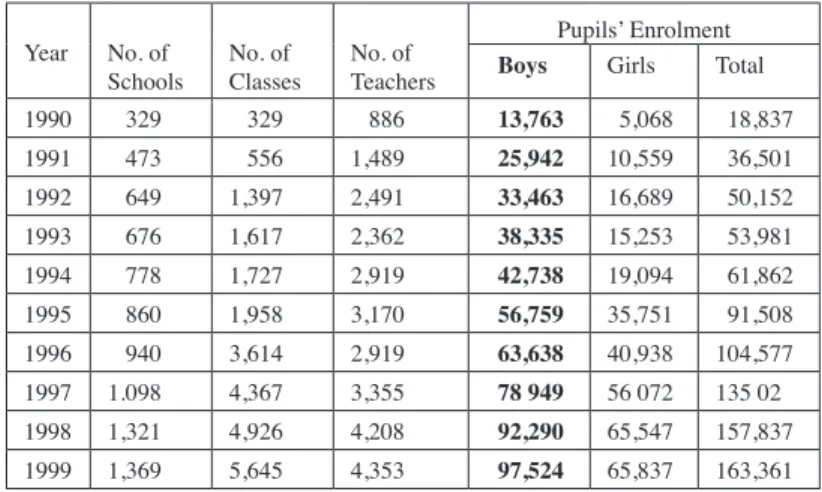
The curriculum policy and process of nomadic primary schools encouraged the retention and promotion of the mother tongue (MT) Fulfulde. Fulfulde is taught as a subject by trained teachers, and is the medium of instruction for children fluent in the MT in exclusive nomadic community primary schools. Hence, major primary school curricular content is connected to children’s previous knowledge (i.e., Islamic Studies and MT languages of the area) and anticipates unfamiliar courses such as Integrated Science and Social Studies (Usman, 2001). Learning text resources titled Defttere Fulfulde Piraamari (Yebre Tatabre) (Fulfulde Primary text books) are available in the mother tongue across subjects like Social Studies, English Language, Health Education, Mathematics, Primary Science, and Handicraft for levels 1-6 primary schools (ADEA Report, 2003). Because of the inclusive approach mentioned earlier, NEP is widely accepted by the recipients. The statistics in Table 1 indicate wider enrolment of the boys.
Even though these data are relatively dated, clearly the enrolment gap between boys and girls is in favor of the boys. But the question remains: To what extent do the boys complete the primary level or progress to high school? There is no coherent data available to ascertain this. Another limitation to the above data is their lack of demarcation between the upland northern cattle herding Fulbe nomadic boys and the nomadic Ijaw fisher boys from southern Nigeria. Hence, it is difficult to make an accurate appraisal of the position of the Fulbe nomadic boys in relation to the general data. Tahir (1998) stated that, since the inception of the program across the country,
65% of boys have completed schooling from the nomadic primary schools (which include nomadic fisher boys), but the author makes no distinction between the cattle herding Fulbe and the fishery nomads, thus making analysis of the Fulbe boys’ primary school completion prior to high school enrollment impossible.
TABLE 1. Statistics of nomadic primary school in nigeria 1990-1999 Year No. of
Schools No. of Classes No. of Teachers
Pupils’ Enrolment
Boys Girls Total 1990 329 329 886 13,763 5,068 18,837 1991 473 556 1,489 25,942 10,559 36,501 1992 649 1,397 2,491 33,463 16,689 50,152 1993 676 1,617 2,362 38,335 15,253 53,981 1994 778 1,727 2,919 42,738 19,094 61,862 1995 860 1,958 3,170 56,759 35,751 91,508 1996 940 3,614 2,919 63,638 40,938 104,577 1997 1.098 4,367 3,355 78 949 56 072 135 02 1998 1,321 4,926 4,208 92,290 65,547 157,837 1999 1,369 5,645 4,353 97,524 65,837 163,361
Source: Monitoring, Evaluation and Statistics Department (NCNE) (Kaduna & Tahir, 1999).
Despite this inconclusive data, higher drop-out rates, lower enrolment and achievement rates, and lower completion percentages were identified as ongoing problems in my interviews with nomadic and multiethnic primary school teachers, principals, and Fulbe nomadic boys (Usman, 2001). In the following section, these research data will be analyzed, discussed, and compared to past research findings (Ayanniyi, 1998; Ezeomah 2002; Saad, 2002) as well as official documents from the Nomadic Commission.
PRIMARY SCHOOLING PRACTICES
The Nomadic Commission, as well as states and local school boards, are experiencing financial deficits due to the costs of nomadic and multieth-nic rural primary schools (Ismail, 2004). In response, teachers and school administrators have had to implement inappropriate teaching and learning strategies that do not accommodate the boys’ needs and are unwelcome by Fulbe nomadic parents. This has affected parental decision making regard-ing school attendance, thereby leadregard-ing to de-enrolment, school drop out, and low academic achievement for the few participating boys. Some of the observed schooling practices that constitute learning challenges for the boys include unfavorable school shift systems, a multiethnic school culture of
bul-lying, inappropriate school levies, ineffective discipline strategies, insufficient male teachers as role models, poor classroom gender relations, a curriculum at odds with the boys’ nomadic way of life, and parental phobias regarding boys’ primary school outcomes.
Unfavorable school shift system
Based on my findings (Usman, 2001), as well as recent data derived from a survey by Ezeomah (2002), a major issue regarding Fulbe boys’ primary schooling is the operation of an unsuitable shift system. This system affects boys’ regular attendance and participation, and may result in school drop out. Most nomadic and multiethnic schools operate on the conventional morning school shift system. According to traditional nomadic herding practices and their gendered divisions of labor, boys and other males in the family graze the animals early in the morning (Ismail, 2004; Reisman, 1984; Saad, 2002). This was taken into consideration by the educational planners and the parents prior to developing the Blueprint: that school shifts should accommodate the boys’ herding obligations was not only stated in the Blue-print (FME, 1987), but also in the National Policy on Education NPE (FRN, 1993). This policy stated that “Education is the birthright of every child, and should be brought close to the environment of the child…. Whenever possible, arrangements will be made for such children to assist their parents in the morning and go to school in the evening” (FRN, 1993). Because primary schools most often operate the morning shift, however, parents are forced to make a difficult choice between herding and school attendance for their sons. Considering the level of rural poverty in Nigeria, since the cattle economy is the main sustenance of the family unit, most parents are left with no choice but to have their boys work in the fields rather than attend the morning school. This has decreased boys’ participation, enrolment, and completion rates (Usman, 2001).
Multiethnic primary school and the culture of bullying.
Nomadic Fulbe boys attending community multiethnic primary schools often find the social environment unfriendly (Tahir, 1991; 1998). This is often triggered by peer attitudes and a lack of teacher concern for effec-tive discipline. Fulbe boys experience a significant amount of peer bullying within the classroom and around the school compound at recess periods. Aside from their status as an ethnic minority, their physical appearance (i.e., traditional clothing, tattoos, hairstyles, accessories) make them stand out from the rest of the students. Peer bullying and harassment of the boys is also triggered by their culture of silence in peer play or social interaction. In observance of pulaaku, which requires them to display Fulbe self-preser-vation and shyness in public, the boys keep to themselves in school (Tilde, 2005). The separatist attitude of the nomadic boys is not understood by
peers or school mates from other tribes, who react by verbally teasing and intimidating them to get them involved and talking. Because nomadic boys’ socialization forbids them from engaging in “unreasonable” confrontations or fights in order to command respect and preserve their dignity in public, the boys simply ignore their peers or take a break from attending school for a few days. This choice of school abstinence by the boys interrupts their learning flow and continuity of attendance, which subsequently affects their academic performance. Asked why they do not complain to either the teach-ers or school principal, most Fulbe boys express the desire to avoid drawing public attention for fear of experiencing more embarrassment (they are a very shy tribe by nature). They also say that keeping the information from their parents is a better option, because the parents may not take it kindly but “slug it out” with parents of the bullies; this would likely incite further conflict between nomads and farmer settlers in Northern Nigeria (Reisman, 1984; Tahir, 1998). The boys also added that the occurrence of any abuses within the school playground in most cases are ignored by teachers, and the bullies neither reprimanded nor punished.
In their defense, most teachers I talked to (the majority women) defended their acts of noninterference (especially with boys in the senior primary grades) by referring to the “norms” of boyhood culture and to letting them “do their thing.” Again, these comments belie misconceived gender stereotypes regarding boys’ behaviors. The teachers’ assumptions relating to interaction among boys is synonymous with the “boys will be boys” theoretical discourse described by Gilbert & Gilbert (1998). This theory suggests that boys’ behaviors are controlled by biological or physiological activities and psycho-social emotional displays that are distinct from girls. This theory expects boys to be active or boisterous at all times as part of their socialization schema, specifically within their peer group units. This discourse does not take into consideration socio-cultural variables or differ-ences in boys’ public and in private socialization, which varies according to their social and cultural history (Vygotsky, 1956). Considering the nature of Fulbe boys’ socialization, “boys will be boys” can only occur within their own peer age group, specifically during grazing periods when they are away from public observation, or during their all-boys festivities such as the stick dance sharo (Tilde, 2005), a social gathering where they test their bravery and perseverance to pain as boys soon to be men. Hence, for nomadic Fulbe, “boys will be boys” is a private domain where they not only project their identities and masculinities, but also reinforce their cultural obligations and duties as “pseudo-men” undergoing the transition to manhood (Ezeomah, 1983; Tilde, 2005).
Inappropriate school levies
Financial cutbacks to educational projects have affected the running cost of nomadic primary schools (Ismail, 2004). In some of the rural schools it is not uncommon to find teachers, with principal support, implementing “soft financial levies” which they claim are used to augment dwindling school resources. Indeed, the teachers claim to purchase instructional materials such as chalk, as well as dusters, brooms, and physical education equipment. Some teachers insist that all students purchase required learning materials themselves; this is overstretching the resources of poor, rural nomadic par-ents. Considering the government’s stated responsibility for providing their children with “free” education, including all necessary learning resources, parents become suspicious of school demands and the government’s failure, thereby building a culture of distrust toward all school management. Older primary boys commented that whenever such demands are made by the teachers or the school management, they resort to withholding such requests from their parents so as not to upset them. To avoid harassment by teachers and principals, they often simulate illness so as to avoid attending school and instead accompany their fathers to graze the cattle. According to their reasoning, skipping school for a week or two would enable them to make a few pennies to either purchase the demanded material or forward the levy to the teachers without their parents’ participation. This action illustrates the boys’ commitment to learning, and displays the boys’ learning of their tribe’s cultural values of social responsibility. In retrospect, this allows them take control of their learning, which debunks the opinion of some public critics (especially from the dominant culture of southern Nigeria) that no-madic children are not interested in formal schooling, and that setting an exclusive educational policy is a waste of resources.
Ineffective school discipline strategies
Multiethnic primary schools do not practice discipline strategies conducive to encouraging a social learning environment and accommodation of Fulbe nomadic boys (and girls). Like most public primary schools across Nigeria, teachers and school administrators use corporal punishment to modify be-havior and ensure adherence to school rules and procedures. When boys are sometimes late to school, or lack the required learning materials, teachers often spank them. Such discipline is unacceptable according to nomadic Fulbe parents and indeed most Sub-Sahara pastoral male parents. Their philosophy is that the use of a stick should not be afflicted on their herds, let alone hu-man beings, most especially the boy child who is appreciated as both a child laborer and the future head of his own household. This discipline style scares the boys from attending school, which affects their learning continuity and leads to low academic performance. News of corporal punishment creates further conflict between the communities and the school, causing parents
to withdraw students from school completely. This affects students’ progress and their chances at achieving primary school literacy.
Lack of male teachers as role models
In most Nigerian primary schools, the majority of the teacher population is female. Of the few available male teachers, most are non-Fulbe or from dominant ethnic tribes who are often unfamiliar with Fulbe traditions and how to relate to nomadic boys in the school. As noted earlier, nomadic boys have been raised, socialized, and trained from childhood to adulthood by males whom they imitate and observe as role models. Hence, parents and the boys expect a continuity of this practice in schools (even with non-Fulbe male teachers) to direct learning and continue to provide social guidance. In addition, there is a lack of trained counselors to whom the boys may turn for emotional or academic support. The absence of Fulbe male teach-ers in nomadic primary schools affects the boys’ learning and exposes them to more communication or social challenges in schools, especially when confronted with such social concerns as peer bullying. Increasing the ratio of male teachers should be a prerogative of the University of Maiduguri, whose responsibilities include training and organizing curricula workshops for male and female nomadic primary school teachers (Ezeomah, 1981; NCNC, 1995).
Poor classroom gender relations
Due to the traditional Fulbe single-sex socialization pattern, the boys find it difficult to interact with their female teachers and female classmates dur-ing the process of teachdur-ing and learndur-ing. This phenomenon is discussed by Epstein (1998) and Gilbert and Gilbert (1998), who focus on how gender relations are constructed and how different ideas of masculinity and femininity affect students’ expectations and relationships. Beliefs regarding masculinities impact boys’ participation in school in many ways. Nomadic Fulbe boys are not used to cross-gender interaction; with their shy nature nurtured from the moral code of pulaaku, most of them resort to passive learning behaviors. Pedagogical approaches such as cooperative teaching-learning that demand heterogeneous group formations of boys and girls are especially difficult for nomadic Fulbe boys. According to them, most would prefer all-boy coopera-tive learning groups (regardless of ethnic differences). On issues of general classroom management, even when the nomadic Fulbe boys are emotionally stressed (i.e., as a result of bullying by classmates), they find it difficult to ap-proach the female teachers because of their gender socialization background. The impact of the boys’ cultural gender communication and relationships is that they seldom seek help from female teachers in learning situations, but rather face their learning challenges and lack of support in isolation; this affects their overall academic performance.
Considering these boys’ young age and corresponding place in the pre-oc-cupational stage of development (Piaget, 1976), the ”boys will be boys” discourse (Gilbert et al, 1998) has negative effects on classroom teaching and learning procedures in exclusive nomadic primary schools. Ayanniyi (1998) states that the lack of teacher support for younger boys (who often turn to their peers for support) may result in displays of Attention Deficit Disorder. This disorder is not only associated with younger nomadic Fulbe primary school boys, but generally is common to boys seeking attention, which often interferes with their learning performance and achievement in the classroom (Head, 1999; Lingard, Martino & Bahr, 2002).
Most female teachers from dominant cultural backgrounds do not understand the cultural orientation of the nomadic boys and find it difficult to provide them with classroom learning support or even deal with them. Again, they lack adequate training on constructivist models of pedagogy that deal with cultural sensitivity for inclusive classroom management (Barakett & Cleghorn, 2000).
A curriculum at odds with the boys’ nomadic way of life
The recommended primary curriculum is taught to the nomadic children outside their social and economic realities. Teachers fail to integrate thematic aspects of the prescribed curriculum into the functional learning needs of the boys. As noted by Ismail (2004), nomadic Fulbe parents express their disgust with some of the curriculum content. Citing subjects such as Integrated Sci-ence, where students are taught topics like “breeding cockroaches,” Fulbe parents consider such curricula not only dysfunctional to the daily needs of Fulbe nomads, but ineffective to the needs of their herding and social life style. This discourages some of the parents from allowing their boys to continue to learn, as they consider these curricula to be an insult to their intelligence and culture (Ismail, 2004). Hence, many parents withdraw their sons, or simply do not pressure them regarding the regular attendance required for school completion.
Again, the curriculum processes adopted by teachers in nomadic primary schools are incompatible with traditional nomadic learning processes. The research findings of Ayanniyi (1998) illustrate the lack of culturally sensi-tive pedagogical approaches, as most strategies fail to adopt the practical exploratory learning method to which the boys are accustomed, and which are recommended in primary education objectives:
The Government will ensure that the teaching methods employed in the primary school.... [e]ncourage practical, exploratory and experimental methods, and in particular the development of manual skills is stressed and encouraged. (FRN, 1993, Section 13:15:3)
Apparently, teachers at nomadic schools lack training in culturally adaptable methods and techniques that would encourage a diverse pedagogical approach. They rely more on the orthodox transmission model of teaching (Barrakett & Cleghorn, 2000), which delivers instruction in a holistic manner without taking into account individual differences and learning needs.
The boys’ and their parents’ frustration and inability to see the relevance of the school curriculum often resulted in the boys dropping out of school to pursue the knowledge and skills that they and their parents considered more of a functional education. Fulbe parents have commented that these emerging concerns need to be addressed by the nomadic commission and the local school boards through making the curriculum more relevant to nomadic boys and their social and economic lifestyles (Ismail, 2004). Only when such issues are addressed will there be retention and graduation of nomadic Fulbe boys in primary schools.
Parental phobias regarding boys’ primary school outcomes
Most literature on nomadic primary schooling (Ezeomah, 2002; Ayanniyi, 1998; Usman, 2001) has indicated the boys’ general enthusiasm for learning, regardless of schooling practices. However, younger primary graders see their regular attendance at school as a break from their work in the fields. Such perceptions regarding children’s schooling are similar to those demonstrated by children living in rural agrarian communities in developed countries, such as children in mid-nineteenth century rural British Columbia (Sutherland, 1995). In as much as some nomadic parents appreciate specific aspects of their children’s primary school attendance, such as the acquisition of modern literacy skills, the majority fear their sons’ rejection of expected gender roles, including a rejection of traditional herding behaviours (Ismail, 2004). One nomadic leader commented that
We are not opposed to the idea of getting our children to schools, but we fear that at the end of their schooling they will only be good at eating up cattle instead of tending and caring for them. (Nkiyangi, 1980, p. 195)
Parental fears regarding educational outcomes may lead them to prefer that the boys tend the cattle rather than attend school (Saad, 2002). This possibility is supported by survey data, in which over 60% of teachers confirmed that boys’ morning labour reduced their attendance and completion of primary school level when compared to nomadic girls and children from dominant tribes (Ezeomah, 2002). Additionally, the managerial inefficiency of local and state schools boards has meant delays of months and even years in teachers’ receipt of their wages. This has limited the primary schools’ abil-ity to accommodate the needs of not only nomadic boys’, but all students. Many teachers facing salary delays or losses but who are still committed to the profession teach only in the morning shift, while they spend part of the day working as farmers, traders, or tailors to support their families. Parents,
boys, and teachers who are enthusiastic about school are unhappy with the state’s negligence of teachers’ welfare; it has shown boomerang effects, such as acute learning discontinuity and dropping out.
Generally, challenges and problems experienced by nomadic Fulbe boys in public primary schools stem from inconsistencies in educational policy implementation, as well as the strong adherence to cultural traditions and poverty levels of nomadic parents and boys. These can be modified with more favorable social policies, specifically extensions to accommodate parents and nomadic Fulbe boys, religious leaders and Fulbe nomadic communities in general.
CONCLUSION
It is obvious that nomadic Fulbe boys’ primary schooling experiences and outcomes are affected by the cultural demands regarding identity and mascu-linity so central to their roles in an informal herding economy (Saad, 2000). Structural lapses, such as a lack of evaluation and improvement of existing educational programs and practices (Nwabueze, 1995; Nwagu, 1976), also affect the boys. The major challenges regarding enrolment, attendance, and completion of primary school faced by Northern Nigerian nomadic boys can be addressed through re-establishment of the single-sex or all-boys primary school system operated in British colonial times. A single sex-school for boys with male teachers as role models (AEU, 2004; BBC, 2003; Stoessiger, 1995) would create a safe and social learning environment to encourage retention and completion of at least the primary school level.
Future primary school teachers in teacher training colleges should be pro-vided with pre-service training in Nigeria’s people and culture to acquaint them with the different customs and traditions that will be found in their classrooms. Such courses should be modeled on a constructivist pedagogical approach to meet the learning needs of diverse children. Additionally, teach-ers should be trained in thematic curricula modification to fit the learning needs and expectations of the nomadic boys as demanded by their parents and male elders (Ezeomah, 1981; Hegelsson, 2001; Ismail, 2004).
Corporal punishment should be outlawed in all primary schools in northern Nigeria by the ministries of education. Inflicting fear through punishment will reduce boys’ participation in school. Their parents’ objections toward corporal punishment should be respected.
To boost the male teacher ratio in nomadic primary schools, male Koranic school teachers with some high school education should be provided with teacher college training and reposted to nomadic primary schools as substi-tutes, and be paid regular wages in order to retain them in the profession. Only in this way will more male teachers be involved in nomadic primary
schools (Ezeomah, 1981; Tahir, 1998). Additionally, to minimize costs as-sociated with training nomadic male teachers and moving them away from their families for residential teacher training, nomadic teacher training programs at the National Teachers Institute should utilize more distance learning opportunities (in addition to the training offered at the University of Maiduguri). This collaboration with NTI will not only decrease teacher-student ratios but will assist in managing the demand for male teachers in nomadic primary schools across the country.
While it is true that negligence and a lack of continuous research data hampers effective educational planning and resource allocation in Nigeria, educational planners may consider using research recommendations from developed countries with nomadic or pastoral boys, such as Australian Ab-originals (Lingard, Martino & Bahr, 2002), the Sámi and Lapps of Sweden, the Roma of eastern Europe, the gypsies of Ireland, and the cowboys of Nebraska. This information can be accessed through UNESCO and World Bank educational data resources; further information can be obtained from international educational conference abstracts, papers and seminars, which often allow participants and presenters to provide not only recent data on the education of the nomadic populations, but engaging debates on the subject. Such information exchange between developed and developing nations with pastoral communities will facilitate development of global educational policies for nomadic youth, children, and adults, regardless of their geo-political differences. Furthermore, international discussion will lead nations to identify priority areas for policy extension or modification, as they work toward more progressive perspectives on education for the benefit of nomadic boys globally.
REFERENCES
Adamu, H. A. (1973). The north and Nigerian unity: Some reflections on the political, social and educational problems of northern Nigeria. Zaria: Gaskiya Corporation Printers.
Ado-Kurawa, I. (2003). State failure and the collapse of educational system in Northern Nigeria. www. kanoonline.com/cgi-bin/articles/template.php/iak018.txt Retrieved 11/29/2003.
AEU Women’s Focus. What’s new, boys in education (male teachers strategy). AEU Federal Report on Boys Education. http://www.aeufederal.org.au/Women/index2.html#BIE Retrieved July 30, 2005.
Abubakar A. (2005). Why the federal government embarked on educational policy integration. The Tide Online Newspaper. www.thetidenews.com/article.aspx Retrieved 12/3/2005. Ayanniyi, B. A. (1998). Attention deficit disorders among nomadic school pupils: A case study of selected nomadic schools in Bauchi State. Journal of Nomadic Studies, 1(1), 52-60.
Bandura, A. (1977). Social learning theory. Englewood Cliffs, NJ: Prentice Hall.
Barakett, J., & Cleghorn, A. (2000). Sociology of education: An introductory view from Canada. Scarborough, ON: Prentice-Hall Canada.
Bello, A. (2005). Northern governors and the North. [email protected] www.gamji. com/article4000/NEWS4892.htm Retrieved 12/9/2005.
Bodgan, C. R., & Biklen, S. K. (2003). Qualitative research for education. An introduction to theories and methods. (4th ed.). Boston: Ally & Bacon.
Bray, M. (1981). Universal primary education in Nigeria: A study of Kano State. London: Routledge & Keagan Paul.
Crain, W. (2000). Theories of development. Concepts and applications (4th ed.). Upper Saddle River, NJ: Prentice Hall.
Creswell, W. J. (2005). Educational research: Planning, conducting and evaluating quantitative and qualitative research. Upper Saddle River, NJ: Merrill Prentice Hall.
Denga, D. (2000). Evolving a new education culture: The universal basic education focus in Nigeria. International Journal of Research in Basic and Lifelong education. 1&2, 1-6.
Edukugho, E. (2005). Rise in public primary school: 2633 built yearly by federal government. Vanguard Newspaper. www.vanguardngr.com/articles/2002.features/education/edu115122005. Dated 15 December, 2005. Retrieved 12/19/2005
Epstein, D. (1998). Failing boys? Issues in gender and achievement. Centre for Research and Educa-tion on Gender, Institute of EducaEduca-tion. Buckingham, England: Open University Press. Ezeomah, C. (2002). Social, economic and political activities of nomads and educational policy imple-mentation. A tentative research report presented at the international conference. 16-19 January, Abuja, Nigeria.
Ezeomah, C. (1983). The education of nomadic people. The Fulani of Northern Nigeria. Hull: Britain: Oriel Press.
Ezeomah, C. (1981, June). Strategies for training nomadic teachers. Commonwealth Council for Educational Administration. Studies in Educational Administration 23.
Federal Ministry of Education. (1987). Blueprint on nomadic education: Fair deal for the Nomads. Nigerian Educational Research Council.
Federal Republic of Nigeria, (2000). Implementation guideline for the Universal Basic Education [UBE] Programme. Federal Ministry of Education, Abuja, Nigeria.
Federal Republic of Nigeria, (1989). National Commission for Nomadic Education: Decree 41. Lagos: Government Printers
Federal Republic of Nigeria (1993). National policy on education. Lagos: Government Printers. Francis, P. A. (1998). Hard lessons: Primary schools, Community and social capital in Nigeria. World Bank Technical Paper No. 420. Africa Region Series. Washington DC. World Bank. Freire, P. (1972). Pedagogy of the oppressed. London: Penguin books.
Gilbert, R., & Gilbert, P. (1998). Masculinities goes to school. Sydney: Allen and Unwin. Head, J. (1999). Understanding the boys: Issues of behavior and achievement. London: Falmer Press.
Hegelsson, L. (2001). Equality: Girls’ and boys’ basic education in Maasai and Kisarawa districts. Evaluation report. Tanzania Ministry of Education and Culture, Kuleana Centre for Children’s Rights. 2001/029.
Ibrahim, M. (1984). Veterinary traditional practices in Nigeria. In R. Kaufmann, S. Chater, & R. Blench (Eds.), 1986, Livestock systems research in Nigeria’s sub humid zone. Proceedings of a second ILCA/NAPRII symposium held in Kaduna, Nigeria, October 29-November 4, 1984. pp. 189-208. Addis Ababa: ILCA
Ismail, I. (2004). Nomadic education and education for nomadic Fulani. www.gamji.com/fulani7. htm Retrieved 7/25/2004.
Lingard, B., Martino, W., Mills, M., Bahr, M. (2002, Nov.). Research report: Addressing the educational needs of boys. Submitted to the Department of Education, Science and Training, The University of Queensland, Australia.
Lloyd, C. B., & Hewett, P. C. (2003). Primary schooling in sub-Saharan Africa: Recent trends and current challenges. Policy Research Division Working Paper no. 176. New York: Population Council.
Maslow, A. (1971). The further reaches of human nature. New York: Viking.
McLaren, P. S. J. (1995). “New Canadians” or “Slaves of Satan”? The Law and the Education of the Doukhobor Children, 1911-1935. In J. Barman, N. Sutherland, & D. Wilson (Eds.), Children, teachers and schools. The history of British Columbia: Children, teachers & schools, pp. 147-159. Calgary, AB: Detselig Enterprise.
National Commission for Nomadic Education, (1999). Monitoring report. Kaduna: NCNE Nkinyangi, J. (1980). Education for the nomadic pastoralists: Development planning by trial and error. In The future of pastoral people. Proceedings of a conference held in Nairobi, August 4-8, 1980 by the Institute for Development Studies, Nairobi. (pp. 183-194).
Nwagu, N. A. (1976). Problems in the formulation of educational policies in Nigeria. Nigeria Educational Forum, 2(1), 39-43.
Nwabueze, B. O. (1995). Crises and problems in education in Nigeria. Ibadan: Spectrum. Piaget, J. (1972). Intellectual evolution from adolescence to adulthood. Human Development, 15, 1-2
Reisman, P. (1984). The Fulani in development context: The relevance of cultural traditions for coping with change and crisis. In E. Scott (Ed.), Life before the drought, pp. 171-183. London: Allen & Urwin.
Saad A. M. (2002). Pastoralist children and stakeholders assessment of nomadic education in Nigeria: A tentative report of a consultative survey of nomadic education pupils, communities and the CBOs/ NGOs. Paper presented at an international conference on nomadic education in Nigeria: Issues and directions by DFID, Rockview hotel, Abuja. 16-19 January, 2002.
Stoessiger, Rex (1995). Boys failing boys: What can teachers, parents and schools do to improve schooling for boys? & Boys need men in schools. http://education.qld.gov.au/stud-mngt/suppr/ advocacy/access-equity/gender-sch/ Retrieved 28 July, 2005.
Sutherland, N. (1995). “I can’t recall when I didn’t help”. The working lives of pioneering children in twentieth-century British Columbia. In J. Barman, N. Sutherland, & J. D. Wilson (Eds.), Children, teachers and schools in the History of British Columbia.(pp.125-146). Calgary: Detselig Enterprise Ltd.
Tahir, G. (2006). Qu’ranic education threatens universal basic education UBE Scheme. Thisday newspaper. www.thisdayonline.com/nview.php?id=37715 Retrieved 1/9/06.
Tahir, G. (1998). Nomadic education in Nigeria: Issues, problems and prospects. Journal of Nomadic Studies 1(1), 10-26.
Tahir, G. (1991). Nomadic education in Africa: Issues and cases. Zaria: ABU Press.
Tilde, A. (2005). Pulaaku among the Fula & Fula and their problems in Nigeria. Friday Discourse (111). http://www.gamji.com/tilde/tilde.htm Retrieved 8 May, 2005.
Tilde, A. (2005). Enrolment and falling standard of education. Friday Discourse (112). http://www. gamji.com/tilde/tilde.htm Retrieved 12/10/2005.
Time Magazine (2005). UBE program in Nigeria. June 27, 2005.
UNESCO (1971). Education in Nigeria. Educational projects for external aid. Vol.1. Report 560. Paris: UNESCO.
Usman, M. L. (2001). Analysis of Nigeria’s nomadic education policy on the socio-economic develop-ment of Fulbe women and girls. Unpublished Ph.D dissertation, University of Alberta, Edmonton, Alberta, Canada.
Vygotsky, L. S. (1956) Thoughts and language (Trans: A Kazulin). Cambridge, MA: MIT Press, 1986.
World Bank (2001). Nomadic education in Nigeria. A chance to learn: Knowledge and Finance for Education in Sub-Saharan Africa. (p. 48-54). 22005. February. Africa Region Human Develop-ment Series.
Yewan, Saraya (2005). The price of being Almajir. [email protected] www.gamji.com/ article5000/Neews5242.htm Retrieved 12/9/2005.
LANTANA USMAN is a graduate and past sessional professor at the University of Al-berta. She is currently an Assistant Professor at the Education Program, University of Northern British Columbia, Prince George, Canada. Her teaching and research areas include educational policy studies, economics of education, gender and educa-tion (children and youth), internaeduca-tional comparative and developmental educaeduca-tion, multicultural and social studies education. She has published in journals as well as contributed book chapters.
LANTANA USMAN est diplômée de l’Université de l’Alberta, dont elle a déjà fait partie du corps enseignant. Elle est actuellement professeure adjointe au sein du département d’éducation de la University of Northern British Columbia, à Prince George, au Canada. Son travail d’enseignement et de recherche s’articule autour des politiques d’éducation, de l’économie de l’éducation, des liens entre le sexe et l’éducation (chez les enfants et les jeunes), de l’éducation comparative et de développement à l’échelle internationale, de l’éducation multiculturelle et de l’éducation en sciences sociales. Ses articles sont parus dans des revues spécialisées et elle a rédigé des chapitres de livre.