Distributed anonymous function computation
in information fusion and multiagent systems
The MIT Faculty has made this article openly available.
Please share
how this access benefits you. Your story matters.
Citation
Hendrickx, J.M., A. Olshevsky, and J.N. Tsitsiklis. “Distributed
anonymous function computation in information fusion and
multiagent systems.” Communication, Control, and Computing,
2009. Allerton 2009. 47th Annual Allerton Conference on. 2009.
1582-1589. © Copyright 2010 IEEE
As Published
http://dx.doi.org/10.1109/ALLERTON.2009.5394487
Publisher
Institute of Electrical and Electronics Engineers
Version
Final published version
Citable link
http://hdl.handle.net/1721.1/59370
Terms of Use
Article is made available in accordance with the publisher's
policy and may be subject to US copyright law. Please refer to the
publisher's site for terms of use.
Distributed anonymous function computation in
information fusion and multiagent systems
Julien M. Hendrickx, Alex Olshevsky, John N. Tsitsiklis
Abstract—We propose a model for deterministic distributed
function computation by a network of identical and anonymous nodes, with bounded computation and storage capabilities that do not scale with the network size. Our goal is to characterize the class of functions that can be computed within this model. In our main result, we exhibit a class of non-computable functions, and prove that every function outside this class can at least be approximated. The problem of computing averages in a distributed manner plays a central role in our development.
I. INTRODUCTION
The goal of many multi-agent systems, distributed compu-tation algorithms and decentralized data fusion methods is to have a set of nodes compute a common value based on initial values or observations at each node. Towards this purpose, the nodes, which we will sometimes refer to as agents, perform some internal computations and repeatedly communicate with each other. Let us consider some examples.
(a) Quantized consensus: Suppose that each agent begins
with an integer value xi(0)∈ {0, . . . , K}. We would like the
agents to end up, at some later time, with values yi that are
almost equal, i.e., |yi− yj| ≤ 1, for all i, j, while preserving
the sum of the values, i.e.,!n
i=1xi(0) =!ni=1yi. This is the
so-called quantized averaging problem which has received considerable attention recently; see [16], [9], [3], [20]. It may be viewed as the problem of computing the function (1/n)!n
i=1xi, rounded to the nearest integer.
(b) Distributed hypothesis testing: Consider n sensors
interested in deciding between two hypotheses, H0 and H1.
Each sensor collects measurements and makes a preliminary decision xi∈ {0, 1} in favor of one of the hypotheses. The
sensors would like to make a final decision by majority vote, in which case they need to compute the indicator function of the event!n
i=1xi ≥ n/2, in a distributed way.
Alternatively, in a weighted majority vote, they may be interested in computing the indicator function of the event !n
i=1xi≥ 3n/4.
(c) Solitude verification: This is the problem of verifying
that at most one node in the network has a given state.
The authors are with the Laboratory for Information and Decision Systems, Massachusetts Institute of Technology, Cambridge, MA,
[email protected], [email protected], [email protected].
This research was supported by the National Science Foundation under grant ECCS-0701623, and postdoctoral fellowships from the F.R.S.-FNRS (Belgian Fund for Scientific Research) and the B.A.E.F. (Belgian American Education Foundation), and is on leave from the Dept. of mathematical engineering of the Universit´e catholique de Louvain, Louvain-la-Neuve, Belgium.
This problem is of interest if we want to avoid simultaneous transmissions over a common channel [13], or if we want to maintain a single leader (as in motion coordination — see for example [15]) Given K possible states, so that xi ∈ {1, . . . , K}, solitude verification is equivalent to the
problem of computing the binary function which is equal to 1 if and only if |{i : xi= 1}| = 1.
There are numerous methods that have been proposed for solving problems such as the above. (See for example the vast and growing literature on consensus and averaging methods.) Oftentimes, different algorithms involve different computa-tional capabilities on the part of the agents, which makes it hard to talk about “the best” algorithm. At the same time, simple algorithms (such as setting up a spanning tree and aggregate information by progressive summations over the tree) are often “disqualified” because they require too much coordination or global information. One then realizes that a sound discussion of such issues requires the specification of a precise model of computation, followed by a systematic analysis of fundamental limitations under any given model. This is precisely the objective of this paper: to propose a particular model, and to characterize the class of computable functions under this model.
Our model provides an abstraction for the most common requirements for distributed algorithms in the sensor network literature. It is somewhat special because (i) it does not allow for randomization; (ii) it does not address the case of time-varying interconnection graphs; such extensions are left for future research. Qualitatively speaking, our model includes the following features.
Identical agents: Any two agents with the same number of
neighbors must run the same algorithm.
Anonymity: An agent can distinguish its neighbors using its
own, private, local identifiers. However, agents do not have global identifiers.
Absence of global information: Agents have no global
information, and do not even have an upper bound on the total number of nodes. Accordingly, the algorithm that each agent is running is independent of the network size and topology.
Convergence: Agents hold an estimated output, and this
estimate must converge to a desired value which is generally a function of all agents’ initial observations or values. In particular, for the case of discrete outputs, all agents must eventually settle on the desired value. On the other hand, the agents do not need to be aware of such termination, which is anyway impossible in the absence of any global information [6].
Forty-Seventh Annual Allerton Conference Allerton House, UIUC, Illinois, USA September 30 - October 2, 2009
A. Goal and Contribution
We provide in this paper a general model of decentralized anonymous computation with the above described features, and characterize the type of functions of the initial values that can be computed. To keep our model simple, we only consider deterministic and synchronized agents exchanging messages on a fixed bi-directional network, with no time-delays or unreliable transmissions. Agents are modelled as finite automata, so that their individual capabilities remain bounded as the number of agents increases.
We prove that if a function is computable under our model, then its value only depends on the frequencies of the different possible initial values. For example, if the initial values xi
only take values 0 and 1, a computable function necessarily only depends on p0 := |{i : xi = 0}|/n and p1 := |{i :
xi= 1}|/n. In particular, determining the number of nodes,
or whether at least two nodes have an initial value of 1 is impossible.
Conversely, we prove that if a function only depends on the frequencies of the different possible initial values (and is measurable), then the function can at least be approxi-mated with any given precision, except possibly on a set of frequency vectors of arbitrarily small volume. Moreover, if the dependence on these frequencies can be expressed by a combination of linear inequalities with rational coefficients, then the function is computable exactly. In particular, the functions involved in the quantized consensus and distributed hypothesis testing examples are computable, whereas the function involved in solitude verification is not. Similarly, statistical measures such as the standard deviation and the kurtosis can be approximated with arbitrary precision.
Finally, we show that with infinite memory, the frequencies of the different values (i.e., p0, p1 in the binary case) are
computable.
B. Overview of previous work
There is a large literature on distributed function computa-tion in related models of computacomputa-tion. A common model in the distributed computing literature involves the requirement that all processes terminate when the desired output is produced. A consequence of the termination requirement is that nodes typically need to know the network size n (or an upper bound on n) to compute any non-constant functions. We refer the reader to [1], [6], [31], [17], [26] for some fundamental results in this setting, and to [10] for an excellent summary of known results.
Similarly, the biologically-inspired “population algorithm” model of distributed computation has some features in com-mon with our model, namely finite-size agents and lack of a termination condition; see [2] for a very nice summary of known results. However, these models involve a somewhat different type of agent interactions from the ones we consider. We note that the impossibility of computing p1without any
memory was shown in [21]. Some experimental memoryless algorithms were proposed in the physics literature [12]. Randomized algorithms for computing particular functions
were investigated in [16], [7]. We also point the reader to the literature on “quantized averaging,” which often tends to involve similar themes [9], [20], [3], [8].
Several papers quantified the performance of simple heuristics for computing specific functions, typically in ran-domized settings. We refer the reader to [14] and [29], which studied simple heuristics for computing the majority function. A deterministic algorithm for computing the majority func-tion (and some more generalized funcfunc-tions) was proposed in [23].
Semi-centralized versions of the problem, in which the nodes ultimately transmit to a fusion center, have often be considered in the literature, e.g., for distributed statistical inference [25] or detection [19]. The papers [11], [18], and [22] consider the complexity of computing a function and communicating its value to a sink node. We refer the reader to the references therein for an overview of existing results in such semi-centralized settings.
Our results differ from previous works in several key respects: (i) Our model, which involves totally decentralized computation, deterministic algorithms, and constraints on memory and computation resources at the nodes, but does not require the nodes to know when the computation is over, does not seem to have been studied before. (ii) Our focus is on identifying computable and non-computable functions under our model, and we achieve a nearly tight separation.
II. FORMAL DESCRIPTION OF THE MODEL
The system consists of (i) a communication graph G = (V, E), which is bidirectional (i.e., if (i, j) ∈ E, then (j, i) ∈ E); (ii) a port labeling whereby edges outgoing from node i are labeled by port numbers in the set {1, 2, . . . , degree(i)}; (iii) a family of finite automata (Ad)d=1,2,3,.... (The
automa-ton Ad is meant to describe the behavior of a node with
degree d.)
The state of the automaton Ad is a tuple
(x, z, y, m1, . . . , md); we will call x ∈ X= {0, 1, . . . , K}
the initial value, z ∈ Zd the internal memory state, y ∈ Y
the output or estimated answer, and m1, . . . , md ∈ M the
messages. The sets X, Y, Zd, M are assumed finite, unless
there is a statement to the contrary. Furthermore, we assume that the number of bits that can be stored at a node is proportional to the node’s degree; that is, log |Zd| ≤ Cd,
for some absolute constant C. (Clearly, at least this much memory would be needed to be able to store the messages received at the previous time step.) We will also assume that ∅ is an element of the above defined sets Y , Zd, and
M . The transition law Ad maps X × Zd × Y × Md to
X × Zd × Y × Md: [x, z, y; (m1, . . . , md)] is mapped to
[x, z!, y!; (m!
1, . . . , m!d)] . In words, the automaton creates a
new memory state, output, and (outgoing) messages at each iteration, but does not change the initial value.
We construct a dynamical system out of the above ele-ments as follows. Let d(i) be the degree of node i. Node i begins with an initial value xi ∈ X; it implements
the automaton Ad(i), initialized with x = xi, and with
z = y = m1 = . . . = md = ∅. We use Si(t) = 1583
[xi, yi(t), zi(t), mi,1(t), . . . , mi,d(i)(t)] to denote the state
of the automaton implemented by agent i at round t. Let j1, . . . , jd(i)be an enumeration of the neighbors of i, and let
pk be the port number of the link (jk, i). The evolution of
the system is then described by
"xi, zi(t + 1), yi(t + 1); mi,1(t + 1), . . . , mi,d(i)(t + 1)
#
= Ad(i)[x, zi(t), yi(t); mj1,p1(t), . . . , mjd,pd(t)] .
In words, the messages “sent” by the neighbors of i into ports leading to i are used to transition to a new state and create new messages that i “sends” to its neighbors at the next round. We say that y∗ ∈ Y is the final output of this
dynamical system if there is a time t! such that y
i(t) = y∗
for every i and t ≥ t!.
Consider now a family of functions (fn)n∈N : Xn →
Y . We say that such a family is computable if there exists a family of automata (Ad)d=1,2,... such that for any n, for
any connected graph G = (V, E) with n nodes, any port labelling, and any set of initial conditions x1, . . . , xn, the
final output of the above system is always fn(x1, . . . , xn).
In some results, we will also refer to function families (fn)n∈N computable with infinite memory, by which we
mean that the internal memory sets Zd and output set Y
are countable, the rest of the model being unaffected. We study in the sequel the general function computation problem: What families of functions are computable, and how can we design the automata Ad to compute them?
III. NECESSARY CONDITION FOR COMPUTABILITY
Let us first state the following lemma which can easily be proved by induction on time.
Lemma III.1. Suppose that G = ({1, . . . , n}, E) and
G! = ({1, . . . , n}, E!) are isomorphic, that is, there ex-ists a permutation π such that (i, j) ∈ E if and only if (π(i), π(j)) ∈ E!. Further, suppose that the port label at node i for the edge leading to j in G is the same as the port label at node π(i) for the edge leading to π(j) in G!. Then, the state Si(t) resulting from the initial values x1, . . . , xn with the graph G is the same as the state Sπ(i)(t) resulting from the initial values xπ(1), . . . , xπ(n)with the graph G!.
Proposition III.1. Suppose that the family {f1(x1), f2(x1, x2), f3(x1, x2, x3), . . .} is computable with infinite memory. Then, each fi is invariant under permutations of its arguments.
Proof: Let πijbe permutation that swaps i with j; with a
slight abuse of notation, we also denote by πij the mapping
from Xn to Xn that swaps the ith and jth elements of a
vector. We show that for all x ∈ Xn, f
n(x) = fn(πij(x)).
We run our distributed algorithm on the n-node com-plete graph. Consider two different initial configurations: (i) starting with the vector x; (ii) starting with the vector πij(x). Let the way each node enumerates his neighbors
in case (i) be arbitrary; in case (ii), let the enumeration be such that the conditions in Lemma III.1 are satisfied, which is easily accomplished. Since the limiting value of yi in
one case is f (x) and in the other is f (πij(x)), we obtain
f (x) = f (πij(x)). Since the permutations πij generate the
group of permutations, permutation invariance follows. Let x ∈ Xn. We will denote by x2 the concatenation of x
with itself, and, generally, xk the concatenation of k copies
of x. We now prove that self-concatenation does not affect the value of a computable family of functions.
Proposition III.2. Suppose that the family {f1(x1), f2(x1, x2), f3(x1, x2, x3), . . .} is computable with infinite memory. Then, for every m ≥ 2, every sequence x ∈ Xm, and every positive integer k,
fm(x) = fkm(xk).
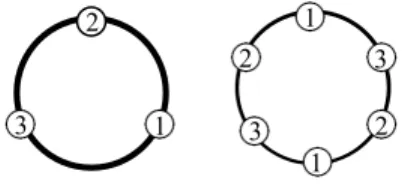
Proof: Consider a ring of agents of size m, where the ith agent counterclockwise begins with the ith element of x; and consider a ring of size km where the agents i, i + m, i + 2m, . . . (counterclockwise) begin with the ith element of x. Suppose further that each node enumerates its two neighbors so that the neighbor on the left is labelled 1, while the neighbor on the right is labelled 2. See Figure 1 for an example with m = 3, k = 2 and xi= i.
Fig. 1. Example of two situations that are indistinguishable by the nodes.
Initially, the state of node i in the first ring is exactly the same as the state of the nodes j = i, i + m, i + 2m, . . . in the second ring. We show by induction that this property must hold at all times t. (To keep notation simple, we assume, without any real loss of generality, that i (= 1 and i (= m.)
Indeed, suppose this property holds up to time t. At time t, node i in the first ring receives a message from node i − 1 and a message from node i + 1; and in the second ring, node j satisfying j (mod m) = i receives one message from j − 1 and j + 1. Since j − 1 (mod m) = i − 1 and j + 1 (mod m) = i + 1, the states of j − 1 and i − 1 are identical at time t, and similarly for and j +1 and i+1. Thus the messages received by i (in the first ring) and j (in the second ring) at time t are identical. Since i and j were in the same state at time t, they must be in the same state at time t + 1. This proves that they are in the same state forever.
It follows that yi(t) = yj(t) for all t, whenever
j (mod m) = i, and therefore fm(x) = fkm(xk).
We can now prove our main negative result, stating that if a family of functions is computable, then the value of the function only depends on the frequencies of the different possible initial values. We define D = {(p1, . . . , pK) ∈
[0, 1]K : !K
k=1pk = 1}, which we call the proportion set.
We say that a function h : D → Y corresponds to a family (fn: Xn → Y ) if for every x ∈ Xn,
where
pk(x1, . . . , xn) = |{i | xi= k, }|/n,
so that pk(x1, . . . , xn) is the frequency of occurrence of the
initial value k. In this case, we say that the family (fn) is proportion-based.
Theorem III.1. Suppose that the family (fn) is com-putable with infinite memory. Then, this family is proportion-based.
Proof: Let x and y be two sequences of n and m elements, respectively, such that pk(x1, . . . , xn) =
pk(y1, . . . , ym) =: ˆpk for k = 1, . . . , K, that is, the number
of occurrences of k in x and y are nˆpkand mˆpk, respectively.
Observe that for any k ∈ X, the vectors xm and yn
have the same number mn of elements, and both contain mnˆpk occurrences of k. The sequences yn and xm can
thus be obtained from each other by a permutation, which by Proposition III.1 implies that fnm(xm) = fnm(yn). It
then follows from Proposition III.2 that fnm(xm) = fn(x)
and fmn(yn) = fm(y), so that fn(x) = fm(y). This
proves that the value of fn(x) is determined by the vector
(p1(x), . . . , pn(x)).
The following examples illustrate this result. (a) The parity function !n
i=1xi (mod k) is not
com-putable, for any k > 0.
(b) In a binary setting (X = {0, 1}), checking whether the number of nodes with xi = 1 is at least 10 plus the
number of nodes with xi= 0 is not computable.
(c) Solitude verification, i.e. checking whether |i : {xi =
0}| = 1, is not computable.
(d) An aggregate difference functions such as !
i<j|xi−
xj| is not computable, even calculated modulo k.
IV. REDUCTION OF GENERIC FUNCTIONS TO THE COMPUTATION OF AVERAGES
In this section, we show that the computability question for large classes of functions reduces to the computability question for a particular averaging-like function. Namely, we will make use of the following theorem.
Theorem IV.1. Let X = {0, . . . , K} and define Y to be
following set of single-point sets and intervals:
Y = {{0}, (0, 1), {1}, (1, 2), . . . , {K −1}, (K −1, K), {K}} (or equivalently, an indexing of this finite collection of intervals). Let (fn) be the following family of functions: fn maps (x1, x2, . . . , xn) to the element of Y which contains the average!
ixi/n. Then, the family (fn) is computable.
The proof of Theorem IV.1 is fairly involved and too long to be included in this extended abstract; however, we give an informal description of the algorithm for computing fn
in Section V. In this section, we show that Theorem IV.1 implies the computability of a large class of functions. We will say that a function h on the proportion set is computable if it it corresponds to a proportion-based computable family
(fn). The level sets of h are defined as the sets L(y) = {p ∈
D | h(p) = y}, for y ∈ Y .
Theorem IV.2 (Sufficient condition for computability). Let
h be a function from the proportion set D to Y . Suppose that every level set L(y) can be written as a finite union,
L(y) =$
k
Ci,k,
where each Ci,kcan in turn be written as a finite intersection of linear inequalities of the form
α1p1+ α2p2+ · · · + αKpK≤ α, or
α1p1+ α2p2+ · · · + αKpK< α,
with rational coefficients α, α1, . . . , αK. Then, h is com-putable.
Proof: Consider one such linear inequality. Let P be the set of indices i for which αi ≥ 0. Since all coefficients
are rational, we can clear the denominators and rewrite the inequality as % k∈P βkpk− % i∈Pc βkpk ≤ β, (IV.1)
for nonnegative integers βk and β. Let χk be the indicator
function associated with initial value k, i.e., χk(i) = 1 if
xi= k, and χk(i) = 0 otherwise, so that pk = n1!iχk(i).
Then, (IV.1), becomes 1 n n % i=1 & % k∈P βkχk(i) + % k∈Pc βk(1 − χk(i)) ' ≤ β+% k∈Pc βk, or 1 n % i qi≤ q∗,
where qi=!k∈Pβkχk(i)+!k∈Pcβk(1−χk(i)) and q∗=
β +!
k∈Pcβk.
To determine if the latter inequality is satisfied, each node can compute qiand q∗, and then apply a distributed algorithm
that computes 1n!n
i=1qi, which is possible by virtue of
Theorem IV.1. To check any finite collection of inequalities, the nodes can perform the computations for each inequality in parallel.
To compute h, the nodes simply need to check which set L(y) the frequencies p1, . . . , pK lie in, and this can be
done by checking the inequalities defining each L(y). All of these computations can be accomplished with finite automata: indeed, we do nothing more than run finitely many copies of the automata provided by Theorem IV.1, one for each inequality.
Theorem IV.2 shows the computability of functions h whose level-sets can be defined by linear inequalities with rational coefficients. On the other hand, it is clear that not every function h can be computable. (This can be shown by a counting argument: there are uncountably many possible functions h, but for the special case of bounded degree graphs, only countably possible algorithms.) Still, the next
lemma shows that the set of computable functions is rich enough, in the sense that such functions can approximate any measurable function.
We will call a set of the form (K
k=1(ak, bk), with every
ak, bk rational, a rational open box, where ( stands for
Cartesian product. A function that can be written as a finite sum!
iai1Bi, where the Bi are rational open boxes and the
1Bi are the associated indicator functions, will be referred to
as a box function. Note that box functions are computable by Theorem IV.2.
Corollary IV.3. If every level set of a function h : D → Y
on the proportion set is Lebesgue measurable, then, for every % > 0, there exists a computable box function h" : D → Y such that the set {h (= h"} has measure at most %.
Proof: The proof relies on the following elementary result from measure theory. Given a Lebesgue measurable set E ∈ [0, 1]K and some % > 0, there exists a set E!
which is a finite union of disjoint open boxes, and which satisfies
µ((E − E!) ∪ (E!− E)) < %,
where µ is the Lebesgue measure. By a routine argument, these boxes can be taken to be rational. By applying this fact to the level sets of the function h (assumed measurable), the function h can be approximated by a box function h". Since
box functions are computable, the result follows.
The following corollary states that quantizations of con-tinuous functions are approximable.
Corollary IV.4. If a function h : D → [L, U ] ⊆ + is
continuous, then for every % > 0 there exists a computable function h": D→ [L, U ] such that ,h − h",∞< %
Proof: Since D is compact, f is uniformly continu-ous. One can therefore partition D into a finite number of subsets A1, A2, . . . , Aq, that can be described by linear
inequalities with rational coefficients, so that maxp∈Ajh(p)−
minp∈Ajh(p) < % holds for all Aj. The function h" is
then built by assigning to each Aj an appropriate value in
{L, L + %, L + 2%, . . . , U }.
Finally, we show that with infinite memory, it is possible to recover the exact frequencies pk. (Note that this is impossible
with finite memory, because n is unbounded, and the number of bits needed to represent pk is also unbounded.)
Theorem IV.5. The vector (p1, . . . , pK) is computable with infinite memory.
Proof: We show that p1 is computable exactly,
which is sufficient to prove the theorem. Consider the following algorithm, parametrized by a positive in-teger m. The initial set Xm will be {0, 1, . . . , m}
and the output set Ym will be as in Theorem IV.1:
Ym= {{0}, (0, 1), {1}, (1, 2), {2}, (2, 3), . . . , {m−1}, (m−
1, m), {m}}. If xi = 1, then node sets its initial value xi,m
to m; else, the node sets its initial value xi,m to 0. The
algorithm computes the function family (fn) which maps Xmn
to the element of Ym containing (1/n)!ni=1xi,m, which is
possible, by Theorem IV.1. We will call this algorithm Qm.
Let ym be its final output.
The nodes run the algorithms Qmfor every positive integer
value of m, in an interleaved manner. Namely, at each time step, a node runs one step of a particular algorithm Qm,
according to the following order:
Q1, Q1, Q2, Q1, Q2, Q3, Q1, Q2, Q3, Q4, Q1, Q2, . . .
At each time t, let mi(t) be the smallest m (if it
exists) such that the output yi,m(t) of Qm at node i is
a singleton (not an interval). We identify this singleton with the numerical value of its single element, and we set yi(t) = yi,mi(t)(t)/mi(t). If mi(t) is undefined, then yi(t)
is set to some default value.
It follows from the definition of Qm and from Theorem
IV.1 that there exists a time after which the outputs yi,m
of the algorithms Q1, . . . , Qn do not change, and are the
same for every node, denoted ym. Moreover, at least one
of these algorithms has an integer output ym. Indeed observe
that Qncomputes (1/n)!ni=1n1xi=1=
!n
i=11xi=1, which
is clearly an integer. In particular, mi(t) is eventually
well-defined and bounded above by n. We conclude that there exists a time after which the output of our overall algorithm is fixed, shared by all nodes, and different from the default value.
We now argue that this value is indeed p1. Let m∗ be the
smallest m for which the eventual output of Qm is a single
integer ym. Note that ym∗ is the exact average of the xi,m∗,
i.e. ym∗ = n1!ni=1m∗1xi=1 = m
∗p
1. For large t, we have
yi(t) = yi,m∗(t)/m∗= p1.
Finally, it remains to argue that the algorithm described here can be implemented with a sequence of automata. All the above algorithm does is run a copy of all the automata implementing Q1, Q2, . . . with time-dependent transitions.
This can be accomplished with an automaton whose state space is the countable set N × ∪∞
m=1
(m
i=1Qi, where Qi is
the state space of Qi, and the set N of integers is used to
keep track of time.
To illustrate the results of this section, let us consider again some examples.
(a) Majority testing between two options is equivalent to checking whether p1≤ 1/2, with alphabet {0, 1}, and
is therefore computable.
(b) Majority testing when some nodes can “abstain” amounts to checking whether p1 − p2 ≥ 0, with
alphabet {0, 1, abstain}. This function family is com-putable.
(c) We can ask for the second most popular value out of four, for example. In this case, the sets Ai can be
de-composed into constituent sets defined by inequalities such as p2≤ p3≤ p4 ≤ p1, each of which obviously
has rational coefficients.
(d) For any subsets I, I! of {1, . . . , K}, the indicator
function of the set where !
i∈Ipi ≥ !i∈I"pi is
computable. This is equivalent to checking whether more nodes have a value in I than do in I!.
(e) The indicator functions of the sets defined by p2 1 ≤
1/2 and p1 ≤ π/4 are measurable, so they are
approximable. We are unable to say whether they are computable.
(f) The indicator function of the set defined by p1p2≤ 1/8
is approximable, but we are unable to say whether it is computable.
V. ASKETCH OF THE PROOF OFTHEOREMIV.1 In this section, we sketch an algorithm for computing the average of integer initial values, but omit the proof of correctness. We start with an important subroutine that tracks the maximum (over all nodes) of time-varying inputs at each node.
A. Distributed maximum tracking
Suppose that each node i has a time-varying input ui(t)
stored in memory at time t, belonging to a finite set of numbers U. We assume that, for each i, the sequence ui(t)
must eventually stop changing, i.e., that there exists some T! such that
ui(t) = ui(T!), for all t ≥ T!.
(However, the nodes need not be ever aware that ui(t)
has reached its final value.) Our goal is to develop a dis-tributed algorithm whose output eventually settles on the value maxiui(T!). More precisely, each node i is to maintain
a number Mi(t) which must satisfy the following constraint:
for every connected graph and any allowed sequences ui(t),
there exists some T!! with
Mi(t) = max
i=1,...,nui(t), for all t ≥ T !!
.
Moreover, node i must also maintain a pointer Pi(t) to
a neighbor or to itself. We will use the notation P2 i(t) =
PPi(t)(t), P
3
i(t) = PP2
i(t)(t), etc. We require the following
additional property, for all t larger than T!!: for each node i
there exists a node j and a power K such that for all k ≥ K we have Pk
i = j; moreover, Mi(t) = uj(t). In other words,
by successively following the pointers Pi(t), one can arrive
at a node with the maximum value.
Theorem V.1. An algorithm satisfying the above
condi-tions exists and can be implemented at each node with a finite automaton whose state can be stored using at most C(log |U| + d(i)) bits, for some absolute constant C.
We briefly summarize the algorithm guaranteed by this theorem. Each node i initially sets Mi(0) = ui(0), Pi(0) = i.
Nodes exchange their values ui(t) and forward the largest
value they have seen; every node sets its estimated maximum Mi(t) equal to that largest value, and sets its pointer Pi
to the node that forwarded that value to i. When some ui
changes, the corresponding node sends out a reset message, which is then forwarded by all other nodes. The details of the algorithm and its analysis are somewhat involved because we need to make sure that the reset messages do not cycle forever.
B. The averaging algorithm
We continue with an intuitive description of the averaging algorithm. Imagine the initial integer values xias represented
by xi pebbles. Our algorithm attempts to exchange pebbles
between nodes with unequal number of pebbles so that the overall distribution becomes more even. Eventually, either all nodes will have the same number of pebbles, or some will have a certain number and others just one more. We let ui(t)
be the current number of pebbles at node i; in particular, ui(0) = xi. An important property of the algorithm is that
the total number of pebbles is conserved.
To match nodes with unequal number of pebbles we use the maximum tracking algorithm of Section V-A. Recall that the algorithm provides nodes with pointers which attempt to track the location of the maximal values. When a node with ui pebbles comes to believe in this way that a node with at
least ui+ 2 pebbles exists, it sends a request in the direction
of the latter node to obtain one or more pebbles. This request follows a path to a node with a maximal number of pebbles, until the request either gets denied, or gets accepted by a node with at least ui+ 2 pebbles.
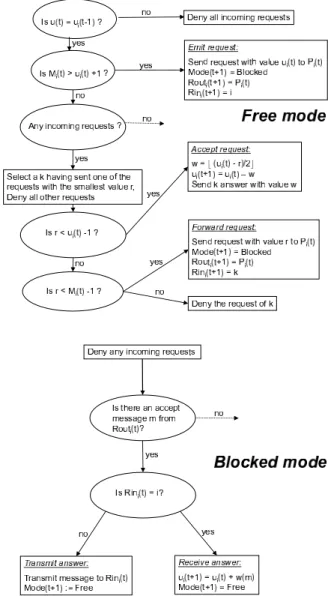
More formally, the algorithm uses two types of messages: (a) (Request, r): This is a request for a transfer of value. Here, r is an integer that represents the current number of pebbles at the emitter.
(b) (Accept, w): This corresponds to acceptance of a request, and subsequent transfer of w pebbles to the requesting node. A request with a value w = 0 represents a request denial.
As part of the algorithm, the nodes run the maximum tracking algorithm of Section V-A, as well as a minimum tracking counterpart. In particular, each node i has access to the variables Mi(t) and Pi(t) of the maximum tracking
algorithm (recall that these are, respectively, the estimated maximum and a pointer to a neighbor). Furthermore, each node maintains three additional variables.
(a) “mode”∈ {free,blocked}. Initially, the mode of every node is free. Nodes become blocked when they are handling requests.
(b) “Rini(t)”, “Routi(t)” are pointers to a neighbor of
i or to itself. They represent, respectively, the node from which i has received a request, and the node to which i has transmitted a request. Initially, Rini(0) =
Routi(0) = ∅.
The algorithm is described in Figure 2.
A key step in the proof of Theorem IV.1 is the following proposition, whose proof is omitted.
Proposition V.1. There is a time t! such that ui(t) =
ui(t!), for all i and t ≥ t!. Moreover,
% i ui(t!) = % i ui(0) = % i xi, |ui(t ! ) − uj(t ! )| ≤ 1, for all i, j.
We now conclude our sketch of the proof of Theorem IV.1. Let u∗i be the value that ui(t) settles on. It follows 1587
Fig. 2. Representation of the average computation algorithm
from Proposition V.1 that if the average ¯x of the inputs xi is
integer, then ui(t) = u∗i = ¯x will eventually hold for every
i. If ¯x is not an integer, then some node will eventually have u∗i = -¯x. and others u
∗
i = /¯x0. Using the maximum and
minimum computation algorithm, nodes will eventually have a correct estimate of maxiu∗i and miniu∗i, because each
ui(t) converges to u∗i. This allows the nodes to determine
if the average is exactly ¯x (integer average), or if it lies in (¯u∗ i, ¯u ∗ i + 1), or (¯u ∗ i − 1, ¯u ∗
i), which is the property asserted
by Theorem IV.1.
REFERENCES
[1] “Local and global properties in networks of processors,” D. Angluin,
Proceedings of the twelfth annual ACM symposium on Theory of computing, 1980.
[2] “An introduction to population protocols,” J. Aspnes and E. Ruppert,
Bulletin of the European Association for Theoretical Computer Sci-ence, 93:98117, October 2007.
[3] “Distributed Average Consensus using Probabilistic Quantization,” T.C. Aysal, M. Coates, M. Rabbat, 14th IEEE/SP Workshop on
Statistical Signal Processing, 2007.
[4] Y. Afek and Y. Matias, “Elections in anonymous networks,”
Informa-tion and ComputaInforma-tion, 113:2, pp. 113-330, 1994.
[5] O. Ayaso, D. Shah, M. Dahleh, “Counting bits for distributed function computation,” Proceedings of the IEEE International Symposium on
Information Theory, 2008.
[6] H. Attiya, M. Snir, M.K. Warmuth, “Computing on an anonymous ring,” Journal of the ACM, Vol. 35, No. 4, pp. 845 - 875, 1988. [7] F. B´en´ezit, P. Thiran, M. Vetterli“Interval consensus: from quantized
gossip to voting,” , Proceedings of ICASSP 08.
[8] R. Carli, F. Bullo, “Quantized Coordination Algorithms for Ren-dezvous and Deployment, ” preprint.
[9] P. Frasca, R. Carli, F. Fagnani, S. Zampieri, “Average consensus on networks with quantized communication,” preprint.
[10] F. Fich, E. Ruppert, “Hundreds of impossibility results for distributed computing,” Distributed Computing, Vol. 16, pp. 121-163, 2003. [11] A. Giridhar, P.R. Kumar, “Computing and communicating functions
over sensor networks,” IEEE Journal on on Selected Areas in
Com-munications, Vol. 23, No. 4, pp. 755- 764, 2005.
[12] P. Gacs, G.L. Kurdyumov, L.A. Levin, “One-dimensional uniform arrays that wash out finite islands,” Problemy Peredachi Informatsii, 1978.
[13] A.G. Greenberg, P. Flajolet, R. Lander, “Estimating the multiplicity of conflicts to speed their resolution in multiple access channels,” Journal of the ACM, Vol 34, No. 2, 1987.
[14] Y. Hassin and D. Peleg, “Distributed Probabilistic Polling and Applica-tions to Proportionate Agreement,” Information and Computation 171, (2001), 248-268.
[15] A. Jadbabaie, J. Lin, A.S. Morse, “ Coordination of groups of mobile autonomous agents using nearest neighbor rules,” IEEE Transactions
on Automatic Control, Vol. 48, No. 6, pp. 988-1001, 2003.
[16] A. Kashyap, T. Basar, R. Srikant, “Quantized consensus,” Automatica, Vol. 43, No. 7, pp. 1192-1203, 2007.
[17] E. Kranakis, D. Krizanc, J. van den Berg, “Computing boolean func-tions on anonymous networks,” Proceedings of the 17th International
Colloquium on Automata, Languages and Programming, Warwick
University, England, July 1620, 1990.
[18] N. Khude, A. Kumar, A. Karnik, “Time and energy complexity of distributed computation in wireless sensor networks,” Proceedings of
INFOCOM 05.
[19] N. Katenka, E. Levina, and G. Michailidis, “Local Vote Decision Fusion for Target Detection in Wireless Sensor Networks,” IEEE
Transactions on Signal Processing, 56(1):329-338, 2008.
[20] S. Kar, J.M Moura, “Distributed average consensus in sensor networks with quantized inter-sensor communication, ” IEEE International
Con-ference on Acoustics, Speech and Signal Processing, 2008.
[21] M. Land, R.K. Belew, “No perfect two-state cellular automaton for density classification exists, ” Physical Review Letters, vol 74, no. 25, pp. 5148-5150, Jun 1995.
[22] Y. Lei, R. Srikant, G.E. Dullerud, “Distributed Symmetric Function Computation in Noisy Wireless Sensor Networks,” IEEE Transactions
on Information Theory, Vol. 53, No. 12, pp. 4826-4833, 2007.
[23] L. Liss, Y. Birk, R. Wolff, and A. Schuster, “A Local Algorithm for Ad Hoc Majority Voting Via Charge Fusion,” Proceedings of DISC’04, Amsterdam, the Netherlands, October, 2004
[24] S. Martinez, F. Bullo, J. Cortes, E. Frazzoli, “On synchronous robotic networks - part I: models, tasks, complexity,” IEEE Transactions on
Robotics and Automation, Vol. 52, No. 12, pp. 2199 - 2213, 2007.
[25] S. Mukherjeea, H. Kargupta, “Distributed probabilistic inferencing in sensor networks using variational approximation,” Journal of Parallel
and Distributed Computing, Volume 68, Issue 1, Pages 78-92, 2008.
[26] S. Moran, M.K. Warmuth, “Gap Theorems for Distributed Computa-tion,” SIAM Journal of Computing Vol. 22, No. 2, pp. 379-394 (1993). [27] A. Nedic, A. Olshevsky, A. Ozdaglar, J.N. Tsitsiklis, “On distributed averaging algorithms and quantization effects,” preprint, to be pub-lished in Proceedings of 47th IEEE Conference on Decision and
Control, 2008.
[28] D. Peleg, “Local majorities, coalitions and monopolies in graphs: a review, ” Theoretical Computer Science, Vol. 282, No. 2, pp. 231-237, 2002.
[29] E. Perron, D. Vasuvedan, M. Vojnovic, “Using Three States for Binary Consensus on Complete Graphs,” preprint.
[30] L. Xiao and S. Boyd, “Fast Linear Iterations for Distributed Averag-ing,” Systems and Control Letters, 53:65-78, 2004.
[31] M. Yamashita and T. Kameda, “Computing on an anonymous network,”
Proceedings of the seventh annual ACM Symposium on Principles of distributed computing, 1988.