Distributed Web Caching System with Consistent
Hashing
by
Alexander Sherman
Submitted to the Department of Electrical Engineering and
Computer Science
in partial fulfillment of the requirements for the degree of
Bachelor of Science in Computer Science and Engineering
and
Master of Engineering in Electrical Engineering and Computer
Science
at the
MASSACHUSETTS INSTITUTE OF TECHNOLOGY
February 1999
(© Massachusetts Institute of Technology 1999. All rights reserved.
Signature redacted
Author ... _... ... LL-Department of Electrical Engineering and Computer Science
| February 19, 1999
| Signature redacted
Certified by... . . ... 5 yaw .Madhu Sudan
Associate Professor-of Computer Science
©Thesis-Supervisor
Signature redacted
Accepted by .... fr er ln Pw El ..Arthur C. Smith
Chairman, Department Committee on Graduate Students
~TIASSACHUSETTS INSTITUTE
Distributed Web Caching System with Consistent Hashing
hy
Alexander Sherman
Submitted to the Department of Electrical Engineering and Computer Science on February 19, 1999, in partial fulfillment of the
requirements for the degree of
Bachelor of Science in Computer Science and Engineering and
Master of Engineering in Electrical Engineering and Computer Science
Abstract
As the traffic on the World Wide Web increases, users experience more delays and
failures in data delivery. The efficiency with which the content is served to the users is critical. Distributed Web Caching is one of the key techniques that improves the effeciency of service. This work describes a Distributed Web Caching system based on the Consistent Hashing algorithms that improve on the methods used by the existing
web caching systems. Consistent Hashing as used in our system provides for a more efficient use of caches on the World Wide Web, which translates into faster service
for the users. In addition, our system offers features such as load balancing and high fault tolerance, features that are absent from most web caching implementations.
Thesis Supervisor: Madhu Sudan
Title: Associate Professor of Computer Science I
Acknowledgments
I would like to thank Professor Tom Leighton and Professor Madhu Sudan, my two supervisors, for their direction and help. I would especially like to thank Bill Bogstad.
David Karger, Tom Leighton, Daniel Lewin and Yoav Yerushalmi, all of whom ma-jorly contributed to the work presented here. In addition, I would like to thank undergraduate students Ken Iwamoto, Brian Kim, and Luke Matkins who also par-ticipated in this research.
Contents
} Introduction 9
1.1 Delays and Failures on the Web 9
1.2 Web Caching . 10
1.3 Related Work - Distributed Web Caching Systems 11
1.3.1 Malpani . . . 12
1.3.2 Harvest System 12
1.3.3 Crispy Squid . 13 1.4 Need for a New Design RE
1.5 Presentation . 14
z Hashing 15
2.1 A New Approach 15
2.2 Desired Properties of Hashing .. 16
2.3 Introducing Consistent Hashing 18
= Consistent Hashing 22
3.1 Properties of . 22
3.1.1 Previously Proven Bounds 22
3.1.2 Balancing with Multiple Cache Copies 24
3.2 Implementation . 28
3.2.1 Range . .. 28
3.2.2 Mapping Points . . 28
3.2.4 Primitives 31
3.2.5 Evaluating URLs and Caches |
3.3 Useful Statistics . 32
1 Our System 34
4.1 Caches . 34
4.2 Users’ browsers . 36 4.3 Domain Name Servers . 37 4.3.1 Functionality . 37
4.3.2 Efficient Cache Use with Consistent Hashing . 38
4.3.3 Advantages . 38 4.3.4 Disadvantages . 39
4.4 Monitor . . 40
4.5 Overview . 40
5 Comparison with Other Systems 41
5.1 Overview of Systems . 41 5.1.1 Harvest System . 41 5.1.2 Crispy Squid 42 5.1.3 Our System 43 5.2 Testing . . 43 5.2.1 Network Setup 43
5.2.2 Test Driver - Surge 44 5.2.3 Modifications . 45
5.2.4 Results. . . . 46
6 Side Effects 51
6.1 Locality ol
6.2 Advanced Load Balancing - Hot Pages . 93
6.3 Fail-over Features . . 5b
R Future Research 59
8.1 Bounds on Consistent Hashing . 99
8.2 Load Balancing among Caches .. 60 8.3 URL Hashing ... 60
8.4 General Goal : .. 61
List of Figures
2-1 Result of adding cache with standard modulo hashing 17
2-2 The basic construction of a consistent hash function 19
2-3 Making multiple copies of each cache 21
3-1 Load of cache A . 25
4-1 System Components 35
5-1 Test Network Setup . 44
5-2 Cache Miss rates of Common Mode vs Cache Resolver Mode 47
5-3 Difference in Latencies . 48
5-4 Miss rates of three additional configurations 48
5-5 Various Cache System Configurations . . 49
Chapter 1
Introduction
As a solution to the problem of slow service experienced by most World Wide Web
users, we offer an experimental analysis of a web caching scheme that uses consistent
hashing algorithms due to [5].
1.1 Delays and Failures on the Web
As the traffic on the World Wide Web increases users experience longer delays and failures. Over the recent months the World Wide Web has become a highly popular
medium for news, entertainment and commerce. With advancements in client and server technologies, many web sites can offer increasingly elaborate services such as
stock trading, streaming video clips and real audio. As more users join the Internet and take advantage of these services, traffic on the World Wide Web grows steadily, servers get swamped and networks become congested. Swamped servers and network
congestion in turn cause greater delays and failures for the users.
Servers for popular web sites often get swamped from too many requests. As
the queue of user requests at a server grows, the average response time per request
decreases. If the queue grows very large servers spend additional time on queue
management and less time serving users. Many users connect to servers via modems
of the data. Number of open connections is another limiting factor for the servers
and additional requests are dropped. Swamped servers either shut down completely causing long timeouts on connection attempts or continue serving requests very slowly causing users to experience long delays.
Networks that serve as central exchange areas for the Internet often become
con-gested. Multitude of packets often get held up by the routers at such networks. Just
like busy web servers, routers process packets at a reduced rate as the request queue
grows. At such times router’s buffer could overflow and any additional packets will be dropped. Dropped packets require retransmissions and thus waste the precious
bandwidth. Congested networks contribute to more delays on the Web.
1.2 Web Caching
Web caching is a common technique used to reduce the number of delays and failures experienced by the users. Caching allows users to bypass both problems mentioned in
section 1.1 by storing resources closer to users. Access times are improved since most connection to busy servers are avoided and minimal packet travel over congested
networks is required. A common form of web caching is present in most browsers
where users can select a storage space of certain capacity to be used for caching. On
request for a URL, a browser serves the resource out of the local cache if a copy that is not outdated exists."
However, local browser caching is not a sufficient solution. In order for such a cache to be useful, a fresh copy of requested data must be first placed into a cache, and that requires the user to visit the original web server at least once to retrieve that data. That means at least one connection for every user visiting a given web site. There are hardly any web users today who do not use local browser caches and
yet they still complain about slow connections and delays. A more comprehensive
'A caching HTTP client is allowed to use cached data only if the time specified in the “Expires” header has not yet arrived. If “Expires” header is not provided, a client is required to issue a
conditional request to the origin server and retrieve the data if it is more recent than the client’s cached copy. There are also some additional HTTP caching constraints.
solution is to provide for a larger regional cache that can serve all of the users in a region. In such a case only the first user from that region who requests a certain
resource will experience a delay, but all the following requests for that resource will be served directly from the cache.
Regional cache also presents a problem. If it is serving only a small group of users
it can be placed very close to those users, and retrievals from that cache are likely to
be fast. At the same time a small group is unlikely to have a significant overlap in
the resources they request, and such a cache would hardly do any better than a local
browser cache. On the other hand, if the cache is serving a large region, a significant overlap in user requests is likely. But such a cache would be placed far from most end users, and even though hit rate may be high the data retrieval time will become
considerable. In addition, such a cache may itself turn into a swamped server due to
many requests. Thus, a regional cache presents a tradeoff between faster access times and higher hit rate.
1.3 Related Work - Distributed Web Caching
Sys-tems
In order to achieve both, high hit rate in a cache and proximity to the end user, many research teams have produced designs that combine individual regional caches into more complex distributed cache systems. Common approach of all such systems [8, 2, 3] is to place caches into relatively small regions (i.e. at close proximity to end
users) and to improve hit rate by allowing caches to communicate in order to request
data from other participating caches in case of a miss. Given that there are many caches significantly close to a region, a miss in the primary cache can still result in a
win as it may be less expensive to retrieve data from other caches than the original
1.3.1 Malpani
In one such system, Malpani [8] introduces a protocol called “IP Multicast”. In case of a miss, caches send multicast packets addressed to all other caches. If one of the caches replies that it has the requested data, it is retrieved from that cache. If
no cache has the data, request is forwarded to the original host for that resource.
The disadvantage of this system is that communication among caches proves quite
expensive when all of the caches send out multicast requests on every miss. Such requests queue up and slow down the server. If the data is not present in any cache,
the cache that originated a multicast request waits until it receives all of the replies,
while the user waits for the data.
1.3.2 Harvest System
To eliminate all-cache communication, the Harvest system [2] implements “A
Hier-archical Internet Object Cache”. As the name suggests, caches in this system form a hierarchical tree structure with leaf nodes serving as primary regional caches. In
case of a miss a leaf node cache forwards its request only to its siblings and parent as
opposed to all caches. This request propagates up the tree until it reaches the root
node cache which in case of a miss contacts the home server for the resource. Then,
data travels down to the leaf node, and its copy is stored in each cache on its path.
Although this system eliminates expensive multicast, there is still significant delay associated with the inter-cache communication. In fact, several layers of communica-tion could take place as request propagates up the tree. In addicommunica-tion, this hierarchical arrangement introduces new points of failure. Few caches that are at the top of the
tree are likely to become overloaded if many misses are propagated simultaneously to
the top. At such instances all of the users will receive very slow service, and if the
top caches fail, the whole system is rendered useless. Harvest designers produced a
proxy cache implementation called “Squid” that uses Internet Cache Protocol (ICP,
9, 10]) optimized for inter-cache communication. As the next generation of Squid
Crispy Squid, was designed.
1.3.3 Crispy Squid
Crispy Squid [3] attempts to reduce inter-cache communication even further by
in-troducing “centralized directory” into the system. On a cache miss communication is reduced to only two steps. Cache sends a lookup request to the directory to find out which other cache (if any) contains requested resource, and then it retrieves the data
from a cache suggested by the directory or from origin host if no other cache is known to have the data. Mappings of resources to caches in the directory can be updated asynchronously, and do not contribute directly to user request latencies. Although
the directory improves cache miss latencies, it also introduces a point of failure into the system; if the server containing the directory dies, caches stop communicating and start behaving as individual caches. Crispy Squid system allows the directory
to be replicated on several servers, however such configuration requires much greater storage space as central directory can be quite large. An alternative configuration
is a replicated partial directory where each directory contains only partial mappings
somewhat reducing the system hit rate.
Paper written by the Crispy Squid developers [3] and the very existence of various
directory configurations suggest, that the Crispy Squid project was also struggling
with the same regional cache tradeoff described in section 1.2. One central
direc-tory would mean guaranteed hit if any cache in the system had the data, but the
access time to one directory for the whole (possibly global) system can be quite large. Replicated partial directory can place one of its parts in every region of the world
and provide very fast access times, but the hit rate in such a directory will suffer.
1.4 Need for a New Design
It appears that none of the existing distributed cache systems have been able to
In addition, complexity of these designs has introduced many points of failure into
their systems. Our work suggests a new approach that does away with all inter-cache
communication, and yet allows caches to behave together in one coherent system maintaining a high hit rate. At the same time, the system we develop is free of single points of failure such as the centralized directory or a few caches at the top of the
cache hierarchy
1.5 Presentation
Chapter 2 introduces an alternative approach to distributed web caching. This ap-proach is based on consistent hash functions that were developed by the MIT Al-gorithms group and will be thoroughly described in Chapter 3. Chapter 4 presents
the design of the actual system that we implemented. Chapter 5 talks about some test results of our system especially in comparison with other distributed web caching systems. Additional features of our web caching system are discussed in chapter 6. Chapter 7 summarizes the practical relevance of the formal properties of consistent
hashing to our web caching system. Directions for future research are outlined in
Chapter 2
Hashing
This chapter describes hashing as a possible approach to a web caching scheme. This
discussion leads into the introduction of a web caching scheme based on consistent
hashing that was proposed by Karger, Lehman, Leighton, Levine, Lewin and
Pani-grahy in [5].
2.1 A New Approach
Cache Resolver, the distributed web caching system that we developed, eliminates
the necessity for any inter-cache communication on a cache miss by letting clients
decide for themselves which cache has the required data. Instead of contacting a
primary cache which on a miss sends requests to other caches or a directory, user’s
browser directly contacts the cache that contains the required resource. Browsers make their decision with help of a hash function which maps resources (or URLs)
to a set of available caches. With a globally known hash function, all of the system clients (users) can agree on which caches are responsible for storing each resource.
Thus, our system speeds up access time to the “right cache” in two ways. First of all, executing a hash function locally is faster than running non-trivial protocols among
caches to find the right cache. Also, if there is a “right cache”, no time is wasted on
2.2 Desired Properties of Hashing
In order to insure a high hit rate and fast access times, the hash function that will
map URLs to caches must possess several properties. First of all, this hash function must distribute data items evenly among caches. If a large disproportionate fraction
of resources is mapped to some cache, such cache is likely to become overloaded due to requests for all of the resources. It is also possible that such cache would run out of storage space for the data and the hit rate would decrease. One common hash function that can be used to achieve good balance is a modulo function:
f(d)=ad+b (mod n)
which can be used to map data item d to a set of n caches {0,1,2,...,n—1}. (a and
b are relatively prime). For a given distribution of data items it is possible to choose
a and b for optimal balance.
Another key property for the mapping function is consistency of mappings of
data items to caches. In a world wide cache system that stretches across a myriad of domains and regions, it is practically impossible to maintain a constant set of live
cache machines. Some cache machines are likely to become unavailable for service
due to shutdown for software re-installation, or due to network, power, or hardware failures. After some time interval, these machines will come back on line and other
machines could fail. In addition, the global cache system is expected to grow steadily
with new machines added every day. These fluctuations in the set of available cache
machines correspond to fluctuations in range of the mapping hash function. As the range changes, if the mappings of documents to caches do not remain consistent,
documents will become duplicated among many caches. The miss rate and access times will increase as many new caches will need to access the origin servers for the
given documents. The cache system will require more storage for the duplicated documents.
Modulo hash functions, for example, will behave especially poorly under
Hash Results mod 4 ¢
Hash Results mod 5
-~L- a L —_—
10 15 20 25 30 35 40 45
Documents
Figure 2-1: Result of adding cache with standard modulo hashing
Hash Results (mod 4) represent the assignment of 10 documents to 4 caches using the hash function f(d) = d +1 (mod 4). Hash Results (mod 5) represent the assignment after one additional cache is added. The hash function is changed to be f(d) =d+1 (mod 5). Note, that with the addition of a new cache, almost every
URL is mapped to a different cache.
n to n+1, approximately only 1/n fraction of data items keep their old mappings. Example shown in figure 2.2 demonstrates that when a set of 4 caches is increased
to 5, the modulo hash function changes from (mod 4) to (mod 5) to include the
new cache into the range. As a result, items 5, 7, 10, 11, 27, 29, 36, 38 and 43 get reshuffled to different caches, and only item 40 remains mapped to the same cache. Because of data duplications, the total storage requirement almost doubles.
It is also important to note that in a large system all the users can not be notified
instantaneously of all the changes in the set of live cache machines. As different
groups of users learn about some changes sooner than others, views on the set of live machines are likely to differ among users. As a result, even as the cache set is
evolving users could be simultaneously requesting the same data item from different caches. In such a case, if the mapping is highly inconsistent, superfluous copies of this
data item will never become outdated and forced out from caches!. Instead, these items will compete with other data for the critical space in the fast access memory of RAM on many machines. Using the same example as in figure 2.2, imagine one view consisting of one more cache than another view. With a modulo function these two
views map almost all of the items to different caches, making very inefficient use of the system. Thus, the mapping hash function used in the global web cache system
should map items consistently despite possible disjoint views.
2.3 Introducing Consistent Hashing
A family of consistent hash functions developed by the Algorithms group at MIT
possesses all of the properties required for mapping documents to caches in the global cache system. As the name suggests these functions maintain consistent mappings despite fluctuations in range.
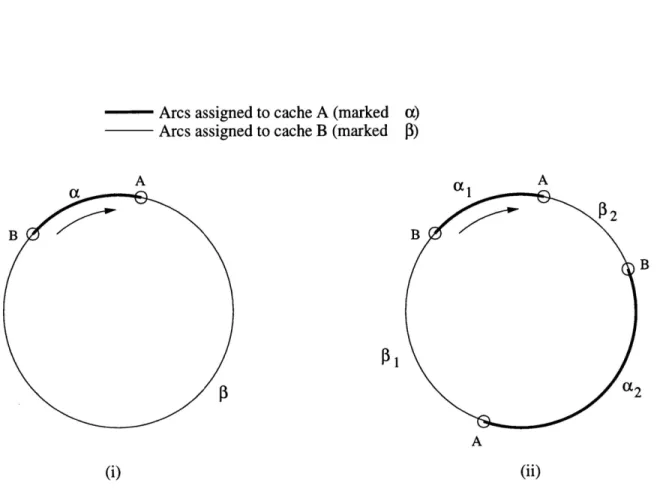
The basic construction of a consistent hash function is quite simple. Both, the data items and the caches, are mapped randomly and independently to a circle with circumference of length 1 as shown in figure 2.3(i). A data item is assigned to the closest cache in the clockwise direction along the circle. Thus, in figure 2.3(i), items
1, 2, and 3 are mapped to cache A, and items 4 and 5 are mapped to cache B. We
call the arc from point B to point A in the clockwise direction a responsibility arc of
cache A, because cache A is responsible for storing all of the data items that fall into
that arc. The formal definitions and properties of consistent hash functions will be
described in section 3.1.1. In this section, the intuition for the properties of consistent hash functions will be explained.
The “consistency” of consistent hash functions can be observed from the example in figure 2.3(ii)). When a new Cache, C, is added to the system, only data item 1
that is now closest to C' in clockwise direction change its assignment. However, items
that are not closest to the new cache will not change their assignments. Thus, as the
1 Usually caches use Least Recently Used (LRU) replacement strategy to force least recently used
Caches:A,B,C
Items: 1,2,3,4,5
Figure 2-2: The basic construction of a consistent hash function
(i) Both, items and caches, are mapped randomly to points on a circle. An item is assigned to the closest cache going clockwise around the circle. For example items 1, 2, and 3 are mapped to cache A. items 4, and 5 are mapped to cache B. Arrow shows the direction of mapping of items to caches. (ii) When a new cache, C, is added, only
items that are closest to that cache (in clockwise direction) are reassigned. In this case, only item 1 is reassigned to the new cache C. Items do not move between
previously existing caches. Compare this with the results obtained from standard hashing in figure 2.2
t
(ii)
set of caches fluctuates, mappings from URLs to caches change only slightly; only
documents that are mapped closest to caches in question will be affected.
Since both, the documents and the caches, are mapped to the circle at random,
documents are likely to be well balanced among caches.? As a result each cache will
be responsible for serving, a small proportionate fraction of the data items. To further reduce the probability of imbalance each physical cache can be represented by multiple
points on the circumference, collecting items from more, but smaller arcs of the circle. Figure 2.3 demonstrates an example where adding an additional copy of each cache to the circle helps balance collective lengths of responsibility arcs between caches A and B. As a result of using two copies of each cache, the sum of responsibility arcs of each cache is closer to 1/2. (Remember the total circumference of the circle is 1.)
This trick can be shown to improve the distribution and will be discussed further in section 3.1.2.
Following the same intuition, it is possible to see that despite disjoint views among users, the mapping will remain consistent. Since the data items are always mapped to caches closest to them in the counterclockwise direction along the circle, they can only
be hashed to caches in their vicinity and not anywhere in the circle. So if there is some
disagreement with regards to which caches are alive, documents could be duplicated
in more than one cache, but will be constrained to caches in their neighborhood, and
the duplication degree will be small.
Next chapter formally states the properties of Consistent Hashing. It discusses practical implementation of consistent hashing and lists a few statistics on usability of these functions.
© 2The probability of balanced distribution is especially high when the data set is large. Since we are considering a set of all the web documents, it is a large set.
——— Arcs assigned to cache A (marked «) — Arcs assigned to cache B (marked J3)
Bq
i‘ fii
Figure 2-3: Making multiple copies of each cache
Each cache point is responsible for storing data items that fall in the arc between this point and the first cache point in counterclockwise direction from it. Each cache, is
responsible for all the arcs assigned to its cache points. This figure demonstrates an
example when adding an extra copy of cache A and B to the circle helps balance the responsibility arcs between the caches. (i) Here, with unlucky mapping of each cache point to the circle, cache A is responsible for a much smaller arc then cache B. (ii)
With an additional copy of each cache the sum of the two responsibility arcs of A is closer to the sum of responsibility arcs of B
0.
Chapter 3
® J
Consistent Hashing
This chapter states formal properties of consistent hashing, results that were first introduced in [5]. It continues with discussion of our research of implementation and experimental analysis of consistent hash functions.
3.1 Properties of
3.1.1 Previously Proven Bounds
Consistent hash functions can be shown to possess properties suitable for mapping
documents to caches in a global web caching system. These properties include
mono-tonicity, low spread, low load, and balance. Monotonicity implies consistency in
map-ping documents to caches despite fluctuations in the cache set. Spread refers to degree of duplication of each document. Low spread guarantees that despite disjoint views.
each document will be spread to a small subset of caches. Load represents the total
number of documents mapped to each cache. Low load says that each cache will be responsible for a proportionate fraction of documents. Balance property insures that for a given view, the items will be even distributed among the caches. The theo-retical work described in [5, 7, 11] lists detailed analysis and proofs of each of these properties. Here, the formal definitions and the properties are only stated.
B. The total number of distinct physical caches seen by any of the views is T. Each view is required to contain at least 1/t fraction of caches, so that each view contains at least T/t caches. Let I be the complete set of data items that are mapped to
caches. Let N > 1 be a confidence factor. Each cache is replicated m times over the
unit circle. For m = (log(T)), the following properties hold:
1. Monotonicity: Let Vi and V3 be two views of live caches, such that V; C V5, CU.
Let f,,(¢) return a cache that item i is mapped to under view Vj. Then, f,,(i) € V
implies that f,, (i) = fu, (i). This property says, that as the caches are added to a view, all elements still mapped to one of the old caches were mapped to the same caches under the old view. Thus, mappings maintain consistency.
2. Low Spread: Since the views of the set of the available cache machines may be inconsistent among users, it is possible that a particular item will be mapped to
many different physical caches by different views. The spread of an item4isthetotal
number of caches that this item is mapped to by all of the views. Low spread property
of consistent hash functions guaranteed that with high probability each item will be
duplicated only in a small fraction of caches. Specifically, for any item ¢ € I,
Pr[spread(U, i) = O(tlog(Nk))] >1—1/N.
3. Low Load: Load of a cache is a measure of the total number of distinct items
mapped to that cache by all of the views. Since the items are mapped randomly to
the circle circumference, this measure can be thought of roughly as the total fraction
of the circumference this cache is responsible for. Note, that for different views, a particular cache could be responsible for different arcs of the circle. The load of a
cache is a union of all the responsibility arcs of that cache under all views. This means
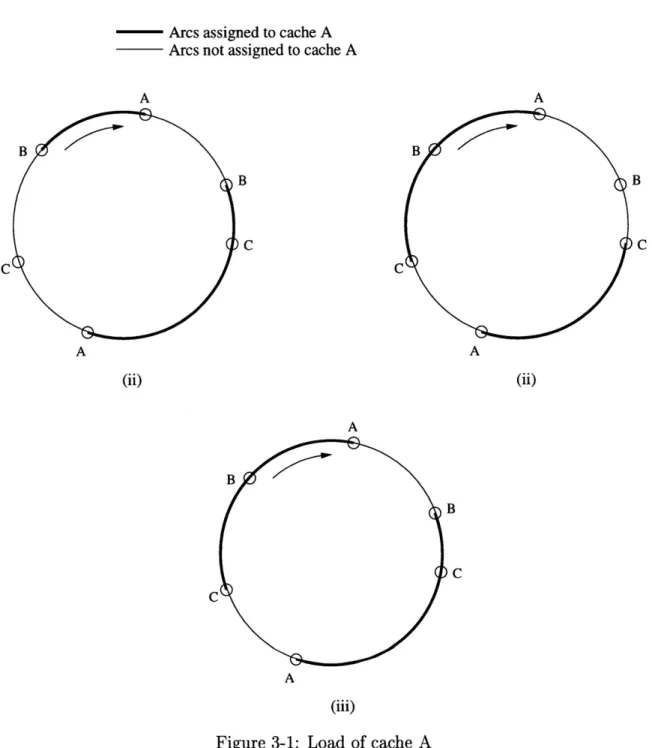
that as long as any view assigns certain items to a given cache, these items contribute to that cache’s total load. Figure 3-1 demonstrates this point. Figure 3-1(i) shows
responsibility arcs of cache A for a view containing only caches A and B, out of the
total set, {A, B,C}. Figure 3-1(ii) shows responsibility arcs of cache A for a view
containing caches A and C, excluding cache B. The total load of cache A, comprised
of the union of all its responsibility arcs under each view is indicated in figure 3-1(iii). The low load property of consistent hash functions limits the maximum load of any cache under all possible valid views. For any cache b € B:
Prlload(b) = O((1 + I/T)tlog(Nmk))] > 1 —1/N.
4. Balance: Balance property states that for each particular view, the data items are
well balanced among the caches in that view. Each cache in a given view is responsible
for only a small fraction of total load. Let V be a fixed view that contains v = |V/| physical caches. Let m = glog(v) for some constant q. (m is the number of copies,
or point representations, of each physical cache, with each copy mapped randomly to
the circle). Then for any cache b € 1
Prlitem i is assigned to b] = 08) + :
Balance property does not say anything directly about a general case, as it only
fixates on one view. However, balance property for one view provides an intuition for a good balance among caches for all views. In addition, this result can be applied
directly to a system that can maintain one consistent view or a small number of
views. In systems where such situations are likely this property immediately implies
a balanced distribution of load among caches.
3.1.2 Balancing with Multiple Cache Copies
Although it can be explained intuitively how multiple copies of each cache help reduce
the probability of imbalance, this result is not obvious from the bounds proven above.
More copies of each cache create more, but smaller responsibility arcs for each cache. The expected value of the sum of the responsibility arcs stays constant, regardless of the number of copies of each cache. However, greater number of responsibility
arcs (i.e. cache copies) gives smaller variation in the sum of these arcs. This is the
= Arcs assigned to cache A — Arcs not assigned to cache A
ae (4 ko,
‘5 op 4
BZ
R
Figure 3-1: Load of cache A
Load of cache A corresponds to the union of all the responsibility arcs of cache A under all views. In this example two distinct views are possible: {A, B} and [A,C}. Responsibility arcs of cache A under each view are shown in bold. (i) Shows responsibility arcs of cache A under view-1 that contains caches A and B, but not C. (ii) Shows responsibility arcs of cache A under view-2 that contains caches A and C, but not B. (iii) Shows total load of cache A, which is the union of its responsibility arcs under all existing views.
(ii) (i1)
Bound on Balance
In case of the bound on balance that considers a specific view it can be shown more
clearly how a greater number of copies of each cache improves the bound. Section 3.1.1
states that the probability of any item : being mapped to a specific cache b in a
given view V, is at most O(n + +). where N is the confidence factor, and
|V| is number of caches in view V. Number of copies of each cache is taken to be
m = Q(log(|V])). Lemmas 2.2.8 and 2.2.9 in [7] describe the analysis of this bound. It is important to point out that this bound is actually composed of two
compo-nents. Probability that an item 7 is assigned to a give cache is roughly represented by the fraction of the circle that the cache points (or copies) are responsible for, or the
sum of responsibility arcs of this cache. The analysis in [7] that proves the bound on the sum of these arcs actually splits these arcs into two types, discretized arcs, and
continuous arcs. Both types are represented in the bound. Discretized arcs are bound
with O(a) + +, and continues arcs are bound with O(1/V). The bound is the
sum of these values. log(|V]) that appears in the denominator of the first fraction is
actually exactly the measure of m that is taken to be Q(log(|V])). In fact the analysis
in Lemma 2.2.8 can be carried out substituting m for log(|V'|). So the actual bound
will look as follows:
Prlitem i is mapped to cache b] = o£) + O57) + ©)
Notice that m, the number of caches, appears in the denominator of the first fraction
and helps improve the bound as it increases. If N is taken to be Q(|V]), and m =
Q(log(N|V])), the bound on probability is reduced to O(1/|V]).
Clarification of the balance bound demonstrates that the increase in the the num-ber of copies helps to balance load among the caches in one view. When m is
Bound on Load
Just like with the balance property, bound on the load property should also reflect that
the bound improves as the number of copies of each cache is increased. Although the
balance bound provides the intuition, the load bound is much more difficult to prove.
In fact, the bound for load stated in section 3.1.1 becomes looser as m increases. It is
also possible to show a bound on load that does not depend on m altogether. In [7],
through the analysis of 7-hash functions, which are shown to be equivalent to consis-tent hash functions, the bound on load can be shown to be O((1 + yt log(NV |1|k)).
This bound, however, does not reflect any dependence on m. It is preferable to show
the same dependence on m as in the bound on balance, where one term decreases with
m and one term is independent of m. The most likely approach that would result in
such a bound is the analysis used for the balance property.
This analysis is conducted as follows. Responsibility arcs of a cache are discretized. It is then shown, that for a given distribution of discrete lengths of m arcs, their sum
is bounded with high probability. This probability is then summed over all possible
distributions, and the summation of these probabilities is still shown to be small. The difficult step in this analysis is bounding a specific distribution of lengths
of m arcs. For the balance property analysis, where a single view was considered, it
was sufficient to show that with high probability there is one cache point that falls inside any of the arcs in the distribution. A cache point occurring anywhere, would
bound the arc where it occurred, thus bounding the total lengths of the arcs. In the
load property analysis, however, it is necessary to show that at least one point from
every view falls into one of the arcs. Only then, would that arc (and therefore the
distribution) be bounded under all possible views. Although the exact form for that
bound has not yet been found, all the research work done so far indicates that the
3.2 Implementation
Implementation of a consistent hash function involves two components. First compo-nent is choosing a way to map caches and data items to the circumference of a circle
randomly and independently. Second component is maintaining a view of available caches. Each component is discussed in order.
3.2.1 Range
In order to map caches and data items efficiently to the unit-circumference circle, the circumference of this circle is discretized. Specifically, a large prime, P is chosen to represent the number of discrete intervals in the circumference of a circle. All points
on the circle are then restricted to integer values from 0 to P-1. The values of the
points themselves are not significant as long as all the points (representing caches
and items) appear in the same order as they would on a continues circle. Same order guarantees same mappings of items to caches. P is chosen in such a way that all
the documents and caches can be comfortably represented on the interval. Using terminology of section 3.1.1, number of points that needs to be mapped to the circle is: m|B| + |I|, where I is the set of all data items, B is the set of all physical caches, and m is the number of points (or replications) for each physical cache on the circle. Thus, P is chosen to be of size O(m|B| + |I|). The advantage of discretizing the
circumference is that only log(P) = O(log(m|B| + |I|)) bits, is required to represent
points on the circle.
3.2.2 Mapping Points
Although consistent hashing theory requires for all the items to be mapped randomly
to the interval (or circle), in practice truly random and independent mappings are
im-possible. In his Master’s Thesis [7], Daniel Lewin defines an independence parameter,
K, that simplifies the random mapping requirement. A function is K-way
indepen-dent if it maps any K elements from domain to range indepenindepen-dently. Theorem 2.2.12 in [7] shows that if K-way independent functions are used to map caches and items to
the circle, with K = Q(t log(NTk)), then bounds outlined in section 3.1.1 still hold. One practical way to implement a K-way independent function is to use a K-degree polynomial with K randomly chosen coefficients. In our implementation we select
coefficients in the interval [0,P-1] using UNIX pseudo-random number generation
routines. Values of caches and items are plugged into these polynomials and are
evaluated modulo P to determine their values on the interval.
Each cache point on the interval is responsible for the subinterval for which it is the smallest upper bound. Thus, all URLs mapped to that subinterval are assigned
to this cache. As suggested by the bounds on consistent hashing in section 3.1.1, it is highly unlikely for any cache to be assigned a large fraction of items. In an unlucky scenario, however, some sub-interval that corresponds to one cache could be disproportionately large, and therefore contain more URLs. In order to reduce the
likelihood of such an event, we want to deal with smaller sub-intervals. The solution
is to create multiple copies of each cache and map each copy randomly to the interval [0, P-1]. As a result, each cache is represented by a multiple number of points on the interval and is responsible for many smaller subintervals instead of a larger one. The improvement due to a larger number of copies of each cache is discussed in 3.1.2.
Since each cache is represented with m points on the circumference we require m, K-way independent functions to map each copy of a given cache. So to map all the cache and data points to the interval, we generate m+1 K-degree polynomials,
{Polyo, Poly, ..., Poly}, with pseudo-random coefficients in the range [0, P-1]. The
first polynomial is used to map data items. The other m polynomials are used to map m cache copies, such that Poly; is used to map copy i of each cache.
It should be noted that in order for the users who know about the same set of
caches to have identical mappings between URLs and caches, they must use
poly-nomials with the same coefficients to create their Cache View and to hash URLs.
Therefore, exact polynomial coefficients must be included in the distribution of the
3.2.3 View Representation
In order to be able to actually hash URLs to the set of available caches, we must find some suitable representation of the cache view itself. Cache view must contain all
the copies of the available caches with their respective values on the [0, P-1] interval.
Representation of the cache view must also provide an efficient way to hash URLs to caches. Hashing a URL means finding a cache point whose value is the smallest upper
bound on the mapped value of a URL and returning the physical cache associated with that point. One suitable data structure for this representation is a binary tree. Nodes in the binary tree will correspond to the cache points that will be arranged according to their values on the [0, P-1] interval. For any node A in the tree, all the non-leaf nodes in its left subtree will have values smaller than value(A), and all the non-leaf nodes in its right subtree will have values greater than value(A). The tree has a total of m|B| nodes for all the points associated with caches. If the tree is kept balanced, the height of the tree will be log(m|B]), and it will take at most that
many comparisons to hash an item. The tree representation of user’s view allows the
following operations:
Insert _Node(View, val, C)
Inserts a node corresponding to cache C, with given value: val, into the View
Remove _Nodes(View, C)
Removes all the nodes corresponding to cache, C, out of the View.
Find _NextNode(View, val)
Returns the cache that has a node in the View with the smallest value exceeding val. (In order for consistent hashing properties to hold strictly the sequence of nodes must
correspond to the circular circumference. Therefore, if the value given to Find _NextNode
exceeds the highest-value node in the tree, the lowest value node is returned).
Balance_Tree(View)
3.2.4 Primitives
Our implementation of Consistent Hashing provides the following primitives to
main-tain a view of caches and hash URLs:
Generate _Polynomials(P, K, m):
For i = 0 to m
Poly; = Generate _Poly(P, K)
Add_Cache(View, C):
Fori=1tom val = Poly;(C)Insert_Node(View, val, C)
Balance _Tree(View)
Remove_Cache(View, C):
Remove _Nodes(V, C)
Balance_Tree(View)
Hash Item(View, i):
val = Poly (i)
node = Find _NextNode(View, val)
return Get_Cache(node)
3.2.5 Evaluating URLs and Caches
Before K-way independent polynomials are used to map caches and items onto the
interval, it is important to assign numerical values to URLs and caches. Caches
adminis-into the polynomials.
It is slightly more difficult to assign numerical values to string representations of URLs. Here, something simple can be performed, such as adding up string characters.
However, it is preferable to preserve unique value of each URL string in its numerical
representation for more random distribution of URLs across the interval. A better
scheme then, is to multiply each character by its position in the URL string and take
the product of these multiplications modulo some prime. The resulting value is then plugged into the first of the m+1 polynomials to be mapped to [0, P-1] interval.
3.3 Useful Statistics
We list a few brief statistics that demonstrate the usefulness of Consistent Hashing. First, it is important to realize that hashing consistently is a relatively fast operation.
For our testing environment, we have set up a Cache View using 100 virtual caches,
creating 1000 copies of each cache on interval [0, P-1]. We used 10-degree
polynomi-als for mapping. We timed the dynamic step of Consistent Hashing on a PentiumII
266MHz chip. (The dynamic step includes URL string evaluation, polynomial
evalu-ation, and traversing a binary tree). On average each call to the hash function took
20 microseconds. This is about 0.1% of the total time necessary to transmit a 20KB
file from a local cache over 10Mbit Ethernet. The value of 20 microseconds can be
significantly reduced if we use a balanced binary tree as the underlying Cache View
representation, as opposed to a regular binary tree currently used in our
implemen-tation.
We also took some measurements to show that consistent hashing balances well
among the caches, as its low load property stipulates. We used a week’s worth of logs from the theory.lcs.mit.edu web server. During that period of time, a total of 26,804
unique URL requests were made. We ran these unique requests through our hash
function with a varying number of various caches to see how well it would distribute files among the caches.
Number of caches | Mean entries in cache | Std Dev | Deviation as 7% of mean
| ) 8934 246 2.7
: 5360 | 173 3.2
2 3350 112 3.4
10 2680 68 2.6
The above data shows that the standard deviation of the number of entries is quite
low: around 3% of the mean. These numbers improve when the data set is larger. As described in section 3.1.1, consistent hashing possesses very convenient prop-erties for a global web caching system. The rest of this chapter has demonstrated the
triviality of the actual implementation of consistent hashing, and listed some of the
usage results. Next chapter will describe the web caching system itself and how it
Chapter 4
Our System
In order to demonstrate the practical advantage of Consistent Hashing we imple-mented a web caching system, called the Cache Resolver that uses our hashing algo-rithm. The system consists of three major components: the actual cache machines for storing the content, users’ browsers that direct requests toward virtual names of the
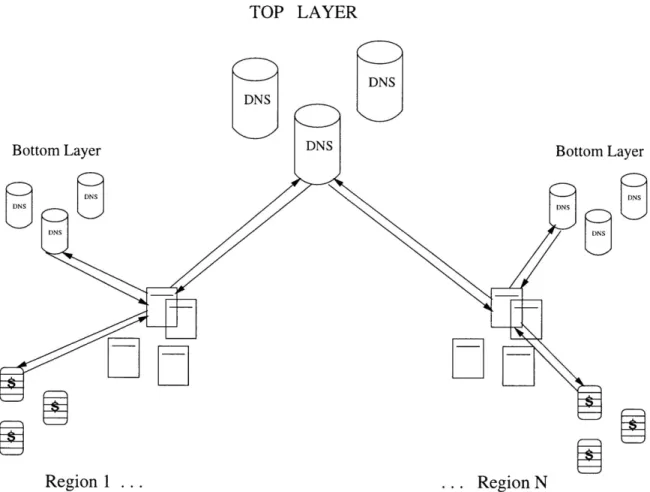
caches, and the domain name servers (also known as resolution units) that use
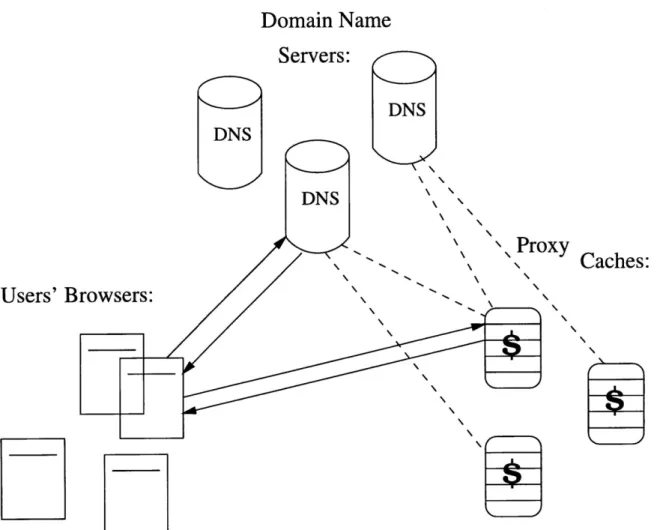
con-sistent hashing to resolve virtual names requested by the users into specific physical addresses of the cache machines. Figure 4-1 depicts the relationship between various parts of the system. We describe each component in order.
4.1 Caches
Our proxy caches use a distribution of the Squid cache package. We made no
modi-fications to the standard Squid distribution. The proxy cache replies with the data if it has a valid copy stored. Otherwise, it fetches the data from the original web server
and stores a copy as well. Squid uses LRU replacement strategy.
We run small programs, called “Squid monitors”, on the same physical machines as
the caches themselves. These monitors communicate with the Squid process using
the Object Cache Protocol and monitor the status (dead or alive) and load of the Squid process. When the Squid is alive, the load represents the byte transfer rate at
Domain Name
Servers:
{ a Sz DNS DNS ' | DNS | ProxyCaches:
Users’ Browsers:
| oo >
1|
Figure 4-1: System Components
Browsers make DNS requests to resolve virtual names of proxy caches in terms of
con-crete IP addresses. Then, they contact a proxy cache with a given IP. Asynchronously
from users’ requests, DNS units monitor proxy caches as discussed in section 4.3.1.
(This monitoring is indicated with dashed lines.) DNS units run consistent hashing to map all the virtual names to IP addresses of only the live cache machines.
which the cache served web requests over the last minute interval of service. Squid
monitors are ready to reply with the status and load information when queried by other units in the system.
4.2 Users’ browsers
We take advantage of the autoconfiguration option for proxy cache configuration
offered by the most commonly used browsers (Netscape Navigator 2.0x and above
and Internet Explorer 3.01 and above). In such browsers, users can specify a function
written in JavaScript that will be invoked on every request and will select a list of
proxy caches to be contacted based on the URL string being requested. A browser
contacts proxy caches in the order listed until it contact one that can respond with
the data.
We wrote an example of such an autoconfiguration function that users of the web
caching system could down-load and install in their browsers. This function takes
requested URLs as input and performs a modulo hash (the hash function here is not related to Consistent Hashing that takes place elsewhere in the system) and returns
a list of virtual names of the cache machines. To resolve virtual names into actual IP
addresses of the caches, a browser will have to contact the DNS system.
To generate virtual names, we use a function of the form
f(<url >) =ax <url > +b (mod p).
Here url is the numerical value of the URL string, a and b are a pair of small but
relatively prime integers, and p is a prime number larger than a and b (here, we chose 997). The range of possible return values of this hash function is from 0 to 996. We
use a few pairs (a, b) in order to return a list of values. These numeric values returned
by the hash function are included in the virtual names (e.g., A123.ProxyCache.com,
where 123 is the numeric value corresponding to a hash of a URL string).
of the “broken” browsers. In our testing, we discovered that some versions of the browsers under some operating systems will not reinvoke DNS even if they contain
an outdated resolution of a virtual name (i.e. a virtual name resolves to an IP address
that no longer responds). By returning a list, we give the “broken” browsers several
chances to achieve a correct resolution of a physical name as they try each element on the list in order. The last value on the list that is returned is “DIRECT” which is understood by the browser as an instruction to connect directly to the content server if all the other names fail.
4.3 Domain Name Servers
4.3.1 Functionality
The primary function of our DNS system is to resolve the virtual names generated by the users’ Java Script function to the actual physical IP addresses of the caches. We
use a number of DNS servers each running a copy of unmodified BIND 8.0 distribution.
(BIND is an implementation of DNS protocol.) In addition to BIND, each DNS
machine runs one of our programs, called “dnshelper”. The “dnshelper” program
periodically polls all of the caches, by communicating with the Squid monitors (that
run on the cache machines), to determine the dead/alive status of each machine. It then uses consistent hashing to map all of the virtual names to physical addresses
of only the live machines. (As noted in section 4.2 our virtual name space consists
of 997 possible names.) If any of the mappings change, it writes the new mappings to a “records” file and signals BIND to update itself by reloading that file. BIND updates itself “dynamically” which allows it to respond to DNS queries even during the update stage. It is important to note that all of the “dnshelper” activity and
the BIND updates take place independently of user requests. When a user request
arrives, DNS immediately replies with the mappings that it currently contains. The
DNS units represent the key component of our system since these units ultimately
4.3.2 Efficient Cache Use with Consistent Hashing
Properties of consistent hashing allow us to use the caches very effectively. First, we
eliminate duplication of resources among caches since each DNS server with the same
view of caches will compute the same mapping from virtual names to IPs. Thus, each cache is only responsible for storing a small fraction of content that it serves to all of
the users who request this content. As a result, the number of misses is reduced, since only one cache responsible for the content can miss only once, and fewer users see
delays associated with cache misses. Moreover, since the total set of documents stored
by each of our caches is small, our caches are more likely to keep the popular content
in RAM and thus serve it faster. In a large web caching system it is possible that
the views of live caches will differ slightly from one DNS server to another perhaps due to some lost connections over congested Internet links. In addition, if the set of caches is large, that view is likely to change with the shutdown of some servers and
other servers (new or old) coming back up. Consistent Hashing guarantees that even
when the view is changing, only a small fraction of mappings from virtual names to IPs will change, and the duplication of resources could be contained to a very small
fraction of caches.
The load property of Consistent Hashing guarantees that the number of virtual
names assigned to each cache will be evenly distributed among the caches. This property helps to balance load and prevent any one cache from serving too much content which would make the service time for that content longer. We describe
more advanced load balancing strategies with consistent hashing in section 6.2.
4.3.3 Advantages
By placing a significant portion of functionality of our system into the DNS units,
we simplify modifications that need to be done to users’ browsers and also allow for
a more flexible web caching system. Since consistent hashing and communication protocols with proxy caches are carried out asynchronously by the DNS units (i.e.
con-tribute to request latencies. We do not need to place this functionality inside the users’ browsers which would require significant modifications to the browser code and
would render the system impractical for most users. Even if the browser software could easily be modified to carry out communication protocols with the cache ma-chines, network congestion at the cache machines would simply build up from all the browsers running these protocols, and would slow down service. Traffic is insignificant
when the protocol runs only by the designated DNS machines. In addition, since it is
much easier for us to maintain control over the DNS units than the users’ browsers, the system can behave much more flexibly. If we ever decide to augment consistent
hashing algorithms with some heuristics or to make changes to communication pro-tocols, such changes would be trivial to perform on our own DNS machines. Thus, the DNS units play a key role in our web caching scheme by providing for a simple
use and smooth evolution of our system.
4.3.4 Disadvantages
Of course, there are also disadvantages associated with adding additional components to any system. Adding DNS servers creates another point of possible failure in our system. However, our system is designed in such a way that no single failing DNS machine could bring down the system. As long as some DNS machines continue to respond to DNS queries, the system will continue to function properly, without
even slowing down. In this way, our DNS system is strikingly different from the
directories in the Crispy Squid or individual caches in the Harvest System that could bring down the effectiveness of the web caching system through failure. The fault
tolerance aspects of our system are further discussed in section 6.3. Another downside
of designating special DNS units to handle some of the functionality is the additional DNS lookup. Browsers need to resolve virtual cache names into IP addresses before they can contact the caches. However, we believe that DNS lookups should be fairly
quick on average. DNS lookups will not actually travel directly from the browsers to
our DNS machines will be cached upto the Time-To-Live (TTL) value specified by our DNS machines. All of the ISP clients (except for the first few) that will request a given virtual name within the TTL period will have very fast DNS lookups as ISP’s
own DNS will reply. So, on average, virtual name resolutions should not contribute significantly to user latencies.
4.4 Monitor
We also implemented a tool to monitor our system. This tool, from time to time. communicates with the “dnshelper” programs on some of the DNS machines, and
generates very low traffic. From a “dnshelper” it could retrieve all of the information about the status and load of all the cache machines (since they are being monitored by the “dnshelper”). The tool displays status and load information graphically on the
screen. This monitor could be used by an administrator of the web caching system.
4.5 Overview
The main innovation in our cache system design is allowing users to contact directly the caches that are responsible for storing desired data. In this way, we achieve a high hit rate and fast access times as no inter-cache communication takes place
dur-ing requests. All heavy-bandwidth inter-cache communication for exchange of URL
pointers and actual data is avoided. A very low-bandwidth communication is
con-ducted by the DNS servers that simply poll the caches for status and load information,
and even that is performed asynchronously, not contributing to user latencies.
Con-sistent Hashing allows all of the DNS servers to agree on the mappings from virtual names to IP addresses. This agreement provides for more efficient use of caches and
reduces latencies for the users. Additional side effects, including high fault tolerance
Chapter 5
¥ ® ®
Comparison with Other Systems
We believe that our design based on consistent hashing algorithms warrants better performance than the existing web caching systems we studied. We compare our Cache Resolver against two such systems: the Harvest Project and the Crispy Squid. We demonstrate results that corroborate our hypothesis. (Results listed here, first
appeared in [6]).
5.1 Overview of Systems
5.1.1 Harvest System
The Harvest System [2] arranges its caches in a hierarchical tree. First, a user contacts
his/her primary cache. On a miss, that cache forwards user’s request to its siblings and the parent in the cache tree. If one of these caches has the data, it is transferred back to the user’s primary cache, stored there, and returned to the user. Otherwise, the request propagates further up the tree until finally the root node of the tree gets
the content from the origin content server.
Harvest System operated under the assumption that on average it is more
expen-sive to fetch the data from the origin server than traverse a hierarchical subtree of
with inter-cache communication between tree nodes, and inter-cache data transfer.
In addition, since data will travel from cache to cache, it will become duplicated in a large number of caches that will cause very inefficient space management. Poor space
management may cause many disk swaps and even forcing some data out of caches.
Disk swaps translate into slower data retrievals, and frequent data replacement results
in lower hit rate.
5.1.2 Crispy Squid
The Crispy Squid project [3] came as an improvement to the Harvest System. The analysis conducted by the Crispy Squid developers has shown that inter-cache
com-munication of the Harvest System can be extremely expensive, especially if it is propagated to higher levels of the hierarchy. Instead of a tree, Crispy Squid
intro-duces an additional system unit, the directory, that helps locate missing data. The
directory maintains a lookup table with mappings of URLs to caches that store these files. On a miss, a primary cache contacts the directory, which replies with the
lo-cation of the cache that has the data or states that no cache has it. The primary
cache then, retrieves the data from the suggested cache. The directory can be main-tained asynchronously without directly contributing to user request latencies. Crispy
Squid significantly reduces inter-cache communication; on a miss only one query to
the directory is made, followed by data transfer from the suggested cache.
However, Crispy Squid still manages space very inefficiently as there are no
deter-mined assignments of data to caches. Any piece of data can still be requested from
any primary cache, which will cause that cache to store a copy of that data upon
request completion.
In addition, the directory location presents a non-trivial problem. A centralized
directory located on one machine will be far from most caches in a global cache system. From most locations, a query to such a directory will be slow, as it will
travel a long network distance, possibly over many congested links. Crispy Squid
allows directories to be replicated. However, as mentioned in [3] each replica of the
complex as each cache will need to send updates to each of the replicas. Crispy Squid allows yet another, compromising configuration of a distributed partial directory. Partial directories are limited in size and store only some of the pointers. The latter configuration solves the problem of proximity to a directory, but the hit rate suffers
as only some of the URL pointers are stored.
5.1.3 Our System
Cache Resolver solves many of Harvest’s and Crispy Squid’s problems. By assigning
each piece of data to a specific cache or a small subset of caches massive data dupli-cation is avoided. In addition, Cache Resolver entails no inter-cache communidupli-cation; on a miss the content provider is contacted by the cache. The logic is simple: if the
cache is contacted it means it is the one that’s responsible for storing this data so
it’s worth fetching a copy to store locally. Why not fetch from other caches? The low spread property of Consistent Hashing guarantees that only one cache or a small
subset of caches will contain a specific data item. So on a cache miss, it is likely that
no other cache has the data, or else very few caches have it, and it is expensive to search for the few that do.
5.2 Testing
5.2.1 Network Setup
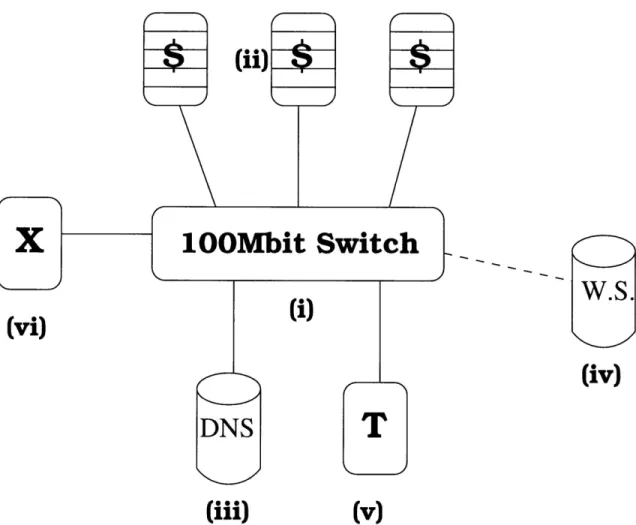
To test these systems, we used a network of seven machines connected to one 100Mbit
switch. Three of these machines ran Squid, the proxy cache program. One machine
was designated as the origin web server and was placed on a 10Mb link in order to make data transfer with the web server more costly. Another machine ran a copy
of BIND and was the designated domain name server that used Consistent Hashing
to resolve virtual names to IP addresses of the three caches. One more machine was used to run the test driver. The seventh machine was used for some additional cache
(i) S-
—
_—— _ —y [ ®X 100Mbit Switch
| . W.S| : (1)(vi)
(iv)
_— |DNS T
(iii) (v)
Figure 5-1: Test Network Setup
The test network consists of several components. (i) 100 Mbit Ethernet net-work switch, (ii) 3 proxy caches, (iii) DNS unit, (iv) web server hosting the
con-tent(connected to the switch over a slower, 10Mbit link, represented with the dashed
line), (v) test driver running Surge, and (vi) an extra machine used in some of the
tests
system configurations. Figure 5-1 demonstrates this setup.
5.2.2 Test Driver - Surge
For the test driver, we used Surge [1], a web load generating tool developed at Boston
University. Prior to the test, Surge generates a web server database. It also generates
a sequence in which files from the database are to be requested. Each file may be
requested a variable number of times. The designers of Surge were among the first researchers to realize that sizes of web requests form a Pareto distribution, a heavy
tailed decaying function. In order to generate the database and the query sequence, Surge takes in two parameters: number of files and the total number of requests for the most popular file. These parameters define the Pareto distribution of the web
requests. Surge also differentiates among image files, plain HTML files, and HTML
files with embedded objects. Surge developers found Pareto distributions for these
type of files to differ slightly and they account for these distributions in the model. Surge makes requests for objects rather than files. Each object may result in requests
for many additional files to simulate embedded objects. The detailed mathematical distribution model used by Surge to simulate web server request sequence is described
in [1].
For our testing we generated a request sequence using 1500 distinct objects, with the most popular one requested 5000 times. Using this parameters, Surge generated
a 34MB database that we copied to our web-server.
To simulate user-equivalents, Surge is run with a specified number of clients
(pro-cesses), and threads per clients. The total number of threads represents the user-equivalents. During one Surge test, all of the threads together run through the global
object request sequence. Each thread reads the next object to be requested out of the globally available sequence. It requests all the files associated with a given web object, and then sleeps for a specified amount of time before reading the next object.
Sleep time is also chosen from an upper-bounded Pareto distribution. Surge program stops when the global request sequence is exhausted. For our tests, we always run Surge with 3 clients, 75 threads each.
5.2.3 Modifications
We modified Surge to run in two distinct modes: Common Mode and Cache Resolver
Mode. Common Mode represents a common cache setup where users always contact
a primary local cache first. When a miss occurs, that cache either fetches the data from another cache or from the origin content server. In Common Mode, each of the three Surge clients is assigned one of the three proxy caches as its primary cache.
fetch the data for their clients. (A client in Surge runs many threads and represents
a whole set of users from one region.)
Cache Resolver Mode is designed to test our system. In this mode, each of the three clients execute a simple hash function similar to the autoconfiguration function
that would be utilized by our users’ browsers described in section 4.2. That function
takes the URL (or object) requested as input and returns a set of virtual names.
Surge clients proceed to resolve the names in that set to IP addresses of the three proxy caches through our DNS unit.
5.2.4 Results
We ran tests to compare our system, the Cache Resolver, with the Common Mode
under various proxy cache configurations. We then analyzed proxy cache logs to
compare miss rates from different test runs. We expected to see lower miss rate for
the Cache Resolver for a couple of reasons. First, the Cache Resolver mode, assigns each piece of data to a particular cache, so the hit rate for each file should be higher.
Also, we vary cache sizes between tests from 9MB to 36MB per cache. Since the total database we are testing has a size of 34MB, caches with smaller sizes will have higher miss rate because data could be forced out of caches with LRU. With smaller size caches, we expect the Cache Resolver to behave significantly better than other systems. Since other systems duplicate data among caches, they will cause a lot more
data to be forced out of smaller size caches. In each test we ran, caches were cleared
from previous data storage. The three caches were equal in their capacities for each test. Capacities took on values of 9, 12, 18, 24, 30 and 36 Mbytes for different tests.
The largest capacity tested, 36MB, exceeded the total web server database of 34MB
and therefor could be completely stored in a single cache.
In the first set of tests we did not configure proxy caches to communicate among one another. They simply fetched data from the origin server on a miss. For this
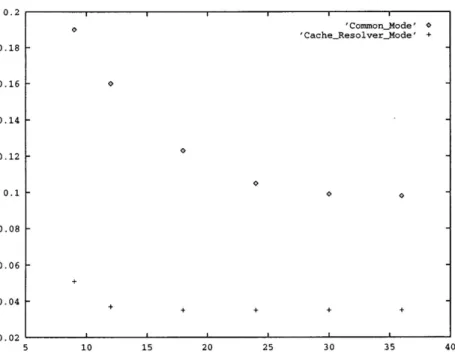
basic configuration, figure 5-2 shows higher miss rate displayed by the Common Mode
” Cacne pS! 0.18 + 0.16 } 0.14 i 0.12 } 0.14 0.08 + 0.06 « 0.041 0.02 hy o
-Figure 5-2: Cache Miss rates of Common Mode vs Cache Resolver Mode X-axis represents cache sizes in MBytes of all the caches used in the test and Y-axis
is the miss rate.
smaller cache capacities, where the data duplication of the Common Mode has even
worse effect.
The average file size in our database is 20KB. Given the difference in miss rates
and the fact that the link to the web server is 10 times slower (10Mbits per sec), we
can perform some trivial calculations to compute the difference in latencies that the
users of each cache system experience.
Figure 5-3 shows that average users of the Common Cache Mode system observe
latencies of 1 to 2.2 milliseconds higher on every request than the users of the Cache
Resolver Mode. In reality, these differences will be even greater since longer queues
will form at the caches of the slower system. Since the users of the Common Mode
system will have to compete with more users for service, their request latencies will
be even longer.
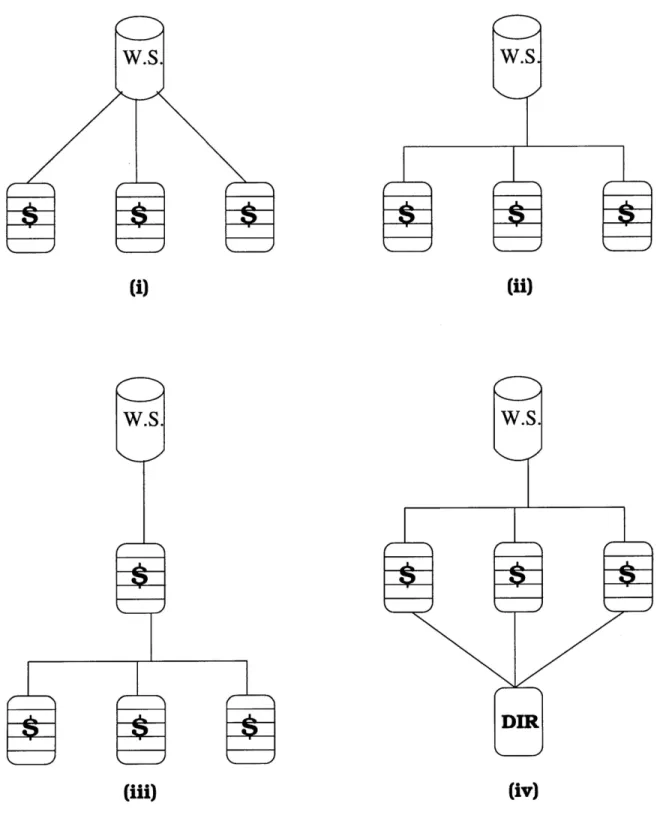
We also used our setup to test three other common cache system configurations
for the Common Mode. We tested Sibling Configuration, where all three caches were
bd1ca Latencies Between the Common Mode and Cache Resolver Mode users + TR 2 14 z 0.5} obo oa i ena © 10 15 20 25 30 a= 40
Size of each cache in MBytes
Figure 5-3: Difference in Latencies
Difference in latencies per request observed by the user of Common Mode cache and that of the Cache Resolver. The result is expressed in milliseconds
0 2 .
Sibling Config -First Cache Miss ¢
Sibling Config - System Miss +
0.18 b , Crispy Config -First Cache Miss O
Crispy Config - System Miss X
Hierarchy Config -First Cache Miss 4 Hierarchy Config -System Miss * 0.16 0.14 3 0.12 3 . @ 4 o.1l 0.08 + 0.06 0.04 0.02 L J SE _ JR E—— 4 - 10 15 20 25 30 1% 40
Size of Each Cache in MB