Volume17, Numberl,Winter1988 ISSN 0710-4340
The Future of Educational Technology Don Beckwith
Computer-Aided Personalized System of Instruction for the Virtual Classroom W. Klnsner
J.J.Pear
Computerized Television: Technology Overshadows Aesthetics
Nikos Metallinos
The Renfrew Quality Education Project: Teachers’ Views After the First Year DonnaSharon
Canadian Journal of
Educational
Communication
Volume 17, Number 1
Winter 1988
Editor
Robert M. BernardAssistant Editor
Jacques LeCavalierProduction Manager
MayGeneva, WRlTEWORKSEditorial Assistant
Liidy AmatoProduction Assistant
Helen de GourvilleColumn Editors
Richard Ellis, From the Educational Communication and Technology P e r i o d i c a l s
Len Proctor, Microware Review Rose Bene, Book Reviews
ISSN 0710 - 4340
The Canadian Journal of Educational
Communi-cation is published quarterly by the Association
for Media and Technology in Education in Can-ada; 500 Victoria Road North; Guelph, Ontario N1E 6K2; Canada: Attention: Mr. Ron Eyre, Secretary/Treasurer. Notification of address change should be sent to the above. All articles are copyright by AMTEC and may be repro-duced for non-profit use without permission provided credit is given to CJEC. Back issues of
CJEC are $10 Canadian and may be obtained
by contacting the Editor. CJEC is indexed in the
Canadian Education Index and ERIC.
Second Class Mail Registration No. 6956
ARTICLES
PerspectiveThe Future of Educational Technology
Don Beckwith
Computer-Aided Personalized 21 System of Instruction for the
Virtual Classroom W. Kinsner J. J. Pear Computerized Television: Technology Overshadows Aesthetics Nikos Me tallinos 3 7
PROFILE
The Renfrew Quality Education 53 Project: Teachers’ Views After the First Year
Donna Sharon
COLUMNS
Microware Review
Guest Editor: Earl Misanchuk
From the Educational Communication and Technology Periodicals
83
6 7
All correspondence should be addressed to:
Dr. Robert M. Bernard, Editor Education Department Concordia University
1455 de Maisonneuve Blvd. W. Montreal, PQ, Canada H3G 1M8
International Faculty Development Miriam K. Mills
Televised University Teaching: Cost Analysis of a Laboratory Class
Ruth C. MacKay E. Joyce Carver
Introductory Accounting on DUET: A Comparative Evaluation Diana R. Carl
Bruce Densmore
Individual Differences in the Self-Regulation of Learning Emerging from Think Aloud Protocols
P. R. J. Simons
CJEC is typeset on an Apple
Macintosh Plus” in PageMaker
2.0(TM).Galley proofs to authors and final camera-ready impressions are
output on an Apple LaserWrite(TM).
Printing: Concordia University
Printing Services.
AMTEC. However, many prefer to order the journal separately, and may do so by completing the form below:
( N a m e )
(Address)
0 $40.00 (Cdn.) annual subscription
0 New Subscriber
0 Renewal
0 Please send me information about AMTEC and a membership form. CHANGE OF ADDRESS
Send this form to: Mr. Ron Eyre
AMTEC
500 Victoria Road North Guelph, Ontario N1 E 6K2 Canada
Perspective
The Future of Educational Technology
Don Beckwith
INTRODUCTION
What we need is a transformation, not just a reformation of the educational system. We will prepare Master’s students for jobs that don’t exist and look for school systems with the vision to hire them. We’ll call them “Instructional Transformers” and their job will be to guide the learning of our children (Welliver, cited in Middendorf & Coleman, 1987)
Welliver’s visionary projection epitomizes the expectation of altruistic dream fulfillment that has drawn people to the field of educational technology for years. Educational technology is a winner. Upon encountering the field one immediately senses the powerful promise of potential. Within educational technology resides the potential for better schooling, better learning, better transmission of information, better interactive communication, better worlds.
Educational technologists can be recognized by the stars in their eyes. They know they are sitting on the most explosive potential of the century. Theirs is the apex of innovative motivation. Whether they are fashioning learning environments, creating media, designing instruction or effecting research and theory, educational technologists have a dream-a dream that can sustain them, and those they touch, well into the next century. As Finn (1964) prophesied, “the educational future will belong to those who can grasp the significance of instructional technology” (p. 26).
With the power of the systems approach, the promise of mastery learning and the potential to subsume and redirect all relevant resources, educational technology can effect the transformation of learning processes and learning outcomes. Further, if it is accepted that improved learning can improve individuals and that improved individuals can effect improved environments, educational technology is a vanguard of social transformation. Educational technology is visionary, for its base, its focus, its vantage
Don Beckwith is Visiting Associate Professor of Educational Technology at Concordia University. 1455 de Maisonneuve Blvd. W., Montreal, PO H3G 1 M8. This paper was invited and therefore not subject to the normal review process.
point, its lofty goals are all grounded in the future. Its dream is the transformation of the way things are to the way things could be.
But the dream, while ever present, remains only a dream. The power, promise and potential of educational technology have not been realized. Resultingly, mild insecurity and disappointment have been replaced by unrest and discontent, The focus has turned from transformational leadership to survival within the status quo. And the voice of discontent is getting louder and more persistent.
Much of the discontent can be attributed to the realization that educational technol-ogy has not yet assumed its predicted third stage of evolution. Analyses of the past and future essences of educational technology (e.g., Davies, 1978) have determined three levels of evolution. The past has been described as the tools approach (Educational Technology I), i.e., the application of audio-visual devices to the improvement of teaching. The present has been described as the systematic(1) approach (Educational Technology II), i.e., the development and application of methodological, rule-based processes to the facilitation of learning. The future has been described as the systemic’
approach (Educational Technology III), i.e., the creation of unified and dynamic wholes (from previously separated components) to effect the transformation of leam-ing. The field dreams of the ideal of Educational Technology III while operating within the status quo confines of Educational Technology II.
The discontent with mere survival within the level of the systematic approach, however loudly voiced and/or solution oriented, has been insufficient to force the field to the level of the systemic approach. The mission and the belief in the mission remain - to transform the learning process to a level that can only at present be imagined. Just as a master coach can transform individual teenagers into an Olympic medalist team; just as a master architect can stretch the capabilities of each construction team; just as a master film director can transform almost any assortment of people, things and proces-ses into a vibrant and scintillating whole - so too can a master educational technol-ogist systemically structure environments to effect higher and higher levels of cognitive ability. Instead, the status quo of Educational Technology II appears to be guaranteeing its survival at the expense of the realization of Educational Technology III.
The purpose of this Perspective is to review the mounting discontent (and its imbedded solutions) in order to determine the traps that must be avoided and the path-ways that must be created so that educational technology can force its evolution to the systemic approach and the then-reachable dreams beyond.
THE DISCONTENT
The discontent within the ranks of educational technologists is not new, nor is it surprising. A future- and ideal-oriented field will, by definition, be discontented with the present, the status quo. Whereas the discontent of the past focused on the
(1) “The words ‘systematic’ and ‘systemic’ come from different roots. The former from the Latin, with a nuance of order or interval; and the latter from the Greek, with a nuance of organ-ized whole” (Davies, 1984, p. 9).
PERSPECTIVE 5
nonrealization of Educational Technology III, however, the more recent discontent appears to be focused on the difficulty of surviving at the level of Educational Technol-ogy II. Concern has shifted from the future of learning to the future of educational technology. Moreover, for the past ten years the latter concern has increased in tempo, breadth and frequency. Postulates abound on why educational technology has not yet realized its transformational potential. Proposed solutions to the problem are even more prevalent. These solutions, however, especially ones that purport to effect short-term survival, may, in fact, effect a continuation of the problem.
Finn (1955) warned that unless the field creates and communicates, throughout society; a public philosophy that is adequate for the times, “we can well disintegrate . . . we can become so immersed in trivia that a scientific dictatorship is inevitable”
(p. 252). While this warning was targeted at a field that was at the time struggling to evolve from Educational Technology I to Educational Technology II, it remains valid for the struggling emergence to Educational Technology III.
Expanding on Finn’s concern years later, Silber (1970) suggested that educational technologists did not even know what field they were in, that they had not communi-cated to themselves - much less throughout society - either the field’s conceptual-ized purpose or even the interrelations of the components of the system called educa-tional technology.
Torkelson (1977) reviewed what educational technology had accomplished and had yet to accomplish. Still needed, he suggested, were for the field a) to apply its intellectual technique directly to the benefit of humankind, by, for example, encom-passing “value systems and idiosyncracies of individuals in the large purposes of schooling and society” (p. 357); b) to integrate the combined energies of its sub-groups to common problems, such as the lack of an agreed-upon path and continuity for future inquiry, and the distance between the practitioner and researcher; and c) to constantly challenge itself by asking the “blunt, yet critical question: SO WHAT!” (p. 358).
Clark (1978) criticized graduate programs for producing practitioners rather than scholarly inquirers; and faculty for conducting too little research, teaching inappropri-ate research skills, holding experimental design and data analysis skills in low esteem, and for allowing soft-money contracts to control the focus of doctoral programs.
Silber (1978) chided that unless educational technology overcame its problems -i.e., a) the lack of proactive synthesis of the subprofessions within the field, due to the restricted conceptual frameworks of the membership of each; b) the failure to effect or even recognize our potential impact on the educational system; c) the concern with the means rather than the ends of education, and therefore the nonenforcement of the field’s ethical and value positions; d) the inappropriate and limited focus of research; e) the low quality of professional communication among educational technologists; f) the lack of understanding of the field’s conceptual framework; and g) the inadequacy of leadership development efforts - “the profession will remain only partially developed or, perhaps, regress to a less fully developed stage” (p. 184), i.e., a subservient rather than a leadership role.
Torkelson (1980) urged that educational technologists move away from reduc-tionist research (which could be said to typify the systematic approach of Educational
Technology II) and toward constructionist research (which could be said to typify Educational Technology III).
Heinich (1984) placed the blame for educational technology’s slower than desired evolution partly on the shoulders of those in other fields who reject our cause, but mostly on our own shoulders for a) creating alliances with those who have neither the power nor inclination to effect change; b) being blind to what-should-have-been obvious institutional constraints; c) allowing vested interests to interfere with scholarly inquiry; d) failing to distinguish “between our administrative ‘home’ and our intellec-tual foundations” (p. 73), thus fostering the inhibition of intellecintellec-tual freedom; e) artificially restraining our technology to fit institutions within which it is being applied, f) narrowing our research focus on such as learning gains rather than exploring the “system effects of technology” (p. 76), i.e., emphasizing conclusion-oriented research over decision-oriented research; g) trying to apply established but inappropriate research questions, designs and techniques to systemic issues; and h) failing to “pro-duce” sufficient reflective, thinking educational technologists. He further labeled educational technology a craft rather than a profession (again characteristic of the sys-tematic approach of Educational Technology II).
Clark (1984) suggested that educational technology graduate programs have focused on instructional design models and procedures at the expense of the mindset of science and the tools of research, resultingly reducing the number of graduates who have the independent and original inquiry skills and the devotion to keep our field alive and well.
Hlynka and Nelson (1985), building from Davies’ (1978) threefold definition of educational technology (the tools approach, the systematic approach and the systemic approach), presented an argument for viewing the field as a metaphor in order to realize a tripartite system which could sustain a creative productivity through its synergy.
Winn (1986), echoing a host of prior discontent with research in educational technology (e.g., Becker, 1978; Beckwith, 1984; Clark & Snow, 1975; Koetting, 1983; Salomon & Clark, 1977) stated that we are not only addressing the wrong research questions but also are applying inappropriate research methodologies. And Torkelson (1987) called for an end to the use of static research models in the study of dynamic learners and learning processes.
Gagne (1987) regretfully reminded us “that instructional design is not a part of the established order” (p. 20) in industry, military or universities, and warned that the valuable technical knowledge that instructional designers have “must be guarded from contamination, and not be compromised by the various influences of the marketplace”
(p. 20).
Clark (1987) suggested that in order for us to become the world’s third profession - after medicine and engineering - we must emulate the first two professions. Echoing Heinich’s (1984) concerns, he said that until we do so, we will remain a craft.
At the recent (1987) conference of Professors of Instructional Technology and Development (PIDT), 85 professors from the U.S. and Canada shared a weekend of informal presentations and discussions. In steady succession, throughout the
confer-ence, concerns about the survival of educational technology were expressed, and a wide array of “solutions” were traded. Rossett (1987), for example, traced her
PERSPECTIVE 7
department’s success at finding new, alternative and amazing markets, during the late 70’s and early 80’s, primarily in business and industry. “It was easy. It was also seduc-tive” (p. l), but now that the school market is beginning to resuscitate itself, we must, she suggested, for survival (translated in terms of monetary and administrative support for faculty and equipment), be ready to balance the needs of our diverse markets.
Bratton (1987) once again offered a plan for certification as the solution to our problem, the premise being that through the national and international certification/ accreditation of educational technology graduates and graduate programs, quality and survival will be assured. By following the paths of such as the National Board of Medical Examiners and the Institute of Industrial Engineers, educational technology, too, could emerge as a respected profession.
Walter Dick offered the Florida State University model of linking, inseparably, educational technology and educational psychology in our graduate programs in order to do better what teacher education purports to do. Canelos (1987) offered the Pennsyl-vania State University example of working with and for departments of engineering, which are currently receiving large development grants and in need of instructional design consulting. Schwen (as cited in Middendorf & Coleman, 1987) suggested the development of an educational technology degree to “rock the boat of regular teacher education” (p. 4). Barry Bratton proposed that educational technology needed some type of continuing education system so that graduates can keep up with the field. (Perhaps this too could be accredited.)
Caffarella and Sachs (1987) announced the forthcoming publication of Doctoral Research in Educational Communication and Technology, conceived to “help the
profession to identify invisible colleges and research trends, (for) by building upon the research of others, future researchers can advance the field more collectively than could be done by one individual working in isolation” (p. 3).
A large number of participants expressed concern about the next generation of educational technology professors, since very few graduates opt for academia over the higher-paying corporate world. In fact, this worry seemed to pervade the conference as an undercurrent theme. Such comments as, “. . . for those who will sit in these chairs at future meetings . . . “; “ . . . for those who will follow us . . .“; “very few of our gradu-ates are interested in our jobs, jobs in higher education”; “we must do more to empha-size the positive aspects of professorship and deemphaempha-size the negative aspects” were sounded and echoed throughout the weekend. Another question was posed more than once: “Why do most college of education faculty view educational technology and in-structional design endeavors as superficial, unprofessional, training rather than educa-tion, or any of the other negative comments often expressed?” Again, the concern was that of survival - survival of the professors of educational technology, survival of the field of educational technology.
Throughout the presentations and discussions, the underlying questions of “who are we”, “where do we want to go”, “how can we best affect the world?” (Middendorf & Coleman, 1987) were omnipresent. To the extent that one can judge a field by the words and actions of the professors within that field, it would appear that educational technology is undergoing a period of anxiety, a temporary loss of focus/dimction/raison d’etre. Silber’s (1971) old question: “What field are we in, anyway?” is resurfacing in a number of interesting and, perhaps, frightening ways.
The discontent expressed in publications, presentations and conversations is clear, and it is pervasive. We are not being complacent about the situation. Solutions are being offered. Solutions are being applied. But these very solutions may be the seeds of our own infertility. If we are to survive, purposefully, as the cutting-edge field of our original vision, there are some solution-related traps that must be avoided.
THE TRAPS
The three major traps (Compromised Integrity, Status Quo Adherence, and Solid-ification) are presented as separate categories to ensure comprehensiveness and to facil-itate discussion. The categories (and their sub-categories) are not intended to be seen as mutually exclusive. Approach them as a set of interrelated and interdependant traps. The Trap of Compromised Integrity
The trap of Compromised Integrity can be found in three forms: a) Innovation affiliation, b) Greener pastures, and c) Political expediency.
Innovation affiliation. This trap is realized as the temptation to define learning and instructional problems in terms of the latest innovative ‘solutions’ rather than to create appropriate solutions to pre-addressed problems. Whether the ensnarement is in the form of ‘blind’ adoption of hardware, software, methodology or structure, the bait is alluring. Within the shining, bright newness of the innovation resides hope. How many have not been swept away (at least momentarily) by the dreams embedded within videodisc technology (or substitute any other magnetic innovation)?
The innovation is there. It is tangible, public and can be put to use immediately. Further, since innovations tend to be popular, those who affiliate with them may also be popular, or at least be seen as people who are in step with important trends. There is also the hope of survival, with a new gimmick, a new thrust, we may be able to stay alive long enough to do what we really must and want to do.
For the above reasons - hope, convenience, popularity - the pressure will remain on educational technologists to adopt and incorporate the latest innovations. Some recent examples: Clark (1987) suggested that an educational technology graduate program should be structured along the lines of the latest problem-orientation models of medical education (operational&d by such leaders as Harvard, McMaster and Maastricht); Rossett (1987) suggested that opportunity is here and now to teach com-puter literacy skills to all public school teachers, for we have the hardware, the exper-tise, and the desire has been communicated by governments and university administra-tors. Beckwith (1987) suggested that computer-mediated conferencing has the potential for effecting superior group problem-solving skills.
While there is nothing inherently wrong in hop-on-the-bandwagon suggestions such as these, the risks are threefold. First, looking for the cutting-edge in other fields can have the effect of transforming a leader into a follower, constantly looking for the next innovation to latch on to rather than creating the cutting edge to lean out and lead from.
Second, while it is important for a cutting-edge field to be aware of and purpose-fully incorporate what is new and viable within its systemic framework, educational
PERSPECTIVE 9
technology cannot afford to run the risk of defining itself (or letting itself be defined) through current phenomena By falling into this trap, educational technology has, inter alia, been defined as a field of equipment jockeys, Skinnerian behaviorists, media producers and computer software specialists. When the vanguard message is not strong enough, educational technology runs the risk of being defined by its most visible and tangible parts; it becomes just another nomadic craft following today’s sun, hoping that a new sun to follow lies just beyond the horizon.
Third, the time and energy given to the adoption of innovations can deplete significantly the time and energy needed for goal realization. This phenomenon is especially relevant when there are so many tempting innovations on the marketplace. While educational technology is, by definition, a subsumptive field, i.e., it is systemi-cally possible to incorporate all on the way to goal realization, history suggests that innovation affiliation has more often led to the divergent dissipation of desired goals.
Through innovation affiliation temporary survival may be guaranteed at the cost of identity, purpose, and cutting-edge leadership. Being on the cutting edge of positive change is not to be equated to latching on to what appear to be the current winners. When a field is truly operating on the cutting edge, the world comes to it. As true now as it was when the field first emerged, there is a need for a collective of educational technologists (balanced on the cutting edge) which, by its very integrity of systemic validity, demands followers.
Greener pastures. “. . . Leadership will have to come from individuals who do scholarly inquiry for its own sake, who do not have one eye (or both) constantly on the alert for the next consulting opportunity” (Heinich, 1984, p. 85).
Now that the consulting opportunities in medical education, public schools and much of higher education have been all but exhausted by educational technologists, and those opportunities in business and industry appear likely soon to follow suit, we are once again seeking greener pastures. Engineering, for example, has been touted as the ideal pasture for current and future grazing (e.g., Canolis, 1987), for engineering has the money and is in need of the services that educational technology can provide. There are potential contracts and internships galore, and even, it is said, possibilities to link academically in a variety of ways with departments of engineering in higher education. The obvious risk in falling into this trap is that of losing one’s intellectual integrity by selling out to the highest bidder.
At three educational technology conferences in the past year people have been seen wearing T-shirts proclaiming, “We will do IT in your field”. While on the way to becoming the world’s third profession (after medicine and engineering) we might, instead, become part of the oldest profession.
Political expediency. In any educational technology endeavour, be it in academia or on the front line, there is the temptation to use political expediency to ensure temporary (and perhaps on-going) survival. Compromise, in the form of doing what is expected of us (by those who do not know what we are capable of or by those who know very well what we are capable of and feel threatened), instead of doing what we know must be done, is high risk behaviour.
While all educational technologists must deal with significant others who may in some way affect their destiny, the trap snaps shut when the time and energy expended
satisfying the perceived desires/mandates of these significant others preclude the time and energy needed to satisfy the mission of educational technology. Compromise for political expediency is not a critical attribute of a cutting-edge field. Every instance of relinquishing the integrity of the cutting-edge ideal is one step closer to the status quo. Every realization of others’ misconceptions (whether through their ignorance or awareness) is one step backward from the educational technology ideal.
Such steps may be rationalized with surface logic, e.g., “It’s what the client (Substitute ‘dean’, ‘boss’, ‘student’, ‘subject matter expert’, ‘employer’) wants”; “These are our bread and butter courses”; “It’s where the money is”; “If we don’t, we’ll be forced to amalgamate with Department X”; “By doing this, we’ll generate FTE’s (Substitute ‘further contracts’, ‘student employment possibilities’.), and then we can do the important things we really want and need to do”; “ the state/university/administra-tion expects it”; “This is the way it is”; “This is the reality of the situastate/university/administra-tion”. The true reality, however, is that by accepting and submitting to “reality”, the ideal is lost.
The compromise of political expediency can have a stifling effect on every aspect of educational technology - its programs, its graduates, its professional work, its goals. Yet the practice persists. In fact, the trap of political expediency has so exacer-bated the ill-being of the field that radical “solutions” have been proposed. Heinich (1984), for example, so frustrated with educational technology’s futile attempts at transforming the educational status quo, advocated that our place is on the side of management (rather than labor) so that a top-down coup may be effected. Schwen (cited in Middendorf & Coleman, 1987), so fed up with the ineffectuality of teacher education, proposed the creation of an undergraduate educational technology program to compete directly with teacher education programs. Clark (1984), so discontented with the inability of educational technologists to do what they should be doing (i.e., scholarly inquiry) urged that educational technology faculty and students have a solid background in and mastery of science.
Awareness of the deleterious effects of political expediency, not the least of which is the radical reaction to these effects, is a necessary fiit step toward avoidance of the trap. The solution - minimizing the compromise - can follow. Other proposed “solutions”, such as the above-mentioned, face yet another trap, that of Status Quo Adherence.
The Trap of Status Quo Adherence
This trap awaits in three guises: a) Emulation; b) Legitimacy; and c) Absorption. Emulation. Educational technology emerged to fill a gap left by the status quo. Educational technologists were and remain dissatisfied with the efforts of established fields to effect positive, meaningful change. While dedicated to a transformation to the teaching-learning ideal, educational technology persists in seeking out other models to emulate, status quo fields to mimic, instead of forcing to realization Educational Technology III.
A case in point: It has been suggested that we emulate the two established profes-sions - medicine and engineering (e.g., Clark, 1987) - so that we too may become a profession (or at least display the external trappings of a profession?) Can a
cutting-PERSPECTIVE 11
edge field determined to transform the status quo risk emulation of established profes-sions? When the medical profession dedicates itself to a transformation - from the repair of malfunction to the creation of steady-state health - it may be worthy of emulation. When the engineering profession dedicates itself to a transformation -from minor modifications of and improvements to existing environments to the creation of ideal environments for living - it too may be worthy of emulation. It may be a very long wait.
If others must be emulated, let it be those who have successfully applied systemic creation to the continual transformation of outcomes. Two that come to mind are film directors and athletic coaches. Both have demonstrated a capability to create a steady progression of new and improved, transformed systems from the potential system components at hand.
Part of the motivation for emulation, it appears (e.g., Heinich, 1984), stems from the fear of scaring off or eliciting defensive behaviour from those who have a vested interest in the status quo. While we, for example, are careful not to present educational technology as a panacea, our hope that it could be keeps us going; we are careful not to present educational technology as the revolutionary, transformational rebel that it is. Change is our game, but we act as if we are part of the establishment. The waves from a rocking boat caught in the undertow pass without notice.
The other part of the motivation stems from the loneliness and anxiety that come with being on the cutting-edge. It is scary on the edge. A leader must look for direction and purpose from within and many times must gut it out on faith alone. Until the field accepts the systemic approach as the suprasystem/suprastructure that it is, educational technology will remain a craft or, at best, a technology with a science foundation, i.e., the systematic approach. To suggest that the systemic approach is scientific, is or should be based on the methods of science is folly. Educational Technology III, is a new breed which cannot draw on the principles of the status quo for its definition, operationalization nor evaluation
By limiting ourselves to the status quo structure, within which to fashion the means to our desired ends, we limit our findings to those of the status quo, for it is the status quo environment (in all its limited yet diverse applications) which has produced the status quo outcomes. Our everpresent dissatisfaction with such outcomes should force us to create our own viable systems rather than to emulate systematic models of proven insufficiency.
Legitimacy. Closely related to the trap of emulation is the trap of legitimacy. So intent are we at gaining and maintaining the reputation of a legitimate profession, we strive to look and act like the “legitimate” disciplines. The acceptable research in educational technology looks like legitimate research - legitimate, that is, for psychology, sociology, medicine. The journals of educational technology have the size and shape of legitimacy. Their contents, order, review procedures, presentational formats all strive for the look and feel of legitimacy. No matter that a very small percentage of educational technologists subscribe to these journals, they nonetheless convince us of their legitimate rigor, excellence, and worthiness. So, too, for the educational technology conferences, striving for the legitimate look and feel of an AERA or APA conference, forcing would-be presenters to take fewer chances and tow
the party line. Is adherence to the status quo in terms of legitimacy worth the price of losing sight of our systemic goal and mandate?
One problem in striving for legitimacy is that only that which has already been legitimated is legitimate. If educational technology adopts the posture of the legitimate within the status quo, it relinquishes the opportunity - nay, right - to create new and better-suited legitimate postures. What makes for legitimacy in fields that focus their energies on the systematic discovery of what is cannot be the same as that which makes for legitimacy in a field that focuses its energies on the systemic creation of what could be. The legitimacy of an educational technology posture, whether we are examining graduate programs, research, development, production, dissemination, or whatever, can only be evaluated by systemic criteria. Our potential legitimacy lies in the systemic approach of Educational Technology III. It seems that the time is right to create our own legitimacy - a legitimacy that is modelled after the true experts in educational technology (i.e., the risk takers, the rule breakers, the system creators) - for we need the creation of legitimate systems designed specifically for all aspects of our field: research, development, programs, etc. Until this has been accomplished, yet another trap looms - that of being absorbed by status quo legitimates.
Absorption. Educational technology has done very well with respect to surviving. But this survival has been at the cost of attachment to and absorption by other fields. Educational technologists have become, over the years, teacher educators, faculty
development specialists, medical educators, training consultants, to name but a few. Not only has our field attached itself to existing, successful fields and been absorbed by them in the process - each time redefining its identity (and losing a bit more of its original identity) - but it has also attached itself to emerging fields promising the prospect of survival. Fields such as open learning, organizational development, distance education, cybernetics (general systems), and human resources development come to mind.
At the PIDT conference telling questions arose time and time again: “Where do we turn now?” (now that the business and industry market is close to saturation), “To whom do we attach ourselves?“. Trying to instill some optimism, many suggested that the time is ripe to look back to the public schools. After all, the predictions all suggest increasing enrollments. Here certainly is a chance to rebuild and restaff the media centers that flourished in the 60’s and 70’s, and to work with teachers and school boards on the reform and renewal of instruction and curriculum. Others put forth computer literacy within the university environment as the next obvious target. Still others suggested that educational technology needed to accelerate and increase its attachment with the military establishment. And perhaps the nonprofit sector (e.g., museums, libraries) holds some promise for attachment, absorption, survival.
Educational technology has unfortunately established itself as a field that can only survive via attachment to other fields. A potential cutting-edge field has defined and redefined itself through a series of parasitic associations rather than through its own goals for learning transformation. Our field has allowed itself to be used and to be seen as a means for effecting the goals of other fields (however worthwhile) rather than as a means to the worthwhile and legitimate goals of educational technology.
PERSPECTIVE 13
rather than parasitic survival. Among other things, a cutting-edge field provides clear, desirable visions (if they still can be remembered) and means for achieving these. By reason, these visions are at best contrary to those imaged by non cutting-edge fields. Hence, the risk. While the cutting edge is sharp and at times scary, the risk is far greater if someone else is allowed to hold the handle. While there may be untapped fields willing to absorb educational technology into an adjunct role, the ultimate consequence of the trap of absorption is the loss of the singular identity necessary to realize our unique potential to lead in the creation of ideals rather than to serve for the betterment of the status quo.
Status quo adherence has resulted in educational technology’s chameleonesque behaviour for the past 25 years. At first glance, this may appear to be the epitomization of a vibrant, dynamic field. In fact, by jumping from one survival attachment to another and losing identity to each in turn - instead of creating a dynamism of self-realization - educational technology is sowing the seeds of staticity. While each new attachment may bring the excitement and envigoration of another breath of life, temporary survival is insufficient and unfullfilling. Only iron-jawed adherence to the ideals of educational technology can guarantee long-term survival, mission realization, and the ultimate in excitement and envigoration.
The Trap of Solidification
When, in education, the psychologist or observer and experimentalist in any field reduces his findings to a rule which is to he uniformly adopted, then, only, is there a result which is objectionable and destructive of the free play of education as an art. (Heinich, 1984. p. 87)
Reducing findings to a rule can be said to be characteristic of the systematic approach of Educational Technology II. When finally achieved, the free play of educa-tion as an art, on the other hand, will be characteristic of the systemic approach of Educational Technology III. Through continued reduction to uniformly applied rules, educational technology can solidify at the status quo, relinquishing the systemic dynamism necessary for transformation to the ideal. By accepting a caged existence within the traps of Compromised Integrity and Status Quo Adherence, educational technology has sampled the bait of the ultimate trap of Solidification - ultimate because once that trap has sprung, the potential realization of Educational Technology III will be lost forever.
Evidence of solidification is everywhere. At the most foundational level, educa-tional technology has solidified as a field that has yet to proclaim, widely and loudly, its public philosophy. The focus continues to bypass the ends to spotlight the means -the means of survival (of -the field, of -the subgroups within), -the means of research, -the means of graduate programs, the means of educational technologists.
The energy needed to apply the intellectual techniques of educational technology to the betterment of humankind has been sapped by solidification within the mode of short-term survival. Thus the desired ends of our field are subverted to the desired ends of our survival benefactors.
meaningful entities has precluded the desirable (from the systemic point of view) synthesis of these sub-groups into a dynamic, purposeful whole, capable of elevating the field to its destiny. Within the subgroups there is solidification as well. In instruc-tional design, for example, the models that are touted are, with rare exception (e.g., Bmtton, 1977; Gentry & Trimby, 1984; Goldman, 1984) systematic, rule-based, reductionist procedures, differing little one to another.
Graduate programs, too, have solidified - to a primary focus on instructional design models and procedures (Clark, 1984). The graduate programs of today appear to be clones of the cutting-edge programs of a decade ago; in examining current graduate programs, one is struck with the overwhelming sensation of d e j a vu. The only original-ity found is within those programs which have ‘had’ to implement innovative solutions to survive in academia. Moreover, acceptance of proposed certification and accredita-tion plans could effect total program solidificaaccredita-tion.
Research in educational technology has come close to solidification as an inappro-priate and limited method of inquiry. The cementing of reductionist, conclusion-oriented, static, systematic research models precludes the needed study and realization of systemic entities. Systemic ends cannot be attained via systematic means.
The motto of the trap of Solidification could be: “Let’s not reinvent the wheel”. While educational technology will neither benefit from the reinvention of the known wheel nor from the novel application of existing wheels, the determination to create something better than the wheel will freeze the closing jaws of the trap.
To remain on the cutting edge, educational technology cannot enjoy the false comfort of solidification, cannot allow the devolution of artful systemic approaches to uniformly applied systematic rules. Only by embracing the amorphousness of the systemic approach can educational technology ensure its necessary, future existence.
As educational technologists have discovered, the traps of Compromized Integrity, Status Quo Adherence and Solidification are easy to fall into. They can be alluring and captivating. They can appear to be logical and rightful pathways to follow. They seem to offer security and comfort It would be easy to suggest that educational technology just avoid the traps - easy, but misleading. For the traps to be successfully avoided, alternatives must be created - alternatives that serve as pathways to Educational Technology III and subsequent realization of the ideal.
PATHWAYS
As I see it, two things must be done in order to resolve the current educational technology dilemma: a) reaffirm and publicly proclaim the goal and philosophy of educational technology; and b) create systemic roles for educational technology, edu-cational technologists, and research in eduedu-cational technology.
Goal and Philosophy
In its quest for survival, educational technology has focused its energies on the means rather than the end. The goal of educational technology, and its philosophical
PERSPECTIVE 15
base, have been momentarily obscured by attention to such means as designing graduate programs, implementing instructional designs for clients, maintaining a piece of the teacher education pie, conducting “legitimate” research, disseminating hardware and software, fashioning learning environments, and gaining acceptance and support from those in authority. The goal is still there; it has just not been recently attended to or sought after. While never formally stated as such (but often implied), I submit that the goal of educational technology is the transformation of learners and the learning process. Our goal is at once a goal of vision and proactivity.
Heinich (1984) suggested that “survival depends on establishing our own intellec-tual identity” (p. 73). The first step in this direction is the public affirmation and procla-mation of our goal - the transforprocla-mation of learners and learning processes. No other field shares this goal. Other fields are trying to discover what learning is, to determine how learning occurs, to facilitate learning. Our own intellectual identity awaits realiza-tion through public affirmarealiza-tion.
Just as the goal of educational technology has been kept under wraps, so too has the philosophical base of educational technology been implied rather than directly communicated. The philosophy is inherent in the voiced discontent with the field. Simply stated: We believe that all learners can be transformed to the highest level of cognitive ability. With such a lofty goal and supportive philosophical base, an ex-tremely powerful means is necessary to effect goal realization. We have that too - the systemic approach.
Once we have reaffirmed our philosophy, goal and means to ourselves, and then publicly stated them to society, we can get on with the business of creating systemic roles for educational technology, educational technologists and research in educational technology.
The Role of Educational Technology
If educational technology is to have a viable, meaningful and identifiable place in society it must assume the role that others have not and will not assume - the role of idealizer (i.e., one who creates the means to realize the ideals of learning). The sys-temic approach enables us to serve as the problem-solvers of the learning process, the dreamers and creators of new and more effective learner systems.
Educational technology must also assume the role of conscience of learning in all sectors. Ours is the responsibility for ensuring the strengthening of individual value systems, idiosyncratic uniquenesses. Ours is the responsibility for ensuring the realiza-tion of the ethical and value posirealiza-tions of educarealiza-tional technology. Since operating systemically requires control over all system components (including those of
Educa-tional Technology I and II) ours is the responsibility for management of learner and learning transformation.
The Role of Educational Technologists
If Educational Technology III is to emerge and work, every educational technolo-gist must be capable of systemic operation, i.e., every educational technolotechnolo-gist must be a scholar (in the broadest sense of the word), “someone prepared to examine his or her own field in terms of its basic premises, its status, and its place in the general scheme
of things - a reflecting, thinking individual” (Heinich, 1984, p.86). Beyond this, educational technologists should be creative, proactive individuals, always aware of the current systemic level of our dynamic, upwardly-spiralling field, and creating the next systemic level. The ideal educational technologist is not one who follows all of the known rules, not even one who follows all of the known rules well. The ideal educa-tional technologist is one who breaks the known rules and creates new rules, thus enabling accomplishment of systemic creation, the type of creation not possible through the application of known, status quo, systematic rules.
Instead of spending time and energy training graduate students for specific, known jobs, as Clark (1984) suggested is occurring too frequently, educational technology could be preparing students, as Welliver (1987) suggested, for jobs that do not yet exist. For this to be possible, graduates must be equipped with a) altruistic skills that go beyond job acquisition and maintenance, to the satisfaction of learning needs of self, others and educational technology; b) systemic directorship ability, i.e., the ability to create (the way a good athletic coach or film director does) viable systems to transform learning, to direct, from conceptualization through evaluation and reconceptualization, toward successive approximations of systemic realization: c) the ability to control and manipulate given means (and create needed means) to effect desired ends; d) the skill to break known rules and create appropriate new rules as needed, the application of which will lead to higher, more inclusive, and greater integrative levels of performance -just long enough to break those newly created rules and create even newer ones; e) the ability to determine valid learning needs, above and beyond those perceived by the learner and/or the client; f) the ability to evaluate their own performance, the per-formance of learners, and the perper-formance of educational technology; g) the skill to offer alternatives to the status quo by defining and redefining the ideal: and h) the ability to think and act systemically in all situations.
To the extent that our graduates master these skills, our long-term survival (without resorting to the short-term survival traps of Compromised Integrity, Status Quo Adherence and Solidification) will be assured. Whether educational technologists assume the traditional jobs of systems managers, producers, instructional designers, human resources developers, evaluators or professors, or jobs that do not yet exist, the role assumed and performed must be that of a transformer of learning if the field is to survive and thrive on the cutting edge. When all educational technologists have assumed the role of transformer, the artificial boundaries between the subgroups within the field and between the researcher and practitioner will disappear, allowing educational technology to transform itself to the systemic field it must become.
A word about the intellectual colleagues of educational technologists: While the desired state for a cutting-edge field is for every individual within to possess and exhibit the above-mentioned skills, in every field there are a few individuals who are always on the cutting edge and beyond. These are the mavericks (the geniuses, per-haps), able to define true needs, set desirable goals, create viable means, and evaluate the effectiveness of performance. It is these individuals - from any field - who must be our intellectual kin, our models, our support group.
The role of the educational technologist is one of catalyst of optimism, aligned, at least in spirit, with others who are proactively trying to raise the roofbeams, to elevate
PERSPECTIVE 17
the actualized potential of human performance. With the afore-mentioned skills in hand and with the intellectual kinship of these mavericks from other fields, each and every educational technologist will be drawn to and capable of systemic inquiry. But first the role of research in educational technology must be attended to.
The Role of Research
In keeping with the goal and philosophy of educational technology, the obvious role of research is to accept such charges as Bloom’s (1984) “2 sigma” challenge (an unfortunate norm-referenced concept), i.e., to create systems that effect learner per-formance two standard deviations above the mean. (The systemic researcher might prefer the challenge of creating systems to effect leamer performance at the highest levels of affect and cognition.)
In order to accept this challenge, educational technology must first abolish the artificial distinctions between its subcomponents. With the systemic approach there can be no distinctions between research, development, evaluation, management, teaching, design, or learning. In Educational Technology III all are one system with one goal, one philosophy, one means, and one role to play. By fully incorporating all educational technology components into the research process, the problem of limitations and inappropriateness of systematic approach research to the study of dynamic systems is eliminated. In its place is a proactive, systemic approach with the high expectations that come with a strong goal orientation. The systematic exclusion and/or control of variables is replaced by the systemic inclusion of all variables. All educational technol-ogy components become proactive participants in the research process. The research question, “Let’s see what happens” transforms itself, through the systemic approach, to the challenge, “Let’s make it happen together”. (See Beckwith, 1984, for a fuller discussion of one possible systemic research methodology.)
Winn (1986) building from his earlier work (1975) and the work of Beckwith (1983) on open system models of learners, suggested thar
...if we can create expert instructional design systems, it should be possible to create CAI systems that design themselves as they interact with students. In other words, the prescriptive principles embodied in an instructional theory would be discovered by the system as it became familiar with each student it was teaching. In effect, a separate theory of instruction would develop for each student, offering the ultimate in adaptive instruction. (p. 351)
Imagine such to include all of the components of educational technology -research, design, development, production, learners, teachers, evaluation, management, etc. - together operating as a system, to effect higher and higher levels of learning transformation. Imagine such a system to be the personal learning environment of your dreams - rich, vibrant, alive, dynamic, accelerating - an environment in which such as research and development, production and dissemination, and teaching and learning are fused so tightly together that transformation is activated and reactivated like coiled springs released from their solidifying compression. In rapid succession, the system knows, knows it knows, knows how it knows, knows how to control how it knows, knows how to improve how it knows, searches to know what and how it doesn’t yet know, and knows how to improve what it knows (Ego, 1987).
And such a systemic research model is possible - but only if the current system-atic form is abandoned. As Heinich (1984) suggested, “When the linear extension of a technological form” (in this case, the systematic approach) “reaches its limits, an increase in scale can only occur when the form itself is abandoned” (p. 76); . . . “increasing the scale” (in this case by forcing evolution to the systemic approach) “in-creases the range of control” (p. 76). Increasing the range of control in“in-creases the likelihood of goal attainment, dream realization.
CONCLUSION
Educational technology has a powerful and worthy dream - a dream yet to be fulfilled. Resultingly, the discontent within the field is mounting. Centering on the inability of educational technology to transform itself from the systematic approach to the systemic approach, this pervasive discontent warns of three debilitating traps -Compromised Integrity, Status Quo Adherence, and Solidification.
It is suggested that the pathways leading out of the dilemma are: a) the reaffirma-tion and public proclamareaffirma-tion of the goal (the transformareaffirma-tion of learners and the learning process) and philosophy (that all learners can be transformed to the highest levels of cognitive ability) of educational technology; and b) the substitution of the traps of the systematic approach with a systemic recreation of the roles of educational technology, educational technologists, and research in educational technology.
This accomplished, the significance of educational technology will finally be grasped, and the educational future will belong to us. How significant is educational technology? It could be said that if educational technology were medicine, health could be realized if educational technology were engineering, ideal living space could be realized; if educational technology were law, peace could be realized. Educational technology as itself can realize the highest levels of cognition and affect in individuals - individuals who, in turn, will be able to create health, ideal space and peace.
To fulfill its dream, educational technology must reclaim its rightful place on the cutting edge - constantly pushing upward to the next level of transformation, applying constructionism to what needs to be. While life on the cutting edge is, at best, uncom-fortable, this is where the systemic, transformational field of educational technology must reside to realize its destiny.
REFERENCES
Becker, A.D. (1977). Alternative methodologies for instructional media research. Audio-Visual Communication Review, 25, No.2, 181-194.
Beckwith, D. (1984). A research methodology for studying the learner as a total system: A conceptual paper. Proceedings of Selected Research Paper Presentations. Research and Theory Division, Association for Educational Communications and Technology, Ames, IA.
PERSPECTIVE 19
Beckwith, D. (1987). Group problem-solving via computer conferencing: The realiz-able potential. Canadian Journal of Educational Communication, 16(2), 89-106. Beckwith, D. (1983, Fall). The nature of learners as total systems, with implications for
research and instructional development: A theoretical/conceptual paradigm. Journal of Visual Verbal Languaging, 9-28.
Bloom, B.S. (1984). The 2 sigma problem: The search for methods of group instruction as effective as one-to-one tutoring. Educational Researcher, 13, 4-16.
Bratton, B. (1977, November). Instructional development and systems. Audiovisual Instruction, 22, 60.
Bratton, B. (1987, May). International Board of Standards for Training, Performance, and Instruction. Paper presented at the annual conference of Professors of Instruc-tional Design and Technology. Shawnee Bluffs, IN.
Caffarella, E.P., & Sachs, S.G. (1987, May). Doctoral research in educational commu-nication and technology: A directory of dissertations. Paper presented at the annual conference of Professors of Instructional Design and Technology. Shawnee Bluffs, IN.
Canelos, J. (1987, May). Educational technology: Intelligent life beyond the college of education. Paper presented at the annual conference of Professors of Instructional Design and Technology. Shawnee Bluffs, IN.
Clark, R.E. (1987, October). Media and technology: Their present and futureroles in education and training. Paper presented to the Faculty of Educational Technology, Concordia University, Montreal.
Clark, R.E. (1984). “Where’s the beef’?“: A reply to Heinich. Educational Communica-tions and Technology Journal, 32(4), 229-232.
Clark, R.E. (1978). Doctoral research training in educational technology. Educational Communications and Technology Journal, 26(2), 165-178.
Clark, R.E., & Snow, R.E. (1975). Alternative designs for instructional technology research. Audio-Visual Communication Review, 23(4), 373-394.
Davies, I. (1984). Instructional development: Themata, archetypes, paradigms and models. In R.K. Bass & C.R. Dills (Eds.), Instructional development: The state of the art, II, (pp. 9-17). Dubuque, IA: Kendall/Hunt Publishing.
Davies, I. (1978). Prologue: Educational technology: Archetypes, paradigms, and models. In J. Hartley, & I. Davies (Eds.), Contributions to an Educational Technol-ogy. London: Butterworths.
Ego (1987). Groupthink: Consciousness. Conferencing System (CoSy). Guelph, ON: University of Guelph.
Finn, J.D. (1955). A look at the future of AV communication. Audio-Visual Communi-cation Review, 3(4),244-256.
Finn, J.D. (1964). The Franks had the right idea. NEA Journal, 53(4),24-27.
Gentry, C.G., & Trimby, M.J. (1984). Interface analysis of ID systems. In R.K. Bass & C. R. Dills (Eds.), Instructional development: The state of the art, II (pp. 94-107). Dubuque, IA: Kendall/Hunt Publishing.
Goldman, H.D. (1984). Instructional system development in the United States Air Force. In R.K. Bass & C. R. Dills (Eds.),Instructional development: The state of the art, II (pp. 470495). Dubuque, IA: Kendall/Hunt Publishing.
Heinich, R. (1984). The proper study of educational technology. Educational Commu-nications and Technology Journal, 32 (2), 61-87.
Hlynka, D., & Nelson, B. (1985). Educational technology as metaphor. Programmed Learning and Educational Technology Journal, 22 (l) l-15.
Koetting, J.R. (1983). Philosophical foundations of instructional technology.
Proceedings of Selected Research Paper Presentations (pp. 416-440). Ames, IA: Research and Theory Division, Association for Educational Communications and Technology.
Middendorf, J., & Coleman, S. (1987, August). The 1987 PIDT Conference. Newsletter of the Division for Instructional Development, Association for Educational
Communications and Technology, 17(l), 3-4.
Rossett, A. (1987, May). Forces affecting the development of the Department of Educational Technology at San Diego State University. Paper presented at the annual conference of Professors of Instructional Design and Technology. Shawnee Bluffs, IN.
Salomon, G., & Clark, R.E. (1977). Reexamining the methodology of research on media and technology in education. Review of Educational Research, 47, 99-120. Silber, K.H. (1970). What field are we in, anyhow? Audio-Visual Instruction, 15(5),
21-24.
Silber, K.H. (1978). Problems and needed directions in the profession of educational technology. Educational Communications and Technology Journal, 26(2),174-185. Torkelson, G.M. (1977). AVCR One quarter century: Evolution of theory and
research. Audio-Visual Communication Review, 25(4), 317-358.
Torkelson, G.M. (1987). Perspective: Theoretical bases for research in media. Canadian Journal of Educational Communication, 16 (l), 3-9.
Torkelson, G.M. (1980, April). Research symposium. A paper presented to the Re-search and Theory Division of the Association for Educational Communications and Technology, Denver, CO.
Winn, W. (1986). Trends and future directions in educational technology research from a North American perspective. Programmed Learning and Educational Technology Journal. 23(4), 346-355.
Computer-Aided Personalized System of
Instruction for the Virtual Classroom
W. Kinsner
J. J. Pear
Abstract: This paper describes a computer-aided personalized system of instruction (CAPSI) and its implementations with regard to both on-campus and off-campus teaching. Four years of experience with the method have prompted a natural evolution of the system from a single terminal to multiple terminals, with direct and remote links, and electronic mailing and messaging. Local area networks are being considered to extend the system even further to allow stand-alone implementations of CAPSI. In a broad sense, the method is conceptualized as a step toward the goal of involving the computer in the development of educational material and the evaluation of learning in a virtual classroom environment.
INTRODUCTION
In a classic paper, Keller (1968) launched a new approach to teaching at the post-secondary level called Personalized System of Instruction (PSI). Based on principles and procedures from the newly emergent field of the experimental analysis of behavior, founded by Keller’s friend and colleague, B.F. Skinner (e.g., 1953 and 1954). the approach stressed: a) clear specification of the behavior to be modified; b) frequent and immediate reinforcement of the behavior; c) minimization of punishment: and d) self-pacing by the student. These principles had been incorporated earlier by Skinner (e.g., 1961), in his work on programmed instruction and teaching machines, in which students filled in critical words or phrases that were left blank in a short piece of text. However, Keller applied the principles to larger segments of behavior (See Keller &
W. Kinser is an Associate Professor in the Department of Electrical Engineering at the University of Manitoba. J. J. Pear is a Professor in the Department of Pscyhology, also at the University of Manitoba. We thank Bernie Simand, Director of InterUniversi-ties North (IUN), and Sam Shaw, former Director of IUN, for their support and encour-agement in developing the off-campus teaching component of this project. Special thanks go to Frank Herzog for the initial coding of the program, and to Manix Leung for many improvements to the code. This work was supported in part by the University of Manitoba Academic Development Fund, the Natural Sciences and Engineering Re-search Council of Canada, and private funds.
Sherman, 1982). Studies on PSI have shown it to be more effective in teaching specific material than other methods commonly used at the postsecondary level (Kulik, Kulik & Cohen, 1979; Sherman, 1982).
Comparisons between traditional and other techniques of teaching and learning, including PSI, are made in the volume compiled by Sherman, Ruskin, and Semb (1982). A review of modem approaches to a more significant use of machines in design is given by Ehrmann and Balestri (1987). Another example of the extensive use of computer communication systems, and particularly computerized conferencing, in the formation of human community is given by Hiltz and Turoff (1978). A serious attempt to develop an authoring system for the computer-mediated learning environment is represented by NATAL (1981). In a more recent approach, knowledge representation and knowledge engineering are applied to intelligent tutors by Woolf (1987).
The method described in this paper represents a fundamental extension of PSI in which the above modem approaches can be folly applied. The method provides a basis for modelling, parameter estimation, optimization, and the use of knowledge engineer-ing to improve its value to both the teacher and the student. To demonstrate the usefulness of the method, we first describe the principles of PSI, followed by comput-erization of PSI for on-campus and off-campus education, and an analysis of data obtained using the new method.
PRINCIPLES AND PROCEDURES OF PSI The major distinguishing characteristics of PSI are as follows:
Clear specification of thebehavior. In PSI, the behavior to be learned is specified as answering questions about or solving problems relating to the course material. For each course, a list of study questions or study objectives on the material is drafted, such that a student who can answer a large percentage of the questions or meet a large percentage of the objectives can be said to have mastered the course material. In addition to being given the study questions or study objectives, the student is informed exactly how mastery of the course material will be assessed.
Frequent and immediate reinforcement of the behavior. The course material is broken down into units that are small enough to ensure frequent reinforcement in the form of feedback on unit tests. Immediate feedback on the tests is provided by the instructor, by teaching assistants, and by other students (termed “proctors”) who have mastered the material.
Minimization of punishment. The unit tests are designed to increase in difficulty gradually so as to minimize. the probability of failing a test, which is the most signifi-cant form of punishment in educational settings. In addition, the only penalty for not passing a test is that the student must restudy and attempt another test on that unit. Finally, the word “fail” is avoided since it produces conditioned emotional responses in many students.
Self-pacing by the student. For a variety of reasons, different people require different amounts of time to master a given subject matter. PSI takes account of this by
COMPUTER-AIDED PERSONALIZED SYSTEM 23
permitting individual students to progress through the course at their own rates within the deadline set by the academic institution for the submission of final grades.
COMPUTERIZATION OF PSI CAPSI for On-Campus Learning
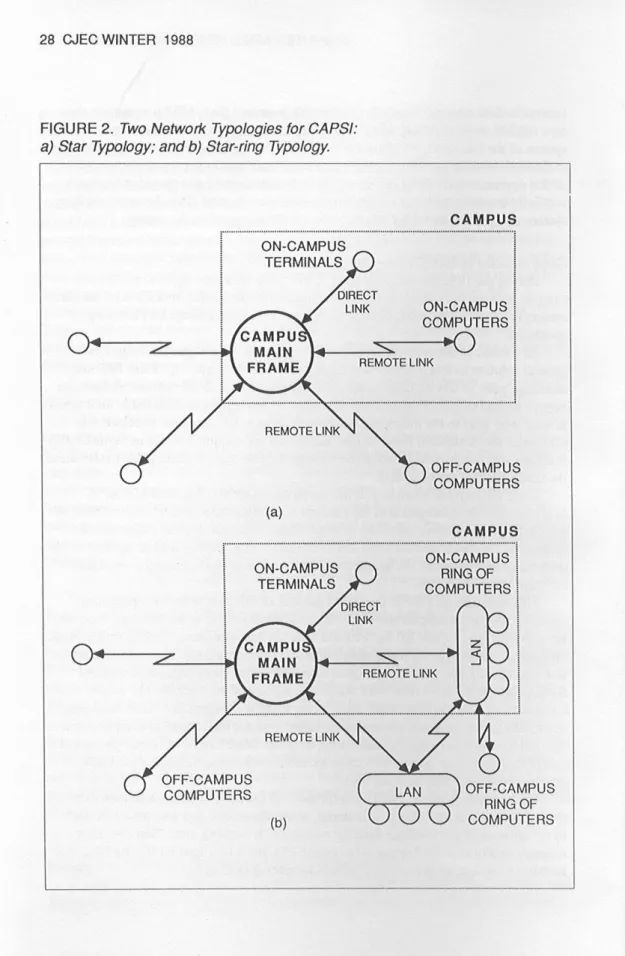
PSI lends itself well to computerization because it is a highly systematic proce-dure. Development of a program for computer-aided PSI (CAPSI) has been an on-going project at the University of Manitoba since 1983. The program has been described in detail elsewhere (Pear & Kinsner, in press). A simplified diagram of the CAPS1 program is shown in Figure 1. The success of the program can be attributed to the finite-state modelling of all the transactions that take place during the course offered.
Briefly, the main function of the computer is to give tests to students who request them, to assign markers to completed tests, and to keep track of the progress of each student through the course. The program was initially designed for students to write their tests “off-line” using pencil and paper, since only two computer terminals could be obtained for the courses using CAPSI. Each test is marked by either the instructor, a teaching assistant, or proctors who are students enrolled in the same course and who have passed the units for the tests they are assigned to mark. To help ensure marking verification, two proctors are chosen to mark each test. If more than two eligible proc-tors are available at the time a student requests to have a test marked, the computer chooses the two who have proctored the fewest number of times. If there are more than two who have proctored the fewest number of times, the computer chooses randomly among them. The computer designates the instructor or teaching assistant to mark a test only if two eligible proctors are not available. Students receive points from the com-puter toward their final grade for acting as proctors, since serving in this capacity helps them to better learn the course material.
CAPS1 at the. University of Manitoba has been used in several different ways. The courses taught have included “Introduction to Psychology”, “Behavior Modification Principles”, “Behavior Modification Applications”, “Learning Foundations of Psychol-ogy”, and “Humanistic and Transpersonal Psychology” taught by J. J. Pear, “Introduc-tion to Psychology” taught by J. J. Pear and J. H. Whiteley jointly, and “Experimental Child Psychology” taught by J.H. Whiteley. It is also being considered for teaching in engineering. The range of students in any given course has been from about 20 to 65. The method is independent of course content provided that the course material is structured appropriately for the subject matter. For example, typical study questions from a course on humanistic and transpersonal psychology might be as follows:
1) Why was humanistic psychology originally called “third-force psychology”? 2) Why were some third-force psychologists unhappy with the name “humanistic
psychology” as the name for their movement?
3) According to Maslow, what are “peak experiences”? What can produce them? Describe a peak experience that you have had, including the circumstances under which it occurred.