HAL Id: hal-00598028
https://hal.archives-ouvertes.fr/hal-00598028
Preprint submitted on 3 Jun 2011
HAL is a multi-disciplinary open access
archive for the deposit and dissemination of
sci-entific research documents, whether they are
pub-lished or not. The documents may come from
teaching and research institutions in France or
abroad, or from public or private research centers.
L’archive ouverte pluridisciplinaire HAL, est
destinée au dépôt et à la diffusion de documents
scientifiques de niveau recherche, publiés ou non,
émanant des établissements d’enseignement et de
recherche français ou étrangers, des laboratoires
publics ou privés.
A magnetic thrust action on small bodies orbiting a
pulsar
Fabrice Mottez, J. Heyvaerts
To cite this version:
Fabrice Mottez, J. Heyvaerts. A magnetic thrust action on small bodies orbiting a pulsar. 2011.
�hal-00598028�
June 3, 2011
A magnetic thrust action on small bodies orbiting a pulsar.
F. Mottez
1and J. Heyvaerts
2,1,1 LUTH, Observatoire de Paris, CNRS, Unviersité Paris Diderot, 5 place Jules Janssen, 92190 Meudon, France.
e-mail: [email protected]
2 Observatoire Astronomique, Université de Strasbourg, 11, rue de l’Université, 67000 Strasbourg, France.
e-mail: [email protected] Preprint online version: June 3, 2011
ABSTRACT
Aims.We investigate the electromagnetic interaction of a relativistic stellar wind with small bodies in orbit around the star.
Methods. Based on our work on the theory of Alfvén wings to relativistic winds presented in a companion paper, we estimate the force exerted by the associated current system on orbiting bodies and evaluate the resulting orbital drift.
Results. This Alfvénic structure is found to have no significant influence on planets or smaller bodies orbiting a millisecond pulsar. On the timescale of millions of years, it can however affect the orbit of bodies with a diameter of 100 kilometres around standard pulsars with a period P ∼1 s and a magnetic field B ∼ 108T. Kilometer-sized bodies experience drastic orbital changes on a timescale of 104years.
Key words.pulsars – exoplanets– magnetospheres
1. Introduction
Accretion discs are expected to form at some phase of the evo-lution of neutron stars in a binary system, possibly giving birth to second generation planets. The interaction of the disc with the pulsar’s wind constrains its extension and notably the value of its inner radius. The rotational power transferred to the disk by the magnetic field of a young neutron star (propeller effect) would rapidly disrupt a disc of plasma, putting its inner radius beyond the light cylinder (Ek¸si et al. 2005). Concerning dust, ablation by the pulsar’s wind would extract protons and pro-vide them enough kinetic energy to chase them away (Jones 2007). The Poynting-Robertson effect (Burns et al. 1979) may also act on the drift of smaller (and isothermal) particles such as grains and dust (Cordes & Shannon 2008). This is consistent with infra-red observations of radio-pulsars showing that their inner radius is two or more orders of magnitude larger than the light cylinder radius (Jones 2008).
On the other hand, small bodies, such as planetoids, aster-oids or comets may also orbit pulsars and it is expected that some of them occasionally fall below the light cylinder. For instance Cordes & Shannon (2008) have shown that neutral, circumpulsar debris that enters the magnetospheres of neutron stars could disrupt current flows and account for some of the intermittency seen in radio pulsars. The neutral material of size
∼ 1 m or more can move toward the star under the influence of
collisions and of the Yarkovsky effect (a net force induced by a difference of temperature between the illuminated and warm afternoon side and the night-time face).
In the present paper, we study the influence of a pulsar’s wind on the trajectory of hypothetical larger bodies (1-100 km) through the action of the Poynting flux. It is based on Alfvén wings, whose theory is described in a joint paper (Mottez & Heyvaerts 2011), hereafter (MH1). The concept of Alfvén wings was initially developed by Neubauer (1980) to explain the interaction of Jupiter with its satellite Io. It says that a con-ducting solid body embedded in a plasma flow slower than Alfvén waves supports a system of electric currents carried by a stationary Alfvénic structure. When the wind is relativistic albeit slower than the total Alfvén speed, the amplitude of this current can be estimated. In the present study, we estimate the force exerted by the associated current system on orbiting bod-ies and evaluate the resulting orbital drift.
2. Alfvén wings
In this section, results demonstrated in the companion paper (MH1) and useful for the present study are recalled.
The star is assumed to be spinning with an angular
fre-quency Ω∗. For simplicity, the theory is developed for a pulsar
with a magnetic dipole axis aligned with the rotation axis. The wind flow is assumed to be radial (r direction in spherical
coor-2 Mottez and Heyvaerts: magnetic thrust
dinates) and the magnetic field in the companion’s environment to be mainly azimuthal (φ direction). The wind is characterized by two invariants along its flow : the neutron star’s magnetic flux Ψ, and the mass flux f ,
f = γ0ρ′0v
r
0r
2, (1)
Ψ = r2Br0, (2)
where v0 is the unperturbed wind’s velocity, Br0 is the radial
magnetic field, γ0 is the wind’s Lorentz factor, and ρ′0 is the
proper rest mass density in the unperturbed wind’s frame. The azimuthal magnetic field is given by,
Bφ0= Br0v φ 0− Ω∗r vr 0 ∼ −B r 0Ω∗r c , (3)
the approximation in the right hand side term being relevant at large distance from the light cylinder.
The engine of the Alfvén wings is the convection electric field associated to the wind that appears in the reference frame of the star’s companion. The wing currents are generated by a
potential drop U along the body of radius RP,
U = 2RPE0 =
2RPΩ∗Ψ
r , (4)
where E0 = vr0Bφ0, directed perpendicularly to the wind flow
and to the magnetic field, is the convection electric field in-duced by the motion of the wind into the magnetic field. This potential generates a system of currents that flow along the companion, then in space into the plasma, in a direction which depends on the wind’s magnetic field and the wind’s velocity. The conductivity of the plasma part of this circuit has been evaluated by Neubauer (1980) for the non-relativistic motion of Io in the Jovian magnetospheric plasma. In the ultra-relativistic wind of a pulsar, it can be approximated very simply by
ΣA ∼ 1
µ0c
. (5)
(See Eq. (67-69) of (MH1) for more details.)
Then, adopting a simplified geometry, it is possible to esti-mate the total electric current. Neubauer (1980) gives useful ex-pressions for the total current I flowing along an Alfvén wing.
Writing RPfor the body’s radius, he gets:
I = 4 (E0− Ei) RPΣA= 4
Ω∗Ψ
r − Ei
!
RPΣA (6)
The electric field Ei, set along the body, is caused by its iono-sphere or surface internal resistance. The Joule dissipation is
maximum when Ei = E0/2. In our estimations, we shall use
Neubauer’s values for I.
3. A magnetic thrust
The above theory, because of the involved symmetries, de-scribes mainly what happens in space, far enough from the body. At closer distances, the plasma suffers compressive mo-tions and compressive MHD waves certainly have a non-negligible influence on the system. These waves propagate
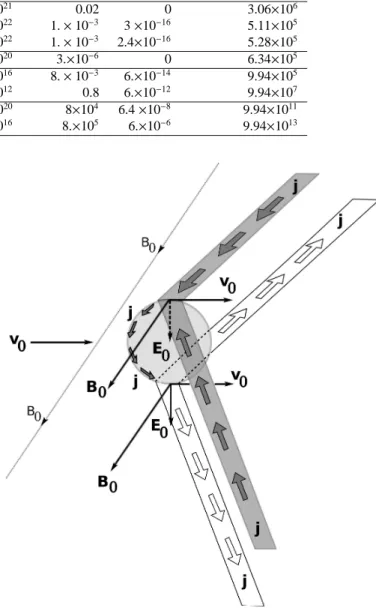
quasi-isotropically. Their amplitude decrases as the inverse of the distance to the body and they contribute to deflect the wind around it. Nevetheless, without entering into these considera-tion, we can still make a few inferences based on the theory of the Alfvén wings, as presented in the previous section. As Neubauer (1980), we can assume that the current associated to the wing is closed in the vicinity of the body (see Fig. 1), through its surface or its ionosphere. We can estimate (roughly) what force the wind exerts on it.
The two Alfvén wings carry a current that, in the two branches flowing along the body (perpendicular to the plane of Fig 1), generates a force density j × B. The two current systems flowing on each side of the body exert this force density in the same radial direction. We may expect the body to orbit near the equatorial plane of the pulsar. In this plane, at such a distance, the magnetic field direction is almost azimuthal, being
perpen-dicular to the wind flow velocity. The sign of Bφ0 depends on
whether the magnetic moment of the neutron star is parallel or antiparallel to the rotation axis. Nevertheless, the force density
j × B always has the same direction as the wind velocity.
At first order, considering Eq. (4), E0 = Ω∗Ψ/r and the
force is expressed explicitely as a function of the distance r from the pulsar to the body as
F = 2RPIBφ= 8 Ω∗Ψ r − Ei ! R2P Ω∗Ψ µ0c2r . (7)
The power ˙EJ dissipated by Joule effect along the ionosphere
or in the body is maximized when the internal load matches the external one, that is, still according to Neubauer (1980), when
Ei= E0/2. In that case the force is
F = 4
µ0c2
R2PΩ2∗Ψ2
r2 (8)
On the night side of the body, this force tends to wipe out the ionosphere (if there is one), but on the day side, on the con-trary, it pushes the ionosphere towards it. The dynamics of this system is probably quite complex, but we can retain that there is a force pushing the body and/or its atmosphere away from its star. Maybe the atmosphere has been completely wiped out, and the day side of the body is ionised by the flux of X rays coming from the neutron star. Then, the current may flow along the dayside of the body’s crust, directly pushing it away. Actually, it remains that, when the field is azimuthal and the dissipation is maximal, the force is radial and proportional to
r−2 (Eq. (8)). Therefore, it acts the same way as the
gravita-tional force, and cannot have a secular influence on the orbit.
When Eidoes not vary with the distance r of the body as E0
does, according to Eq. (7), a fraction of the force is not of a Keplerian nature. For an azimuthal field, this force is however still central and causes nothing more than a periastron preces-sion. Since we are mainly interested in the evolution of the semi-major axis and of the eccentricity, we don’t consider this case any further in this paper.
But the unperturbed magnetic field also has a small radial component and the force is therefore not exactly central. Our estimate that Bφ
∼ BrΩ
∗r/c shows that the small angle between
the magnetic field and the azimuthal direction is:
In the case of PSR 1257+12, at 1 AU, δ = 2 × 10⁻⁶. In the
general context of a vacuum dipole wave, or a pulsar wind, its sign does not vary, and its amplitude decreases gently with the distance. As the force density j ×B is perpendicular to the mag-netic field, the force is not strictly radial when the field is not strictly azimuthal. In spite of the small value of this angle, this azimuthal force component acts constantly in the same direc-tion. Therefore, this force can work.
The tangential component of the force always has the same direction as the rotation of the neutron star. Therefore, if the planet’s orbital angular momentum and the star’s rotational spin are parallel (in the same direction), the j × B force con-tributes to its acceleration, and therefore it increases its semi-major axis and its eccentricity. The force modulus increases at smaller distance and the angle δ also becomes larger. These two effects cause the tangential force to become stronger at closer distances from the star.
From Eqs. (8) and (9), a rough estimate of the tangential force is Ft= Fδ = 4 µ0c R2 PΨ 2Ω ∗ r3 . (10)
Let vorb∼ (GM∗/r)1/2be the orbital velocity. The power asso-ciated to the work of Ftis
˙ Wt= Ftvorb∼ 4G1/2 µ0c M∗1/2R2PΨ2Ω∗ r7/2 . (11)
Four planets have been discovered around two pulsars. Three of them orbit PSR 1277+12, with periods of the order of a few weeks. Their mass is comparable to the mass of the Earth (more details are given in (MH1)). Planets around pul-sars are expected to have been captured by the neutron star or to have orbited its progenitor before the supernova explosion. A capture would provide an initially large orbital eccentricity. Similarly, a body surviving a supernova explosion should be left after the event with a large eccentricity. However, the ec-centricities of the orbits of planets measured around pulsars are very small (see Table (2) in (MH1)). Could the tangential com-ponent of the j ×B force associated to the planets’Alfvén wings be an explanation ?
Let us notice that a captured planet orbiting in the opposite direction to the star’s rotation experiences a tangential compo-nent of the j × B force that tends to slow it down and/or to reduce its eccentricity.
This force may also be exerted on smaller bodies, such as comets or asteroids. Here again, it is interesting to know how the orbits of such bodies would be influenced by their Alfvén wings. This may be of importance for second generation plan-ets, which form (or not) after the supernova explosion from solid debris in the fall back accretion disc.
4. Influence of the magnetic thrust on the orbit
Let us now write down the equations of motion of an iso-lated body, orbiting a neutron star, under the action of the (Newtonian) gravitational force and the magnetic thrust. The magnetic thrust is decomposed into its radial component (Eq.
(8)) and orthoradial component. We roughly assume Eito be a
fraction of E0. The orthoradial component is given by Eq. (10).
The acceleration then is:
Fr MP = C r2 and Ft MP = D r3, (12)
where C and D are constant factors,
C = 4R 2 PΩ 2 ∗Ψ 2 µ0c2MP , (13) D = 4R 2 PΩ∗Ψ2 µ0cMP . (14)
The radial force does not modify the body’orbit, which remains
Keplerian, the star’s mass M∗ being replaced by the slightly
lower mass M,
M = M∗−C
G. (15)
The equations of motion then become
¨r − r ˙φ2= −GMr2 (16)
d (r2φ˙)
dt = D
r2 (17)
These equations are those of a Keplerian motion, with a small correction induced by the right-hand side term of Eq. (17). Therefore, we can consider that this motion is Keplerian in first approximation, and that the orbital elements a and e evolve very slowly. They are quasi-constant over an orbit. It is pos-sible to compute their slow average variations over an orbital period, < da/dt > and < de/dt >. One first needs to compute the instantaneous drifts da/dφ and de/dφ, and the variations
∆a and ∆e over an orbit through an integration over φ from 0
to 2π, considering the values of a and e to be constant in this sum and the motion to be purely Keplerian. The average values
<da/dt > and < de/dt > are the variations ∆a et ∆e divided
by the orbital period. The orbit of a Keplerian motion is repre-sented by the equation
r = a (1 − e
2)
1 + e cos φ (18)
The correction (proportional to D) is equivalent to a force that is tangential to the orbit. The induced variations of a and e in this rather standard problem are (Milani et al. 1987):
da dφ = 2D GM (1 + e cos φ)2 (1 − e2)2 (19) de dφ = D GMa
e(1 + cos2φ) + 2 cos φ
(1 − e2) (20)
In one orbit, a changes by
∆a = Z 2π 0 d a dφ dφ = 4πD GM 1 + e2/2 (1 − e2)2 (21)
The change of the eccentricity over one orbit is
∆e = Z 2π 0 d e dφ dφ = 3πD GMa e (1 − e2), (22)
4 Mottez and Heyvaerts: magnetic thrust
The average changes of a and e over an orbital period are
< da dt > = ∆a P = 2a D √ GMa5 2 + e2 2(1 − e2)2 ! (23) <de dt > = ∆e P = 3 2 D √ GMa5 e (1 − e2) (24)
These variation rates both have the same sign as D. We can see that for a prograde orbit, D > 0, a and e increase, the or-bit becoming more eccentric and distant. Therefore, the Alfvén wing thrust tends to chase the body away from the star. A ret-rograd orbit evolves toward a circular shape with a decreasing semi-major axis.
We now present a few numerical applications of Eqs. (23) and (24). The basic numerical data about the pulsars and their companions can be found in Tables 1 and 2 of the joint pa-per (MH1). In table 1 of the present papa-per, we have written the corresponding yearly variations of a and e for the four know pulsar’s planets, and for hypothetical pulsar’s compan-ions. For large planets, the influence of the Alfvén wing on the orbit is negligible; the Alfvén wing could not explain why the orbits of the planets around PSR 1257+12 and PSR 1620-26 have a small eccentricity. The orbit of small bodies (1 and 100 km) orbiting a 10ms pulsar is also not significantly altered by the Alfvén wing. On the contrary, the trajectory of a 100km body orbiting a 1s pulsar, because of a much larger ambient magnetic field, can be significantly modified on a time scale of millions of years. The effect is significant in only 10 000 years for a 1km sized asteroid. The orbits of asteroids orbit-ing in the sense of the neutron star’s rotation spin increase in size and become more and more eccentric. Objects in counter-rotation (anti-parallel orbital angular momentum and counter-rotation spin) would be quickly precipitated onto the neutron star. We can then expect that a young pulsar, even isolated (with no ac-cretion disc), can stimulate the in-fall of small bodies.
In order to get a more precise idea about the Eqs. (23,24), we have solved them numerically, using a fourth order Runge-Kutta algorithm, for a small set of initial orbits. We have solved the equation over a time span small enough to con-sider that the pulsar parameters that determine the parameter
D are constant. Figure 2 shows the evolution of the semi-major
axis of a 1 km size body, initially at a distance of 0.16 AU, for various values of the initial eccentricity. We have chosen
D/√GM = +1014m5/2· s−1that corresponds to the value given
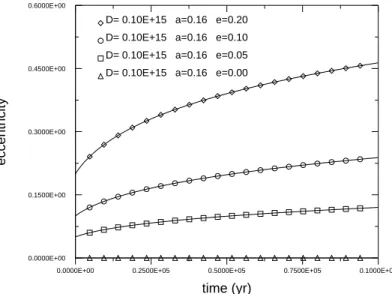
in Table 1. The sign + means that the body orbits in the sense of the pulsar’ spin. We can see that, in accordance to what was said above, the semi-major axis increases significantly in a time scale of tens of thousand years. The increase is slightly larger for an initially large eccentricity. Figure 3 shows the evolution of the corresponding eccentricities. There is no variation for an initially null eccentricity, and the larger the initial eccentricity, the larger its further increase.
Figure 4 shows the evolution of the semi-major axis for the same body in the case of counter-rotation. In less than 6000 years, the body falls onto the star, or at least beyond the in-ner frontier between the wind and the magnetosphere (which is the limit of validity of the present calculations). In the in-ner magnetosphere, the magnetic thrust still acts onto the body (although differently), and a rapid fall onto the star is expected.
5. Conclusion
A planet orbiting around a pulsar develops a system of Alfvén wings, caused by its interaction with the sub-Alfvénic Poynting-flux-dominated pulsar wind. A system of strong elec-tric currents is set, which exerts an ortho-radial force upon the planet that can, if the magnetic to mechanical energy coupling is efficient, have an incidence on the planetary orbit.
The data in Table 1 show that the orbital drift of a planet around a millisecond pulsar is negligible. In particular, this ef-fect cannot be involved in an explanation for the very low ec-centricity of the four known planets orbiting a pulsar. But, for bodies with a diameter of a few kilometres orbiting around a P = 1 second pulsar, the drifts occur on time scales that are short in comparison with the time of evolution of an iso-lated pulsar. For bodies orbiting in the same direction as the star’spin (the orbital angular momenta being in the same di-rection as the star’s angular momentum) this force tends to in-crease the semi-major axis and the eccentricity. For bodies in counter-rotation (the two angular momentum having opposite directions), this force tends to decrease the eccentricity and the semi-major axis, favouring the precipitation of the body onto the neutron star. If the bodies falling into the pulsar’s magne-tosphere studied by Cordes & Shannon (2008) fall under the influence of the Alfvén wings, then these object were, before their fall, in counter-rotation with the the neutron star. Rocks and asteroids in counter-rotation may come directly from the fall back after the supernova explosion. They may as well come from recent collisions. As suggested by Cordes & Shannon (2008) the smaller bodies (about 1 metre) falling toward the star, and evaporating in its vicinity, may cause a momentary interruption of the pulsar’s radio emissions. It is also possi-ble that the fall of a larger object on the star’s crust powers transient high energy emissions, such as those observed with soft gamma-ray repeaters. This might be particularly relevant for those associated to pulsars with a "standard" magnetic field (Rea et al. 2010) or with the Crab nebula (Abdo et al. 2011). These aspects of the question remain to be explored
More generally, the force caused by Alfvén wings may have consequences on the dynamics of fall-back accretion discs, and onto the formation of second generation planets around pulsars.
Acknowledgements. The authors thank Silvano Bonazzola (LUTH, Obs. Paris-Meudon) for interesting comments on this topics. This research has made use of the SIMBAD database, operated at CDS, Strasbourg, France, and The Extrasolar Planets Encyclopaedia (http://exoplanet.eu/index.php), maintained by Jean Schneider at the LUTH, and the SIO, at the Observatoire de Paris, France.
References
Abdo, A. A., Ackermann, M., Ajello, M., et al. 2011, Science, 331, 739
Burns, J. A., Lamy, P. L., & Soter, S. 1979, Icarus, 40, 1 Cordes, J. M. & Shannon, R. M. 2008, Astrophysical Journal,
682, 1152
Ek¸si, K. Y., Hernquist, L., & Narayan, R. 2005, The Astrophysical Journal, 623, L41
Table 1. Electric potential drop, total electric current associated to the Alfvén wing. Electrical energy ˙EJmaxdissipated in the Alfvén wing. Variation per (terrestrial) year of the semi-major axis estimated from Eq. (23). Variation of the eccentricity, per year, ∆e/year, estimated from Eq. (24).
Name U (V) I (A) E˙Jmax(W) ∆a/year (m) ∆e/year D/
√ GM (m5/2 ·s−1) PSR 1257+12 a 1.1 ×10¹² 3.0 ×10⁹ 2.5×10²¹ 0.02 0 3.06×10⁶ PSR 1257+12 b 3,5 ×10¹² 9.4 ×10⁹ 2.5×10²² 1. × 10−3 3 ×10⁻¹⁶ 5.11×10⁵ PSR 1257+12 c 2,6 ×10¹² 7.0 ×10⁹ 1.4×10²² 1. × 10−3 2.4×10⁻¹⁶ 5.28×10⁵ PSR 1620-26 a 6,0 ×10¹¹ 1.5 ×10⁹ 7×10²⁰ 3.×10−6 0 6.34×10⁵ PSR 10ms b 100 km 2.4×10⁹ 6.×106 1.2×10¹⁶ 8. × 10−3 6.×10−14 9.94×10⁵ PSR 10ms b 1 km 2.4×10⁷ 6.×104 1.2×10¹² 0.8 6.×10−12 9.94×10⁷ PSR 1 s b 100 km 2.4 ×10¹¹ 6×10⁸ 1.2 ×10²⁰ 8×10⁴ 6.4 ×10⁻⁸ 9.94×10¹¹ PSR 1 s b 1 km 2.4 ×10⁹ 6.×106 1.2×10¹⁶ 8.×105 6.×10−6 9.94×10¹³
Jones, P. B. 2007, Monthly Notices of the Royal Astronomical Society, 382, 871
Jones, P. B. 2008, Monthly Notices of the Royal Astronomical Society, 386, 505
Milani, A., Nobili, A. M., & Farinella, P. 1987, Non-gravitational perturbations and satellite geodesy. (Adam Hilger Ltd., Bristol,UK. 5+125 pp. (1987).)
(MH1) Mottez, F. & Heyvaerts, J. 2011, submitted to Astronomy and Astrophysics
Neubauer, F. M. 1980, Journal of Geophysical Research (Space Physics), 85, 1171
Rea, N., Esposito, P., Turolla, R., et al. 2010, Science, 330, 944
Fig. 1. Schematic view of an unipolar inductor. The unperturbed wind’s magnetic field B0and velocity v0are almost, but not exactly,
perpendicular. The electric field E0 created by the unipolar inductor
is perpendicular to these two vectors; it induces an electric current (of density j) along the body. This current then goes into the inter-planetary medium, forming two structures, each of them made of an outward and an inward flow. The current density j flowing along the planet is the cause of a j × B force density that is the topics of the present study.
6 Mottez and Heyvaerts: magnetic thrust
0.0000E+00 0.2500E+05 0.5000E+05 0.7500E+05 0.1000E+06
time (yr) 0.0000E+00 0.2000E+00 0.4000E+00 0.6000E+00 0.8000E+00
semi-major axis (AU)
D= 0.10E+15 a=0.16 e=0.20 D= 0.10E+15 a=0.16 e=0.10 D= 0.10E+15 a=0.16 e=0.05 D= 0.10E+15 a=0.16 e=0.00
Fig. 2. Evolution of the semi-major axis of a 1 km sized body as a function of time, under the influence of the magnetic thrust. The body orbits in the same direction as the pulsar’ spin. The four curves are given for four different values of the initial eccentricity.
0.0000E+00 0.2500E+05 0.5000E+05 0.7500E+05 0.1000E+06
time (yr) 0.0000E+00 0.1500E+00 0.3000E+00 0.4500E+00 0.6000E+00 eccentricity
D= 0.10E+15 a=0.16 e=0.20 D= 0.10E+15 a=0.16 e=0.10 D= 0.10E+15 a=0.16 e=0.05 D= 0.10E+15 a=0.16 e=0.00
Fig. 3. Evolution of the eccentricity in the same cases as in Fig. 2.
0.0000E+00 0.1500E+04 0.3000E+04 0.4500E+04 0.6000E+04
time (yr) 0.0000E+00 0.6250E-01 0.1250E+00 0.1875E+00 0.2500E+00
semi-major axis (AU)
D=-0.10E+15 a=0.16 e=0.20 D=-0.10E+15 a=0.16 e=0.10 D=-0.10E+15 a=0.16 e=0.05 D=-0.10E+15 a=0.16 e=0.00
Fig. 4. Evolution of the semi-major axis of a 1 km sized body as a function of time, under the influence of the magnetic thrust. The body orbits in the opposite direction to the pulsar’ spin. The four curves are given for four different values of the initial eccentricity.