HAL Id: hal-01873984
https://hal.archives-ouvertes.fr/hal-01873984
Submitted on 13 Sep 2018
HAL is a multi-disciplinary open access
archive for the deposit and dissemination of
sci-entific research documents, whether they are
pub-lished or not. The documents may come from
teaching and research institutions in France or
abroad, or from public or private research centers.
L’archive ouverte pluridisciplinaire HAL, est
destinée au dépôt et à la diffusion de documents
scientifiques de niveau recherche, publiés ou non,
émanant des établissements d’enseignement et de
recherche français ou étrangers, des laboratoires
publics ou privés.
MOISTURE DRIVEN DAMAGE GROWTH IN
WOOD MATERIAL : 3D IMAGE ANALYSIS FOR
VISCOELASTIC NUMERICAL MODEL VALIDATION
Seif Hamdi, Rostand Moutou Pitti, Joseph Gril
To cite this version:
Seif Hamdi, Rostand Moutou Pitti, Joseph Gril. MOISTURE DRIVEN DAMAGE GROWTH IN
WOOD MATERIAL : 3D IMAGE ANALYSIS FOR VISCOELASTIC NUMERICAL MODEL
VAL-IDATION. 2018 World Conference On Timber Engineering, Aug 2018, Seoul, South Korea.
�hal-01873984�
MOISTURE DRIVEN DAMAGE GROWTH IN WOOD MATERIAL : 3D
IMAGE ANALYSIS FOR VISCOELASTIC NUMERICAL MODEL
VALIDATION
Seif Eddine Hamdi
1, Rostand Mouttou Piti
1,2, Joseph Gril
1ABSTRACT: The viscoelastic behavior of wood under moisture content variation, known as mechano-sorption,
induces different responses in the drying and the humidification phase. However, in presence of climatic variations, long-term loading and crack initiation, the mechanical behavior of wooden structures is highly modified, disturbing their implementation and shortening their life in service. In a combined experimental, numerical, and 3D image analysis approach, damage onset and propagation in samples from tropical Pterocarpus soyauxii (Padouk) due to climatic changes are investigated. The rupture in mixed mode coupling mechanical and moisture loads for orthotropic materials such as wood is also studied. The analytical formulation of the energy release rate is introduced by the A- integral, which couples rupture in mixed mode, thermal effects and the pressure applied on the crack lips. The efficiency of the proposed model is justified by showing the evolution of energy release rate versus crack length and versus moisture variation for various configurations by means of X-ray Computed Tomography.
KEYWORDS: Mixed mode crack growth, Viscoelasticity, Moisture loadings, Finite element method, X-ray Computed
Tomography, Wood material
1 INTRODUCTION
123Currently, worldwide and particularly in Europe, industries show an increasing interest in wood-based structures. Economic and environmental contexts have enabled the emergence of new markets for green constructions so far confined to steel and concrete based structures. Improving the mechanical properties of wood-based materials would offer many advantages, including lower cost and environmental impact [1]. The benefits may also include energy savings, resource renewability, reducing the content of raw fossil materials, and recycling. However, wood materials present drawbacks compared with conventional civil engineering structures as steel and concrete, such as thermal and hydric sensitivity and multi-feature heterogeneity. The full potential of wood-based materials has still not been completely exploited because the relationships between fracture parameters at the microscale and macroscale behavior remain poorly described or integrated.
1 Hamdi Seif Eddine, Université Clermont Auvergne, CNRS,
Institut Pascal, France, [email protected]
1 Rostand Moutou Pitti, Université Clermont Auvergne, France,
1 Joseph Gril, Université Clermont Auvergne, CNRS, France,
2 Rostand Moutou Pitti, CENAREST, IRT, Gabon,
Moisture damage failure in wood based-structures is commonly induced by micro-cracks occurring under repeated moisture cycles loadings. In fact, combined with mechanical solicitations as fatigue, overload or creep loading, environmental actions play an important role in the propagation of these micro-cracks in the material.
To predict the crack-growth process, many numerical methods were developed to characterize the mechanical fields around the crack tip. The most popular is the J-integral proposed by Rice [2] based on the assessment of the strain energy density and Noether’s theorem [3]. This method is inefficient when dealing with mixed-mode crack-growth problems because it is necessary to separate the displacement field into a symmetric and an antisymetric parts. To circumvent this difficulty, Chen and Shield [4] have developed the M-integral in order to separate fracture modes based on a bilinear form of the strain energy density with virtual mechanical fields. Wood is considered as an orthotropic hydro-mechanical material whose mechanical behavior strongly depends on the moisture content and the temperature. Taking into account humidity and temperature variations, the mechanical behavior assessment becomes more complex due to the coupling effect between the mechanical stress and the hydric state (thermo-hydro-mechanical behavior (THM)) [5, 6]. The viscoelastic behavior of wood under variable humidity, known as the mechano-sorption behavior, induces different responses in the drying and
the humidification phases. However, in presence of climatic variations, the long terms load and especially the crack initiations, the mechanical behavior of wooden structures is found highly modified, disturbing their implementation and shortening their life in service. The effects of moisture changes on the propagation of cracks are not yet clearly identified. Therefore, it appears necessary to investigate the influence of the variable environment and crack growth process on the mechanical properties of wood structures.
In recent work, a new analytical formulation of A-integral developed by Moutou Pitti et al. [5] and implemented in finite element software for moisture effects investigation by Hamdi et al [6] is proposed. This formulation takes into account the viscoelastic behaviour, the effects of thermal load, induced by temperature variation, and complex boundaries conditions, such as contact between crack lips during crack-growth process.
The X-ray computed tomography (X ray CT) is a non-invasive imaging technique used to obtain three- dimensional (3D) volume [7]. The X-ray CT has appeared to become a powerful tool for to internal microstructure characterization [7, 8]. Thanks to recent developments in X-ray CT, 3D volumes with a voxel size of a few micrometers can be acquired and reconstructed promptly [9]. Over the past five to ten years, X-ray CT has become an increasingly accepted technique for qualitative and quantitative damage monitoring, dimensional inspection and local characterization of the 3D internal structures of various materials [7, 9, 10]. The X-ray CT, can characterize micro-damage that occur when local resilience of the material is exceeded [9, 10]. Several sources of damage mechanisms related to climatic variations and material properties needs to be understood.
This paper deals with an experimental validation of the numerical model by means of a 3D image analysis method. X-ray Computed Tomography is applied for crack length evolution versus simulated energy release rates. The first part of this abstract presents the mathematical formulation of the invariant integral A with the part of crack growth process under moisture variations. The second section, is dedicated to study the efficiency of the proposed image analysis based- X-ray CT approach in the case of orthotropic material, where crack growth analysis on Mixed-Mode Crack Growth (MMCG) wood specimen [6], is performed.
2 MATERIALS AND METHODS
2.1 FINITE ELEMENT FORMULATION INELASTIC MEDIUM
The formulation of the A-integral is based on the analytical work developed by Moutou Pitti et al. [5] to estimate the effects of mechanical and thermal loadings. Considering a two-dimensional cracked volume 𝛀 with a rectilinear crack of length a, subjected to external loads σ$and γ$, applied far from the crack, and 𝛤 a path
which surrounds the crack tip oriented by the normal 𝑛 of component nj, (j=1,2). With these considerations, according to Lagrangian Euleurian hypothesis [11], and conservative laws [12, 13], in stationary crack, the A-integral is given by [5, 6]: 𝐴 = 1 2 𝜎-.,01 𝑢-− 𝜎-.4 𝑣-,0 𝜃0,.𝑑𝑆 9 − 1 2 𝛾𝜗-𝛿-.𝑣-,.0∆𝑇,. 𝜃0,.𝑑𝑆 9 + 1 2𝐹- 𝑣-,. 𝜃.𝑑𝑥B C (1)
The first term of the A-integral is the classical term of the Mθ-integral which facilitates the separation of the contribution of each fracture mode, without resorting to separate the displacement field into a symmetric and an antisymmetric parts. The second term of the A-integral deals with the temperature effect, including temperature gradients inducing thermal dilatation and contraction. The last term of the A-integral represents the effect of pressures p and q applied perpendicularly to the cracked lips. Note that the mechanical load applied on the cracked lips can be induced by fluid action or contact between the crack lips during the crack growth process. The only restriction is the non-existence of friction or shear effects in the cracked lips [6].
2.2 GENERALIZATION TO VISCOELASTIC BODIES
The analytical formulation of the A-integral, presented in equation 4, is achieved assuming an elastic behavior. However, timber structures have a viscoelastic behavior. In this case, the mechanical fields are time dependent and their computation by a finite element method is often a hard task. The evaluation of time-dependent deformation in wood based materials bas been, to date, most accurately described by rheological models [5, 6]. These models separate and combine an elastic, a viscoelastic and a viscous term. The viscoelastic term is generally presented as a series of Kelvin elements as posted in the following Fig. 1.
Figure 1: Generalized Kelvin Voigt model
Hence, according to this rheological model, the Equation (1) is generalized to time depend behaviour through 𝐴D
𝐴D= 𝐴1E F EGH = 1 2 E𝜎-.,01 − E𝜎-.4 𝜐-,0E 𝜃0,.𝑑𝑉 K − 1 2 𝛾∆𝑇,. 𝛿-.𝑢-,.0E 𝜃0,.𝑑𝑉 K − (E)𝜎-.,01 𝑢 -,. (E)+ 𝜎 -.,04 (E) 𝜐 -,. (E) K + 𝛽 𝛿-. 𝑢-,.0 (E) ∆𝑇 𝜃 0 𝑑𝑉 + 1 2𝐹- 𝜐-,.0(E) 𝜃.𝑑𝑥B C (2)
with 𝑝 = 0; 1; . . . ; N . According to the definition of the energy release rate 𝐺 , the superposition principle (Moutou Pitti et al. [14]), gives for A-integral the following expression: 𝐾V4 W = 8 𝐴 1 E W𝐾V1 = 1, 𝐾W VV1 = 0 𝐶BE , and 𝐾VV4 W = 8 𝐴 1 E W𝐾V1 = 0, 𝐾 W VV1 = 1 𝐶]E (3) Where W𝐾V4 and 𝐾 VV4
W are the real stress intensity factors
in mode I and mode II, respectively. 𝐶BE and 𝐶]E designate the reduced viscoelastic compliances in opening and shear modes, respectively [14]. Each virtual stress and displacement field induces virtual stress intensity factors, denoted W𝐾V1and W𝐾VV1 for each fracture
mode, respectively. The mixed-mode fracture separation is given by performing two distinct calculations and choosing judicious values of the corresponding virtual stress intensity factors. According to Equations (2) and (3), the viscoelastic energy release rate in each fracture mode is given by the following expressions:
𝐺WE= 𝐺W VE+ 𝐺 VVE W , 𝑤𝑖𝑡ℎ 𝐺VE W = 𝐶 BE 𝐾V4 W ] 8 , 𝑎𝑛𝑑 𝐺W VVE= 𝐶]E 𝐾VV4 W ] 8 (4)
At the end, the equation (4) is implemented in a finite elements algorithm in order to obtain fracture parameters at any time.
2.3 MIXED-MODE CRACK GROWTH SPECIMEN
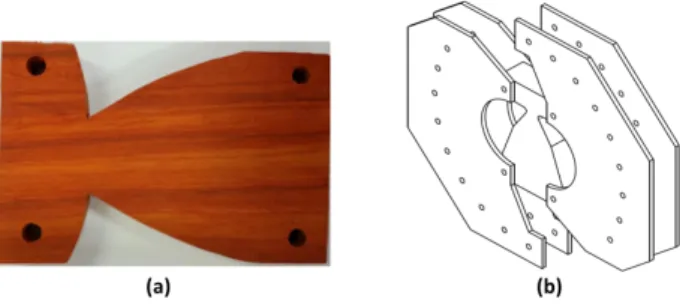
The MMCG wood specimen presented in Fig 2a, a combination of wood CTS specimen developed by DCB specimen [5], is used in order to obtain different mixed mode ratios while maintaining crack growth stability. The MMCG design stability is obtained by proposing a variable section. However, the geometry must concentrate the stress singularity around the crack tip in order to obtain an initial instability by using the arcan device, as depicted in Fig 1b. The numerical analysis is
performed under plane stress conditions and based on the finite element mesh depicted in Fig 3(a).
For the numerical simulations, the A-integral method is implemented in the finite elements software Cast3m. The external load is a creep loading applied to a perfect rigid arm with a chosen initial crack length of 40 mm is chosen. Points Aα and Bα with α = (1...7) are holes where
forces can be applied with the angle β oriented according to the trigonometrically direction for different mixed-mode ratios. The pure opening mixed-mode is obtained by applying opposite forces in A1 and B1 with β=0°, as
shown in Fig 2b. In the same way, loading points, with loading angle β=90°, are employed in order to impose a pure shear mode, as depicted in Fig 2(c). Intermediate positions induce different mixed mode ratios.
Figure 2: (a) MMCG wood specimen – (b) Modified Arcan fixture
Figure 3: (a) Finite elements mesh of the MMCG specimen; (b) Virtual displacements for opening mode; (c) Virtual displacements for shear mode
2.4 X-RAY COMPUTED MICROTOMOGRAPHY
A high-resolution Skyscan X-ray microtomograph with a closed X-ray micro-focus source, was used for non-destructive three-dimensional (3D) image acquisitions. A peak voltage of the X-ray source was set at 50 kV with a maximum power of 40 W. A 14-bit cooled CCD camera was used for pixel detection. The images were acquired with a minimum pixel size of 6 µm. The process is non-destructive and requires no special preparation of the specimen.
The investigated cracked wood sample with a dimension around 10 x 10 x 10 mm3 was withdrawn, and placed between the X-ray source and the detector, as shown in
Fig. 4(a). Multiple 2D X-ray projections images were taken every 0.4° rotation step over 360°.
After reconstruction using ImageJ software, a 3D volume was obtained in consecutive slices from the 2D cross-sectional images of the investigated cracked wood, as shown in Fig. 4(a). Once the region of interest (ROI) was chosen, the crack path was segmented and binary images were obtained. Three-dimensional rendering of the sample, as shown in Figure 4(b), was used to obtain information regarding the orientation, porosity, density and size distribution using image analysis (Fig. 5), and thus about the crack growth process in dry and wet MMCG specimen.
(a) (b) Figure 4: (a) Cracked wood sample – (b) Reconstructed 3D volume observation.
Figure 5: Crack properties extraction using image analysis.
3 RESULTS AND DISCUSSION
3.1 CRACK GROWTH ANALYSIS UNDERMOISTURE VARIATION
Cracks initiation and development are provoked by various driving forces, such as moisture variations. When the crack became stable and had to be triggered to propagate beyond it, this indicated that the stable crack tip had reached a zone of high toughness; in order to propagate further, the crack preferred the path of least resistance, which bypasses the tough zone. Then, it is necessary to quantify the crack driving mechanisms such as moisture level and crack growth speed.
The experimental setup, composed of a wooden MMCG specimen with an Arcan steel system under moisture loadings, was simulated by finite elements (Fig. 6).
Figure 6: Numerical MMCG mesh of MMCG sample under moisture loadings.
The analysis of cracks propagation in mixed mode coupling the mechanical and moisture loads via the MMCG sample is carried out using an incremental finite elements approach based on the A-integral. This fact simultaneously leads to the possibility of separating the rupture process and the viscoelastic effect.
(a)
(b)
Figure 7: Evolution of GI versus moisture content for different temperature variation (a); Evolution of GII versus moisture content for different temperature variation (b).
The hydric fields calculated in the elastic phase before crack propagation are projected on the MMCG mesh in order to calculate the cohesion stress which incorporates this time a selected humidity variation. It should be noted that the viscoelastic procedure is applied before the next moisture step is taken into account and the cracking parameters in terms of viscoelastic energy release rate (G) are evaluated at each step.
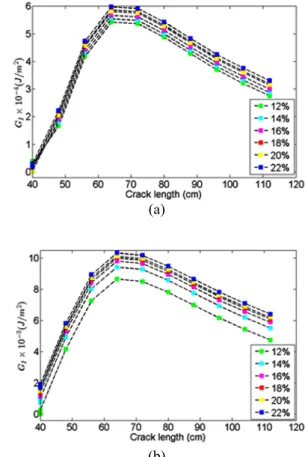
The effect of Thermo-Visco-Hydro-Mechanical Load Coupling is observed in the wood material for all mixed mode configurations. In this case, Fig. 7(a) and Fig. 7(b) show the evolution of energy release rates in opening mode (GI), and shear mode (GII) as a function of crack
length, for different moisture levels and different mixing rates using the invariant integral A. We note initially, a gradual growth of the development zone (growth phase of energy release rates) and, in a second phase, a stationary phase with a stabilizing changing release rate energy.
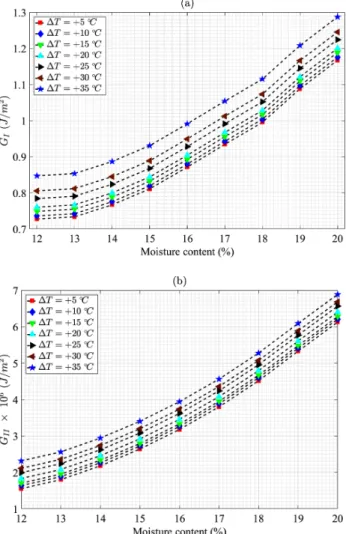
Figure 8: Evolution of GI versus moisture content for different
temperature variation (a); Evolution of GII versus moisture
content for different temperature variation (b).
The effect of moisture variation on mixed modes energy release under temperature variation is depicted in Fig. 8(a) and Fig. 8(b). Results show important information about the influence of moisture content on fracture toughness of this tropical wood species in constant and variable environments. More precisely, we observe, a higher rate of energy restitution for the mode II part (G_II), indicating that the cracking phenomenon is driven by this mode. It’s to be noted that G increases in proportion to the moisture content with a higher proportion for ΔT = 30 °C.
3.2 CRACK GROWTH MONITORING WITH IMAGE ANALYSIS
In order to track the three-dimensional crack growth process in Padouk sample, the X-ray CT method is performed conducted on dry and wet wood craked samples. Fig. 9(a) and Fig. 9(b) show the 3D volume visualisation of Padouk sample under moisture variation. It seems that under wet conditions, wood fibres restrict firstly at the edges of the sample.
Fig. 10 present a 2D cross sectional visualisation of crack opening. The effect of moisture content on the spatial variability details of the wood sample is clearly shown on the crack path. Hence, for regular wood fibre shapes with low rates of X ray CT method provide a reliable description of the wood morphology. Additionally, it appears necessary to use an adaptive and complimentary analysis strategy to take advantage of the strengths of X-ray micro tomography to investigate fracture parameters.
(a)
(b)
Figure 9: 3D volume visualisation of Padouk sample under moisture variation (a); 2D cross sectional visualisation of moisture effect on internal crack growth (b).
4 CONCLUSION
This work attempted to investigate numerically the influence of moisture on crack driving forces of wood-based materials. An analytical formulation of the A-integral for mixed mode fracture separation in viscoelastic media was used. Crack driving forces are then estimated. Due to large differences in the conditions under which moisture levels can be compared and the variety of wood species, relaxation effects can be observed through the energy release rate evolution versus crack growth process. X-ray CT was used to validate the morphological behaviour of crack growth process under moisture variation. Then, it was possible to show a general trend, but not a universally valid description to what extent the wood behavior will change at a certain temperature level and what the impact is on the occurrence and development of cracks in wood subjected to thermal and hydric loadings. In general, it could be concluded that thermo-visco-hydro variation has a greater effect on the reduction of the mechanical proprieties of wood-based materials. However, a viscoelastic critical energy release rate that causes structurer failure and enhance crack growth dramatically, could not be stated, due to the time dependence behavior during wood heating and cooling, but also, no doubt, due to wood species behavior. An experimental procedure is planned in order to validate the numerical analysis. This procedure allows to measure the impact of Thermo-Hydro-Mecanical lodings on the structural collapse. In the end, all data obtained will be compared with results of the numerical model. Comparison of the results will help to refine the analytical and numerical models, and thus to extend their application to other types of wood species such as temperate and tropical wood.
ACKNOWLEDGEMENT
The authors would like to acknowledge the National Research Agency (ANR) and the CNRS for their financial support through the CLIMBOIS ANR-13-JS09-0003-01 and the PEPS “RUMO” projects respectively, as well as the labelling awarded by France's ViaMéca cluster. The authors thank also the French Civil Engineering Association (AUGC) for the financial support to attend this conference.
REFERENCES
[1] Nziengui C, Ikogou S, Moutou Pitti R. Impact of cyclic compressive loading and moisture content on the mechanical behavior of Aucoumea Klaineana Pierre. Wood Material Science & Engineering 1-7, 2017
[2] Rice J.R. A path independent integral and the approximate analysis of strain concentrations by notches and cracks. J Appl Mech, 35:379-386, 1968. [3] Noether E. Invariant variations problem. Transport
Theory Stat Phys, 1:183-207, 1918.
[4] Chen F.M.K, Shield R.T. Conservation laws in elasticity of the J-Integral. J Appl Math Phys, 28:1-22, 1977.
[5] Moutou Pitti R, Dubois F, Petit Ch. Generalization of T and A integrals to time-dependent materials:
analytical formulations. Int J Fract, 161:187-198, 2010.
[6] S.E. Hamdi, R. Moutou Pitti, F. Dubois. Temperature variation effect on crack growth in orthotropic medium: Finite element formulation for the viscoelastic behavior in thermal cracked wood-based materials. International Journal of Solids and
Structures, 115–116:1–13, 2017
[7] Hamdi SE, Delisée C, Malvestio J, Da Silva N, Le Duc A, Beaugrand J. X-ray computed microtomography and 2D image analysis for morphological characterization of short lignocellulosic fibers raw materials: A benchmark survey. Composites Part A: Applied Science and
Manufacturing, 76:1–9, 2015
[8] Graupner N, Beckmann F, Wilde F, Mussig J. Using synchrotron radiation-based micro-computer tomography (SR µ-CT) for the measurement of fibre orientations in cellulose fibre-reinforced polylactide (PLA) composites. Journal of Materials Science, 49:450-460, 2014
[9] Alemdar A, Zhang H, Sain M, Cescutti G, Mussig J. Determination of Fiber Size Distributions of Injection Moulded Polypropylene/Natural Fibers Using X-ray Microtomography. Advanced Engineering Materials, 10:126-130, 2008
[10] Buffiere J.Y, Maire E, Adrien J, Masse P, Boller E. In situ experiments with X ray tomography: an attractive tool for experimental mechanics.
Experimental Mechanics, 50(3):289–305, 2010
[11] Donea J, Giuliani S, Halleux J. An arbitrary lagrangian-eulerian finite element method for transient dynamic fluid-structure interactions.
Computer Methods in Applied Mechanics and Engineering, 33:689–723, 1982
[12] Noether E. Invariant variations problem. Transport
Theory Statistical Physics, 1:183–207, 1921
[13] Bui H D. Conservation laws, duality and symmetry loss in solid mechanics. International Journal of
Fracture, 147:163–172, 2007
[14] Moutou Pitti R., Dubois, F., Petit, C., Sauvat, N. Mixed mode fracture separation in viscoelastic orthotropic media: numerical and analytical approach by the Mθ-integral. International Journal
of Fracture, 145:181-193, 2007
[15] Valentin G., Morlier P. A criterion of crack propagation in timber. Matériaux et Constructions, 88:291–298, 1982