Data Structure Repair Using Goal-Directed
Reasoning
by
Brian C. Demsky
Submitted to the Electrical Engineering and Computer Science
Department
in partial fulfillment of the requirements for the degree of
Doctor of Philosophy
at the
MASSACHUSETTS INSTITUTE OF TECHNOLOGY
@ Massachusetts
January 2006
Institute of Technology 2006.
All rights reserved.
A uthor . ... .. . -.. 7...:%A ...
Electrical Engineering and Computer Science Department
January 19, 2006
Certified by
..
...
..Martin C. Rinard
Associate Professor in Electrical Engineering and Computer Science
Thesis Supervisor
/
Accepted by ...
.
...Arthur C. Smith
Chairman, Departmental Committee on Graduate Students
MASCUmT NTTT MASSACHUSETTS INSTTFE OF TECHNOLOGY
JUL
1 0
2006
MASSACHUSETTS INSTFTUTE OF TECHNOLOGYLIBRARIES
ARCHIVES
Data Structure Repair Using Goal-Directed Reasoning
by
Brian C. Demsky
Submitted to the Electrical Engineering and Computer Science Department on January 19, 2006, in partial fulfillment of the
requirements for the degree of Doctor of Philosophy
Abstract
Software errors, hardware faults, and user errors can cause data structures in running applications to become damaged so that they violate key consistency properties. As a result of this violation, the application may produce unacceptable results or even crash.
This dissertation presents a new data structure repair system that accepts a speci-fication of key data structure consistency constraints, then generates repair algorithms that dynamically detect and repair violations of these constraints, enabling the ap-plication to continue to execute productively even in the face of otherwise crippling errors. We have successfully applied our system to five benchmarks: CTAS, an air traffic control tool; AbiWord, an open source word processing application; Freeciv, an online game; a parallel x86 emulator; and a simplified Linux file system. Our experi-ence using our system indicates that the specifications are relatively easy to develop once one understands the data structures. Furthermore, for our set of benchmark applications, our experimental results show that our system can effectively repair inconsistent data structures and enable the application to continue to operate suc-cessfully.
Thesis Supervisor: Martin C. Rinard
Acknowledgements
I owe a debt of gratitude to many people, for their assistance and guidance in my research . First, to my advisor, Martin Rinard, for without his guidance, patience, encouragement, wisdom, and help this project could not have been done. I would like to thank the remaining members of my committee, Michael Ernst and Daniel Jackson, for their time and contributions to this project. I would like to thank the Fannie and John Hertz Foundation for their fellowship.
I would like to thank Scott Ananian, Patrick Lam, Viktor Kuncak, Darko Marinov, Maria Cristina Marinescu, Radu Rugina, Alexandru Salcianu, Amy Williams, Karen Zee, and Mary McDavitt for their support and assistance.
I would like to thank Daniel Roy for his specification checking code and Philip Guo for his Dwarf2 code that was used to develop the automatic structure extraction tool.
I would like to thank all of the great friends I have made during my stay at MIT for
making MIT enjoyable. I would like to thank Fuji Lai for being there this entire time. Finally, I would like to thank my parents and my brother for their moral support.
Contents
1 Introduction 15
1.1 Specification-Based Data Structure Repair . . . . 16
1.2 Experience . . . . 18
1.3 Scope of Data Structure Repair . . . . 19
1.3.1 Acceptability of Repaired Data Structures . . . . 20
1.3.2 Target Applications . . . . 20 1.4 Specification Language . . . . 21 1.5 Term ination . . . . 23 1.6 Contributions . . . . 24 1.7 O rganization . . . . 25 2 Overview 27 2.1 Set and Relation Declarations . . . . 29
2.2 Translating Data Structures into Relations . . . . 30
2.2.1 Decoding the Heap . . . . 31
2.2.2 Translating the Decoded Heap into a Relational Model . . . . 32
2.3 Specifying Consistency Constraints . . . . 35
2.3.1 Classes of Basic Propositions . . . . 35
2.3.2 Q uantifiers . . . . 37
2.4 Repairing the Model . . . . 37
2.5 Translating Abstract Repairs into Data Structure Updates . . . . 39
2.5.1 How Additional Changes to the Model Occur . . . . 40
2.6.1 Repair Dependence Graph 2.6.2 Cascading Changes . . . . 2.6.3 Pruning Nodes . . . . 2.6.4 Compensation Updates . . 2.7 Scope . . . . 2.8 Summary . . . .
3 File System Example
3.1 Consistency Specification . . . . .
3.1.1 Structure Declaration . . .
3.1.2 Model Definition . . . . .
3.1.3 Consistency Constraints .
3.2 Repair Algorithm . . . .
3.3 Repair Algorithm Generation . .
3.4 Repair Dependence Graph . . . .
4 The Specification Language
4.1 Structure Definition Language . . . . 4.2 Model Definition Language . . . . 4.2.1 Set and Relation Declarations . . . . 4.2.2 Model Definition Rules . . . .
4.3 Consistency Constraint Language . . . . 4.3.1 Treatment of Undefined Values . . .
4.3.2 Using Relations as Functions . . . . . 4.3.3 Restrictions on Basic Propositions . 4.4 Desugaring Set and Relation Declarations 4.5 Language Design Rationale . . . .
4.5.1 Set- and Relation-Based Model . . . 4.5.2 Model Definition Rules . . . .
4.5.3 Consistency Consistency Constraints 4.6 Discussion . . . . . . . . 42 . . . . 43 . . . . 47 . . . . 47 . . . . 48 . . . . . 5 1 53 . . . . 54 . . . . 54 . . . . 57 . . . . 59 . . . . 61 . . . . 66 . . . . 66 71 71 . . . . . 73 . . . . . 73 . . . . . 74 . . . . . 75 . . . . . 76 . . . . . 77 . . . . . 78 . . . . . 80 . . . . . 82 . . . . . 82 . . . . . 83 . . . . . 84 84
5 The Repair Algorithm 87
5.1 Basic Concepts . . . .. . . .. . .. . . . . .. 87
5.2 Repair Algorithm Overview . . . . 89
5.3 Model Construction . . . . 90
5.3.1 Denotational Semantics . . . . 91
5.3.2 Negation and the Rule Dependence Graph . . . . 91
5.3.3 Ensuring a Finite Model . . . . 93
5.3.4 Pointers . . . . 94
5.4 Consistency Checking . . . . 95
5.5 Repairing a Single Constraint . . . . 95
5.5.1 Model Repair Actions . . . . 98
5.5.2 Data Structure Updates . . . . 98
5.5.3 Atomic Modifications . . . . 100
5.5.4 Recursive Data Structures . . . . 101
5.5.5 Compensation Updates . . . . 102
5.5.6 New Objects . . . . 104
6 The Repair Dependence Graph 105 6.1 Nodes in Repair Dependence Graph . . . . 106
6.2 Edges in the Graph . . . . 108
6.3 Interference . . . . 112
6.3.1 Model Repair Effects . . . . 112
6.3.2 Data Structure and Compensation Updates . . . . 127
6.3.3 Scope Increases and Decreases . . . . 130
6.3.4 Computing Upper Bounds on the Sizes of Sets and Relations . 131 6.4 Behavior of the Generated Repair Algorithms . . . . 132
6.5 Term ination . . . . 133
6.5.1 Individual Model Repairs Terminate . . . . 134
6.5.2 Repair Terminates . . . . 135
7 Bounds on the Repair Overhead
141
7.1 Bound on the Number of Repair Actions ... 141
7.2
Reducing the Repair Overhead . . . 143
7.2.1 Reducing the Number of Repairs . . . . 144
7.2.2 Reducing the Model Building Overhead . . . . 144
7.3 Reducing the Checking Overhead . . . . 145
7.3.1 Check On Failure . . . . 145
7.3.2 Partial Specification Checking . . . . 145
7.3.3 Incremental Checking . . . . 146
8 Developer Control of Repairs 147 8.1 Developer Control . . . . 147
8.2 Communication with the Developer . . . . 149
9 Experience
153
9.1 Methodology . .. . ... . . . .. ... ... ... .. .... ... ... ...153 9.2 AbiWord... ... ... 154 9.2.1 Specification... ... 155 9.2.2 E rror . . . . 156 9.2.3 Results. ... .. . .. .. . . . . .. . .. .. . .. . ... ... . 159 9.3 Parallel x86 emulator . .. . .. . .. . .. .. . . . .. . .. . . . 160 9.3.1 Specification... ... 161 9.3.2 E rror . . . . 161 9.3.3 Results. .. ... .... .. . .. . .. .. . . . .. . ... . 161 9.4 CTAS ... ... 164 9.4.1 Specification... ... 165 9.4.2 Fault Injection .. . . . . .. ... ... . .. ... . .. . . . . 166 9.4.3 Results. .. . .. . ... . . . .. . ... .... .. . ... ... ..166 9.5 Freeciv . . . . 167 9.5.1 Specification . . . . 167 9.5.2 Fault Injection . . . . 1689.5.3 Results . . . . 172
9.6 A Linux File System . . . . 172
9.6.1 Specifications . . . . 172
9.6.2 Fault Injection . . . . 173
9.6.3 Results . . . . 176
9.7 Randomized Fault Injection . . . . 177
9.7.1 CTAS Results . . . . 177
9.7.2 Freeciv Results . . . . 178
9.8 Comparison with Our Previous System . . . . 179
9.9 Discussion . . . . 181
10 Related Work 185 10.1 Rebooting . . . . 185
10.2 Checkpointing . . . . 186
10.3 Transactions . . . . 187
10.4 Manual Data Structure Repair . . . . 188
10.5 Constraint Programming . . . . 189
10.6 Integrity Management in Databases . . . . 190
10.7 Data Structure Repair using Search . . . . 192
10.8 Specification-Based Data Structure Repair . . . . 193
10.9 File Systems . . . . 193
10.10Object Modelling Languages . . . . 194
11 Conclusion 195 11.1 Future W ork . . . . 197
List of Figures
2-1 Repair Process . . . . . 2-2 2-3 2-4 2-5 2-6 2-7 2-8 3-1 3-2 3-3 3-4 3-5 3-6 3-7 3-8 3-9 3-10 3-11 4-1 4-2Example Set and Relation Declarations . . . . Example Structure Definitions . . . . Example Model Definition Rules . . . . Example Consistency Constraint . . . .
Repair Dependence Graph . . . . Repair Dependence Graph with Updates . . . . . Pruned Repair Dependence Graph with Updates . Inconsistent File System . . . . Structure Definitions . . . . Set and Relation Declarations . . . . Model Definition Rules . . . . Consistency Constraints . . . . Broken M odel . . . . Repair Sequence . . . . Model with a BlockBitmap . . . . Repaired Model . . . . Repair Dependence Graph . . . . Pruned Repair Dependence Graph . . . . Structure Definition Language . . . . Set and Relation Declarations . . . . 4-3 Model Definition Language . . . . .
28 . . . . 30 . . . . 3 1 . . . . 33 . . . . 35 . . . . 43 . . . . 46 . . . . 48 . . . . 54 . . . . 55 . . . . 58 . . . . 59 . . . . 60 . . . . 62 . . . . 64 . . . . 65 . . . . 67 . . . . 68 . . . . 70 . . . . 73 . . . . 74 75
4-4 Consistency Constraint Language . . . . 77
4-5 Three Value Logic Truth Table . . . . 78
5-1 Denotational Semantics for the Model Definition Language . . . . 92
5-2 Denotational Semantics for Consistency Constraints . . . . 96
6-1 Repair Dependence Graph Schema . . . . 106
6-2 Rules for computing interference from set additions . . . . 115
6-3 Rules for computing interference from set removals . . . . 116
6-4 Rules for computing interference from relation additions . . . . 117
6-5 Rules for computing interference from relation additions . . . . 118
6-6 Rules for computing interference from relation additions . . . . 119
6-7 Rules for computing interference from relation additions . . . . 120
6-8 Rules for computing interference from relation removals . . . . 121
6-9 Rules for computing interference from relation removals . . . . 122
6-10 Rules for computing interference from relation removals . . . . 123
6-11 Rules for computing interference from relation removals . . . . 124
6-12 Rules for computing interference from relation modifications . . . . . 125
6-13 Rules for computing interference from relation modifications . . . . . 126
6-14 Rules for computing interference from model definition rule scope changes 131 6-15 Rules for computing interference from model definition rule scope changes 139 9-1 Piece Table Data Structure . . . . 155
9-2 Structure Definitions for AbiWord (extracted) . . . . 157
9-3 Model Declarations for AbiWord . . . . 158
9-4 Model Definition Rules for AbiWord . . . . 158
9-5 Consistency Constraints for AbiWord . . . . 158
9-6 Cache Data Structure . . . . 160
9-7 Structure Definitions for x86 Emulator (extracted) . . . . 162
9-8 Model Declarations for x86 Emulator . . . . 163
9-10 Consistency Constraints for x86 Emulator . . . . 163
9-11 CTAS Data Structure . . . . 165
9-12 Freeciv Data Structure . . . . 168
9-13 Part 1 of the Structure Definitions for Freeciv (extracted) . . . . 169
9-14 Part 2 of the Structure Definitions for Freeciv (extracted) . . . . 170
9-15 Model Declarations for Freeciv . . . . 171
9-16 Model Definition Rules for Freeciv . . . . 171
9-17 Consistency Constraints for Freeciv . . . . 171
9-18 Structure Definitions for File System . . . . 173
9-19 Model Declarations for File System . . . . 174
9-20 Model Definition Rules for File System . . . . 175
9-21 Consistency Constraints for File System . . . . 175
9-22 Results of Randomized Fault Injection for CTAS . . . . 178
Chapter 1
Introduction
Applications often make assumptions about the states of the data structures that they manipulate. Errors that cause these data structures to become inconsistent and violate these assumptions may cause software systems to behave unacceptably or even fail catastrophically. A common recovery strategy for data structure inconsistencies is to reboot the system, thereby eliminating the inconsistencies when the system rebuilds the data structures from scratch. However, this strategy may fail: if inconsistencies appear in persistent data structures or are triggered by recurring problematic inputs, then the system may continue to be completely inoperable, even after rebooting.
Motivated in part by the drawbacks of rebooting, researchers have developed hand-coded data structure repair techniques to address data structure corruption errors. Several very successful deployed systems use data structure inconsistency detection and repair techniques to improve reliability in the face of errors. For example, the Lucent 5ESS switch and IBM MVS operating systems both use hand-coded audit and repair procedures to recover from data structure corruption errors [21, 29]. The reported results indicate an order of magnitude increase in the reliability of these systems [18]. Similar repair procedures exist for persistent data structures such as file systems and application files [5, 3].
While hand-coded repair algorithms are a useful way to enable software systems to recover from data structure corruption events, they are difficult to implement, as the developer must reason about the operational details of the repair process to
obtain a correct repair algorithm. Because of the context in which they are used, repair algorithms also present additional challenges that are not present in standard software:
o One challenge is that repair algorithms must repair completely unconstrained data structures. For example, software errors, hardware errors, or user errors can leave data structures in arbitrary states. This can be difficult for the de-veloper, as he or she must write code that traverses, checks, and repairs a data structure while making absolutely no assumptions about the state of that data structure. For example, code to process a broken linked list must check for invalid pointers, cycles in the linked list, sharing between linked lists, and overlapping linked list elements in addition to implementation-specific errors. o A second challenge is that it is difficult to test repair algorithms. In particular,
testing is complicated by the following issues: 1) testing must ensure that the repair algorithm functions on completely unconstrained inputs, and 2) there are many ways the data structure can be broken. In particular, the testing process must ensure that the repair algorithms: 1) terminate for all possible input data structures, 2) do not crash on any input data structures, and 3) successfully repair any damaged data structures.
1.1
Specification-Based Data Structure Repair
To address these challenges, we have developed a specification-based approach to data structure repair. This dissertation presents our specification-based data structure repair technique and our experience using this technique to enable systems to recover from data structure corruption.
Instead of manually developing ad-hoc procedures to repair inconsistent data structures, our technique allows the developer to write a declarative specification of the data structure consistency properties and annotate the application to indicate where these specifications should hold. When possible, our specification compiler
then compiles this specification into C code that checks that the consistency proper-ties hold. When the user runs the application, the application invokes the generated repair algorithm at the developer annotated points. When invoked, the repair algo-rithm checks for constraint violations, repairs any violations that it finds, and finally returns control to the application.
This specification-based approach has the following key advantages:
" It enables the developer to focus on the consistency constraints rather than
on the low-level operational details of developing algorithms that detect and correct violations of these constraints. Because of the declarative nature of the constraints and the enormous number of operational details the developer must take into account when developing repair algorithms by hand, we believe that it is easier for developer to specify constraints than to develop repair algorithms
by hand.
" The highly-defensive and unnatural programming style necessary to access
arbi-trarily broken data structures can be automatically generated by the compiler. Since the specification compiler automatically generates the traversals it can systematically insert the necessary checks at every access.
" The specification compiler is likely to be more rigorously tested than any given
hand-coded repair algorithm because it will be used to generate repair algo-rithms for many different applications. The repair algoalgo-rithms generated by the specification compiler are therefore more likely to be correct (and therefore more likely to correctly repair any inconsistent data structures) than hand-coded re-pair algorithms.
" The specification compiler automatically reasons about interactions between
re-pair actions and consistency properties to ensure that the rere-paired data struc-ture correctly satisfies all of the consistency properties specified by the devel-oper. Compared with hand-coded repair algorithms, the specification compiler automatically reasons about the interactions between repair actions and consis-tency properties. To write repair algorithms, the developer must reason about
all possible interactions between the repair actions and the consistency proper-ties the code enforces. If the developer of a hand-coded repair algorithm forgets to account for an interaction, the hand-coded repair algorithm could fail to terminate or not repair some violated consistency property.
* The generated repair algorithm is guaranteed to terminate.
Because of all of these reasons, we expect our specification-based approach to substantially simplify the process of developing repair algorithms. One beneficial result of this simplification is that developers may be able to successfully incorporate data structure repair into a larger body of software systems.
1.2
Experience
Our data structure repair technique produces data structures that satisfy the consis-tency properties. While these repaired data structures are not guaranteed to be the same data structures that a correct execution would have produced, they are heuris-tically close to the original broken data structures. While in practice this may enable applications to continue to execute successfully, it does not ensure any properties about the continued execution of the application. Furthermore, whether a repaired execution is acceptable to the user is a subjective question that can only be evalu-ated by considering the deviation from correct behavior and the context in which the application is intended to be used. As a result, we believe that the most reasonable way to evaluate whether data structure repair enables applications to recover from otherwise serious or even fatal errors is to perform an empirical evaluation. A key question that our evaluation focuses on is whether data structure repair, when given a specification that detects an inconsistency, effectively enables applications to recover from that inconsistency in an acceptable manner.
To perform this evaluation, we first developed a compiler-based implementation of our data structure repair technique. This implementation compiles data structure consistency specifications into C code that implements a repair algorithm for the data
structure.
We then acquired five different applications and applied our technique to each. The five applications were: a word processor, a parallel x86 emulator, an air-traffic control system, a Linux file system, and an interactive game. For each of the ap-plications we developed a workload that exercised the application and identified a pre-existing error or injected a fault to corrupt a data structure. We then wrote a specification that was targeted towards the particular constraint. Without data structure repair, the corrupted data structures caused each of the applications to crash. With data structure repair, the corruption was repaired and the applications were able to continue to execute successfully. In some cases, data structure repair leveraged the presence of redundant information to produce a completely correct data structure. In other cases, the repair produced data structures that potentially devi-ated from the correct data structure. Nevertheless, these repaired data structures satisfied the basic data structure consistency constraints and enabled the application to continue to execute acceptably.
To incorporate data structure repair in these applications, we had to write data structure specifications for each application. To simplify the evaluation, we first found a software error, then wrote the data structure consistency specification to cover the properties violated by the selected error. In this evaluation, we found that the specifi-cations were relatively to easy to develop once we understood the consistency proper-ties for the data structure and that most of the time we spent developing specifications was spent understanding the consistency properties of the data structures. Our eval-uations leaves open the question of how hard it is to obtain comprehensive enough specifications to repair previously unknown errors and to ensure that repairs of one constraint do not violate other important but unstated consistency constraints..
1.3
Scope of Data Structure Repair
We do not expect that specification-based data structure repair will be suitable for all applications. The scope of data structure repair is limited by the acceptability of the
repaired data structures for each application in the context in which it is used and whether the application has properties that make data structure repair attractive.
1.3.1
Acceptability of Repaired Data Structures
A significant issue is that data structure repair does not necessarily generate the
same data structure that a correct execution would have. As a result, the continued execution of the application after repair may diverge significantly from the correct execution and even produce unacceptable results. Our results, however, indicate that repairing the inconsistencies in the data structures almost always enables our applications to execute in an manner that we believe the user will find acceptable. Moreover, for these applications continued acceptable execution is more desirable than crashing and losing all of their volatile state. However, we recognize that there are applications where absolute correctness is more important than continued execution, and data structure repair is not appropriate for these applications. Examples of such computations include cryptography algorithms (which cannot tolerate even the slightest deviation from correct behavior) and many numerical calculations (for which confidence in accuracy of the output value is important and small deviations in the calculations can produce large differences in the output).
1.3.2
Target Applications
Our target applications have several properties that make data structure repair at-tractive:
e Rebooting Ineffective: There must be some reason why a user would not
just reboot these applications to recover from inconsistencies. Some reasons that a user may wish to not simply reboot an application include: the applica-tion maintains persistent data that may become corrupt (such inconsistencies persist across reboots and may cause the rebooted system to crash), the system has important information in volatile data structures, the system may take too long to boot, the boot process may be complicated and involve human
inter-vention, or recurring problematic inputs may cause the system to repeatedly crash. Applications that maintain persistent data structures are particularly good candidates for data structure repair, because inconsistencies in these per-sistent data structures cannot be fixed by rebooting these applications.
" Well-specified Data Structures: The application should have well-specified
data structures with important consistency properties. It can be difficult to write a useful consistency specification if the consistency properties are not known, if all of the possible data structure configurations are consistent, or if the consistency properties relate local variables in different naming contexts. " Tolerates Deviations from Complete Correctness: The application must
tolerate some deviation from complete correctness. Several different factors can help applications tolerate deviations from completeness correctness: 1) the application may have many decoupled subcomputations, some of which are not affected by the deviation; 2) the application may contain many independent objects only some of which are affected by the inconsistency and, therefore, the application is able to correctly process the correct objects; 3) the user may be able to tolerate large deviations from correct behavior; 4) the application may flush incorrect state and, therefore, eventually return to completely correct behavior; and 5) the consistency properties may be sufficient to ensure that the future behavior of the application is acceptable.
" Application's Uptime is Important: There must be a reason why the devel-opers care enough about the application's uptime to apply data structure repair. This can either be that the application is important and/or widely deployed.
1.4
Specification Language
Our specification language uses a set- and relation-based abstract model of data structures. This model consists of sets of objects and relations between these objects. The developer writes consistency constraints in terms of these sets and relations.
Many of the objects in an application's data structures have identical consistency properties. For example, all of the nodes in a linked list should be pointed to by at most one other object in the list. We included sets in our abstract model because they provide a natural way to group together all of these objects so that the developer can then write a consistency property that holds for all objects in the set. The fields in objects associate the object with primitive values or other objects. Other data structures such as a hashtable can also associate an object with primitive values or other objects. We included relations in our abstract model because they provide a natural way to abstract both of these associations.
As we previously discussed, it is often useful to write constraints that must be true for all objects in a set. We have included guarded universal quantifiers to enable the developer to write a constraint that holds for all objects in a set or all tuples in a relation. Our specification language includes a set of basic propositions, which can be combined by standard logical connectives (or, and, negation). We chose the set of basic propositions so that they were easy to repair, and that they could express impor-tant consistency properties. These basic propositions include numerical inequalities (for example, a lower bound on an object's fields), pointer equalities (for example, constraints that ensure that back-pointers in a doubly-linked list are consistent with the forward pointers), set and relation inclusion constraints (for example, constraints that relate set membership to other properties), constraints on the sizes of sets (for example, constraints that ensure that data structures exist), and constraints on the in-degree and out-degree of relations with respect to a given object (for example, constraints that ensure that an object in a linked-list is referenced at most once by other objects in the list).
A key challenge in this approach is constructing the sets and relations in the
abstract model from the concrete data structures. Our specifications include a set of developer-provided model definition rules, which the developer uses to specify the connection between the concrete data structures and the abstract model. The repair algorithm then uses these model definition rules to construct an abstract model of the concrete data structure.
We generate repair algorithms that use the model definition rules to traverse the concrete data structures in the heap to classify objects into sets and to construct the relations. The repair algorithm then checks that the consistency properties hold on the abstract model. If it finds a constraint violation, it selects a conjunction in the disjunctive normal form (DNF) of the constraint to make true. Note that if the selected conjunction in the constraint is true, the entire constraint is true. The repair algorithm then makes the conjunction true by performing model repairs to make each of the individual basic propositions that comprise the conjunction true. These model repairs make the basic propositions true by either adding or removing objects (or tuples) to or from sets (or relations). At this point the repair algorithm has repaired the abstract model, but it has not yet repaired the underlying data structure. The repair algorithm next uses goal-directed reasoning to analyze the model definition rules to translate these model repairs into data structure updates. After performing the concrete data structure update, the algorithm has repaired a single constraint violation in the underlying data structure. However, multiple constraints may be violated, so the the repair algorithm repeats the process until it finds no further violations. The end result of the repair process is that all of constraints hold on the repaired data structure.
1.5
Termination
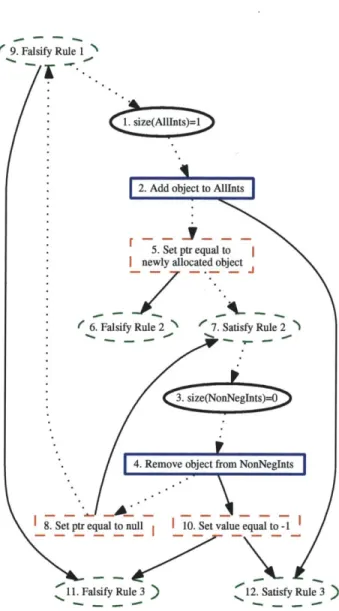
In general, it is possible for a repair algorithm to become trapped in an infinite repair loop. This can happen, for example, if the repair algorithm repairs one constraint and in the process violates a second constraint, then repairs the second constraint and in the process violates the original constraint. The specification compiler determines if this kind of non-termination can happen by building the repair dependence graph, which tracks all of the possible dependences between repair actions. The absence of certain kinds of cycles in the repair dependence graph guarantees that the repair algorithm will always terminate. Even if this graph contains one or more of these cycles, the algorithm may in some cases be able to prune sets of nodes to eliminate
these cycles. This pruning corresponds to eliminating potential repair actions that the repair algorithm could otherwise use. Before the specification compiler generates the repair algorithm, it checks for the absence of any such cycles in the repair dependence graph. The generated repair algorithm will therefore always terminate and leave the data structure in a consistent state.
1.6
Contributions
This dissertation makes the following contributions:
o Specification-Based Data Structure Repair: It presents a specification-based approach to data structure repair. The developer simply writes the key consistency properties, and our tool automatically generates the corresponding data structure repair algorithm. This approach allows the developer to focus on the consistency properties and frees the developer from reasoning about the operational details of the repair algorithms.
o Abstract Model: Our approach is based on a set- and relation-based abstract model of the data structure. The developer uses this abstraction of the data structure to express key data structure consistency properties.
o Specification language suitable for repair: It presents a specification lan-guage that can express many data structure consistency properties and that can be used to automatically generate data structure repair algorithms. This specification language also specifies how to construct the set- and relation-based abstraction of the concrete data structures.
o Model Construction: It presents how the repair algorithm evaluates the model definition rules to construct a set- and relation-based abstract model of a concrete data structure.
o Consistency Checking and Repair: It presents how our repair algorithm checks the consistency properties on the abstract model and repairs any violated
constraints that it finds.
" Repair Translation: A key challenge with this approach is translating the
repair actions from this abstraction into operations that update the concrete data structures. This dissertation presents an algorithm that uses goal-directed reasoning to translate repair actions into operations that update the concrete data structures.
" Termination Analysis: It presents a conservative analysis that determines
whether the generated repair algorithm terminates. This analysis reasons about the interactions between the consistency constraints, the repair actions for these constraints, and the model definition rules to ensure that the generated repair algorithm always terminates.
" Experience: It presents our experience using data structure repair on several
applications. We have used data structure repair to successfully enable five ap-plications to recover from otherwise fatal data structure consistency corruption.
At this point we have completed an initial investigation of our technique and obtained positive results. However, several questions remain unanswered. How hard is it to obtain specifications that have good coverage of the properties that software errors will violate? How well will data structure repair work on a broader class of applications with (presumably) a broader class of errors? The next step would be to perform an evaluation in which we first develop a consistency specifications for a broader class of applications, find errors in the applications, and finally test whether the repair algorithm enables the applications to acceptably recover from these errors.
1.7
Organization
The remainder of the dissertation is organized as follows. Chapter 2 presents an overview of the repair technique. Chapter 3 presents a file system example. Chap-ter 4 presents the specification language in detail. ChapChap-ter 5 presents the general
repair strategy the generated repair algorithms utilize. Chapter 6 presents the repair dependence graph and describes how the algorithm uses this graph to ensure that the generated repair algorithms terminate. Chapter 7 presents a method for computing upper bounds on the time taken by a generated repair algorithm. Chapter 8 presents the mechanisms that the developer can use to control the generated repair algorithms. Chapter 9 presents our experience applying data structure repair to five benchmark applications. Chapter 10 presents related work. Chapter 11 presents our conclusions.
Chapter 2
Overview
Our repair algorithm starts by building an abstract relational model of the system's data structures. This abstract relational model is composed of sets of objects and relations between these objects. After the model is constructed, the repair algorithm checks the model consistency constraints on the abstract model. If the checking algorithm finds a violated consistency constraint, it begins the repair process. We implement the repair process as a sequence of insertions and removals of tuples from this relational model. Note that it is possible to perform any desired change to the model using a sequence of insertions and removals of tuples. A key issue with this approach is translating repairs made to the relational model back into changes to the bits. Our approach uses goal-directed reasoning to translate the repair actions for the abstract model into updates to the concrete data structures.
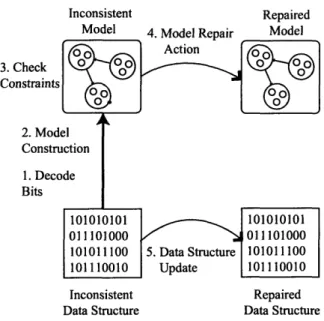
Figure 2-1 presents a graphical overview of the repair process. The boxes at the bottom of the figure represent the bits in the heap, and the rounded boxes at the top of the figure represent the relational model. The repair process performs the following steps:
1. Structure Decoding: This step in the repair process decodes the bit patterns
in memory into objects. The developer specifies the layout of the objects using our structure definition language.
Inconsistent Repaired
Model 4. Model Repair Model
0 Action 0 3. Check 0 00 0 0 Constraints 2. Model Construction 1. Decode Bits 101010101 101010101 011101000 1011101000 101011100 5. Data Structure 101011100 101110010 Update .101110010 Inconsistent Repaired Data Structure Data Structure
Figure 2-1: Repair Process
objects, places the objects into the appropriate sets, and constructs the relations in the model. It constructs the sets and relations by starting from a set of roots and tracing out the pointers in the heap. A set of model definition rules tells the repair algorithm how to classify the objects and construct the relations.
3. Checking Properties: This step checks for inconsistencies in the abstract
model. The developer expresses the data structure consistency properties as a set of consistency constraints. Each constraint is a boolean combination of basic propositions involving the sets and relations in the model. This step evaluates each of these consistency constraints on the relational model.
4. Perform Model Repair: This step repairs any inconsistencies that the repair algorithm discovered in the previous step. To generate a repair for a violated constraint, the repair algorithm rewrites the constraint in disjunctive normal form (DNF), chooses one of the conjunctions in the DNF form of the constraint, and then applies model repairs as appropriate to make each of the individual basic propositions in the selected conjunction true. The repair algorithm im-plements these model repairs using a sequence of operations that either add or
remove objects (or tuples) to or from sets (or relations).
5. Translating the Model Repairs: This step translates the model repairs into
data structure updates. As mentioned above, the repair algorithm uses a se-quence of operations that either add or remove an object (or tuple) to or from a set (or relation) to implement each repair. To implement such a repair, the repair algorithm finds the model definition rules that construct a given set or relation, then manipulates the data structures to cause these model definition rules to either add or remove the object (or tuple) to or from the set (or rela-tion). While we could generate data structure updates dynamically, our system statically pre-computes all possible model repairs and then for each possible model repair generates code that, when invoked, performs the corresponding data structure update. The repair algorithm then implements the data struc-ture update by invoking the correct piece of pre-generated code.
6. Repeat the Process: The process discussed above repairs a single violation.
To repair all of the constraint violations, the repair algorithm repeats the process until all of the constraints hold.
We next discuss each of the components of the repair algorithm in more detail.
2.1
Set and Relation Declarations
The developer writes set and relation declarations to declare the sets and relations that comprise the abstract relational model. A set declaration declares the name of the set and the type of objects or primitive values that this set contains. The set declaration can also declare that a set is a subset of another set, or that a set is partitioned into other sets. A relation declaration declares the name of the relation and relation's domain and range. The domain and range can be declared as either a set, a type of object, or a type of primitive value.
Figure 2-2 presents set and relation declarations for an example. The first line of this figure declares the set AllInts to contain objects of the type IntObj. Note that
set AllInts of IntObj set NonNegInts of IntObj set IntValues of integers
Figure 2-2: Example Set and Relation Declarations
Figure 2-3 in Section 2.2.1 presents the definition for the IntObj type. The second line declares the set NonNegInts to contain objects of the type IntObj. The final line declares the set IntValues to contain primitive integer values. Many objects in the computation may have the same consistency properties. For example, all of the nodes in a linked list usually have the same consistency properties. We expect that developers will typically use sets to group together all objects that have the same consistency properties.
We expect that developers will use relations to model the values of fields and referencing relationships. For example, a developer might use a set to store the nodes in a linked list and a relation to model the fields that link the nodes together.
2.2
Translating Data Structures into Relations
The first step in the repair process translates the concrete data structures into the sets of objects and relations in the relational model. Sets contain either objects or primitive values depending on the declared type of the set. Conceptually, there are two different types of relations in the model: relations that model object fields that store primitive values, and relations that model the referencing relationships between objects. Relations that model array indexes are an interesting special case; while the underlying field stores a primitive value, the relation may relate the location of the index to the indexed element in the array.
Our approach to translating data structures into relations has two major com-ponents: decoding the bits in the heap into objects and tracing out the referencing relationships between these objects to construct the sets and relations in the relational model.
2.2.1
Decoding the Heap
Applications represent their data structures as a string of bits in memory. The first step of the repair process decodes this string of bits into objects with fields. The repair system could use C structure declarations for this step, but this approach has some limitations. Instead, we have developed a structure definition language based on C structure declarations with extensions added to address the limitations. The first limitation is that C structure definitions do not support dynamically sized arrays. We have developed an extension that allows the sizes of these arrays to be computed from integer values stored in the decoded fields of data structures. The second limitation is that C structure declarations do not support packed arrays of bits. We have developed an extension to support packed arrays of bits. Finally, C structure declarations do not support inheritance. We have developed extensions to support two types of inheritance: structural inheritance and extensional inheritance. Structural inheritance allows a developer to define types that leave a region in the data structure undefined, and then incrementally refine part of that region in that type in a second type definition that declares fields in these undefined parts. Extensional inheritance allows the developer to define a type that adds fields to a previous type definition.
structure Obj { }
structure IntObj subclass of Obj { int value;
}
IntObj *ptr;
Figure 2-3: Example Structure Definitions
Figure 2-3 presents the structure definitions for the example. The first structure definition declares the type Obj to contain no fields. The second structure definition declares that the type IntObj extensionally inherits from the type Obj and adds the primitive integer field value. The last line of this figure declares that the application
has a variable ptr that references a IntObj object.
2.2.2
TIranslating the Decoded Heap into a Relational Model
After decoding the bits in the heap, the repair algorithm finds and classifies objects and constructs relations from the information stored in the fields of objects. The basic strategy is to construct the sets and relations by starting from a set of roots to trace out the pointers in the heap. The repair algorithm classifies objects into sets based on both the path taken through the heap to reach the object and the contents of the objects.
Our repair algorithms use a set of developer-provided model definition rules to trace out the referencing relationships in data structures to find and classify objects.
Each model definition rule has the following components in order:
" Optional quantifiers over sets and/or relations
* A guard that tests a condition on the concrete data structure and/or the ab-stract model
" A right arrow that separates the guard from the inclusion condition
" An inclusion condition that specifies an object (or tuple) to add to a set (or relation) if the guard is true.
To trace out the pointers in a recursive data structure, a developer would typically use a pair of model definition rules: one rule handles the base case and the other handles the recursive case. The base case model definition rule adds the root of the data structure to a set. The recursive case model definition rule then quantifies over this set, checks if a developer-specified pointer in the quantified object is non-null, and if so adds the pointer's value to the set. We designed the model definition rules to be both easy to analyze for common usage patterns yet powerful enough to support sophisticated translations.
Figure 2-4 presents the model definition rules for the example. The first model definition rule checks to see if ptr is non-null, and if so, adds the object referenced
1. ptr != null => ptr in AllInts
2. (ptr != null) and (ptr.value >= 0) => ptr in NonNegInts
3. for n in AllInts, true => n.value in IntValues
Figure 2-4: Example Model Definition Rules
by ptr to the AllInts set. The second model definition rule checks to see if ptr is
non-null and if ptr .value is greater than or equal to zero, and if so, adds the object
referenced by ptr to the NonNegInts set. Notice that the first two model definition rules do not have quantifiers as they operate directly on a pointer in the root set. The final model definition rule quantifies over all objects in the AllInts set and adds the contents of the value field of these objects to the IntValues set. Since the third model definition rule does not need to test any conditions, we have used true as the guard.
Ensuring Termination of Model Construction Sometimes it is useful to
con-struct a set of objects that do not satisfy some property. For example, a developer may define an active set of objects that participate in a given data structure, and then use negation to specify a free set that contains objects that are not in the active set. Negation complicates model construction because it may introduce a non-monotonicity into the fixed point computation that constructs the relational model. Consider the model definition rules ! o in S => o in S' and true=>o in S. The issue with negation is that the first model definition rule may initially place the ob-ject referenced by o in S' because o is not in S. If a second model definition rule then adds o to S, this causes the guard of the first model definition rule to become false even though the this rule has already added o to S'. Note that if the model construction algorithm had evaluated the rules in the opposite order, the algorithm would only add o to S. Notice that there are two solutions. The model construction algorithm generated the second solution because it evaluated a negated inclusion con-straint on a partially constructed and therefore added o to S'. The problem is that it is possible that only one of these models satisfies the consistency constraints, and
therefore whether a data structure is consistent may depend on the order in which the model definition rules is evaluated. Our algorithm eliminates the other solutions
by ordering the evaluation of the model definition rules to ensure that the model
con-struction algorithm completely constructs all of a model definition rule's negated set and relation dependences before evaluating the model definition rule. In the example, this ordering would ensure that the second model definition rule was evaluated before the first model definition rule.
Consider the model definition rule ! o in S => o in S. This model definition rule has a negated dependence on the set it constructs, and therefore the model construction algorithm cannot completely construct S before evaluating the rule. To address this issue, we restrict negation to be used only when a model definition rule's negated predicate does not depend directly on the set or relation constructed by that model definition rule or indirectly on this set or relation through the actions of other model definition rules. In the current example, this restriction disallows the model definition rule ! o in S => o in S. In general, this restriction allows the model construction algorithm to completely construct all of a model definition rule's negated set and relation dependences before evaluating the model definition rule.
Our repair algorithm also supports the creation of sets or relations that contain primitive values. The primary issue with supporting primitive values is the possibility of constructing an infinite model. For example, a model definition rule could state that the successor of every integer in a set is also in the set. To address this issue, our repair algorithm places limitations on the synthesis of new primitive values in the inclusion condition of model definition rules that quantify over a set or relation that may grow larger as a result of the action of this model definition rule. These restrictions serve to ensure that the generated model is finite.
Ensuring Basic Representation Consistency The model construction process
ensures the basic representation consistency of the data structures as follows. It ensures that data structure references point to allocated memory. If it discovers a pointer to unallocated memory, it writes a zero value to that pointer. It also ensures
that objects do not illegally overlap with other objects. If the repair algorithm finds illegally overlapping objects, it writes a zero value over the reference to one of these objects. Finally, the developer can write model definition rule guards that ensure that the model construction step does not place illegal values in sets or relations.
2.3
Specifying Consistency Constraints
Once the repair algorithm constructs the abstract model, it needs to know what constraints the model should satisfy. The developer expresses consistency constraints in terms of the sets of objects and relations in the model.
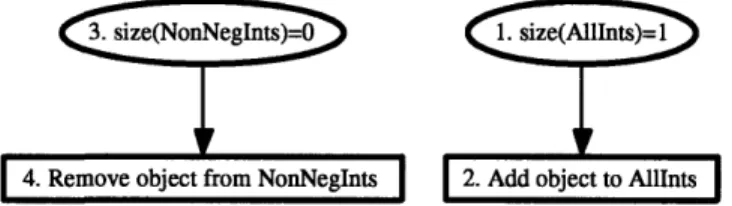
1. size(AllInts)=1
2. size(NonNegInts)=0
Figure 2-5: Example Consistency Constraint
Figure 2-5 presents the consistency constraint for the example. This example con-tains two consistency constraints. The first set size constraint 1. size(AllInts)=1 ensures that the AllInts set contains exactly one object. The effect of this con-straint is to ensure that the ptr variable always points to an IntObj object. The second set size constraint 2. size (NonNegInts) =0 ensures that the NonNegInts set is empty. The effect of this constraint is to ensure that the ptr variable only points to an IntObj object that stores a negative integer value.
2.3.1
Classes of Basic Propositions
Our repair system supports boolean combinations of the following classes of basic propositions:
* Numerical Inequalities: Developers often use relations to model the values of a data structure field or variable. Numerical inequality basic propositions allow the developer to express numerical inequalities over the primitive field values that these relations model. An example numerical inequality is x. R>1.
" Pointer Equalities: These basic propositions express pointer equalities.
De-velopers typically use these constraints to ensure local topological constraints, such as consistency between forward and backward pointers. An example pointer inequality is n.Next .Prev=n. The Next and Prev relations in this
ex-ample are used to model the next and prev fields in a double linked list.
" Set Size Constraints: These basic propositions express constraints on the
sizes of sets. In general, developers use these constraints to ensure that data structures exist. The previous example contains the constraint size (AllInts)=1, which ensures that the AllInts set contains exactly one IntObj object. This constraint ensures that the IntObj object pointed to by the ptr variable exists.
" Topology Constraints: These basic propositions express constraints on how
many objects a relation (or its inverse) maps a given object to or from. Devel-opers typically use these constraints to express local topological properties of the heap - specifically what the in-degree or out-degree of a given object is. For example, the topology constraint size (n. -Next) <=1 ensures that a node in a linked list is referenced at most once by the next field of another node in
the linked list.
* Inclusion Constraints: These basic propositions express constraints on whether an object (or tuple) is in a set (or relation). An example of an inclusion con-straint is n in Nodes. This concon-straint ensures that n is a member of the set Nodes. These propositions are useful for relating an object's membership in a set to some other condition (perhaps whether a flag is set in the object).
We chose this set of basic propositions because we could express many interesting data structure properties using them and it was easy to generate repair actions for the individual basic propositions.
2.3.2
Quantifiers
Our consistency constraint language supports guarded universal quantifiers over sets and relations. Quantifiers allow developers to write consistency constraints that apply to all objects in a set or to all tuples in a relation. We have restricted the form of the quantifiers to simplify the repair algorithm. In particular, we only allow guarded uni-versal quantifiers to appear to the left of the body of the constraint, and we disallow existential quantifiers. These restrictions simplify the evaluation and the repair of the constraint, as the repair algorithm does not need to perform a search to find the ap-propriate quantifier binding. One drawback of this restriction is that disallowing exis-tential quantifiers complicates the expression of properties about incoming reference to an object. For example, the formula for n in Nodes, n in Root or exists parent in Tree, parent. left=n or parent. right=n specifies that all nodes (ex-cept the root node) in the tree have a parent. We address this issue by supporting the inverse operation on relations. The developer can use relation inverses to express constraints about the existence of an incoming reference to an object. For example, we can rewrite the previous constraint using relation inverses as f or n in Nodes, n in Root or size(n. Left)>=1 or size(n. Right)>=1.
The existential quantifier can also specify that at least one element in a set satisfies a given property. For example, the constraint exists tail in List,
size (tail. Next)=0 ensures that a list has a tail node that doesn't reference any other nodes. While this type of property cannot be specified in our model construction language, the developer can write a model definition rule to place the tail of a linked list in its own set, and the developer can specify that this set contains one element.
2.4
Repairing the Model
Consider the first constraint size (AllInts) =1 from the example. If the variable ptr was null, the model construction step would construct an empty AllInts set, and the consistency checking step would detect a violation of the constraint size (AllInts) =1. The repair algorithm would generate a model repair that creates a IntObj object and
adds this object to the AllInts set.
The goal is to generate a sequence of operations that add or remove objects (or tuples) to or from sets (or relations). Our repair algorithm constructs this sequence of repair actions as follows. It repairs a constraint by choosing a conjunction in the disjunctive normal form (DNF) of a constraint and performs individual repair actions to the basic propositions in the conjunction making that conjunction true.1 Note that making any conjunction in the DNF form of a constraint true makes the entire constraint true. Our repair algorithm locally selects a conjunction to make true, using a cost function to guide the selection of the conjunction. This function assigns costs for making each of the basic propositions true. While this cost mechanism was originally designed to guide the operation of the repair algorithm to select repairs that minimally change the data structure, we have extended it to allow developers to specify preferences for certain repair actions. When repairing a constraint, the repair evaluates the total cost of the repair actions that each conjunction choice will require and then chooses the conjunction with the smallest cost to repair. This greedy algorithm enables us to avoid search during repairs, but comes at the cost of potentially performing lower quality repairs. This could be alleviated by combining our current technique with a bounded search to select repair actions.
One limitation of this repair strategy is that it only considers a single basic propo-sition when generating a repair action. We chose this design to simplify the repair algorithm. However, this simplicity comes at a cost: our repair algorithm is unable to generate repair actions that satisfy multiple constraints at once. One example of such a specification is a system of linear equations. A successful repair strategy for linear equations needs to coordinate updates to multiple equations when generating repair actions. Our system would only generate repair actions for individual equations; such actions would violate other equations in such a specification. As a consequence, our specification compiler would fail to generate a repair algorithm for such a specification,
'The disjunctive normal form of a constraint is a normal form where the constraint is expressed as a disjunction (or operation) of conjunctions (and operation) of the basic properties in the constraint language.