HAL Id: hal-01253136
https://hal.inria.fr/hal-01253136
Preprint submitted on 8 Jan 2016
HAL is a multi-disciplinary open access
archive for the deposit and dissemination of
sci-entific research documents, whether they are
pub-lished or not. The documents may come from
teaching and research institutions in France or
abroad, or from public or private research centers.
L’archive ouverte pluridisciplinaire HAL, est
destinée au dépôt et à la diffusion de documents
scientifiques de niveau recherche, publiés ou non,
émanant des établissements d’enseignement et de
recherche français ou étrangers, des laboratoires
publics ou privés.
Readable semi-automatic formal proofs of Depth-First
Search in graphs using Why3
Ran Chen, Jean-Jacques Levy
To cite this version:
Ran Chen, Jean-Jacques Levy. Readable semi-automatic formal proofs of Depth-First Search in graphs
using Why3. 2015. �hal-01253136�
Readable semi-automatic formal proofs of
Depth-First Search in graphs using Why3
Ran Chen and Jean-Jacques L´evy
State Key Laboratory for Computer Science, Institute of Software, Chinese Academy of Sciences
& Inria
Abstract. Quite often formal proofs are not published in conferences or journal articles, because formal proofs are usually too long. A typical article states the ability of having implemented a formal proof, but the proof itself is often sketched in terms of a natural language. At best, some formal lemmas and definitions are stated. Can we do better ? We try here to publish the details of a formal proof of the white-paths the-orem about depth-first search in graphs. We use Why3 as the proving platform, because Why3 uses first-order logic augmented with inductive definitions of predicates and because Why3 makes possible to delegate bits of proofs to on-the-shelf automatic provers at same time as Why3 provides interfaces with interactive proof checkers such that Coq, PVS or Isabelle. Algorithms on graphs are also a good testbed since graphs are combinatorial structures whose algebraic properties are not fully ob-vious. Depth-first search may look over-simple, but it is the first step of the construction of a library of readable formal proofs for more complex algorithms on graphs with more realistic data structures.
1
Introduction
Formal proofs of program correctness are a big challenge. They often comprise a large number of cases, which makes them intractable on paper. Fortunately proof-assistants and automatic provers can help. But the resulting proofs are usually long listings of elementary steps which are almost impossible to read by a normal human being. Even in the realm of mathematics where algebraic prop-erties have been studied for a long time, formal libraries are hard to follow. Take for instance the impressive Mathematical Components library, the Standard Coq library or the Compcert certified compiler. It would be good to have readable quasi-formal proofs for algorithms or easy mathematics. Our paper aims to work in that direction.
We consider first-order logic with inductive definitions for predicates as such implemented in the Why3 platform [10]. First-order logic lacks of abstraction. For instance, we miss a calculus of relations which could be useful for graphs, but first-order logic is easy to understand and allows mechanical proofs. Higher-order logic allows conciseness, and with the help of the Coq proof-assistant, one can use elegant notations for operators. But we refer the reader to the proofs about finite graphs in the MathComp library [11], where one needs to
type vertex
constant vertices : set vertex
function successors vertex : set vertex
axiom successors vertices : ∀x. mem x vertices → subset (successors x) vertices
predicate edge (x y : vertex) = mem x vertices ∧ mem y (successors x) Fig. 1. Definitions and axioms for finite graphs
understand higher-order logic, the difference between propositions and truth-values, and small reflection. (And we did not mention the proofs with backward chaining)
In a previous work, we considered basic programs with lists and arrays [16], such as mergesort as implemented in Sedgewick’s book about algorithms [21]. There is also the fantastic gallery of programs on the Why3 webpage [9], which enumerates many formal proofs of algorithms on arrays and algebraic structures. But here we consider graphs with its most basic program, i.e. depth-first search (dfs). We will treat three versions of dfs expressed in the ML Why language, which here would not be much different from a functional language, although ML Why also allows mutable data structures and imperative programming. The interested reader is also referred to our webpage (jeanjacqueslevy.net/why3) for more iterative versions of dfs, one of which corresponds exactly to the version in Sedgewick’s book.
2
Representation of graphs
A graph is represented by a finite set of vertices and a successors function which gives for any vertex the finite set of vertices directly reachable from it (figure 1). The edge predicate states that there is an edge from its first argument to the second argument. The mem predicate expresses membership to a set. The finite set theory is presented in the Why3 standard library (located at URL why3.lri. fr/stdlib-0.86).
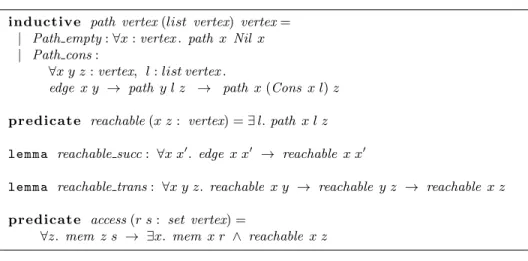
In this paper, we want to prove the white-paths theorem which often appears in books about algorithms. Therefore we need a theory of paths in graphs. We take paths as already defined in the graph theory of the Why3 standard library (see figure 2). Thus path x l z states that there is a path l from vertex x to vertex z in the graph. The path l is the list of intermediate vertices comprising the first vertex x but not the last one z, except when x and z are the same vertex. (We therefore use the polymorphic list library of Why3) We further define two predicates reachable and access useful for our first proof of dfs. The first predicate says there is a path between two vertices without precising the path, the second one says that its second argument is reachable from the first set of vertices.
inductive path vertex (list vertex) vertex = | Path empty : ∀x : vertex . path x Nil x | Path cons :
∀x y z : vertex, l : list vertex .
edge x y → path y l z → path x (Cons x l) z
predicate reachable (x z : vertex) = ∃ l. path x l z
lemma reachable succ : ∀x x0. edge x x0 → reachable x x0
lemma reachable trans : ∀x y z. reachable x y → reachable y z → reachable x z predicate access (r s : set vertex) =
∀z. mem z s → ∃x. mem x r ∧ reachable x z
Fig. 2. Definitions and lemmas for Dfs with non-black-to-white assumption
3
Dfs with non-black-to-white assumption
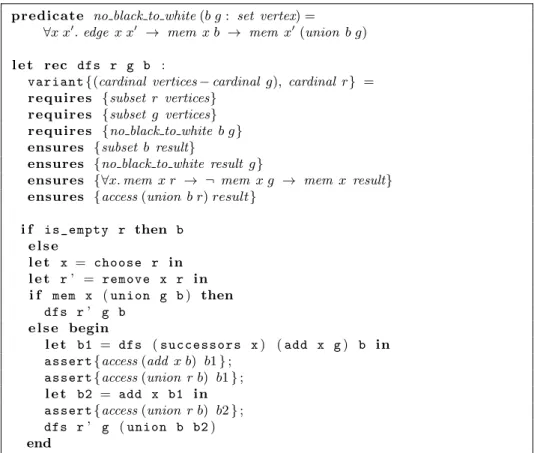
Depth-first search is a naive recursive search on graphs which marks vertices to prevent from looping. It starts from a set r of roots and provides as result the set of vertices accessible from r. We use three types of marking: white, gray, black. White vertices are not yet visited, gray vertices started to be explored, black vertices are fully visited. As usual, dfs chooses randomly a vertex x in roots, turns that node to gray and explores the successors of x. Then dfs turns x to black and continues with remaining roots (see figure 3). In our program, the parameters of dfs are r, g, b standing for the sets of roots, gray vertices and black vertices. The functions is empty, choose, mem, union, add, remove are standard functions of the set library in Why3. Notice that our program is not fully effective since working on sets rather than lists, but this presentation facilitates the correctness proof. (On our webpage there are proofs for more efficiently implementable versions of dfs) Here dfs contains two recursive calls, but the second call is tail recursive and we could have used a more iterative version.
In this version of dfs, we show the no black to white invariant which says that an edge from a black vertex can only end into a non-white vertex, i.e. a black or gray node. We also prove as post-conditions of dfs that all vertices in the result are accessible from the initial sets of black and gray vertices, and further that non-gray roots belong to the result. The intermediate assertions are self-explainable (b1 is the resulting set of visited nodes after the recursive call on successors of x; and b2 is same set with x turned to black). These assertions and post-conditions are proved automatically by Alt-Ergo [3], Eprover [20], Spass [23] and Z3 [7]. The variant property states the termination of dfs (here with a lexicographic ordering on the pair made of the number of non-gray nodes and the number of roots)
predicate no black to white (b g : set vertex) =
∀x x0. edge x x0 → mem x b → mem x0(union b g)
l e t rec dfs r g b :
variant {(cardinal vertices − cardinal g), cardinal r} = req uires {subset r vertices}
req uires {subset g vertices} req uires {no black to white b g} ensures {subset b result}
ensures {no black to white result g}
ensures {∀x. mem x r → ¬ mem x g → mem x result} ensures {access (union b r) result}
i f is_empty r then b e l s e
l e t x = choose r in l e t r ’ = remove x r in i f mem x ( union g b ) then
dfs r ’ g b e l s e begin
l e t b1 = dfs ( successors x ) ( add x g ) b in assert {access (add x b) b1 } ;
assert {access (union r b) b1 } ; l e t b2 = add x b1 in assert {access (union r b) b2 } ; dfs r ’ g ( union b b2 ) end
Fig. 3. Dfs with non-black-to-white assumption (part I)
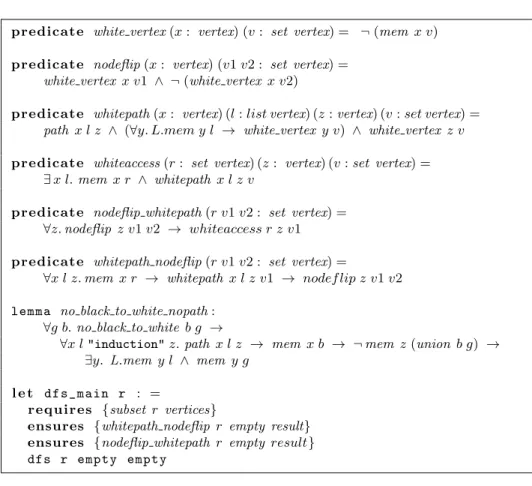
Now we want to prove that dfs results in the set of all nodes accessible from the roots when we start with empty sets of gray and black nodes. That is all vertices are white at the beginning of dfs (see figure 4). The post-conditions of dfs main function are expressed in terms of white paths and node flipping, since we want to match this proof with following ones on other versions of dfs. The first post-condition means that accessible vertices from roots are in the result, the second post-condition is the other direction (all vertices in the result are accessible from roots). A white path is white with respect to a set v of visited vertices; the definition of whitepath uses the L.mem membership predicate on lists, which is distinct from the mem predicate on sets.
The two post-conditions of dfs main are proved by Alt-Ergo, CVC3 [1] and Eprover, once lemma no black to white nopath is proved. This lemma states that there is no path from a black vertex to a white vertex, when the no black to white condition holds. We then are forced to go through a gray node. This lemma needs an induction on the length of the path, which is difficult to get with SMT-solvers or even theorem provers. The keyword ‘‘induction’’ may be used to hint an induction on the preceding variable, but in our case it did not work and Coq has
predicate white vertex (x : vertex) (v : set vertex) = ¬ (mem x v) predicate nodeflip (x : vertex) (v1 v2 : set vertex) =
white vertex x v1 ∧ ¬ (white vertex x v2)
predicate whitepath (x : vertex) (l : list vertex) (z : vertex) (v : set vertex) = path x l z ∧ (∀y. L.mem y l → white vertex y v) ∧ white vertex z v predicate whiteaccess (r : set vertex) (z : vertex) (v : set vertex) =
∃ x l. mem x r ∧ whitepath x l z v
predicate nodeflip whitepath (r v1 v2 : set vertex) = ∀z. nodeflip z v1 v2 → whiteaccess r z v1 predicate whitepath nodeflip (r v1 v2 : set vertex) =
∀x l z. mem x r → whitepath x l z v1 → nodef lip z v1 v2 lemma no black to white nopath :
∀g b. no black to white b g →
∀x l "induction" z. path x l z → mem x b → ¬ mem z (union b g) → ∃y. L.mem y l ∧ mem y g
l e t dfs_main r : =
req uires {subset r vertices}
ensures {whitepath nodeflip r empty result} ensures {nodeflip whitepath r empty result} dfs r empty empty
Fig. 4. Dfs with non-black-to-white assumption (part II)
to be used (see our webpage). We use Coq with the Ssreflect package, although not yet fully compatible with the Why3 Coq driver. The Coq proof is then quite easy, since the argument is obvious; but it is Coq stylish.
4
Random search stepwise
The previous proof does not match the standard proofs for dfs which states a finer property known as the white-paths theorem [6]. Whatever is the initial marking of vertices, this theorem states that a vertex has its color flipped if and only if it is accessible from the roots by a white path. We first consider that property with one step of random search in a graph, as suggested to us by a note of Dowek quoting a proof by Mu˜noz [18, 8]. In the rest of this paper, we only use two colors as marks of vertices: white and black.
The random step search picks any white node x in the set of roots and replace it by its successors after marking x to black. We thus continue with the union of these successors of x and the set of roots minus x. If the picked vertex x is non-white, we remove it from the set of roots. When no more roots, we give the
l e t rec search1 r v
variant {(cardinal vertices − cardinal v), cardinal r} = req uires {subset r vertices}
req uires {subset v vertices} ensures {subset v result}
ensures {nodeflip whitepath r v result} i f is_empty r then v e l s e l e t x = choose r in l e t r ’ = remove x r in i f mem x v then search1 r ’ v e l s e
l e t b = search1 ( union r ’ ( successors x ) ) ( add x v ) in ( ∗ −−−−−−−−−−− nodeflip whitepath −−−−−−−−−− ∗ )
assert {∀z. nodeflip z v b → z = x ∨ nodeflip z (add x v) b } ;
( ∗ c a s e 1.1 : nodeflip z v b ∧ z = x ∗ ) assert {whitepath x Nil x v } ;
( ∗ c a s e 1.2 : nodeflip z v b ∧ z 6= x ∗ )
assert {∀z. nodeflip z (add x v) b → whiteaccess r0z (add x v)
∨ whiteaccess (successors x) z (add x v) } ;
assert {∀x0l z. whitepath x0l z (add x v) → whitepath x0l z v } ;
assert {∀z x0l. edge x x0 → whitepath x0
l z v → whitepath x (Cons x l) z v } ; assert {∀z. nodeflip z (add x v) b → whiteaccess r z v } ;
b
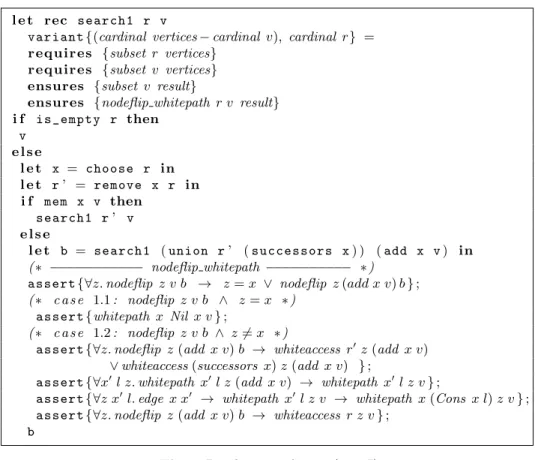
Fig. 5. Random search step (part I)
marked nodes as the result. This search step is compatible with various searching strategies (depth-first, breadth-first). It is also interesting to notice that this proof is generic of the further dfs proof that we will later consider. There is here an interesting analogy with the Lamport’s way of proving quicksort with an iterative algorithm working on quicksort step (see Meyer’s Lampsort [17]). We consider two independent proofs.
We first prove the nodeflip whitepath post-condition (see figure 5) with Alt-Ergo and CVC3. This simple proof considers the case the flipped node z is the picked white vertex x or distinct from it. If z is x, then the empty Nil path is white at the beginning of the search step. If z is not x, then it is flipped by the recursive call with again two cases: the node is accessible from the successors of x or the rest of roots r0. In both case, we conclude to the existence of an initial white path by monotony on the last argument of whitepath.
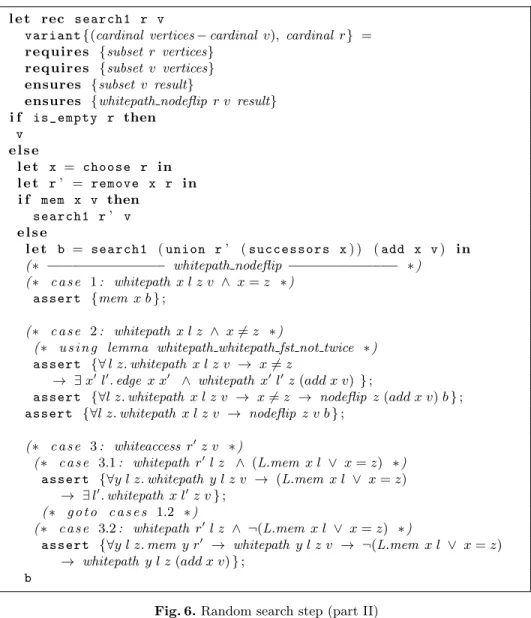
The whitepath nodeflip post-condition needs more work (see figure 6). Assume we have a white path from the picked white vertex x to another vertex z. The case z = x is easily solved by the first post-condition proving that x belongs to the result b. When z and x are distinct, we rely on the important lemma whitepath whitepath fst not twice (see figure 9). We know then that there is a
l e t rec search1 r v
variant {(cardinal vertices − cardinal v), cardinal r} = req uires {subset r vertices}
req uires {subset v vertices} ensures {subset v result}
ensures {whitepath nodeflip r v result} i f is_empty r then v e l s e l e t x = choose r in l e t r ’ = remove x r in i f mem x v then search1 r ’ v e l s e
l e t b = search1 ( union r ’ ( successors x ) ) ( add x v ) in ( ∗ −−−−−−−−−−−−−− whitepath nodeflip −−−−−−−−−−−−− ∗ ) ( ∗ c a s e 1 : whitepath x l z v ∧ x = z ∗ )
assert {mem x b } ;
( ∗ c a s e 2 : whitepath x l z ∧ x 6= z ∗ )
( ∗ u s i n g lemma whitepath whitepath fst not twice ∗ ) assert {∀ l z. whitepath x l z v → x 6= z
→ ∃ x0
l0. edge x x0 ∧ whitepath x0
l0z (add x v) } ;
assert {∀l z. whitepath x l z v → x 6= z → nodeflip z (add x v) b } ; assert {∀l z. whitepath x l z v → nodeflip z v b } ;
( ∗ c a s e 3 : whiteaccess r0z v ∗ )
( ∗ c a s e 3.1 : whitepath r0l z ∧ (L.mem x l ∨ x = z) ∗ )
assert {∀y l z. whitepath y l z v → (L.mem x l ∨ x = z)
→ ∃ l0
. whitepath x l0z v } ;
( ∗ g o t o c a s e s 1.2 ∗ )
( ∗ c a s e 3.2 : whitepath r0l z ∧ ¬(L.mem x l ∨ x = z) ∗ )
assert {∀y l z. mem y r0 → whitepath y l z v → ¬(L.mem x l ∨ x = z)
→ whitepath y l z (add x v) } ; b
Fig. 6. Random search step (part II)
white path from x to z not containing x. Therefore by the recursive call we knows that z has been flipped. Now if the white path was starting not from x but from another vertex in the set of remaining roots r0. If that path contains x, it is no longer white when starting the recursive call. But that means that there was a white path from x to z and we go back to the case of white paths issued from x. If that path from r0 does not contains x, it is still white at the recursive call and inductively the node z at end of the path is flipped. That proof is automatic with Alt-Ergo, CVC3 and Eprover. The lemmas can also be
l e t rec dfs r v
variant {(cardinal vertices − cardinal v), cardinal r} = req uires {subset r vertices}
req uires {subset v vertices} ensures {subset v result} ensures {subset result vertices} ensures {nodeflip whitepath r v result} ensures {whitepath nodeflip r v result} i f is_empty r then v e l s e l e t x = choose r in l e t r ’ = remove x r in i f mem x v then dfs r ’ v e l s e l e t b = dfs ( successors x ) ( add x v ) in l e t b ’ = dfs r ’ b in ( ∗ −−−−−−−− nodeflip whitepath −−−−−−−−−−−−−−−−−−−−−−−−−−− ∗ )
assert {∀z. nodeflip z v b0 → nodeflip z v b ∨ nodeflip z b b0} ;
( ∗ −−−−−−− c a s e 1 −−−−−−−−− ∗ )
assert {∀z. nodeflip z v b → z = x ∨ nodeflip z (add x v) b } ;
( ∗ c a s e 1.1 : nodeflip z v b ∧ z = x ∗ ) assert {whitepath x Nil x v } ;
( ∗ c a s e 1.2 : nodeflip z v b ∧ z 6= x ∗ )
assert {∀z. nodeflip z (add x v) b → whiteaccess (successors x) z (add x v)
assert {∀x0l z. whitepath x0l z (add x v) → whitepath x0l z v } ;
assert {∀z x0l. edge x x0 → whitepath x0
l z v → whitepath x (Cons x l) z v } ; assert {∀z. nodeflip z (add x v) b → whiteaccess r z v } ;
( ∗ −−−−−−− c a s e 2 −−−−−−−−− ∗ )
assert {∀z. nodeflip z b b0 → whiteaccess r0z b } ;
assert {∀z x0l. whitepath x0l z b → whitepath x0l z v } ;
. . .
Fig. 7. Depth-First search (part I)
proved automatically, but we will discuss about the proof of these lemmas in later section.
Notice that we can prove exactly in the same way the iterative dfs algorithm with a stack, or breadth-first search with a queue (see our webpage) One just needs to add two assertions about the state of the stack or queue. It is frustrating that the recursive version of dfs is a bit longer to be proved!
5
Depth-first search
The program is now making the standard recursive call on the successors of the picked white vertex x and another tail-recursive call on the remaining set r0 of
. . .
( ∗ −−−−−−−− whitepath nodeflip −−−−−−−−−−−−−−−−−−−−−−−−−−−−−−− ∗ ) ( ∗ c a s e 1 : x = z ∗ )
assert {mem x b } ;
( ∗ c a s e 2 : ∃ l. whitepath x l z v ∧ x 6= z ∗ )
( ∗ u s i n g lemma whitepath whitepath fst not twice ∗ ) assert {∀ l z. whitepath x l z v → x 6= z →
whiteaccess (successors x) z (add x v) } ;
assert {∀ l z. whitepath x l z v → x 6= z → nodeflip z (add x v) b } ; assert {∀ l z. whitepath x l z v → nodeflip z v b } ;
( ∗ c a s e 3 : whiteaccess r0z v ∗ )
( ∗ c a s e 3 . 1 : ¬ whiteaccess r0z b ∗ )
assert {∀x0l z. whitepath x0l z v → ¬ whitepath x0l z b →
∃ y.(L. mem y l ∨ y = z) ∧ nodeflip y v b } ;
assert {∀x0l z. whitepath x0l z v → ¬ whitepath x0l z b →
∃ y.(L. mem y l ∨ y = z) ∧ (y = x ∨ whiteaccess (successors x) y (add x v)) } ; assert {∀y. whiteaccess (successors x) y (add x v) →
∃ l0. whitepath x l0y v } ;
assert {∀x0l z. whitepath x0l z v → ¬ whitepath x0l z b →
∃ y l0.(L. mem y l ∨ y = z) ∧ whitepath x l0y v } ;
assert {∀x0l z. whitepath x0l z v → ¬ whitepath x0l z b →
∃ l0. whitepath x l0z v } ; ( ∗ g o t o c a s e s 1 − 2 ∗ )
assert {∀x0l z. whitepath x0l z v → ¬ whitepath x0l z b → nodeflip z v b0} ;
( ∗ c a s e 3 . 2 : whiteaccess r0z b ∗ )
assert {∀x0l z. mem x0r0 → whitepath x0
l z b → nodeflip z v b0} ;
b ’
Fig. 8. Depth-First search (part II)
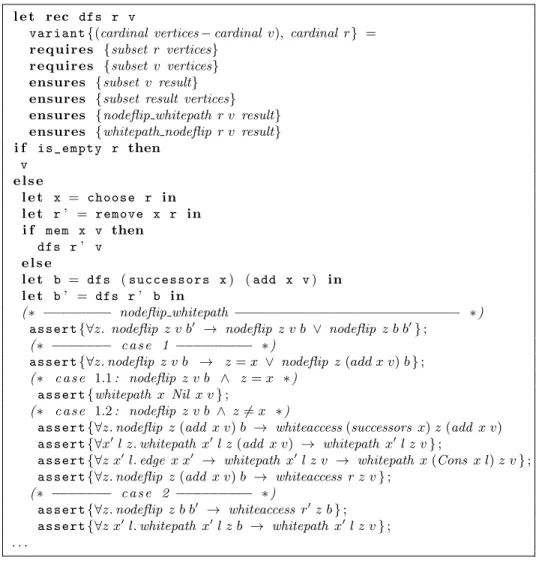
roots with the already visited vertices augmented by the set of nodes visited by the call on the successors of x. As the already visited nodes are part of the result, one has just to consider the result b of this recursive call. We again split the proof in two proofs with respect to the direction of post-conditions.
The proof of nodeflip whitepath is quite similar to the one of the random search step (see figure 7). There is an extra case when the node is flipped during the tail-recursive call, which is just proved inductively by the post-condition of that call.
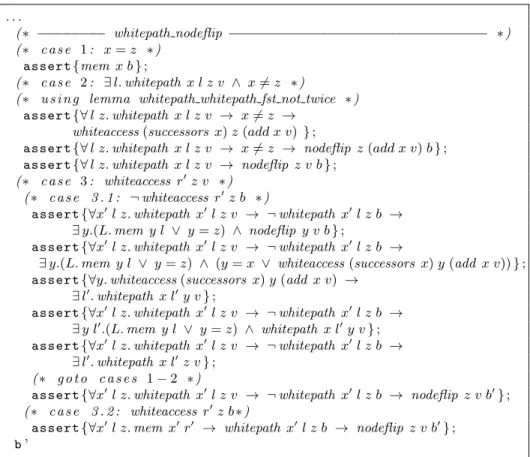
The proof of whitepath nodeflip is more subtle. The difference comes from the larger set of nodes which are flipped by the recursive call. In random search step, we knew that only the picked node x was flipped before the tail-recursive call. Here the whole set produced by the dfs call on successors of x is flipped. So we start as in the random search step by considering a white path from x to any vertex z. If the path starts from x, the proof is similar to the one of random search step. But if the path starts from a vertex in r0, the proof is a bit more complex. If the path keeps white after the recursive call on successors of x (case 3.2 in the proof in figure 8), then the post-condition of the tail-recursive call
states that z is flipped. If the path is no longer white after the recursive call on successors of x (case 3.1 in the proof), then there is a node y which flipped on that path after the first recursive call. That node y is either x or is flipped with respect to add x v. Then by using the nodeflip whitepath, we know that y is connected by a white path from x or one of its successors. In both cases, there is a white path starting from x and leading to y. Therefore there is a path from x to z by using lemma whitepath Y. We thus notice that these two proofs of the post-conditions of dfs are not independent.
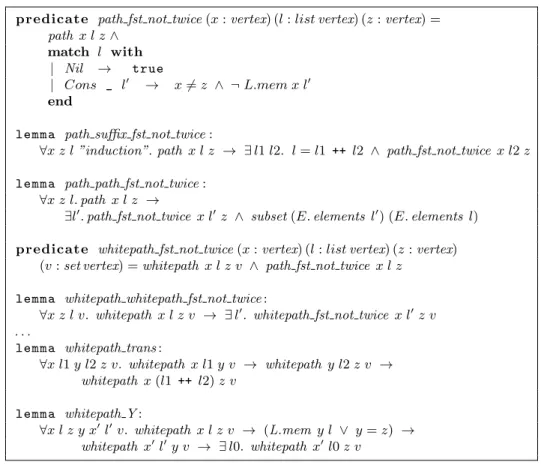
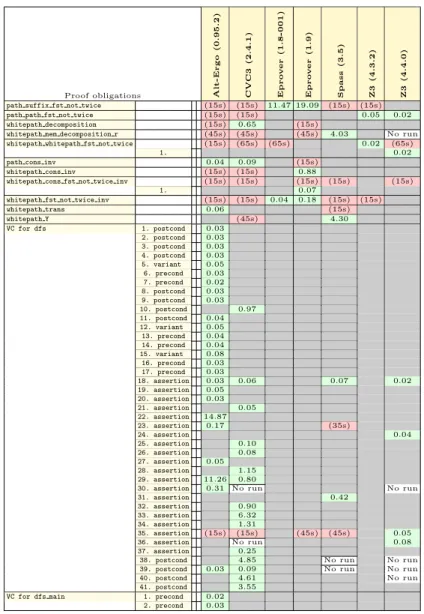
We now discuss definitions and lemmas needed by these dfs proofs. We first use the whitepath fst not twice predicate. Notice we need not use simple paths, i.e. paths with no vertex repetitions. Eliminating repetition of the ini-tial node is sufficient. (Mu˜noz’s note is using simple paths) We can also prove automatically the lemma following lemma path suffix fst not twice with the use-ful ‘‘induction’’ keyword, hinting induction to be done on previous variable, which Eprover can follow. All lemmas are proved automatically (see the stats in figure 10). Lemma whitepath Y looks strange, but is quite useful when a white path has an intermediate node which is flipped.
predicate path fst not twice (x : vertex) (l : list vertex) (z : vertex) = path x l z ∧
match l with
| Nil → true
| Cons _ l0 → x 6= z ∧ ¬ L.mem x l0
end
lemma path suffix fst not twice :
∀x z l ”induction”. path x l z → ∃ l1 l2. l = l1 ++ l2 ∧ path fst not twice x l2 z lemma path path fst not twice :
∀x z l. path x l z → ∃l0
. path fst not twice x l0z ∧ subset (E. elements l0) (E. elements l)
predicate whitepath fst not twice (x : vertex) (l : list vertex) (z : vertex) (v : set vertex) = whitepath x l z v ∧ path fst not twice x l z
lemma whitepath whitepath fst not twice :
∀x z l v. whitepath x l z v → ∃ l0. whitepath fst not twice x l0z v
. . .
lemma whitepath trans :
∀x l1 y l2 z v. whitepath x l1 y v → whitepath y l2 z v → whitepath x (l1 ++ l2) z v
lemma whitepath Y :
∀x l z y x0l0v. whitepath x l z v → (L.mem y l ∨ y = z) →
whitepath x0l0y v → ∃ l0. whitepath x0l0 z v
6
Conclusion
We hope to have met our goal of producing readable formal proofs (checked by computer) for depth-first search in graphs. There are surely other formal proofs such as the ones by Neuman (180 lines of Isabelle) [14] or Pottier (in Coq) [19]. Depth-first search can also be implemented with more concrete data structures. We proved a version with arrays and lists as in algorithms textbooks. We can also easily design one with lists for sets as the sequences in the Mathcomp library. One longer term objective is to get readable proofs for other algorithms on graphs. We do have proofs of test for acyclicity, strongly connected components with various techniques and minimum spanning tree. Readable versions of these programs proofs have to be soon inserted on our webpage.
The engineering of readable long proofs is less clear. Why3 is a fabulous system for interfacing many provers and interactive proof systems. But making these proofs is often unstable. An interactive proof assistant where all elemen-tary steps are explicit (as long as implicit names are not permitted such as in MathComp) is more robust to modifications. Again a better system of nota-tions (as in the Coq system) would help for the readability of proofs. Finally we did not use ghost variables in the proofs presented in this article, but these are quite useful in many proofs of algorithms. Ghost propositions would also help to maintain a set of valid hypotheses in the proof environments.
7
Acknowledgements
We thank Jean-Christophe Filliˆatre and the Why3 team for their precious ad-vices. We are grateful to Gilles Dowek for pointing us his note with Cesar Mu˜noz. J.-J. L´evy deeply thanks Huimin Lin and ISCAS for hosting this research.
References
1. C. Barrett and C. Tinelli. CVC4, the smt solver. New-York University - University of Iowa, 2011. http://cvc4.cs.nyu.edu.
2. Y. Bertot and P. Cast´eran. Interactive Theorem Proving and Program
Develop-ment. Coq’Art: The Calculus of Inductive Constructions. Springer, 2004.
3. F. Bobot, S. Conchon, E. Contejean, M. Iguernelala, S. Lescuyer, and A. Mebsout. The alt-ergo automated theorem prover, 2008. http://alt-ergo.lri.fr/.
4. F. Bobot, J.-C. Filliˆatre, C. March´e, and A. Paskevich. Why3: Shepherd your
herd of provers. In Boogie 2011: First International Workshop on Intermediate Verification Languages, pages 53–64, Wroc law, Poland, August 2011.
5. Coq Development Team. The coq 8.5 standard library. Technical report, Inria, 2015. http://coq.inria.fr/distrib/current/stdlib.
6. T. H. Cormen, C. Stein, R. L. Rivest, and C. E. Leiserson. Introduction to Algo-rithms. McGraw-Hill Higher Education, 2nd edition, 2001.
7. L. de Moura and N. Bj¨orner. Z3, an efficient smt solver. Microsoft Research, 2008.
8. G. Dowek et al. Informatique et sciences du num´erique- Sp´ecialit´e ISN en terminale S. Eyrolles, 2012.
9. J.-C. Filliˆatre et al. The why3 gallery of verified programs. Technical report,
CNRS, Inria, U. Paris-Sud, 2015. http://toccata.lri.fr/gallery/why3.en.html.
10. J.-C. Filliˆatre and A. Paskevich. Why3 — where programs meet provers. In
M. Felleisen and P. Gardner, editors, Proceedings of the 22nd European Symposium on Programming, volume 7792 of Lecture Notes in Computer Science, pages 125– 128. Springer, Mar. 2013.
11. G. Gonthier et al. Finite graphs in mathematical components, 2012. Available
at http://ssr.msr-inria.inria.fr/∼jenkins/current/Ssreflect.fingraph.html, The full
li-brary is available at http://www.msr-inria.fr/projects/mathematical-components-2/.
12. G. Gonthier, A. Mahboubi, L. Rideau, E. Tassi, and L. Th´ery. A modular
for-malisation of finite group theory. In Theorem Proving in Higher-Order Logics
(TPHOLS’07), volume 4732 of Lecture Notes in Computer Science, pages 86–101, 2007.
13. G. Gonthier, A. Mahboubi, and E. Tassi. A Small Scale Reflection Extension for the Coq system. Rapport de recherche RR-6455, INRIA, 2008.
14. P. Lammich and R. Neumann. A framework for verifying depth-first search algo-rithms. In Proceedings of the 2015 Conference on Certified Programs and Proofs, CPP ’15, pages 137–146, New York, NY, USA, 2015. ACM.
15. X. Leroy. Formal verification of a realistic compiler. Communications of the ACM, 2009. http://compcert.inria.fr.
16. J.-J. L´evy. Essays for the Luca Cardelli Fest, chapter Simple proofs of simple
programs in Why3. Microsoft Research Cambridge, MSR-TR-2014-104, 2014. 17. B. Meyer. Lampsort. Technical report, ETHZ, 2014. http://bertrandmeyer.com/
2014/12/07/lampsort.
18. C. Mu˜noz, V. Carre˜no, and G. Dowek. Formal analysis of the operational concept
for the Small Aircraft Transportation System. In Rigorous Engineering of Fault-Tolerant Systems, volume 4157 of Lecture Notes in Computer Science, pages 306– 325, 2006.
19. F. Pottier. Depth-first search and strong connectivity in Coq. In Journ´ees
Fran-cophones des Langages Applicatifs (JFLA 2015), Jan. 2015.
20. S. Schulz. System Description: E 1.8. In K. McMillan, A. Middeldorp, and
A. Voronkov, editors, Proc. of the 19th LPAR, Stellenbosch, volume 8312 of LNCS. Springer, 2013.
21. R. Sedgewick and K. Wayne. Algorithms, 4th Edition. Addison-Wesley, 2011.
22. A. Tafat and C. March´e. Binary heaps formally verified in Why3. Research Report
7780, INRIA, Oct. 2011. http://hal.inria.fr/inria-00636083/en/.
23. C. Weidenbach, D. Dimova, A. Fietzke, R. Kumar, M. Suda, and P. Wischnewski.
Spass version 3.5. In 22nd International Conference on Automated Deduction,
Proof obligations Alt-Ergo (0.95.2) CV C3 (2.4 .1) Epro v er (1.8-001) Epro v er (1.9) Spass (3.5) Z3 (4.3.2) Z3 (4.4.0)
path suffix fst not twice (15s) (15s) 11.47 19.09 (15s) (15s)
path path fst not twice (15s) (15s) 0.05 0.02
whitepath decomposition (15s) 0.65 (15s)
whitepath mem decomposition r (45s) (45s) (45s) 4.03 No run
whitepath whitepath fst not twice (15s) (65s) (65s) 0.02 (65s)
1. 0.02
path cons inv 0.04 0.09 (15s)
whitepath cons inv (15s) (15s) 0.88
whitepath cons fst not twice inv (15s) (15s) (15s) (15s) (15s)
1. 0.07
whitepath fst not twice inv (15s) (15s) 0.04 0.18 (15s) (15s)
whitepath trans 0.06 (15s) whitepath Y (45s) 4.30 VC for dfs 1. postcond 0.03 2. postcond 0.03 3. postcond 0.03 4. postcond 0.03 5. variant 0.05 6. precond 0.03 7. precond 0.02 8. postcond 0.03 9. postcond 0.03 10. postcond 0.97 11. postcond 0.04 12. variant 0.05 13. precond 0.04 14. precond 0.04 15. variant 0.08 16. precond 0.03 17. precond 0.03 18. assertion 0.03 0.06 0.07 0.02 19. assertion 0.05 20. assertion 0.03 21. assertion 0.05 22. assertion 14.87 23. assertion 0.17 (35s) 24. assertion 0.04 25. assertion 0.10 26. assertion 0.08 27. assertion 0.05 28. assertion 1.15 29. assertion 11.26 0.80
30. assertion 0.31 No run No run
31. assertion 0.42 32. assertion 0.90 33. assertion 6.32 34. assertion 1.31 35. assertion (15s) (15s) (45s) (45s) 0.05 36. assertion No run 0.08 37. assertion 0.25
38. postcond 4.85 No run No run
39. postcond 0.03 0.09 No run No run
40. postcond 4.61 No run
41. postcond 3.55
VC for dfs main 1. precond 0.02
2. precond 0.03