HAL Id: halshs-01511473
https://halshs.archives-ouvertes.fr/halshs-01511473
Submitted on 21 Apr 2017HAL is a multi-disciplinary open access archive for the deposit and dissemination of sci-entific research documents, whether they are pub-lished or not. The documents may come from teaching and research institutions in France or abroad, or from public or private research centers.
L’archive ouverte pluridisciplinaire HAL, est destinée au dépôt et à la diffusion de documents scientifiques de niveau recherche, publiés ou non, émanant des établissements d’enseignement et de recherche français ou étrangers, des laboratoires publics ou privés.
To cite this version:
Luc Pecquet. Choosing a mason (Lyela country, Burkina Faso). 9th International Masonry Conference 2014, International Masonry Society (UK) & Universidade do Minho (Portugal), Jul 2014, Guimarães Portugal. pp.287. �halshs-01511473�
Choosing a mason (Lyela country, Burkina Faso)
PECQUET, LUC
1ABSTRACT:
Doubtlessly, in many societies the mason is an important figure. But he is also theconspicuous absentee from the literature on African
earth architecture
, and in particular from the literature on West Africa (the most diversified): everyone, it is said, can build his own house, that doesn't take any technical specialisation; the mason does not have any particular social role. Through a case study – the Lyela of Burkina Faso – this paper proposes to revisit this a priori. In the Lyela country, a mason cannot build his own house: he must call onto a foreign mason who will not dwell in the building he makes. To give an account of this singular fact, the following questions will be asked: how is the mason chosen? How does one ask him to come by and make his building? We should thus understand why he occupies an important place in the construction process.Keywords: Lyela (Burkina Faso), Banco, Builders, Construction process, Earth, Master-mason
1 INTRODUCTION
The context ? A society of settled farmers in Burkina Faso: the Lyela (Sanguié province). Their original earth architecture has been the object of some studies (by Boudier & Min-Ha, 1983, it is well documented).i The subject ? Interested in how the person who orders the construction (“client”) chooses a builder (the master-mason; contractor) to build his compound, show the importance that a mason can have, the mason being a great forgotten in Africanist research.
For months the “client” has been searching for a site where to build his compound (kele: a cluster of houses surrounding a courtyard; Figure 1), for which he will be responsile (kele cebal; from bal, man, and ci, to order, own, and be responsible or master of). All the steps of this difficult process, which he has undertaken single-handedly, have been passed: he has just received the approval of the “Master of the Earth” (ce cebal), the most important person in the village, who has come to the site of the future compound in order to perform the appropriate rites. From now on, the site belongs to him, “it has its master”, it is said. In agreement with the ancestors who before him occupied this function, the “Master of the Earth” has given the site to the kele cebal, just like he previously gave him by means of ritual the permission to excavate the earth in order to build the houses (one cannot excavate the earth with impunity). That same evening, the (future) compound chief will sleep in a vegetable shelter where he will stay throughout the construction work. He has to: invisible forces could arrive in his absence and, believing the site uninhabited, make it their abode.ii
1)
Ethnologist, Institut des mondes africains, CNRS-EPHE-IRD-EHESS-Univ. Paris I et de Provence, [email protected]. Associate professor, Ecole Nationale Supérieure d’Architecture de Saint-Etienne, [email protected]
There are three things to do for the construction work to begin: weed, excavate the land (in sufficient quantity to be able to begin the construction), ask a mason to come and build the coumpound. It is this last stage that is of interest here. Just as, at the end of a long hardship, he has acquired a site where to settle, on which he has rights, the compound-chief-to-be must relinquish some of his prerogatives. Indeed, he must call a mason who, in his quality of responsible for the construction site, will have an ascendant on him – for instance, the power to exact fines if the rules of the construction site are not respected. Three points will be considered, in particular regarding this intervention of the mason: 1) the obligation he has, in the society considered – Lyela country in Burkina Fasoiii – to call a mason from outside to build his compound; 2) the criteria for choosing the mason; 3) the procedure to follow in order to ask a mason to come and do the building.
The facts exposed hereafter originate in ethnographic fieldwork undertaken between 1988 and 2001, when there were two types of masons: the traditional masons, who are the subject of this paper, and those called “money masons”. The former used to build “with banco”, earth mixed with water and employed while humid (the technique of moulding); the latter, who were remunerated, used the technique of adobe (earth bricks dried in the sun, assembled with earth mortar), and the buildings they made were rectangular (those made of banco only have round walls). Since, the situation has changed quite radically: the “traditional” architectural model has become very rare (an assessment made in 2013); various social and symbolic data that were attached to it have been disrupted or reconfigured. It is not the purpose of this paper to determine what is still actual of the data considered. Of interest here is to show through a case study that, although globally forgotten from Africanist scholarship (diviners, blacksmiths, potters, griots, and various personalities with ritual and political responsiblities have retained attention), masons continue to be of primary importance for understanding architecture and society. In other words, questions concerning the construction reveals actors and ways of doing things that are not trivial, but indicative of complex systems. Masonry, and we can say techniques, are part from other social facts and the facts of thought, based on choice.
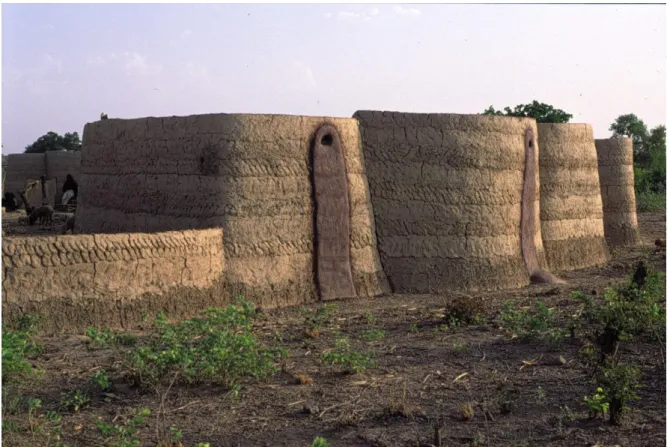
Figure 1. Building site, new compound. Walls are not yet plastered (Nebyepu, May 1989), © Luc Pecquet
2 THE MASON FROM ELSEWHERE
Masons ? Although African architecture has been noticed, for its diversity at least, there is very little on building process. Techniques and materials have been very little studied or else simplified, and the construction site as a situation has been generally ignored. Globally, there prevails the idea of simple techniques associated with social facts of the same order, the builder being the future occupant of what he builds – not a specialist -, and receiving the support of kinsmen, who remain largely undefined. Masons have not caught the attention; they are, so to speak, inexistantiv. A noteworthy exception, however: that of the bari, or barey, masons of Djenne (Mali), associated to the so-called “soudanese” architecture – impressive and (therefore ?) respected –, and to the fact that they form a society, constitute a caste or form very organised groups.v Elsewhere, the situation is quite different. There are no corporations of masons, the mason does not seem to have a status, responsability or any specific role that would make him into a character worthy of interest. There are therefore few data on masons and construction sites. Yet, the observations made in 1910 by Tauxier, and then those of Labouret (1931), may have retained the attention.vi Tauxier (1924: 151) points out, about the Lyela among others that “masons are farmers who do the work of masons in addition to that”. In saying this, he underlines a common phenomenon – the mason is also a farmer: he does not make a living from this activity (in many societies, diviners, blacksmiths, potters, etc. are in a similar situation). But it is also an observation about the exercise of an occupation that is, of a certain professionalismvii. And if, still regarding the Lyela, Tauxier does not mention the obligation that the mason be from elsewhere, when he states that these masons “are supported by kinsmen whose houses they build or repair”, it is nevertheless possible to make this supposition. Labouret (1931), whose remarks are about a much larger area, associates professionalism with remuneration, although he goes in the same direction as Tauxier, and if he leaves the idea obligation in the shadow too, he nevertheless makes it clear that “when the moment has come to raise the walls, masons […] are called on” (our emphasis).
In Lyela country, the mason is always “called on”, he is “asked”, he is “asked for the service”viii
. The mason works outside his home. More precisely, he cannot be the responsible for the building site of or in his kele of residence. The mason is someone who must “come out” from elsewhere. Everyone can become a mason, the condition is the will to learn. “One does not tell another to come and learn the banco (i.e. to learn to build). No. It is you yourself who know that your will (pùbùla) catches (catches the banco).”
To build one or more houses in a compound, people call on someone “who has a name”: a well known mason, established, and not an apprentice. Different termes are used to designate the masons, especially if they are not at work. Jì lùrna (“house builder”) and jì lùrna bal (or jì lùrbal: “man buiding houses”) are common. Bo lùrna (“builder of banco”), designates the building material, and
lùrbal ou lùrna (builder) are less common; sometimes he is called jì morna (“modeler of house”). But
when one speaks about the mason in the context of the construction site, the mason at work, he is called bo cebal (cebal of the banco, “master of the banco”). This denomination is reminiscent of that of the “Master of the Earth” and it is not anodyne. During the building process, and at the work place, the master of the banco has similar prerogatives – in proportion – to those of the Master of the Earth at the head of the village. Like the Master of the Earth, the master of the banco is connected to a force: that of the earth, that of the raw material for the construction of the walls (earth and water mixed).
A mason whose house is being built can at the same time be called on to work elsewhere. There is also the possibility to build for the person who is building one’s own house. More shrewdly, one can also work together:
“I want to build houses, it is our kele (compound). I want to build. But you cannot build your own house by yourself, you must fetch someone to come by and begin the house. He can also come and get me to go and build his house, and the two of us can support each other in order to build…”
There is no way around the obligation to call on a mason, it is an evidence. There is no interdiction on building one’s own kele. It is a fact, as if the opposite no longer meant to build, nor even to destroy or build for nothing. Such act does not have a referent that can institute it as a fault, it does not exist, it is not an act. One can say: “If you know how to build, you can build, you are going to build, But …”. But you will not do it. To build one’s own kele is to waste one’s breath. The fact that it cannot be done has several implications, and it is difficult to convey in few words the reason or reasons of this impossibility. Asking “why can’t you build your kele ?” is to make a strange question. Some answers:
- “If you make it yourself, it is you who will prepare the banco and then turn yourself to climb (on the scaffolding) ? You cannot do that. This is why you can (must) go and get someone else”.
- “One does not fall back on one’s own kele. It is luck (yo nyo, “good head”).
- “Your banco is a matter of luck (id). So, you yourself will not say that you can build, that you will enclose your kele to (show that you can) build”.
- “A mason can build (in his kele), but you must go and get someone who will come, and he (the mason of the kele) will assist him. You cannot run your own work. But if you bring along someone from elsewhere, and that you support him in his work, this makes sense” (kùr; a base, a foundation).
Prepare the raw material – the Lyela mason does not make it: he builds with what he is given – and to build, beyond a strictly practical sense that is no less real, does not seem to be compatible. There is something unpredictable about construction, something of the order of luck (“good head”), which implies to put the matter in someone else’s hands. In the end, to ask for external support, and to associate oneself to the work, has implications of the order of meaning for the end result. Reciprocity, which is often rendered explicit in relation to the intervention of an external mason, is an important notion. On the building site there is not one person responsible for everything, but two people who support each other, and who furthermore take upon themselves different responsabilities. In this context, one must differentiate the individual who is responsible (cebal) for a group of people (here, the future compound chief, responsible towards the mason for the actions of all those present on the site), and the responsible for the work (the mason). This is necessary for the following reason: if you are your own mason and someone commits an error, you will not be able to settle the matter; this “spoils” (zhìlìix) your kele: “You build, but it is worthless”. Such a house will not have the required
qualities, those qualities that are asserted by the future master of the house from the beginning of his search for a good location, and that the mason will specify: to have at this place good health, descendants, and nourishment.
The intervention of a third person to obtain something important, or in relation to a major event, is common – the mason and the kele in the present case. It concerns social relations as a whole; in many respects or situations, it is vital. The resolution of conflicts for instance – or marriages, births, divorces – is always a motif for the intervention of an intermediary, a role that is often devolved to a uterine nephew (son of a daughter of the lineage or clan, “sister’s son”). The logic of the gift and of the counter gift (giving – returning – receiving), the notion of power conveyed by the term cebal, can be placed in these triangular relations, or, in other words, in this obligation to have recourse to an intermediary. To close this parenthesis, let us remark that to call on a mason is – among other things – essential for the kele to be ultimately given to you. Indeed, upon his arrival at the construction site, the mason will ritually take possession of the space in order to carry out his work (his special relation to the material requires him to do so). But when the work has been completed the mason will relinquish all the prerogatives he had on the site and give the kele to the master of the house. Who is called on ? How to go about this ? The answers to these questions outline some elements of the obligation to call on a mason.
3
“EACH ONE HAS HIS PERSON”
The choice of the mason reproduces some of the important aspects of the preceding stage, that of the choice of a good location: in particular the assertion of a personal choice, which originates in one’s pùbùla (“thoughts inside”, a specific category of thought about which more will be said later), and which is not necessarily limited to (or delimited by) kinship. In this respect the following aspects will be evoked: 1) the designation of the mason through divination, a procedure that is not very advisable nor common; 2) the role of kinship; 3) the most common procedures. Whatever the modality of the choice of the mason, its criteria, it is a very important step, because it commits the future of the compound, and hence of its future inhabitants.
Divination was mentioned to me twice, in two different villages, Eno and Sanguié: the information is therefore fragmented. In Eno, people say that the diviner chooses a mason among those envisaged by his client (and who are symbolised by objects). But it is explained that the designation of the person can only be made by the diviner, that it can be or not a mason, and that it can only concern the beginning of the work: to “throw the banco on the ground” that is, to start the construction of a wall (laying the foundation), “take So-and-so”, says the diviner. A similar case was found in Sanje, which can be resumed as follows.
The choice of the mason cannot be random. To have good health and children in the future kele, one must consult a diviner. To build a kele the designation of the mason must be made by a diviner, but to build a house in a kele that already exists it is possible to call directly on a uterine nephew, if he is a mason. For a compound, the mason must be “looked for” (i.e. with a diviner): “to bring along one’s person” that is, to ask one’s uterine nephew, who he is not a “simple person” – his word, for instance, is supposed to be effective – to come and build the kele, it means “to fall” (to limit oneself to the power of the uterine nephew leads to the failure of the whole enterprise. But if the divination “touches” one’s nephew, and if he is still young, one must take him despite his young age. Likewise, “if you are told that a Moose builder (neighbouring ethnicity) will come to build for you so that you may have good health, then you must go and fetch him”. Yet, neither the child nor the Moose can be proper masons.
The first, in fact, is too young. The second, for the Lyela, though clearly distinct from the nomadic Peuls who do not have houses (vegetable dwellings), is neverhteless the very image of the poor builder: the round houses with conical roof of the Moose are little looked after, and minuscule. Aren’t they more like barns ? Aren’t the building techniques of the Moose, and the layout of their houses (etc), not just basic? If the mason is chosen by the diviner, this does not concern the material aspect of the construction work. This is the overall sense of the statements made about the Moose and the too young nephew. With respect to the technique of construction, which requires a certain mastery, it is possible to suppose that their role is to “throw the banco on the ground” only once: the gesture, here, has a symbolic, not a technical significance. To be more precise, the laying of the foundation seals the relation between the mason (master of the banco) and the material and the former inscribes his authority on the whole construction site. But lets go back to the other statements, which do not make the diviner intervene, and which more generally foreground the individual’s choice.
To build a compound, one must call on one of the uterine nephews, if there is a mason among them, or on a son-in-law. As in many other societies, the former has in his maternal uncles’ compound rights and powers, whereas the son-in-law has mainly obligations in relation to his family-in-law. The status of the uterine nephew (“sister’s son”, and “sister’s grand-son”) is paramount. The power he has in his maternal uncle’s compound is often marked by his words: his curse is to be feared. The nephew can go at will to his maternal uncles and help himself with a chicken, or even a goat or a lamb: he can get what he does not have in his father’s house. The jests that he can and that sometimes he must play can, according to the relations he has and his character, lead to veritable provocations; his power can take him to excesses, while at the same time the avoidance of any conflict with him is vital.
The good wishes that the nephew utters at the end of a construction can be as efficacious as his curses, which is why he is an enviable mason. His power enhances that which any mason has. The wishes of success that a mason utters at the end of the work are not treated lightly: if the mason is a uterine nephew, their potentiality and efficaciousness are enhanced. The ambiguity of his prerogatives notwithstanding, the uterine nephew is desiarable as mason. This is stated like this: the
kele of his maternal uncles is his “second kele”, it is the place where he goes and where he will
always be received, should he leave that of his father: he is directly concerned, implicated in the successful outcome of the building project.
Some people indicate the son-in-law as a potential mason, to remind that the nephew is not essential or necessary. Then, the statements slip towards asserting that the mason can also be your friend … To the choice of the newphew, builder of his “second kele”, is juxtaposed the relevance of the son-in-law for a different kind of relations, which belong to the field of work. In relation to his family-in-law, the son-in-law has work obligations. They consist mainly of agricultural work, but they include also building work. The obligations of the son-in-law, which are generally of a moral nature, are particularly important on the occasion of the (second) big funeralx. Overall, it is in the interest of the son-in-law to honour his obligations. As to the future compound chief, if he already has an ascendant on his son-in-law because of the work service this latter owes him, he must also keep in mind the good relations between the two families. The work, where the mutual understanding and trust between the mason and the kele cebal are necessary for both of them, can tighten this relation, perhaps even an occasion for probing it.
There is only one prescription on the choice of the mason: he must come from elsewhere, he must not be one of the residents of the future kele. Related by kinship to the future compound chief, the mason can be from a different family, even from a different ethnicity – Moose for instance. Or, the mason and the kele cebal may not have any kinship relation, nor envisage one. In many instances, the choice of the mason by the kele cebal is determined by mutual understanding and trust. Friendship overrides in this case kinship. But in practice, things are more complex and diverse.
For many people kinship does not preside over the choice of the mason. Unless one is on exceptionally good terms with one’s nephew, or turns to the son-in-law for practical or political reasons, the search for a mason rests on different considerations. The purpose, to build one’s kele, is a work that rests on three parameters: time, the mason’s know-how, and the quality of the relationship one has with him. These parameters combine differently according to the individuals facing the choice, their knowledge and relations, their personality, their desire, etc. The ideal mason who works fast, very well, whose disposition is propitious for creating a good atmosphere on the site needs to be pulled together. When this image does not match kinship relations, these are no longer taken into consideration when choosing the mason. Instead of being preferred, these relations become an eventuality. In discourse, the kinship tie moves in the background until it fades away completely. Facing these principles of choice, these requirements for the work to carry out, kinship cannot be a criterion. Everything rests on the “thoughts inside” (the pùbùla) the individual – already important for the choice of locationsxi –, on his will, his expectations. All this takes root in the individual’s situation, in his presence at this location where there is no other structure than a vegetable shelter: “Isn’t the vegetable shelter your wish (pùbùla) ? That which you are looking for is the builder (jì lùrbal) that you know, that your pùbùla have caught”. The individual needs to choose the person he loves, that his pùbùla love; he takes his reflection in different directions (among which are the previous ones):
“It is according to your will (pùbùla). Your pùbùla love that person who knows how to build the banco. You tell (yourself) that you are going to fetch that person, that she may make the work for you. For some people it is someone young who is strong with the banco (i.e. skilled). Whatever the number of doors (i.e. houses), he can make them: you go fetch him. But there are other reasons too, each one with his own person, each one with his own person (i.e. his favourite mason). Sometimes you catch one who will not even once fail to show up for work. Even if he works in other places too (other
building site), and that he is tired, he forces himself to come. But there are others… If you catch him, he has strange ways (behaviour, attitudes). If you yourself cannot build, the banco will take days… The work will not even be completed”.
The committment of the mason to do his work, which is often evoked in temporal terms, is a recurrent datum. The mason is someone who comes early, the work “will not be long before it is finished”… sometimes the speed with which the work is carried out is given as the reason for the choice of the mason. The drive of the mason incites all those who take part to the work. Underpinning this search for rapidity in the realization of the work is the dread that the work may never be achieved, that it may fail. In other words, the harmony between the persons working together has a vital role for the successful outcome of the building project. Harmony and mutual assistance imply one another, both are indispensable. The clarity of mutual intentions prevents prejudices of all sorts from arising, or harmful actions from hapening, both on the side of the mason and on that of the kele cebal. In case of discord, the mason, upon leaving the site, may not utter his good wishes for the kele and its residents. The kele of so and so was build by that mason, in this kele there is good health: this can weigh on the choice, people will call on a mason they do not know, or very little. The role of the mason’s reputation is also expressed by saying that one calls on a mason “who has luck”. The mason who has built compounds where soon after there have been births is certainly the best example of this idea of “luck”. Luck on the other hand is capricious, it cannot be mastered, it is also a function of something indetereminate at play in the relation between the mason and the kele cebal. For instance, the kele is built and it staggers, it is like drunk, everything goes the wrong way and yet no error has been committed. “We say then that so-and-so does not have luck with so-and-so”, between the mason and the kele cebal “something prevents” and it is why nothing goes well at the kele. Prevent ? What is prevented is an encounter between the “luck” of the mason and that of the kele cebal.
The mason’s capacity to mobilise labour, or to bring along with him other masons who will help him out, can also play a not insignificant role. All depends on the support one can count on from his own side, and on the size of the work to be carried out. People for instance can mention a kele with an old mason who no longer practises, but one of several of his sons know the trade: if one asks him, he will send them do the work. The material capacity to take on the costs of the building site is not talked about. With a noteworthy exception, but in an indirect way and with reference to kinship relations: at the end of the work the nephew and the son-in-law do not receive the same remuneration.
These data show well that, besides the difficulty of “looking for” a mason, kinship relations do not suffice, they cannot constitute an obligation. The transgression of a rule, a harmful deed, can indeed prevent to have recourse to a kinsman. That in these important choices, of the location and of the mason, the individual must obey his pùbùla and not that which structures his society, defines his place, his identity, his belonging… this goes beyond the territorial framework of the village. The location for instance can be anywhere, a person can go and settle in another village, likewise one can go and look for a mason elsewhere. After the long utterance reported above, the interlocutor adds for instance: “The place where the very good mason is, it does not matter where, there where he is… you love him, you go fetch him (outside the villlage). At Kyon, or elsewhere, at (…)”, at twenty kilometers from the place of the conversation, in this case. To be more precise, the category of “thoughts” called
pùbùla, which relate the individual to his emotions, to his deepest feelings, his personal choices, has
the characteristic of being associated to the wishes expressed in front of God (Yi) before birth, and which we no longer remember once we are born but that trace our destinies on earth, at least in part.
The choice having been made, one needs to go and see the mason: to ask him, to “catch” him.
4
“THE CHICKEN OF THE BANCO” AND “THE DAY OF WATER”
called “the chicken of the banco”. This step takes place few days after the Master of the Earth has visited the site. The time necessary to weed, and to make the location inhabitable by bringing some necessary goods: in the vegetable shelter a pottery with potable water; outside, a large jar for the water, chickens, and eventually a provisional henhouse made of the conical roof of a granary, woven, placed on the ground, and fixed with stones. But it is possible to go and see the mason at an earlier stage. After the departure of the Master of the Earth, the earth for the construction is extracted (banco) and then one goes to see the mason, or else one goes to see the mason first anticipating to have enough time to then “extract one’s banco”. One can also tell the mason that the material will be extracted on particular day, day for which one counts on some support: “he says to go and extract”, even if his agreement is not necessary for this. But unless a diviner has fixed the day for the beginning of the work, only the mason can decide the moment of is arrival on the site: it is out of question to impose it on him. It is therefore better to prepare oneself in advance, meaning to have on the site all that is necessary, to have excavated the banco, and only then pay a visit to the mason.
Ideally, one takes a hen. In fact, it is said that “whatever chicken” will do, without any distinctive features, such as colour. It is also possile to bring a young rooster. One takes the fowl to the mason of one’s choice: “You go and tell the person who will build the banco that your banco is finished (i.e. excavated)”; “You tell him to come and make your thing a ball (i.e. your banco; walls are made of balls of banco)”; “You tell him to take the chicken and to come to begin your thing (i.e. your kele); “You ask him to come to throw your banco on the ground (to layout the basis of the house, the foundation layer)” . Bringing a chicken is in itself a request. One sepcifies its content by speaking about the banco, the building of the walls, or the very beginning of the construction work. Other formulas can be added, for instance: “you tell him to come to make your banco into balls, so that you can enter the shade (in a house); to come and build so that you can have shade”. The future kele cebal can send someone else on his behalf, even several of his children – “the elder gives the chicken, to ask you to come…”xii – who will then report the words of the mason who has been sollicited: on such and such a
day you must put the water (on the banco). The mason will then come to lay out the foundation (kùr) of the first house. The mason receives the chicken: he accepts the work.
If the mason is not kele cebal, it is to this latter, his “father”, that he gives the chicken he has received. In either case, the chicken must be kept and not killed “even if it is a small chicken”, meaning the prototype of the sacrificial chicken. If the mason has received a young rooster, he will hear it crow, it is said, but this image illustrates a principle. If a sacrifice is to take place and if the rooster has the required characteristics, in this case it is possible to use it for this purpose. But it is prefereable to bring a hen, and it will not be killed. “The fowl will lay eggs, and likewise he will begin the banco and the woman will give birth in the compound. It is for this reason that we don’t kill it”: it will grow as the compound is being built, the hen will lay eggs and the woman will give birth. The “hen of the banco” is important. It is associated with gestation and one can say that the egg of this hen virtually contains all the future generations. It is not the chicken of the compound but the chicken of the banco. The banco must have these potentialities, it must lead to this realisation: this is the mason’s job. The mason does not kill the hen, and he fixes “the day of the water”, or else he gives his permission to add water and adds: “I will come on such day”.
The mason does not refuse to come and build, he takes the chicken he has been offered. Unless he is ill, the act of bringing him the chicken, his receiving it, is followed by his arrival on the site. These acts commit one and the other side, they have implications. The mason’s refusal in the following image illustrates some aspects. One cannot exclude this possibility, but it an unlikely occurrence.
“He can refuse. If he does not like it (literally: if his pùbùla...). He could refuse, and you went in search of another to rely on. Mutual support (yé cònò, that which goes towards something better, a better result) makes grow (the field of knowledge expands more and more)”.
Refusal is not inconceivable but it does not happen, and it is certainly one of the reasons why it is often said that one goes “fetch the mason”. It is not prohibited to refuse, but it is prohibited not to bring a chicken when calling on the mason. This gesture is a request, one is “asking him for a service”, which is considerable if one judges by the size of the work. The request implies mutual obligations. It
outlines the relations that will later prevail for the duration of the construction site, between the mason and the kele cebal. By means of the gift of the hen, the future kele cebal puts his fate in the hands of the mason, in other words, he recognises his ascendant on him. If he compels the mason to come, the future kele cebal becomes his debtor in a way that will be examined in greater detail hereafter. At a later date, for instance, he can be told “was it not you who went to his house to ask for this service ?”
By receiving the chicken, the mason accepts this situation and he assumes the responsability. The terms of the contract are implicit, they are those of the construction site for which the two of them committ themselves. In practice, nothing is said. But the place of each, one having power over the other, is fixed by the gift of this hen. The reality of the construction site will make visible the complexity of the relations, the way power is gauged. To see the way in which roles are effective, distributed, their edges and efficaciousness better defined, it is necessary to move a step further than the gift of the hen. It is a fact though that in this gift there is the submission of the future kele cebal, a submission that is part of a predefined order of things. The “hend of the banco” establishes solid links, it is more than a simple request. This tacit agreement is illustrated by the following fact. If during the construction work the kele cebal and the mason no longer get along, if they cheat on one another, the
kele cebal cannot easily have recourse to another mason to finish the construction. This latter will
refuse: “He will not accept. Not even if you bring him a cow”, which in material terms represents a large number of chickens… Beforehand, and this is also the case if the first mason continues the work, the conflict must be settled.
By accepting the work the mason expands, maintains, or strengthens the circle of his relations. Mutual assistance is seen as a way of going towards something more, something better, and it is an important feature that is put forth in the terms used by the interlocutor. Other formulas are also used to speak about the mutual support that is necessary for the construction of the kele. They express the idea of mutual consent. What is put forth is not the object to build, but the material used in the construction. It is said for instance that “the banco of so and so was not supported; you must support one another”. The following remark can be seen as a definition: “the construction of the banco, it is mutual support”. This is not without connection to the fact that “fighting” is the paramount interdiction on a construction site, from the simple quarrel to bloodshed: it is an injunction that all the protagonists get on well, to start with the principal ones (the responsibles, the master of the work and the master mason). Without this – and without the settlement of transgressions by ritual and by fines fixed by the mason and that one has the obligation to pay – the construction process is doomed to fail. The idea of harmony at the location of the construction site of the future house also foreshadows what the house is meant to be, to last and grow (then, it is up to the compound chief to prevent conflicts to arise among his people).
The individual gives the hen to the mason. And if he knows that in the kele there are several masons, he can specify that “he takes him with his people” so that the other masons will be more likely to come along. Those who do not know how to “build the banco”, meaning those who are not masons, will also come. If nothing is specified, after the departure of the visitor, the mason who has received the hen will tell the people of his kele – “So-and-so wants to build his kele” -, and those who want will come to assist him. It is not an obligation and it can be the aid of a single day. This moreover varies with the social position of the mason within his kele (his age, the number of his wives and children, his responsabilities – if for instance he is kele cebal – influence his capacity to assemble, etc.), or it varies according to the relations between the members of the kele (mutual aid, solidarity, mutual understanding can vary widely from one kele to another), etc. But the word of the visitor, it is said, makes the issue “a problem for all of you”: in one way or another, or in different degrees, all the residents of the kele where the mason lives are implicated. To build a kele several masons are needed. The mason who has received the hen informs those who in the area exercise the same profession. He can ask them something like this: “Come, So-and-so has given a chicken; we need to go and build his kele”. But “the work has a responsible” (cebal) – the mason that was called on first –, not two or more: the others follow him. From the point of view of the kele cebal, for whom it is not a question of having merely a place where to live but a kele, everyone, it is said, “comes to build your
place, for you to enter”.
According the diviner whose words have been reported above, to build a house in a kele peole have recourse to a nephew without a prior divination session. In other villages, whithout any divination (even for a kele), the statements are contradictory about not consulting a diviner. But a mason, even for a kele, is someone who will not live in the compound he builds. For some, a kele must be built by a nephew (with a but…), or “anyone” in the case of a house in an existing kele. For others, this perspective is inverted: one calls on someone from the lineage or clan to build a house, but this cannot be a consideration for the construction of a kele, and the mason can be even from another village. These various scenarios of the choice of the mason could be analysed in terms of alliances, kinship relations between different groups who are bound by an obligation of mutual support, that are formed or projected, or else it could be more simply stated that the nephew is of primary importance by taking into account the significance of his ritual status. But if this kind of considerations are part of the choice and of its difficulty, if they are taken into account (in a way that varies in function of the persons), they are by no means the only ones. The mason must be a skilled individual and he must come from elsewhere: this is the condition to be fulfilled when choosing a mason. “You go fetch someone (i.e. a mason). You become attached to her. It is this person’s hand (i.e. her work, her responsability)”. And this responsability of the mason is first and foremost a ritual one: the mason can delegate his work, but his presence on the building site at the strong moments (beginning, middle, and end) is mandatory to carry out the rites without which the compound will not fulfill its function in the future – that of being a space of procreation and, more broadly, a place where the family can grow under the most auspicious conditions: a place for living.
5 CONCLUSION
The wishes an individual has made from the moment he has began to look for a site where to settle (“seat down” in lyele), the steps and actions undertaken, all move in the direction of the following purpose, which is conceivable as the realisation of one’s fate (the realisation of the wish made in front of God before one’s birth): to become kele cebal. To this end, it is vital to withdraw oneself, meaning to put everything in the hands of another (the mason). The gift of the hen in a way brings about one of the qualities of the notion of power: power derives its legitimacy from others or, in other words, its exercise always results in never actually possessing its force. It may even be said, about the intervention on the site of the Master of the Earth to assert an authority that he had inherited, that the “others” are like his ancestors. The nuance of the power could be translated in the following terms: if you are the owner of a thing (cebal) it means to admit that you are in its service; that the thing itself has power, or is powerful; that its qualities cannot be fully possessed and, if need be, that it can turn itself against you; ultimately, before acquiring it, it is something given, or appears to be such. This characteristic, this way of understanding power, is not peculiar to the Lyela: other Voltaic societies share it.
The material out of which the houses are built, the banco, is at the forefront of the procedure by which a mason is approached. Why, when calling on him, people give him “the hen of the banco” ? Why is it that, on these terms, mutual support builds the banco and not the houses ? Why is it that on the construction site the mason is no longer called “builder of banco” (bo-lùrna) or of houses
(jì-lùrbal), but bo cebal (“master of the banco”; “man (bal) who commands (ci) the banco”) ? This paper
does not answer these questions. But this point needs to be underlined: the mason is “master” of the banco only to the extent and for as long as he respects and makes others respect its rules (cf. Pecquet 2004), otherwise the material turns against him (it can make him fall from his scaffolding, etc.), or the houses fall apart or have a very short life.xiii It is because of his close relation to the material, which takes its force from the Earth, that he can build a kele that assembles all the necessary conditions for good health, a descent, and nourishment.
As we have seen, through the question of the choice of a mason, the specialization of labor and application of techniques are not a purely technical matter. When considering the masonry, we must
look beyond materials and techniques toward the powers animating materials, techniques, specialists and human society.
REFERENCES
i
Bourdier, J.-P. & Minh-ha, T. T.: The Architecture of a Lela Compound. African Arts, 16 (1983) 1, 68-72.
ii For precisions on the process of acquisition of a site where to build one’s compound, see Pecquet, L.: Les
lieux de “l’être-là” (pays lyela, Burkina Faso). In: Finding the spirit of place – between the tangible and the
intangible, 16th Icomos Gal Assembly and Int. Symposium, Québec (octobre 2008);
(http://openarchive.icomos.org/id/eprint/163).
iii
Before the colonization (beginning of XXth century), Lyela country was organized in independent villages, each under the authority of a Master of the Earth (or Earth Priest), person in charge of rituals (the Earth is a power, a entity) and politic. A village territory covers several square kilometers. It divides in districts, where group together compounds of very variable sizes (a compound can count ten inhabitants, an other one 300), and distant between them from 50 to 200 meters.
iv To the extent that the construction work is seen as indifferentiated (everyone builds….), there are no masons:
just men at work… The techniques in use are themselves the object of approximations, or are caught in interpretations that must be approached with caution. See Prussin, L.: Building Technologies in the West
African Savannah. In Le sol, la parole et l’écrit. Mélanges en hommage à Raymond Mauny, Société
française d’histoire d’outre-mer: Paris 1981, 229-245. See also, on the overall question, Pecquet, L.: La culture en chantier. Techniques et matériaux de l’architecture de terre. In: Construire en terre. Du patrimoine historique à l’architecture contemporaine. Des professionnels des savoir-faire et des techniques en Europe, Actes du colloque Européen du projet Terra-Incognita, Marseille 2011, 68-71.
v
The most recent work, and the most thorough, on the masons of Djenne is that of Marchand, T.H.J.: The Masons of Djenne. Indiana University Press: Bloomington-Indianapolis 2009.
vi Labouret, H.: L’habitation indigène dans les possessions françaises. Afrique occidentale et équatoriale. La
terre et la Vie (1931), 343-363. Tauxier, L.: Nouvelles notes sur le Mossi et le Gourounsi. Editions Larose: Paris 1924.
vii
About Kasena, Nuna, Nankana, population related to Lyela see also Tauxier, L.: Le noir du Soudan. Pays Mossi et Gourounsi. Editions Larose: Paris 1912: 209, 750, 122, 731.
viii
Quotes refer to translations of the lyele.
ix
Zhìlì: to spoil, deteriorate, loss of qualities as a result, for instance, of the transgression of an interdiction. Sometimes people evoke the image of someone who builds his own kele, but as if indirectly to say something else. In the literal sense, this does not exist.
x
This takes place one or several years after the death. On this occasion, the sons-in-law must demonstrate their prodigality, they enter into competition with one another… The success of the festivities owes much to the quality of their participation.
xi
When the person chooses several locations where he would like to settle, to in the end have only one where the project can be realised, it is these thoughts that must be mobilised.
xii
A preliminary agreement has then been finalised, and in all likelihood such agreement is common (the mason arrives few days after the request has been made, so he must be available). But the procedure must be followed, the chicken must be given.
xiii
See Pecquet, L.: The mason and the banco, or raw material as a power for building a lyela house (Burkina Faso). Paideuma, 50 (2004), 151-171.