Query Refinement for
Patent Prior Art Search
Doctoral Dissertation submitted to the
Faculty of Informatics of the Università della Svizzera Italiana in partial fulfillment of the requirements for the degree of
Doctor of Philosophy
presented by
Parvaz Mahdabi
under the supervision of
Prof. Fabio Crestani and Dr. Monica Landoni
Dissertation Committee
Prof. Kai Hormann Università della Svizzera Italiana, Switzerland Prof. Evanthia Papadopoulou Università della Svizzera Italiana, Switzerland Prof. Gareth J. F. Jones Dublin City University, Ireland
Prof. Andreas Rauber Vienna University of Technology, Austria
Dissertation accepted on 30 July 2014
Research Advisor Co-Advisor
Prof. Fabio Crestani Dr. Monica Landoni
PhD Program Director
Prof. Stefan Wolf and Prof. Igor Pivkin
I certify that except where due acknowledgement has been given, the work presented in this thesis is that of the author alone; the work has not been sub-mitted previously, in whole or in part, to qualify for any other academic award; and the content of the thesis is the result of work which has been carried out since the official commencement date of the approved research program.
Parvaz Mahdabi Lugano, 30 July 2014
To My Loved Ones
Somewhere, something incredible is waiting to be known.
Carl Sagan
Abstract
A patent is a contract between the inventor and the state, granting a limited time period to the inventor to exploit his invention. In exchange, the inventor must put a detailed description of his invention in the public domain. Patents can encourage innovation and economic growth but at the time of economic crisis patents can hamper such growth. The long duration of the application process is a big obstacle that needs to be addressed to maximize the benefit of patents on innovation and economy. This time can be significantly improved by changing the way we search the patent and non-patent literature.
Despite the recent advancement of general information retrieval and the rev-olution of Web Search engines, there is still a huge gap between the emerging technologies from the research labs and adapted by major Internet search en-gines, and the systems which are in use by the patent search communities.
In this thesis we investigate the problem of patent prior art search in patent retrieval with the goal of finding documents which describe the idea of a query patent. A query patent is a full patent application composed of hundreds of terms which does not represent a single focused information need. Other relevance evidences (e.g. classification tags, and bibliographical data) provide additional details about the underlying information need of the query patent.
The first goal of this thesis is to estimate a uni-gram query model from the textual fields of a query patent. We then improve the initial query representation using noun phrases extracted from the query patent. We show that expansion in a query-dependent manner is useful. The second contribution of this thesis is to address the term mismatch problem from a query formulation point of view by integrating multiple relevance evidences associated with the query patent. To do this, we enhance the initial representation of the query with the term distri-bution of the community of inventors related to the topic of the query patent. We then build a lexicon using classification tags and show that query expan-sion using this lexicon and considering proximity information (between query and expansion terms) can improve the retrieval performance. We perform an empirical evaluation of our proposed models on two patent datasets. The
viii
imental results show that our proposed models can achieve significantly better results than the baseline and other enhanced models.
Acknowledgements
So many people have helped me come to this point in my education. My greatest debt is to my advisor, Fabio Crestani and my co-advisor, Monica Landoni. Thanks to Fabio’s confidence in me I was able to explore research directions with free-dom, while getting suggestion and feedback from him at critical times. I would like to thank Monica for the scientific support, for her incredible energy and for her friendship specially in difficult moments.
I am grateful to my doctoral thesis committee, Andreas Rauber, Gareth Jones, Kai Hormann, and Evanthia Papadopoulou for reading my thesis and providing me with valuable feedback. I am also thankful to the anonymous reviewers of my papers for providing me valuable feedback which helped me improve the quality of my work.
I also thank Linda Andersson, Florina Piroi, Mihai Lupu, Allan Hanbury, and John Tait for their support and interesting discussions on patent search, compu-tational linguistics, and Information Retrieval. In particular I thank Linda An-dersson for sharing with me her enthusiasm for patent search and for opening my eyes to the beauty of computational linguistics.
I would like to thank the members of the IR group, Mostafa Keikha, Shima Gerani, Ilya Markov, Giacomo Inches, Mark Carmen, and Morgan Harvey for sharing with we me their knowledge of the field of information retrieval and their passion for statistics and machine learning in one way or another. In par-ticular, I would like to thank Mostafa Keikha and Shima Gerani, for giving me their insights, suggestions, feedback and for many interesting discussions about my work.
I also thank Jimmy Huang for his supervision during my internship in York University in Toronto. I thank Narges Nattaghi, Vivian Hu, Zahra Amin Nayeri and Hoda forghani for their friendship during this period.
I would like to thank Claire Cardie for her support during few months that I spent in her Natural Language Processing lab at Cornell. It was very exciting to learn about computational linguistics and machine learning through the pas-sionate discussions in the weekly NLP-seminars. Thanks to Lu Wang and Bishan
x
Yang for the interesting discussions and their collaboration.
My deepest thanks to all the faculty, staff, and students at University of Lugano who helped me in ways large and small. My special thanks goes to the staff members of the Faculty of Informatics, Nina Caggiano, Elisa Larghi, and Danijela Milicevic for providing help and warm support during my PhD time.
My special thanks to my office mates (cubicle mates), Randolf Schärfig, Tim Winkler, Francesco Alberti, Saeed Aghaee, Mattia Vivanti, Amanj Sherwany and Nosheen Zaza for interesting discussions and tolerating me in difficult moments. I am particularly thankful for the extraordinary friendship of Parisa Jalili Marandi, for the many good times we shared and for the endless encouragement and empathy she had for me. In particular her amazing zest for research has always stayed with me and inspired me. When things got tough, Parisa often reminded me not to give up and to look at research problems like a detective trying to solve a challenging case. I also thank Maïa Khassina, Rebeka Johnson, and Sara Vannini for all the good times we shared and for making my PhD life multi-dimensional. I want to thank the following students at the university of Lugano, for all the fun we shared and for their friendship, which make part of my life today: Lile Hattori, Amir Malekpour, Sandeep Kumar Dey, Mehdi Mirzaaghaei, Elena Khramtcova, Marianna Saba, Navid Ahmadi, Hamid Ghods Elahi, Olga Kaiser, Somaye Danafar, Sebastian Daum, Marco Pasch, Katharina Hohmann, Ricardo Padilha, and Kourosh Khazai.
I am grateful to my husband and my best friend, Nicolas Schiper, for his generous support, who encouraged me and stood by me through thick and thin. I am thankful to my parents in law for their sincere support and continuous encouragement while I was writing my dissertation. I am thankful to them for the numerous interesting discussions we had on research, creativity, innovation, and inspiration.
I sincerely thank my brother, Mahdad, for many years of moral support and placing his trust in me. I thank my family and close friends, in particular my grandmother and my aunts for their endless encouragements, when things got tough.
To finish, I want to dedicate this work to the memory of my parents, Simin and Bahram, who always encouraged me throughout difficult challenges in my life. Thanks for installing in me a love for learning and appreciating beauty. Thanks for transmitting your sensitivity, faith, and strength to me. Although you are not physically present, your unconditional love will always be with me, in every single day of my life. Thank you.
Contents
Contents xi
List of Figures xv
List of Tables xvii
1 Introduction 1
1.1 Introduction . . . 1
1.2 Motivation . . . 4
1.3 Research Outline and Questions . . . 5
1.4 Main Contributions . . . 7 1.5 Thesis Overview . . . 7 1.6 Publications . . . 11 2 Related work 13 2.1 Introduction . . . 13 2.2 Information Retrieval . . . 13
2.3 Statistical Language Models for IR . . . 15
2.3.1 Query Likelihood Model . . . 16
2.3.2 Relevance Models . . . 17
2.4 Query Transformation . . . 18
2.5 Query Performance Prediction . . . 20
2.6 Patent Prior Art Search . . . 20
2.6.1 Query Formulation for Patent Retrieval . . . 22
2.6.2 Leveraging Knowledge Bases and Using Proximity Heuristics 24 2.6.3 Citation Analysis . . . 26
2.6.4 Evaluation Metrics for Patent Retrieval . . . 28
2.7 Conclusions . . . 29 xi
xii Contents 3 Experimental Setup 31 3.1 Introduction . . . 31 3.2 Benchmark Dataset . . . 31 3.2.1 Test Collections . . . 32 3.2.2 Test sets . . . 33 3.2.3 Assessment . . . 35 3.3 Evaluation . . . 36
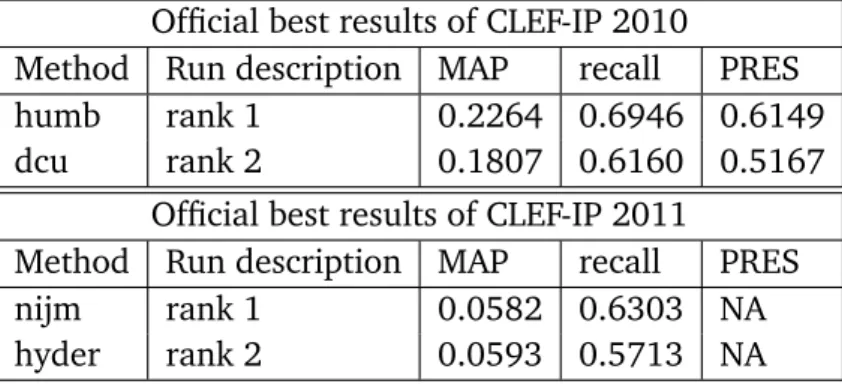
3.3.1 Best Official Results of CLEF-IP Challenge . . . 37
3.3.2 Statistical Significance . . . 38
3.4 Conclusions . . . 38
4 Query Reduction 41 4.1 Introduction . . . 41
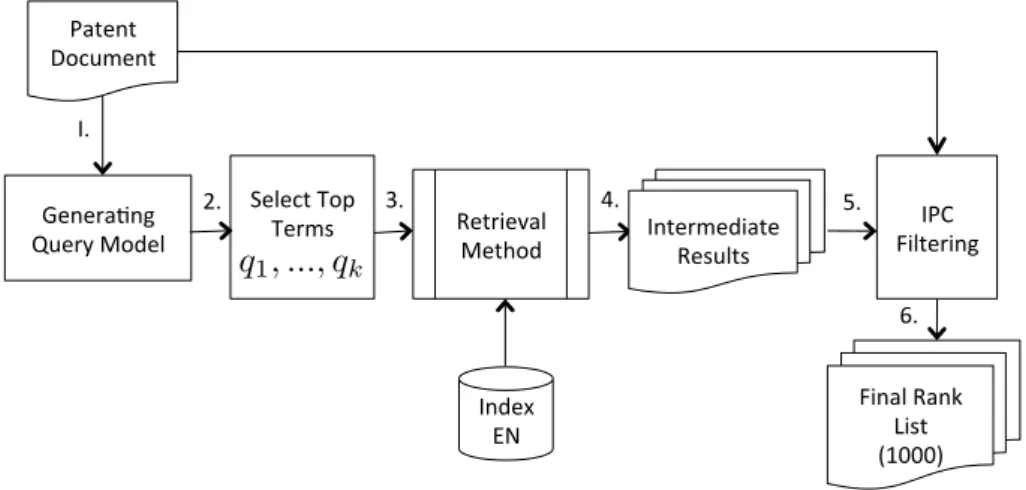
4.2 System Architecture . . . 42
4.3 Query Model based on Weighted Log-Likelihood . . . 42
4.4 Cluster-based Query Modeling . . . 44
4.5 Parsimonious Query Modeling . . . 44
4.6 Experiments . . . 45
4.6.1 Effect of Query Length and Field . . . 45
4.6.2 Comparison with the CLEF-IP 2010 participants . . . 48
4.6.3 Removing Patent Specific Stop-words . . . 50
4.7 Conclusions . . . 50
5 Query Quality Prediction 53 5.1 Introduction . . . 53
5.2 Using Noun Phrases for Query Expansion . . . 54
5.3 Establishing a Uni-gram Baseline . . . 55
5.4 Extracting Candidate Key Phrases . . . 57
5.5 Scoring Key Phrases . . . 58
5.5.1 Scoring Phrases based on TF/IDF . . . 58
5.5.2 Scoring Phrases based on Mutual Information . . . 59
5.6 Predicting Noun Phrase effectiveness . . . 60
5.6.1 Features . . . 61
5.6.2 Evaluating the Dependence between the Predictors and Average Precision . . . 63
5.7 Experiments . . . 65
5.7.1 Uni-gram Query Models . . . 65
5.7.2 Combining Uni-gram and Phrase Query . . . 66
xiii Contents
5.8 Conclusions . . . 71
6 IPC-based Conceptual Lexicon for Query Disambiguation 73 6.1 Introduction . . . 73
6.2 Potential Relevance Evidences for Query Reformulation . . . 74
6.3 The Architecture of our Proposed Model . . . 75
6.4 IPC Conceptual Lexicon . . . 75
6.5 A Proximity-based Framework for Query Expansion . . . 77
6.5.1 Query Reformulation . . . 77
6.5.2 Estimating Query Relatedness . . . 78
6.5.3 Calculating Document Relevance Scores . . . 80
6.5.4 Normalization . . . 81
6.6 Experimental Results . . . 81
6.6.1 Building the Initial Query . . . 81
6.6.2 Choosing the Baseline . . . 82
6.6.3 Motivation for Using Proximity Information . . . 83
6.6.4 Effect of Density Kernels . . . 84
6.6.5 Effect of Query Reformulation . . . 86
6.6.6 Comparison to Standard PRF . . . 88
6.6.7 Influence of Different Parameter Settings . . . 89
6.7 Conclusions . . . 92
7 Citation Analysis 93 7.1 Introduction . . . 93
7.2 Query-Specific Citation Graph . . . 94
7.3 Query Expansion Guided by Page Rank Scores . . . 96
7.4 Temporal Analysis of the Citation Graph . . . 97
7.5 Query Expansion using Citation Graph and Temporal Features . . 99
7.6 Experimental Results . . . 100
7.6.1 Sensitivity Analysis of Different Parameter Settings . . . 102
7.6.2 Enhancing Citation Analysis with Temporal Information . . 106
7.7 Conclusions . . . 108
8 Synthesizing Multiple Relevance Evidences for Query Formulation 111 8.1 Introduction . . . 111
8.2 The Architecture of the Proposed Model . . . 112
8.3 Experimental Results . . . 113
8.3.1 Comparison with Standard PRF . . . 115
xiv Contents
8.4 Conclusions . . . 119
9 Conclusions and Future Work 121
9.1 Summary and Contributions . . . 121 9.1.1 Reducing the Query Patent Application . . . 121 9.1.2 Enhancing Query Representation using Classification Tags 123 9.1.3 Analyzing Patent Citation Network . . . 124 9.1.4 Synthesizing Different Relevance Evidences . . . 124 9.2 Future Directions . . . 125
Figures
3.1 A query topic selected from the training set of CLEF-IP 2010. . . . 33 3.2 An example query topic in CLEF-IP 2011 test set (an excerpt) . . . 34 3.3 The relevance judgements for the query topic “PACt-1” selected
from the training set of CLEF-IP 2010. . . 36 4.1 Overall architecture of the proposed system. . . 42 5.1 Sensitivity of uni-gram query models against (a) the number of
terms and (b) the number of feedback documents used for query model construction . . . 67 5.2 Sensitivity of the expanded query models using noun phrases against
(a) the number of terms and (b) the number of feedback docu-ments used for expanded query model construction . . . 68 6.1 The general scheme of our proposed method for query expansion
using IPC lexicon. Numbers indicate the sequence flow of opera-tions. . . 76 6.2 DIS value for CLEF-IP 2010 query topics in the relevant and
non-relevant document sets. . . 85 6.3 Sensitivity to the effect of number of expansion terms on CLEF-IP
2010 . . . 90 6.4 Sensitivity to theλ coefficient in the linear combination of results
made from the initial and the expanded query. . . 91 7.1 The general scheme of our proposed method for query expansion
using citation information. Numbers indicate the sequence flow of operations. . . 96 7.2 Sensitivity analysis of QM-cit2 to the number of feedback terms
on CLEF-IP 2011. . . 103 xv
xvi Figures
7.3 Sensitivity analysis of the baseline method to the number of query terms selected from the initial query model on CLEF-IP 2011. . . . 104 7.4 Sensitivity analysis of QM-cit2 to the number of feedback
docu-ments on CLEF-IP 2011. . . 104 8.1 The general scheme of our proposed method for query expansion
using IPC lexicon and citation information. Numbers indicate the flow of operations. . . 112 8.2 Sensitivity to the number of expansion terms and number of
feed-back documents on CLEF-IP 2010. . . 117 8.3 Sensitivity analysis of PRF and PPRF on CLEF-IP 2010. . . 118
Tables
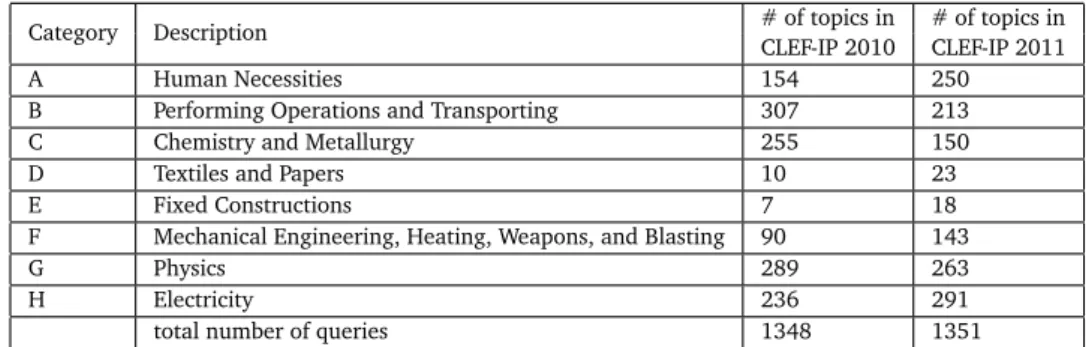
3.1 Specifications of test collections. . . 32 3.2 IPC classes in CLEF-IP collections. . . 35 3.3 IPC section distribution over English test set of CLEF-IP 2010 and
CLEF-IP 2011. . . 35 3.4 The performance of the best official results on English Test Set. . . 38 4.1 Evaluation scores of the different query estimation methods using
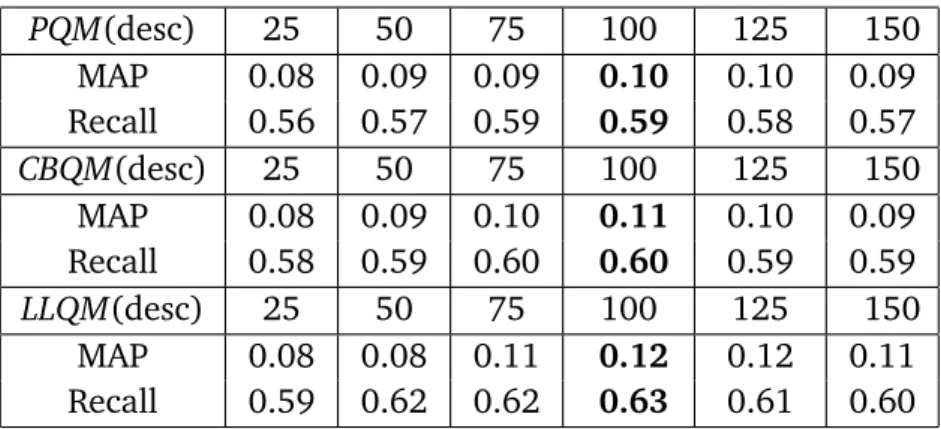
the description field on the training set for the English subset. . . 46 4.2 Evaluation scores of the different query estimation methods using
the claims field on the training set for the English subset. . . 46 4.3 Evaluation scores of the different query estimation methods using
the abstract field on the training set for the English subset. . . 47 4.4 Evaluation scores of the different query estimation methods using
the title field on the training set for the English subset. . . 47 4.5 Comparison of performance of the different query estimation
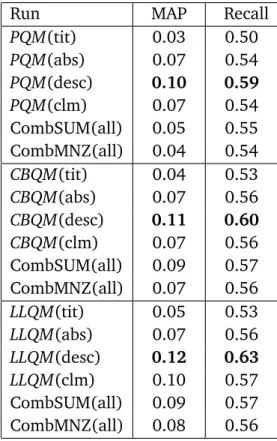
meth-ods using the different fields of a patent document. . . 49 4.6 Prior art results for best runs in CLEF-IP 2010, ranked by PRES,
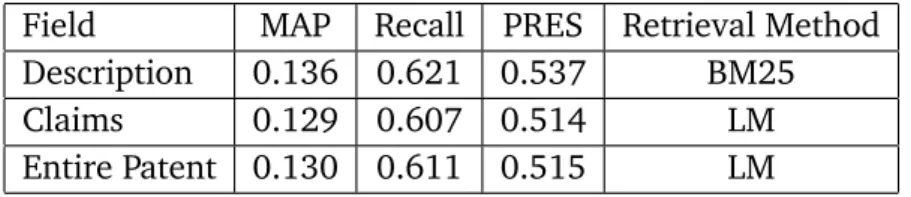
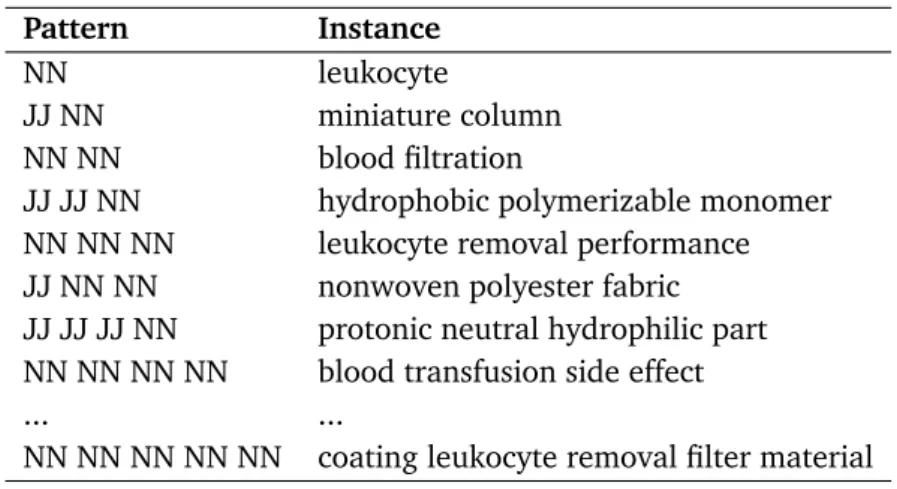
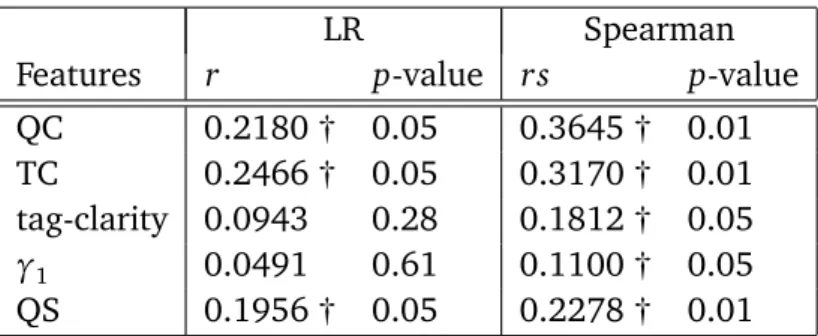
using the large topic set for the English subset. . . 49 4.7 Results of CLEF-IP 2010 extracted from different fields. . . 50 5.1 Examples of extracted noun phrases and corresponding patterns . 58 5.2 Performance results using the true noun phrase effectiveness . . . 61 5.3 Features used in the regression model for query Q . . . 63 5.4 Linear Regression and Spearman rank correlation coefficient of
the query performance predictors with Average Precision . . . 64 5.5 Performance comparison of the uni-gram query models, the
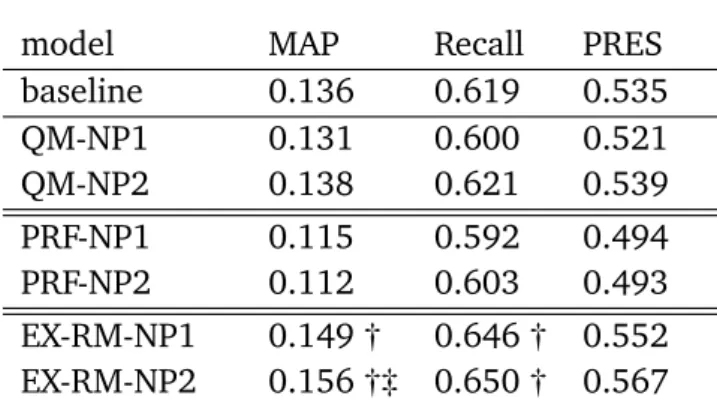
base-line run, relevance models using pseudo feedback documents and sample relevant documents . . . 66 5.6 Performance of the expanded query models using phrases . . . 67 5.7 Retrieval results on CLEF-IP 2010 using selective query expansion 70
xviii Tables
6.1 An entry in the conceptual lexicon. . . 76 6.2 Comparison between the list of expansion terms derived from
three information sources for the query with title “ink-jet record-ing ink”. . . 79 6.3 Choosing baseline on the two retrieval collections. . . 82 6.4 Strong baselines of the previous work . . . 83 6.5 Recall results of different settings of the kernel functions using
IEC query reformulation methods on the training topics of CLEF-IP 2010. . . 83 6.6 Recall results of different settings of the kernel functions using
EEC query reformulation methods on the training topics of CLEF-IP 2010. . . 83 6.7 The performance results of query reformulation approaches on
two patent retrieval datasets on the test topics of CLEF-IP 2010 and CLEF-IP 2011. . . 86 6.8 Recall of the Max and Avg method using Gaussian kernel with IEC
reformulation method on training topics of CLEF-IP 2010. . . 87 6.9 Examples of queries for which IEC reformulation method improved
recall. . . 88 6.10 The comparison of performance results of PRF and PPRF. . . 89 6.11 Comparison of different normalization methods over CLEF-IP 2010
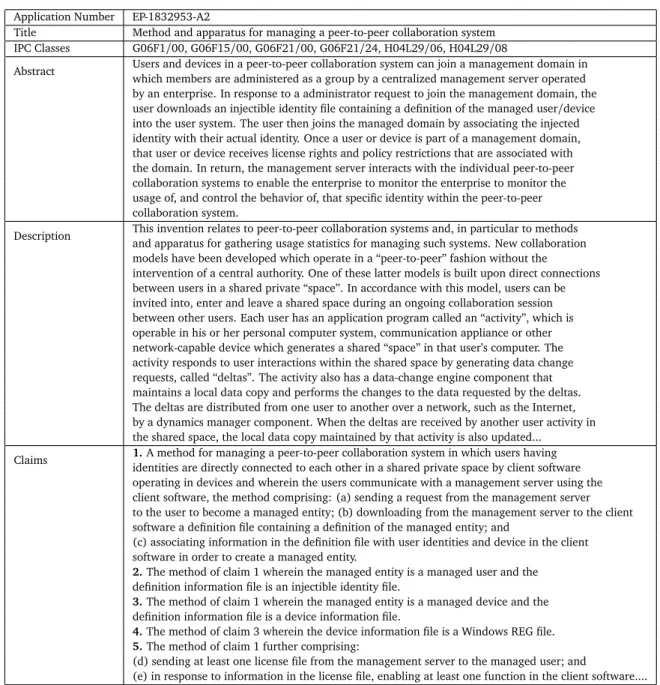
using IEC method . . . 91 7.1 Comparing the query terms selected from topic EP-1832953-A2
and the topic-specific citation graph. . . 99 7.2 Choosing baselines on two retrieval collections. . . 101 7.3 Performance of different citation analysis methods with a cut off
value of 1000. . . 101 7.4 Performance of different citation analysis methods with a cut off
value of 1000. . . 102 7.5 QM-cit2 results over CLEF-IP 2011 dataset with a cut-off value of
1000. . . 105 7.6 Recall, MAP and PRES results over CLEF-IP 2011 dataset with a
cut-off value of 100. . . 106 7.7 Recall, MAP and PRES results over CLEF-IP 2011 dataset with a
cut-off value of 500. . . 107 7.8 Performance of temporal modeling with a cut off value of 1000. . 107 7.9 Evaluation results over test set of CLEF-IP 2010. . . 108 7.10 Evaluation results over test set of CLEF-IP 2011. . . 108
xix Tables
8.1 Performance results of query reformulation approaches on two patent retrieval datasets on the test topics of CLEF-IP 2010 and CLEF-IP 2011. . . 113 8.2 Comparison with the best official results on the English subset of
the test set. . . 115 8.3 The comparison of performance results of PRF and PPRF. . . 115
1
Introduction
“One doesn’t discover new lands without consenting to lose sight, for a very long time, of the shore.”
– Andre Gide
1.1
Introduction
The role of intellectual property in the form of patents is indispensable in the growth of today’s knowledge-based economy where production and services are based on knowledge-intensive activities. This makes the patent information re-trieval an economically important search activity.
A patent is a legal document granted by a state or by a regional office acting for several states, which gives a set of rights of exclusivity and protection to the owner of an invention for a limited period, generally 20 years. The patent allows the inventor to exclude anyone else from making, using, selling, offering for sale, or importing the patented invention [79]. In exchange for this right of exclusivity, the owner of the patent is obliged to disclose the details of the invention to the public as well as the related technical and scientific background of the invention.
Patents are granted by patenting authorities or central offices that are usually part of the national governments in many countries around the world. The pro-cess by which patenting authorities and inventors negotiate toward the terms of a patent is called “patent examination” and is also referred to as “patent prosecu-tion”. Patent examiners, who are employed by a national or regional patenting authority, conduct patent examination.
2 1.1 Introduction
A particular invention needs to meet the following conditions to be granted a patent: novelty, non-obviousness, and utility. The novelty criteria states that an invention must not have been described or used before the filing of a patent application. The non-obviousness criteria requires an invention to not be an obvious combination of existing processes or entities. The final criteria, the utility criteria, demands that a patent can be built and used in practice.
During examination, the patent examiner will perform “prior art search” with the aim of finding public disclosure of the features of the invention, that were available prior to the filing date of a patent application and may invalidate the novelty of a claim. Simply put, all patent and non patent literature that have been published prior to the filing date of a patent application need to be searched with the goal of finding documents that are similar to the patent application.
Both patent applications and granted patents are structured documents with the following fields:
Abstract. This field represents a brief summary of the invention.
Description. This field provides a detailed description of the invention, includ-ing prior work, examples, and related technologies.
Claims. This field presents the legal description of an invention.
Bibliographical data. This field is composed of the title, and the metadata re-lated to the patent document such as the inventors, assignees, agents or applicants, and the relations to other documents.
Patent search is a general term that covers different types of search processes such as technology survey, prior art search, freedom to operate, validity and patent
portfolio search. Different processes in patent search differ in terms of the
un-derlying information need, and the needed search output. The information need can be an idea, a patent application, a claim, or a granted patent. The required output can be one of the following items: a set of patents, a single patent, a set of scientific publications covering a domain, or public documents (i.e. anything that is disclosed to public) [64]. We now present a short description of the dif-ferent tasks in patent search:
3 1.1 Introduction
Technology Survey. In this search process, the input information need is an idea and the output is to obtain a general understanding of the innovation by searching in all public documents.
Prior Art Search. The input information need is a patent application and the search is performed over all public documents until the date of the appli-cation. The purpose of this search is to identify whether a given patent application satisfies the condition for granting. This task is also referred to as Novelty, or Patentability Search.
Freedom to Operate. The information need is about a product and its related technologies. This search is carried out on a set of patents in force in a specific jurisdiction. This process is also called Infringement, Right-to-Use, and Clearance.
Validity. In this search process, the information need is composed of a granted patent and all the public documents prior to the priority date of the patent in question will be searched to identify if a granted patent satisfied the granting criteria at the earliest priority date. Priority date is the moment when a first application was registered for the invention described. Other names for this search process are: Invalidity, Enforcement Readiness, and Opposition.
Patent Portfolio Search. In this search process, the information need is a com-pany, or a technology area. The goal of this search is to obtain a general understanding of the patents, in a specific technology area by looking into all public documents. This search task is referred to as Due Diligence, and Patent Landscape.
Notice, however, that the precise names and definitions of these search processes vary between those who deal with patents, like for example, information special-ists, private patent searchers, patent examiners, and patent lawyers. Chapter 2 will describe the field of information retrieval (IR) in more detail and presents how patent retrieval is related to IR.
In the next section we explain our motivations for pursuing this line of re-search.
4 1.2 Motivation
1.2
Motivation
Although general information retrieval has advanced immensely in the recent years and Web Search engines were revolutionized (by Google), the systems which are in use by the patent search communities do not yet take advantage fully of the advancement in search technologies. More specifically, the Boolean search is still common instead of the ranked retrieval systems[6].
Considering the increase in the number of patent applications, and the long duration of the application process which leads to the big backlogs of patent offices, there is a visible need to change the way the patent information is searched.
In this thesis we focus our attention on the patent prior art search which is a critical step in the examination and evaluation process of a patent application. Prior art search is a challenging task, with different issues when compared to other search tasks, such as web search.
Here we review some of these challenges:
• The first challenge is that the starting point of the prior art search task is a full patent application. In this task the information need is presented by a patent document (comprised of a hundred words) instead of a short web search query (composed of two or three keywords). Therefore, a major challenge is how to transform the patent application into search queries in order to find similar documents.
• A second challenge is related to the vocabulary usage in patent domain which is very unique and far from everyday speech and writing and often contains highly specialized or technical words not found in everyday lan-guage [6]. Writers tend to use many vague terms and expressions along with non-standard terminology in order to avoid narrowing the scope of their claims[9]. This usage of vocabulary by patent writers results in term (vocabulary) mismatch. Term mismatch refers to a situation where two patent documents have few or no keywords in common, while at the same time the idea conveyed in these two patents are similar. In other words, the query words used to search for relevant documents are not exactly the same terms used in the relevant documents. Term mismatch is a common problem in most of information retrieval tasks – due to spelling mistakes, ambiguity of words and different ways of referring to the same concept. However, this problem is exacerbated in patent retrieval because of its ex-ceptional vocabulary.
5 1.3 Research Outline and Questions
• The last issue is related to the fact that patent prior art search is a recall oriented application where the goal is to retrieve all relevant documents at early rank positions as opposed to ad hoc and web search, where the goal is to achieve high precision. In prior art search, the searcher needs to ensure s/he is not missing on any relevant document as infringing on some existing patents might result in a multi-million dollar lawsuit; con-sequently, this search can take a very long time (days or weeks)[54]. We focus on the following properties of patents and propose solutions for integrating them in a retrieval system in order to address the challenges men-tioned previously.
• The first property is linked to the structure of patents. Patent documents are structured documents with different fields such as abstract, descrip-tion, and claims. Patent writers use different style of writing for describing the invention in different fields of patent. For example, the abstract and description use a technical terminology while the claims field uses a legal jargon[107].
• A variety of different techniques have been employed in previous studies for identifying effective query terms, mainly looking into the distribution of term frequency [83, 90]. But, in addition to the textual content of patent documents, there are other rich relevance evidences (e.g. classifi-cation information, bibliographical information) which can be utilized for finding documents relevant to a patent. The second property is related to these dependencies which can be employed for minimizing the term mismatch between a query patent and documents relevant to it[6]. • The last property is related to language evolution over time. Terminology
of technological domains is changing over time; as a result, identifying the vocabulary of different time intervals is helpful to address the term mismatch.
1.3
Research Outline and Questions
The following are the research questions that we tried to address in this thesis. RQ1 How can we estimate a query model from a patent application (query patent) using the different textual fields available in it?
6 1.3 Research Outline and Questions
(I) Which field of the patent application serves as a more effective source for extracting query terms?
(II) Are there any advantages in using phrases in the query representation, in addition to terms (uni-grams)?
(III) For what type of queries can we expect the noun phrases to be more effec-tive?
RQ2 How can we leverage the classification tags (associated to patent docu-ments) to construct a domain dependent lexicon?
More detailed sub-questions are:
(I) Is the IPC conceptual lexicon useful for query expansion?
(II) Is the proximity information between query terms and expansion terms, extracted from the IPC conceptual lexicon, helpful in identifying weights for expansion terms? How can we model such proximity?
(III) What are the best parameters of the kernel function used for modeling proximity information?
RQ3 Could we use the citation links, the content, and the temporal features of the cited documents to expand the initial query model built from the query patent?
We break this general research question into following sub-questions:
(I) Do citation links together with the content of the cited documents improve the performance of the initial query built from the query document? Does employing the temporal features of the query and of the collection result in a more precise query?
(II) What type of document prior is more effective in modeling the decay over time?
RQ4 Is combining different dependencies that are available with the initial query patent helpful for improving the query formulation? Assuming that it is helpful, how can we combine different dependencies to formulate a query?
The remainder of this section discusses how the thesis addresses the above objectives.
7 1.4 Main Contributions
1.4
Main Contributions
In this section we summarize the main contributions of this thesis:
• We investigate different ways of estimating a query model from a query patent utilizing patent-specific characteristics.
• We present a method for predicting whether query expansion using noun phrases (concepts) will improve the retrieval effectiveness in a selective query expansion framework – we extract different features from each query and its initial rank list (both pre and post retrieval features) to predict the quality of queries. We then make a query dependent decision for expan-sion using noun phrases.
• We present an approach to construct a domain-dependent lexicon for iden-tifying query expansion concepts. We develop a proximity-based query ex-pansion method for estimating the probability that an exex-pansion term is relevant to a query term. We also investigate different query reformulation strategies for extracting concepts from a domain-dependent lexicon. • We develop an approach for boosting the initial query model using a
topic-sensitive graph built from the citation links. We propose an approach for exploiting the temporal features of documents in the citation graph in or-der to improve the query representation.
• We present a framework to combine multiple relevance evidences associ-ated with a query patent, namely classification and bibliographic informa-tion.
• We perform experimental evaluation and validate our proposed models on two patent retrieval test collections.
1.5
Thesis Overview
Chapter 2 and 3 of this thesis play the role of introductory chapters to familiar-ize the reader with the field of information retrieval (IR) and the experimental evaluation in the context of IR. This thesis consists of five main research chap-ters, Chapters 4 – 8, each addressing the set of research questions introduced earlier. Finally we present concluding remarks in Chapter 9.
8 1.5 Thesis Overview
Chapter 2. We present an introduction to IR in general and patent prior art search in particular as a specific task which we address in this thesis. We explain the related work in the area of patent retrieval and focus on the challenges that were not properly addressed in previous work.
Chapter 3. We introduce the evaluation methodology and the experimental setup that forms the basis of the empirical evaluations throughout this thesis. The test collections, the set of test queries, and evaluation metrics are introduced in this chapter.
Chapter 4. Next, we present a solution to the patent prior art search prob-lem allowing the user to submit a full patent document as a query and the retrieval system identifying related patent documents from a corpus accordingly. We first define the query generation problem and describe three approaches to estimate the topic of a query patent. We also explore generating queries from different fields of the patent documents. Our con-tribution is to build an effective term selection and weighting technique us-ing a weighted log-likelihood based approach to distus-inguish words which are both indicative of the topic of the query and are not extensively used in the collection. We also investigate query modeling based on the Par-simonious Language Model for estimating a query model from the query patent. Furthermore, we utilize the knowledge embedded in IPC classes. This addresses the vocabulary mismatch as we include words in the query which are not present in the query topic itself.
This chapter provides answer to sub-question RQ1.(I).
Chapter 5. We propose a technique to process patent documents and extract terms and key phrases in order to form a query to retrieve relevant docu-ments from the patent corpus. This approach refines the initial query by expanding it with selected key concepts (i.e., bi-grams or phrases) from the query patent using the global analysis of the patent collection. Query expansion using noun phrases is not consistently beneficial for all queries, as sometimes the expansion candidates are not associated with the main aspect of the query. For example, for a patent application related to “wa-ter filtration”, the selected expansion candidates are “removing fil“wa-ters”, “continuous pores” and “integrating bag” which are focused on the partial aspects (subtopics) of the query while the main aspect of the topic related to “filter material” (such as carbon and/or ceramic) is neglected. We thus decided to perform query expansion in a query dependent manner to
guar-9 1.5 Thesis Overview
antee the inclusion of expansion candidates related to the main aspect of the topic to guarantee a profitable expansion.
In this chapter we propose a method for distinguishing between queries and deciding when to selectively use the result of a refinement technique that is likely to improve the retrieval performance. Our goal is to iden-tify queries that have highly positive changes in query performance using refinement. To this end, we use query performance predictors (pre and post-retrieval)[4, 26, 48, 104] and patent-specific features in order to find highly performing queries in the expanded retrieval rank list. To the best of our knowledge no previous work has used query performance predictors in the patent domain. To decide when to use the result of the expanded list, we rely on a machine learning approach that tries to predict which one of two competing approaches will offer the best result for a given query. This chapter provides answer to subquestions RQ1.(II) and RQ1.(III). Chapter 6. Here, our aim is to address the term mismatch problem by
tak-ing advantage of IPC classifications which categorize patent documents by topics. A simple analogy can be made between IPC classes and tags associ-ated to news articles or tweets. We are interested to use IPC classification tags to improve the representation of the query. These IPC classifications are assigned to a patent document in the patent office before the prior art search. Thus, they can be exploited at the time of prior art search.
Definition of IPC classes consists of the explanations regarding each IPC class. This vocabulary serves as an established and accepted terminology among the practitioners in the domain, shared between examiners and inventors. In this chapter, our aim is to address the term mismatch prob-lem by taking advantage of the established terminology of IPC classes and identify related terminology to the important topics and subtopics of the query.
The language of the patent documents uses a less standard terminology, compared to the terminology of IPC definitions. The reason is related to the frequent usage of non-standardized acronyms which are invented by patent applicants, the presence of homonyms (the same word referring to two or more different entities), such as bus1 and closet2, and synonyms (i.e. signal and wave). Paraphrasing is another source of term mismatch, where a re-wording is used to express the meaning of a concept with a
1i) motor vehicle, ii) an electronic subsystem transferring plurality of digits bits in group. 2i) water closet (flush toilet), ii) a small cupboard used for storing things.
10 1.5 Thesis Overview
greater clarity (for example “a drink sucking hollow plastic tube” is used to refer to “straw”).
We propose a proximity-based query propagation method to calculate the query term density at each point in the document. We then use term prox-imity information to calculate reliable importance weights for the expan-sion concepts. Our proximity-based framework incorporates positional in-formation into the estimation of importance of expansion concepts so that we can reward expansion concepts occurring close to query terms. This way we can concentrate on the terms that are associated with the query terms and avoid the topic drift which is caused by taking into account irrelevant terms.
RQ2 is addressed in this chapter.
Chapter 7. Next, we focus on taking advantage of the citation links – similar to hyper links in the web – between patent documents in the collection to improve the term mismatch problem. We look into temporal information to adapt to the change of the language in the cited documents over time. We first perform a citation link analysis over the patent citation graph using Page Rank method to identify important documents, which could influence their domain terminology. The assumption is that if a patent is cited by a large number of documents, the cited patent is possibly a foundation of the citing patents and is considered influential on other patents. As a result of its impact, its language might be useful to bridge the gap between the query and its relevant documents.
We are interested to improve term mismatch solutions by tapping the power of the community of inventors related to the subject of the inven-tion of the query. In other words, through citainven-tion link analysis we identify a set of terms which are relevant to a given query document and can be exploited for improving the original ranking to find documents that do not contain the exact wording of the query patent.
In order to consider the dynamic nature of the patent citation network and recognize the new influential nodes which are added to the network but have not stayed long enough to accumulate sufficient links, we parametrize the random walk with a time factor. We do this by considering the tem-poral order of the nodes in the citation network. We discount the initial probability of selecting a node as the seed of the Page Rank algorithm ac-cording to some temporal decay factor. To the best of our knowledge, there
11 1.6 Publications
has been little or no work on using temporal information for modeling the change of the vocabulary over time in the patent domain.
RQ3 is addressed in this chapter.
Chapter 8. We propose a unified framework to take advantage of all dependen-cies associated to a query patent such as IPC classifications, citation links, the content and the temporal features of the cited documents to enhance the initial query representation estimated from a query patent.
RQ4 is addressed in this chapter.
Chapter 9. In the final chapter, we report the conclusions and list possible future directions.
1.6
Publications
This thesis is based on several published works. Chapter 4 which estimates query models using the query patent document (patent application) is based on the following works:
• Mahdabi, P., Keikha, M., Gerani, S., Landoni, M., and Crestani, F. Building Queries for Prior Art Search. Proceedings of Information Retrieval Facility
Conference, pp. 3-15, 2011.
• Mahdabi, P., Andersson, L., Hanbury, A., and Crestani, F., Report on the CLEF-IP 2011 Experiments: Exploring Patent Summarization. In
Confer-ence on Multilingual and Multimodal Information Access Evaluation (CLEF 2011)
Chapter 5 which presents a selective query expansion framework using noun phrases is based on the following studies:
• Mahdabi, P., Andersson, L., Keikha, M., and Crestani, F. Automatic refine-ment of Patent Queries using Concept Importance Predictors, Proceedings
of International ACM SIGIR Conference on Research and Development in
In-formation Retrieval, pp. 505-514, 2012.
• Mahdabi, P. and Crestani, F. Learning-Based Pseudo-Relevance Feedback for Patent Retrieval. Proceedings of Information Retrieval Facility
12 1.6 Publications
The proximity-based framework for query expansion which uses an IPC lexicon presented in Chapter 6 is described in:
• Mahdabi, P., Gerani, S., Huang, J., and Crestani, F. Leveraging Conceptual Lexicon: Query Disambiguation using Proximity Information for Patent Retrieval, Proceedings of International ACM SIGIR Conference on Research
and Development in Information Retrieval, pp. 113-122, 2013.
Chapter 7 which presents the work on using citation information (extracted from the top-ranked documents of an initial rank list) for query expansion is based on the following study:
• Mahdabi, P. and Crestani, F. The Effect of Citation Analysis on Query Ex-pansion for Patent Retrieval, Information Retrieval Journal.
Chapter 8 which presents the work on combining different sources of relevance evidence for query expansion is based on the following work:
• Mahdabi, P. and Crestani, F. Patent Query Formulation by Synthesizing Multiple Sources of Relevance Evidence, ACM Transaction on Information
Systems.
This thesis also includes material that is under review and thus we do not mention it here.
2
Related work
“I believe that reading and writing are the most nourishing forms of med-itation anyone has so far found. By reading the writings of the most interesting minds in history, we meditate with our own minds and theirs as well. This to me is a miracle.”
– Kurt Vonnegut
2.1
Introduction
In this chapter we introduce the previous work on which this thesis is based. The baseline approaches for prior art search, presented in Section 2.6, are most immediately relevant. However, we build related material in several steps. We start this chapter by recalling the basic concepts and terminology of IR in Sec-tion 2.2, to which we refer throughout this thesis. Then, we take a closer look at Language Modeling for IR in Section 2.3. Next, we discuss query transformation methods (such as query expansion) and review the importance of query trans-formation in different IR tasks in Section 2.4. Then, we describe query quality prediction approaches in Section 2.5 and, Finally, in Section 2.6, we describe the existing work on patent prior art search.
2.2
Information Retrieval
Users require information when performing particular tasks. The motivation for a person to use a search engine is described as the information need. Information Retrieval (IR) is a branch of computer science whose goal is to provide effective
14 2.2 Information Retrieval
models for matching user’s expression of their information need with relevant information in a collection of documents, or other data. The information need is not observed by IR models directly; instead, an IR system receives an expression of the user’s information need, called a query. According to Belkin, a query may be a non-specific, imprecise, and incomplete description of the user’s information need [10]. We call a document that satisfies an information need, relevant. A retrieval model scores the documents in the collection, providing a list of relevant documents and preferably ranking them according to some measure denoting how well the query is matched to the information in the documents.
The first popular retrieval models were Boolean systems. These did not gen-erate a ranking; instead, they returned a set of documents fulfilling a Boolean query. Later, the Vector Space Model (VSM)[92] was introduced by Salton et. al which was first implemented and used in the SMART system [40]. VSM was the basis of the research in IR in its early days and the research was focused on textual documents, mainly books and journals, for library applications.
In the VSM, queries and documents are represented by vectors, where each dimension in the vector corresponds to a separate term [92]. The similarity between vectors is defined using a distance measure. The most commonly used distance measure is based on the cosine of the angle between vectors. Each component of a vector goes beyond binary values (non-zero values for denoting term occurrence in a document) and can take statistical information such as term frequency (TF) and inverse document frequency (IDF). The TF of a term in a document is defined as the relative frequency of occurrence of that term in the document. IDF is defined as the log of the inverse of the relative frequency of occurrence of a term in the entire collection.
Traditional notion of relevance[22] centered on topicality (aboutness) also relies on TF and IDF; in fact, these term weightings are in common use in most retrieval models nowadays. The idea behind these weight representations is that documents with a high TF for a term are more likely to be relevant to queries containing this term. Moreover, terms that are infrequent in the collection have more discriminative power and are the ones that describe better the information content. Therefore a common weighting scheme called TF/IDF, a simple com-bination of the two weighting schema, was introduced in [92]. VSM was the first model to provide a rank list of search results for a query. The disadvantage of VSM model was that it could not specifically explain how these weighting schema and ranking algorithm were related to relevance.
The first work that encouraged the development of probabilistic retrieval model was Probability Ranking Principle (PRP) proposed by Robertson and Spärk Jones [86, 87], in which documents are ranked by their decreasing probability
15 2.3 Statistical Language Models for IR
of relevance to the user who submitted the request. They introduce assumptions such as the relevance of a document to a query being independent of other doc-uments. However, they did not explain how to estimate this probability and it is only later works that proposed methods for estimating this probability [88]. The Okapi team developed an extended version of the PRP model, which makes use of term frequency (TF), inverse document frequency (IDF), and document length. This model which became mainstream is now commonly known as (Okapi) BM25 [55]. This model performed very well in TREC1 retrieval
ex-periments and has influenced the ranking algorithms of both commercial and web search engines.
A relatively new model, known as language modeling (LM), appeared in the late 1990’s. The success of statistical language models in improving tasks in a variety of natural language processing and understanding applications such as speech recognition [53] generated considerable interest among IR researchers. They thus borrowed this notion to represent the document retrieval in a gener-ative probabilistic framework. In such a framework documents are represented as generative probabilistic models. This model is now commonly used and in fact, most of the work in this thesis is inspired by LM. We thus will take a closer look at LM in the next section.
2.3
Statistical Language Models for IR
The simplest form of language model, known as uni-gram language model, as-signs probabilities to every words in the vocabulary for a collection by means of a probability distribution[84]. This model does not capture the influence of the words before or after the target. This leads to a bag of words model and turns out to generate a multinomial distribution over words. The multinomial model explicitly captures the frequency of occurrence of a term.
In applications such as speech recognition, word prediction is based on longer sequences, which are called n-gram language models [56]. An n-gram model predicts a word based on the previous n− 1 words. The most common n-gram models are bi-grams or tri-grams models where prediction is based on the pre-vious word or the two prepre-vious words, respectively. N-gram models can be used to compute the probability of observing a sequence of terms, by calculating the product of the probabilities of observing individual terms. That is, they can tell which possible output word sequences are more probable than others. We will focus our discussion on uni-grams as they are simpler (considering the huge size
16 2.3 Statistical Language Models for IR
of textual collections) and proven to be very effective as the basis for ranking algorithms.
2.3.1
Query Likelihood Model
In the query likelihood retrieval model, retrieved documents are ranked based on the probability that the document language model would generate the terms of the query[24]. Starting with a query Q, we would like to calculate P(D|Q) to rank the documents. Using Bayes’ Rule, we can calculate this by
Score(Q, D) = P(D|Q) =rankP(Q|D)P(D) (2.1)
where D is a document and the symbol =r ank means that the right-hand side
is rank equivalent to the left-hand side, ignoring the normalization value P(Q) which is the same for all the documents. It is common to assume that the docu-ment prior P(D) is uniform, the same for all docudocu-ments, and therefore it is safely ignored too.
Documents are then ranked by P(Q|D) (the probability that a query is ob-served as a random sample from the document model). P(Q|D) is calculated using a multinomial uni-gram language model for the document, considering a simplifying independence assumption between terms in the query:
P(Q|D) =Y
q∈Q
P(q|D)f(q,Q) (2.2)
where q denotes a query word and f(q,Q) indicates the frequency of word q in Q. As multiplying small numbers can cause arithmetic underflow, we use logarithms instead.
log P(Q|D) =X
q∈Q
f(q,Q) log P(q|D) (2.3)
Maximum likelihood estimates, for multinomial distributions, are commonly
used to estimate a document’s generative language model as follows:
P(q|D) = f(q, D)
|D| (2.4)
where |D| denotes the length of document D and f (q, D) indicates the fre-quency of term q in D. Maximum likelihood (ML) is the estimate that makes the observed value of f(q, D) most likely. In a maximum likelihood estimate,
17 2.3 Statistical Language Models for IR
unseen events (terms that do not appear in the document) receive zero proba-bility. Smoothing techniques play an indispensable role to avoid data sparsity problem while calculating ML estimate. Smoothing techniques [21, 112] (e.g. Laplace, and Good Turing) accounts for unseen words by discounting the prob-ability mass of seen words either from the document or from the collection. An-other type of commonly used smoothing in IR is Jelink-Mercer smoothing which is an interpolation-based smoothing. It considers documents to be a mixture of a document-specific model and a more general background model. The latter is usually estimated based on a sufficiently large collection C.
P(t|θD) = λP(t|D) + (1 − λ)P(t|C) (2.5) whereλ denotes the interpolation coefficient and P(t|C) = f(t,C)
|C| .|C| is the total
number of words in the collection. So far, Bayesian smoothing using a Dirichlet
priorhas been shown to be the most effective on different IR tasks[112], this is
its formulation:
P(t|θD) = |D|
|D| + µP(t|D) +
µ
|D| + µP(t|C) (2.6) whereµ is a hyper parameter that controls the level of smoothing – it is typically set to the average document length of documents in the collection.
Various extensions of language models have been introduced in the liter-ature. We will discuss two of them that will be used later on in this thesis. In [51], Hiemstra et al. introduced a variation of language modeling called the Parsimonious Language Model, where they used an Expectation Maximization based algorithm which takes away probability mass from frequent terms in the general English and gives it instead to terms that are rare in a document.
In[66], the authors proposed a unified language modeling framework called Positional Language Model (PLM), which implements two retrieval heuristics, proximity and passage retrieval. The proximity heuristic rewards a document where the matched query terms occur close to each other. The passage retrieval heuristic scores a document mainly based on the best matching passage. They achieve this goal by defining a language model for each position in a document and score a document based on the score of its PLMs. Each PLM is estimated based on a density kernel function[30] which captures proximity heuristics and achieves an effect similar to passage retrieval.
2.3.2
Relevance Models
The basic query likelihood model can be extended to incorporate information about relevant documents while modeling the query and information need. We
18 2.4 Query Transformation
call this a query language model relevance model as it represents the topic cov-ered in relevant documents. If we can estimate a relevance model from a query, we can directly compare this language model with the document model. We can then rank documents according to the topical similarity between the docu-ment model and the relevance model. A (non-symmetric) measure of difference between two probability distributions called, Kullback-Leibler divergence (KL di-vergence) has been borrowed from probability theory and information theory. Given a true (reference) probability distribution P and another distribution Q, which is an approximation of P, KL divergence is defined as follows:
K L(P||Q) =X
x
P(x) log P(x)
Q(x) (2.7)
divergence is always a non-negative value. The larger the value of the KL-divergence, the bigger the difference between the two probability distributions, and equal distributions receive zero divergence value. As we would like to assign a high score for highly similar documents and a low score for less similar ones, thus, the negative KL-divergence has been used for ranking in LM[24]:
X
t∈V
P(t|R) log P(t|D) −X
t∈V
P(t|R) log P(t|R) (2.8) where the relevance model for query (R) is the true distribution and the doc-ument language model (D) represents the approximation. The summation is done over all terms t in the vocabulary V .
2.4
Query Transformation
As mentioned earlier, query is a vague formulation of the user’s underlying in-formation need. In order to improve the query model and better represent the underlying information need, IR researchers proposed a variety of query
trans-formation techniques. The primary goal of query transformation approaches is
to improve the retrieval performance and the ranking presented to the user as the result of the submitted query to the search system by changing the query representation[23]. Query transformation is also referred to as query modeling,
query reformulation, or query refinement in the literature.
Query transformation is composed of two stages: the first processing stage alters the query at a morphological level (e.g., tokenization, spelling corrections, and stemming); the second stage works on the output of the first stage and modifies the query at a structural level [12]. Modifications in the second stage
19 2.4 Query Transformation
include, query expansion using related terms[103], identifying key concepts and re-weighting query terms[11], rewriting the query and substituting terms [29], to mention a few. Query expansion is a popular method of query transformation which help addressing the term mismatch problem by adding and re-weighting query terms. Term mismatch is a scenario where matching the query with the relevant documents is hampered, as the terms used in the query are different than those used in the relevant documents.
Query expansion approaches are classified into three main groups: pseudo,
explicit, and implicit relevance feedback, depending on how the relevant
infor-mation sources are acquired. A popular form of query expansion is called pseudo
relevance feedback (PRF) where the top ranked documents in the initial result of
a query (called feedback documents) are assumed to be relevant and are used to locate additional query terms[106]. Explicit relevance feedback uses explicit relevance assessment provided by the user [43]. Implicit relevance feedback, on the other hand, uses query logs [28] to infer the behavior of the user from the low-level user interactions with the search interface, which is logged as click data. Another common approach is to use resources such as thesauri and con-trolled vocabularies[13], or external corpora [33] as another source for query expansion. The latter approach permits the calculation of collection independent statistics.
Recently, machine learning approaches have been employed to improve the selection of terms and documents in query expansion. Cao et al. proposed to refine PRF at a term level [17]. They use a Support Vector Machine (SVM) to select good expansion terms using a set of term-level features such as the prox-imity of an expansion term and an original query term, or the co-occurrences of an expansion term and an original query term in the collection. He and Ounis proposed a method to improve PRF by choosing the right documents for rel-evance feedback [50] among top-ranked documents. Their goal is to predict which feedback documents are of better quality for query expansion, instead of assuming all top-ranked documents to be relevant (the simplifying assumption of PRF). They apply Naïve Bayes classification and Logistic Regression to classify feedback documents. They use document-level features such as the distribution of query terms in the feedback document and all the top-ranked documents or the proximity between the expansion terms and the original query terms in the feedback document.
20 2.5 Query Performance Prediction
2.5
Query Performance Prediction
Query performance prediction approaches estimate the effectiveness of a search performed in response to a query without any relevance judgements[18]. Such predictors are classified into two groups:
1. Pre-retrieval predictor methods: this category analyzes the query expres-sion before search is performed[26, 45, 48, 77]. This category of methods look into available information at query time including linguistic features, statistical properties of the query-terms distribution, and the collection-based statistics. The Clarity score[26], measures the degree of ambiguity of a query with respect to a collection of documents by computing the relative entropy between a query language model and the collection lan-guage model. The resulting score measures the dissimilarity between the language usage associated with the query and the generic language of the collection as a whole.
2. Post-retrieval predictor methods: this group of methods analyzes the top ranked documents from the result list as a response to a query. The Clarity score reappears in this category too, as it can be used to estimate the focus of the result list with respect to the corpus, as measured by the KL-divergence between their induced language models. Variants of the Clarity score are proposed for improving prediction performance[19, 25, 46]. Query performance predictors are usually evaluated by reporting correlation coefficients to denote how well the methods perform at predicting the retrieval performance of a set of queries[47, 48]. Query performance predictors are used to predict queries that have highly negative changes in Average Precision after query expansion, using a score that does not depend on relevance information, in order to improve the retrieval effectiveness in a selective query expansion framework[4, 25, 104]. These predictors can be used alone or in a combination to predict the effectiveness of a rank list (e.g. Average Precision).
2.6
Patent Prior Art Search
Patent prior art search is composed of a search over available patent and non-patent data (prior to the filing date of a non-patent application) with the goal of retrieving similar documents, which describe the prior art work of a patent ap-plication, (henceforth referred to as query patent). The challenges of patent
21 2.6 Patent Prior Art Search
prior art search are different from those of standard ad hoc text and web search. These differences are categorized below:
• The first distinguishing property of prior art search compared to standard information retrieval tasks (such as web search) is that the information need is presented by a patent document rather than short queries [107]. The challenge here is how to reduce a query patent which comes with a rich set of metadata, in order to find a single focused information need and to remove the ambiguous and noisy terms. In previous work, re-searchers explored different fields of the query patent to perform query reduction [20, 107]. Some of the previous work reported that effective queries were built from the entire query patent[20]; others obtained bet-ter results using single fields such as the “background summary”[107]. It is worth mentioning that the “background summary” field is specific to US patents.
• The second distinct property of patent retrieval is related to the terminol-ogy of patents which contains highly specialized and/or technical words not found in everyday language [54]. It also contains exceptional (cre-ative) vocabulary, curious grammatical constructions, regulatory, and le-gal requirements[6]. These inherent properties lead to an overwhelming term (vocabulary) mismatch. For example one patent document may con-tain few or no keywords in common with the query patent, but the idea conveyed in it might be quite similar or even identical to the query patent – one possible reason is paraphrasing[6]. As a result, the retrieval problem is exacerbated and standard search systems may be confused. One possi-ble solution for this propossi-blem is query disambiguation. Previous work used different external resources for query expansion such as Wikipedia [63] and WordNet[69] with the goal of query disambiguation. The goal here is to alleviate the term mismatch problem by expanding the query with topically related words or synonyms of the query terms.
• The third property is related to the fact that patent prior art search is a recall oriented application where the goal is to retrieve all relevant doc-uments at considerably early rank positions. Ad hoc and web search, on the other hand have the goal of retrieving only a few relevant documents at the top of a ranking and thus achieving high precision [8]. In a prior art search scenario even missing one relevant patent can lead to a multi-million Euro law suit due to patent infringement, and so a high recall is demanded in this type of search.
22 2.6 Patent Prior Art Search
In this chapter, we first survey different approaches for query formulation in Sec-tion 2.6.1 and describe how the textual secSec-tions of the patent and the metadata associated to the patent document such as classification are used for query refor-mulation. We then describe different approaches that use external knowledge bases and proximity information in Section 2.6.2. Then, in Section 2.6.3 we present different techniques that consider patent citation information. Finally, in Section 2.6.4, we explain the evaluation metric designed for patent retrieval.
2.6.1
Query Formulation for Patent Retrieval
The main line of research in patent retrieval started after the third NTCIR work-shop in 2003 [52], where a few test collections were released. Starting from the fourth NTCIR workshop in 2004 [36], a search task was presented called “invalidity search run”. The goal was to find documents prior to the filing date of a particular granted patent which conflict with the claimed invention. The citation parts of the applications were removed and counted as ground truth. Participants used different term weighting methods for query generation from the claims field.
In [95] the authors studied the rhetorical structure of a claim (an item in the claims field). They segmented a claim into multiple components, each of which was used to produce an initial query. They then searched for candidate documents on a component by component basis. Similar work was introduced in [74] where the authors analyzed the structure of claims field to enhance retrieval effectiveness. The structure of each item of claims usually consists of the premise and invention parts, which describes existing and new technologies, respectively. The authors proposed a two stage process where they first extract a query from the premise to increase the recall. They then aim to increase the precision by extracting another query from the invention part. The final relevance score of each document was calculated by merging the scores of both stages.
A recent line of work advocated the use of the full patent application as the query to reduce the burden on patent examiners. This direction was initiated by Xue and Croft[107], who conducted a series of experiments in order to examine the effect of different patent fields on the query formulation and concluded with the observation that the best Mean Average Precision (MAP) is achieved using the text from the “background summary” field of the query patent.
23 2.6 Patent Prior Art Search
Property task within the CLEF2initiative. Several teams participated in prior art search task of the CLEF-IP 2010 and proposed approaches to reduce the query patent by extracting a set of key terms from it. Different participating teams experimented with term distribution analysis in a language modeling frame-work and employed the document structure of the patent documents in various ways [83]. Here, we only discuss in detail the two best performing approaches in the CLEF-IP 2010. Lopez et al. [63] constructed a small corpus by exploiting the citation structure and IPC metadata. They then performed retrieval over this initial corpus. In[70] Magdy et al. generated the query out of the most frequent uni-grams and bi-grams. In this work the effect of using bi-grams in query gen-eration was studied but the improvement was not significant. This is perhaps because of the unusual vocabulary usage in the patent domain.
So far, one of the most comprehensive descriptions of the problems and pos-sible solutions for prior art search is presented by Magdy and Lopez [72]. The authors showed that the best performing run of CLEF-IP 2010 [63] used cita-tions extracted by training a Conditional Random Field (CRF). The second best run [70] used a list of citations extracted from the patent numbers within the description field of patent queries. They also showed that the best run em-ployed sophisticated retrieval methods using two complementary indices, one constructed by extracting terms from the patent collection and the other built from external resources such as Wikipedia. They compared these approaches and concluded that the second best run achieves a statistically indistinguishable performance compared to the best run when initial citations are provided with the query patent.
Many CLEF-IP and NTCIR participants used classification information as an extra feature besides the content of the patent. Thus, a different range of meth-ods for combining text content and classification information were proposed. A standard way of combining the classification information is to consider it as a metadata and use it to filter the search results [41, 44, 73, 95, 99, 102]. This helps to filter out classifications that are too general or not related to the subject area of the query patent. Conclusive results are reported with respect to the use-fulness of filtering using classification information. In[37] the authors integrate IPC codes into a probabilistic retrieval model, employing the IPC codes for esti-mating the document prior. A different usage of IPC classification has been per-formed in[31]. They used the classification information to extract query terms from triples specific to an IPC class. To do this, they used LCS software [59] which builds class profiles representing the term distribution (word and