HAL Id: hal-02482614
https://hal.archives-ouvertes.fr/hal-02482614
Submitted on 18 Feb 2020
HAL is a multi-disciplinary open access
archive for the deposit and dissemination of
sci-entific research documents, whether they are
pub-lished or not. The documents may come from
teaching and research institutions in France or
abroad, or from public or private research centers.
L’archive ouverte pluridisciplinaire HAL, est
destinée au dépôt et à la diffusion de documents
scientifiques de niveau recherche, publiés ou non,
émanant des établissements d’enseignement et de
recherche français ou étrangers, des laboratoires
publics ou privés.
Apollonian Packing in Polydisperse Emulsions
Sylvie Kwok, Robert Botet, Lewis Sharpnack, Bernard Cabane
To cite this version:
Sylvie Kwok, Robert Botet, Lewis Sharpnack, Bernard Cabane. Apollonian Packing in Polydisperse
Emulsions. Soft Matter, Royal Society of Chemistry, In press. �hal-02482614�
Sylvie Kwok∗
CBI, ESPCI, CNRS, PSL University, 75005 Paris, France
Robert Botet
Physique des Solides, CNRS UMR 8502, Univ. Paris-Saclay, Univ. Paris-Sud, 91405 Orsay, France
Lewis Sharpnack
ESRF-The European Synchrotron, CS40220, 38043 Grenoble Cedex 9, France
Bernard Cabane
CBI, ESPCI, CNRS, PSL University, 75005 Paris, France. (Dated: September 4, 2019)
We have discovered the existence of polydisperse High Internal-Phase-Ratio Emulsions (HIPE) in which the internal-phase droplets, present at 95% volume fraction, remain spherical and orga-nize themselves in the available space according to Apollonian packing rules. These polydisperse HIPE are formed during emulsification of surfactant-poor compositions of oil-surfactant-water two-phase systems. Their droplet size-distributions evolve spontaneously towards power laws with the Apollonian exponent. Small-Angle X-Ray Scattering performed on aged HIPEs demonstrated that the droplet packing structure coincided with that of a numerically simulated Random Apollonian Packing. We argue that these peculiar, space-filling assemblies are a result of coalescence and frag-mentation processes obeying simple geometrical rules of conserving total volume and minimizing surface area.
PACS numbers: 64.70.pv, 64.75.Yz, 61.43.Hv, 61.05.cf
High Internal-Phase-Ratio Emulsions (HIPE) [1–4] are coarse, long-lasting mixtures of non-miscible liquids in which the internal-phase droplets (e.g. oil) occupy a vol-ume fraction higher than 74%, and are separated by an outer continuous phase (e.g. water + surfactant). These extremely concentrated emulsions were described over a century ago [5], and have since been patented by indus-trial researchers for applications such as safety and rocket fuel, oil recovery fracturing fluids, and foam and latex production [6–11].
Until now, HIPEs have typically been made with a very high concentration of surfactant in the continu-ous phase (14 to 20%, if the surfactant is non-ionic) [1, 12, 13]. Under such conditions, it is relatively easy, using processes inspired by the classical mayon-naise recipe [14], to obtain HIPE in which the inner phase droplets are nearly monodisperse in their diam-eters [1, 12, 15]. As their volume fraction increases, the inner-phase droplets remain separated by continuous films of the outer phase, but they become non-spherical with beautiful polyhedral shapes such as rhomboedra, dodecahedra and tetrakaidecahedra packed with short-range order [1, 4, 16]. The surface tension of the inter-connected surfactant films causes these HIPEs to behave like elastic solids, since any displacement of a droplet requires the stretching of this film network. Mason et al. likewise observed the same rheological / mechanical behavior through the clever use of polymer dialysis to impose very high osmotic pressure on a HIPE in order to attain 97% volume fraction [17, 18].
In the present work, we show that another class of HIPEs exists, which have completely different structures and properties. They are obtained when surfactant avail-ability is reduced. Indeed, in the experiments reported here, the aqueous concentration (w/w) of surfactant in the continuous phase was only 0.6%. Surprisingly, these HIPEs flow under the effect of very weak forces such as gravity. When swollen by excess continuous phase, they simply become regular oil-in-water emulsions, characterized by a power-law droplet-size distribution. Such extreme polydispersity causes the structure of the HIPEs to exhibit scale invariance instead of the short-range order in monodisperse emulsions. According to X-ray scattering, the relative positions of droplets match an Apollonian construction, where the interstice between droplets are occupied by even smaller ones (of the largest size possible). This is particularly curious because it has long been believed in the domain of concentrated colloidal science that “this peculiar kind of heterodispersity will rarely, if ever, be encountered” [19] due to the need to fabricate a very large number of droplets of different sizes.
Each HIPE was made with the non-ionic surfactant, hexaethylene glycol monododecyl ether (C12E6), water
and mineral oil. C12E6 was diluted in Millipore Milli-Q
water to 0.6% (w/w) to constitute the HIPE’s continu-ous phase. Oil was then added dropwise under constant shearing from a 4-bladed propeller stirrer. To avoid emul-sion inveremul-sion, a new oil drop was introduced only after
2
FIG. 1. Optical microscope photos of HIPE at large volume fractions (φ ' 0.9). Depending on the surfactant concentra-tion in the continuous phase, the oil droplets have different shapes: polyhedral at 20% surfactant (left); polyhedral (small droplets) and round (large droplets) at 5% surfactant (mid-dle); spherical at 0.6% surfactant (right). The size of each photo is 20µm, 50µm, and 250µm, respectively. The droplets < 1µm could not be resolved under the optical microscope.
the previous one had been homogeneously dispersed. FIG.1 presents optical microscopy images of three HIPEs at the same internal phase ratio φ = 0.95 – the oil droplets occupy 95% of the total volume, and the continuous aqueous phase only 5% – with decreasing amounts of surfactant. The left panel shows a classical HIPE in which the continuous phase contains 20% surfactant; the packing is an assembly of distorted micrometer-sized polyhedral oil droplets. In the central panel, the surfactant concentration in the continuous phase is reduced to 5%; the assembly has a hybrid tex-ture in which large nearly spherical drops are dispersed in an array of much smaller polyhedral droplets. The right panel shows a HIPE in which the surfactant is reduced to 0.6% in the continuous phase; the larger oil droplets are perfectly spherical whereas the smaller ones are too small to be resolved.
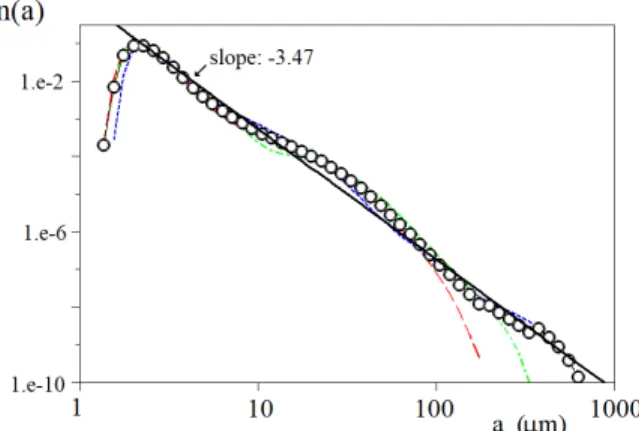
We subsequently focused on the droplet-size distri-bution and analyzed correlations between neighboring droplets in the HIPE made at the lowest surfactant con-centration. To quantify the droplet-size distribution, we diluted the sample in excess continuous phase and used Dynamic Light Scattering. FIG.2 shows that the distri-bution, n(a), is well fitted by a power law within a defined range of diameters:
n(a) ∝ 1/adf+1 , (1)
where a is the oil droplet diameter. From the expo-nent of the power law, we may deduce df, the fractal
dimension characterizing the interfaces formed by the droplets. Regardless of their initial state (as given by dif-ferent shearing conditions during emulsification), these HIPE acquired a power-law diameter-distribution with df = 2.48 − 2.50, after they had been left to stand for
a month. These values are particularly interesting be-cause variants of the Random Apollonian Packing model have been reported to lead to the same diameter distri-bution (1) with comparable value of the fractal
dimen-FIG. 2. (color online) Droplet-diameter distribution in a surfactant-poor HIPE at φ = 0.95, measured by Dynamic Light Scattering (Malvern Mastersizer 3000), expressed in double-logarithmic scales to highlight any power-law behav-ior. The plotted slope of log n(a) vs log a gives relation (1). The solid line representing a theoretical slope of −3.47 (cor-responding to df = 2.47) is drawn as a guide. Three samples
were prepared under different shearing conditions: at 200rpm, 500rpm and 1000rpm (blue dotted, green dot-dashed, red dashed respectively). The open circles represent the values of the droplet-diameter distribution averaged over the three samples.
sion values (df = 2.45 − 2.52 [20–23]). The process of
filling all available space with only spheres of varying sizes is named after Apollonius of Perga, a Greek geome-ter and astronomer, who famously solved 2000 years ago the problem of finding all cotangent circles to three pre-existing circles [24]. The Random Apollonian geometrical construction begins with an initial system of a few ran-domly dispersed spheres, and space is progressively filled as new spheres (the biggest possible at each step) are suc-cessively found and added one after another to occupy remaining voids in the packing. In the field of numerical simulation, several different algorithms exist to maximize the size of these newly added spheres at each iteration step [20–23]. The resulting size-distribution for the dens-est packing of these spheres expresses as a power law (1) over an ever-increasing range of diameters (amin, amax)
[25]. In the limit of an infinite number of iterations, the interface formed by the spheres is eventually fractal in nature [26] and characterized by the fractal dimension, df .
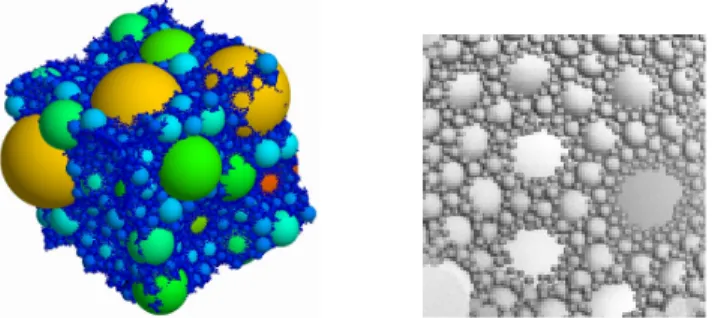
To visualize the spatial arrangement of oil droplets in our HIPEs, we numerically simulated a dispersion (FIG.3) that possessed the same droplet-diameter distri-bution (therefore the same fractal dimension and same ratio amin/amax between the smallest and the largest
di-ameter) and inner-phase volume fraction φ. We then computed the Small Angle X-ray Scattering (SAXS) spectra for this model dispersion, and we compared them to the HIPEs’ experimentally measured spectra.
We use here a 3D Osculatory Random Apollonian Packing (ORAP) process as a generic algorithm to
FIG. 3. (color online) A disordered Apollonian packing of 32 000 spheres, φ = 0.92, in a cubic box with periodic bound-ary conditions, generated by the ORAP algorithm. Colors represent the sphere sizes (from red for the largest spheres to blue for the smallest ones). Right: part of a sliced representa-tion of the same system (in shades of grey), to compare with the experimental image shown in the FIG.1, right.
construct disordered Apollonian packing of spheres. In an ORAP, a location is chosen randomly inside the voids in the packing. A candidate sphere is then centered upon this point such that it is tangent to the neighboring spheres constituting the void. To be physically realistic in the context of emulsions where liquid colloidal droplets may undergo displacements in order to find optimal positions for retaining their spherical shape, we chose an algorithm based on the method described in [23] where the authors explored alternative positions in the local void occupied by the newly-added candidate sphere until said sphere has achieved its largest possible diameter without overlaps with its neighbors; our variant optimizes globally by simultaneously considering all other existing voids in the packing to find the largest one that could house the newly-added candidate sphere, and we subsequently allow said sphere to grow there to its maximum size with no overlaps. We ran our ORAP algorithm many times and consistently found df = 2.47, in agreement
with df values found from other algorithms: 2.474 by
the local optimization approach [23], 2.48 − 2.52 given by a genetic algorithm that recursively solves the global optimization condition in an Apollonian construction [22], and 2.45 by the Voronoi-Delaunay method [21].
We define I(q) as the X-ray intensity scattered by N droplets in a volume V . We further define Pexp(q) as
the average form factor of all individual droplets, taking into account their size distribution. I(q) can then be expressed as the product of Pexp(q) by an experimental
structure factor, Sexp(q):
I(q) = N
V Pexp(q)Sexp(q) . (2) The SAXS experiment was performed on the ID02 instru-ment at European Synchrotron Radiation Facility [27]. We measured the intensity I(q) of the neat HIPE, and the intensity P (q) of the same HIPE diluted in a large
excess of continuous phase. In this way, we obtained the experimental structure factor as the ratio of the HIPE’s intensity and the diluted emulsion’s intensity. This ex-perimental structure factor is of particular interest be-cause it is determined by the relative locations of droplets in the HIPE.
FIG.4 compares Sexp(q) of our three HIPEs at φ =
0.95, and the calculated structure factor, Ssim(q), of a
nu-merically simulated population of spheres packed accord-ing to the ORAP algorithm at φ = 0.92. This particular value for φ was the highest that we could attain; beyond 0.92, the number of particles necessary for the simulation required becomes unacceptably high. We checked numer-ically for 0.84 ≤ φ ≤ 0.92 that the main peak of Ssim(q)
was almost insensitive to the actual value of φ; indeed, an increase in volume fraction generates a large number of very small particles whose contributions modify Ssim(q)
only in the range of larger q values, far from the main peak being examined. We found that our experimental and calculated S(q) shared the same distinctive features: a depression at low q values, followed by a steep rise to a broad peak of magnitude Smax(q) = 1.1 − 1.2, and a tail
that approaches unity at higher q values.
FIG. 4. (color online) Summary of Sexp(q) measured by SAXS
for three power-law polydisperse HIPEs at φ = 0.95, prepared at 200rpm, 500rpm and 1000rpm (blue dotted, green dot-dashed, red dashed respectively) and aged 1 month. The open circles represent the average values over the three Sexp(q).
The heavy solid line is Ssim(q) calculated from a simulated
ORAP at φ = 0.92, which was displayed in FIG.3. For the latter, the horizontal axis have been rescaled by the “aver-age” radius of the spheres, (3φV /4πN )1/3where φV /N is the average volume of the droplets.
Among these features, the most distinctive is the small value of Smax, which is consistent with a system without
any sign of a translational order. This is particularly evident in the case of Ssim(q), since an ORAP generates
systems with scale-invariance but no translational order. Indeed, our Smax values are significantly lower than
those of colloidal systems with the same dispersed-phase ratio, φ, but exhibiting translational short-range order. A striking counterexample is that polymer films
pro-4 duced through the coalescence of monodisperse latex
particles, in which Smax rises above 2.0 when the films
are dried and annealed [28–30]. Thus, the quantitative agreement between our Sexp(q) and Ssim(q) is a strong
indication that in the case of low surfactant availability in the continuous phase, oil droplets in polydisperse HIPE formulations arrange themselves into a ORAP-like structure. We caution here that this result does not mean that our surfactant-poor HIPEs evolved through the same mechanisms as the ORAP: indeed, ORAP does not allow for growth or fragmentation of the spheres, whereas oil droplets in surfactant-poor HIPEs change sizes and volumes by swapping oil and surfactant. In fact, coalescence and fragmentation are the dom-inant processes by which oil droplets swap material with one another in our HIPE samples. While there are many studies published on these physical processes that cause emulsion evolution, they are frequently considered independently, with one phenomenon suppressed or ignored to simplify the study of the other. Here, we propose that both coalescence and fragmentation must be considered in tandem for our surfactant-poor HIPEs at such high internal volume fractions. In our systems, the spherical droplets have to find configurations that satisfy two criteria: firstly, the total oil volume must remain constant because mass is conserved; secondly, droplet deformation must be avoided to prevent a thermodynamically unfavourable increase in surface free energy. These geometrical constraints imply therefore that every successful coalescence event between two droplets would have to produce multiple daughter droplets (fragmentation). Based on our preliminary mathematical calculations, two droplets fusing into one fails to give a power-law diameter-distribution; to obtain such a distribution, the coalescing parents have to fission into multiple droplets that will then maximally fill the void left behind as well as any neighboring voids. Such a construction, where radii are locally maximized without overlaps, is consistent with the definition of an Apollonian construction [26]. Thus, coalescence and fragmentation events happening simultaneously lead to a power-law diameter-distribution of the particles, and the global packing is one that optimally fills space by lodging the right sizes at the right places.
In conclusion, we have discovered a simple exper-imental protocol to fabricate oil-in-water emulsions which appear to spontaneously pack their constituent droplets as a scale-invariant Apollonian liquid. Through well-understood elementary steps (coalescence and fragmentation) obeying geometrical rules, adjacent spheres swap volume and rearrange themselves without overlaps, ultimately leading to a structure composed of a power-law polydisperse population of droplets. Consequently, the process allows us to reach much
higher internal-phase ratios (φ reaches at least 0.95) than translational repetition of a single type of spher-ical droplet (φ = 0.74 at most). There is a further advantage to formulating power-law polydisperse HIPEs at surfactant-poor compositions: it leads to oil-water interfaces that are fractal in nature, as opposed to conventional monodisperse HIPEs whose internal struc-tures are tessellating polyhedra when formulated with much higher amounts of surfactant. The fact that our interfaces are fractal is non-trivial – we may find anomalous behavior for physical phenomena relating to interfacial properties, such as atom or photon trapping, temperature diffusion, electronic conductivity etc. – and this could potentially lead to unexpected material applications.
We wish to express our sincere gratitude towards Yeshayahu Talmon, Lucy Liberman and Irina Davidovich of Technion Israel Institute of Technology, and Klaus Eyer of ESPCI Paris for their invaluable help with mi-croscopy, as well as beamline staff on ID02 at ESRF, Theyencheri Narayanan and Michael Sztucki.
∗
[1] K. J. Lissant, J. Colloid Interface Sci. 22, 6 (1966). [2] K. J. Lissant, J. Soc. Cosmet. Chem. 21, 141 (1970). [3] H. M. Princen, Langmuir 4, 164 (1988).
[4] H. M. Princen and P. Levinson, J. Colloid Interface Sci. 120, 172 (1987).
[5] S. U. Pickering, J. Chem. Soc. Trans. 91, 2001 (1907). [6] N. R. Cameron and D. C. Sherrington, Adv. Polym. Sci.
126, 163 (1996).
[7] O. M. Kiel, Method of fracturing subterranean forma-tions using oil-in-water emulsions. Patent US3710865A, assigned to Esso Production Research Co., U.S. (1973). [8] J. W. Graham, C. Gruesbeck, and W . Salathiel, Method
of fracturing subterranean formations using oil-in-water emulsions. Patent US3977472A, assigned to Exxon Pro-duction Research Company, U.S. (1976).
[9] K. E. Cawiezel and R. Hodge, High internal phase ratio water-in-oil emulsion fracturing fluid. Patent US5633220A, assigned to Schlumberger Technology Corp., U.S. (1994).
[10] H. Zhang and A. I. Cooper, Soft Matter 1, 107 (2005). [11] M. S. Silverstein and N. R. Cameron, in Encyclopedia of
Polymer Science and Technology (John Wiley & Sons, Inc., 2010), DOI:10.1002/0471440264.pst571
[12] H. M. Princen, J. Colloid Interface Sci. 105, 150 (1985). [13] M. P. Aronson and M. F. Petko, J. Colloid Interface Sci.
159, 134 (1993).
[14] A. Viard and M. Fouret, Le cuisinier royal: ou l’Art de faire la cuisine, la patisserie et tout ce qui concerne l’office, pour toutes les fortunes (J.-N. Barba, 1820). [15] H. M. Princen and A. D. Kiss, Langmuir 3, 36 (1987). [16] R. A. Leonard and R. Lemlich, AIChE J. 11, 18 (1965). [17] T. G. Mason, et al, Phys. Rev. E 56, 3150 (1997). [18] T. G. Mason, J. Bibette, and D. A. Weitz, Phys. Rev.
Lett. 75, 2051 (1995).
[19] H. M. Princen, J. Colloid Interface Sci. 71, 55 (1979). [20] M. Borkovec, W. De Paris, and R. Peikert, Fractals 2,
521 (1994).
[21] S. V. Anishchik and N. N. Medvedev, Phys. Rev. Lett. 75, 4314 (1995).
[22] A. Amirjanov and K. Sobolev, Modelling Simul. Mater. Sci. Eng. 14, 789 (2006).
[23] F. Varrato and G. Foffi, Molecular Physics 109, 2923 (2011).
[24] Pappus of Alexandria: Book 4 of the Collection ed. H. Sefrin-Weis, Springer London (2010).
doi:10.1007/978-1-84996-005-2.
[25] S. D. S. Reis, N. A. M. Araujo, J. S. Andrade jr., and H. J. Herrmann, EPL 97, 18004 (2012).
[26] B. B. Mandelbrot, The Fractal Geometry of Nature (W.H. Freeman and Company, 1983).
[27] T. Narayanan, M. Sztucki, P. Van Vaerenbergh, J. L´eonardon, J. Gorini, L. Claustre, F. Sever, J. Morsea and P. Boesecke, J. Appl. Cryst. 51, 1511 (2018). [28] Y. Chevalier et al, Colloid Polym. Sci. 270, 806 (1992). [29] M. Joanicot, K. Wong, J. Richard, J. Maquet, and B.
Cabane, Macromolecules 26, 3168 (1993).
[30] Y. Rharbi, F. Bou´e, M. Joanicot, and B. Cabane, Macro-molecules 29, 4346 (1996).