HAL Id: cirad-01877598
http://hal.cirad.fr/cirad-01877598
Submitted on 28 Sep 2018
HAL is a multi-disciplinary open access archive for the deposit and dissemination of sci-entific research documents, whether they are pub-lished or not. The documents may come from teaching and research institutions in France or abroad, or from public or private research centers.
L’archive ouverte pluridisciplinaire HAL, est destinée au dépôt et à la diffusion de documents scientifiques de niveau recherche, publiés ou non, émanant des établissements d’enseignement et de recherche français ou étrangers, des laboratoires publics ou privés.
Geoffrey Gimonneau, Jean-Baptiste Rayaisse, Jérémy Bouyer
To cite this version:
Geoffrey Gimonneau, Jean-Baptiste Rayaisse, Jérémy Bouyer. Integrated control of trypanosomosis. Pests and vector-borne diseases in the livestock industry, pp.147 - 174, 2018, �10.3920/978-90-8686-863-6_6�. �cirad-01877598�
Geoffrey Gimonneau1,2*, Jean-Baptiste Rayaisse2 and Jérémy Bouyer3,4,5,6
1CIRAD, UMR INTERTRYP, Département BIOS TA A-17/G Campus International de Baillarguet 34398
Montpellier Cedex 5, France; 2Centre International de Recherche-développement sur l’Élevage en
Zone Subhumide, BP 454, Bobo-Dioulasso, Burkina Faso; 3Unité Mixte de Recherche ASTRE ‘Animal,
Santé, Territoires, Risques et Ecosystèmes’, Campus international de Baillarguet, Centre de Coopération Internationale en Recherche Agronomique pour le Développement (CIRAD), 34398 Montpellier, France;
4National Institute for Tsetse and Trypanosomosis Control and Eradication, Livestock Development
Sector, Ministry of Agriculture, Addis Ababa, Ethiopia; 5Pan-African Tsetse and Trypanosomosis
Eradication Campaign coordination office, Rural Economy and Agriculture Department, African Union
Commission, P.O. Box 3243, Addis Ababa, Ethiopia; 6ASTRE, University of Montpellier, CIRAD, INRA,
Montpellier, France; [email protected] Abstract
In many parts of Africa, tsetse eradication is impossible due to political, environmental or economic circumstances. In these situations, African animal trypanosomosis control relies on communities or farmer-based control, implemented at a local scale in accordance to the eco-epidemiological context and the cattle rearing system to be sustainable. Management of the African animal trypanosomosis requires integrated controls strategies that combine the use of more than one locally-based tool and where possible, needs to be assisted by veterinarians and other animal health professionals. Several tsetse control methods based on insecticide treated cattle (i.e. pour-on, manual spraying, community bath) and insecticide treated target (traps and screens impregnated with insecticides) are available and should be complemented with diagnostic tests and medication (active trypanocides with prophylactic and/or therapeutic action). However, their adoption is mainly dependent on the engagement of communities, farmers and herders. Indeed, the adoption of a locally-adapted control strategy will depend on farmers socio-technical networks, the cost-effectiveness of the control activities, as well as the time and cost for implementation. In general, insecticide treated cattle methods are the most suitable and acceptable for farmers, because they protect a private good i.e. cattle, whereas insecticide treated targets are generally considered to provide a public good. Nonetheless, selection of the most appropriate tools requires consideration of local disease epidemiology (including host-parasite coevolution), local environmental and socio-economic constraints. The active involvement of communities, farmers and herders is essential from the beginning of the conception of innovative control strategies, and the cost of local integrated pest management should be reduced as much as possible, to be adopted as an acceptable and sustainable animal production cost.
Keywords: African animal trypanosomosis, cattle rearing system, epidemiological cycle, Glossina,
integrated management, vector control Introduction
Tsetse flies are the major vectors of African animal trypanosomosis (AAT), a disease of economic importance to the livestock production in Africa (Bouyer et al. 2015; Itard et al. 2003). AAT is considered among the greatest constraints to livestock production in sub-Saharan Africa and its economic cost has been estimated at USD 4.75 billion per year (Van den Bossche et al. 2010). To date, vector borne diseases of cattle are mainly controlled through prophylactic and curative
drugs in livestock. This approach is no longer sustainable, because of the increasing development of drug resistance (Geerts et al. 2001).
In 2000, the African Heads of State and Government decided to increase efforts to address the tsetse and trypanosomosis problem on the African continent and created the Pan-African Tsetse and Trypanosomiasis Eradication Campaign (Kabayo 2002). This initiative aims to encourage tsetse eradication projects throughout Africa, based on the area-wide integrated pest management principles (AW-IPM), see Vreysen et al. (2007) and (2013) for more details. The eradication of tsetse populations is considered the most cost-effective option when successful and sustainable (Kgori et al. 2006; Vreysen et al. 2000). However, successful examples of sustainable tsetse eradication
cover less than 2% of the total infested area in Africa (estimated around 10 million km2).
Several conditions must be met to achieve this goal: strong political support, feasibility studies, preoperational agreement (governmental and departmental agreements, ethical committee) and planning, mass rearing facilities (if the sterile insect technique is included in the IPM strategy) and a comprehensive eradication campaign (Vreysen et al. 2007). For more details on eradication, see Chapter 14, ‘Genetic control of vectors’ (Bouyer and Marois 2018). According to an extensive study of the published successes and failures (Bouyer et al. 2010; Vreysen et al. 2013), a decision diagram for tsetse control, taking into account the cost-efficiency of each technique has been proposed (Bouyer et al. 2013).
In most of cases (cases IA and IB in Figure 1), tsetse control will have to be conducted by the beneficiaries themselves in a sustainable way, since tsetse eradication at a regional scale would not be feasible. In this context, it is only necessary to achieve a reduction in the relative density of tsetse flies below the transmission threshold (Bouyer et al. 2013). This local integrated pest management (L-IPM) would be considered as a ‘production cost’ and therefore it would be essential to minimize it as much as possible. Several tools will be needed to implement effective local integrated control strategies for trypanosomosis disease management by either communities or farmers and, in close association with veterinary services. It should include tsetse control methods such as insecticide-treated cattle (ITC; e.g. pour-on, spray and dip) and insecticide-treated targets (ITT; e.g. traps and screens impregnated with insecticides) (Vreysen et al. 2013), but also diagnostic tests for trypanosomes and medications (prophylactic and/or therapeutic trypanocides). Before any intervention, a baseline data collection should be performed in order to select the most appropriate tools, according to the local disease epidemiology, host-parasite coevolution factors and environmental and socio-economic constraints. For tsetse-transmitted AAT, the objective is to use vector control as the primary method to reduce the incidence of the most important trypanosome species for cattle, namely Trypanosoma congolense Broden and Trypanosoma vivax Ziemann (Trypanosomatidae), and thus to prevent or minimize establishment and spreading of strains resistant to trypanocides within the cattle population. Also, the use of insecticides needs to be carefully managed to reduce costs, and the risk of insecticide resistance in tsetse (although this has not been yet observed) but also in other vectors that could be exposed such as ticks in insecticide-treated cattle (Eisler et al. 2003). Therefore, a sustainable AAT control system requires careful over-sight to both minimize costs and avoid resistance development in both the vector and the parasite whilst ensuring effective disease control.
Moreover, the success of AAT control will be strongly dependent on the communities, farmers and herders implication. Indeed, the adoption of the proposed control strategy will depend on their socio-technical networks, and the cost-effectiveness derived from the control activities, as well as the time and cost it will require (Bouyer et al. 2011a; Hargrove 2003; Kamuanga et al. 2001a,b). The perception of the benefits will depend on the establishment and understanding of a sustainable
production plan (i.e. strategy including the management of health, nutritional and zootechnical constraints). In order to select the best L-IPM strategies in the different contexts, it is important to identify baseline indicators such as the eco-epidemiological setting, the rearing system and the cattle breed. According to these pieces of information, L-IPM implementation would be refined in association to the socio-technical networks involved (Bouyer et al. 2013).
This chapter will focus on the control of tsetse-transmitted African animal trypanosomosis (AAT) with a recommended framework for situations where farmer-based vector control is the only sustainable way of controlling the disease.
Vector control methods relevant to African animal trypanosomosis control in cattle
Insecticide treated cattle
This method is based on the treatment of cattle with insecticide formulations (mainly based on pyrethroids) using a wide range of techniques (pour-on, spraying, whole body dips / baths and sprays/ showers). The treated cattle then act as very attractive and lethal baits for tsetse and ticks due to their odour, movement and size.
Figure 1. Decision diagram for tsetse control operation (Bouyer et al. 2013, with permission).
Feasibility study
Definition of the distribution of the target population and study of its level of isolation with neighbouring populations
Natural barrier Gene flow Control area
Socio-economic study
Positive benefit/cost ratio of the control campaign or food or health security
Centralized Program (public agency or private agency mandated by the herder community) Large and sustainable financial investment (international funding),
global short or medium term actions
Man-made barrier Isolated or isolable population, or sequential treatment possible
1 2 3 4 4 5 Decentralized program (herders
or herders associations) Moderate financial investment
B. Trypanosensitive cattle 1. Insecticide treated cattle (hand spraying, pour-on, foot-bath) 2. Insecticide treated targets 3. Insecticide fences
A. Trypanotolerant cattle No vector control
+
Diagnostic of clinical cases, prophylactic and curative treatments
Entomological study
I. Localised IPM suppression II. Area-Wide IPM eradication
Parasitological study
Assessment of the prevalence and incidence of Trypanosomoses
Estimation of the long-term socio-environmental impactsEnvironmental study
Tsetse infested area
Legend
1. Insecticide treated cattle (pour-on) 2. Insecticide treated targets 3. Sequential aerosol technique 4. Sterile Insect technique
Pour-on formulations
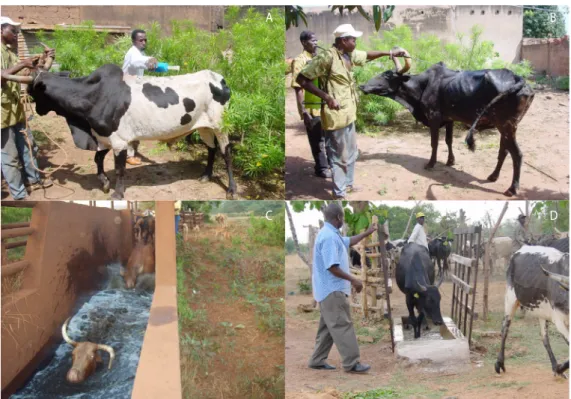
The main advantages of pour-on formulations over other techniques is that no equipment and particularly no water are needed to treat cattle. Application is quick and easy, because the product is deposited on the back line of the animal and diffuses over the whole body (Figure 2A). However, pour-on formulation is more expensive than emulsifiable concentrate formulation of insecticides, due to large dose of active material per kg of animal weight. It is also more suitable for small rather than large herds, as treatment requires a lot of time. Moreover, pour-on formulations have a more important potential impact on the environment than spraying of insecticides (Vale et al. 2004). Manual spraying
Manual spraying of emulsifiable concentrate formulations of pyrethroids is much cheaper (based on the cost of treatment per animal) than pour-on (lower amount of active ingredient required and emulsifiable concentrate cheaper than oil formulations), and presents a similar persistency. Insecticide solution is sprayed over the whole body of cattle (Figure 2B). The main hindrance of pour-on and manual spraying techniques is the treatment time (~5 min per animal) because the animal must be immobilized for treatment. For large herds (>100), the treatment time becomes
Figure 2. Insecticide treated cattle application methods. (A) Treatment of a zebu bull using a flumethrin pour on in Burkina Faso (photo by J. Bouyer). (B) Treatment of a zebu bull using a hand sprayer containing 0.005% alphacypermethrin in Burkina Faso (photo by J. Bouyer). (C) Treatment of zebu in community bath in South Africa (photo by J. Ntshangase). (D) Treatment of a zebu using a footbath containing 0.005% alphacypermethrin in Burkina Faso (photo by J. Bouyer).
A
C
B
D
very long. It can be reduced by handling the animals in a ‘vaccination corridor’ or cattle ‘race’ (with or without mechanical spray jet races) and/or by the simultaneous administration of other prophylactic or therapeutic disease controls. Moreover to be effective, the pour-on or manual spraying must be repeated every 2 weeks or monthly depending on the product used and tsetse species and density (Bouyer et al. 2007, 2008; Torr et al. 2007).
Community bath
Community baths (or dip tanks) are routinely used to treat cattle against ticks (vectors of East Coast fever) in some places like the Kwazulu-Natal region of South Africa. Cattle cross a community bath (generally more than 1.5 m deep) filled with an emulsifiable insecticide solution, resulting in the whole body impregnation in a short time (Figure 2C). The drawback of this method is that the dip tanks must be emptied when insecticides must be changed, with associated environmental hazards and high costs. Dip tanks are also used by individual owners in large and modern farms. However, in general, dip tanks are very expensive to build and to use and are not appropriate for poor farmers. In addition, inappropriate management of residual insecticides can lead to hazards for individual and health risks for farmers.
Restricted spraying of insecticides
Restricting spraying reduces the quantity and cost of insecticides used and improves administration to only the lower parts of the cattle body (belly or lower abdomen, and legs) or by application using a footbath (Stachurski and Lancelot 2006), which is a cheap and fast way to treat cattle (Figure 2D).
This restricted treatment has the additional benefit of controlling the tick Amblyomma variegatum Fabricius (Acari: Ixodidae) for which it was first designed (Stachurski 2006; Stachurski and Lancelot 2006) as well as tsetse flies. Its principle is based on behavioural and ecological studies on A. variegatum, whose invasion process includes a temporary fixation in the inter-digital areas before they can reach their preferred sites on the body (Stachurski 2006). Similarly, this vector control method is very efficient against tsetse because their feeding behaviour mainly focuses on legs and belly of cattle (Torr and Hargrove 1998; Torr et al. 2007; Vale et al. 1999). Moreover, restricted application of insecticides reduces the environmental impact of ITC, particularly for dung fauna (Vale et al. 2004).
A very important parameter of restricting spraying is that 60 cattle can be treated within 8 min with a footbath versus 120 min for a full, hand-operated spray. For farmers, time savings are often more important than direct costs of these treatments, especially during the rainy season when they are very busy in cultivating their fields. The most important drawback of footbaths is that they are fixed installations and thus not appropriate for transhumant herds. Also, they require strong technical skills to correctly dose the insecticide and require community management (insecticide control, individual contribution) for sharing the use of the footbath that can be burdensome and problematic in some situations. A summary of ITC advantages and disadvantages is presented in Table 1.
Insecticide treated targets and traps
Tsetse traps and screens (Figure 3) impregnated with insecticides (known as insecticide treated targets), particularly pyrethroids, have been used as control methods since the 1970s, due to their user friendliness, low cost and efficacy (Cuisance et al. 1991; Laveissière et al. 1980). They can quickly decrease tsetse densities by up to 99% and therefore interrupt parasite transmission. Tsetse trapping has the additional advantage of being a good surveillance tool. Many models of traps and screens are available, and they must be selected specifically for the target species in order to function efficiently (Table 2; Figure 3).
Screens are simple devices (Figure 3B), originally constituted of 1 square meter of fabric impregnated with pyrethroids. They present the advantage to be environmentally friendly since insecticides are not dispersed in the environment, which limits their impact on non-targeted fauna, although a temporary impact on insectivorous birds densities and the disturbance of wild mammals have been observed during area-wide campaigns (De Garine-Wichatitsky et al. 2001). Their efficacy and persistence depends on the active ingredient, its formulation, and its
concentration (200 to 400 mg/m2 of cloth), and also on the nature of the cloth (density of fibres,
presence of an anti-UV protective agent, type of fabric, thickness), and can last up to one year in certain conditions.
Table 1. Summary of insecticide-treated cattle (ITC) advantages and disadvantages.
Advantages Disadvantages
ITT overall cheap
private good
protection against ticks cost sharing of public facilities
requires the treatment of a large proportion of cattle to reduce tsetse densities
no wild fauna
partial protection (need trypanocides treatment)
Pour-on no equipment, no water
quick application costenvironmental impact
Manual spraying cheap treatment time
need animal immobilisation low persistency (2-3 weeks) environmental impact Community baths treatment time expensive to built
management environmental impact Restricted spraying cheap
reduced environmental impact
need animal immobilisation repeated weekly
treatment time
Footbath cheap
very quick treatment time reduced environmental impact
low persistency (repeated application up to 10 times/month) fixed installation (not for pastoralists)
community management constraints
Table 2. Suitabilit
y of differ
ent
trap mo
dels dep
ending on the tsetse sp
ecies tar get ed , based on tr ap efficienc y (NA = not av ailable , + lo w tr apping r at e for this sp ecies , ++ medium tr apping r at e, +++ go od tr apping r at e) (B ouy er et al . 2005; Kappmeier 2000; V ale and T orr 2004). Tr ap model Tar get species Tsetse M echanical v ec tors Riv er ine species Sa vannah species For est species Tabanides St omo xes Glossina palpalis Glossina tachinoides Glossina fuscip es Glossina longipalpis Glossina morsitans Glossina pallidip es Glossina aust eni Glossina brevipalpis Bic onical +++ +++ +++ ++ ++ + NA + + ++ Va voua +++ +++ +++ +++ ++ + NA + ++ +++ Pyr amidal ++ ++ NA + + NA NA NA ++ + N zi +++ ++ NA ++ ++ NA NA NA +++ +++ Tetr a big +++ +++ NA NA ++ NA NA NA +++ ++ Tetr a small +++ +++ NA NA ++ NA NA NA +++ +++ X stick y NA NA NA NA NA NA +++ +++ NA NA H3 NA NA NA NA NA NA +++ +++ NA NA F3 NA NA NA NA ++ +++ NA NA NA NA Epsilon NA NA NA NA ++ +++ NA NA NA NA
Traps attractiveness can be boosted by olfactive attractants (octenol, acetone, metacresol, cow urine), especially against savannah species (Vale 1980), but results for riverine species are not so evident (Rayaisse et al. 2010). The use of olfactive attractant requires technical capacities and therefore is more adapted to AW-IPM programs than to farmer based control. Moreover, the cost effectiveness of attractants still needs to be proved.
The density of targets (trap or screen) placements to obtain the desired effect is context dependent and depends on the target tsetse species, and particularly the density of the vegetation. It is generally necessary to use higher densities of screens against riverine species in forest environments (density of 30/km of river or more) than against savannah species in open
environments (1-5/km2).
The main drawbacks are the vulnerability of target material to fire, theft (especially for traps using metal frame) and floods. The insecticide persistence time may also be an issue, if it is too short and requires regular target replacements with associated cost. Moreover, there is a limited adoption of targets by farmers or communities due to a lack of sensitization on the use of these tools and also their availability on the market. A summary of ITT advantages and disadvantages is presented in Table 3.
Innovations and gaps Tiny targets
The design of the target can have substantial effect on the cost-effectiveness in a vector control campaign and the optimal design is always dependent on the species targeted. Recently, smaller screens have been developed, that could lead to important implications for the costs of tsetse control programs (Esterhuizen et al. 2011). It was recently highlighted experimentally that
reducing the target size to 1/16th of normal 1×1 m size (i.e. 25×25 cm), reduce catches of Glossina
fuscipes fuscipes Newstead (Diptera, Glossinidae) only by half in average, suggesting a better cost-effectiveness (Lindh et al. 2009). Similar results were obtained for Glossina palpalis gambiensis Vanderplank and Glossina tachinoides Westwood reducing the size of the current 1×1 m black-blue-black target to horizontal design of around 50 cm and replacing black clothes by netting Figure 3. (A) Biconical trap set to monitor Glossina palpalis gambiensis Vanderplank (Diptera, Glossinidae) densities in Senegal (photo by G. Gimonneau). (B) Screen impregnated with deltamethrin, used to control G. p.
gambiensis in Senegal (photo A.G. Mbaye).
A B
will improve the cost effectiveness six-fold for G. p. gambiensis and G. tachinoides (Rayaisse et al. 2011). Table 4 gives the relative indexes (proportion of catches relative to black-blue-black 1×1 m standard targets) of small targets for G. p. gambiensis for different models and size.
Although there is evidence that reducing the target size will reduce its cost, it is not so clear if in any situation, this tool will be more cost-effective than other methods. Since the index for smaller targets is below 1, their use requires an increase in their density by 1/index (Table 3). Therefore, their cost effectiveness must be carefully assessed before implementation in control programs Table 3. Summary of insecticide-treated targets (ITT) advantages and disadvantages.
Advantages Disadvantages
ITT overall simple, easy to set up and efficient low environmental impact cheap
public good
community management cost of deployment exposed to vandalism, theft
Screens cheap
easy and fast to set up
could induce behavioural resistance Traps strong sociological impact (visualisation of
flies in the cage)
theft of iron pickets (not for all traps)
Small targets cheaper increased density
low visibility in dense vegetation
Table 4. Detransformed daily mean catches (transformed means in bracket) of male and female Glossina palpalis
gambiensis in Folonzo, Burkina Faso (Rayaisse et al. 2011).1,2
Size (m×m) Material Shape Rep Male Index Female Index Total Index
0.5×0.75 NBlN V 14 3.0 (0.60) 0.57 3.3 (0.63) 0.46 6.5 (0.88) 0.50 0.75×0.5 NBlN H 14 4.3 (0.72) 0.82 5.6 (0.82) 0.78 10.3 (1.05) 0.79 0.25×0.5 BkBlN V 14 0.6 (0.21) 0.12 0.9 (0.27) 0.12 1.3 (0.37)*** 0.10 0.5×0.25 BkBlN H 14 2.8 (0.58) 0.54 1.7 (0.43) 0.24 4.5 (0.74) 0.35 0.25×0.5 NBlN V 14 0.3 (0.10)*** 0.05 0.5 (0.16)*** 0.06 0.7 (0.24) 0.06 0.5×0.25 NBlN H 14 2.2 (0.51) 0.42 1.4 (0.37) 0.19 3.5 (0.65) 0.27 sed 0.085 0.084 0.090 0.25×0.5 BBkBlBk V 24 0.9 (0.29)*** 0.32 0.8 (0.25)*** 0.25 1.8 (0.44)*** 0.28 0.25×0.25 BkBlBk V 24 0.3 (0.12)*** 0.11 0.2 (0.08)*** 0.07 0.5 (0.18)*** 0.08 1×1 NBlN V 24 3.2 (0.62) 1.09 4.6 (0.75) 1.47 7.9 (0.95) 1.25 0.25×0.5 NBlN V 24 0.7 (0.24)*** 0.26 0.6 (0.19)*** 0.18 1.4 (0.37)*** 0.21 0.25×0.25 NBlN V 24 0.1 (0.05)*** 0.04 0.1 (0.05)*** 0.04 0.2 (0.09)*** 0.04 sed 0.068 0.066 0.075
1 Catches followed by *** differ from the control at 0.001 level. Catch index is the mean catch of a target
expressed as a proportion of that of the standard, which is 1×1 BkBlBk.
2 Bk = black; Bl = blueH = horizontal; ; N = net; Rep. = replicates; sed = standard error deviation; V = vertical.
according to the environment and species targeted. For G. fuscipes fuscipes, small targets seems more interesting than classical one, since small targets have indexes of almost 1 (Lindh et al. 2009). A recent study evaluated the cost using small target against this species in Uganda and there was
reduces by 48% from USD 179 to USD 85.4 per km2 (Shaw et al. 2015). For some tsetse species
such as flies of the morsitans group (Diptera, Glossinidae), small targets have been proven to be inefficient (Torr et al. 2011).
Although small target is an important innovation, the knowledge gap here, is a lack of a fine tuned cost-benefit study of small targets to determine if this technology can reduce the cost of ITT in different contexts. Also, when applied by the beneficiaries themselves, to what extent this might impact on the will of communities to take responsibility over targets.
Insecticide treated fences
Insecticide treated fences are very efficient in areas where dairy cows are confined in zero-grazing units (food and water supplied to them). The use of mosquito netting impregnated with a pyrethroid (Figure 4) can reduce significantly the incidence of trypanosomosis (Bauer et al. 2006). This technique was first designed for tsetse control and the principle is to surround zero-grazing units by insecticide-treated mosquito netting at a height of 150 cm. Indeed, behavioural studies have highlighted that tsetse usually attack their hosts at a height of less than 100 cm above ground level to feed on the legs (Bauer et al. 2006). In some situations, insecticide treated fences can also have a significant effect on vector of human diseases. In Ghana, impregnated mosquito nets were used to protect cattle pens but also reduced significantly mosquito malaria vectors (Anopheles gambiae Giles and Anopheles ziemanni Grunberg; Diptera: Culicidae) (Maia et al. 2012). In Ghana, treated fences have been proved to be very efficient to protect pigs pen against tsetse (Bauer et al. 2011). It was also successfully used in Guinea in older non active human African trypanosomosis (HAT) foci to reduce vector densities and prevent HAT transmission (Kagbadouno et al. 2011). In some conditions, it can also offer a good protection against biting flies, Stomoxys spp. (Diptera: Muscidae) (Maia et al. 2010), which favours its adoption since animals were less disturbed by flies.
Figure 4. Protection of cattle with impregnated mosquito net in a modern farm in Senegal (photo by J. Bouyer).
However, in La Reunion Island, it failed to reduce the density of Stomoxys spp., probably because the cattle pens were not surrounded completely with mosquito netting (Bouyer et al. 2011b). The residual gap for this technology is that most of the trials were organized by comparing fully small protected and small control pens, whereas in some farms the reality is quite different with a calculated total length of fence of 1.2 km. Therefore, according to the fence price (i.e. € 160 for a roll of 100 m length × 1 m height in Senegal), it would require € 1,920 to surround all the cattle pens, whereas in the same way, 5 impregnated targets would probably have similar impact on tsetse density. Further research is thus required to define the best areas to protect with either insecticidal fences or screens which will be between the tsetse resting sites in the vegetation and the cattle, in order to reduce the cost of fencing needed to protect a farm.
Combination of repellent and insecticides
Recently, several combinations of repellents and insecticides have been developed in order to improve the effect of formulations in the increasing context of insecticide resistance, especially against mosquitoes (Faulde and Nehring 2012). Today, although no insecticide resistance has been identified in tsetse, combination of different insecticides and molecules can significantly increase the formulation effect (Gimonneau et al. 2016). Application of repellents on cattle to reduce trypanosomosis incidence was tested, and it was concluded that the repellent technology was not sufficiently efficient under natural tsetse challenge to merit commercial development (Bett et al. 2010). Moreover, we think that pushing tsetse towards other animals or herds is not a good principle for tsetse control, even if the repellent technology is efficient. This is because the protection of an individual animal or herd should not increase the risk for other animals at a community level, especially since the poorer farmers in that community might not be able to afford the repellent product. Another option is to associate repellents with insecticides. A new pour-on containing two insecticides, a pyrethroid synergist and a repellent have recently been developed and compared to a standard pour-on (i.e. based on one pyrethroid) (Gimonneau et al. 2016). Results showed in the laboratory that the repellent and insecticides formulation was significantly more efficient than the classical formulation with a longer knockdown effect (37 and 28 days, respectively; Figure 5A). More importantly, it significantly increased the cattle protection against tsetse bites (Figure 5B). In the field, this combination has been proved to be very effective against ticks with a complete elimination three days after application and in the same time a significant reduction in trypanosomosis prevalence and increased in packed-cell volume (PCV). This new pour-on formulation, combining insecticides and repellent, was highly effective against AAT and ticks, with a longer persistence than other pour-on products on the market. It offered immediate effect on ticks and low treatment frequency to maintain a low ticks infestation and trypanosomosis prevalence. Moreover, this new insecticide formulation represented the first one to provide a partial individual protection against tsetse bites and AAT (Hargrove et al. 2000). Although the efficacy will probably not be the same in various contexts and environments (Hargrove et al. 2003), it was therefore a great innovation for farmers for the control of ticks and AAT. Actually, providing individual protection of cattle against AAT and ticks might increase the adoption of the control technique by farmers, as opposed to collective protection (Bouyer et al. 2011a). In sites where AAT coexists with HAT, this tool might represent another weapon against tsetse within a one-health perspective, as it has been suggested earlier that treating cattle could help controlling HAT through a reduction of tsetse densities (Ndeledje et al. 2013).
One of the main constraints for farmers could be the price but a formulation for water suspension has been developed, decreasing the total amount of insecticide used and the treatment price. However, its impact regarding knock-down rate and disease or biting protection will have to be tested. Another knowledge gap is that no data is available on the toxicity, residuals and ecotoxicity of this combination.
Restricted application of insecticides
Socio-economic studies on restricted application of insecticides to cattle have revealed that treatment time and usage by the community were the most important constraints for the adoption of partial spraying and footbaths respectively (Bouyer et al. 2011a; Selby 2010). Socio-economic studies identifying the types of setting in which corridors or footbaths (and the maximal distances between farms and communal corridors or footbaths) are acceptable for sustainable use of the technique are needed to further improve the adoption of these techniques. It would also be important to develop with the stakeholders, acceptable methods for sharing the costs between farmers. Actually, there is no recommendation on how to use this technique taking into consideration the herder constraints and their habits, particularly in the case of traditional farmers.
Moreover, regarding footbaths, the dosage of the insecticide is a tricky issue for traditional farmers, when it is done using an abacus. A simpler system would be needed to reduce the technical problems associated with this dosage of insecticides.
Figure 5. (A) Knock-down rate of Glossina palpalis gambiensis in function of the time after treatment. (B) Rate of unfed G. palpalis gambiensis, giving an estimation of the protective effect of treatment, in function of the time after treatment.
Time after treatment (days)
Knowck−down rate 0 20 40 60 80 Positive control 0.0 0.2 0.4 0.6 0.8 1.0 Treatment 0.0 0.2 0.4 0.6 0.8 1.0 0.0 0.2 0.4 0.6 0.8 1.0 Control Date of treatment 2009−08−26 2009−08−24 2009−10−26 2009−10−28
Time after treatment (days) 0 20 40 60 80 0.0 0.2 0.4 0.6 0.8 1.0 Treatment 0.0 0.2 0.4 0.6 0.8 1.0 Positive control 0.0 0.2 0.4 0.6 0.8 1.0 Control
Rate of unfed flies after exposure
A B
Finally, because restricted application focused to the lower parts of the body, it would be very useful to quantify the insecticide residuals in milk.
Quality control and evaluation procedure for targets
There is a real need to develop a standard quality control procedure and evaluation for targets in order to improve the reliability, efficacy and persistency of the different batches of targets sent by a given manufacturer.
According to the literature, two tools have been developed to evaluate targets but with several drawbacks. The first method consists in the restriction of a fly in the head of a glass tube by a loose-fitting piston carrying a sample of insecticide (Kernaghan and Johnston 1962). The fly is handled only when first introduced into the tube; it then remains in the same tube during the holding period. This method is time-consuming because the test is performed on one fly at a time and several flies are needed to obtain robust statistics (i.e. minimum of 30 flies). Moreover, injuries could be inflicted to the flies, generating biases in the results. Also, the fly stays in the same tube during the observation period which represents a bias since insecticides could remain in the tube. The second apparatus is a ‘T’ shape flight tunnel where flies are attracted to the light where the netting is set (Torr 1985). The fly collides with the netting, set obliquely across the flight-path, and it then flies towards a second, stronger, light source. In this system, there is no possibility to control the time of exposure of the fly that is a very important criterion for insecticide bioassays. Moreover, the apparatus configuration allows some flies to reach the second light source without entering into contact with the net (Torr 1985). Anyway, these two tools seem not to be used by the researchers community as there is no mention of these in the literature, may be due to a lack of reproducibility.
In target manufactures, quality control procedures seem to be absent. Huge differences in persistency are observed in the field between batches that impact the success of vector control. A solution would be that the manufacturers should use exactly the same production process for a given trap or screen model, or that they should be able to test these different properties for each change in the production process and provide data, such as trapping indexes relative to a reference trap and persistency in the field.
Impact of farming systems and tick-borne diseases on the adoption of tsetse control methods Even if socio-economic surveys have already been conducted to study the adoption of tsetse control techniques by farmers, it would be important to study accurately the perception and adoption rate of the different techniques available to control tsetse in different farming systems. Actually, farmers belonging to different farming systems (traditional/modern, sedentary/ transhumant) have different perceptions of their cattle (production tool vs money savings) and socio-economic networks (Bouyer et al. 2015). Moreover, the risk level in case of an innovation is not the same (much higher for traditional farmers) and will probably impact the adoption process (Bouyer et al. 2011a).
It appears also important to study the impact of ticks and tick-borne diseases on the adoption of tsetse control techniques. Because ITC based on pyrethroids directly impact ticks and tick-borne diseases, the adoption process is facilitated. This aspect should not be overlooked because it can lead to situations where the farmers prefer to keep their usual control technique even if it is working only against ticks than to adopt a new one that is working both against tsetse and ticks
(see below the example of ITC in Uganda). It is thus very important to sensitize the farmers on the likely impact on ticks when a new strategy to control tsetse is proposed. These should be studied in each African region (at least western and eastern), since important local specificities might be observed.
AAT control strategies including vector control with preventive and/or curative treatment of cattle
Description of the different epidemiological settings
In this part, we consider only AAT or Nagana, caused by T. congolense, T. vivax and Trypanosoma brucei brucei (Plimmer & Bradford) transmitted to cattle by tsetse, and mechanically transmitted for T. vivax beyond the tsetse belt. Mechanically transmitted Animal trypanosomosis or Surra caused by Trypanosoma evansi (Steel) worldwide and by T. vivax mainly in South America is not considered. For Nagana, and with a special focus on T. congolense and T. vivax, three major eco-epidemiological cycles related to cyclical transmission by tsetse have been described, and one mechanical cycle occurring at the limit of the tsetse distribution area (Pagabeleguem et al. 2012; Van den Bossche et al. 2010).
Sylvatic trypanosomosis
In sylvatic trypanosomosis settings, trypanosomes are transmitted by tsetse to the trypanotolerant wild fauna. Cattle are supposed to be absent in these areas but sometimes enter this system for illicit grazing purposes (and/or transhumance) and are then infected with highly virulent strains. Interface trypanosomosis
Interface trypanosomoses occur at the edge or interface of agro-pastoral areas and protected areas. Tsetse diversity and abundance is high at this interface (border effect), and virulent strains are transmitted from wild fauna to cattle, leading to acute infections in the latter, with a high mortality rate, or even epidemic situations.
Endemic trypanosomosis
In endemic trypanosomosis, no or very scarce wild fauna is involved and cattle are the main host for tsetse. Tsetse density, lifespan and diversity tends to reduce (Van den Bossche et al. 2010). The virulence of trypanosome strains is reduced by their circulation within the cattle compartment, although virulent strains can be imported from the former areas by transhumant herds. In this setting, cattle are used to ‘live with the disease’.
Mechanical trypanosomosis
Mechanical trypanosomosis occurs at the limit of tsetse distribution, within the range of movement of transhumant herds. In West Africa, trypanosomes are imported by cattle transhuming into the tsetse belt and locally transmitted to resident herds by mechanical vectors (T. vivax only). In East Africa, T. vivax is well established in sedentary cattle whereas tsetse flies are absent, but numerous movements of cattle occur and might also allow the importation of trypanosomes (Ahmed et al. 2016). The relationship between mechanical trypanosomosis and cyclical trypanosomosis is not so clear and need further investigation (Tadesse et al. 2011).
Description of the different cattle rearing systems
In this section, 3 types of cattle rearing systems will be considered as important to take into consideration when selecting the best control options:
1. Transhumant rearing systems, where herders drive their cattle to remote grazing areas (up to several hundred kilometres), especially during the dry season. Animals are mainly local breeds, more or less trypanotolerant depending on AAT pressure. Inputs to improve productivity are very low. Animals may encounter tsetse eco-epidemiological contexts that are different from those in their area of origin. Therefore, they will probably move between tsetse free and infested area with different eco-epidemiological cycles, linking them and importing trypanosome strains from one to the other. Controlling this genetic flow is a very important challenge (see below).
The two other rearing systems can be considered as sedentary systems, which are generally exposed to one epidemiological cycle only:
2. Agro-pastoral system/mixed farming systems, where farmers have two main activities: agriculture and cattle rearing. Crop residues are generally used to rear cattle in association with the surrounding environment, i.e. natural pastures within a range of 5 to 10 km. Cattle are mainly local trypanotolerant breeds or more or less crossbred with trypanosusceptible breeds depending on AAT pressure. Inputs are low to medium. Different situations could be observed between farmers according to the time and efforts they spend in different activities, i.e. cropping or cattle rearing but they will be considered here together because the proposed AAT strategies will be the same.
3. Zero grazing units are modern farms, generally in peri-urban areas where animals are mainly fed with forage or agro industrial subproducts. Farmers rear improved local breeds (zebu), sometimes cross-breed with exotic cattle or even pure exotic cattle. Animals are considered as a production tool and generally have high economic value in comparison to previous systems. Inputs are generally high in order to maintain these breed under high parasitological pressure in combination to high productive pressure.
Proposal of a general framework for farmer-based AAT Control
Proposals presented in this section are mainly based on argument present in this chapter and other peer reviewed documents (Bouyer et al. 2010, 2013; Vale and Torr 2004; Van den Bossche and Delespaux 2011; Vreysen et al. 2013).
A general decision framework depending on the type of farming system and epidemiological cycles is presented in Figure 6 from Bouyer et al. 2013. The integrated packages are developed below.
Sylvatic AAT (AI and BI)
This epidemiological cycle is encountered in protected areas only, where cattle rearing should be discouraged. In this situation, ecotourism, ranching of wild fauna or game and hunting reserves should be encouraged instead.
Trypanotolerant cattle (AII and AIII)
In systems involving trypanotolerant cattle, vector control is not cost-effective. Trypanotolerance is defined here as the ability to limit parasitaemia and anaemia and remain productive in enzootic areas (Dayo et al. 2012). Therefore, clinical cases are rare and generally caused by a loss of immunity (other disease or insufficient food). These clinical cases should be diagnosed and treated using trypanocide drug treatments but prophylactic treatments should be avoided in order to reduce the development of drug-resistant strains of trypanosomes. Moreover, it might prevent the establishment of a protective immunity in young cattle that must be infected at an early age to ensure maintenance of tolerance. The relationship between trypanosomes and trypanotolerant cattle is more or less at equilibrium, and interventions should in general be limited to avoid breaking this equilibrium. This strategy has the additional advantage to allow the long term conservation of trypanotolerant breeds.
Decentralized program (herders or herders associations)
B. Trypanosensitive cattle A.Trypanotolerant cattle
+ Prophylaxis
+
Diagnostic of clinical cases and curative treatments Farmer-based AAT
control strategies
I. Sylvatic AAT
IV. Mechanical AAT around tsetse belt III. Endemic AAT II. Interface AAT
No vector control, cattle rearing should be discouraged and replaced by ranching of wild fauna
No vector control Diagnostic of clinical cases
+ Curative treatments
All Transhumant Sedentary Zero grazing
ITC (total spraying or pour-on) ITC (partial spraying or footbath) ITC (foot-bath or insecticide fence) + ITT on watering points or borders of protected areas ABSENT ITC (total spraying or pour-on)
ITC (partial spraying or footbath) ITC (foot-bath or insecticide fence) No vector control + Prophylaxis Prophylaxis Cattle breed Rearing system Eco-Epidemiological cycle +
Diagnostic of clinical cases and curative treatments
+
Diagnostic of clinical cases and curative treatments
Figure 6. Decision framework proposing different strategies integrating vector control and the use of trypanocides, depending on the type of farming system (columns) and epidemiological cycles (rows) (ITC = insecticide treated cattle; ITT = insecticide treated targets; AAT = animal African trypanosomosis) (Bouyer et al. 2013, with permission).
Trypanosensitive cattle (BII to BIV)
Interface AAT (BII)
Interface AAT is probably the case where the economic impact of AAT on cattle rearing systems is the highest, because virulent strains are transmitted from wild fauna to trypanosensitive cattle on a regular basis. Here, the use of different vector control strategies and the use of trypanocides (prophylactic and curative trypanocides) are necessary and cost-effective, in order to reduce the incidence of AAT, the morbidity and mortality of cattle, and the development of resistant strains of trypanosomes.
ITC is the method of choice because it protects an individual good instead of a public one and it is also the most cost-effective (Shaw et al. 2013). The type of ITC must be differentiated depending on the rearing systems:
For transhumant herds, fixed structures like footbaths are not suitable, and water is difficult to transport. Therefore, it should be recommended to reduce the treatment frequency as much as possible by the use of pour-on or total spraying (if water is available) of the cattle.
For sedentary herds, fixed structures are convenient. Restricted application of insecticides using partial spraying (every two weeks) or footbaths (weekly) should be recommended: the treatment corridor or the footbath respectively can be easily built at the exit of the cattle’ pen, with a door allowing to pass cattle through it when desired, in order to reduce treatment time as much as possible.
For zero-grazing herds, insecticide fences can be used around the cattle pens, or footbaths placed between the pen and the grazing area in order to facilitate treatment.
However, ITC is generally not sufficient to protect cattle totally and it should be completed by ITT especially at watering points when riverine tsetse species are involved. The use of impregnated targets or traps set every 100 m along 1 km of the river on each side of the water points will then be enough to suppress the tsetse population at this site (Knols et al. 1993; Willemse 1991). Based on several tsetse control programs, target barriers will never be maintained by the farmers themselves; therefore authorities managing game or hunting reserves should be sensitized to use part of the benefits generated by tourism to maintain these barriers.
Endemic AAT (BIII)
In this system, the same ITC strategy as described for interface AAT (BII) should be recommended but ITT is no more required. Indeed, the strains circulating here are less pathogenic. Moreover, due to environmental degradation, tsetse distribution is much more fragmented and densities are generally low. Because the tsetse feed mainly on domestic animals due to the absence of wild fauna, ITC is likely to have a more important impact on tsetse.
In endemic AAT, the relationship between trypanosomes and trypanotolerant cattle is more or less at equilibrium, so prophylactic treatments should be limited. However, importation of virulent strains from the sylvatic and interface cycles is possible because of transhumant herds. Clinical cases should be quickly diagnosed and treated immediately using curative trypanocides.
Mechanical AAT (BIV)
In mechanical AAT, tsetse are absent and vector control approaches are generally not effective. In this system, AAT occurs as epidemics so prophylactic treatments may not be cost-effective, except in the case of transhumant herds. If animals come from a tsetse free area, it is recommended to use prophylactic drugs and curative ones just before their return.
This regimen is intended to avoid losing animals during transhumance through areas with other epidemiological cycles, and to avoid importing trypanosomes into this tsetse-free area and thus prevent the establishment of mechanical transmission.
Case studies of vector control approaches
Restricted application of insecticides using footbaths around Bobo Dioulasso, Burkina Faso This case study is based on three peer reviewed articles (Bouyer et al. 2007, 2009, 2011a). The epidemiological cycle is the endemic AAT cycle and the type of cattle rearing system is an agro-pastoral rearing system (situation BIII).
In Dafinso (Burkina Faso, 15 km north of Bobo- Dioulasso), 68 cattle of a herd of 96 cattle (i.e. 71%) were treated with a footbath containing a pyrethroid formulation. The effect of this restricted insecticide treatment of cattle was observed on released cohorts of reared, irradiated and marked tsetse flies (Figure 7A).
Footbath treatment significantly reduced the mean lifespan of released flies (G. p. gambiensis and G. tachinoides) from 4.7 days (95% CI 3.4-7.5) to 1.7 days (95% CI 1.3-2.4). The apparent densities of wild flies at the water point frequented by the footbath-treated cattle herds reduced quickly in Dafinso (Bouyer et al. 2007), with an estimated daily mortality rate related to this exposure of 0.39 (95%CI 0.19-0.54), which was much higher than needed to reduce a wild tsetse population (0.03) (Hargrove 2003).
An one-year survey (May 2005-June 2006) was conducted in the same site in order to compare the incidence of AAT in a footbath-treated cattle herd (48 footbath-treated animals with a suspension of pyrethroids administered every 2 days by farmer itself with a control one (69 cattle not treated), watered at another river section in the same area (Bouyer et al. 2009). From farmers’ viewpoint, the main justification of the footbath treatment was to prevent infestation by A. variegatum so, they stopped using the footbath when tick infestation decreased, after the end of the rainy season, i.e. the 7 October 2005. This scenario was monitored and data used to assess whether tsetse-control measure implemented during the rainy season only were sufficient to limit tsetse populations and trypanosome transmission during the dry season, when riparian flies are usually still active and numerous enough to have a great epidemiological importance. During the survey, cattle were sampled for identification of the three trypanosome species occurring in the area using PCR (T. vivax, T. brucei sensu lato and T. congolense savannah type). The study can thus be considered as a comparison of an integrated AAT control strategy combining vector control and curative treatment of clinical cases with the control group only receiving curative treatment of clinical cases but no vector control.
The initial prevalence of trypanosomosis was 6.6% (n=91), i.e. 0.0% for T. brucei, 4.4% for T. congolense and 2.2% for T. vivax (no difference between the two herds, Fisher’s exact test, P=0.69).
The overall PCV was 28.3% with no significant difference between the 2 groups (Welch 2-sample t-test, P=0.18). Pyrethroid administration with the footbath resulted in a significant reduction of the monthly trypanosomosis incidence rate (P=0.003). This effect lasted during the dry season, after the treatment period, and no new AAT infection was recorded in the treated herd (Figure 7B). The overall incidence of cattle trypanosomosis was reduced (P=0.01) from 0.76 (control group) to 0.11 (footbath treated group). A positive effect of the footbath treatment on packed-cell volume was also observed (P<0.001, see Bouyer et al. 2009) which proved a significant improvement of animal health (Bouyer et al. 2009).
These field studies demonstrated that restricted application of insecticides using footbaths allowed a significant reduction of tsetse populations, leading to a breakdown of trypanosome transmission cycle. Moreover, it reduced treatment cost and time by more than 90% compared with other techniques such as spraying of the full body of cattle. These results were also attributed to environmental conditions favourable to tsetse control in this area. Indeed, the scarcity of wild hosts but also the landscape fragmentation has favoured a fast reduction of tsetse sub-populations by reducing the speed of re-invasion of the cleared water points.
Unfortunately, these good results were not sustained. A socio-economic survey conducted in the same study site in 2008 at the beginning of the rainy season revealed that farmers have
Time (d)
Apparent density (flies)
2 4 6 8 5 10 5 10 T50% = 6.2 d Control T50% = 1.7 d Treatment A Time M on thly incidenc e r at e 0.00 0.05 0.10 0.15 Jul 0 5 Aug 0 5 Sep 0 5 Oct 0 5 Nov 0 5 Dec 0 5 Jan 06Feb 0 6 Mar 0 6 Apr 0 6 Control 0.00 0.05 0.10 0.15 Treatment T. vivax T. congolense T. brucei B
Figure 7. (A) Effect of the exposition to footbath-treated cattle on the time corresponding to a 50% reduction (T50%) of the initial apparent density of released, irradiated tsetse flies in Dafinso (Burkina Faso) during the early rainy season 2005 (points: observed data; the solid line was estimated from a negative-binomial model fitted to the points; dashed lines: 95% confidence limits) (Bouyer et al. 2007, with permission). (B) Observed incidence rate of cattle trypanosomosis in Dafinso (Burkina Faso) according to Trypanosoma species and treatment category (Bouyer et al. 2009, with permission).
abandoned the use of footbaths (Bouyer et al. 2011a). The main raison given was technical problems encountered to treat animals (whereas they did not during the experimental period), i.e. cattle were reluctant to pass in the footbaths. Later and in other sites, other farmers built more traditional cattle pens (with wood) instead of using metallic wire which greatly improved the treatment conditions. Moreover, footbaths manager were young educated people that have to count cattle during each treatment in order to calculate the price to pay for each herd (in order to buy new insecticides) and it conferred to them a strategic position which changed the former social relationships that farmers could not accept.
Therefore, the experience of a communal use of footbaths in this site was a failure despite the clear benefits associated to the technique, and an one year follow up by technicians offering long-term technical advice to the farmers. The main adoption factor was related to the economic dynamism of farmer associations. Actually, in another group of farmers using a similar farming system than the one studied here, but with more active farmer associations, a large proportion of the farmers adopted the technique (Bouyer et al. 2011a).
ITC in Uganda: the SOS program
This case study is based on several peer reviewed articles but two main data sources focusing on vector control and animal trypanosomosis were used (Morton 2010; Selby 2010). The Stamp Out Sleeping Sickness (SOS) program was a human health program, initiated mainly to fight sleeping sickness, which is not the priority of this work but it is a good case study for three reasons: 1. it combined mass treatment of cattle with curative drugs and restricted insecticide treatment
of cattle (partial spraying);
2. the size of the initiative in terms of the number of cattle treated (>180,000);
3. the inclusion of the cattle farmers as one of the partners, together with researchers, Ugandan public authorities and the private sector (Ceva Santé Animale and IKARE).
In October 2006, an intervention was initiated to arrest the northerly advance through Uganda of the zoonotic parasite Trypanosoma brucei rhodesiense (Stephens & Fantham). The main goal of the SOS campaign was to target the cattle reservoir of T. brucei rhodesiense (agent of the acute
form of sleeping sickness), in an areas of approximately 8,000 km2 by treating >180,000 head of
cattle (Selby 2010).
The field operations were conducted during 4 years between 2006 and 2010, and Morton (2010) reported the treatment of ‘almost 180,000 cattle – belonging to around 50,000 households – with trypanocidal drugs and insecticidal sprays over five districts’. In this context, we will focus on the involvement of farmers in treating their cattle and the sustainability of the results and also in establishing whether or not this mass treatment of cattle has improved animal health, by controlling T. congolense and T. vivax, which were also present.
The control operations were subdivided in four rounds of treatments of cattle over 5 districts with trypanocides (isometamidium chloride and diminazene aceturate) and pyrethroid spray. Objectives of the first control session (November 2006) were to treat 86% of the estimated cattle population and to sensitise the farmers to pursue treatments on their own with support from District Veterinary Offices. In one month, 178,000 head of cattle were treated, corresponding to more than 100% of the initially estimated cattle population, but more probably to ~55% of the actual one (Selby 2010). The second round of control operations presented a lower coverage and dropped to approximately 30% of animals treated with strong variations of coverage observed
within and between districts despite provision of pyrethroid for two more rounds during the first round. Therefore, the third round (April/May 2007) was supervised by people from the Makerere University and was more successful (~80%). This low coverage was attributed to lack of communication about the insecticide efficacy because herders used other products, and distrust of the programme objectives (fear of taxation of cattle). Finally, a fourth round was implemented in a specific area where substantial cases of T. brucei rhodesiense were found both in cattle and human populations. Only 30,000 cattle were treated. In the other 5 districts, a new control strategy was implemented by five veterinarians sent to the field and in charge of sensitizing farmers and distributing products. Because of different problems lowering the farmers’ investment capacities, this situation was not sustainable for veterinarian earning not enough money. Therefore, they started to sell different products, especially amitraz which is not efficient against tsetse. This product was considered more efficient against ticks by farmers due to its strong and visual knock-down effect on ticks whereas this effect was not visible with pyrethroids (the ticks become dry but remain on cattle; F. Stachurski, personal communication). Moreover, the initial price of the insecticide during the interventions was 0.02 US$/treatment due to reduced or subsidized prices by the private partners, whereas the actual cost of the wholesale drugs was closer to 0.06 US$/ treatment (Shaw et al. 2013). This data on farmers’ awareness and practice of regular spraying have been judged inconclusive. Indeed, by June 2009, 45% of cattle keepers had sprayed their animals in the last month’ which was not dissimilar to the 40% who reported spraying their animals monthly in 2006 before the SOS project (Morton 2010).
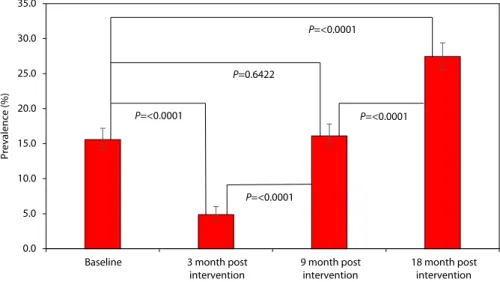
Prior to the SOS project, the prevalence of T. b. brucei within the cattle reservoir was estimated by PCR at 15.57% (T. brucei rhodesiense as 0.81%) (Selby 2010). This prevalence was then monitored in 23 locations at three, nine and 18 months after the beginning of SOS program. A consistent number of cattle was sampled in the 23 sites during the survey (>1700 heads of cattle). The prevalence of T. brucei. s.l. dropped from 15 to 3% three months post intervention, but then returned at nine month and exceeded the baseline at 18 months (Figure 8).
Figure 8. Prevalence of Trypanosoma brucei. s.l. during the SOS operation program (Selby 2010, with permission).
0.0 5.0 10.0 15.0 20.0 25.0 30.0 35.0
Baseline 3 month post
intervention 9 month postintervention 18 month postintervention
Prevalence (%) P=<0.0001 P=<0.0001 P=<0.0001 P=<0.0001 P=0.6422
A similar pattern was observed for T. brucei rhodesiense. This increase in prevalence was attributed to the absence of sustained vector control. Although T. congolense and T. vivax were not directly studied during this program, some data was available before the beginning of the program and highlight that T. congolense was the most prevalent trypanosome species with 43% (of the animals tested; 15/35), followed by T. brucei and T. vivax with 34% (12/35) and 23% (8/35) respectively (Cox et al. 2010). This high prevalence indicated that animal trypanosomosis was a serious problem in this country. Therefore, the SOS program has probably lead to similar reduction in prevalence level in T. congolense and T. vivax as suggested by the increase of PCV in cattle.
Interview of the personnel implicated in the SOS program point out several reasons for the disappointing results such as poor community involvement; absence of crush in treatment sites (technical problem) and transport of animals to and from the treatment site (technical problem). Therefore, the main conclusions of this program are that:
•
Treating cattle with a partial spray of pyrethroid associated with an injection of diminazenedid not succeed to control the transmission of T. brucei. s.l. in a sustainable way. This result is probably the consequence of a failure in the suppression of G. fuscipes fuscipes, the exclusive vector of this trypanosome species in the area. Because resistance to trypanocides has been previously highlighted (Matovu et al. 1997), it could partially explain the result. However, the temporary significant reduction of its prevalence 3 months after mass-treatment shows that T. brucei was at least partially susceptible to diminazene.
•
The reduction in pyrethroid treatment cost due to the restricted application and subventiondid not ensure good adoption by farmers.
•
The technical problems related to the treatment sites and the associated time loss for farmersis probably responsible for the lack of commitment. It proves that even for traditional farmers, ‘time is money’. Therefore the technical approaches could significantly be improved.
•
The potential for improved control of human sleeping sickness was not considered importantenough by the farmers to change their habits, and the apparent efficiency of the insecticide treatment against ticks seemed more important (since both molecules were probably as efficient but amitraze effect was more visible).
ITT in the Loos Islands of Guinea
This case study is based on two peer reviewed articles (Kagbadouno et al. 2009, 2011). In Guinea, the ministry of health has launched a control program against G. palpalis gambiensis (Diptera, Glossinidae) on three islands: Fotoba, Room and Kassa islands. Before the start of control operations, baseline entomological data were collected and revealed that tsetse populations from the Loos Islands presented a low rate of genetics exchange with flies from the mainland and also between islands (Camara et al. 2006; Solano et al. 2009). Therefore, these apparent isolated populations could be targeted using an area-wide integrated strategy with very low risk of reinvasion. Different control operations were implemented on each island:
•
in Fotoba island, impregnated targets were used at a density of 30 and then 60 targets/km2;•
in Room island, ground spraying and impregnated targets at a density of 30 targets/km2 andthen 60 targets/km2 were used;
•
in Kassa island, ground spraying, pour-on treatment of pigs (the major species bred on Kassa),fencing of pig pens with impregnated nets and targets were used at a density of 30 and then
60 targets/km2.
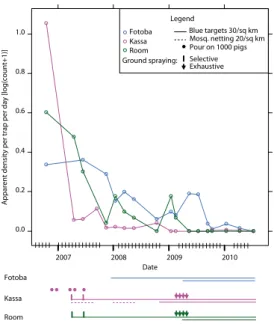
Before control operation, average tsetse apparent densities were 10.33, 3 and 1.16 flies/trap/day in Kassa, Room and Fotoba, respectively. Three years after the beginning of control operations, tsetse apparent reduction was 100%, indicating that populations have been suppressed. This objective was achieved more or less faster according to measures implemented. The fully integrated strategy on Kassa allowed a very fast reduction of tsetse densities (>98% within 6 months) and similar results were obtained in Room island (>97% within 6 months; Figure 9).
The surrounding of pig pens with insecticide mosquito net proved particularly efficient on Kassa.
However, on Fotoba using only blue targets set at the density of 30/km2 was not sufficient to
reduce tsetse densities below 50% and target density was therefore increased to 60/km2 after
one year of control, which allowed a further reduction of densities to undetectable levels within 6 months. The success of control operation was also due to strong community sensitization and participation. The farmers appeared cooperative and the targets and insecticide mosquito nets were well maintained. However, all these techniques were provided free of charge by the national program, and there was no transfer of the control operations to the farmers. Apart from ground spraying, all other techniques used during this control campaign would be suitable for farmer-based vector control. The main limitation was that targets were considered as public goods, and thus pour-on and insecticide mosquito nets would probably have better chances to be adopted. On these islands, the programme was not sustainable and tsetse densities recovered within a few years after the end of the intervention of national authorities.
Figure 9. Evolution of tsetse apparent density in Loos Islands according to different control operations (Kagbadouno
et al. 2011).
Date
Apparent density per trap per day [log(count+1)]
0.0 0.2 0.4 0.6 0.8 1.0 2007 2008 2009 2010 Fotoba Kassa Room Fotoba Kassa Room l l l l Legend l Blue targets 30/sq km Mosq. netting 20/sq km Pour on 1000 pigs Selective Exhaustive l l l l l l l l l l l l l l l l l l l l l l l l l l l l l l l l l l l l l l l l l l l l l l l l l Ground spraying:
Use of fencing to protect zero grazing units in western Kenya
This case study is based on the peer reviewed article from Bauer et al. (2006). The epidemiological cycle is the endemic AAT cycle and the type of cattle rearing system is zero grazing units (situation BIII).
In Kenya, 80% of 3 million dairy cows are the property of small-scale farmers, of which a large part are confined to zero grazing units with all food and water provided to the animals. The farmers use trypanocidal drugs (diminazene aceturate for therapy or isometamidium chloride for prophylaxis (Bauer et al. 2006) but they still experience trypanosomosis cases (adults mortalities, abortions, stillbirths and a reduction of milk production). Four tsetse species occur in western Kenya: G. fuscipes fuscipes, G. pallidipes, Glossina brevipalpis Newstead and Glossina swynertoni Austen at generally low densities (<1 fly per trap per day) (case IIIB of Figure 9), except in Busia District along fringing vegetation, which borders the shores of Lake Victoria, where the densities can be up to 30 per trap per day and in protected areas (Cecchi et al. 2015) (case IIB of Figure 9).
In this context, Bauer et al. (2006) tested the impact of surrounding the zero-grazing units with insecticide-treated mosquito netting to a height of 150 cm to protect the cows against tsetse and AAT. Fifty-seven randomly selected dairy units were protected with netting and another 42 randomly selected units served as controls. The dominant cattle breeds in the trial were Holstein-Friesian and Ayrshire, which are highly trypano sensitive breeds. The authors used black mosquito netting, impregnated with pyrethroid. At the start of the experiment, all cattle (except those in late-stage pregnancy) were given a therapeutic dose of diminazene aceturate (3.5 mg/kg) and also during the trial in case of positive diagnosis of AAT or hematocrit below 25%.
The insecticide-treated netting significantly reduced the risk of trypanosome infection in cattle and significantly increased the mean haematocrit (from 27.6±0.6 to 29.7±0.4; P<0.05) (Bauer et al. 2006).
Just after setting the net, no more flies were detected in the protected pens and cows remained calm during milking. Farmers also reported a reduction in the number of biting flies, mosquitoes and house flies in their homesteads. However, no differences in milk production between the experimental and control groups were observed despite immediate increases in milk production in individual cows, probably because of other constraints (possibly food).
The authors observed that the netting did not last longer than 2 months due to destruction by strong wind or animal movements. Also many farmers let their cattle graze freely outside the units during the day, despite technical advice, resulting in exposure of animals to habitats suitable for tsetse. Although these problems led to increased AAT incidence in comparison to animals under continuous protection, it still offered an advantage in comparison to a system with no protection. In conclusion, fencing farms with insecticidal netting can provide efficient and cost effective protection of zero-grazed cattle but its adoption by farmers is not yet warranted. Indeed, it requires modification of the rearing system, especially for free-grazing system and only a minority of the farmers accepted to change their habits. In this case, the benefit was probably lower because the cattle will be only partially protected. Moreover, in this trial, the pens were totally surrounded with insecticide-treated netting, which is sometime not possible in modern farms (see above). Fencing cattle pens will benefit farmers as they will spend less money for trypanocidal drugs and in the same time, it will limit the emergence of drug resistance of the exposed trypanosome populations.