HAL Id: hal-02881361
https://hal.archives-ouvertes.fr/hal-02881361
Submitted on 29 Jun 2020
HAL is a multi-disciplinary open access
archive for the deposit and dissemination of
sci-entific research documents, whether they are
pub-lished or not. The documents may come from
teaching and research institutions in France or
abroad, or from public or private research centers.
L’archive ouverte pluridisciplinaire HAL, est
destinée au dépôt et à la diffusion de documents
scientifiques de niveau recherche, publiés ou non,
émanant des établissements d’enseignement et de
recherche français ou étrangers, des laboratoires
publics ou privés.
Modelling Marine Sediment Biogeochemistry: Current
Knowledge Gaps, Challenges, and Some Methodological
Advice for Advancement
Gennadi Lessin, Yuri Artioli, Elin Almroth-Rosell, Jerry Blackford, Andrew
Dale, Ronnie Glud, Jack Middelburg, Roberto Pastres, Ana Queirós,
Christophe Rabouille, et al.
To cite this version:
Gennadi Lessin, Yuri Artioli, Elin Almroth-Rosell, Jerry Blackford, Andrew Dale, et al..
Mod-elling Marine Sediment Biogeochemistry: Current Knowledge Gaps, Challenges, and Some
Method-ological Advice for Advancement. Frontiers in Marine Science, Frontiers Media, 2018, 5, pp.19.
�10.3389/fmars.2018.00019�. �hal-02881361�
Edited by: Christian Grenz, UMR7294 Institut Méditerranéen d’Océanographie (MIO), France
Reviewed by: Karen Wild-Allen, CSIRO Oceans and Atmopshere, Australia Nafsika Papageorgiou, Hellenic Centre for Marine Research, Greece
*Correspondence: Gennadi Lessin [email protected]
Specialty section: This article was submitted to Marine Ecosystem Ecology, a section of the journal Frontiers in Marine Science
Received: 25 October 2017 Accepted: 16 January 2018 Published: 02 February 2018
Citation: Lessin G, Artioli Y, Almroth-Rosell E, Blackford JC, Dale AW, Glud RN, Middelburg JJ, Pastres R, Queirós AM, Rabouille C, Regnier P, Soetaert K, Solidoro C, Stephens N and Yakushev E (2018) Modelling Marine Sediment Biogeochemistry: Current Knowledge Gaps, Challenges, and Some Methodological Advice for Advancement. Front. Mar. Sci. 5:19. doi: 10.3389/fmars.2018.00019
Modelling Marine Sediment
Biogeochemistry: Current
Knowledge Gaps, Challenges, and
Some Methodological Advice for
Advancement
Gennadi Lessin
1*, Yuri Artioli
1, Elin Almroth-Rosell
2, Jerry C. Blackford
1,
Andrew W. Dale
3, Ronnie N. Glud
4,5,6, Jack J. Middelburg
7, Roberto Pastres
8,
Ana M. Queirós
1, Christophe Rabouille
9, Pierre Regnier
10, Karline Soetaert
11,
Cosimo Solidoro
12, Nicholas Stephens
13and Evgeniy Yakushev
14,151Plymouth Marine Laboratory, Plymouth, United Kingdom,2Swedish Meteorological and Hydrological Institute,
Oceanographic Research, Norrköping, Sweden,3GEOMAR Helmholtz Centre for Ocean Research Kiel, Kiel, Germany, 4Scottish Association for Marine Sciences, Scottish Marine Institute, Oban, United Kingdom,5Nordcee, Department of
Biology, University of Southern Denmark, Odense, Denmark,6Department of Ocean and Environmental Sciences, Tokyo
University of Marine Science and Technology, Tokyo, Japan,7Department of Earth Sciences, Faculty of Geosciences, Utrecht
University, Utrecht, Netherlands,8Department of Environmental Sciences, Informatics and Statistics (DAIS), University of Ca’
Foscari, Venice, Italy,9Laboratoire des Sciences du Climat et de l’Environnement, LSCE/IPSL, CEA-Centre National de la
Recherche Scientifique-UVSQ-Université Paris Saclay, Gif-sur-Yvette, France,10Department Geosciences, Environment and
Society, Université Libre de Bruxelles, Brussels, Belgium,11Department of Ecosystems Studies, Royal Netherlands Institute
for Sea Research (NIOZ), Yerseke, Netherlands,12Department of Oceanography, Istituto Nazionale di Oceanografia e di
Geofisica Sperimentale – OGS, Sgonico, Italy,13Nereis Bioengineering, Llanwrda, United Kingdom,14Norwegian Institute for
Water Research (NIVA), Oslo, Norway,15P. P. Shirshov Institute of Oceanology RAS, Moscow, Russia
The benthic environment is a crucial component of marine systems in the provision
of ecosystem services, sustaining biodiversity and in climate regulation, and therefore
important to human society. With the contemporary increase in computational power,
model resolution and technological improvements in quality and quantity of benthic
data, it is necessary to ensure that benthic systems are appropriately represented in
coupled benthic-pelagic biogeochemical and ecological modelling studies. In this paper
we focus on five topical challenges related to various aspects of modelling benthic
environments: organic matter reactivity, dynamics of benthic-pelagic boundary layer,
microphytobenthos, biological transport and small-scale heterogeneity, and impacts of
episodic events. We discuss current gaps in their understanding and indicate plausible
ways ahead. Further, we propose a three-pronged approach for the advancement
of benthic and benthic-pelagic modelling, essential for improved understanding,
management and prediction of the marine environment. This includes: (A) development
of a traceable and hierarchical framework for benthic-pelagic models, which will facilitate
integration among models, reduce risk of bias, and clarify model limitations; (B) extended
cross-disciplinary approach to promote effective collaboration between modelling and
empirical scientists of various backgrounds and better involvement of stakeholders and
end-users; (C) a common vocabulary for terminology used in benthic modelling, to
promote model development and integration, and also to enhance mutual understanding.
Keywords: benthic modelling, sediment biogeochemistry, benthic-pelagic coupling, organic matter, recovery, spatial heterogeneity, microphytobenthos, bottom boundary layer
Lessin et al. Modelling Marine Sediment Biogeochemistry
INTRODUCTION
The benthic environment is a key component of marine systems:
it represents the transfer zone between the biosphere and
geosphere; it provides a habitat for organisms from all domains
of life; and it modulates biogeochemical cycles of carbon,
macro-and micronutrients macro-and trace elements. The benthos can be a
source of material for the water column (e.g., releasing nutrients
from mineralisation of organic matter) as well as a temporary
or permanent sink (e.g., C-sequestration). Furthermore, from
an ecological point of view, benthic systems play a major role
in sustaining biodiversity both directly, with large number of
species/orders/phyla, and indirectly, by providing a large number
of diverse habitats via ecosystem engineering (
Meysman et al.,
2006
).
Despite this, benthic systems are generally under-represented
in marine ecosystem models, in both regional and global
applications, and are mostly present as a simple closure term
for mass conservation (
Soetaert et al., 2000; Hülse et al., 2017
).
Historically, the parallel development of marine hydrodynamic
models and pelagic biogeochemical or plankton models, starting
with NPZ formulations (
Steele and Henderson, 1981; Fasham
et al., 1990
), coalesced because their spatial and temporal scales
were compatible. Benthic modelling, however, often started from
a different conceptual basis such as biodiversity (
Hughes, 1984
)
or diagenesis (
Berner, 1980; Boudreau, 1997; Paraska et al., 2014
)
considering different spatial and temporal scales, sometimes
different currencies, and different mechanisms of particle and
solute transport, which in sediments is enhanced by biological
activity. Consequently, this divergence in development has led to
marked differences in the characteristics of the two modelling
approaches. Benthic models tend to be applied over smaller
spatial scales (e.g., mm to m), typically in 1D (vertical), and
solved under steady-state assumptions, while pelagic models
usually operate over larger (m to km) scales in 2D or 3D, and
are generally dynamic. Additionally, computational constraints
have historically limited the ability to dynamically solve advective
and diffusive transport in pore waters at large spatial scales;
benthic data are relatively sparse and communication between
the benthic and the pelagic scientific community has often
been hindered by a lack of common vocabulary and objectives
(
Queirós et al., 2015
). Nevertheless, fully coupled regional 3D
pelagic-benthic models have been successfully developed and
applied (
Baretta et al., 1995; Wakelin et al., 2012
) illustrating that
there is no fundamental barrier between the two domains.
With the contemporary increase in computational power,
model resolution and technology-led improvements in benthic
data availability and synthesis, many of these constraints are now
surmountable. Improved understanding of system complexity
and feedbacks are providing renewed impetus for a holistic
approach. For instance, understanding long-term evolution of
the climate system requires a consideration of feedbacks from
the sediments (
Soetaert et al., 2000; Hülse et al., 2017
); similarly,
assessments of the impact of policies on marine environmental
status can be worthless without accounting for the sediments that
act as the memory of the system (
Artioli et al., 2008; Soetaert
and Middelburg, 2009
). Conversely, investigating the evolution
of benthic systems without considering pelagic dynamics may
lead to imperfect answers.
Here, we present five priorities for further developing benthic
process models that, due to their relevance and intrinsic
inter-disciplinary value, would ensure that the benthic system is
given an appropriate consideration in coupled pelagic-benthic
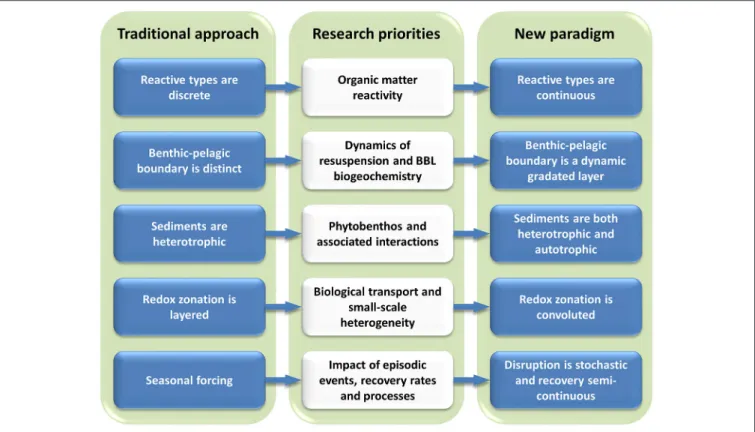
biogeochemical and ecological modelling studies (Figure 1).
REACTIVITY OF ORGANIC MATERIAL
One of the most important yet enigmatic aspects of benthic
biogeochemistry is the reactivity of the particulate organic
material (POM) degraded within the sediment (
Berner, 1980
).
Constraining reactivity rates is crucial as it determines the
sediment burial and recycling efficiencies (
Martin and Bender,
1988; Soetaert et al., 1996
), which allow the quantification of
benthic-pelagic solute fluxes and, ultimately, feedbacks on ocean
chemistry. Organic matter reactivity controls the nature and
magnitude of the electron acceptor sinks from the water column:
close to the sediment surface underlying oxic waters POM
will be mainly respired aerobically and through denitrification,
whereas deeper within the sediment it will mainly be mineralised
through anaerobic pathways such as sulphate-reduction and
methanogenesis (
Regnier et al., 2011
).
Parameterisation of POM reactivity in models requires
information on external (environmental) and internal (intrinsic
to the POM composition) regulating factors. The role each of
these factors play in POM mineralisation is still very poorly
understood (
Burdige, 2007; Arndt et al., 2013
). Attempts have
been made to mathematically describe the vertical distribution of
degradation by compartmentalising POM into discrete reactive
fractions. Yet, in areas of limited data availability different
empirical relationships are used to constrain first-order rate
constants as a function of a master variable such as the POM
rain rate or the sedimentation rate (
Toth and Lerman, 1977;
Middelburg et al., 1997; Martin and Sayles, 2006; Thullner
et al., 2009
). However, their large-scale spatial patterns remain
poorly known, and POM reactivity constants do not strongly
correlate with these global master variables (
Arndt et al., 2013
).
Nonetheless, POM rain rate may be used for predicting its
reactivity when export production is reasonably well described
(
Dunne et al., 2007
).
Less
common
approaches,
in
particular
the
power
(
Middelburg, 1989
) and reactive continuum (
Boudreau and
Ruddick, 1991
) models, assume a continuous distribution
of reactive types that capture the full range of degradation
time scales. They require less parameterisation than discrete
models, but are difficult to apply to bioturbated sediments
where age and reactivity of organic matter depend on the
burial velocity and bioturbation rate (
Meile and Van Cappellen,
2005
). Parameterisation of the continuum model to bioturbated
sediments better captures the degradation of labile material
within the top few millimetres of sediment, and more accurately
predicts the drawdown of oxygen and nitrate from the water
column (
Stolpovsky et al., 2015
). Continuum models can also be
used to define the reactivity of discrete POM fractions, which can
FIGURE 1 | Traditional view of benthic-pelagic coupling and approach to its representation in models (Left), the five cross-disciplinary research priorities that challenge this traditional approach (Middle), and lead to the new paradigm (Right), which is crucial for the improvement of biogeochemical and ecological modelling studies of the marine environment.
then be coupled to the total rain of POM to the seafloor (
Dale
et al., 2015
). However, such approaches are generally not well
suited to coastal areas and seas where seasonality is especially
important. A better understanding of the spatiotemporal
variability of lifetime and composition of POM is crucial for
an improved representation of the benthic-pelagic coupling at
regional to global scales.
THE CONTINUUM OF THE
BENTHIC-PELAGIC BOUNDARY LAYER
The benthic-pelagic boundary is often simplistically regarded as a
discontinuity, the interface between a completely fluid, dynamic
water column and a rigid, porous benthic system. The reality
is a spatially and temporally varying dynamic bottom boundary
layer (BBL), characterised by strong physico-chemical gradients.
While the importance of this layer on the mediation and
transformation of biogeochemical fluxes, the transfer of organic
material and sustaining heterogeneity of benthic habitats has
been widely recognised, many uncertainties remain (
Boudreau
and Jorgensen, 2001
).
The benthic-pelagic transition is often blurred by the presence
of easily resuspendable unconsolidated “fluff ” and fluid muds,
which can form layers extending from a few centimetres
to several meters into the pelagic. The flocculent “fluff ”
usually consists of newly deposited POM, and can sustain rich
microbial communities, also being a valuable food resource
for benthic fauna (
Laima et al., 2002
). Fluid muds containing
high concentrations of fine particular material are distinctive
for the major delta-forming rivers, but also common in other
coastal systems (
McAnally et al., 2007
). They may be subject to
repetitive redox successions and mixing of refractory riverine
material with more labile estuarine organic matter (
Aller, 1998;
Aller and Blair, 2006
). To better account for the fate of organic
material within the BBL, better knowledge of its composition,
degradation and consumption as well as transport dynamics, is
necessary. Supporting this development requires data collected
with equipment that preserves the sediment-water interface
structure.
At the opposite side of benthic-pelagic continuum, properties
of pore water in non-cohesive sandy sediments are similar
to the water column due to enhanced exchange of solutes,
dominated by advective rather than diffusive transport driven
by physical forcing, and enhanced by burrowing organisms
(
Huettel and Webster, 2001; Volkenborn et al., 2012
). This
affects redox structure, biological activity and ultimately the
potential for carbon sequestration (
Reckhardt et al., 2015
). Better
characterisation of sediment types and their regional distribution
is necessary to more accurately quantify material fluxes and
transformations in coupled models (
Almroth Rosell, 2011
).
Representation of a continuous benthic-pelagic interface
in models requires adequate resolution: layers of few
millimetres in thickness can be important for the bulk of
Lessin et al. Modelling Marine Sediment Biogeochemistry
biogeochemical transformations. A compromise usually lies
between implementing high vertical resolution within the BBL
and consolidated sediments (
Yakushev et al., 2017
) or choosing
implicit parameterisations of vertical distributions (
Ruardij and
Van Raaphorst, 1995
). To account for smooth benthic-pelagic
transition in models, decreasing turbulent diffusivity with depth
can be prescribed in the BBL, or potentially parameterised based
on gradients of organic matter concentration and properties.
MICROPHYTOBENTHIC PRIMARY
PRODUCTION
A large area of the coastal sediment receives enough light to
support photosynthesis and sustain benthic primary production
(
Gattuso et al., 2006
), whether seagrasses, macroalgae or
microphytobenthos (MPB), which are generally not yet
considered in holistic model systems. For example the
MPB—typically dominated by pennate diatoms—can be
biogeochemically
significant,
particularly
in
oligotrophic
settings, supported by nutrients regenerated during benthic
mineralisation (
Glud et al., 2009b
). Their diel rhythm of
respiration and photosynthesis has implications for benthic
redox conditions and affects the availability of oxygen and
labile organic material in the upper centimetres of the sediment
(
Cook et al., 2007
). This dynamic directly affects key processes
in the nitrogen cycle (nitrification, denitrification, DNRA), the
redox cycling of metal-oxides and metal-sulphides and thereby
the mobility of metals, trace-metals, phosphorus, sulphur,
and pollutants (
Risgaard-Petersen et al., 1993; Fenchel and
Glud, 2000; Dalsgaard, 2003
). Recent investigations suggest
that MPB metabolism also may directly influence nitrogen
turnover through DNRA and intracellular storage of nitrate
(
Kamp et al., 2011
). Furthermore, extensive production of
exopolymeric substances by MPB can affect the permeability
and erosion thresholds of sediments (
Hanlon et al., 2006; Pierre
et al., 2014
). However, only a few theoretical models on element
cycling, food web structure or biogeochemistry in the coastal
zone illustrate the potential of MPB (
Blackford, 2002; Baird
et al., 2016
). Inclusion of MPB in biogeochemical and trophic
models requires high quality data on distribution and processes
mediated by MPB. New field approaches for mapping biomass
(
Glud et al., 2002; Kazemipour et al., 2012
), trophic coupling
(
Evrard et al., 2008; Oakes et al., 2012
) and performance of MPB
(
Berg et al., 2013; Attard et al., 2014
) may better facilitate model
parameterisation, although basic understanding of in situ growth
and grazing on MPB communities is still rudimentary. However,
to fully appreciate the importance of MPB, field efforts have to
be closely linked to investigations on physiology, metabolism
and behaviour of MPB-dominated communities by, for instance,
taking advantage of new imaging approaches (
Grunwald and
Kühl, 2004; Ralph et al., 2005; Hancke et al., 2014
).
BIOLOGICAL TRANSPORT AND
SMALL-SCALE HETEROGENEITY
Benthic systems are characterised by spatial heterogeneity
at all scales, making sediments a complex mosaic of redox
conditions and habitat niches, often not sufficiently represented
by average rates or attributes (
Glud et al., 2009a
). Without
understanding this variability, benthic systems may exhibit
apparently paradoxical behaviour. For instance, nitrification in
deep nominally anoxic sediment layers (
Satoh et al., 2007
),
occurring as a consequence of burrowing fauna pumping
oxygenated waters into the deeper sediment, locally modifying
redox conditions (
Wenzhöfer and Glud, 2004; Volkenborn et al.,
2010
). Biogeochemical models mostly consider bio-irrigation
(biological enhancement of solute transfer) as a factor enhancing
the diffusion coefficient (
Blackford, 1997; Reed et al., 2011
),
resulting in a thicker oxic layer near the sediment surface.
However, the transport of oxygen (and other solutes) will
likely not occur homogenously, rather being concentrated along
the network of burrows (
Glud et al., 2016
), which become
an extension of the oxic-anoxic interface. It has been shown
that burrowing activity of benthic macrofauna can lead to as
much as 400% increase in denitrification rates (
Gilbert et al.,
1998; Webb and Eyre, 2004
), mostly due to the high rates of
nitrification occurring within the burrows (
Howe et al., 2004
).
Burrows thus offer an ideal environment for diverse microbial
communities to work very closely and efficiently: indeed, genetic
analysis has shown that in-burrow bacterial communities are
more similar to the surface sediment community than the
ambient sediment community at similar depth (
Satoh et al., 2007;
Laverock et al., 2010
). Conversely, anaerobic microniches may
be formed in surface aerobic sediments when the consumption
rate due to the mineralisation of POM by bacteria is higher
than the oxygen diffusion into the particle. Under these
conditions, anaerobic processes such as sulphate reduction and
denitrification (
Jørgensen, 1977; Lehto et al., 2014
) may occur at
the sediment surface.
Recently, sulphide oxidation has been observed even within
anoxic sediments, at the expense of the free oxygen in the distant
oxic layer, thanks to the presence of filamentous cable bacteria
that physically connect the two layers and act as micro-cables
transferring electrons (
Nielsen et al., 2010; Pfeffer et al., 2012
).
In a seasonally hypoxic basin in the North Sea, cable bacteria are
very abundant and active during winter when they build a large
buffer of iron (hydro-)oxides before the onset of summer hypoxia
that is able to prevent the formation of euxinic toxic waters
by chemically oxidising the sulphides formed during summer
(
Seitaj et al., 2015
). Sharp discontinuities in the redox structure
of the benthic environment are rarely represented in models
despite their potential significance. Explicit representation of
these processes would require a significant increase in the
vertical resolution of benthic models, which may be incompatible
with operational modelling. In order to properly upscale these
processes, detailed models implemented at a small scale, or
a sub-grid scale approach could be used to derive optimal
parameterisations.
EPISODIC EVENTS AND RECOVERY
Seasonal variability is an important driver of benthic–pelagic
coupling in the marine environment (
Martens, 1976; Aller, 1994
).
While it is relatively well described in current models, the role
of episodic events has been long neglected because of the lack
of observations and their unpredictability (
Durrieu de Madron
et al., 2011
). Along the continental slope, earthquakes may
generate landslides that affect deposition and, consequently, the
benthic ecosystem (
Oguri et al., 2013
). Other events such as
storms and river floods have been shown to dominate particle
transport in key areas of the coastal zone which implies a large
effect on community structuration and biogeochemical function.
In the North-Western Mediterranean, for example, the Rhône
River shows very large floods that represent 70-80% of the
annual particulate delivery (
Antonelli et al., 2008
) including
POM. These very large deposition rates generate disturbances
of the benthic communities and their functions, and recovery
is often terminated by another event (
Cathalot et al., 2010
). At
the same time, river floods deliver large amounts of nutrients
that induce phytoplankton blooms which feed the pelagic and
benthic biota (
Auger et al., 2011
). Waves and storm-induced
currents can resuspend fine particulates from centimetres in
the sediment (
Toussaint et al., 2014; Bourrin et al., 2015
) and
transport them away from the nearshore coastal zone, thus
feeding deeper benthic communities spread on the shelf and
deep slope (
Jahnke et al., 1990
). Export from the shelf to the
deep-sea is also dominated by intense events (
Sanchez-Vidal
et al., 2008
) through cascading or downwelling in canyons. In
the North-Western Mediterranean, cascading arises from a peak
of cold winds which generate cold and dense waters on the
shelf that are transported to the shelf break and sink, whereas
downwelling events are linked to storms and cyclonic circulation.
Both these phenomena contribute to major export of particles
(
Ulses et al., 2008
) which impoverish the shelf and have profound
impacts on the deep-sea ecosystem (
Sanchez-Vidal et al., 2012
)
including beneficial feeding of the shrimp populations (
Canals
et al., 2009
). Post-disturbance recovery dynamics of benthic
systems will differ depending on nature of disturbance: hypoxia
(
Rosenberg et al., 2002
), benthic trawling (
Collie et al., 2000
),
dredge dumping (
Bolam et al., 2006
) or deep sea mining (
Jones
et al., 2017
) will have different impacts and dynamics of recovery.
One of the modelling challenges is the representation of lateral
recolonization in benthic communities (
Dittmann et al., 1999;
Fowler, 2002
), since microbial functions such as denitrification
only return fully after recovery of deep-digging fauna (
Van
Colen et al., 2012
). Modelling the impacts of intense events
on benthic systems requires consideration of both the physical
reorganisation of the sediments and the associated response of
flora and fauna. Synthesis of current understanding of effects of
these events on organisms’ physiology and ecology will facilitate
better parameterisation of their impacts.
CONCLUSIONS
Benthic environments are a crucial component in the functioning
of marine systems and their services, particularly under
the increasing pressure from anthropogenic activities and
climate change. Therefore, development and application of
numerical models that integrate our understanding of benthic
systems is essential. However, benthic models often require
complex, specific structures and scales, very different from
faster-developing pelagic counterparts. In this paper, we have
discussed some topical challenges related to different aspects of
benthic environments, gaps in their understanding, and research
priorities that will lead to tackling these gaps using a modelling
approach (Figure 1).
We believe that these challenges can be addressed properly
with a different and broader approach than has been used in the
past, one that maximises the utility of benthic modelling within a
whole systems approach. In particular:
• Building on (
Soetaert et al., 2000
) approach, a framework
of traceable and hierarchical complexity for benthic-pelagic
models should be developed. Benthic systems exert different
effects and functions depending on the spatial and temporal
scale being considered. Depending on the scientific question,
some aspects can be neglected, others can be simplified. The
function of the framework would be to assure that these
choices are fully transparent both to scientists and end-users.
This approach will facilitate integration among models, reduce
risk of bias, and clarify any model limitations.
• A cross-disciplinary approach is needed: the complexity of
benthic systems requires an integrated approach toward
research, which necessitates effective communication and
collaboration between modelling and empirical scientists of
various backgrounds, involving stakeholders and end-users
(
Queirós et al., 2015
). This approach has to be fully integrated
rather than sequential or in parallel, including the design of
the conceptual framework of the modelling and experimental
approach.
• A common vocabulary for terminology used in benthic
modelling community needs to be developed. With many
strains and flavours of benthic models developed to date,
an effective interdisciplinary dialogue requires a common
language not only to promote model development and
integration, but also to enhance mutual understanding and
avoid ambiguity.
These three pillars form the foundation for a robust advancement
in multi-disciplinary collaborations in benthic and
benthic-pelagic research necessary to better understand, manage and
predict the marine environment.
AUTHOR CONTRIBUTIONS
All authors contributed to EuroMarine workshop “A
multi-disciplinary consortium approach for advancement of conceptual
frameworks, modelling and experimental approaches to
benthic-pelagic coupling” held at Plymouth Marine Laboratory on May
18–19, 2015, and to consequent discussions leading to this
contribution.
FUNDING
This publication was supported by the EuroMarine Network
(https://www.euromarinenetwork.eu). GL, YA, and JB were
supported by the Marine Ecosystems Research Programme
(NE/L003066/1) and UK Shelf Seas Biogeochemistry programme
Lessin et al. Modelling Marine Sediment Biogeochemistry
(NE/K001876/1), both funded by the UK Natural Environment
Research Council (NERC) and the Department for Environment,
Food and Rural Affairs (Defra), as well as NERC National
Capability in Marine Modelling. RG was supported by the
European Research Council (HADES, grant no. 669947). AQ
was funded under the Marine Ecosystems Research Programme
(NERC and Defra, [NE/L003279/1]). AD was supported by
the Sonderforschungsbereich 754 “Climate – Biogeochemistry
Interactions in the Tropical Ocean” (www.sfb754.de) from the
Deutsche Forschungsgemeinschaft. EA-R was supported by the
BONUS COCOA project, funded by the Baltic Sea research
and development programme (Art 185), funded jointly by
the European Union’s Seventh Framework Programme for
research, technological development and demonstration and by
the Swedish Research Council for Environment, Agricultural
Sciences and Spatial Planning (FORMAS), grant no. 2013–
2056. CR was funded by the Mistrals/Mermex programme
and by the Amorad project ANR-11-RSNR-002 (Investissement
d’Avenir). JM was supported by the Ministry of Education via the
Netherlands Earth System Science Centre (NESSC).
REFERENCES
Aller, R. C. (1994). The sedimentary Mn cycle in Long Island Sound: its role as intermediate oxidant and the influence of bioturbation, O2, and Corg flux on diagenetic reaction balances. J. Mar. Res. 52, 259–295. doi: 10.1357/0022240943077091
Aller, R. C. (1998). Mobile deltaic and continental shelf muds as suboxic, fluidized bed reactors. Mar. Chem. 61, 143–155. doi: 10.1016/S0304-4203(98)00024-3 Aller, R. C., and Blair, N. E. (2006). Carbon remineralization in the Amazon–
Guianas tropical mobile mudbelt: a sedimentary incinerator. Cont. Shelf Res. 26, 2241–2259. doi: 10.1016/j.csr.2006.07.016
Almroth Rosell, E. (2011). Influence of Resuspension on Sediment-Water Solute Exchange and Particle Transport in Marine Environments. Ph.D., University of Gothenburg.
Antonelli, C., Eyrolle, F., Rolland, B., Provansal, M., and Sabatier, F. (2008). Suspended sediment and 137 Cs fluxes during the exceptional December 2003 flood in the Rhone River, southeast France. Geomorphology 95, 350–360. doi: 10.1016/j.geomorph.2007.06.007
Arndt, S., Jørgensen, B. B., LaRowe, D. E., Middelburg, J., Pancost, R., and Regnier, P. (2013). Quantifying the degradation of organic matter in marine sediments: a review and synthesis. Earth Sci. Rev. 123, 53–86. doi: 10.1016/j.earscirev.2013.02.008
Artioli, Y., Friedrich, J., Gilbert, A. J., McQuatters-Gollop, A., Mee, L. D., Vermaat, J. E., et al. (2008). Nutrient budgets for European seas: a measure of the effectiveness of nutrient reduction policies. Mar. Pollut. Bull. 56, 1609–1617. doi: 10.1016/j.marpolbul.2008.05.027
Attard, K. M., Glud, R. N., McGinnis, D. F., and Rysgaard, S. (2014). Seasonal rates of benthic primary production in a Greenland fjord measured by aquatic eddy correlation. Limnol. Oceanogr. 59, 1555–1569. doi: 10.4319/lo.2014.59.5.1555 Auger, P., Diaz, F., Ulses, C., Estournel, C., Neveux, J., Joux, F., et al. (2011).
Functioning of the planktonic ecosystem on the Gulf of Lions shelf (NW Mediterranean) during spring and its impact on the carbon deposition: a field data and 3-D modelling combined approach. Biogeosciences 8, 3231–3261. doi: 10.5194/bg-8-3231-2011
Baird, M. E., Cherukuru, N., Jones, E., Margvelashvili, N., Mongin, M., Oubelkheir, K., et al. (2016). Remote-sensing reflectance and true colour produced by a coupled hydrodynamic, optical, sediment, biogeochemical model of the Great Barrier Reef, Australia: comparison with satellite data. Environ. Model. Softw. 78(Suppl. C), 79–96. doi: 10.1016/j.envsoft.2015.11.025
Baretta, J., Ebenhöh, W., and Ruardij, P. (1995). The European regional seas ecosystem model, a complex marine ecosystem model. Netherlands J. Sea Res. 33, 233–246. doi: 10.1016/0077-7579(95)90047-0
Berg, P., Long, M. H., Huettel, M., Rheuban, J. E., McGlathery, K. J., Howarth, R. W., et al. (2013). Eddy correlation measurements of oxygen fluxes in permeable sediments exposed to varying current flow and light. Limnol. Oceanogr. 58, 1329–1343. doi: 10.4319/lo.2013.58.4.1329
Berner, R. A. (1980). Early Diagenesis: A Theoretical Approach. Princeton, NJ: Princeton University Press.
Blackford, J. (2002). The influence of microphytobenthos on the Northern Adriatic ecosystem: a modelling study. Estuar. Coast. Shelf Sci. 55, 109–123. doi: 10.1006/ecss.2001.0890
Blackford, J. C. (1997). An analysis of benthic biological dynamics in a North Sea ecosystem model. J. Sea Res. 38, 213–230. doi: 10.1016/S1385-1101(97)00044-0
Bolam, S. G., Rees, H. L., Somerfield, P., Smith, R., Clarke, K. R., Warwick, R., et al. (2006). Ecological consequences of dredged material disposal in the marine environment: a holistic assessment of activities around the England and Wales coastline. Mar. Pollut. Bull. 52, 415–426. doi: 10.1016/j.marpolbul.2005.09.028 Boudreau, B. P. (1997). Diagenetic Models and Their Implementation. Berlin:
Springer.
Boudreau, B. P., and Jorgensen, B. B. (eds.). (2001). The Benthic Boundary Layer: Transport Processes and Biogeochemistry. Oxford. UK: Oxford University Press. Boudreau, B. P., and Ruddick, B. R. (1991). On a reactive continuum representation of organic matter diagenesis. Am. J. Sci. 291, 507–538. doi: 10.2475/ajs.291.5.507
Bourrin, F., Many, G., de Madron, X. D., Martín, J., Puig, P., Houpert, L., et al. (2015). Glider monitoring of shelf suspended particle dynamics and transport during storm and flooding conditions. Cont. Shelf Res. 109, 135–149. doi: 10.1016/j.csr.2015.08.031
Burdige, D. J. (2007). Preservation of organic matter in marine sediments: controls, mechanisms, and an imbalance in sediment organic carbon budgets? Chem. Rev. 107, 467–485. doi: 10.1021/cr050347q
Canals, M., Danovaro, R., Heussner, S., Lykousis, V., Puig, P., Trincardi, F., et al. (2009). Cascades in Mediterranean submarine grand canyons. Oceanography 22, 26–43. doi: 10.5670/oceanog.2009.03
Cathalot, C., Rabouille, C., Pastor, L., Deflandre, B., Viollier, E., Buscail, R., et al. (2010). Temporal variability of carbon recycling in coastal sediments influenced by rivers: assessing the impact of flood inputs in the Rhône River prodelta. Biogeosciences 7, 1187–1205. doi: 10.5194/bg-7-1187-2010
Collie, J. S., Hall, S. J., Kaiser, M. J., and Poiner, I. R. (2000). A quantitative analysis of fishing impacts on shelf-sea benthos. J. Anim. Ecol. 69, 785–798. doi: 10.1046/j.1365-2656.2000.00434.x
Cook, P. L., Veuger, B., Böer, S., and Middelburg, J. J. (2007). Effect of nutrient availability on carbon and nitrogen incorporation and flows through benthic algae and bacteria in near-shore sandy sediment. Aquat. Microb. Ecol. 49, 165–180. doi: 10.3354/ame01142
Dale, A. W., Sommer, S., Lomnitz, U., Montes, I., Treude, T., Liebetrau, V., et al. (2015). Organic carbon production, mineralization and preservation on the Peruvian margin. Biogeosciences 12, 1537–1559. doi: 10.5194/bg-12-1537-2015 Dalsgaard, T. (2003). Benthic primary production and nutrient cycling in sediments with benthic microalgae and transient accumulation of macroalgae. Limnol. Oceanogr. 48, 2138–2150. doi: 10.4319/lo.2003.48.6.2138
Dittmann, S., Günther, C.-P., and Schleier, U. (1999). “Recolonization of tidal flats after disturbance,” in The Wadden Sea Ecosystem: Stability, Problems and Mechanisms, ed S. Dittmann (Berlin: Springer), 175–192.
Dunne, J. P., Sarmiento, J. L., and Gnanadesikan, A. (2007). A synthesis of global particle export from the surface ocean and cycling through the ocean interior and on the seafloor. Global Biogeochem. Cycles 21:GB4006. doi: 10.1029/2006GB002907
Durrieu de Madron, X., Guieu, C., Sempér,é, R., Conan, P., Cossa, D., D’Ortenzio, F., et al. (2011). Marine ecosystems’ responses to climatic and anthropogenic forcings in the Mediterranean. Prog. Oceanogr. 91, 97–166. doi: 10.1016/j.pocean.2011.02.003
Evrard, V., Cook, P. L., Veuger, B., Huettel, M., and Middelburg, J. J. (2008). Tracing carbon and nitrogen incorporation and pathways in the microbial community of a photic subtidal sand. Aquat. Microb. Ecol. 53, 257–269. doi: 10.3354/ame01248
Fasham, M., Ducklow, H., and McKelvie, S. (1990). A nitrogen-based model of plankton dynamics in the oceanic mixed layer. J. Mar. Res. 48, 591–639. doi: 10.1357/002224090784984678
Fenchel, T., and Glud, R. N. (2000). Benthic primary production and O2-CO2 dynamics in a shallow-water sediment: spatial and temporal heterogeneity. Ophelia 53, 159–171. doi: 10.1080/00785236.2000.10409446
Fowler, R. T. (2002). Relative importance of surface and subsurface movement on benthic community recovery in the Makaretu River, North Island, New Zealand. N. Z. J. Mar. Freshwater Res. 36, 459–469. doi: 10.1080/00288330.2002.9517101
Gattuso, J.-P., Gentili, B., Duarte, C. M., Kleypas, J., Middelburg, J. J., and Antoine, D. (2006). Light availability in the coastal ocean: impact on the distribution of benthic photosynthetic organisms and contribution to primary production. Biogeosci. Discuss. 3, 895–959. doi: 10.5194/bgd-3-895-2006
Gilbert, F., Stora, G., and Bonin, P. (1998). Influence of bioturbation
on denitrification activity in Mediterranean coastal sediments: an
in situ experimental approach. Mar. Ecol. Prog. Ser. 163, 99–107. doi: 10.3354/meps163099
Glud, R. N., Berg, P., Stahl, H., Hume, A., Larsen, M., Eyre, B. D., et al. (2016). Benthic carbon mineralization and nutrient turnover in a Scottish sea loch: an integrative in situ study. Aquat. Geochem. 22, 443–467. doi: 10.1007/s10498-016-9300-8
Glud, R. N., Kühl, M., Wenzhöfer, F., and Rysgaard, S. (2002). Benthic diatoms of a high Arctic fjord (Young Sound, NE Greenland): importance for ecosystem primary production. Mar. Ecol. Prog. Ser. 238, 15–29. doi: 10.3354/meps238015 Glud, R. N., Stahl, H., Berg, P., Wenzhöfer, F., Oguri, K., and Kitazato, H. (2009a). In situ microscale variation in distribution and consumption of 2: a case study from a deep ocean margin sediment (Sagami Bay, Japan). Limnol. Oceanogr. 54, 1–12. doi: 10.4319/lo.2009.54.1.0001
Glud, R. N., Woelfel, J., Karsten, U., Kühl, M., and Rysgaard, S. (2009b). Benthic microalgal production in the Arctic: applied methods and status of the current database. Bot. Mar. 52, 559–571. doi: 10.1515/BOT.2009.074
Grunwald, B., and Kühl, M. (2004). A system for imaging variable chlorophyll fluorescence of aquatic phototrophs. Ophelia 58, 79–89. doi: 10.1080/00785326.2004.10410215
Hancke, K., Sorell, B. K., Lund-Hansen, L. C., Larsen, M., Hancke, T., and Glud, R. N. (2014). Effects of temperature and irradiance on a benthic microalgal community: a combined two-dimensional oxygen and fluorescence imaging approach. Limnol. Oceanogr. 59, 1599–1611. doi: 10.4319/lo.2014.59. 5.1599
Hanlon, A., Bellinger, B., Haynes, K., Xiao, G., Hofmann, T., Gretz, M., et al. (2006). Dynamics of extracellular polymeric substance (EPS) production and loss in an estuarine, diatom-dominated, microalgal biofilm over a tidal emersion-immersion period. Limnol. Oceanogr. 51, 79–93. doi: 10.4319/lo.2006.51.1.0079 Howe, R. L., Rees, A. P., and Widdicombe, S. (2004). The impact of two species of bioturbating shrimp (Callianassa subterranea and Upogebia deltaura) on sediment denitrification. J. Mar. Biol. Assoc. U.K. 84, 629–632. doi: 10.1017/S002531540400966Xh
Huettel, M., and Webster, I. T. (2001). “Porewater flow in permeable sediments,” in The Benthic Boundary Layer, eds B. P. Boudreau and B. B. Jørgensen (New York, NY: Oxford University Press), 144–179.
Hughes, R. G. (1984). A model of the structure and dynamics of benthic marine invertebrate communities. Mar. Ecol. Progr. Ser. 15, 1–11. doi: 10.3354/meps015001
Hülse, D., Arndt, S., Wilson, J. D., Munhoven, G., and Ridgwell, A. (2017). Understanding the causes and consequences of past marine carbon cycling variability through models. Earth Sci. Rev. 171, 349–382. doi: 10.1016/j.earscirev.2017.06.004
Jahnke, R. A., Reimers, C. E., and Craven, D. B. (1990). Intensification of recycling of organic matter at the sea floor near ocean margins. Nature 348, 50–54. doi: 10.1038/348050a0
Jones, D. O., Kaiser, S., Sweetman, A. K., Smith, C. R., Menot, L., Vink, A., et al. (2017). Biological responses to disturbance from simulated deep-sea polymetallic nodule mining. PLoS ONE 12:e0171750. doi: 10.1371/journal.pone.0171750
Jørgensen, B. B. (1977). Bacterial sulfate reduction within reduced microniches of oxidized marine sediments. Mar. Biol. 41, 7–17. doi: 10.1007/BF00390576
Kamp, A., de Beer, D., Nitsch, J. L., Lavik, G., and Stief, P. (2011). Diatoms respire nitrate to survive dark and anoxic conditions. Proc. Natl. Acad. Sci. U.S.A. 108, 5649–5654. doi: 10.1073/pnas.1015744108
Kazemipour, F., Launeau, P., and Méléder, V. (2012). Microphytobenthos biomass mapping using the optical model of diatom biofilms: application to hyperspectral images of Bourgneuf Bay. Remote Sens. Environ. 127, 1–13. doi: 10.1016/j.rse.2012.08.016
Laima, M., Maksymowska-Brossard, D., Sauriau, P.-G., Richard, P., Girard, M., Gouleau, D., et al. (2002). Fluff deposition on intertidal sediments: effects on benthic biota, ammonium fluxes and nitrification rates. Biogeochemistry 61, 115–133. doi: 10.1023/A:1020264414924
Laverock, B., Smith, C. J., Tait, K., Osborn, A. M., Widdicombe, S., and Gilbert, J. A. (2010). Bioturbating shrimp alter the structure and diversity of bacterial communities in coastal marine sediments. ISME J. 4, 1531–1544. doi: 10.1038/ismej.2010.86
Lehto, N., Glud, R. N., á Norð*i, G., Zhang, H., and Davison, W. (2014). Anoxic microniches in marine sediments induced by aggregate settlement: biogeochemical dynamics and implications. Biogeochemistry 119, 307–327. doi: 10.1007/s10533-014-9967-0
Martens, C. S. (1976). Control of methane sediment-water bubble transport by macroinfaunal irrigation in cape lookout bight, North Carolina. Science 192, 998–1000. doi: 10.1126/science.192.4243.998
Martin, W., and Bender, M. (1988). The variability of benthic fluxes and sedimentary remineralization rates in response to seasonally variable organic carbon rain rates in the deep sea; a modeling study. Am. J. Sci. 288, 561–574. doi: 10.2475/ajs.288.6.561
Martin, W., and Sayles, F. (2006). Organic matter oxidation in deep-sea sediments: distribution in the sediment column and implications for calcite dissolution. Deep Sea Res. Part II Top. Stud. Oceanogr. 53, 771–792. doi: 10.1016/j.dsr2.2006.01.017
McAnally, W. H., Friedrichs, C., Hamilton, D., Hayter, E., Shrestha, P., Rodriguez, H., et al. (2007). Management of fluid mud in estuaries, bays, and lakes. I: present state of understanding on character and behavior. J. Hydr. Eng. 133, 9–22. doi: 10.1061/(ASCE)0733-9429(2007)133:1(9)
Meile, C., and Van Cappellen, P. (2005). Particle age distributions and O2 exposure times: timescales in bioturbated sediments. Global Biogeochem. Cycles 19:GB3013. doi: 10.1029/2004GB002371
Meysman, F. J., Middelburg, J. J., and Heip, C. H. (2006). Bioturbation: a fresh look at Darwin’s last idea. Trends Ecol. Evol. 21, 688–695. doi: 10.1016/j.tree.2006.08.002
Middelburg, J. J. (1989). A simple rate model for organic matter decomposition
in marine sediments. Geochim. Cosmochim. Acta 53, 1577–1581.
doi: 10.1016/0016-7037(89)90239-1
Middelburg, J. J., Soetaert, K., and Herman, P. M. (1997). Empirical relationships for use in global diagenetic models. Deep Sea Res. Part I Oceanogr. Res. Pap. 44, 327–344. doi: 10.1016/S0967-0637(96)00101-X
Nielsen, L. P., Risgaard-Petersen, N., Fossing, H., Christensen, P. B., and Sayama, M. (2010). Electric currents couple spatially separated biogeochemical processes in marine sediment. Nature 463, 1071–1074. doi: 10.1038/nature08790
Oakes, J. M., Eyre, B. D., and Middelburg, J. J. (2012). Transformation and fate of microphytobenthos carbon in subtropical shallow subtidal
sands: a 13C-labeling study. Limnol. Oceanogr. 57, 1846–1856.
doi: 10.4319/lo.2012.57.6.1846
Oguri, K., Kawamura, K., Sakaguchi, A., Toyofuku, T., Kasaya, T., Murayama, M., et al. (2013). Hadal disturbance in the Japan Trench induced by the 2011 Tohoku–Oki Earthquake 3:1915. doi: 10.1038/srep01915
Paraska, D. W., Hipsey, M. R., and Salmon, S. U. (2014). Sediment diagenesis models: review of approaches, challenges and opportunities. Environ. Model. Softw. 61, 297–325. doi: 10.1016/j.envsoft.2014.05.011
Pfeffer, C., Larsen, S., Song, J., Dong, M., Besenbacher, F., Meyer, R. L., et al. (2012). Filamentous bacteria transport electrons over centimetre distances. Nature 491, 218–221. doi: 10.1038/nature11586
Pierre, G., Zhao, J.-M., Orvain, F., Dupuy, C., Klein, G. L., Graber, M., et al. (2014). Seasonal dynamics of extracellular polymeric substances (EPS) in surface sediments of a diatom-dominated intertidal mudflat (Marennes– Oléron, France). J. Sea Res. 92, 26–35. doi: 10.1016/j.seares.2013.07.018
Lessin et al. Modelling Marine Sediment Biogeochemistry
Queirós, A. M., Bruggeman, J., Stephens, N., Artioli, Y., Butenschön, M., Blackford, J. C., et al. (2015). Placing biodiversity in ecosystem models without getting lost in translation. J. Sea Res. 98, 83–90. doi: 10.1016/j.seares.2014.10.004 Ralph, P. J., Schreiber, U., Gademann, R., Kühl, M., and Larkum, A. W.
(2005). Coral photobiology studied with a new imaging pulse amplitude modulated fluorometer1. J. Phycol. 41, 335–342. doi: 10.1111/j.1529-8817.2005. 04034.x
Reckhardt, A., Beck, M., Seidel, M., Riedel, T., Wehrmann, A., Bartholomä, A., et al. (2015). Carbon, nutrient and trace metal cycling in sandy sediments: a comparison of high-energy beaches and backbarrier tidal flats. Estuar. Coast. Shelf Sci. 159, 1–14. doi: 10.1016/j.ecss.2015.03.025
Reed, D. C., Slomp, C. P., and Gustafsson, B. G. (2011). Sedimentary phosphorus dynamics and the evolution of bottom-water hypoxia: a coupled benthic– pelagic model of a coastal system. Limnol. Oceanogr. 56, 1075–1092. doi: 10.4319/lo.2011.56.3.1075
Regnier, P., Dale, A. W., Arndt, S., LaRowe, D., Mogollón, J., and Van Cappellen, P. (2011). Quantitative analysis of anaerobic oxidation of methane (AOM) in marine sediments: a modeling perspective. Earth Sci. Rev. 106, 105–130. doi: 10.1016/j.earscirev.2011.01.002
Risgaard-Petersen, N., Rysgaard, S., and Revsbech, N. P. (1993). A sensitive assay for determination of14N/15N isotope distribution in NO−
3. J. Microbiol. Methods 17, 155–164. doi: 10.1016/0167-7012(93)90009-7
Rosenberg, R., Agrenius, S., Hellman, B., Nilsson, H. C., and Norling, K. (2002). Recovery of marine benthic habitats and fauna in a Swedish fjord following improved oxygen conditions. Mar. Ecol. Prog. Ser. 234, 43–53. doi: 10.3354/meps234043
Ruardij, P., and Van Raaphorst, W. (1995). Benthic nutrient regeneration in the ERSEM ecosystem model of the North Sea. Netherlands J. Sea Res. 33, 453–483. doi: 10.1016/0077-7579(95)90057-8
Sanchez-Vidal, A., Pasqual, C., Kerhervé, P., Calafat, A., Heussner, S., Palanques, A., et al. (2008). Impact of dense shelf water cascading on the transfer of organic matter to the deep western Mediterranean basin. Geophys. Res. Lett. 35:L0560. doi: 10.1029/2007GL032825
Sanchez-Vidal, A., Canals, M., Calafat, A. M., Lastras, G., Pedrosa-Pàmies, R., Menéndez, M., et al. (2012). Impacts on the deep-sea ecosystem by a severe coastal storm. PLoS ONE 7:e30395. doi: 10.1371/journal.pone.0030395 Satoh, H., Nakamura, Y., and Okabe, S. (2007). Influences of infaunal
burrows on the community structure and activity of ammonia-oxidizing bacteria in intertidal sediments. Appl. Environ. Microbiol. 73, 1341–1348. doi: 10.1128/AEM.02073-06
Seitaj, D., Schauer, R., Sulu-Gambari, F., Hidalgo-Martinez, S., Malkin, S. Y., Burdorf, L. D. W., et al. (2015). Cable bacteria generate a firewall against euxinia in seasonally hypoxic basins. Proc. Natl. Acad. Sci. U.S.A. 112, 13278–13283. doi: 10.1073/pnas.1510152112
Soetaert, K., Herman, P. M., and Middelburg, J. J. (1996). Dynamic response of deep-sea sediments to seasonal variations: a model. Limnol. Oceanogr. 41, 1651–1668. doi: 10.4319/lo.1996.41.8.1651
Soetaert, K., and Middelburg, J. J. (2009). Modeling eutrophication and oligotrophication of shallow-water marine systems: the importance of sediments under stratified and well-mixed conditions. Hydrobiologia 629, 239–254. doi: 10.1007/s10750-009-9777-x
Soetaert, K., Middelburg, J. J., Herman, P. M. J., and Buis, K. (2000). On the coupling of benthic and pelagic biogeochemical models. Earth Sci. Rev. 51, 173–201. doi: 10.1016/S0012-8252(00)00004-0
Steele, J., and Henderson, E. (1981). A simple plankton model. Am. Nat. 117, 676–691. doi: 10.1086/283752
Stolpovsky, K., Dale, A. W., and Wallmann, K. (2015). Toward a parameterization of global-scale organic carbon mineralization kinetics in surface marine sediments. Global Biogeochem. Cycles 29, 812–829. doi: 10.1002/2015GB005087 Thullner, M., Dale, A. W., and Regnier, P. (2009). Global-scale quantification of mineralization pathways in marine sediments: a reaction-transport modeling approach. Geochem. Geophys. Geosyst. 10:Q10012. doi: 10.1029/2009GC002484 Toth, D. J., and Lerman, A. (1977). Organic matter reactivity and sedimentation
rates in the ocean. Am. J. Sci. 277, 465–485. doi: 10.2475/ajs.277.4.465 Toussaint, F., Rabouille, C., Cathalot, C., Bombled, B., Abchiche, A., Aouji, O., et al.
(2014). A new device to follow temporal variations of oxygen demand in deltaic sediments: the LSCE benthic station. Limnol. Oceanogr. Methods 12, 729–741. doi: 10.4319/lom.2014.12.729
Ulses, C., Estournel, C., De Madron, X. D., and Palanques, A. (2008). Suspended sediment transport in the Gulf of Lions (NW Mediterranean): impact of extreme storms and floods. Cont. Shelf Res. 28, 2048–2070. doi: 10.1016/j.csr.2008.01.015
Van Colen, C., Rossi, F., Montserrat, F., Andersson, M. G., Gribsholt, B., Herman, P. M., et al. (2012). Organism-sediment interactions govern post-hypoxia recovery of ecosystem functioning. PLoS ONE 7:e49795. doi: 10.1371/journal.pone.0049795
Volkenborn, N., Polerecky, L., Wethey, D., DeWitt, T., and Woodin, S. (2012). Hydraulic activities by ghost shrimp Neotrypaea californiensis induce oxic– anoxic oscillations in sediments. Mar. Ecol. Prog. Ser. 455, 141–156. doi: 10.3354/meps09645
Volkenborn, N., Polerecky, L., Wethey, D., and Woodin, S. (2010). Oscillatory porewater bioadvection in marine sediments induced by hydraulic activities of Arenicola marina. Limnol. Oceanogr. 55, 1231–1247. doi: 10.4319/lo.2010.55.3.1231
Wakelin, S., Holt, J., Blackford, J., Allen, J., Butenschön, M., and Artioli, Y. (2012). Modeling the carbon fluxes of the northwest European continental shelf: validation and budgets. J. Geophys. Res. Oceans 117:C05020. doi: 10.1029/2011JC007402
Webb, A. P., and Eyre, B. D. (2004). Effect of natural populations of burrowing thalassinidean shrimp on sediment irrigation, benthic metabolism, nutrient fluxes and denitrification. Mar. Ecol. Prog. Ser. 268, 205–220. doi: 10.3354/meps268205
Wenzhöfer, F., and Glud, R. N. (2004). Small-scale spatial and temporal variability in coastal benthic O2 dynamics: effects of fauna activity. Limnol. Oceanogr. 49, 1471–1481. doi: 10.4319/lo.2004.49.5.1471
Yakushev, E. V., Protsenko, E. A., Bruggeman, J., Wallhead, P., Pakhomova, S. V., Yakubov, S. K., et al. (2017). Bottom RedOx Model (BROM v.1.1): a coupled benthic–pelagic model for simulation of water and sediment biogeochemistry. Geosci. Model Dev. 10, 453–482. doi: 10.5194/gmd-10-453-2017
Conflict of Interest Statement: The authors declare that the research was conducted in the absence of any commercial or financial relationships that could be construed as a potential conflict of interest.
Copyright © 2018 Lessin, Artioli, Almroth-Rosell, Blackford, Dale, Glud, Middelburg, Pastres, Queirós, Rabouille, Regnier, Soetaert, Solidoro, Stephens and Yakushev. This is an open-access article distributed under the terms of the Creative Commons Attribution License (CC BY). The use, distribution or reproduction in other forums is permitted, provided the original author(s) and the copyright owner are credited and that the original publication in this journal is cited, in accordance with accepted academic practice. No use, distribution or reproduction is permitted which does not comply with these terms.