HAL Id: hal-03004489
https://hal.archives-ouvertes.fr/hal-03004489
Submitted on 13 Nov 2020HAL is a multi-disciplinary open access
archive for the deposit and dissemination of sci-entific research documents, whether they are pub-lished or not. The documents may come from teaching and research institutions in France or abroad, or from public or private research centers.
L’archive ouverte pluridisciplinaire HAL, est destinée au dépôt et à la diffusion de documents scientifiques de niveau recherche, publiés ou non, émanant des établissements d’enseignement et de recherche français ou étrangers, des laboratoires publics ou privés.
Eumorphocystis and its pseudo-arms
Thomas E. Guensburg, James Sprinkle, Rich Mooi, Bertrand Lefebvre
To cite this version:
Thomas E. Guensburg, James Sprinkle, Rich Mooi, Bertrand Lefebvre. Evolutionary significance of the blastozoan Eumorphocystis and its pseudo-arms. Journal of Paleontology, In press. �hal-03004489�
Evolutionary significance of the blastozoan Eumorphocystis and its
1
pseudo-arms
2 3
Thomas E. Guensburg1, James Sprinkle2, Rich Mooi3, and Bertrand Lefebvre4
4 5
1IRC, Field Museum, 1400 South Lake Shore Drive, Chicago, IL 60605 ([email protected])
6 7
2Department of Geological Sciences, Jackson School of Geosciences, University of Texas, 1 University
8
Station C1100, Austin, TX 78712-0254 ([email protected])
9 10
3Department of Invertebrate Zoology, California Academy of Sciences, 55 Music Concourse Drive, San
11
Francisco, CA 94118 ([email protected])
12 13
4 Univ Lyon, Univ Lyon 1, ENSL, CNRS, LGL-TPE , F69622, Villeurbanne, France
14
15 16
Running header: Eumorphocystis, pseudo-arms, homoplasy with crinoids
17 18
Abstract.—Twelve Eumorphocystis specimens provide the basis for new findings and a more
19
informed assessment of whether this blastozoan (eocrinoids, blastoids, diploporites, 20
rhombiferans) constitutes the sister taxon to crinoids, as has been recently proposed. Both 21
Eumorphocystis and earliest-known crinoid feeding appendages express large longitudinal
22
canals, a demonstrable homology exclusive to these taxa. However, the specimen series studied 23
here shows that Eumorphocystis canals constrict proximally and travel within ambulacrals above 24
the thecal cavity. This relationship is congruent with a documented blastozoan pattern but very 25
unlike earliest crinoid topology. Earliest crinoid arm cavities lie fully beneath floor plates; these 26
expand and merge directly with the main thecal coelomic cavity at thecal shoulders. Other 27
associated anatomical features echo this contrasting comparison. Feeding appendages of 28
Eumorphocystis lack two-tiered cover plates, podial basins/pores, and lateral arm plating, all
29
features of earliest crinoid "true arms". Eumorphocystis feeding appendages are buttressed by 30
solid block-like plates added during ontogeny at a generative zone below floor plates, a pattern 31
with no known parallel among crinoids. Eumorphocystis feeding appendages express brachioles, 32
erect extensions of floor plates, also unknown among crinoids. These several distinctions point to 33
non-homology of most feeding appendage anatomy, removing Eumorphocystis and other 34
blastozoans from exclusive relationship with crinoids. Eumorphocystis further differs from 35
crinoids in that thecal plates express diplopores, respiratory structures not present among 36
crinoids, but ubiquitous among certain groups of blastozoans. Phylogenetic analysis places 37
Eumorphocystis as a crownward blastozoan, far removed from crinoids.
38 39 40 Introduction 41 42
It was suggested long ago that blastozoans (eoccrinoids, blastoids, diploporites, 43
rhombiferans) and crinoids comprise a monophyletic assemblage, the so-called Pelmatozoa 44
(Leuckart, 1846), largely on the basis of common possession of a superficially similar 45
attachment stalk. In spite of doubts about this interpretation that arose during the mid-20th 46
century (Ubaghs, 1953, 1968; Sprinkle, 1973), this canon was perpetuated in major reference 47
works such as the Treatise on Invertebrate Paleontology and persists in many publications to the 48
present day. Works seeking to separate blastozoans and crinoids as only distantly related 49
pentaradiate forms or reject the pelmatozoan hypotheses that crinoids and blastozoans share 50
exclusive common ancestry, have met with considerable resistance (Clausen et al., 2009; Zamora 51
and Smith, 2011; Kammer et al., 2013; Sumrall, 2017; Sheffield and Sumrall, 2019a, 2019b; 52
inter alia). 53
However, even detractors of the idea that crinoids and blastozoans are only superficially 54
similar and do not form an exclusive clade seem to have accepted the importance of the crucial 55
suite of feeding appendage features cited by those who question the validity of Pelmatozoa, or at 56
least argue that any resemblances are superficial (Mooi and David, 1998, 2000; David and Mooi, 57
1999; Guensburg and Sprinkle, 2007; Guensburg et al., 2020, inter alia). For example, 58
proponents for blastozoan ancestry of crinoids claimed an unnamed Middle Cambrian blastozoan 59
represented only by disarticulated plates provided evidence that somatocoelar extensions from 60
the main body cavity continued into the arms (Clausen, 2009). However, it is also clear these 61
supposed blastozoan arms lacked any extraxial elements. The purported coelomic canals pass 62
through floor plates toward the peristome, not through the thecal shoulder, which is an anatomy 63
unlike crinoids. The diminutive nature of these blastozoan canals is also problematic. Other 64
workers cited this and other evidence to reject the idea that any canals within the appendages of 65
blastozoans represented spaces for somatocoelar extensions (Guensburg et al., 2010). In spite of 66
attempts to clarify the issue through precise anatomical descriptions, the debate continues. Here, 67
we shed new light on another purported “missing link” between crinoids and blastozoans. 68
Recently, a proposal that Eumorphocystis multiporata Branson and Peck, 1940, 69
(hereafter, Eumorphocystis, as all specimens are conspecific topotypes), a diplopore-bearing 70
blastozoan, represents the nearest-known sister group to crinoids has been published (Sheffield 71
and Sumrall, 2019). Evidence central to this suggestion, largely derived from a single specimen, 72
is the description of a longitudinal canal within each of this taxon’s feeding appendages. These 73
canals are stated to pierce the theca and connect with the thecal coelomic cavity in a manner 74
similar to that known for crinoids (Sheffield and Sumrall, 2019). 75
Two ancillary putative homologies follow: “arm” construction consisting of triserial (here 76
referred to as tripartite, because an aboral series is not in strict one-to-one sequence with the 77
other two) axial and extraxial elements, and the presence of “radial” plates from which an aboral 78
uniserial set of “brachial” extraxial elements extends distally out these appendages. We 79
reconsider and test this proposal using new and existing observations from 12 Eumorphocystis 80
specimens. These data are then compared with an expanded update of early crinoid arm 81
morphology recently made available through examination of earliest crinoids. These data have 82
only recently been more fully explicated in the context of crinoid origins (Guensburg et al., 83
2020). 84
A full understanding of the feeding appendages of Eumorphocystis has been a long-term 85
process, and even now some details, such as their full length, remain unknown (Fig. 1). The 86
original description of Eumorphocystis (Branson and Peck, 1940) was based on the holotype 87
alone, in which the appendages are broken off close to the theca. This led to the initial 88
conclusion that exothecal feeding appendages were lacking in this taxon. More complete 89
Eumorphocystis specimens provided the first evidence of “arms” (Parsley, 1982). Initially, these
90
were considered of blastozoan origin and only homoplastic on crinoid arms (Parsley, 1982). 91
Recently, the discovery that early crinoids express what could also be considered a tripartite 92
pattern (Guensburg and Sprinkle, 2009) formed the basis for a reinterpretation that 93
Eumorphocystis “arm” anatomy is homologous to that of early crinoids (Sheffield and Sumrall,
94
2019a). In this paper, however, we add descriptive data and imagery that enhance our 95
understanding of, and provide a basis for, interpretation of Eumorphocystis “arms” that is in 96
agreement with the original suggestion that Eumorphocystis is of strictly blastozoan affinity 97
(Parsley, 1982). The present data confirm most of the basic “arm” construction details, but reveal 98
significant points of departure, particularly at the juncture of arms to theca (Sheffield and 99
Sumrall, 2019a). This new information forms the core of our reappraisal of the evolutionary 100
significance of Eumorphocystis. 101
102
Repositories, Material, Stratigraphic Occurrence, and Methods
103 104
Specimens used for this study were selected to provide data concerning feeding 105
appendage and associated thecal anatomy. Virtually no additional preparation beyond that 106
already accomplished was needed. Specimens were photographed using a Leica dms 300 digital 107
camera fitted with stacking capability. 108
Repositories and institutional abbreviations.— Eumorphocystis specimens used in this
109
study are housed in the collections of the Sam Noble Museum (OU), University of Oklahoma, 110
Norman, and the Non-vertebrate Paleontology Lab (----TX--, NPL) at the University of Texas, 111
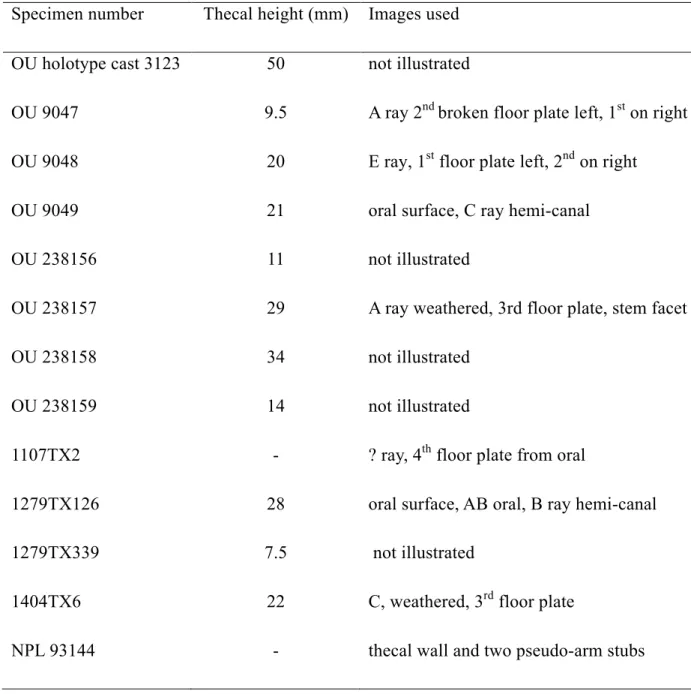
Austin. These twelve topotypes are: OU 9047, OU 9048, OU 9049, OU 238156, OU 238157, 112
OU 238158, OU 238159, 1107TX2, 1279TX126, 1279TX339, 1404TX6, and NPL 93144 (Table
113
1). We also examined a plaster cast of the holotype, OU 3123. Codings for other taxa used in the 114
phylogenetic analysis were primarily obtained from published sources and checked with 115
specimens in the collections of the Field Museum, Chicago, and the Non-vertebrate Paleontology 116
Laboratory at the University of Texas, Austin. 117
All Eumorphocystis specimens were collected from the Lower Echinoderm Zone, 118
Mountain Lake Member, Bromide Formation, Arbuckle Mountains, Oklahoma. Detailed locality 119
data are available from respective repositories. The Bromide Formation is Sandbian, early Late 120
Ordovician, in age. 121
122
Preservation and Taphonomy
123 124
Most Eumorphocystis specimens were surface collected and largely free from enclosing 125
calcareous shale, but a few are preserved on carbonate grainstone surfaces. Specimens are 126
usually three dimensional or nearly so, with negligible crushing. No specimen preserved with 127
complete feeding appendages or stems is known. Instead, available material consists of thecae 128
with arms broken off at varying distances from the theca. The different breakage patterns are 129
important for tracing features such as those involved in the transition from theca to appendage. 130
Only a few specimens preserve proximal portions of the stem, the longest-known segment with 131
31 “columnals”. Specimens show variable amounts of grainy calcite overgrowths and spar 132
infilling of stereom, presumably the result of rapid post-mortem cementation. This is not a 133
serious impediment for observing anatomy such as thecal plate sutures, but it can obscure details 134
of microscopic structures germane to assessing the features crucial to determining the 135
evolutionary significance of Eumorphocystis. In some cases, there are no apparent canals in the 136
thecal or near-thecal portions of the ambulacra. In a few cases, specimens corroded by 137
differential dissolution weathering, presumably resulting from more soluble low magnesium 138
cement versus high-magnesium echinoderm stereom, reveal tiny canals. These are continuations 139
of larger feeding appendage canals. In addition, the twelve specimens available furnish data on 140
intraspecific variation. These findings are incorporated into the subsequent analysis. 141
142
Character analysis
143 144
Here we provide new information in the form of a character analysis for features of an 145
admittedly contentious fossil, Eumorphocystis. The focus is primarily on feeding appendages but 146
includes observations from adjacent skeletal anatomy as well. This analysis is based on 147
examination of specimens hitherto unexamined by those who have suggested a sister group 148
relationship to crinoids for this taxon (Sheffield and Sumrall, 2019a; Deline et al., 2020). 149
Accompanying reasoning that strongly supports a position for Eumorphocystis contrary to this 150
earlier work is presented with this analysis. The cases for or against hypotheses of homology, 151
here and in the opposing viewpoint, both depend upon congruency and accepted ontogenetic, 152
morphological, and positional criteria for homology (Patterson, 1988; Freudenstein, 2005). 153
Past criticisms of our conclusions regarding the origins of crinoids (most recently 154
Sheffield and Sumrall, 2019a) cited reliance on what were perceived to be a priori assumptions. 155
It was claimed that our work presupposed reasoning or knowledge proceeding from theoretical 156
deduction. However, accepted theories such as the Extraxial-Axial Theory were developed from 157
empirical observations and theoretical induction, not the other way around (Mooi and David, 158
1997). Our aforementioned methodology is brought to bear on hypotheses of homology in a 159
detailed explication, without coding based solely on superficial resemblances of individual 160
features that do not fully consider information gleaned from other sources, including but not 161
restricted to the overall relationships of these features one to another. Our approach has, and 162
continues to be, utilization of these explications to code features, and to test these hypotheses of 163
homology in a full phylogenetic analysis. This approach is integral to the uncovering of 164
phylogenetic signal. 165
The same authors criticizing our approach rely on analyses that do not provide detailed 166
delineation of character state parameters, full probing of superficial similarity, or support for 167
why a given transformation series should be a part of a given character or carry phylogenetic 168
signal (Kammer et al., 2013; Sumrall, 2017; Wright, et al., 2017; Deline, et al. 2020; inter alia). 169
Approaches that differ from ours (e.g. Deline et al. 2020) leave uncited available data, or 170
findings that undermine codings they favor (David et al., 2000; Guensburg et al., 2010; 171
Guensburg et al., 2016; Lefebvre et al., 2019; inter alia). We prefer a different way of dealing 172
with echinoderm phylogeny, particularly when working with fossils open to more than one 173
interpretation. As stated in Mooi and David (1997: 306), "The issue of subjectivity versus 174
objectivity is often raised in reference to character analysis, usually with the implication that it is 175
not objective to try to assess the degree to which we can trust phylogenetic signal from certain 176
features. As cladists interested in quality of data as well as quantity, we are resisting the 177
implication that the more we know about our characters, the less objective the study will be." 178
A criticism of our methodology centered on reliance upon differences rather than 179
similarities in our analyses (Wright et al., 2017, p. 831). This oversimplifies our approach and 180
does not fully recognize the strengths of the phylogenetic method itself. Similarities and 181
differences are nested concepts and provide the basis for evaluation of critical issues concerning 182
homoplasy or homology. Commonality at one level of universality will be a difference at 183
another, and our application of the data we have gathered recognize this explicitly. Moreover, 184
our insistence that certain features should not be considered even comparable or coded under the 185
same character system is not founded on a search for differences. We are attempting to address 186
the more profound problem that past nomenclature has reified concepts of similarity that are 187
either inapplicable or violate the central principle that such analyses should capture phylogenetic 188
signal. Our approach employs nuanced and detailed observations drawn from several sources but 189
does not overtly rely on differences. Our evaluations continue to be founded among long 190
established criteria: conjunction, congruence and similarity, and an intimate knowledge of the 191
material at hand (Patterson, 1988; Freudenstein, 2005). 192
We base our characters and codings on analytical data from combined observations 193
accumulated over a period of decades within the framework of established phylogenetic practice 194
(Guensburg, 2012; Guensburg, et al., 2020), and on empirical observations informed by 195
ontogenetic and anatomical information from a wide variety of sources (partially summarized in 196
Mooi and David, 1998; Mooi et al., 2005; inter alia), including from extant specimens whose 197
anatomy is frequently ignored in the context of what is plausible among fossil forms. Recent 198
workers have appropriately applied new or previously little used methodology to the issue of 199
crinoid phylogeny (Ausich, 2015b; Wright et al., 2017), but such approaches should incorporate 200
information from other well-founded methodologies including those utilized here and in other 201
works (e.g. Guensburg et al., 2016; Guensburg, et al., 2020). 202
Here, we start with observations benefiting from anatomical details furnished by the large 203
Eumorphocystis sample size, improved understanding of earliest crinoid morphology and data
204
from origins of specific body wall regions (Mooi and David, 1997, 2008; David et al., 2000; 205
Guensburg and Sprinkle, 2007, 2009; Guensburg, 2012; Guensburg et al., 2016; Guensburg et 206
al., 2020; inter alia). We begin with the three homologies proposed to link Eumorphocystis to 207
crinoids (Sheffield and Sumrall, 2019a) and continue with expanded comparative data from 208
feeding appendages and beyond. These ultimately test the number and specific kinds of 209
transformations in a series of hypothetical evolutionary events required to support an exclusive 210
link between Eumorphocystis and the common ancestor of Crinoidea. 211
212
Coeloms.—The central issue and a principal point of departure of the concept that crinoids are
213
sister to Eumorphocystis (Sheffield and Sumrall, 2019a) in this restudy concerns the 214
interpretation of canals associated with feeding appendages. Adding uncertainty to this matter is 215
the scarcity of comparative information for brachiolar and floor plate canals of blastozoans in 216
general (see Sprinkle, 1973; Clausen et al., 2009, for examples). Among early crinoids, these 217
data have only recently been extensively analyzed in a phylogenetic context, although the nature 218
of these canals has long been understood from an anatomical standpoint (Heinzeller and Welsch, 219
1994; and summarized in Guensburg et al., 2020). 220
Present evidence shows that longitudinal feeding appendage canals, otherwise termed 221
median canals (Sprinkle, 1973), exist in a diversity of blastozoans (gogiids, rhipidocystids, 222
rhombiferans, blastoids) (Fay, 1960; Sprinkle, 1973; 1975; Clausen, et al., 2009; Sumrall and 223
Sheffield, 2019a) (Figs 2-4, 6.1-6.4, 6.6, 6.8, 6.9). However, the generally small scales of 224
available material, and the tendency for diagenesis to obscure details with calcitic infilling or 225
eliminate them through moldic preservation that show only plate exteriors, combine to contribute 226
to the scarcity of data. Further, material with attached feeding appendages remains unavailable 227
for many blastozoans, and even ambulacra on thecae are not commonly broken through in such a 228
way that might reveal internal canals. Not surprisingly, no comprehensive study of blastozoan 229
median canals is available, and none is documented for most taxa. Blastozoan median canals 230
pass through floor plates and their extensions, the brachiolars, presumably to their tips. They are 231
housed within floor plates, and in nearly all known cases, pass between opposing floor plate 232
elements along the appendage mid-line. In one case, canals are encased in uniserial floor plates 233
extending from arms to the theca (Clausen, et al., 2009). Position of canals and the fact that these 234
seem to extend to the oral region suggest they housed nerve branches extending from the 235
circumoral ring. This latter anatomical configuration can be observed among living echinoderms. 236
Previously reported blastozoan canals are circular openings, on the order of 0.1 mm2 237
(using 𝐴 = 𝜋𝑟!, the area for a circle) or smaller in section. These are housed within floor plates
238
or, in the case of brachiole-bearing blastozoans, brachiolars. The roughly elliptical appendage 239
cavities seen in Eumorphocystis are larger than those of other blastozoans, being approximately 240
1.3 mm2 in section (using 𝐴 = 𝜋ab, the area for an ellipse) (Fig. 2.2, but see Fig. 3.6 for much 241
smaller canal). These transition proximally to much smaller, more circular, canals, 242
approximately 0.14 mm2 in section (Figs. 3.2, 3.4-3.6, 4.2, 4.6), on a scale similar to those of 243
other blastozoans. These small proximal canals are often obscured by spar-filling similar in color 244
to adjacent spar-filled plates (Figs. 2.3, 3.4, 4.1). This narrowing occurs at the second to fourth 245
ambulacrals distal to the orals, except in the C-ray where differentiated floor plates skirt the 246
periproct region. In both cases, though, this change takes place not far beyond the thecal wall. 247
Topology in the proximal regions agrees with the most common blastozoan pattern in that canals 248
run along the perradial sutures (ambulacral midline) that form contacts between opposing floor 249
plates. On the theca itself, canals proceed within floor plates just above, but not through, the 250
thecal wall (Figs. 4.2, 4.3). These narrow canals were observed to reach the orals (Fig. 3.5). 251
Opposing floor plate walls each form a hemi-canal or “half-pipe” (Fig. 3.2, 3.5). Larger than 252
usual more distal canals could have accommodated expanded innervation of appendages 253
supplying the dense array of brachioles. 254
The situation among early crinoids (see Guensburg et al., 2010; Guensburg et al., 2020, 255
for detailed analysis) (Figs. 5, 6.5, 6.7) is not comparable to that of Eumorphocystis or any other 256
blastozoan (see Guensburg et al., 2020, for detailed analysis) (Figs. 6.5, 6.7). Unlike blastozoans, 257
crinoid canals expand into the main body mass at thecal shoulders away from the peristome 258
(Figs. 5.1-5.3). In addition, arms themselves express secondary longitudinal grooves within the 259
adoral brachial canals that extend out the arms. Subsequent evolutionary events led to the 260
submergence of this secondary groove into brachials, thereby transforming what initiated as 261
grooves into intraplate canals. Instances of the enclosed canal condition are known from as early 262
as the Late Ordovician (e.g. Columbicrinus) (Guensburg et al., 2020, Fig. 7) and occur among all 263
living crinoids. These canals house the brachial (also known as the aboral) nerve, part of the 264
subepithelial system sensu Heinzeller and Welsh (1994). Ontogeny of living crinoids 265
recapitulates this change in position of the nerve canal, which was originally only partly 266
submerged into brachials. 267
It is important to note that the derived brachial canal condition in modern crinoids and 268
certain fossils superficially resembles the situation found among blastozoans. In both cases, a 269
canal perforates the primary skeletal support elements of feeding appendages. However, 270
comparative study of the nature and origin of the plate bearing canals using earliest crinoid as 271
well as modern crinoid anatomy reveals fundamentally different housing elements: extraxial 272
brachials in crinoids, axial floor plate and brachiolar canals in blastozoans (Fig. 6). Accordingly, 273
proposed homology of Eumorphocystis feeding structures with those of crinoids becomes more 274
conjectural, since there remains no plausible evidence for somatocoels. The polarity of the 275
changes above does not rely on a priori reasoning, but on reciprocal illumination of direct 276
observation of conditions that have nothing to do with the nerve canals themselves, and that are 277
congruent with the topology of the same tree that makes sense of these canal character 278
transitions. 279
280
Tripartite pseudo-arms.— See Summary of character analysis findings below for definition of
281
"pseudo-arm". A finding for homologous tripartite feeding appendages assumes this condition 282
arose through the blastozoan Eumorphocystis to be inherited by earliest crinoids. Recently 283
revealed evidence from earliest crinoids does not support such a series of events because the 284
tripartite pattern is not the earliest condition for crinoid arms (Guensburg et al., 2020). Instead, it 285
simply represents an additional state observed among more crownward crinoids, a state not 286
found among the common ancestor of that group. Earliest crinoid arms (Apektocrinus, 287
Titanocrinus, Glenocrinus) are not tripartite because they express lateral fields of platelets
288
extending from the cup along the arms between brachials and floor plates, in one case, all the 289
way to the arm tips (e.g. Titanocrinus) (Guensburg et al., 2020, Figs. 10.5, 10.6). 290
291
Radials.—Differentiated thecal plates lying at the base of the extraxial feeding appendage
292
series in Eumorphocystis have been interpreted to be homologous with similarly positioned 293
crinoid radials (Sheffield and Sumrall, 2019a). These, like those of crinoids lie at the base of a 294
uniserial, radially positioned plate column, occur at the juncture with the thecal wall, and express 295
a distinct facet articulating with a more distal extraxial plate. The comparison of proposed 296
Eumorphocystis radials fails when a more nuanced attempt to homologize this pattern with that
297
of Early Ordovician crinoids is implemented. In early camerates (Guensburg and Sprinkle, 298
2003), fixed brachials continue upward from radials in a uniserial series within the body wall. 299
However, in the case of Eumorphocystis, no uniserial body wall plates continue above putative 300
radials (Eumorphocystis backing series below). If the comparison is with cladids, the radial 301
facets should express notches accommodating the passage of coeloms extending outward from 302
the thecal shoulder, yet they do not. There is no opening leading distally into the feeding 303
appendages from the “radials” of Eumorphocystis. Plates extending distally from the proposed 304
Eumorphocystis “radial” confirm this anatomy. The first aboral plate beyond the “radial” of
305
Eumorphocystis lacks an adoral groove. Stated another way, the proposed coelomic canal
306
(above) does not bound either the putative radials or in the first two or three subsequent putative 307
brachials. Furthermore, diplopores are evident in the so-called radials in Eumorphocystis (Fig. 308
2.6), features unlike crinoid respiratory structures. 309
310
Ambulacral grooves.—Ambulacral grooves of Eumorphocystis are narrow and shallow,
311
approximately only a quarter of the entire arm width. Those of early crinoids are wide and deep, 312
set down within the adoral grooves of brachials, spanning the entire floor plate and arm's width. 313
It is not until more crownward taxa within the Crinoidea that narrower ambulacral grooves are 314
encountered. It is unparsimonious to hypothesize that Eumorphocystis represents the 315
plesiomorphic morphology of the common ancestor of crinoids and blastozoans when the earliest 316
crinoids express dissimilar groove morphology, only to see something similar reappear in 317
crownward crinoids, particularly when an alternative more parsimonious placement of 318
Eumorphocystis exists.
319 320
Floor plates.—Like blastozoans in general, Eumorphocystis floor plates are massive, blocky
321
elements lacking podial pores. They have large exposed surfaces, both on the theca, and along 322
pseudo-arms, where they form the exposed tops and sides of arms. In nearly all blastozoans, 323
pseudo-arms do not include extraxial elements and form the entire aboral appendage surface. 324
Each Eumorphocystis floor plate bears a facet that facilitated infolding of an attached brachiole 325
toward the peristome (Figs. 2.1, 2.4). The initial floor plate just beyond the orals is distinctly 326
elongate. By contrast, early crinoid floor plates are delicate, largely internal, slat-like elements, 327
with shared podial pores between sequential elements (Guensburg and Sprinkle, 2001, 2009; 328
Guensburg et al., 2020). Arm support in this case is provided by brachials, the extraxial elements 329
that form the aboral surface of the arm (Fig. 5). Although one could envision that thin crinoid 330
floor plates were highly modified from the block-like versions seen in Eumorphocystis, the lack 331
of podial pores makes this an unparsimonious proposition given the frequency of pores in other 332
echinoderms (e.g. edrioasteroid-like forms, certain edrioasteroids) that have hitherto not at all 333
been at all associated with blastozoans. In other words, extensive convergent evolution of podial 334
pores would have to be proposed in the face of strong similarities among them, as well as 335
broadly accepted phylogenetic evidence supporting blastozoan monophyly to the exclusion of all 336
other major echinoderm clades (Guensburg et al., 2016; Guensburg et al., 2020). 337
338
Pinnules and brachioles.—First, it should be recognized that blastozoan brachioles and crinoid
339
pinnules, although superficially similar, are only partly homologous structures in which 340
respective nonhomologous portions indicate significantly different soft tissue anatomies. Both 341
crinoids and blastozoans express cover plates, axial constructs over the ambulacra. However, 342
primary supporting skeletal structures are non-homologous. Blastozoan brachiolars are axial 343
extensions from ambulacral floor plates, crinoid pinnulars are extraxial extensions from the 344
thecal body wall beyond the ambulacra (Mooi and David, 1997, 1998). Brachioles were a 345
diagnostic blastozoan apomorphy from the onset of their origination during the Early Cambrian 346
(Sprinkle, 1973). On the other hand, all known earliest crinoids were apinnulate (Guensburg, 347
2012; Guensburg et al., 2020). It is widely agreed among crinoid workers that pinnules evolved 348
independently at different times among camerate, cladid, and disparid crinoids (Ausich, 1988; 349
Sheffield and Sumrall, 2019a). Modern crinoid anatomy shows the same basic anatomy in arms 350
and pinnules including the presence of left and right somatocoel extensions (Mooi and David, 351
1997, 1998). There is no evidence that would support a different conclusion in the various fossil 352
crinoids. 353
Thecal and feeding appendage floor plates of Eumorphocystis each bear a uniserial 354
brachiole (Fig. 2.1). These formed a dense filtration fan superficially much like pinnulate crinoid 355
arms (Parsley, 1982) (Fig. 1). The suggestion that a Eumorphocystis-like ancestor first lost 356
brachioles, then later evolved pinnules, after crinoids themselves had evolved (Sheffield and 357
Sumrall, 2019a) , requires loss of brachioles in a pre-crinoid phase, followed by development of 358
pinnules after the origination of crinoids. The added complexity for this posited sequence of 359
events undermines supposed homology between the feeding appendages of Eumorphocystis and 360
the arms of any of the pinnulate crinoids, whether pinnules evolved more than once or not. 361
362
Cover plates.—Arm cover plates of earliest crinoid are arranged in a two-tiered pattern
363
(Guensburg et al., 2020). Eumorphocystis appendage cover plates are arranged in a single-tiered 364
alternating biseries, each with a transverse keel running laterally or orthogonal to the longitudinal 365
axis of the appendage (Fig. 2.1). This biseries pattern occurs consistently among early blastozoan 366
brachioles (e.g. the Cambrian imbricates such as lepidocystids, and gogiids) (Sprinkle, 1973). 367
Ambulacral and oral surface cover plating can be more complex, an irregular multi-series, 368
usually a biseries, within a single tier. Derivation of a two-tiered early crinoid-type cover plate 369
pattern from this single blastozoan biseries necessitates novel development of additional plates in 370
stories. Accordingly, this option is not parsimonious given that complex cover plate 371
configurations from which an incipient two-tiered early crinoid pattern potentially originated 372
were available among Cambrian edrioasteroid-like (Smith and Jell, 1990, Fig. 4a; Zhao et al., 373
2010, Fig. 6.7, for instance) and Early Ordovician edrioasterid edrioasteroid (Sprinkle and 374
Sumrall, 2015; Zamora et al., 2015, et al.) echinoderms (see Guensburg et al, 2020). 375
376
Eumorphocystis backing series.—Exterior views of the uniserial backing plates of
377
Eumorphocystis appear crinoid-like. However, their interiors (oral surfaces) do not. The adoral
378
groove of early crinoids is much larger and deeper than the groove forming the bottom of the 379
pseudo-arm canal in Eumorphocystis and in crinoids, it bears a secondary groove (Figs. 6.4, 6.5 380
and 6.7). 381
382
Pseudo-arm buttressing.—Eumorphocystis pseudo-arms are buttressed by a solid wedge of
383
plates underlying floor plates. Additions to this plate wedge are inserted below floor plates 384
during ontogeny. Crinoid arms expand approaching the theca and this expanded region is hollow, 385
the expanding space bounded aborally by brachials and thin lateral plate fields that lie just 386
aborally to the floor plates (Figs. 5, 6.5, 6.7). No known intermediaries link these disparate 387
morphologies. 388
Summary of character analysis findings.—Detailed anatomical analysis does not support
390
somatocoelar, radial, or brachial homologies linking Eumorphocystis with crinoids. To signify 391
these essential differences between the feeding appendages in blastozoans, and the “true arms” of 392
crinoids, we refer to those seen in Eumorphocystis and other blastozoans with similar 393
configurations as “pseudo-arms” (referred to as exothecal ambulacra by Sprinkle, et al., 2011). 394
Thecal plate and respiratory systems, and stem/stalk morphology concur with these findings 395
(Guensburg and Sprinkle, 2007; Guensburg et al., 2010; Guensburg et al., 2016). 396
397
Testing the claim of crinoid sister-group status for Eumorphocystis
398 399
The finding for a sister group relationship of Eumorphocystis, a blastozoan, and crinoids 400
was accompanied by a phylogenetic analysis (Shefffield and Sumrall, 2019a). A more recent 401
study that used Eumorphocystis and other taxa from this study, recovered different results – that 402
crinoids arose independently from pentaradiate echinoderms apart from blastozoans (Guensburg 403
et al., 2020). The present analysis builds upon this latter study, with a primary goal to elucidate 404
further the phylogenetic position of blastozoans, and in particular Eumorphocystis within this 405
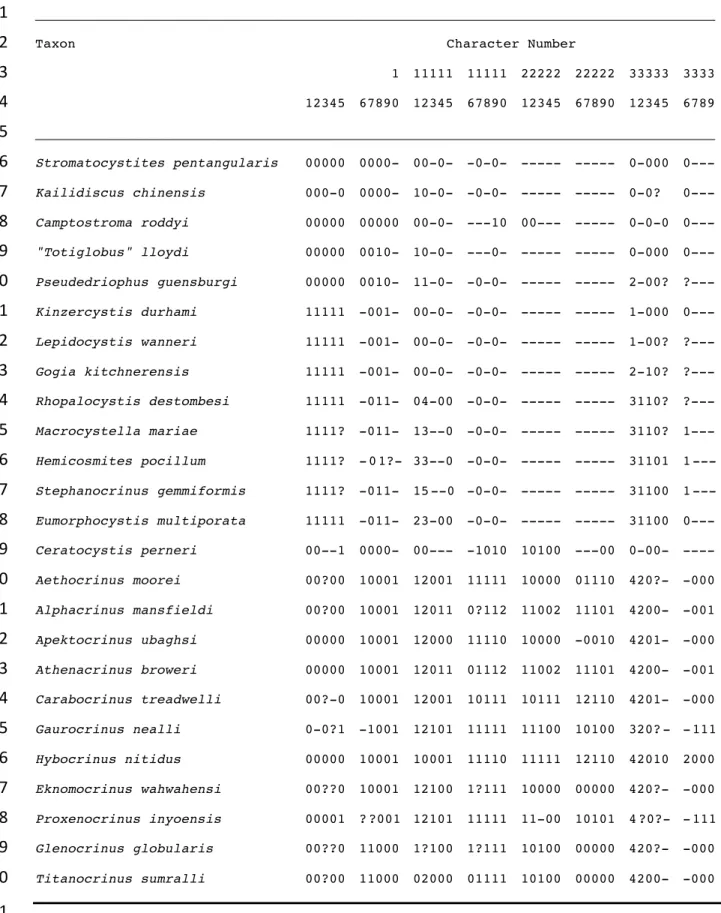
context. The total taxon list from Guensburg et al. (2020) is expanded from 21 to 25 (Table 2), 406
and the character list increased from 34 to 39. Essentially the entire range of taxa used to support 407
a Eumorphocystis sister-group status with crinoids was implemented (Sheffield and Sumrall, 408
2019a). Added taxa include a Middle Ordovician hemicosmitid, a Silurian coronoid blastozoan, 409
and a diplobathrid crinoid. Furthermore, we included the Early Ordovician rhodocrinitid 410
Proxenocrinus, among the earliest-known pinnulate crinoids. However, Cambrian and Early
Ordovician taxa continue to remain in the overall taxon list in order to code for characters found 412
in the earliest members of the clades to which they belong. 413
414
1. Left and right somatocoels: left and right somatocoels underlie ambulacra along their 415
entire length (0); somatocoels restricted to thecal interior (1). State (0) includes those 416
arm-bearing taxa with cavities extending uninterrupted from thecal shoulders. This trait, 417
from a practical standpoint, highlights a key difference in feeding appendage 418
construction. State (1) includes cases where cavities do not extend uninterrupted from the 419
theca, such as Eumorphocystis. Here, this relationship is considered similar to that of 420
paracrinoids where such a cavity has been referred to as a lumen (Parsley and Mintz, 421
1975). 422
2. Podial pores or basins: present (0); absent (1). Determining the existence of podial 423
pores or podial basins is crucial to assessing relationships among early crinoids, as well 424
as with other early echinoderm groups. The fossils can be difficult to interpret where 425
weathering and diagenesis obscure plate boundaries such as in the fossils treated here 426
(see Taphonomy and Preparation above). The best supported interpretation, obtained by 427
coated, submersed, and dry images, is that there are at least podial basins if not actual 428
pores in basins that extend to water vascular elements inside the coelom, internal to the 429
floor plates. Although not documented in later Paleozoic crinoids, these structures can 430
be seen in Aethocrinus, Athenacrinus, Apektocrinus, Titanocrinus, and possibly 431
Glenocrinus (Guensburg et al., 2020, Figs. 4.4, 4,6, 10.3, 10.4).
432
3. Floor plates on the theca: floor plates short, relatively wide (0); long, relatively narrow 433
(1). This trait does not code for appendage morphology. 434
4. Floor plates in appendages: plates thin, slat-like, not providing primary appendage 435
supports (0); thick, blocky, forming primary appendage skeletal supports (1). 436
5. Ambulacral cover plates: arranged in lateral and medial tiers (0); in a single biseries of 437
lateral plates (medial tier not expressed) (1). Medial and lateral tiers were previously 438
referred to as primary and secondary cover plates (Paul and Smith, 1984). Single cover 439
plate tiers can be arranged in an alternating double or other multiple series, but 440
essentially forming one level. This differs from the two-tiered pattern where cover 441
plates form two distinct levels (Guensburg et al., 2020). Patterns can be difficult to 442
interpret in plesiomorphic Cambrian forms where plates are more irregular, but an 443
incipient two-tiered pattern can be discerned (Smith and Jell, 1990; Zhao et al., 2010). 444
6. Medial cover plates: overlapping elements diminishing in size as they arch over the 445
perradial suture (0); an alternating double biseries (1). This character requires medial 446
cover plates and is scored as inapplicable for those taxa lacking medial cover plates. 447
7. Hinging of thecal (non-appendage) cover plates: hinged, capable of opening and 448
closing (0); fixed, forming closed ambulacral tunnels (1). 449
8. Axial orals: absent (0); expressed as differentiated interradial elements surrounding the 450
peristome in all interrays and forming junctions of ambulacra (1). Axial orals are not 451
regarded as homologous with similarly positioned, extraxial, oral-like plates such as 452
those of modern crinoids or of Hybocrinus nitidus and Carabocrinus treadwelli (see 453
Guensburg et al, 2016, for supporting argumentation). Further, earliest hybocrinids lack 454
orals entirely, suggesting acquisition independent from (and therefore not homologous 455
with) the orals seen in blastozoans such as Eumorphocystis (Guensburg and Sprinkle, 456
2017). The plating of the oral region of Stromatocystites pentangularis includes oral-457
like plating in AB and EA interrays. This latter state is autapomorphic among the taxa 458
studied and is omitted from the analysis. 459
9. Brachioles: absent (0); present (1). Brachioles are entirely axial in construction 460
whether uniserial or biserial, their primary support structures always arising from 461
(axial) floor plates, or representing extensions of those floor plates beyond the 462
perforate extraxial region. 463
10. Fixed rays: contacted entirely by non-standardized plating (0); contacted by standardized 464
circlet(s) in part or entirely (1). Fixed rays are the uniserial series in continuity with the 465
primary appendage support plate series. This character is inapplicable for those taxa 466
lacking true arms sensu David and Mooi (1999:2) and David et al. (2000: 354) 467
11. Respiratory pores: epispires (0); absent (1); diplopores (2).State (1) includes taxa with 468
thin, often corrugated, stereom at plate corners. 469
12. Thecal base circlet: absent (0); several irregular plates (1); five infrabasal plates (2); 470
four plates (3); single fused element (4); three plates (5). State (1) consists of a ring of 471
larger thecal plates above a narrower, pinched, pedunculate zone. 472
13. Dorsal cup: conical (0); bowl-shaped (1). The term “dorsal cup” requires left and right 473
somatocoels extending from the thecal shoulders (character 1 above). This character is 474
inapplicable for those taxa lacking true arms according to David and Mooi (1999: 92) 475
and David et al. (2000: 354) (see character 19). 476
14. CD interradius elevation: not expressed except for periproct or anal cone (0); long 477
cylindrical sac (1). 478
15. CD interradial gap plate: present (0); absent (1). This character requires the presence of 479
true arms. State (0) requires extension of the CD interray gapto the stem/stalk, that is, 480
they interrupt the cup base circlet. Gap plates are relatively small and are inserted 481
between an otherwise more or less regular thecal base circlet (character 12). 482
16. True basals: absent (0); expressed as a differentiated mid-cup circlet between infrabasals, 483
if present, and true radials (1). State (1) requires the presence of true arms and is therefore 484
marked as not applicable in cases when true arms are absent (see character 19). 485
17. Secondary median groove: absent (0); expressed in feeding appendages (1). State (1) 486
refers to a subsidiary channel along the interior aboral surface of the presumed 487
coelomic channels in feeding appendages and extending from the theca. This groove 488
could have housed the brachial nerve. 489
18. True radials: absent (0), present (1). A true radial represents the proximalmost extraxial 490
plate of a true arm ray series. These support free arms at least early in ontogeny. This 491
character requires the presence of true arms and is therefore marked inapplicable in 492
cases where true arms are absent. Eumorphocystis expresses extraxial elements 493
superficially similar to true radials of the type seen in derived crinoids where radials 494
form the cup top. Unlike crinoids, the Eumorphocystis plates are not located at the cup 495
top (see Sheffield and Sumrall, 2019a) and facets have no coelomic notches or other 496
evidence of any communication to the thecal interior. 497
19. Left and right somatocoels extended off the theca in feeding appendages, thus forming 498
true arms: absent (0), present (1)
499
20. True arm branching pattern: true arms atomous, non-branching (0); isotomously 500
branching (1); endotomously branching (2). This character is scored inapplicable for 501
taxa lacking true armsand refers to distalmost branching pattern. 502
21. Brachials: absent (0); brachials present (1). Brachials, when expressed, constitute 503
primary skeletal supports for the feeding appendages. This character requires true arms 504
and is scored inapplicable for taxa lacking true arms. Eumorphocystis expresses uniserial 505
backing plates superficially resembling brachials, but these do not form primary 506
appendage supports and do not contain a through-going coelomic canal. 507
22. Extraxial laterals: present, accompanying extended thecal wall out arms (0); absent. 508
Extraxial laterals, when present, occupy aboral arm surfaces aside from brachials. State 509
(0) requires true arms and is scored inapplicable for taxa lacking true arms. 510
23. Platelet webs at branchings: present (0); absent (1). These plate fields are most 511
parsimoniously regarded as extensions of extraxial lateral plating (see character 22). 512
This character requires true arms and is scored inapplicable for taxa lacking true arms. 513
24. Fixed brachials: present (0); absent (1). Fixed brachials are ray plates that extend 514
aborally from true radials and are embedded in the cup; they articulate laterally with 515
interradial plates. This character requires true arms and is scored inapplicable for taxa 516
lacking true arms. 517
25. Cup-like fixed brachials: three or more in all rays (0); none to two in all rays (1); cup-518
like fixed brachials in C or E rays only (2). Cuplike indicates plates embedded in the cup 519
with margins flush with adjacent cup plates, much like radials. This character requires 520
true arms and is therefore scored inapplicable for taxa lacking true arms. Polarity is 521
established by the known crinoid record. 522
26. One or more brachial pairs in lateral union above branchings: present (0); absent, not 523
paired above branchings (1). This character requires true arms and is therefore scored 524
inapplicable for taxa lacking true arms. 525
27. Interradial plate fields separating multiple fixed primibrachials: much wider than fixed rays 526
(0); interradial fields not as wide as fixed rays or absent (1); interradial plate fields absent 527
(2). Width is assessed across the widest portion of the field and compared with the widest 528
fixed brachial. This character requires true arms and is therefore scored inapplicable for 529
taxa lacking true arms. 530
28. CD interradius: CD interradius extending downward to the base of the thecal cavity 531
(0); ending at true radials (1). State (0) indicates the radial circlet is interrupted across 532
the CD interradius, and state (1) indicates radials are contiguous below the CD 533
interradius. This character requires true arms and is therefore scored inapplicable for 534
taxa lacking true arms. 535
29. Radianal(s) and anal X plates: absent (0); present (1). State (1) consists of 536
differentiated plates occupying the space below and to the left of a “raised” C radial. 537
The radianal can be absent in later more derived taxa, but not those treated here. States 538
(0) and (1) require presence of true arms and are therefore scored as not applicable for 539
those forms lacking them. 540
30. Anibrachial plate: absent (0), or present (1). This character requires true arms and is 541
therefore scored inapplicable for those taxa lacking true arms. 542
31. Peduncle, stem, or stalk: absent or only slightly developed as attachment structure (0); 543
anisotropic, imbricate, plated peduncle (1); irregularly tessellated peduncle with 544
pinched demarcation at base of theca (2); monomeric (holomeric) stem (3); pentameric 545
stalk (4). Carabocrinus treadwelli and Hybocrinus nitidus pentameres are 546
inconspicuous (see Sprinkle, 1982a, Figs. 45D, 46H). Note: The presence of a stem has 547
traditionally been used as a key feature linking blastozoans and crinoids, together these 548
comprising the pelmatozoans. Stems are now known among edrioasteroids as well as 549
blastozoans and crinoids (Guensburg and Sprinkle, 2007; Guensburg et al., 2010). 550
Therefore, it is not unparsimonious to assume that stems/stalks evolved more than once. 551
Here we identify types of stems where, at least among treated taxa, a pattern emerges 552
whereby blastozoan and earliest crinoid stems are distinguishable. This approach does not 553
apply to later, more crownward taxa where homoplasy presumably results in more similar 554
constructs. 555
32. Stalk/stem lumen: absent (0); round or irregular trilobate in cross section (1); pentalobate 556
in cross section (2). This character requires a stalk or a stem and scored as not 557
applicable for those forms lacking a meric stalk/stem. 558
33. Ray length on theca: long, approaching the perforate/imperforate boundary in extraxial 559
body wall (0); short, restricted to the region around peristome and not approaching 560
boundary between perforate and imperforate extraxial body wall (1). 561
34. Extraxial “orals”: absent (0); present (1). The interradial circlet bordering the 562
peristome of Hybocrinus nitidus and Carabocrinus treadwelli is considered extraxial 563
and homologous among these and a few other cyathocrinine crinoids (Porocrinus, 564
Palaeocrinus, inter alia); these are all characterized by flat tegmens of few plates and
565
with a hydropore within a single posterior “oral”. 566
35. Gonopore: undifferentiated from hydropore (0), a slit-like pore apart from hyropore (1). 567
State (1) requires an opening in the CD interray separate from the hydropore. 568
36. Hydropore or combined hydropore-gonopore: an interplate pore bordered by small 569
platelets (0); a slit shared across two plates separate from hydropore (1); an intraplate 570
pore (2), subcircular pore shared across two plates (3). 571
37. Pinnules: absent (0), present (1). This character requires true arms. Pinnules are 572
supported by extraxial elements, and are constructed nearly identically to true arms, 573
including containment of coeloms characteristic of arms. Pinnules are not homologous 574
with brachioles, which can nonetheless superficially resemble pinnules. 575
38. Ray branching in dorsal cup: no branching in dorsal cup (0); branching from fixed 576
brachial on the theca (1). 577
39. Uniserial posterior plate column: absent (0); present (1). 578
These 39 characters were assembled for scoring using Mesquite Version 3.2 (build 579
801), and the nexus file run on PAUP 4.0a (build 167) for Macintosh. All characters were 580
unordered and unweighted; one character was parsimony uninformative (Table 3). The analysis 581
employed the branch and bound algorithm, consensus trees were computed, and a bootsrap 582
analysis of 10,000 replicates was run using a fast heuristic search. 583
584
Results of the phylogenetic analysis
585 586
We are acutely aware that merely piling up evidence that crinoids are different from 587
blastozoans is insufficient to falsify the idea that crinoids are derived from within the blastozoan 588
clade, let alone the diploporites, which appear to be non-monophyletic in any case (Sheffield and 589
Sumrall, 2019b). However, unlike previous analyses, we allow for the strong likelihood that 590
morphologies in feeding and other structures are merely superficially similar in blastozoans and 591
crinoids, and lack phylogenetic signal due to homoplasy. For us, the key to uncovering this 592
homoplasy is detailed study of the fossils themselves, details, in addition to broader comparisons 593
with early taxa of both crinoid and blastozoan clades in which these features have very different 594
expressions from those in more crownward forms. Even if it could be shown that 595
Eumorphocystis was a sister to crinoids, this is insufficient to place Crinoidea within any more
596
inclusive blastozoan taxon, without trying to explain why crinoids lack so many of the 597
apomorphies of blastozoans, as also discussed in Guensburg et al. (2020). 598
Nevertheless, our study of material adequate to close data gaps evident in the Sheffield 599
and Sumrall (2019) analysis are not consistent with the suggestion that Eumorphocystis is 600
relevant to the question of crinoid relationship with blastozoans. The latter is a monophyletic 601
assemblage exclusive of the Crinoidea. No blastozoans, let alone the highly derived 602
Eumorphocystis, are more closely related to crinoids than they are to other blastozoans (see
603
Sheffield and Sumrall, 2019b, for a recent treatment of diploporites, in which Eumorphocystis 604
has traditionally been included). 605
Results generally mirror those of Guensburg et al., 2020, and even with additional taxa, 606
and are not surprising given the disparate morphological interpretations relative to those of the 607
opposing view (Sheffield and Sumrall, 2019a). This phylogenetic analysis recovered 660 most 608
parsimonious trees of length 75, consistency index (CI) of 0.675, retention index (RI) of 0.845, 609
rescaled consistency index (RC) of 0.594, and homoplasy index (HI) of 0.307. Strict 50% and 610
majority rule consensus trees are shown in Figure 7, along with the results of the bootstrap 611
analysis. Eumorphocystis branches high in the blastozoan lineage, distantly related to crinoids, 612
which are place closer to the earliest pentaradiate echinoderm branch. Blastozoan history 613
begins during the Early Cambrian, separate from crinoids. 614
Crinoids are first recognized during the Early Ordovician (Guensburg and Sprinkle, 615
2003, 2009, inter alia). Arm morphology in both modern and fossil crinoids indicates an origin 616
from non-blastozoan pentaradiate echinoderms (David and Mooi, 1999; Mooi et al., 2000; 617
Guensburg and Sprinkle, 2007; Guensburg et al., 2010; Guensburg et al., 2012; Guensburg et 618
al., 2016; Guensburg et al., 2020). Incorporation of the camerate crinoid taxa Proxenocrinus 619
and Gaurocrinus in the expanded dataset here (characters 35-39) produced a different overall 620
crinoid topology from an earlier iteration (Guensburg et al., 2020) with disparid and traditional 621
camerate clades as sister taxa. This result contrasts with recent findings (Ausich et al., 2015a; 622
Ausich et al., 2015b; Ausich et al., 2020; and Ausich et al., 2020) but is essentially that 623
suggested by another author (Gahn, 2015). The inclusion of pinnulation, character 37, is 624
interesting because it appears to provide phylogenetic signal only early in crinoid history. This 625
character eventually occurs in disparids and cladids as well as camerates, but the current record 626
indicates this feature evolved first among camerates, during the Late Floian. Pinnules are not 627
known not among cladids and disparids until the Late Ordovician. 628
629
Acknowledgements
630
David Quednau ably assisted in the preparation of figures. We gratefully acknowledge 631
the loan of Eumorphocystis material from the Sam Noble Museum, Universiy of Oklahoma. C. 632
Paul and an anonymous reviewer provided thoughtful and constructive reviews. 633
634
References
635
Ausich, W.I., 1986, The crinoids of the Al Rose Formation (Early Ordovician, Inyo County, 636
California, U.S.A.): Alcheringa, v. 10, p. 217-224. 637
Ausich, W.I., 1988, Evolutionary convergence and parallelism in crinoid calyx design: Journal of 638
Paleontology, v. 62, p. 906-916. 639
Ausich, W.I., 2018, Morphological paradox of disparid crinoids (Echinodermata): phylogenetic 640
analysis of a Paleozoic clade: Swiss Journal of Palaeontology, v. 137, p. 159–176. 641
https//doi.org/10.1007/s13358-0180147-z 642
Ausich, W.I., Kammer, T.W., Wright, D., Cole, S., Peters, M., and Rhenberg, E., 2015a, Toward 643
a phylogenetic classification of the Crinoidea (Echinodermata): pages 29-32, In Zamora, 644
S., and Romano, I. (eds.). Progress in Echinoderm Paleobiology. Instituto Geológico y 645
Minero de España Cuaderno del Museo Geominero, 19, p. 29–32. 646
Ausich, W.I., Kammer, T.W., Rhenberg, E.C., and Wright, D.F., 2015b, Early phylogeny of 647
crinoids within the pelmatozoan clade: Palaeontology, v. 58, p. 937–952. 648
Ausich, W.I., Wright, D.F., Cole, S.R., and Sevastopulo, G.D., 2020, Homology of posterior 649
interrays in crinoids: a review and new perspectives from phylogenetics, the fossil record, 650
and development: Palaeontology, v. 2020, p. 1-21. https://doi.org/10.1111/pala.12475. 651
Blakey, D. Deep Time Maps--maps of ancient Earth: https://deeptimemaps.com/. Accessed 652
September 10, 2018. 653
Branson, E.B. and Peck, R.E., 1940, A new cystoid from the Ordovician of Oklahoma: Journal 654
of Paleontology, v. 14, p. 89–92. 655
Breimer, A., 1978, General morphology, Recent crinoids: in Moore, R.C. and Teichert, C. (eds.) 656
Treatise on Invertebrate Paleontology, Part T, Echinodermata 2(1). Geological Society of 657
America Boulder and University of Kansas Press, Lawrence, p. T9–T50. 658
Callaway, C., 1877, On a new area of Upper Cambrian rocks in South Shropshire, with a 659
description of new fauna: Quarterly Journal of the Geological Society of London, v. 33, 660
p. 652–672. 661
Cole, S.R., 2017, Phylogeny and morphologic evolution of the Ordovician Camerata (Class 662
Crinoidea, Phylum Echinodermata): Journal of Paleontology, v. 91, special Issue 4, p. 663
815–828. 664
Clausen, S., Jell, P.A., Legrain, X., and Smith, A.B., 2009: Pelmatozoan arms from the Middle 665
Cambrian of Australia: Bridging the gaps between brachioles and brachials: Lethaia, v. 666
43, 432-440. 667
Conrad, T.A., 1842, Descriptions of new species of organic remains belonging to the Silurian 668
Devonian, and Carboniferous Systems of the U.S.: Philadelphia Academy of Natural 669
Sciences, Journal (old series), v. 8, p. 235-280. 670
David, B., and Mooi, R., 1999, Comprendre les échinodermes: la contribution du modèle 671
extraxial-axial: Bulletin de la Société Géologique de France, v. 170, p. 91–101. 672
David, B., Lefebvre, B., Mooi, R., and Parsley, R., 2000, Are homalozoans echinoderms? An 673
answer from the extraxial-axial theory: Paleobiology, v. 26, p. 529–555. 674
Deline, B., Thompson, J.R., Smith, N.S., Zamora, S., Rahman, I.A., Sheffield, S., Ausich, W.I., 675
Kammer, T.W., and Sumrall, C.D., 2020, Evolution and development at the origin of a 676
phylum: Current Biology, doi:10.1016/j.cub.2020.02.054. 677
Derstler, K., Guensburg, T.E., Blake, D.B., and Sprinkle, J., 2018, Arms in Camptostroma, an 678
archaic pentaradiate echinoderm: Geological Society of America Abstracts with 679
Programs, v. 50: doi: 10.1130/abs/2018AM-324634. 680
Durham, J.W., 1966, Camptostroma, an Early Cambrian supposed scyphozoan referable to 681
Echinodermata: Journal of Paleontology, v. 40, p. 1216–1220. 682
Durham, J.W., 1967, Camptostromatoids: in Moore, R.C. (ed.) Treatise on 683
InvertebratePaleontology, Part S Echinodermata 1(2). Geological Society of America 684
and the University of Kansas Press, Lawrence, p. S627–S631. 685
Fay, R.O. The type species of Globoblastus Hambach: Oklahoma Geology Notes, v. 21. P. 247-686
248. 687
Foerste, A.F., 1938, Echinodermata: in Resser, C.E and Howell, B.F. (eds.), Lower Cambrian 688
Olenellus Zone of the Appalachians: Geological Society of America Bulletin, v. 49, p.
689
212–213. 690
Freudenstein, J.V., 2005, Characters, states, and homology: Systematic Biology, v. 54, p. 965-691
973. 692
Geissman, J.W., Bowring, S.A., and Babcock, L.E., compilers, 2018, Geological Time Scale, v. 693
5.0: Geological Society of America, https://doi.org/10.1130/2018. Accessed in January 694
17, 2019. 695
Guensburg, T.E., 2012, Phylogenetic implications of the oldest crinoids: Journal of 696
Paleontology, v. 86, p. 455–461. 697
Guensburg, T.E., Blake, D.B., Sprinkle, J., and Mooi, R., 2016, Crinoid ancestry without 698
blastozoans: Acta Palaeontologica Polonica, v. 61, p. 253–266. 699
Guensburg, T.E., Mooi, R., Sprinkle, J., David, B., and Lefebvre, B., 2010, Pelmatozoan arms 700
from the mid-Cambrian of Australia: bridging the gap between brachioles and arms? 701
Comment: there is no bridge: Lethaia, v. 43, p. 432–440. 702
Guensburg, T.E. and Sprinkle, J. 2001. Earliest crinoids: new evidence for the origin of the 703
dominant Paleozoic echinoderms: Geology, v. 29, p. 131-134. 704
Guensburg, T.E. and Sprinkle, J., 2003, The oldest known crinoids (Early Ordovician, Utah), and 705
a new crinoid plate homology system: Bulletins of American Paleontology, 364: p. 1– 706
43. 707
Guensburg, T.E. and Sprinkle, J., 2007, Phylogenetic implications of the Protocrinoidea: 708
Blastozoans are not ancestral to crinoids: Annales de Paléontologie, v. 93, p. 277–290. 709
Guensburg, T.E., and Sprinkle, J., 2009, Solving the mystery of crinoid ancestry: New fossil 710
evidence of arm origin and development: Journal of Paleontology, v. 83, p. 350–364. 711
Guensburg, T.E., and Sprinkle, J., 2017, New evidence of early hybocrinid tegmens; 712
Phylogenetic implications: Geological Society of America Abstracts with Programs, 713
Paper number 49–2. 714
Guensburg, T.E., Sprinkle, J., Mooi, R., David, B., Lefebvre, B., and Derstler, K. 2020. 715
Athenacrinus n. gen. and other early echinoderm taxa inform crinoid origin and arm
716
evolution: Journal of Paleontology, v. 94, p. 311-333. 717
Hall, J., 1866, Descriptions of new species of Crinoidea and other fossils from the lower 718
Silurian strata principally of the Hudson-River Group (a note on it only): New York 719
State Cabinet, Natural History, 20th Annual Report, p. 304. 720
Heinzeller, T. and Welsch, U., 1994, Crinoidea: in Harrison, F.W. and Chia, F-S. (eds.), 721
Microscopic Anatomy of the Invertebrates, Vol. 14, Echinodermata. Wiley-Liss Inc., 722
New York, p. 9–148. 723
Hyman, L., 1955, The Invertebrates, Volume 4, Echinodermata: McGraw-Hill, New York, p. 1– 724
761. 725
Jaekel, O., 1899, Stemmesgeschichte der Pelmatozoen, 1 Thecoidea und Cystoidea: P. 1-442, 726
Julius Springer, Berlin. 727
Jaekel, O., 1901, Über Carpoideen, eine neue Klasse von Pelmatozoen: Zeitschrift der Deutschen 728
Geologischen Gesellschaft, v. 52, p. 661–677. 729
Kammer, T.W., Sumrall, C.D., Zamora, S., Ausich, W.I., and Deline, B., 2013, Oral region 730
homologies in Paleozoic crinoids and other plesiomorphic pentaradial echinoderms: 731
PLoS ONE, vol. 8, p. 1–16. (doi: 10.1371/journal.pone.0077989) 732
Kolata, D.R., 1982, Camerates: in Sprinkle, J. (ed.) Echinoderm faunas from the Bromide 733
Formation (Middle Ordovician) of Oklahoma: The University of Kansas Paleontological 734
Contributions, Monographs v. 1, p. 170–205. 735
Mooi, R., and David, B.,1997,Skeletal homologies of echinoderms: The Paleontological Society 736
Papers, v. 3, p. 305-335. 737
Mooi, R., and David, B., 1998, Evolution within a bizarre phylum: homologies of the first 738
echinoderms: American Zoologist, v. 38, p. 965–974. 739
Mooi, R. and David, B., 2000, What a new model of skeletal homologies tells us about asteroid 740
evolution: American Zoologist, v. 40, p. 326–339. 741
Mooi, R., David, B., and Wray, G., 2005, Arrays in rays: terminal addition in echinoderms and 742
its correlation with gene expression: Evolution and Development, v. 7, p. 542–555. 743
Parsley, R.D., 1982, Eumorphocystis: in Sprinkle, J. (ed.) Echinoderm Faunas from the Bromide 744
Formation (Middle Ordovician) of Oklahoma: University of Kansas Paleontological 745
Contributions, Monograph 1, p. 180–188. 746
Paul, C.R.C., 1968, Macrocystella Callaway, the earliest glyptocystitid cystoid: Palaeontology, 747
v.11, p. 580–600. 748
Patterson, C., 1988, Homology in classical and molecular biology: Molecular Biology and 749
Evolution, v. 5, p. 603-625. 750
Paul, C.R.C. and Smith, A.B., 1984, The early radiation and phylogeny of echinoderms: 751
Biological Reviews, v. 59, p. 443–481. 752
Pompeckj, J.F., 1896, Die Fauna des Cambrium von Tejrovic und Skrej in Böhmen: Jahrbuch 753
der kaiserlich-königlichen geologischen Reichsanstalt, v. 45, p. 495–614. 754
Robinson, R.A., 1965, Middle Cambrian eocrinoids from western North America: Journal of 755
Paleontology, v. 39, p. 355-364. 756
Roux, M., and Lambert, P., 2011, Two new species of stalked crinoids from the northeastern 757
Pacific in the genera Gephyrocrinus and Ptilocrinus (Echinodermata, Crinoidea, 758
Hyocrinoidae). Effects of ontogeny and variability on hyocrinid taxonomy: Zootaxa, v. 759
2825, p. 1-54. 760
Ruedemann, R., 1933, Camptostroma, a Lower Cambrian floating hydrozoan: Proceedings of the 761
United States National Museum, v. 82, p. 1–13. 762
Sheffield, S.L., and Sumrall, C.D., 2019a, A re-interpretation of the ambulacral system of 763
Eumorphocystis (Blastozoa, Echinodermata) and its bearing on the evolution of early
764
crinoids: Palaeontology, v. 62, p. 1–11 doi: 10.1111/pala.12396. 765
Sheffield, S.L. and Sumrall, C.D., 2019b, The phylogeny of the Diploporita: a polyphyletic 766
assemblage of blastozoan echinoderms: Journal of Paleontology, online, 767
https://doi.org/10.1017/jpa.2019.2, 13 pages.
768
Sinclair, G.W., 1945, Some Ordovician echinoderms from Oklahoma: American Midland 769
Naturalist, v. 34, p. 707–716. 770
Smith, A.B. and Jell, P.A., 1990, Cambrian edrioasteroids from Australia and the origin of 771
starfishes: Memoirs of the Queensland Museum, v. 28, p. 715-778. 772