HAL Id: hal-00509777
https://hal.archives-ouvertes.fr/hal-00509777
Submitted on 21 Aug 2020
HAL is a multi-disciplinary open access
archive for the deposit and dissemination of
sci-entific research documents, whether they are
pub-lished or not. The documents may come from
teaching and research institutions in France or
abroad, or from public or private research centers.
L’archive ouverte pluridisciplinaire HAL, est
destinée au dépôt et à la diffusion de documents
scientifiques de niveau recherche, publiés ou non,
émanant des établissements d’enseignement et de
recherche français ou étrangers, des laboratoires
publics ou privés.
Island (Indian Ocean), supporting two geomagnetic
events in the time period 2.2-2.0 Ma
X. Quidelleur, J.W. Holt, T. Salvany, E. Bouquerel
To cite this version:
X. Quidelleur, J.W. Holt, T. Salvany, E. Bouquerel. New K-Ar ages from La Montagne massif, Réunion
Island (Indian Ocean), supporting two geomagnetic events in the time period 2.2-2.0 Ma. Geophysical
Journal International, Oxford University Press (OUP), 2010, 182 (2), pp.699-710.
�10.1111/j.1365-246X.2010.04651.x�. �hal-00509777�
Geophys. J. Int. (2010) 182, 699–710 doi: 10.1111/j.1365-246X.2010.04651.x
GJI
Geomagnetism,
ro
ck
magnetism
and
palaeomagnetism
New K-Ar ages from La Montagne massif, R´eunion Island (Indian
Ocean), supporting two geomagnetic events in the time period
2.2–2.0 Ma
X. Quidelleur,
1J. W. Holt,
2T. Salvany
1and H. Bouquerel
31IDES, Equipe G´eochronologie et Dynamique des Syst`emes Volcaniques, UMR 8148 CNRS-UPS, Universit´e Paris-Sud 11, Orsay, France.
E-mail: [email protected]
2Institute for Geophysics, the University of Texas at Austin, Austin, Texas, USA 3Laboratoire de Pal´eomagn´etisme, IPGP, 4 Place Jussieu, 75252 Paris, Cedex 05, France
Accepted 2010 May 6. Received 2010 February 25; in original form 2009 August 31
S U M M A R Y
We present new radiometric ages obtained at the type locality in La R´eunion Island where palaeomagnetic records of the R´eunion events have first been identified. Seven dated lava flows from the Rivi`ere Saint Denis section, which recorded a reverse-to-normal transition, display ages from 2.12 ± 0.03 to 2.17 ± 0.03 Ma, with a mean age of 2.15 ± 0.02 Ma. Two significantly younger flows from this section, interpreted here as valley fill flows from trace elements compositions and Pb isotopic data, have been dated at 2.06± 0.03 and 2.08 ± 0.03 Ma. Within the Grande Chaloupe section, where a normal-to-reverse transition is recorded, two coherent ages of 2.05± 0.03 and 2.03 ± 0.03 Ma have been obtained. When a direct comparison was possible, our new K-Ar ages performed on separated groundmass show a rather good coherence with previous ages from La R´eunion Island. When considered with continuous palaeomagnetic sedimentary records in the 2.2–2.0 Ma interval, these new results suggest that two distinct events are recorded in La Montagne lava flows at La R´eunion Island, with ages of 2.15± 0.02 and 2.04 ± 0.02 Ma. Following recent nomenclature, the former is the R´eunion event s.s., while the latter can be related to the Huckleberry Ridge event. Globally distributed volcanic and sedimentary records show that the first (R´eunion s.s.; RU-1) is associated with a large dipole intensity decrease at 2.15± 0.02 Ma, and hence is recorded in many sequences. On the other hand, the dipole intensity decrease was not as pronounced at 2.04 ± 0.02 Ma, when the Huckleberry Ridge (RU-2) palaeomagnetic event occurred. Consequently, it is not present as a full directional change in many sections worldwide, but rather appears as a geomagnetic excursion during an episode of increased secular variation. Finally, the use of the R´eunion event for magnetostratigraphic studies is recommended, while the clear identification of the Huckleberry Ridge excursion might often be difficult, preventing its use as a reliable time marker.
Key words: Geomagnetic excursions; Reversals: process, timescale, magnetostratigraphy;
Oceanic hotspots and intraplate volcanism; Indian Ocean.
1 I N T R O D U C T I O N
Magnetostratigraphy is a powerful tool to constrain the timing of sedimentary sequences. It is widely used in continental sections or in deep-sea sediment cores where volcanic layers, which can allow radiometric dating, are infrequent or missing. Magnetostratigra-phy relies on the assumption that geomagnetic field reversals are globally recordable at the Earth’s surface without significant time gap between different sites. However, when a resolution better than about 1 Myr is needed, it is tempting to rely on geomagnetic excur-sions, which are much more frequent than reversals, with at least six
of them occurring in the past 0.78 Myr, within the Brunhes chron (Langereis et al. 1997; Lund et al. 2006). Excursions are often de-scribed as aborted reversals (Valet et al. 2008) and are characterized by palaeomagnetic directions significantly different than those due to the normal (N) secular variation, that is, associated with a virtual geomagnetic pole (VGP) more than 45◦away from the geographic north or south direction. Excursions are less straightforward to use for magnetostratigraphy than reversals as they can display different characteristics at different locations, mainly related to the intensity of the dominant dipolar field. Recent numerical modelling demon-strated that they may not even be globally synchronous (Brown
Geophysical Journal International
et al. 2007), reinforcing the difficulty of correlating their different
records. When the dipolar intensity decrease is pronounced, it is likely that the non-dipolar field would be dominant at most places on the globe (Valet & Plenier 2008), and, hence, that excursional palaeomagnetic directions that are not consistent with a dipole field could be recorded in sediments or lava flows emplaced at that time (Guyodo & Valet 1999). Alternatively, a model suggesting the dom-inance of the equatorial dipole during the Laschamp excursion has been advocated (Laj et al. 2006). Such opposing hypotheses pro-posed to describe the behaviour of the geomagnetic field during excursions illustrates that the ability of most sediments to accu-rately record palaeomagnetic changes when the field intensity is low remains the primary limitation in obtaining nearly continuous records of excursions (Quidelleur & Valet 1994; Quidelleur et al. 1995).
In addition to excursions, palaeomagnetic events, also called sub-chrons, have been reported and are of great importance for mag-netostratigraphy since they are globally recordable, full polarity episodes lasting from about 10 to 100 kyr.
Within the relatively long Matuyama chron (from 2.54 to 0.78 Ma; Cande & Kent 1995), several excursions have been recorded in deep-sea sediments (e.g. Channell et al. 2002) between the Oldu-vai and Jaramillo subchrons (from 1.78 to 1.07 Ma; Cande & Kent 1995), but between the Gauss Matuyama transition and the base of the Olduvai, only the R´eunion event is observed at about 2.15 Ma, which makes its precise dating very important for magnetostratig-raphy in this time frame. However, dating of this magnetic event in deep-sea sediments largely depends on poorly controlled param-eters such as the accumulation rate and the magnetization lock-in depth, and on an accurate counting of Milankovich cycles during as-tronomical tuning. It appears therefore fundamental to also rely on radiometric ages to better constrain the age of this geomagnetic fea-ture. Furthermore, the R´eunion event appears as a single subchron with a few 10 kyr duration in some studies, while others display evidence for an additional excursion preceding or following it by about 100 kyr. Following the initial work from R´eunion Island sites (McDougall & Watkins 1973), several recent studies have focused on the dating of the R´eunion event ( Baksi et al. 1993; Kidane et al. 1999; Baksi & Hoffman, 2000; Lanphere et al. 2002; Roger et al. 2000), but no consensus arisen regarding the number of events, nor regarding their precise age.
The aim of this study is to provide new K-Ar age determinations on the type locality in the R´eunion Island (Indian ocean) where this geomagnetic event was first identified in lava flows of the La Montagne massif, and to decipher between one or two N polarity events occurring around 2.1 Ma within the Matuyama chrons by comparison with deep-sea and continental sedimentary records.
2 G E O L O G I C A L S E T T I N G A N D S A M P L I N G
The volcanic island of La R´eunion lies within the Indian Ocean and has been linked to the present day superficial activity of hot-spot magmatism initiated with the Deccan trapps emplacement about 65 Ma (Duncan & Richards 1991). La R´eunion Island is composed of two main volcanoes, the now extinct, Piton des Neiges (PN) and the presently active Piton de la Fournaise (PF; Fig. 1), with basaltic eruptive centres migrating towards the southeast from about 2 Ma to present (McDougall 1971). PN volcano terminated its activity with the emplacement of differentiated products, which probably evolved in an isolated shallow reservoir, between 330 and 30 ka (Gillot &
Nativel 1982), while the main deep magma feeding system was already displaced below the younger massif of PF volcano since 500 ka (Gillot & Nativel 1989).
The oldest products found on the island are approximately 2 Ma old lavas and constitute the Oceanite series of La Montagne (Mc-Dougall 1971), which are located to the north–northwest of the PN volcano. They have been associated with the initial building stage of PN volcano and they were emplaced at a high extrusion rate in less than 100 kyr, (McDougall 1971), during the construction of the primitive shield volcano of La R´eunion (Gillot et al. 1994).
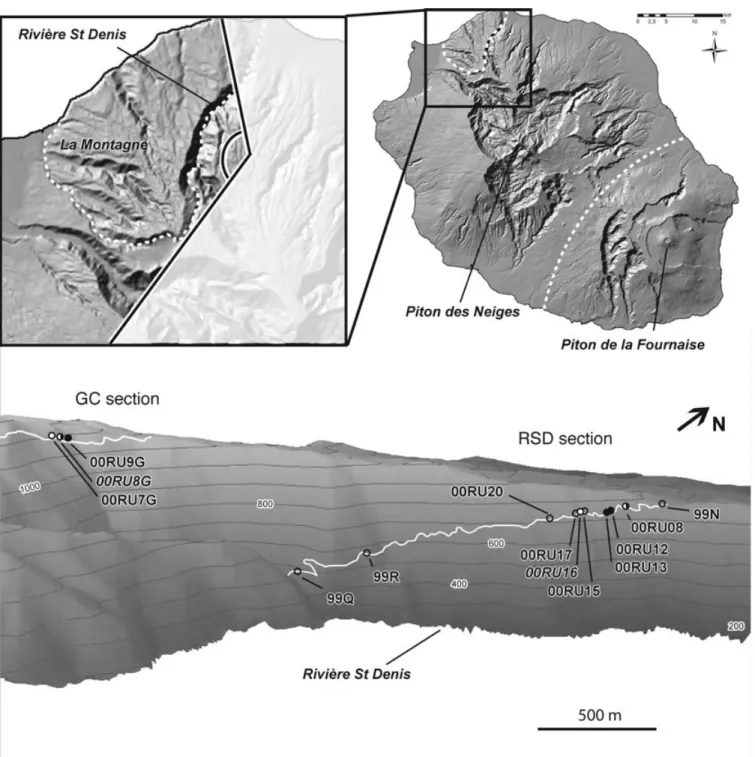
The Oceanite Series are made of olivine-bearing basalts and olivine-rich oceanites that are gently dipping (< 5◦) towards the northwest. Based on palaeomagnetic investigations of this massif (Chamalaun & McDougall 1966; McDougall 1971), a N polarity event was identified within the Matuyama chron, at two distinct locations, in the Rivi`ere St Denis (RSD) and Grande Chaloupe (GC) sections (McDougall & Watkins 1973). The former consists of several tens of 0.5–2-m thick lava flows, while the latter, strati-graphically above (Fig. 1), is much smaller and consists of about 10 superimposed 2–5-m thick lava flows. A reverse-to-normal (R-to-N) polarity transition was recorded between lava flows 13 and 14 at the RSD section, while a N-to-R transition was recorded at the GC section, between flows 9 and 7 (McDougall & Watkins, 1973). Be-cause all these flows yielded undistinguishable whole-rock K-Ar ages at about 2.02± 0.02 Ma (recalculated at 2.07 ± 0.02 Ma using the conventional decay constants; Steiger & J¨ager 1977), the exis-tence of a new single geomagnetic event called the R´eunion event was proposed (McDougall & Watkins 1973). However, because these previous individual lava flow ages are scattered between 2.00 and 2.11 Ma, and because there is a large elevation gap between these sections (Fig. 1), the existence of multiple distinct geomag-netic events recorded in La Montagne lavas cannot be ruled out.
This study focuses on the same two reference sections. Three flows have been sampled for K-Ar dating from the GC section (labelled 00RUxG; which are identical to GCxx of McDougall & Watkins 1973) and nine flows from the RSD section (labelled 00RUxx or 99x). A correlation in the field with the previous sampling in this section (McDougall & Watkins 1973) was less straightforward. In addition, several oriented blocks were taken for palaeomagnetic polarity determinations. Site locations are shown in Fig. 1.
3 T E C H N I Q U E S
3.1 Geochemistry
Whole-rock major and trace element analyses were performed at the Service d’Analyse des Roches et des Min´eraux (SARM)—Centre de Recherches P´etrographiques et G´eochimiques (CRPG; CNRS, Nancy, France). Samples were fused with LiBO2 then dissolved
with HNO3. Major element contents were determined by ICP-AES
(Jobin – Yvon JY 70) and trace element concentrations by ICP-MS (Perkin Elmer 5000). Uncertainties for each element can be found at http://www.crpg.cnrs-nancy.fr/SARM/index.html.
3.2 Palaeomagnetism
Two cores were drilled in the laboratory from one block of each sampled flow. The blocks were oriented in the field using a mag-netic compass, which, given the relatively high magnetization of basaltic lava flows, yields a relatively large declination uncertainty.
Figure 1. Location of sampled sections. (a) Shadowed digital elevation model (Institut G´eographique National) of the R´eunion Island with Rivi`ere St Denis (RSD) section close-up. (b) Perspective view of the western wall of the RSD canyon. Elevation is given in metres above sea level. White (black) symbols show lava flows with a measured reverse (normal) magnetic polarity, while black and white symbols are for transitional direction lava flows. No palaeomagnetic measurements were made in this study for dated lava flows with open symbols. Names in italic indicate lava flows not selected for K-Ar dating.
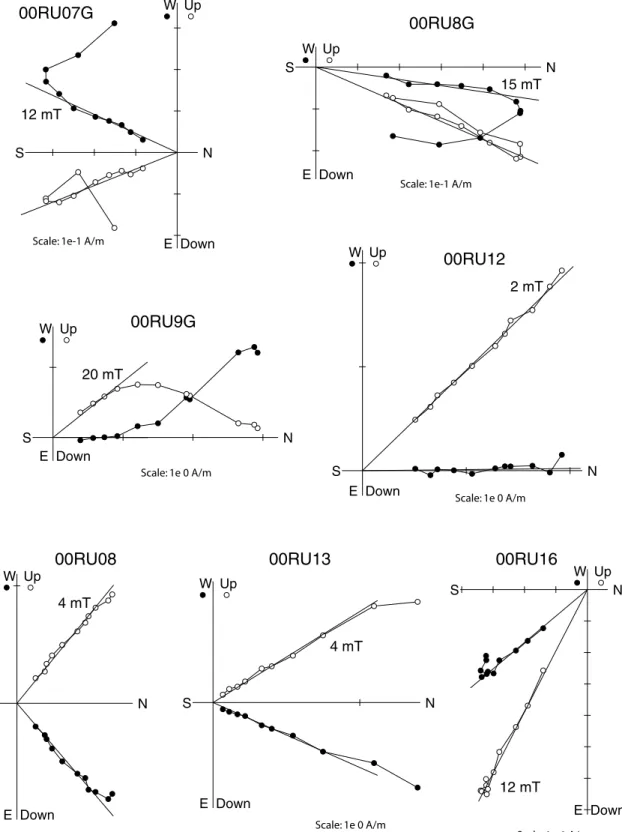
The measurements were made on two specimens per core in the magnetically shielded room of the Institut de Physique du Globe de Paris (IPGP) using a JR5 spinner magnetometer. Alternating field (AF) demagnetization was preferred to remove possible isothermal magnetization due to lightning strikes, and was performed with 10 incremental steps, from 2 to 40 mT. The characteristic directions of magnetization (ChRM) were determined with the Paleomac soft-ware (Cogn´e 2003), using Zijderveld projections (Zijderveld 1967) and principal component analysis (Kirschvink 1980).
3.3 K-Ar dating
The petrographic examination of all sampled flows revealed that the groundmass of 00RU8G and 00RU16 display a slight evidence of weathering and thus were discarded for K-Ar analyses. Hand-size samples (1–2 kg) from all other flows were crushed to a 125–250μm size fraction and were ultrasonically cleaned for 15 min in a 5 per cent nitric acid solution to remove possible trace of weathered ma-terial such as secondary minerals. To make the contribution of
magmatic argon and weathered phases negligible, we have removed mafic phenocrysts from the groundmass using heavy liquids. The remaining groundmass obtained within a narrow density range, typ-ically between 2.95 and 3.00 g cm–3, was kept for analysis of K and
Ar. K was measured by flame emission spectroscopy and was com-pared with reference values of MDO-G and ISH-G standards (Gillot
et al. 1992). Between 1 and 2 g of sample were wrapped in Cu foil
and fused for 15 min above 1500◦C using a high-frequency furnace, which is sufficient for complete extraction of argon from basaltic groundmass. Before analysis, multiple-step gas cleaning was per-formed using Ti foam at 700◦C and SAES MP-10 getters at 400◦C. Argon was measured following the K-Ar Cassignol-Gillot technique (Cassignol & Gillot 1982), which is based on a direct comparison between the unknown (sample) and an air pipette aliquot measured with the same 40Ar signal conditions, with a mass spectrometer
identical to the one described by Gillot & Cornette (1986). The in-terlaboratory standard GL-O, with the recommended value of 6.679 × 10¹⁴atom g–1of40Ar∗(Odin et al. 1982), was used for40Ar signal
calibration. Typical uncertainties of 1 per cent are achieved for the
40Ar signal calibration (including GL-O standard uncertainty) and
for the K determination. The uncertainty on the40Ar∗determination
is a function of the radiogenic content of the sample. The detection limit of the system is 0.1 per cent of40Ar (Quidelleur et al. 2001).
The total age uncertainty for each analysis is then given by the square root of the quadratic sum of the three sources of uncertainty mentioned earlier (e.g. Quidelleur et al. 1999). To take into account the systematic errors, the age uncertainty for each flow is conser-vatively calculated by simply weighing each duplicate uncertainty using the proportion of radiogenic argon, similarly to the mean flow age calculation. All uncertainties herein are quoted at the 1-sigma
(σ ) level. The decay constants and isotopic ratios of Steiger & J¨ager
(1977) have been used.
This technique is especially suitable for dating low K and/or Quaternary lavas. It has been used to calibrate the geomagnetic polarity timescale (GPTS) (Quidelleur et al. 1999, 2003). Direct comparison with the40Ar/39Ar technique has shown identical ages
(Couli´e et al. 2003), while dating of MMhb-1 standard, for instance, provided ages of 525± 2 Ma using the GL-O standard (Fiet et al. 2006), in perfect agreement with the values of 523± 2 Ma obtained by40Ar/39Ar (Renne et al. 1998).
4 R E S U L T S
4.1 Geochemistry
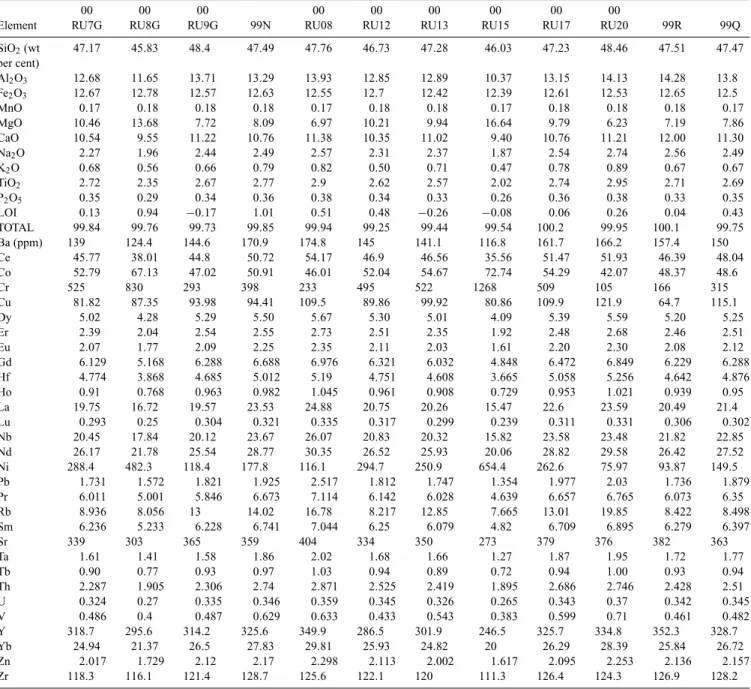
Whole-rock major and trace elements for all flows investigated here are given in Table 1. Analysed samples from the GC and RSD sec-tions show a narrow range of composition within the basaltic field of the total alkali versus silica content (TAS) diagram (Le Bas et al. 1986), with SiO2values between 46.0 and 48.5 wt. per cent (Fig. 2).
The rocks define a linear array, which suggests an evolution by a fractional crystallization, except sample 00RU9G, which is char-acterized by slightly lower alkali concentration. Spider diagrams of trace elements (normalized to primitive-mantle concentrations; McDonough & Sun 1995) show similar patterns for all samples with an overall enrichment of incompatible elements typical of oceanic island basalts, and relative depletions in Rb, U, Pb and Zr (Fig. 2b). Note that 00RU15 and 00RU8G, the less evolved samples from this data set, show a slight depletion in all elements.
In addition, Pb, Hf, Nd and Sr isotopes were measured on seven out of 12 samples from this study (Bosch et al. 2008). These
re-sults, together with those from all stages of the PN and PF volcanoes, support an origin from a very homogeneous mantle-plume source composition, mixed with a small amount of depleted mantle com-ponent similar to the source of central Indian Ocean ridge basalts. The small isotopic variations observed between the two volcanoes have been interpreted as the presence of two distinct blobs sam-pling different parts of a single large plume (Bosch et al. 2008). The La Montagne lavas, which are the oldest subaerial lavas of the island and display slightly distinct isotopic compositions, have been related to the impingement of the first upwelling mantle blob and disruption of the lithosphere (Bosch et al. 2008). Interestingly, these lavas show the same range of Pb isotopic compositions than the whole PN lavas, although the time interval covered is one order of magnitude shorter (McDougall 1971).
4.2 Palaeomagnetism
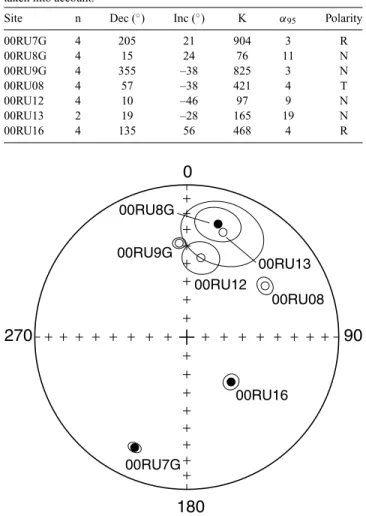
Examples of typical demagnetization diagrams are shown in Fig. 3 and ChRM direction are given in Table 2. Most samples were de-magnetized at about 80 per cent following a 40 mT AF treatment, suggesting that magnetite or low Ti titanomagnetite is the main car-rier of the natural remanent magnetization (NRM). The ChRM is easily identified for all specimens, but with a N polarity overprint, re-moved at about 15 mT, observed in the three flows of the GC section. In the RSD section, the lowermost flow measured here (00RU16) display a R direction, while, as noted earlier, flows 00RU123 and 00RU12 recorded a N polarity, and 00RU08 appears transitional. In the GC section, a N-to-R transition is recorded (Figs 3 and 4 and Table 2).
As expected, these directions confirm that a R-to-N transition is recorded in the RSD section, while GC section recorded a N-to-R transition, as previously observed (Chamalaun & McDougall 1966; McDougall & Watkins 1973), and moreover, confirm that the lava flows dated here recorded one or two palaeomagnetic events within the Matuyama chron.
4.3 K-Ar dating
New K-Ar Cassignol-Gillot ages obtained for 11 flows are given in Table 3. All analyses have been duplicated and yield reproducible ages within the 1-σ uncertainty.
In the RSD section, the lowermost (99Q) and uppermost (99N) flows give undistinguishable ages of 2.16± 0.03 and 2.14 ± 0.03 Ma, respectively. However, two out of the seven ages obtained for lava flows located between them are significantly younger, with ages of 2.06± 0.03 and 2.08 ± 0.03 Ma, for 00RU20 and 00RU08, respectively. When the latter two are not considered further (see later for discussion), the seven remaining ages of the RSD section are undistinguishable between 2.17± 0.03 and 2.12 ± 0.03 Ma, and yield a weighted mean (Taylor 1982) age of 2.15± 0.01 Ma. To take into account the 1 per cent uncertainty on the GL-O standard used for the absolute calibration of our argon measurements, this weighted mean age becomes 2.15± 0.02 Ma, our best estimate for the R-to-N transition recorded in the RSD section (Fig. 5).
In the GC section only two ages were obtained. 00RU9G and 00RU7G yield undistinguishable ages of 2.05± 0.03 and 2.03 ± 0.03 Ma, respectively, with a weighted mean (Taylor 1982) of 2.04± 0.02 Ma. The latter is therefore our best age for the N-to-R transition recorded in the GC section (Fig. 5). Note that despite a radiogenic argon content varying by a factor of three (Table 3), these two flows yielded undistinguishable ages, which support the evidence that the
Table 1. Major and trace elements concentrations.
00 00 00 00 00 00 00 00 00
Element RU7G RU8G RU9G 99N RU08 RU12 RU13 RU15 RU17 RU20 99R 99Q
SiO2(wt per cent) 47.17 45.83 48.4 47.49 47.76 46.73 47.28 46.03 47.23 48.46 47.51 47.47 Al2O3 12.68 11.65 13.71 13.29 13.93 12.85 12.89 10.37 13.15 14.13 14.28 13.8 Fe2O3 12.67 12.78 12.57 12.63 12.55 12.7 12.42 12.39 12.61 12.53 12.65 12.5 MnO 0.17 0.18 0.18 0.18 0.17 0.18 0.18 0.17 0.18 0.18 0.18 0.17 MgO 10.46 13.68 7.72 8.09 6.97 10.21 9.94 16.64 9.79 6.23 7.19 7.86 CaO 10.54 9.55 11.22 10.76 11.38 10.35 11.02 9.40 10.76 11.21 12.00 11.30 Na2O 2.27 1.96 2.44 2.49 2.57 2.31 2.37 1.87 2.54 2.74 2.56 2.49 K2O 0.68 0.56 0.66 0.79 0.82 0.50 0.71 0.47 0.78 0.89 0.67 0.67 TiO2 2.72 2.35 2.67 2.77 2.9 2.62 2.57 2.02 2.74 2.95 2.71 2.69 P2O5 0.35 0.29 0.34 0.36 0.38 0.34 0.33 0.26 0.36 0.38 0.33 0.35 LOI 0.13 0.94 −0.17 1.01 0.51 0.48 −0.26 −0.08 0.06 0.26 0.04 0.43 TOTAL 99.84 99.76 99.73 99.85 99.94 99.25 99.44 99.54 100.2 99.95 100.1 99.75 Ba (ppm) 139 124.4 144.6 170.9 174.8 145 141.1 116.8 161.7 166.2 157.4 150 Ce 45.77 38.01 44.8 50.72 54.17 46.9 46.56 35.56 51.47 51.93 46.39 48.04 Co 52.79 67.13 47.02 50.91 46.01 52.04 54.67 72.74 54.29 42.07 48.37 48.6 Cr 525 830 293 398 233 495 522 1268 509 105 166 315 Cu 81.82 87.35 93.98 94.41 109.5 89.86 99.92 80.86 109.9 121.9 64.7 115.1 Dy 5.02 4.28 5.29 5.50 5.67 5.30 5.01 4.09 5.39 5.59 5.20 5.25 Er 2.39 2.04 2.54 2.55 2.73 2.51 2.35 1.92 2.48 2.68 2.46 2.51 Eu 2.07 1.77 2.09 2.25 2.35 2.11 2.03 1.61 2.20 2.30 2.08 2.12 Gd 6.129 5.168 6.288 6.688 6.976 6.321 6.032 4.848 6.472 6.849 6.229 6.288 Hf 4.774 3.868 4.685 5.012 5.19 4.751 4.608 3.665 5.058 5.256 4.642 4.876 Ho 0.91 0.768 0.963 0.982 1.045 0.961 0.908 0.729 0.953 1.021 0.939 0.95 La 19.75 16.72 19.57 23.53 24.88 20.75 20.26 15.47 22.6 23.59 20.49 21.4 Lu 0.293 0.25 0.304 0.321 0.335 0.317 0.299 0.239 0.311 0.331 0.306 0.302 Nb 20.45 17.84 20.12 23.67 26.07 20.83 20.32 15.82 23.58 23.48 21.82 22.85 Nd 26.17 21.78 25.54 28.77 30.35 26.52 25.93 20.06 28.82 29.58 26.42 27.52 Ni 288.4 482.3 118.4 177.8 116.1 294.7 250.9 654.4 262.6 75.97 93.87 149.5 Pb 1.731 1.572 1.821 1.925 2.517 1.812 1.747 1.354 1.977 2.03 1.736 1.879 Pr 6.011 5.001 5.846 6.673 7.114 6.142 6.028 4.639 6.657 6.765 6.073 6.35 Rb 8.936 8.056 13 14.02 16.78 8.217 12.85 7.665 13.01 19.85 8.422 8.498 Sm 6.236 5.233 6.228 6.741 7.044 6.25 6.079 4.82 6.709 6.895 6.279 6.397 Sr 339 303 365 359 404 334 350 273 379 376 382 363 Ta 1.61 1.41 1.58 1.86 2.02 1.68 1.66 1.27 1.87 1.95 1.72 1.77 Tb 0.90 0.77 0.93 0.97 1.03 0.94 0.89 0.72 0.94 1.00 0.93 0.94 Th 2.287 1.905 2.306 2.74 2.871 2.525 2.419 1.895 2.686 2.746 2.428 2.51 U 0.324 0.27 0.335 0.346 0.359 0.345 0.326 0.265 0.343 0.37 0.342 0.345 V 0.486 0.4 0.487 0.629 0.633 0.433 0.543 0.383 0.599 0.71 0.461 0.482 Y 318.7 295.6 314.2 325.6 349.9 286.5 301.9 246.5 325.7 334.8 352.3 328.7 Yb 24.94 21.37 26.5 27.83 29.81 25.93 24.82 20 26.29 28.39 25.84 26.72 Zn 2.017 1.729 2.12 2.17 2.298 2.113 2.002 1.617 2.095 2.253 2.136 2.157 Zr 118.3 116.1 121.4 128.7 125.6 122.1 120 111.3 126.4 124.3 126.9 128.2
atmospheric contamination of a given lava flow cannot be used as a criteria of age validity.
5 D I S C U S S I O N
5.1 Volcanic series of La Montagne massif and K-Ar ages Within the RSD section, lava flows 00RU20 and 00RU08 display ages significantly younger than all others (Table 3) and two hypothe-ses can be proposed. First, that they have experienced weathering with fluids circulations, which have affected their ages. Second, that they might be valley fill flows emplaced significantly later in this section.
Because 00RU08 is the least contaminated sample analysed, with about 50 per cent of radiogenic40Ar (Table 3), and since 00RU20
is also relatively poor in atmospheric argon, the first
hypothe-sis appears unsupported. In addition, their loss on ignition (LOI; Table 1) is only of 0.51 and 0.26 wt. per cent, and the relatively good correlation between K and Rb elements (Fig. 6a) for all studied samples also suggests that 00RU08 and 00RU20 (the most evolved lavas) did not experience significant secondary K enrichment. Sim-ilar conclusions arise when Rb/Nb or K/Nb ratios (not shown) are scrutinized.
The second hypothesis can be tested using the isotopic signa-tures to identify slight source changes. Pb isotopes of PN and La Montagne lavas display two distinct trends as previously identified (Bosch et al. 2008). Fig. 6(b) shows that206Pb/204Pb and208Pb/204Pb
isotopic ratios of La Montagne lavas vary between 18.92 and 19.08, and between 38.75 and 38.96, respectively. Although the isotopic data set is relatively limited, two slightly overlapping domains can be identified. More radiogenic Pb isotopes are observed for RSD lavas, except 00RU08, which displays the lowest ratios, below the lower end of the GC lavas domain (Fig. 6b). The lower Pb isotopic
Figure 2. (a) Total alkali versus silica (TAS) diagram, with diamonds and circles for the Grande Chaloupe (GC) and Rivi`ere St Denis (RSD) samples, respectively. (b) Spider diagrams of incompatible trace elements normalized to primitive-mantle concentrations (McDonough & Sun 1995).
ratios can be interpreted as a shallow contamination of upwelling plume material at the base of the lithosphere by upper-mantle and oceanic-crust material, suggesting a certain time lag between lavas from La Montagne (Bosch et al. 2008). This suggests that 00RU08 flows comes from a source with geochemical characteris-tics of the second series of La Montagne lavas emplaced between 2.08 and 2.03 Ma, while the first series emplaced earlier, around 2.15 Ma.
5.2 Comparison with previous radiometric ages from R´eunion Island
Within the earlier effort of calibrating the GPTS, a detailed investi-gation of the oldest massif from the R´eunion Island was performed (McDougall & Watkins 1973). Ages recalculated using the decay constants of Steiger & J¨ager (1977), display values ranging from 2.13± 0.02 Ma for a R polarity flow within the bottom of the section, to 2.00± 0.02 Ma for two reverse polarity flows sampled above the N polarity interval. Within the latter polarity interval, ages range from 2.10± 0.02 to 2.00 ± 0.02 Ma. Because of the discon-tinuity of the records and overlapping ages from the two sections, it
has been challenging to give an age for the R´eunion event from this data set, but also to decipher between one or two events. However, within the GC section, the ages of 2.05± 0.02 Ma obtained for both GC7 and GC8 (McDougall & Watkins 1973) are fully com-patible with lava flows 00RU7G (same as GC7) and 00RU9G (lava flow below GC8) dated here at 2.03± 0.03 and 2.05 ± 0.03 Ma, respectively. Within the RSD section previous K-Ar ages are more scattered with values of 2.03± 0.02 (RN14) and 2.00 ± 0.08 Ma (RN13) for flows located just below and above the transition (Mc-Dougall & Watkins 1973), while we obtained ages of 2.13± 0. 0.03 for 00RU17 and of 2.14± 0.03 for 00RU15, the last R and first N polarity flow dated in this section, respectively (Table 3).
Baksi et al. (1993) have reinvestigated one of the previous section (RSD) using whole-rock 40Ar/39Ar. The direct comparison with
our results is not straightforward, since about 40 N polarity flows have been identified by these authors, while we (this study) and McDougall & Watkins (1973) only found 15 and 13 individual lava flows, respectively, for the same stratigraphic interval. However, from their stratigraphic position and chemical analyses, we can suppose that our flow 00RU15 corresponds to flow 44, and 99N to flow 52 or 53. An age of 2.14± 0.03 Ma has been obtained here for
Figure 3. Typical Zijderveld (1967) projection diagrams obtained during alternating field (AF) demagnetization. Straight lines show the ChRM calculated
between a given step (value indicated in mT) and the origin. Solid symbols correspond to projections onto the horizontal plane, while open symbols are projections onto the vertical plane.
both 00RU15 and 99N (Table 3), in perfect agreement with the age of 2.15± 0.03 Ma reported for both flows 44 and 53 (Baksi et al. 1993).
Baksi & Hoffman (2000) presented two new whole-rock
40Ar/39Ar ages, one (GC42) obtained on the previously studied GC
section, and one (LM41) from La Montagne section, which is
lo-cated farther north from the GC and RSD sections. The plateau age obtained from LM41 is 2.137± 0.034 Ma (isochron age: 2.18 ± 0.10 Ma), in agreement with our mean age of 2.15± 0.02 Ma calcu-lated for the nearby RSD section (Fig. 5). Only the VGPs, showing the N-to-R polarity change are reported in that study, but it shows that no less than 46 flows were reported for the GC section while
Table 2. Palaeomagnetic directions. Column headings indicate Site #; n:
number of samples measured; Dec: declination, in degrees; Inc: inclination, in degrees;α95: radius of the 95 confidence cone from Fisher’s statistics
(Fisher 1953). Polarity: N= normal, R = reverse and T = transitional. Note that declination is only indicative relative since only a magnetic compass was used for orientation and the local declination of about 25◦W was not taken into account.
Site n Dec (◦) Inc (◦) K α95 Polarity
00RU7G 4 205 21 904 3 R 00RU8G 4 15 24 76 11 N 00RU9G 4 355 –38 825 3 N 00RU08 4 57 –38 421 4 T 00RU12 4 10 –46 97 9 N 00RU13 2 19 –28 165 19 N 00RU16 4 135 56 468 4 R
Figure 4. Stereographic projection of individual flow directions. Solid
and open symbols indicate directions in the upper and lower hemisphere, respectively.
we found only 10 flows there, as previously described (McDougall & Watkins 1973). We have identified only 00RU8G lava flows as transitional (Table 1), while Baksi & Hoffman (2000) reported five distinct transitional flows. One of which, GC42, yielded plateau and isochron ages of 2.125± 0.03 and 2.10 ± 0.06 Ma, respectively (Baksi & Hoffman 2000). Because 00RU8G was slightly weathered it was not dated here, but we obtained a mean age of 2.04± 0.02 Ma for the GC section (Fig. 5). Although the step heating analysis of GC 42 display an age decrease pattern (Baksi & Hoffman 2000), typical of39Ar recoil having biased the age towards too old values, the rather
large uncertainty associated with the inverse isochron, makes this age compatible with both our RSD and GC mean ages, precluding any further speculation about its validity or its sampling location.
5.3 Other radiometric ages proposed for the R´eunion event(s)
At the Gamarri section in Afar (Ethiopia), 33 lava flows emitted during the Matuyama chron display a full N polarity interval towards the top of the section (Kidane et al. 1999), and a high palaeosecular
interval, associated with a low absolute palaeointensity interval (Carlut et al. 1999), towards its base. K-Ar ages obtained on five flows distributed within the section yield a mean value of 2.07± 0.05 Ma (Kidane et al. 1999), with ages of 2.14± 0.06 and 2.02 ± 0.04 Ma, for the bottom and top flow, respectively. When only ages associated with the two low palaeofield intervals are considered, the last flow of the first interval is dated at 2.09± 0.06 Ma, while the second flow of the second interval at 2.03± 0.08 Ma. Although, the relatively high uncertainties of these ages prevent unique solutions for GPTS calibration, it appears clearly that the R´eunion events occurred as two distinguished palaeomagnetic events in the Gamarri section. Note that this relatively high age uncertainty is due to the high atmospheric contamination of these lavas, which is a constant phenomenon observed for all Ethiopian Afar dated flows (Lahitte
et al. 2001, 2003), and cannot be directly related to weathering
effects as claimed by some authors (Baksi & Hoffman 2000). The Huckleberry Ridge Tuff (HRT), which was erupted during the major explosive stage of the Yellowstone caldera, has recorded a transitional polarity direction (Reynolds 1977; Anders et al. 1989; Byrd et al. 1994). Recent 40Ar/39Ar ages constrained its age to
2.059± 0.008 Ma (Lanphere et al. 2002), a significantly younger value than those obtained for ages associated with the R´eunion s.s. N polarity interval. This led Lanphere et al. (2002) to propose a new event designation associated with the HRT.
A combination of step heating40Ar/39Ar performed on
multi-grains and total fusion approach applies to single multi-grains from a N polarity tephra horizon sampled within the Sen`eze maar (France) yielded an age of 2.10± 0.01 Ma (Roger et al. 2000). This result has been challenged by Baksi (2001) who pointed out that possible weathering processes have affected the sanidine feldpars, which led Singer et al. (2004) to propose a revised age of 2.135± 0.050 Ma for this tephra.
In southern Argentina, a well-defined age of 2.136± 0.019 Ma, therefore associated with the R´eunion event s.s., has been obtained from transitional and N polarity lavas from Cerro del Fraile dated by step heating40Ar/39Ar performed on groundmass separates (Singer
et al. 2004). Finally, note that the ages of standards used as flux
monitors have been significantly revised in the last decades, induc-ing systematic age changes significantly larger than the age uncer-tainty reported for most40Ar/39Ar ages, which highlights the fact
that uncertainties reported above are often largely underestimated (i.e. reflecting analytical precision rather than absolute accuracy). Effectively, it is now admitted that total (analytical plus system-atic) uncertainties for previous40Ar/39Ar ages is on the order of
1–2 per cent (Kuiper et al. 2008), that is, 0.02–0.04 Ma for the R´eunion event.
5.4 Records of the R´eunion events and/or associated features within sedimentary sections
Sedimentary sequences offer the advantage of providing a more or less continuous record of the Earth’s geomagnetic changes and hence are required to identify if one or two events occurred between 2.20 and 2.00 Ma.
Below the Olduvai subchron in lacustrine sediments of the Con-fidence Hills in Death Valley, California, USA (Holt & Kirschvink 1995) the sequence displays a N polarity event. About 10 m above this event (but well below the Olduvai subchron) the HRT, unam-biguously recognized in this section from tephrostratigraphy (Sarna-Wojcicki et al. 1991), serves as a tiepoint for this section (Holt & Kirschvink 1997) and allows the correlation of this N polarity event with the R´eunion event s.s.. As discussed, since the HRT captured
Table 3. New Cassignol-Gillot K-Ar ages40Ar∗(per cent): radiogenic argon in percentage;40Ar∗(×1012at g–1): radiogenic
argon in number of atoms per gram of sample. Pol.: magnetic polarity.
N coord. E coord. K 40Ar∗ 40Ar∗ Age± 1σ Mean H Flow (UTM) (UTM) (per cent) (per cent) (×1012at g–1) (Ma) (Ma) (m) Pol. 00RU7G 334209 7682158 0.739 45.4 1.5658 2.028 ± 0.029 41.0 1.5919 2.031 ± 0.029 2.03 ± 0.03 1209 R 00RU9G 334282 7682112 0.636 15.2 1.3929 2.065 ± 0.032 15.8 1.3771 2.041 ± 0.032 2.05 ± 0.03 1123 N 99N 334924 7685470 0.815 32.9 1.8205 2.137 ± 0.031 31.9 1.8231 2.140 ± 0.031 2.14 ± 0.03 760 00RU08 334878 7685264 0.816 50.3 1.7948 2.074 ± 0.030 48.6 1.8046 2.085 ± 0.030 2.08 ± 0.03 748 T 00RU12 334867 7685165 0.691 18.9 1.6037 2.188 ± 0.033 19.5 1.5774 2.152 ± 0.032 2.17 ± 0.03 730 N 00RU13 334870 7685141 0.678 25.3 1.5082 2.129 ± 0.031 26.9 1.5022 2.120 ± 0.031 2.12 ± 0.03 730 N 00RU15 334831 7684984 0.582 25.5 1.3037 2.143 ± 0.031 24.8 1.3010 2.139 ± 0.031 2.14 ± 0.03 720 00RU17 334872 7684935 0.745 27.0 1.6905 2.139 ± 0.031 35.0 1.6469 2.115 ± 0.031 2.13 ± 0.03 710 00RU20 334850 7684787 0.785 31.7 1.7018 2.074 ± 0.030 31.7 1.6702 2.036 ± 0.029 2.06 ± 0.03 700 99R 334778 7683727 0.636 29.9 1.4391 2.165 ± 0.031 26.7 1.4523 2.185 ± 0.032 2.17 ± 0.03 550 99Q 334783 7683332 0.669 27.8 1.5068 2.155 ± 0.031 37.0 1.5110 2.161 ± 0.031 2.16 ± 0.03 450
Figure 5. K-Ar ages from this study (Table 3) shown as a function of
elevation (in metres above sea level). Diamonds are for Grande Chaloupe (GC) and circles are for Rivi`ere St Denis (RSD) samples. Open and closed symbols are for reverse and normal polarity, respectively, and no polarity was measured for grey symbols. Crosses indicate rejected samples (see text). Dashed lines show the mean age and the associated 1 sigma uncertainty for each section.
some part of a polarity excursion dated at about 2.06 (Lanphere
et al. 2002) or 2.09 Ma (Singer et al. 2004), this Death Valley record
clearly demonstrates that two distinct deviations from reversed po-larity exist in the GPTS within the 2.0–2.2 Ma interval. Assuming a constant sedimentation rate calculated between the lower Olduvai
transition and the HRT, led Holt & Kirschvink (1997) to propose an age of 2.15 Ma for the R´eunion event s.s.. Note that there, the sediments stratigraphically near the HRT do not display a full N polarity episode, but only an episode of increased secular variation around 2.04 Ma. However, the palaeomagnetic sampling interval in that zone was larger than elsewhere and the HRT itself was not sampled there due to its highly friable nature.
Within the Turkana Basin, northern Kenya, surprisingly old ages of 2.27± 0.04–2.19 ± 0.04 Ma and 2.15 ± 0.04–2.11 ± 0.04 Ma have been associated with the RU-1 and RU-2 events, respectively (McDougall et al. 1992). Although undetected varying sedimenta-tion rates could have biased these ages, it is clear from these records that two geomagnetic events have existed in this late Matuyama interval.
In southern Ethiopia, Kidane et al. (2007) present a palaeomag-netic record within the Shungura formation where two N polarity episodes have been recognized. By correlation with tephra layers dated by40Ar/39Ar (McDougall & Brown 2006), ages of 2.06±
0.01–2.08± 0.01 Ma, 2.15 ± 0.01–2.20 ± 0.01 Ma, relative to 28.1 for Fish Canyon sanidine (FCs) (Spell & McDougall 2003), have been proposed for these events, hence correlated to the RU-2 and RU-1 events, respectively (Kidane et al. 2007).
South of Iceland, a well-defined N polarity interval spanning the 2.153–2.115 Ma interval has been recorded at ODP site 981, and a marked inclination shallowing (from about –70 –+10◦) between 2.08 and 2.02 Ma (Channell et al. 2003). Comparable features have also been observed in nearby ODP sites 983 and 984 (Channell et al. 2002).
A similar episode of unusually large inclination variations has been recorded in the western Philippine Sea around oxygen isotopic stage 78, at about 2.05 Ma (Horng et al. 2002). It occurs about 1.5 m above a clearly identified N polarity event identified as the R´eunion event s.s. and astronomically dated there between 2133± 5 and 2118± 3 ka (Horng et al. 2002).
Figure 6. (a) K content (in percentage) as a function of Rb concentration
(in ppm). (b)206Pb/204Pb versus208Pb/204Pb (Bosch et al. 2008) for some
of the lava flows dated here. Field A highlights 2.15 Ma Rivi`ere St Denis (RSD) samples (00RU26, 00RU13 and 00RU15), while field B is for samples from the 2.04 Ma Grande Chaloupe (GC) section (00RU8G, 00RU7G and 00RU9G). Note that 00RU08, although from the RSD section, lies on the low radiogenic side of the GC samples field B. Same symbols as in Fig. 2(a)
5.5 Structure of the R´eunion events
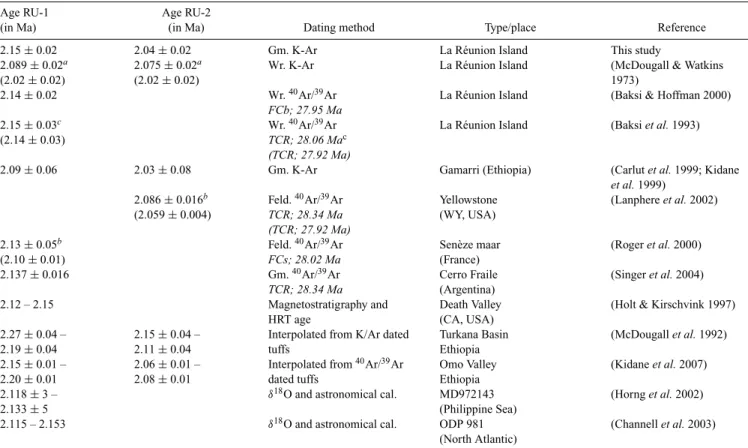
Our K/Ar ages of 2.15± 0.02 and 2.04 ± 0.02 Ma, obtained here for RU-1 and RU-2 from seven and two dated lava flows, respec-tively, are distinct at the 2 sigma level, strongly suggesting that two independent N polarity episodes have been recorded in the R´eunion Island.
As mentioned, the RU-1 event, which is the R´eunion event
s.s., has been found in many deep-sea and lacustrine sedimentary
sections, while the RU-2 event, which can be related to the Huck-leberry Ridge event, is not always recorded in the same sections (Table 4). This can be explained by the fact that RU-1 is a true, albeit short, N polarity event (or subchron), while RU-2 is rather similar to a magnetic field excursion. RU-2 is most probably associated with a low dipole field, which did not succeed in reversing polar-ity. During RU-2, the dominant magnetic field displayed a complex and rapidly changing non-dipolar geometry, which explains why the
RU-2 event is not globally observed as a full polarity episode, there-fore making its use for magnetostratigraphy purposes problematic. Effectively, it has been recommended that only correlation between sites of less than 30◦on the Earth’s surface should be attempted for the excursions (Merrill & McFadden 2005).
This hypothesis is further supported by deep-sea sedimentary records. In the equatorial Pacific (Valet & Meynadier 1993), palaeointensity records display two intensity minima that can be related to RU-1 and RU-2 recorded at La R´eunion Island. It can be noted that RU-2 displays a somehow lower intensity decrease, which could explain why it is not globally recorded as a full N polarity event, but appears at some location as only an episode of intense sec-ular variation with large departures from the expected geocentric axial dipole directions (Carlut et al. 1999). Finally, note that re-lated features (i.e. a stable N polarity event followed by an episode of unstable polarity) have also been recorded in North Atlantic (Channell et al. 2002) and Philippine Sea (Horng et al. 2002) at the same ages as the RU-1 and RU-2 events recorded at the R´eunion Island sections we studied.
6 C O N C L U S I O N S
Overall, our new K-Ar ages performed on separated groundmass show a rather good coherence with most flows previously dated at La R´eunion despite the fact that the previous analyses were whole-rock analyses performed for K-Ar and40Ar/39Ar dating. The confusion
regarding the existence of one or two N polarity events recorded at La R´eunion Island within the 2.2–2.0 Ma interval might have originated by (1) the difficulty of fully assessing the continuity of volcanic sections, (2) the use of whole-rock material in the earlier studies, which for a few flows, led to significantly younger ages and (3) the presence of valley fill flows inferred here from major and trace elements data and available Pb isotopic analyses.
When all previous sedimentary and volcanic records are consid-ered together with the new volcanic ages obtained at La R´eunion Is-land, it can be confidently proposed that two palaeomagnetic events occurred within the 2.2 –2.0 Ma interval. The first (R´eunion 1; RU-1) is associated with a large dipole intensity decrease at 2.15± 0.02 Ma, and hence is globally recorded, while at 2.04 ± 0.02 Ma, the dipole intensity decrease was not as pronounced, making the R´eunion 2 (RU-2) event not present as a full directional change in many sections worldwide.
Finally, the comparison with globally distributed records asses that RU-2 can be confidently associated to the Huckelberry Ridge event, while RU-1 is the R´eunion event s.s., as originally identified in the R´eunion Island (McDougall & Watkins 1973).
A C K N O W L E D G M E N T S
We thank two anonymous referees for throughout reviews, which helped us to improve the clarity of this manuscript. Comments by G. Delpech and A. Hildenbrand on an earlier version have been appreciated. This work was initiated when one of us (JWH) enjoyed a Professeur Invit´e position in the Department of Earth Sciences at the Universit´e Paris-Sud 11. Sampling was performed while one of us (XQ) was at the IPGP volcanic observatory of Piton de la Fournaise for survey duties. We thank the whole team of the ob-servatory and its past director T. Staudacher for their assistance. Funding was obtained from INSU CNRS DyETI program. This is LMGT contribution no. 86.
Table 4. New and previously published ages derived for the RU-1 and RU-2 events. Mineralogical phases used for radiometric dating; Gm.: groundmass; Wr.:
whole-rock; Feld.: feldspar. Flux monitor name and age used for40Ar/39Ar analyses is given in italics; TCR: Taylor Creek Rhyolite; FCb: Fish Canyon Tuff
biotite; FCs: Fish Canyon Tuff sanidine. Note that relative to 28.02 Ma for FCs, an age of 28.34 Ma has been proposed for TCR (Renne et al. 1998). Age RU-1
(in Ma)
Age RU-2
(in Ma) Dating method Type/place Reference
2.15± 0.02 2.04± 0.02 Gm. K-Ar La R´eunion Island This study 2.089± 0.02a
(2.02± 0.02)
2.075± 0.02a
(2.02± 0.02)
Wr. K-Ar La R´eunion Island (McDougall & Watkins 1973)
2.14± 0.02 Wr.40Ar/39Ar
FCb; 27.95 Ma
La R´eunion Island (Baksi & Hoffman 2000)
2.15± 0.03c
(2.14± 0.03)
Wr.40Ar/39Ar
TCR; 28.06 Mac
(TCR; 27.92 Ma)
La R´eunion Island (Baksi et al. 1993)
2.09± 0.06 2.03± 0.08 Gm. K-Ar Gamarri (Ethiopia) (Carlut et al. 1999; Kidane
et al. 1999) 2.086± 0.016b (2.059± 0.004) Feld.40Ar/39Ar TCR; 28.34 Ma (TCR; 27.92 Ma) Yellowstone (WY, USA) (Lanphere et al. 2002) 2.13± 0.05b (2.10± 0.01) Feld.40Ar/39Ar FCs; 28.02 Ma Sen`eze maar (France) (Roger et al. 2000) 2.137± 0.016 Gm.40Ar/39Ar TCR; 28.34 Ma Cerro Fraile (Argentina) (Singer et al. 2004) 2.12 – 2.15 Magnetostratigraphy and HRT age Death Valley (CA, USA)
(Holt & Kirschvink 1997)
2.27± 0.04 – 2.19± 0.04
2.15± 0.04 – 2.11± 0.04
Interpolated from K/Ar dated tuffs Turkana Basin Ethiopia (McDougall et al. 1992) 2.15± 0.01 – 2.20± 0.01 2.06± 0.01 – 2.08± 0.01
Interpolated from40Ar/39Ar
dated tuffs Omo Valley Ethiopia (Kidane et al. 2007) 2.118± 3 – 2.133± 5
δ18O and astronomical cal. MD972143
(Philippine Sea)
(Horng et al. 2002)
2.115 – 2.153 δ18O and astronomical cal. ODP 981
(North Atlantic)
(Channell et al. 2003)
Notes:aAges recalculated using Steiger & J¨ager (1977) decay constants orbrecalculated by (Singer et al. 2004) orcby (Baksi & Hoffman, 2000). Originally
published ages are given in parentheses.
R E F E R E N C E S
Anders, M.H., Geissman, J.W., Piety, L.A. & Sullivan, J.T., 1989. Parabolic distribution of circumeastern Snake River plain seismicity and latest Qua-ternary faulting: migratory pattern and association with the Yellowstone hotspot, J. geophys. Res., 94, 1589–1621.
Baksi, A.K., 2001. Discussion – Comment on “40Ar/39Ar dating of the tephra layer in the Pliocene Seneze maar lacustrine sequence (French Massif Central): constraint on the age of the Reunion-Matuyama tran-sition and implications on paleoenvironmental archives” by Roger et al,
Earth planet. Sci. Lett., 192, 627–628.
Baksi, A.K. & Hoffman, K.A., 2000. On the age and morphology of the Reunion Event, Geophys. Res. Lett., 27, 2997–3000.
Baksi, A.K., Hoffman, K.A. & McWilliams, M., 1993. Testing the accu-racy of the geomagnetic polarity time-scale (GPTS) at 2–5 Ma, utilizing
40Ar/39Ar incremental heating data on whole-rock basalts, Earth planet.
Sci. Lett., 118, 135–144.
Bosch, D., Blichert-Toft, J., Moynier, F., Nelson, B.K., Telouk, P., Gillot, P.Y. & Albarede, F., 2008. Pb, Hf and Nd isotope compositions of the two Reunion volcanoes (Indian Ocean): a tale of two small-scale mantle “blobs”? Earth planet. Sci. Lett., 265, 748–768.
Brown, M. C., Holme, R. & Bargery, A., 2007. Exploring the influence of the non-dipole field on magnetic records for field reversals and excursions,
Geophys. J. Int., 168, 541–550.
Byrd, J.O.D., Smith, R.B. & Geissman, J.W., 1994. The Teton fault, Wyoming: topographic signature, neotectonics, and mechanisms of de-formation, J. geophys. Res., 99, 20 095–20 122.
Cande, S. & Kent, D., 1995. Revised calibration of the geomagnetic polarity time scale, J. geophys. Res., 100, 6093–6095.
Carlut, J., Valet, J.-P., Quidelleur, X., Courtillot, V., Kidane, T., Gallet, Y. & Gillot, P.-Y., 1999. Paleointensity across the Reunion event in Ethiopia,
Earth planet. Sci. Lett., 170, 17–34.
Cassignol, C. & Gillot, P.-Y., 1982. Range and Effectiveness of Unspiked
Potassium-Argon Dating: Experimental Groundwork and Applications,
ed. Odin, G.S., John Wiley, New York.
Chamalaun, F.H. & McDougall, I., 1966. Dating geomagnetic polarity epochs in Reunion, Nature, 210, 1212–1214.
Channell, J.E.T., Mazaud, A., Sullivan, P., Turner, S. & Raymo, M.E., 2002. Geomagnetic excursions and paleointensities in the Matuyama Chron at Ocean Drilling Program Sites 983 and 984 (Iceland Basin), J. geophys.
Res., 107, 2114, doi:10.1029/2001JB000491.
Channell, J. E.T., Labs, J. & Raymo, M.E., 2003. The Reunion subchrono-zone at ODP site 981 (Feni Drift, north Atlantic), Earth planet. Sci. Lett.,
215, 1–12.
Cogn´e, J.P., 2003. Paleomac: a Macintosh application for treating pale-omagnetic data and making plate reconstructions, Geochem. Geophys.
Geosyst., 4, 1007, doi:10.1029/2001GC000227.
Couli´e, E., Quidelleur, X., Gillot, P.-Y., Courtillot, V., Lev`evre, J.-C. & Chiesa, S., 2003. Comparative K-Ar and Ar/Ar dating of Ethiopian and Yemenite Oligocene volcanism: implications for timing and du-ration of the Ethiopian Traps., Earth planet. Sci. Lett., 206, 477– 492.
Duncan, R.A. & Richards, M.A., 1991. Hotspots, mantle plumes, flood basalts, and true polar wander, Rev. Geophys., 29, 31–50.
Fiet, N., Quidelleur, X., Parize, O., Bulot, L.G. & Gillot, P.-Y., 2006. Lower Cretaceous stage durations combining radiometric data and or-bital chronology: towards a more stable relative time scale? Earth planet.
Sci. Lett., 246, 407–417.
Fisher, R.A., 1953. Dispersion on a sphere, Proc. R. Soc. Lond., A217, 295–305.
Gillot, P.-Y. & Cornette, Y., 1986. The Cassignol technique for potassium-argon dating, precision and accuracy: examples from late Pleistocene to recent volcanics from southern Italy, Chem. Geol., 59, 205– 222.
Gillot, P.Y. & Nativel, P., 1982. K-Ar chronology of the ultimate activ-ity of Piton des Neiges volcano, R´eunion Island, Indian Ocean, J. Volc.
Geotherm. Res., 13, 131–146.
Gillot, P.Y. & Nativel, P., 1989. Eruptive history of the Piton-de-La-Fournaise volcano, Reunion-Island, Indian-Ocean, J. Volc. Geotherm. Res., 36, 53–65.
Gillot, P. Y., Cornette, Y., Max, N. & Floris, B., 1992. Two reference materi-als, trachytes MDO-G and ISH-G, for argon dating (K-Ar and40Ar/39Ar)
of Pleistocene and Holocene rocks, Geostandards Newsletter, 16, 55–60. Gillot, P.-Y., Lef`evre, J.-C. & Nativel, P.-E., 1994. Model for the structural evolution of the volcanoes of R´eunion Island, Earth planet. Sci. Lett.,
122, 291–302.
Guyodo, Y. & Valet, J.-P., 1999. Global changes in intensity of the Earth’s magnetic field during the past 800 kyr, Nature, 399, 249–252.
Holt, J.W. & Kirschvink, J.L., 1995. The upper Olduvai geomagnetic field reversal from Death Valley, California: a fold test of transitional directions,
Earth planet. Sci. Lett., 133, 475–491.
Holt, J.W. & Kirschvink, J.L., 1997. A detailed record of the reunion normal-polarity geomagnetic subchron from Death valley, California, USA, IAGA meeting, Uppsala (Sweeden).
Horng, C.S., Lee, M.Y., Palike, H., Wei, K.Y. & Liang, W.T., 2002. Astro-nomically calibrated ages for geomagnetic reversals within the Matuyama chron, Earth Planets Space, 54, 679–690.
Kidane, T., Carlut, J., Courtillot, V., Gallet, Y., Quidelleur, X., Gillot, P.Y. & Haile, T., 1999. Paleomagnetic and geochronological identifica-tion of the Reunion subchron in Ethiopian Afar, J. geophys. Res., 104, 10 405–10 419.
Kidane, T., Otofuji, Y.I., Brown, F.H., Takemoto, K. & Eshete, G., 2007. Two normal paleomagnetic polarity intervals in the lower Matuyama Chron recorded in the Shungura Formation (Omo valley, southwest Ethiopia),
Earth planet. Sci. Lett., 262, 240–256.
Kirschvink, J., 1980. The least-squares line and plane and the analysis of paleomagnetic data: examples from Siberia and Morocco, Geophys. J. R.
astr. Soc., 62, 699–718.
Kuiper, K. F., Deino, A., Hilgen, F.J., Krijgsman, W., Renne, P.R. & Wijbrans, J.R., 2008. Synchronizing rock clocks of Earth history, Science, 320, 500–504.
Lahitte, P., Couli´e, E., Mercier, N., Kidane, T. & Gillot, P.-Y., 2001. Chronologie K-Ar et TL du volcanisme aux extr´emit´es sud du propa-gateur Mer Rouge en Afar depuis 300 ka, C. R. Acad. Sc. Paris, 322, 13–20.
Lahitte, P., Gillot, P.-Y., Kidane, T., Courtillot, V. & Bekele, A., 2003. New age constraints on the timing of volcanism in central Afar, in the presence of propagating rifts, J. geophys. Res., 108, Art. 2123.
Laj, C., Kissel, C. & Roberts, A.P., 2006. Geomagnetic field behavior dur-ing the Iceland Basin and Laschamp geomagnetic excursions: a simple transitional field geometry? Geochem. Geophys. Geosyst., 7, Q03004, doi:10.1029/2005GC001122.
Langereis, C.G., Dekkers, M.J., de Lange, G.J., Paterne, M. & van Santvoort, P.J.M., 1997. Magnetostratigraphy and astronomical calibration of the last 1.1 Myr from an eastern Mediterranean piston core and dating of short events in the Brunhes, Geophys. J. Int., 129, 75–94.
Lanphere, M., Champion, D., Christiansen, R.L., Izett, G.A. & Obradovitch, J.D., 2002. Revised age for tuffs of the Yellowstone Plateau volcanic field: assignment of the Huckleberry Ridge Tuff to a new geomagnetic polarity event, Geol. Soc. Am. Bull., 114, 559–568.
Le Bas, M.J., Le Maitre, R.W., Streckeisen, A., Zanettin, B. & IUGS Sub-commission on the Systematics of Igneous Rocks, 1986. A chemical classification of volcanic rocks based on the total alkali-silica diagram,
J. Petrol., 27, 745–750.
Lund, S., Stoner, J.S., Channell, J.E.T. & Acton, G., 2006. A summary of Brunhes paleomagnetic field variability recorded in Ocean Drilling Program cores, Phys. Earth planet. Inter., 156, 194–204.
McDonough, W.F. & Sun, S.S., 1995. The composition of the Earth, Chem.
Geol., 120, 223–253.
McDougall, I., 1971. The geochronology and evolution of the young vol-canic island of R´eunion, Indian Ocean, Geochim. cosmochim. Acta, 35, 261–288.
McDougall, I. & Brown, F. H., 2006. Precise40Ar/39Ar geochronology for
the upper Koobi Fora Formation, Turkana Basin, northern Kenya, J. geol.
Soc., 163, 205–220.
McDougall, I. & Watkins, N.D., 1973. Age and duration of the Reunion geomagnetic polarity event, Earth planet. Sci. Lett., 19, 443–452. McDougall, I., Brown, F.H., Cerling, T.E. & Hillhouse, J.W., 1992. A
reap-praisal of the geomagnetic polarity time scale to 4 Ma using data from the Turkana Basin, East Africa, Geophys. Res. Lett., 19, 2349–2532. Merrill, R.T. & McFadden, P.L., 2005. The use of magnetic field excursions
in stratigraphy, Quat. Res., 63, 232–237.
Odin, G.S. et al. 1982. Interlaboratory standards for dating purposes, in
Numerical Dating in Stratigraphy, pp. 123–150, ed. Odin, G.S., John
Wiley and Sons, Chichester.
Quidelleur, X., Holt, J. & Valet, J.P., 1995. Confounding influence of mag-netic fabric on sedimentary records of a field reversal, Nature, 374, 246–249.
Quidelleur, X. & Valet, J.P., 1994. Paleomagnetic records of excursions and reversals: possible biases caused by magnetization artefacts, Phys. Earth
planet. Int., 82, 27–48.
Quidelleur, X., Gillot, P.-Y., Carlut, J. & Courtillot, V., 1999. Link be-tween excursions and paleointensity inferred from abnormal field direc-tions recorded at La Palma around 600 ka, Earth planet. Sci. Lett., 168, 233–242.
Quidelleur, X., Gillot, P.Y., Soler, V. & Lef`evre, J.C., 2001. K/Ar dating extended into the last millennium: Application to the the youngest effusive episode of the Teide volcano (Spain), Geophys. Res. Lett., 28, 3067– 3070.
Quidelleur, X., Carlut, J., Soler, V., Valet, J.-P. & Gillot, P.-Y., 2003. The age and duration of the Matuyama-Brunhes transition from new K-Ar data from La Palma (Canary Islands) and revisited40Ar/39Ar ages, Earth
planet. Sci. Lett., 208, 149–163.
Renne, P.R., Swisher, C.C., Deino, A.L., Karner, D.B., Owens, T.L. & DePaolo, D.J., 1998. Intercalibration of standards, absolute ages and un-certainties in40Ar/39Ar dating, Chem. Geol., 145, 117–152.
Reynolds, R. L., 1977. Paleomagnetism of welded tuffs of the Yellowstone Group, J. geophys. Res., 82, 3677–3693.
Roger, S. et al. 2000.40Ar/39Ar dating of a tephra layer in the Pliocene
Seneze maar lacustrine sequence (French Massif Central): constraint on the age of the Reunion-Matuyama transition and implications on pale-oenvironmental archives, Earth planet. Sci. Lett., 183, 431–440. Sarna-Wojcicki, A.M., Lajoie, K.R., Meyer, C.E., Adam, D.P. &
Rieck, H.J., 1991. Tephrochronologic correlation of upper Neo-gene sediments along the Pacific margin, conterminous United States, in Quaternary Nonglacial Geology: Conterminous U.S., pp. 117–140, ed. Morrison, R.B., Geological Society of America, Boulder, CO.
Singer, B.S., Brown, L.L., Rabassa, J.O. & Guillou, H., 2004.40Ar/39Ar chronology of late pliocene and early pleistocene geomagnetic and glacial events in southern Argentina, in Timescales of the Paleomagnetic Field, pp. 175–190, eds Channell, J.E.T., Kent, D.V., Lowrie, W. & Meert, J.G., American Geophysical Union Geophysical Monograph 145.
Spell, T. L. & McDougall, I., 2003. Characterization and calibration of
40Ar/39Ar dating standards, Chem. Geol., 198, 189–211.
Steiger, R.H. & J¨ager, E., 1977. Subcommission on geochronology: con-vention on the use of decay constants in geo and cosmochronology, Earth
planet. Sci. Lett., 36, 359–362.
Taylor, J.R., 1982. An Introduction to Error Analysis, University Science Books, Mill Valley.
Valet, J.-P. & Meynadier, L., 1993. Geomagnetic field intensity and reversals during the past four million years, Nature, 336, 234–238.
Valet, J.P. & Plenier, G., 2008. Simulations of a time-varying non-dipole field during geomagnetic reversals and excursions, Phys. Earth planet.
Inter., 169, 178–193.
Valet, J.P., Plenier, G. & Herrero-Bervera, E., 2008. Geomagnetic excursions reflect an aborted polarity state, Earth planet. Sci. Lett., 274, 472–478. Zijderveld, J.D.A., 1967. A. C. demagnetization of rocks: Analysis of results,
in Methods in paleomagnetism, pp. 254–286, eds. Collinson, D.W., Creer, K.M. & Runcorn, S.K, Elseiver, New York.