HAL Id: hal-03138095
https://hal.archives-ouvertes.fr/hal-03138095
Submitted on 11 Feb 2021
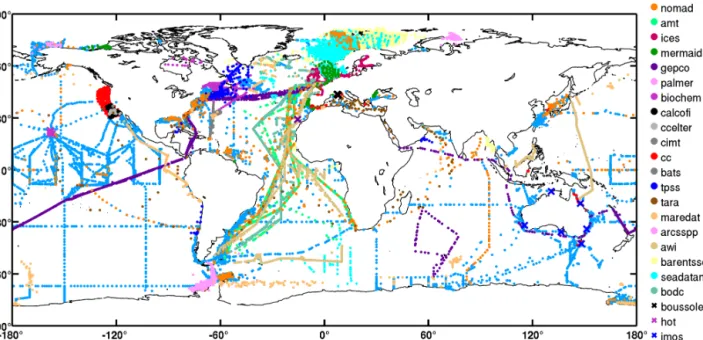
HAL is a multi-disciplinary open access
archive for the deposit and dissemination of
sci-entific research documents, whether they are
pub-lished or not. The documents may come from
teaching and research institutions in France or
abroad, or from public or private research centers.
L’archive ouverte pluridisciplinaire HAL, est
destinée au dépôt et à la diffusion de documents
scientifiques de niveau recherche, publiés ou non,
émanant des établissements d’enseignement et de
recherche français ou étrangers, des laboratoires
publics ou privés.
ocean-colour satellite applications – version two
André Valente, Shubha Sathyendranath, Vanda Brotas, Steve Groom, Michael
Grant, Malcolm Taberner, David Antoine, Robert Arnone, William Balch,
Kathryn Barker, et al.
To cite this version:
André Valente, Shubha Sathyendranath, Vanda Brotas, Steve Groom, Michael Grant, et al.. A
com-pilation of global bio-optical in situ data for ocean-colour satellite applications – version two. Earth
System Science Data, Copernicus Publications, 2019, 11 (3), pp.1037-1068.
�10.5194/essd-11-1037-2019�. �hal-03138095�
https://doi.org/10.5194/essd-11-1037-2019 © Author(s) 2019. This work is distributed under the Creative Commons Attribution 4.0 License.
A compilation of global bio-optical in situ data for
ocean-colour satellite applications – version two
André Valente1, Shubha Sathyendranath2, Vanda Brotas1,2, Steve Groom2, Michael Grant2,3, Malcolm Taberner3, David Antoine4,5, Robert Arnone6, William M. Balch7, Kathryn Barker8,9,10,
Ray Barlow11, Simon Bélanger12, Jean-François Berthon13, ¸Sükrü Be¸siktepe14, Yngve Borsheim15,
Astrid Bracher16,17, Vittorio Brando9,18, Elisabetta Canuti13, Francisco Chavez19, Andrés Cianca20,
Hervé Claustre4, Lesley Clementson9, Richard Crout21, Robert Frouin22, Carlos García-Soto23,24, Stuart W. Gibb25, Richard Gould21, Stanford B. Hooker26, Mati Kahru22, Milton Kampel27,
Holger Klein28, Susanne Kratzer29, Raphael Kudela30, Jesus Ledesma31, Hubert Loisel32, Patricia Matrai7, David McKee33, Brian G. Mitchell22, Tiffany Moisan34,†, Frank Muller-Karger35,
Leonie O’Dowd36, Michael Ondrusek37, Trevor Platt2, Alex J. Poulton38, Michel Repecaud39, Thomas Schroeder9, Timothy Smyth2, Denise Smythe-Wright40, Heidi M. Sosik41,
Michael Twardowski42, Vincenzo Vellucci4, Kenneth Voss43, Jeremy Werdell26, Marcel Wernand44,†, Simon Wright45, and Giuseppe Zibordi13
1MARE – Marine and Environmental Sciences Centre, Faculdade de Ciências,
Universidade de Lisboa, Campo Grande, 1749-016 Lisbon, Portugal
2Plymouth Marine Laboratory, Plymouth, PL1 3DH, UK 3EUMETSAT, Eumetsat-Allee 1, 64295 Darmstadt, Germany
4Sorbonne Université, CNRS, Laboratoire d’Océanographie de Villefranche, LOV,
06230 Villefranche-sur-Mer, France
5Remote Sensing and Satellite Research Group, School of Earth and Planetary Sciences,
Curtin University, Perth, WA 6845, Australia
6University of Southern Mississippi, Stennis Space Center, MS, USA
7Bigelow Laboratory for Ocean Sciences, 60 Bigelow Dr., East Boothbay, ME 04544, USA 8ARGANS Ltd, Plymouth, UK
9CSIRO Oceans and Atmosphere, Perth, Western Australia, Australia 10Australian Research Data Commons, Caulfield East, Australia 11Bayworld Centre for Research and Education, Cape Town, South Africa
12Université du Québec à Rimouski, Rimouski, Quebec, Canada 13European Commission, Joint Research Centre, Ispra, Italy
14Dokuz Eylul University, Institute of Marine Science and Technology, Izmir, Turkey 15Institute of Marine Research, Bergen, Norway
16Alfred Wegener Institute Helmholtz Centre for Polar and Marine Research, Bremerhaven, Germany 17Institute of Environmental Physics, University Bremen, Bremen, Germany
18CNR – ISMAR, Rome, Italy
19Monterey Bay Aquarium Research Institute, Moss Landing, CA, USA
20PLOCAN – Oceanic Platform of the Canary Islands, Carretera de Taliarte, 35214 Telde, Gran Canaria, Spain 21Naval Research Laboratory, Stennis Space Center, MS, USA
22Scripps Institution of Oceanography, University of California San Diego, CA, USA 23Spanish Institute of Oceanography (IEO), Corazón de María 8, 28002 Madrid, Spain
24Plentziako Itsas Estazioa/Euskal Herriko Unibetsitatea (PIE/EHU), Areatza z/g, 48620 Plentzia, Spain 25Environmental Research Institute, North Highland College,
University of the Highlands and Islands, Thurso, Scotland, UK
27Remote Sensing Division, National Space Research Institute (INPE), Sao Jose dos Campos, Brazil 28Operational Oceanography Group, Federal Maritime and Hydrographic Agency, Hamburg, Germany 29Department of Ecology, Environment and Plant Sciences, Stockholm University, 106 91 Stockholm, Sweden
30University of California Santa Cruz, Santa Cruz, CA, USA 31Instituto del Mar del Perú, Callao, Peru
32Laboratoire d’Océanologie et de Géosciences, Université du Littoral-Côte-d’Opale, Université Lille,
CNRS, UMR 8187, LOG, 32 avenue Foch, Wimereux, France
33Physics Department, University of Strathclyde, Glasgow, G4 0NG, Scotland, UK 34NASA Goddard Space Flight Center, Wallops Flight Facility, Wallops Island, VA, USA
35Institute for Marine Remote Sensing/ImaRS, College of Marine Science,
University of South Florida, St Petersburg, FL, USA
36Fisheries and Ecosystem Advisory Services, Marine Institute, Rinville – Oranmore, Galway, Ireland 37NOAA/NESDIS/STAR/SOCD, College Park, MD, USA
38Lyell Centre for Earth and Marine Science and Technology, Heriot-Watt University, Edinburgh, UK 39IFREMER Centre de Brest, Plouzane, France
40Ocean Biogeochemistry and Ecosystems, National Oceanography Centre,
Waterfront Campus, Southampton, UK
41Biology Department, Woods Hole Oceanographic Institution, Woods Hole, MA, USA 42Harbor Branch Oceanographic Institute, Fort Pierce, FL, USA
43University of Miami, Coral Gables, FL, USA
44Royal Netherlands Institute for Sea Research, Texel, the Netherlands
45Australian Antarctic Division and the Antarctic Climate and Ecosystems Cooperative Research Centre,
Hobart, Australia
†deceased
Correspondence:André Valente ([email protected]) Received: 8 February 2019 – Discussion started: 18 February 2019 Revised: 24 June 2019 – Accepted: 25 June 2019 – Published: 15 July 2019
Abstract. A global compilation of in situ data is useful to evaluate the quality of ocean-colour satellite data records. Here we describe the data compiled for the validation of the ocean-colour products from the ESA Ocean Colour Climate Change Initiative (OC-CCI). The data were acquired from several sources (including, inter alia, MOBY, BOUSSOLE, AERONET-OC, SeaBASS, NOMAD, MERMAID, AMT, ICES, HOT and GeP&CO) and span the period from 1997 to 2018. Observations of the following variables were compiled: spectral remote-sensing reflectances, concentrations of chlorophyll a, spectral inherent optical properties, spectral diffuse attenu-ation coefficients and total suspended matter. The data were from multi-project archives acquired via open inter-net services or from individual projects, acquired directly from data providers. Methodologies were implemented for homogenization, quality control and merging of all data. No changes were made to the original data, other than averaging of observations that were close in time and space, elimination of some points after quality control and conversion to a standard format. The final result is a merged table designed for validation of satellite-derived ocean-colour products and available in text format. Metadata of each in situ measurement (original source, cruise or experiment, principal investigator) was propagated throughout the work and made available in the final table. By making the metadata available, provenance is better documented, and it is also possible to analyse each set of data separately. This paper also describes the changes that were made to the compilation in relation to the previ-ous version (Valente et al., 2016). The compiled data are available at https://doi.org/10.1594/PANGAEA.898188 (Valente et al., 2019).
1 Introduction
Currently, there are several sets of in situ bio-optical data, worldwide, suitable for validation of ocean-colour satellite data. Whereas some are managed by the data producers, oth-ers are in international repositories with contributions from multiple scientists. Many have rigid quality controls and are built specifically for ocean-colour validation. The use of only any one of these datasets would limit the number of data in validation exercises. It is, therefore, vital to acquire and merge all these datasets into a single unified dataset to max-imize the number of matchups available for validation, their distribution in time and space, and, consequently, to reduce uncertainties in the validation exercise. However, merging several datasets together can be a complicated task. First it is necessary to acquire and harmonize all datasets into a single standard format. Second, during the merging, duplicates be-tween datasets have to be identified and removed. Third, the metadata should be propagated throughout the process and made available in the final merged product. Ideally, the com-piled dataset would be made available as a simple text table, to facilitate ease of access and manipulation. In this work such unification of multiple datasets is presented. This was done for the validation of the ocean-colour products from the ESA Ocean Colour Climate Change Initiative (OC-CCI), but with the intent to serve the broader user community as well.
A merged dataset is not without drawbacks: it is likely to be large and so not always easy to manipulate; because the merging is done on pre-existing, processed databases, it is not possible to have full control of the whole processing chain; the dataset would be a compilation of observations collected by several investigators using different instruments, sampling methods and protocols, which might eventually have been modified by the processing routines used by the reposito-ries or archives. To minimize these potential drawbacks, we have, for the most part, incorporated only datasets that have emerged from the long-term efforts of the ocean-colour and biological oceanographical communities to provide scientists with high-quality in situ data, and we implemented additional quality checks on the data to enhance confidence in the qual-ity of the merged product. Nevertheless, it is still recognized that different and unpredictable uncertainties may affect data from the diverse sources as a result of the application of a variety of field/laboratory instruments, methods and data re-duction schemes.
In Sect. 2 the methodologies used to harmonize and inte-grate all data, as well as a description of individual datasets acquired, are provided. In Sect. 3 the geographic distribu-tion and other characteristics of the final merged dataset are shown. Section 4 provides an overview of the data.
2 Data and methods
2.1 Preprocessing and merging
The compiled global set of bio-optical in situ data de-scribed in this work has an emphasis, though not exclu-sive, on open-ocean data. It comprises the following vari-ables: remote-sensing reflectance (rrs), chlorophyll a con-centration (chla), algal pigment absorption coefficient (aph), detrital and coloured dissolved organic matter absorption co-efficient (adg), particle backscattering coco-efficient (bbp), dif-fuse attenuation coefficient for downward irradiance (kd) and total suspended matter (tsm). The variables rrs, aph, adg, bbp and kd are spectrally dependent, and this depen-dence is, hereafter, implied. The data were compiled from 27 sources (MOBY, BOUSSOLE, AERONET-OC, SeaBASS, NOMAD, MERMAID, AMT, ICES, HOT, GeP&CO, AWI, ARCSSPP, BARENTSSEA, BATS, BIOCHEM, BODC, CALCOFI, CCELTER, CIMT, COASTCOLOUR, ESTOC, IMOS, MAREDAT, PALMER, SEADATANET, TPSS and TARA): each one described in Sect. 2.2. The data sources in this work should also be viewed as groups of data that were acquired from a specific source, standardized with a specific method and later merged into the compilation. The compiled in situ observations have a global distribution and cover the period 1997 to 2018. The listed variables, with the excep-tion of total suspended matter, were chosen as they are the operational satellite ocean-colour products of the ESA OC-CCI project, which currently focuses on the merging of four ocean-colour satellite sensors: the Medium Resolution Imag-ing Spectrometer (MERIS) of ESA, the Moderate Resolution Imaging Spectroradiometer (MODIS) of NASA, the Sea-viewing Wide Field-of-view Sensor (SeaWiFS) of NASA, and the Visible Infrared Imaging Radiometer Suite (VIIRS) of NASA and the National Oceanic and Atmospheric Admin-istration (NOAA) to create a time series of satellite data.
This is the second version of the compilation of global bio-optical in situ data described by Valente et al. (2016). A track-change file of the manuscript of the first version can be found in the Supplement. The new version has more data and a higher temporal and spatial coverage. The increases in the number of observations are mainly for chla, rrs and aph. In comparison with Valente et al. (2016), the observa-tions of chla and aph have doubled in number and provide a better spatial coverage, especially in the Southern and Arctic Ocean. The rrs values also increased in number, but not as much in spatial coverage, because most of the new observa-tions came from fixed locaobserva-tions.
The present second version is a compilation of data from sources used in the first version (MOBY, BOUS-SOLE, AERONET-OC, SeaBASS, NOMAD, MERMAID, AMT, ICES, HOT and GeP&CO) plus data from addi-tional sources (AWI, ARCSSPP, BARENTSSEA, BATS, BIOCHEM, BODC, CALCOFI, CCELTER, CIMT, COAST-COLOUR, ESTOC, IMOS, MAREDAT, PALMER,
SEA-DATANET, TPSS and TARA). The main differences from the first version are (1) some of the data sources used in the first version were updated (MOBY, AERONET, SeaBASS and HOT), (2) new data sources were added, (3) a new vari-able was compiled (total suspended matter), (4) the format of the database was modified and (5) two new flags were added. Concerning the change in format, in Valente et al. (2016) the compilation was provided as one unique two-dimensional table. Now, given its increased size (136 250 rows and 1286 columns compared with 80 524 rows and 267 columns pre-viously), the table has been broken into three smaller tables that relate to each other via one unique key identifying each row. One additional table is also provided to help with data manipulation. Despite this change, the compilation should still be viewed conceptually as one unique table, and as such, it is still described in that way. In the present version, two flags were added: flag_time and flag_chl_method. The first is because in the present version three data sources were used (ESTOC, MAREDAT and TPSS) where information on time (hour of the day) was not available. The time for these observations was set to 12:00:00 UTC and the observations were flagged with “1” in the column flag_time. A second flag was necessary, because in two data sources (ARCSSPP and SEADATANET) there was uncertainty on whether the compiled chlorophyll concentrations were measured using fluorometric, spectrophotometric or high-performance liq-uid chromatography (HPLC) methods. The compiled chloro-phyll observations from these two data sources were flagged with “1” in the column flag_chl_method and were marked as chla_fluor.
Remote-sensing reflectance (rrs) is a primary ocean-colour product defined as rrs = Lw/Es, where Lw is the upward water-leaving radiance and Es is the total downward irradi-ance at sea level. Another quantity that is often required is the normalized water-leaving radiance (nLw) (Gordon and Clark, 1981), which is related to remote-sensing reflectance via rrs = nLw/Fo, where Fo is the top-of-the-atmosphere so-lar irradiance. If not directly available, remote-sensing re-flectance was calculated through the equations described above, depending on the format of the original data. The original data were acquired in an advanced form (e.g. time-averaged, extrapolated to surface) from nine data sources de-signed for ocean-colour validation and applications (MOBY, BOUSSOLE, AERONET-OC, SeaBASS, NOMAD, MER-MAID, COASTCOLOUR, TARA, AWI), therefore only re-quiring the conversion to a common format. In the processing made by the space agencies, the quantity rrs is normalized to a single Sun-viewing geometry (Sun at zenith and nadir viewing) taking in account the bidirectional effects as de-scribed in Morel and Gentili (1996) and Morel et al. (2002). Thus, for consistency with satellite rrs product, the latter nor-malization was applied to the in situ rrs.
Chlorophyll a concentration is the conventional measure for phytoplankton biomass and one of the most widely used satellite ocean-colour products (IOCCG, 2008). To validate
satellite-derived chlorophyll a concentration, two different variables were compiled: one of these represents chloro-phyll a measurements made through fluorometric or spec-trophotometric methods, referred to hereafter as chla_fluor and the other is the chlorophyll concentration derived from HPLC measurements, referred to hereafter as chla_hplc. The chlorophyll data were compiled from the following 25 data sources: BOUSSOLE, SeaBASS, NOMAD, MERMAID, AMT, ICES, HOT, GeP&CO, AWI, ARCSSPP, BAR-ENTSSEA, BATS, BIOCHEM, BODC, CALCOFI, CCEL-TER, CIMT, COASTCOLOUR, ESTOC, IMOS, MARE-DAT, PALMER, SEADATANET, TPSS and TARA. One re-quirement for chla_fluor measurements was that they were made using in vitro methods (i.e. based on extractions of chlorophyll a). Although this severely decreased the num-ber of observations, since in situ fluorometry (e.g. fluorome-ters mounted on CTDs) is widely available in oceanographic databases, it was decided to exclude such data because of potential problems with the calibration of in situ fluorom-eter data. The variable chla_hplc was calculated by sum-ming all reported chlorophyll a derivatives, including di-vinyl chlorophyll a, epimers, allomers and chlorophyllide a. The two chlorophyll variables are retained separately in the database to facilitate their use. HPLC measurements could be considered of higher quality, but fluorometric measure-ments are more numerous. Thus one option for users is to use chla_fluor only when there are no chla_hplc measurements available. To be consistent with satellite-derived chlorophyll values, which are derived from the light emerging from the upper layer of the ocean, all chlorophyll observations in the top 10 m (replicates at the same depth, or measurements at multiple depths) were averaged if the coefficient of varia-tion among observavaria-tions was less than 50 %, otherwise they were discarded. The averages were then assigned to the sur-face. The depth of 10 m was chosen as a compromise be-tween clear oligotrophic and turbid eutrophic waters. Other methods, such as chlorophyll depth averages using local at-tenuation conditions (Morel and Maritorena, 2001), require observations at multiple depths, which, given our decision to use only in vitro measurements, would have reduced consid-erably the final number of observations.
With regard to the inherent optical properties (aph, adg, bbp), if not already calculated and provided in the con-tributed datasets, they were computed from related vari-ables that were available: particle absorption (ap), detrital absorption (ad), coloured dissolved organic matter (CDOM) absorption (ag) and total backscattering (bb). The follow-ing equations were used: adg = ad + ag, ap = aph + ad, and bb = bbp + bbw. For the latter equation, the variable bbw was computed using bbw = bw/2, where bw is the scatter-ing coefficient of seawater derived from Zhang et al. (2009). The diffuse attenuation coefficient for downward irradiance (kd) did not require any conversion and was compiled as originally acquired. Observations of inherent optical proper-ties (surface values) and the diffuse attenuation coefficient
for downward irradiance were acquired in total from six data sources designed for ocean-colour validation and ap-plications (SeaBASS, NOMAD, MERMAID, AWI, COAST-COLOUR, TPSS), thus already subject to the processing rou-tines of these datasets. Concerning total suspended matter, these data were compiled as originally available from MER-MAID and COASTCOLOUR.
The merged dataset was compiled from 27 sets of in situ data, which were obtained individually either from archives that incorporate data from multiple contribu-tors (SeaBASS, NOMAD, MERMAID, ICES, ARCSSPP, BIOCHEM, BODC, COASTCOLOUR, MAREDAT, SEA-DATANET) or from particular contributors, measurement programmes or projects (MOBY, BOUSSOLE, AERONET-OC, HOT, GeP&CO, AMT, AWI, BARENTSSEA, BATS, CALCOFI, CCELTER, CIMT, ESTOC, IMOS, PALMER, TPSS, TARA) and were subsequently homogenized and merged. Data contributors are listed in Table 2. There were methodological differences between datasets. Therefore, af-ter acquisition, and prior to any merging, each set of data was preprocessed for quality control and converted to a com-mon format. During this process, data were discarded if they had (1) unrealistic or missing date and geographic coordi-nate fields, (2) poor quality (e.g. original flags) or method of observation that did not meet the criteria for the dataset (e.g. in situ fluorescence for chlorophyll concentration), and (3) spuriously high or low data. For the last item, the follow-ing limits were imposed: [0.001–100] mg m−3for chla_fluor and chla_hplc; [0–0.15] sr−1 for rrs; [0.0001–10] m−1 for aph, adg and bbp; [0–1000] g m−3 for tsm; and [aw(λ) − 10] m−1for kd, where aw is the pure water absorption coef-ficients derived from Pope and Fry (1997). Also during this stage, three metadata strings were attributed to each obser-vation: dataset, subdataset and contributor. The dataset con-tains the name of the original set of data and can only be one of the following: aoc, boussole, mermaid, moby, nomad, seabass, hot, ices, amt, gepco, arcsspp, awi, barentssea, bats, biochem, bodc, calcofi, cc, ccelter, cimt, estoc, imos, mare-dat, palmer, seadatanet, tpss or tara. The subdataset starts with the dataset identifier and is followed by additional infor-mation about the data, as <dataset>_<cruise/station/site> (e.g. seabass_car81). The contributor contains the name of the data contributor. An effort was made to homogenize the names of data contributors from the different sets of data. These three metadata are the link to trace each observation to its origin and were propagated throughout the processing. Finally, this processing stage ended with each set of data be-ing scanned for replicate variable data and replicate station data, which when found were averaged if the coefficient of variation was less than 50 %, otherwise they were discarded. Replicates were defined as multiple observations of the same variable, with the same date, time, latitude, longitude and depth. Replicate station data were defined as multiple mea-surements of the same variable, with the same date, time, lat-itude and longlat-itude. For the latter case, a search window of
5 min in time and 200 m in distance was given to account for station drift. A small number of observations that were iden-tified as replicates had different subdataset identifiers (i.e. different cruise names). These observations were considered suspicious if the values were different and discarded. If the values were the same, one of the observations was retained. This possibly originated from the same group of data being contributed to an archive by two different data contributors.
Once a set of data was homogenized, its data were in-tegrated into a unique table. This final merging focused on the removal of duplicates between the sets of data. Al-though some duplicates are known (e.g. MOBY, BOUS-SOLE, AERONET-OC and NOMAD data are found in SeaBASS and MERMAID), others are unknown (e.g. how many data of GeP&CO, ICES, AMT and HOT are within NOMAD, SeaBASS and MERMAID). Therefore, dupli-cates were identified using the metadata (dataset and sub-dataset) when possible and temporal–spatial matches, as an additional precaution. For temporal–spatial matches, several thresholds were used, but typically 5 min and 200 m were taken to be sufficient to identify most duplicated data, which reflected small differences in time, latitude and longitude, between the different sets of data. Larger thresholds were used in some cases as a cautionary procedure. This was the case when searching for NOMAD data in other datasets, be-cause NOMAD includes a few cases where merging of ra-diometric and pigment data was done with large spatial– temporal thresholds (Werdell and Bailey, 2005). A large tem-poral threshold was also used when integrating observations from the three data sources that did not have time available (ESTOC, MAREDAT and TPSS). In regard to all data, if du-plicates were found, data from the NOMAD dataset were selected first, followed by data from individual projects or contributors (MOBY, BOUSSOLE, AERONET-OC, AMT, HOT,GeP&CO, AWI, BARENTSSEA, BATS, CALCOFI, CCELTER, CIMT, ESTOC, IMOS, PALMER, TPSS and TARA), and finally for the remaining datasets (SeaBASS, MERMAID,ICES, ARCSSPP, BIOCHEM, BODC, COAST-COLOUR, MAREDAT and SEADATANET). This proce-dure was chosen to preserve the NOMAD dataset as a whole, since it is widely used in ocean-colour validation. It should be noted that, by this procedure, data from individual projects or contributors may be listed under NOMAD (e.g. some PALMER data are found in NOMAD with metadata string nomad_palmer_lter). After giving priority to NOMAD, the priority was generally given to data from individual projects or contributors, but due to an incremental approach, where only new data are added to previous versions of the com-pilation, some data from individual projects or contributors (BATS, CALCOFI, CIMT, PALMER and TPSS) added in later stages may be found under other data sources. This occurs mainly for BATS and CALCOFI, which have their earlier chlorophyll data in SeaBASS with metadata strings seabass_bats* and seabass_cal*, and also CIMT, which has some of its data under COASTCOLOUR. After all data from
Table 1.The standard variables, nomenclatures and units in the final table. Variable/column Description and units
idx Unique key identifying each row
time GMT, <YYYY-MM-DD>T<HH:MM:SS>Z lat Decimal degree, −90 : 90, south negative long Decimal degree, −180 : 180, west negative depth_water Sampling depth (m) – all assigned to zero
chla_hplc Total chlorophyll a concentration determined from the HPLC method (mg m−3) chla_fluor Chlorophyll a concentration determined from fluorometric or
spectrophotometric methods (mg m−3) rrs_<band> Remote-sensing reflectance (sr−1) aph_<band> Algal pigment absorption coefficient (m−1) adg_<band> Detrital plus CDOM absorption coefficient (m−1) bbp_<band> Particle backscattering coefficient (m−1)
kd_<band> Diffuse attenuation coefficient for downward irradiance (m−1) tsm Total suspended matter (g m−3)
etopo1 Water depth from ETOPO1 (m) chla_hplc_dataset Metadata string for chla_hplc chla_hplc_subdataset Metadata string for chla_hplc chla_hplc_contributor Metadata string for chla_hplc chla_fluor_dataset Metadata string for chla_fluor chla_fluor_subdataset Metadata string for chla_fluor chla_fluor_contributor Metadata string for chla_fluor rrs_dataset Metadata string for rrs rrs_subdataset Metadata string for rrs rrs_contributor Metadata string for rrs aph_dataset Metadata string for aph aph_subdataset Metadata string for aph aph_contributor Metadata string for aph adg_dataset Metadata string for adg adg_subdataset Metadata string for adg adg_contributor Metadata string for adg bbp_dataset Metadata string for bbp bbp_subdataset Metadata string for bbp bbp_contributor Metadata string for bbp kd_dataset Metadata string for kd kd_subdataset Metadata string for kd kd_contributor Metadata string for kd tsm_dataset Metadata string for tsm tsm_subdataset Metadata string for tsm tsm_contributor Metadata string for tsm
flag_time “1” if observation without time (set to 12:00:00 UTC) flag_chl_method “1” if observation as unknown chlorophyll method
a given source were free of duplicates, they were merged consecutively by variable in the final table. During this pro-cess, we also searched for rows (stations) that were sepa-rated from each other by time differences less than 5 min and horizontal spatial differences of less than 200 m. When such rows were found, the observations in those rows were merged into a single row. The compiled merged data were compared with the original sets to certify that no errors oc-curred during the merging. As a final step, a water column (station) depth was recorded for each observation, which was the closest water column depth from the ETOPO1 global
relief model (National Geophysical Data Center ETOPO1; Amante and Eakins, 2009). For observations where the clos-est water depth was above sea level (e.g. data collected very near the coast), it was given the value of zero.
Data processing thus included two major steps: prepro-cessing and merging. The first step was related to each set of contributing datasets in particular and aimed to identify problems and convert the data of interest to a standard for-mat. The second step dealt with the integration of data into one unique file and included the elimination of duplicated
Table 2.Original sets of data and data contributors in the final table.
Data source Description Data contributors Marine Optical
Buoy (MOBY)
Daily observations of remote-sensing reflectance, measured by a fixed mooring system, located west of the Hawaiian island of Lanai. Data compiled be-tween 1997 and 2012. Data were obtained from the MOBY website. Compiled standard variable: rrs.
Paul DiGiacomo, Kenneth Voss
Bouée pour l’acquisition d’une Série Optique à Long Terme (BOUSSOLE)
High-frequency (15 min) observations of remote-sensing reflectance, from a fixed mooring system, located in the western Mediterranean Sea. Mea-surements of chlorophyll a concentration are also available at the mooring locations. Remote-sensing reflectance and chlorophyll a data were compiled between 2003–2012 and 2001–2012, respectively. Data were provided by David Antoine. Compiled standard variables: rrs and chla_hplc.
David Antoine, Vicenzo Vellucci
AErosol RObotic NETwork-Ocean Color
(AERONET-OC)
Daily observations of remote-sensing reflectance, measured by modified sun photometers. Data compiled between 2002 and 2012. Sites in-cluded Abu_Al_Bukhoosh (∼ 25◦N, ∼ 53◦E), COVE_SEAPRISM (∼ 36◦N, ∼ 75◦W), Glo-ria (∼ 44◦N, ∼ 29◦E), Gustav_Dalen_Tower (∼ 58◦N, ∼ 17◦E), Helsinki Lighthouse (∼ 59◦N, ∼24◦E), LISCO (∼ 40◦N, ∼ 73◦W), Lucinda (∼ 18◦S, ∼ 146◦E), MVCO (∼ 41◦N, ∼ 70◦W), Palgrunden (∼ 58◦N, ∼ 13◦E), Venice (∼ 45◦N, ∼12◦E) and WaveCIS_Site_CSI_6 (∼ 28◦N, ∼ 90◦W). Data were obtained from the AERONET-OC website. Compiled standard variable: rrs.
Robert Arnone (WaveCIS), Sam Ahmed (LISCO), Vittorio Brando (Lucinda), Dick Crout (Wave-CIS), Hui Feng (MVCO), Alex Gilerson (LISCO), Rick Gould (WaveCIS), Brent Holben (COVE-SEAPRISM), Susanne Kratzer (Palgrunden), Thomas Schroeder (Lucinda), Heidi M. Sosik (MVCO), Giuseppe Zibordi (Abu Al Bukhoosh, Gloria, Gustav Dalen Tower, Helsinki Lighthouse and Venice)
SeaWiFS
Bio-optical Archive and Storage System (SeaBASS)
Global archive of in situ marine data from mul-tiple contributors. Bio-optical global data between 1997 and 2012 were extracted from the SeaBASS website. Pigment data were mostly extracted us-ing the Pigment search tool, which provides data directly from the archives. Radiometric data were extracted using the Validation tool, which only provides in situ data with matchups for ocean-colour sensors. Compiled standard variables: rrs, chla_hplc, chl_fluor, aph, adg, bbp and kd.
Robert Arnone, Kevin Arrigo, William Balch, Ray Barlow, Mike Behrenfeld, Sukru Besiktepe, Emmanuel Boss, Chris Brown, Douglas Capone, Ken Carder, Francisco Chavez, Alex Chekalyuk, Jay-Chung Chen, Dennis Clark, Herve Claustre, Lesley Clementson, Jorge Corredor, Glenn Cota, Yves Dandonneau, Heidi Dierssen, David Es-linger, Piotr Flatau, Robert Frouin, Carlos Garcia, Alex Gilerson, Joaquim Goes, Gwo-Ching Gong, Adriana Gonzalez-Silvera, Rick Gould, Larry Hard-ing, Jon Hare, Stan B. Hooker, Chuanmin Hu, Milton Kampel, Sung-Ho Kang, Gary Kirkpatrick, Oleg Kopelevich, Sam Laney, Pierre Larouche, Jesus Ledesma, Zhongping Lee, Ricardo Letelier, Marlon Lewis, Steven Lohrenz, Mary Luz Canon, Antonio Mannino, John Marra, Chuck McClain, Christophe Menkes, Mark Miller, Greg Mitchell, Ru Morrison, James Mueller, Frank Muller-Karger, Ruben Negri, James Nelson, Norman Nelson, Mary Jane Perry, David Phinney, John Porter, Collin Roesler, David Siegel, Mike Sieracki, Jef-frey Smart, Raymond Smith, Heidi Sosik, James Spin-hirne, Dariusz Stramski, Rick Stumpf, Ajit Sub-ramaniam, Chuck Trees, Michael Twardowski, Kenneth Voss, Marcel Wernand, Ronald Zaneveld, Eric Zettler, Giuseppe Zibordi, Richard Zimmerman
Table 2.Continued.
Data source Description Data contributors NASA bio-Optical
Marine Algorithm Dataset (NOMAD)
High-quality global dataset of coincident bio-optical in situ data. The dataset was built upon the SeaBASS archive. The current version (version 2.0 ALPHA, 2008) was used, with an additional set of columns of remote-sensing reflectance corrected for the bidirectional nature of the light field, pro-vided by NOMAD creators. Data compiled between 1997 and 2007. Compiled standard variables: rrs, chla_hplc, chl_fluor, aph, adg, bbp and kd.
Robert Arnone, Kevin Arrigo, William Balch, Ray Bar-low, Mike Behrenfeld, Chris Brown, Douglas Capone, Ken Carder, Francisco Chavez, Dennis Clark, Herve Claustre, Jorge Corredor, Glenn Cota, David Es-linger, Piotr Flatau, Robert Frouin, Rick Gould, Larry Harding, Stan B. Hooker, Oleg Kopelevich, Marlon Lewis, Antonio Mannino, John Marra, Mark Miller, Greg Mitchell, Tiffany Moisan, Ru Morri-son, Frank Muller-Karger, James NelMorri-son, Norman Nel-son, David Siegel, Raymond Smith, Timothy Smyth, James Spinhirne, Dariusz Stramski, Rick Stumpf, Ajit Subramaniam, Kenneth Voss
MERIS Match-up In situ Database (MERMAID)
Global database of in situ bio-optical data matched with concurrent MERIS Level 2 satellite ocean-colour products. The Extract matchup tool to ac-quire data was used. Data were compiled between 2002 and 2012. Access has been granted through a signed service level agreement. Compiled stan-dard variables: rrs, chla_hplc, chl_fluor, aph, adg, bbp and kd.
Simon Belanger, Jean-Francois Berthon, Vanda Bro-tas, Elisabetta Canuti, Pierre Yves Deschamps, An-nelies Hommersom, Mati Kahru, Holger Klein, Hu-bert Loisel, David McKee, Greg Mitchell, Michael On-drusek, Michel Repecaud, David Siegel, Gavin Til-stone, Giuseppe Zibordi
Atlantic Meridional Transect (AMT)
Multidisciplinary programme that makes biologi-cal, chemical and physical oceanographic measure-ments during an annual voyage between the United Kingdom and destinations in the South Atlantic. It has compiled observations of chlorophyll a concen-tration between 1997 (AMT5) and 2005 (AMT17). Data were provided by the British Oceanographic Data Centre (BODC). Compiled standard variables: chla_hplc and chl_fluor.
Ray Barlow, Stuart Gibb, Victoria Hill, Patrick Hol-ligan, Gerald Moore, Leonie O’Dowd, Alex Poulton, Emilio Suarez
International Council for the Ex-ploration of the Sea (ICES)
Database of several collections of data related to the marine environment. It has compiled observa-tions of chlorophyll a concentration in the northern European seas, between 1997 and 2012. Data were provided by the ICES database on the marine envi-ronment (2014, Copenhagen, Denmark). Compiled standard variables: chla_hplc and chl_fluor.
Not available
Hawaii Ocean Time-series (HOT)
Multidisciplinary programme that makes repeated biological, chemical and physical oceanographic observations near Oahu, Hawaii. Measurements of chlorophyll a concentration between 1997 and 2012 were extracted from the project website. Compiled standard variables: chla_hplc and chl_fluor.
Bob Bidigare, Matthew Church, Ricardo Letelier, Jas-mine Nahorniak
Geochemistry, Phy-toplankton, and Color of the Ocean (GeP&CO)
Programme of in situ data collection aboard a mer-chant ship from France to New Caledonia, between 1999 and 2002. Measurements of chlorophyll a concentration were obtained from the project web-site. Compiled standard variables: chla_hplc and chla_fluor.
Yves Dandonneau
ARCSSPP Arctic System Science Primary Production database. Available from the NODC FTP site. Compiled standard variable: chla_fluor.
Table 2.Continued.
Data source Description Data contributors AWI Several 2007–2012 cruises in the Atlantic,
Pa-cific and Southern Ocean from Astrid Bracher’s group at AWI. Provided by Astrid Bracher. Avail-able from PANGAEA. Compiled standard vari-ables: chla_fluor, rrs and aph.
Astrid Bracher
BARENTSSEA Data collection from cruises of the Institute of Ma-rine Research (Norway) mainly around the Barents Sea. Provided by Knut Yngve Børsheim. Compiled standard variable: chla_fluor.
Knut Yngve Børsheim
BATS Data collection from the Bermuda Atlantic Time-series Study. Available from BATS website. Com-piled standard variables: chla_fluor and chla_hplc.
Not available
BIOCHEM The Fisheries and Oceans Canada database for bio-logical and chemical data. Mostly data from Gulf of St Lawrence. Available from BIOCHEM website. Compiled standard variable: chla_fluor.
Diane Archambault, Hughes Benoit, Esther Bon-neau, Eugene Colbourne, Alain Gagne, Yves Gagnon, Tom Hurlbut, Catherine Johnson, Pierre Joly, Mau-rice Levasseur, Patrick Ouellet, Jacques Plourde, Luc Savoie, Michael Scarratt, Philippe Schwab, Michel Starr, François Villeneuve
BODC British Oceanographic Data Centre. Mainly Euro-pean seas. Provided by BODC. Compiled standard variables: chla_fluor and chla_hplc.
Not available
CALCOFI Cruise data from the California Cooperative Oceanic Fisheries Investigations programme. Avail-able from CalCOFI website. Compiled standard variable: chla_fluor.
Ralf Goericke
CCELTER Cruise data from California Current Ecosystem Long Term Ecological Research. Available from CCELTER website. Compiled standard variable: chla_fluor.
Ralf Goericke
CIMT Sampling from the Center for Integrated Marine Technology (California). Available from CIMT website. Compiled standard variable: chla_fluor.
Raphael Kudela
COASTCOLOUR Quality-controlled compilation of bio-optical data in several coastal sites. Available from PANGAEA. Compiled standard variables: chla_fluor, chla_hplc, rrs, aph, adg, bbp and tsm.
Not available
ESTOC Sampling from the Estación Europea de Series Temporales del Oceano Canary Islands. Provided by Andrés Cianca. Compiled standard variable: chla_fluor.
Octavio Llinas and Andres Cianca
IMOS Australian National Reference Stations. Available from the Australian Ocean Data Network (AODN). Compiled standard variable: chla_hplc.
Lesley Clementson
MAREDAT Quality-controlled global compilation of chla HPLC. Available from PANGAEA. Compiled stan-dard variable: chla_hplc.
Ray Barlow, Robert Bidigare, Herve Claustre, Denise Cummings, Giacomo DiTullio, Chris Galli-enne, Ralf Goericke, Patrick Holligan, David Karl, Michael Landry, Michael Lomas, Michael Lucas, Jean-Claude Marty, Walker Smith, Denise Smythe-Wright, Rick Stumpf, Emilio Suarez, Koji Suzuki, Maria Vernet, Simon Wright
Table 2.Continued.
Data source Description Data contributors PALMER Palmer station Long-Term Ecological Research
(Antarctica). Available from PALMER website. Compiled standard variables: chla_fluor and chla_hplc.
Oscar Schofield, Raymond Smith, Maria Vernet.
SEADATANET Global archive of in situ marine data. Available from SEADATANET website. Compiled standard variable: chla_fluor.
Not available
TPSS Compilation of bio-optical data predominantly from the northwestern Atlantic but also from the In-dian Ocean, South Pacific and central Atlantic. Pro-vided by Trevor Platt and Shubha Sathyendranath. Compiled standard variables: chla_hplc, chla_fluor and aph.
Trevor Platt, Shubha Sathyendranath.
TARA Data collection from the TARA global transects. Provided by Emmanuel Boss. All data available in SeaBASS. Compiled standard variables: chla_hplc and rrs.
Emmanuel Boss
data between the individual sets of data. In the next subsec-tions a brief overview of each original set of data is provided.
2.2 Preprocessing of each set of data 2.2.1 Marine Optical Buoy (MOBY)
MOBY is a fixed mooring system operated by the National Oceanic and Atmospheric Administration (NOAA) that pro-vides a continuous time series of water-leaving radiance and surface irradiance in the visible region of the spectra since 1997. The site is located a few kilometres west of the Hawaiian island of Lanai where the water depth is about 1200 m. Since its deployment, MOBY measurements have been the primary basis for the on-orbit vicarious calibra-tions of the SeaWiFS and MODIS ocean-colour sensors. A full description of the MOBY system and processing is pro-vided in Clark et al. (2003). Data are freely available for scientific use at the MOBY Gold directory. The products of interest are the Scientific Time Series files, which refer to MOBY data averaged over sensor-specific wavelengths and particular hours of the day (around 20:00–23:00 UTC). For this work, the satellite band-average products for Sea-WiFS, MODIS AQUA, MERIS, VIIRS and the Ocean and Land Colour Instrument (OLCI) were compiled from the R2017 Reprocessing. The in-band-average subproduct was used, and to maintain the highest quality only data deter-mined from the upper two arms (Lw1) and flagged as good quality were acquired. Data from the MOBY203 deployment were discarded due to the absence of surface irradiance data. The compiled variable was the remote-sensing reflectance, rrs, which was computed from the original water-leaving ra-diance (Lw) and surface irrara-diance (Es). The water-leaving
radiances were corrected for the bidirectional nature of the light field (Morel and Gentili, 1996; Morel et al., 2002) us-ing the same lookup table and method as that used in the SeaWiFS Data Analysis System (SeaDAS) processing code. The MOBY data were reprocessed in 2017 (MOBY R2017 Reprocessing) to include various improvements in the cali-bration of the instrument and post-processing, which include (1) a new method to extrapolate the upwelling radiance atten-uation coefficient to the surface, (2) an increase in arm depth by 0.234 m and (3) a single pixel shift in the data for the red spectrograph collected at a bin factor of 384. Only the last two changes were included in present compilation. As mentioned before, the MOBY data compiled in this work are sensor-specific. Therefore, attention is necessary to use the correct MOBY data when validating a particular sensor. The way MOBY data are stored in the final merged table is con-sistent with the original wavelengths; however, these wave-lengths can differ from what is sometimes expected to be the central wavelength of a given band and sensor. Irrespective of the wavelength where MOBY data are stored in the fi-nal table, for validation of bands 1–6 of SeaWiFS, MOBY data stored in the final merged table at 412, 443, 490, 510, 555 and 670 nm, respectively, should be used. For validation of bands 1–6 of MODIS AQUA, MOBY data stored in the final merged table at 416, 442, 489, 530, 547 and 665 nm, respectively, should be used. For validation of bands 1–7 of MERIS, MOBY data stored in the final merged table at 410.5, 440.4, 487.8, 507.7, 557.6, 617.5 and 662.4 nm, re-spectively, are the appropriate data. For validation of bands 2–8 of OLCI, MOBY data stored in the final merged ta-ble at 412.0676, 443.1898, 490.7176, 510.6403, 560.5796, 620.626 nm and 665.3737, respectively, are the appropriate
data. Finally, for validation of bands 1–5 of VIIRS, MOBY data stored in the final merged table at 412.9, 444.5, 481.2, 556.3 and 674.6 nm, respectively, are the appropriate data.
2.2.2 BOUée pour l’acquiSition de Séries Optiques à Long termE (BOUSSOLE)
The BOUSSOLE project started in 2001 with the objective of establishing a time series of bio-optical properties in oceanic waters to support the calibration and validation of ocean-colour satellite sensors (Antoine et al., 2006). The project consists of a monthly cruise programme and a permanent op-tical mooring (Antoine et al., 2008). The mooring collects radiometry and inherent optical properties (IOPs) in continu-ous mode every 15 min at two depths (4 and 9 m nominally). The monthly cruises are devoted to the mooring servicing, to the collection of vertical profiles of radiometry and IOPs, and to water sampling at 11 depths from the surface down to 200 m, for subsequent analyses including phytoplankton pigments, particulate absorption, CDOM absorption and sus-pended particulate matter load. The BOUSSOLE mooring is in the western Mediterranean Sea at a water depth of 2400 m. All pigment (2001–2012) and radiometric (2003–2012) data were provided by the principal investigator. The compiled variables were rrs and chla_hplc. Observations of the diffuse attenuation coefficient (kd) were not included in the present compilation, as they were under internal quality revision at the time of data acquisition. Remote-sensing reflectance was computed from the original fully normalized water-leaving radiance (nLw_ex), which is the normalized water-leaving radiance (nLw, previously described), with a correction for the bidirectional nature of the light field (Morel and Gentili, 1996; Morel et al., 2002). The solar irradiance (Fo) was com-puted from two available variables in the original set of data: the normalized water-leaving radiance (nLw) and the remote-sensing reflectance (rrs), using the equation Fo = nLw/rrs. Only radiometric observations that meet the following cri-teria were used: (1) tilt of the buoy was less than 10◦, (2) the buoy was not lowered by more than 2 m as compared to its nominal water line (to ensure the Es reference sensor is above water and exempt from sea spray) and (3) the solar irradiance was within 10 % of its theoretical clear-sky value (determined from Gregg and Carder, 1990). The latter crite-rion was used to select clear skies only. An additional quality control was to remove observations that were 50 % higher or lower than the daily average. This removed a small number of spikes in the time series. The final quality control step was to remove days where the standard deviation was more than half of the daily average. This was meant to identify days with high variability. Very few days (N = 2) were removed with this test. These quality control criteria were applied per wavelength, which resulted in some observations with an in-complete spectrum.
2.2.3 AErosol RObotic NETwork-Ocean Color (AERONET-OC)
AERONET-OC is a component of AERONET, including sites where sun photometers operate with a modified mea-surement protocol leading to the determination of the fully normalized water-leaving radiance (Zibordi et al., 2006, 2009). As a result of collaboration between the Joint Re-search Centre (JRC) and NASA, this component has been specifically developed for the validation of ocean-colour ra-diometric products. The strength of AERONET-OC is “the production of standardized measurements that are performed at different sites with identical measuring systems and proto-cols, calibrated using a single reference source and method, and processed with the same codes” (Zibordi et al., 2006, 2009). All high-quality data (Level-2) were acquired from the project website for 11 sites: Abu_Al_Bukhoosh (∼ 25◦N, ∼ 53◦E), COVE_SEAPRISM (∼ 36◦N, ∼ 75◦W), Gloria (∼ 44◦N, ∼ 29◦E), Gustav_Dalen_Tower (∼ 58◦N, ∼17◦E), Helsinki Lighthouse (∼ 59◦N, ∼ 24◦E), LISCO (∼ 40◦N, ∼ 73◦W), Lucinda (∼ 18◦S, ∼ 146◦E), MVCO (∼ 41◦N, ∼ 70◦W), Palgrunden (∼ 58◦N, ∼ 13◦E; Philip-son et al., 2016), Venice (∼ 45◦N, ∼ 12◦E) and Wave-CIS_Site_CSI_6 (∼ 28◦N, ∼ 90◦W). The compiled vari-able was rrs. Remote-sensing reflectance was computed from the original fully normalized water-leaving radiance (see Sect. 2.2.2 for definition). The solar irradiance (Fo), which is not part of the AERONET-OC data, was computed from the Thuillier et al. (2003) solar spectrum irradiance, by averag-ing Fo over a wavelength-centred 10 nm window. Data were compiled for the exact wavelengths of each record, which can change over time for a given site depending on the specific instrument deployed.
In comparison with the previous compilation of AERONET-OC data from the Lucinda site, a calibra-tion correccalibra-tion was applied by NASA affecting instrument SN-520. All radiometric data from this instrument provided by NASA prior to October 2018 were underestimated by approximately a factor of 2 due to incorrect application of instrument gains during the processing.
2.2.4 SeaWiFS Bio-optical Archive and Storage System (SeaBASS)
SeaBASS is one of the largest archives of in situ marine bio-optical data (Werdell et al., 2003). It is maintained by NASA’s Ocean Biology Processing Group (OBPG) and in-cludes measurements of optical properties, phytoplankton pigment concentrations, and other related oceanographic and atmospheric data. The SeaBASS database consists of in situ data from multiple contributors, collected using a variety of measurement instruments with consistent, community-vetted protocols from several marine platforms such as fixed buoys, handheld radiometers and profiling instruments. Quality con-trol of the received data includes a rigorous series of
pro-tocols that range from file format verification to inspection of the geophysical data values (Werdell et al., 2003). Ra-diometric data were acquired through the Validation search tool, which provided in situ data with matchups for particular ocean-colour sensors (Bailey and Werdell, 2006). The crite-rion in the search query was defined to have the minimal flag conditions in the satellite data, to retrieve a greater number of matchups and, therefore, in situ data. Regarding phyto-plankton pigment data, the majority were acquired through the Pigment search tool, which provided pigment data di-rectly from the archives. As was stated in the SeaBASS web-site, the Pigment search tool was originally designed to return only in vitro fluorometric measurements, which is consis-tent with our approach, but over time chlorophyll a measure-ments made using other methods (e.g. in situ fluorometry) were included in the retrieved pigment data. In the pigment data used in this work, a large number of in situ fluorometric measurements from continuous underway instruments were identified and discarded. These data were initially identified from cruises with more than 50 observations per day and then rechecked in the SeaBASS website to confirm whether in-deed they were continuous underway measurements. A to-tal of 120 412 such measurements were identified and dis-carded. Given the large volume of this group of data, it is possible that some chlorophyll a observations from in situ methods may have escaped the scrutiny and persisted into the final merged dataset. The Pigment search tool was re-cently discontinued, and, instead, the File search tool can be used, which was also used here to acquire chlorophyll obser-vations for more recent years. The compiled variables from SeaBASS data were rrs, chla_hplc, chla_fluor, aph, adg, bbp and kd. No conversion was necessary since all variables were acquired in the desired format.
2.2.5 NASA bio-Optical Marine Algorithm Dataset (NOMAD)
NOMAD is a publicly available dataset compiled by the NASA OBPG at the Goddard Space Flight Center. It is a high-quality global dataset of coincident radiometric and phytoplankton pigment observations for use in ocean-colour algorithm development and satellite-data product-validation activities (Werdell and Bailey, 2005). The source of the bio-optical data is the SeaBASS archive; therefore, many depen-dencies exist between these two datasets, which were ad-dressed during the merging. The current version (version 2.0 ALPHA, 2008) includes data from 1991 to 2007 and an ad-ditional set of observations of inherent optical properties. The current version was used in this work, but with an addi-tional set of columns of remote-sensing reflectance corrected for the bidirectional effects (Morel and Gentili, 1996; Morel et al., 2002). This additional set of columns was provided directly by the NOMAD creators. The compiled variables were rrs, chla_hplc, chla_fluor, aph, adg, bbp and kd. Con-version was necessary only for aph, adg and bbp and
fol-lowed the procedures described in Sect. 2.1. For the calcu-lation of bbp the variable bb was used with a smooth fitting to remove noise. A portion of the NOMAD data were opti-cally weighted (for methods see Werdell and Bailey, 2005). These data are not consistent with the protocols chosen in this work, but these observations were retained since NOMAD is a widely used dataset in ocean-colour validation.
2.2.6 MERIS Match-up In situ Database (MERMAID)
MERMAID provides in situ bio-optical data matched with concurrent and comparable MERIS Level 2 satellite ocean-colour products (Barker, 2013a, b). The MERMAID in situ database consists of data from multiple contributors, mea-sured using a variety of instruments and protocols from sev-eral marine platforms such as fixed buoys, handheld radiome-ters and profiling instruments. Comprehensive quality con-trol and protocols are used by MERMAID to integrate all the data into a common and comparable format (Barker, 2013a, b). Access to MERMAID data is limited to the MERIS Val-idation Team, the MERIS Quality Working Group and to the in situ data contributors. For this work, access has been granted to the MERMAID database through a signed ser-vice level agreement. The MERMAID data includes sub-sets of several datasub-sets used in this compilation (MOBY, AERONET-OC, BOUSSOLE, NOMAD). These observa-tions were removed from the MERMAID dataset to avoid du-plication (as discussed in Sect. 2.1). The compiled variables were rrs, chla_hplc, chla_fluor, aph, adg, bbp, kd and tsm. Remote-sensing reflectance was calculated by dividing the original fully normalized water-leaving reflectance (Rw_ex), which is the water-leaving reflectance (Rw = π Lw/Es), with a correction for the bidirectional nature of the light field (Morel and Gentili, 1996; Morel et al., 2002), by π . Conver-sion was also necessary for aph, adg and bbp and followed the procedures described in Sect. 2.1.
2.2.7 Hawaii Ocean Time-series (HOT)
HOT programme provides repeated comprehensive observa-tions of the hydrography, chemistry and biology of the water column at a station located 100 km north of Oahu, Hawaii, since October 1988 (Karl and Michaels, 1996). This site is representative of the North Pacific subtropical gyre. Cruises are made approximately once a month to the deep-water sta-tion ALOHA (A Long-Term Oligotrophic Habitat Assess-ment; 22◦450N, 158◦000W). Pigment data (chla_hplc and chla_fluor) were extracted directly from the project web-site. Radiometric measurements from the HOT project are also available, but observations of rrs and kd from the HOT project were acquired in this work as part of the SeaBASS dataset.
2.2.8 Geochemistry, Phytoplankton, and Color of the Ocean (GeP&CO)
GeP&CO is part of the French PROOF programme and aims to describe and understand the variability of phytoplankton populations, as well as to assess its consequences on the geo-chemistry of the oceans (Dandonneau and Niang, 2007). It is based on the quarterly travels of the merchant ship Con-tship London from France to New Caledonia in the Pacific. A scientific observer sailed on each trip and operated the sam-pling for surface water, filtration, various measurements and checking at several times of each day. The experiment started in October 1999 and finished in July 2002. Pigment data were extracted from the project website. Additional pigment data obtained during the OISO-4 cruise in the southern Indian Ocean on board R/V Marion Dufresne (January–February 2000) were added. The samples were measured by Yves Dandonneau following the method used in the GeP&CO project. The compiled variable was chla_hplc and chla_fluor.
2.2.9 Atlantic Meridional Transect (AMT)
AMT is a multidisciplinary programme, which undertakes biological, chemical and physical oceanographic research during an annual voyage between the UK and destinations in the South Atlantic (Robinson et al., 2006). The programme was established in 1995 and since then has completed 28 research cruises. Pigment data between 1997 (AMT5) and 2005 (AMT17) were provided by the British Oceanographic Data Centre (BODC) following a specific request for discrete observations of chlorophyll a concentration since 1997. The AMT data were isolated by searching for the string AMT in the cruise columns, and the respective principal investigators were then searched for individually in a separated metadata file. Data not flagged with highest quality or without method of measurement were not used. For any interest in the origi-nal data, BODC is the point of contact, which ensures that if there are any updates, the most recent data are supplied. The compiled variables are chla_hplc and chla_fluor.
2.2.10 International Council for the Exploration of the Sea (ICES)
ICES is a network of more than 4000 scientists from almost 300 institutes, with 1600 scientists participating in activities annually. The ICES Data Centre manages a number of large dataset collections related to the marine environment cov-ering the northeastern Atlantic, Baltic Sea, Greenland Sea and Norwegian Sea. The majority of data originate from na-tional institutes that are part of the ICES network of mem-ber countries. Data were provided (on 28 April 2014) from the ICES database on the marine environment (Copenhagen, Denmark) following a specific request. The ICES data were made available under the ICES data policy, and if there is any conflict between this and the policy adopted by the users,
then the ICES policy applies. The compiled variables were chla_hplc and chla_fluor.
2.2.11 Arctic System Science Primary Production (ARCSSPP)
The ARCSSPP database is a synthesis of observations be-tween 1954 and 2006 from the Arctic Ocean and northern seas (Matrai et al., 2013). The observations were acquired from data repositories, publications or provided by individ-ual investigators. The database includes qindivid-uality-controlled observations of productivity and chlorophyll a, photosyn-thetically available radiation and hydrographic parameters. This collection of data was acquired at http://www.nodc. noaa.gov/cgi-bin/OAS/prd/accession/download/63065 (last access: 10 July 2019). For the present work, only observa-tions of chlorophyll a concentration with known time zones were used. The compiled chlorophyll observations were from discrete samples, but the exact method (either chla_fluor or chla_hplc) was not available for all observations. Thus, the ARCSSPP chlorophyll observations were marked as chla_fluor, although some might have been from HPLC measurements, and were flagged with “1” in the column flag_chla_method. The compiled variable was chla_fluor.
2.2.12 Data provided by Astrid Bracher, Alfred Wegener Institute Helmholtz Centre for Polar and Marine Research (AWI)
In this work, the AWI data source refers to the group of observations that were provided to the OC-CCI project by Astrid Bracher. These are bio-optical observations collected during several cruises in the Atlantic and Pacific Ocean. All data were available through the PANGAEA repository. Observations of concentration of chlorophyll a as well as 1 nm spectrally resolved remote-sensing reflectances and the algal pigment absorption coefficient were considered. The methods for these observations are described by Taylor et al. (2011a). For chlorophyll, data from the following cruises were used: ANT-XXIV/1, ANT-XXIV/4, ANT-XXVI/4 and MSM18/3 (https://doi.org/10.1594/PANGAEA.847820; Bracher et al., 2015); SO202/2 (https://doi.org/10.1594/PANGAEA.820607;
Zindler et al., 2013); ANT-XXVII/2 (https://doi.org/10.1594/PANGAEA.848590;
Bracher, 2015); ANT-XXV/1 (https://doi.org/10.1594/PANGAEA.819099; Tay-lor et al., 2011b); and ANT-XXVIII/3 and SO218 (https://doi.org/10.1594/PANGAEA.848591; Soppa et al., 2014). Concerning remote-sensing reflectances, the observations taken during cruises XXIV/4 and ANT-XXVI/4 (https://doi.org/10.1594/PANGAEA.847820; Bracher et al., 2015) and cruise ANT-XXV/1 (https://doi.org/10.1594/PANGAEA.819099; Taylor et al., 2011b) were gathered. The remote-sensing reflectances
were corrected for the bidirectional nature of the light field (Morel and Gentili, 1996; Morel et al., 2002). The absorption coefficients were taken during cruise SO202/2 (https://doi.org/10.1594/PANGAEA.820607; Zindler et al., 2013), cruise ANT_XXV/1 (https://doi.org/10.1594/PANGAEA.819099; Taylor et al., 2011b), and cruises ANT-XXVI/3 and ANT-XXVIII/3 (https://doi.org/10.1594/PANGAEA.819617; Soppa et al., 2013). The compiled variables were chla_hplc, rrs and aph.
2.2.13 Bermuda Atlantic Time-series Study (BATS)
BATS is a long-term study by the Bermuda Institute of Ocean Sciences based on regular cruises in the western At-lantic Ocean (Sargasso Sea) since 1988. The cruises at the BATS site (∼ 31◦400N, 64◦100W) sample ocean tempera-ture and salinity but are focused on biogeochemical vari-ables such as nutrients, dissolved inorganic carbon, oxygen, HPLC of pigments, primary production and sediment trap flux. In this work all the phytoplankton pigment data avail-able from the BATS website (http://bats.bios.edu/bats-data/, last access: 10 July 2019) were considered, which also in-cluded regional and transect cruises not specific to the nom-inal BATS site. The compiled variables were chla_hplc and chla_fluor.
2.2.14 Data provided by Knut Yngve Børsheim (BARENTSSEA)
The BARENTSSEA data source refers to a group of observa-tions that were provided to OC-CCI project by Knut Yngve Børsheim. This collection was developed using data from the archives of the Institute of Marine Research (Norway). It comprises observations of temperature, salinity and chloro-phyll a routinely collected by cruises, mainly in the North Sea, the Norwegian Sea and the Barents Sea between 1997 and 2013. The chlorophyll a concentration was measured by filtering and extraction using Turner fluorometers. The com-piled variable was chla_fluor.
2.2.15 The Fisheries and Oceans Canada database for biological and chemical data (BIOCHEM)
BioChem is an archive of marine biological and chem-ical data maintained by Fisheries and Oceans Canada (DFO, 2018; Devine et al., 2014). The available obser-vations are from department research initiatives and col-lected in areas of Canadian interest. Available parame-ters include pH, nutrients, chlorophyll, dissolved oxygen and other plankton data (species and biomass). Chloro-phyll measurements from in vitro fluorometric meth-ods were extracted (from http://www.dfo-mpo.gc.ca/science/ data-donnees/biochem/index-eng.html, last access: 10 July 2019) with close guidance by the BioChem help desk, con-firming quality and methods. The used data span from 1997
to 2014 and were mainly from the Gulf of St Lawrence (west-ern North Atlantic). The compiled variable was chla_fluor.
2.2.16 British Oceanographic Data Centre (BODC)
BODC is the designated marine science data centre for the United Kingdom. The data used in this work derive from a specific request for discrete observations of chlorophyll a concentration since 1997. Initially, this request was used to compile AMT data (see Sect. 2.2.9). The remaining data comprising observations of chlorophyll a concentration from fluorometric and HPLC methods, mostly sampled in the North Atlantic, were analysed and added (the dataset string for this data source is bodc). Data not flagged with highest quality or without method of measurement were discarded. The compiled variables were chla_hplc and chla_fluor.
2.2.17 California Cooperative Oceanic Fisheries Investigations (CALCOFI)
CalCOFI is a partnership of the California Department of Fish and Wildlife, National Oceanic and Atmospheric Ad-ministration Fisheries Service, and Scripps Institution of Oceanography. CalCOFI has conducted quarterly cruises off southern and central California since 1949. Data col-lected in the upper 500 m include temperature, salinity, oxygen, nutrients, chlorophyll, primary productivity, plank-ton biodiversity and biomass. For this work, only observa-tions of chlorophyll a concentration derived from fluoromet-ric methods flagged with highest quality were used. Data were acquired from the file CalCOFI_Database_194903-201701_csv_20Sept2017.zip available at http://www.calcofi. org (last access: 10 July 2019) The compiled variable was chla_fluor.
2.2.18 California Current Ecosystem Long-Term Ecological Research (CCELTER)
CCELTER investigates the California Current coastal pelagic ecosystem, with a focus on long-term forcing. The CCELTER data include primary and derived mea-surements from both Process and CalCOFI-augmented cruises, as well as other time series. CCELTER data include variables from the physical environment, bio-geochemistry and biological populations/communities. For this work chlorophyll observations measured from dis-crete bottle samples from CCELTER Process cruises deter-mined by extraction and bench fluorometry (https://doi.org/ 10.6073/pasta/7feb632dabb30f0e79683017721a83c7; Goer-icke, 2017) were compiled. The compiled variable was chla_fluor.
2.2.19 Center for Integrated Marine Technologies (CIMT)
CIMT was a non-operational programme where marine sci-entists from different disciplines and institutions combine their efforts on observations directed towards understanding the central California upwelling system. The CIMT archived data include coastal ocean observations from satellites, ship-board data, moorings and large marine animal movements. For this work, pigment data from discrete bottle samples taken during CIMT monthly cruises were used. Data were ac-quired from the project website (https://cimt.ucsc.edu/data_ portal.htm, last access: 10 July 2019). The compiled variable was chla_fluor.
2.2.20 CoastColour Round Robin (COASTCOLOUR)
COASTCOLOUR datasets were designed to evaluate the performance of ocean-colour satellite algorithms in the re-trieval of water quality parameters in coastal waters (Nechad et al., 2015a). Three types of COASTCOLOUR datasets are available: (1) a matchup dataset where in situ bio-optical observations are available simultaneously with a cloud-free MERIS product, (2) an in situ reflectance dataset where an in situ reflectance is available simultaneously with an in situ measurement of chlorophyll a concentra-tion and/or total suspended matter, and (3) a simulated dataset where reflectances were generated by a radiative transfer model. This work used the matchup dataset, which includes most of the in situ measurements and is avail-able at https://doi.org/10.1594/PANGAEA.841950 (Nechad et al., 2015b). The matchup dataset provides optical, bio-geochemical and physical data collections at 17 sites across the globe. From this dataset, observations of reflectance, chlorophyll a, total suspended matter and IOPs were com-piled. The remote-sensing reflectances were corrected for the bidirectional nature of the light field (Morel and Gentili, 1996; Morel et al., 2002). The compiled variables were rrs, chla_hplc, chla_fluor, aph, adg, bbp and tsm.
2.2.21 European Station for Time series in the Ocean, Canary Islands (ESTOC)
ESTOC is an open-ocean monitoring site located in the east-ern North Atlantic subtropical gyre. ESTOC was initiated in 1991 with particle flux measurements and in 1994 began standard observations of the water column, in addition to the deployment of a current meter mooring. The core parame-ters measured at ESTOC include salinity, temperature, cur-rent speed, nutrients, chlorophyll, inorganic carbon, partic-ulate organic carbon and nitrogen, and sinking particle flux (Neuer et al., 2007). For this work measurements of chloro-phyll a concentration from monthly cruises from 1994 to 2011 were used. These data were provided to CCI follow-ing a specific request. The time of day was unavailable and was set to 12:00:00 UTC. These observations were flagged
Figure 1.Relative spectral frequency of remote-sensing reflectance in the final table, using 10 nm wide class intervals, defined as the ratio of the number of observations at a particular waveband to the total number of observations at all wavebands, multiplied by 100 to report results in percentage. Data at a total of 611 unique wave-lengths, between 404.7 and 1022.1 nm, were compiled.
with “1” in the column flag_time. The compiled variable was chla_fluor.
2.2.22 Integrated Marine Observing System (IMOS)
IMOS is a national collaborative research infrastructure sup-ported by Australian Government. Since 2006, IMOS has operated a wide range of observing equipment throughout the coastal and open ocean around Australia, making all data openly available to the scientific community and other stake-holders and users. In this work, the IMOS dataset refers only to a data collection entitled IMOS National Reference Sta-tion (NRS) – Phytoplankton HPLC Pigment ComposiSta-tion Analysis, which was acquired from the Australian Ocean Data Network Portal (https://portal.aodn.org.au, last access: 10 July 2019). This dataset comprises phytoplankton pig-ment composition measured by HPLC collected as part of the IMOS National Mooring Network – National Reference Station field sampling. Pigment sampling was conducted on a monthly basis with small vessels at nine sites. The IMOS also hosts the Satellite Remote Sensing Bio-optical Database, which comprises phytoplankton pigment composition mea-sured by HPLC collected as part of a suite of bio-optical parameters from samples collected from research voyages in Australian waters; however, for this work, the observa-tions from the IMOS Bio-optical Database were acquired as a subset of the SeaBASS dataset. The compiled variable was chla_hplc.
Figure 2.The distribution of (a) rrs at 44X nm and (b) rrs at 55X nm. Data were first searched for at 445 and 555 nm and then with a search window of up to 8 nm to include data at 547 nm. The black boxes delimit the percentiles 0.25 and 0.75 of the data and the black horizontal lines show the extension of up to percentiles 0.05 and 0.95. The red line represents the median value and the black circles the values below (and above) the percentile 0.05 (0.95). The number of measurements of each dataset is reported on the right axis of the graph.
2.2.23 MARine Ecosystem DATa (MAREDAT)
The MAREDAT database is a global assemblage of pig-ments measured by HPLC (Peloquin et al., 2013a) from the combination of 136 independent field datasets, solicited from investigators and databases. The database provides high-quality measurements of taxonomic pigments includ-ing chlorophyll a and b, butanoyloxyfucoxanthin, 19’-hexanoyloxyfucoxanthin, alloxanthin, divinyl chlorophyll a, fucoxanthin, lutein, peridinin, prasinoxanthin, violaxanthin and zeaxanthin. The database is available through PAN-GAEA (https://doi.org/10.1594/PANPAN-GAEA.793246; Pelo-quin et al., 2013b). For this work only measurements of total chlorophyll a flagged with high quality were used. The time of day was unavailable and was set to 12:00:00 UTC. These observations were flagged with “1” in the column flag_time. The compiled variable was chla_hplc.
2.2.24 Palmer station Long-Term Ecological Research (PALMER)
PALMER is a monitoring station located in western Antarctic Peninsula. The Palmer station investigates the marine ecology of the Southern Ocean with a focus on the pelagic marine ecosystem, including sea ice habi-tats, regional oceanography and nesting sites of seabird predators. The PALMER data include measurements of meteorological, oceanographic, sea ice, predators, nutri-ents and biogeochemistry, pigmnutri-ents, primary production, zooplankton and microbe parameters. This work used the measurements of chlorophyll analysed by HPLC and fluorometry taken at the Palmer station (https://doi.org/ 10.6073/pasta/0624c7d161d3b5486d7ba06c2e50ee21; Schofield et al., 2018a; and https://doi.org/10.6073/pasta/ dea95430a6ad84ecea023ee1ced650d3; Schofield et al., 2018b) and from the annual cruises off the coast of the western Antarctic Peninsula (https://doi.org/10.6073/pasta/
Figure 3. Temporal distribution of chlorophyll a concentration (chl), remote-sensing reflectance (rrs), algal pigment absorption co-efficient (aph), detrital plus CDOM absorption coco-efficient (adg), particle backscattering coefficient (bbp), the diffuse attenuation co-efficient for downward irradiance (kd) and total suspended matter (tsm) in the final table. All chlorophyll data were considered, but for a given station, HPLC data were selected if available. Colours indi-cate the number of stations available for each variable, as a function of month and hemisphere of data acquisition (N – Northern Hemi-sphere; S – Southern Hemisphere). The empty (white) squares indi-cate no data for that month.
4d583713667a0f52b9d2937a26d0d82e; Schofield et al., 2018c; and https://doi.org/10.6073/pasta/c479b922 d42ace1ce37f9a977e214952; Schofield et al., 2017). The compiled variables were chla_hplc and chla_fluor.
2.2.25 SeaDataNet archive (SEADATANET)
SeaDataNet is a Pan-European infrastructure for ocean and marine data management. It aims to develop a standardized