Active Prototyping:
A Computational Framework for Designing while Making
by
Maroula Bacharidou
Diploma in Architectural Engineering
National Technical University of Athens, Greece, 2014 Post-Graduate Diploma in Architectural Design -Space -Culture
National Technical University of Athens, Greece, 2016
SUBMITTED TO THE DEPARTMENT OF ARCHITECTURE IN PARTIAL FULFILLMENT OF THE REQUIREMENTS FOR THE DEGREE OF
MASTER OF SCIENCE IN ARCHITECTURE STUDIES AT THE
MASSACHUSETTS INSTITUTE OF TECHNOLOGY JUNE 2018
@ 2018 Maroula Bacharidou. All rights reserved.
The author hereby grants to MIT permission to reproduce and to distribute publicly paper and electronic copies of this thesis document in whole or in part
in any medium now known or hereafter created.
Signature of the Author:
Certified by: Accepted by: MASSACHUSETTS INSTITUTE OF TECHNOLOGY
JUN 222018
Signature redacted
TV--roula Bacharidou Department of Architecture May 24, 2018Signature redacted
o o Terry Knight Professor of Design and Co tation, Department of Architecture I AThesis AdvisorSignature redacted
t - Shla Kennedy
Professor of Architecture, Department ofrchitecture Chair of the Department Committee on Graduate Students
Thesis Committee
Terry Knight Professor of Design and Computation
Thesis Advisor
Stefanie Mueller Assistant Professor of Electrical Engineering and Computer Science Thesis Reader
George Stiny Professor of Design and Computation
Thesis Reader
Active Prototyping:
A Computational Framework for Designing while Making
by
Maroula Bacharidou
Submitted to the Department of Architecture on May 24, 2018 in Partial Fulfillment of the Requirements for the Degrees of Master of Science
in Architecture Studies.
Abstract
In the wake of an increased accessibility of rapid prototyping tools in design education and practice, designers still face a series of challenges related to their use, one of them being the way in which they use these machines to actively explore and enhance their ideas. At the same time, the concepts of continuous interaction with computational fabrication tools and design exploration through physical prototyping are gaining
impetus in computational design research and human-computer interaction. Stimulated
by these inquiries, the hypothesis of this thesis is that physical prototyping tools can be
used as tools for active design exploration and evaluation. Towards this goal, I introduce Active Prototyping, a framework for enhancing physical engagement with design objects
by aiding the designer to project the impact of tools on design outcomes and explore a
range of possible design solutions while making.
Active Prototyping integrates the following operations: (a) physical control of a fabrication device, (b) recording of designer actions while using the device (c) visual exploration of possible design solutions while developing a physical prototype and (d) machine feedback on the prototyping of selected design solutions. To demonstrate the Active Prototyping framework, I develop Fabcorder, a technical apparatus that implements a number of the above operations. Through application examples, I demonstrate how Active Prototyping can render physical prototyping processes more exploratory and digital fabrication processes more intuitive. I conclude by proposing action recording and generative methods as two novel additions to existing frameworks for computational design and fabrication that can bring future tool-making strategies into a more creative context.
Thesis advisor: Terry Knight
Acknowledgements
Terry Knight for her unique intellectual guidance and support in my work for this thesis. Her view on computational making as a multi-faceted and human-centered enterprise was a constant inspiration from the very beginning of my graduate studies at MIT. Her trust in me inspired me to explore my research interests with confidence and constant motivation.
George Stiny for always being there to discuss my research questions and for providing me with critical insights on my thesis work. His unique view on design and computation provided me with a valuable intellectual background and led to discussions that
shaped the way I think about design.
Stefanie Mueller for her conceptual and technical insights on my thesis work. Her questions and arguments were key in shaping the method of this research and my vision on its future paths.
Maria Yang for her astute critique, for providing me with valuable references and insights from her teaching experience, and for supporting my work.
Skylar Tibbits for offering me teaching opportunities that infuenced this work in important ways.
Takehiko Nagakura and Skylar Tibbits for offering me the opportunity to participate in the organization of ACADIA 2017
at MIT. Andreea, Inala, Patricia and Jesi for their wonderful collaboration during the organization of the conference.
The MIT Department of Architecture, the Alexander S. Onassis Public Benefit Foundation and the A.G. Leventis Foundation for financially supporting my studies at MIT.
My dear friends from the Design and Computation Group for
cultivating a unique intellectual climate that kept me motivated and excited about my research. Special thanks to Athina and Kate, Iris and Angelos for their friendship, support and great
discussions. My classmates from the 2018 Class, Chang, Eytan, Jonah, Ty and Wengzhe.
Professors Georgios Parmenidis, Dimitris Papaleksopoulos and Panayiotis Tournikiotis from the National Technical University of Athens for stimulating my interest in design research and for en-couraging my decision to pursue my graduate studies at MIT.
My friends Stavros, Zoe and Stefania for the endless fun, support
from afar and inspiration. Special thanks to Alex, for his support and for making every day count.
My mother, Despoina and my brother, Stefanos for their love.
Also, my father, Charalampos, who left this world too early but will always live in my heart. My mother made me love art and science at an early age, and was the one that encouraged me to study Architecture. Her tireless and support and trust in me made everything I do possible.
pp. pp. pp. pp. pp. 15 17 21 24 27
Table of Contents
1. Introduction 1.1 Hypothesis 1.2 Method 1.3 Steps 1.4 Intended contributions 2. Background:Current trends in prototyping tools and methods
2.1 Problem statement
2.2 Trajectories in Design Research:
Studying prototyping activity
2.3 Trajectories in Human-Computer Interaction: New tools for prototyping
2.4 Reclaiming the lost information between prototyping tools, materials and designer actions
3. Active Prototyping: Informing Design through Making
3.1 Design vs Making: A motivating problem
3.2 Solution: Active Prototyping 3.2.1 Physical Tool Use 3.2.2 Action Recording 3.2.3 Design Exploration 3.2.4 Machine Feedback
3.3 Designing while Making: An Active Prototyping workflow 3.4 Applicability
4. Implementation: Fabcorder
4.1 Functionality
4.2 Technical Description
4.3 Integrating Frameworks
4.3.1 Physical Tool Use: Extruding / gesturing
4.3.2 Action Recording: calculating tool position
4.3.3 Design Exploration: Interfacing 4.3.4 Feedback: Directions pp- 29 pp. 31 pp. 32 pp. 37 pp. 39 pp. pp. pp-pp. pp. pp. pp-pp. pp. pp. pp. pp. pp-pp. pp. pp. pp. 41 43 49 51 53 54 57 59 61 63 65 67 70 70 71 74 77
pp. 79 5. Discussion and Conclusions pp. 82 5.1 Recording as a result
pp. 83 5.2 Recording as a process
pp. 83 5.3 Recording as a research tool
pp. 85 6. Contributions
pp. 89 Bibliography
pp. 93 Image Credits
1.1
Hypothesis
Figure 1. One of the first numerical control machines introduced at MIT in 1949s
Figure 2. 4'X 4' X 3' 3D printed wall by Branch Technology, using a tabletop
Kuka robot.
Figure 3. Makerspace built by 1st Maker Space LLC.
Since their early introduction during the 1950s, machines for
rapid prototyping, for example 3d-printers and CNC machines have been used to facilitate the fabrication process across different design disciplines, such as architecture, mechanical engineering and industrial design. In recent years, the vision of Personal Fabrication (Gershenfeld 2015) coalesced with the expansion of the Maker Movement (Hatch 2014), as well as important changes in the licensing of previously patented tools (Baudisch and Mueller
2017), yielding the dissemination of machines for rapid prototyping
beyond the boundaries of the design disciplines.
This ubiquity of rapid prototyping tools increased the use of machines for rapid prototyping within the design disciplines, too. However, in the wake of this increased accessibility, designers who use machines for rapid prototyping in their everyday practice still face high production and maintenance costs, results that are often of uncertain quality -as they highly depend on the capabilities and the calibration of machines-, and, most critically, lack of physical interaction while the prototype is being produced. For example, in an architecture studio, the printing of a small-scale prototype can take up to twenty hours to be completed. Typically, the time spent during the prototyping process is inactive on the part of the designer, as a prototype cannot be re-designed, changed and improved until the 3d-printing process is complete.
If the designer decides to make design changes, the fabrication
process has to start from scratch and be repeated until the result satisfies the designer goals. Moreover, there is lack of compatibility with regards to physical design inputs. If the designer wants to experiment on a physical prototype or a sketch before creating a digital model, she has to find ways to digitize it first. This back and forth process between designing and making represents not only a delay in realizing a design outcome, but also one in being able to reflect on it and evaluate it while making, an activity which is integral to design as discussed in relevant literature (Sch6n 1983;
Sch6n 1985; Anthony 1991; Smith 2000). In a broader sense, it lies
in the fact that, in a computer-aided prototyping process, making is detached from design.
Even anticipating technical advances that will reduce fabrication time and costs, the problem of interaction with design prototypes, and in particular the problem of exploring design while making using machines for rapid prototyping, remains a conceptual and technical challenge. Towards the solution of this problem, I introduce Active Prototyping, a computational framework in which prototyping tools are used as tools for design exploration
and evaluation. The idea motivating the Active Prototyping framework is that, by collecting information related to the use of tools during the development of a physical prototype, designers
can archive the design knowledge that these actions encompass, and by further processing this information using generative design systems, they can explore, control and enhance design outcomes.
I introduce Active Prototyping, a computational framework that
enables designers to:
- Physically engage with design objects during the process of prototyping.
- Record their actions and their translations into design outcomes.
" Explore a range of design ideas and choose among them. " Get feedback and assistance on the physical
implementation of designs.
Active prototyping is introduced at a time and in a technological reality where the way that designers learn and improve their artifacts through in-situ, real-time prototyping practices (tool-using) is being widely investigated. At the same time, it is inspired
by new systems for integrating prototyping machines into the
design process (tool-making) that are mostly developed within the fields of engineering and human-computer interaction. In particular,
In prototyping research, studies mainly focus on tool-using practices. The use of physical mediums, such as sketches, gestures, material units and actions in combination with computational design and making tools is a common direction among current inquiries.
Figure 4. Abstracting Craft: The Practice Digital Craft, a book with a broad influence in current tools and technologies for
2. 2 4 orI 4-. 4f'rK-4 4 0 5. _ -4m m Figure 5. Making Grammars, a computational framework for analyzing techniques for making.
Figure 6. Constructable, a system facilitating the use of fabrication machines.
Figure 7. CopyCAD, one of
the first system introducing
hands-on interaction between users and fabrication devices.
In architectural design and design theory, they range from conceptual (McCullough 1998) to formal (Knight
and Stiny 2015) to technical (Johns et al 2014),
expressing different attitudes and levels of enthusiasm with technological tools. In industrial design and in engineering, research examines the efficiency of the design outcome as a result of the material and crafting procedures followed by the designer: interaction with physical prototypes is viewed as a learning tool (Yang
2005), or as a medium for evaluation and selection of
possible solutions (Ward et. al 1995). Among these approaches, focus is given on how findings can be used to enhance current making and prototyping methods, rather than to create new tools.
At the same time, systems for integrating the same mediums (sketches, gestures, etc.) in the process of prototyping have recently been developed in the field of human-computer interaction. This branch of research,
referred to as interactive fabrication (Willis et al. 2011)
views tools for fabrication as embodied interfaces that can make design, prototyping and fabrication accessible to non-designers, as well as more intuitive and flexible for designers. The process of prototyping in these systems largely depends on the capabilities of the tools, so focus is given to the technical specifications that make the tool operations possible. In particular, current interactive fabrication systems focus on the facilitation of the fabrication processes through the translation of physical mediums into computer inputs and outputs
(Baudisch and Mueller 2017; Peng et al. 2016; Peng et
al 2018), or on the introduction of traditionally digital functions, such as reversing ("undoing") operations (Weichel et al. 2015). User testing as well as documented demonstrations of interactive fabrication tools have shown what tools can do more efficiently than the hands of a novice user, however more is to be explored on how tools can enhance the practices of experienced users or learn from them.
-A comparison between current tool-using and tool-making
approaches indicates that analysis of what makes a prototyping procedure creative and invention of new techniques for efficient control of prototyping tools are deployed as two remote enterprises. Based on an analysis of current divergences and convergences between these two directions, I propose Active Prototyping as a framework for integrating tool-making agendas with tool-using practices. This objective stems from the observation that tools for making, both physical and computational, and the associated ways in which these tools affect the user's creative process and operation lie in the intersection of this distance: on the one hand there is a rich variety of findings on tool using, and on the other there is an emerging expansion on tool-making. How then can we use knowledge deriving from prototyping activity (tool-using) to build functional tools engaging design creativity and thinking (tool-making)? Moreover, how can we take advantage of the computational features of storage, automation and feedback towards informing and enhancing our physical actions when m aking? ... .... ----...
tool-analysis of w prototypirnc pro l. % US.,--... %
ising
hat makes aeduir -e effir eni wp
Figure 8. Design of new prototyping tools and analysis of how designers develop their ideas through prototyping practices are currently being developed as remote enterprises. This thesis questions how these two areas can come together and form novel tool-making agendas.
tool-making
invention of techniques -r actIve
collaboralion with prototyping
tools
Oew tools 0
These questions call upon the integration of systematic methods for design exploration into the workflow of prototyping tools. In my proposal, I introduce these methods through generative design frameworks. While research on prototyping tools and activity demonstrates how design can be enhanced through physical making, frameworks for generative design propose a computational, representation-based way for enhancing design.
in a generative way? Active Prototyping takes advantage of the main conceptual and technical tools of generative design methods such as rule applications, solution enumeration and selection in order to answer this question.
Stimulated by these inquiries, the hypothesis of this thesis is that prototyping tools can be used as tools for active design exploration and evaluation through the integration of generative methods into their workflows. If we want to develop new ways of extracting information from our practice and turn it into applicable knowledge, we need to consider the different kinds of
mechanisms - conceptual, technical, formal and empirical - that
will allow this transformation to reach its full potential. Towards this goal, the hypothesis of this thesis will be supported by (i) an up-to-date analysis of current findings in design research and personal fabrication, (ii) the formulation the Active Prototyping framework as a novel scheme for enhancing the use of physical prototyping tools through methods for digital design exploration and (iii) the development of Fabcorder, a human-machine interface that implements this framework through a number of technical procedures such as motion tracking technologies, computational search of possible design outcomes, and interfaces for visual output.
1.2
Method
The proposal of developing a human-machine prototyping framework based on research coming from these diverse backgrounds does not reflect an intention for creating a hybrid assembly between them, or one for importing concepts from one to the other. In the case of prototyping research, the premise is that design research and human-computer interaction look into tools from opposite sides - design research focuses on tool-using whereas interactive fabrication focuses on tool-making-, and that, within a design prototyping context, the one can be used to support the function of other. In both enterprises, tools are examined with regard to physical designer actions, and are what make actions and material manipulation possible. In design research, actions
and, if proved efficient, to be used as methods in future practices. In interactive fabrication systems, actions are recorded in order to be translated into computer inputs to produce physical outputs. The method of this thesis is centered on the integration of frameworks that support both operations of action analysis and translation into computer input and output. This is where generative methods come to contribute. I use generative methods as the conceptual tool for translating results gathered through prototyping activity into computational tool inputs.
On the basis of the Active Prototyping framework is the identification of actions that can be recorded and extracted into information. Within the scope of the hypothesis that prototyping tools can be used as tools for active design exploration and evaluation, actions are viewed as events directly associated with the use and the capabilities of tools. To explore this hypothesis, Active Prototyping deploys the following operations:
(i) Physical control ofprototyping tools that are connected to a computer system,
(ii) Action recording through continuous calculation of the position of the tool while it is being operated by the user, (iii) Exploration of different design alternatives via the application
of generative design rules to the recorded inputs, and
(iv) Machinefeedback on the next steps of the prototyping process through means of automation or guidance of designer actions.
Design Exploration
. - .
Figure 9. The four components of the Active Prototyping framework as they are synthesized in this research.
I propose Active Prototyping as a system for aiding designers to track their actions as they work on physical prototypes, and therefore to explore, archive and evaluate the design possibilities that these actions relate to. The technical implementation of this framework demonstrates how these operations relate to each other in action and within a physical context. These aspects have both a physical and a digital expression - physical in the sense of analyzing actions, and digital in the sense of recording, retrieving, processing them and bringing them back into the physical prototyping process. This duality creates the need for two parallel operations: a manual operation that allows designers to perform physical prototyping actions and a digital operation of tracking actions, extracting data from them, storing and processing that data, and making them available to designers in real time. However, this distinction is rather abstract; in a real-life context, Active Prototyping integrates these operations, and this integration is demonstrated through Fabcorder, the physical apparatus that implements it.
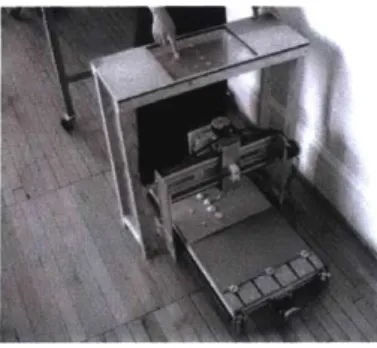
I develop Fabcorder as a prototyping device that implements the operations introduced by the Active prototyping Framework. The device consists of a work table attached to a hand-operated tool for material extrusion. A series of systems are combined to integrate the Active Prototyping operations:
- Physical control of prototyping tools is implemented through a two-state prototyping system for material extruding and gesturing.
- Action recording is implemented through a position tracking mechanism that is attached to the prototyping tool. The mechanism consists of three rotary sensors that are connected to each other through a system of taught strings. The sensors convert the angular position and motion of the tool to a digital signal. The digital signal produced from each sensor is communicated to an interface for shape calculation, display and storage. While the position tracking mechanism records movement in three dimensions, the work table can move across the vertical axis. The motor system that activates the table
communicates with the system that tracks and records tool position and movement, and therefore designer actions can be detected in three-dimensional space. By communicating the tool state described in (i) to the shape display interface, the system can record and represent not only the position of the movement in space, but also its effects to the physical object that is being prototyped. - Design Exploration is implemented through a visual
system for manipulating recordings and letting the user save, retrieve, re-use and re-design them as rules for generative design. Examples of such projections are transformations of an extruded profile which, stacked on top each other, form a three-dimensional prototype. The purpose of these manipulations and their projection is to define a range of design possibilities and outcomes after every step of the prototyping process, and to aid the designer choose among these possibilities in her next physical action.
- Machine feedback on the next steps of the prototyping process is proposed through two methods that are integrated into the action recording and the visual display systems.
1-3 Steps
This thesis is organized in the following way:
Chapter 2 will proceed with a discussion of human-machine schemes of interaction in prototyping environments and will analyze common concerns among tool-using and tool-making research attitudes.
- Section 2.1 will present the problem statement of this thesis, which lies in the observation that, among current inquiries, research on the development of embodied prototyping tools and research on hands-on prototyping activity are deployed as two remote enterprises.
* Section 2.2 will present and analyze findings from recent studies in design prototyping and will discuss how they contribute to the existing knowledge about (i) how different strategies for prototyping, and their associated tools, techniques, materials and workflows affect design decisions and (ii) to what degree these findings hint at flexible and efficient schemes of interaction between designers, design objects and prototyping frameworks. Focus will be given to the aspects of iteration, media and information gathering.
* Section 2.3 will discuss and analyze tools that have recently been developed through research in computational fabrication and in particular in the field of interactive fabrication. This section will discuss (i) what are the new types of designer actions and feedback that emerge through the development of these tools and (ii) what are the capabilities of these tools when used within
a design environment.
- Based on the analyses in the previous two sections,
section 2.4 will highlight ways in which the problem of informing design through making can be countered
though new ways of using prototyping tools. In particular,
this section will be centered on the problem of "lost information" between designers, tools and materials that occurs through prototyping processes, and will outline critical steps that need to be taken towards its solution.
Chapter 3 will introduce the thesis proposal, Active Prototyping. - Section 3.1 ("Design vs making: A motivating problem")
will approach the questions addressed in the problem statement from the perspective of a specific design task that is common in architectural and engineering studios. This section will discuss that, while physical prototyping enhances experimentation with, and evaluation of, individual design solutions, due to its nature it doesn't easily allow for exploration of multiple solutions as
frameworks for generative design do. Aiming for a prototyping scheme that is based on the interplay between physical experimentation and design exploration, I propose that combining systems for generative design with methods for analyzing designer actions and fabrication devices can bring physical prototyping tools and methods into a more exploratory context.
- Section 3.2 will introduce the fundamental principles of Active Prototyping. Focus will be given both on the analysis of capabilities that Active Prototyping introduces to methods for computational design and fabrication, and on the technical and material frameworks that can support it. Active Prototyping will be examined as the ability to develop a physical prototype without necessarily having a fixed design idea in mind, but instead, a series of ideas to test and select from - as the ability to design while making. In Subsections 3.2.1, 3.2.2, 3.2.3 and 3.2.4,
the analysis of the framework components (physical control of prototyping tools, action recording, design exploration and machine feedback) will be illustrated in relation to the design problem described in Section 3.1.
- Section 3.3 "An articulated Active Prototyping workflow" will demonstrate how the principles introduced in Section 3.2 are applied towards the solution of the motivating
problem described in Section 3.1.
- Section 3.4 ("Applicability") will outline how the Active Prototyping framework can contribute to prototyping tools and practices that are currently being applied in
education and the design industry.
Chapter 4 will introduce Fabcorder, the device that implements the Active Prototyping framework. Fabcorder integrates a variety of technical systems, each one corresponding to a number of the framework components analyzed in section 3.2. In this chapter
I will outline future technical directions to which the proposed
apparatus can be expanded.
by the Active Prototyping framework and their potential
to enhance future tool-making strategies and agendas. In particular, this chapter is going to discuss how action recording and generative methods can function as two novel additions to existing frameworks for computational design and fabrication, and to bring technologies for making into a more creative, human-centered and skill-based context.
1.4
Intended Contributions
This thesis aims to engage three kinds of audiences. For design researchers, it intends to problematize on current methods for studying, analyzing and enhancing designer actions through physical and computational prototyping processes. For researchers in human-computer interaction, it aims to provide new directions towards using human dexterity in the development of computational fabrication devices and in the design of interfaces serving creative human-machine enterprises. For makers and tinkerers, this thesis aims to demonstrate and share a technical framework for making machines that make based on physical inputs.
2.
Background:
Current trends
in prototyping
tools & methods
2.1
Problem Statement
The natural sciences are concerned with how things are. Design, on the other hand, ... is concerned with how things ought to be.
- Herbert Simon, in The Sciences of the Artificial
The problem statement of this thesis is centered on the observation that, in contemporary inquiries, research on tool-using and research on tool-making are deployed as two remote enterprises. Based on this problem, this thesis questions how information extracted from prototyping activity can inform the design and use of computational prototyping interfaces and devices, and vice versa. This chapter frames the relevance of this question by reviewing methods that currently reflect it, as well as tools that are currently being developed to address it.
The chapter is initiated with a summary of how design research and research on computer-aided design, manufacturing and prototyping have been developed as two independent streams of inquiry throughout the past decades, besides exhibiting some critical interconnections. While the focus of the thesis is the distance between research on tool-using and tool-making as it gets expressed through contemporary practices, and how it can be resolved through new agendas, it is important to examine its roots in design as well as in CAD/CAM research, which has been, in the past decades, incorporated into the emerging field of HCI. The framing of the argument continues by illustrating contemporary examples that suggest how and why research on tool-using and research on tool-making should be integrated within common design and technological agendas. A review of the findings of current methods and of the capabilities of new tools indicates a yet unresolved need to seamlessly adapt technological tools to methodological research findings. Throughout this inquiry, what prevails as a critical issue that will be discussed in the following chapters is the problem of the "lost information" between tool users, materials, and tools themselves as it is manifested through contemporary practices, and how it calls for new schemes of interaction.
2.2
Trajectories in design research:
Studying prototyping activity
In design research, focus has been given on the recording, reasoning and refinement of the different stages of the design process. The foundations of this stream were set during the 1950s by the work of mechanical engineer and later Professor of Design Research at the Royal College of Art, Bruce Archer, who aimed to establish design as an academic discipline by analyzing the design process as a dialogue between the natural world and a systematic model (Archer 1965) in which design goals and qualities are embedded. This view of design as an activity that can be investigated and directed through academic and manufacturing organizations (Bayazit 2004), as opposed to one that produces art and craft outside an institutional context, created a new generation of researchers studying the methods through which design gets conceived, prototyped and implemented within various contexts -academic and non-academic- and disciplines, for example engineering, industrial, and architectural design. Although in past decades, the main body of design research focused on schemes
for design analysis and description (Stiny 1980; Gero 1990),
more recent studies have shifted the focus on design prototyping strategies (Camburn et al. 2013), techniques (Buchenau et al.
2000), and dynamics (Dow et al. 2012). Recent studies have also
contributed in adapting existing design production systems into a material context (Knight and Stiny 2015).
Within this realm of research, described from educationalist and writer Christopher Frayling as "research through design" (Frayling 1993), the implementation of experimental methods and empirical studies within design studios has shed light on how different aspects of prototyping activity enhance creative thinking, learning, problem solving and idea refinement throughout the design process. One conspicuous change in research studying how designers prototype their ideas is the transition of the disciplinary area in which it happens. Relevant research is currently developed within the fields of engineering, industrial design and interaction design; in architecture, it is not being developed extensively, as it is used to in the past through the work of pioneers as Donald
d&.
P-1UdS 2 C' '.a-~.".
Figure 10. Bruce Archer's illustration of the design process as a dialogue between the real-world and the "operational" model.
h~mmn
N--Figure 11. John Gero's Design Prototypes.
FilrchPapers
Figure 12. Christopher Frayling's paper on Design Research, first in a series of
papers using the term.
Schdn and its dissemination in the practice of architectural design educators. Nevertheless, concepts as reflective practice and reflection-in-action, initially introduced by Sch6n, are prevalent among contemporary inquiries across all the aforementioned fields. Considering this shift, one of the goals of this thesis is to analyze critical aspects that constitute this reflection-in-action and articulate a scheme for introducing them into diverse means of practice, including architecture.
Among diverse empirical studies, three aspects prevail as
highly determinant regarding the above features: (i) iteration
style (parallel, serial or evolutionary) and number (Christie et al
2012; Moe et al. 2004; Zemke 2012; Thomke & Bell 20o; Dow
et al. 2009; Yang 2005), (ii) media used (physical/digital/mixed)
(Bordegoni et al. 2009; Gronbok 1990; Moten et al. 2014), (iii)
information gained from developed prototypes (time spent on specific tasks, parts developed, use of software/hardware/tools)
(Yang 2005; Camburn et al. 2017). Other aspects include scale,
system representation and requirement fulfillment (Camburn et al. 2017). Considering the purpose of a prototype, which is to test a concept or process or to act as a thing to be replicated or learned from, these aspects can be translated as follows: (i) iteration can be translated into how we change a design; (ii) media used can be translated into how we implement a design; (iii) information gained can be translated into how we learn from this process of using both iterations and media.
A further inquiry into how each individual aspect from the ones
discussed above contributes to the functional, aesthetic and pedagogical qualities of prototyping activities demonstrates more specific findings, explained in the following subsections. These findings contribute to the background of this thesis by providing insights on how prototyping activity contributes to the enhancement of the design process with regards to design exploration. Among these findings, what prevails as a critical issue is the role of the prototyping process itself, and how it affects not only design outcomes but also the designer's engagement, perception and knowledge of the tools, materials and procedure use.
2.1.1 Iteration
(how a design is changed)
In design, engineering and interaction design research, findings have shown that iteration allows a gradual achievement of design goals through the development of
multiple prototypes (Christie et al. 2012, Moe et al. 2004).
Besides being critical to obtaining insights into specific construction and performance problems, iteration has been proven a useful procedure for identifying errors
and simplifying object parts (Zemke 2012; Yang 2005).
Studies have also shown that this gradual improvement can continue over many cycles of iteration (Moe et al.
2004). Throughout this process, a general observation
is that the time to produce each iteration decreases significantly (Camburn 2017). Selection of fabrication methods has been also proved to have a significant impact on the number of pursued iterations (Thomke 1998; Yang
2013), and how time-efficient the prototyping process
overall is (Ward et al. 1995).
A critical finding from current studies is the distinction
between the different forms that iteration can take, and its impact on the functional, aesthetic and pedagogical efficiency of the process ofprototyping. In recent inquiries, it has been shown that exploration of multiple design solutions at the same time enhances creativity and leads to more elaborate and designs. In engineering design, this practice is described as set-based design (Ward et
al. 1995; Yang et al. 2013), as opposed to point-to-point
design. In user interface design, it has been described as parallel prototyping as opposed to serial (Dow et al.
2010). These approaches add to the exploratory function
of iteration by involving additional iterative steps within each prototyping stage. Based on this distinction, the thesis will explore how the strategies of set-based and parallel prototyping can be integrated in interfaces for interactive prototyping.
I.
I
Iterations of each concept. I
Figure 13. Prototyping strategy space by Camburn et al.
Figure 14. As studies show, techniques for physical prototyping are still preferred in some industries over ones for rapid prototyping.
2.1.2 Media used
(how a design is physically implemented)
A common question among recent inquiries is how
the media used during the prototyping process affect the final design outcome with regard to performance, aesthetics and cost. Research into relevant studies indicates a loosening of the barriers between physical and digital workflows for prototyping, as well as the acknowledgement that the right or wrong way to test a prototype is not always known, but dependent on what is the feature to be evaluated. Mixed prototyping techniques that involve both physical and digital media allow for this versatility. For example, digital simulations in conjunction with physical models have been proven to be an important tool for evaluating system dynamics (Moten et al. 2014). This conjunction has also proved useful in integrating different levels of fidelity within a
prototype (Camburn et al. 2017).
The advantages of physical prototyping over digital, and vice versa, have been widely discussed. In summary, physical modeling has been proven more efficient in parts of the design process where decision making is required, as it provides the ability to assess the look and feel of the prototyped object (Smith 2000; Ward et al. 1995). On the other hand, digital modeling allows for precision and control of complex geometries (Oxman 2012), reduced time in implementing design changes (Sefelin et al. 2003), as well as communication with software and machines for computer-aided manufacturing. Considering the loosening of the barriers between the physical and the digital, and the rise of the need for mixed ways of implementing and evaluating design ideas, one of the big questions for design research seems to be how these mediums can be seamlessly integrated in order to simultaneously give designers a sense of accuracy, exploration and engagement throughout the prototyping process.
2.1.3 Information gained
(how we learnfrom prototypes)
The previous section discussed prototyping strategies, sequential and material-wise. But how are these sequential steps, these implemented techniques, and their associated impacts on the prototyping process measured? How can we improve our practices by gathering this information? As pointed out by recent state-of -the-art research on design prototyping, a clearer understanding of quantified information gained from prototypes is needed (Camburn et al. 2017). The term "quantified" in information related to design activity can have various meanings, as quantifiable actions or choices might have qualitative impacts. I take this observation to a more inclusive level with regards to the information gained, suggesting that, towards the improvement of current prototyping processes, a more thorough understanding of information, coming both form designer actions and their translations into artifacts through the use of tools -physical and computational- is essential.
The empirical studies presented in the previous subsections exhibit meticulous methodologies for gathering information related to prototyping activity. Such information can be the number of
parts used (Yang 2005), user satisfaction (Evans et al. 2005), or time spent on a prototype (Elsen et al. 2012). However, there is
little discussion on how these findings on tool-using can inform the development of new tools, or how the related information be gathered through the tools themselves -instead of only through empirical studies. The importance of these findings calls upon new tools that will be able to collect, and adapt to, data collected throughout the prototyping process.
Figure 15. Ivan
Sutherland's Sketchpad, one of the most revolutionary instantiations of the CAD project. fttIn
/
PD1 PubWNsOng Scitipting Desktop nutackwtogI
Figure 16. The scheme of Interactive Fabrication, introduced by Willis et al.
2.2
Trajectories in human-computer
interaction: New tools for prototyping
While the previous section focused on research on tool-using, and how it suggests ways in which prototyping processes can be improved through the articulation of the proper iteration, medium and information gathering strategies, this section will focus on tool-making. Within the scope of the thesis, tool-making is approached from a both digital and physical perspective. In particular, focus will be given on how emerging, computational tools for prototyping exhibit particular capabilities and constraints, and how the goals they set can potentially address the three components discussed
in section 2.1 - iteration, medium use and information gathering.
Initiated within the field of computer science during the 1950s, research on computer-aided design and manufacturing aimed to aid designers systematize and control the design process, which would make possible the automation of the fabrication process. One of the main objectives of the CAD/CAM project was to free designers from the "toils of manufacturing and calculations" (Cardoso-Llach 2015). The way Steven Coons begins his description of the design process in his seminal 1963 paper titled "An Outline of the Requirements for a Computer-Aided Design System" epitomizes this objective: "The design process begins with a graphical description of a proposed device or system to satisfy a human need" (Coons 1963). This view of tools as facilitators of the implementation of a preconceived idea has considerably affected design practice throughout the past decades. The vast majority of the efforts described in section 2.1 use technologies that were developed under the CAD/CAM framework. As a result, design prototyping and making activities have been largely dependent on the capabilities of fabrication machines.
Recent research in human-computer interaction and engineering has made steps towards overcoming this status quo by introducing interactive frameworks for user engagement within the fabrication process. The concept of engaging the user as she is rapid prototyping an object has been introduced as interactive fabrication (Willis et al. 2011). The interactive fabrication framework is based the principles of direct manipulation (Schneiderman 1983), however
adapted to a case in which interaction between the user and the fabrication machine occurs through an embodied interface (Willis et al. 2011). Such interface can be any tool that is connected to a computer system that allow users achieve their design objectives (Baudisch and Mueller 2017). The principles of the interactive fabrication framework are (i) continuous representation of the object of interest, with the focus of the user being on the fabricated form (ii) physical actions that are interpreted by the computer as inputs, (iii) rapid, incremental, reversible operations that are initiated through user inputs and produce outputs, and (iv) layered approach to learning across a variety of materials and mediums of expression. Essentially, what interactive fabrication suggests is an integration of hands-on approaches to craft with the operations and advantages offered by tools for computational design and fabrication.
Since its introduction as a concept in 2011, interactive fabrication
has been instantiated in a variety of systems. The majority of these systems developed perform additive, subtractive or both additive and subtractive manufacturing. For example, Constructable (Mueller et al. 2012) supports precise and interactive laser cutting, enabling users to construct functional objects without the mediation of CAD software. Using the technique of wax coiling, D-Coil (Peng et al. 2015) allows novices to physically build three-dimensional models while modifying constraints in the digital model. Reform (Weichel et al. 2015) supports both material extrusion, milling and hand-shaping, while allowing users to reverse the last step in their prototyping process. On-the-Fly-Print (Peng et al. 2016) allows users to 3d print objects in low resolution while designing digital models, and also subtract material based on changes in the digital object using a cutting knife.
A critical observation about this new generation of tools is,
according to Baudisch and Mueller, turn-taking: an interaction style in which the user produces some input, then the system updates the physical object, then the user produces another input, and so on (Baudisch and Mueller 2017). Turn-taking, according to the authors, is a being used as a result of the limitations of currently used fabrication machinery, while in the future it should be replaced by continuous means of interactive fabrication. This
.---workbench
~V augmented wax cutter
6 DOF mouse augmented wax extrude
Figure 17. D-Coil, an interactive fabrication system for augmenting the technique of wax extrusion
(Peng et al 2017).
Figure 18. Shaper, one of the first prototypes for
interactive fabrication (Willis et al. 2011).
Figure 19. On-the-Fly Print, a system for 3d printing while modeling (Peng et al. 2016).
vision resonates with the purpose of making fabrication tools for users that want quick results with minimal involvement of mediating software and design tools. In this thesis, I propose that the current state of turn-taking can be improved and expanded. The reason behind this argument is that this turn-taking supports the functions of (i) translation of designer actions into data during each stage of the fabrication process, and (ii) feedback on how design goals that have been set can be achieved based on the user inputs and the system outputs. To augment the fabrication process, interactive fabrication tracks user inputs in order to automate the output. In a scenario where automation can be replaced by skill, the thesis suggests that user inputs can be tracked in order to explore potential outputs and be stored for future use. This different view on the role of inputs and outputs implies new ways of feedback, and therefore interaction between designers and machines. The next section will argue how this approach on turn-taking can support needs expressed through current inquiries in design research.
2-3
Reclaiming the lost information between
prototyping tools, materials and
designer actions
The two previous sections described different directions currently being followed in design research and human-computer interaction. Among these directions, a major distinction was observed: in design research, a trend for analyzing the efficiency of the prototyping process through use of tools; in human-computer interaction, a trend for making prototyping tools capable of guiding and automating the design process. What makes these approaches different is the attitude towards the relationship between the user and the tool: in design research, focus is given to how the users (designers) use their knowledge in order to achieve design goals through prototyping; in human-computer interaction, focus is given to the capabilities of the tool itself, and how these capabilities are perceived and harnessed by the user. What is common among these two approaches is the exchange of information between users (designers or non-designers) and tools; in the tool-using scenario, information needs to be recorded and
This thesis views this distinction as an opportunity rather than as a barrier. The findings and systems analyzed in the last two sections justify how concepts currently developed under strategies for tool-making can enhance research on tool-using. A particular opportunity in this potential collaboration is that of using devices for interactive fabrication towards recording, analyzing and evaluating designer actions throughout the prototyping process. The next two chapters will articulate frameworks and systems that address this potential and support the hypothesis that prototyping tools can be used as tools for design exploration and evaluation. Based on generative methods, these frameworks and systems will propose ways for exploring design while of making through interfaces for design transformation, projection, selection and implementation based on physical inputs.
3. Active
Prototyping:
Informing
design through
making
3.1
Design vs Making: A Motivating problem
You can find out how to do something and then do it or do something and then find out what you did.- Isamu Noguchi
"Design," "making" and "prototyping" are terms that carry different meanings and uses in various disciplines and industries. Tools, systems and final products might differ in each field, but the terms have a similar relationship with each other. Design is to plan, whereas making is to produce, and prototyping is to evaluate a design through making. The established definitions of the terms express this generality: design is "to create, execute or construct according to a plan," (Merriam-Webster, 2018) whereas making is "to bring into being by forming, shaping, or altering material." Prototyping is "to form a prototype," which is defined as "a preliminary model of something, from which other forms are developed". Prototyping is essential to design because it introduces making. It is interesting how in disciplines related to design, these terms keep their general meaning: in architecture, engineering and industrial design, "design" relates to how a design idea is being developed, "making" refers to how this same idea is implemented, and "prototyping" relates to further developing and testing, essentially "informing" this idea through making.
The paradigms in Chapter 2 instantiated two prototyping approaches for informing design through making: one centered on the use of tools, and one centered on tool development. What prevailed as a critical step towards enhancing the implications of these studies in contemporary design practices is the focus on designer actions; in particular, the collection of information about (a) what makes these actions effective -based on their outcomes-and (b) how efficiency of actions can be augmented through new tools. Research in the first approach is based on the observation of the process and its outcomes as complete artifacts, whereas in the second approach, systems were based on an incremental exchange between actions translated into inputs and outputs. The question that I make through analysis of both approaches, and I addressed through the hypothesis of the thesis, is how informing design
This hypothesis can be instantiated in various design examples, and is independent of tools, techniques and materials used. The example analyzed below brings this hypothesis into a more practical context. Let us imagine the task of designing and prototyping a three-dimensional, free-standing object that needs to have a certain height (h), width (w) and length (y) to allow it to carry the weight that it supports. If the object is a pedestal, it should be able to carry the weight of the objects that are supposed to be placed on top of it; if it is a column, it should be able to afford the weight of the elements (e.g. roof, floor) that it supports. Let us start with an empty bounding box, and speculate on what form parameters a designer might consider when designing this object (Figure 21): what are the boundaries of the object thickness? What are the possible profiles that can be used in the cross-section of the object -how will it look like if this cross-section were a square, or freeform profile; what if this profile varied instead of being uniform across the z-axis; if so, what would the logic be behind the transformations creating this variance?
Figure 20. Fabclay, a project exploring clay printing in architectural scale with columns as a design problem ('FABBOTS 3.o' Research & Development Studio, IAAC, 2012). Max/min dimensions h,
w,
y It 10 o Profile shape oP Logic of transformation TFigure 21. The column problem, which will be used
as a motivating example for the Active Prototyping framework.
I
These few form aspects are enough to generate a myriad of possible design solutions, even with short sets of sample widths, lengths, profiles and logics of transformation. One could just sketch her own solution and then design it without exploring even a part of this range of possibilities. But let us think of a case in which exploration of possible solutions is needed -which is typically the case in design education and practice.
In this case, a series of schemes and tools for generative design can be used to visually populate multiple possible solutions. Approaches to this design problem can vary depending on the system that is used to generate this range. The three following examples demonstrate how visual design exploration can be implemented through a variety of computational procedures. Later on, this analysis is going to transferred into a context of making. In particular, I will demonstrate how the type of exploration that visual ways of representation offer outperform, and respectively, fall behind, physical exploration that prototyping can offer. But first, let us focus on the design problem discussed above.
A computational way of enumerating the range in question is using
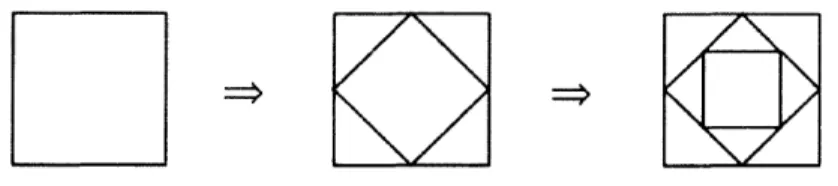
the formalism of Shape Grammars, an example of which is shown in Figure 22. The parameters of the column problem (h, 1, w and
p) can be embedded into a grammar that contains a simple set
of shapes (ps), rules (applied across h), and transformations that affect both shapes and measurements (h, w, 1) (Figure 23).
Figure 22. A computation
for producing the design on the right, starting with the bectangle on the left as the base shape and using the transformation shown in the middle shape as the rule.
In this scenario, profiles (ps) can be distributed across the height (h) axis using rules. Within these rules, they can be manipulated through transformation operations, for example scale, rotation, etc. Figure 24 demonstrates how, four simple rules (addition, subtraction, division and scale) can embed the parameters of the design problem and produce a set of solutions within a
designer-defined range. Assuming that we want to distribute profiles across the axis of the given height, the height of the object's parameter-defined bounding box needs to be divided (division rule), then abstracted into planes (subtraction) to be modified (here by scaling, but different transformations might apply) and finally be merged together (Figure 25). Given a simple set of n possible values for each one of the object parameters 4" column designs can
be generated.
Figure 23. Example transformations used by the shape grammars scheme.
rotatkm
L
I
,
fltiA
iWLwa
.. 60
Division0
Replacement0
Scale b0 Sutaton Figure 24.Transformations used in the distribution of the profiles p accross the z-axis of the column bounding box.
2.6iZ~ ~
Figure 25. A computation based on the rules presented in Figure 24, producing a single column design. By modifying variables such as the profile shape, its dimensions and their logic of transformation, more designs can be produced.
Figure 26
Divsio Relaemn Scal Sbr ctio Lof
66) 6c c6
6c) c6) 6c
Division Replacement Scale Subtraction Loft
The shape grammar scheme is used as a formal, computational way of approaching the problem. In a computer-aided design system, the logic for exploring possible solutions would be similar, though the implementation procedure and mediums would be different: rules would be replaced by commands such as "move," "rotate," "scale," "mirror" etc. (Figure 26). Using the given h, w, 1, and p values/types as inputs, the same number of cross-referenced designs can be produced. A similar procedure would apply using a
computer script (Figure 27).
These generative approaches differ in terminology, medium, intuitiveness, and most probably enumeration time. However, when it comes to implementation through prototyping and making, they exhibit the same problem: when the exploration, or search, is complete, all a designer has is a number of designs, each of which corresponds to a separate iteration. Thus, in order for all of the designs to be evaluated, they need to be fabricated separately -all of them or a number of them. Let us not count the time that this process might take, but rather focus on what might render work that has been done in the design stage invalid. In this case, not only will we have spent time to design and fabricate all -or a number of- these artifacts, but we will also have to go back and re-think, re-design, re-fabricate them. This parameter is change: change in a design decision or change in tools and materials that are going to be used to prototype this object. For example, based on the column problem described above, let us imagine that we ,L
have gone through the workflow of prototyping an object only to realize that the profiles are too sharp in real life (change in design decision), or that that the tools that are in the designer's availability cannot achieve a particular detail developed during the design stage (change in the use of tools). How can this change, its inherent role in the design process, and the further aspects to which it is associated to, can be embedded in such a generative
scheme? In other words, how can design exploration be informed through making, while making?
The precedents analyzed in Chapter 2 take a step towards answering this question. However, some important aspects of it still remain unanswered: these parts, as Chapter 2 concludes, are (a) gathering information from designer actions as they are being developed, a remaining question mostly addressed through experiments in design research- and (b) investigation of means of feedback that designer actions exhibit, and the design possibilities that they allow for. If schemes for generative design provide methods for enumerating and visually exploring a variety of solutions before making, and tools for prototyping provide a direct way of physically evaluating design outcomes after a design has been defined, how can design be evaluated while making?
f 0%Y1==9).
FACE 1
,,,&ticcs~woi for fir pair of faces .,tfI P2 (XI, y1.;
~t]P2 (.W, Y21; o(J[ P3 =(x2, y2001116t2); feoat[] P4 = (X1, y1+offset1}; fill(ZSS,0,S); drsF c-2(P, P2, P3, P4, i); FACE 2 fillC(,S,255); drawFOC02(P2, P1, P4, P3, 1+30); '' -FACE 3 fil1(9,255,0);
1 update vertices for next pair of faces
P1[0] = x2; P1(1] = y2+0ffset2; P3(6] c x1+ffseti; P3(1] z Yl~offs~tl; P4[0] * X24"f"set2; P4[1] .y2.offset2; dra"Faco2(P2, P1, P4' P, 1);
Figure 27. Computer script generating the column design.
3.2 Solution: Active Prototyping
I propose Active Prototyping as a framework that introduces a new range of capabilities in tools for computational design and fabrication. The idea motivating the Active Prototyping framework is that, by collecting information related to the use of tools during the development of a physical prototype, designers can archive the design knowledge that these actions are embedding, and by further processing this information through schemes for generative design, they can explore, control and improve design outcomes. Essentially, Active Prototyping is the ability to develop a physical prototype without necessarily having a fixed design idea in mind, but instead, a series of ideas to test and select from. In this framework, action recording is the fundamental process around which a series of operations are deployed: it implies the use of systems that embed both prototyping tools and action recording mechanisms. Additionally, it requires systems for storing and processing these recordings, as well as for bringing the results of this processing back into the making process (Figure 28).
Figure 28. The four components of the Active Prototyping
framework and their interaction.