How Mobility Increases Mobile Cloud Computing Processing Capacity
Anh-Dung Nguyen ∗† , Patrick S´enac ∗† and Victor Ramiro ‡ [email protected], [email protected], [email protected]
∗ ISAE/University of Toulouse, Toulouse, France
† LAAS/CNRS, Toulouse, France
‡ NIC Chile Research Labs, Santiago, Chile
Abstract—In this paper, we address a important and still unanswered question in mobile cloud computing “how mobility impacts the distributed processing power of network and com- puting clouds formed from mobile ad-hoc networks ?”. Indeed, mobile ad-hoc networks potentially offer an aggregate cloud of resources delivering collectively processing, storage and network- ing resources. We demonstrate that the mobility can increase significantly the performances of distributed computation in such networks. In particular, we show that this improvement can be achieved more efficiently with mobility patterns that entail a dynamic small-world network structure on the mobile cloud.
Moreover, we show that the small-world structure can improve significantly the resilience of mobile cloud computing services.
Index Terms—Mobile cloud computing, mobility, quality of service
I. I NTRODUCTION
“Cloud computing” has recently appeared as a buzz word in many medias in which the term refers both to the technology advancement and also to the business model behind. The idea is not new but roots from already developed technologies such as distributed computing, autonomic computing, hard- ware virtualization and web services. It’s the maturation and convergence of all these technologies that makes cloud com- puting viable today. By virtualizing the aggregated computing resources in order to offer to users the on-demand utility (e.g. computing, storage, software as service) in a pay-as- you-go fashion, much like the power distribution grid system, cloud computing appears as a main actor of information industry today. This can be seen through the explosion of cloud computing services deployed the Internet in recent years.
Besides, with the advances of electronic technologies, mo- bile wireless devices have gradually become more and more powerful in terms of processing, storage and communication capacity. This potentially leads to the emergence of mo- bile ad-hoc networks that deliver, without any infrastructure, computing resource complementary to the existing infrastruc- tured networks. These “mobile clouds”, which leverage on opportunistic contacts between users, can potentially deliver free communication, storage and processing services shared between users according to peer to peer resource sharing policies.
Although the application perspective sounds interesting, the underlying technology challenges are not negligible due to the difficulties raised by dynamic networks. The first obstacle
comes from the mobile nature of such network and raises the question of “how the mobility impacts the distributed processing performances of the mobile clouds?”. Indeed, the unstable network topology makes that continuous end-to-end communication unguaranteed and hence the service delivery may be disrupted. Indeed, in the context of spontaneous and infrastructureless networks, a kind of delay tolerant network, nodes must rely on intermittent contacts leading to use the store-carry-and-forward communication paradigm for inter- node communication. Therefore, if the role of mobility on communication performances such as end to end delay and bandwidth has been already studied, the impact mobility schemes on the global processing power delivered by a mobile network cloud has not been studied yet.
In this paper, we address this issue and show that the mobility can enhance significantly the computing capacity of network clouds composed of mobile nodes. Considering a dynamic network as an aggregate distributed computing resource, we use Particle Swarm Optimization (PSO) - an optimization method based on distributed autonomous agents- coupled with a generic mobility model to assess the impact of node mobility on distributed processing. The questions on service resilience against network churn are also discussed.
The rest of the paper is structured as follows. First, Section II discusses the state of the art of mobile cloud computing. In Section III, we study the impact of mobility on the quality of mobile cloud computing services. Section III studies of the impact of dynamic network structures on mobile cloud computing. In Section V, the question of service resilience is discussed. Finally, Section VI concludes the paper.
II. S TATE OF T HE A RT
Mobile cloud computing is still a young field and there
is still discussion on its definition. In its infancy, mobile
cloud computing has been considered as a derived branch of
cloud computing with two schools of thought (see [7] for a
survey). The first refers to performing computing activities
(data storage and processing) in infrastructured cloud and let
mobile devices be simple terminals to access to service. This
centralized approach has the advantage that mobile devices
don’t need to have a powerful computing capacity but the
drawback is that users depend strongly on the infrastructure
network and on its performances.
The second school of thought defines mobile cloud com- puting as performing computing activities on mobile platform.
Therefore a mobile cloud network is an infrastructureless ex- tension of the traditional infrastructure based cloud networks.
Mobile devices are clients of service but are also part of the cloud, providing hardware and software resources. The benefit of this distributed approach is the omnipresence and the speed of service accessibility, the support of mobility and locality, the freedom of deployment and use of new services as well as the reduced hardware maintenance costs. Although the approach is promising, its main challenge resides in the dynamic of network which poses difficulties in communication and hence service access. In this paper, we focus on this definition of mobile cloud computing.
To the best of our knowledge, very few contributions have been proposed for mobile cloud computing. Hyrax [2] is a mobile-cloud infrastructure that enables smart-phone applica- tions that are distributed both in terms of data and computation.
Hyrax allows applications to conveniently use data and execute computing jobs on smart-phone networks and heterogeneous networks of phones and servers. Its implementation is based on Hadoop and tested on Android platform. But since An- droid doesn’t support ad-hoc network yet, the phones have to communicate through a WIFI central router.
Satyanarayanan et al. [4] present the cloudlet concept.
In this approach a mobile client is seen as a thin client with respect to a service which is customized over a virtual machine in the wireless LAN. Hence the cloudlet is a proxy representation of a real service enhanced for the mobile device.
The main motivation is how bandwidth limits and latency over wireless networks impacts over users services.
III. I MPACT OF M OBILITY ON M OBILE C LOUD
C OMPUTING
In this section, we evaluate the impact of mobility on mobile cloud computing. Let us consider that a mobile cloud network created by several human portable devices offers a distributed processing service such as optimizing a function via a Particle Swarm Optimization (PSO) algorithm. According to PSO, each node in the network has a local solution to the optimiza- tion problem. Through intermittent contacts, mobile nodes learn others’ solution to improve their local optimum and hence accelerate the convergence towards the global optimum.
For the sake of simplicity, we make the following assumptions:
1) Each node in the network knows in advance the goal function and its solution.
2) An external system (e.g. WIFI hot-spots) is responsible for results retrieval from mobile nodes.
3) The service is considered delivered when the global optimum reaches a goodness predefined by user.
In practice, the goal function as well as its solution is usually unknown in advance and therefore we have to rely on a diffusion technique to disseminate the information of the goal function into the network. The obtained global optimum and stopping condition in that case will depend on the current solutions found by nodes (e.g. a node stops the computation
1 2
4 3
p11 p12 p22
p23
p44 p34 p33 p43
p14 p41
p21
p13
p31 p42
p24
Fig. 1. STEPS markovian mobility model
when its local solution no longer changes for a while). In this theoretical work, we focus only on the impact of mobility on computing delay and therefore the previous assumptions seem reasonable.
A. Mobility model
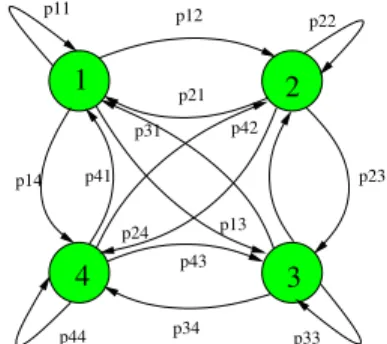
In order to reproduce at the simulation level realistic human mobility patterns, we use the STEPS mobility model [3]. As we have shown in a previous work, this flexible parametric model can express a large spectrum of mobility patterns: from highly nomadic ones to localized ones. Therefore, STPES makes it possible to evaluate the impact of different mo- bility contexts on mobile cloud computing. In STEPS, the network area is modeled as a torus divided in several zones.
The model implements the notion of preferential attachment usually observed in human mobility in which each node is attached to one or several preferential zones. Inside zones, mobile nodes move according to the Random Waypoint model.
The movement of nodes between zones follows a Markov chain of which the transition probability is given by a power law distribution. This distribution is driven by a parameter of the STEPS model which allows the nodes nomadism to be enforced or reduced (i.e. the probability that a mode moving outside his preferential zone has to return to that zone).
Figure 1 illustrates the underlying Markov chain of STEPS with 4 zones.
B. Particle Swarm Optimization
The Particle Swarm Optimization (PSO) algorithm [1] is an
optimization method based on swarm intelligence - a sub-field
of artificial intelligence which studies the collective intelligent
behavior emerging from the interactions between individu-
als of a swarm of autonomous agents. Swarm intelligence
considers intelligence as the combination of the knowledge
acquired by individuals through experiences in the past and
the knowledge acquired from the others through social in-
teractions. In PSO algorithm, a set of candidate solutions
called particles move around in the search space according
to a simple mathematical formula over the particle’s position
and velocity. Each particle’s movement is influenced by its
local best known position and also by the global best known
position found by other particles. The swarm is expected to
00 00 11 11 000 000 000 111 111 111
Fig. 2. Typical static neighborhood topologies vs dynamic neighborhood topology generated by STEPS
move collectively towards the optimal solution. Besides, this method is able to solve a multimodal optimization problem.
In its simplest form, let ~ x i be the multidimensional vector of the particle i position, the position of the particle is updated according to the formula
~ x i (t + 1) = ~ x i (t) + ~ v i (t) (1) where ~ x i (t) is the position of particle i at time t.
The velocity of the particle is updated according to the formula
~ v i (t) = ~ v i (t − 1) + φ 1 [~ p i − ~ x i (t − 1)] + φ 2 [~ p g − ~ x i (t − 1)]
(2) where
• φ 1 , φ 2 are uniform random variables taking values in [0, 1]. These variable represent the relativity between the effect of individual experience and of social influence.
• p ~ l denotes the best known position of particle i (“l” for local).
• p ~ g denotes the best known position of i’s neighbors (“g”
for global)
This formula entails wider and wider oscillations of particles in the search space. One solution to this issue is based on velocity damping, that is, if v id > V max then v id = V max else if v id < −V max then v id = −V max where v id is the dimension d of ~ v i . In consequence, the particles move only in a restricted search space.
In PSO, individual can be connected to one another ac- cording to a great number of neighborhood topologies (Figure 2 illustrates the most used schemes). Each neighborhood topology, traditionally considered as static conversely to our analysis, results in different behaviors and performances for the PSO algorithm.
In this work, since node moves, the neighborhood topology is no longer static but dynamic. Indeed, when the mobility degree is low, links between nodes is stable and the network is nearly static. On the contrary, when the mobility is high, links change rapidly over time and so does the neighborhood topology. Therefore the goal of this experiment is to evaluate the effect of mobility on the convergence delay of the algo- rithm.
C. Simulation Results
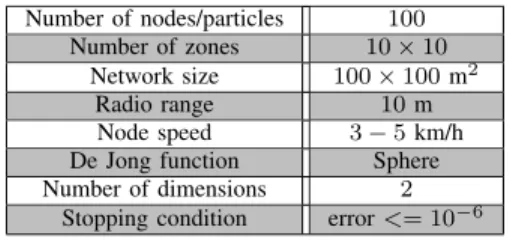
We implemented the mobility model and the PSO algorithm on MATLAB. At the beginning of each simulation, 100 nodes are uniformly distributed over the network area which is
Number of nodes/particles 100 Number of zones 10 × 10
Network size 100 × 100 m 2
Radio range 10 m
Node speed 3 − 5 km/h De Jong function Sphere Number of dimensions 2
Stopping condition error <= 10 −6 TABLE I
S IMULATION SETTINGS
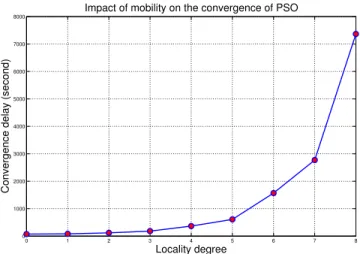
divided in 10 × 10 zones representing preferential attachment according to STEPS model. The movement of node between zones is driven by the locality degree parameter (α) of STEPS model. We vary α between 0 and 8 to obtain a large spectrum of mobility patterns. When α = 0 nodes are highly nomadic, moving from a zone to one another in a random manner that makes the network highly dynamic. On the contrary, when α = 8, nodes are highly localized (i.e.sedentary) and therefore there are less information exchange between distant zones.
The PSO algorithm is implemented in every mobile nodes so that each node contains 1 particle. The position of particle is randomly initialized, taking values in range [x max , −x max ].
Particle’s position is updated at each contact with another node according to the formula 2.
As goal function, we used the Sphere function from the De-Jong test suite. This suite consists of goal functions with different difficulties to measure the performances of optimiz- ers. The Sphere function is the first and easiest function of the suite. It is symmetric, unimodal and is often used to measure the general efficiency of optimizers. That is
f (~ x) =
D
X
i=1
x i 2
where D is the number of elements of ~ x. The Sphere function has a global optimum f (~ x) = 0 at ~ x = (0, 0, 0, . . . , 0).
We used root-mean-square error to measure the goodness of the solution. The algorithm stops when the error is smaller than a predefined threshold. The simulation settings are summarized in Table I
Figure 3 shows the optimization convergence delay accord- ing to nods’ locality degree. These results is are averaged over 10 simulation runs. On the figure, we can see that the more mobile nodes are, the smaller convergence delay is. This result shows that nodes mobility can increase dramatically the processing capacity of mobile cloud networks.
IV. I MPACT OF N ETWORK S TRUCTURE ON M OBILE
C LOUD C OMPUTING
In this section, we evaluate the processing capacity of
mobile cloud computing under various dynamic network
structures. With the same approach as introduced in Section
III, we measure the convergence delay of a PSO algorithm
implemented on a mobile cloud network and show that this
delay can be significantly minimized if the network has a
dynamic small-world structure.
0 1 2 3 4 5 6 7 8 0
1000 2000 3000 4000 5000 6000 7000 8000
Locality degree
Convergence delay (second)
Impact of mobility on the convergence of PSO
Fig. 3. Impact of mobility on the convergence delay of PSO algorithm
The small-world phenomenon introduced by Watts and Stro- gatz [6] refers to static graphs with high clustering coefficient and low shortest path length. Through a process which consist in rewiring randomly edges of a graph, by varying the rewiring ratio, the authors showed that for an interval a rewiring ration the resulting static graph, exhibit a small world structure which cumulate short path observed in random graphs with high clustering coefficient intrinsic to regular lattices. In a previous work [3], we have shown that this small world behavior can be observed in dynamic graphs too. We have shown that in a dynamic networks, the analog of the rewiring process in static graph is done from varying the ratio and intensity of nomadic nodes. Moreover, we have shown that the STEPS model is capable of exhibiting this small-world phenomenon in dynamic networks.
Indeed, starting from the same network configuration as in Section III, we divide mobile nodes in 2 categories. The first consists in highly localized nodes which stay almost all their time in their preferential zones. The second category consists in highly nomadic modes which move constantly from zone to zone. At the beginning of simulation, the nodes are distributed over the network area so that nodes in different preferential zones cannot communicate each other (Figure 4 shows the node spatial distribution). We vary the fraction of mobile node p m from 0 to 1. When p m equals to 0, the network consists in disconnected islands with only intra-zone communications that entails a regular structure similar to the one in static graphs. On the contrary, when p m equals to 1, the inter-zones movement of highly mobile nodes makes that the network topology changes constantly which entails a random network structure. Figure 5 shows the evolution of the clustering coefficient and shortest path length according to the fraction of highly mobile nodes.
We processed the PSO algorithm over all these network structures and then measured the resulting convergence delay.
Figure 6 shows the results averaged over 10 simulations. These simulation results show that the convergence delay of PSO decreases rapidly down to an asymptotic part started when the
0 10 20 30 40 50 60 70 80 90 100
0 10 20 30 40 50 60 70 80 90 100
Fig. 4. Node spatial distribution
10
−210
−110
00 0.1 0.2 0.3 0.4 0.5 0.6 0.7 0.8 0.9 1
Fraction of mobile nodes (%)
Normalized values
Small−world phenomenon in dynamic networks
Clustering coefficient Shortest path length
Fig. 5. Small-world phenomenon in dynamic network
10
−210
−110
00 200 400 600 800 1000 1200 1400 1600 1800 2000
Fraction of mobile nodes (%)
Convergence delay (second)
PSO in dynamic small−world networks
Fig. 6. Mobile cloud computing in small-world networks
network exhibits a small world structure. This original result is significant because the small-world structure, which as shown in this paper improves distributed processing, was shown to emerge naturally in the great majority real dynamic networks [5].
V. R ESILIENCE OF M OBILE C LOUD C OMPUTING S ERVICE
Nowadays, mobile devices still have limited energy capacity and communication as well processing are two important sources of energy waste. Therefore nodes’ churn is intrinsic to dynamic netwoks clouds. Nodes running out of battery cannot contribute to distributed processing anymore and in consequence, mobile cloud networks may suffer impredictible nodes failures. Besides, mobile cloud networks may be the target of attacks, for instance DDOS, which can potentialy make unavailable parts of the network. In this section, we evaluate, under various mobility contexts, the resilience of distributed services deployed on such networks.
First, we assume that the evolution of number of inactive nodes (i.e. attacked or out of battery) follows a Poisson process. Therefore, the number of inactive nodes during a time interval τ is distributed according to a Poisson distribution
P [(N(t + τ) − N (t)) = k] = exp −λτ (λτ ) k k!
where k = 0, 1, 2, . . . and λ is the arrival rate of inactive nodes.
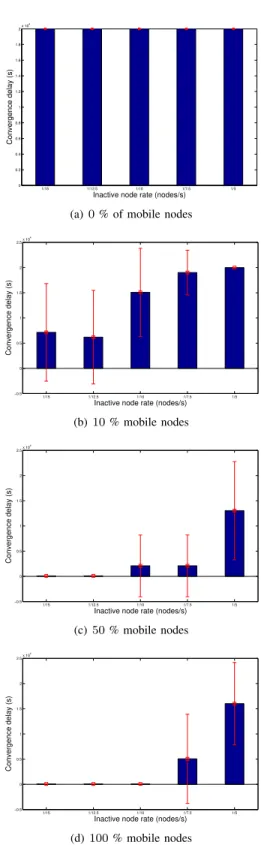
With the same simulation settings as introduced in Sec- tion IV, we perform simulations with various values of λ (1/15, 1/12.5, 1/10, 1/5) and under various mobility contexts (i.e. by varying the fraction of mobile nodes). In these simula- tions, we stop the PSO algorithm when 95 % nodes reach the optimum. If this threshold is not reached before all the nodes become inactive, as there is no recovery possible in this case, the service will never be delivered and hence we assign the simulation duration time to the convergence delay.
Figure 7 shows the results averaged over 20 simulations.
These simulations show that with dynamic small-world net- works (Figure 7(b) and 7(c)), the distributed service resists much better to departed nodes compared highly localized network (Figure 7(a)) and offers approximately the same resilience level than random networks (Figure 7(d)). These results suggest that a small-world structure not only contribute to enhancing distributed performances but also offers good resilience properties.
VI. C ONCLUSION
In this paper we not only show that nodes’ mobility enhance the processing capacity of dynamic network cloud but we also showed how mobility impacts the performance and the resilience of these mobile clouds. In particular, we have shown that significant performance improvement can be obtained when dynamic networks exhibit a small-world structure and moreover, this particular structure can improve the resilience of the network against inactive nodes. This means that by introducing even a small percentage of highly mobile nodes
1/15 1/12.5 1/10 1/7.5 1/5
0 0.2 0.4 0.6 0.8 1 1.2 1.4 1.6 1.8 2x 10⁴
Inactive node rate (nodes/s)
Convergence delay (s)
(a) 0 % of mobile nodes
1/15 1/12.5 1/10 1/7.5 1/5
−0.5 0 0.5 1 1.5 2 2.5x 10⁴
Inactive node rate (nodes/s)
Convergence delay (s)
(b) 10 % mobile nodes
1/15 1/12.5 1/10 1/7.5 1/5
−0.5 0 0.5 1 1.5 2 2.5x 10⁴
Inactive node rate (nodes/s)
Convergence delay (s)
(c) 50 % mobile nodes
1/15 1/12.5 1/10 1/7.5 1/5
−0.5 0 0.5 1 1.5 2 2.5x 10⁴