S E Biotechnol. Agron. Soc. Environ. 2002 6 (4), 231–235
1. INTRODUCTION
Microirrigation is used in the arid and semi-arid countries. In this study a network is composed of laterals with identical emitters that have a small discharge to low pressure. The network must satisfy a good uniformity of water distribution by emitters to the irrigated plants. Thus, the hydraulic phenomenon study of the lateral is primordial for the adequate and economic network design. For the lateral, other than changes in elevation, variations of the pressure are due to the energy loss of friction along the lateral that provokes disorder to the uniformity of the water distribution. The successful design is a compromise between the choice of high uniformity or small cost of the installation. It is important to calculate the pressure distribution and emitter discharge correctly along the lateral. Using equations of energy and mass conservation, the closing between two sections of an elementary control volume, ends up in a two partial differential equations system, non linear, associating pressure and velocity. These equations describe the flow in the lateral, their solution is tedious because of interdependence of the discharge and the pressure in a
non linear relation. The solution of these equations cannot be completely analytic due to the empiric relation of discharge emitters and the energy loss relations. The numeric control volume method (CVM) is often used to determine pressure and discharge in microirrigation lateral. It is applied to an elementary control volume on the lateral and permits an iterative development, volume after volume, from a lateral extremity to the other. Howell and Hiler (1974), Helmi
et al. (1993) applied this technique to an example of
microirrigation lateral, starting iterative procedure of calculation from the lateral entrance. Thus knowing the output discharge to the lateral entrance, represented by the sum of average emitters discharge, the technical “Trial and error” is successively used till the lateral end, in order to lead to the convergence. However, the risk of obtaining a negative velocity still exists.This approach seems to provide some precise results but could become slow for numerous reasons of the possible iteratives, without excluding the divergence risk. Warrick, Yitayew (1988), Kosturkov (1987) defined non linear system of partial differential equations, of the second order. The first ones used the numeric method of RK4, the others substituted the
Numerical methods of microirrigation lateral design
Lakhdar Zella
( 1 ), Ahmed Kettab
( 2 )(1)Blida University. ANDRU, CRSTRAB.P. 30A, Ouled Yaich. Blida (Algérie). E-mail : [email protected] (2) École nationale polytechnique Hacen Badi. El Harrach. Alger (Algérie).
Received 12 June 2002, accepted 15 October 2002.
The present work contributes to the hydraulic analysis of the lateral microirrigation by using the numerical methods: the control volumes method “CVM” and the Runge-Kutta method “RK4”. These methods are relatively simple to manipulate and agree to the use of the partial differential equations of the first order. The CVM method warrants to follow the hydraulic phenomenon step by step and facilitates iterative development; whereas, the RK4 method is used in the integration and the solution of the d i fferential equations system. The risk of divergence, as the slowness of the computation is avoided by the recourse to the interpolation using the polynomial of Lagrange in order to accelerate the convergence toward the solution. The models of calculation used have the advantage to be simple, fast, precise, and allow their extension to large microirrigation network. Keywords. Trickle irrigation, model, design, uniformity, CVM, Runge-Kutta.
Méthodes numériques de dimensionnement de rampe de microirrigation. Le présent travail contribue à l'analyse hydraulique d'une rampe de microirrigation en utilisant les méthodes numériques, en l’occurrence la méthode des volumes de contrôle (CVM) et la méthode Runge-Kutta (RK4). Ces méthodes sont relativement simples et permettent la résolution des équations différentielles partielles du premier ordre qui en découlent. La méthode CVM permet de réaliser un bilan massique et énergétique pas à pas et facilite le développement itératif alors que la méthode RK4 est utilisée pour l'intégration du système d’équations différentielles. Le risque de divergence est écarté grâce au recours à l'interpolation utilisant le polynôme de Lagrange. Les modèles ont l'avantage d'être simples, rapides et précis et se prêtent à l'utilisation de cas de réseau. Mots-clés. Irrigation goutte à goutte, modèle, dimensionnement, uniformité, CVM, Runge-Kutta.
pressure by a velocity expression. These equations are linear, the choice of the limit conditions permits to use the least square method and the Rosenbrock's algorithm. This method seems to give precise results. Nevertheless, it requires at the begining of the calculation, the prior knowledge of an initial vector-solution and the vector-solution of linear algebric system. Valiantzas (1998) tempted an analytic approach based on the hypothesis of spatial distribution of the discharge along the lateral. The extension to the network presents some difficulties. Bralts, Segerlind (1985), Mohtar et al. (1991), Bralts et al. (1993), Kang, Nishiyama, (1996) defined the partial differential equations, non linear, of the second order based on the pressure. These equations are solved after linearisation by the numeric method of finite elements, using not negligible extensive calculation programs but the results obtained are exact. The present work consists to use the numeric method of Runge-Kutta of order four and the CVM. The RK4 allows the integration of the differential equations system of the first order by describing variations of pressure and velocity from the initial conditions to the lateral extremity (x = 0). Given the fact that the pressure in this point is unknown, it is therefore necessary to use an iterative process in order to converge toward the solution to the other extremity of the lateral (x = L), where the value of the pressure is known (input). The iterative process is assured thanks to the interpolation by Lagrange’s polynomial .
2. THEORETICAL DEVELOPMENT
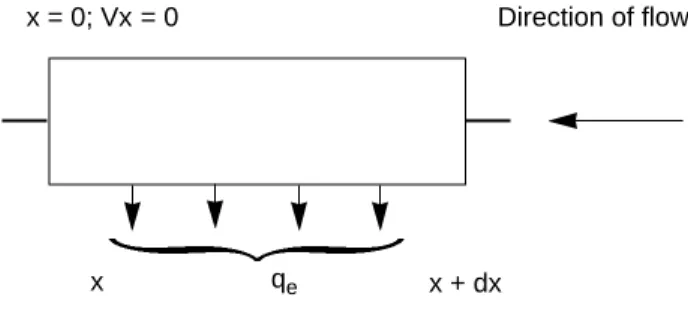
The mathematical model to be derived is a system of two coupled differential equations of the first order, the unknown parameters are pressure and velocity. It describes the flow of water along a horizontal microirrigation lateral. The principle of mass conservation is first applied to an elemental control volume of length dx of the pipe (Figure 1).
AVx= AVx+dx+ qe (1)
where
A = cross-sectional area of lateral; V = velocity of
flow in the control volume between x and x + dx and
qeis the emitter water discharge which is assumed to be uniformly distributed through the length dx, which expression is given by the following empirical relation.
qe=αH y
(2) where
α= emitter constant; y = emitter exponent for flow regims and emitter type; H = pressure at the emitter.
For the sake of simplification purposes, is taken as the hydraulic head (elevation charge head = 0). The principle of energy conservation is also applied to the same elemental control volume to give the Bernouilli’s following:
(3)
where hf is the head loss due to friction between x and
x+dx. Its expression is given by the well known
formula:
hf = aVmdx . (4)
Regime flow is determined by Reynold’s number
(5) where D is lateral diameter, and µ is kinematic viscosity.
When Re >2300, m = 1.852 and the value of a is given by the following equation when the Hazen-Williams formulation is used as
(6)
where C = H a z e n - Williams coefficient; K = c o e f-ficient; m = exponent describing flow regime.
When Re < 2300; m = 1 and the value of a is
(7) where g is the gravitational acceleration. After expan-sion of the terms Hx + d xand Vx + d x, equation (3) is written
2
32
gD
a
=
µ
5835 . 0 A C K a = mµ
VD
Re
=
Hx+ 1 2gVx 2=H x+dx+ 1 2gVx+dx 2 +hf x = 0; Vx = 0 Direction of flow x qe x + dxFigure 1. Elemental control volume — Volume de contrôle élémentaire.
(8)
If the term is supposed to be negligeable, equation (8) becomes
. (9)
By using the expansion of Vx+dxin equation (1), we get
(10)
Finally, by combining equations (2), (4), (7) and (8) the final system of equations is found as
(11)
and . (12)
In order to solve the solution of (11) and (12), the velocity at the end of the lateral (V(x=L)=0) and the pressure head (H(x=0)=Hmax) are given. We propose to integrate this system using the method of Runge-Kutta of order 4 by constructing an iteration process. Let us assume that H(L)=Hminis known. A new space variable X is definied such as X=L-x. The system of equations (11) and (12) becomes
(13)
and . (14)
The initial conditions to this problem are V(X=0)=0 and
H(X=0)=Hmin.
2.1. Iteration process
To integrate simultaneousely equations (13) and (14), we have only to provide two estimates of the pressure head at the downstream end of the lateral (X=0); call them H°minand H1min. Now, two solutions of the initial value problem (13) and (14) are carried out, yielding H°max and H1max. A new estimate of Hmin can then be
obtained by making use of the interpolating Lagrange polynomial of degree one. This new estimate Hmin is written as follows (Mathews, 1998) in order to get the next solution H2
max.
. (15) This process is continued until convergence which means
(16) or
. (16)
A program of calculation in Fortran has been applied for the two numeric methods and executed on a microcomputer until convergence ErH and Erv to
ε=10-5.
2.2. Uniformity equations
The uniformity of water distribution is a main finality of network design, the discharge and pressure uniformity are given by the statistical followings (19) and (20).
(17) where NG is the total emitter number in the lateral.
(18)
Cuq= 100 (1-Cvq) (19) CuH= 100 (1-CvH) (20) Cvq: coefficient of variation of emitter flow;
CvH: coefficient of variation of pressure; Cuq: coefficient of uniformity of emitter flow; CuH: coefficient of uniformity of pressure.
3. APPLICATIONS
A lateral line at zero slope, in black polyethylene matter was chosen in this application. The total length is 250 m and internal diameter is 15.2 mm. Along this lateral, 50 similar emitters were placed with equal
NG H Hmoy=
∑
i NG q qmoy =∑
i ε p new old new V V V ErV = − ε p new old new H H H ErH = − 0 min 1 max max max 0 min 1 max 0 max 1 max max min H H H H H H H H H H H o − − + − − = ∂H ∂X =aV m− α Ag∆xVH y ∂V ∂X= α A∆xH y y mH
x
A
g
V
aV
x
H
∆
+
−
=
∂
∂
α
y H Adx x V =− α ∂ ∂ A ∂V ∂xdx+qe=0 ∂H ∂xdx+ V g ∂V ∂xdx+hf=0 ( ∂V ∂xdx) 2 Hx+1 2gVx 2=H x+ ∂Hx ∂x dx+ 1 2g( Vx 2+2V x ∂Vx ∂x dx+( ∂Vx ∂x dx) 2)+hf xinterval. The characteristics of emitter used in empirical relation (2) are as follow α=9.14 10-7, exponent y = 0.5, C = 150, m = 1.852, K = 5.88 and
g = 9.81m/s2. Kinematic viscosity of water is µ= 10-6 m2/s. These data are introduced in calculation program, Hmaxis given to 30m, after we insert any Hmin to obtain velocity, flow and pressure distribution along the lateral. Results are given by figures 2, 3 ,4 and 5. The main values are selected in table 1.
These two calculations program of lateral, CVM and RK4, are simple to use with non divergence problem. The convergence criterion for calculation is ε= 10-5, the same results are found by finite element method (FEM) tested by Bralts et al. (1993). These programs have been tested for different other values of Hminand Hmax with several diameters and lengths and gave precise results with very short execution time.
Programs have tested the linear and parabolic appro-ximation of velocity and pressure distribution with but a slight difference in the results. The precise calculation
permits to insure that the total discharge input on head of lateral (217.56 10-6m3/s) is completly distributed to the emitters with the best uniformity of 94.22 %. In this work, the effects of temperature, slope and plugging of emitters that constitute the limiting factors of the uni-formity have been ignored in this phase of the calculation. Ta b l e 1 . Hydraulic parameters with two methods — Comparaison des paramètres obtenus par les méthodes CVM et RK4 et par celle des éléments finis (FEM).
Parameters CVM RK4 Bralts (FEM)
Vmax(m/s) 1.199 1.200 -Hmax(m) 30 30 30 Hmin(m) 20.302 20.435 20.3 Cuq(%) 94.22 94.32 94 CuH(%) 88.15 88.36 88 Iterations 5 3 15 velocity emitters discharge inlet 1,5 1 0,5 0 0 5 10 15 20 25 30 35 40 45 50 Emitters along lateral
Figure 2. Distribution of emitters discharge and velocity (CVM) — Répartition du débit et de la vitesse (CVM) au niveau des goutteurs.
35 30 25 20 15 10 5 0
inlet0 5 10 15Emitters along lateral20 25 30 35 40 45 50
Figure 3. Distribution of pressure along lateral (CVM) — Répartition de la pression au niveau des goutteurs (CVM).
1,4 1,2 1 0,8 0,6 0,4 0,2 0 0 5 10 15 20 25 30 35 40 45 inlet Emitters along lateral
velocity
emitters discharge
Figure 4. Distribution of emitters discharge and velocity along lateral (RK4) — Répartition du débit et de la vitesse (RK4) au niveau des goutteurs.
35 30 25 20 15 10 5 0 inlet0 5 10 15 20 25 30 35 40 45 50 Emitters along lateral
Figure 5. Distribution of pressure along lateral (RK4) — Répartition de la pression au niveau des goutteurs.
4. CONCLUSION
The calculation procedure, the methods and the interpolation by the Lagrange’s polynomial enabled us to avoid several trial and error attempts and complicated numerical methods which are hard to use. The results achieved are precise and the computation is fast. The restraint of the distribution discharge along the lateral microirrigation opens perspectives for the generalization of these calculation procedures to the design of large microirrigation network without the risk of oscillations and divergence. The precise calculation means a well balanced functioning network, a better uniformity of water distribution to cultures and a lowest cost of the installation.
Bibliography
Bralts VF., Segerlind LJ., (1985). Finite elements analysis of drip irrigation submain units. A S A E 2 8 ( 3 ) , p. 809–814.
Bralts VF., Kelly SF., Shayya WH, Segerlind LJ. (1993). Finite elements analysis of microirrigation hydraulics using virtual emitter system. ASAE. 36 (3), p. 717–725.
Helmi MH., Ahmed IAA., Fawzi SM. (1993). Analysis and design of trickle irrigation laterals. ASCE 119 (5), p. 756–767.
Howell TA., Hiler EA. (1974). Trickle irrigation lateral design. ASAE 17 (5), p. 902–908.
Kang Y., Nishiyama S. (1996). Analysis and design of microirrigation laterals. ASCE 112 (2), p. 75–82. Kosturkov J. (1987). Modelling of has distributing pipeline
at no linear relation between water discharge and pressure. Politecchniki, wroclawskiej 51, Konferencje, 23, p. 76–82.
Mathews JH. (1998). http://chronomath. irem.univ-mrs.fr/ M o h t a r RH., Bralts V F., Shayya H. (1991). To finite
element model for the analysis and optimization of pipe networks. ASAE 34 (2), p. 393–401.
Valiantzas JD. (1998). Analytical approaches for direct drip lateral hydraulic calculation. ASCE 124 (6), p. 300–305. Wa r r i c k AW., Yi t a y e w MR. (1988). Trickle lateral
hydraulics. I: Analytical solution. A S C E 11 4 ( 2 ) , p. 281–288.