On-line Gas Chromatographie Studies of Chlorides of Rutherfordium
and Homologs Zr and Hf
By B. Kadkhodayan2, A. Türler3, Κ. E. Gregorich1, P. A. Baisden2, Κ. R. Czerwinski1, Β. Eichler3, H. W. Gäggeler3, T. M. Hamilton1, D. T. Jost3, C. D. Kacher1, A. Kovacs3, S. A. Kreek1, M. R. Lane1, M. F. Mohär1, M. P. Neu1, N. J. Stoyer1, E. R. Sylwester1, D. M. Lee1, M. J. Nurmia1, G. T. Seaborg1, and D. C. Hoffman1
1 Lawrence Berkeley Laboratory, Berkeley, California, USA
2 G. T. Seaborg Institute for Transactinium Science, Livermore, California, USA 3 Paul Scherrer Institute, CH-5232 Villigen PSI, Switzerland
(Received June 20, 1995; revised August 29, 1995)
Chromatography / Isothermal / Rutherfordium / Volatility / Adsorption / Enthalpy
Abstract
Gas-phase isothermal chromatography is a method by which volatile compounds of different chemical elements can be sepa-rated. The technique, coupled with theoretical modeling of the processes occurring in the chromatography column, provides in-formation about thermodynamic properties (e.g., adsorption en-thalpies) for compounds of elements, such as the transactinides, which can only be produced on an atom-at-a-time basis. In ad-dition, the chemical selectivity of the isothermal chromatogra-phy technique provides the decontamination from interfering ac-tivities necessary for determination of the nuclear decay prop-erties of the isotopes of these elements.
The Zr and Hf isotopes, 30.7-s 98Zr and 38-s ,62Hf were
produced via the 235U(n,f) and 147Sm(20Ne,5n) reactions,
respec-tively. The 65-s 261 Rf was produced via the 2 4"Cm('O,5n)
reac-tion. A new and more accurate half-life for 261Rf of 78:¿'-s has
been measured. Measurements were performed on chloride spe-cies of Rf and its group 4 homologs, Zr and Hf and on Zr-bromides using the Heavy Element Volatility Instrument (HEVI). Adsorption enthalpies were calculated for all species using a Monte Carlo code simulation based on a microscopic model for gas thermochromatography in open columns with laminar flow of the carrier gas and the following adsorption en-thalpies for the group 4 chlorides were obtained for quartz surfaces: Z r ( - 7 4 ± 5 kJ/mol), Hf ( - 9 6 ± 5 kJ/mol) and Rf (—'77±6 kJ/mol). These results indicate that Rf deviates from the trend expected based on extrapolation of the Zr and Hf valu-es. Further calculations are needed to assess whether this is due to relativistic effects in the transactinide region.
1. Introduction
In the transition region at the end of the actinide series and beginning of the transactinide series, the role of the 7 ρ ta and 6 d orbitals in the chemistry of these elements is difficult to predict. Early relativistic calcu-lations [ 1 - 6 ] predicted a ground state electron con-figuration for Lr° of [ R n ^ /1 4? s2l p1 instead of
[ R n ] 5 / "46 i / 7 s2 as expected by analogy with Lu°.
Based on extrapolations from this result Keller [3] suggested that the ground state configuration of Rf should be 7 s21 p2 rather than 6 d2l s2 analogous to the
5 d26 s2 configuration of its lighter homolog, Hf. In
recent more accurate Multiconfiguration Dirac-Fock (MCDF) calculations, Glebov et al. [7] determined that the ground state of Rf should be a J = 2 level con-sisting mainly (80%) of the 6 d 1 s2 7 ρ configuration
with a level only 0.5 eV higher consisting mainly (95%) of the 6 d27 J2 configuration, while the 7 s2l p2
state (predicted to be the ground state by Keller) is 2.9 eV above the ground state. Generally, Rf is in a 4+ oxidation state with an electron configuration of
[Rn]5/"4. The formation of chemical bonds in Rf
in-volves the participation of the empty ρ and d orbitals which, as discussed above, are close in energy. It is conceivable that Rf compounds may exhibit either ρ or d element character or possibly a combination of both, due to the hybridization of these empty orbitals. This can possibly lead to very interesting chemical properties not necessarily observed in the lighter homologs (Zr and Hf).
The recent experimental work in the chemistry of transactinide elements has prompted an intense effort in relativistic molecular orbital calculations relevant to the properties of their halides. Various chemical pro-cedures have been devised to investigate the chemical properties of the transactinides. These experiments in-clude solution chemistry using chromatographic and solvent extraction techniques and volatility studies of both the elemental form [8] and of the halides [ 9 - 1 6 ] using on-line gas chromatographic techniques. Results from gas chromatography measurements are more use-ful for comparison to relativistic molecular orbital cal-culations since solvent interactions do not play a part in the chemistry. In a work published in 1990, Zhuikov
et al. [5] evaluated various experimental approaches
for investigating relativistic effects in Rf involving volatilities in the elemental state, thermochromatogra-phy of Rf tetrahalides, and the stability of lower oxida-tion states. It was stated that in gas chromatography experiments (elemental forms) it is hardly possible to distinguish between different possible ground state electronic configurations, as it is extremely difficult to stabilize elements like Hf and Rf in the atomic state at the required high column temperatures of up to
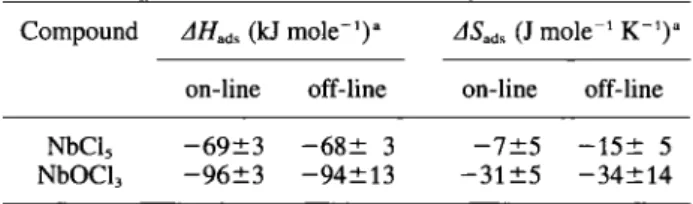
Table 1. Comparison of adsorption enthalpies and entropies
from on-line and off-line measurements
Compound ΔΗ,ds (kJmole-')* zlSads (J mole-1 K-1)"
on-line off-line on-line off-line NbCl5 —69±3 —68± 3 —7±5 —15± 5 NbOCl3 —96±3 —94±13 —31 ±5 - 3 4 ± 1 4
° Data from [20] Table 1.1.
1500 °C. Thermochromatography of the tetrachlorides or tetrabromides appeared most promising.
Rudolph [17] has investigated the validity of "on-line" gas chromatography measurements of inorganic halides and oxides as a tool in determining adsorption enthalpies and entropies for short-lived nuclides. Ad-sorption enthalpies and entropies on quartz surfaces
were measured, for NbCl5 and NbOCl3, using the
54-s 97mNb. These results were compared with results
from "off-line" gas chromatography measurements. As shown in Table 1, on-line measurements of adsorp-tion enthalpies and entropies were found to provide reliable and reproducible results.
As early as 1966, Zvara et al. [12] developed a gas chromatography technique (gas-solid thermochroma-tography) to separate volatile chlorides of element 104.
With this technique, volatile compounds such as ZrCl4
and HfCl4 are separated based on deposition
tempera-ture in a quartz chromatography column. This method was used to detect Rf halides, assuming that Rf would form volatile chlorides like its lighter homologs Zr and Hf. After completion of the experiment, fission tracks attributed to an isotope of Rf, were found near the section of the column where Hf was deposited. How-ever, detection by recording fission tracks is insuf-ficient for identifying the atomic number (Z) or mass number (A) of a fissioning species since all infor-mation concerning the Z, A and the half-life of the fissioning nucleus is lost.
In 1990, Türler et al. [11] studied the volatilities of chlorides and bromides of Hf and Rf using on-line gas chromatography. They detected α-particles from
the decay of 78-s 261 Rf and its 26-s daughter 257No and
registered a number of a—a correlations. This was an unambiguous proof that Rf forms volatile halide spe-cies.
The short half-lives and low production rates of the transactinide elements make the study of their nu-clear and chemical properties difficult. On-line gas chromatography provides a very fast and efficient chemical separation of transactinides from interfering actinide activities providing an invaluable technique for transactinide studies. Furthermore, chemical prop-erties such as volatility of halide species of the trans-actinides and homologs can be studied. From these measurements, adsorption enthalpies on various solid surfaces can be calculated, and trends in the periodic table can be investigated. In the current work, we
care-fully studied the relative volatility of the tetrachlorides of group 4 elements Zr, Hf and Rf.
2. Experimental
Several targets were used in this work for the produc-tion of transactinide elements and their lighter homo-logs. All targets were prepared via a molecular deposi-tion technique [18—20] from an isopropanol soludeposi-tion. This method ensures a thin, adherent, and uniform tar-get.
All irradiations for the production of 98Zr were
per-formed at the PSI SAPHIR reactor. A helium-filled
beam line provides (4.6±0.5) X106 thermal neutrons/
(s · cm2) with a beam size of 50 mm in diameter [21],
98Zr was produced via the neutron-induced fission of
235U. The 235U target with a thickness of 0.180 mg/
cm2, was electrodeposited in a 60-mm diameter on a
4.05 mg/cm2 aluminum foil.
All irradiations for the production of Hf and Rf isotopes were performed at the LBL 88-Inch
Cyclo-tron. 162Hf was produced by the U7Sm(20Ne6+, 5n)
re-action. The 140-MeV (laboratory system) 20Ne6+
beam, after passing through the 2.75-mg/cm2 Be
vacu-um window, 0.2-mg/cm2 nitrogen cooling gas and the
2.75-mg/cm2 Be target backing, was degraded to
122 MeV before striking the target material. The over-all thickness of this mixed Sm and Eu target was
0.365-mg/cm2 (0.214-mg/cm2 147Sm, and 0.151-mg/
cm2 natEu). Typical beam currents of 0.1 ρμΑ were
used throughout the experiments. The isotopes 41-s
162Hf and 1.7-min 165Hf were produced with cross
sec-tions of hundreds of millibarns.
The 78±¿'-s 261Rf (half-life measured in this work,
see section 3.2.3) was produced by the
248Cm(1805+, 5n) reaction with a cross section of 5 nb
[22, 23]. The 117-MeV (laboratory system) , 805 +
beam from the LBL 88-Inch cyclotron, passing through the same materials as in the previous para-graph, was degraded to 99 MeV before striking the
tar-get material. The final thickness of 248Cm in the
Cm203 target material was 0.81-mg/cm2 (6-mm
diam-eter). Typical beam currents of 0.5 ρμΑ were used throughout the experiments.
All products from nuclear reactions were transport-ed to the gas chromatography system, the Heavy El-ement Volatility Instrument (HEVI) [24], via a He/
MO03 gas jet transport system. The recoiling reaction
products were stopped in the He and collected on the aerosols in the helium, which continuously swept out the volume behind the target. The activity-laden aero-sols were transported by the helium through a 1.6-mm 1.d. capillary tube to the gas chromatography apparatus. At LBL all capillaries and tubings used in the transport of the products to HEVI were made of Teflon to elim-inate any exchange of oxygen through the capillary walls because the yield of volatile halides was found to be sensitive to oxygen. The total transportation yield of the system ranges from 60—80%.
ITarget System | He/Mo03or He/KCI "f1
\
/ EOperation Principle active Gas
IChromatography Column | Recluster Chamber Beam
Quartz Wool
Exhaust • MG System
Rotathg tt petition whMl with polypropyton« collodion d u
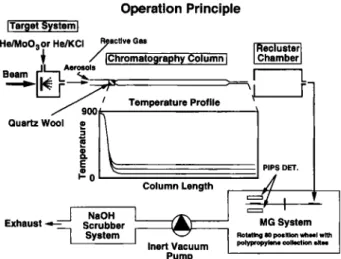
Fig. 1. Illustration of the different parts of the experimental
set-up. The experimental process has been followed from production to chromatography and finally to detection.
Potassium chloride aerosols were used in the early development stages of this chemical separation since the He/KCI system was a well-established method of transporting reaction products from heavy ion nuclear reactions. This is the preferred transport system for aqueous chemistry since KCl readily dissolves in aqueous solutions. However, after prolonged gas chemistry experiments with this system, the quartz surface of the chromatography column is partially co-ated with a thin layer of KCl causing the chromatogra-phy to be performed on KCl rather than on Si02. Our volatility measurements are strongly dependent on the chromatography surface and therefore a new transport system ( H e / M o 03) had to be developed to resolve this problem. Reactions between M o 03 and a variety of chlorinating agents produce MOC15 and MOOC13 which are volatile at temperatures as low as 100 °C. After the transport of reaction products to the chromatography system, the aerosols are converted to volatile species which leave the column without coating the quartz (Si02) chromatography surface. The H e / M o 03 trans-port system is very new and not completely under-stood. Intensive studies of this system are being con-ducted at PSI [25].
After transport to HEVI, the activity-laden aero-sols enter the first section of the quartz column and are stopped on a quartz wool plug placed at the entrance to the chromatography section of the column (Fig. 1). This first section of the quartz column is kept at ap-proximately 900 °C to vaporize the aerosols, leaving the activity on the quartz wool. Reactive gases are ad-ded to the quartz wool plug to form volatile halide compounds which are then carried down a cooler, iso-thermal section of the column by the helium gas flow.
In isothermal chromatography, the retention times of short-lived activities are measured using their half-lives as a clock. If the half-life is short compared to the retention time, the activity will decay in the column. If the half-life is long in comparison to the retention time, the activity can pass through the column and is
available for detection. The species that leave the col-umn enter a recluster chamber, where they are attached to new KCl aerosols in N2 and are transported to the detection system.
The retention time, and thus the yield of short-lived activities, is dependent on the adsorption en-thalpy, the column temperature, the true volume flow rate of the carrier gas and the column length. A Monte Carlo simulation of the processes taking place inside the chromatography column is used to determine ¿fHads by fitting yield as a function of the isothermal column temperature.
All gases were purchased from Matheson Gas Company, Inc. and all other chemicals were purchased from Aldrich Chemical Company, Inc. The HCl gas and the carbon tetrachloride (CC14) were 99.995% and 99% in purity, respectively. Experiments were con-ducted with the halogenating system of HCl gas and a mixture of HCl gas and CC14. Further experiments were conducted using a mixture of HCl gas and SOCl2, Cl2 gas, a mixture of Cl2 gas and CC14, and HBr gas [26], The quartz chromatography columns provided the S i 02 surfaces.
In the subsequent of this paper, references will be made to 'direct catch' or 'chemistry' measurements. These are the two types of measurements performed in the gas chemistry experiments. The activity-laden aerosols which exit the target system are either inject-ed into the chromatography system, where chromatog-raphy is performed before transport to the detection system for a 'chemistry' measurement, or the chroma-tography system is bypassed and the activities are sent directly to the detection system where a 'direct catch' measurement is performed. A direct catch is simply a measurement of the amount of activity from specific nuclides under study, without chemical separation. A comparison of the activities from a direct catch measurement and a chemistry measurement gives the relative yield of a species. For experiments conducted at the LBL 88-Inch Cyclotron, the integrated beam current was recorded for each direct catch and chemis-try measurement to correct for any beam current fluc-tuations.
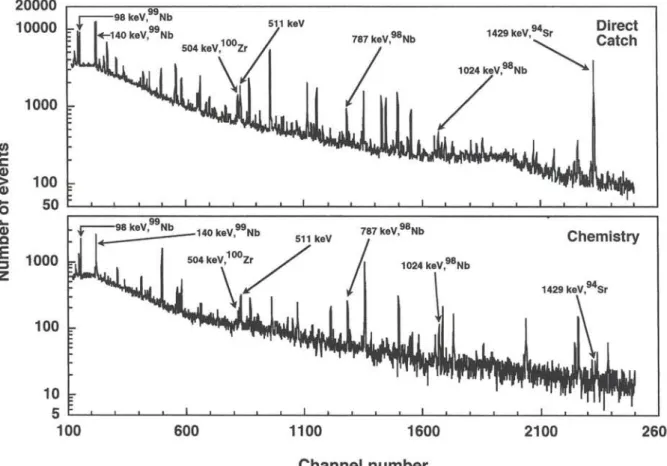
For detection of species with characteristic γ ac-tivities (98Zr and 162Hf), a high-purity Ge y - r a y spec-trometer system was used in conjunction with a Teflon collection site [26]. During all measurements samples were collected for 5 min and surveyed during the col-lection period for characteristic photopeaks. All y-ray spectra (Figs. 2 and 3) from direct catch and chemistry measurements were analyzed using the SAMPO com-puter code [27], The output from SAMPO provided energy, total area, total activity, and the respective standard deviations on each value for each peak in the spectrum. In a typical experiment at a certain column temperature, two chemistry measurements were pre-ceded and followed by a direct catch measurement. Corrections were made to peak area values to account for fluctuations in accelerator beam currents and dead time during data collection. Photopeak areas and their
20000 10000
100 600 1100 1600 2100 2600
Channel number
Fig. 2. Typical 5-min y-spectra of 'direct catch' and 'chemistry' measurements for Zr experiments.
corresponding statistical errors were calculated for the full-energy peaks corresponding to each radionuclide. All peak areas from chemistry measurements con-ducted at the same temperature were averaged together and the relative yield for each isotope was calculated by a direct comparison of the average areas from the chemistry measurements and the corresponding direct catch measurements.
The Merry-Go-Round (MG) and Realtime Data Acquisition and Graphics System (RAGS) [28, 29] were used for the detection of a/SF activities from
the (180,5n) reaction with 248Cm at the LBL 88-Inch
Cyclotron. The 25.4-cm radius horizontal wheel of the MG had 80 equally spaced collection positions about its circumference. A steel ring with a 0.63-cm i.d.
hole, which was covered with a 40±10μg/cm2 film
of polypropylene, was placed in each collection posi-tion. The activity-laden aerosols from the gas-jet were deposited on the polypropylene film. The wheel was stepped at one-minute time intervals so as to move the foils consecutively from the collection site into posi-tions between pairs of passivated ion-implanted planar silicon detectors (PIPS). Because of the corrosive na-ture of the reactive gases used, PIPS detectors were required for this experiment, since they are chemically inert. The MG wheel was replaced with a new one after two complete revolutions in order to minimize the accumulation of any long-lived activities. Six pairs of detectors were used to measure the kinetic energies
of coincident fission fragments and alpha particles. The efficiency for detection of a particles in each de-tector is 30%. Since in this configuration each detec-tion stadetec-tion consists of two detectors, one above and the other below the wheel, the efficiency for the detection of a particles is about 60% and that for co-incident fission fragments is about 60%. All events werestored on a hard disk in list mode. Each event was tagged with a time, channel number, and a detector number.
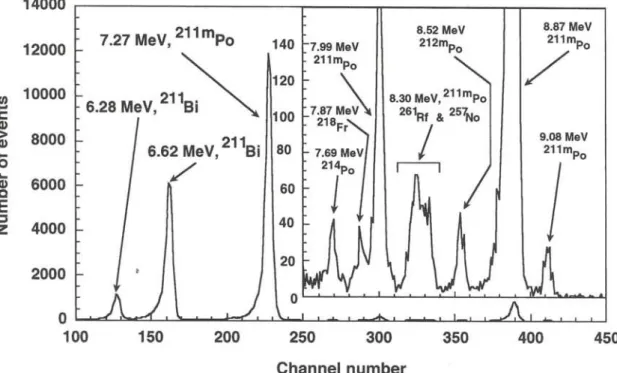
Alpha spectra from all chemistry measurements were analyzed for the number of events in the 8.15 — 8.38 MeV energy region. This region contains all
events due to 261Rf and its 25±2-s daughter 257No
(Fig. 4). A weak a line at 8.305 MeV (0.25%) from
the 25.2-s 2l1mPo also falls into this region. For all
chemistry measurements the number of events in the
8.15-8.35 MeV range, due to 2,lmPo, was calculated,
based on the intensity of the 7.275-MeV (91.05%)
2iimp0 alpha line, and subtracted from each spectrum.
Corrections were made to account for fluctuations in accelerator beam currents for all measurements. Re-sults from all chemistry measurements conducted at the same temperature were summed together and a plot of relative yield versus temperature was
construct-ed for 261Rf. The same procedure was followed to
con-struct similar plots for 211Bi and 21,mPo. The 6.62-MeV
and the 7.27-MeV a lines were used for 21,Bi and
Channel number
Fig. 3. Typical 5-min y-spectra of 'direct catch' and 'chemistry' measurements for Hf experiments.
Channel number
Fig. 4. Sum spectrum of all a particles observed in the Rf chemistry experiments for the first 3 minutes of counting.
To calculate the half-life of 261Rf, all chemistry likelihood [30] decay-curve fit was performed on the
data were summed together (Fig. 4) and sorted into 7.275 MeV region of the spectrum. The two
HCI/CCU
He/Mo03
Temperature (°C)
Fig. 5. Relative Yield curves for 98Zr- and 94Sr-chloride
mole-cules with a H e / M o 03 gas jet and HCI/CCU as chlorinating
agent.
In this fit half-lives of both radionuclides were fixed.
The initial activity for the 211mPo from this fit was used
to calculate an initial activity for the 8.305 MeV (0.25%) a line of the same radionuclide. A growth and decay plus one component fit was then performed on the 8.15—8.38 region of the spectrum consisting of
261Rf, its daughter 257No, and 2 , , mp0 to arrive at a
half-life value for 261 Rf. In this fit, half-lives of211mPo and
257No and the initial activity of 211mPo (calculated from
the first fit) were fixed; all other parameters were al-lowed to vary.
To determine the adsorption enthalpies a Monte Carlo simulation [26] of the yield versus temperature curves has been developed. This Monte Carlo code simulates the processes within the column based on the microscopic thermochromatography model pro-posed by Zvara [31]. Yield versus temperature plots at given adsorption enthalpy values were generated for each halide molecule. A number of such plots at vari-ous adsorption enthalpy values were produced to com-pare to the experimental data. The adsorption enthalpy value was found by using a weighted least-squares procedure to find the generated plot which best rep-resented the experimental data. The shape of the simu-lated yield curves matched the experimental data well, confirming the validity of the model proposed by Zvara.
3. Results
Fig. 5 shows a yield curve for 98ZrCl4. HC1/CC14 was
used as the halogenating agent and Mo03 as transport
aerosol. When the halogenating agents containing hy-drogen (HCl and HBr) were used, significant yields were unexpectedly oserved at very low temperatures (50 °C to —150 °C). During experiments with isotopes
CI /CCI4
He/Mo03
Temperature (°C)
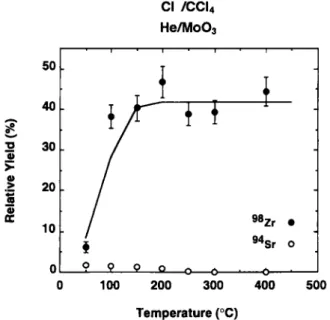
Fig. 6. Relative Yield curves for 98Zr- and 94Sr-chloride
mole-cules with a H e / M o 03 gas jet and C12/CC14 as chlorinating
agent. The solid line drawn through the data points is from the Monte Carlo computer program.
of Zr, an isotope of strontium (94Sr) was also produced.
Strontium does not form volatile halides. However, significant yields are observed at 50 °C and 100 °C
(Fig. 5) for 94Sr. The yield then decreases with
increas-ing temperature to acceptable levels. Therefore, trans-port by mechanisms other than isothermal chromatog-raphy is indicated at very low temperatures when us-ing HBr or HCl as halogenatus-ing agents. This
compli-cates the interpretation of the yield curves. When Cl2/
CCI4 was used as the halogenating agent, the Sr yields at low temperatures were decreased to acceptable lev-els (Fig. 6), resulting in yield curves which agree well with our Monte Carlo simulations of the isothermal chromatography process.
The results for relative yields are plotted versus temperature. The error bars shown in all yield curves represent one sigma uncertainties based on statistical fluctuations in the peak areas. If no error bars are dis-played, the error is smaller than the symbols.
3.1 Bi- and P o - c h l o r i d e s
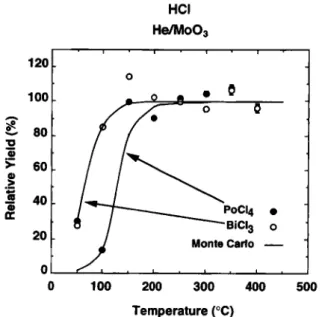
Fig. 7 shows a relative yield curve for 2.14-min
2,1BiCl3 and 25.2-s 21,mPoCl4 with a He/Mo03 gas-jet
and HCl as chlorinating agent. The experimental data (Table 4) were normalized to 100% at maximum yield. As illustrated, the high yield effect at low temperatures
is observed at 50 °C for Po. BiCl3 is volatile at 100 °C
and PoCl4 is volatile at 150 °C, with respective
adsorp-tion enthalpies of - 6 9 ± 4 kJ/mol and —74 ± 5 kJ/mol (Table 2).
The adsorption enthalpy for the Po species agrees well with Rudolph's value of - 6 9 ± 2 0 [32-33]; how-ever, the Bi value does not. This disagreement may be a result of the large estimated errors in Rudolph's measurements.
HCl
He/Mo03
Temperature (°C)
Fig. 7. Relative Yield curves for 211Bi- and 211mPo-chloride
mole-cules with a H e / M o 03 gas jet and HCl as chlorinating agent.
The solid lines drawn through the data points are from the Monte Carlo computer program.
3 . 2 G r o u p 4 e l e m e n t s
3.2.1 Zr-chlorides and -bromides
As depicted in Fig. 8 a sharp increase in relative yield is observed at temperatures between 100 °C and
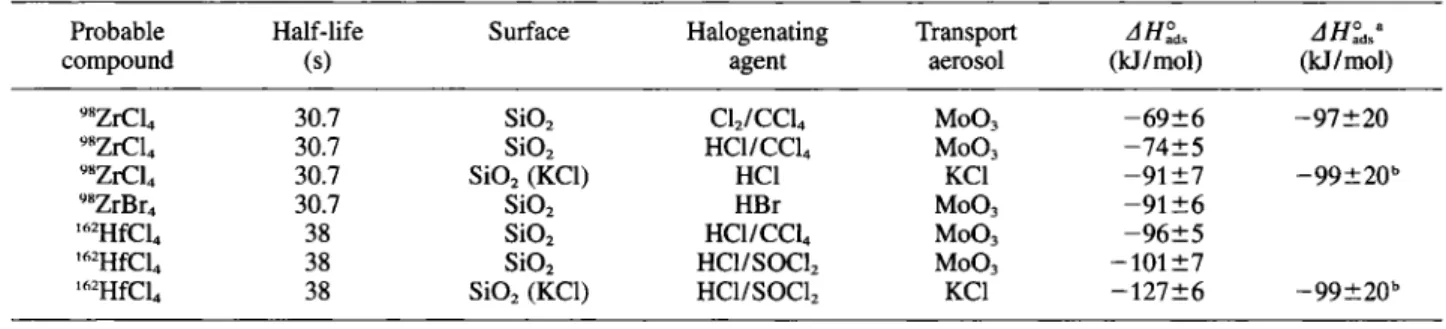
150 °C for ZrCl4. Table 3 lists the calculated
adsorp-tion enthalpies. When KCl was used as the transport aerosol, a decreased volatility on the order of 100 °C
was observed for ZrCl4 since the separation was
con-ducted on a partially KCl coated column. This effect is consistent with results of Rudolph [32, 33] for a NaCl surface. As expected, a more negative adsorption enthalpy value was observed. An adsorption enthalpy
value of - 7 4 ± 5 kJ/mol for ZrCL, on a Si02 surface
is obtained from experiments performed with a He/
MO03 gas-jet and HCl/CCL, as chlorinating agent. Our
results show a lower volatility for ZrBr4 in comparison
to ZrCl4.
3.2.2 Hf-chlorides
As shown in Fig. 8, a sharp increase in relative yield
is observed for HfCl4 at temperatures between 200 °C
and 250 °C. Again, when using KCl as transport aero-sol material a decrease in volatility (on the order of 150 °C) and adsorption enthalpy is expected. An
ad-sorption enthalpy value of —96±5 kJ/mol for HfCl4
Temperature (°C)
Fig. 8. Relative Yield curves for 98Zr- and l62Hf-, and 261 Rf-chloride molecules with a He/MoO, gas jet and HC1/CC14 as
chlorinating agent. The solid lines drawn through the data points are from the Monte Carlo computer program.
on a Si02 surface is obtained (Table 3) from
experi-ments performed with a He/Mo03 gas-jet and HCl/
CC14 as chlorinating agent.
3.2.3 Rf-chlorides
A new half life of 78i"-s has been measured for 261Rf.
This is believed to be a better value than the previous 65 ±10 s measured by Ghiorso et al. [22] because our chemical separation removed a number of contami-nants which were present in their spectrum. The
re-sulting correction for 2,lmPo was much less and, in
ad-dition, we performed a multi-component decay analy-sis. A decay curve is shown in Fig. 9. A total of 1054
a events was observed for 261Rf and its daughter 257No.
A total of 170 a - a correlations were observed which corresponds very well to the expected 169 α—α corre-lations. The expected number of correlations are ar-rived at considering both true and random correlations of unrelated events. The measured number is incon-sistent with expected correlations of random unrelated events. There appears to be a short component in the observed spontaneous fission events. An upper limit of 11% is estimated as the spontaneous fission branch
for 261Rf which gives a spontaneous fission half-life of
>709 s, assuming no other modes of decay.
A yield curve (Fig. 8) for 98ZrCl4, ,62HfCl4, and
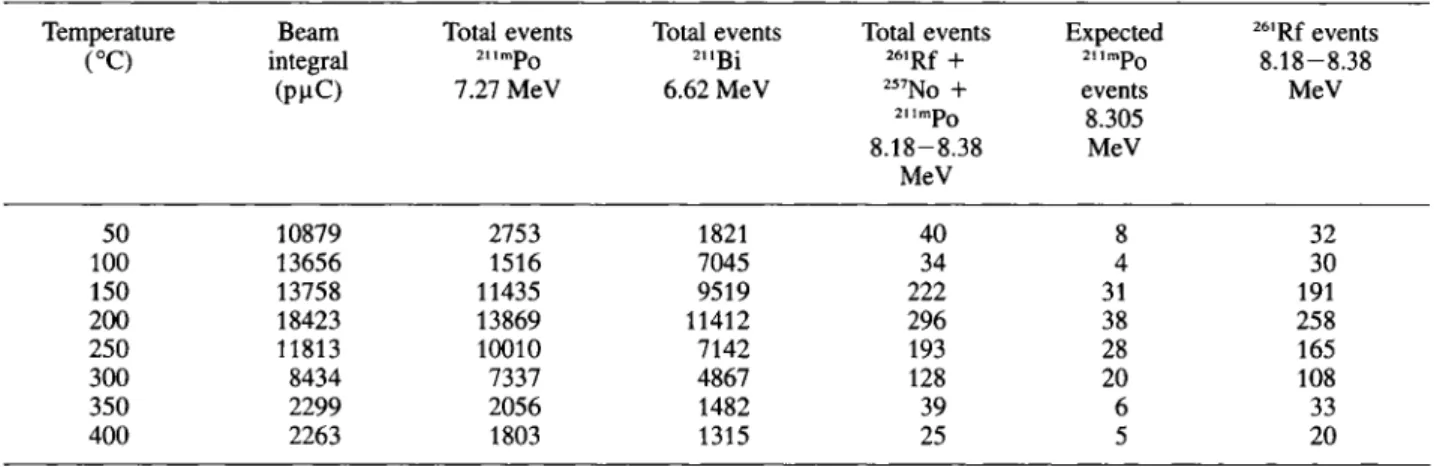
261RfCl4 was constructed. Table 4 contains the data
Table 2. Adsorption enthalpies for Bi- and Po-chlorides
Probable Surface Halogenating Transport Δ HI*
compound agent aerosol (kJ/mol) (kJ/mol)a
BiClj Si02 HCl M0O3 —69±4 - 1 0 1 ± 2 0
P0CI4 Si02 HCl M0O3 —74±5 —69±20
Table 3. Adsorption enthalpies for Zr-chlorides and -bromides and Hf-chlorides
Probable Half-life Surface Halogenating Transport
compound (s) agent aerosol (kJ/mol) (kJ/mol)
98ZrCl4 3 0 . 7 S i 02 C12/CC14 M O 03 - 6 9 ± 6 - 9 7 ± 2 0 98ZrCl4 3 0 . 7 S i 02 HC1/CCL, M O 03 — 7 4 ± 5 98ZrCl4 3 0 . 7 S i 02 (KCl) HCl KCl - 9 1 ± 7 - 9 9 ± 2 0B 98ZrBr4 3 0 . 7 S i 02 HBr M 0 O 3 - 9 1 ± 6 I62HfCl4 3 8 S i 02 HC1/CCL, M 0 O 3 — 9 6 ± 5 ,62HfCl4 3 8 S i 02 HCl/SOCl2 M 0 O 3 — 1 0 1 ± 7 162HfCl4 3 8 S i 02 (KCl) HC1/SOC1, KCl — 1 2 7 ± 6 - 9 9 ± 2 0B a Data from [32, 33],
b Adsorption enthalpy on NaCl surface.
100 150 200 250 300 350 Time (s)
Fig. 9. Growth (261Rf) and decay (257No) plus one component
(2"mPo) fit to the 8.15 to 8.38 MeV region. In this fit half-lives
of Po and No and the initial activity of Po were fixed; all other parameters were allowed to vary. A maximum likelihood decay curve fit has been used. The upper and lower limits on the
half-life interval correspond to a confidence level of 68% [30],
used in constructing yield curves for RfCl4. As
illus-trated, the yield of RfCl4 maximizes at temperatures
between 100 °C and 150 °C, corresponding to an ad-sorption enthalpy value of —77 ± 6 kJ/mol (Table 5).
4. Conclusions
Table 5 gives the adsorption enthalpies (AHads) for
chlorides of the group 4 elements on S i 02 surfaces. As
explained earlier, these values result from Monte Carlo simulations based on the yield versus temperature curves and the 50% yield temperatures (Γ50%)
meas-ured in this work. The following adsorption enthalpies were obtained:
ZrCl4 - 7 4 ± 5 kJ/mol
HfCl4 —96±5 kJ/mol
RfCL, —77±6 kJ/mol.
HfCl4 was found to have a more negative Δ HMk than
ZrCl4. Based on a simple extrapolation down the
-50 - 6 0 w . 8 0 « Λ χ < .go -100 -110
* Results from this work • Oxy-chloridee o Tetrachlorides J3 O > £ o Zr Hf Rf
Fig. 10. Adsorption enthalpy values for group 4 chlorides and
oxy-chlorides.
fourth group of the periodic table RfCl4 would be
ex-pected to have the most negative A //ads, and, therefore,
require the highest temperature to reach a maximum yield. The z///ads for RfCl4 of —77 kJ/mol deviates
from the trend expected from this simple periodic table extrapolation and is similar to that measured for ZrCl4.
In Fig. 10, we have included Δ Hads from other
ref-erences for Zr- and Hf-tetrachlorides and -oxychlo-rides. As illustrated, these values vary widely in the literature for both Zr- ( - 9 6 to - 8 9 kJ/mol) and Hf-tetrachlorides (—71 to - 9 6 kJ/mol); these variations are far outside the quoted error limits. However, in those experiments where values for Zr and Hf were measured together, their adsorption enthalpies were similar. Our conclusions regarding the deviation from the expected trends in AHads for the group 4 elements
were made based only on values from this work, since all elements were studied under same conditions using the same chromatography system (HEVI).
In Ref. [36], the Δ Hads for Zr- and Hf-chlorides
were measured as a function of the oxygen concentra-tion. Both Hf and Zr showed two different adsorption enthalpies which were attributed to the tetrachlorides and oxychlorides. The authors found that ZrOCl2 and
HfOCl2 had similar adsorption enthalpies which were
Table 4. Experimental data used in constructing relative yield curves for BiCl3, PoCl4, and RfCl4
Temperature Beam Total events Total events Total events Expected 261 Rf events
(°C) integral 2 , , mPo 2"Bi 26,Rf + 2 , , mPo 8.18-8.38
( ρ μ ΰ ) 7.27 MeV 6.62 MeV 257No + events MeV
2 l l mPo 8.305 8 . 1 8 - 8 . 3 8 MeV MeV 50 10879 2753 1821 40 8 32 100 13656 1516 7045 34 4 30 150 13758 11435 9519 222 31 191 200 18423 13869 11412 296 38 258 250 11813 10010 7142 193 28 165 300 8434 7337 4867 128 20 108 350 2299 2056 1482 39 6 33 400 2263 1803 1315 25 5 20
Table 5. The best volatility and adsorption enthalpy values for
all species studied on Si02 surface. The temperatures for 50%
relative yield are given for comparison, but the complete relative yield versus temperature curve is used in the Monte Carlo
calcu-lations to obtain the adsorption enthalpy values
Probable Temperature
compound (kJ/mol) (50% yield) (°C) BiCl, —69±4 5 9 ± 5 P0CI4 —74±5 1 4 2 ± 5 Z1CI4 —74±5 1 2 0 ± 5 HfCl4 —96±5 225 ± 5 RfCL, —77±6 1 2 4 ± 5 ZrBr4 - 9 1 ± 6 1 9 8 ± 5
which were also very similar. In addition, for Zr and Hf, the conversion from the pure chloride species to the oxychloride occurred at the same oxygen concen-tration. It seems that the difference between the AH.itk
measured for Zr and for Hf in our work could be ex-plained by assuming that ZrCl4 and HfOCl2 were
measured. However, from the specifics of the experi-ments, the oxygen concentration for the measurements of the Zr was higher than in the experiments for Hf. Discrepancies between the values of Δ Η^ in the literature and our work may be due to slight differ-ences in experimental conditions and the methods by which experimental observables were converted into
Δ Hads values. Nevertheless, the deviation in periodic trends observed here is quite interesting and warrants further investigation. More calculations are needed to assess whether or not this is due to relativistic effects in the transactinide region.
The future of on-line gas chromatographic studies in the actinide and transactinide region is both chal-lenging and exciting. The chalchal-lenging aspect of this research comes from the short half-lives and low pro-duction rates of the transactinides. Improvements in detection methods for the existing system (HEVI) should allow studies of elements with half-lives of a few seconds or even less. Presently, volatility studies are being conducted on the bromide systems of group
4 (Zr, Hf, and Rf) and group 5 (Nb, Ta, and Ha) el-ements. Other elements with available 4+ oxidation
states such as cerium, thorium, plutonium and ber-kelium will also be investigated.
Acknowledgements
The authors wish to thank the U.S. Department of En-ergy for the use of the 248Cm, provided through the
transplutonium element production facilities at the Oak Ridge National Laboratory. This work was sup-ported in part by the Director, Office of Energy Research, Chemical Sciences Division, U.S. Depart-ment of Energy under contract number DE-AC03-76SF00098.
The authors would like to thank the staff and crew of the LBL 88-Inch Cyclotron and the SAPHIR reac-tor at PSI for providing excellent heavy ion beams and neutron beams, respectively.
References
1. Brewer, L.: High Temp. Sci. 17, 1 (1984).
2. Desclaux, J. P., Fricke, B.: J. Phys. (Paris) 41, 943 (1980). 3. Keller, Jr., O. L.: Radiochim. Acta 37, 169 (1984). 4. Pyyko, P.: Chem. Rev. 88, 563 (1988).
5. Zhuikov, B. L., Glebov, V. Α., Nefedov, V. S., Zvara, I.: Int. Conf. Actinides '89, Tashkent, USSR; Radioanal, and Nucl. Chem. Articles 143, 103 (1990).
6. Brewer, L. J.: Opt. Soc. Am. 61, 1101 (1971).
7. Glebov, V. Α., Kasztura, L., Nefedov, V. S., Zhuikov, B. L.: Radiochim. Acta 46, 117 (1989).
8. Zhuikov, B. L., Chuburkov, Yu. T., Timokhin, S. N„ Jin, K. U„ Zvara, I.: Radiochim. Acta 46, 113 (1989).
9. Gäggeler, H. W„ Jost, D. T., Baltensperger, U„ Weber, Α., Kovacs, Α., Vermeulen, D., Türler, Α.: Nucl. Instrum. Methods A309, 201 (1991).
10. Jost, D. T., Gäggeler, H. W„ Vogel, C. H., Schädel, M., Jäger, E., Eichler, B., Gregorich, Κ. Ε., Hoffman, D. C.: Inorg. Chim. Acta 146, 255 (1988).
11. Türler, Α., Gäggeler, Η., Gregorich, Κ. E., Barth, Η., Brüchle, W , Czerwinski, Κ. R„ Gober, M. K„ Hannink, N. J., Henderson, R. Α., Hoffman, D. C., Jost, D. T., Kacher, C. D., Kadkhodayan, B., Kovacs, J„ Kratz, J. V., Kreek, S. Α., Lee, D. M., Leyba, J. D., Nurmia, M. J., Schädel, M., Scherer, U. W., Schimpf, E., Vermeulen, D., Weber, Α.,
Zimmermann, H. P., Zvara, I.: J. Radioanal. Nucl. Chem.
160, 327 (1992).
12. Zvara, I., Chuburkov, Yu. T., Caletka, R., Zvarova, T. S., Shalaevsky, M. R., Shilov, Β. V.: Dubna Report D2710 (1966); At. Energ. 21, 83 (1966); J. Nucl. Energy 21, 601 (1967); Sov. At. Energy 21, 709 (1966).
13. Zvara, I., Chuburkov, Yu. T., Caletka, R., Shalaevsky, M. R.: Sov. Radiochem. 11, 161 (1969).
14. Zvara, I., Chuburkov, Yu. T., Belov, V. Z., Buklanov, G. V., Zakhvataev, Β. V., Zvarova, T. S., Maslov, O. D., Caletka, R., Shalaevsky, M. R.: J. Inorg. Nucl. Chem. 32, 1855 (1970).
15. Zvara, I., Belov, V. Z., Domanov, V. P., Shalaevski, M. R.: Radiokhimiya 18, 371 (1976).
16. Zvara, I.: Int. Conf. Actinides '89, Tashkent, USSR, Sep-tember 1989, Abstracts, Nauka, Moscow, p. 989.
17. Rudolph, J., Bächmann, Κ.: Radiochim. Acta 27, 105-108 (1980).
18. Aumann, D. C„ Müllen, G.: Nucl. Instrum. Methods 115, 75 (1974).
19. Evans, J. E., Lougheed, R. W„ Coops, M. S„ Hoff, R. W„ Hulet, E. K.: Nucl. Instrum. Methods 102, 389 (1972). 20. Müllen, G., Aumann, D. C.: Nucl. Instrum. Methods 128,
425 (1975).
21. Ya Nai-Qi, Jost, D. T., Baltensperger, U., Gäggeler, H. W.: Radiochim. Acta 47, 1 - 7 (1989).
22. Ghiorso, Α., Nurmia, M., Eskola, D., Eskola, P. : Phys. Lett.
32B, 95 (1970).
23. Kratz, J. V., Gober, Μ. Κ., Zimmermann, H. P., Schädel, M., Brüchle, W., Schimpf, E., Gregorich, Κ. Ε., Türler, Α., Hannink, Ν. J., Czerwinski, Κ. R., Kadkhodayan, Β., Lee,
D. M., Nurmia, M. J., Hoffman, D. C., Gäggeler, H., Jost, D. T., Kovacs, J., Scherer, U. W., Weber, Α.: Phys. Rev. C45, 1064 (1992).
24. Kadkhodayan, Β., Türler, Α., Gregorich, Κ. E., Nurmia, M. J., Lee, D. M., Hoffman, D. C.: Nucl. Instrum. Methods
A317, 254-261 (1992).
25. Türler, Α. : Private communication.
26. Kadkhodayan, Β.: Ph. D. thesis, University of California, Berkeley (1993), Lawrence Berkeley Laboratory Report # 33961, Nuclear Science Division (1993).
27. Routti, J. T., Prussin, S. G.: Nucl. Instrum. Methods 72,125 (1969).
28. Hoffman, D. C„ Lee, D., Ghiorso, Α., Nurmia, M„ Aleklett, K.: Phys. Rev. C22, 1581 (1980).
29. Leres, R. G.: Lawrence Berkeley Laboratory report # 24808, Engineering Division (1987).
30. Gregorich, Κ. E.: Nucl. Instrum. Methods A302, 135-142 (1991).
31. Zvara, I.: Radiochim. Acta 38, 9 5 - 1 0 1 (1985).
32. Rudolph, J., Bächman, Κ.: J. Chromatogr. 178, 459 - 4 6 9 (1979).
33. Rudolph, J., Bächman, Κ.: J. Chromatogr. 187, 319-329 (1980).
34. Pershina, V., Sepp, W. D., Bastug, T., Fricke, B., Ionova, G. V.: J. Chem. Phys. 97, 1123 (1992).
35. Pershina, V., Fricke, B.: J. Phys. Chem. 98, 6468 (1994). 36. Domanov, V. P. et al. : Radiokhimiya 31, 19 (1989). 37. Kim U Zin et al. : Isotopenpraxis 24, 30 (1988). 38. Eichler, Β., et al. : JINR-Report P12-9454 (1976). 39. Zvara, I., et al. : Radiokhimiya 11, 163 (1969).