C. Charbonnel, M. Tosi, F. Primas & C. Chiappini, eds. doi:10.1017/S1743921310003893
Abundances of hydrogen and helium
isotopes in the Protosolar Cloud
Johannes Geiss
1and George Gloeckler
21
International Space Science Institute, Hallerstrasse 6, CH-3012 Bern, Switzerland, email: [email protected]
2Department of Atmospheric, Oceanic and Space Sciences, University of Michigan
2455 Hayward St., Ann Arbor, MI 48109, USA email: [email protected]
Abstract. For our understanding of the origin and evolution of baryonic matter in the Universe, the Protosolar Cloud (PSC) is of unique importance in two ways: 1) Up to now, many of the naturally occurring nuclides have only been detected in the solar system. 2) Since the time of solar system formation, the Sun and planets have been virtually isolated from the galactic nuclear evolution, and thus the PSC is a galactic sample with a degree of evolution intermediate between the Big Bang and the present.
The abundances of the isotopes of hydrogen and helium in the Protosolar Cloud are primarily derived from composition measurements in the solar wind, the Jovian atmosphere and “planetary noble gases” in meteorites, and also from observations of density profiles inside the Sun. After applying the changes in isotopic and elemental composition resulting from processes in the solar wind, the Sun and Jupiter, PSC abundances of the four lightest stable nuclides are given. Keywords. Sun: solar wind, corona, abundances
1. Introduction
Our concepts of nucleosynthesis were originally derived from solar system abundances, and even to this day, our knowledge of the production of most stable and long-lived nuclei is based on elemental and isotopic composition measurements in solar system material. Without isotopic abundances in meteorites and terrestrial samples, could we clearly dis-tinguish the s- and r-processes, recognize the p-nuclei or establish a nuclear chronology for the Galaxy? For most nuclear species, Galactic evolution models are really models for the evolution of the matter that made up the PSC some 4.6 Gyr ago. Extensions to the present for most nuclei would be mere extrapolations, if we had not reliable Galactic
and solar system data for several elements and a few isotopic ratios. Among these are,
most importantly, the isotopes of hydrogen and helium. Composition measurements in the solar wind, the Jovian atmosphere and to a lesser extend - the “planetary gas” in meteorites provide the main evidence from which the protosolar abundances of these nuclides are derived (Table 1).
2. Protosolar (D+
3He)/H derived from
3He/
4He in the solar wind
In the early Sun, deuterium was converted into3He by the reaction
D + H =3He + γ. (2.1)
The short D-burning phase, involving the whole Sun, preceded the H-burning epoch (Ezer & Cameron, 1965; Mazzitelli & Moretti, 1980). In the material of the Outer Convective Zone (OCZ) of the present Sun,3He has not been further processed, as can be surmised
Table 1. Measurements primarily used in this paper for deriving Solar and Protosolar Abundances.
SO LA R W IN D
3H e/4H e m easurem ents w ith SW IC S/U lysses, SW C /A p ollo, old solar w ind in lunar m aterial
→ Extrapolation to3H e/4H e in the O C Z (O uter C onvective Zone of the Sun)
→Protosolar (D +3H e)/H→ Protosolar D/H
M ET EO R IT ES
3
H e/4H e m easurem ent in the “Planetary G as” C om p onent of M eteorites
→ Protosolar3
H e/4H e SU N
D ensity Profile from SO H O Seism ology
→ Protosolar He/H
JU PIT ER
3H e/4H e, H e/H m easurem ent w ith G alileo Entry-Prob e
D /H m easurem ent w ith ISO
→ Protosolar D/H,3
H e/4H e, (D + 3H e)/H
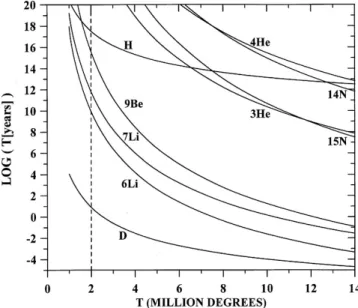
from the abundance there of beryllium (Geiss & Reeves, 1972). At any temperature9Be is destroyed much faster by thermonuclear reactions than3He (Figure 1). Thus, 3He in the OCZ represents not only protosolar 3He, but the sum of protosolar D and3He (see Geiss, Eberhardt & Signer, 1966).
Systematic investigations of3He/4He in the solar wind have been carried out using var-ious space experiments: SWC/Apollo, ICI/ISEE-3, SWICS/Ulysses, SWICS/ACE and recently Genesis. The results have revealed significant variations in solar wind com-position. Theoretical studies have shown that the variations are caused by separation
Figure 1. Life-time of light nuclides as a function of temperature. Given are the life-times due to thermonuclear reactions with density and composition normalized to the present conditions at the bottom of the Outer Convective Zone (OCZ) of the Sun. The dashed line marks the present temperature at the bottom of the OCZ. Note: D-burning proceeds well before H-burning commences due to the temperature difference at which the two hydrogen isotopes are fusing (Ezer & Cameron,1965; Mazzitelli & Moretti, 1980). 9Be is destroyed much faster than3He at all temperatures that could have occurred during the life of the Sun. Thus the presence of Beryllium (9Be) in the OCZ at protosolar abundance precludes the loss there of3He by nuclear reactions (Geiss & Reeves, 1972).
Table 2. Protosolar (D+3He)/4He from 3He/4He in the solar wind. Solar W ind (SW IC S/U lysses) 3H e/4H e Figure 1
Solar W ind (SW C /A p ollo) 3H e/4H e Figure 1
Sun, O uter C onvective Zone 3H e/4H e (3.83± 0.25) × 10−4 P rotosolar C loud (D +3H e)/4H e (3.68± 0.25) × 10−4
processes in the corona (Geiss, Hirt & Leutwyler, 1970; B¨urgi & Geiss, 1986; Isenberg & Hollweg, 1983) as well as ion-neutral separation processes in or near the chromosphere (Geiss, 1982; von Steiger & Geiss, 1989). Several physical processes were identified that cause or control charging, separation and transport of major and minor ion species from the chromosphere to the corona and into the supersonic solar wind. Their varying influ-ence produces the observed variations in space and time. Theory alone cannot exactly predict the changes in composition caused by different solar and solar wind conditions, but theory can predict which pairs of ion species should causally correlate and could be used to obtain OCZ abundances from solar wind data by extrapolation.
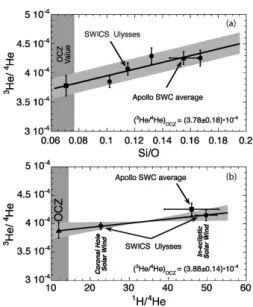
So far empirical extrapolations from abundances in the slow solar wind and the high-speed streams coming out of the polar coronal holes give the best results. We follow here the method introduced by Gloeckler & Geiss (2000). Figures 2a and 2b show, respectively, the correlations of 3He/4He with Si/O and with H/He measured by SWICS/Ulysses in several periods each of in-ecliptic solar wind and high speed streams. Extrapolating by linear regression to Si/O observed in the photosphere and to H/He = 11.9 determined for the OCZ (P´erez Hern´andez & Christensen-Dalsgaard, 1994) gives (3He/4He)O C Z = (3.78± 0.18) × 10−4 and (3He/4He)O C Z = (3.88± 0.14) × 10−4 respectively (Figure 2). The 1-σ errors include statistical uncertainties as well as the spread due to solar wind variability. The systematic instrumental uncertainties are estimated to be 0.2× 10⁻⁴ (Gloeckler & Geiss, 2000). The two extrapolation methods give essentially the same result, leading to an average of (3He/4He)
O C Z = (3.83± 0.25) × 10−4 (Table 2), which is in remarkable agreement with earlier values of (3He/4He)
O C Z obtained by other methods (see Geiss & Gloeckler, 1998).
During the in-ecliptic periods, steady low-speed solar wind prevailed, free of CME events. Winds related to CMEs would compromise the correlation between3He/4He and H/He, because they combine low H/He ratios with relatively high 3He/4He ratios, i.e. opposite to the correlation in Figure 2b.
We have plotted in Figure 2 also the average3He/4He ratio of the SWC/Apollo exper-iments that collected the solar wind during five periods in 1969-1972 (Geiss et al., 2004, see also Geiss et al. 1970). These were slow wind periods (320-510 km/s), and there are no indications of a CME influence. The H/He and Si/O ratios for the SWC exposure periods are estimates. Solar wind composition data were rudimentary during the Apollo epoch (1969-1972). Thus the corresponding estimates of H/He and Si/O are crude by necessity.
Recently Heber et al. (2009) published precise isotopic abundances of noble gases including the 3He/4He ratio obtained from the DOS Genesis target. The Genesis value is 9 % higher then the SWC/Apollo average i.e. well within the known variability of in-ecliptic3He/4He ratios. The collection period of the DOS target lasted 2.3 years and included slow solar wind, high speed streams and some CME events. Therefore, their results are not directly applicable to our extrapolation method.
The 3He/4He value derived from the extrapolations shown in Figure 2 refers to the present-day OCZ. Two processes, however, could have changed this ratio during the life of the Sun.
Figure 2. 3He/4He versus Si/O (2a) and 1H/4He (2b)) measured in the Solar Wind with SWICS/Ulysses and extrapolated to the corresponding values in the Outer Convective Zone (OCZ) of the Sun (adapted from Gloeckler & Geiss, 2000). The OCZ value for H/He was given by P´erez Hern´andez & Christensen-Dalsgaard (1994), the Si/O value by Grevesse & Sauval (1998). Combining these methods of extrapolation gives 3He/4He = (3.83± 0.25) × 10−4 for the OCZ (Table 2). The 3He/4He ratio measured in 1969-1972 with Apollo SWC is identical
to the “in-ecliptic”3He/4He ratio measured with SWICS/Ulysses during quiet slow solar wind
conditions.
Solar models show that He/H in the OCZ is 16% lower than it was in the PSC (e.g. Bahcall, Pinsonneault & Wasserburg, 1995). The difference is interpreted as being due to settling of helium out of the OCZ into deeper layers of the Sun. 3He settles more slowly than 4He, resulting in an increase in the present-day (3He/4He)O C Z ratio of 2 to 3% (Gautier & Morel, 1997).
The second possible change of (3He/4He)
O C Z over solar history is due to solar mixing. During the lifetime of the Sun, the pp-reaction produces additional 3He outside the solar core at intermediate depth in the Sun (Figure 3). H-burning at low temperature is controlled by the weak interaction reaction
1H +1H→2H + e++ ν. (2.2)
Deuterium (D or 2H) is immediately converted into3He (Eq. 2.1). Further fusion of3He becomes effective only at substantially higher temperature (see Figure 1).
A significant increase of 3He in the OCZ could have been caused by mixing of pp-produced3He into the OCZ. Theoretical studies show this increase to be small, dependent on solar models and solar rotation (Vauclair, 1998; Turck-Chi`eze et al., 2001). Recent changes in solar abundances imply changes in opacity. Whether this has a significant effect on solar mixing is under investigation.
Addition of pp-produced 3He to the OCZ has also been investigated by comparing solar wind helium trapped in very old and more recent lunar surface material. Using this method, Wieler & Heber (2003) concluded, that the increase of3He/4He in the OCZ by solar mixing is at most 5%. Combining the two effects, settling of helium out of the OCZ
Table 3. Protosolar3He/4He from 3He/4He in Jupiter
and the Meteoritic “Planetary Gas”.
3H e/4H e×10−4
Planetary C om p onent in M eteorites1 , 2 ∼ 1.5 ± 0.2
Q -Phase of C arb onaceous C hrondite Isna3 1.23± 0.02
Jupiter Entry-Prob e4 1.66± 0.06
P rotosolar C loud5 1.66+ 0 . 0 6
−0 . 1 0
Notes:1Eb erhardt (1974);2Frick & M oniot (1977);3Busem ann, Baur & W ieler (2000); 4
M ahaff y et al. (1998);5see text.
and solar mixing, we thus adopt a correction of−(4 ± 2)% for (3He/4He)
O C Z and obtain [(D +3He)/4He]
PSC = (3.68± 0.25) × 10−4 (Table 2).
3. Protosolar
3He/
4He
Before data of the Galileo Entry Probe were available, the3He/4He ratio in the “plan-etary gas” of meteorites (e.g. Eberhardt, 1974; Frick and Moniot, 1977) served as a proxy for the isotopic abundance of helium in the PSC. More recently, it was realized that this planetary component is a mixture of components differing somewhat in composition. In Table 3 we have included the3He/4He ratio in the “Q-phase” of the carbonaceous chon-drite Isna (e.g., Busemann et al., 2000). The situation changed when the3He/4He ratio in the Jovian atmosphere was measured by the Galileo Probe Mass Spectrometer (GPMS), (see Niemann et al., 1996). The ratio of (1.66± 0.06) × 10−4 obtained by Mahaffy et al. (1998) given in Table 3 is presently considered to be the best value for estimating the protosolar value.
In the atmosphere of Jupiter helium is depleted by ∼ 18% relative to the protosolar cloud (von Zahn, Hunten & Lehmacher, 1998). The degree, of helium depletion in the OCZ of the Sun is similar, but the causes could be quite different: diffusive separation in the case of the Sun, and probably descent of helium-rich droplets in the case of Jupiter (Stevenson & Salpeter, 1976; von Zahn, Hunten & Lehmacher, 1998). If the droplet hypothesis is correct, the Jovian process should fractionate isotopes much less than the solar process, and 3He/4He fractionation in the Jovian atmosphere would be less than the∼2% fractionation that has occurred in the OCZ of the Sun (Gautier & Morel, 1997; Vauclair, 1998). Thus, we adopt here the Jovian 3He/4He ratio obtained by Mahaffy
et al. (1998) as the protosolar value, giving it, however, an asymmetric error.
The 3He/4He ratios in the “planetary gas” of meteorites are typically lower by (10-20)% than the Jovian ratio (Table 3). If 3He/4He in the Jovian atmosphere is identical to the OCZ value, a depletion of 3He/4He by (10-20)% in the planetary component in meteorites is certainly not high, considering the large mass difference of the two helium isotopes (cf. Geiss & Gloeckler, 2003).
4. Protosolar deuterium abundance
The deuterium abundance in the PSC has been derived in two ways: One method is based on a direct deuterium abundance measurement in Jupiter, either by remote spectroscopy (e.g. Beer & Taylor, 1973; Drossart et al., 1982; Encrenaz et al., 1996; Lellouch et al., 2001) or by in-situ mass spectrometry (Niemann et al., 1996; Mahaffy
et al., 1998). The values obtained by infrared spectroscopy have been given lower errors
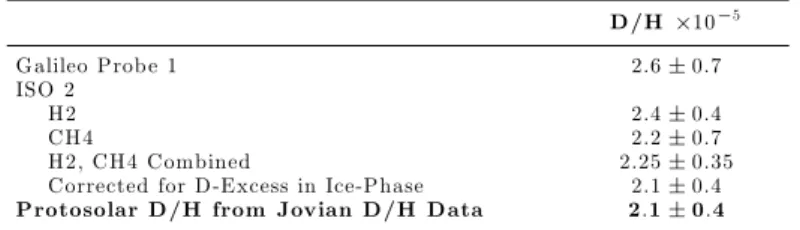
Table 4. Protosolar D/H from D/H in the Jovian Atmosphere. D /H ×10−5 G alileo Prob e 1 2.6± 0.7 ISO 2 H 2 2.4± 0.4 C H 4 2.2± 0.7 H 2, C H 4 C ombined 2.25± 0.35
C orrected for D -Excess in Ice-Phase 2.1± 0.4
P rotosolar D /H from Jovian D /H D ata 2.1± 0.4
et al. (2001) measured D/H = (2.40 ± 0.4) × 10−5 in molecular hydrogen and D/H = (2.2± 0.7) × 10−5 in methane. Recently, B´ezard (2002) obtained a D/H ratio in the methane below < 2× 10⁻⁵. We adopt here the results of Lellouch et al. (2001) who combined their two determinations and obtained D/H = (2.25± 0.35) × 10−5 as representative for Jupiter.
For the other method, the relation
(D/H)Protosolar = (4.1)
{[(D + 3He)/4He]Protosolar− (3He/4He)Protosolar} × (He/H)
Protosolar is used. With protosolar (D + 3He)/4He = (3.68± 0.25) × 10−5, protosolar 3He/4He = (1.66+ 0.06−0.10)× 10−4 (cf. Table 3) and protosolar H/He = 10.28 (Bahcall, Pinsonneault & Wasserburg (1995)) we obtain (D/H)Protosolar = (1.97± 0.3) × 10−5 (Table 5).
Jupiters D/H ratio is probably enriched above the protosolar value by the admixture of deuterium-rich ices to the nebular gas during the planets formation (cf. Owen, 2003). According to Guillot (1999) the enrichment is about (5-10)%. Lellouch et al. (2001) have corrected their ISO value for this effect and obtain (D/H)Protosolar = (2.1± 0.4) × 10−5. The agreement between the D/H ratio determined using the solar wind value and that based on Jupiter measurements is excellent. We adopt (2.0±0.3)×10−5as the protosolar D/H ratio (Table 5).
5. Remarks and Conclusions
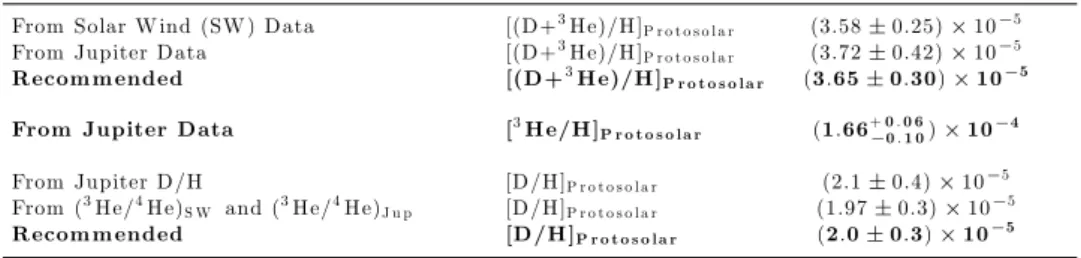
The protosolar abundances of hydrogen and helium isotopes are summarized in Table 5. We give “recommended abundances” whenever there are two independent values for the same abundance ratio. Our results are not very different from those in our earlier publications (Gloeckler & Geiss, 2000; Geiss & Gloeckler, 2003).
Deriving OCZ abundances from solar wind measurements could be improved, if data from experiments with different capabilities can be sensibly combined. Using Figure 2b, we present here an example. The SWC/Apollo 3He/4He ratio is 2.9% above the SWICS/Ulysses correlation line. There are two extremes we could consider: (1) Assuming that the 2.9% difference is due to a systematic error of the 3He/4He ratios determined with SWICS Ulysses and the difference of 2.9% was the same for all solar wind conditions covered in Figure 2b, the Apollo data would extrapolate to (3He/4He)
O C Z = 3.99×10⁻⁴. This value lies well within the systematic error limit assumed for the (3He/4He)
O C Zratio in Table 2. (2) As Figure 2a suggests, we assume that there are no systematic deviations between the 3He/4He values measured by the two instruments. In this case we correlate the SWC/Apollo slow wind data point with the high speed data point measured by SWICS/Ulysses and obtain (3He/4He)O C Z = 3.83× 10⁻⁴, about 1.3 % below the value given in Table 2. These examples demonstrate the potential of combining the composition data of two experiments.
Figure 3. The secular buildup of 3He at intermediate depth in the Sun as a function of Mr, (where Mr is the mass radius), calculated for a non-mixing Sun (Bochsler & Geiss, 1973) The buildup does not get close to the OCZ, but thorough experimental and theoretical investigations are needed to exclude contamination by3He produced at intermediate depth of the Sun.
Table 5. Protosolar Abundances.
From Solar W ind (SW ) D ata [(D +3H e)/H ]
P r o t o s o l a r (3.58± 0.25) × 10−5
From Jupiter D ata [(D +3H e)/H ]
P r o t o s o l a r (3.72± 0.42) × 10−5
R ecom m ended [(D +3H e)/H ]
P r o t o s o l a r (3.65± 0.30) × 10−5
From Jupiter D ata [3H e/H ]P r o t o s o l a r (1.66+ 0 . 0 6−0 . 1 0)× 10−4 From Jupiter D /H [D /H ]P r o t o s o l a r (2.1± 0.4) × 10−5
From (3H e/4H e)S W and (3H e/4H e)J u p [D /H ]P r o t o s o l a r (1.97± 0.3) × 10−5
R ecom m ended [D /H ]P r o t o s o l a r (2.0± 0.3) × 10−5
Presently, the uncertainties in the protosolar abundances are not so much due to mea-surement errors, but they result mainly from uncertainties in the transformation of solar wind or Jupiter data to protosolar values.
The systematic difference in H/He between OCZ and high-speed streams is caused mainly by ion-atom separation in or near the chromosphere (Geiss, 1982). Therefore, models applicable to corona ion fractionation cannot be applied to extend the (3He/4He) versus H/He correlation from the high-speed wind data to the OCZ abundance. Theories for ion-atom separation depending on photo-ionization time predict only very minor frac-tionation for3He/4He (von Steiger & Geiss, 1989). Since the difference between3He/4He in the High-Speed Streams and the OCZ is only 2% (see Figure 2), the error introduced by the extrapolation ought to be small.
The contamination of the OCZ with pp-produced 3He from below is one of the more serious uncertainties, but what could be done about this problem? The 9Be abundance gives us a solid argument against loss of3He in the OCZ due to nuclear reactions. There is no comparable argument against a raise of3He/4He in the OCZ by admixture of pp-produced3He. It is the other way around: a raise in time of3He in the OCZ or the solar wind is the most sensitive indicator for admixture of material to the OCZ from below, as was recognized long ago (Schatzman, Maeder, Angrand & Glowinski, 1981). Only by further theoretical studies and analyses of solar wind particles trapped in ancient dust and breccias could we further reduce the uncertainty of the protosolar (D+3He)/H ratio.
If we accept3He/4He = 1.66×10⁻⁴as measured in the Jovian atmosphere by Mahaffy
et al. (1998) as the protosolar value, then3He/4He in the “planetary gas” of meteorites would have been reduced by 10%. This seems to be a small reduction, considering that in the “planetary gas”20Ne/22Ne is reduced relative to the solar abundance by (25-30)% (Geiss et al. 2004) and36Ar/38Ar by 2% (Heber et al., 2009).
Considering that the age of the Sun is about 35% of the age of the Galaxy, the chemical evolution during this 35% time interval is small, and for many nuclear species, evolution in time disappears in the noise of local differences. The levelling of evolution is attributed to infall (Tosi, 1998), but there is no consensus on the nature of this infall. Studying the evolution of dwarf galaxies should help to clarify this point.
The principal effect of stellar processing is the conversion of D into3He with the sum (D +3He) remaining nearly constant (e.g. Geiss & Gloeckler, 2003). This was recognized when3He and D were determined in both the Protosolar Cloud and the Local Interstellar Cloud (Gloeckler & Geiss, 1996; Linsky, 1998). At the same time, theoretical studies showed (Charbonnel, 1998; Tosi, 1998) that3He from incomplete hydrogen burning could not have a large effect on the chemical evolution in the Galaxy. Since then, progress in understanding late Galactic evolution has slowed. Determining abundances of a larger number of nuclides in one and the same Galactic sample could correct this impasse better than further collecting scattered composition data. This could be accomplished with a mission similar to Ulysses but with the primary objective of measuring the composition of the Local Interstellar Cloud by determining abundances of elements and isotopes in the gas and dust that is entering the heliosphere. A study to identify the nuclear species in the Local Interstellar Cloud that could be determined in this way would be most worthwhile. Advanced solar wind composition measurement would be a second objective of such a mission. Moreover, comparing the differing paths of the physical and the chemical evolution of our Galaxy and dwarf galaxies would lead to identifying the nature and origin of the infall into the Milky Way.
Acknowledgements
The authors thank Rudolf von Steiger and Rudolf Treumann for discussions. J. G. is grateful to the ISSI directors and staff for their support. The work of G. G. was supported in part by NASA’s Ulysses Heliophysics Investigation NNX09AH726 and the ACE Data Analysis Contract, 44A-1080828.
References
Bahcall, J. N., Pinsonneault, M. H., & Wasserburg, G. J. 1995, Rev. Mod. Phys., 67, 781 Beer, R. & Taylor, F. W. 1973, ApJ, 179, 309
B´ezard, B. 2002, in: Highlights in Astronomy (Astron. Soc. Pacific: San Francisco) Vol. 12, pp. 607
Bochsler, P. & Geiss, J. 1973, Solar Phys., 32, 3 B¨urgi, A. & Geiss, J. 1986, Solar Phys., 103, 347
Busemann, H., Baur, H., & Wieler, R. 2000, Meteorites & Planetary Sci., 35, 949
Charbonnel, C. 1998, in: Space Science Series of ISSI, SSSI-4, and Space Sci. Rev., 84, 199 Drossart, P., Encrenaz, T., Combes, M., Kunde, V., & Hanel, R. 1982, Icarus, 49, 416-426 Eberhardt, P. 1974, Earth Planet. Sci. Lett., 24, 182
Encrenaz, Th., de Graauw, Th., Schaeidt, S., Lellouch, E., Feuchtgruber, H., Beintema, D. A., B´ezard, B., Drossart, P., Griffin, M., Heras, A., Kessler, M., Leech, K., Morris, P., Roelfsema, P. R., Roos-Serote, M., Salama, A., Vandenbussche, B., Valentijn, E. A., Davis, G. R., & Naylor, D. A. 1996, A&A, 315, L397
Ezer, D. & Cameron, A. G. W. 1965, in Solar Wind Three (University of California Press: Los Angeles), pp. 58
Frick, U. & Moniot, R. K. 1977, in Eighth Lunar Science Conference (Pergamon Press: New York), Vol. 1, pp. 229
Gautier, D. & Morel, P. 1997, A&A, 323, L9 Geiss, J. 1982, Space Sci. Rev., 33, 201
Geiss, J. & Gloeckler, G. 1998, in Space Science Series of ISSI, SSSI-4, and Space Sci. Rev., 84, 239
Geiss, J. & Gloeckler, G. 2003, in Space Science Series of ISSI, SSSI-16, and Space Sci. Rev., 106, 3
Geiss, J. & Reeves, H. 1972, A&A, 18, 126
Geiss, J., Eberhardt, P., & Signer, P. 1966, Proposal to NASA for Apollo experiment S-080, (NASA archive, Record Number 14759)
Geiss, J., Eberhardt, P., B¨uhler, F., Meister, J., & Signer, P. 1970, J. Geophys. Res., 75, 5972 Geiss, J., Hirt, P., & Leutwyler, H. 1970, Solar Phys., 12, 458
Geiss, J., B¨uhler, F., Cerutti, H., Eberhardt, P., Filleux, Ch., Meister, J., & Signer, P. 2004,
Space Sci. Rev., 110, 307
Gloeckler, G. & Geiss, J. 1996, Nature, 381, 210
Gloeckler, G. & Geiss, J. 2000, in The Light Elements and their Evolution, Proc. IAU-Symp. Vol. 198, (IAU: Natal, Brazil) pp. 224
Grevesse, N. & Sauval, A. J. 1998, in Space Science Series of ISSI, SSSI-5, and Space Sci. Rev., 85, 161
Guillot, T. 1999, Planet. Space Sci., 47, 1183
Heber, V. S. Wieler, R., Baur, H., Olinger, C., Friedmann, T. A., & Burnett, D. S. 2009,
Geochimica et Cosmochimica Acta, 73, 7414
Isenberg, P. A. & Hollweg, J. V. 1983, J. Geophys. Res., 88, 3923
Lellouch, E., B´ezard, B., Fouchet, T., Feuchtgruber, H., Encrenaz, T., & de Graauw, T. 2001,
A&A, 370, 610
Linsky, J. L. 1998, in Space Science Series of ISSI, SSSI-4, and Space Sci. Rev., 84, 285 Mahaffy, P. R., Donahue, T. M., Atreya, S. K., Owen, T. C., & Niemann, H. B. 1998, in Space
Science Series of ISSI, SSSI-4, and Space Sci. Rev., 84, 251
Mazzitelli, I. & Moretti, M. 1980, ApJ, 235, 955
Niemann, H. B., Atreya, S. K., Carignan, G. R., Donahue, T. M., Haberman, J. A., Harpold, D. N., Hartle, R. E., Hunten, D. M., Kasprzak, W. T., Mahaffy, P. R., Owen, T. C., Spencer, N. W., & Way, S. H. 1998, Science, 272, 846
Owen, T. 2003, in Space Science Series of ISSI, SSSI-28, and Space Sci. Rev., 138, 301 P´erez Hern´andez, F. & Christensen-Dalsgaard, J. 1994, MNRAS, 269, 475
Schatzman, E., Maeder, A., Angrand, F., & Glowinski, R. 1981, A&A, 96, 1 von Steiger, R. & Geiss, J. 1989, A&A, 225, 222
Stevenson, D. J. & Salpeter, E. E. 1976, in Jupiter (University of Arizona Press: Tucson), pp. 85
Tosi, M. 1998, in Space Science Series of ISSI, SSSI-4, and Space Sci. Rev., 84, 207 Turck-Chi`eze, S., Nghiem, P., Couvidat, S., & Turcotte, S. 2001, Solar Phys., 200, 323 Vauclair, S. 1998, in Space Science Series of ISSI, SSSI-4, and Space Sci. Rev., 84, 256 Wieler, R. & Heber, V. S. 2003, in Space Science Series of ISSI, SSSI-16, and Space Sci. Rev.,
106, 197