ORIGINAL PAPER
Melanin-based coloration covaries with ovary size
in an age-specific manner in the barn owl
Alexandre Roulin
Received: 11 March 2009 / Revised: 18 May 2009 / Accepted: 20 May 2009 / Published online: 3 July 2009
# Springer-Verlag 2009
Abstract While the adaptive function of black eumelanin-based coloration is relatively well known, the function of reddish-brown pheomelanin-based coloration is still unclear. Only a few studies have shown or suggested that the degree of reddish-brownness is associated with predator– prey relationships, reproductive parameters, growth rate and immunity. To gain insight into the physiological correlates of melanin-based coloration, I collected barn owl (Tyto alba) cadavers and examined the covariation between this colour trait and ovary size, an organ that increases in size before reproduction. A relationship is expected because melanin-based coloration often covaries with sexual activity. The results showed that reddish-brown juveniles had larger ovaries than whiter juveniles particularly in individuals in poor condition and outside the breeding season, while in birds older than 2 years lightly coloured females had larger ovaries than reddish-brown conspecifics. As barn owls become less reddish-brown between the first and second year of age, the present study suggests that reddish-brown pheomelanic and whitish colorations are associated with juvenile- and adult-specific adaptations, respectively. Keywords Barn owl . Covariation . Eumelanin . Pheomelanin . Ovary
Introduction
In both vertebrates and invertebrates, the deposition of melanin pigments is responsible for many colourful traits.
While melanin-based coloration plays an important role in camouflage in many organisms (Majerus1998; Nachman et al. 2003; Roulin and Wink 2004; Caro 2005), the importance of this type of coloration in social interactions remains elusive. To gain insight into the potential adaptive function of melanin-based coloration, and particularly to identify the potential benefits an individual may derive by mating with a darkly or lightly coloured partner, an approach is to determine whether coloration is associated with physiological and behavioural traits. Dark colorations are due to the deposition of either pheomelanin pigments responsible for reddish-brown coloration or eumelanin pigments that give black and grey colorations. A recent review of the empirical literature has shown that in vertebrates the degree of blackness is frequently associated with sexual behaviour, aggressiveness, resistance to stres-sors and body mass (Ducrest et al. 2008). This indicates that eumelanin-based coloration can signal aspects of individual quality (McGraw2008) and thereby be involved in mate choice as shown in a number of species (e.g. Burley 1977; Dunn et al.2008; Fox et al.2002; Houtman and Falls
1994).
Much less is known about whether pheomelanin-based traits covary with similar phenotypic traits, as few studies have been carried on this aspect. In adult European rollers (Coracias garrulous) and western bluebirds (Sialia mex-icana), redder males were heavier (Silva et al. 2008; Budden and Dickinson 2009); in eastern bluebirds (Sialia sialis), redder males started reproductive activities earlier and produced more offspring (Siefferman and Hill 2003); while in the yellow warbler (Dendroica petechia), browner males fed their brood at a lower rate during incubation and chick rearing (Studd and Robertson 1985). In cross-fostering experiments, redder tawny owl (Strix aluco) mothers produced heavier foster offspring (Roulin et al. A. Roulin (*)
Department of Ecology and Evolution, Biophore, University of Lausanne,
1015 Lausanne, Switzerland e-mail: [email protected]
2004a); body mass of nestlings raised by foster parents was positively correlated with reddish-brown coloration of their biological mother both in the tawny owl and the barn owl (Tyto alba) (Roulin et al.2004a,2008; Piault et al. 2009). Another experiment in the tawny owl showed that dark reddish-brown females maintained a stronger level of antibody specifically directed against a vaccine for a longer period of time compared to pale reddish-brown females, but at a cost in terms of greater loss of body mass (Gasparini et al.2009; see also Galeotti and Sacchi2003). Finally, in the barn owl, dark reddish-brown males fed their brood at a higher rate than paler conspecifics and therefore they produced more fledglings (Roulin et al. 2001a). As we can see from this review, there is yet no data on a potential link between pheomelanin-based coloration and physiolog-ical parameters associated with reproductive activities. This contrasts with the situation prevailing for eumelanin-based coloration showing that in vertebrates darker eumelanic individuals are sexually more active and have higher amount of plasma circulating testosterone levels (Ducrest et al.2008).
As variation in reproductive success is usually higher in males than in females, most researchers interested in sexual selection theory have searched for covariation between gonad size, sex steroids and eumelanin-based coloration in males (Bubenik and Bubenik 1985; Møller and Erritzøe 1988; Hill 1994; West and Packer 2002; Roulin et al.2004b; Bókony et al.2008). Much less interest has been devoted to female-specific sexual functions even though females often vary in conspicuous traits such as coloration. Searching for covariation between female coloration and other phenotypic attributes is interesting for two reasons. First, significant covariation may indicate that females signal their quality to males who compete to secure the best partners (Owens and Thompson1994; Johnstone et al.1996; Kokko and Johnstone2002; Amundsen and Pärn 2006; Kraaijeveld et al. 2007). Second, even if variation in female coloration plays no role in male mate choice, a significant covariation may indicate that the production of pheomelanin-based coloration is associated with physi-ological parameters either because colour production is condition dependent or because genes involved in pheome-lanogenesis have pleiotropic effects. The ‘pleiotropy hypothesis’ implies that some of the variation in plumage coloration is selectively neutral or even maladaptive because the evolution of coloration is genetically con-strained by genetically correlated traits (e.g. Kraaijeveld and Reumer 2008). Selection on correlated traits could produce non-adaptive plumage colour until counter-selection reduces the genetic linkage (e.g. Lande1987).
In the barn owl, individuals vary continuously from dark reddish-brown to white (a pheomelanin-based trait) and from lightly to heavily marked with black spots of varying
size (eumelanin-based traits), two heritable traits that are not or weakly condition dependent in their expression (Roulin et al.1998,2008; Roulin and Dijkstra2003; Roulin 2004). Members of the two sexes can display any phenotype but females are on average darker pheomelanic and display more and larger black spots than males; the two colour traits are genetically correlated between the sexes, dark parents producing darkly coloured daughters and sons (Roulin et al.2001a). The size of black spots is positively associated with calcium physiology, gland size, feather quality, the ability to resist stressful environments and parasites, age at first reproduction and survival (Table 1), while lightly pheomelanic females initiate reproductive activities earlier in the season than dark reddish-brown females and they produce offspring that are better able to grow rapidly in high quality environments (Table1). Males appear to select their partner and to adjust reproductive investment based on the degree of female eumelanic coloration (Roulin1999; Roulin and Altwegg2007), while the exact role played by pheomelanin-based coloration in mate choice is still unclear. In the present paper, my intention is to investigate whether pheomelanin-based or eumelanin-based coloration is associated with ovary size measured in dead individuals. This species is particularly suited for such a study because the reproductive season is very long (February to November), and thus individuals found dead during the whole year can be used in an analysis. In animals, ovary size is positively associated with photoperiod (Horseman et al.1978; Velarde et al.2002), the onset of reproductive activities and food supply (Henderson et al.2000; Stelzer2001; Bagg et al.2004) and with clutch size (Trouvé et al. 1999; Henderson et al. 2000) but not with egg size (Trouvé et al.1999; Stelzer2001).
Materials and methods
From 1996 to 2008, I measured the size of ovaries in 242 cadavers collected dead along French highways in the Champagne and Lorraine regions (ten individuals in 1996, 49 in 1997, 26 in 1998, 29 in 1999, 32 in 2000, nine in 2001, 17 in 2003, ten in 2004, 12 in 2005, 13 in 2006, 28 in 2007 and seven in 2008). The ‘Société des Autoroutes Paris-Rhin-Rhône APRR’ collected bodies daily, and thus dead animals stayed less than a day on the roadside before being frozen at –20°C. I identified sex after gonad inspection. Two hundred and four individuals with a bursa of Fabricius were denoted ‘juveniles’ and 38 individuals without any bursa of Fabricius and that already moulted one or several primary or secondary wing feathers were classed as ‘adults’ (i.e. ≥2-year-old; Taylor 1993; personal observation). (I did not consider 27 individuals without any bursa of Fabricius and for which all wing feathers were
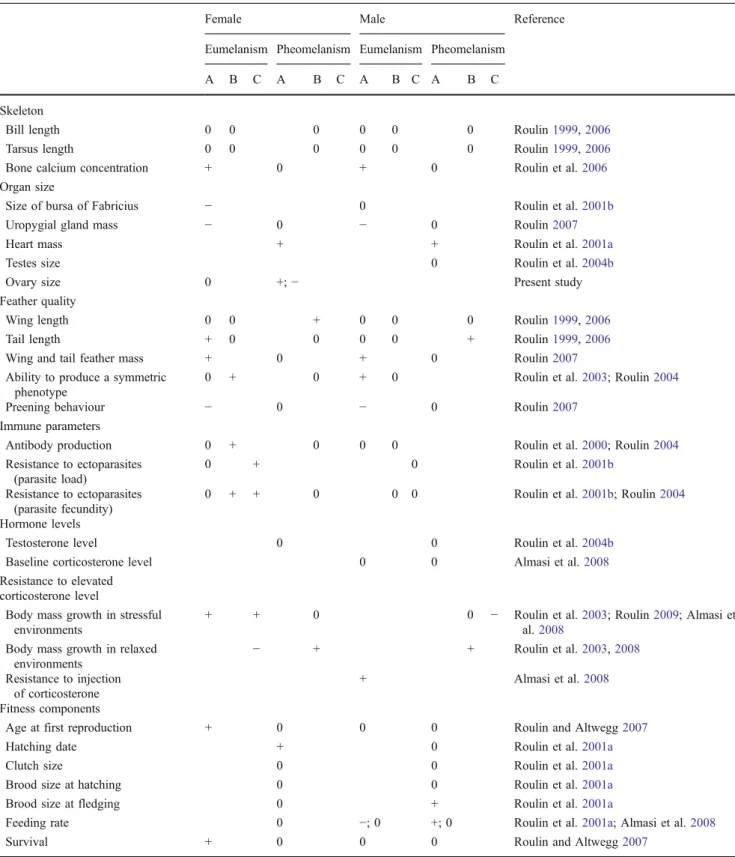
Table 1 Summary of published studies carried out on the covariation between melanin-based plumage traits and other phenotypic traits in the barn owl
Female Male Reference
Eumelanism Pheomelanism Eumelanism Pheomelanism
A B C A B C A B C A B C
Skeleton
Bill length 0 0 0 0 0 0 Roulin1999,2006
Tarsus length 0 0 0 0 0 0 Roulin1999,2006
Bone calcium concentration + 0 + 0 Roulin et al.2006
Organ size
Size of bursa of Fabricius − 0 Roulin et al.2001b
Uropygial gland mass − 0 − 0 Roulin2007
Heart mass + + Roulin et al.2001a
Testes size 0 Roulin et al.2004b
Ovary size 0 +;− Present study
Feather quality
Wing length 0 0 + 0 0 0 Roulin1999,2006
Tail length + 0 0 0 0 + Roulin1999,2006
Wing and tail feather mass + 0 + 0 Roulin2007
Ability to produce a symmetric phenotype
0 + 0 + 0 Roulin et al.2003; Roulin2004
Preening behaviour − 0 − 0 Roulin2007
Immune parameters
Antibody production 0 + 0 0 0 Roulin et al.2000; Roulin2004
Resistance to ectoparasites (parasite load)
0 + 0 Roulin et al.2001b
Resistance to ectoparasites (parasite fecundity)
0 + + 0 0 0 Roulin et al.2001b; Roulin2004
Hormone levels
Testosterone level 0 0 Roulin et al.2004b
Baseline corticosterone level 0 0 Almasi et al.2008
Resistance to elevated corticosterone level
Body mass growth in stressful environments
+ + 0 0 − Roulin et al.2003; Roulin2009; Almasi et
al.2008
Body mass growth in relaxed environments − + + Roulin et al.2003,2008 Resistance to injection of corticosterone + Almasi et al.2008 Fitness components
Age at first reproduction + 0 0 0 Roulin and Altwegg2007
Hatching date + 0 Roulin et al.2001a
Clutch size 0 0 Roulin et al.2001a
Brood size at hatching 0 0 Roulin et al.2001a
Brood size at fledging 0 + Roulin et al.2001a
Feeding rate 0 −; 0 +; 0 Roulin et al.2001a; Almasi et al.2008
Survival + 0 0 0 Roulin and Altwegg2007
Black eumelanic (i.e. diameter of spots located on the tip of feathers) and reddish-brown pheomelanic colorations are distinguished. Columns A indicate the sign of covariation between melanin-based coloration and other phenotypic traits measured within individuals (e.g. darker eumelanic females have a longer tail); columns B indicate the sign of covariation between colour traits measured in biological parents and other phenotypic traits measured in their offspring raised in a foster nest (e.g. darker pheomelanic fathers produce longer-tailed offspring that were raised by foster parents); columns C report the sign of covariation between colour traits measured in parents and phenotypic traits measured in their non-cross-fostered offspring
seemingly of the same generation because there was some doubt about their age.) Juveniles were collected between 5 August and 12 April (mean±SD=5 December±42 days) and adults between 13 August and 18 June (17 January± 75 days). Body mass (298 ±25 g) was given by the difference between the mass measured on the day of collection minus the mass of the stomach contents (11.9± 12.0 g); I removed stomach contents to minimise variation in body mass due to recent meals. I measured the length (13.2±2.7 mm) and width (4.6±1.5 mm) of ovaries to the nearest 0.1 mm; mass of ovaries was not recorded because of the difficulty of extracting them. In eight adults and 62 juveniles, I measured the diameter of the largest follicle to the nearest 0.1 mm (1.4±0.6 mm) to investigate whether this measure is correlated with ovary size, and thus with the degree of ovary maturation and in turn reproductive activities (e.g. Wikelski et al.2000).
On the breast of each individual, I scored pheomelanin-based coloration by comparison with eight colour chips ranging from I for reddish-brown to VIII for white. Then, I placed a 60×40 mm frame within which I counted black spots located at the tip of feathers and measured their diameter to the nearest 0.1 mm. Methods of assessing plumage traits are reliable (Roulin 1999, 2004). Because some individuals were damaged, I could not measure all plumage traits in all individuals, explaining discrepancies in sample sizes between analyses. Juveniles were darker pheomelanic than adults (juveniles—3.49±1.03; adults— 4.37±1.55; Student’s t test—t240=4.43, P<0.0001) and
displayed smaller (1.22±0.36 mm vs. 1.38±0.48 mm; t236=
2.42, P=0.016) but more black spots (52.5±23.4 vs. 44.6± 22.1; t236=−1.89, P=0.059). These age-specific patterns are
due to the fact that between the first and second year of age females become less pheomelanic and lose spots that also become larger (unpublished data). Nevertheless, an indi-vidual that is darker and more spotted than another individual at the juvenile stage is still darker and more spotted at adulthood (Roulin and Dijkstra2003). Barn owls can start to reproduce at the first year of age and the first moult of body feathers takes place not before the second year. As already shown in a Swiss population (Roulin 2004), darker pheomelanic owls displayed more (Pearson correlation, r=−0.29, n=233, P<0.0001) and larger black spots (r=−0.28, n=238, P<0.0001), and number and size of black spots were positively correlated (r=0.43, n=233, P<0.0001). Since ovaries are larger during the reproductive period (Horseman et al. 1978; Henderson et al. 2000; Stelzer 2001; Velarde et al. 2002; Baag et al. 2004), I statistically controlled for the number of days separating date of cadaver collection and the 1st of August, an arbitrary date for the end of the mating season for adults (in our population, egg laying dates span from 25 February to 30 July) and for the time of independence for juveniles.
For instance, number of days between the 13th of March vs. 2nd of September and the 1st of August is 224 and 32, respectively. In both juveniles and adults, plumage traits were neither correlated with date of cadaver collection nor with body mass (Pearson correlations, P values >0.24).
All statistical analyses were performed with the package JMP IN 5.1 (SAS Institute Inc., Cary, NC, USA), are two-tailed and P values smaller than 0.05 considered significant. Means are quoted ±SD.
Results
Follicle size was positively associated with ovary width (ANCOVA with follicle size as dependent variable, F1,63=
29.86, P<0.0001) but not with ovary length (F1,63=2.60,
P=0.11) after controlling for date (F1,63=3.25, P=0.07;
follicles tended to increase from the 1st of August onwards) and age (F1,63=7.43, P=0.008; follicles were smaller in
juveniles than in adults). Ovary width is thus an appropriate proxy of developmental stage of follicles, and for this reason I consider only this measure in subsequent analyses. In an ANCOVA with ovary width as dependent variable and age (juvenile vs. adult; F1,225= 19.57, P< 0.0001),
pheomelanin-based coloration (F1,225= 2.07, P= 0.15),
number of spots (F1,225=0.04, P=0.85) and spot diameter
(F1,225=0.004, P=0.95) as four independent variables, only
the interaction between age and pheomelanin-based colora-tion was significant (F1,225=15.41, P=0.0001) but not the
interactions between age and number of spots (F1,225=1.55,
P=0.21) and between age and spot diameter (F1,225=1.78,
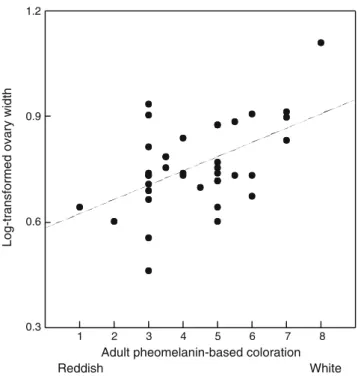
P=0.18). In juveniles, darker reddish-brown females had wider ovaries mainly when individuals had a low body mass (significant interaction between pheomelanin-based colora-tion and body mass in Table 2; Fig. 1). Furthermore, the negative relationship between pheomelanin-based coloration and ovary size was detected only outside the breeding season (significant interaction between pheomelanin-based colora-tion and date in Table 2). In contrast to juveniles, ovaries were bigger in whitish than reddish-brown adults (Fig. 2; Table 2); interactions between coloration, body mass and date were not significant (Table2). In these models, I did not control for the variable‘year’ because it did not explain any significant part of the variation in ovary width (P values >0.12). In juveniles and adults, ovary size increased with body size and from the 1st of August onwards (Table2).
Discussion
In French barn owls, ovary size was associated with the degree of pheomelanin-based coloration in interaction with age. In juveniles, ovaries were wider in dark than lighter
pheomelanic females particularly in individual in poor condition (Fig.1) and outside the breeding season, while in adults the opposite relationship was found with ovaries being wider in light than darker pheomelanic females (Fig.2) independently of date and body mass.
In female birds, variation in plumage traits is often associated with laying date, clutch size and egg size (Kraaijeveld et al. 2007). In a previous study in the barn owl, we showed that lightly reddish-brown individuals lay their clutch earlier in the season than dark reddish-brown conspecifics (Roulin et al.2001a), a relationship detected in adults but not in yearlings (Dreiss and Roulin, unpublished data). These unpublished results are consistent with the present study as ovaries were bigger in less pigmented pheomelanic adult females. Development of ovaries relies in part on luteinising hormone (LH), follicle-stimulating hormone (FSH) and sex steroids (Wingfield and Farner 1993) for which the level is partly under the control of melanocortins and agouti-signalling protein. The latter two hormones are involved in melanogenesis providing a potential proximate link between ovary size and melanin-based coloration (Ducrest et al.2008).
Has the covariation between laying date, ovary size and pheomelanin-based coloration a genetic basis or is it environmentally induced? Evidence for a relationship
between coloration and laying date comes from a study performed in Switzerland, while the covariation with ovary size has been detected in France, the two populations being distant of 260 km. Sign of covariation Table 2 Stepwise multiple regression on log10-transformed ovary
width with breast pheomelanin-based coloration, date (i.e. number of days separating date of cadaver collection and the first of August, an arbitrary date for the end of the mating season in adults and for the time of independence in juveniles) and body mass as three independent variables F df P Juvenile Pheomelanism (P) 0.05 1, 264 0.83 Body mass (B) 30.61 1, 264 <0.0001 Date (D) 66.09 1, 264 <0.0001 P×D 7.00 1, 264 0.009 P×B 9.64 1, 264 0.0021 B×D 1.79 1, 263 0.18 P×D×B 0.06 1, 262 0.81 Adult Pheomelanism (P) 9.74 1, 34 0.004 Body mass (B) 12.78 1, 34 0.001 Date (D) 5.56 1, 34 0.024 P×D 3.77 1, 33 0.06 P×B 0.76 1, 31 0.39 B×D 1.00 1, 32 0.32 P×D×B 1.11 1, 30 0.30
I removed non-significant interactions starting with the least signifi-cant ones, explaining why degrees of freedoms vary between factors. Separate tests were carried out for juveniles and adults
1 2 3 4 5 6 7 8 0.3 0.6 0.9 1.2
a
Log-transformed ovary width
Juvenile pheomelanin-based coloration
Reddish White
b
Log-transformed ovary width
Juvenile pheomelanin-based coloration
Reddish White 0 1 2 3 4 5 6 7 8 9 0.3 0.6 0.9 1.2
Fig. 1 Relationship between log10-transformed ovary width and pheomelanin-based coloration in juvenile barn owls for which body mass is a below or b above the median (298 g). Regression lines are drawn for illustrative purpose
between pheomelanin-based coloration and ovary size changes with age, an observation which is not consistent with the hypothesis of environmentally induced effects. This hypothesis would indeed imply that environmental conditions prevailing in France are favourable for dark owls in the first year of life but disadvantageous at adulthood. For this reason, I privilege the hypothesis that genes creating variation in the degree of pheomelanin-based coloration pleiotropically regulate sexual activities including ovary development. As recently suggested for vertebrates, the melanocortin system may provide a link between melanin-based coloration and other phenotypic traits including those associated with sexual activities and production of LH, FSH, testosterone and progester-one (Ducrest et al. 2008). Because birds become lighter coloured between the first and second year of age, the expression of genes involved in the melanocortin system may change between these two age classes potentially explaining why sign of the covariation between coloration and ovary size is different in juveniles and adults. Furthermore, gene expression might be sensitive to environmental factors as I found that the relationship between ovary size and pheomelanin-based coloration is stronger when juveniles are in poor condition and outside the breeding season. Context-dependent covariation between the degree of pheomelanin-based coloration and other phenotypic traits such as body condition has already been found in both the barn owl and tawny owl (Roulin et
al. 2008; Piault et al. 2009). These studies showed that, when food is available in large quantities, dark pheome-lanic nestlings grow better than lighter pheomepheome-lanic conspecifics. The present study shows that poor condition, as measured by body mass, negatively affects ovary size, an effect that is less pronounced in darker reddish-brown juvenile females.
The finding that the sign of covariation between pheomelanin-based coloration and ovary width is negative in juveniles and positive in adults has important implica-tions to understand the potential adaptive value of colour change with age. In many organisms, individuals change in coloration with age between the first and second year of life (e.g. Beauchamp 2003), a frequent pattern in species displaying melanin-based coloration (e.g. Ferguson-Lees and Christie2001). Although we can suspect that juvenile-and adult-specific colorations are associated with age-dependent adaptations (e.g. Vergara and Fargallo 2007), no clear advantage of being darkly pheomelanic at the juvenile stage and whitish at adulthood has yet been found. In many birds, individuals become more brightly coloured between the first and second year of age (e.g. Rohwer et al. 1980) probably due to physiological changes that might also trigger the age-dependent increase in reproductive success (Sæther 1990). For example, in black-headed grosbeaks Pheucticus melanocephalus, testis mass is positively associated with plumage brightness in yearlings but not in adults (Hill 1994). The present study in the barn owl suggests that the change from dark reddish-brown to a lighter coloration between the first and second year of age is associated with an improvement in fitness-related traits. Data in other animal species are required to examine whether results found in the barn owl are applicable to other species in which individuals vary in the degree of melanin-based coloration.
Assuming that in the barn owl the covariation between ovary size and pheomelanin-based coloration is partly under genetic control, selection on ovary size may constrain the evolution of plumage colour (e.g. Kraaijeveld and Reumer 2008). This non-adaptive genetic linkage may persist because selection needs to be strong and exerted during long periods of time to break down a genetic correlation (Lande 1987). Thus, it remains to tackle whether covariation between coloration and ovary size is adaptive or not both at the juvenile and adult stages, and whether males assess female pheomelanin-based coloration to select a partner. This proposition is interesting because it would imply that mate choice decisions are age dependent. However, I can still not exclude the possibility that covariation between ovary size and coloration is the result of selection being exerted in males rather in females. Hormones generating such a covariation may indeed have a more important function in males. For example, we found
1 2 3 4 5 6 7 8 0.3
0.6 0.9 1.2
Adult pheomelanin-based coloration
Reddish White
Log-transformed ovary width
Fig. 2 Relationship between log10-transformed ovary width and pheomelanin-based coloration in adult barn owls. Regression line is drawn for illustrative purpose
that in some years darker reddish-brown males invest more in feeding their progeny (Roulin et al.2001a), a trait that might be regulated by sex steroids that could also affect female parental and sexual activities.
Signalling function of pheomelanin-based and eumelanin-based coloration in the barn owl
Several papers have reported covariations between coloration and other phenotypic traits in the barn owl. The finding that covariations are sex specific and pigment specific led to the proposition that eumelanin-based and pheomelanin-based colorations play an important function in females and males, respectively (Roulin et al.2001b; Roulin and Altwegg2007). Furthermore, several observations and experiments showed that eumelanic and pheomelanic individuals are best adapted to poor and rich environments, respectively (Roulin et al. 2008). Table 1 shows that the degree of eumelanin-based coloration is positively associated with calcium physiology, gland size, feather quality, the ability to resist stressful environments and parasites, age at first reproduction and survival. Interestingly, the degree of pheomelanin-based coloration is associated with other phenotypic traits including heart mass, ovary size, wing and tail length, reproductive parameters, feeding rate, as well as the ability to grow rapidly in high quality environments. Even if in the barn owl eumelanin-based coloration is believed to be a female ornament and pheomelanin-based coloration a male orna-ment (Roulin 1999; Roulin and Altwegg 2007), the two colour traits were found to covary with other phenotypic traits in the two sexes probably because the genetic correlation between the sexes is strong (Roulin et al.2001a). Melanic colorations are correlated with many phenotypic traits (Table1; see also Jawor and Breitwisch2003; Ducrest et al.2008) and for this reason it might be difficult to draw an exhaustive list without understanding the underlying proximate mechanisms. Thus, our current research goal is to identify the genes involved in melanogenesis that pleiotropically regulate other phenotypic traits as explained in Ducrest et al. (2008). Melanogenesis is a process that is well conserved in vertebrates implying that knowledge accumulated in model organisms such as mice can be used to derive predictions regarding which gene might generate covariations between melanin-based coloration and other phenotypic traits. Preliminary results are promising in showing that, as expected from Ducrest et al. (2008), the proopiomelanocortin gene is polymorphic and associated with the degree of melanic pigmentation in the barn owl. Investigating proximate genetic mechanisms will provide useful insights into the exact adaptive function of melanin-based traits in both females and males. This is also necessary to determine why some phenotypic traits are associated only with pheomelanin-based coloration as
found for ovary size in the present study, only with eumelanin-based coloration or with both colour traits. This is particularly important because in some cases the two categories of melanin-based colour traits provide redundant information on specific phenotypic attributes such as resistance to oxidative stress (unpublished data) or infor-mation on different traits. As can be seen, the study of the adaptive function of melanin-based coloration is complex probably because genes involved in melanogenesis pleio-tropically regulate many other phenotypic traits.
Acknowledgements I thank Hughes Baudvin for having organised the collection of dead barn owls along French highways by the SAPRR (Société des Autoroutes Paris-Rhin-Rhône) and the Swiss National Science Foundation (grant PPOOA-102913) for financial support. Ken Kraaijeveld and an anonymous referee kindly provided useful comments to improve the manuscript.
References
Almasi B, Roulin A, Jenni-Eiermann S, Jenni L (2008) Parental investment and its sensitivity to corticosterone is linked to melanin-based coloration in barn owls. Horm Behav 54:217–223 Amundsen T, Pärn H (2006) Female coloration: review of functional and nonfunctional hypotheses. In: Hill GE, McGraw KJ (eds) Bird coloration, function and evolution. Harvard University Press, Cambridge, pp 280–345
Baag MA, Vassena R, Papasso-Brambilla E, Grupen CG, Armstrong DT, Gandolfi F (2004) Changes in ovarian, follicular, and oocyte morphology immediately after the onset of puberty are not accompanied by an increase in oocyte developmental compe-tence in the pig. Theriogenol 62:1003–1011
Beauchamp G (2003) Delayed maturation in birds in relation to social foraging and breeding competition. Evol Ecol Res 5:589–596
Bókony V, Garamszegi LZ, Hirschenhauser K, Liker A (2008) Testosterone and melanin-based black plumage coloration: a comparative study. Behav Ecol Sociobiol 62:1229–1238 Bubenik GA, Bubenik AB (1985) Seasonal variations in hair
pigmentation of white-tailed deer and their relationship to sexual activity and plasma testosterone. J Exp Zool 235:387–395 Budden AE, Dickinson JL (2009) Signals of quality and age: the
information content of multiple plumage ornaments in male western bluebirds Sialia mexicana. J Avian Biol 40:18–27 Burley N (1977) Parental investment, mate choice, and mate quality.
Proc Natl Acad Sci U S A 74:3476–3479
Caro T (2005) The adaptive significance of coloration in mammals. Bioscience 55:125–136
Ducrest A-L, Keller L, Roulin A (2008) Pleiotropy in the melano-cortin system, coloration and behavioural syndromes. Trends Ecol Evol 23:502–510
Dunn PO, Whittingham LA, Freeman-Gallant CR, DeCoste J (2008) Geographic variation in the function of ornaments in the common yellowthroat Geothlypis trichas. J Avian Biol 39:66–72 Ferguson-Lees J, Christie DA (2001) Raptors of the world. Helm
Identification Guides. Helm, London
Fox S, Johnson CN, Brooks R, Lewis MJ (2002) Polymorphism, mate choice and sexual selection in the Gouldian finch (Erythrura gouldiae). Aust J Zool 50:125–134
Galeotti P, Sacchi R (2003) Differential parasitaemia in the tawny owl (Strix aluco): effects of colour morphs and habitat. J Zool 261:91–99
Gasparini J, Bize P, Piault R, Wakamatsu K, Blount JD, Ducrest A-L, Roulin A (2009) Strength and cost of an induced immune response are associated with a heritable melanin-based colour trait in female tawny owls. J Anim Ecol 78(3):608–616 Henderson BA, Trivedi T, Collins N (2000) Annual cycle of energy
allocation to growth and reproduction of yellow perch. J Fish Biol 57:122–133
Hill GE (1994) Testis mass and subadult plumage in black-headed grosbeaks. Condor 96:626–630
Horseman ND, Smith CA, Culley DD (1978) Effects of age and photoperiod on ovary size and condition in bullfrogs (Rana catesbeiana Shaw) (Amphibia, Anura, Ranidae). J Herpetol 12:287–290
Houtman AM, Falls JB (1994) Negative assortative mating in the white-throated sparrow, Zonotrichia albicollis: the role of mate choice and intra-sexual competition. Anim Behav 48:377–383 Jawor JM, Breitwisch R (2003) Melanin ornaments, honesty, and
sexual selection. Auk 120:249–265
Johnstone RA, Reynolds JD, Deutsch JC (1996) Mutual mate choice and sex differences in choosiness. Evolution 50:1382–1391 Kokko H, Johnstone RA (2002) Why is mutual mate choice not the
norm? Operational sex ratios, sex roles and the evolution of sexually dimorphic and monomorphic signalling. Phil Trans R Soc Lond B 357:319–330
Kraaijeveld K, Reumer BM (2008) Constraints and the evolution of mutual ornamentation. In: Weber EA, Krause LH (eds) Animal behaviour, new research. Nova, New York
Kraaijeveld K, Kraaijeveld FJL, Komdeur J (2007) The evolution of mutual ornamentation. Anim Behav 74:657–677
Lande R (1987) Genetic correlations between the sexes in the evolution of sexual dimorphism and mating preferences. In: Bradbury JW, Andersson MB (eds) Sexual selection: testing the alternatives. Wiley, London, pp 83–94
Majerus MEN (1998) Melanism, evolution in action. Oxford University Press, Oxford
McGraw KJ (2008) An update on the honesty of melanin-based color signals in birds. Pigment Cell Melanoma Res 21:133–138 Møller AP, Erritzøe J (1988) Badge, body and testes sizes in house
sparrow Passer domesticus. Ornis Scand 19:72–73
Nachman MW, Hoekstra HE, D’Agostino SL (2003) The genetic basis of adaptive melanism in pocket mice. Proc Natl Acad Sci U S A 100:5268–5273
Owens IPF, Thompson DBA (1994) Sex differences, sex ratios and sex roles. Proc R Soc Lond B 258:93–99
Piault R, Gasparini J, Bize P, Jenni-Eiermann S, Roulin A (2009) Pheomelanin-based coloration and the ability to cope with variation in food supply and parasitism. Am Nat (in press) Rohwer S, Fretwell SD, Niles DM (1980) Delayed maturation in
passerine plumages and the deceptive acquisition of resources. Am Nat 115:400–437
Roulin A (1999) Nonrandom pairing by male barn owls Tyto alba with respect to a female plumage trait. Behav Ecol 10:688– 695
Roulin A (2004) Proximate basis of the covariation between a melanin-based female ornament and offspring quality. Oecologia 140:668–675
Roulin A (2006) Linkage disequilibrium between a melanin-based colour polymorphism and tail length in the barn owl. Biol J Linn Soc 88:475–488
Roulin A (2007) Melanin pigmentation negatively correlates with plumage preening effort in barn owls. Funct Ecol 21:264–271 Roulin A (2009) Covariation between eumelanic pigmentation and
body mass only under specific conditions. Naturwissenschaften 96:375–382
Roulin A, Altwegg R (2007) Breeding rate is associated with pheomelanism in male and with eumelanism in female barn owls. Behav Ecol 18:563–570
Roulin A, Dijkstra C (2003) Genetic and environmental components of variation in eumelanin and phaeomelanin sex-traits in the barn owl. Heredity 90:359–364
Roulin A, Wink M (2004) Predator–prey relationships and the evolution of genetic colour polymorphism. Biol J Linn Soc 81:565–578 Roulin A, Richner H, Ducrest A-L (1998) Genetic, environmental and
condition-dependent effects on female and male plumage ornamentation. Evolution 52:1451–1460
Roulin A, Jungi TW, Pfister H, Dijkstra C (2000) Female barn owls (Tyto alba) advertise good genes. Proc R Soc Lond B 267:937–941 Roulin A, Riols C, Dijkstra C, Ducrest A-L (2001a) Fe and
male-specific signals of quality in the barn owl. J Evol Biol 14:255–267 Roulin A, Riols C, Dijsktra C, Ducrest A-L (2001b) Female plumage spottiness and parasite resistance in the barn owl (Tyto alba). Behav Ecol 12:103–110
Roulin A, Ducrest A-L, Balloux F, Dijkstra C, Riols C (2003) A female melanin-ornament signals offspring fluctuating asymme-try in the barn owl. Proc R Soc Lond B 270:167–171
Roulin A, Bize P, Ravussin P-A, Broch L (2004a) Genetic and environmental effects on the covariation between colour poly-morphism and a life-history trait. Evol Ecol Res 6:1253–1260 Roulin A, Müller W, Sasvári L, Dijkstra C, Ducrest A-L, Riols C,
Wink M, Lubjuhn T (2004b) Extra-pair paternity, testes size and testosterone level in relation to colour polymorphism in the barn owl Tyto alba. J Avian Biol 35:492–500
Roulin A, Dauwe T, Blust R, Eens M, Beaud M (2006) A link between eumelanism and calcium physiology in the barn owl. Naturwissenschaften 93:426–430
Roulin A, Gasparini J, Bize P, Ritschard M, Richner H (2008) Melanin-based colorations signal strategies to cope with poor and rich environments. Behav Ecol Sociobiol 62:507–519
Sæther BE (1990) Age-specific variation in reproductive performance of birds. Curr Ornithol 7:251–283
Siefferman L, Hill GE (2003) Structural and melanin coloration indicate parental effort and reproductive success in male eastern bluebirds. Behav Ecol 14:855–861
Silva N, Avilés JM, Danchin E, Parejo D (2008) Informative content of multiple plumage-coloured traits in female and male European rollers. Behav Ecol Sociobiol 62:1969–1979
Stelzer C-P (2001) Resource limitation and reproductive effort in a planktonic rotifer. Ecology 82:2521–2533
Studd MV, Robertson RJ (1985) Sexual selection and variation in reproductive strategy in male yellow warblers (Dendroica petechia). Behav Ecol Sociobiol 17:101–109
Taylor IR (1993) Age and sex determination of barn owls Tyto alba alba. Ring Migr 14:94–102
Trouvé S, Jourdane J, Renaud F, Durand P, Morand S (1999) Adaptive sex allocation in a simultaneous hermaphrodite. Evolution 53:1599–1604 Velarde RAM, Wiedenmann RN, Voegtlin DJ (2002) Influence of photoperiod on the overwintering induction of Galerucella calmariensis L. BioControl 47:587–601
Vergara P, Fargallo JA (2007) Delayed plumage maturation in Eurasian kestrels: female mimicry, subordination signalling or both? Anim Behav 74:1505–1513
West PM, Packer C (2002) Sexual selection, temperature, and the lion’s mane. Science 297:1339–1343
Wikelski M, Hau M, Wingfield JC (2000) Seasonality of reproduction in a neotropical rain forest bird. Ecology 81:2458–2472 Wingfield JC, Farner DS (1993) Endocrinology of reproduction in
wild species. In: Farner DS, King JR, Parker KC (eds) Avian biology. Academic, London