HAL Id: hal-02968352
https://hal-univ-tlse3.archives-ouvertes.fr/hal-02968352
Submitted on 15 Oct 2020HAL is a multi-disciplinary open access
archive for the deposit and dissemination of sci-entific research documents, whether they are pub-lished or not. The documents may come from teaching and research institutions in France or abroad, or from public or private research centers.
L’archive ouverte pluridisciplinaire HAL, est destinée au dépôt et à la diffusion de documents scientifiques de niveau recherche, publiés ou non, émanant des établissements d’enseignement et de recherche français ou étrangers, des laboratoires publics ou privés.
higher education
Nicole Lancereau-Forster, Josiane Martinez
To cite this version:
Nicole Lancereau-Forster, Josiane Martinez. Interlinguistic insecurity in the workplace, an issue for higher education. Language Learning in Higher Education, De Gruyter, 2018, 8 (2), pp.375-398. �10.1515/cercles-2018-0021�. �hal-02968352�
Nicole Lancereau-Forster and Josiane Martinez
Interlinguistic insecurity in the workplace, an issue for higher education
Abstract
Due to globalization and the spread in the use of foreign languages in the workplace, language needs have been regularly and increasingly researched, whether from linguistic, psychological or socio-economic perspectives. The use of these languages, far from being neutral, gives rise to a whole set of attitudes, feelings, behaviours and representations from the speakers of these languages. It may also induce for employees situations of stress, work-related suffering and compromised promotion. This article deals with the interlinguistic insecurity of French employees using English as a foreign working language in oral communication. A
quantitative research enquiry involving 642 French employees from various fields of activity was carried out. It explored attitudes, feelings (for example foreign language anxiety or feelings of inferiority), behaviours (such as withdrawal) and representations (like awareness of shortcomings and desire for improvement) linked to interlinguistic insecurity in the workplace. The above attitudes and feelings were analysed in the light of three variables: gender, age and education level. The effects of these variables and their relevance were investigated. The results showed that education level was the prevalent variable and that interlinguistic insecurity is a real issue for higher and continuous education. Possible approaches to alleviate insecurity in the workplace were then considered on linguistic and cultural grounds.
Keywords: linguistic insecurity, interlinguistic insecurity, foreign working language, English
Nicole Lancereau-Forster (corresponding author) University of Toulouse, France
Josiane Martinez
University of Toulouse, France [email protected]
1 Introduction
Since the 1990s and the early years of the 21st century, language needs in the workplace have
been regularly and increasingly researched, whether from linguistic, psychological or socio-economic perspectives. Indeed in a global world, the spread of the use of foreign languages in the workplace rarely runs smoothly. The frequent belief that a foreign language could be a mere tool or an “instrument of communication” may imply, as Calvet (2015) writes, that the relation between the speaker and the language used is “neutral”. Yet the use of languages gives rise to a whole set of attitudes and feelings from the speakers of these languages, and linguistic attitudes undoubtedly have repercussions on linguistic behaviours. Among these attitudes, one emerged as a key issue from the research carried out at the LAIRDIL1 laboratory in its programme called OULis (Observatory of the use of languages in the workplace (Lancereau-Forster and Martinez 2015), namely linguistic insecurity. Although a crucial issue, linguistic insecurity in the workplace has been the focus of little research so far and our study tries to reduce this gap, more particularly with regard to language learning in higher education. Our research was conducted in the light of three variables deemed important by industrial partners in our OULis programme: gender, age and education level. Our overall aim is to alleviate linguistic insecurity in the workplace through the design of new language courses.
After defining the theoretical framework of linguistic insecurity, or rather
interlinguistic insecurity, in the workplace, this article deals with a quantitative research study carried out among French employees in 2016. It explores the attitudes, feelings, behaviours and representations linked to interlinguistic insecurity in oral communication.
1 LAIRDIL: Laboratoire Inter-universitaire de Recherche en Didactique LANSAD, Toulouse, Université Paul
2 Theoretical framework
2.1 Language needs in the workplace
In the late 1990s, several European studies dealing with language needs in the workplace were published (Huhta 1999; Hagen 1999). Some years later, the ELAN report (2006)
(Effects on the European Economy of Shortages of Foreign Language Skills in Enterprise)
stressed the effects of the lack of language skills in SMEs on the European economy, citing for example a loss of export contracts. In 2011, based on ELAN’s findings, the PIMLICO report (Promoting, Implementing, Mapping Language and Intercultural Communication Strategies) presented forty case studies of companies and their “good practice in the use of
language management strategies” (PIMLICO 2011: 8). This study was followed in 2013 by the CELAN report (CELAN 2013) (Language Strategies for Competitiveness and
Employability).
In 2015, a Languages and Employability (LEMP) project focused on the link between foreign languages and employability in French businesses. It showed both a quantitative and qualitative increase in the use of English in the French workplace. The prevalence of the English language in the workplace was highlighted:
English is top of the list of languages used in the workplace, with German, Spanish and Italian just behind. The need for greater linguistic diversity is clear as 21 foreign languages are cited by businesses. 22 languages are included by employers in the vacancies advertised by the public employment services. (LEMP 2015: 2)
Secondly, the importance of the use of foreign languages, whatever the position of the employees in the company, was also stressed:
Although executives and senior managers use foreign languages in all of their written and spoken forms, technicians, white and blue-collar workers all make use of written and verbal skills too. (LEMP 2015: 3)
The summary of the report declared that, in order to alleviate the difficulties met by
employees using a foreign language, some companies offered language courses to their staff and more particularly laid emphasis on “promoting personal skills development (increasing range of skills, helping staff to feel more at ease with a foreign language etc.)” (LEMP 2015: 4).
In parallel to these reports, international management researchers have also studied communication and language skills in the workplace and aim at making “the development of language in international business […] a research stream” (Brannen et al. 2014: 498). This is
illustrated by increasing research into feelings and attitudes, social identity and emotions (Klitmøller and Lauring 2013), career prospects (Piekkari 2008), cultural awareness and intercultural skills (Neeley 2012).
2.2 Linguistic insecurity
The notion of linguistic insecurity (LI) was first developed by the sociolinguist William Labov ([1966] 2006), as he investigated speech in New York City and studied the social stratification of English. He found a gap between the use of English by some speakers as observed by the linguist and the speaker’s own perception of a more “prestigious” language. In fact, Labov concluded that lower middle class speakers were more prone to experience LI since they hoped to emulate socially dominant groups. Women also showed higher LI than men. Labov noted that LI could have particular effects such as “superficial stigmata of
insecurity – hesitation, nervousness, self-correction and extreme style-shifting” (Labov [1966] 2006: 322).
Labov devised what he called an index of linguistic insecurity to measure LI; Owens & Baker (1984) latercreated a Canadian version of Labov’s index to study LI in Winnipeg and validate the index. Differences between socioeconomic categories and between males and females were found as in Labov’s initial study.
LI was subsequently regarded as an intralinguistic issue, particularly by French-speaking researchers (Guenier 1994; Bretegnier 1996; Bretegnier & Ledegen 2002; Francard 1993/ 1994). Francard, in Belgium, defined linguistic insecurity as “the manifestation of a quest for linguistic legitimacy” (1997) and referred to Bourdieu’s concept of “marché linguistique” (“linguistic marketplace”) with dominated groups striving to ascend the social ladder (1982). Calvet went a step further and suggested extending the notion of LI to interlinguistic contexts and particularly language contact situations:
L’insécurité peut aussi résulter de rapports que j’appellerai interlinguistiques, entre des langues différentes, et elle est alors le produit du plurilinguisme. [Insecurity may also come from relations which I would call interlinguistic, between different languages. It is therefore the product of plurilingualism. [Our translation] (1999: 160)
We can assume with Neeley (2017) that, when using a foreign language, “everyone is at least slightly uncomfortable detaching from a native language and culture”. This form of
interlinguistic discomfort or insecurity may be particularly crippling in the workplace when a foreign working language (FWL) has to be used. Neeley (2013) stresses the fact that language performance anxiety is so important that it may affect everyday behaviour of non-native
English-speaking employees in the workplace. Other researchers carried out studies on the use of a FWL. Holmes (2000) studied the challenges of using English in the workplace, particularly with regard to workplace small talk and social talk. Using a sociolinguistic approach, Deneire (2008) considered the anxiety caused by using English in French workplaces. More recently, Guntzviller et al. (2011) investigated the medical context and devised a scale to measure “foreign language anxiety in a medical office” (FLAMOS). Tenzer and Pudelko (2015) considered the business area and specifically studied “self-directed anxiety triggered by language barriers” (p. 17). Gargalianou et al. (2016) also explored foreign language anxiety (FLA) in professional Dutch environments. They concentrated on studying employees’ emotions when working in English as a foreign language and created a short scale to measure FLA in formal contexts. They also examined its link to gender and general personality traits. They concluded that women tended to experience more FLA than men in the workplace and suggested that this may be more the result of personality variables than of gender differences.
In our article, a wider scope was chosen and consisted in the study of linguistic insecurity as a whole including foreign language anxiety, among other feelings, attitudes and behaviours. Moreover, English being a FWL in French multinationals, we will use the more appropriate term interlinguistic insecurity to refer to this kind of insecurity. Thus, following Francard (1993/1994, 1997) and Calvet (1999, 2015), we can adopt the following working definition of interlinguistic insecurity (ILI) as being the attitude derived from the self-perception by an individual or a group of individuals of a gap or a distance between the foreign language they make use of and the foreign language as taught or used according to the existing norm.
In this article, the focus was on the attitudes, feelings and behaviours linked to ILI as regards oral communication in the workplace. Three variables were applied: gender, age and education level. The first two variables were chosen after discussions with a number of human resource managers. They had noticed differences in the levels of discomfort experienced by the different genders and age groups when using a FWL. We then added a third variable, that of education level as it directly affects employability and is of particular interest to university research laboratories. The research questions in this article investigated the way these variables applied, as well as the relevance of each one.
3 Methodology
3.1 Quantitative survey
In order to explore ILI, a questionnaire was devised and sent to French employees in a national and international context who use a foreign working language (FWL). In all cases, English was reported as the most often used FWL (by 99.07% of the respondents) and our research then focused on English. The first part of the questionnaire included social
characteristics such as gender, age, number of years at university, socio-professional category and field of activity. The second part of the questionnaire consisted in a list of 10 different feelings/attitudes, behaviours and representations linked to the use of English as a FWL (Appendix). The respondents were asked to rate each item on a Likert-type scale, from 1 to 5 (1 strongly disagree to 5 strongly agree), according to the feelings/ attitudes, behaviours or representations they were most likely to adopt when using English as a FWL.
The questionnaires were sent electronically to associations of former students and to companies. An important factor in order to avoid useless stress and ensure true and free answers were given was the fact that this questionnaire was anonymous. Only after the last question was a choice of leaving an electronic address and being contacted again given.
3.2 Respondents
A total of 642 people responded, 72% males and 28% females. The age groups of the respondents fell into 3 categories, shown in Table 1.
[Please insert Table 1 about here]
Respondents fell into two groups differing both in the duration of their studies and their academic qualifications. The first group was made up of former students of French universities (e.g. Institutes of Technology) who had studied for a Bachelor’s degree with, at the most, 3 years in higher education and were aiming at the job of technician. The second group consisted of former students of French universities or engineering schools who had passed at least a Master’s degree (4 or 5 years in higher education) and were aiming at a professional engineering or managerial position. For the students in this group, the universities would generally have made a selection after 4 years of study and only the top students would have entered the 5th year. In the case of engineering schools, the students would have undergone a selective entry process accepting only top students. In addition, these students would have undergone a period of internship abroad to acquire practical skills. To investigate the differences in interlinguistic insecurity between these two groups, the
respondents were classified into two categories: up to three years of HE, more than three years of HE. As Table 2 shows, a large majority of respondents had a higher level of studies (about four fifths of the total corpus).
[Please insert Table 2 about here]
As far as socio-professional category is concerned (Figure 1), a total of 84% of the respondents were chartered engineers, executives, managers, researchers and lecturers (> 3 years of HE). Conversely, the respondents with shorter studies (≤ 3 years of HE) were either technicians or intermediate staff (clerical, sales, service and administrative). This situation reflects the French reality in which a diploma or degree often paves the way to a job category.
[Please insert Figure 1 about here]
Our respondents reported a wide range of fields of activity. Figure 2 represents the variety of the fields (15) having a minimum of 10 occurrences. This variety had the advantage of providing us with a broad cross-section of the working world.
[Please insert Figure 2 about here]
3.3 Analysis
As the distribution of responses could not be assumed to be normally distributed, non-parametric tests were used: Wilcoxon rank sum test (also known as the Mann-Whitney test) for two independent samples, and the Kruskal-Wallis test for multiple independent samples. (Hinton [2004] 2008).
4 Results
Horwitz et al. defined FLA (Foreign Language Anxiety) as a “distinct complex of self-perceptions, beliefs, feelings and behaviors related to classroom language learning” (1991: 31). In our study, we chose to use these categories as a starting point. These were adapted so as to explore the possible markers of interlinguistic insecurity: feelings/attitudes (including self-perceptions and beliefs) and behaviours. Finally, the category of
representations/expectations was added in order to capture any positive aspects counter-balancing interlinguistic insecurity.
4.1 Feelings/ Attitudes
Feelings when using English as a FWL were first studied, following a Likert-type scale of 1 to 5 (1 strongly disagree to 5 strongly agree). Charts were drawn to show the influences of three variables, namely gender, age and education level.
4.1.1 Fear of being ridiculed if making mistakes
As is mentioned in the CEFR (2001: 155), a distinction is to be made between errors and mistakes:
Errors are due to an ‘interlanguage’, a simplified or distorted representation of the target competence. When the learner makes errors, his performance truly accords with his competence, which has developed characteristics different from those of L2 norms. Mistakes, on the other hand, occur in performance when a user/learner (as might be the case with a native speaker) does not bring his competences properly into action.
Yet even though this dichotomy does exist, our respondents gave a general answer to this question.
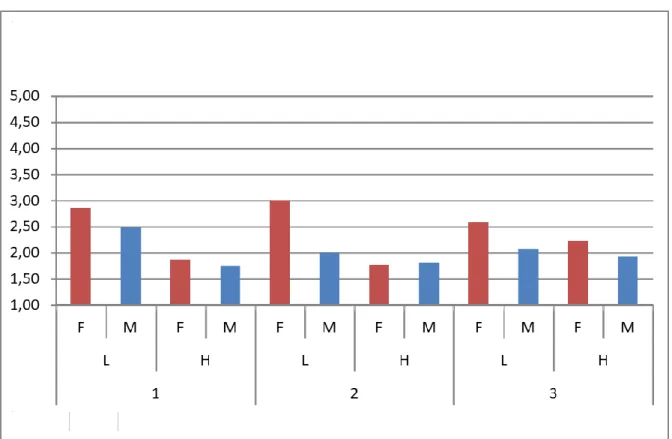
The following figure depicts the fear of being ridiculed if making mistakes. The y-axis represents the mean scores of the answers (1–5). The x-axis represents the different variables that are: F/M for gender, L/H for lower or higher education level and 1, 2 and 3 for the different age groups.
[Please insert Figure 3]
The results of the combination of these three variables will be presented in the graphs of the article so as to stress the different interactions.
With this combination, we can see that less well-qualified younger women (FL1) experience the most fear of being ridiculed if making mistakes. Women seem to be more aware of the negative effects of language mistakes and may be more concerned with linguistic standards and rules. Conversely, highly qualified older men (MH3) feel the least fear. Higher qualified males, whatever their ages, appear more constant and self-confident. This may correspond to the fact that they will occupy a higher position in the company, keeping in mind that, as discussed above, socio-professional categories in France are usually linked to the education level.
We conjecture that a higher education level implies a better mastery of the language, hence fewer mistakes made.
4.1.2 Awareness of French accent
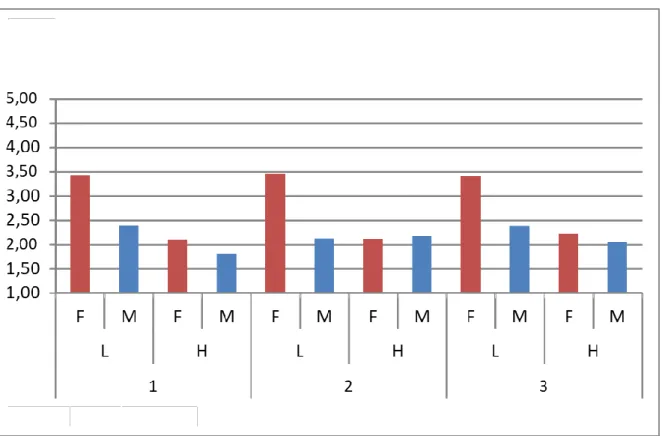
The item of the questionnaire was: “I am aware that I have a French accent and that bothers me”. In Labov’s work, although one single language was considered, linguistic insecurity appeared in the variation of the pronunciation. After the study of the fear of making mistakes, we wanted to know the part occupied by the difficulties due to pronunciation, intonation and foreign accent.
[Please insert Figure 4]
Apart from less well-qualified younger women (FL1), the answers are quite
homogeneous. The respondents do not seem very affected by their foreign accent, even if they are aware of it. A previous study showed that only 16% of the French technicians surveyed regarded pronunciation and intonation as problematical (Lancereau-Forster 2014). Awareness of the importance of the accent tends to remain stable with professional experience.
4.1.3 Feeling of inferiority
The awareness of the existence of people who communicate better in English can create a feeling of inferiority. They may be native speakers or colleagues with a higher mastery of English. The feeling of inferiority may also come from a mental comparison of the discourse they would hold in their mother tongue with the discourse held in a foreign language, simpler, more limited and lacking nuances, as summed up in the “Keep it short and simple” formula often used in the workplace. Neeley (2014) makes this point in an interview:
I’ve written about this for years, where you have these incredibly competent employees who are experts in their various areas of work. They say they feel “childlike” when they have to switch to the working language. It affects how they contribute.
[Please insert Figure 5 about here]
The highest scores are for lower-educated, middle-aged women and men. We
conjecture that they are likely to feel inferior because of their short studies, their professional pressure and responsibilities linked to a career peak. For all those reasons, they may become more aware of their linguistic lacks and needs.
4.1.4 Foreign language anxiety (FLA)
MacIntyre and Gardner described FLA as “[t]he feeling of tension and apprehension
specifically associated with second language (L2) contexts, including speaking, listening and learning” (1994: 284). MacIntyre later mentions “the worry and negative emotional reaction aroused when learning or using a second language” (MacIntyre 1999: 27). We wanted to observe if this feeling existed in the working world.
[Please insert Figure 6 about here]
Lower-educated women feel the most FLA, whatever their ages. Higher-educated women in the three age groups appear to experience practically the same level of FLA as higher-educated men in the three age groups.
Gargalianou (2016) noted that women tended to experience more FLA than men in the workplace. Yet by adding the variable of education to our study, we can see that higher-educated women experience the same level of FLA as higher-higher-educated men, which is particularly noteworthy.
Two reasons could explain this situation. First, longer study and different syllabuses could give a better command of the foreign language and hence alleviate FLA. Second, the motivation of higher-educated women who want to be regarded as equal to their male
colleagues could play a part in the decrease in FLA. Trudgill pointed to this change in society for language as a whole:
If the social roles of men and women change, moreover, as they seem to be doing currently in many societies, then it is likely that gender differences in language will change or diminish also. (2000: 79–80)
4.2 Behaviours
These feelings give rise to varied behaviours. We studied 3 examples of these behaviours, which are withdrawal, incapacity to improvise and awareness of inadequate cultural behaviours.
4.2.1 Withdrawal
Some human resources managers told us in preliminary studies (Lancereau-Forster 2013, Lancereau-Forster and Martinez 2015) that the main problem faced by French employees having to use English as a FWL was “mental block”, with difficulties or incapacity to express himself or herself in the foreign language. This may lead to partial or total silence with hardly any willingness to communicate but a will to escape from speaking the foreign language.
[Please insert Figure 7 about here]
Our results regarding mental block and withdrawal show that lower-educated women are more affected than any other group, whatever their ages. By contrast, higher-educated women feel no more hindered than men (or even less so), with the exception of older higher-educated women.
Lower-educated men and women in age group 1 appear to have a high level of mental block, which could be linked to a “school-like” attitude, in which silence is a solution. Yet in the workplace the employee is expected to be involved and active.
4.2.2 Avoiding improvisation
To escape from this “silent way”, the employees may have to resort to improvisation. This latter term was defined by Hodgson and Richards (1974) as “spontaneous response to the unfolding of an unexpected situation”. Landy (1982) also referred to improvisation as “an unscripted, unrehearsed, spontaneous set of actions”. Improvisation may then be a source of stress, all the more as a quick response is usually expected. Employees may or may not be ready to improvise.
Figure 8 shows capacity/incapacity to cope with improvisation.
[Please insert Figure 8 about here]
We can observe that the profile of the answers for resorting to improvisation is quite similar to the previous one, that of the mental block. Mental block could explain the
difficulties encountered by individuals in improvising.
The averages are clearly higher for lower-educated women (whatever their age
groups) having to improvise. This might suggest that the faculty of improvising increases with the practise of the foreign language and a better mastery of it.
4.2.3 Awareness of inadequate cultural behaviours linked to language use
Some employees lacking the knowledge of appropriate cultural behaviours may choose to transfer their usual cultural behaviours (linked to their mother tongue) over a particular communication context, even though they are aware of their inadequacy. Others may also choose wrong behaviours or refrain from acting.
The scores are generally homogeneous and fairly high. The employees are aware that problems may exist both on the linguistic level and the cultural one. This could be the case of socializing in the professional context (“small talk”, for example) or working in an
international team. Nevertheless, group FL2 scores the highest. These women may have a better position than when they were FL1 and may be more aware of the importance of specific cultural behaviours.
4.3 Representations and expectations
As a third part, we tried to discover if, in spite of this linguistic insecurity, the employees could see some positive aspects in the use of a FL in the workplace.
4.3.1 Linguistic enjoyment
The employees were asked if they enjoyed using a FL in the workplace.
[Please insert Figure 10 about here]
The response values are generally quite high and stand in contrast with the previous answers. This implies that most employees, although being faced with hurdles, are able to overcome them and adopt a positive attitude. However, younger lower-educated women and older lower-educated men report feeling less enjoyment. For the second category, the use of a FL in the workplace has been a relatively recent phenomenon in France and older lower-educated people may resent it and feel it has been imposed on them (Lancereau-Forster 2013: 385–387).
4.3.2 Cultural enjoyment
The employees were asked whether they were eager to discover another culture.
[Please insert Figure 11 about here]
The results obtained reach the highest scores for everyone, especially for age groups 1 and 2. In this case, the gender variable is not relevant, men and women feeling the same desire to explore new cultural horizons.
We saw earlier that some employees admitted lacking appropriate cultural behaviours regarding the use of a FWL. Nevertheless, they are able to keep a positive representation of the foreign culture. Despite their awareness of linguistic and cultural insecurity and the
suffering the employees may experience as a result of them, they are able to foresee solutions or remediation.
4.3.3 Desire for improvement
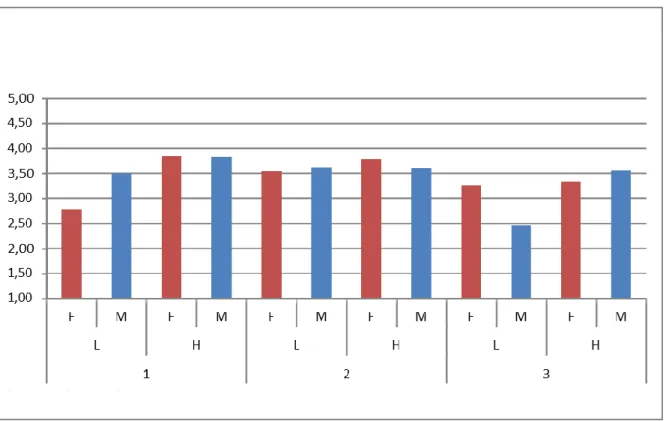
Finally, the employees were asked if their desire for improvement kept increasing.
[Please insert Figure 12 about here]
This graph shows that most employees display quite a high desire for progress. Here again, the gender variable appears irrelevant.
Middle-aged lower-educated employees have a greater desire for progress. This is probably due to maximum work stress related to the use of English and often linked to new career prospects. Secondly, older employees, whatever their education level, are not
statistically different (p = 0.162). They may show more resistance to, or less adhesion to, the fact of having to use a foreign language in the workplace. They may regard English as a mandatory tool (Lancereau-Forster 2013: 225).
These last three graphs demonstrate that the “game is not over”. Indeed, linguistic and cultural enjoyment as well as a desire for progress reveal an existing motivation which can be built upon in educational targets at the university.
4.4 Synthesis and discussion
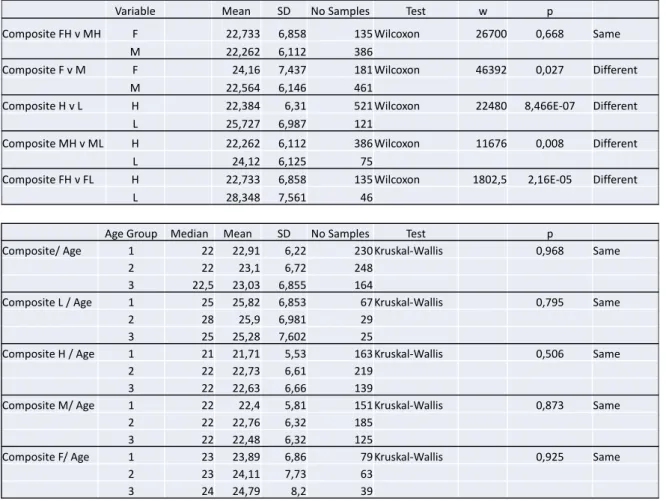
From the previous analysis and observations, we can present a composite chart to synthesize the results obtained both regarding the relevance of each of the three variables and all the items of the questionnaire (Items 1, 5 and 9, being positive scale items, had to be reversed in our analysis).
[Please insert Figure 13 about here]
[Please insert Table 3 about here] Table 3 Statistical analysis of composite data with different variables
In the composite chart, the obvious differences correspond to the FL group, whatever the age group, with the highest level of ILI. This is corroborated by the comparison in which groups FH and MH are the same (p=0.668) and groups FL and FH are different (p=0.00002). In other words, the composite chart shows that the level of ILI is the same for higher-educated women as for higher-educated men. The gender variable is not relevant, whereas the
education level is a key factor. Another major result is that ILI is higher for lower-educated women than for higher-educated women. In this context, the education level variable is also relevant.
As a comparison, the following results have to be highlighted: groups ML and MH are different (p=0.008) and groups FL and ML are different (p=0.002). ILI is higher for lower-educated men than for higher-lower-educated men. The education level variable is relevant. Then, with the same education level (low), women experience more ILI than men. The gender variable plays a part in this case. To sum up, in 3 cases out of 4, the education level variable comes first. We can add that the age variable does not affect the general pattern in the chart.
The main conclusion that can be drawn from these results is that, according to our findings, the education level is the most relevant variable accounting for interlinguistic insecurity in the workplace, followed by the gender and age variables.
The grid of our questionnaire can also be adapted as a scale to measure ILI in the workplace. The answers to all items, except items 1, 5 and 9, can give rise to an individual profile regarding ILI. The answers to 1, 5 and 9 have to be processed inversely as they are positive items (1= maximum ILI and 5 =minimum ILI). The latter indicate a more or less positive attitude from the employees. A higher level of motivation would increase the capacity for improvement. The composite scale we obtained could be used for further research, adapting the items to various countries as appropriate.
Interlinguistic insecurity in the workplace appears as a real issue for higher education and requires means for alleviation in order to reach what MacIntyre et al. (1998) regard as
the ultimate goal of the learning process [which] should be to engender in language education students’ willingness to seek out communication
opportunities and the willingness actually to communicate in them” (p. 547). This study of the three variables, gender, age and education level, demonstrates that solutions to ILI in the workplace could come from higher education courses and continuous learning. Teachers could be informed of this type of research on the use of English in the workplace and consequently become more aware of the expectations of the working world. Taking into consideration feelings, attitudes, behaviours and representations like the ones presented in our study could support the creation of new syllabuses targeting psycholinguistic factors, among others, to alleviate ILI. For example, in order to improve the pronunciation issue, syllables and lexical stress patterns could be focused on, as suggested by Stenton’s research (2013) which calls for annotated, sound-synchronised on-screen text for better cognition. New directions to follow could be an innovative emphasis on the development of improvisation
skills and debating to fight inhibition and reinforce self-confidence. The practice of “small talk” or role plays in simulated job environments (serious games) could also be motivating to develop instinctive reactions and gain spontaneity. Some of these activities could take place in Language Centres just as activities like videoconferences, teleconferences and telephone conversations so as to train the students for these usual forms of communication in the workplace.
The connections between higher education and the working world have to become close-knit so that the needs of both parties may be known and acknowledged. Some forms of cooperation could be defined, such as that of creating “shadow” employees with student trainees observing the linguistic difficulties faced by their fellow employees carrying out their daily tasks. Video CVs or videos of business meetings could be used to correct mistakes. This knowledge could then be collected by research organizations like OULis, the observatory, to set up resources for both universities and the working world.
5 Conclusion
This study dealt with the issue of the interlinguistic insecurity (ILI) in the oral communication of French employees using English as a foreign working language. First, the existence of ILI in the workplace was confirmed, as shown by the feelings, attitudes, behaviours and
representations explored. This research, however, was based on self-declared assertions. The employees may have under-reported the level of their difficulties because the fear of making mistakes in the use of FWL may have hidden the fear of being judged by the management. Nevertheless, the employees are both aware of the management expectations in favour of a very good command of the FL and of their own shortcomings and weaknesses.
Yet, even though employees declare their difficulties and the effects of their ILI, they do not reject the use of a FWL and show willingness to adapt and improve their command of the FWL. This fact could give food for thought to universities and language teachers and encourage the design of new courses. Further, with knowledge of appropriate sociocultural behaviours linked to languages, the learner might feel more at ease with the foreign language and better prepared for its use in his or her future workplace.
Our research examined the French context. For comparison, similar studies could be carried out as regards ILI variations in other countries. Other foreign languages could be also researched, either instead of English or as well as English, comparing the levels of ILI in the workplace.
References
Bourdieu, Pierre. 1982. Ce que parler veut dire: l'économie des échanges linguistiques. Paris: Fayard.
Brannen, Mary Y., Piekkari, Rebecca and Susanne Tietze. 2014. The multifaceted role of language in international business: Unpacking the forms, functions and features of a critical challenge to MNC theory and performance. Journal of International Business
Studies 45, 495–507
Bretegnier, Aude. 1996. L’insécurité linguistique: objet insécurisé? Essai de synthèse et perspectives. In Didier de Robillard and Michel Beniamino (eds). Le français dans
l’espace francophone, Tome II. 903–919. Paris: Honoré-Champion.
Bretegnier Aude, Ledegen, Gudrun (eds.). 2002. Sécurité/ insécurité linguistique, terrains et
approches diversifiées, propositions théoriques et méthodologiques, actes de la 5e Table
Ronde du Moufia, (22–24 avril 1998), LCF- UMR 6058 du CNRS. Université de la Réunion. Paris: L’Harmattan.
Calvet, Louis-Jean. 1999. Pour une écologie des langues du monde. Paris: Plon.
Calvet, Louis-Jean. 2015. La sociolinguistique. Paris: PUF.
CEFR. Common European Framework of Reference for Languages. 2001. https://rm.coe.int/1680459f97 (accessed 29 May 2017).
CELAN report. 2013. http://www.celan-platform.eu/assets/files/D1.3-Business_Needs_Report-Final.pdf. (accessed 10 April 2017).
Deneire, Marc. 2008. English in the French workplace: realism and anxieties. World
Englishes 27(2). 181–195.
ELAN report. 2006.
http://ec.europa.eu/dgs/education_culture/repository/languages/policy/strategic-framework/documents/elan_en.pdf (accessed 10 April 2017).
Francard, Michel. 1997. In Marie-Louise Moreau (ed.). Sociolinguistique. Concepts de base, 170–176. Liège: Madraga.
Francard, Michel (ed.). 1993/1994. L’insécurité linguistique dans les communautés
francophones périphériques. Cahiers de l’Institut de linguistique de Louvain-la-Neuve,
vol. 1 et 2.
Gargalianou, Vasiliki, Muehlfeld, Katrin, Urbig, Diemo & Arjen Van Witteloostuijn. 2016. Foreign Language Anxiety in Professional Contexts. A Short Scale and Evidence of Personality and Gender Differences. Schmalenbach Business Review 17(2). 195–223.
Gueunier, Nicole. 1994. Sécurité / insécurité linguistiques chez les étudiants et les jeunes enseignants de français. Le français aujourd’hui 105. 111–118.
Guntzviller, Lisa M., Jensen, Jakob D., King Andy J. & LaShara A. Davis. 2011. The Foreign Language Anxiety in a Medical Office Scale: Developing and Validating a
Measurement Tool for Spanish-Speaking Individuals. Journal of Health
Communication 16(8). 849–869.
Hagen, Stephen. 1999. Business communication across borders: a study of language use and
practice in European companies. London, U.K.: Languages National Training
Organisation.
Hinton, Perry R. [2004] 2008. 2nd ed. Statistics Explained. London: Routledge.
Hodgson, John & Ernest, Richards. 1974. Improvisation. London: Eyre Methuen. Holmes, Janet. 2000. Talking English from 9 to 5: challenges for ESL learners at work.
International Journal of Applied Linguistics 10(1). 125–140.
Horwitz, Elaine K., Michael B. Horwitz and Joann Cope. 1991. Foreign language classroom anxiety. In Language anxiety: from theory and research to classroom implications, eds. Elaine K. Horwitz, Dolly J. Young. 27–39. Englewood Cliffs: Prentice Hall.
Huhta, Marjatta. 1999. Language/Communication Skills in Industry and Business – Report for
Prolang/Finland. <http://www.oph.fi/download/47735_skills42.pdf>. (accessed
10/04/2017).
Klitmøller, Anders, & Jakob Lauring. 2013. When global virtual teams share knowledge: Media richness, cultural difference and language commonality. Journal of World
Business 48(3). 398–406.
Labov, William. [1966] 2006. The social stratification of English in New York City. 2nd ed. Cambridge UK: Cambridge University Press.
Lancereau-Forster, Nicole. 2013. L’anglais comme langue de formation en IUT et langue de travail dans le domaine aéronautique industriel. Thèse de doctorat. Toulouse: Université de Toulouse 3.
Lancereau-Forster, Nicole. 2014. Variation de la perception de besoins langagiers dans un contexte d’IUT (Institut Universitaire de Technologie), Recherche et pratiques
pédagogiques en langues de spécialité. XXXIII(1). 151–167.
http://apliut.revues.org/4222 (accessed 13 April 2017).
Lancereau-Forster, Nicole & Josiane Martinez. 2015. La gestion linguistique des entreprises. Communication 1ères rencontres de l’Observatoire OULis. Université de Toulouse, 19 juin.
Landy, Robert J. 1982. Handbook of Educational drama and theater. London: Greenwood Press.
LEMP. 2015. Summary of survey report: Analysis of the foreign language skills requirements
of French employers. Erasmus +.
http://www.ciep.fr/sites/default/files/atoms/files/lemp-summary-survey-report.pdf. (accessed on 12 April 2017).
MacIntyre, Peter D. & Robert C. Gardner. 1994. The subtle effects of language anxiety on cognitive processing in the second language. Language Learning 44(2). 283–305.
MacIntyre, Peter D., Clément, Richard, Dörnyei, Zoltán & Noels, Kimberly A. 1998. Conceptualizing willingness to communicate in a L2: A situational model of L2 confidence and affiliation. The Modern Language Journal 82(4). 545–562.
Maclntyre, Peter D. 1999. Language anxiety: a review of the research for language teachers. In Affect in foreign language and second language learning, ed. Dolly J. Young, 24–45. Boston: McGraw-Hill.
Neeley, Tsedal. 2012. Global business speaks English. Harvard Business Review 90(5). 116– 124.
Neeley, Tsedal B. 2013. Language matters: Status loss and achieved Status distinctions in global organizations. Organization Science 24(21:476–497).
Neeley, Tsedal. 2014. Language Investments Pay Big Dividends for Global Companies. http://www.hbs.edu/news/articles/Pages/language-investments-pay-big-dividends.aspx. (accessed 13 April 2017)
Neeley, Tsedal. 2017. The Language of Global Success. Princeton: Princeton University Press.
Owens, Thompson W. & Paul M. Baker. 1984. Linguistic insecurity in Winnipeg: Validation of a Canadian index of linguistic insecurity. Language in Society 13. 337–350.
Piekkari, Rebecca. 2008. Languages and careers in multinational corporations. In Suzanne Tietze (ed). International management and language. 128–137. London: Routledge.
PIMLICO report. 2011.http://ec.europa.eu/dgs/education_culture/repository/languages/policy/ strategic-framework/documents/pimlico-full-report_en.pdf. (accessed 10 April 2017).
Stenton, Anthony. 2013. The role of the syllable in foreign language learning. Improving oral production through dual-coded, sound-synchronised, visual annotations. Language
Learning in Higher Education, Journal of the European Confederation of Language Centres in Higher Education (CercleS), 2, 1, 145–161.
Tenzer, Helene & Markus Pudelko. 2015. Leading across language barriers: managing
language-induced emotions in multilingual teams. TheLeadership Quarterly 26(4). 606– 625.
Appendix
Questionnaire – part 2 (English translation from the French original)
Rate each item, from 1 to 5 (1= minimum to 5= maximum), according to the feelings or behaviours you are most likely to adopt.
Complete the sentence: “when I have to use a foreign working language”, …
1 2 3 4 5
1- I enjoy it
2- I am afraid of being ridiculed if I make mistakes
3- I am aware that I have a French accent and that bothers me 4- I feel a sort of anxiety
5- I am more and more willing to improve
6- I feel a mental block and that leads to withdrawal, harldly speaking or not at all
7- I sometimes feel inferior
8- I do not really like to speak the FWL without preparation 9- I discover another culture with pleasure
10- I am aware that I do not always have the adequate cultural behaviours linked to the FL
Tables and figures
Table 1: Age groups
Age groups of respondents Percentages
1 ≤ 25–30 years-old 36%
2 31–45 years-old 39%
3 46–≥ 61 years-old 25%
Table 1: Education level
Higher education level Percentages
≤ 3 years of HE 19% > 3 years of HE 81%
Table 3: Statistical analysis of composite data with different variables
Variable Mean SD No Samples Test w p
Composite FH v MH F 22,733 6,858 135 Wilcoxon 26700 0,668 Same
M 22,262 6,112 386
Composite F v M F 24,16 7,437 181 Wilcoxon 46392 0,027 Different
M 22,564 6,146 461
Composite H v L H 22,384 6,31 521 Wilcoxon 22480 8,466E-07 Different
L 25,727 6,987 121
Composite MH v ML H 22,262 6,112 386 Wilcoxon 11676 0,008 Different
L 24,12 6,125 75
Composite FH v FL H 22,733 6,858 135 Wilcoxon 1802,5 2,16E-05 Different
L 28,348 7,561 46
Age Group Median Mean SD No Samples Test p
Composite/ Age 1 22 22,91 6,22 230 Kruskal-Wallis 0,968 Same
2 22 23,1 6,72 248
3 22,5 23,03 6,855 164
Composite L / Age 1 25 25,82 6,853 67 Kruskal-Wallis 0,795 Same
2 28 25,9 6,981 29
3 25 25,28 7,602 25
Composite H / Age 1 21 21,71 5,53 163 Kruskal-Wallis 0,506 Same
2 22 22,73 6,61 219
3 22 22,63 6,66 139
Composite M/ Age 1 22 22,4 5,81 151 Kruskal-Wallis 0,873 Same
2 22 22,76 6,32 185
3 22 22,48 6,32 125
Composite F/ Age 1 23 23,89 6,86 79 Kruskal-Wallis 0,925 Same
2 23 24,11 7,73 63
Fig 2
Figure 6 Foreign language anxiety
Figure 12 Desire for improvement
Figure 13 Composite chart with three variables
10 12 14 16 18 20 22 24 26 28 30 F M F M F M F M F M F M L H L H L H 1 2 3