The Combinatorics of Reduced Decompositions
by
Bridget Eileen Tenner
A.B., Harvard University, 2002
A.M., Harvard University, 2002
Submitted to the Department of Mathematics
in partial fulfillment of the requirements for the degree of
Doctor of Philosophy
at the
MASSACHUSETTS INSTITUTE OF TECHNOLOGY
June 2006
®
Bridget Eileen Tenner, MMVI. All rights reserved.
The author hereby grants to MIT permission to reproduce and
distribute publicly paper and electronic copies of this thesis document
in whole or in part.
Authior
~Author
. -...-
,
- ...
-..... / . | . .-.
~-...~..
. .._
~. ...
...
.. ...
nnnnrt~mont f MTX/hpbmant-c March 16, 2006Certified
Certified
by
by ...--.. .-. ....
.
~
~ ~~
...
...
...
Richard P. Stanley
Norman Levinson Professor of Applied Mathematics
I
Accepted
by...
--
...
T hesis
Supervisor
.,< ~ ~...Rodolfo Ruben Rosales
Chairman, Applied Mathpmatjc Committee
4
Accepted by ... J
Pavel . Etingof
Chairman, Department Committee on Graduate Students
The Combinatorics of Reduced Decompositions
by
Bridget Eileen Tenner
Submitted to the Department of Mathematics
on March 16, 2006, in partial fulfillment of the requirements for the degree of
Doctor of Philosophy
Abstract
This thesis examines several aspects of reduced decompositions in finite Coxeter groups. Effort is primarily concentrated on the symmetric group, although some discussions are subsequently expanded to finite Coxeter groups of types B and D.
In the symmetric group, the combined frameworks of permutation patterns and reduced decompositions are used to prove a new characterization of vexillary permu-tations. This characterization and the methods used yield a variety of new results
about the structure of several objects relating to a permutation. These include its
commutation classes, the corresponding graph of the classes, the zonotopal tilings of a particular polygon, and a poset defined in terms of these tilings. The class of freely braided permutations behaves particularly well, and its graphs and posets are explicitly determined.
The Bruhat order for the symmetric group is examined, and the permutations
with boolean principal order ideals are completely characterized. These form an or-der ideal which is a simplicial poset, and its rank generating function is computed. Moreover, it is determined when the set of permutations avoiding a particular set of patterns is an order ideal, and the rank generating functions of these ideals are com-puted. The structure of the intervals and order ideals in this poset is elucidated via
patterns, including progress towards understanding the relationship between pattern
containment and subintervals in principal order ideals.
The final discussions of the thesis are on reduced decompositions in the finite Coxeter groups of types B and D. Reduced decompositions of the longest element in the hyperoctahedral group are studied, and expected values are calculated, expanding on previous work for the symmetric group. These expected values give a quantitative interpretation of the effects of the Coxeter relations on reduced decompositions of the longest element in this group. Finally, the Bruhat order in types B and D is studied, and the elements in these groups with boolean principal order ideals are characterized and enumerated by length.
Thesis Supervisor: Richard P. Stanley
Acknowledgments
The greatest influence on this thesis has been my advisor Richard Stanley. I am con-tinually inspired by his work and encouragement, and have benefited immeasurably from both the breadth and depth of his knowledge. I am honored to be joining his large and well respected '"family."
I am indebted to Alex Postnikov, particularly for suggesting the questions that led to Chapter 4 of this thesis. Chapter 5 of this thesis arose from conversations with Vic Reiner, and I am grateful for our many interactions. I am thankful to Richard Stanley and Anders Bjdrner for organizing the semester on algebraic combinatorics at the Institut Mittag-Leffler. I also appreciate the time and energy of my thesis committee: Richard Stanley, Alex Postnikov, and Ira Gessel.
While at MIT, I have been surrounded by many wonderful and talented people. I am particularly grateful for the friendship of Cilanne Boulet, Lauren Williams, Eti-enne Rassart, Sergi Elizalde, Mike Hill, Teena Gerhardt, Francesca Deserti, Vigleik Angeltveit, Reimundo Heluani, Damiano Testa, Nataga Sesum, Nenad Dedid, Fred6ric Rochon, and Cathy O'Neil. Cilanne has been - and continues to be - a most outstand-ing "cofactor" and friend, even agreeoutstand-ing to edit this thesis. I am especially thankful to Mike, my roommate of nearly three years, for filling our home with wit, affection, and occasional financial advice.
I have also been blessed with many friends and teachers beyond the numbered buildings of MIT. These include Mike O'Brien, Kristen Suzda, Justin Schoolmaster, Monica Groves, Alysoun Kegel, Amanda Moment, the extended family of Quincy 320, Richard Webster, Paul Sally Jr., and the mathematics department of New Trier High School. Thank you for reminding me of the world outside.
My family deserves more thanks than will fit in this thesis; in particular my parents Mary, Howard, and Jim, for love, encouragement, and strength. I am inspired by each
of you and grateful for everything you have given and taught to me. To my siblings, grandparents, aunts, uncles, cousins, and nephews, no one is luckier than I.
And finally to Kari, astin mfn. For support, laughter, travel, adventure, and the things that lie between. Alltaf og alls stabar.
Contents
1 Introduction 13
2 Definitions and tools 17
2.1 Permutations ... 17
2.2 Finite Coxeter groups of types A, B, and D ... ... . 18
2.3 Reduced decompositions ... 19
2.4 Permutation patterns ... 20
2.5 Posets ... 21
2.6 Bruhat order ... 22
3 Reduced decompositions and permutation patterns in type A 25 3.1 Introduction ... 25
3.2 Vexillary characterization ... ... 27
3.3 The commutation relation ... ... . 34
3.4 Elnitsky's polygon ... 36
3.5 Zonotopal tilings and the poset of tilings ... ... . 41
3.6 The freely braided case ... ... . 46
4 Pattern avoidance and the Bruhat order for type A 49 4.1 Introduction ... 49
4.2 Isomorphism classes of principal order ideals ... ... . 50
4.3 Boolean principal order ideals ... . . . 53
4.4 Principal order ideals isomorphic to a power of B(w(k)) ... 57
4.5 Patterns and order ideals . . . ... 60
4.6 Bruhat intervals ... . 62
5 Computing expected values in type B 69 5.1 Introduction ... 69
5.2 Vexillary elements, shapes, and hook lengths in type B ... .. . 71
5.3 Expectation of Yang-Baxter moves ... 73
5.4 Expectation of 01 moves ... 76
6 Boolean order ideals in the Bruhat order for types B and D 79 6.1 Introduction ... . 79
6.3 TypeD ... 81
Bibliography 85
List of Figures
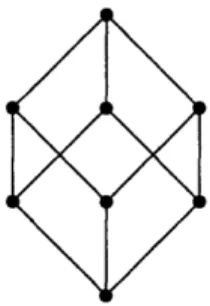
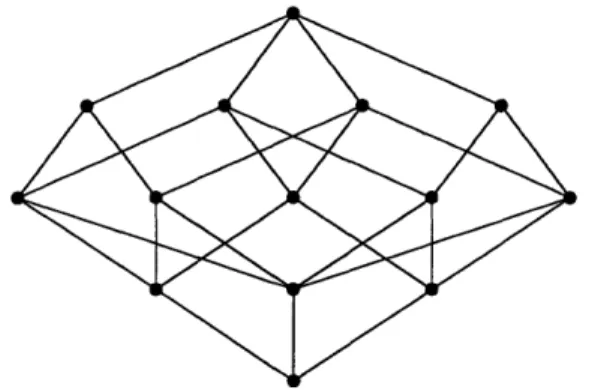
2-1 The Bruhat order for G4 ... 23
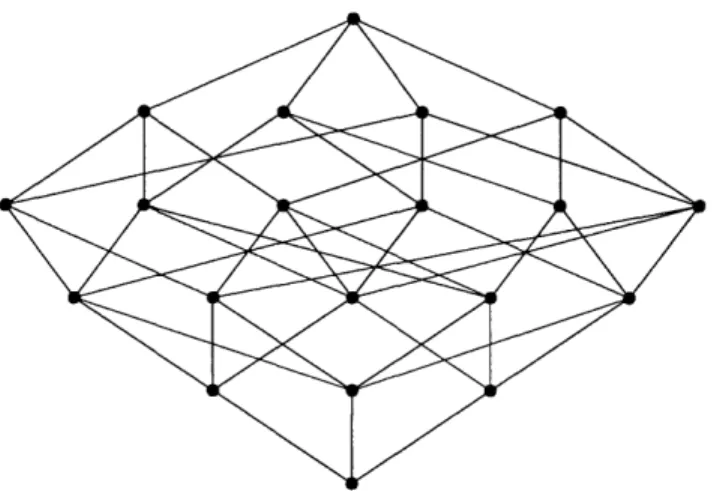
2-2 The Bruhat order for 6B ... 23
3-1 The polygon X(4132). ... 37
3-1 The polygon X(4132) . . . 37
3-2 The two tilings in T(321) ... 37
3-3 A tiling in T(53241) ... 38
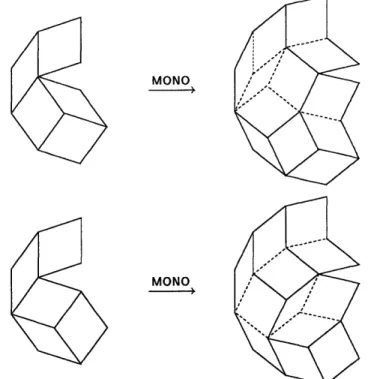
3-4 The output of MONO, given each of the two elements of T(31542). . 40 3-5 A tiling in Z(53241) . . . 41
3-6 A tiling of X(5274163) by four hexagons ... 43
3-7 G(243196587) ... 47
3-8 P(243196587) ... 47
4-1 The boolean poset B ... 50
4-2 The principal order ideal B(4231) ... 52
4-3 The principal order ideal B(3421) ... 52
4-4 The principal order ideal B(321) . . . 57
4-5 The principal order ideal B(3412) ... 57
4-6 The form of every length two interval in the Bruhat order ... . 63
4-7 The poset B(351624) ... 64
4-8 The poset B(3614725) ...
5-1
The
shape
A
=
(5,5,1)
.
65 . . .70
5-2 The shifted shape AB = (5,4,1) ... 70
5-3 Determining the shifted shape in Example 5.2.4 ... 72
5-4 Hook lengths for AB
=
(5,4,1) . . . .. 735-5 The shifted shapes AB(WoB) and AB(wk) for n = 8 and k = 2 ... 74
5-6 Step (7) of Definition 5.2.3 applied to w ... 77
List of Tables
2.1 Cardinality of the finite Coxeter groups of types A, B, and D .... 19
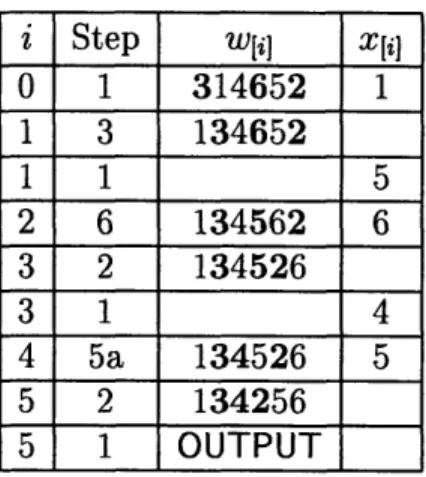
3.1 The progression of VEX on Example 3.2.9 ... 33
4.1 Representative reduced decompositions giving all non-isomorphic prin-cipal order ideals of length at most 5 in e ... 51 4.2 The non-isomorphic principal order ideals of length at most 5 in 5n.. 51 4.3 Comparing the number of non-isomorphic intervals and the number of
non-isomorphic principal order ideals of length at most 5 in . . ... 53 4.4 The number of boolean permutations of each length in ®1,..., 58... 56
5.1 The expected values of XB and ynB for n < 8, rounded to four decimal places ... 78
6.1 Patterns that must be avoided by boolean elements in Gn, (5, and (5D 83
Chapter
1
Introduction
This thesis studies the combinatorics of reduced decompositions, also known as re-duced words or rere-duced expressions, of Coxeter group elements. The interplay be-tween reduced decompositions, patterns, and the Bruhat order is investigated, with particular emphasis on these relationships in the symmetric group (the finite Coxeter group of type A). Chapters 3 and 4 thoroughly examine the combinatorics of reduced decompositions in the symmetric group from the two viewpoints of patterns and the Bruhat order, while Chapter 5 considers reduced decompositions of a distinguished element in the hyperoctahedral group, and Chapter 6 discusses aspects of the Bruhat order for the finite Coxeter groups of types B and D.
Coxeter groups have been studied from several mathematical perspectives, in-cluding algebra, combinatorics, and geometry. The finite Coxeter groups of types A,
B, and D have combinatorial interpretations as permutations, signed permutations,
and signed permutations with certain restrictions. The combinatorial aspects of all Coxeter groups are treated in depth in 4]. These groups are classical objects with a bountiful literature, although there are still many open questions, particularly in reference to patterns and the Bruhat order, as discussed in this thesis. Reduced de-compositions of Coxeter group elements are a similarly classical topic in mathematics,
appearing throughout the literature. As evidenced in this thesis, their close
relation-ships with patterns and the Bruhat order give rise to very interesting combinatorics. In the last two decades, subsequent to the work of Simion and Schmidt in 131], there has been a surge of interest in permutation patterns. This field has seen exten-sive research and yielded many intriguing results. Unfortunately, some of the most basic questions, such as how many permutations avoid a given pattern, remain unan-swered. However, recent work (see Chapter 3) has uncovered connections between reduced decompositions and permutation patterns that may prove useful to resolving some of these issues.
The Bruhat order is a partial ordering, related to reduced decompositions, of the elements in a Coxeter group. This order plays a remarkably significant role in the study of Coxeter groups. Somewhat surprisingly, very little is known about the structure of this order, particularly in terms of its order ideals and intervals. Results of Lakshmibai and Sandhya in 19], and more recently those presented in Chapters 4 and 6, elucidate some pattern-related facts about this structure. These
results, combined with the relationship between reduced decompositions and patterns in Chapter 3, are significant steps towards understanding the more general structural aspects of this partial order.
After providing necessary background material in Chapter 2, this thesis examines reduced decompositions in four different ways. The first two examine reduced decom-positions in the finite Coxeter group of type A, and the latter two consider types B and D. Two of these discussions are based on 42] and 43]. The individual chapters include more detailed introductory material pertinent to their respective topics.
Many properties of reduced decompositions are already well known, particularly in the case of the symmetric group. For example, in 135], Stanley uses symmet-ric functions to present a formula for the number of reduced decompositions of an element in the symmetric group. Perhaps the earliest link between reduced decompo-sitions and permutation patterns in the symmetric group occurs in 12]. There Billey, Jockusch, and Stanley show that 321-avoiding permutations are exactly those per-mutations whose reduced decompositions never contain a factor i(i ± 1)i. Relatedly, Reiner shows in 26] that the number of i(i i 1)i factors in a reduced decomposition
of the longest element in the symmetric group, which has the most occurrences of the pattern 321, is equal to the number of such reduced decompositions. These results suggest an underlying relationship in the symmetric group between reduced decom-positions and permutation patterns, which is examined extensively in Chapter 3.
The primary result of Chapter 3 is a new definition of vexillary permutations in terms of principal dual order ideals in a particular poset (Theorem 3.2.8). In broad terms, the result states that any permutation containing a vexillary p-pattern has a reduced decomposition with a factor that is a reduced decomposition of p (a constant may be added to each letter in this factor). The converse of this statement is also true: if p is not vexillary, then there exists a permutation containing p that has no such reduced decomposition. The structure of the graph of the commutation classes of a permutation is also described, as in Theorem 3.4.10, which shows that the number of commutation classes of a permutation is monotonically increasing with respect to pattern containment. The work of Elnitsky in 9] is expanded upon to describe the zonotopal tilings of a particular polygon associated with a permutation. For example, a tiling of Elnitsky's polygon can include a 2k-gon if and only if the permutation has a decreasing sequence of length k (Theorem 3.5.4). Corollary 3.5.7 and Theorem 3.5.8 discuss when Elnitsky's polygon can be tiled entirely by 2k-gons. The latter of these results states that a centrally symmetric 2n-gon with unit sides can be tiled by centrally symmetric 2k-gons with unit sides if and only if k E {2, n}. The
poset of zonotopal tilings of Elnitsky's polygon is also discussed, and the permutations whose posets have a maximal element are shown in Theorem 3.5.14 to be exactly those
permutations that avoid the patterns 4231, 4312, and 3421.
In Chapter 4, the combinatorics of reduced decompositions is studied from the perspective of the Bruhat order for the symmetric group. The Bruhat ordering can be defined in terms of reduced decompositions, and this chapter examines the struc-ture of order ideals and intervals in this poset. Several of the results further relate the concepts of reduced decompositions and permutation patterns. For example, Therem 4.3.2 characterizes those permutations with boolean principal order ideals as
exactly those which avoid the patterns 321 and 3412. The discussion is generalized in a natural way to consider permutations whose principal order ideals are isomorphic to other classes of posets, and these too can be characterized by patterns. For a fixed k > 3, Theorem 4.4.3 shows that the permutations whose principal order ideals are isomorphic to a power of the principal order ideal for the longest element in ek are
those permutations in which every inversion is in exactly one decreasing sequence of length k. Additionally, the question of when the set of permutations that avoid a pattern p or two patterns p and q will form a nonempty order ideal in this poset is completely answered. Somewhat surprisingly, the set of permutations that avoid a single pattern p E 6k, for k > 3, is never an order ideal (Theorem 4.5.1). On
the other hand, as discussed in Theorem 4.5.2, the set of permutations avoiding two patterns p k and q 61, for k, 1 > 3, is an order ideal in exactly three situa-tions: {p,q} {321,3412}, 321,231}, 321,312}}. Finally, Theorem 4.6.10 shows that if a permutation p avoids sixteen subpatterns, then every permutation contain-ing a p-pattern has a principal order ideal in which an interval is isomorphic to the principal order ideal for p. The reverse implication is only proved in a special case (Theorem 4.6.11), although it is conjectured always to be true.
Chapter 5 consists of calculations for the longest element in the finite Coxeter group of type B, analogous to Reiner's work for type A in [261. In this chapter, the expected number of occurrences of each of the "interesting" Coxeter relations in an arbitrary reduced decomposition of the longest element in the hyperoctahedral group is computed. Unlike Reiner's result, where the expected number of i(i ± 1)i factors was always 1, each of the expectations for this group are dependent on the cardinality of the group. The expected number of i(i+ )i or (i + )i(i+ 1) factors, for i C [n-2], is computed to be 2- 4/n in Theorem 5.3.1, while the expected number of 0101 or 1010 factors is computed to be 2/(n 2 - 2) in Theorem 5.4.1. The former result is
perhaps not surprising, as the length of the longest element in the hyperoctahedral group is n2, which is approximately twice the length of the longest element in the symmetric group (which is ()).
Expanding on some of the results in Chapter 4, Chapter 6 examines the Bruhat order for the finite Coxeter groups of types B and D. In particular, those elements with boolean principal order ideals are precisely defined in Theorems 6.2.1 and 6.3.1. Once again, permutation patterns emerge, although now for signed permutations, and the avoidance of certain patterns is equivalent to having a boolean principal order ideal. While the case for type A required avoiding only two patterns, it is necessary to avoid ten patterns in type B, and twenty patterns must be avoided to have a boolean principal order ideal in type D. For both types B and D, the elements avoiding these patterns are enumerated by length in Corollaries 6.2.3 and 6.3.3.
Chapter 2
Definitions and tools
In preparation for the examination of reduced decompositions and their combina-torics, some background material is necessary. To define a reduced decomposition, it is first necessary to introduce Coxeter groups. In this thesis, the primary group considered is the finite Coxeter group of type A. Additionally, the finite Coxeter groups of types B and D will be discussed, although in somewhat less detail. These groups can all be defined in terms of permutations (unsigned for type A and signed
for types B and D), thus emphasizing their combinatorial nature. Much of this thesis
works with permutation patterns, either unsigned or signed, and with a partial order structure on a Coxeter group known as the Bruhat order. Each of these concepts is introduced in this chapter.
2.1 Permutations
This section establishes basic facts and notation for permutations. Additional infor-mation can be found in 21].
Let be the group of permutations on n elements, and let [n] denote the set of integers {1,.. , n}. An element w E on is the bijection on [n] mapping i -* w(i). A
permutation will be written in one-line notation as w = w(1)w(2) .. w(n).
Example 2.1.1. The permutation 4213 E G4 maps 1 - 4, 2 -* 2, 3 -* 1, and 4 - 3. Definition 2.1.2. An inversion in w is a pair (i, j) such that i < j and w(i) > w(j).
The inversion set is I(w) = {(i,j) (i,j) is an inversion in w}.
Since I(w) C [n]2, the inversion set can also be viewed as an array.
Definition 2.1.3. The number of inversions in a permutation w is equal to the length
def
of w, denoted (w). The permutation w0 =e n.. 21 E n, is aptly named the longest
element in n, and (w0) = (n). If the value of n is unclear from the context, this
longest element may be denoted w( ).
Let [n] denote the set of integers {±1,.. ., in}. For ease of notation, a negative
dsign
may be
written beneath an integer: defi.
Definition 2.1.4. A signed permutation of the set [n] is a bijection w: [n] - [n]
with the requirement that
w(i) = w(i). (2.1)
Let G' be the set of signed permutations on [n].
Equation (2.1) indicates that the signed permutation w is entirely defined by
w(1),...,w(n). Therefore one-line notation will be used, although some values may
now be negative.
Example 2.1.5. The signed permutation 4213 eB maps
±1
-4 :4,i2
'-
i2,
i3 -4i±1, and
±4
-4 3.As with unsigned permutations, there is a notion of length for signed permutations. The precise definition is not necessary to this discussion, and the reader is referred to [4] for more details. Analogous to w0 C an, the longest element in type B is
w e=12---n, and (wOB ) = n2.
2.2 Finite Coxeter groups of types A, B, and D
The only Coxeter groups considered in this thesis are the finite Coxeter groups of types A, B, and D. Consequently, these are the only groups defined in this section. For more thorough discussions of general Coxeter groups, the reader is encouraged toread [4] and 16].
Define bijections, called simple reflections, on [n] as follows:
Si ' [in] -+ [±n] transposes i -4 i + 1 (and / 4- i + 1) for i [n- 1]; (2.2)
so ' [±n] - [±n] transposes 1 +-+ 1; and (2.3)
def
Si1 = SOS1S0, thus this map transposes 1 - 2 (and 1 2). (2.4)
All other elements are fixed by these maps. For i > 0, the map si may be restricted to [n] and considered as the bijection transposing i +- i + 1 and fixing all other elements. The maps {Si,... , sn-} are sometimes called adjacent transpositions. Let
n = {81', So, Si,.. , Sn-1}
It is not hard to see from the definitions in equations (2.2)-(2.4) that the following relations hold for the maps in Sn:
s2 = e for all s E Sn, where e is the identity permutation; (2.5)
sisj = sjsi for i,j E [0, n- 1] and
i-jl
> 1; (2.6)s1,si = 8is1, for i E (In- 1] \ {2}); (2.7)
8i8si+s18i = 8si+ls8isi+l for i E [n- 2]; (2.8)
sos0sos = sisosiso; and (2.9)
Definition 2.2.1. The finite Coxeter group of type A is the set of permutations
of [n], for some n, denoted 6n. This group is generated by the simple reflections
{sl,.
.
., snl}, subject to the relations in equations (2.5)-(2.6) and (2.8). This is alsocalled the symmetric group on n elements.
The symmetric group is studied from a variety of mathematical viewpoints in 129]. While the finite Coxeter group of type A is defined in terms of permutations, types
B and D require the additional structure of sign.
Definition 2.2.2. The finite Coxeter group of type B is the set of signed permutations of [n], for some n, denoted EnB. This group is generated by the simple reflections
{s, sl,.. ,sn-I}, subject to the relations in equations (2.5)-(2.6) and (2.8)-(2.9). This is also called the hyperoctahedral group.
Definition 2.2.3. The finite Coxeter group of type D, denoted ~O, is the subgroup of B consisting of those signed permutations whose one-line notation contains an even number of negative values. This group is generated by the simple reflections
{Sl, sl, . .., sn-1}, subject to the relations in equations (2.5)-(2.8) and (2.10).
Note that the signed permutation in Example 2.1.5 has an even number of negative values in its one-line notation. Therefore 4213 E D C E.
The longest element in nD is equal to wB if n is even, and 123... n if n is odd.
It is straightforward to calculate the sizes of these three Coxeter groups, as dis-played in Table 2.1.
Table 2.1: Cardinality of the finite Coxeter groups of types A, B, and D.
2.3 Reduced decompositions
The Coxeter groups En, enB, and ED are each generated by a subset of the simple reflections Sn. Therefore, every element in these groups can be written as a product of elements of Sn.
Definition 2.3.1. Let W be a Coxeter group generated by the simple reflections
T C Sn. For w E W, if w = ... sit and is minimal among all such expressions,
then the string il ' it is a reduced decomposition of w and is the length of w, denoted (w). The set R(w) consists of all reduced decompositions of w.
This definition of length and the definition in Section 2.1 are in fact equivalent, as discussed in 141 and [211.
Group Cardinality
En n!
En n! . 2n
Definition 2.3.2. A consecutive substring of a reduced decomposition is a factor.
The relations described in equations (2.5)-(2.10) are often called braid relations or Coxeter relations. Similarly, in this thesis, certain factors in reduced decompositions corresponding to the braid relations will be referred to by the following names.
Definition 2.3.3. Consider si,sj E Sn. If si and s satisfy equation (2.6) or (2.7), then a factor of the form ij in a reduced decomposition is a short braid move. Fol-lowing the terminology in 261, a factor iji in a reduced decomposition, where si and sj satisfy equation (2.8) or (2.10), is a Yang-Baxter move. Finally, a factor of the form 0101 or 1010 in a reduced decomposition, corresponding to equation (2.9), is a
01 move.
A factor ij is a short braid move exactly when the reflections si and sj commute. The order of multiplication for permutations will follow the standard that a func-tion is written to the left of its input. Thus, if i E [n- 1], the permutation siw interchanges the positions of the values i and i + 1 (and and i + 1 if w is a signed permutation) in w, whereas wsi transposes the values in positions i and i + 1 in
w. Therefore wsi can be written as w(1)...- w(i + 1)w(i).-.--w(n). Similarly, sow
transposes 1 -+ 1 in w, and ws0 changes the sign of the first position in w, so
wso = w(1)w(2) ... w(n). Products involving sl, can be defined analogously.
Example 2.3.4. The unsigned permutation 4213 E 64 decomposes as s3s2sls2. This permutation has length 4, so there is no shorter such expression. Therefore 3212 is a reduced decomposition of this permutation, and the factor 212 is a Yang-Baxter
move.
2.4 Permutation patterns
The classical notion of (unsigned) permutation pattern avoidance is as follows.
Definition 2.4.1. Let w En and p E Ek for k < n. The permutation w contains the pattern p, or contains a p-pattern, if there exist il < '" < ik such that W(il) .. W(ik)
is in the same relative order as p(1) .. p(k). That is, w(ih) < w(ij) if and only if
p(h) < p(j). If w does not contain p, then w avoids p, or is p-avoiding.
The study of permutation patterns has gathered much momentum in recent years, both as mathematical objects in their own right and for their connection to other, not always obviously related, questions. One subject in the former category concerns the enumeration of permutations that contain or avoid a given pattern. Recently the Stanley-Wilf conjecture was resolved affirmatively, proving an exponential upper bound on the number of permutations that avoid a particular pattern (see 241). An example in the second category is the fact that (unsigned) permutations for which no reduced decomposition contains a Yang-Baxter move are exactly those that avoid
the pattern 321 (see [2]).
In Chapter 3 of this thesis, the reduced decompositions of an unsigned permutation are analyzed in conjunction with the notion of pattern containment. This coordinated
approach yields significant results for both concepts, including statements about their
relationship to each other.
Suppose that w contains the pattern p, with {il.. , ik} as defined above. Then
w(il)...-- W(ik) is an occurrence of p in w. The notation (p(j)) will denote the value
w(ij). If p = p(j)p(j + 1) ... p(j + m), then (p) = w(ij)w(ij+l) w(ij+m). If more
than one occurrence of the pattern p is being considered, these will be distinguished
by subscripts: ( ).
Example 2.4.2. Let w = 7413625, p = 1243, and q = 1234. Then 1365 is an
occurrence of p, with (1) = 1, (2) = 3, (4) = 6, and (3) = 5. Also, (24) = 36. The
permutation w is q-avoiding because there is no increasing subsequence of length 4 in the one-line notation of w.
The definition of patterns in signed permutations, as in types B and D, requires an extra clause because of the additional structure that some values can be negative.
Definition 2.4.3. Let w E EB and p G 6 for k < n. The permutation w contains
the pattern p if there exist 0 < il < ... < ik such that
1. w(ij) and p(j) have the same sign; and
2. w(il)l . Iw(ik)l is in the same relative order as p(1)l ... p(k)l. If w does not contain p, then w avoids p, or is p-avoiding.
Example 2.4.4. Let w = 4213, p= 312, q = 312, and r = 132. Then 413 and 423
are both occurrences of p in w. The signed permutation w is q- and r-avoiding.
2.5 Posets
Standard terminology from the theory of partially ordered sets will be used throughout this thesis. Good sources for information on this topic are 138] and 145].
The notation related to posets that will appear in this thesis is as follows.
* If P is a poset and x, y C P, then x < y indicates that x is covered by y in P.
* P x Q denotes the direct product of the posets P and Q.
* P' indicates the direct product of a poset P with itself r times:
r copies of P
pr ef x ... x
* The unique maximal element in a poset, if it exists, is denoted 1.
Two aspects of a poset that will be discussed in Chapters 4 and 6 are order ideals and intervals. An order ideal in a poset P, sometimes called a down-set, is a subset
I C P such that if y E I and x < y in P, then x E I. The principal order ideal of an element y in P is the order ideal {x E P: x < y in which y is the unique maximal element. If x < y in P, then the interval [x, y] is {z E P: x < z < y}.
2.6 Bruhat order
The Bruhat order is a partial ordering that can be placed on a Coxeter group. This order will first be defined for an arbitrary Coxeter group.
Definition 2.6.1. Let W be a Coxeter group generated by the simple reflections T.
Let T=
{wtw
-1 w E W,t T}. For w, w' E W, write w<
w' if both of thefollowing are true:
1. (w') = t(w) + 1; and
2. w' = tw for some t E T.
The partial order defined by the covering relations w < w' gives the Bruhat order for the Coxeter group W.
It should be noted, as discussed in [4], that neither left nor right multiplication is favored by the Bruhat order. That is, restating the second requirement of Defini-tion 2.6.1 as w = wt gives rise to the same partial order.
There is also a partial order known as the weak Bruhat order, or simply the weak
order. In that order, the clause "t E T' in the second requirement of Definition 2.6.1
is replaced by "t E T," so that only simple reflections yield covering relations. The weak order is not explicitly studied in this thesis.
In the language of unsigned permutations, the covering relation in Definition 2.6.1 means that the permutation w' covers the permutation w if and only if w' can be obtained from w by transposing two values (equivalently, positions) in the one-line
notation of w in such a way so as to increase the length by exactly one.
Example 2.6.2. The permutation 7314625 E 7 covers the permutation 7312645.
However, it does not cover 1374625, because t(7314625) - £(1374625) > 1. Although not a covering relation, it is true that 7314625 > 1374625 in the Bruhat order.
This partial order has many properties which are discussed and proved in 14]. The property most relevant to this thesis, the subword property, gives an equivalent definition of the Bruhat order in terms of reduced decompositions.
Theorem 2.6.3 (Subword property). Let W be a Coxeter group and w,
w'
E W. Choose a reduced decompositionil
... it, E R(w'). Then w<
w' in the Bruhat orderif and only if there exists a reduced decomposition jl .. je E R(w) which is a subword
of il
'
"it'.
The two equivalent definitions of the Bruhat order for a Coxeter group indicate that it gives a graded poset where the rank function is equal to the length of an element. The maximal element in (fn is w0, and the maximal element in n is WOB .
Figures 2-1 and 2-2 give the Hasse diagrams for the Bruhat order on (4 and E,
respectively.
Other properties of the Bruhat order include that it is an Eulerian poset (as shown by Verma in 46]) and that it is CL-shellable (as shown by Bjbrner and Wachs in 5]).
4321
4123
1432
1234
Figure 2-1: The Bruhat order for ®4.
12 12 21 21 21 21 12 12
Bjdrner and Wachs also show that every open interval in the poset is topologically a sphere. These properties are not defined here, as they will not be discussed in this thesis. For more information, see 51, 138], and 146].
As mentioned in Chapter 1, there are many open questions concerning the Bruhat order, including the structure of the intervals in this poset. This question is made substantially simpler by Dyer's result (see 181) that, for any , there are only finitely many non-isomorphic intervals of length £ in the Bruhat order of finite Coxeter groups. The length 4 intervals have been classified, as have the length 5 intervals in the symmetric group, by Hultman in [141 and 1151.
Chapter 4 of this thesis considers the Bruhat order on the symmetric group 6n and uses reduced decompositions to elucidate many facts about its structure. The principal order ideals in particular are considered, and several facts are shown about their structure which once again emphasize the relationship between permutation patterns and reduced decompositions. Likewise, Chapter 6 discusses the Bruhat order for nB and E5, although in less depth than the type A discussion.
Chapter 3
Reduced decompositions and
permutation patterns in type A
3.1 Introduction
Throughout this chapter, all permutations can be assumed to be unsigned. That is, all permutations are in the symmetric group, not the hyperoctahedral group.
In [21, Billey, Jockusch, and Stanley related the two concepts of reduced decompo-sitions and permutation patterns, possibly for the first time. There they showed that 321-avoiding permutations are exactly those permutations where the subsequence
i(i i 1)i never occurs in a reduced decomposition. That is, a permutation is
321-avoiding if and only if none of its reduced decompositions have any Yang-Baxter moves. Reiner showed in [26] that the total number of i(i i 1)i occurrences in
re-duced decompositions of the longest element in the symmetric group, which has the maximal number of occurrences of 321, is equal to the number of such reduced decom-positions. Stanley had previously shown that this is the number of standard Young tableaux of a staircase shape in [35].
Inspired by these results, and more generally by the relationship they suggest be-tween the two aspects of permutations, this chapter studies reduced decompositions of elements of the symmetric group in relation to the concept of permutation
pat-terns. While reduced decompositions and permutation patterns appear extensively in combinatorial literature, they are not often treated together. This chapter strives
to remedy that fact, addressing several questions where reduced decompositions and
permutation patterns together lead to interesting results.
After introducing basic terminology and notation, Section 3.2 generalizes the result of Billey, Jockusch, and Stanley via a new characterization of vexillary permutations in Theorem 3.2.8. This characterization is based on the reduced decompositions of
the permutations containing the permutation in question, and is strikingly different
from all previous (equivalent) characterizations. In addition to requiring that each of the permutations containing the vexillary permutation has a certain kind of reduced decomposition, the proof of Theorem 3.2.8 explicitly constructs such a reduced
containing the pattern, which has no such reduced decomposition.
There are three algorithms which appear in this chapter, the first of which occurs in the proof of Theorem 3.2.8. It should be noted that these are not deterministic, and include a certain amount of choice. For instance, Example 3.2.9 describes only one possible route that the algorithm VEX may take on a particular input.
There is an equivalence relation, sometimes known as the commutation relation, on the set of reduced decompositions of a particular permutation. This and an associated graph are discussed in Section 3.3. Theorem 3.3.7 and Corollary 3.3.9 characterize permutations with graphs and commutation classes having certain properties, and these results are later strengthened in Theorem 3.5.13.
The results in Sections 3.4 and 3.5 discuss permutation patterns with respect to a polygon defined by Elnitsky in 9], whose rhombic tilings are in bijection with the commutation classes of a permutation. New results include that the number of commutation classes of a permutation is monotonically increasing with respect to pattern containment (Theorem 3.4.10), and several facts pertaining to a poset associated with tilings of the polygon. Finally, Section 3.6 completely describes this poset in the case of a freely braided permutation, as defined by Green and Losonczy
in 121 and [13].
In addition to the definitions and notation in Chapter 2, a few concepts particular to this chapter must also be defined.
Definition 3.1.1. Let w contain the pattern p, and let (p) be a particular occurrence of p. If w(j)
C
(p), then w(j) is a pattern entry in w. Otherwise w(j) is a non-patternentry. If a non-pattern entry lies between two pattern entries in the one-line notation
for w, then it is inside the pattern. Otherwise it is outside the pattern. "Inside" and "outside" are only defined for non-pattern entries.
Example 3.1.2. Let w = 7413625 and p = 1243, where (p) = 1365. In this example, the pattern entries are 1, 3, 5, and 6, while the non-pattern entries are 2, 4, and 7. Of the latter, 4 and 7 are outside the pattern, and 2 is inside the pattern.
Definition 3.1.3. Let (p) be an occurrence of p E ek in w. Suppose that x is inside
the pattern, that (m) < x < (m + 1) for some mn E [k - 1], and that the values
{
(m), x, (m + 1)} appear in increasing order in the one-line notation for w. Let the non-negative integers a < mn - 1 and b < k - m be maximal so that the values{(m-a),(m-a+ 1),..., (mn),x,(m+1),...,(m+
b- 1), (m+b)}
appear in increasing order in the one-line notation for w. The entry x is obstructed to
the left if a pattern entry smaller than (m - a) appears between (m- a) and x in w.
Likewise, x is obstructed to the right if a pattern entry larger than (m + b) appears between x and (m + b) in w.
Example 3.1.4. Let w = 32451 and p = 3241. Then 3241 and 3251 are both
occurrences of p in w. Obstruction is only defined for the latter, with x = 4 and
Example 3.1.5. Let w = 21354 and p = 2143. Then 2154 is an occurrence of p in w.
Using x = 3 and m = 2 in Definition 3.1.3 shows that a = b = 0, and 3 is obstructed
both to the left and to the right.
3.2 Vexillary characterization
Vexillary permutations first appeared in [201 and subsequent publications by Las-coux and Schiitzenberger. They were also independently found by Stanley in 351. There have since emerged several equivalent definitions of these permutations, and a thorough discussion of these occurs in 21]. The original definition of Lascoux and Schiitzenberger, and the one of most relevance to this discussion, is the following.
Definition 3.2.1. A permutation is vexillary if it is 2143-avoiding.
These permutations were first enumerated by West in 471.
Example 3.2.2. The permutation 3641572 is vexillary, but 3641752 is not vexillary
because 3175 is an occurrence of the pattern 2143 in the latter.
The following lemma is key to proving one direction of Theorem 3.2.8.
Lemma 3.2.3. Let w contain the pattern p. Let x be inside the pattern, with (m) <
x < (m + 1) and the values (m), x, (m + 1)} appearing in increasing order in w. If
p is vexillary then x cannot be obstructed both to the left and to the right.
Proof. Such obstructions would create a 2143-pattern in p. [ Example 3.1.5 illustrates a non-vexillary permutation which has an element x that
is obstructed on both sides.
There are several equivalent characterizations of vexillary permutations. These concern the inversion set I(w) of Section 2.1 or the following objects.
Definition 3.2.4. The diagram of a permutation w is D(w) C [n]2 where
(i,j) E D(w) if and only if i < w-1(j) and j < w(i).
Definition 3.2.5. The code of w is the vector c(w) = (cl(w),...,cn(w)), where
ci(w) =
#{j:
(i,j) E I(w)}. The shape A(w) is the partition formed by writing theentries of the code in non-increasing order.
Proposition 3.2.6. The following are equivalent definitions of vexillarity for a
per-mutation w:
(Vi) w is 2143-avoiding;
(V2) The set of rows of I(w) is totally ordered by inclusion; (V3) The set of columns of I(w) is totally ordered by inclusion;
(V4) The set of rows of D(w) is totally ordered by inclusion;
(V5) The set of columns of D(w) is totally ordered by inclusion; and
(V6) )A(w)' = A(w-1), where A(w)' is the transpose of )A(w).
Proof. See 121]. 0
This section proves a new characterization of vexillary permutations, quite dif-ferent from those in Proposition 3.2.6. A partial ordering can be placed on the set of all permutations E1 U 62 U 63 U ... , where u < v if v contains the pattern u. Definition 3.2.1 determines vexillarity by a condition on the principal order ideal of a permutation. The new characterization, Theorem 3.2.8, depends on a particular condition holding for the principal dual order ideal.
Definition 3.2.7. Let i = i... it be a reduced decomposition of w = w(1)- w(n).
For a non-negative integer M, the shift of i by M is
iM _ (i + M)... (it + M).
Note that this is a reduced decomposition of the permutation
12..
M(w(1) + M)(w(2) +
M)... (w(n) + M) E En+m.Theorem 3.2.8. The permutation p is vexillary if and only if, for every permutation
w containing a p-pattern, there exists a reduced decomposition j E R(w) containing
some shift of an element i E R(p) as a factor.
Proof. First suppose that p Ok is vexillary. Let w E 5n contain a p-pattern. Assume for the moment that there is a
w
=(SI
1 * SIq) W (SJ* SJ. ) E6n
(3.1)such that
(R1)
(i)
= (w) - (q + r); and(R2) has a p-pattern in positions {1 + M, ... ., k + M} for some M E [0, n- k]. Choose a reduced decomposition i E R(p). Let ' E 6n be the permutation
obtained from
i
by placing the values {(1 + M), . . , Z(k + M)} in increasing orderand leaving all other entries unchanged. Choose any h G R('). Then
(Iq ...
I)
hiM (Jr "
' JI) E R(w).
(3.2)
It remains only to find a Z E 6n satisfying (R1) and (R2). This will be done by an algorithm VEX that takes as input a permutation w E 5n containing a p-pattern and
outputs the desired permutation Z E 6n. Because the details of this algorithm can
Algorithm VEX
INPUT: w E en with an occurrence (p) of the pattern p E ek.
OUTPUT: E as in equation (3.1), satisfying (R1) and (R2). Step 0: Initialize variables.
def def
Set w[01 = w and i 0. Step 1: Check if ready to output.
If w[i] has no entries inside the pattern, then OUTPUT w[i]. Otherwise,
choose x[i] inside the pattern.
Step 2: Move all inside values larger than (k) to the right of (p).
If x[i] > (k), then BEGIN
a. Let B(x[i]) = {y > x[i] : y is inside the pattern}.
b. Consider the elements of B(x[]) in decreasing order. Multiply w[i] on the right by simple reflections (changing positions in the one-line notation) to move each element immediately to the right of (p).
def
c. Let w[i+l] be the resulting permutation. Set i = i + 1 and GOTO Step 1. Step 3: Move all inside values smaller than (1) to the left of (p).
If x[i] < (1), then BEGIN
a. Let S(x[i]) = {y < x[ij : y is inside the pattern}.
b. Consider the elements of S(x[iq) in increasing order. Multiply wti] on the right by simple reflections to move each element immediately to the left of (p).
c. Let W[i+l] be the resulting permutation. Set i f i + 1 and GOTO Step 1. Step 4: Determine bounds in the pattern for the inside value.
Let m E [1, k- 1] be the unique value such that (m) < x[i] < (m+ 1).
Step 5: Change the occurrence of (p) and the inside value so that it does not lie between
its bounds in the pattern.
If the values (m), x[i], (m + 1)
}
appear in increasing order in W[j], then define a and b as in Definition 3.1.3 and BEGINa. If X[i] is unobstructed to the right, then BEGIN
i. Let R(x[i]) be the set of non-pattern entries at least as large as x[i] and appearing between x[i] and (m + b) in the one-line notation for w[i].
ii. Consider the elements of R(x[i]) in decreasing order. For each y
R(x[i]), multiply on the right by simple reflections until y is to the right
of (m + b), or the right neighbor of y is z > y. In the latter case,
z = (m + b') for some [1, b] because all larger non-pattern entries
are already to the right of (m + b). Interchange the roles of y and
(m +
b'),
and move this new y to the right in the same manner, until it is to the right of (the redefined) (m + b).iii. Let w[i+lI be the resulting permutation, with (p) redefined as indicated. Let x[i+] be the non-pattern entry in the final move after any inter-change of roles. This is greater than x[i] and the redefined (m + b), and occurs to the right of the new (m + b). If x[i+ is outside of the pattern,
GOTO Step 1 with i d i + 1. Otherwise GOTO Step 2 with i de i + 1.
b. The entry x[i] is unobstructed to the left (Lemma 3.2.3). BEGIN
i. Let L(x[i]) be the set of non-pattern entries at most as large as x[i] and appearing between (m- a) and x[il in the one-line notation for Wli].
ii. Consider the elements of L(x[i]) in increasing order. For each y E L(x[i]),
multiply on the right by simple reflections until y is to the left of (m-a), or the left neighbor of y is z < y. In the latter case, z = (m - a') for some a' G [0, a] because all smaller non-pattern entries are already to the left of (m- a). Interchange the roles of y and (m- a'), and move this new y to the left in the same manner, until it is to the left of (the redefined) (m- a).
iii. Let w[i+l] be the resulting permutation, with (p) redefined as indicated. Let x[i+1] be the non-pattern entry in the final move after any inter-change of roles. This is less than x[i] and the redefined (m- a), and occurs to the left of the new (m - a). If x[i+1 is outside of the pattern,
GOTO Step 1 with i e i + 1. Otherwise GOTO Step 3 with d i + 1.
Step 6: Change the occurrence of (p), but not its position, so that the value of the inside
entry increases but the values of (p) either stay the same or decrease.
If w[i](s) = (m + 1) and w[i](t) = x[i with s < t, multiply w[i] on the left by simple reflections (changing values in the one-line notation) to obtain w[i+11 with the values [x[i], (m + 1)] in increasing order. Then w[i+l](s) is in
the half-open interval [x[i], (m + 1)), and w[i+ l](t) is in the half-open interval
def
(x[il, (m + 1)]. GOTO Step 2 with X[i+l] de w[i+l](t), the pattern redefined so
that (m + 1) def W[i+](s), and i def i + 1.
Step 7: Change the occurrence of (p), but not its position, so that the value of the inside entry decreases but the values of (p) either stay the same or increase.
If w[i] (s) = (m) and w[i] (t) = x[i] with s > t, multiply w[i] on the left by simple reflections to obtain w[i+l] with the values [(m),x[i]] in increasing order. Then w[i+l](s) is in the half-open interval ((m),x[i]], and w[i+i](t) is
in the half-open interval [(in),x[i]). GOTO Step 3 with x[i+l] def w[i+l](t), the
pattern redefined so that (m) d w[i+1(s), and i de= i + 1.
Each subsequent visit to Step 1 involves a permutation with strictly fewer entries inside the pattern than on the previous visit. Each multiplication by an adjacent transposition indicated in the algorithm removes an inversion, and so decreases the length of the permutation. This is crucial because of requirement (R1).
* Step 1 ==- HALT or begin a pass through VEX;
*
Step 2 -- Step 1;* Step 3 - Step 1;
* Step 5a - Steps 2 or 6;
* Step 5b - Steps 3 or 7;
* Step 6 Steps 2, 5, or 6; and
* Step 7 - Steps 3, 5, or 7.
Step 5a concludes with [i+I] to the left of its lower pattern bound, and smaller pattern elements lying between x[ji+I] and this bound. Therefore, no matter how often
Step 6 is next called, the algorithm will never subsequently go to Step 5b before going to Step 1. Likewise, a visit to Step 5b means that Step 5a can never be visited until Step 1 is visited and a new entry inside the pattern is chosen.
Steps 2 and 3 do not change the relative positions of (p).
Steps 5a and 6 imply that x[i+] > x[i], while X[i+I] < X[i] after Steps 5b and 7.
Let m be as in Step 4. Until revisiting Step 1, the values (m'), for mi' > m 1, do not increase if x[i+l] > X[i]. Nor do the values (m'), for mn' < m, decrease if x[i+l] < x[i]. The other pattern values are unchanged. The definition of mn means that the reordering of values in Steps 6 and 7 does not change the positions in which the pattern p occurs. Additionally, these steps change the value of the entry inside the pattern (that is, x[i+l]
$
~ x[i]), but not its position.These observations indicate not only that VEX terminates, but that it outputs
E cEn as in equation (3.1) satisfying (R1) and (R2). This completes one direction
of the proof.
For the other direction, suppose that p E &k is not vexillary. There is an
occur-rence of 2143 such that
p = -.. (2) ... (1) ((2) + 1) ((2) + 2) ((3) - 2) ((3) - 1) (4) .- (3)...
Define z to be the index such that p(z) = (1). Define w G Gk+l by
p(m)
m < z andp(m) < (2);
p(m) 1 m < z and p(m) > (2);
w(m)
(2)+1
m=z+ 1;
p(m-1) m > z+ 1 andp(m) < (2); and
p(mn-1)+1
m>z+l1 andp(m)
>
(2).
For example, if p = 2143, then w = 21354.
If there is a reduced decomposition j E R(w) such that j = j1iMj2 for i R(p)
Keeping the values (1), (2), (3), and (4) as defined above, the permutation w was constructed so that
w =..- (2) (1) ((2) + 1) ((2) + 2). ((3) - 2) ((3) - 1) (3) ((4) + 1) ((3) + 1)
One of the values in the consecutive subsequence ((2) + 1)((2 + 2)... (3) must move to get a consecutive p-pattern in . However, the values {(2),..., (3) + 1} appear in increasing order in w, and the consecutive subsequence
(1) ((2) + 1) ((2) + 2).. ((3) - 2)((3) - 1) (3) ((4) + 1)
in w is increasing. Therefore, there is no way to multiply w by simple reflections, always eliminating an inversion, to obtain a consecutive p-pattern.
Hence, if p is not vexillary then there exists a permutation w containing a p-pattern such that no reduced decomposition of w contains a shift of a reduced decomposition
of p as a factor. El
Example 3.2.9. If w = 314652 and p = 231, with the chosen occurrence (p) in bold,
the algorithm VEX may proceed as follows.
def
* w
101 = 314652.def
* Step 1: X[o] = 1.
* Step 3: w[ol w 0 sols = 134652 - w[ij.
* Step 1: x[ - 5. def d~ef * Step 6: w[ 4 s5w[ = 134562 e wf21; X[2] 6 * Step 2: [2] - [2]s5= 134526 - W[3 * Step 1: X[3 4. def def * Step 5a: W[31 -4 W[3 = 134526 ef w[41; x[41 = 5. def * Step 2: W[41 - W[4]S4 = 134256 w[5. * Step 1: output 134256.
Therefore w = 134256 = 5wss 5s4, and &t = 123456. Keeping the notation of
equation (3.2), h = 0 and M = 1. The unique reduced decomposition of 231 is 12, and indeed
(5)0(12)1(451) = 523451 E R(w).
The progression of VEX on this example is also displayed in Table 3.1. The table gives a slightly clearer depiction of which steps affect only the permutation w[j or
i Step W[i] x[i 0 1 314652 1
T
.3 134652 I _ 5 2 6 134562 6 3 2 134526 3 1 4 4 5a 134526 5 5 2 134256 5 1 OUTPUTTable 3.1: The progression of VEX on Example 3.2.9.
For an example of how Theorem 3.2.8 acts on a non-vexillary permutation p, consider the smallest non-vexillary permutation p = 2143. The permutation w defined
in the proof of Theorem 3.2.8 is 21354, where (p) = 2154.
Example 3.2.10. Let w = 21354 and p = 2143. No element of R(w) = {14,41}
contains a shift of any element of R(p) = {13,31} as a factor. Suppose that j R(w) contains a shift of i G R(p) as a factor,
j
= jiMj2-
(3.3)
The factor i E R(p) can be replaced by any i' E R(p) in equation (3.3).
Some care must be taken regarding factors in reduced decompositions. This is clarified in the following definition and lemma, the proof of which is straightforward and omitted here.
Definition 3.2.11. Let w be a permutation and i E R(w). Write i = abc, where a E
R(u) and c E R(v). Suppose that b contains only letters in S =
{1+M,...,
k-1+M}.If no element of R(u) has an element of S as its rightmost character and no element of
R(v) has an element of S as its leftmost character, then b is isolated in i. Equivalently,
the values {1 + M, . , k + M} must appear in increasing order in v, and the positions
{1 + M,..., k + M} must comprise an increasing sequence in u.
If b E R(w(k)) and a shift bM appears as a factor in a reduced decomposition of
some permutation, then b is necessarily isolated. This is because b has maximal reduced length in the letters {1,..., k- 1}, so any factor of length greater than (2k )
in the letters {1 + M, . , k- 1 + M} is not reduced.
Lemma 3.2.12. If a reduced decomposition of w contains an isolated shift of a reduced
decomposition of p, then w contains the pattern p.
The converse to Lemma 3.2.12 holds if p is vexillary.
The characterization of vexillary in Theorem 3.2.8 differs substantially from those in Proposition 3.2.6. There is not an obvious way to prove equivalence with any of
the definitions (V2)-(V6), except via (V1). This raises the question of whether more may be understood about vexillary permutations (or perhaps other classes, such as Grassmannian or dominant permutations) by studying their reduced decompositions
or the permutations that contain vexillary permutations as patterns.
Theorem 3.2.8 has a number of consequences, and will be used often in the subse-quent sections of this chapter. Most immediately, notice that it generalizes the result of Billey, Jockusch, and Stanley mentioned earlier. The permutation 321 is vexillary and every factor iM for i E R(321) must be isolated. Thus, containing a 321-pattern is equivalent to some reduced decomposition containing a factor that is a shift of an element of R(321) = {121,212}, which is a Yang-Baxter move.
3.3 The commutation relation
Recall the definitions of short braid moves and Yang-Baxter moves in a reduced decomposition, as well as the braid relations described in equations (2.6) and (2.8). It is well known that any element of R(w) can be transformed into any other element of R(w) by successive applications of these braid relations.
Because the short braid relation represents the commutativity of particular pairs of simple reflections, the following equivalence relation is known as the commutation
relation.
Definition 3.3.1. For a permutation w and i,j C R(w), write i j if i can be ob-tained from j by a sequence of short braid moves. Let C(w) be the set of commutation classes of reduced decompositions of w, as defined by -.
Example 3.3.2. The commutation classes of 4231 E 64 are {12321}, {32123}, and
{13231,31231,13213,31213}.
For a given permutation w, there is a representation of its commutation classes
C(w) by a particular graph. This graph also takes into account the Yang-Baxter
moves that may occur between elements of R(w).
Definition 3.3.3. For a permutation w, the graph G(w) has vertex set equal to
C(w), and two vertices share an edge if there exist representatives of the two classes
that differ by a Yang-Baxter move.
Example 3.3.4. As shown in [21,
{w: G(w) is a single vertex} = {w: w is 321-avoiding}.
Elnitsky gives a very elegant representation of the graph G(w) in [91, which will be discussed in depth in Section 3.4. A consequence of his description, although not difficult to prove independent of his work, is the following.
Proposition 3.3.5. The graph G(w) is connected and bipartite.
Despite Proposition 3.3.5, much remains to be understood about the graph G(w). For example, even the size of the graph for wo (that is, the number of commutation classes for the longest element) is unknown.
Billey, Jockusch, and Stanley characterize all permutations with a single commuta-tion class, and hence whose graphs are a single vertex, as 321-avoiding permutacommuta-tions. A logical question to ask next is: for what permutations does each reduced decom-position contain at most one Yang-Baxter move? More restrictively: what if this Yang-Baxter move is required to be a specific shift of 121 or 212? Moreover, what are the graphs in these cases?
Definition 3.3.6. Let Un = {w E En: no j C R(w) has two Yang-Baxter moves}.
Theorem 3.3.7. U is the set of permutations such that every 321-pattern in w has
the same maximal element and the same minimal element.
Proof. Assume w has a 321-pattern. Suppose that every occurrence of 321 in w has (3) = x and (1) = y. Suppose that j R(w) has at least one long braid move.
Choose k so that jkjk+ljk+2 is the first such. Each adjacent transposition in a reduced decomposition increases the length of the product. Then by the supposition,
SJk+2 Sjk+ 1 SJk Sjl W
is 321-avoiding, so ik+3 Je has no Yang-Baxter moves. It remains only to consider
when jk+2jk+3jk+4 is also a Yang-Baxter move. The only possible reduced configura-tions for such a factor jkjk+ljk+2jk+3jk+4 are shifts of 21232 and 23212. If either of
these is not isolated, then it is part of a shift of 212321, 321232, 123212, or 232123.
Notice that
* 212321,321232,123212,232123 E R(4321); * 23212 C R(4312); and
* 21232 E R(3421).
If jkjk+ljk+2jk+3jk+4 is isolated in j then w contains a 4312- or 3421-pattern by Lemma 3.2.12. Otherwise, w contains a 4321-pattern. However, every 321-pattern in w has (3) = x and (1) = y. Therefore jkjk+ljk+2 is the only Yang-Baxter move in j,
so w C U,.
Now let w be an element of U,. If w has two 321-patterns that do not have the same maximal element and the same minimal element, then they intersect at most once or they create a 4321-, 4312-, or 3421-pattern. These three patterns are vexillary. Thus by Theorem 3.2.8 and the examples above, containing one of these patterns would imply that some element of R(w) has more than one long braid move. If the two 321-patterns intersect at most once, their union may be a non-vexillary pattern, so Theorem 3.2.8 does not necessarily apply. However, a case analysis shows that it is possible to shorten w by simple reflections and eliminate one 321-pattern (via a Yang-Baxter move) without destroying the other 321-pattern. Thus an element of R(w) would have more than one Yang-Baxter move, contradicting w E U. 0