HAL Id: hal-01841009
https://hal.inria.fr/hal-01841009
Submitted on 17 Jul 2018
HAL is a multi-disciplinary open access
archive for the deposit and dissemination of
sci-entific research documents, whether they are
pub-lished or not. The documents may come from
teaching and research institutions in France or
abroad, or from public or private research centers.
L’archive ouverte pluridisciplinaire HAL, est
destinée au dépôt et à la diffusion de documents
scientifiques de niveau recherche, publiés ou non,
émanant des établissements d’enseignement et de
recherche français ou étrangers, des laboratoires
publics ou privés.
ConnectionLens: Finding Connections Across
Heterogeneous Data Sources
Camille Chanial, Rédouane Dziri, Helena Galhardas, Julien Leblay,
Minh-Huong Le Nguyen, Ioana Manolescu
To cite this version:
Camille Chanial, Rédouane Dziri, Helena Galhardas, Julien Leblay, Minh-Huong Le Nguyen, et
al.. ConnectionLens: Finding Connections Across Heterogeneous Data Sources. Proceedings of the
VLDB Endowment (PVLDB), VLDB Endowment, 2018, 11, pp.4. �10.14778/3229863.3236252�.
�hal-01841009�
ConnectionLens: Finding Connections Across
Heterogeneous Data Sources
Camille Chanial
Ecole polytechnique France [email protected]R ´edouane Dziri
Ecole polytechnique France [email protected]Helena Galhardas
INESC-ID and IST Univ. Lisboa, PortugalJulien Leblay
AIRC, AIST Tokyo, Japan [email protected]Minh-Huong Le Nguyen
Ecole polytechnique France [email protected]Ioana Manolescu
Inria and LIX, CNRS and Ecole Polytechnique, FranceABSTRACT
Nowadays, journalism is facilitated by the existence of large amounts of publicly available digital data sources. In par-ticular, journalists can do investigative work, which typi-cally consists on keyword-based searches over many hetero-geneous, independently produced and dynamic data sources, to obtain useful, interconnecting and traceable information. We propose to demonstrate ConnectionLens, a system based on a novel algorithm for keyword search across het-erogeneous data sources. Our demonstration scenarios are based on use cases suggested by journalists from the french journal Le Monde, with whom we collaborate.
1.
MOTIVATION AND OUTLINE
The explosion of digital data sources on about every as-pect of modern life has led journalists to collaborate with computer scientists, statisticians, and social scientists of var-ious disciplines, aiming at novel digital tools to analyze and exploit this data. Since a seminal interdisciplinary study [2], the field of data journalism [10], that is, journalistic work significantly based on digital data, increasingly attracts the attention of journalists and computer scientists alike.
In this work, we focus on a core data journalism prob-lem: identifying connections across a set of heterogeneous, independently produced data sources. We are inspired by in-vestigative journalism work, which seeks out and explores connections between individuals, organizations, companies etc. Such work requires, first, getting access to data sources, through any means (from verbal or phone communication, to paper mail, fax, and any electronic transmission method); second, analyzing this data, to find out what valuable in-formation it may contain. For instance, consider an ex-ample raised by journalists at Le Monde, a leading French national newspaper, with which we currently collaborate: France’s national elections in 2017 brought about an un-precedented ratio of first-time National Assembly elected members. Journalists scrambled to learn as much as pos-sible about the nation’s new representatives, in particular asking e.g., “what connections the new representatives have (or have had) with companies?” This question is interesting to identify areas of economic competence, but also possible conflicts of interest. By law, French representatives must
disclose direct financial interests, but more indirect connec-tions (e.g., being, for many years, a close collaborator of a company’s current CEO) must be dug out by the press.
Many digital data sources which could be used to answer such questions are publicly available today. However, find-ing answers to journalists’ queries is challengfind-ing for many reasons. (i) The data is large, precluding the use of the hand-crafted tools (often spreadsheets) that journalists are used to; (ii) there are many, structurally heterogeneous, independently-produced data sources; some sources, e.g. na-tional company registry, are relana-tional, some others, e.g. contracts, discourses are text, social media content comes as JSON documents, open data is often structured in RDF graphs etc.; (iii) an answer stating, e.g., that a certain repre-sentative has studied with the CEO of a given company, may require interconnecting information from several data sources, e.g., the history of company C, the Wikipedia page of A, and the public information available on D and its CEO, namely B; (iv) journalists do not know the shape, size, and structure of the connections they are seeking out, thus they need the ability to search through keywords; (v) the set of data sources is highly dynamic, as journalists collect various data sources and try to see what insights they can get by combining them with existing ones. It is also worth stressing that newsrooms function under extreme time con-straints, making it unfeasible to clean, consolidate and inte-grate all data sources in a unified warehouse. Finally, (vi) a staple of professional journalism is to be able to show ev-idence for a published claim. Thus, in an answer such as the one outlined in (iii) above, it is important to be able to show where each piece of information came from and how the connections were made.
We have built and propose to demonstrate Connection-Lens, a system addressing the above challenges; at its core is a novel algorithm for keyword search across a set D of het-erogeneous data sources, each of which can be: a relational table; a JSON document; a text file; or an RDF graph.
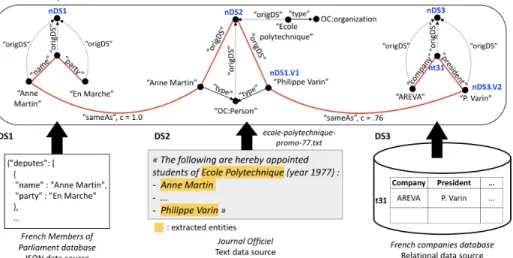
For instance, Figure 1 shows a JSON datasource DS1
containing information about elected representatives, a text dataset DS2listing the alumni of Ecole polytechnique, where
many French company executives have studied, and a re-lational source DS3 providing information about
Figure 1: Motivating example: data source collection D, corresponding virtual graph G, and an answer tree (red). {w1, . . . , wn} for some integer n ≥ 1. In Figure 1, the
query “En Marche company” seeks to find out connections between elected representatives from the “En Marche” po-litical party, and some company. An answer tree to Q over D is a tree, part of a virtual graph (which, as we explain later, is the way we view D). Each answer tree node ni comes from a dataset Di ∈ D, and each edge ej either
comes from a dataset Dj∈ D, or is a link between two nodes
(from the same or from two different datasets) whose data content we find sufficiently similar to consider them “the same” for the purpose of our querying. Further, each Q keyword matches a node or an edge of the answer tree. For example, in Figure 1, the red lines trace an answer tree to the sample query: one of the elected representatives of the party “En Marche” (node matching “En Marche” in DS1) is
Anne Martin, who studied at Ecole Polytechnique (alumni information from DS2) just like Philippe Varin, the CEO of
the Areva company (edge labeled “company” from DS3).
A query Q may have several answer trees on a given D, some more interesting, or insightful, than others; this can be captured by a answer tree score function s associating to every answer tree a number reflecting its interest (the higher, the better). The problem solved by ConnectionLens then, is: given D, Q, the score function s and an integer k, find the k answer trees across D with the highest s scores.
A novel contribution of our system is its keyword search approach capable of finding answers across heterogeneous data sources, approach based on a virtual graph we describe next. Our score function, tailored toward journalistic inter-ests (Section 3) is also novel.
2.
VIRTUAL GRAPH
To be able to exploit data connections occurring within and across all data sources D ∈ D, we view all data sources as a single, virtual graph G, and answer keyword search queries with subtrees of this graph. Each G node has a (globally unique) identifier, some of which are shown in Fig-ure 1, inblue. A label function λ assigns to every node a (possibly empty) text label, reflecting its content in D. G edges are directed; each edge e carries a text label (we use λ also to denote the edge labeling function) and a confidence ce which is between 0 and 1, whose usage will be shortly
explained below. Node and edge labels appear as quoted strings in Figure 1. Based on this figure, we explain below how G nodes and edges are (conceptually!) derived from
each data source D.
2.1
Nodes and edges derived from a source
First, a dataset node nD is created in G to represent D
itself, e.g., nDS1 to nDS3. Every G node corresponding to data from D (see below) is connected to nD, through an
edge labeled origDS (standing for originating data source); we show such edges with dotted lines in the figure. They ensure that any two virtual graph nodes coming from the same data source D are connected at least through nD.
The other nodes and edges of G are defined as follows: (i) If D is an RDF graph, then G contains all its nodes and edges of D; λ attaches to each node its URI or literal (constant) label in D. The property labeling every edge becomes an edge label in G.
(ii) If D is a JSON document such as DS1, G has a node
for each constant, list and map occurring in D, and an edge labeled origDS connects the node representing D, to the one corresponding to the top list or map in D. For each (n1, v1)
name-value pair in a map, n1becomes the label of the edge
leading to the node corresponding to v1.
(iii) If D is a text such as DS2, we apply entity and
re-lationship extraction to identify in D occurrences of enti-ties (such as people, places, organizations etc.) and of rela-tionships (such as bornIn, worksFor etc.) Any off-the-shelf extractor (or set of extractors) can be used; Connection-Lens currently uses OpenCalais (http://www.opencalais.com)
for entity extraction. A G node is created to each extracted entity (resp. relationship) occurrence; its λ label is the ex-act text snippet identified by the extrex-actor; it has a type edge pointing to the entity type identified by the extractor, e.g., OC:Person stands for OpenCalais’ Person type URI, and child nodes containing the offset and length of its ap-pearance in the original text (omitted in Figure 1 to avoid clutter). Further, each node corresponding to an occurrence of a relationship between two entities, is connected to the nodes corresponding to the respective entity occurrences by edges identifying the entity roles in the relationship.
(iv) If D is a relational database such as DS3, for each
relation R(a1, a2, . . .) ∈ D and each tuple r ∈ R, G contains
a node nr, with outgoing edges labeled a1, a2 etc. toward
G nodes, labeled with the values of the respective attributes of r. The label of nr is one of its primary keys (we add such
for any two relations S, T ∈ D such that S.a is a foreign key corresponding to the primary key T.b, and tuples s ∈ S, t ∈ T such that s.a = t.b, G comprises an edge ns
a
−→ nt.
For instance, if S.spouse is a foreign key on T.id, then G comprises ns
spouse
−−−−→ nt. This graph view of a relational
database is often used for keyword search, e.g. [12, 17]. (v) Any G node whose label λ(n) is longer than a threshold θtext is treated like a text data source, i.e., entity and
rela-tionship occurrences are extracted as in (iii); however, the G nodes created from these occurrences are all descendants of n, and their original data source is that of n. This both provides a uniform treatment of text regardless of where it appears, and records the origin of each text content.
All virtual G edges described above have a confidence of 1.0. Some extractors provide a confidence value for the ex-traction: this can be attached to the edges between the nodes, e.g. nDS1.V1, and their types, e.g. OC:Person.
2.2
SameAs edges
We add to G an edge labeled sameAs between nodes n1, n2
(from the same or from different data sources), as soon as they are similar beyond a certain threshold θsim; the
con-fidence of such an edge is the similarity score, normalized to [0, 1]. Identifying when two data objects represent the same thing (aka approximate duplicate detection, etc.) is a thoroughly studied data integration problem [6], for which many solutions exist, especially among similarly-structured objects, e.g. [11, 18]. ConnectionLens interconnects dis-parate sources that may not even have the same data model, e.g., an extracted entity may match with a JSON value (e.g., “Anne Martin”), or with an attribute in a relational tuple, e.g. “Philippe Varin” and “P. Varin”; or, an interesting link may exist between, say, a person and a company, if they both mention a certain user in their tweets etc. We seek to find all such value connections, and distinguish the trivial from the interesting ones using a score (Section 3).
ConnectionLens uses the labels λ(n1), λ(n2) of two G
nodes to decide if they are the same. If the labels are shorter than a certain size limit L, the Jaro distance between them is compared with θsim. If λ(n1) or λ(n2) are longer than
L, we turn them both into bags of words and then compute their set-based Jaccard distance. If λ(n1), λ(n2) are
iden-tical URIs, we connect them through sameAs with a con-fidence of 1.0. Different distance functions or comparisons can be plugged in as users get familiar with data sources, in pay-as-you-go data integration fashion [3].
We do not build sameAs links based on nodes’ adjacent edges and neighbor nodes. However, sameAs links based on labels alone, e.g., a common last name of two people, suffice to establish the data connections we are interested in.
2.3
Virtual graph indexing
We encode, index and store the G nodes and edges derived from a source D in a set of data structures, as follows. 1. We compute an ID idD for the dataset.
2. We derive nodes and edges as explained above from D. For each node n, we compute an ID idnprefixed with idD.
This de facto encodes the edge nD origD
−−−−→ n into idn.
3. We compute λ(n) from the original text content of n, through stop word and punctuation removal, and stemming. 4. For each word w ∈ λ(n), we insert (w, idn) in the index
I(word, node). Similarly, λ(e) is computed for each edge e and its words indexed in I.
5. We seek to find sameAs edges to which a node n de-rived from D may participate. We look up all the nodes n0 whose labels share at least a word with n, that is, (w, idn)
and (w, idn0) belong to I, and compute the similarity
be-tween λ(n) and λ(n0). All sameAs edges are stored in a bridge table B(id1, id2, c) which records that the nodes
identified by n1, n2 are judged the same with confidence c.
For instance, the B(nDS1.V1,nDS3.V2, 0.76) tuple encodes the sameAs link between the two nodes corresponding to Philippe Varin in Figure 1.
3.
ANSWERING KEYWORD QUERIES
Given a query Q = {w1, . . . , wn}, the problem of finding
the k answer trees (recall their definition in Section 1; we call them ATs, in short) with the best score is known to be NP-hard, by reduction to the Steiner tree problem. Thus, ConnectionLens adopts a heuristic method to enumerate answer trees and returns the k highest-score ones.
The AT enumeration algorithm starts by looking up in the index I for the potentially interesting data sources for Q, denoted P (Q), that is: the data sources from which G nodes matching some query keywords are derived. For each sub-query Q0of Q, and each source D ∈ P (Q) containing exactly the keyword set Q0, the procedure localSearch(D, Q0) re-turns the ATs (if any) whose nodes and edges derive only from D. The implementation of localSearch(D, Q) depends on the nature of D: it follows the lines of [12] for relational sources, [1] for JSON, and [13] for RDF data. The algorithm starts by optimistically asking each D ∈ P (Q) for ATs for the largest subset of Q for which D has matches. If D has only one connected component, it is sure to contain at one such AT; also note that ATs are undirected, that is, G edges form an AT as soon as they share a node, regardless of the direction of the edges. For instance, an AT may consist of three G edges n1 a ←− n2 b − → n3 c ←− n4. This is because we
are interested in data connections, and find an edge such as n1
a
−→ n2 interesting as a link, in both directions.
Partial ATs (initially, those local to each data source) are inserted in a priority queue U, based on their score (dis-cussed below). The algorithm greedily picks the top-score AT t from U, and adds it to the result set if it is an answer to Q and its score is among the k best so far. If t is just a partial answer, we try to find another partial tree t0to com-bine with t, through a sameAs edge between a node from t and one from t0. The AT t00resulting from t and t0 is again added to U and the process continues, until a time-out oc-curs or there are no ATs left to add in U. If answers to Q are not found after a certain time, localSearch calls are made with smaller Q subqueries, in the hope that the re-sulting ATs may participate to more sameAs edges allowing to combine them in answers to Q.
The score s(t) of an AT t comprises for each wi ∈ Q,
a matching score ms(t, wi) reflecting the extent to which
the labels of all t nodes and edges match wi, as well as
a structure score ξ(t) depending on the AT structure. We quickly found that unlike many previous keyword search works, small ATs are not always preferable because they may bring trivial (uninteresting) information. For instance, any French representative may be connected to any French company through a node labeled “France” (where they re-side). Instead, for our journalistic applications, we favor a specificity metric, computed as follows. The edge n1
a
−→ n2is
specific in an AT, if n1has few outgoing a edges, and n2has
Figure 2: Sample views of the keyword query interface. average specificity of its edges; and the product of its edge confidences. We consider s(t1) > s(t2) if t1 has non-zero
ms scores for strictly more keywords than t2; otherwise, a
weighted combination of the ms and ξ values for both trees is used to decide who has the highest score.
4.
IMPLEMENTATION AND SCENARIOS
ConnectionLens is developed in Java and Python, rely-ing on Postgres and Jena to store the data sources. We im-plemented localSearch for relational, JSON, (annotated) text and RDF data, with the rest of the algorithm from Section 3. We plan to show two scenarios.
Scenario 1 is based on (i) JSON data from the Re-gards Citoyens NGO that publishes all the French parlia-ment activity, including all National Assembly representa-tive (800KB); (ii) wikidata information about people, for ex-ample their past jobs (1.55GB JSON file); (iii) a text dump of recent articles published in main French media; and (iv) a text dump of Journal Officiel, France’s official public law repository. Starting from political parties and companies, e.g. {“En Marche”, “Areva”} from our motivating exam-ple, we will search for connections between them using the information available from the underlying data sources.
Scenario 2 Here, we aim at identifying political leaders who spread journalistic hoaxes. We will use: (i) a DB-Pedia RDF graph of French political leaders; (ii) a JSON document containing tweets from French political leaders; (iii) a known JSON database of hoaxes, provided by Le Monde. Given queries such as {”Front National”, ”Macron”, ”hoaxes”}, we will investigate connections between pairs of political leaders through hoaxes, e.g., who disseminates on the social media hoaxes about the other one.
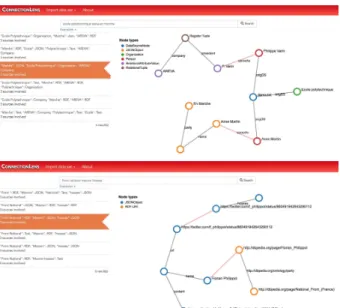
Figure 2 shows a screenshot of the possible answers to the initial keyword-based query.
5.
RELATED WORK
Our work is related to several areas of prior research. Large knowledge bases such as DBPedia or Yago are cur-rently available, yet journalists find “blind spots” in these ones, as relatively little-known people, events etc. are not covered there, yet they are described in details in other specific and/or local data sources. ConnectionLens is meant exactly to enable using together data sources of var-ious nature, model, format etc. Exploiting together large
data source collection is a core goal of data integration sys-tems, and in particular dataspaces [9] or more recently data lakes [4]; our work can be seen as keyword search for datas-paces, following [7]; in contrast with that work, we seek to find connections across distinct data sources, whereas they only find local answers. Recent works focused on finding how to join large tables sets, based on their schema and sets of values in each column [5]. In contrast, we (also) work with semi-structured or text data, and aim at identifying con-nections (whose shape, size, and organization are unknown to the user asking a keyword query) among items scattered across a set of data sources. Keyword search is well-studied in text databases; more recently, algorithms have been pro-posed to answer keyword queries in structured databases including relational [12, 15, 14], XML [1] and RDF [8] ones; in all these works, each keyword query answer is local to one data source. Active learning is used in [16] to help integrate and exploit heterogeneous relational databases through key-word queries, whereas we consider more varied data sources, and seek to find data connections across them, also with a focus on answer specificity.
6.
REFERENCES
[1] L. J. Chen and Y. Papakonstantinou. Supporting top-k keyword search in XML databases. In ICDE, 2010. [2] S. Cohen, H. J. T., and F. Turner. Computational
journalism. Commun. ACM, 54(10):66–71, Oct. 2011. [3] A. Das Sarma, X. Dong, and A. Halevy. Bootstrapping
pay-as-you-go data integration systems. In SIGMOD, pages 861–874, New York, NY, USA, 2008. ACM.
[4] D. Deng, R. C. Fernandez, Z. Abedjan, S. Wang,
M. Stonebraker, A. K. Elmagarmid, I. F. Ilyas, S. Madden, M. Ouzzani, and N. Tang. The data civilizer system. In CIDR, 2017.
[5] D. Deng, A. Kim, S. Madden, and M. Stonebraker. Silkmoth: An efficient method for finding related sets with maximum matching constraints. PVLDB, 10(10), 2017. [6] A. Doan, A. Y. Halevy, and Z. G. Ives. Principles of Data
Integration. Morgan Kaufmann, 2012.
[7] X. Dong and A. Halevy. Indexing dataspaces. In SIGMOD, pages 43–54, 2007.
[8] S. Elbassuoni and R. Blanco. Keyword search over RDF graphs. In CIKM, pages 237–242, New York, NY, USA, 2011. ACM.
[9] M. Franklin, A. Halevy, and D. Maier. From databases to dataspaces: A new abstraction for information
management. SIGMOD Record, 34(4):27–33, Dec. 2005. [10] J. Gray, L. Chambers, and L. Bounegru. The Data
Journalism Handbook: How Journalists can Use Data to Improve the News. O’Reilly, 2012.
[11] M. Herschel, F. Naumann, S. Szott, and M. Taubert. Scalable iterative graph duplicate detection. IEEE Trans. Knowl. Data Eng., 24(11):2094–2108, 2012.
[12] V. Hristidis and Y. Papakonstantinou. DISCOVER: keyword search in relational databases. In VLDB, 2002. [13] W. Le, F. Li, A. Kementsietsidis, and S. Duan. Scalable keyword search on large RDF data. TKDE, 26(11), 2014. [14] G. Li, B. C. Ooi, J. Feng, J. Wang, and L. Zhou. EASE: An
effective 3-in-1 keyword search method for unstructured, semi-structured and structured data. In SIGMOD, 2008. [15] Q. H. Vu, B. C. Ooi, D. Papadias, and A. K. H. Tung. A graph method for keyword-based selection of the top-k databases. In SIGMOD, pages 915–926, 2008.
[16] Z. Yan, N. Zheng, Z. G. Ives, P. P. Talukdar, and C. Yu. Active learning in keyword search-based data integration. VLDBJ, 24(5), Oct. 2015.
[17] B. Yu, G. Li, K. R. Sollins, and A. K. H. Tung. Effective keyword-based selection of relational databases. In SIGMOD, pages 139–150, 2007.
[18] E. Zhu, Y. He, and S. Chaudhuri. Auto-join: Joining tables by leveraging transformations. PVLDB, 10(10), 2017.