HAL Id: hal-02628561
https://hal.inrae.fr/hal-02628561
Submitted on 26 May 2020
HAL is a multi-disciplinary open access
archive for the deposit and dissemination of
sci-L’archive ouverte pluridisciplinaire HAL, est destinée au dépôt et à la diffusion de documents
Mating behavior of Psammotettix alienus (Hemiptera:
Cicadellidae)
Maja Derlink, Isabelle Abt, Romain Mabon, Charlotte Julian, Meta
Virant-Doberlet, Emmanuel Jacquot
To cite this version:
Maja Derlink, Isabelle Abt, Romain Mabon, Charlotte Julian, Meta Virant-Doberlet, et al.. Mating behavior of Psammotettix alienus (Hemiptera: Cicadellidae). Insect Science, Wiley, 2018, 25 (1), pp.148-160. �10.1111/1744-7917.12379�. �hal-02628561�
Version postprint
This is an Accepted Article that has been peer-reviewed and approved for publication in the Insect Science but has yet to undergo copy-editing and proof correction. Please cite this article as doi:
Running title: Behaviour of the leafhopper P. alienus 1
Title for authors: M. Derlink et al. 2
Correspondence: Emmanuel Jacquot, INRA-Cirad-SupAgro Montpellier, UMR 385 BGPI, Cirad TA 3
A-54K, 34398 Montpellier, France; Tel: +00(33) 4 99 62 48 36; email: 4
*: These two authors contribute equally to the work.
6 7
Original article
8
Mating behaviour of Psammotettix alienus (Hemiptera: Cicadellidae)
9
Maja Derlink1*, Isabelle Abt2,3,*, Romain Mabon2,3, Charlotte Julian2,3, Meta Virant-Doberlet1 10
and Emmanuel Jacquot2 11
12
1
National Institute of Biology, Department of Organisms and Ecosystems Research, Večna pot 111,
13
1000 Ljubljana, Slovenia, 2INRA-Cirad-SupAgro Montpellier, UMR 385 BGPI, Cirad TA A-54K,
14
34398 Montpellier, France, and 3 Bayer CropScience, 16 rue Jean Marie Leclair - CS 90106, 69266
15
Lyon Cedex 09, France
16 17
Abstract
18 19
The Wheat dwarf virus, the causal agent of the wheat dwarf disease, is transmitted by 20
leafhoppers from the genus Psammotettix and currently the main protection strategy is based 21
on the use of insecticide treatments. Sustainable management strategies for insect vectors 22
should include methods that are targeted to disrupt reproductive behaviour and here we 23
investigated the mating behaviour of Psammotettix alineus (Dahlbom 1850) in order to 24
determine the role of vibrational signals in intra-specific communication and pair formation. 25
Both genders spontaneously emit species- and sex-specific calling songs that consisted of 26
Version postprint
regularly repeated pulse trains and differ primarily in pulse train duration and pulse repetition 27
time. Females preferred the conspecific male calling song. After a coordinated exchange of 28
pulse trains, the male approached the stationary female. During the close range courtship and 29
also immediately prior to copulatory attempts distinct male vibrational signals associated 30
with wing flapping and wing vibrations were recorded from the substrate. In the presence of a 31
receptive female, competing males emitted vibrational signals most likely aimed to interfere 32
with male-female interaction. Mated females regained sexual receptivity after they laid eggs. 33
Although results suggest that the viruliferous status of insects may have an effect on 34
vibrational songs, our current results did not reveal a significant effect of virus on leafhopper 35
performance in mating behaviour. However, the present study also suggests, that detailed 36
understanding of plant-vector-virus interactions relevant for vector mating behaviour is 37
essential for trying new approaches in developing future control practices against plant 38
viruses transmitted by insect vectors. 39
Keywords: mating behavior, Psammotettix alienus, vibrational communication, Wheat dwarf 40 virus 41 42 43 Introduction 44
Substrate-borne vibrations play an important role in mating behaviour of many insect pests 45
from the order Hemiptera (e.g. Kanmiya, 2006; Čokl, 2008; Mazzoni et al., 2009; Mazzoni et 46
al., 2010; Eben et al., 2015). Leafhoppers (Hemiptera: Auchenorrhyncha: Cicadellidae) are, 47
with more than 22 000 described species, one of the most speciose groups of phytophagus 48
insects and are among the most important vectors of plant diseases (Weintraub & Beanland, 49
2006). Vibrational signals have been described in a great number of leafhopper species (e.g., 50
Tishechkin, 2000; Čokl & Virant-Doberlet, 2003); however, taking into account the 51
economic importance of leafhopper vectors and leafhopper diversity, it is surprising that a 52
more detailed and comprehensive knowledge about the role of vibrational communication in 53
leafhopper mating behaviour is limited to three species, namely Graminella nigrifrons 54
(Heady & Nault, 1991; Hunt & Nault, 1991; Hunt & Morton, 2001), Scaphoideus titanus 55
Version postprint
(Mazzoni et al., 2009; Polajnar et al., 2014) and Aphrodes makarovi (de Groot et al., 2012; 56
Kuhelj et al., 2015). 57
In Cicadellidae, mate recognition and location are mediated exclusively by vibrational 58
signals and the emerging general pattern of a leafhopper mating sequence is (a) that pair 59
formation begins with the emission of a male advertisement call and (b) that after vibrational 60
contact has been established, male searches for a replying stationary female (Heady & Nault, 61
1991; Hunt & Nault, 1991; Mazzoni et al., 2009; de Groot et al., 2012; Polajnar et al., 2014). 62
The leading role of the male in the pair formation is associated with the „fly/jump/walk-call‟ 63
strategy found in many Auchenorrhyncha (Hunt & Nault, 1991; De Luca & Cocroft, 2011; de 64
Groot et al., 2012; Polajnar et al., 2014) and used by males to increase their signalling space 65
in order to find the receptive females that are scattered unpredictably in the environment. The 66
studies aimed at describing the role of vibrational signals in the context of species recognition 67
showed (a) that vibrational signals are species- and sex-specific; (b) that signals emitted by 68
males are more complex than those emitted by females; and (c) that partners exchange signals 69
in a coordinated, stereotyped manner, in which a female reply follows vibrational signal 70
emitted by a male. However, the results also revealed that leafhopper species differ greatly in 71
the repertoire, structure and complexity of emitted signals, as well as in a duet structure (e.g. 72
Tishechkin, 2000; Percy et al., 2008; Mazzoni et al., 2009; Derlink et al., 2014). 73
Cereals, important crops in the world for both human and domestic animals, can be 74
infected by different pathogens of which the Wheat dwarf virus (WDV, genus Mastrevirus, 75
family Geminiviridae [ICTV report, 2012]) is the causal agent of dwarfing, mottling and 76
yellowing symptoms in wheat, barley and oat. The wheat dwarf disease, described for the 77
first time in the 1960s in a wheat (Triticum aestivum L.) field in the former Czechoslovak 78
Version postprint
Socialist Republic (Vacke, 1961), is among the most important sanitary issues in cereals 79
production. WDV is transmitted from plant-to-plant by leafhoppers of the genus 80
Psammotettix (Deltocephalinae), holartic insects commonly found in cereal fields and in 81
grassland (Lindblad & Areno, 2002). Parameters linked to the WDV/Psammotettix 82
pathosystem are still poorly documented in the literature (reviewed in Abt & Jacquot, 2015). 83
Due to the lack of genetic resistance sources and the absence of anti-viral molecules, 84
currently the main protection strategy used against WDV is based on the area-wide use of 85
chemicals against the leafhoppers vectors. 86
The main objective of the present study was to provide the essential information on the 87
reproductive behaviour of P. alienus (Dahlbom 1850), which is considered the main WDV 88
vector (Zhang et al., 2010). Although vibrational signals emitted by males of P. striatus (L. 89
1758), P. confinis (Dahlbom 1850), P. narsikulovi (Dlabola 1960). P. pictipennis (Kirchbaum 90
1868) and P. poecilus (Flor 1861) have been recorded (Tishechkin, 1999; Tishechkin, 2000), 91
the information on other aspects of vibrational communication associated with mating 92
behaviour in this genus is lacking. Genus Psammotettix is considered a taxonomically 93
challenging group and on the one hand, such knowledge is needed for a reliable delimitation 94
and identification of vectors, since behavioural characters are the most accurate ones to 95
delimit species (Schlick-Steiner et al., 2010). On the other hand, a more detailed knowledge 96
on mating behaviour may also provide information on which the direction of more 97
environmentally friendly control practices can be developed (Weintraub & Beanland, 2006). 98
Due to increased awareness of harmful effects of pesticides on biodiversity and human 99
health, the exploitation of vibrational signals in pest management has in recent years received 100
an increased attention (Čokl & Millar, 2009; Eriksson et al., 2012; Mankin et al., 2013; 101
Version postprint
Polajnar et al., 2015; Polajnar et al., 2016; Korinšek et al., 2016). In the study we also 102
included virus-free and viruliferous individuals in order to obtain some preliminary 103
information whether viruliferous status of insects has an effect on the pre-copulatory mating 104
performance. 105
106
Materials and Methods
107 108
Insects 109
Adult P. alienus leafhoppers were collected using a sweep net in June and September in 110
years 2012 and 2013 in various cereal fields in North and South France and also from 111
grassland and vineyards in West Slovenia in August 2014. 112
Based on the sanitary status of the gravid females collected in 2012 (determined by PCR 113
methods [see Supplementary Material]), virus-free and viruliferous (WDV wheat strain 114
[WDV-w] and WDV barley stain [WDV-b]) leafhopper populations were initiated using 115
selected progenies. These leafhopper populations were reared in large plexi-glass cages (50 × 116
50 × 80 cm) in a temperature controlled chamber (24°C during the day/20°C during the night, 117
40% RH, 16/8, day/night period). Fresh potted plants were added to the cages every month. 118
While virus-free and WDV-w leafhoppers were maintained on wheat cv. Sunstar (Posadas & 119
Henry, 2002), WDV-b Psammotettix populations were maintained on barley cv. Express 120
(Sadeghi et al., 2000) according to the host specificity of the WDV strains described in the 121
literature (reviewed in Abt & Jacquot, 2015). 122
Leafhoppers collected in the field in 2013 were maintained in the laboratory individually 123
on a 2-leaf cereal plantlet covered by a micro-perforated cellophane bag in a temperature 124
Version postprint
controlled chamber as described above. For four weeks following the collection, the 125
individual rearing systems were daily monitored for the presence of eggs and larvae. For each 126
of the 330 gravid females collected in field, up to 10 larvae were transferred individually on 127
young cereal plantlets and reared as described above in order to obtain virgin adults. The 128
sanitary status of the 330 gravid females was determined by PCR method (see Supplementary 129
Material). 130
Individuals collected in Slovenia in 2014 were maintained in individual rearing systems 131
as described above until used in the experiments. The sanitary status of the insects was 132
determined by PCR method. 133
134
Recording vibrational signals and behaviour 135
Experimental set-up All experiments were performed on wheat cv. Sunstar plantlets
136
(approximate height 14 cm, 2-leaf stage, 1 leaf removed) at room temperature (20–25°C and 137
at 40%–50% RH). Individual plantlet was planted in a plastic vial filled with vermiculite and 138
placed upright into a jar filled with moist artificial substrate. The plantlet was positioned 139
within a circular opening (10 cm diameter) of a custom made wooden tripod and the hole was 140
covered with overlapping incised paper circles surrounding the plant thus creating a platform 141
and separating the upper and lower part of the plantlet (de Groot et al., 2012). The upper part 142
was covered with a transparent plastic vial (height 9.5 cm, diameter 2.5 cm) to prevent 143
leafhoppers from escaping. 144
Vibrational signals were registered from the plantlet 1 cm below the platform, with a 145
laser vibrometer (PDV-100, Polytec, GmbH, Waldronn, Germany) and stored in a computer 146
using a Sound Blaster 2 ZS sound card (Creative, Singapore) and Cool Edit pro 2.0 software 147
Version postprint
(Syntrillium Software, Phoenix, USA) at the sampling rate 48 kHz and 16 bit resolution. In 148
order to increase reflectance, a small piece of reflective tape was placed on the stem at the 149
recording location 1 cm below the platform. 150
The set-up also enabled playback stimulation with the pre-recorded vibrational signals 151
(see below). We applied vibrational stimuli to the plantlet stem approximately 3 cm below 152
the platform via the conical tip of the 5-cm metal rod (4 mm in diameter) screwed firmly into 153
the head of a vibration exciter (Minishaker type 4810, Brüel & Kjær, Nærum, Denmark). The 154
vibration exciter was driven from the computer via the above mentioned sound card by Cool 155
Edit Pro2 program. The amplitude of stimulation was adjusted to the level of naturally 156
emitted vibrational signals registered at the point of recording. 157
158
Male and female calling songs 159
Calling signals were defined as signals that are emitted spontaneously by isolated 160
individuals (de Groot et al., 2012). We conducted seven overnight recording sessions 161
(between 18:00 and 08:00 hours) of single individuals that included five males (three virus-162
free, one WDV-w viruliferous, one WDV-b viruliferous) and two females (both virus-free). 163
A single leafhopper was placed to the plantlet above the platform and recorded vibrational 164
signals were automatically stored in a computer every 30 min using Raven 1.4 software 165
(Cornel Laboratory of Ornithology, Ithaca, USA). From the recordings, we determined the 166
time periods when leafhoppers were signalling and measured the duration of calling bouts. 167
Subsequent experiments were carried out between 08:00 and 17:00 hours. Vibrational 168
activity of single leafhoppers was recorded for 15 to 60 min. In order to induce signalling, 169
females were stimulated with a pre-recorded P. alienus male call. From our library of 170
Version postprint
recordings, we randomly chose a calling song of one virus-free male and the stimulatory 171
sequence was 7.6 s long and included 6 pulse trains (pulse train duration, mean ± SD = 0.11 ± 172
0.01 s; pulse train repetition time = 1.51 ± 0.29 s). If a female did not start emitting 173
vibrational signals, stimulation was repeated every 10 s for 20 min. 174
In the analyses of male calls, we included signals from 28 healthy males and from 7 and 175
12 WDV-w and WDV-b viruliferous leafhoppers, respectively. In the analyses of female calls 176
we included signals from 18 virus-free leafhoppers and from 5 and 14 WDV-w and WDV-b 177
viruliferous individuals, respectively. We measured the following parameters: pulse train 178
duration, pulse repetition time within the train, pulse train repetition time, calling bout 179
duration and dominant frequency. 180
Females used in mating experiments (see below) were after copulation kept separately on 181
young wheat plantlets and after they had laid eggs their progenies were maintained as 182
separate lineages. Vibrational signals of 12 F1 individuals (9 males and 3 females) from three 183
virus-free lineages were recorded two months after the copulation as described above. 184
185 186
Female preferences 187
To test the preference of P. alienus females, 26 females (9 virus-free, 17 viruliferus [WDV-188
b]) were placed singly on a plantlet and stimulated with a sequence that included calling 189
songs of virus free and viruliferus (WDV-b) P. alienus, calling songs of two P. confinis males 190
and male advertisement call of the leafhopper Gramphocraerus ventralis (Table 1). Within 191
the stimulation sequence, each song was repeated five times in a random order separated by 192
30 s silent intervals. All male songs included in the stimulatory sequence were taken from our 193
Version postprint
library of recordings and had been recorded with the laser vibrometer mentioned above not 194
more than 3 cm away from the calling male. Vibrational signals of Psammotettix males were 195
registered on a wheat plantlet, while the male call of G. ventralis was recorded on the clover 196
(Trifolium pratense). Each female was tested with the same stimulation sequence; however, 197
for each trial the starting song was set randomly. Since female calling song can last for 198
several minutes, the male calling song during which the female started signalling was scored 199
as the preferred call. The playback was stopped at the end of the male song; however, the 200
recordings continued until the end of the female calling bout. We measured the signalling 201
latency (time from the beginning of the preferred calling song to the first emitted female 202
pulse train) and the duration of the emitted female calling song. 203
204
Mating behaviour 205
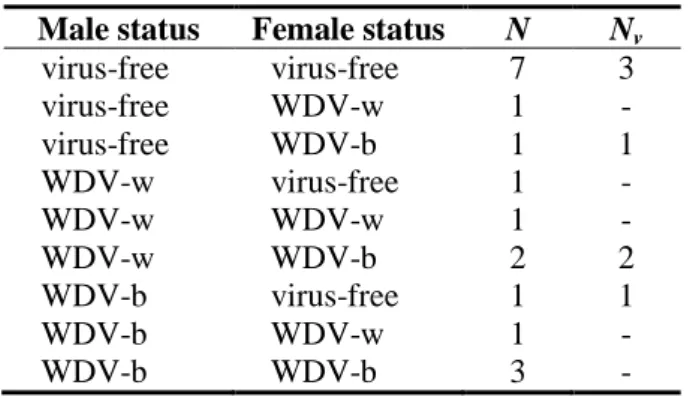
Eighteen pairs of virgin individuals were used to describe mating behaviour and we included 206
virus-free leafhoppers, as well as viruliferous individuals (Table 2). A male and a female 207
were placed on a plantlet and their behaviour and emitted vibrational signals were monitored 208
until the end of copulation. Care was taken to position the partners as far apart as possible; 209
however, due to their small size (3–4 mm) and high mobility, the initial distance between the 210
male and the female on the plantlet was variable. Vibrational signals emitted during the 211
mating sequence were recorded as described above. For seven pairs leafhopper behaviour 212
together with the emitted vibrational signals was simultaneously recorded with a 3CCD video 213
camcorder (Canon DM XM2) fitted with a 4.2–84 mm zoom lens (Table 2). 214
In all experiments, we monitored the following parameters: male calling latency (time 215
from the beginning of the experiment to the first pulse train emitted by male), female calling 216
Version postprint
latency (time from the beginning of the male calling song to the first pulse train emitted by 217
the female), the number of emitted courtship signals, mating sequence duration (time from 218
the emission of the first male or female pulse train to the beginning of copulation) and 219
duration of copulation (Table S1). Whenever possible, we also determined the search 220
duration (time from the onset of a duet to the location of the female) and close-range 221
courtship duration (time between the location of the female and the beginning of copulation). 222
In addition, 49 females of P. alienus collected in the field in September 2013 that had 223
laid eggs in the laboratory (i.e. they mated in the field) were after one month after egg 224
deposition stimulated with a pre-recorded P. alienus song described above in order to 225
determine whether they regained sexual receptivity. 226
227
Rivalry 228
To stage a rivalry situation, two males (N = 25 male pairs; 12 pairs of virus-free 229
males, 5 pairs of a virus-free male and a b male, 3 pairs of a w male and WDV-230
b male, 5 pairs of WDV-b males) were placed on a wheat plantlet and we played them a pre-231
recorded female calling song. From our library of recordings, we randomly chose a 60 s long 232
recording of a calling song of one virus-free female. The sequence contained 46 pulse trains 233
(duration: mean ± SD = 0.56 ± 0.04 s; pulse train repetition time: 1.31 ± 0.07 s). The 234
stimulatory sequence was played in a loop throughout the experiment; however, we randomly 235
stopped the playback for 30 s intervals. Vibrational activity was recorded for 30 min. 236
237
Terminology and statistical analyses 238
Version postprint
Pulse was defined as a unitary homogenous parcel of sound of finite duration (de Groot 239
et al., 2012), while a pulse train was characterized as a group of pulses with a characteristic 240
sequence or form. We defined song as a bout of repeated pulse trains. Since pulse train 241
repetition time was not always regular, the end of the bout was determined at the start of the 242
inter-pulse train interval longer than 5 s. Vibrational signals recorded exclusively during the 243
later close-range stages of the mating sequence were defined as courtship signals, while 244
signals emitted immediately prior to copulation attempts were termed pre-copulatory signals. 245
Data are presented as means and standard deviations, together with the numbers of 246
leafhoppers from which signals were obtained (N) and the numbers of signals analysed (n). 247
Dominant frequency data are presented as medians together with ranges. For quantifying 248
calling activity of single leafhoppers throughout the night, the cumulative calling time was 249
used to represent the calling activity in each hour. We obtained the cumulative calling time 250
for each individual by summing up the durations of all calling bouts (i.e. calling songs) in 251
these periods. 252
The parameters of calling songs (pulse repetition time, pulse train duration, pulse train 253
repetition time and dominant frequency) in each sex were compared between all viruliferous 254
leafhoppers (WDV-w and WDV-b) and virus-free individuals (collected in the field and the 255
progeny). Similarly, in each sex these parameters have been compared between virus-free 256
individuals from the field and virus-free progeny reared in the laboratory. Data were first 257
checked for normality with Shapiro-Wilk normality test and accordingly analysed either with 258
nonparametric Wilcoxon rank sum test or parametric Student`s t-Test. The proportions of all 259
females responding to either conspecific or heterospecific male calls included in the 260
stimulatory sequence used in female preference tests were compared with Test of equal of 261
Version postprint
given proportions, while correlations between sanitary status of the females and their 262
preferences for male calling songs were calculated using two-tailed Fisher‟s exact test. All 263
statistical analyses were conducted using R version 3.2.1. 264 265 Results 266 267 General observations 268
Overnight recordings of single individuals revealed that both sexes emit vibrational 269
signals spontaneously. The overall calling time during the night was longer in female (13020 270
s and 8522 s) than in males (2413 ± 2041 s), and was a result of longer pulse train durations 271
(see below). Although calling activity varied between individuals, the emerging pattern 272
suggests that while female calling activity is low in the period between midnight and 6 am, 273
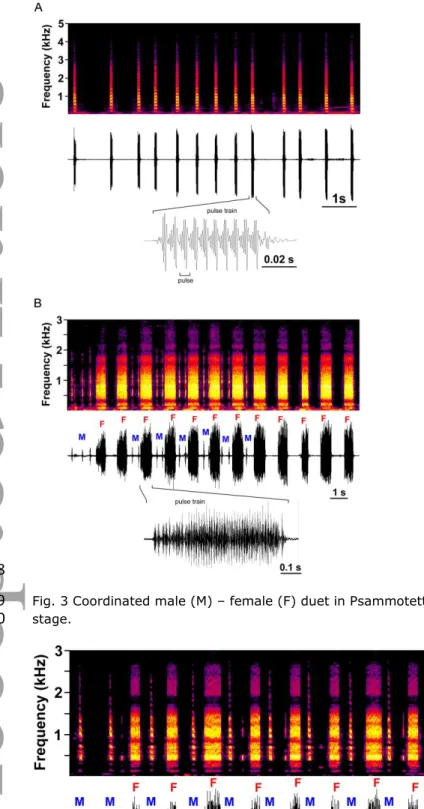
males are calling throughout the whole night (Fig. 1). 274
All recorded vibrational signals associated with the earlier stages of the mating sequence 275
consisted of a series of single pulses and the main difference between the male calling song, 276
female calling song and male rivalry song was in the pulse train duration and pulse repetition 277
time (Table 3, Figs. 2, 5). 278
279
Male calling song 280
Male calling song is characterized by short pulse train duration, highly regular pulse 281
repetition time within the train and less regular pulse train repetition time within the song 282
(Fig. 2, Table 3). Pulse trains span broad frequency range and have clear harmonic structure 283
Version postprint
with dominant frequency between 130 and 1000 Hz. Duration of the registered male calling 284
songs was variable (10.5 ± 5.9 s, N = 70, n = 70). 285
The analysed dominant frequencies, pulse train durations and pulse repetition time of 286
the male calling song did not differ significantly between the virus-free and viruliferous 287
males (Student‟s t-Test, P > 0.05), while viruliferous males emitted songs with significantly 288
longer pulse train repetition time (Student‟s t-Test, P = 0.04). 289
Parameters of calling song emitted by field collected free males and by virus-290
free males from a progeny produced in the laboratory were similar; however, in the latter, the 291
pulse train repetition time was significantly longer (Student‟s t-Test, P = 0.008) (Table 3). 292
However, eight of the nine F1 males tested belonged to the same lineage that appears to be 293
characterized by long pulse train repetition time (Table S2). 294
295
Female calling song 296
In comparison with the male calling song, female calling song is characterized by 297
longer pulse train duration, longer and less regular pulse repetition time within the train and 298
more regular pulse train repetition time (Figs. 2, 3, Table 3). As in the male calling song, 299
pulse trains span broad frequency range and also have similar dominant frequencies; 300
however, without the harmonic structure. Duration of the registered female calling songs was 301
highly variable (42.92 ± 43.95 s; N = 41, n = 41). The analysed parameters of female calling 302
song did not differ significantly between the virus-free and viruliferous females (Student‟s t-303
Test, P > 0.05) and neither did between the female progeny and virus-free females (Student‟s 304
t-Test, P > 0.05). 305
Version postprint
Female preferences 307
In the tested P. alienus females the emission of calling song was clearly associated wit 308
h the conspecific male calling song (Test of equal or given proportions, P < 0.001) (Table 4). 309
None of the females responded to G. ventralis male advertisement call; however, four P. alie 310
nus females started signalling during the playback of the P. confinis male calling song. In thre 311
e of these females the preceding male calling song in the stimulatory sequence was the consp 312
ecific male song. Preferences for P. alienus males and P. confinis males in the virus-free and 313
viruliferous females did not differ significantly (Fisher‟s exact test, P = 0.591) and we did not 314
observe any correlation in preferences for the male calling songs emitted by the virus-free an 315
d viruliferous P. alienus males and virus-free and viruliferous females (Fisher‟s exact test, P 316
= 1), however the number of the tested individuals was low (Table 4). 317
318
Mating behaviour 319
In general, observations did not reveal significant differences in mating behaviour 320
between the virus-free and virulifeorus leafhoppers (Table S1). On avarage, the complete 321
mating sequence duration (excluding copulation) was 54 ± 26 min (minimum = 11 min, 322
maximum = 101 min, N = 15). The main stages of the mating sequence in P. alienus are 323
shown in the Supplementary movie and in Fig. S1. Broadly, the stages can be described as 324
recognition, approach, courtship and pre-copula phase. In 17 out of 18 trials that finished 325
with copulation, the first registered vibrational signal was a male calling song (male calling 326
latency = 199 ± 255 s). On average, females emitted calling song 88 ± 164 s after the first 327
emitted pulse train by male. The first vibrational interaction was a coordinated duet in which 328
a male and a female regularly exchanged pulse trains in an M-F-M-F sequence (Fig. 3). 329
Version postprint
After vibrational contact was established, the male started to approach the stationary 330
female. On average, the approach stage lasted 24 ± 18 min (minimum = 3 min, maximum = 331
51 min, N = 7). During this stage vibrational interaction between a male and a female was 332
less precisely coordinated and leafhoppers continued to emit calling songs when the partner 333
stopped calling (Fig. 2b). Males were signalling only when they were not walking and often 334
they only sporadically emitted single pulse trains. 335
When the male reached the female, he positioned himself behind or on the side of the 336
female, facing in the same direction (Fig. S1A, B). On average, the close-range courtship 337
lasted for 34 ± 17 minutes (minimum = 10 min, maximum = 64 min, N = 7). While during the 338
courtship stage most females stopped calling, most males continued emitting the calling song; 339
however, male calling activity was lower than during the earlier stages. Courtship stage was 340
usually associated with a continuous emission of pulses emitted with irregular repetition time; 341
however, we were not able to determine whether they were produced by a male or a female. 342
During the close-range courtship males were rubbing and tapping the females with the front 343
leg (Fig. S1C) and flapping their wings (Fig. S1D). The latter resulted in distinct courtship 344
vibrational signals recorded in the substrate (Table 3, Fig. 4). Pulse trains produced by wing 345
flapping span broad frequency range and within the main frequency band (100–1000 Hz) 346
they have a clear harmonic structure with dominant frequency between 100 and 400 Hz. 347
Courtship signals produced by wing flapping were registered in all mating sequences that 348
concluded with copulation (minimum = 2; maximum = 25, N = 16). 349
Copulation attempts were associated with a distinct complex vibrational signal composed 350
of a 1-3 s long pulse train (buzz), followed by high amplitude pulses produced by wing 351
Version postprint
flapping and vibrating one wing over the female (Fig. 4 and Fig. S1E). The average duration 352
of copulation was 522 ± 88 s (N = 11). 353
Results of recordings of virus-free females that had mated in the field and have laid eggs 354
in the laboratory showed that 26% of P. alienus females started signalling again when 355
stimulated with the conspecific male calling song. 356
357
Rivalry behaviour 358
In seven out of 25 tested male pairs that were presented with a playback of the female calling 359
song, males emitted another type of vibrational signal (Fig. 5). These signals were recorded 360
in two pairs of virus-free males, two pairs of a virus-free male and a WDV-b male and three 361
pairs that included a WDV-b male and a WDV-w male. Although males usually started to 362
emit this signal in the interval between pulse trains in the female calling song, it always 363
overlapped at least part of the pulse train emitted by the female (Fig. 5). Although the 364
temporal and spectral parameters of this putative masking signal were variable, it is 365
characterized by a long pulse train duration and long pulse repetition time (Table 3). Pulse 366
train repetition time is not regular. Masking signal spans broad frequency range with 367
dominant frequencies between 400 and 1200 Hz (Fig. 5). 368
In all trials in which the putative masking signals were recorded, they were preceded by 369
the male calling song emitted by a live male. On average we recorded 23 (SD = 19, minimum 370
= 2, maximum = 51) masking signals per trial. Due to the small size of P. alienus 371
leafhoppers, it was not possible to determine which male emitted the recorded calling songs 372
and masking signals. 373
Version postprint
Discussion
375 376
Results of the present study show that as in other Cicadellidae, mating behaviour in P. 377
alienus is stereotyped and associated with the emission of species- and sex-specific 378
vibrational signals. However, our results also revealed important differences with other 379
leafhopper species so far studied in detail. The unique features of vibrational communication 380
in P. alienus are: (i) that the pair formation is initiated by either gender; (ii) the same general, 381
simple structure of male and female calling song and (iii) progression from a patterned to a 382
loosely coordinated duet. 383
For leafhoppers, it is generally accepted that mating sequence is initiated by the emission 384
of male calling signals (Claridge, 1985; Hunt & Nault, 1991; Čokl & Virant-Doberlet, 2003; 385
Mazzoni et al., 2009; de Groot et al., 2012). However, one older study indicated that females 386
also show low levels of spontaneous calling activity and can rarely also initiate a pair 387
formation (Saxena & Kumar, 1984). Although in mating experiments, most duets were 388
initiated by the male, taken together, the structure of the female calling song (see below) and 389
high spontaneous female calling activity in overnight recordings suggest that in P. alienus 390
females may be equally likely to trigger the exchange of vibrational signals. While apparently 391
rare in leafhoppers, such behaviour seems to be more common in planthoppers (e.g. Virant-392
Doberlet & Žežlina, 2007; Mazzoni et al., 2010). However, mating systems are shaped in part 393
also by ecological aspects of the environment, including population density (Virant-Doberlet 394
& Žežlina, 2007).Despite considerable economic importance of leafhoppers, we still know 395
very little about their mating systems and reproductive strategies under field conditions and 396
Version postprint
future studies should provide more insight into mechanisms that are involved in the evolution 397
of different communication strategies in Auchenorrhyncha. 398
In contrast to males, mated leafhopper females stop signalling and, consequently, males, 399
cannot locate them (Bailey & Nuhardiyati, 2005; Mazzoni et al., 2009) and it is usually 400
accepted that in leafhoppers, females, unlike males, most likely mate only once in their 401
lifetime. Our results show that after they laid eggs mated P. alienus females regained their 402
sexual receptivity. In the absence of studies of P. alienus mating behaviour under field 403
conditions it is not clear whether this result reflects a natural situation. However, it has been 404
observed that in the field leafhopper females can mate multiply (Hayashi & Kamimura, 2002) 405
and that when ejaculate size is small, some females become responsive again after a post-406
mating refractory period (Bailey & Nuhardiyati, 2005). 407
Calling signals are long-range signals associated with the initial stage of mating 408
behaviour when individuals advertise their presence and readiness to mate and should reveal 409
the identity (species and gender) of the signaller and also provide information necessary to 410
determine its location (Čokl & Virant-Doberlet, 2003). This is in agreement with our results 411
that in P. alienus vibrational signals used in the recognition stage enabled a reliable 412
identification of the partner. However, studies done so far show that in leafhoppers calling 413
signals emitted by males are more complex than those emitted by females (Čokl & Virant-414
Doberlet, 2003; Percy et al., 2008; Mazzoni et al., 2009; de Groot et al., 2012; Derlink et al., 415
2014). In contrast, in P. alienus male and female calling songs do not differ in their 416
complexity and in both genders calling songs are simple and formed by regularly emitted 417
pulse trains. In particular, female calling song in this respect more closely resembles female 418
vibrational signals in the hemipteran species in which females initiate vibrational exchange 419
Version postprint
between partners (e.g. the planthopper Hyalesthes obsoletus (Mazzoni et al., 2010) and the 420
pentatomid bugs [Čokl, 2008]) than female replies described in other leafhopper species. 421
Consequently, a duet structure in P. alienus also differs from the exchange of male and 422
female vibrational signals described in other Cicadellidae (e. g. Heady et al., 1986; Percy et 423
al., 2008; Mazzoni et al., 2009; Derlink et al., 2014). 424
Coordinated duet observed in the recognition stage to some extent resembles a duet 425
structure described in the early stages of the mating sequence in the leafhopper S. titanus 426
(Polajnar et al., 2014) and the planthopper H. obsoletus (Mazzoni et al., 2010). Additional 427
studies are needed to determine whether in P. alienus such coordinated duet results from 428
resetting the endogenous oscillator generating the song rhythm by the perceived pulse trains 429
emitted by the partner or partners listen out for each other and reply (Polajnar et al., 2014). 430
During the approach stage, a continuous emission of female calling song may be important 431
for successful and quick localization. For small plant-dwelling insects relying on vibrational 432
communication, locating the partner is difficult (Virant-Doberlet et al., 2006). The 433
experimental environment used in the current study was not complex enough to test the 434
localization ability of P. alienus; however, even for leafhoppers with the body size of around 435
3–4 mm, vibrational signals provide a reliable information needed to locate the female 436
(Polajnar et al., 2014). As in other leafhoppers (Mazzoni et al., 2009; Kuhelj et al., 2015), P. 437
alienus males were alternating periods of signalling with periods of walking. Less 438
coordinated duet observed during the approach stage may result from inability to coordinate 439
the activity of muscles involved in signal production and walking, or from inability to detect 440
female vibrational signals while walking, since leg movements likely stimulate the same leg 441
mechanoreceptors that also detect vibrational signals. 442
Version postprint
As in some other Auchenorrhyncha that emit relatively simple vibrational signals during 443
the earlier stages of the mating sequence (e.g. Virant-Doberlet & Žežlina, 2007; Mazzoni et 444
al., 2009), in P. alienus more complexity has been introduced at the later stages of mating 445
behaviour. In leafhoppers, production of vibrational signals is costly (Kuhelj et al., 2015) and 446
it has been hypothesized that the cost may be rationalized by emitting more complex and 447
energetically more demanding signals after the recognition and location of the female have 448
been completed (Polajnar et al., 2014). Wing flapping and wing vibrations produced by males 449
during the close-range stages have been observed in several leafhopper species (Shaw et al., 450
1974; Shaw, 1976; Saxena & Kumar, 1984; Heady et al., 1986; Hunt & Nault, 1991). Our 451
results show that wing movements result in distinct and stereotyped vibrational signals; 452
however, the role of these signals is not clear since wing flapping can also be associated with 453
visual and/or chemical signals. 454
Our results suggest that in the presence of a receptive female, competing P. alienus 455
males emit vibrational signals most likely to interfere with male-female communication. Such 456
signals have been described in other leafhopper species (Mazzoni et al., 2009; Kuhelj et al., 457
2015). The data obtained in the current study by playback experiments are not sufficient to 458
determine whether these putative masking signals are used to disrupt a coordinated male-459
female duet or to mask female calling song. Future studies should reveal whether this species 460
coordinated duet is vulnerable to disruption and whether rival males also use satellite 461
behaviour to approach the female duetting with another male. 462
Preliminary results obtained in the current study suggest that the viruliferous status of the 463
leafhopper does not have a significant effect on leafhopper performance in mating behaviour; 464
however, our results also showed that pulse train repetition time in male calling song was 465
Version postprint
significantly longer in viruliferous than in the virus-free males. Although due to the low 466
numbers of tested individuals the current results are not conclusive, they show that it is 467
worthwhile testing in more detail whether reproductive behaviour in P. alienus is influenced 468
by the virus. Plant viruses can modify vector performance via indirect effects of virus 469
infection on plant nutritional composition (Fiebig et al., 2004) or directly via altering vector 470
behaviour and physiology (Ingwell et al., 2012; Moreno-Delafuente et al., 2013; Wan et al., 471
2015). Behaviour associated with mating (advertising, walking, rivalry interactions) is 472
energetically demanding (Kuhelj et al., 2015) and better availability of nutrients in infected 473
plants may have an important role on performance (Morehouse et al., 2010). Leafhoppers 474
keep their feeding stylets inserted into plant tissue while emitting vibrational signals (Kuhelj 475
et al., 2015) and there is indirect evidence that P. alienus males may also be signalling while 476
feeding (Tholt et al., 2015). Furthermore, virus infection also alters other parameters of the 477
host plant (phenotypic and physiological) (Scholthof et al., 2011) that can affect plant 478
transmission properties that can in turn affect the ability of leafhoppers to communicate with 479
conspecifics. Future studies on virus-host plant-vector interactions should also take these 480
potential effects into account. 481
Developing new approaches in pest management that could help to reduce the use of 482
pesticides is one of the main challenges in sustainable agriculture. Until recently, exploitation 483
of vibrational signals used in intraspecific communication has been rarely considered in pest 484
management even from a theoretical viewpoint. However, recent work done on S. titanus 485
(Eriksson et al., 2012; Polajnar et al., 2016) and psyllid Diaphorina citri (Mankin et al., 486
2013) highlights that, although currently due to the lack of obvious technical solutions, the 487
Version postprint
implementation of acoustic methods in pest management may seem limited, more directed 488
efforts may provide new perspectives in management strategies. 489
490 491
Acknowledgments
492
The authors acknowledge Gabrijel Seljak for his help in leafhopper identifications during 493
field survey in Western Slovenia. The presented work has been supported by the Institut 494
National de la Recherche Agronomique (France), Montpellier SupAgro (France) and by 495
funding from the Slovenian Research Agency (research programme P1-0255). 496
497
References
498
Abt, I. and Jacquot, E. (2015) Wheat dwarf. Virus Diseases of Tropical and Subtropical 499
Crops (eds P. Tennant & R. Fermin), CAB International, Plant protection series, 2015, 500
27–41 501
Bailey, W.J. and Nuhardiyati, M. (2005) Copulation, dynamics of sperm transfer and female 502
refractoriness in the leafhopper Balclutha incisa (Hemiptera: Cicadellidae: 503
Deltocephalinae). Physiological Entomology, 30, 343–352 504
Cocroft, R.B., Shugart, H.J., Konrad, K.T. and Tibbs K. (2006) Variation in plant substrates 505
and its consequences for insect vibrational communication. Ethology, 112, 779–789 506
Čokl, A. (2008) Stink bug interaction with host plants during communication. Journal of 507
Insect Physiology, 54, 1113–1124 508
Čokl, A. and Millar, J.G. (2009) Manipulation of insect signalling for monitoring and control 509
of pest insects. Biorational Control of Arthropod Pests: Application and Resistance 510
Management (eds I. Ishaaya & R. Horowitz), Springer, Dordrecht, pp. 279–316 511
Version postprint
Čokl, A. and Virant-Doberlet, M. (2003) Communication with substrate-borne signals in 512
small plant-dwelling insects. Annual Review of Entomology, 48, 20–50 513
de Groot, M., Derlink, M., Pavlovčič, P., Prešern, J., Čokl, A. and Virant-Doberlet, M. (2012) 514
Duetting behaviour in the leafhopper Aphrodes makarovi (Hemiptera: Cicadellidae). 515
Journal of Insect Behaviour, 25, 419–440 516
De Luca, P.A. and Cocroft, R.B. (2011) The influence of age on male mate-searching 517
behaviour in thornbug treehoppers. Ethology, 117, 1–11 518
Derlink, M., Pavlovčič, P., Stewart, A.J.A. and Virant-Doberlet, M. (2014) Mate recognition 519
in duetting species: the role of male and female vibrational signals. Animal Behaviour, 520
90, 181–193 521
Eben, A., Mühlethaler, R., Gross, J. and Hoch, H. (2015) First evidence of acoustic 522
communication in the pear psyllid Cacopsylla pyri L. (Hemiptea: Psyllidae). Journal of 523
Pest Science, 88, 87–95 524
Eriksson, A., Anfora, G., Lucchi, A., Lanzo, F., Virant-Doberlet, M. and Mazzoni, V. (2012) 525
Exploitation of insect vibrational signals reveals a new method of pest management. 526
PLoS ONE, 7, e32954. doi: 10.1371/journal.pone.0032954 527
Hayashi, F. and Kamimura, Y. (2002) The potential for incorporation of male derived 528
proteins into developing eggs in the leafhopper Bothrogonia ferruginea. Journal of Insect 529
Physiology, 48, 153–159 530
Heady, S.E. and Nault, L.R. (1991) Acoustic signals of Graminella nigrifrons (Homoptera: 531
Cicadellidae). Great Lakes Entomology, 24, 9–16 532
Version postprint
Heady, S.E., Nault, L.R., Shambaugh, G.F. and Fairchild, L. (1986) Acoustic and mating 533
behavior of Dalbulus leafhoppers (Homoptera: Cicadellidae). Annals of Entomological 534
Society of America, 79, 727–736 535
Hunt, R.E. and Morton, T.L. (2001) Regulation of chorusing in the vibrational 536
communication system of the leafhopper Graminella nigrifrons. American Zoology, 41, 537
1222–1228 538
Hunt, R.E. and Nault, L.R. (1991) Roles of interplant movement, acoustic communication 539
and phototaxis in mate location behavior of the leafhopper Graminella nigrifrons. 540
Behavioral Ecology & Sociobiology, 28, 315–320 541
King, A.M.Q., Adams, M.J., Carstens, E.B. and Lefkowitz, E.J (2012) ICTV Report: “Virus 542
taxonomy: classification and nomenclature of viruses: Ninth Report of the International 543
Committee on Taxonomy of Viruses”. Elsevier Academic Press, San Diego, USA. 544
Ingwell, L.L., Eigenbrode, S.D. and Bosque-Pérey, N.A. (2012) Plant viruses alter insect 545
behaviour to enhance their spread. Scientific Reports, 2, 578. doi: 10.1038/srep00578 546
Kanmiya, K. (2006) Mating behaviour and vibratory signals of whiteflies (Hemiptera: 547
Aleyrodidae). Insect Sounds and Communication: Physiology Behaviour and Ecology 548
(eds. S. Drosopoulos & M.F. Claridge), Taylor and Francis, Boca Ratoon, pp. 365–376 549
Korinšek, G., Derlink, M., Virant-Doberlet, M. and Tuma, T. (2016) An autonomous system 550
of detecting and attracting leafhopper males using species- and sex-specific substrate 551
borne signals. Computers & Electronics in Agriculture, 123, 29–39. 552
Kuhelj, A., de Groot, M., Pajk, F., Simčič, T. and Virant-Doberlet, M. (2015) Energetic cost 553
of signalling in a leafhopper. Behavioral Ecology & Sociobiology, 69, 815–828 554
Version postprint
Lindblad, M. and Areno, P. (2002) Temporal and spatial population dynamics of 555
Psammotettix alienus, a vector of wheat dwarf virus. International Journal of Pest 556
Management, 48, 233–238 557
Mankin, R.W., Rohde, B.B., McNeill, S.A., Paris, T.M., Zagvazdina, N.I. and Greenfeder, S. 558
(2013) Diaphorina citri (Hemiptera: Liviidae) responses to microcontroller-buzzer 559
communication signals of potential use in vibration traps. Florida Entomology, 96, 560
1546–1555. 561
Mazzoni, V., Prešern, J., Lucchi, A. and Virant-Doberlet, M. (2009) Reproductive strategy of 562
the Nearctic leafhopper Scaphoideus titanus Ball (Hemiptera: Cicadellidae). Bulletin of 563
Entomological Research, 99, 401–413 564
Mazzoni, V., Lucchi, A., Ioriatti, C., Virant-Doberlet, M. and Anfora, G. (2010) Mating 565
behaviour of Hyalesthes obsoletus (Hemiptera: Cixiidae). Annals of Entomological 566
Society of America, 103, 813–822 567
Moreno-Delafuente, A., Garzo, E., Moreno, A. and Fereres, A. (2013) A plant virus 568
manipulates the behaviour of its whitefly vector to enhance its transmission efficiency 569
and spread. PLoS ONE, 8, e61543. 570
Percy, D.M., Boyd, E.A. and Hoddle, M.S. (2008) Observations of acoustic signals in three 571
sharpshooters: Homalodisca vitripennis, Homalodisca liturata and Graphocephala 572
atropunctata (Hemiptera: Cicadellidae). Annals of Entomological Society of America, 573
101, 253–259 574
Polajnar, J., Eriksson, A., Lucchi, A., Anfora, G., Virant-Doberlet, M. and Mazzoni, V. 575
(2015) Manipulating behaviour with substrate-borne vibrations – potential for insect pest 576
control. Pest Management Science, 71, 15–23 577
Version postprint
Polajnar, J., Eriksson, A., Virant-Doberlet, M. and Mazzoni, V. (2016) Mating disruption of a 578
grapevine pest using mechanical vibrations: from laboratory to the field. Journal of Pest 579
Science, in press (doi:10.1007/s10340-015-0726-3) 580
Polajnar, J., Eriksson, A., Rossi, S.M.V., Lucchi, A., Anfora, G., Virant-Doberlet, M. and 581
Mazzoni, V. (2014) The process of pair formation mediated by substrate-borne 582
vibrations in a small insect. Behavioural Processes, 107, 68–78 583
Posadas, G. and Henry, M. (2002). Resistance to BYDV-PAV and CYDV-RPV in a bread 584
wheat x agrotricum cross. Barley Yellow Dwarf Disease: Recent Advances and Future 585
Strategies (eds. M. Henry & A. McNab), CIMMYT, Mexico. 127pp. 586
Sadeghi, S.E., Dedryver, C.A., Riault, G. and Tanguy, S. (2000) Variation in virus content 587
among individual leaves and roots of barley and wheat infected with a BYDV-PAV 588
isolate. Journal of Agricultural Science and Technology, 2, 151–160 589
Saxena, K.N. and Kumar, H. (1984) Acoustic communication in the sexual behavior of the 590
leafhopper Amrasca devastans. Physiological Entomology, 9, 77–86 591
Schlick-Steiner, B.C., Steiner, F.M., Seifert, B., Stauffer, C., Christian, E. and Crozier, R.H. 592
(2010) Integrative taxonomy: a multisource approach to exploring biodiversity. Annual 593
Review of Entomology, 55, 421–438. 594
Scholthof, K.B.G., Adkins, S., Czosnek, H., Palukaitis, P., Jacquot, E., Hohn, T., Saunders, 595
K., Candresse, T., Ahlquist, P., Hemenway, C. and Foster, G.D. (2011) Top 10 Plant 596
Viruses in Molecular Plant Pathology. Molecular Plant Pathology, 12, 938–954 597
Shaw, K.C. (1976) Sounds and associated behavior of Agallia constricta and Agalliopsis 598
novella (Homoptera: Auchenorrhyncha: Cicadellidae). Journal of Kansas Entomological 599
Society, 49, 1–17 600
Version postprint
Shaw, K.C., Vargo, A. and Carlson, O.V. (1974) Sounds and associated behavior of some 601
species of Empoasca. Journal of Kansas Entomological Society, 47, 284–307 602
Tholt, G., Samu, F. and Kiss, B. (2015) Feeding behaviour of a virus-vector leafhopper on 603
host and non-host plants characterized by electrical penetration graphs. Entomologia 604
Experimentali et Applicata, 155, 123–136 605
Tishechkin, D.Y. (1999) The variability of acoustic signals and some morphological 606
characters in Psammotettix striatus (Homoptera, Cicadellidae) from Russia and adjacent 607
countries. Zoologičenskij žurnal, 78, 1298–1305 (in Russian) 608
Tishechkin, D.Y. (2000) Vibrational communication in Aphrodinae leafhoppers 609
(Deltocephalinae auct., Homoptera: Cicadellidae) and related groups with notes on 610
classification of higher taxa. Russian Entomological Journal, 9, 1–66 611
Vacke, J. (1961) Wheat dwarf virus disease. Biologia Plantarum, 3, 228–233. 612
Virant-Doberlet, M., Čokl, A. and Zorović, M. (2006) Use of substrate vibrations for 613
orientation: from behaviour to physiology. Insect Sounds and Communication: 614
Physiology Behaviour and Ecology (eds. S. Drosopoulos & M. F. Claridge), Taylor and 615
Francis, Boca Ratoon, pp. 81–97 616
Virant-Doberlet, M. and Žežlina, I. (2007) Vibrational communication of Metcalfa pruinosa 617
(Hemiptera: Fulgoroidea; Flatidae). Annals of Entomological Society of America, 100, 618
73–82 619
Wan, G.J., Jiang, S.L., Wang, W.J., Li, G.Q., Tao, X.R., Pan, W.D., Sword, G.A. and Chen, 620
F.J. (2015) Rice stripe virus counters reduced fecundity in its vector by modifying insect 621
physiology, primary endosymbionts and feeding behaviour. Scientific Reports, 5, 12527. 622
Version postprint
Wintraub, P.G. and Beanland, L.A. (2006) Insect vectors of phytoplasmas. Annual Review of 623
Entomology, 53, 91–111 624
Zhang, X., Zhou, G.H., Wang, X.F. (2010) Detection of wheat dwarf virus (WDV) in wheat 625
and vector leafhopper (Psammotettix alienus Dahlb.) by real-time PCR. Journal of 626
Virological Methods, 169, 416–419 627
628 629
Table 1 Temporal and spectral parameters of the male calling songs included in the
630
stimulation sequence used to test preferences of Psammotettix alienus females. 631 632 633 634 635 636 637
Means ± standard deviations are shown while for dominant frequency medians, minimum 638
and maximum measured values (in brackets) are given. 639
WDV-b: individuals viruliferous for the WDV barley strain. 640
641 642 643 644
Male calling song Sequence duration (s) Number of pulse trains Pulse train duration (ms) Pulse train repetition time (s) Dominant frequency (Hz) P. alienus, virus-free 10 12 76 ± 5 0.88 ± 0.34 s 586 (164–609) P. alienus, WDV-b 19 12 68 ± 6 1.7 ± 1.1 s 375 (328–727) P. confinis 1 19 41 40 ± 9 0.46 ± 0.21 s 703 (585–773) P. confinis 2 10 25 40 ± 5 0.41 ± 0.16 s 773 (633–1172) G. ventralis 7 70 62 ± 21 0.10 ± 0.03 s. 280 (195–388)
Version postprint 645 646 647 648 649 650 651
Table 2 Sanitary status of
652
Psammotettix alienus 653
individuals included in 654
observations of mating behaviour. 655 656 657 658 659 660 661 662 663 664
N: number of pairs included in observations. 665
NV: subset in which mating behaviour was also recorded on video.
666
WDV-w: individuals viruliferous for the WDV wheat strain. 667
WDV-b: individuals viruliferous for the WDV barley strain. 668 669 670 671 672 673 674 675
Male status Female status N Nv
virus-free virus-free 7 3 virus-free WDV-w 1 - virus-free WDV-b 1 1 WDV-w virus-free 1 - WDV-w WDV-w 1 - WDV-w WDV-b 2 2 WDV-b virus-free 1 1 WDV-b WDV-w 1 - WDV-b WDV-b 3 -
Version postprint
676
Table 3 Temporal and spectral properties of vibrational signals emitted by Psammotettix
677 alienus. 678 679 N n Pulse repetition time (ms) N n Pulse train duration (s) Dominant frequency (Hz) n Pulse train repetition time (s)
Male calling song – virus free 9 94 6 ± 1 28 344 0.07 ± 0.01 492 (141–1078) 295 1.05 ± 0.38 Male calling song – WDV-w 5 51 7 ± 1 7 99 0.08 ± 0.01 409 (129– 603) 83 1.53 ± 0.63A Male calling song – WDV-b 10 93 7 ± 1 12 134 0.08 ± 0.01 345 (129– 991) 112 1.40 ± 0.38A Male calling song – progeny, virus free 9 92 6 ± 1 9 74 0.08 ± 0.01 609 (375 – 914) 108 1.56 ± 0.43B Female calling song – virus free 8 75 20 ± 6 18 221 0.45 ± 0.06 363 (117– 914 ) 184 1.35 ± 0.14 Female calling song – WDV-w 5 49 20 ± 4 5 52 0.46 ± 0.10 492 (492–539) 47 1.31 ± 0.08 Female calling song – WDV-b 10 99 24 ± 3 14 156 0.42 ± 0.05 387 (234 – 727) 30 1.43 ± 0.16 Female calling song – progeny, virus free 3 33 15 ± 5 3 140 0.48 ± 0.06 469 (375 – 516) 117 1.62 ± 0.36
Courtship signal 8 28 300 ±32 8 28 8.09 ± 1.47 140 (108–450) - -
Masking signal 7 516 13 ± 2 7 160 4.03 ± 2,09 574 (390 ± 1187) - -
680
Means ± standard deviations are shown while for dominant frequency medians, minimum 681
and maximum measured values (in brackets) are given. 682
WDV-w: individuals viruliferous for the WDV wheat strain. 683
WDV-b: individuals viruliferous for the WDV barley strain. 684
A – Pulse train repetition time of the viruliferous males was statistically different than in the 685
virus-free males (Student`s t-Test, P = 0.004); B – Pulse train repetition time of the virus-free 686
progeny males was statistically different from the field-collected virus-free males (Student`s 687 t-Test, P = 0.004). 688 689 690 691 692 693 694 695 696
Table 4 Responsiveness parameters of Psammotettix alienus females to stimulation with
697
conspecific and heterospecific male calling songs, 698
699
Version postprint 700 701 702 703 704 705
Means ± standard deviations are shown. When N < 3, measured values are given. 706
Significantly higher number of females started calling during the presentation of the 707
conspecific male calling songs (Test of equal or given proportions, P < 0.001). 708
709
Fig 1. Nightly calling activity of individual male and female Psammotettix alienus. Virus-free females
710
(N=2); black circle and black diamond; Virus-free males (N=3): white squares; WDV-W infected male
711
(N=1): asterisk; WDV-b infected male (N=1): cross.
712
713 714
Fig. 2 Male (A) and female (B) calling song of Psammotettix alienus. For each signal, the spectrogram is
715
shown above the corresponding waveform. Insets show expanded individual female pulse trains. A male
716
(M) – female (F) duet shown in (B) was registered during the approach stage.
717
Virus-free WDV-b Virus-free WDV-b Virus-free WDV-b
P. alienus, virus-free 15.4 38.5 5.23 ± 3.18 8.68 ± 4.07 41,3 ± 30,1 51,8 ± 55,6
P. alienus, WDV-b 11.5 19.2 18.04 ± 13.72 10.86 ± 7,62 34,0 ± 34,6 63,0 ± 44,5
P. confinis 1 7.7 7.7 7.8; 13.5 14.2; 6.8 92; 2 188; 20
P. confinis 2 0 0 - - - -
Version postprint
718
Fig. 3 Coordinated male (M) – female (F) duet in Psammotettix alienus registered during the recognition
719
stage.
720
721
Fig. 4 Representative courtship (a) and pre-copulatory (b) signals emitted by male Psammotettix
722
alienus.
Version postprint
Inset in (a) shows expanded section of the signal.
724
725
Fig. 5 Putative masking signals (MS) emitted by male Psammotettix alienus. (F) female pulse trains.
726
Inset shows expanded section of the signal.
Version postprint