Macrocyclic Effects in the Mesomorphic Properties of Liquid-Crystalline
Pillar[5]- and Pillar[6]arenes
Iwona Nierengarten,
[a]Sebastiano Guerra,
[a,b]Michel Holler,
[a]Lydia Karmazin-Brelot,
[c]Joaquín Barberá,*
[d]Robert Deschenaux,*
[b]and Jean-François Nierengarten*
[a]Dedicated to Dr. Raymond Ziessel on the occasion of his 60th birthday
Keywords: Nanostructures / Macrocycles / Liquid crystals / Structure elucidation / Click chemistry
Whereas the reaction of 1,4-bis(2-bromoethyloxy)benzene (4)with paraformaldehyde in the presence of BF3·Et2O afforded
exclusively the cyclopentameric pillar[5]arene derivative (5), both cyclopenta- and cyclohexameric macrocycles 5 and 6 were obtained when the reaction of 4 with paraformaldehyde was performed at 45 °C in CHCl3with FeCl3as the catalyst.
Treatment of compounds 4–6 with sodium azide provided the corresponding polyazides, to which a cyanobiphenyl build-ing block was subsequently grafted to generate model com-pound 1, pillar[5]arene 2, and pillar[6]arene 3, bearing two,
Introduction
One important aspect of modern chemistry is the
synthe-sis of complex nanomolecules that exhibit specific
proper-ties for applications in materials science and biology.
[1]It is
clear that synthetic chemistry has played a major role in
the recent advances of nanosciences and nanomedicine.
[1]However, the preparation of complex nanostructures
com-bining the required functional groups often remains
diffi-cult and requires a large number of synthetic steps, limiting
both their accessibility and applicability. In this light, the
design of versatile nanoscaffolds allowing for the grafting
[a] Laboratoire de Chimie des Matériaux Moléculaires, Université de Strasbourg et CNRS (UMR 7509), Ecole Européenne de Chimie, Polymères et Matériaux,
25 rue Becquerel, 67087 Strasbourg Cedex 2, France E-mail: [email protected]
Homepage: http://www-ecpm.u-strasbg.fr/umr7509/ WebLaboNierengarten.htm
[b] Institut de Chimie, Université de Neuchâtel, Av. de Bellevaux 51, 2000 Neuchâtel, Switzerland E-mail: [email protected]
Homepage: http://www2.unine.ch/macrochem/page-6502.html [c] Service de Radiocristallographie, Institut de Chimie, Université
de Strasbourg,
1 rue Blaise Pascal, B.P. 296/R8, 67008 Strasbourg Cedex, France
[d] Departamento de Química Orgánica, Instituto de Ciencia de Materiales de Arágon, Universidad de Zaragoza – CSIC, 50009 Zaragoza, Spain
E-mail: [email protected]
Supporting information for this article is available on the WWW under http://dx.doi.org/10.1002/ejoc.201300356.
ten and twelve mesomorphic subunits, respectively. The li-quid-crystalline and thermal properties of the compounds were investigated by polarized optical microscopy (POM), differential scanning calorimetry (DSC), and X-ray diffrac-tion (XRD). Comparison of the liquid-crystalline properties of macrocycles 2 and 3 with those of 1 revealed the strong influ-ence of the macrocyclic pillar[n]arene core on the mesomor-phic properties. Whereas only a monotropic mesophase was observed for 1, a broad enantiotropic mesophase was evi-denced for both pillar[n]arene derivatives.
of one or more molecular entities to easily generate
sophis-ticated nanomolecules has attracted enormous interest.
[2–5]The recent development of efficient synthetic tools, namely
the so-called ‘click’ reactions,
[6]greatly facilitated the
emer-gence of this field. As part of this research, we recently
be-came interested in the use of a pillar[5]arene core as a
nano-scaffold for the preparation of nanomaterials with a
con-trolled distribution of functional groups on the macrocyclic
framework.
[7]Pillar[5]arenes are unique tubular-shaped
compounds composed of 1,4-disubstituted hydroquinone
subunits linked by methylene bridges in their
2,5-posi-tions.
[8–9]They are conveniently prepared from
1,4-dialk-oxybenzene derivatives and paraformaldehyde in the
pres-ence of a Lewis acid catalyst.
[10]Owing to the reversibility
of the Friedel–Crafts reaction, the cyclooligomerization is
thermodynamically driven, thus allowing pillar[5]arenes to
be obtained in high yields.
[11]The reaction conditions are,
however, not compatible with a large variety of functional
groups and the direct synthesis of pillar[5]arenes bearing
sophisticated substituents is often not possible. The
cycliza-tion reaccycliza-tion is also sensitive to steric effects, and the
pres-ence of large substituents on the starting
1,4-dialkoxybenz-ene considerably lowers the yields.
[10]This major problem
was addressed by producing readily accessible pillar[5]arene
derivatives bearing ten terminal groups, allowing their
fur-ther functionalization to generate structurally more
com-plex systems.
[7,12]For example, we have developed a
func-tions and shown that the copper-mediated Huisgen
1,3-di-polar cycloaddition of azides and alkynes resulting in
1,2,3-triazoles is an ideal tool with which to efficiently produce
functionalized pillar[5]arenes.
[7]This building block was
decorated with cyanobiphenyl moieties, thus providing the
first example of a liquid-crystalline pillar[5]arene
(com-pound 2).
[7]Importantly, comparison of its mesomorphic
properties with those of model compound 1 revealed a
dra-matic influence of the pillar[5]arene core. Indeed, whereas
only a monotropic mesophase was observed for 1, a broad
enantiotropic mesophase was evidenced by linking together
five linear subunits through the central macrocyclic
pillar-[5]arene core in 2. Clearly, the macrocyclic core unit is
cap-able of providing orientational and/or positional disorder
within the smectic layers to prevent crystallization but also
intermolecular π–π interactions between neighboring cores
to stabilize the lamellar phase. An important question
re-mains open however: Is this a general macrocyclic effect or
does it result from the peculiar fivefold symmetry
[13]of the
pillar[5]arene core? To answer to this question, we now
re-port a full account on this work, including the preparation
of the corresponding sixfold symmetrical pillar[6]arene
de-rivative 3.
Results and Discussion
Synthesis
As shown in Scheme 1, pillar[5]arene derivative 5 was
ob-tained from compound 4. Treatment of 4 and
paraform-aldehyde with BF
3·Et
2O in 1,2-dichloroethane gave
pillar-[5]arene 5 in 40 % yield.
[14]Under these conditions, no trace
of the corresponding pillar[6]arene derivative 6 could be
de-tected.
Our initial attempts to prepare compound 6 from 4
un-der the conditions recently reported for the preferential
preparation of pillar[6]arenes
[15](FeCl
3
/CHCl
3) gave, at
best, pillar[5]arene 5, but no trace of the corresponding
pil-lar[6]arene derivative 6. The reaction conditions (solvent,
catalyst, stoichiometry, temperature, reaction time) were
Scheme 1. Preparation of the azide building blocks. Reagents and conditions: (i) (CH2O)n, BF3·Et2O, CH2ClCH2Cl, room temp. (5: 40 %);
(ii) (CH2O)n, FeCl3, CHCl3, 45 °C (5: 15 %; 6: 30 %); (iii) NaN3, DMF, room temp. (7: 97 %; 8: 98 %; 9: 92 %).
thus systematically investigated in the particular case of
starting material 4. FeCl
3and CHCl
3appeared to be
suit-able, but both the temperature and the reaction time played
an important role in the outcome of the reaction. The
high-est yields in pillar[6]arene were obtained when the reaction
mixture was stirred for more than 3 d at temperatures
higher than 45 °C. Furthermore, it was also noticed that the
use of an excess of paraformaldehyde favored the formation
of the cyclohexamer. Under optimized conditions, the
reac-tion of 4 (1 equiv.) with a large excess of paraformaldehyde
(5 equiv.) in the presence of FeCl
3(0.2 equiv.) in CHCl
3at
45 °C for 3 d gave both 5 and 6. After work-up, compounds
5 and 6 were conveniently separated by column
chromatog-raphy on SiO
2and were isolated in 15 and 30 % yield,
respectively. The
1H and
13C NMR spectra of 5 and 6 are
similar, but mass spectrometry provided definitive
struc-tural assignments.
For compound 6, crystals suitable for X-ray crystal
struc-ture analysis were obtained by slow diffusion of hexane into
a CHCl
3/PhCN (2:1) solution of 6. As shown in Figure 1,
6 has a hexagon-like cyclic structure with two benzonitrile
molecules included in its cavity. Interestingly, the relative
orientation of the two PhCN molecules located in the same
macrocycle is not antiparallel. The dipole moment thus
generated may play an important role in the supramolecular
organization within the crystal lattice (see above). The
average bond angle for the methylene bridge in 6 is 114.2°,
and differs significantly from both the ideal 109.5° angle for
sp
3hybridized carbons and the theoretical 120° internal
an-gle for an unstrained hexagon. As a result, all the six
aro-matic subunits of 6 are slightly bent by about 1.6 to 4.2°.
To further accommodate the strain across the methylene
bridges, the six CH
2moieties are not located in the same
plane. Indeed, a deviation of 0.395 and 0.513 Å is observed
for two methylene centers from the plane encompassing the
four other centers. With its D
6-symmetrical structure,
com-pound 6 is chiral and crystallizes as a racemate. Close
in-spection of the packing down the crystallographic a axis
reveals alternating layers of both enantiomers (Figure 1, b).
Layers a–b are related to the a
⬘–b⬘ layers by a
crystallo-graphic glide plane. The macrocycles are not oriented
paral-lel to these planes but are significantly tilted. In this way,
the PhCN molecules within one layer are oriented
antipar-allel with respect to the PhCN molecules of the neighboring
layer. It is thus believed that the tilt of the pillar[6]arene
cores results from interlayer dipole-dipole interactions.
Within the layers, it can be noted that the pillar[6]arene
mo-lecules are organized in a hexagonal lattice (Figure 1, c).
Even though the tilted orientation of the macrocycles
pre-vents optimal overlap of the aromatic subunits, the
estab-lishment of notable intermolecular π–π interactions
be-tween neighboring macrocycles is clearly observed.
Figure 1. (a) ORTEP plot of the structure of 6·(PhCN)2(thermal
ellipsoids are shown at 50 % probability level; C: gray; O: black, Br: pale gray; N: dark gray, H: white). (b) Stacking within the 6·(PhCN)2lattice showing successive a/b/a⬘/b⬘ layers (view down
the crystallographic a axis; the H atoms and the PhCN molecules are omitted for clarity). (c) Stacking within the 6·(PhCN)2lattice
revealing the hexagonal packing of the pillar[6]arene molecules within one layer (view down the crystallographic b axis; H are omit-ted for clarity).
The clickable pillar[5]- and pillar[6]arene building blocks
7
[16]and 8 were obtained by reaction of 5 and 6,
respec-tively, with sodium azide in N,N-dimethylformamide
(DMF) at room temperature (Scheme 1). Similarly,
treat-ment of 4 with NaN
3afforded 9, the precursor of 1. Owing
to the high number of azide residues, compounds 7–9 were
handled with special care: upon evaporation, these
poly-azides were not dried under high vacuum and the use of
metallic spatula was strictly avoided. Furthermore, these
compounds were always prepared on small scales
(
⬍500 mg).
The functionalization of 7 and 8 with terminal alkynes
under the typical copper-catalyzed alkyne-azide
cycload-dition (CuAAC) concycload-ditions used for the functionalization
of multi-azide cores
[3](CuSO
4
·5H
2O, sodium ascorbate,
CH
2Cl
2/H
2O) was first attempted from commercially
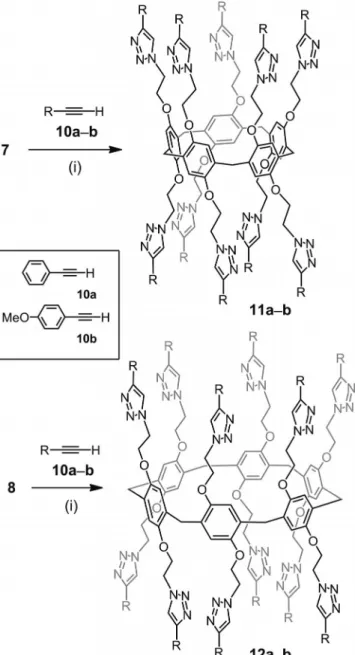
avail-able alkynes 10a–b (Scheme 2). The clicked derivatives 11a–
b and 12a–b were obtained in good yields. The structures
of compounds 11a–b and 12a–b were confirmed by their
1
H and
13C NMR spectra as well as by mass spectrometry.
Inspection of the
1H NMR spectra indicates the
disappear-ance of the CH
2azide signal at δ = 3.67–3.50 ppm (see the
Supporting Information). IR data also confirmed that no
azide residues (2089 cm
–1) remain in the final products (see
the Supporting Information). Importantly, the
1H NMR
spectra of 11a–b and 12a–b show the typical singlet of the
1,2,3-triazole unit at δ = 7.8–7.9 ppm (see the Supporting
Information).
Scheme 2. Model CuAAC reactions from the pillar[n]arene build-ing blocks 7 and 8. Reagents and conditions: (i) CuSO4·5H2O,
so-dium ascorbate, CH2Cl2/H2O, room temp. (11a: 60 %; 11b: 88 %;
12a: 84 %; 12b: 78 %).
The reaction conditions used for the preparation of 11a–
b and 12a–b were then applied to the mesomorphic subunit
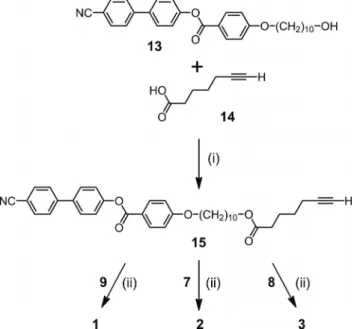
15 (Scheme 3). Compound 15 was prepared by
esterifica-tion of 6-heptynoic acid (14) with alcohol 13 using
4-(di-methylamino)pyridinium p-toluenesulfonate (DPTS) and
N,N
⬘-dicyclohexylcarbodiimide (DCC). A mixture of 7
(1 equiv.), 15 (11 equiv.), CuSO
4·5H
2O (0.1 equiv.) and
so-dium ascorbate (0.3 equiv.) in CH
2Cl
2/H
2O (1:1) was
vigor-ously stirred at room temperature for 24 h. After work-up
and purification by column chromatography on SiO
2fol-lowed by gel permeation chromatography (Biobeads SX-1,
CH
2Cl
2), 2 was obtained in 81 % yield. Similarly, reaction
of polyazide 8 with alkyne 15 gave pillar[6]arene derivative
3 in 90 % yield. Finally, model compound 1 was obtained
in 91 % yield from 9 and 15. The structures of compounds
1–3 were confirmed by IR,
1H and
13C NMR spectroscopy,
and by mass spectrometry. For all these compounds, the
1H
NMR spectra revealed one set of signals for the peripheral
mesogenic moieties thus showing that they are all
equiva-lent, in agreement with the symmetrical structures of
com-pounds 1–3 (see the Supporting Information).
Scheme 3. Preparation of compounds 1–3. Reagents and conditions: (i) DCC, DPTS, CH2Cl2, 0 °C to room temp. (91 %);
(ii) CuSO4·5H2O, sodium ascorbate, CH2Cl2/H2O, room temp. (1:
91 %; 2: 81 %; 3: 90 %).
Liquid-Crystalline Properties
The liquid-crystalline and thermal properties of
com-pounds 1–3 and 15 were investigated by polarized optical
microscopy (POM), differential scanning calorimetry
(DSC), and X-ray diffraction (XRD). Their thermal
prop-erties are summarized in Table 1.
On heating, model compound 1 melted at 145 °C from
the crystalline state into the isotropic liquid. The formation
of a monotropic smectic A phase (focal-conic fan texture,
see the Supporting Information) was observed during the
cooling run followed by crystallization of the sample. In
contrast, the corresponding monomer 15 gave rise to an
enantiotropic behavior with the observation of smectic A
Table 1. Thermal properties of compounds 1–3 and 15 deduced from the POM and DSC investigations.
Compd. Phase transition[a][b] Temp. Enthalpy changes ΔH
[°C][b] [kJ mol–1] 1 I씮SmA 149 5.8 SmA씮Cr 125 119 2 (Tg: 32 °C); SmA씮I 201 53 3 (Tg: 28 °C); SmA씮I 209 60 15 Cr씮SmA 114 64 SmA씮N 156 0.5 N씮I 158 0.1
[a] Cr: crystalline solid; SmA: smectic A phase; N: nematic phase; I: isotropic liquid, Tg: glass transition temperature. [b]
Tempera-tures are given as the onset of the peak obtained during the second heating run. Tgvalues are determined during the first cooling run.
(114–156 °C) and nematic (156–158 °C) phases.
Compari-son of the thermal behavior of 1 and 15 reveals interesting
features. Model compound 1 was isolated in a crystalline
form, suggesting favorable intermolecular π-π interactions
between the central aromatic parts of neighboring
mole-cules. As a consequence of the strong intermolecular π-π
interactions, the crystalline phase is stabilized and only a
monotropic mesophase could form.
By linking together five or six linear subunits through a
central macrocyclic pillar[n]arene core, the liquid-crystalline
properties changed dramatically. Indeed, pillar[n]arene
de-rivatives 2 and 3 gave rise to a broad enantiotropic smectic
A phase (focal-conic fan texture and homeotropic areas, see
the Supporting Information). Moreover, both 2 and 3 were
obtained as glassy products and not as crystalline solids.
Clearly, when compared with model compound 1,
crystalli-zation is prevented by the macrocyclic structures linking the
linear dimeric substructures. At the same time, the broad
enantiotropic mesophases observed for 2 and 3 show that
the macrocyclic core plays an important role regardless of
its shape, i.e., pentagonal vs. hexagonal. It appears that the
observed effect is not related to the fivefold symmetry of
the central scaffold but is a general macrocyclic effect.
[17]To gain further understanding of this effect,
high-tem-perature XRD measurements were carried out on the
me-sophases of cyclopentameric (2) and cyclohexameric (3)
compounds and of precursor 15. A full angular range 2θ
= 1–40° was recorded and, for comparative purposes, the
experiments were carried out in the three cases at the same
temperature (130 °C). XRD measurements of the
meso-phase of 1 could not be performed due to its monotropic
character and tendency to crystallize.
The X-ray patterns of the three compounds are
consis-tent with a smectic A phase, as they contain a small-angle
sharp maximum and a large-angle diffuse band. The sharp
maximum is related to the layer order and from its angular
position it is possible to deduce the interlayer spacing by
using Bragg’s law. The diffuse band arises from the lateral
interferences between conformationally disordered
hydro-carbon chains and denotes the absence of positional order
of the mesogenic units within the layers.
Table 2 collects the spacing deduced from the XRD
ex-periments for each compound. For 15, the experimental
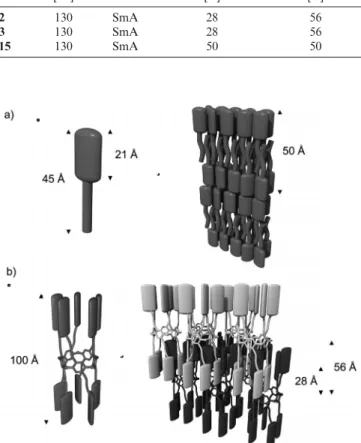
value (50 Å) is larger than the molecule length estimated
from stereomodels for a fully-extended conformation (45 Å;
Figure 2, a). A segment of 21 Å of that length corresponds
to the rigid mesogenic unit and 24 Å corresponds to the
hydrocarbon chains. However, the hydrocarbon chains are
known not to be in their most-extended conformation in
the mesomorphic state, and therefore the actual length of
the molecule must be shorter than the theoretical value of
45 Å. To account for the experimental value of 50 Å, the
molecules must adopt some kind of bilayer arrangement.
This can be achieved if the molecules in the smectic layers
adopt an alternating antiparallel orientation, so that the
ali-phatic regions are interpenetrated (Figure 2, a). It is
prob-able that additional interdigitation takes place between
ad-jacent layers due to the dipole–dipole interactions between
the terminal cyano groups, a phenomenon described
pre-viously.
[18]Table 2. Structural data of compounds 2, 3 and 15 deduced from the XRD measurements.
Compd. Temp. Mesophase Measured spacing Layer thickness
[°C] [Å] [Å]
2 130 SmA 28 56
3 130 SmA 28 56
15 130 SmA 50 50
Figure 2. (a) Theoretical molecule length of 15 and postulated ar-rangement in the SmA phase. (b) Theoretical molecule length of 2 and postulated arrangement in the SmA phase; a similar organiza-tion is also postulated for 3.
For compounds 2 and 3, the experimentally-measured
spacing was 28 Å. This value is too low for the layer
thick-ness, taking into account that these molecules are much
longer than molecules of 15. Indeed the molecule length
estimated with stereomodels for the fully-extended
confor-mation of 2 and 3 is about 100 Å (Figure 2, b). Two
conclu-sions arise from these results: (i) it is clear that some kind
of interdigitation between molecules in neighboring layers
takes place and that this reduces the effective layer
thick-ness; (ii) the small-angle X-ray maximum corresponds to
the second order layer reflection and thus the actual layer
thickness is twice the value directly deduced from Bragg’s
law, that is 56 Å. This behavior in XRD has been previously
reported and is related to the existence of some peculiarities
in the supramolecular arrangement (see below).
Interdigitation in the mesophases of 2 and 3 must be a
consequence of the particular molecular features of these
mesomorphic compounds, in which the macrocyclic
struc-ture must provide a large space to accommodate the
mesog-enic units of the upper and lower layers. Considering that
the mesogenic units in the pillar[n]arenes are able to
mutu-ally interpenetrate as described above for compound 15, a
fully-interdigitated structure can be proposed for the
smec-tic layers of 2 and 3. This high degree of interdigitation
means that the mesogenic units of one particular layer are
interpenetrated beyond the mesogenic units of the adjacent
layer and are embedded in the aliphatic region of this
adja-cent layer (Figure 2, b).
The effective layer thickness estimated for the proposed
structure can be as short as 58 Å (the molecule length,
100 Å, less twice the mesogenic unit length, 21 Å).
Con-sidering an additional shortening due to the conformational
freedom of the aliphatic chains, which would reduce the
effective periodicity to 56 Å, this is consistent with the
ob-servation of the second order reflection at 28 Å. The
ab-sence of the first order reflection may be related to the
exis-tence of a modulation of the electron density wave with a
period equal to half the layer periodicity. Indeed, in the
structure proposed for the smectic A phase of 2 and 3, there
are two maxima of the electron density along the normal
to the layers, one of which corresponds to the macrocycles
and the second corresponding to the interdigitated
meso-genic units. The two regions are mutually spaced by half
the full layer thickness. The same phenomenon has been
described for side-chain polymers
[19]and dendritic
sys-tems
[20]with liquid crystal properties and is accounted for
by the confinement of the polymer backbones or dendritic
cores in a thin sublayer, thus producing an electron density
maximum comparable to that of the mesogenic units. It is
interesting to note that no differences are found between
the supramolecular arrangement of 2 and 3. It can be
con-cluded that in both compounds a high degree of
interpen-etration between adjacent layers produces a good space
fill-ing and yields an efficient lateral arrangement of the
mesog-enic units in the SmA structure.
Conclusions
We have described the synthesis of pillar[5]arene 2 and
pillar[6]arene 3, bearing ten and twelve mesomorphic
sub-units, respectively. A broad enantiotropic mesophase has
been evidenced for both macrocyclic compounds. The
spe-cific orientation of the cyanobiphenyl moieties attached on
both rims of the macrocyclic core forces the system to
adopt a supramolecular organization in which each smectic
layer is interdigitated with its two neighboring layers. In this
way, the mesophase is stable over a broad temperature
range, which explains the macrocyclic effect observed for 2
and 3 when compared with model compounds 1 or 15.
Fi-nally, it can be noted that pillar[n]arene derivatives are
chi-ral. The present work paves the way for the preparation of
optically pure derivatives with ferroelectric liquid crystalline
properties. Work in this direction is underway in our
laboratories.
Experimental Section
General: All reagents were used as purchased from commercial sources without further purification. Compounds 4[14]and 13[21]
were prepared according to previously reported procedures. Evapo-ration and concentEvapo-ration were performed at water aspirator pres-sure and drying in vacuo at 10–2Torr. Column chromatography
was performed with silica gel 60 (230–400 mesh, 0.040–0.063 mm) purchased from E. Merck. Thin-layer chromatography (TLC) was performed on glass sheets coated with silica gel 60 F254purchased
from E. Merck (visualization by UV light). NMR spectra were re-corded with a Bruker AC300 or AC400 with solvent peaks as refer-ence. IR spectra were recorded with a Perkin–Elmer Spectrum One. Elemental analyses were performed by the analytical service of the ETH Zürich (Switzerland). MALDI-TOF and ESI mass spectra were recorded by the analytical service of the School of Chemistry (Strasbourg, France).
Liquid-Crystalline Properties: Transition temperatures (peak transi-tions) and enthalpies were determined with a differential scanning Mettler Toledo DSC 1 STAR calorimeter, under N2, at a rate of
10 °C/min. The instrument was calibrated against indium. Optical studies were conducted with a Zeiss-Axioscope polarizing micro-scope equipped with a Linkam-THMS-600 variable-temperature stage. XRD measurements were carried out at high temperatures using a Pinhole camera (Anton-Paar) operating with a point fo-cused Ni-filtered Cu-Kαbeam. The sample was held in Lindemann
glass capillaries (0.9 mm diameter) heated with a variable-tempera-ture attachment. The diffraction patterns were collected on a flat photographic film mounted perpendicular to the X-ray beam. Compound 5: BF3·Et2O (1.63 g, 11.5 mmol) was added to a stirred
solution of 4 (3.73 g, 11.5 mmol) and paraformaldehyde (1.04 g, 34.5 mmol) in 1,2-dichloroethane (200 mL) at room temperature. After 3 h, the reaction mixture was concentrated. Column chromatography (SiO2; cyclohexane/CH2Cl2, 1:1) gave 5 (1.54 g,
40 %). The analytical data were identical to those reported in the literature for compound 5.[14]
Compound 6: FeCl3(0.20 g, 1.24 mmol) was added to a stirred
solu-tion of 4 (2.00 g, 6.17 mmol) and paraformaldehyde (926 mg, 30.85 mmol) in CHCl3(90 mL) at 45 °C. After 72 h, the reaction
mixture was concentrated. Column chromatography (SiO2;
cyclo-hexane/CH2Cl2, 1:1) followed by gel permeation chromatography
(Biobeads SX-1; CH2Cl2) gave 5 (0.31 g, 15 %) and 6 (0.62 g, 30 %).
Data for 6: Colorless solid.1H NMR (CD
2Cl2, 300 MHz): δ = 6.75
(s, 12 H), 4.14 (t, J = 6 Hz, 24 H), 3.86 (s, 12 H), 3.55 (t, J = 6 Hz, 24 H) ppm.13C NMR (CD
2Cl2, 75 MHz): δ = 150.7, 129.0, 116.2,
69.5, 31.0, 30.9 ppm. MALDI-TOF-MS: m/z calcd. for C66H73O12Br12 [M + H]+ 2017.12; found 2017.2. C66H72Br12O12·
CH2Cl2: calcd. C 38.30, H 3.55; found C 38.18, H 3.66.
Compound 7: A mixture of 5 (370 mg, 0.22 mmol) and NaN3
(172 mg, 2.64 mmol) in DMF (10 mL) was stirred for 24 h at room temperature under Ar, then H2O (45 mL) was added. The aqueous
layer was extracted with Et2O (3⫻). The combined organic layers
were washed with water, dried with MgSO4, filtered, and
concen-trated. Column chromatography (SiO2; CH2Cl2) gave 7[16](278 mg,
97 %) as a colorless solid that was used as received in the next step. Caution: Owing to its high number of azide residues, this compound
must be handled with special care. Upon evaporation, compound 7 has never been dried under high vacuum and the use of metallic spat-ula should be avoided. Furthermore, this compound has always been prepared on a small scale. IR (neat): ν˜ = 2089 (N3) cm–1.1H NMR
(CD2Cl2, 300 MHz): δ = 6.94 (s, 10 H), 4.11 (t, J = 6 Hz, 20 H),
3.82 (s, 10 H), 3.67 (t, J = 6 Hz, 20 H) ppm.
Compound 8: A mixture of 6 (295 mg, 0.146 mmol) and NaN3
(133 mg, 2.05 mmol) in DMF (10 mL) was stirred for 24 h at room temperature under Ar, then H2O (50 mL) was added. The aqueous
layer was extracted with Et2O (3⫻60) and the combined organic
layers were washed with water (2⫻), dried with MgSO4, filtered
and concentrated. Column chromatography (SiO2; CH2Cl2) gave 8
(225 mg, 98 %) as a colorless solid that was used as received in the next step. Caution: Owing to its high number of azide residues, this
compound must be handled with special care. Upon evaporation, com-pound 8 has never been dried under high vacuum and the use of met-allic spatula should be avoided. Furthermore, this compound has al-ways been prepared on a small scale. IR (neat): ν˜ = 2089 (N3) cm–1. 1H NMR (CD
2Cl2, 300 MHz): δ = 6.77 (s, 12 H), 3.99 (t, J = 6 Hz,
24 H), 3.91 (s, 12 H), 3.50 (t, J = 6 Hz, 24 H) ppm.
Compound 9: Prepared as described for 7 starting from 4 (389 mg, 1.2 mmol) and NaN3(195 mg, 3.0 mmol) in DMF (8 mL). Column
chromatography (SiO2; CH2Cl2) gave 9 (273 mg, 92 %) as a
color-less oil that was used as received in the next step. Caution: Owing
to its high nitrogen content, this compound must be handled with special care. Upon evaporation, compound 9 has never been dried under high vacuum and the use of metallic spatula should be avoided. Furthermore, this compound has always been prepared on a small scale. IR (neat): ν˜ = 2105 (N3) cm–1.1H NMR (CDCl3, 300 MHz): δ = 6.88 (s, 4 H), 4.12 (t, J = 5 Hz, 4 H), 3.58 (t, J = 5 Hz,
4 H) ppm.
Compound 15: DCC (1.31 g, 6.36 mmol) was added to a solution of 13 (2.00 g, 4.24 mmol), 14 (640 mg, 5.09 mmol) and DPTS (1.25 g, 4.24 mmol) in anhydrous CH2Cl2(100 mL) at 0 °C. After 1 h, the
mixture was warmed slowly to room temperature and then stirred for 24 h at this temperature. The resulting mixture was evaporated and column chromatography (SiO2; CH2Cl2) followed by
precipi-tation (the sample was dissolved in CH2Cl2and the resulting
solu-tion added dropwise to MeOH) and filtrasolu-tion gave 15 (2.23 g, 91 %) as a colorless solid.1H NMR (CDCl 3, 400 MHz): δ = 8.20 (d, J = 9 Hz, 2 H), 7.76 (AA⬘XX⬘, JA,X= 9 Hz, 4 H), 7.68 (d, J = 9 Hz, 2 H), 7.38 (d, J = 9 Hz, 2 H), 7.03 (d, J = 9 Hz, 2 H), 4.11 (t, J = 7 Hz, 2 H), 4.10 (t, J = 6 Hz, 2 H), 2.38 (t, J = 7 Hz, 2 H), 2.26 (td, J = 7, 3 Hz, 2 H), 2.00 (t, J = 3 Hz, 1 H), 1.84 (m, 4 H), 1.61 (m, 4 H), 1.53 (m, 2 H), 1.37 (m, 10 H) ppm.13C NMR (CDCl 3, 100 MHz): δ = 173.5, 164.9, 163.7, 151.6, 144.9, 136.7, 132.7, 132.4, 128.4, 127.7, 122.61, 118.9, 114.4, 111.0, 84.0, 68.6, 68.4, 64.5, 33.8, 29.5, 29.45, 29.4, 29.2, 29.1, 28.7, 27.9, 26.0, 25.9, 24.1, 18.2 ppm. ESI-MS: m/z calcd. for C37H41NO5Na [M + Na]+602.29; found
602.7. C37H41NO5(579.30): calcd. C 76.66, H 7.13, N 2.42; found
C 76.42, H 7.17, N 2.39.
General Procedure for the Click Reactions: CuSO4·5H2O and
so-dium ascorbate were added to a mixture of azide 7–9 and the ap-propriate terminal alkyne in CH2Cl2/H2O (1:1). The resulting
mix-ture was vigorously stirred at room temperamix-ture under Ar. After 24 h, H2O was added, the aqueous layer was extracted with CH2Cl2
(3⫻), and the combined organic layers were dried (MgSO4),
fil-tered and concentrated. The product was then purified as outlined in the following text.
Compound 11a: Prepared from 7 (166 mg, 0.13 mmol), 10a (146 mg, 1.43 mmol), CuSO4·5H2O (3.3 mg, 0.013 mmol) and sodium
as-corbate (7.9 mg, 0.04 mmol) in CH2Cl2/H2O (1:1, 6 mL). Column
chromatography (SiO2; CH2Cl2containing 2 % methanol) gave 11a
(180 mg, 60 %) as a colorless glassy product. 1H NMR (CD 2Cl2, 300 MHz): δ = 7.92 (s, 10 H), 7.79 (m, 20 H), 7.38 (m, 20 H), 7.30 (m, 10 H), 6.55 (s, 10 H), 4.72 (m, 10 H), 4.57 (m, 10 H), 4.19 (m, 10 H), 4.05 (m, 10 H), 3.33 (s, 10 H) ppm. 13C NMR (CDCl 3, 75 MHz): δ = 149.6, 147.8, 130.6, 129.0, 128.6, 128.3, 125.7, 120.3, 115.7, 67.2, 50.3, 29.7 ppm. ESI-TOF-MS: m/z calcd. for C135H120N30O10[M]+2320.9804; found 2320.9.
Compound 11b: Prepared from 7 (198 mg, 0.152 mmol), 10b (221 mg, 1.67 mmol), CuSO4·5H2O (3.8 mg, 0.015 mmol) and
so-dium ascorbate (9.0 mg, 0.046 mmol) in CH2Cl2/H2O (1:1, 8 mL).
Column chromatography (SiO2; CH2Cl2containing 2 % methanol)
gave 11b (350 mg, 88 %) as a colorless glassy product.1H NMR
(CD2Cl2, 300 MHz): δ = 7.83 (s, 10 H), 7.72 (d, J = 7 Hz, 20 H), 6.93 (d, J = 7 Hz, 20 H), 6.57 (s, 10 H), 4.72 (m, 10 H), 4.58 (m, 10 H), 4.19 (m, 10 H), 4.04 (m, 10 H), 3.78 (s, 30 H), 3.36 (s, 10 H) ppm.13C NMR (CDCl 3, 75 MHz): δ = 159.6, 149.5, 147.6, 128.6, 127.0, 123.3, 119.5, 115.6, 114.4, 67.2, 55.2, 50.3, 29.4 ppm. ESI-TOF-MS: m/z calcd. for C145H140N30O20[M]+2621.086; found
2621.1.
Compound 12a: Prepared from 8 (77 mg, 0.05 mmol), 10a (66 mg, 0.65 mmol), CuSO4·5H2O (1.3 mg, 0.005 mmol) and sodium
as-corbate (3.0 mg, 0.015 mmol) in CH2Cl2/H2O (1:1, 8 mL). Column
chromatography (SiO2; CH2Cl2containing 1.6 % methanol) gave
12a (114 mg, 84 %) as a colorless glassy product. 1H NMR
(CD2Cl2, 300 MHz): δ = 7.91 (s, 12 H), 7.76 (d, J = 7 Hz, 24 H),
7.38 (m, 36 H), 6.55 (s, 12 H), 4.45 (br. s, 24 H), 4.06 (br. s, 24 H), 3.42 (s, 12 H) ppm.13C NMR (CDCl
3, 75 MHz): δ = 150.0, 147.8,
130.5, 128.9, 128.2, 127.8, 125.6, 120.6, 115.5, 67.1, 49.9, 31.0 ppm. MALDI-TOF-MS: m/z calcd. for C162H144N36O12[M]+2785.177;
found 2785.9.
Compound 12b: Prepared from 8 (73 mg, 0.047 mmol), 10b (81 mg, 0.61 mmol), CuSO4·5H2O (1.3 mg, 0.005 mmol) and sodium
as-corbate (2.8 mg, 0.014 mmol) in CH2Cl2/H2O (1:1, 8 mL). Column
chromatography (SiO2; CH2Cl2containing 1.5 % methanol) gave
12b (115 mg, 78 %) as a colorless glassy product. 1H NMR
(CD2Cl2, 300 MHz): δ = 7.81 (s, 12 H), 7.63 (d, J = 7 Hz, 24 H),
6.85 (d, J = 7 Hz, 24 H), 6.51 (br. s, 12 H), 4.46 (m, 24 H), 4.04 (m, 24 H), 3.75 (s, 36 H), 3.38 (s, 12 H) ppm.13C NMR (CD
2Cl2,
75 MHz): δ = 160.0, 150.5, 147.8, 128.3, 127.0, 123.8, 120.3, 115.9, 114.6, 67.6, 55.6, 50.3, 29.8 ppm. MALDI-TOF-MS: m/z calcd. for C174H168N36O24[M + H]+3146.311; found 3146.0.
Compound 1: Prepared from 9 (72 mg, 0.288 mmol), 15 (418 mg, 0.720 mmol), CuSO4·5H2O (7 mg, 0.029 mmol) and sodium
as-corbate (17 mg, 0.086 mmol) in CH2Cl2/H2O (1:1, 10 mL). Column
chromatography (SiO2; CH2Cl2containing 1.7 % methanol) gave 1
(370 mg, 91 %) as a colorless solid. IR (neat): ν˜ = 2226 (C⬅N), 1725 (C=O) cm–1.1H NMR (CD 2Cl2, 300 MHz): δ = 8.07 (d, J = 7 Hz, 4 H), 7.67 (AA⬘XX⬘, JA,X= 7 Hz, 8 H), 7.61 (d, J = 7 Hz, 4 H), 7.42 (s, 2 H), 7.26 (d, J = 7 Hz, 4 H), 6.93 (d, J = 7 Hz, 4 H), 6.73 (s, 4 H), 4.59 (t, J = 6 Hz, 4 H), 4.20 (t, J = 6 Hz, 4 H), 3.98 (t, J = 6 Hz, 4 H), 3.96 (t, J = 6 Hz, 4 H), 2.63 (m, 4 H), 2.25 (m, 4 H), 1.75 (m, 4 H), 1.60 (m, 8 H), 1.53 (m, 4 H), 1.41 (m, 4 H), 1.25 (m, 20 H) ppm.13C NMR (CDCl 3, 75 MHz): δ = 173.6, 164.8, 163.7, 152.71, 151.6, 144.8, 136.7, 132.6, 132.3, 128.3, 127.7, 122.6, 121.2, 118.9, 115.8, 114.4, 111.0, 68.4, 67.1, 64.5, 34.0, 29.5, 29.4, 29.3, 29.2, 29.1, 28.6, 26.0, 25.9, 25.3, 24.5 ppm. ESI-TOF-MS: m/z calcd. for C84H95N8O12 [M + H]+ 1407.7069; found 1407.8.
C84H95N8O12(1407.71): calcd. C 71.67, H 6.73, N 7.96; found C
71.39, H 6.69, N 7.85.
Compound 2: Prepared from 7 (83 mg, 0.064 mmol), 15 (408 mg, 0.704 mmol), CuSO4·5H2O (2.0 mg, 0.007 mmol) and sodium
as-corbate (4.0 mg, 0.019 mmol) in CH2Cl2/H2O (1:1, 8 mL). Column
chromatography (SiO2; CH2Cl2 containing 2.5 % methanol)
fol-lowed by gel permeation chromatography (Biobeads SX-1; CH2Cl2)
gave 2 (369 mg, 81 %) as a colorless glassy product. IR (neat): ν˜ = 2226 (C⬅N), 1727 (C=O).1H NMR (CD 2Cl2, 300 MHz): δ = 8.04 (d, J = 7 Hz, 20 H), 7.64 (AA⬘XX⬘, JA,X= 7 Hz, 40 H), 7.57 (d, J = 7 Hz, 20 H), 7.53 (s, 10 H), 7.23 (d, J = 7 Hz, 20 H), 6.89 (d, J = 7 Hz, 20 H), 6.56 (s, 10 H), 4.70 (m, 20 H), 4.20 (m, 10 H), 4.10 (m, 10 H), 3.94 (t, J = 6 Hz, 20 H), 3.91 (t, J = 6 Hz, 20 H), 3.21 (s, 10 H), 2.61 (m, 20 H), 2.19 (m, 20 H), 1.70 (m, 20 H), 1.56 (m, 60 H), 1.37 (m, 20 H), 1.22 (m, 100 H) ppm. 13C NMR (CDCl 3, 75 MHz): δ = 173.5, 164.8, 163.7, 151.6, 149.4, 148.0, 144.8, 136.7, 132.6, 132.3, 131.5, 128.3, 127.7, 122.5, 121.3, 121.2, 118.8, 114.4, 111.0, 68.3, 67.1, 64.5, 50.1, 33.9, 29.7, 29.5, 29.4, 29.2, 29.1, 28.9, 28.6, 26.0, 25.9, 25.3, 24.5 ppm. MALDI-TOF-MS: m/z calcd. for C425H470N40O60Na3 [M + 3Na]3+ 2389.167; found 2388.8.
C425H470N40O60(7098.62): calcd. C 71.91, H 6.67, N 7.89; found
C 71.66, H 6.84, N 7.62.
Compound 3: Prepared from 8 (70 mg, 0.045 mmol), 15 (60 mg, 0.59 mmol), CuSO4·5H2O (1.0 mg, 0.005 mmol) and sodium
as-corbate (5.0 mg, 0.014 mmol) in CH2Cl2/H2O (1:1, 14 mL).
Col-umn chromatography (SiO2; CH2Cl2containing 2.4 % methanol)
followed by gel permeation chromatography (Biobeads SX-1; CH2Cl2) gave 3 (345 mg, 90 %) as a colorless glassy product. IR
(neat): ν˜ = 2226 (C⬅N), 1726 (C=O). 1H NMR (CD 2Cl2, 300 MHz): δ = 8.10 (d, J = 7 Hz, 24 H), 7.71 (AA⬘XX⬘, JA,X = 7 Hz, 48 H), 7.64 (d, J = 7 Hz, 24 H), 7.51 (s, 12 H), 7.29 (d, J = 7 Hz, 24 H), 7.00 (d, J = 7 Hz, 24 H), 6.59 (br. s, 12 H), 4.55 (m, 24 H), 4.12 (m, 24 H), 4.00 (m, 48 H), 3.33 (br. s, 12 H), 2.61 (m, 24 H), 2.26 (m, 24 H), 1.79 (m, 24 H), 1.56 (m, 72 H), 1.44 (m, 24 H), 1.29 (m, 120 H) ppm. 13C NMR (CDCl 3, 100 MHz): δ = 173.6, 164.9, 163.7, 151.6, 150.1, 148.0, 144.8, 136.7, 132.7, 132.4, 128.4, 127.7, 122.6, 121.2, 118.9, 114.4, 114.1, 111.0, 68.4, 67.3, 64.6, 49.9, 34.0, 29.5, 29.4, 29.3, 29.2, 29.0, 28.7, 26.1, 26.0, 25.4, 24.6 ppm. MALDI-TOF-MS: m/z calcd. for C510H565N48O72[M +
H]+ 8519.241; found 8520.5. C
510H564N48O72 (8518.23): calcd. C
71.91, H 6.67, N 7.89; found C 71.62, H 6.70, N 7.83.
X-ray Crystal Structure of Compound 6: Crystals suitable for X-ray crystal structure analysis were obtained by slow diffusion of hexane into a CHCl3/PhCN solution of 6. Data were collected at 173 K
with a Bruker APEX-II Duo KappaCCD diffractometer (Mo-Kα
radiation, λ = 0.71073 Å). The structure was solved by direct meth-ods (SHELXS-97) and refined against F2using the SHELXL-97
software. The non-hydrogen atoms were refined anisotropically using weighted full-matrix least-squares on F2. The H-atoms were
included in calculated positions and treated as riding atoms using SHELXL default parameters. A semiempirical absorption correc-tion was applied using SADABS in APEX2; transmission factors: Tmin/Tmax = 0.2341/0.3227. Crystallographic data: formula:
C66H72O12Br12·(C7H5N)2(M = 2222.40 g mol–1); colorless crystal;
0.35⫻ 0.30⫻ 0.25 mm; crystal system: monoclinic; space group
P21/c; a = 13.8558(7) Å; b = 50.521(3) Å; c = 13.5767(7) Å; β =
119.0850(10)°; V = 8305.4(7) Å3; Z = 4; F(000) = 4368; a total of
reflections with 13909 having I⬎2σ(I); 955 parameters; Final re-sults: R1(F2) = 0.0653; wR2(F2) = 0.1217, Goof = 1.113.
CCDC-923081 contains the supplementary crystallographic data for this paper. These data can be obtained free of charge from The Cam-bridge Crystallographic Data Centre via www.ccdc.cam.ac.uk/ data_request/cif.
Supporting Information (see footnote on the first page of this arti-cle): Spectroscopic data and HPLC traces for the new compounds, DSC thermograms, and POM pictures of the liquid crystalline de-rivatives.
Acknowledgments
This research was supported by the University of Strasbourg, the Centre Nationale de la Recherche Scientifique (CNRS), the Span-ish project CTQ2012-35692, the FEDER founds and the Swiss National Science Foundation (grant number 200020-140298). I. N. thanks the Agence National de la Recherche (ANR) and S. G. the Swiss National Science Foundation for postdoctoral fellowships. The authors further thank M. Schmitt for the NMR measurements. [1] K. E. Geckeler, H. Nishide (Eds.), Advanced Nanomaterials,
Wiley-VCH, Weinheim, Germany, 2010.
[2] For general examples, see: a) L. M. Campos, K. L. Killops, R. Sakai, J. M. J. Paulusse, D. Damiron, D. E. Drockenmuller, B. M. Messmore, C. J. Hawker, Macromolecules 2008, 41, 7063–7070; b) A. S. Goldmann, A. Walther, L. Nebhani, R. Joso, D. Ernst, K. Loos, C. Barner-Kowollik, L. Berner, A. H. E. Muller, Macromolecules 2009, 42, 3707–3714; c) L. Nurmi, J. Lindqvist, R. Randev, J. Syrett, D. M. Haddleton,
Chem. Commun.2009, 2727–2729; d) S. Mischler, S. Guerra, R. Deschenaux, Chem. Commun. 2012, 48, 2183–2185. [3] For examples constructed on a fullerene scaffold, see: a) J. Iehl,
R. Pereira de Freitas, B. Delavaux-Nicot, J.-F. Nierengarten,
Chem. Commun.2008, 2450–2452; b) J. Iehl, J.-F. Nierengarten,
Chem. Eur. J. 2009, 15, 7306–7309; c) P. Pierrat, S. Vand-erheiden, T. Muller, S. Bräse, Chem. Commun. 2009, 1748– 1750; d) J. Iehl, J.-F. Nierengarten, Chem. Commun. 2010, 46, 4160–4162; e) J.-F. Nierengarten, J. Iehl, V. Oerthel, M. Holler, B. M. Illescas, A. Muñoz, N. Martín, J. Rojo, M. Sánchez-Nav-arro, S. Cecioni, S. Vidal, K. Buffet, M. Durka, S. P. Vincent,
Chem. Commun. 2010, 46, 3860–3862; f) P. Compain, C. Decroocq, J. Iehl, M. Holler, D. Hazelard, T. Mena Barragán, C. Ortiz Mellet, J.-F. Nierengarten, Angew. Chem. 2010, 122, 5889; Angew. Chem. Int. Ed. 2010, 49, 5753–5756; g) M. Durka, K. Buffet, J. Iehl, M. Holler, J.-F. Nierengarten, J. Ta-ganna, J. Bouckaert, S. P. Vincent, Chem. Commun. 2011, 47, 1321–1323; h) S. Cecioni, V. Oerthel, J. Iehl, M. Holler, D. Go-yard, J.-P. Praly, A. Imberty, J.-F. Nierengarten, S. Vidal, Chem.
Eur. J.2011, 17, 3252–3261; i) P. Fortgang, E. Maisonhaute, C. Amatore, B. Delavaux-Nicot, J. Iehl, J.-F. Nierengarten, Angew.
Chem.2011, 123, 2412; Angew. Chem. Int. Ed. 2011, 50, 2364– 2367; j) J. Iehl, M. Holler, J.-F. Nierengarten, K. Yoosaf, J. M. Malicka, N. Armaroli, J.-M. Strub, A. Van Dorsselaer, B. Dela-vaux-Nicot, Aust. J. Chem. 2011, 64, 153–159; k) M. Sanchez-Navarro, A. Munoz, B. M. Illescas, J. Rojo, N. Martin, Chem.
Eur. J.2011, 17, 766–769; l) J. Iehl, J.-F. Nierengarten, A. Har-riman, T. Bura, R. Ziessel, J. Am. Chem. Soc. 2012, 134, 988– 998; m) J. Iehl, M. Frasconi, H.-P. Jacquot de Rouville, N. Re-naud, S. M. Dyar, N. L. Strutt, R. Carmieli, M. R. Wasielew-ski, M. A. Ratner, J.-F. Nierengarten, J. F. Stoddart, Chem. Sci. 2013, 4, 1462–1469.
[4] For examples constructed on a polyhedral oligomeric silses-quioxane (POSS) scaffold, see: a) Y. Gao, A. Eguchi, K. Kakehi, Y. C. Lee, Org. Lett. 2004, 6, 3457–3460; b) Z. Ge, D. Wang, Y. Zhou, H. Liu, S. Liu, Macromolecules 2009, 42, 2903–2910; c) B. Trastoy, M. E. Pérez-Ojeda, R. Sastre, J. L.
Chiara, Chem. Eur. J. 2010, 16, 3833–3841; d) S. Fabritz, D. Heyl, V. Bagutski, M. Empting, E. Rikowski, H. Frauendorf, I. Balog, W.-D. Fessner, J. J. Schneider, O. Avrutina, H. Kolnar,
Org. Biomol. Chem.2010, 8, 2212–2218; e) M. Lo Conte, S. Staderini, A. Chambery, N. Berthet, P. Dumy, O. Renaudet, A. Marra, A. Dondoni, Org. Biomol. Chem. 2012, 10, 3269–3277; f) A. Marra, S. Staderini, N. Berthet, P. Dumy, O. Renaudet, A. Dondoni, Eur. J. Org. Chem. 2013, 1144–1149.
[5] For examples constructed on a macrocyclic core, see: a) E.-H. Ryu, Y. Zhao, Org. Lett. 2005, 7, 1035–1038; b) S. P. Bew, P. Brimage, N. L’Hermite, S. Sharma, Org. Lett. 2007, 9, 3713– 3716; c) J. Morales-Sanfrutos, M. Ortega-Munoz, J. Lopez-Jar-amillo, J. Hernandez-Mateo, F. Santayo-Gonzales, J. Org.
Chem.2008, 73, 7768–7771; d) S. Cecioni, S. Faure, U. Dar-bost, I. Bonnamour, H. Parrot-Lopez, O. Roy, C. Taillefumier, M. Wimmerova, J.-P. Praly, A. Imberty, S. Vidal, Chem. Eur. J. 2011, 17, 2146–2159.
[6] For selected reviews, see: a) H. C. Kolb, M. G. Finn, K. B. Sharpless, Angew. Chem. 2001, 113, 2056; Angew. Chem. Int.
Ed.2001, 40, 2004–2021; b) C. Remzi Becer, R. Hoogenboom, U. S. Schubert, Angew. Chem. 2009, 121, 4998; Angew. Chem.
Int. Ed.2009, 48, 4900–4908; c) C. E. Hoyle, C. N. Bowman,
Angew. Chem.2010, 122, 1584; Angew. Chem. Int. Ed. 2010,
49, 1540–1573; d) G. Franc, A. K. Kakkar, Chem. Soc. Rev. 2010, 39, 1536–1544; e) C. E. Hoyle, A. B. Lowe, C. N. Bow-man, Chem. Soc. Rev. 2010, 39, 1355–1387.
[7] I. Nierengarten, S. Guerra, M. Holler, J.-F. Nierengarten, R. Deschenaux, Chem. Commun. 2012, 48, 8072–8074.
[8] T. Ogoshi, S. Kanai, S. Fujinami, T. Yamagishi, Y. Nakamoto,
J. Am. Chem. Soc.2008, 130, 5022–5023.
[9] For reviews on pillar[n]arenes, see: a) P. J. Cragg, K. Sharma,
Chem. Soc. Rev.2012, 41, 597–607; b) M. Xue, Y. Yang, X. Chi, Z. Zhang, F. Huang, Acc. Chem. Res. 2012, 45, 1294– 1308; c) T. Ogoshi, J. Inclusion Phenom. Macrocyclic Chem. 2012, 72, 247–262.
[10] a) T. Ogoshi, T. Aoki, K. Kitajima, S. Fujinami, T.-a. Yamagi-shi, Y. Nakamoto, J. Org. Chem. 2011, 76, 328–331; b) D. Cao, Y. Kou, J. Liang, Z. Chen, L. Wang, H. Meier, Angew. Chem. 2009, 121, 9901; Angew. Chem. Int. Ed. 2009, 48, 9721–9723; c) Y. Kou, H. Tao, D. Cao, Z. Fu, D. Schollmeyer, H. Meier,
Eur. J. Org. Chem.2010, 6464–6470; d) Y. Ma, Z. Zhang, X. Ji, C. Han, J. He, Z. Abliz, W. Chen, F. Huang, Eur. J. Org.
Chem. 2011, 5331–5335; e) T. Boinski, A. Szumma,
Tetrahe-dron2012, 68, 9419–9422.
[11] M. Holler, N. Allenbach, J. Sonet, J.-F. Nierengarten, Chem.
Commun.2012, 48, 2576–2578.
[12] a) T. Ogoshi, R. Shiga, M. Hashizume, T.-A. Yamagishi, Chem.
Commun.2011, 47, 6927–6929; b) H. Zhang, N. L. Strutt, R. S. Stoll, H. Li, Z. Zhu, J. F. Stoddart, Chem. Commun. 2011, 47, 11420–11422; c) N. L. Strutt, R. S. Forgan, J. M. Spruell, Y. Y. Botros, J. F. Stoddart, J. Am. Chem. Soc. 2011, 133, 5668–5671; d) H. Deng, X. Shu, X. Hu, J. Li, X. Jia, C. Li, Tetrahedron
Lett.2012, 53, 4609–4612; e) I. Nierengarten, K. Buffet, M. Holler, S. P. Vincent, J.-F. Nierengarten, Tetrahedron Lett. 2013, 54, 2398–2402.
[13] It is known that isolated molecules with point groups dis-playing fivefold symmetry must reduce their symmetry when forming crystalline monolayers, see: T. Bauert, L. Merz, D. Bandera, M. Parschau, J. S. Siegel, K.-H. Ernst, J. Am. Chem.
Soc.2009, 131, 3460–3461.
[14] Y. Ma, X. Ji, F. Xiang, X. Chi, C. Han, J. He, Z. Abliz, W. Chen, F. Huang, Chem. Commun. 2011, 47, 12340–12342. [15] H. Tao, D. Cao, L. Liu, Y. Kou, L. Wang, H. Meier, Sci. China
Chem.2012, 55, 223–228.
[16] Compound 7 has already been prepared by following another synthetic route, see: X.-B. Hu, L. Chen, W. Si, Y. Yu, J.-L. Hou,
Chem. Commun.2011, 47, 4694–4696.
[17] Related stabilization of mesophases has also been observed for metallomesogens, see: a) K. Binemans, Y. G. Galymetdinov, R. Van Deun, D. W. Bruce, S. R. Collinson, A. P. Polishchuk, I.
Bikchantaev, W. Haase, A. V. Prosvirin, L. Tinchunira, I. Litvi-nov, A. Gubajdullin, A. Rakhmatullin, K. Uyttterhoeven, L. Van Meerlet, J. Am. Chem. Soc. 2000, 122, 4335–4344; b) J.-F. Eckert, U. Maciejczuk, D. Guillon, J.-F. Nierengarten, Chem.
Commun. 2001, 1278–1279; c) K. Binnemas, K. Lodewyckx,
Angew. Chem.2001, 113, 248; Angew. Chem. Int. Ed. 2001, 40, 242–244; d) K. Binnemas, C. Gorller-Walrand, Chem. Rev. 2002, 102, 2303–2345.
[18] a) G. J. Brownsey, A. J. Leadbetter, J. Phys. Lett. 1981, 42, 135– 140; b) B. Dardel, D. Guillon, B. Heinrich, R. Deschenaux, J.
Mater. Chem.2001, 11, 2814–2831.
[19] a) P. Davidson, A. M. Levelut, M. F. Achard, F. Hardouin, Liq.
Cryst.1989, 4, 561–571; b) J. Barberá, L. Giorgini, F. Paris, E. Salatelli, R. M. Tejedor, L. Angiolini, Chem. Eur. J. 2008, 14, 11209–11221.
[20] S. Frein, F. Camerel, R. Ziessel, J. Barberá, R. Deschenaux,
Chem. Mater.2009, 21, 3950–3959.
[21] B. Dardel, D. Guillon, B. Heinrich, R. Deschenaux, J. Mater.