British Journal of Nutrition (1990), 64, 715-720 715
Biotin supply by large bowel bacteria in minipigs: evidence from
intracaecal avidin
B y J O H A N N E S C H O L T I S S E K , C H R I S T I A N A. B A R T H A N D H A N S H A G E M E I S T E R
Bundesanstalt fur Milchforschung, 0-2300 Kiel 1, Federal Republic of Germany
A N D M A R T I N F R I G G
Department o j Animal Nutrition and Health, F. Hoffmann-La-Roche, CH 4002 Bade, Switzerland (Received 25 September 1989 - Accepted 28 June 1990)
.~ ~. ~ ~~
The influence of a change of colonic availability of biotin on biotin status was studied. This was done by inhibition of biotin absorption by intracaecal avidin infusion. Five adult minipigs with a permanent caecal
‘T’ cannula were fed on a semi-synthetic, biotin-deficient diet for 4 months. Following an 8-week adaptation period there were nine sequential 1-week infusion periods with or without oral lactulose or antibiotics. Avidin infusion during weeks 2, 5 and 8 amounted to 18 mg/d (13 U/mg). Plasma biotin concentrations were not changed by avidin infusions. There was a significant average 84 % rise in faecal biotin excretion during the avidin periods. Urinary biotin output following avidin decreased by 21 YO. This is taken as evidence that biotin synthesized by colonic bacteria is available for host metabolism. A rough estimate shows that under basal conditions 1.7-17 YO of the metabolic allowance may be covered by this metabolic route.
Biotin synthesis : Biotin absorption : Colonic microflora : Minipig
In animals, symptoms of vitamin deficiency (growth retardation, claw lesions) can be induced by feeding a biotin-deficient diet (Bonjour, 1984). In humans, nutritional biotin deficiency seems to occur only in the case of a high intake of avidin interfering with intestinal biotin absorption (Sydensticker et a/. 1942; Bonjour, 1984). There is a general belief that in humans dietary biotin may be less important than its provision by intestinal bacteria (Davidson et al. 1979). Investigations of Kopinski & Leibholz (1985, 1988), Sauer
et a/. (1988) and Mosenthin et al. (1990) show that there is considerable synthesis of biotin in the large intestine of the pig independent of biotin intake.
However, despite detailed knowledge about the metabolic effects and physiology of this vitamin, the proportion of biotin of dietary origin and that contributed by the intestinal microflora is unknown. This is illustrated by the fact that several national and international agencies do not consider it appropriate to issue recommendations about the dietary intake for this vitamin (Davidson et a/. 1979; Food and Nutrition Board, 1980; Deutsche Gesellschaft fur Ernahrung, 1985). Moreover, lack of knowledge about the quantity of biotin provided by intestinal bacteria prevents its true metabolic requirement from being defined. There are only rough estimates of the metabolic needs, e.g. the recommendation to provide 300 pg (1230 nmol)/d for adults in the case of total parenteral nutrition (Davidson et a/. 1979).
There may be two sites of biotin absorption, the small bowel (Spencer & Brody, 1964) and the colon (Barth et a/. 1986). Microbial synthesis of biotin takes place in the lower part of the intestinal tract where absorption of nutrients is believed to be rather limited (Tagwerker, 1977; Kopinski et al. 1983). Nevertheless one clinical study (Sorrel1 et al. 1971)
- .. . . -.
716 J. S C H O L T I S S E K A N D O T H E R S
detected an increase in urinary output of biotin, when biotin was administered into the midtransverse colon of patients with colostomies. An absorptive capability of the large bowel for biotin was demonstrated in pigs (Barth et al. 1986) and in rats (Bowman &
Rosenberg, 1987). In an attempt to define the contribution of the intestinal microflora we have followed variables of biotin nutriture during inhibition of its colonic absorption by intracaecal avidin infusion.
M A T E R I A L S A N D M E T H O D S Materials
Avidin from egg white, lyophilized, (13 U/mg; 1 U binds 1 pg biotin), was purchased from Serva, Heidelberg, West Germany.
Animals
Five male Gottingen minipigs (age 2-3 years), each fitted with a permanent caecal ‘T’ cannula, were individually housed in metabolism cages with slatted floors to prevent coprophagy. Room temperature was 2 0 + 2 O and humidity ranged from 60 to 7 0 % ; light
was on from 06.00 to 19.00 hours. The diet was given in two equal portions at 06.00 and 15.00 hours. Water was available ad lib.
Diet
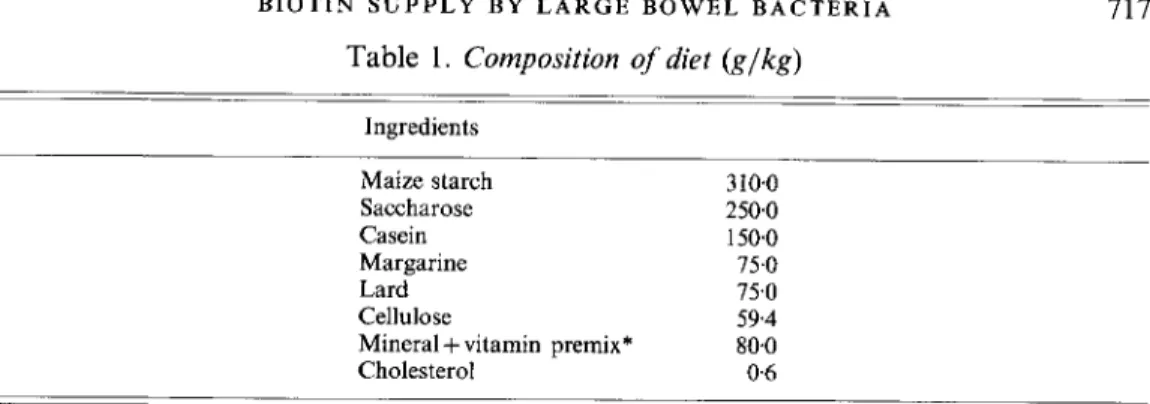
A semi-synthetic, low-fibre diet with an energy content of 17.6 MJ metabolizable energy
(ME)/kg dry matter was composed as shown in Table 1 to meet maintenance requirements
(0.44 MJ ME/kg body-weighto 7 5 per d). The pigs were given daily a semi-synthetic diet of
433 g (approximately 400 g dry matter) supplemented with 157 nmol (38 pg) biotin, which amounted to about 25 O h of the dietary allowance of 150 pg/d per animal for growing pigs proposed by Tagwerker (1983) if the body-weight of minipigs is taken into account. The initial body-weight was 35.8 (SE 1.7) kg and increased to 38.0 (SE 1.2) kg during the trial. Supplements to the diet are described on p. 717.
Experimental procedure
The experiment consisted of a 2-month adjustment period followed by nine-sequential 1-week infusion periods (see Table 2) with or without oral lactulose (26 g/d) or antibiotics (250 mg Veomycin sulphate/d and 300 mg Bacitracin/d). Lactulose was given to alter the intestinal flora and increase bacterial biotin synthesis. Antibiotic treatment was carried out to reduce biotin-synthesizing or biotin-utilizing micro-organisms in the intestine, or both. Avidin ( I 8 mg/d) dissolved in 200 ml water was continuously infused during weeks 2 , 5 and 8. This amount of avidin can bind 960 nmol biotin. Water (200 ml/d) was infused during weeks 1, 3, 4, 6, 7 and 9 (solvent control).
Total urine was collected for 24 h on crushed ice during the last 2 d of each week and subsequently stored at - 20
’.
Faeces of the last 3 d were collected, pooled, lyophilysed and stored at room temperature. Before the morning feed on the last day of each week blood samples were collected by puncture of the vena jugularis. Plasma was obtained by anticoagulation with heparin (143 USP/10 ml) and stored at -20 O before determinationof biotin.
Analytical procedures
Biotin concentrations in plasma, faeces and urine were determined using the microbiological procedure of Frigg & Brubacher (1976). The test organism was Lactobacillus plantarum
717
B I O T I N S U P P L Y B Y L A R G E B O W E L B A C T E R I A
Table 1. Composition of diet ( g l k g )
Ingredients Maize starch Saccharose Casein Margarine Lard Cellulose
Mineral
+
vitamin premix* Cholesterol 310.0 250.0 150.0 75.0 75.0 59.4 80.0 0 6* Minerals and vitamins in the diet (g/kg): calcium 1085, phosphorus 6.13, chloride 4.61, magnesium 4.03, potassium 5.10, sodium 3.88, (mg/kg): copper 40.0, iron 200.0, manganese 1000, zinc 200.0, bromine 13.6, fluoride 3.8, iodine 1.2, selenium 0.5, nickel 1.88, cobalt 08 , molybdenum 1.98, arsenate 015, boron 0.55, retinyl acetate 18.15, cholecalciferol 016, choline chloride 25800, ascorbic acid 585.0, a-tocopheryl acetate 3000, nicotinic acid 75.5, Ca pantothenate 67.5, menadione 24.0, riboflavin 22.4, pyridoxal hydrochloride 19.7, thiamin hydrochloride 8.9, pteroylmonoglutamic acid 5.4, biotin 0088, cyanocobalamin 016.
Table 2. Plasma biotin concentrations following di8erent oral supplements and intracaecal
avidin ~.
Plasma biotin* (nmol/l)
Week of Oral Intracaecal
experiment supplement infusion Mean SE
Lactulose Lactulose Lactulose Antibiotics Antibiotics Antibiotics Solvent Avidin Solvent Solvent Avidin Solvent Solvent Avidin Solvent 1.7 0- I 1.9 0.2 1.8 0.4 1.9 0.4 1.8 0.2 2.0 0.2 2.0 0.2 1.6 0.2 1.8 0.3 ._ - --_ ~~
* There were no statistically significant differences
Statistics
Due to the unequal number of observations per animal, least square procedures were applied to estimate means, standard errors and contrasts (Searle, 1971). A model was adopted including fixed effects of animal, infusion (solvent before avidin, avidin, solvent after avidin), supplement (basal diet, lactulose, antibiotics) and interaction of infusion x
supplement. The computer program LSML 76 (Harvey, 1976) was applied.
R E S U L T S
During the whole 17-week period there were no clinical symptoms of biotin deficiency. Plasma biotin concentrations tended to be lower during intracaecal avidin infusion between weeks 4 and 9; however, these somewhat lower values were not significantly different from those for their controls (Table 2).
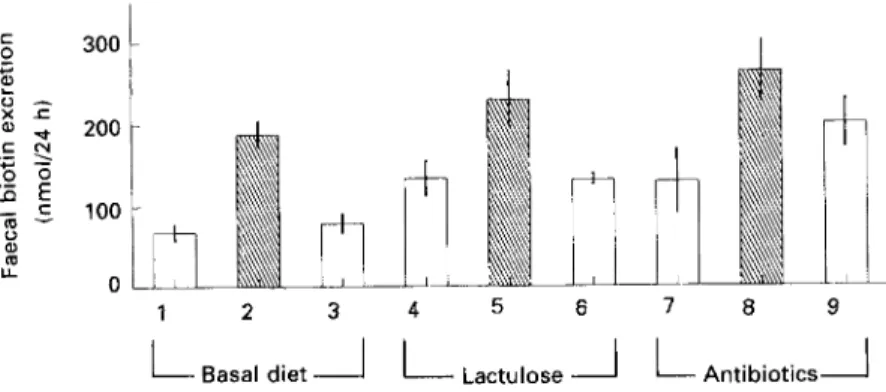
There was a significant average 84% increase in faecal biotin during avidin infusions demonstrating the efficient binding of the vitamin (Fig. 1). An average faecal biotin
718 J . S C H O L T I S S E K A N D O T H E R S
5
300 2 .- c 0 -X T * 200 . ;2
0 0 .-;
E
100 0 m LL 0 1 2 3 4 5 6 7 8 9L
Basal diet1
I--
Lactulose AntibioticsJ Period of experiment (weeks)Fig. 1. Faecal biotin loss during avidin infusions (H) or solvent controls (0). Values are means with their standard errors represented by vertical bars for five minipigs. The means of all avidin infusion periods proved to be significantly different (P < 0.05) from those for all solvent control periods. For details of procedures, see pp. 716717.
Table 3 . Urinary biotin excretion following diflerent oral supplements and intracaecal avidin . ~- - .- ___ Urinary biotin excretion (nmo1/24 h)
Week of Oral Intracaecal -
experiment supplement infusion Mean SE
Lactulose Lactulose Lactulose Antibiotics Antibiotics Antibiotics Solvent Avidin Solvent Solvent Avidin Solvent Solvent Avidin Solvent 93.5 17.6 85.3 11.3 97.2 9.1 106.4 12.8 932 3.9 102.4 9.0 125.3 13.9 77.9 18.8 125.5 9.0
excretion during avidin infusion of 230 nmol/d corresponded to 24 YO of the biotin-binding capacity of the avidin infused.
Table 3 summarizes changes in urinary biotin excretion. Avidin infusions caused lower urinary biotin concentrations. When multifactorial statistics were applied, the urinary biotin excretion of all ‘avidin’ weeks compared with all ‘non-avidin’ weeks proved to be significantly lower
(P
< 0.01). The interaction infusion x supplement was not significant(P
= 0.2). Differences between animals were significant(P
< O.Ol), whereas effects of oral supplements were not ( P = 0.09).D I S C U S S I O N
It was our aim to study the influence of a change in colonic availability of biotin on biotin nutriture. The method chosen proved to be efficient as an 84% increase in faecal biotin excretion was observed. Surprisingly no significant change in plasma biotin was observed. In piglets a good correlation between plasma biotin and biotin nutriture has been observed
B I O T I N S U P P L Y B Y L A R G E B O W E L B A C T E R I A 719 by several investigators (Christensen, 1980 ; Bryant et al. I985 ; Misir & Blair, 1986; Streiff
et al. 1986). However, urinary biotin excretion was lowered by 21 % in our experiments showing some supply by colonic bacteria.
To substantiate further such a contribution two oral supplements were given, known to alter colonic microflora. Lactulose and antibiotics both led to higher rates of faecal and urinary biotin excretion, showing that biotin-producing or biotin-requiring bacteria were indeed changed, leading to a higher net biotin production.
Earlier experiments with sulphonamides and antibiotics gave inconclusive results. Some investigators have reported a reduction in faecal biotin output (Oppel, 1942; Grundy et al. 1947) and urinary excretion by streptomycin (Sarett, 1952). Markkanen (1960) observed no effect of neomycin on urinary biotin excretion. The rise in faecal biotin excretion associated with antibiotic treatment is in accordance with earlier findings of a higher liver biotin concentration in poultry following antibiotic supplementation (Buenrostro & Kratzer, 1983). The evidence presented may also be taken to estimate the supply of biotin by colonic bacteria. For this purpose we have made the following assumptions: (1) avidin does not interfere with bacterial biotin synthesis and degradation, (2) trapping of endogenous (e.g. biliary) or non-absorbed dietary biotin by avidin is negligible because the quantities from these sources can be assumed to be relatively low due to the low dietary intake, (3) avidin is not absorbed because of its high molecular weight of 53.1 kDa; in fact no colonic avidin absorption has been described in the literature to the best of our knowledge, (4) there is no degradation of avidin in the alimentary tract (Gyorgy & Langer, 1968). Therefore, release of biotin from the avidin-biotin complex can be excluded.
If one accepts these premises one can roughly estimate the quantity of biotin provided by the colonic microflora. If one considers the decrease in urinary biotin by avidin during weeks 1-6 (basal and lactulose) a value of 10.6 nmolj24 h is obtained.
If one bases the calculation on the increase in faecal biotin excretion by avidin in our experiments (Fig. 1) the value will be 102 nmo1/24 h.
The question about the metabolic biotin requirement of swine remains unanswered by the present investigation. This can be estimated properly only by experiments with gnotobiotic animals. However, if one accepts the recommended dietary requirement proposed by Kopinski & Leibholz (1989) of 410 nmol/kg feed and that these animals consumed 1.5 kg feed/d, our findings would imply that about 1.7 % of the requirement is satisfied by intestinal bacteria under basal conditions and that about 17
YO
may be satisfied if based on the increase of faecal biotin by avidin. The former value is lower than earlier estimates of Kopinski & Leibholz (1985, 1988) and W. Drochner and L. Volker (unpublished results) who reported that about 10 % of the biotin requirement is provided by intestinal microflora.The efficient technical assistance of Mrs K. Gonda, and the care of the experimental animals by Mr H. Fischer and Mr J. Kunze are gratefully acknowledged. The authors thank Mrs J. Engler and Dr U. Manz, Hoffmann-La-Roche, Basle, for carrying out the biotin assays.
R E F E R E N C E S
Barth, C. A,, Frigg, M. & Hagemeister, H. (1986). Biotin absorption from the hindgut of the pig. Journal of Bonjour, J.-P. (1984). Biotin. In Handbook of Vitamins, pp. 403435 [L. J. Machlin, editor]. New York and Basel:
Animal Physiology and Animal Nutrition 55, 128-1 34. Marcel Dekker.
Bowman, B. B. & Rosenberg, I. H. (1987). Biotin absorption by distal rat intestine. Journal of Nutrition 117, 2 I2 1-2 126,
720 1. S C H O L T I S S E K AND O T H E R S
Bryant, K. L., Kornegay, E. T., Knight, J. W., Webb, K. E. & Notter, D. R. (1985). Supplemental biotin for swine. I. Influence on feedlot performance, plasma biotin and toe lesions in developing gilts. Journal of Animal
Science 60, 136-144.
Buenrostro, J. L. & Kratzer, F. H. (1983). Effect of lactobacillus inoculation and antibiotic feeding of chickens on availability of dietary biotin. Poultry Science 62, 2022-2029.
Christensen, K. (1980). Evaluation of the background for determination of vitamin requirements in pigs. Livestock
Production Science 1, 569-590.
Davidson, S . , Passmore, R., Brock, J. F. & Truswell, A. S . (1979). Water-soluble vitamins. In Human Nutrition
and Dietetics, 7th ed., pp. 15G-151 [S. Davidson and R. Passmore, editors]. Edinburgh, London, New York:
Churchill Livingstone.
Deutsche Gesellschaft fur Ernahrung (1985). Empfehlungen fur die Nuhrstoflzufuhr, 4th revised ed., p. 82. Frankfurt am Main : Umschau Verlag.
Food and Nutrition Board (1980). Recommended Dietary Allowances. Washington, DC : National Academy of
Sciences.
Frigg, M . & Brubacher, G. (1976). Biotin deficiency in chicks fed a wheat-based diet. International Journal of
Vitamin Nutrition Research 46, 314321.
Grundy, W. E., Freed, M., Johnson, H. C., Henderson, C. R., Berryman, G. H. & Friedmann, T. E. (1947). The effect of phthalylsulfathiazole (sulfathalidine) on the excretion of B-vitamins by normal adults. Archives of
Biochemistry and Biophysics 15, 187-194.
Gyorgy, P. & Langer, B. W. Jr (1968). Biotin. In The Vitamins, vol. 2,2nd ed., pp. 31C322
m.
H. Sebrell Jr and R. S. Harris, editors]. London, New York: Academic Press.Harvey, W. R. (1976). Mixed Model and Maximum Likelihood General Purpose Computer Program. Ohio: Ohio State University.
Kopinski, J. S., Bryden, W. L. & Leibholz, J. (1983). Biotin synthesis and absorption in the pig. Proceedings of
the Nutrition Society of Australia 8, 205.
Kopinski, J. S. & Leibholz, J. (1985). Post-ileal absorption of biotin in the pig. Proceedings of the Nutrition Society
of Australia 10, 170.
Kopinski, J. S. & Leibholz, J. (1988). Post-ileal absorption of biotin. Proceedings of 4th International Seminar on
Digestive Physiology in the Pig, Jablona, Poland.
Kopinski, J. S. & Leibholz, J. (1989). Biotin studies in pigs. 2. The biotin requirement of the growing pig. British
Journal of Nutrition 62, 761-766.
Markkanen, T. (1960). Studies on the urinary excretion of thiamine, riboflavin, nicotinic acid, pantothenic acid and biotin in achlorhydria and after partial gastrectomy. Acia Medica Scandinavica 169, Suppl. 1, 1-55. Misir, R. & Blair, R. (1986). Effect of biotin supplementation of barley-wheat diet on restoration of healthy feet,
legs and skin of biotin-deficient sows. Research in Veterinary Science 40, 212-218.
Mosenthin, R., Sauer, W. C., Volker, L. & Frigg, M. (1990). Synthesis and absorption of biotin in the large intestine of pigs. Livestock Production Science 25, 95-1 03.
Oppel, T. W. (1942). Studies of biotin metabolism in man. American Journal of the Medical Sciences 204,856875, Sarett, H. P. (1952). Effect of oral administration of streptomycin on urinary excretion of B vitamins in man. Sauer, W. C., Mosenthin, R. & Ozimek, L. (1988). The digestibility of biotin in protein supplements and cereal Searle, S . R. (1971). Linear Models. New York: John Wiley.
Sorrell, M. F., Frank, O., Thomson, A. D., Aquino, H. & Baker, H. (1971). Absorption of vitamins from the large intestine in vivo. Nutrition Reports International 3, 143-148.
Spencer, R. P. & Brody, K. R. (1964). Biotin transport by small intestine of rat, hamster and other species.
American Journal of Physiology 206, 653457.
Streiff, K., Volker, L. & Frigg, M. (1986). Availability of biotin from feed ingredients to the growing pig,
Proceedings of the 6th International Conference on Production Disease in Farm Animals, pp. 112-1 15
[C. H. McMurray, editor]. Belfast.
Sydenstricker, V. P., Singel, S. A., Briggs, A. P., De Vaughn, N. M. & Isbell, H. (1942). Observations of the ‘egg white injury’ in man and its cure with a biotin concentrate. Journal of the American Medical Association 118, Tagwerker, F. J. (1977). Biotin in pigs. Nippon Roche Feed Seminars, Tokyo and Osaka: Roche Information Tagwerker, F. J. (1983). Biotin in poultry and swine nutrition. Feed International 1-9.
Journal of Nutrition 41, 275-287.
grains for growing pigs. Journal of Animal Science 66, 2583-2589.
1199-1200.