Bulletin of Entomological Research (1998) 88, 165-175 165
Quantifying the impact of insect predators
and parasitoids on populations of the
apple ermine moth, Yponomeuta
malinellus (Lepidoptera:
Yponomeutidae), in
Europe
U. Kuhlmann
1*, K.P. Carl
1and N.J. Mills
2international Institute of Biological Control, European Station,
1, chemin des Grillons, CH-2800 Delemont, Switzerland:
2Center of
Biological Control, University of California at Berkeley, USA
Abstract
Life tables were developed to assess the significance of natural enemies on the
dynamics of apple ermine moth, Yponomeuta malinellus Zeller, in southwestern
Germany and to select parasitoid species for use in the biological control of this pest
in Canada. During the study from 1993 to 1995 the abundance of Y. malinellus
varied from 1.5 to 4.3 tents per 100 leaf clusters indicating that this was a
non-outbreak population. From the life tables it was evident that the impact of egg
predators accounted for 2 5 ^ 3 % of the total generational mortality of Y. malinellus,
more than any other known mortality factor. Percent parasitism varied from 18 to
30%, but the impact of parasitoids in relation to the total generational mortality of
Y. malinellus from the life tables was remarkably constant at 11-14%. The loss of
potential fecundity had an important influence on the generational mortality of Y.
malinellus, but declined from 27% to 15% over the course of this study. This decline
corresponded with a rise in the net rate of increase Ro from 1.35 in 1993 to 6.8 in
1995, despite the impact of insect predators and parasitoids on the generational
mortality. Yponomeuta malinellus was attacked by five different obligate primary
parasitoids, a single obligate hyperparasitoid, and three facultative
hyperpara-sitoids. Of these, the oligophagous egg-larval parasitoid Ageniaspis fuscicollis
Dalman (Encyrtidae) and the oligophagous larval-pupal and pupal parasitoid
Herpestomus brunnicornis Gravenhorst (Ichneumonidae) were selected as potential
biological control agents for Canada due to a minimal degree of interspecific
competition.
Introduction throughout the Palaearctic region. Recently, Y. malinellus was _, . . . . . . , ,. ,, „ ,, accidentally introduced into British Columbia (Parker & The apple ermine moth, Yponomeuta malinellus Zeller, is a „ , ... ir,Dl-x , ... , . . o. . , , i n n i .<
, rY, „ ./ . . x ... . ,, , ' Schmidt, 1985) and Washington State, and by 1991, the member of the small genus Yponomeuta Latreille in the family ,. . . . . ,\, ,. ,, , °, , , . ' , ., . , /T j N j • j , j - i j distribution of Y. malinellus had extended into northwestern Yponomeutidae (Lepidoptera) and is widely distributed _ ... , , i n n_x T r , . ., , .
Y
\ v v i 3 Oregon (Unruh rf a/., 1993). In Europe, during the early part of the century, Y. malinellus was considered to be among the •Fax: 41 32 422 4824 most destructive defoliators of apple, a pest second in E-mail: [email protected] importance to the notorious codling moth (Cydia pomonella
166 U. Kuhlmann et al. (Linnaeus), Lepidoptera: Tortricidae) (Faes, 1928; Janecke,
1933). More recently, it has come to be regarded as a minor pest of apples under current management practices in Europe (Galli & Hohn, 1992). Yponomeuta malinellus does not pose a serious threat to conventional apple production in North America if an early cover spray is used for codling moth control. However, the replacement of insecticide treatment of this latter pest with alternative control measures, such as mating disruption, is already being implemented in large demonstration plots in western North America (Unruh et al., 1993). In this case, Y. malinellus represents a significant threat to apple production in the absence of its coevolved natural enemies (Unruh et al., 1993). Yponomeuta malinellus is univoltine, and lays batches of 30-50 eggs on apple trees from July to September (Parott & Schoene, 1912; Thorpe, 1929; Minkiewicz, 1943; Pag, 1959). Hatching takes place in early autumn and the first-instar larvae enter diapause and overwinter in a communal hibernaculum beneath the covering of the egg batch (Ruzaev, 1929; Pag, 1959). In early April, first instar larvae emerge from the hibernacula to mine the adjacent developing leaves (Pag, 1959; Junnikkala, 1960). From the second to the fifth instar, the larvae feed externally of the foliage from within a characteristic communal tent (Pag, 1959; Junnikkala, 1960). During heavy infestations, the tents may envelop the entire tree, resulting in total defoliation and affecting fruit production for several years following an outbreak (Parker & Schmidt, 1985). The mature larvae spin cocoons that are suspended in rows or clusters within, or adjacent to, the larval tents. Pupal development lasts 10-14 days and adult emergence occurs from July to early September (Minkiewicz, 1943; Pag, 1959).
Although natural enemies have not always been implicated in the natural control of small ermine moth populations in Europe (e.g. Junnikkala, 1960; Mowat & Clawson, 1995), there is evidence that parasitoids have played a major role in the dynamics of populations in at least some regions (Eremenko, 1974; Pyornila & Pyornila, 1979). Thus, at the request of Agriculture and Agri-Food Canada, Y. malinellus populations were intensively sampled in southwestern Germany to determine the impact of natural enemies on the generational mortality of this potential pest in its region of origin and to select potential parasitoids for use in a classical biological control programme in Canada.
Material and methods Field sites
Samples of Y. malinellus were collected from two sites in southwestern Germany, where populations had been consistently observed in previous years (Burghause, 1993, personal communication). The first collection site, located at Biebesheim, was a 1.5 km2 grass covered apple orchard situated 100-200 m from the Rhine River. It contained unpruned, unevenly spaced (10-20 m), 8 m high trees, ranging from 50 to 60 years old, and was used for a life table study. The second collection site was located near Giessen-Wettenberg. This orchard contained unpruned, evenly spaced (10 m) in a row, 3-A m high trees, in a grass-annual weed ground cover and was used for additional assessments of parasitism.
Estimates of Y. malinellus fecundity
Pupae of Y. malinellus were collected from both Biebesheim and Giessen-Wettenberg, each year from 1993 to 1995, and kept in rearing cages (30 x 30 x 57 cm) under laboratory conditions at 20°C, 16:8 L:D, 70-80% rh to await emergence. Newly emerged moths were collected randomly from the rearing cages and deep-frozen at -22°C for 24 h to determine the sex ratio and potential fecundity. Potential fecundity was determined by dissection of female abdomens in 70% alcohol to count the total number of mature, pigmented and unpigmented eggs. A second set of mated females was collected randomly from the rearing cages and kept singly in sleeve cages (20 x 30 cm) on several apple trees
in Delemont, Switzerland, to obtain data on realized fecundity under field conditions. At the end of the oviposition period (July 1 to early August), all egg batches were counted for each female and the number of eggs in each batch was recorded. The latter was estimated accurately in the field, without destroying the egg batches, using a microscope mounted on a tripod.
Estimates of mortality factors in different developmental stages of Y. malinellus
Freshly laid egg batches of Y. malinellus are light yellow in colour and can be detected in the field, but change within a couple of days to a red and then brownish colour and can no longer be easily detected. Due to the difficulty of monitoring naturally-laid egg batches in the field, mortality of Y. malinellus egg batches was studied using experimental populations on trees in a small apple orchard in Delemont, Switzerland. Ten Y. malinellus adults were placed in each of a series of sleeve cages (20 x 35 cm) over branches of the apple trees and left to oviposit for four to five weeks from July 1 each year. After removal of the sleeve cages, all egg batches on the branches were marked with coloured pins and the number of eggs in each batch counted. The egg batches and subsequent egg-batch hibernacula were counted each month from August through to March to monitor their loss due to predation. In March, the egg batches were removed from the branches and the number of live overwintered first instar larvae counted. The loss of egg batches and hibernacula and the difference between the number of eggs in a batch and the number of overwintered first instar larvae in March were combined as egg and hibernaculum mortality. Sampling was carried out at the two field sites in southwestern Germany from late April to mid June each year, to estimate the number of individuals of Y. malinellus and the extent of mortality at each of five life stages (L2-L5 and cocoons). The sample unit most suitable for studying populations of small ermine moths is the leaf cluster (e.g. Leather & Mackenzie, 1994), as it represents a distinct unit of food resource and all juvenile stages of Y. malinellus are found on it. Ten trees selected at random were sampled at each site. Each tree crown was divided into an upper and lower canopy and each half was divided into four equal quadrants according to the four cardinal points of the compass. This provided eight sampling sections within the tree crown. From each section a single branch was selected at random and 30 leaf clusters were examined to determine the number of Y. malinellus tents and the number of individuals in each tent. Sampling occurred when the insects were at the mid point of each life stage and selected branches
Life tables for the apple ermine moth 167
were marked to avoid reselection during the assessment of other host life stages. Mortality at each of the life stages was estimated from the differences in Y. malinellus abundance in each of the successive samples.
On each sampling occasion, the Y. malinellus tents sampled were collected from the field to determine rates of parasitism. Individual tents were placed, with fresh apple foliage, in plastic containers (10x10x8 cm) with a gauze lid and the Y. malinellus were reared outdoors at Delemont, Switzerland until adult moths and parasitoids had emerged. Rearing containers were checked every two days until pupation to supply fresh apple foliage if necessary. After pupation, rearing containers were checked daily to count the number of moths and parasitoids emerging. Percent parasitism was estimated from the number of parasitoid adults (divided by the mean clutch size per host, one for solitary species) divided by the total number of adult moths and parasitoid adult clutches and multiplied by 100. The estimate of parasitism was based on parasitoid adults emerged, and so may not reflect parasitoid attack rates, although there was no reason to suspect that there was differential mortality of healthy and parasitized hosts.
Construction of life tables
For the study site at Biebesheim, life tables were constructed for 1993, 1994 and 1995 with the following columns: k the number of Y. malinellus present in each life stage, d« the number of Y. malinellus dying during each life stage, Fd* the factor(s) responsible for the Y. malinellus mortality at each life stage, and the corresponding marginal death rate, apparent mortality, and k-value. More detailed descriptions of columns used are given in Southwood (1978) and Bellows et al. (1992).
Percent loss of Y. malinellus egg batches and hibernacula was used both as a mortality factor (due primarily to predation) in the egg stage and to calculate, from the number of first instar larvae, the number of Y. malinellus eggs. The results of the sampling programme described above were used to obtain data on the number of individuals of Y. malinellus in each larval stage. Although parasitism could be detected from the rearing of Y. malinellus samples at all larval stages, parasitoid-induced mortality ('para-sitism') in the life tables was estimated from the fifth instar larval and cocoon samples only. The number of hosts in the pupal stage was estimated by subtracting the number of hosts killed by larval parasitoids in the fifth instar from the number of Y. malinellus cocoons sampled on the final sampling date. The number of Y. malinellus adults in the life table was estimated from the number reared from the sampled cocoons. Fecundity estimates of Y. malinellus were introduced into life tables from estimates of sex ratio and 'potential fecundity' (from dissection) of emerged females, and 'realized fecundity' from individual females in sleeve cages. The net reproductive rate (R) was estimated as the ratio of the expected egg population in the following generation to the egg population at the beginning of the generation. Values of R> less than one indicate declining populations, while values greater than one indicate increas-ing populations. The total generational mortality (K) was calculated from the sum of the individual k-values associated with each life stage, allowing each stage mortality or each mortality factor to be expressed as a percentage of the generational mortality (100ki/K).
Results
Estimates of Y. malinellus fecundity
The following sex ratios of Y. malinellus (proportion of females) were determined: 0.47 (n = 184) in 1993, 0.51 (n = 415) in 1994, and 0.49 (n = 106) in 1995. From dissection of emerging Y. malinellus females the mean fecundity was 115 ± 4.5 SE (n = 19) and ranged from 72 to 153 eggs, giving 153 as an estimate of the potential fecundity. The mean realized fecundity of emerging females in the field was 52 (±5.9 SE, n = 22) in 1993, 75 (±9.4 SE, n = 20) in 1994, and 107.3 (+ 8.3 SE, n = 20) in 1995. The number of eggs per batch in the field was on average 39.3 (±1.2 SE, n = 195) in 1993, 41.4 ( + 1.1 SE, n = 238) in 1994, and 48.6 (±2.7 SE, n = 42) in 1995.
Estimates of mortality factors in different developmental stages
of Y. malinellus
Predation of Y. malinellus egg batches and hibernacula by unknown insect predators started soon after oviposition. It was determined that mortality caused by insect predators reached 64% in 1992/93,64% in 1993/94 and 65% in 1994/95. Although no systematic observations were made of the predators responsible, both the European earwig, Forficula auricularia Linnaeus (Dermaptera: Forficulidae), and larvae of Chrysoperla carnea (Stephens) (Neuroptera: Chrysopidae) were observed to feed on egg batches and hibernacula.
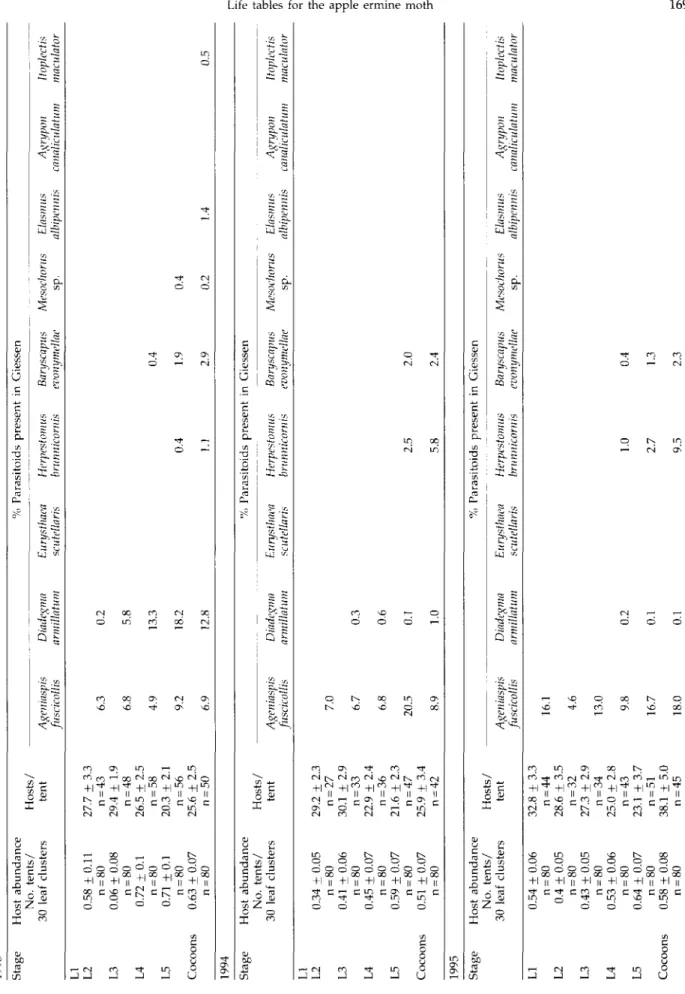
The sampling programme provided estimates each year of Y. malinellus tents per 30 leaf clusters, individuals per tent and percent parasitism (separately for each parasitoid species present) for each larval instar of Y. malinellus both for Biebesheim (table 1) and for Giessen (table 2). Nine parasitoid species of the hymenopteran families Ichneu-monidae (five species), Encyrtidae (one species), Eulophidae (one species), and Elasmidae (one species) and of the dipteran family Tachinidae (one species) were identified (table 3). Five of the parasitoid species were obligate primary parasitoids, but Mesochorus sp. (Hymenoptera: Ichneu-monidae) was an obligate hyperparasitoid and Baryscapus evonymellae (Bouche) (Hymenoptera: Eulophidae), Elasmus albipennis Thompson (Hymenoptera: Elasmidae) and Itoplec-tis maculator Fabricius (Hymenoptera: Ichneumonidae) acted as facultative hyperparasitoids. Parasitism by several of the parasitoid species at Giessen appeared not to occur as early in the life cycle as at Biebesheim and two of the parasitoids, Eurysthaea scutellaris Robineau-Desvoidy (Diptera: Ta-chinidae) and Agrypon canaliculatum Ratzeburg (Hy-menoptera: Ichneumonidae), were entirely absent from Giessen.
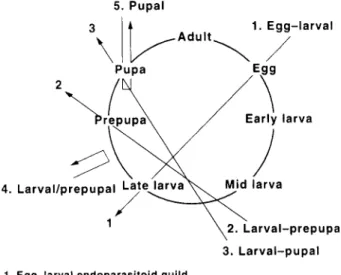
Primary parasitoid species with the same pattern of host utilization can be grouped into parasitoid guilds to represent the structure of the parasitoid community. From the stage-specific patterns of parasitism (tables 1, 2) five parasitoid guilds of Y. malinellus were recognized: (1) egg-larval endoparasitoid, (2) larval-prepupal endopara-sitoid, (3) larval-pupal endoparaendopara-sitoid, (4) larval/prepupal ectoparasitoid, and (5) pupal endoparasitoid (fig. 1). The polyembryonic egg-larval endoparasitoid Ageniaspis fuscicol-lis Dalman (Hymenoptera: Encyrtidae) which attacked host eggs, was detected in all larval instars, and killed the host during the final larval instar. This univoltine species mummifies the final instar larvae and produces 80 parasitoid
Tabl e 1 . 199 3 Stag e L I L 2 L 3 L 4 L 5 Cocoon s 199 4 Stag e L I L 2 L 3 L 4 L 5 Cocoon s 199 5 Stag e L I L 2 L 3 L 4 L 5 Cocoon s Hos t abundanc e an d Hos t abundanc e No . tents / 3 0 lea f cluster s 0. 6 + 0. 1 n = 8 0 0. 6 + 0.0 7 n = 8 0 0. 9 + 0. 1 n = 8 0 0. 9 + 0. 1 n = 8 0 0.6 5 + 0.0 8 n = 8 0 Hos t abundanc e No . tents / 3 0 lea f cluster s 0. 7 + 0.0 9 n = 8 0 0. 5 + 0.0 7 n = 8 0 0.4 8 + 0.0 6 n = 8 0 0.4 6 + 0.0 6 n = 8 0 0.4 8 + 0.0 7 n = 8 0 0.5 5 + 0.0 9 n = 8 0 Hos t abundanc e No . tents / 3 0 lea f cluster s 1.2 5 + 0.1 1 n = 8 0 1.1 3 + 0.1 1 n = 8 0 1.5 3 + 0.1 3 n = 8 0 1.3 4 + 0.1 1 n = 8 0 1.2 4 + 0.1 2 n = 8 0 1.2 1 +0.1 2 n = 8 0 percentag e o f appl e ermin e Hosts / -ten t 34. 7 + 4. 2 n = 4 8 29. 8 + 2. 3 n = 5 1 21. 2 + 1. 5 n = 7 2 18. 3 + 1. 4 n = 7 2 16. 9 + 1. 8 n = 5 2 Hosts / -ten t 42. 3 + 2. 1 n = 5 4 35. 6 + 2. 7 n = 3 9 25. 5 + 2. 1 n = 3 8 25. 2 + 2. 3 n = 3 7 24. 9 + 3. 4 n = 3 7 18. 7 + 1. 7 n = 4 3 Hosts / ten t 35. 9 + 2. 3 n = 10 0 32. 8 + 2. 4 n = 9 6 24. 3 + 2. 0 n = 11 0 25. 0 + 1. 5 n = 10 7 26. 4 + 2. 3 n = 9 9 25. 2 + 2. 6 n = 9 7 Ageniaspis fuscicoUis 0. 1 0. 1 0. 4 0. 3 1. 5 Ageniaspis fuscicoUis 0. 4 0. 3 1. 0 1. 1 1. 5 Ageniaspis fuscicollis 1. 8 1. 0 1. 0 1. 5 2. 2 1. 6 moth
, Yponomeuta Diadegma armillatum
0. 2 12. 4 6. 3 20. 7 5. 3 Diadegma armillatum 1. 0 1. 9 7. 2 4. 4 Diadegma armillatum 0. 2 1. 2 3. 4 2. 7 1. 4 malmellus, attacke d b y parasitoid s i n relatio n t o % Eurysthaea scutellaris 0. 1 0. 8 0. 6 % Eurysthaea scutellaris 0. 8 2. 7 3. 0 % Eurysthaea scutellaris 0. 6 0. 4 1. 0 Parasitoid s presen t Herpestomus brunnicornis 0. 1 0. 7 1. 4 3. 4 Parasitoid s presen t Herpestomus brunnicornis 0. 5 4. 0 6. 6 Parasitoid s presen t Herpestomus brunnicornis 0. 1 2. 0 4. 8 9. 6 in Biebeshei m Baryscapus evonymellae 0. 8 0. 8 9. 7 in Biebeshei m Baryscapus evonymellae 1. 5 3. 7 9. 8 in Biebeshei m Baryscapus evonymellae 0.0 4 0. 1 5. 4 hos t stag e a t Mesochorus sp . 0. 3 2. 2 1. 8 0. 8 Mesochorus sp . Mesochorus sp . 0.0 5 0. 2 0. 3 0. 2 Biebesheim , Elasmus albipennis 3. 4 Elasmus albipennis 0. 1 Elasmus albipennis 1. 4 Germany , fro m 199 3 t o 1995 . Agrypon Itoplectis canaliculatum maculator 0. 3 0. 3 Agrypon Itoplectis canaliculatum maculator 0. 1 Agrypon Itoplectis canaliculatum maculator 0. 1 0 0 r w c n s
Tabl e 2 . 199 3 Stag e Hos t abundanc e an d Hos t abundanc e No . tents / 3 0 lea f cluster s percentag e Hosts / ten t o f appl e ermin e Ageniaspis fuscicollis moth , Yponomeuta Diadegma annillatum malinellus, attacke d b y parasitoid s i n relatio n % Parasitoid s presen t Eurysthaea Hcrpestomus scu'tellaris brunnicornis in Giesse n Baryscapus evonymellae to hos t stag e Mesochorus sp . a t Giessen , Elasmus albipennis Germany , fro m Agrypon canaliculatum 199 3 t o 1995 . ltoplectis maculator L I L 2 L 3 L 4 L 5 Cocoon s 0.5 8 + 0.1 1 n = 8 0 0.0 6 ± 0.0 8 n = 8 0 0.7 2 + 0. 1 n = 8 0 0.7 1 ± 0. 1 n = 8 0 0.6 3 + 0.0 7 n = 8 0 27. 7 ± 3. 3 n = 4 3 29. 4 + 1. 9 n = 4 8 26. 5 ± 2. 5 n = 5 8 20. 3 + 2. 1 n = 5 6 25. 6 ± 2. 5 n = 5 0 6. 3 6. 8 4. 9 9. 2 6. 9 0. 2 5. 8 13. 3 18. 2 12. 8 0. 4 1. 1 0. 4 1. 9 2. 9 0. 4 0. 2 1. 4 0. 5 199 4 Stag e Hos t abundanc e No . tents / 3 0 lea f cluster s Hosts / ten t % Parasitoid s presen t i n Giesse n Ageniaspis fuscicollis Diadegma annillatum Eurysthaea scutcllaris Hcrpestomus brunnicornis Baryscapus Mesochorus Elasmus Agrypon ltoplectis evonymellae sp . albipennis canaliculatum maculator L I L 2 L 3 L 4 L 5 Cocoon s 0.3 4 + 0.0 5 n = 8 0 0.4 1 + 0.0 6 n = 8 0 0.4 5 ± 0.0 7 n = 8 0 0.5 9 ± 0.0 7 n = 8 0 0.5 1 ± 0.0 7 n = 8 0 29. 2 ± 2. 3 n = 2 7 30. 1 + 2. 9 n = 3 3 22. 9 ± 2. 4 n = 3 6 21. 6 + 2. 3 n = 4 7 25. 9 + 3. 4 n = 4 2 7. 0 6. 7 6. 8 20. 5 8. 9 0. 3 0. 6 0. 1 1. 0 2. 5 5. 8 2. 0 2. 4 199 5 Stag e Hos t abundanc e No . tents / 3 0 lea f cluster s Hosts / ten t % Parasitoid s presen t i n Giesse n Ageniaspis fuscicollis Diadegma armillatum Eurysthaea scutellaris Hcrpestomus Baryscapus Mesochorus Elasmus Agrypon ltoplectis brunnicornis evonymellae sp . albipennis canaliculatum maculator L I L 2 L 3 L 4 L 5 Cocoon s 0.5 4 ± 0.0 6 n = 8 0 0. 4 ± 0.0 5 n = 8 0 0.4 3 ± 0.0 5 n = 8 0 0.5 3 ± 0.0 6 n = 8 0 0.6 4 + 0.0 7 n = 8 0 0.5 8 ± 0.0 8 n = 8 0 32. 8 + 3. 3 n = 4 4 28. 6 + 3. 5 n = 3 2 27. 3 + 2. 9 n = 3 4 25. 0 ± 2. 8 n = 4 3 23. 1 ± 3. 7 n = 5 1 38. 1 + 5. 0 n = 4 5 16. 1 4. 6 13. 0 9. 8 16. 7 18. 0 0. 2 0. 1 0. 1 1. 0 2. 7 9. 5 0. 4 1. 3 2. 3
170 U. Kuhlmann et al.
Table 3. Primary parasitoids and hyperparasitoids reared from the apple ermine moth, Yponomeuta malinellus, at two sites in Germany from 1993 to 1995.
Parasitoid and hyperparasitoid species of the apple ermine moth, Yponomeuta malinellus Obligate primary parasitoids
Ichneumonidae
Diadegma armillatum Gravenhorst Herpestomus brunnicornis Gravenhorst Agrypon canaliculatum Ratzburg Obligate hyperparasitoids
Ichneumonidae Mesochorus sp.
Facultative hyperparasitoids
Ichneumonidae Elasmidae
Itoplectis tnaculator Fabricius Elasmus albipennis Thompson Eulophidae
Baryscapus evonymellae Bouche
Encyrtidae
Ageniaspis fuscicollis Dalman Tachinidae
Eurysthaea scutellaris Robineau-Desvoidy
individuals per host. The solitary larval-prepupal endopara-sitoid Diadegma armillatum (Gravenhorst) (Hymenoptera: Ichneumonidae) attacked as early as the second larval instar, but as percent parasitism increased in samples up to the fifth larval instar, it appeared able to attack a broad range of larval instars. It killed Y. malinellus hosts as prepupae producing an oval, brown cocoon, outside or inside the cocoon of Y. malinellus and was itself attacked by the hyperparasitoid Mesochorus sp. The gregarious larval/prepupal ectopara-sitoid E. albipennis attacked Y. malinellus as fifth instar larvae protected in a tent or as prepupae in cocoons. Elasmus albipennis is also known to act as a facultative hyperpara-sitoid of the cocoon stage of D. armillatum (Dijkerman et al., 1986). The solitary larval-pupal endoparasitoids E. scutel-laris, A. canaliculatum and Herpestomus brunnicornis Graven-horst (Hymenoptera: Ichneumonidae) and the gregarious larval-pupal endoparasitoid B. evonymellae attacked Y. malinellus larvae from the third or fourth larval instar but only killed their host in the pupal stage. Baryscapus evonymellae is also known to be a facultative hyperparasitoid, parasitizing D. armillatum and Mesochorus sp. (Dijkerman et al., 1986; Graham, 1991). Herpestomus brunnicornis continued to attack Y. malinellus in the pupal stage which, together with the solitary /. maculator, form the pupal endoparasitoid guild. Itoplectis maculator is also known to be a facultative hyperparasitoid of other parasitoids developing within Y. malinellus pupae (Zwolfer, 1963).
Construction of life tables
Life tables were constructed for the Y. malinellus study site at Biebesheim for 1993, 1994, and 1995 (table 4). They include the life stages directly sampled from the field (LI to cocoon) and were completed, using independent obser-vations from Delemont, for egg and hibernaculum mortality and the realized fecundity of Y. malinellus females. The number of Y. malinellus eggs was calculated from the number of first instar larvae in leaf mines (LI) and the independent estimates of egg/hibernaculum mortality. The number of Y. malinellus pupae was calculated from the number of cocoons sampled in the field minus the number of individuals dying from parasitism as prepupae. The maximum number of eggs in a dissected female of Y. malinellus, reared from cocoons collected at Biebesheim,
represented the potential fecundity and was used to calculate the potential progeny. The realized fecundity was estimated from emerging females sleeve-caged in Delemont and was used to calculate the actual progeny for the following generation. The net reproductive rate of increase (Ro) was
5. Pupal
Early larva 1. Egg-larval
4. Larval/prepupal Late larva
2. Larval-prepupa 3. Larval-pupal
1. Egg-larval endoparasitoid guild
Ageniaspis fuscicollis (Hymenoptera: Encyrtidae) 2. Larval-prepupal endoparasitoid guild
Diadegma armillatum (Hymenoptera: Ichneumonidae) 3. Larval-pupal endoparasitoid guild
Herpestomus brunnicornis (Hymenoptera: Ichneumonidae) Agrypon canaliculatum (Hymenoptera: Ichneumonidae) Baryscapus evonymellae (Hymenoptera: Eulophidae) Eurysthaea scutellaris (Diptera: Tachinidae) 4. Larval/prepupal ectoparasitoid guild
Elasmus albipennis (Hymenoptera: Elasmidae) 5. Pupal endoparasitoid guild
Itoplectis maculator (Hymenoptera: Ichneumonidae) Herpestomus brunnicornis (Hymenoptera: Ichneumonidae)
Fig. 1. Parasitoid guilds of the apple ermine moth, Yponomeuta malinellus, defined by their pattern of host utilization. Arrows connect the host stage attacked to the host stage killed by the parasitoid, and arrows passing through the host circle indicate endoparasitic development, whereas those remaining outside
Life tables for the apple ermine moth 171 estimated from the ratio of the actual progeny to eggs and
was 1.35 in 1993, 2.43 in 1994 and 6.8 in 1995.
Parasitism between the fifth instar larval and pupal stages was caused by A. fuscicoUis, D. armillatum and E.
ilbipennis. Mortality due to A. fuscicoUis was estimated from
the combined fifth instar larval and cocoon samples, as parasitized larvae often died in rearing. Parasitism due to
D. armillatum was estimated from the fifth instar larval
samples and included hosts from which the obligate hyperparasitoid Mesochorus sp. emerged. Parasitism by
Table 4. 1993 Stage
Life tables for the apple ermine moth, Factor Ypononwuta Stage Ix malinellus dx , in Biebesheim in Factor Marginal rate Germany from 1993 to Apparent Stage <?* mortality Factor 1995. k-Value Stage Factor E gg LI L2 L3 L4 L5 Pupae \dults \dult female Potential progeny Actual progeny 11 Jl 13 14 15 \dult \dult female Potential progeny Actual progeny Predation Unknown factors Unknown factors Unknown factors Unknown factors Parasitism Residual Parasitism Residual Sex ratio Potential fecundity Realized fecundity 7812 2852 1732 1521 1500 1319 776 435 0.467 203 153 31059 52 10564 1.35 4960 1120 211 21 181 543 339 20495 4960 1120 211 21 181 361 182 128 211 20495 0.635 0.393 0.122 0.014 0.121 0.298 0.162 0.194 0.301 0.660 0.635 0.393 0.122 0.014 0.121 0.412 0.437 0.660 0.635 0.393 0.122 0.014 0.121 0.230 0.274 0.138 0.165 0.272 0.660 0.438 0.217 0.056 0.006 0.056 0.251 0.468 0.438 0.217 0.056 0.006 0.056 0.153 0.077 0.095 0.156 0.468 1994
Stage Factor Stage
Ix dx Factor Marginal rate A p p a r e n t Stage mortality Factor <?* k-Value Stage Factor Predation U n k n o w n factors U n k n o w n factors U n k n o w n factors U n k n o w n factors Parasitism Residual Parasitism Residual Sex ratio Potential fecundity Realized fecundity 6332 2286 1387 970 933 923 749 403 0.508 205 153 31365 75 15375 2.43 4046 899 417 37 10 174 346 4046 899 417 37 10 83 91 154 192 0.639 0.393 0.301 0.038 0.011 0.095 0.104 0.240 0.291 0.639 0.393 0.301 0.038 0.011 0.189 0.461 0.639 0.393 0.301 0.038 0.011 0.090 0.099 0.205 0.256 0.442 0.217 0.155 0.017 0.005 0.091 0.269 0.442 0.155 0.017 0.005 0.043 0.048 0.120 0.149 15990 0.510 0.310 15990 0.510 0.510 0.310 Continued overleaf
172 Table 4—continued. 1995 Stage Egg LI L2 L3 L4 L5 Pupae Adult Adult female Potential progeny Actual progeny Ro Factor Predation Unknown factors Unknown factors Unknown factors Unknown factors Paratism Residual Parasitism Residual Sex ratio Potential fecundity Realized fecundity U. Stage L 10167 3589 3151 2676 2670 2617 2336 1316 0.491 646 153 98838 107 69122 6.8 Kuhlmann et al. d, 6578 438 475 6 53 281 1020 29716 Factor j Civ 6578 438 475 6 53 167 114 390 630 29716 Marginal death rate 0.647 0.122 0.151 0.002 0.02 0.066 0.046 0.196 0.299 0.301 Apparent Stage q. 0.647 0.122 0.151 0.002 0.02 0.108 0.437 0.301 mortality Factor q. 0.647 0.122 0.151 0.002 0.02 0.064 0.044 0.167 0.270 0.301 k-Value Stage 0.452 0.056 0.072 0.001 0.009 0.049 0.249 0.155 Factor 0.452 0.056 0.072 0.001 0.009 0.029 0.020 0.095 0.154 0.155
E. albipennis was estimated from the cocoon samples, but as
this species is a facultative hyperparasitoid a proportion of the hosts from which E. albipennis emerged were transferred to parasitism by D. armillatum, under the assumption that it attacked primary and secondary hosts in proportion to their abundance. Similarly, B. evonymellae can be a facultative parasitoid of D. armillatum and using the same assumption of proportional attack, a proportion of hosts from which B. evonymellae emerged were also transferred to parasitism by
D. armillatum. Apparent parasitism during the fifth instar
larval and prepupal stages reached 27% in 1993, 9% in 1994 and 6% in 1995.
Rates of parasitism in the cocoon stage, due to B.
evonymellae, E. scutellaris, A. canaliculatum, I. maculator a n d H. brunnicornis, were estimated from the cocoon samples and
were based on the number of Y. malinellus pupae. Apparent parasitism by B. evonymellae and /. maculator were propor-tionally reduced due to potential hyperparasitism of
D. armillatum and other pupal stage parasitoids respectively.
Apparent parasitism in the pupal stage was 17% in 1993,21% in 1994, and 17% in 1995.
The impact of predation and parasitism on the generational mortality of Y. malinellus was determined at Biebesheim in 1993-1995, using the k-values from the life tables. The generational mortality (K = Zk,) was 1.72 in 1993, 1.51 in 1994 and 1.04 in 1995. The percentage of the generational mortality due to loss of potential fecun-dity, predation of eggs and hibernacula and parasitism (100k,/K) are presented in table 5. Predation had the greatest impact on the Y. malinellus population studied, although it equalled the loss of potential fecundity in the first year of the study. The impact of parasitism had the least impact of the known mortalities and this remained remarkably constant over the three-year period. The combined effect of natural enemies at 40-55% of the generational mortality of the Y. malinellus population was substantially greater than the loss of potential fecundity at 15-27%.
Table 5. Loss of potential fecundity and impact of natural enemies on the generational mortality of the apple ermine moth, Yponomenta malinellus, at Biebesheim in Germany from 1993 to 1995. Year 1993 1994 1995 mean Host fecundity losses (%) 27.2 20.6 14.9 20.9 Impact Egg predators 25.4 29.3 43.3 32.7 of natural enemies (%) Parasitoids 14.4 10.8 11.9 12.4 Total 39.8 40.1 55.2 45.0
Life tables for the apple ermine moth 173 Discussion
We have presented here the results of a life table study to determine the impact of natural enemies on a population of Y. malinellus over a three year period in southwestern Germany. This approach was used to provide data for the selection of natural enemies for use in a biological control programme for Y. malinellus in Canada.
Factors influencing the generational mortality of Y. malinellus
The abundance of Y. malinellus varied from 1.8 to 4.3 tents per 100 leaf clusters in Biebesheim and from 1.5 to 2.2 tents per 100 leaf clusters in Giessen. These densities were generally below the traditional control threshold of 3-5 larval tents per 100 leaf clusters (Baggiolini et al., 1980) and would not have been considered for control treatments as no economic threshold values exist for Y. malinellus in central Europe because of its reduced importance today under ;urrent pest management practices (Galli & Hohn, 1992).
Insect predation obviously played an important role in the reduction of Y. malinellus egg and hibernaculum populations. From the life tables, it is evident that the impact Df egg predators accounted for 25-43% of the total generational mortality of Y. malinellus, more than any other known mortality factor. Unfortunately, no systematic Dbservations of the predator species responsible for the mortality of egg batches and hibernacula were possible. However, based on the results of this study, and according to Unruh et al. (1993) and Smith (1994, personal communi-:ation) endemic polyphagous predators in Europe and in the western United States and Canada do produce significant mortality in Y. malinellus populations. These generalist predators may be largely responsible for preventing even more damaging levels of Y. malinellus in the western United States (Unruh et al, 1993).
Percent parasitism, in the present study, varied from 21 to 26% at Biebesheim and from 18 to 30% at Giessen. However, the impact of parasitoids in relation to the total generational mortality of Y. malinellus from the life tables at Biebesheim was remarkably constant at 11-14%. All other studies of Y. malinellus in its natural range have considered anly percent parasitism. These studies reported values ranging from 30 to 98% (Ruzaev, 1929; Thorpe, 1930; Voukassovitch, 1933; Bilanovski, 1938; Iren, 1952; Vaclav, 1958; Junnikkala, 1960; Balachowsky, 1966; Aleksidze & Bezhanishvili, 1974; Eremenko, 1974; Dijkerman et al., 1986; Tkachev, 1986).
We estimated the average potential fecundity of Y. malinellus to be 115, a value that is almost identical to the sstimate of 117 for Y. evonymellus (Linnaeus) (Lepidoptera: Vponomentidae) (Leather & MacKenzie, 1994). Failure of populations to realize their potential fecundity can be a major factor contributing to changes in numbers of insects between generations (Banerjee, 1979; Courtney & Duggan, 1983; Preszler & Price, 1988; Price et al, 1990). The loss of potential fecundity was a significant component of the life tables of Y. malinellus, but declined from 27% to 15% of the generational mortality over the course of this study. Kuhlmann (1995) demonstrated that the fecundity of Y. malinellus is significantly influenced by the mean daily temperature during the oviposition period. The number of jgg batches laid per Y. malinellus female increased
significantly with higher mean daily temperatures during the oviposition period.
Parasitoid community of Y. malinellus and selection of biological control agents
A natural parasitoid community is defined as an assemblage of primary parasitoid species that attack the population of a particular host species in a given locality (Ehler, 1992; Mills, 1992, 1994a). In the present study, Y. malinellus populations were attacked by eight different parasitoid species at Biebesheim and by six parasitoid species at Giessen. The parasitoid species represent five different parasitoid guilds, somewhat less than the eight parasitoid guilds that have been recognized for the Yponomeutidae as a whole (Hawkins & Mills, 1996). Three of the guilds are occupied by a single parasitoid species, with the larval-pupal endoparasitoid and pupal endoparasitoid guilds being occupied by four and two species respectively. The most consistent parasitoid species found attacking Y. malinellus throughout its native range are the egg-larval endoparasitoid A. fuscicollis, the larval-prepupal endopara-sitoid D. armillatum, and the larval-pupal or pupal endoparasitoid H. brunnicornis. These same parasitoids were responsible for the greatest levels of parasitism at both Biebesheim and Geissen in the present study. Other parasitoids reported from Y. malinellus in Europe that were not found during the present study include the tachinids Bactromyia aurulenta (Meigen) (Pag, 1959; Dijkerman et al, 1986) and Bessa selecta (Meigen) (Pag, 1959), the eulophid Baryscapus galactopus (Ratzeburg) (Junnikkala, 1960), and the ichneumonids Pimpla turionellae (Linnaeus) (Junnikkala, 1960) and Agrypon anxium (Wesmael) (Dijkerman et al, 1986). In the selection of parasitoids for use in a classical biological control programme, it is important to exclude antagonistic species in the reconstruction of a parasitoid community for the target region of a pest, as they can prevent the most effective parasitoids from realizing their potential as control agents (Waage & Mills, 1992; Mills, 1994b). Considering the natural parasitoid community of Y. malinellus, competitive interactions are minimal between the egg-larval parasitoid and the larval-pupal guilds, and of course interspecific competition is excluded between the egg-larval and the pupal parasitoid guilds. Ageniaspis fuscicollis is the only member of the egg-larval endopara-sitoid and H. brunnicornnis in the only member of the pupal endoparasitoid guild that is not a facultative hyperpara-sitoid. Although H. brunnicornis is also a larval-pupal endoparasitoid and can attack Y. malinellus from the fourth instar larvae onwards, it preferentially attacks fifth instar larvae and pupae, with a maximum rate of parasitism in the pupal stage. Overlap between A. fuscicollis and H. brunnicor-nis is likely to be confined to the fourth larval instar of Y. malinellus because H. brunnicornis is unlikely to attack a fifth instar host larva that is close to mummification by A. fuscicollis. This degree of overlap is minimal and so these two specific parasitoids could be safely introduced simul-taneously in a classical biological control programme against Y. malinellus. Both parasitoid species are restricted in their host range to the genus Yponomeuta, they are univoltine and therefore well-synchronized with the development of their host, and occupy a wide geographic range (for details of H. brunnicornis see Kuhlmann, 1996). The ichneumonid D. armillatum was not considered as a biological control agent
174 U. Kuhlmann et al. despite its high impact due to the fact that it is known to be
a polyphagous parasitoid of microlepidopteran hosts (Hert-ing & Simmonds, 1982). The egg-larval parasitoid A.fuscicol-Hs has already been introduced into Canada and its impact is being determined in British Columbia (Cossentine, 1996, personal communication).
Acknowledgements
We greatly appreciated the help of Andreas Kahlert, Andrea Raps, Dirk Babendreier, Stefanie Erb, and Heike Gose with the laboratory and field work. They made an enthusiastic team with which it was a pleasure to work. We wish to thank the following specialists for identification of parasitoids: Klaus Horstmann (Ichneumonidae), Stefan Vidal (encyrtids, eulophids, and elasmids), and Hans-Peter Tschorsnig (tachinids). This study was supported by Agriculture and Agri-Food Canada.
References
Aleksidze, G.N. & Bezhanishvili, T.D. (1974) Parasites of
leaf-eating insects. Zashchita Rastenii 10, 24-25 (in Russian, English abstract).
Baggiolini, M., Keller, E., Milaire, H.G. & Steiner, H. (1980)
Visuelle Kontrollen im Apfelanbau. 3. Aufl. 104 pp. France,
Generalsekretariat IOBC/wprs.
Balachowsky, A.S. (1966) Entomologie appliquee a Vagriculture,
Tome II. Eepidopteres Vol.1, 145 pp. France, Masson &
Cie.
Banerjee, B. (1979) A key-factor analysis of population
fluctuations in Andraca bipunctata Walker (Lepidoptera: Bombycidae). Bulletin of Entomological Research 69, 195-201.
Bellows, T.S., van Driesche, R.G. & Elkinton, J.S. (1992)
Life-table construction and analysis in the evaluation of natural enemies. Annual Review of Entomology 37, 587-614.
Bilanovskii, I.D. (1938) Zoological factors that limited the
increase of the apple ermine moth in the province of Kiew in the years 1934—1936. Traveaux Museum de Zoologie
Academique et Scientifique d'Ukraine 21/22, 153-166 (in
Ukrainian, German abstract).
Courtney, S.P. & Duggan, A.E. (1983) The population dynamics
of the orange tip butterfly, Anthocharis cardamines, in Britain. Ecological Entomology 8, 271-281.
Dijkerman, H.J., de Groot, J.M.B. & Herrebout, W.M. (1986)
The parasitoids of the genus Yponomeuta Latreille (Lepidoptera, Yponomeutidae) in the Netherlands.
Proceed-ings of the Koninklijke Nederlandse Akademie van Wetenschap-pen Series C 89, 379-398.
Ehler, L.E. (1992) Guild analysis in biological control.
Environmental Entomology 21, 26—40.
Eremenko, T.S. (1974) Ageniaspis - a parasite of the apple moth.
Zashchita Rastenii 11, 25 (in Russian, English abstract).
Faes, H. (1928) La lutte contre les chenilles fileuses ou
chenilles d'Hyponomeutes. Annales Agriculture de Suisse 29, 520-533.
Galli, P. & Hohn, H. (1992) Visuelle Kontrollen im Apfelanbau. 4.
Aufl. 104 pp. France, Generalsekretariat IOBC/wprs.
Graham, M.W.R. (1991) A reclassification of the European
Tetrastichinae (Hymenoptera: Eulophidae): revision of remaining genera. Memoirs of the American Entomological
Institute 49, 1-36.
Hawkins, B.A. & Mills, N.J. (1996) Variability in parasitoid
community structure. Journal of Animal Ecology 65, 501-516.
Herting, B. & Simmonds, F.J. (1982) A catalogue of parasites and
predators of terrestrial arthropods, Section B, enemy/host or prey, Volume II Hymenoptera Terebrantia, 223 pp. Farnham Royal,
UK, Commonwealth Agriculture Bureaux.
Iren, Z. (1952) The native parasites of small ermine moth
Hyponomeuta padella and codling moth Carpocapsa pomonella
larvae in Ankara (Turkey). Bitki Koruma 4, 16-18.
Janecke, O. (1933) Gespinstmotten als Grosschadlinge an
Obstbaumen. Arbeiten der biologischen Reichanstalt fiir
Land-und Forstwissenschaften 20, 4 3 1 ^ 4 1 .
Junnikkala, E. (1960) Life history and insect enemies of
Hyponomeuta malinellus Zell. (Lep., Hyponomeutidae) in
Finland. Annales Zoologici Societatis Zootogkae Botanicae
Fennicae "Vanamo" 21, 3—14.
Kuhlmann, U. (1995) Measuring and understanding the impact
of insect predators and parasitoids on populations of the Apple Ermine Moth, Yponomeuta malinellus, (Lepidoptera: Yponomeutidae). PhD thesis University of Kiel, Germany, 101 pp.
Kuhlmann, U. (1996) Biology and ecology of Herpestomus
brunnicornis (Hymenoptera: Ichneumonidae), a potential
biological control agent of the apple ermine moth (Lepidoptera: Yponomeutidae). International Journal of Pest
Management 42, 131-138.
Leather, S.R. & MacKenzie, G.A. (1994) Factors affecting the
population development of the bird cherry ermine moth, Yponomeuta evonymellus (L.). The Entomologist 113, 86-105.
Mills, N.J. (1992) Parasitoid guilds, life-styles, and host
ranges in the parasitoid complexes of tortricid hosts (Lepidoptera: Tortricoidea). Environmental Entomology 21, 230-239.
Mills, N.J. (1994a) Parasitoid guilds: defining the structure of the
parasitoid communities of endopterygote insect hosts.
Environmental Entomology 23, 1066-1083.
Mills, N.J. (1994b) The structure and complexity of parasitoid
communities in relation to biological control, pp. 397-417 in Hawkins, B.A. & Sheehan, W. (Eds) Parasitoid community
ecology. Oxford, Oxford University Press.
Minkiewicz, S. (1943) Die Apfelgespinstmotte - Hyponomeuta
padells L. ssp. biol. malinellus Zeller. Berichte der land-wirtschaftlichen Forschungsanstalt General Gouvernement Pu-lawy 1, 104-128.
Mowat, D.J. & d a w s o n , S. (1995) Natural control of the small
ermine moth Yponomeuta padella. Agriculture, Ecosystems and
Environment 52, 93-102.
Pag, H. (1959) Hyponomeuta-Arten als Schadlinge im Obstbau.
Ein Beitrag zur Biology, Okologie und Bekampfung, unter besonderer Beriicksichtigung des Arten-Rassenproblems.
Zeitschrift fiir angewandte Zoologie 46, 129-189.
Parker, D.J. & Schmidt, A.C. (1985) Apple ermine moth,
Yponomeuta malinellus. 8 pp. Report of Agriculture Canada Plant Health Division, Ottawa, Ontario.
Parrot, P.J. & Schoene, W.J. (1912) The apple and cherry tree
ermine moth. New York Agricultural Experiment Station
(Geneva, N.Y.) Technical Bulletin 24, 1-39.
Prezler, R.W. & Price, P.W. (1988) Host quality and sawfly
populations: a new approach to life table analysis. Ecology 69, 2012-2020.
Price, P.W., Cobb, N., Craig, T.P., Fernandes, G.W. & Itami, J.K.
Life tables for the apple ermine moth 175 shrubs: new approaches relevant to latent and eruptive
species and life table development, pp. 1-38 in Bernays, E.A. (Ed.) Insect-plant interactions. Boca Raton, Florida, CRC Press.
Pyornila, M. & Pyornila, A. (1979) Role of parasitoids in
termination of a mass occurrence of Yponomeuta evonymellus (Lepidoptera: Yponomeutidae) in northern Finland. Notulae
Entomologicae 59, 133-137.
Ruzaev, K.S. (1929) Notes on the biology of Hyponomeuta
malinella Zeller. Plant Protection Leningrad 6, 213-219 (in
Russian, English abstract).
Southwood, T.R.E. (1978) Ecological methods with particular
reference to the study of insect populations. 2nd edn,
524 pp. London, Chapman & Hall.
Thorpe, W.H. (1929) Biological races in Hyponomeuta padella L.
journal of the Linnean Society (Zoology) 37, 489^192.
Thorpe, W.H. (1930) The natural control of Hponomeuta
padellus, L. Proceedings of the Entomological Society of London
5, 28-30.
Tkachev, V.M. (1986) Protection of apple. Zashchita Rastenii 5, 24-25 (in Russian, English abstract).
Unruh, T.R., Congdon, B.D. & LaGasa, E. (1993) Yponomeuta
malinellus Zeller (Lepidoptera: Yponomeutidae), a new
immigrant pest of apples in the Northwest: phenology and distribution expansion, with notes on efficacy of natural enemies. Pan-Pacific Entomologist 69, 57-70.
Vaclav, V. (1958) The importance of parasites of the apple and
plum moths in reducing populations of these important pests in Bosnia and Herzegovina. Plant Protection Beograd
49-50, 113-119.
Voukassovitch, P. (1933) Contribution a l'etude des parasites et
hyperparasites d'Hyponomeuta malinellus Zell. Revue de
Zoologie Agricole et Appliquee 31, 108-183.
Waage, J.K. & Mills, NJ. (1992) Biological control, pp. 412^130
in Crawley, M.J. (Ed.) Natural enemies. Oxford, Blackwell
Scientific Publications.
Zwolfer, H. (1963) Untersuchungen iiber die Struktur von
Parasiten-Komplexen bei einigen Lepidopteren. Zeitschrift
fur Angewandte Entomologie 51, 346-357.
(Accepted 24 October 1997) £ CAB INTERNATIONAL, 1998