Lichenologist 29(5): 441-454 (1997)
THE ' MEDITERRANEAN ' RAMALINA PANIZZEI
NORTH OF THE ALPS: MORPHOLOGICAL,
CHEMICAL AND rDNA SEQUENCE DATA
Urs GRONER* and Scott L A G R E C A J
Abstract: Ramalina panizzei De Not. is reported from Switzerland and north of the Alps for the first time. Recent collections and thalli found amongst specimens of
R. fastigiata (Pers.) Ach. are described; the species is obviously not restricted to the
Mediterranean. The confusion in several herbaria around this and related corti-colous species, particularly R. subgeniculata Nyl. and R. fastigiata, can be traced back to imprecise original and subsequent diagnoses, all of which lack a clear species delimitation. Similarities and differences of these species are discussed. In addition, sequences from the rDNA ITS regions were determined for two individuals of
R. panizzei and two of R. fastigiata, including one of each from a site where both
species grow intermixed. Kimura 2-parameter genetic-distance estimates indicate that R. panizzei and R. fastigiata are as different from each other as either is from the reference species R. siliquosa (Hudson) A. L. Sm. s.l. A broad-based taxonomic revision of involved species is not possible due to the limited number of analyses, but the results demonstrate the potential for using DNA sequence data to investigate species-level questions in lichens. Based on morphology, chemistry, and DNA sequence data, R. panizzei is retained as a distinct species.
C 1997 The British Lichen Society
Introduction
Ramalina panizzei De Not. belongs in section Fistularia (Vain.) Rasanen,
characterized by a hollow thallus. Nylander (1870) placed it in the R. pusilla group with more or less smooth, fistulose or subfistulose and perforated thalli. The distribution of the species was summarized as: ' Regio mediterranea, corticola ' by Zahlbruckner (1930: 501). Subsequently the species was only rarely reported and current keys to the European lichen flora such as Poelt (1969) and Clauzade & Roux (1985) consider R. panizzei to be a rare Mediterranean species. A poor knowledge of the species and, as Nimis & Poelt (1987) pointed out, an unclear species circumscription, are the reasons for the confusion surrounding R. subgeniculata Nyl., R. fastigiata (Pers.) Ach. and
R. panizzei in several European collections.
Ramalina sp. A in Groner (1990) with fistulose, robust, perforate and
fenestrate thalli, has been identified as Ramalina panizzei. This determination was suggested by H. Krog, who had previously examined the type material. The occurrence of R. panizzei north of the Alps in Switzerland, distant from the Mediterranean, is incompatible with previous knowledge and prompted a closer look at the species. This paper gives information on the new localities, and some of the taxonomic problems connected with this and similar corticolous Ramalina species are discussed.
*Engelstrasse 5, CH-8004 Zurich, Switzerland.
^Department of Botany, Duke University, Box 90339, Durham, N.C. 27708-0339, U.S.A. 0024-2829/97/050441 + 14 S25.00/H970098 © 1997 The British Lichen Society
442 THE LICHENOLOGIST Vol. 29 DNA sequence data for R. fastigiata and R. panizzei are also presented and discussed with regard to species delimitation. These data were collected from the internal transcribed spacer (ITS) regions of ribosomal DNA (rDNA), which have been shown to possess variability that is useful at the species level in many groups of organisms (Hillis & Dixon 1991). While a number of large-scale, molecular phylogenetic studies of lichenized ascomycetes have been initiated at the ordinal and higher levels (DePriest & Gargas 1996; Gargas et al. 1995; Lutzoni et al. 1996; Tehler 1995), the current paper is one of the first attempts to use DNA sequence data to resolve species questions in these organisms.
Materials and Methods
Morphology, chemistry and ecology of Ramalina panizzei are based mainly on the thalli collected in Switzerland (see Specimens examined and Table 1). The type and other Italian specimens (TSB) were not available, but photographs of the type have been seen; there is not much left of the original collection (Bartsch, in litt.). ' Ramalina panizzei' from H-NYL together with specimens from BERN, G and MARSSJ were examined. In addition, collections of fertile shrubby species of
Ramalina (especially R. fastigiata and R. subgeniculatd) from the herbaria BERN, G, Z and ZT
were searched for misidentified R. panizzei. For these specimens, microcrystal tests (Hale 1979) were used on small thallus fragments to exclude specimens with divaricatic (R. subgeniculatd) or evernic acid (R. fastigiata). All collections of R. panizzei were analysed by thin-layer chromatog-raphy (TLC) (Culberson & Ammann 1979; Culberson & Johnson 1982). A total of 43 thalli containing sekikaic acid is included in the morphological and chemical study.
Ramalina panizzei De Not.
Giorn. hot. ital. II, 1, I: 211 (1846); type: Italy, Liguria, near San Remo, Panizzi (TSB) [TLC:
homosekikaic and sekikaic acids; Nimis, in litt.; Bartsch 1992].
Specimens examined: France: Haute-Savoie: Sommet du Voirons, 1881, J. Rome (G).—
Switzerland: Bern: Bellelay, 1960, E. Frey 23.418 (BERN); 1993, U. Groner 1480 (hb. Groner);
Graubilnden: Engadin, C. Egli (Z); Schwyz: Muotatal, Bodmerenwald, 1985, U. Groner 53
and 115; 1988, U. Groner 614; Vaud: Vallon de Naye, 1991, U. Groner 1147; 1995, U. Groner 1761 (all hb. Groner).—Romania: Karpaten: Rodna burback, 1910, Z., hb. Frey 15.905 (BERN).
DNA sequence data: collection of specimens
Two specimens of R. fastigiata and two of R. panizzei were collected in Switzerland, one of each from a pure population and from a locality where the two species grow intermixed on Acer
pseudoplatanus (Table 1). Two specimens of R. siliquosa (Huds.) A. L. Sm. s.l., collected by
W. L. and C. F. Culberson in Wales, were chosen as reference species. Secondary product chemistry of all specimens was determined by TLC by the collectors.
Preparation of Genomic DNA
Lyophilized pieces of individual R. fastigiata and R. panizzei thalli weighing 15-25 mg were ground in fine sand in 1-5-ml Eppendorf tubes, and the total genomic nuclear DNA was isolated using the DTAB/CTAB procedure of Armaleo & Clerc (1995). The guanidinium procedure (Method I) of Armaleo & Clerc (1991) was used for extraction of individual thalli of R. siliquosa. Prior to DNA extraction, lyophilized thallus pieces of R. siliquosa weighing 35-60 mg were extracted four times (twice at room temperature, then twice on a slide warming tray) in 2 ml acetone, for 5 min each time, to remove lichen secondary products.
TABL E 1 . The species, collection locality, chemistry, method of preservation, and specimen information for each of the six Ramalin a samples sequenced for this study Sampl e nam e Specie s Localit y Chemistr y (majo r products ) Everni c aci d Everni c aci d Sekikai c aci d Sekikai c aci d Sticti c aci d Norsticti c acid , sticti c aci d Metho d o f preservatio n Freeze r Silic a ge l Freeze r Silic a ge l Freeze r Freeze r Specime n an d GenBan k no . a R.fas. a R.fas. b R.pan. a R.pan. b R.sil.s t R.sil.ns t R. fastigiata R. fastigiata R. panizzei R. panizzei R. siliquosa s.l. R. siliauosa s.l. Switzerland : Schaffhausen, Beringen , Lieblosental . Acer campestre Switzerland : Bern, Bellelay , Tourbier e L a Sagne . Acer pseudoplatanus Switzerland : Vaud, Veytaux , Naye , Preis e a u Maidzo . Acer pseudoplatanus [sam e a s R.fas.b ] Unite d Kingdom : Wales, Anglesey , Hol y Island , Trearddu r Bay . Maritim e clif f [sam e a s R.sil.st ] Groner 176 0 (hb . Groner , DUKE ) U8458 2 Groner 147 9 (hb . Groner , DUKE ) U8458 3 Groner 176 1 (hb . Groner , DUKE ) U8458 4 Groner 148 0 (hb . Groner , DUKE ) U8458 5 W. L. Culberson 1 3 08 7 (DUKE ) U8458 6 W. L. Culberson 1 3 10 0 (DUKE ) U8458 7 CD 3 s 5
444 THE LICHENOLOGIST Vol. 29 rDNA fragment amplification and preparation
The primer pair BMB-CR (5'-GTACACACCGCCCGTCG-3') (Lane et al. 1985) and LR1 (5'-GGTTGGTTTCTTTTCCT-3') (Vilgalys & Hester 1990) was used for polymerase chain reaction (PCR) amplification of a c. 750 base pair (bp) double-stranded fragment of rDNA including both internal transcribed spacer regions (ITS-1 and ITS-2) and the entire 5-8 S rRNA gene. BMB-CR was used as the 5' flanking primer because preliminary tests indicated that, compared with the primers SLG-1 (see below), SR6R, and ITS-1, it yielded the highest amount of desired lichen fungus PCR product and the least amount of extraneous (e.g. algal) products at the high annealing temperature used (LaGreca 1997). Amplifications were performed using Amplitaq DNA polymerase (Perkin-Elmer Cetus) with buffer conditions recommended by the manufacturer and the following parameters: 30 cycles of 1-min denaturation at 94°C, 45-s annealing at 60°C, and 2-min extension at 72°C, followed by 1 cycle of 5-min extension at 72°C. Two microlitres of PCR product were electrophoresed on an agarose gel to verify product size, and the remaining product was then purified using Magic PCR Preps DNA Purification System (Promega Corp.). Two microlitres of purified product were then electrophoresed on an agarose gel with various amounts of 10 ng |^1" ' lambda genomic DNA standard in order to determine the concentration of each template DNA.
DNA Sequencing and Sequence Analysis
Sequencing of all template DNAs was performed using an Applied Biosystems Inc. Model 373 DNA Sequencing System and the following primers: SLG-1 (5'-TTGCGCAACCTGC GGAAGGAT-3'), 5 8 SR (5'-TCGATGAAGAACGCAGCG-3')s 5-8 S (5'-CGCTGCGTTC TTCATCG-3'), and LR1. SLG-1 binds near the 3' end of the 18 S rRNA gene, and its 5' end is designed to overlap the 3' end of a Group I intron found at position 1516 (using Escherichia coli as the reference sequence; Gutell 1993) in other Ramalina sequences (LaGreca 1997). This primer worked well for sequencing the R. fastigiata, R. panizzei, and R. siliquosa samples included in this study, despite the fact that these samples lack this intron.
Chromatograms were analysed using the computer programme Sequencher (Gene Codes, Inc.). Sequences were aligned by eye. Average nucleotide composition and pairwise Kimura 2-parameter genetic-distance estimates were calculated using the programme MEGA version 1-0 (Kumar et al. 1993). Positions with gaps and missing data were excluded when calculating genetic-distance estimates.
Results Morphology
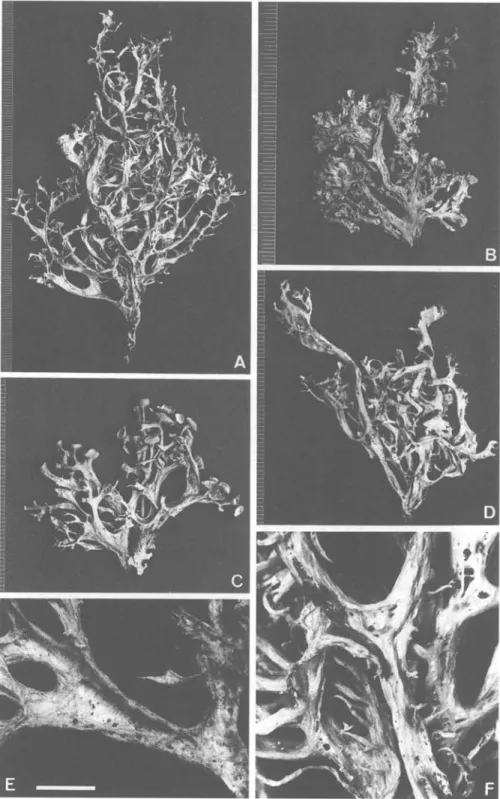
Characteristics: see Table 2 and Figs 1 & 2. Ramalina panizzei is a polymorphic species, often recalling or looking like R. fastigiata: slender, small tufted morphs with mostly apical apothecia have been found, together with rigid, irregularly and sparingly branched thalli. Intermediates of these morphotypes are common.
Chemistry
Sekikaic acid, homosekikaic acid; 4'-O-methylnorhomosekikaic acid, prob-ably 4'-O-demethylsekikaic and/or 4'-O-methylnorsekikaic acids and other related substances. Medulla UV2 5 4 n m +yellowish-white to bright green,
according to Bartsch (1992). TLC patterns of the specimens are very similar and show, with regard to the relative proportions of the substances, little variation; sekikaic acid is the major product, followed by homosekikaic acid. Usnic acid is usually present in trace amounts; it is rarely accompanied by a trace of atranorin.
Character s Thallu s Branche s Apotheci a Apica l spu r Perforation s Fenestration s Pseudocyphella e Othe r characteristic s Chemistr y (diagnosti c acids ) Know n distributio n •Detail s fro m Poel t TABL E 2 . Main differences between Ramalin a panizze i and similar species* R. panizzei Mor e o r les s hollo w Robus t and/o r irregularl y branche d form s frequent ; partl y inflated , compresse d Apical-subapical , latera l Ofte n presen t Presen t Presen t Absen t (? ) Ofte n disintegratin g o r cracke d corte x Sekikai c aggr . ? Centra l European — Mediterranean ? montan e (? ) R. fastigiata Solid ; partl y hollo w Ofte n palmatel y branched ; compresse d an d partl y inflated , longitudinall y furrowe d Apical-subapical , mor e rarel y latera l Ofte n presen t Ofte n presen t Sometime s presen t Absen t — Everni c Souther n boreal — Mediterranea n 1969) , Kro g & Jame s (1977) , Kro g & 0sthage n R. subgeniculata Hollo w Usuall y narrow , ofte n compressed , mor e o r les s canaliculat e Apical , subapical , latera l Ofte n presen t Presen t Presen t Absen t Ofte n wit h blackene d area s Divaricati c Mediterranean , Macaronesia n (1980) , Clauzad e & R. elegans Mor e o r les s hollo w Shrubb y an d rigid ; moderatel y branched ; usuall y compressed , partl y inflate d Apical-subapica l Presen t Presen t Absen t Presen t (linear ) o r absen t — Sekikai c aggr . Souther n boreal — Mediterranean ; montan e Rou x (1985) , Skyte n R. calicaris Soli d Usuall y narrow ; moderatel y t o densel y branched , canaliculat e Subapical , latera l Presen t Absen t Absen t Punctiform-linea r o r absen t Spore s mostl y straigh t Sekikai c aggr./n o medullar y substance s Souther n boreal — Mediterranean ; wester n (1993) , Arroy o et al. R. pusilla Hollo w Irregularl y branched ; inflate d Apica l Absen t +/ - Orbicular ; longitudina l crack s Absen t Absen t Corte x wit h blac k patche s Sekikaic , terpenoids / salazini c Mediterranean , Macaronesia n (1995) . 997 Pa s 2.
a s
a~1
£? 1 t- 445FIG. 1. Ramalina panizzei (Groner 614). A-D, Different morphotypes from a single tree. E, Disintegrating cortex on underside of thallus. F, Irregular branching, perforations and cracking
1997 Ramalina panizzei—Groner & LaGreca 447
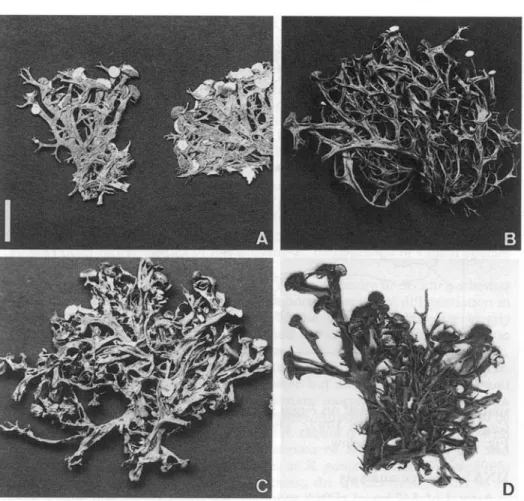
FIG. 2. Morphs of Ramalina panizzei from old collections. A, Egli (Z); B, Frey 23.418 (BERN); C, hb. Frey 15.905 (BERN); D, Rome (G). Scale=10 mm.
Localities and habitat ecology
Recent collections of R. panizzei have been made in three different parts of Switzerland. Muotatal, east of Lake Lucerne in central Switzerland, is part of the Northern Calcareous Alps (details in Groner 1990). The second locality, Naye, is close to Lake Geneva in the Prealpes region (western Switzerland), and Bellelay, the third, is situated in the Jura Mountains in the northwestern part of the country. Common to all three localities are more or less calcareous rocks of Jurassic or Cretaceous age; these sediments are covered by a Quaternary peat bog at Bellelay. The collection sites (900 to 1350 m a.s.l.) are in the montane-upper montane zone of fir-beech forest, where suboceanic and oceanic lichens occur. Ramalina panizzei is found on trunks and lower branches of Acer pseudoplatanus; the pertaining epiphytic communities are attributed to a Ramalinetum fastigiatae Duvign. Collection data are scarce or incomplete on three of the four examined herbarium specimens; Acer
448 THE LICHENOLOGIST Vol. 29
FIG. 3. Known distribution of Ramalina panizzei. Italian locations from Bartsch (1992).
specimens were collected on Fagus in montane forests, a single specimen on
Castanea sativa (Bartsch 1992). The distribution of/?, panizzei is shown in
Fig. 3 and discussed below.
DNA sequence analysis
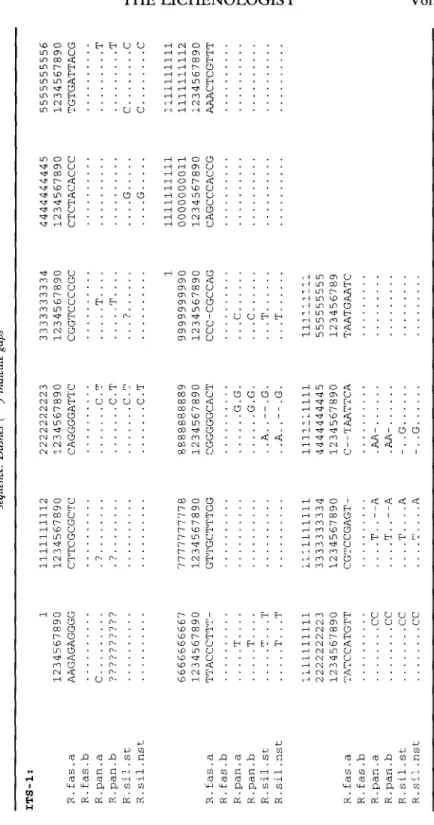
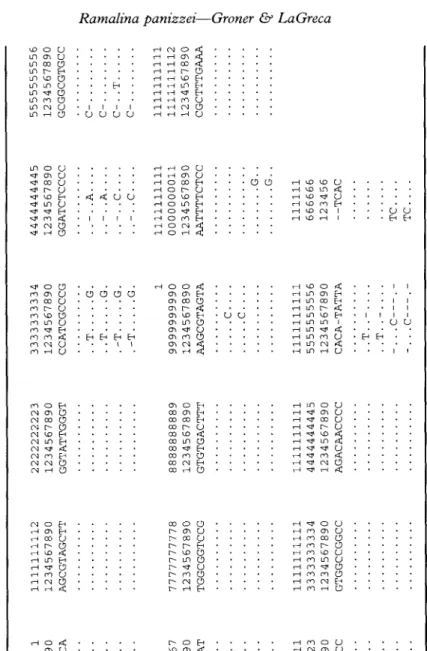
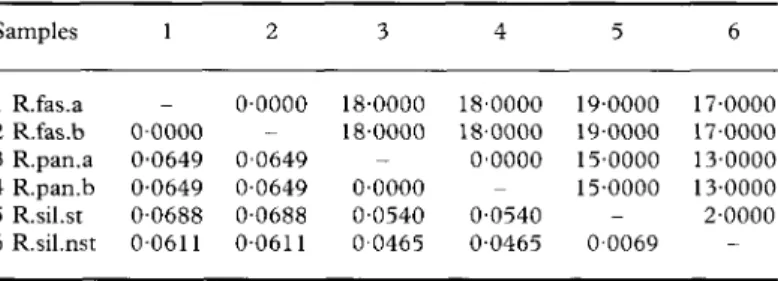
A total of 542 bp of rDNA sequence including ITS-1 and ITS-2 were determined for all six samples. Complete ITS-1 and ITS-2 sequences, 159 bp and 166 bp long, respectively, are given in Table 3. These sequences are readily alignable over their entire lengths; excluding the 22 positions with gaps, they are 85-2% identical (277 nucleotides out of 325). The average nucleotide composition calculated over all six sequences is: 192%A, 31-8%C, 24-7%G, and 24-3%T. Average pairwise genetic-distance estimates within species is 0-0023 and between species is 0-0600 (Table 4).
Discussion
There are considerable differences between the original diagnosis of R.
panizzei (De Notaris 1846) and the description summarized in Table 2. Based
on De Notaris' description, it seems likely that the specimens he examined were poorly developed or that they originated from a population with diminutive thalli (3 cm). While the herbarium specimens roughly match the diagnosis (Fig. 2A-B, D), the new collections represent unusually well-developed, robust individuals up to 8( - 13) cm long (Fig. 1). In addition, De Notaris did not mention the perforations and fenestrations present in the type.
1997 Ramalina panizzei—Groner & LaGreca 449 This could be because the material examined was possibly heterogeneous since Panizzi collected both R. panizzei and R. fastigiata at the type locality (see De Notaris 1846; Nylander 1870, and specimen mentioned below). Also, the original description did not mention the variability of the species nor its delimitation from similar, fertile shrubby species such as R. fastigiata and
R. subgeniculata. The confusion of R. panizzei, R. subgeniculata (Krog &
0sthagen 1980; Nimis & Poelt 1987) and R. fastigiata, seems to derive from the monograph of Nylander (1870). His rather short diagnosis of R. panizzei was obviously based on De Notaris' description and on specimens ex herb. Lenormand collected by Panizzi (the corresponding tiny specimen in H-NYL is R. fastigiata). Probably, like Nylander, none of the earlier authors citing R.
panizzei had seen the original material of De Notaris. Later authors referring
to Nylander's work (e.g. Stizenberger 1891; Harmand 1907; Steiner 1920), did so without seeing Nylander's reference specimens. In consequence, several authors determined morphs of R. fastigiata, R. subgeniculata or similar species as R. panizzei.
This confusion of species is partly due to the difficulty in deciding whether a thallus is fistulose or not, which is an important aspect of differentiation in this species group. Several specimens of the new collections are clearly fistulose, whereas the other thalli examined showed a wide range of solid to partly hollow to entirely hollow branches, such as Italian specimens of R.
panizzei (Bartsch 1992). The variation of this feature is well known for R. fastigiata; R. subgeniculata is usually fistulose but may have compressed and
canaliculate thallus parts (Table 2). Problematic morphs of these three species may be separated by their distinctive chemistry. Another species that has to be considered in this regard (Krog, in litt.) is R. elegans (Bagl. & Car.) Jatta, with thalli similar to some morphs of R. fastigiata or R. calicaris (L.) Fr. and apparently the same medullary substances as R. panizzei (Arroyo et al. 1995; Skyten 1993). Ramalina elegans is, at present, the species most similar to R.
panizzei and may prove to be a synonym, but further research on this taxon is
necessary to clarify its identity. Concerning subfistulose specimens in general, the question ' solid or hollow?' cannot definitely be answered (see also discussion in Krog & 0sthagen 1980). Ramalina panizzei must be retained within Fistularia until more results are available.
At first sight, specimens of R. panizzei, especially of the fastigiata morph (Fig. 2A-B), might be regarded as a chemotype of R. fastigiata, as they lack the striking combination of morphological characteristics of recent collections (Fig. 1). Other Ramalina species also show considerable morpho-logical and chemical variation; see for example Culberson et al. (1990) and LaGreca (1997). Moreover, the two species have been collected together at the type locality and the same is true for herbarium specimens, because
R. panizzei was found among R. fastigiata thalli. For instance, E. Frey's
collection in the Swiss Jura Mountains (Frey 23.418) contains 18 thalli of R.
panizzei and two of R. fastigiata. We have recently collected two R. panizzei
and 19/?. fastigiata thalli on the same tree; the species were indistinguishable in the field.
DNA sequence data, however, are inconsistent with these arguments. The low levels of intraspecific ITS sequence divergence found in this study (Tables
TABL E 3 . Complete, aligned DNA sequence data of the ITS regions for the six samples. Dots (.) in the sequences indicate bases which are identical to the R.fas. a sequence. Dashes (—) indicate gaps ITS-1 : R.fas. a R.fa s . b R.pan. a R.pan. b R.sil.s t R.sil.ns t R . fa s . a R.fas. b R.pan. a R.pan. b R.sil.s t R.sil.ns t R . fa s . a R.fas. b R.pan . a R.pan. b R.sil.s t R.sil.ns t 1 123456789 0 AAGAGAGGG G C 666666666 7 123456789 0 TTACCCTTT -T T... . T . . T T . . T 111111111 1 222222222 3 123456789 0 TATCCATGT T C C C C C C C C 111111111 2 123456789 0 CTTCGCGCT C 777777777 8 123456789 0 GTTGCTTTG G 111111111 1 333333333 4 123456789 0 CGTCCGAGT - ....T..--A ....T..--A ....T.... A ....T.... A 222222222 3 123456789 0 CAGGGGATT C C. T C. T C. T C. T 888888888 9 123456789 0 CGGGGGCAC T G.G . G.G . ..A. .--.G . . A G . 111111111 1 444444444 5 123456789 0 C--TAATTC A .AA -.AA -. . G -. . G 333333333 4 123456789 0 CGGTCCCCG C T . . . . T... . 1 999999999 0 123456789 0 CCC-CGCCA G c c . . T . T 11111111 1 55555555 5 12345678 9 TAATGAAT C 444444444 5 123456789 0 CTCTACACC C . . . . G .... G 111111111 1 000000001 1 123456789 0 CAGCCCACC G 555555555 6 123456789 0 TGTGATTAC G T T C C C C 111111111 1 111111111 2 123456789 0 AAACTCGTT T
3
w
n X
§
o
S
0
C/3H
<
oTABL E 3 . Continued. ITS-2 : R . fa s R.fa s R.pa n R.pa n R.si l R.si l . a . b . a . b . s t .ns t R.fas. a R . fas. b R.pan. a R.pan. b R.sil.s t R.sil.ns t 123456789 0 GCACCACTC A A T . . . T . . . 666666666 7 123456789 0 CGAAAAGCA T 111111111 2 123456789 0 AGCGTAGCT T 777777777 8 123456789 0 TGGCGGTCC G 222222222 3 123456789 0 GGTATTGGG T 888888888 9 123456789 0 GTGTGACTT T 333333333 4 123456789 0 CCATCGCCC G . . T G . . . T G . . -T G . .-T G . 999999999 0 123456789 0 AAGCGTAGT A C... . C... . 444444444 5 123456789 0 GGATCTCCC C ..-..A... . ..-..A... . ..-..C... . ..-..c... . 111111111 1 000000001 1 123456789 0 AATTTTCTC C .G . .G . 555555555 6 123456789 0 GCGGCGTGC C C -C -C-.. T C -111111111 1 111111111 2 123456789 0 CGCTTTGAA A a ' a & a 3 a TO R . fa s . a R.fas. b R.pan. a R.pan. b R.sil.s t R.sil.ns t 111111111 1 222222222 3 123456789 0 GCCTCACGC C .TT. T . T T . T 111111111 1 333333333 4 123456789 0 GTGGCCGGC C 111111111 1 444444444 5 123456789 0 AGACAACCC C 111111111 1 555555555 6 123456789 0 CACA-TATT A ..T... . T — -. . .c—. --. . .c — . -mil l 66666 6 12345 6 --TCA C TC . . . . TC . . . . Q>
452 THE LICHENOLOGIST Vol. 29
TABLE 4. Total number of nucleotide differences (upper right) and Kimura
2-parameter genetic distance estimates (lower left) for pairs of samples from Table 3 Samples 1 2 3 4 5 6 R.fas.a R.fas.b R.pan.a R.pan.b R.sil.st R.sil.nst 1 _ 00000 0-0649 0-0649 0-0688 00611 2 0-0000 0-0649 0-0649 0-0688 0-0611 3 18-0000 18-0000 -0-0000 0-0540 00465 4 18-0000 18-0000 0-0000 -0-0540 0-0465 19 19 5 •0000 •0000 15-0000 15 0 •0000 -•0069 17 17 6 •0000 •0000 13-0000 13 o, •0000 •0000
-3 & 4) agree with those for many other Ramalina species (LaGreca 1997) and are comparable with those reported for various angiosperms (review: Baldwin
et al. 1995) and the parasitic ascomycetes Botrytis (Carbone & Kohn 1993)
and Cladosporium (Curtis et al. 1994). The interspecific differences, however, between the three Ramalina species here are almost ten times as great (Table 4). Another, similar study of the lichen species Lasallia papulosa and L. rossica (Niu & Wei 1993) showed a much higher (24%) interspecific sequence difference (ITS-2 only), but this may reflect the fact that those two species were collected on two different, distant continents (North America and Asia, respectively). The identity of the within-species sequences from R. panizzei and R. fastigiata and the substantial average between-species genetic distance (0-0649) of these two species (Table 4) indicate that they are distinct and separate from each other. This evidence is especially compelling because, as mentioned above, one sample of each species was collected from a tree where both species grow intermixed (Table 1), a situation where a high incidence of gene-flow between them might be expected. In addition, both species are approximately as different from each other (genetic-distance-wise) as either is from R. siliquosa s.L, a morphologically and ecologically dissimilar European species. An emendation ofR. panizzei is presently not possible because Italian specimens have not been sequenced, nor have specimens of R. elegans. However, the results of this study demonstrate the potential of utilizing DNA sequence data for resolving species complexes in lichens.
The occurrence of Ramalina panizzei north of the Alps and in the Carpathians (Fig. 3) considerably extends its known distribution, no longer being restricted to the Mediterranean or southern Europe. Its range and ecological preferences may be similar to that of R. fastigiata. More material should be looked for under conditions like those of the recent discoveries: well-lit places in rather undisturbed forests, with high air humidity and precipitation levels and trees with more or less base-rich bark. The appropriate climatic conditions in central Europe are found in montane and upper montane zones or in humid montane forests in southern Europe (Nimis, in
litt.). While a broad-based taxonomic revision is impossible given the limited
scope of this study, R. panizzei is retained here as distinct on the (although provisional) basis of morphological, chemical and DNA sequence data. The re-examination of old and recent Ramalina collections, as well as additional
1997 Ramalina panizzei—Groner & LaGreca 453 field and molecular work including related taxa, are encouraged to provide a better understanding of this species.
Excluded specimens (labelled Ramalina panizzei):
Ramalina calicaris (L.) Fr.: Portugal: without location; Basel Rheinhafen, 1961, W. Baumgartner (G).
Ramalina canariensis Steiner: France: Corsica: Requien a reliq. b. Schaereri (H-NYL 36874). Ramalina fastigiata (Pers.) Ach.: Italy: Liguria occid.: In sylvis supra S. Remo, Panizzi (H-NYL
36876); Liguria: 1962, M. Steiner [Lichenes AlpiumlMunchen no. 335] (BERN, MARSSJ);
Carnica: Lago di Sauris, 1990, A. Vezda (MARSSJ).—France: Var. Esterel, 1965, J. Lambinon
(MARSSJ).—Spain: Route de Murcie a Grenade, 1962, H. Derval, hb. Bouly de Lesdain (MARSSJ).—Greece: Rhodos, 1886, Dr. Forsyth (G).—Algeria: Sommet de 1'Atlas, 1844,
Durieu (H-NYL 36875).
Ramalina pusilla Duby: Portugal: without location, hb. Bouly de Lesdain? (MARSSJ). Ramalina subgeniculata Nyl.: France: Corsica: Requien (H-NYL 36873); Corsica: Bonifacio,
1878, J. P. Norrlin (H-NYL 36872); Var. He de Porquerolles, 1955, C. Sbarbaro, hb. Bouly de Lesdain (MARSSJ); Var: He de Porquerolles, 1955, G. Clauzade, hb. Bouly de Lesdain (MARSSJ); Var. Port-Cros, 1971, Y. Rondon [Vezda, Lichenes selecti no. 1018] (G).—Algeria: Oran, 1852, 1853, Balansa (H-NYL 36870).
We are most grateful to H. Krog for valuable suggestions and to P. L. Nimis and S. Bartsch for information and comments on the species; S. Bartsch provided photographs of the type. Thanks are also due to the curators of the mentioned herbaria for the loan of specimens. The use of T L C facilities of the Swiss Federal Institute FSL Research was kindly permitted by C. Scheidegger. We thank C. F. Culberson and W. L. Culberson for collection, and C. F. Culberson for DNA extraction, of the R. siliquosa samples; D. Armaleo for assistance with all DNA extractions; and R. Vilgalys for generously providing lab space. P. Clerc, C. F. and W. L. Culberson, M. Dietrich, F. Rose, W. Untereiner and A. Withey are thanked for their helpful suggestions and critical comments on drafts of the manuscript. The molecular work was supported by an A. W. Mellon Foundation grant for graduate training in plant systematics to the Duke University Department of Botany.
R E F E R E N C E S
Armaleo, D. & Clerc, P. (1991) Lichen chimeras: DNA analysis suggests that one fungus forms two morphotypes. Experimental Mycology 15: 1-10.
Armaleo, D. & Clerc, P. (1995) A rapid and inexpensive method for the purification of DNA from lichens and their symbionts. Lichenologist 27: 207-213.
Arroyo, R., Serina, E. & Manrique, E. (1995) Ramalina elegans (Lichenes, Ramalinaceae) a taxon which has been mistaken for Ramalina calicaris and R. fastigiata in the Iberian Peninsula.
Cryptogamic Botany 5: 22-27.
Baldwin, B. G., Sanderson, M. J., Porter, J. M., Wojciechowski, M. F., Campbell, C. S. & Donoghue, M. J. (1995) The ITS region of nuclear ribosomal DNA: a valuable source of evidence on angiosperm phylogeny. Annals of the Missouri Botanical Garden 82: 247-277. Bartsch, S. (1992) Chemotaxonomische Untersuchungen an mediterranen und makaronesischen Arten
der Gattung Ramalina unter besonderer Beriicksichtigung der fruchtenden Formen. Diplomarbeit,
Freie Universitat Berlin.
Carbone, I. & Kohn, L. M. (1993) Ribosomal DNA sequence divergence within internal transcribed spacer 1 of the Sclerotiniaceae. Mycologia 85: 415-427.
Clauzade, G. & Roux, C. (1985) Likenoj de Okcidenta Europo. Ilustrita determinlibro. Bulletin
de la Societe Botanique du Centre-Ouest. N. S., Numero Special 7: 1-893.
Culberson, C. F. & Ammann, K. (1979) Standardmethode zur Dunnschichtchromatographie von Flechtensubstanzen. Herzogia 5: 1-24.
Culberson, C. F. & Johnson, A. (1982) Substitution of methyl tert.-butyl ether for diethyl ether in the standardized thin-layer chromatographic method for lichen products. Journal of
Chromatography 238: 483-487.
Culberson, C. F., Culberson, W. L. & Johnson, A. (1990) The Ramalina americana complex (Ascomycotina, Ramalinaceae): chemical and geographic correlations. Bryologist 93: 167-186.
454 THE LICHENOLOGIST Vol. 29
Curtis, M. D., Gore, J. & Oliver, R. P. (1994) The phylogeny of the tomato leaf mould fungus
Cladosporium fulvum syn. Fulvia fulva by analysis of rDNA sequences. Current Genetics 25:
318-322.
De Notaris, G. (1846) Frammenti Lichenografici di un lavoro inedito. Giornak Botanico Italiano anno II, parte 1, tomo I: 174-224.
DePriest, P. T. & Gargas, A. (1996) Origins of the lichen association in the fungi: phylogenetic analyses of nuclear small subunit ribosomal DNA sequences. Third IAL Symposium, Salzburg,
Austria. Abstracts: 100. September 1-7.
Gargas, A., DePriest, P. T., Grube, M. & Tehler, A. (1995) Multiple origins of lichen symbioses in fungi suggested by SSU rDNA phylogeny. Science 268: 1492-1495.
Groner, U. (1990) Die epiphytischen Makroflechten im Bodmerenwaldgebiet, Muotatal SZ.
Berichte der Schwyzerischen Naturforschenden Gesellschaft 9: 77-93.
Gutell, R. R. (1993) Collection of small subunit (16S- and 16S-like) ribosomal RNA structures.
Nucleic Acids Research 21: 3051-3054.
Hale, M. E. (1979) How to know the lichens. Pictured Key Nature Series. Dubuque, Iowa: Wm. C. Brown Co.
Harmand, J. (1907) Lichens de France. Catalogue systematique et descriptif. Fascic. Ill: 207-478. Paris: P. Klincksieck.
Hillis, D. M. & Dixon, M. T. (1991) Ribosomal DNA: molecular evolution and phylogenetic inference. Quarterly Review of Biology 66: 411-453.
Krog, H. & James, P. W. (1977) The genus Ramalina in Fennoscandia and the British Isles.
Norwegian Journal of Botany 24: 15^43.
Krog, H. & 0sthagen, H. (1980) The genus Ramalina in the Canary Islands. Norwegian Journal
of Botany 27: 255-296.
Kumar, S., Koichir, T. & Nei, M. (1993) MEGA: Molecular Evolutionary Genetics Analysis (version
1-0). Pennsylvania University Park: Pennsylvania State University.
LaGreca, S. A. (1997) Systematics and evolution of the lichen genus Ramalina with an emphasis on the R. americana chemotype complex. Ph.D. Thesis, Duke University, Durham N.C.
Lane, D. J., Pace, B., Olsen, G. J., Stahl, D. A., Sogin, M. L. & Pace, N. R. (1985) Rapid determination of 16S ribosomal RNA sequences for phylogenetic analyses. Proceedings of the
National Academy of Sciences of the United States of America 82: 6955-6959.
Lutzoni, F., Spatafora, J. W., Armaleo, D., Sochting, U., Johnson, J., Mahoney, B., LaGreca, S. & Culberson, W. L. (1996) Relationships among lichenized and nonlichenized Ascomycota based on phylogenetic analyses of ribosomal DNA. Third IAL Symposium, Salzburg, Austria. Abstracts: 6. September 1-7.
Nimis, P. L. & Poelt, J. (1987) The lichens and lichenicolous fungi of Sardinia (Italy), an annotated list. Studia Geobotanica 7, Suppl. 1: 1-269.
Niu, Y. & Wei, J. (1993) Variations in ITS2 sequences of nuclear rDNA from two Lasallia species and their systematic significance. Mycosystema 6: 25-29.
Nylander, W. (1870) Recognitio monographica Ramalinarum. Bulletin de la Societe Linneenne de
Normandie, Serie 2, 4: 101-180.
Poelt, J. (1969) Bestimmungsschliissel europdischer Flechten. Lehre: J. Cramer.
Skyten, R. (1993) Ramalina elegans, new to Sweden and Norway. Graphis Scripta 5: 93-95. Steiner, J. (1920) Beitrage zur Kenntnis der Flora Griechenlands. C. Lichenes. Verhandlungen der
Zoologisch-Botanischen Gesellschaft Wien 69: 52-101.
Stizenberger, E. (1891) Bemerkungen zu den Ramalina-Arten Europa's. Jahresberichte der
Naturforschenden Gesellschaft Graubiindens, N.F. 34: 77-130.
Tehler, A. (1995) Arthoniales phylogeny as indicated by morphological and rDNA sequence data.
Cryptogamic Botany 5: 82-97.
Vilgalys, R. & Hester, M. (1990) Rapid genetic identification and mapping of enzymatically amplified ribosomal DNA from several Cryptococcus species. Journal of Bacteriology 172: 4238-4246.
Zahlbruckner, A. (1930) Catalogus lichenum universalis. Band VI. Leipzig: Borntrager.