BEHAVIORAL AND BRAIN SCIENCES (1989) 12, 683-739 Printed in the United States of America
Selfishness examined: Cooperation
in the absence of egoistic
incentives
Linnda R. Caporael
Department of Science and Technology Studies, Rensselaer Polytechnic Institute, Troy, NY 12181
Electronic mall: [email protected] Robyn M. Dawes
Department of Decision and Social Sciences, Carnegie-Mellon University, Pittsburgh, PA 15213
Electronic mail: [email protected] John M. Orbell
Department of Political Science, University of Oregon, Eugene, OR 97403
Electronic mall: [email protected] Alphons J. C. van de Kragt
Department of Political Science, University of Oregon, Eugene, OR 97403
Abstract: Social dilemmas occur when the pursuit of self-interest by individuals in a group leads to less than optimal collective outcomes for everyone in the group. A critical assumption in the human sciences is that people's choices in such dilemmas are individualistic, selfish, and rational. Hence, cooperation in the support of group welfare will only occur if there are selfish incentives that convert the social dilemma into a nondilemma. In recent years, inclusive fitness theories have lent weight to such traditional views of rational selfishness on Darwinian grounds. To show that cooperation is based on selfish incentives, however, one must provide evidence that people do not cooperate without such incentives. In a series of experimental social dilemmas, subjects were instructed to make single, anonymous choices about whether or not to contribute money for a shared "bonus' that would be provided only if enough other people in the group also contributed their money. Noncontributors cited selfish reasons for their choices; contributors did not. If people are allowed to engage in discussion, they will contribute resources at high rates, frequently on irrational grounds, to promote group welfare. These findings are consistent with previous research on ingroup biasing effects that cannot be explained by "economic man" or "selfish gene" theories. An alternative explanation is that sociality was a primary factor shaping the evolution of Homo sapiens. The cognitive and affective mechanisms underlying such choices evolved under selection pressures on small groups for developing and maintaining group membership and for predicting and controlling the behavior of other group members. This sociality hypothesis organizes previously inexplicable and disparate phenomena in a Darwinian framework and makes novel predictions about human choice.
Keywords: altruism; game theory; group behavior; human evolution; prisoner's dilemma; rational choice; selfishness; social cognition; social dilemmas; sociality; sociobiology
Group living has been a central characteristic of the human species throughout human evolution (Foley 1987); there is no archaeological evidence of a transition from isolation to group life. Yet psychologists, an-thropologists, and evolutionists have rarely considered what psychological characteristics might have evolved as adaptations to living in small groups. Instead, most theo-rists assume that human nature is basically selfish and individualistic, an assumption that applies just as well to animals that have evolved in isolation as to those that have evolved in groups. In recent years, "selfish gene" theo-ries (e.g., Dawkins 1976) have provided the ultimate justification for this centuries-old notion of "economic man" (Myers 1983) by arguing - somewhat tautologically - that human behavior evolved to maximize fitness in local environments. A variety of "egoistic incentive" theories have accordingly been proposed to account for
the minimal amount of cooperation necessary for group living in terms of the individual selfish payoffs it affords; for example, Axelrod (1984) proposes that cooperation evolves as the result of the payoffs to the cooperating individual when cooperation is reciprocated ("reciprocal altruism"), whereas Alexander (1987) proposes that coop-eration evolves as the result of payoffs that accrue to the genes of the cooperating individual when the benefici-aries of the cooperation are genetically related ("kin altruism").
These egoistic incentive1 (El) notions are really un-tested metatheories; they seem to be based on cultural beliefs about "human nature" rather than on reasoned argument. In this target article, we present experimental evidence that (1) human cooperation can be controlled by manipulating variables totally unrelated to self-interest and that (2) satisfying self-interest is not necessary to
Caporael et al.: Selfishness examined
elicit this cooperation. These results cannot be explained by El theories. Instead, we suggest that the cognitive and affective mechanisms underlying the cooperation ob-served in these studies may have evolved from selection pressures exerted under small-group living conditions for developing and maintaining group membership. Accord-ing to this "sociality hypothesis," human nature is basical-ly social rather than selfish.2
1. Social dilemmas and egoistic incentive theories
In a later section, experiments are described in which people are faced with choices between individual self-ishness and social cooperation. These experiments con-front people with "social dilemmas" - situations that maximize the conflict between private incentives and group welfare. We use a simple example, the funding of public broadcasting, to introduce the basic concepts and structural features of social dilemmas. (The Appendix includes a glossary for readers unfamiliar with the tech-nical terms of game theory.)
For almost all potential contributors, the success or failure of public broadcasting is determined by what others contribute, usually in private; there are neither tangible social rewards (payoffs) for contributing nor sanctions for not contributing (the absence of a sanction is also a payoff). We can "free ride" on the contributions of others by making no contribution and still enjoy the broadcast; if we fear that the contributions of others will not be enough to maintain this public good, we can avoid "throwing away" our own money by withholding it. In fact, no matter how many others contribute, our potential contribution has greater utility for us if it is spent on private consumption rather than on public broadcasting; hence not contributing is a dominating strategy. But if all listeners withhold all contributions, the demise of public broadcasting follows, a deficient equilibrium for all who enjoy it. The payoff for each individual is higher for not contributing than for contributing, but if each individual follows the dominating strategy, the outcome is one that no individual desires. Choosing the dominating strategy by withholding one's contribution is known as defection; accepting a lower individual payoff to sustain public broadcasting is called cooperation.
Fossil fuel shortages, overpopulation, "brown-outs," air pollution, and the depletion of fresh water supplies all represent social dilemmas because each individual's payoffs for choosing defection are higher than those for choosing cooperation, no matter what others choose; however, all individuals receive lower payoffs under universal defection than under universal cooperation. Cooperation can be difficult to obtain in social dilemmas because individual decisions typically have a low impact on the collective outcome, especially when the group is large. Also, gains associated with self-interest accrue to the individual whereas the costs - inconveniences, de-clines in the quality of life, or depletion of resources - are shared by all. Sociobiology's "central problem" (Wilson 1975) can also be framed as a social dilemma: How can cooperation evolve when the genetic payoffs for defection are higher than for cooperation?
Stated in game theoretic terms3 (see Appendix and
Glossary), a social dilemma is a structure in which domi-nating strategies converge on a deficient equilibrium (Dawes 1980). The outcome of choosing the dominating strategies is "deficient" because some other outcome is preferred by the choosers; it is an "equilibrium" because no group member receives a higher payoff for picking some other option if indeed others choose their dominat-ing strategies. People are assumed to be (1) rational decision makers (i.e., they are capable of assessing and acting upon their perceived interests and preferences), and (2) selfish maximizers (i.e., only their own costs and benefits enter their decision calculations). Rational choice involves determining and comparing (1) the vari-ous outcomes that could result from each alternative course of action and (2) the probability that each outcome will subsequently occur - and then choosing on the basis of personal values (called utilities). Selfishness is defined as not taking the consequences for the group into account in this calculation. (Shubik [1964] describes the formal assumptions of "economic man" theories, and Schwartz [1986] describes how they are involved in everyday life.) According to El theory, people will always choose the selfish strategy in social dilemmas. The only way to avoid the resulting deficient equilibrium, then, is to embed the dilemma in a larger context involving utilities that make the dominating strategies no longer dominating. These utilities assessed by economic man can be external, such as avoiding sanction or obtaining a direct payment, or internal, such as a positive psychological payoff for "doing the right thing" or "having a clear conscience," irrespec-tive of consequence. Some authors have proposed that these measures of utility can also be more indirect; for example, it would be to the benefit of the current cooper-ator to have others observe the cooperative act and reciprocate with future acts of their own (Alexander 1987; Campbell 1986).
Social dilemmas are not "trust dilemmas," in which people receive higher individual rewards for choosing a socially beneficial alternative only if others do (as occurs in some business partnerships, for example). The conflict between individual payoffs and group payoffs is maximal in social dilemmas because individuals always receive higher rewards for choosing the (dominating) option lead-ing to the deficient equilibrium that no one desires. It should also be noted that social dilemmas are defined in terms of available choice options and payoffs - not in terms of what people actually choose. It is always possible to hypothesize arbitrary egoistic payoffs post hoc when-ever an individual is observed to choose what does not appear to be the dominating strategy, or one can simply claim that some such payoffs must exist. It is also possible to maintain that an apparently nonegoistic incentive that motivates behavior must by definition be "selfish," or that choosing a dominated option is impossible, again by definition, because the very fact that it was chosen means the apparently dominating option cannot be dominating. This last argument is known as revealed preference (see Glossary) -the term is a double entendre - because the observer claims "revealed" knowledge of an internal cause of behavior (i.e., self-interest) and because behav-ior "reveals" the actor's utilities (i.e., the matter of self-interest and its subjective value to the actor). (The diffi-culties of revealed preference are discussed in section 1.4.)
The economic-man prediction for behavior in social dilemmas is that people will neither contribute their own resources nor will they practice restraint in the use of freely available ones. Everyday observation, however, quickly reveals that some people do cooperate in social dilemmas, at least some of the time. El explanations for cooperative behavior differ only superficially: Theorists who accept the selfish incentive paradigm must transform the social dilemma into a nondilemma. If an inducement or penalty is imposed or developed, the utility of the dominated cooperative behavior is thereby changed so that the consequence of the cooperative choice becomes individually beneficial. Because the cooperative choice is beneficial for the group, these sanctions would explain how selfish behavior is compatible with beneficial group outcomes.
Responses to social dilemmas are ideal for studying El theories because hypotheses about the necessity of incen-tive changes are testable. A hypothesized incenincen-tive for cooperation would be falsified, for example, if coopera-tion did not decline when the putative incentive was removed. Similarly, a pattern of findings that was incon-sistent with El theory over a number of experiments would be grounds for doubting its usefulness as a general explanation for human cooperation even if a post hoc El explanation could be separately generated for each ex-periment. It is important to test El theories not only because they are ubiquitous, but because they can have important, and sometimes draconian, implications for social organization (see below). We will now briefly de-scribe incentive changes that have been suggested by prominent El theorists to account for cooperation. 1.1. Coercion. Thomas Hobbes's (1651/1958) classical justification for absolute government (Leviathan) is based on his analysis of the social dilemma structure of life in its absence. When the self-seeking propensity of mankind is constrained only by others' capacity to defend them-selves, where the "covenants without a sword are but words, and of no strength to secure a man at all," the result is the "warre of all against all" (a dominating strategy). This war is the worst outcome for everyone (a deficient equilibrium from which individuals cannot re-move themselves). It can (and should) be averted by a government strong enough to make peaceable action the dominant strategy. By coercing people to cooperate, Leviathan changes the incentive structure to make coop-eration compatible with egoistic incentives. Hobbes pro-vides not only an evolutionary and ethical justification for strong, coercive state power, but a psychological one as well. People, at least vaguely aware of their own impulses to defect and the resulting individual loss that the collec-tive expression of these impulses would mean, will accept the existence of this power - even when it is used to the selfish advantage of those wielding it.
More recently, Hardin (1968) has rekindled interest in coercion as a strategy for inducing cooperation. He has suggested that exploiting the environment, polluting it, and having children are all dominating strategies, partic-ularly in developing countries. Modern technology and population growth have made these strategies converge on deficient equilibria: pollution, overexploitation of the environment, and overpopulation. Hardin uses the anal-ogy of overgrazing a common pasture: All herdsmen have
Caporael et al.: Selfishness examined a dominating strategy to add cattle because their share of the destruction produced by an additional animal costs them less than the profit they accrue from the animal. Yet if all herdsmen choose this strategy, the common re-source is destroyed. Hardin's proposal is "mutual coer-cion mutually agreed upon." Although the process (mutu-al consent) differs from Leviathan, the result is the same; cooperation becomes compatible with egoistic incentives - provided, of course, that the sanctions enforcing it make the probable payoff of behaving uncooperatively negative.
1.2. Reciprocity. Before Hardin's paper Anatol Rapoport (Rapoport & Chammah 1965) conducted experiments on
prisoner's dilemma games (see Appendix) as analogues of
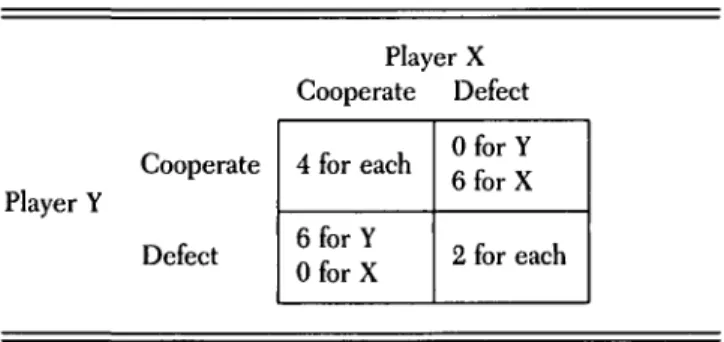
the nuclear arms race. These games have the same structure as social dilemmas except that the game has two players (i.e., defection is dominant, but the strategy leads to an outcome neither player desires). Rapoport consid-ered the arms race to be a prototypical prisoner's dilem-ma because both sides appear to have a dominating strategy to arm even though both would prefer disarma-ment and prosperity rather than the resulting escalation of arms production and concentration of resources in the military sector simply to achieve stalemate. Creating prisoner's dilemmas through payoffs in laboratory situa-tions allowed Rapoport and others to investigate how success in avoiding the deficient equilibrium across re-peated plays varied with players' overall choice strategy, forms of communication, personality characteristics, and even their gender.
As early as 1967, Amnon Rapoport demonstrated math-ematically that the defecting choice in a prisoner's dilem-ma dilem-may no longer dominate when that choice is embed-ded in a metagame created by repeated (iterated) plays in which reciprocity - or even its possibility - can make cooperation nondominated on particular plays. In iter-ated dilemmas, players are faced with a very compliciter-ated problem of behavioral control in which they try to shape the other players' behavior to yield cooperation, while simultaneously being rewarded or punished themselves. Players may reward cooperative choices by subsequently cooperating and respond to defection with defection (a strategy called "tit-for-tat"). This is analogous to the situation faced by a parent who must decide whether or not to forego a pleasant interaction with a child in the hope of changing future behavior by punishing a past transgression. Like coercion, reciprocity is hypothesized to "work" by making cooperation a selfish choice.
Empirical results suggest that cooperation can result from egoistic incentives because reciprocity exists; indi-viduals making a choice have at least an implicit under-standing of this reciprocity and its potential benefits. The strongest and most replicable finding is that subjects who use a tit-for-tat strategy in two-person prisoner's dilem-mas attain the best overall outcomes across trials. This strategy consists of cooperating on the first play and then simply matching the opponent's prior choice on suc-cessive plays. Thus, cooperation is rewarded with cooper-ation and defection is punished with defection.4 Axelrod (1984) replicated these results with two computer tourna-ments in which various experts in cooperation and con-flict submitted overall ("metagame") strategies as com-puter programs for playing iterated prisoners' dilemmas
Caporael et al.: Selfishness examined
against one another. In both tournaments, tit-for-tat garnered the most points.
An interesting elimination of a dilemma through reci-procity was achieved at the height of the nineteenth-century American "cult of domesticity." Catherine Beecher (1847/1972) observed that, "in order that each individual may pursue and secure the highest degree of happiness within his reach, unimpeded by the selfishness of others, a system of laws must be established, which sustain certain relations and dependencies in social and civil life" (pp. 171—72). Beecher defended a system in-volving the "duties of subordination," which women would undertake. Because the sexes were equal, how-ever, women would undertake their duties only when men's regard for women's best interest demanded it. In compensation for their subordination, women would be treated, by custom and courtesy, as superiors. The as-sumption that women were better suited to voluntary subordination was founded partially on the belief that women were more capable than men of acting in the absence of egoistic incentives; providence has provided them with a selfless and superior moral nature.5 1.3. Conscience. One of the goals of socialization is to take a child "brought into the world with apparently no other thought than its own gratification" (Rushton 1980, p. viii) and teach it concern for others. Campbell (1975) proposes that abstract cultural ideals such as fairness, equity, sharing, and so forth, are instilled in individuals as "con-science": general rules and customs that guide interac-tions with others. The Freudian version is the superego. Innate selfishness is opposed by internal rewards and punishments that have a higher utility than external ones. In our view, it makes no difference whether a choice payoffis external (such as avoiding a sanction or obtaining rewards through reciprocity in the future) or internal (as in having a clear conscience, heightened self-esteem, or the avoidance of guilt). An individual whose decision can be traced to a positive psychological payoffis acting on the basis of egoistic incentive.
1.4. Inclusive fitness maximization. According to so-ciobiologists, "altruism" includes not only genetically-based self-sacrifice of genes (the usual biological usage), but also any expenditure of resources, energy, and time that may benefit another organism (Barash 1977). Hence, they try to explain social behavior with the same princi-ples that govern genetic self-sacrifice. According to Alex-ander (1979), all human behavior, whether categorized as "selfish individualism" or "group altruism," can be ex-plained in terms of striving to maximize the survival by reproduction of one's own genes or copies of one's genes possessed by relatives: That is, the ultimate goal of behavior is to maximize inclusive fitness. (Note that "survival by reproduction" confounds the survival of the individual organism and the reproduction of the genes, thereby collapsing genetic and individual levels of analy-ses.) Thus, the solution to sociobiology's "central prob-lem" is to transform the dilemma of altruism into a nondilemma by hypothesizing egoistic incentives for "selfish" genes as an explanation for cooperation. In-stances of apparent cooperation among unrelated indi-viduals are best interpreted as the aggregate outcome of individuals pursuing their own (gene-prompted)
self-interest (Alexander 1974; Trivers 1971; 1985; Williams 1966).
The sociobiology of choice rests on the revealed prefer-ence approach (described in section 1 and Appendix), which also transforms dilemmas into nondilemmas. Even apparently altruistic choices are assumed to reveal under-lying utilities to the genes, with people choosing only what maximizes genetic fitness (Chagnon & Irons 1979). The corollary to El theory, that people are rational, may also be given an explicit genetic justification. Alexander (1979), for example, states that "the 'rational self-interest' of'utilitarian' explanations of human behavior is really the combination of the genes and chromosomes in perpetuat-ing themselves" (p. 70). This approach is circular, but it does imply the testable claim that humans routinely make rationally self-interested decisions. If choices reveal "un-derlying" utilities, then they must be consistent, tran-sitive, and independent of the way they are elicited. In reality, however, inconsistencies, intransitivities, and systematic "preference reversals" occur that depend, for example, on whether one's choice is based on comparing commodities directly or on using a system of common currency (see Grether & Plott 1979; Lichtenstein & Slovic 1971).6 Another example of inconsistency is the following: The finding that people seek sure gains and avoid sure losses leads to predictable preference reversals when the same problem is framed in different ways - a credit card surcharge versus a cash discount, or, more important, lives lost (e.g., 400 of 600) versus lives saved (e.g., 200 of 600; Tversky & Kahneman 1981). As with economic man theories, genetic reductionist accounts can neither accommodate nor dismiss such systematic deviations from rationality.
Although cultural evolutionists also assign a key role to egoistic incentives, they can avoid the shortcomings of revealed preference and the "adaptationist program" by positing intervening selective processes. Boyd and Richerson (1985) explicitly use the social dilemma frame-work to explore the conflict between self-interest and cooperation. In their view, a theory of cooperation must explain how a tendency to acquire self-sacrificial beliefs could evolve and why altruistic behavior is directed toward some individuals and not others. They propose "conformist transmission" of cultural beliefs and behavior as an explanation. According to Boyd and Richerson, people use a simple rule to judge what behaviors or beliefs to imitate: The more frequent a trait, the greater the value of imitating it. In general, the advantage of conformist transmission is that it provides an easily used "rule of thumb" that increases the probability of acquir-ing values, goals, beliefs, and behavior favored in the local population. "Excessive cooperation" from the ge-netic point of view may simply be a byproduct of an otherwise adaptive strategy for judging what behavior and cultural values to imitate.
1.5. Summary. El theories are variants of a metatheory that assumes, but does not demonstrate, that the only way to "resolve" a social dilemma is to embed it in a larger context in which it is no longer a dilemma. Cooperation is explained as a byproduct of the individualistic pursuit of some goal other than collective success. Goals may be variously identified in the social and behavioral sciences, but as in folk psychology, the organizing principle is that 686 BEHAVIORAL AND BRAIN SCIENCES (1989) 12.4
Caporael et al.: Selfishness examined people try to maximize their chances of obtaining
out-comes of purely personal value (Kitcher 1985). Cultural materialism explains the exotic customs of nonindustrial cultures as the "unknowing" cost/benefit calculations of production and reproduction (Harris 1979); psycho-analysis views mental life as being organized around unconscious pleasures and pains (Freud 1900/1965), and political economics posits government for the self-in-terest of politicians (Downs 1957); psychology stands accused of sanctioning selfishness (Wallach & Wallach 1983), and sociobiology offers the ultimate causal explana-tion for self-interest - the genes (Alexander 1987). All these theories explain social interaction in terms of incen-tives that are present in society, but that would be just as highly valued by an isolated nonsocial animal as by a social one.
Experimental studies and computer simulations (such as those described above) have generally supported El theories by showing that such incentives "work"; how-ever, these variables are manipulated without testing what happens in their absence. Most empirical investiga-tions are of two-person games played repeatedly with the same other player (or presumed player - often in reality a computer program). A cooperative subject may therefore expect to gain more points or money "in the long run" than an uncooperative one, provided that cooperation is reciprocated. (A true dilemma, in contrast, is defined by a dominating strategy of defection, not just one that ap-pears to be dominating because of a short-sighted failure to realize that cooperation yields a higher payoff in a broader context.) Given the existence of reciprocal al-truism in most cultures - a fact we do not deny - a player who cooperates in iterated play, especially in a tit-for-tat manner, will garner higher payoffs in the long run than a player who defects; however, the existence of these payoffs does not imply that the factor responsible for such cooperation is the expectation of receiving them. (In our culture, airplane crashes yield monetary payoffs to the survivors and the relatives of those killed with even greater certainty than cooperation yields reciprocity -which implies nothing about the factors responsible for such crashes.) What must be demonstrated is a lack of cooperation when the game is not repeated. Moreover, when people are identifiable, their expectation of re-ciprocal altruism in other contexts may generalize to yield cooperation even when the game is not iterated; conse-quently, the only two-person games relevant to our concerns are those played once in total anonymity.
Such games have been studied (Rapoport et al. 1976), but other factors have made their interpretation unclear. First, subjects are typically told to make as many points as they can; thus they are instructed to seek personal benefit, which at best confronts potentially cooperative players with a choice between cooperating with the other player or with the experimenter. Worse yet, the experimenter may offer a monetary prize to the player or players who "earn" the most points, thereby making the pursuit of joint gain a logical impossibility. Finally, to avoid the "inefficiency" of paying subjects for making a single choice in just one game (Rapoport et al. 1976, p. 90), subjects are often asked to play many different games, though not repeating a particu-lar one. As Rapoport later points out, however, "when the subject's task is to make a long series of choices, and where the structure of the decision problem varies from one
[problem] to the next, the subject may adopt an 'across the board' strategy" (1983, p. 377) - thereby making an understanding of the playing of a particular game impossible.
Deutsch's (1961a; 1961b) and Wrightsman's (1966) are the only studies we have been able to find in which subjects make an anonymous single choice without ancil-lary instructions from the experimenter about what to maximize in order to succeed at the task. The Deutsch studies used imaginary monetary payoffs and the Wrightsman study used real money in some conditions and imaginary money in others. Both these investigators, however, studied the role of personality and attitudinal variables in a single social context rather than the effects of different contexts, which is the emphasis of the experi-ments reported here.
2. Cooperation in the absence of egoistic incentives
In this section, we report a series of experiments testing the assumption that people will not promote group wel-fare in the absence of egoistic incentives. All the experi-ments were monetary public-goods dilemmas in which subjects were given a sum of money and chose anony-mously to keep it or contribute it. The general research strategy was to eliminate El explanations for cooperation by using a "subtractive procedure." Some incentives (e.g., the opportunity to make deals to redistribute the money) were obviated by the experimental design; others were tested directly in the experiments. It is important to note that these laboratory games are not simulations of naturally occurring social dilemmas; they are social dilemmas.
The experiments test the basic El prediction that public goods will be underprovided relative to demand, if they are provided at all. Consider the following il-lustrative "game" for example: Nine strangers are each given $5. If five or more contribute their money, all nine will receive a $10 bonus whether or not they contributed. If enough members contribute, the net payoff for the contributor would be $10, for a noncontributor $15. If too few contributed, a contributor would lose the contribu-tion, receiving nothing at all, whereas a noncontributor would retain the $5. The game theoretic strategy is to retain the money, but if this strategy is selected by all the members of the group, it leads to a deficient equilibrium: All receive $5 when all could have received $10 by contributing. This game illustrates the kind of decision confronted by people in all of the experiments to be described. Subjects who participate in groups are given money and then required to make a choice between retaining the money or contributing it to a "public good."7
The general paradigm was the same for all the experi-ments, which were conducted in Oregon, Utah, and Arizona over a period of 10 years. More than 1,000 people participated. Subjects were students and townspeople recruited through advertisements in campus and local newspapers.8 Subjects were scheduled at their conve-nience to participate in specific groups, which were randomly allocated to experimental conditions. Friends or relatives were prevented from participating in the
Caporael et al.: Selfishness examined
same groups (although ultimately the experimenters had to rely on the subjects' honesty in complying with this). When they arrived for the experiment and were seated, subjects were given a promissory note for the same amount of money (usually $4 to $6) that they later had to decide to retain or give to the group. The specific conse-quences of "giving" or "keeping" the money were ex-plained in some detail, including a "payoff matrix" that specified the monetary consequences for each person who gave or kept as a function of the total number of people in the group who gave. The word "contribute" was avoided; the words used were consistently "give" and "keep." All the experiments involved a single decision to keep or give to the group the full amount of the money in the promissory note. The experimenter read instructions to participants, explained the payoffmatrix and answered questions; subjects were subsequently given a short quiz to test their understanding of the instructions and the payoff matrix. (Any failures in this test led to more explanation. The choices were not made until the experi-menters were satisfied that all subjects understood the payoff structures.) The experimenter repeatedly empha-sized that all decisions were to be made anonymously. If the decision was to "keep," subjects would get the amount of money on the note at the end of the experiment plus the bonus, if the public good was provided. If subjects chose to "give," the payoffmatrix specified the payoffs they and the others in the experiment would receive. (The specific consequences, of course, depended on the experiment and condition.)
Subjects were not allowed to talk among themselves except in experiments involving one or more "discussion" conditions. Subjects made their decisions secretly by marking a box on the decision form that could not be seen by other subjects. After the experiment was completed, subjects were released one at a time to the "payroom" where they completed a questionnaire, were told the group outcome, and were paid. Only one subject was ever in the payroom at a time. This procedure was explained to all subjects before they made a decision to give or keep.
To summarize: Subjects were strangers (to the best of the experimenters' knowledge), they made a single deci-sion, their choices were anonymous, and interaction among group members was prevented before and after the session. The prohibition on interaction and the provi-sions for anonymity were designed to prevent: (a) reci-procity (during the experiment by allowing more than one decision, or after the experiment by splitting the money); (b) coercion (e.g., interpersonal abuse or sanc-tions); or (c) reputational concerns (which might, for example, lead a subject to hypothesize that giving or keeping would affect others observing this decision to respond in the future perhaps outside the experiment -to the selfish benefit or detriment of the subject). Thus, the paradigmatic design specifically excluded the "clas-sic" egoistic incentives invoked to explain cooperation.
2.1. Greed, fear, and the pursuit of self-interest. Beginning
their research as El theorists, Dawes et al (1986) designed their initial experiments to distinguish between two selfish motives (Coombs 1973): "Greed" to receive the good without contributing ("free riding") versus "fear" that one may lose money in a futile support of the public good (the
"sucker's payoff"). These experimenters conducted a se-ries of "step-level" public-goods games of the type just described; a specified number of contributions ("give" choices, e. g., "5 or more") of $5 supplied to the subjects in the form of a promissory note were required for the experimenters to provide a monetary bonus of $10 to all. That was the "standard" condition in the experiment. In a no-free-ride condition, the opportunity to free-ride was eliminated by truncating the amount paid to subjects at $ 10 in the event the public good was provided. The experi-menters explained this modified structure, complete with the payoff matrix, in the same way they explained the standard structure. If greed is a motive for defecting (not contributing), eliminating the incentive for it should enhance contributing. Contributors might still lose the value of their promissory note, but if the public good was provided, a noncontributor would make no more money than a contributor. In contrast, a money-back guarantee condition eliminated the possibility offutile contributions. The experimenters explained that contributing subjects would keep the $5 they gave to the group if too few subjects overall gave to yield the $10 bonus. Although this condi-tion eliminated the fear of losing their $5 as the result of giving it to the group, subjects could still make $15 rather than $10 by keeping it whenever enough others gave their $5 to yield the $10 bonus. Table 1 illustrates payoffs for the three conditions; it is similar to the payoff matrices pre-sented to the subjects.
Subjects were tested in groups of seven requiring either three or five contributors to obtain the public good. Over three replications, the rate of contributing averaged 51% in the standard condition; 58% in the money-back guarantee condition, and 87% in the no-free-ride condi-tion. (The number of groups in each condition was, respectively, 25, 19, and 25.) The authors concluded that the major motive for not contributing is greed rather than fear of futile contributing.
2.2. The rational pursuit of self-interest. Because
step-level games require a specified number of contributors for the public good to be provided, individuals might believe that their contribution was critical. For example,
ii exactly four others have contributed while five or more
contributions are necessary, then subjects who contrib-ute their $5 receive the $10 bonus, which is a better outcome than retaining the $5. Contributing is clearly
Table 1. Payoff matrices for standard dilemma, money-back guarantee, and no-free-ride conditions
Standard dilemma Contributors Noncontributors Money-back guarantee Contributors Noncontributors No free ride Contributors Noncontributors Less than 5 contributions 0 5 5 5 0 5 5 or more contributions 10 15 10 15 10 10
rational and consistent with egoistic motivations if such an outcome is likely. It is irrational, however, to believe that one's own contribution is critical if each other subject is assumed to have a constant probability, p, of contribut-ing, because in groups requiring three or five contrib-utors the probability that exactly two of the six others would contribute [15 p2 (1 — p)4] or that exactly four of the six others would do so [15 p4 (1 — p)2] can never be greater than .50 regardless of the value of p. Neverthe-less, subjects may be poor estimators of binomial proba-bility distributions. Amnon Rapoport (1967), for example, performed similar experiments and calculated the ex-pected values for contributing in the three conditions based on subjects' estimates of three probabilities: (i) the probability that their own contribution would be futile (i.e., that so few others would contribute that one's own contribution would not provide enough to provide the bonus); (ii) the probability that a contribution would be critical, and (iii) the probability that a contribution would be redundant (i.e., that enough others would contribute enough to make their contribution unnecessary). Thus, in a subsequent replication involving the standard, money-back guarantee and no-free-ride conditions in the pre-vious experimental design (a minimum of five contribu-tions of the $5 from seven players required to yield the $10 bonus), the subjects were also asked to indicate on a 100-point scale the likelihood that: (i) fewer than four others would contribute; (ii) exactly four others would contribute; and (iii) five others or more would contribute. Subjects who were maximizing expected value in the standard condition, for example, would contribute only if their estimate of its being critical was greater than .50. Table 2 shows the average values obtained for the probability estimates. Subjects should cooperate in the three conditions if their estimate of their contribution's being critical, on the average, was large enough so that contributing would have a higher expected value than withholding. (The actual requisite values are given in the table; note that this probability varies by condition; for example, with the money-back guarantee, it is derived by considering only the probability of contributing being critical or redundant, because futile contributions are returned.) Probability estimates did vary significantly by condition, but the proportion of subjects who judged their contribution to be critical did not. In both the no-free-ride and the money-back-guarantee conditions, the perceived probability of a contribution's being redundant is enhanced and of its being futile is diminished by a ratio of 2:1. Some directional support for the hypothesis that subjects ascertain and pursue their self-interest in accor-dance with the expectation model was obtained in the no-free-ride condition only; the non-contributors' estimate of futility was .51 compared to the contributors' estimate of .20. Virtually no contributors, however, believed that their contribution was critical to obtaining the public good with a probability sufficient to justify the "give" decision. In fact, pooling across all conditions, 67% of the contributors believed that so many others would contrib-ute that their own contributions would be redundant.
2.3. The reasonable pursuit of self-interest. The foregoing results could still be interpreted according to El theory. If potential gains are subjectively more valuable than potential losses, a contribution's being critical may not be
Caporael et al.: Selfishness examined
Table 2. Predicted and obtained probability estimates of making futile, critical, and redundant contributions
Experimental condition (expected value) and choice By condition Standard dilemma (.50)" Money-back guarantee (.37) No free ride (.27) By choice and condition
Standard dilemma Contributors (N = 9) Noncontributors (N = 26) Money-back guarantee Contributors (N = 15) Noncontributors (N = 20) No free ride Contributors (N = 27) Noncontributors (N = 8) Subjects that Futile .47 .27 .27 .24 .55 .25 .28 .20 .51 ' estimated probability their contribution would be Critical .21 .25 .24 .29 .18 .29 .21 .23 .25 Redundant .32 .48 .50 .46 .26 .46 .50 .57 .24
"Subjects maximizing expected value should cooperate if and only if their probability estimate for their cooperation's being critical is greater than the value indicated in parentheses.
important and people might be willing to contribute despite their estimates of probable outcomes. After all, even if a contribution is redundant, a contributor will gain $10 rather than $5 if the bonus is provided.
To see whether contributing could be enhanced when subjects had the opportunity to "educate" each other, van de Kragt et al. (1983) tested 12 groups in new conditions in which subjects could communicate with each other. What happened was that every group used discussion to make a decision about who would and would not ute. In 10 groups, exactly the minimal number of contrib-utors was designated (2 groups specified more than the minimum number), everyone so designated contributed, and there was 100% provision of the public good, with overprovision in 3 of the 10 groups (i.e., people who were not supposed to contribute did so anyway). The most common means of designating who was to contribute was a lottery, followed by volunteering; one group attempted to establish which group members were the neediest. Subjects designated as contributors, knowing that only the minimal number was specified, knew that they could not receive the bonus unless they contributed. The fact that all such designated subjects contributed appears to indicate that a contribution's being critical, which had played little role in the expectation analysis, was a power-ful motive to contribute.
Subjects' expectations about the number of contribu-tions from others in their groups are consistent with the idea that discussion reduces uncertainty and perceived risk; the pooled variance of expected contributions was 11 times as high in the previous no-discussion conditions as it was in this new discussion condition. Somewhat
Caporael et al.: Selfishness examined
pectedly, however, subjects in the no-discussion groups appeared to tailor their expectations to the requirements for providing the bonus; the mean number of expected contributors was always higher when five contributions were required than when three were required. This suggests that subjects either believe that "the group" will tend to its own welfare, or that they are focusing more on incentives confronting the group as a whole than on individual incentives.
As long as one knows that one's own contribution is necessary for obtaining the bonus and one assumes that other designated contributors are equally aware that their contributions too are necessary, self-interest will pro-mote contributing without any help from conscience, normative considerations, or group identity. Again, greed is impossible, as in the earlier no-free-ride condi-tions. This interpretation, however, is not supported by the explanations the subjects themselves provide for their behavior. A research assistant coded into six categories the explanations subjects gave for their choices in the discussion conditions in which the contributors were designated.9 Seventy percent of the contributors and 90% of the noncontributors (who were designated not to contribute) attributed their choice to "the group's deci-sion." For comparison purposes, the reasons for contrib-uting in the previous money-back guarantee and standard conditions were collapsed (because they did not produce significant differences). In these conditions, the most common explanations for contributing involved nor-mative constraints, such as appeals to concepts of justice, charity, and equity (40%); selfish considerations such as wanting to make the most money or "looking out for number one" (26%); and, finally, willingness to take a risk (17%). In contrast, comparable explanations in the discus-sion condition were 2%, 5%, and 0%. Thus, following group discussion, contributors did not explain their be-havior in terms of normative constraint or a reasonable expectation of an egoistic payoff. The most common explanation for not contributing in the conditions without discussion was private payoff (80%), followed by un-willingness to take a risk (17%).
2.4. Designating contributors. Two variables were con-founded in the foregoing experiment: the decision to designate subjects as contributors and the opportunity to engage in discussion, which has been found to raise the rate of contributing in similar games (e.g., Dawes et al. 1977; Jerdee & Rosen 1974; Rapoport 1974). The reason for such discussion effects is unclear, although the usual assumption is that discussion triggers concern for group welfare or feelings of obligation. Discussion in the experi-ments just described may simply have served to reinforce how critical the choices of the designated contributors were - both to their own receiving of the bonus, and to others' getting it. If this factor is the basis for the perfect cooperation observed, then any method that convinces potential contributors that their contribution is necessary for obtaining the bonus - and assures them that other group members likewise recognize their own contribu-tions to be critical - should yield almost perfect coopera-tion. Although the explanations of the subjects did not support this interpretation, it needed to be investigated experimentally because subjects do not always have in-trospective insight into the actual factors influencing their
choices (cf., Nisbett & Wilson 1977). Perhaps the subjects were in reality motivated by egoistic incentives, but simply cited nonegoistic factors in explaining their behav-ior to the experimenters.
Van de Kragt et al. (1986) conducted an experiment with five conditions to test the above possibilities. In all conditions, the general procedures were the same as those described earlier, except that there were nine people in each group, of whom five or more had to contribute if everyone was to receive the $10 bonus. In two conditions a set of contributors was designated by having subjects draw a chip from a bag containing five blue poker chips and four white ones. Blue chip holders were designated as potential contributors who had to make a choice between contributing their $5 promissory notes to the public good (the $10 bonus) or retaining it for themselves. White chip holders had no choice to make; they simply retained their $5 promissory notes and re-ceived the additional $10 bonus if all blue chip holders contributed, otherwise not. Thus, if all blue chip holders contributed their note for the $5, a decision made pri-vately and anonymously, a $10 bonus would be dis-tributed to all group members, white chip and blue chip holders alike. In one condition, a discussion followed the drawing; in the other condition, decisions were made immediately after the experimenter was satisfied that all participants understood the game.
There were also two conditions in which there was no designation of which subjects could contribute. One was a replication of the standard conditions in the previous experiments. Another condition had the same structure, but subjects were permitted up to 10 minutes to discuss the problem. This discussion period took place before subjects knew the number of contributions necessary for producing the $10 bonus; they were told that after discus-sion this number would be from a paper bag with num-bered poker chips drawn by a randomly selected subject. The lottery was rigged (an exception to the care usually taken to avoid deception) so that the number five was always drawn. The reason for not making this number known to the subjects prior to discussion was that the previous experiments had indicated that the subjects would designate five among themselves to be contrib-utors had they known that five contributions were neces-sary. (The experimenter monitored discussion to prevent subjects from using a variant of this procedure.)
In a fifth condition (labeled "super simple ") there were five subjects in each group; all were required to contrib-ute to obtain the public good. In this condition, the contributions of everyone in the group were critical for receiving the bonus. Hence, the number of such critical people was the same as in the other conditions, but all members confronted the same problem. All were aware that everyone knew that each was critical; the problem was, accordingly, very simple.
The results are presented in Table 3. As indicated in that table, designating a group of people whose contribu-tion is critical enhances rates of contributing, but not enough to yield the $10 bonus more often than in the standard condition. Unexpectedly, the rate of contribut-ing in the super-simple condition, where self-interest was so clearly contingent on contributing fell far short of the 84% to 100% range anticipated; and in no instance was the public good provided. We will suggest an explanation for
Caporael et al.: Selfishness examined
Table 3. Rates of contributing and providing the public good
in designated set experiments
Table 4. Consistency with expectations for contributing
and noncontributing Condition Designated sets'" Super simple No discussion Discussion No designated sets No discussion Discussion Rate of contributing 64% 84% 100% 47% 84% Rate of providing the public good (provided/ total groups)" 0% (0/5) 54% (6/11) 100% (11/11) 60% (6/10) 100% (10/10)
"Five of nine contributors required for public-good provision.
fc
The percentage of designated contributors (blue chip holders) is reported in these conditions.
this finding later. The finding for the super-simple condi-tion does eliminate the subjects' understanding (of the logic of being critical to obtaining the bonus) as an explanation for the facilitating role of discussion. If this understanding accounted for the effects of discussion, the super-simple game would yield near perfect cooperation, which does not occur.
As indicated in Table 3, the rate of contributing among designated contributors in the discussion condition was 100%; the public good was hence always provided — a replication of the results of the first study where subjects themselves designated contributors. But discussion in and of itself resulted in contributing at the same level as did designating who should contribute without discussion (84%); and discussion led to the provision of the $10 public good in every group.10 Finally, if it were important that the subjects in the groups themselves - rather than the experiments - designate the contributors, the rate of contributing among such people should not be 100% when they are designated by lot. But it is.
2.5. The consistency between expectations and behavior.
In these studies, the experimenters once more investigat-ed subjects' ability to determine their best interests and to pursue them accordingly. Subjects were asked (after their decisions had been made) how many others in their group they expected would contribute. If one expects one's contribution to be critical, then contributing is rational and consistent with the expectation; similarly, if one expects one's contribution to be futile or redundant, withholding is rational and consistent. But "pessimists" (who expect fewer than the required number of people to contribute) or "optimists" (who expect the required number or more to contribute) who contribute anyway are economically irrational. We call the relationship be-tween individuals' expectations about the number of other contributors and their actual contributing behavior
consistency with expectations.
A widely held intuition is that expectations always precede behavior; people assess (perhaps on an intuitive basis) the likelihood of other group members' contribut-ing and then they behave accordcontribut-ingly. In this view,
Condition Designated sets Super simple No discussion Discussion No designated sets No discussion Discussion Contributors 67% 74% 87% 21% 8% Noncontributors 89% 86% [none] 88% 72%
consistency with expectation should be relatively high and independent of the individual's own choice about whether or not to contribute. There is evidence, how-ever, that people's expectations of others are based on how they themselves have behaved: That is, people use their own behavior as a cue in predicting the choices other group members will make or have already made privately (Dawes et al. 1977; Messe' & Sivacek 1979). If so, then contributors would expect higher rates of con-tributing than would noncontributors - even if this high-er rate meant that their contributions would be unneces-sary.
Table 4 shows the percentage of subjects whose behav-ior was consistent with their expectations for contributing and non-contributing subjects in each of the five condi-tions. When there was no designation of who should contribute, 84% of contributors were inconsistent. Among these inconsistent contributors, 90% in the no-discussion condition and 96% in the no-discussion condition believed their contributions would be redundant. In contrast, the behavior of non-contributors was consistent with their expectations in all conditions; 8 of 10 believed that their contributions would be unnecessary. Hence their behavior - but not that of contributors - was consistent with their egoistic incentives as they judged them to be.
2.6. Noncontingent contribution. The El theorist might argue that the high rate of contributing in discussion conditions is still due to the private advantage that is contingent on group welfare, despite the inconsistencies between the behavior and expectations of the contrib-utors. If the link between personal payoff and group payoff were broken, so that an individual's contribution to the group did not benefit the donor, an El theorist would predict a substantial drop in the rate of contributing. To test this prediction, van de Kragt et al. (1986) designated five people in nine-person groups as contributors by lottery (as in the earlier experiments, by having five blue chips and four white chips drawn from a bag). Subjects were instructed, however, that whether or not any partic-ular member of the group received the bonus depended on the behavior of the others in the group. White chip holders received the bonus if at least four blue chip holders contributed, blue chip holders if all four other blue chip holders contributed. Thus, each blue chip holder would receive $5 more by not contributing than by contributing no matter what the other blue chip holders did - $15 rather than $10 if they all contributed, $5 rather
Caporael et al.: Selfishness examined
than $0 if one or more of these others failed to contribute. Retaining the $5 is the dominating strategy.u There were three experimental conditions: one as described, with discussion, one without, and a baseline condition in which each subject received the $10 bonus if four or more of any of the remaining eight subjects contributed.
There was no difference in the rate of contributing between the subjects in the baseline condition (30%) and the blue chip holders in the no-discussion condition (28%), indicating that designating the contributing set has no effect if there is no contingency between one's own and others' outcomes. The difference between these rates of contributing and those in the standard dilemma (47%; see Table 3) suggests that some individuals recognize that contributing might serve their personal interest when payoff is contingent on their own choice. In the discussion condition, however, 96% (24 of 25 people) contributed. Thus, even when group interest provides no egoistic incentives, discussion yields essentially the same rate of contributing as it did when a subject received the bonus only if the group did; discussion has this effect even though the rate of contributing in the baseline noncon-tingent condition is lower than that in the standard condition.
2.7. Conscience. If "a good conscience is our only sure reward," the effect of discussion may be to make the demands of conscience salient. Humans are still selfish, so the argument runs, but internalized social norms provide internal rewards for behaviors that are desirable according to social teaching and punishments for those that are socially undesirable; this thereby provides ego-istic incentives to cooperate (cf., "cooperation among genetic competitors" [Campbell 1975; 1982]). If this is so, individuals acting to satisfy the demands of conscience would be as likely to contribute to strangers in another group as to members of their own group. To test this proposition, Orbell et al. (1988) devised a "give-away" dilemma to compare contributions to one's own and other groups under conditions of discussion or no discussion. Groups of 14 subjects were randomly divided (again, by drawing poker chips) into two groups of 7 that met in separate rooms. All subjects were given a promissory note for $6 and told that if they chose to give away their note, 6 "other people in the experiment" would be given $2 each. (Subjects were presented with a payoff matrix as well.) How much - if anything - a contributor received depended on the contributions made by other group members, as did the amount a noncontributor received -which was always $8 more than a contributor received (because contributors neither retained their $6 nor re-ceived $2 from their own contribution). The situation is a social dilemma because each subject is $6 better off keeping the money, but if all give theirs away, all receive $12 - a better outcome than the sure $6 everyone can make by keeping the note.
In half of the groups, subjects were initially told that their contributions would benefit members in their own group; in the remaining groups, subjects were told the contributions would go to comparable members in the other group (and that a bonus for them would come from members of the other group as well). This initial belief condition was crossed with final belief at decision-making time. In half the groups of each type, a "switch for
Table 5. Rates of contributing
in the beneficiary-switched experiment
Initial belief that beneficiaries of contributing are:
Own group Other group Final belief that beneficiaries of contributing are:
Own Other Own Other group group group group No discussion Discussion 38% 79% 30% 59% 45% 32% 20% 29%
experimental purposes" in the identity of the benefici-aries was announced three minutes before the decision. For subjects initially believing that the beneficiaries would be their own group members, the actual benefit would go to the corresponding members in the other group. For those initially believing that the other group would be the beneficiaries, the actual benefit would go to members in their own group (see Table 5). In summary, initial belief (beneficiaries in own group versus other group) and final belief (likewise) were crossed to form four types of groups. Half the groups of each of these four types were allowed up to 10 minutes to discuss the problem, half not. Switching the locus of beneficiaries occurred only after discussion was finished. Eight 7-person groups were tested in each of the resulting eight conditions.
Table 5 shows that, contrary to the clear-conscience hypothesis, discussion does not enhance cooperation when beneficiaries are in the other group. It enhances contributing to the subjects' own group only. Further analysis also showed that the initial belief about the locus of benefit was more important than the actual locus. We interpret the results of the experiment as generally sup-portive of an ingroup biasing effect (Tajfel & Billig 1974), discussed in more detail in the following section. 2.8. Discussion. In the experiments described above, allowing subjects a period for discussion reliably elicited contributing. The last experiment indicates that discus-sion per se is not a completely adequate account for contributing in these social dilemmas. We believe that the best explanation for the effects of discussion is that it engages ingroup bias. This tendency to evaluate one's own group positively and to reward it preferentially has been extensively documented in cross-cultural field stud-ies (Brewer & Campbell 1976) and laboratory experi-ments. Tajfel (1970; 1981; Tajfel & Billig 1974), for exam-ple, discovered the remarkable flexibility of the bias in experiments using what is termed a "minimal group situation." Subjects in these studies are randomly as-signed group membership ostensibly on the basis of the outcome of a trivial judgment task, such as whether they overestimated or underestimated the number of dots in a display, or on the basis of a preference between two abstract painters. Without ever actually meeting a mem-ber of their own group or the other one, participants were 692 BEHAVIORAL AND BRAIN SCIENCES (1989) 124
asked to make a choice from a distribution of paired payoffs for a member of each group identified only by a group name and an individual number. Subjects system-atically distributed greater sums to those they supposed to be members of their own group than to members of the other group. Further research (reviewed in Brewer 1979) demonstrated that ingroup biasing is a remarkably robust and easily elicited psychological phenomenon, often in-volving total strangers combined into groups on totally superficial bases.
Tajfel and Turner (1979; Turner 1987; Turner & Giles 1981) argue that group behavior is mediated by a redefini-tion of the self in terms of shared category membership, or social identity. Social categorizations become inter-nalized as self-images and as regulators of behavior. When social identity is salient, individuals react to them-selves and others as exemplars of the group rather than as differentiated individuals. Thus, group identification rather than individual self-interest can be the basis for cooperative behavior. (Note that social identity theory is not an explanation for the ingroup bias; rather, it concerns the elicitation of the bias by cultural categories and social structures.)
Clearly, a group's discussion of the dilemma facing its members is a considerably more substantial basis for establishing group identity than estimating dots on a display or stating a preference for Klee or Kandinsky. Social identity, by reducing the distinctions between one's own welfare and that of others, explains our sub-jects' willingness to contribute in the face of expectations of their contribution's being redundant. The results of the "give-away" game (section 2.5) are consistent with Brewer's (1979) conclusion that ingroup biasing consists of increased favoritism toward members of one's own group rather than hostility toward members of other groups. This is also consistent with Brewer's later finding (1985; Brewer & Schneider 1987) that being in a small group can, under certain circumstances, mediate contrib-uting to larger collective interests.
Finally, ingroup biasing may explain the dismal rate of contributing in our super-simple game, where self-in-terest was so clearly compatible with egoistic incentives for cooperation. Brewer (1981), summarizing the results of cross-cultural studies of ethnocentrism, argues that social identification forms the basis for the "deper-sonalized trust" characteristic of ethnic group identity. There is a universal tendency to evaluate members of one's own group as friendlier, more trustworthy, and more honest. If ingroup identity is the basis for coopera-tion, then subjects in the super-simple game may have lacked the trust essential for promoting group welfare even when it was so clearly compatible with egoistic motives. Without group discussion or even an identifia-ble "other group," the public good bonus of $10 was never provided in the super-simple game.
Assuming that a case can be made for the evolution of the ingroup bias, social identity theory illustrates how innate mechanisms as well as evidence of considerable flexibility can be accommodated within a Darwinian framework: The tendency to favor one's own group may be a fixed species characteristic, but the bias is engaged by drawing category boundaries that vary over time, size of social group, context, and the favorableness of the salient distinctions characterizing the group. In the
fol-Caporael et al.: Selfishness examined lowing section, we suggest a general hypothesis about the evolution of human cognition that provides grounds for considering in-group biasing to be an innate tendency.
3. Sociality
Theorists have suggested a variety of conditions leading to sociality: intergroup warfare and cannibalism (Alex-ander 1971), big game hunting (Washburn & Lancaster 1968), and parental care (Lovejoy 1981), for example. These theorists envision characteristic hominid capacities (e.g., group cohesion, communicating ability, and intel-ligence) as preconditions for sociality; in contrast, ex-tractive foraging (Parker & Gibson 1979) would not re-quire such capacities. A solitary initial state is often also envisioned. In arguing that tool use evolved out of neces-sity, for example, Brace (1962, cited in Wolpoff 1987, p. 269) writes, "It would seem a weaponless biped trudging over the savanna with a ripe load of meat would be an exceedingly poor bet for survival." Even with a weapon, however (particularly with anything like the earliest stone tools), a single biped is a poor bet for survival.12
Despite the evidence that human ancestors were so-cial, sociobiological models of cooperative behavior (e.g., Alexander 1987; Hamilton 1964; Trivers 1971) also de-scribe ancestors who begin in isolation and evolve to a social state in order to achieve the same egoistic goals they had in their prior isolated state. Yet the catarrhines from which the hominid line derives (35 million years ago) were already social; paleontologists identify the key ques-tion to be about the kinds of social groups ancestral catarrhines lived in (Fleagle & Kay 1985). If the so-called first-family collection (Johanson & Edey 1981) can be taken to represent a single contemporaneous group, then bipedal, small-brained Pliocene hominids gathered in mixed sex and age groups at least 3 million years ago. Stone "choppers" were manufactured 1.8 million years ago in hominid campsites showing evidence of food col-lection, and the same tool technology persisted for about a million years. Our predecessor, Homo erectus (1.6 to .5 million years ago), used stone flake technology, pene-trated the temperate zone, used fire, hunted cooper-atively, and lived in small groups. According to Foley (1987, p. 10), "the high level of sociality represents] the starting point in any consideration of human evolution." The precedence of sociality appears to be difficult to incorporate in evolutionary formulations, however. In spite of his injunction, Foley (1987, p. 223) defines "community" as the species hominids ate, those that ate hominids, and those with which hominids competed: His definition fails to include interactions with conspecifics in social groups as an important, or even identifiable, cate-gory. Gowlett's (1984) analysis of the mental abilities discernible from tool making is similarly constrained. There is no hint that the activity must be learned over time from other individuals who themselves mastered the skills under tutelage. Surely the "basic pattern of opera-tion of the human mind" would include this ability as much as the capacity to construct chains of activity that extend in space and time (Gowlett 1984, p. 183).
Hypotheses abut innate mental abilities or tendencies require a basis in evolutionary ecology, a discipline that attempts to identify the problems humans faced when