773
A Method for the Quantification of Intracellular Zidovudine Nucleotides
Herbert Kuster, Markus Vogt, Beda Joos, Vera Nadai,
and Ruedi Luthy
Division of Infectious Diseases, Department of Medicine, University Hospital, Zurich, Switzerland
An assay to quantify the phosphorylation products of zidovudine (AZT) in peripheral blood mononuclear cells (PBMC) was developed. Extracts of PBMC were separated by high-perfor-mance liquid chromatography. Eluted AZT mono- (MP), di- (DP), and triphosphate (TP) were collected in separate portions. Treatment with alkaline phosphatase yielded equimolar amounts of AZT, which after solid-phase enrichment were assayed by radioimmunoassay. Detection limit was 0.1 pmol/f O" PBMC for each nucleotide. Recoveries of 102%-118% were observed. AZT nucleotides were measured in samples from three patients receiving 250 mg of AZT every 12 h. Intracellular concentrations of AZT-MP after 1-2 h ranged from 0.9 to 1.4 pmol/Hl" PBMC and then declined to 0.3-1.1 pmol/LO"PBMC after 4 h. AZT-DP and AZT-TP reached concentra-tions of 0.3-0.5 pmol/Iu" PBMC after 1-2 h and could not be detected after 4 h in any of the three patients. Duplicate determinations deviated by <20%.
Zidovudine (3'-azido-3'-deoxythymidine; AZT) has been shown to improve survival in patients with AIDS and ad-vanced AIDS-related complex [I]. The compound is a thy-midine analog that is efficiently converted intracellularly to AZT-5'-monophosphate (AZT-MP) by thymidine kinase. AZT-MP is then further phosphorylated by thymidylate ki-nase to the 5'-diphosphate (DP) form and finally to AZT-5'-triphosphate (AZT-TP) [2]. AZT-TP is assumed to be the active form of the drug as it competitively inhibits viral re-verse transcriptase [2-4] and further causes proviral DNA chain termination [5].
Serum pharmacokinetics of AZT have been studied exten-sively [6]; however, no data about the extent and kinetics of in vivo phosphorylation are available. To date the intracellu-lar anabolism of AZT and of other dideoxynucleosides has been examined only in vitro using radiolabeled compounds [2, 7-9]. A detailed knowledge about the in vivo phosphory-lation is important for several reasons. First, there is a docu-mented variability of AZT phosphorylation in various cell systems [8], and data from in vitro experiments cannot neces-sarily be extrapolated to the in vivo situation. Second, interin-dividual differences in drug metabolism are well known in clinical medicine for a variety of compounds, and it is con-ceivable that differences in phosphorylation may at least
Received 5 February 1991; revised 3 May 1991.
Presented in part: 30th Interscience Conference on Antimicrobial Agents and Chemotherapy. Atlanta. 1990 (abstract 625).
Informed consent was obtained from all study subjects: guidelines of the University Hospital Ethical Committee were followed.
Grant support: Swiss National Science Foundation (3.584-0.87. 31-9169.87).
Reprints or correspondence: Dr. Ruedi Luthy. Division ofInfectious Dis-eases, Department of Medicine. University Hospital, CH-8091 Zurich. Swit-zerland.
The Journal of Infectious Diseases 1991;164:773-6
© 199\ by The University of Chicago. All rights reserved. 0022-1899/91/6404-0023$0 \.00
partly explain the observed differences in the toxicity profile and the clinical and virologic response. Finally, a better un-derstanding of the in vivo pools and pharmacokinetics of intracellular AZT-TP might lead to improved drug schedules for individual patients. Thus we developed a method to mea-sure the intracellular anabolites of AZT in whole blood from patients treated with this drug.
Materials and Methods
Preparation of cell extracts. From patients receiving 250 mg of AZT every 12 h or from healthy human immunodeficiency virus (HIV)-seronegative controls, peripheral blood mononu-clear cells (PBMC) from 20 ml of heparinized venous blood were separated by ficoll-hypaque density gradient centrifuga-tion. Aliquots of plasma were stored frozen at - 20°C for subse-quent determination of AZT concentrations by RIA. Cells were washed twice with cold PBS and counted by trypan blue dye exclusion. Nucleotides were extracted twice with 250 J,LI of 0.33 rnol/l perchloric acid.
After neutralization of combined extracts with trioctylamine-freon [10], the ribonucleotides were degraded by adding 20 J,LI of 0.2 mol/I sodium periodate, followed after 2 min by 30 J,Llof 3 mol/I glycine. After mixing, extracts were incubated at40°C for 1 h: 2 J.LI of 1 mol/l rhamnose was then added, and the samples were put on ice or stored frozen at - 20°C.
Separation of AZT nucleotides. Aliquots of extracts (200J.L1, corresponding to 6.8-16.5 X 10⁶
PBMC) were separated by ion exchange high-performance liquid chromatography (HPLC) on a 5-J.Lm column (250 X 4.6 mrn: Supelcosil LC-SAX; Supelco, Bellefonte. PA). A linear gradient from 12 to 120 mmol/l potas-sium dihydrogen phosphate (KH2P04 ) was applied within 10 min at a flow rate of 2 nil/min. Three fractions of the eluate (4 ml each) containing the AZT-MP. AZT-DP, or AZT-TP. respec-tively, were collected.
Collection periods were established by chromatographing a mixture of all three AZT nucleotides using UV detection at 267 nm. Beginning and end times were extended by at least 0.2 and 0.5 min on the front and back side of the peaks. This standard
774 Concise Communications 1ID 1991; 164 (October)
solution was freshly prepared by adding 0.07 units of alkaline phosphatase (bovine type I-S; Sigma, S1. Louis) to 100 ttl of 4.25 ttmoljl AZT-TP (Burroughs Wellcome, Research Triangle Park, NC). After each series of separations the column was flushed with 400 mmoljl phosphoric acid for 10 min to avoid peak broadening due to column aging.
Hydrolysis of AZT nucleotides. After addition of I ml of 1 moljl TRIS, pH 8.8, and 17.5 units of alkaline phosphatase, fractions were incubated at 37°C for 24 h.
Solid-phase extraction of AZT. Hydrolyzed samples were loaded on to a SepPak C 18 cartridge (Waters, Milford, MA) pre-conditioned with 5 ml of methanol followed by 10 ml of dis-tilled water. After washing with 10 ml of disdis-tilled water, AZT was eluted with 2 ml of methanol.
Quantification of AZT. Methanol was removed by vacuum centrifugation (Speed Vac; Savant, Farmingdale, NY). The resi-due was reconstituted in 200 ttl of RIA buffer. Amounts of AZT were determined by RIA (ZDV-Trac RIA; Incstar, Stillwater, MN) according to the manufacturer's instructions. Standard samples containing 1.1, 2.3, 4.6, 10, 20, 76, and 272 pmol of AZT- TP in 200 ttl of distilled water were assayed in duplicate as described for neutralized extracts. Calibration curves were con-structed by plotting RIA counts against logarithms of standard amounts. Results of unknown samples were normalized to 106 PBMC based on cell counts and volumes of extracts.
Determination ofanalytical recovery. Blood samples from an untreated control were processed as described above, except that known amounts of AZT -TP were added to the cell pellet before perchloric acid extraction.
Cell cultures. PBMC (20 X 106
) from a healthy HIV-sero-negative blood donor were cultured for 24 h in 20 ml of RPM I 1640 medium (GIBCO BRL, Basel, Switzerland) supplemented with 20% fetal bovine serum (Inotech, Wohlen, Switzerland) and 10% interleukin-2 (200 units/rnl; Boehringer Mannheim, Mannheim, Germany) in the presence of 2 ttmol/l eH]AZT (500 dpm/pmol; cultures I and II) or 2 ttmoljl cold AZT (cul-ture III). Antibiotics were omitted. Cells were collected from the same blood donor for all three batches. Thereafter, cells were harvested by centrifugation at 600gfor 10 min (cultures I and III) or by ficoll separation (culture II). AZT nucIeotides in cell extracts were quantified in duplicate by liquid scintillation counting of HPLC eluates (cultures I and II) [I I] or by the method described above (culture Ill).
Results
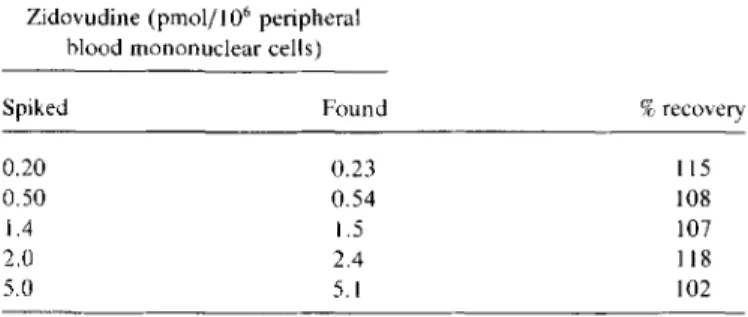
Log-logit transformed calibration curves obtained with AZT-TP were linear from 1.1 to 272 pmol (r < -.990). Lower amounts were not detectable. Analytical recoveries from blank PBMC spiked with known amounts of AZT-TP are shown in table 1. Duplicate determinations deviated by <15%.
In PBMC cultured in the presence of 2 ~mol/l [3H]AZT for 24 h, concentrations of AZT-MP, AZT-DP, and AZT-TP were 193, 1.3, and 2.0 pmolj 106 PBMC, respectively, after ficoll-hypaque density-gradient centrifugation. If cells were
Table 1. Recovery from cell extracts spiked with zidovudine
tri-phosphate.
Zidovudine (pmol/ I06peripheral blood mononuclear cells)
Spiked Found %recovery
0.20 0.23
n s
0.50 0.54 108
1.4 1.5 107
2.0 2.4 118
5.0 5.1 102
NOTE. Data are means of duplicate determinations.
harvested by simple centrifugation, concentrations of 215, 1.7, and 1.6pmolj106PBMC were found. PBMC of the same donor treated under identical conditions but with unlabeled AZT yielded concentrations of 198 pmol/ I06 PBMC for AZT-MP, 1.8pmol/Iu'' PBMC for AZT-DP, and 2.4 pmolj 106PBMC for AZT-TP by RIA. These results rule out exces-sive loss of AZT nucIeotides during sample preparation.
AZT-MP, -DP, and -TP were well separated by HPLC. Mean retention times of 5.38, 7.87, and 9.49 min, respec-tively, were observed, with only minor run-to-run variability within the same day (SO
<
O.I min).Blood samples were obtained from three patients on long-term oral therapy with 250 mg of AZT every 12 h. AZT nucleotides were determined before and I, 2, and 4 h after administration of the drug. No phosphorylation products were found before administration.
Intracellular concentrations of AZT-MP after 1-2 h were 0.9-1.4 pmol/l 06 PBMC and then declined to 0.3-1.1 pmol/Iu" PBMC after 4 h. AZT-DP and AZT-TP reached concentrations of 0.3-0.5 pmoljI06 PBMC after 1-2 hand could not be detected after 4 h in any of the three patients (table 2).
Discussion
Quantification of intracellular AZT nucleotides has so far been done only in cell cultures treated with [3H]AZT [2, 7-9]. Since radiolabeling is not feasible in human pharmaco-kinetic studies, a method was developed that uses the selectiv-ity ofHPLC to separate mono-, di-, and triphosphate and the sensitivity of a commercially available RIA to quantify them in PBMC obtained from patients treated with AZT.
Cell extracts contain large amounts of natural ribonucleo-tides, which in part coelute with AZT nucleotides in HPLC. They were destroyed by periodate oxidation [12] to limit potentially cross-reacting contaminations of RIA samples. Alkaline phosphatase activity is inhibited by inorganic phos-phates present in the elution buffer. Large amounts of the
JID 1991; 164 (October) Concise Communications 775
Table 2. Phosphorylation of zidovudine(AZT)in three patients receiving250 mg every 12h.
Plasma AZT
Patient. h (umol/I) AZT-MP AZT-DP AZT-TP
1,0 <0.03 <0.1 <0.1 <0.1 I 2.22 1.2 0.3 0.2 2 0.72 1.4 0.3 0.3 4 0.25 1.1 <0.1 <0.1 2, 0 <0.03 ND NO ND I 2.98 0.9 0.3 0.3 2 0.61 0.6 0.2 0.2 4 0.10 0.3 <0.1 <0.1 3,0 <0.03 <0.1 <0.1 <0.1 I 0.81 0.7 <0.1 0.2 2 2.17 1.1 0.5 0.5 4 0.77 1.0 <0.1 <0.1
NOTE. Values are means of duplicate determinations that deviated by<20%.
AZT-MP (monophosphate), -OP (diphosphate), and -TP (triphosphate) concen-trations are given in pmol/ I06 peripheral blood mononuclear cells. NO =not
done.
enzyme and long incubation times are therefore required to obtain equimolar amounts of AZT from AZT-MP, -DP, and -TP. Recovery experiments showed the feasibility of our ap-proach (table 1). AZT-TP concentrations found were always slightly above the expected value. Considering multiple sam-ple manipulations and the lack of an internal standard, accu-racy appears satisfactory.
Since the cell membrane is partly permeable for AZT-MP [13], and isolation of PBMC from whole blood takes r-.,1 h,
we suspected a partial loss of intracellular AZT-MP may oc-cur. However, no change in AZT-MP concentration and no hydrolysis of AZT-TP was observed when [3H]AZT-labeled PBMC were harvested from cell cultures by ficoll-hypaque separation. Analyzing AZT nucleotide pools of PBMC grown in the presence of [3H]AZT or AZT by either HPLC and liquid scintillation counting or HPLC-RIA yielded com-parable results. AZT-TP concentrations measured in patient cells suggest a rapid decay in vivo (table 2). This contrasts with an in vitro study [7] using a leukemic T cell line in which an intracellular half-life for AZT-TP of200 min was observed. A possible explanation may be the finding by Bal-zarini et al. [8] that intracellular metabolism of AZT is highly dependent on the cell species [8].
Stretcher et al. [14, IS] measured the concentration of total phosphorylated AZT (i.e., AZT-MP, -DP, and -TP) in PBMC of patients receiving AZT at a dose of500 mg/day. In 14 samples obtained from 12 patients at various time points, concentrations of 0.3-4 pmol/ 106cells were found. Pooled
data from that population showed no decrease in total phos-phorylated AZT over 3.5 h so the authors concluded that the decay of phosphorylated AZT was slow. Nevertheless, since AZT-MP is the most abundant phosphorylation product and
the ratio between mono- and triphosphate appears incon-stant (table 2), changes in the AZT-TP concentration will not necessarily be detected by that assay.
Assuming a mean cellular volume of 0.25 pl, the detection limit of O. Ipmol/ 106 PBMC corresponds to an intracellular concentration of 0.4 Jlmol/l. Data from various studies indi-cate that AZT-TP may affect viral transcription at concentra-tions below the detection limit ofour assay. Competitive inhi-bition of human immunodeficiency virus type 1 reverse transcriptase (HIV-RT) by AZT-TP has been studied by sev-eral groups [2-4]. Depending on the primer template used,
K,values ranging from 0.01 umcl/l (for HIV RNA) to 0.3
umol/I (for activated calf thymus DNA) were reported, which suggests that considerable inhibition of HIV -R T oc-curs even at concentrations < 0.4 Jlmol/l.
Huang et al. [5] studied the incorporation of AZT-TP into a DNA primer by HIV-RT in vitro. They observed termina-tion of primer elongatermina-tion even when the AZT-TP concentra-tion was 0.3 Jlmolfl, l Ofl-fold less than that of thymidine 5'-triphosphate.
The data from this pilot study with three patients show that AZT nucleotides in PBMC can be measured with our method. Currently the assay is laborious and requires blood volumes that make frequent sampling unacceptable. Further modifications may improve its sensitivity and facilitate de-tailed studies of intracellular AZT nucleotide pharmaco-kinetics.
Acknowledgments
We thank the physicians, nurses, and staff of the HIV Clinic, University Hospital Zurich, for patient care and Phil Furman, Burroughs Wellcome, for providing [3H]AZT and AZT-triphos-phate.
References
I. Fischl MA, Richman DD, Grieco MH, et al. The efficacy of azidothy-midine (AZT) in the treatment of patients with AIDS and AIDS-re-lated complex-a double blind, placebo controlled trial. N Engl J Med 1987;317:185-91.
2. Furman PA,FyfeJA, St. Clair MH. et al. Phosphorylation of 3'-azido-3'-deoxythymidine and selective interaction of the 5'-triphosphate with human immunodeficiency virus reverse transcriptase. Proc Nat! Acad Sci USA 1986;83:8333-7.
3. Cheng Y, Dutchman GE, Bastow KF, Sarngadharan MG, TingRYe.
Human immunodeficiency virus reverse transcriptase. General prop-erties and its interaction with nucleoside triphosphate analogs. J Bioi Chern 1987;262:2187-9.
4. St. Clair M, Richards CA, Spector T, et al. 3'-azido-3'-deoxythymidine triphosphate as an inhibitor and substrate ofpurified human immuno-deficiency virus reverse transcriptase. Antimicrob Agents Chemother 1987;31: 1972-7.
3'-azido-3'-776 Concise Communications JID 1991; 164 (October)
deoxythymidine 5'-triphosphate on viral reverse transcriptases and human DNA polymerases. J Bioi Chern 1990;265: 11914-8. 6. Langtry HD, Campoli-Richards OM. Zidovudine: a review of its
phar-macodynamic and pharmacokinetic properties. and therapeutic effi-cacy. Drugs 1989;37:408-50.
7. Ho HT. Hitchcock MJM. Cellular pharmacology of2',3'-dideoxy-2',3'-didehydrothymidine, a nucleoside analog active against human im-munodeficiency virus. Antimicrob Agents Chemother 1989:33: 844-9.
8. Balzarini J, Pauwels R. Baba M. et al. The in vitro and in vivo anti-retrovirus activity, and intracellular metabolism of 3'-azido-2',3'-dideoxythymidine and 2',3'-dideoxycytidine are highly dependent on the cell species. Biochem Pharmacol 1988;37:897-903.
9. Vogt MW, Hartshorn KL, Furman PA, et al. Ribavirin antagonizes the effect of azidothymidine on HIV replication. Science 1987;235:
1376-9.
10. Khym JX. An analytical system for rapid separation of tissue nucleo-tides at low pressures on conventional anion exchangers. Clin Chern 1975;21: 1245-52.
II. Vogt MW. Schwarz C. KusterH.Nadai V. Siegenthaler W, Luthy R. Effect of daily zidovudine (AZT) pulse-therapy on replication ofhu-man immunodeficiency virus type I and type II in vitro. Antiviral Chern Chemother 1991; I :293-8.
12. Garrett CH, Santi DV. A rapid and sensitive high pressure liquid chro-matography assay for deoxyribonucleoside triphosphates in cell ex-tracts. Anal Biochem 1979;99:268-73.
13. Frick LW, Nelson OJ. St. Clair MH. Furman PA, Krenitsky TA. Effects of 3'-azido-3'-deoxythymidine on the deoxynucleotide triphosphate pools of cultured human cells. Biochem Biophys Res Commun 1988; 154: 124-9.
14. Stretcher BN. Pesce AJ, Wermeling JR. Hurtubise PE. In vitro measure-ment of phosphorylated zidovudine in peripheral blood leucocytes. Ther Drug Monit 1990: 12:48 1-9.
15. Stretcher BN. Pesce AJ. Murray JA, Hurtubise PE. Frame PT. Lack of correlation of phosphorylated zidovudine (ZDV) in patient mononu-cleocytes with ZDV dose and serum concentration. Presented at the 10th AIDS Clinical Trials Group Meeting. Washington. DC. 1990.