Aedes albopictus (Diptera: Culicidae): Physiological Aspects of
Development and Reproduction
HANS BRIEGELANDSUSANNE E. TIMMERMANN
Institute of Zoology, University of Zu¨rich, CH-8057 Zu¨rich, Switzerland
J. Med. Entomol. 38(4): 566Ð571 (2001)
ABSTRACT Basic ecophysiological data are presented on the development and reproduction of
Aedes albopictus(Skuse) that were reared and maintained at four temperatures between 12 and 32⬚C. Median larval developmental time from hatching to pupation was correlated inversely with tem-perature, lasting 7 d at 32⬚C and up to 28 d at 12⬚C. Duration of the pupal period also varied from 2Ð3 d at 32⬚C to 7Ð12 d at 12⬚C. This extension of larval development elongated the phagoperiod and gave rise to larger imagoes. Based on wing length measurements, body sizes varied from 10 to 57 mm3
for females and from 10 to 30 mm3for males. The caloric protein content at emergence showed a
linear and signiÞcant regression with body size, independent of sex, treatment, or temperature. Teneral lipid content also followed a linear relationship with body size at warmer temperatures, whereas at low temperatures it increased exponentially with body size. Glycogen was always below 10% of the protein or lipid levels. Reserves at emergence determined median adult survival times, which ranged from 16 d at 32⬚C to 100 d at 17⬚C. Access to sucrose solution allowed females to increase their teneral glycogen up to fourfold within 1 wk, and their lipids up to 10-fold within 2 wk. Despite a broad variation, the number of mature oocytes (15Ð110 eggs per female) was correlated positively with body size, but inversely with the rearing and maintenance temperature. Utilization of the blood meal protein for oogenesis ranged between 35 and 50%, again inversely correlated with temperature; absolute compositions per oocyte were 6.3Ð6.5 mcal of protein but ranged from 5 to 7 mcal of lipid.
KEY WORDS Aedes albopictus, development, body size, reserves, survival, fecundity
THEASIAN TIGERmosquito, Aedes albopictus (Skuse), has recently expanded its distribution, a process that is not often witnessed in a biologistÕs lifetime. Origi-nating in the Far East, during the last 20 yr this species has become established in the United States (OÕMeara et al. 1995) as well as in southern Europe (Dalla Pozza and Majori 1992, Mitchell 1995, Adhami and Reiter 1998). In view of its potential as a vector of dengue and other arboviruses, epidemiological concerns have been expressed throughout its newly acquired range (Mitchell et al. 1990, 1992; Mitchell 1995).
In the current report we summarize experiments aimed at describing the basic physiology of this spe-cies, which has remained largely unknown or men-tioned only sporadically from different laboratories. Developmental and reproductive parameters were an-alyzed under controlled laboratory conditions at four constant temperatures from 12 to 32⬚C. This informa-tion should be useful for ecologists and extend the valuable review on the species biology presented by Hawley (1988).
Materials and Methods
Aedes albopictusoriginated from Louisiana, a strain obtained from M. J. Klowden. It was maintained at 27 ⫾ 1⬚C, 85 ⫾ 2% RH, and a photoperiod of 14:10 (L:D) h with two 45-min periods that simulate sunrise and sunset. At other temperatures tested, the same
long-day conditions prevailed without dimming peri-ods. TetraMin (Tetra Werke, Melle, Germany) was provided as larval food according to a regimen adopted from previous studies of Ae. aegypti (L.) (Timmermann and Briegel 1993). Our routine rearing with 400 larvae per pan (25 by 18 by 5 cm) in 400 ml of distilled water, i.e., a density of 1 larva/ml, led to a fairly synchronous pupation and emergence of pop-ulations with a narrow range in body size. To obtain extremes in imaginal body size, densities of 0.5 lar-vae/ml (200 larvae) or ⬎3 larlar-vae/ml (⬎1,000 larvae) were used. To simulate various climatic conditions, development and survival were measured under tem-perature conditions of 12, 17, 2⬚, and 32⬚C, and the larval feeding regime was adjusted to the extended or reduced developmental periods.
Wing length was measured for each insect under a dissecting microscope and its cubic value (mm3) is
henceforward called body size. Survival experiments were conducted with groups of 30Ð50 females or males in the presence of sucrose solution (10%) or water (starvation). Blood meals were always on the same fore-arm (H.B.) until the females withdrew their proboscis, i.e.,whenfedtorepletion.Fecunditywasdeterminedfor the Þrst gonotrophic cycle and by dissecting ovaries and counting the mature oocytes present; therefore, mating status was not considered relevant.
Biochemical analyses of single males or females for total protein, lipid, and glycogen were identical to our 0022-2585/01/0566Ð0571$02.00/0 䉷 2001 Entomological Society of America
previous studies (Timmermann and Briegel 1998, 1999). Caloric values of protein, lipid, or glycogen were related to body size. Dividing the caloric data by the cubic wing length (body size) revealed the size-speciÞc caloric content (SSCC-value), which allowed direct comparison among experimental cohorts, irre-spective of treatments.
Regressions were calculated and the t-test was ap-plied to check for signiÞcance of the slopes or between means, according to Wardlaw (1985).
Results
Development Until Eclosion. Median
developmen-tal times were measured at four temperatures (12, 17, 27, and 32⬚C) and for low and crowded density pop-ulations (Table 1). Median pupation was 28 d at 12⬚C and decreased to 7 d at 32⬚C, indicating a fourfold acceleration of development for a rise in temperature of 20⬚C. In low density populations (⬍1 larva/ml) developmental success increased from ⬇60% at 12⬚C to 90Ð99% at 27 or 32⬚C.
Duration of the pupal period was between 7 and 12 d (9.3 ⫾ 2.1, n ⫽ 63) at 12⬚C, 1.5Ð6 d at 27⬚C (2.8 ⫾ 1.2, n ⫽ 16), and 1Ð3.5 d (2.3 ⫾ 0.7, n ⫽ 16) at 32⬚C for both sexes and densities. Eclosion time of females showed a reduction from 34 d (12⬚C) to 8 d (32⬚C), but under crowding this was from 66 or 90 d at 12 and 17⬚C to 32 d at 32⬚C (Table 1). Males always appeared 1 d earlier than females. The end of the emergence period was extremely variable, especially under crowding. The sex ratio of males to females in almost all cases approximated 2:1, regardless of temperature and den-sity (Table 1). The exceptions of 17 and 47% exemplify the variability.
Imaginal Body Size and Teneral Reserve Status.
Different rearing and dietary conditions largely de-termined body size and protein reserves at emer-gence. The lower the temperature, the longer the larval phagoperiod and therefore the larger the body size at emergence. Mean female body sizes were 41.78 at 12⬚C, 44.74 at 17⬚C, 23.89 at 27⬚C, and 23.39 at 32⬚C. The corresponding wing lengths were 3.47 ⫾ 0.16 mm,
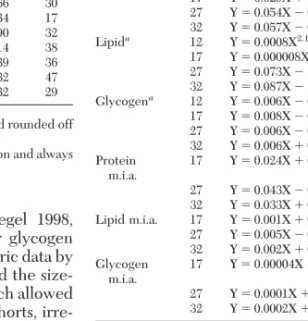
range 3.2Ð3.8 (n ⫽ 51) at 12⬚C; 3.55 ⫾ 0.10 mm, range 3.3Ð3.7 (n ⫽ 41) at 17⬚C; 2.88 ⫾ 0.40 mm, range 2.3Ð3.5 (n ⫽ 40) at 27⬚C; and 2.86 ⫾ 0.35 mm, range 2.2Ð3.4 (n ⫽ 44) at 32⬚C. Males were always 17Ð20% smaller than females. There was a signiÞcant linear correlation between body size and protein content of newly emerged Ae. albopictus, regardless of sex, diet, or tem-perature (Table 2). In contrast, relation of total lipids with female (and males, not shown) body sizes was exponential at the two lower temperatures with their extended phagoperiods, but linear at the two higher temperatures (Table 2). Glycogen consistently com-prised ⬍1/10 of the caloric protein or lipid content. In Fig. 1 we summarized these three components for females and males at emergence in relation to body size.
To assess the extent of reserve mobilization by Ae.
albopictus,50Ð100 females were provided only water from emergence until death. Subsequent analyses of protein, lipid, and glycogen revealed their minimal irreducible amounts (Table 4) required for survival (Van Handel 1984). These minima also were related linearly with body size and data for the two sexes coincided, therefore they were pooled for the regres-sions. In all circumstances, up to 90% of the teneral lipid, most of the glycogen, and up to 20% of the teneral protein were catabolized in both sexes and at all four temperatures.
Survival Times. Daily survivorship was recorded for
males and females at different temperatures in cohorts of 30Ð50 mosquitoes with access to water or sucrose (1
Table 1. Developmental times (days) for Ae. albopictus from hatching to emergence at four temperatures and low or high density conditions
Temp, ⬚C Density
Pupation Female emergence Start End Median Start End % of allpupaea
12 Low 22 51 28 34 55 28 High 25 53 33 35 66 30 17 Low 14 26 17 19 34 17 High 16 88 30 19 90 32 27 Low 6 14 8 9 14 38 High 8 38 17 11 39 36 32 Low 6 14 7 8 32 47 High 11 31 13 13 32 29
Data have been extrapolated from sigmoidal plots and rounded off to the nearest full day.
aIn most experiments males eclosed in a 2:1 proportion and always
started 1 d before the females.
Table 2. Regression formulas (Y ⴝ aX ⴙ b or Y ⴝ aXb) for teneral reserves and m.i.a. (Y, cal/mosquito) and body size (X, cubic wing length) of newly emerged Ae. albopictus, reared and main-tained at four temperatures
Component Temp,⬚C Regression n r2 t
Protein 12 Y ⫽ 0.030X ⫹ 0.203 39 0.824 13.17 17 Y ⫽ 0.029X ⫹ 0.256 64 0.893 22.73 27 Y ⫽ 0.054X ⫺ 0.330 20 0.865 10.74 32 Y ⫽ 0.057X ⫺ 0.316 34 0.904 17.38 Lipida 12 Y ⫽ 0.0008X2.19 25 0.261 17 Y ⫽ 0.000008X3.23 73 0.790 27 Y ⫽ 0.073X ⫺ 1.035 20 0.958 20.34 32 Y ⫽ 0.087X ⫺ 1.075 34 0.872 14.83 Glycogena 12 Y ⫽ 0.006X ⫺ 0.094 25 0.345 3.48 17 Y ⫽ 0.008X ⫺ 0.119 73 0.686 12.45 27 Y ⫽ 0.006X ⫺ 0.001 20 0.689 9.18 32 Y ⫽ 0.006X ⫹ 0.040 34 0.506 8.21 Protein m.i.a. 17 Y ⫽ 0.024X ⫹ 0.022 83 0.818 19.07 27 Y ⫽ 0.043X ⫺ 0.170 54 0.882 19.64 32 Y ⫽ 0.033X ⫹ 0.026 69 0.885 22.73 Lipid m.i.a. 17 Y ⫽ 0.001X ⫹ 0.141 58 0.022 1.13b 27 Y ⫽ 0.005X ⫺ 0.019 65 0.755 13.94 32 Y ⫽ 0.002X ⫹ 0.018 87 0.227 4.99 Glycogen m.i.a. 17 Y ⫽ 0.00004X ⫹ 0.027 67 0.002 0.32 b 27 Y ⫽ 0.0001X ⫹ 0.027 66 0.025 1.29b 32 Y ⫽ 0.0002X ⫹ 0.016 84 0.045 1.97b
Females and males were pooled except fora,where only females
were considered.
All P ⬍ 0.01 or ⬍0.001, except forb,which was NS; for the power
or 10%). Access to water (⫽starvation) revealed the minimal survival time and sucrose 10% the maximal survival time. Because all curves followed a negative sigmoidal pattern, we selected only three character-istic time points in Table 3, i.e., the 90, 50, and 10% survival times. The 90% survival time often marks the point when gradual mortality starts, whereas the max-imum survival time is an erratic Þgure of little signif-icance. Therefore, the best characterization of a pop-ulation is the 50% or median survival time. Sucrose (1%) always improved survival considerably over star-vation and often was more pronounced than
concen-tration increases from 1 to 10%. The longest survival times were observed at 17⬚C, whereas at 32⬚C survival clearly was reduced. Data for males were similar to females.
Reserve Synthesis from Carbohydrate Sources.
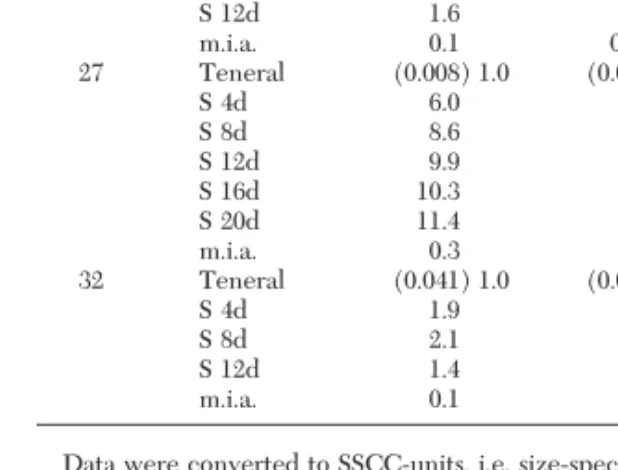
De-spite their need for a blood meal, female mosquitoes often feed on carbohydrate before encountering or seeking a vertebrate host. We tested the potential for synthesis of reserves based on a 10% sucrose diet. Fe-males raised and maintained at three temperatures had accessto10%sucroseadlibitumfor2Ð3wk,duringwhich their lipid and glycogen reserves were analyzed at 2- to 3-d intervals until the maximum level declined. Charac-teristic data points are summarized in Table 4 in SSCC-values and for comparison, the minimal irreducible amount was also included as an SSCC-value. At 12⬚C, insufÞcient material was available for analyses.
Lipogenesis was most efÞcient at 27⬚C, where the teneral value increased ⬎10-fold within 2 wk, whereas glycogenesis was weaker with only a fourfold increase within 1 wk. At the lower temperatures, lipid and glycogen values doubled within 1 wk. Comparing the teneral SSCC-value with the manyfold increases through sugar-feeding, it appeared that at all three temperatures similar maxima of lipids and of glycogen were reached, ⬇0.080 cal of lipid and 0.016 cal glyco-gen per female in SSCC-units. Under all circum-stances, lipid synthesis was clearly higher than glyco-gen synthesis.
Fig. 1. Cumulative caloric content of protein (P), lipid (L), and glycogen (G) of newly emerged females and males of Ae. albopictus, depending on their body sizes attained at the four different temperatures. Single lipid values (triangles and dashed regression line) for fe-males raised at 12⬚C have been added to the diagram at 17⬚C. See Table 2 for underlying regression formulas.
Table 3. Selected survival times (days) of female Ae. albopictus at four temperatures with access to water (W) or sucrose (S) 1 and 10%
TEMP, ⬚C Diet Survival times, d 90% 50% 10% Max 12 W 9.5 18.5 23.5 30 17 W 15.2 17.9 20.0 24 S 1% 31.0 64.0 77.0 95 S 10% 47.0 100.0 114.5 123 27 W 6.2 7.5 8.8 11 S 1% 6.2 15.2 29.5 47 S 10% 25.0 49.0 86.0 112 32 W 4.2 5.6 7.2 8 S 1% 7.6 22.8 42.0 47 S 10% 10.6 16.2 33.6 39
The table shows the days when 90, 50, or 10% of the populations (30Ð50 females) still were alive; maximum means the day of death of the last female.
Oogenesis. To assess the reproductive potential of
this species during the Þrst gonotrophic cycle, we analyzed blood meal consumption and fecundity at the same four temperatures with females given free access to 10% sucrose for 2Ð3 d after emergence, fol-lowed by human blood meals as a protein source. The number of mature oocytes always increased as a linear function of maternal body size from 17 to 32⬚C (Fig. 2), despite a broad range of 15Ð110 eggs per female. Means for fecundity were signiÞcantly greater (P ⬍ 0.01) at cool temperatures, but at 12⬚C only one-third of the females were oogenic (n ⫽ 8); the rest remained
nonoogenic (n ⫽ 18). Oogenesis required 12Ð15 d, and up to 75 eggs matured, coinciding with the same re-gression line. Regardless of temperature, female body size and therefore blood meal volume determined fecundity. The reasons for the high proportion of nonoogenic females has not been explored.
There were linear relationships between tempera-ture and ovarian protein, lipid, and glycogen values, parallel to body size. SigniÞcant linear regressions with body size were obtained for ovarian protein (Y ⫽ 0.010X ⫹ 0.037; n ⫽ 43, r2⫽ 0.438, t ⫽ 5.66, P ⬍ 0.001),
Fig. 2. Linear regression of fecundity with body size of
Ae. albopictusduring the Þrst reproductive cycle at 27Ð32⬚C (F) and 17⬚C (Œ). Regression: Y ⫽ 1.48X ⫹ 14.12 (n ⫽ 83, r2⫽ 0.426, t ⫽ 7.76, P ⬍ 0.001).
Table 4. Synthesis of lipid and glycogen after emergence of female Ae. albopictus when maintained on 10% sucrose (S) ad libitum at three temperatures
Temp, ⬚C Conditions Lipid Glycogen n
17 Teneral (0.047) 1.0 (0.005) 1.0 20 S 4d 1.5 1.7 9 S 8d 2.0 2.1 9 S 12d 1.6 2.8 12 m.i.a. 0.1 0.24 7 27 Teneral (0.008) 1.0 (0.004) 1.0 10 S 4d 6.0 4.0 10 S 8d 8.6 4.2 9 S 12d 9.9 2.6 10 S 16d 10.3 3.0 10 S 20d 11.4 2.7 9 m.i.a. 0.3 0.6 16 32 Teneral (0.041) 1.0 (0.006) 1.0 34 S 4d 1.9 2.3 9 S 8d 2.1 1.6 10 S 12d 1.4 1.8 10 m.i.a. 0.1 0.1 23
Data were converted to SSCC-units, i.e. size-speciÞc caloric con-tents (absolute caloric values in parentheses). The teneral SSCC-value is arbitrarily deÞned as 1.0, and all the data are expressed on this basis. Minimal irreducible amounts (m.i.a.) also were included for each temperature.
Table 5. Mean blood consumption, fecundity and yolk composition of Aedes albopictus reared and maintained at different temper-atures (meansⴞ SE, N in parentheses)
17⬚C 27⬚C 32⬚C
Body size 41.19 ⫾ 3.77 (31) 21.42 ⫾ 5.45 (35) 25.86 ⫾ 3.97 (18)
Wing length (mm) 3.45 2.78 2.96
Hematin (g) 20.24 ⫾ 5.19 (31)a 14.46 ⫾ 5.53 (36)a 18.23 ⫾ 7.57 (15)
Blood volume (l) 3.1 ⫾ 0.8 2.2 ⫾ 0.8 2.8 ⫾ 1.1
Blood protein (cal) 2.13 1.52 1.91
No. of eggs matured 76.5 ⫾ 18.2 (33)b 46.5 ⫾ 18.5 (37)b 56.4 ⫾ 24.6 (17) Ovarian content (cal)
Protein 0.49 ⫾ 0.11 (15)c 0.29 ⫾ 0.10 (18)c 0.38 ⫾ 0.17 (10)
Lipid 0.55 ⫾ 0.08 (15)d 0.25 ⫾ 0.13 (16)d 0.27 ⫾ 0.12 (7)
Glycogen 0.04 ⫾ 0.02 (15) 0.02 ⫾ 0.01 (14) 0.03 ⫾ 0.02 (7)
Sum 1.08 0.56 0.68
% of Blood meal 49 37 36
Oocyte content (mcal)
Protein 6.3 ⫾ 0.7 (15) 6.4 ⫾ 0.3 (15) 6.5 ⫾ 0.5 (10)
Lipid 7.0 ⫾ 0.7 (15) 5.1 ⫾ 0.4 (14) 5.1 ⫾ 0.4 (7)
Glycogen 0.5 ⫾ 0.2 (15) 0.5 ⫾ 0.1 (14) 0.6 ⫾ 0.2 (7)
Sum 13.8 12.0 12.2
Yolk per oocyte (SSCC)
Protein 0.0118 ⫾ 0.0030e 0.0121 ⫾ 0.0030 0.0139 ⫾ 0.0049e
Lipid 0.0140 ⫾ 0.0022f 0.0104 ⫾ 0.0026 0.0114 ⫾ 0.0051f
Glycogen 0.0010 ⫾ 0.0004g 0.0012 ⫾ 0.0005 0.0014 ⫾ 0.0007g
Sum 0.0268 0.0237 0.0267
lipids (Y ⫽ 0.016X-0.105; n ⫽ 36, t ⫽ 10.57, r2⫽ 0.767,
P ⬍ 0.001), and glycogen (Y ⫽ 0.001X ⫹ 0.008; n ⫽ 36, r2 ⫽ 0.256, t ⫽ 3.42, P ⬍ 0.01). These regressions
combine the absolute caloric data for all females. The absolute yolk content per mature oocyte was provided in Table 5. At 17⬚C, each oocyte contained an average of 6.26 mcal protein, 6.98 mcal lipid, and 0.48 mcal glycogen. At 27⬚C these values were 6.37 mcal protein, 5.11 mcal of lipid, and 0.54 mcal of glycogen per oocyte. At 32⬚C, 6.48 mcal protein, 5.10 mcal lipid, and 0.63 mcal glycogen. The total caloric yolk per oocyte was 13.72 mcal/oocyte at 17⬚C, 12.02 mcal/ oocyte at 27⬚C, and 12.21 mcal/oocyte at 32⬚C (Table 5). Protein contributed an average of 6.4 mcal (46Ð 53% of the total) and glycogen 0.5 mcal/oocyte (3.5Ð 5.2%). Lipid yolk ranged from 5.1 to 7.0 mcal, depend-ing on temperature, i.e., 42Ð51% of the total caloric content per oocyte.
To relate the caloric content of the yolk produced at different temperatures to the respective body sizes of the females, ovarian values were standardized in-dividually for maternal body size (Table 5). At 17⬚C the mean SSCC-values for ovarian yolk were 0.0118 cal protein, 0.0140 cal lipid, and 0.0010 cal glycogen. At 27⬚C these values were 0.0121 cal protein, 0.0104 cal lipid, and 0.0012 cal glycogen; and at 32⬚C they were 0.0139 cal protein, 0.0114 cal lipid, and 0.0014 cal gly-cogen. Although the size-speciÞc ovarian protein and glycogen did not markedly differ among the three temperatures, lipid yolk was highest at 17⬚C and lower at 27 or 32⬚C.
Discussion
Temperature, Body Size, Reserves, and Survival.
Temperature is one of the most important factors governing the distribution of Ae. albopictus. According to Mitchell (1995), the 10⬚C cold-month isotherm ap-proximates the demarcation line of Ae. albopictus pop-ulations between continuous breeding and survival in dormancy in Europe, whereas a much lower isotherm of Ð5⬚C has been described for the United States (Nawrocki and Hawley 1987). We characterized de-velopment and survival between 12 and 32⬚C under long-day conditions. The developmental time until emergence of females ranged from 6 d at 32⬚C to 90 d at 17⬚C. More important was the effect of rearing temperature on imaginal body size, with the slowest development giving rise to the largest females. This agreed with earlier data on several mosquito species, where larval growth was described as synthesis of protein that perfectly reßected the increase of bio-mass (Timmermann and Briegel 1998, 1999). The longer the duration of the larval phagoperiod, primar-ily the fourth instar, the larger the size of the emerging imagoes. The signiÞcant linear relationship between imaginal body size and caloric protein content of ten-eral females was identical for all rearing conditions. As in other mosquitoes, wing length was an accurate and reliable predictor of teneral protein content (Briegel 1990a, 1990b) or biomass measured as dry weight (Packer and Corbet 1989). Obviously, protein
synthe-sis in the larvae follows constant, linear kinetics. How-ever, there is another aspect with the lipids. The longer that larvae can feed, the more surplus is avail-able for reserve synthesis, leading to an exponential lipid accumulation in newly emerged males and fe-males (Briegel 1990a for Ae. aegypti, the current report for Ae. albopictus). At higher temperatures, growth terminated much earlier (female body sizes of 40), so that larval lipid synthesis could not reach the expo-nential phase encountered at low temperatures.
With access to 10% sucrose, female Ae. albopictus increased their low teneral glycogen content three- to fourfold within the Þrst week of imaginal life. During another 2 wk their teneral lipid increased ⬎10-fold. As already shown by Van Handel (1965) for Ochlerotatus
sollicitans,for biochemical reasons the synthesis of glycogen from sucrose occurs at a higher rate than lipogenesis. In Oc. sollicitans and Oc. taeniorhynchus the extent of glycogenesis is suppressed by the endo-crine system, thereby favoring lipogenesis (Lea and Van Handel 1970). Apparently the same principle ap-plies to Ae. albopictus. The highest lipid synthesis in Ae.
albopictuswas observed at 17⬚C, whereas at high tem-peratures, lipogenesis only doubled the teneral values. This result may reveal an adaptation to cold, similar to higher yolk lipids under cool conditions (see below). Thereisasimilar2-wkrequirementforlipogenesisfound in two palaearctic species: Oc. cantans with a Þvefold increase of female lipids (Renshaw et al. 1995), and Ae.
vexanswith a ⬎20-fold increase (Briegel et al. 2001a) after emergence. In contrast, lipogenesis occurred con-siderably faster in Oc. punctor (Renshaw et al. 1995) and in Ae. aegypti (Briegel et al. 2001b).
The levels of lipids and glycogen are detrimental for the survival of males and females. Starvation after emergence allowed 1Ð3 wk of survival, but by adding 1% sucrose survivorship clearly was extended. Inter-estingly, 10% sucrose did not strongly increase survival above 1% sucrose. Although these laboratory Þndings appear somewhat unnatural, they demonstrate that large segments of a population may survive at all tem-peratures for several weeks, as long as sufÞcient car-bohydrate sources are accessible.
As mentioned before, glycogen synthesis from su-crose was not affected greatly by environmental tem-peratures, but lipogenesis appeared to be tempera-ture-sensitive. Diminished lipogenesis at 32⬚C may explain reduced survivorship at high temperatures. Conversely, the strong lipogenesis at 17⬚C agreed with the extended survival times.
At 12⬚C the caloric content of starved females that died after the 90% survival time was in the range of minimal irreducible lipid or glycogen titers. We as-sume that the 90% survival time was an acceptable estimate of the time when mortality starts as a gradual process, reßecting the exhaustion of reserves. Therefore, mortalities before the 90% survival time and later than 10% survival time were considered random events.
Fecundity. Body size, regulated by larval diet or
density (Nasci 1990, Teng and Apperson 2000) or by temperature (Teng and Apperson 2000; and the cur-rent report), largely determined the fecundity of Ae.
albopictus(Blackmore and Lord 2000; and the current report). Females reared and maintained at 17⬚C ma-tured from 30 to 106 eggs during 6 d, whereas at 32⬚C from 16 to 102 eggs matured during 2 d. At 12⬚C, up to 75 eggs matured in a minority of the females and required at least 10 d. In theory, the duration of oo-genesis, in combination with our survival data, indi-cated up to 10 reproductive cycles possible between 17 and 32⬚C. The 12⬚C temperature is close to the 10⬚C cold-month isotherm (Mitchell 1995), where repro-duction was possible but not guaranteed. At 12⬚C, approximately two-thirds of the females remained non-oogenic or died, retaining masses of undigested blood. With such a low Þtness, winter survival of fe-males in these temperature zones is questionable, un-less they enter a winter dormancy comparable to
Culex pipiens(L.) (Mitchell and Briegel 1989). There-fore, for this species with its pronounced lipogenesis, the possibility for female diapause, despite its tropical origin, should not be excluded and ought to be further studied under cold adaptation.
Utilization of the blood meal protein for vitellogen-esis was approximately one-quarter at 27⬚C, one-third at 32⬚C, but about one-half at 17⬚C. Our blood meal sizes varied between 2 and 4l of human blood and the resulting numbers of eggs agreed with results re-ported by Blackmore and Lord (2000) and Chin-Chang and Chin-Chang (1993), obtained by enemas at 28⬚C.
Ae. aegypti,the closely related yellowfever mosquito, also spread around the globe in historic times, but did not become established as far north as Ae. albopictus. Both show a tremendous larval lipogenesis (Briegel 1990a, Timmermann and Briegel 1999), but Ae.
albo-pictusappears to be even more efÞcient. As mentioned before, it seems to adapt to cool temperatures by in-creasing lipid synthesis and also by producing larger segments of yolk lipid under such circumstances. This also might be viewed in relation to interspeciÞc compe-tition between the two species (OÕMeara et al. 1995).
Acknowledgments
The authors thank R. Haigis for reliable assistance with the analyses. Suggestions by anonymous referees are kindly ac-knowledged. This work was supported by the Swiss National Science Foundation to H.B.
References Cited
Adhami, J., and P. Reiter. 1998. Introduction and establish-ment of Aedes (Stegomyia) albopictus Skuse (Diptera: Culicidae) in Albania. J. Am. Mosquito Control Assoc. 14: 340Ð343.
Blackmore, M. S., and C. C. Lord. 2000. The relationship between size and fecundity in Aedes albopictus. J. Vector Ecol. 25: 212Ð217.
Briegel, H. 1990a. Metabolic relationship between female body size, reserves, and fecundity of Aedes aegypti. J. In-sect Physiol. 36: 165Ð172.
Briegel, H. 1990b. Fecundity, metabolism, and body size in
Anopheles (Diptera: Culicidae), vectors of malaria. J. Med. Entomol. 27: 839Ð850.
Briegel, H., I. Knu¨sel, and S. E. Timmermann. 2001b. Aedes
aegypti:size, reserves, survival, and ßight potential. J. Vector Ecol. (in press).
Briegel, H., A. Waltert, and R. Kuhn. 2001a. Reproductive physiology of Aedes (Aedimorphus) vexans (Diptera: Cu-licidae) in relation to ßight potential. J. Med. Entomol. 38: 557Ð565.
Chin-Chang, Y., and S. Chang-Laung. 1993. Studies on egg production of Aedes aegypti (L.) and Aedes albopictus (Skuse) by enema. Chin. J. Entomol. 13: 241Ð249. Hawley, W. A. 1988. The biology of Aedes albopictus. J. Am.
Mosq. Control Assoc. Suppl. 1: 1Ð40.
Dalla Pozza, G., and G. Majori. 1992. First record of Aedes
albopictusestablishment in Italy. J. Am. Mosq. Control Assoc. 8: 318Ð320.
Lea, A. O., and E. Van Handel. 1970. Suppression of glycogen synthesis in the mosquito by a hormone from the medial neurosecretory cells. J. Insect Physiol. 16: 319Ð321. Mitchell, C. J. 1995. Geographic spread of Aedes albopictus
and potential for involvement in arbovirus cycles in the Mediterranean basin. J. Vector Ecol. 20: 44Ð58. Mitchell, C. J., M. L. Niebylski, G. C. Smith, N. Karabatsos,
D. Martin, J.-P. Mutebi, G. B. Craig, Jr., and M. J. Mahler. 1992. Isolation of Eastern equine encephalitis from Aedes
albopictusin Florida. Science 257: 526Ð527.
Mitchell, C. J., G. C. Smith, and B. R. Miller. 1990. Vector competence of Aedes albopictus for a newly recognized Bunyavirus from mosquitoes collected in Potosi, Mis-souri. J. Am. Mosq. Control Assoc. 6: 523Ð527.
Mitchell, C. J., and H. Briegel. 1989. Inability of diapausing
Culex pipiens(Diptera: Culicidae) to use blood for pro-ducing lipid reserves for overwinter survival. J. Med. Entomol. 26: 318Ð326.
Nasci, R. 1990. Relationship of wing length to adult dry weight in several mosquito species (Diptera: Culicidae). J. Med. Entomol. 27: 716Ð719.
Nawrocki, S. J., and W. A. Hawley. 1987. Estimation of the northern limits of Aedes albopictus in North America. J. Am. Mosq. Control Assoc. 3: 314Ð317.
O’Meara, G. F., L. F. Evans, A. D. Gettman, and J. P. Cuda. 1995. Spread of Aedes albopictus and decline of Ae.
ae-gypti(Diptera: Culicidae) in Florida. J. Med. Entomol. 32: 554Ð562.
Packer, M. J., and P. S. Corbet. 1989. Size variation and reproductive success of female Aedes punctor (Diptera: Culicidae). Ecol. Entomol. 14: 297Ð309.
Renshaw, M., J. B. Silver, and M. W. Service. 1995. Differ-ential lipid reserves inßuence host-seeking behaviour in the mosquitoes Aedes cantans and Aedes punctor. Med. Vet. Entomol. 9: 381Ð387.
Teng, H.-J., and C. S. Apperson. 2000. Development and survival of immature Aedes albopictus and Aedes triseria-tus(Diptera: Culicidae) in the laboratory: effects of den-sity, food, and competition in response to temperature. J. Med. Entomol. 37: 40Ð52.
Timmermann, S. E., and H. Briegel. 1993. Water depth and larval density affect development and accumulation of reserves in laboratory populations of mosquitoes. Bull. Soc. Vector Ecol. 18: 174Ð187.
Timmermann, S. E., and H. Briegel. 1998. Molting and metamorphosis in mosquito larvae: a morphometric anal-ysis. Mitt. Schweiz. Entomol. Ges. 71: 373Ð387. Timmermann, S. E., and H. Briegel. 1999. Larval growth
and biosynthesis of reserves in mosquitoes. J. Insect Physiol. 45: 461Ð470.
Van Handel, E. 1965. The obese mosquito. J. Physiol. 181: 478Ð486.
Van Handel, E. 1984. Metabolism of nutrients in the adult mosquito. Mosq. News 44: 573Ð579.
Wardlaw, A. C. 1985. Practical statistics for experimental biologists. Wiley, New York.
Received for publication 1 June 2000; accepted 27 February 2001.