Developing Attribute Acquisition Strategies in
Spoken Dialogue Systems via User Simulation
by
Edward A. Filisko
B.S., University of Michigan, Ann Arbor (1999)
S.M., Massachusetts Institute of Technology (2002)
Submitted to the Department of
Electrical Engineering and Computer Science
in partial fulfillment of the requirements for the degree of
Doctor of Philosophy in Computer Science
at the
MASSACHUSETTS INSTITUTE OF TECHNOLOGY
June 2006
(@
Massachusetts Institute of Technoloev 2006. All rights reserved.
A " r
-Department of Electrical Engineering and
MASSACHUSETTS INSWIM
OF TECHNOLOGYNOV 0 2 2006
LIBRARIES
Computer Science
May 17, 2006
- ICertified by.
,,
...
. ...- ..-
4.
...
Stephanie Seneff
Principal Research Scientist
Thesis Supervisor
/r
Accepted b-.
-... ..
.:.--.-......
Arthur C. Smith
Chairman, Department Committee on Graduate Students
PACHNiES
i-Developing Attribute Acquisition Strategies in
Spoken Dialogue Systems via User Simulation
by
Edward A. Filisko
Submitted to the Department of Electrical Engineering and Computer Science on May 17, 2006, in partial fulfillment of the requirements for the degree of
Doctor of Philosophy in Computer Science
Abstract
A spoken dialogue system (SDS) is an application that supports conversational interaction with a
human to perform some task. SDSs are emerging as an intuitive and efficient means for accessing
information. A critical barrier to their widespread deployment remains in the form of communication breakdown at strategic points in the dialogue, often when the user tries to supply a named entity from a large or open vocabulary set. For example, a weather system might know several thousand cities, but there is no easy way to inform the user about what those cities are. The system will likely misrecognize any unknown city as some known city. The inability of a system to acquire an unknown value can lead to unpredictable behavior by the system, as well as by the user.
This thesis presents a framework for developing attribute acquisition strategies with a simulated user. We specifically focus on the acquisition of unknown city names in a flight domain, through a spell-mode subdialogue. Collecting data from real users is costly in both time and resources. In addition, our goal is to focus on situations that tend to occur sporadically in real dialogues,
depending on the domain and the user's experience in that domain. Therefore, we chose to employ
user simulation, which would allow us to generate a large number of dialogues, and to configure the input as desired in order to exercise specific strategies.
We present a novel method of utterance generation for user simulation, that exploits an existing corpus of real user dialogues, but recombines the utterances using an example-based, template approach. Items of interest not in the corpus, such as foreign or unknown cities, can be included by splicing in synthesized speech. This method allows us to produce realistic utterances by retaining the structural variety of real user utterances, while introducing cities that can only be resolved via spelling. We also developed a model of generic dialogue management, allowing a developer to quickly specify interaction properties on a per-attribute basis. This model was used to assess the effectiveness of various combinations of dialogue strategies and simulated user behavior.
Current approaches to user simulation typically model simulated utterances at the intention level, assuming perfect recognition and understanding. We employ speech to develop our strategies in the context of errors that occur naturally from recognition and understanding.
We use simulation to address two problems: the conflict problem requires the system to choose how to act when a new hypothesis for an attribute conflicts with its current belief, while the
com-pliance problem requires the system to decide whether a user was compliant with a spelling request.
Decision models were learned from simulated data, and were tested with real users, showing that the learned model significantly outperformed a heuristic model in choosing the "ideal" response to the
conflict problem, with accuracies of 84.1% and 52.1%, respectively. The learned model to predict
compliance achieved a respectable 96.3% accuracy. These results suggest that such models learned from simulated data can attain similar, if not better, performance in dialogues with real users.
Thesis Supervisor: Stephanie Seneff Title: Principal Research Scientist
Acknowledgments
I would first like to extend my gratitude to my advisor, Dr. Stephanie Seneff, who has guided and supported me through every step of my graduate education. She has truly inspired me over the past six years with her constant flow of creative ideas and her persistent desire to
tackle the most challenging of problems.
I would like to thank the members of my thesis committee, Dr. Michael Collins and Dr. Regina Barzilay. I greatly appreciate their comments and helpful suggestions.
The members of the Spoken Language Systems Group have provided a very supportive daily environment over the years. Thanks go to all the research staff and grad students for their willingness to help and share ideas. I also want to thank Joe Polifroni for his especially
intriguing and helpful conversations on discourse and dialogue.
Thanks go to my awesome SLS officemates for making the daily work life tolerable through the years: Grace Chung, Xiaolong Mou, Brooke Cowan, Vlad Gabovich, Chia-Hao La, Kate Saenko, Karen Livescu, Han Shu, Mitch Peabody, and Chih-yu Chao. Thanks also go to Marcia Davidson for her humorous interludes and inspirational wit.
I am additionally grateful to those outside school who enabled my learning of a different sort, providing a break from my graduate work. I want to thank Kieran Jordan and Dancers for an amazing and rare opportunity to experience Irish music and dance. I would also like to thank Chef Argyropoulos, Chef Berry, Chef Merlo, Chef Wright, and Kara Nielsen for enabling me to stay in tune with the culinary world. Special thanks go to Craig Gerardi, Wayne Hsiao, Dora Kelle, Bobby Middleton, Alex Park, and Jane Wu for taste testing my food and making every day thought-provoking and fun.
I truly appreciate the support from my family and friends, especially Theresa, Andy, Chris, Carmen, Christian, Johnna, Rrrranjana for her e-mail updates, Maninder for his inspiring wake-up calls, Manpreet for her encouragement, and, of course, the Cheese Club. Most importantly, I want to thank my parents who, no matter what I do, always give me constant encouragement and their unconditional support.
Ed Filisko June, 2006
This research was supported by an industrial consortium supporting the MIT Oxygen Alliance, by the T-Party Project, a joint research program between MIT and Quanta Computer Inc., Taiwan, and by Nokia.
Contents
1 Introduction
1.1 Thesis Goals and Approach ... 1.2 Background and Related Work ...
1.2.1 Unknown Words and Spelling . ... 1.2.2 Learning in Dialogue Management ...
1.2.3 User Simulation ...
1.2.4 Attribute Value Acquisition ...
1.3 Overview .. ... .... ... ... . .. .... ...
2 System Background
2.1 Research Domain ... 2.2 GALAXY Architecture ...
2.2.1 Speech Recognition . ...
2.2.2 Natural Language Understanding ...
2.2.3 Context Resolution ... 2.2.4 Dialogue Management . ...
2.2.5 Natural Language Generation . ...
2.2.6 Speech Synthesis ...
2.3 Specialized Components . ...
2.3.1 Speak-and-Spell Recognizer . ... . . 2.3.2 Spelling Recognizer . ...
2.4 Summary ...
3 Error Recovery: From Keypad to Speak-and-Spell 3.1 MERCURY Flight Reservation System . ...
19 . . . . 24 . . . . 27 . . . . . 27 . . . . . 30 . . . . 36 . . . . 38 . . . . 41 43 .. . 43 .. . 44 . . . 45 . . . 46 .. . 46 . . . 47 . . . 49 .. . 49 . . . 49 . . . 51 . . . 52 .. . 52
3.2 3.3
3.4 3.5
3.1.1 Error Detection and Recovery ... 3.1.2 Analysis of Telephone Keypad Responses Spoken Spelling ...
Preliminary User Simulation . ...
3.3.1 Results and Discussion ... . . A Live Test of Speak-and-Spell . ...
Summ ary ... . . . . . 54 . . . . . 56 . . . . . 59 . . . . . 60 . . . . . 62 . . . . . 64 . . . . . 65
4 Creative Utterance Generation for Simulation 4.1 Previous Generation Methods ... 4.2 Novel Generation from Existing Corpora . . . . . 4.2.1 Database of Utterance Templates . . . . . 4.2.2 Concatenative Speech Synthesis . . . . 4.3 Summary ... 67 . . . . 68 . . . . . 70 . . . . . 72 . . . . . 73 . . . . 75
5 Attribute-Centric Generic Dialogue Management 5.1 Overview of the Model ... 5.2 Benefits of the Model ... 5.3 Model Components ... 5.3.1 Attribute Model ... 5.3.2 Dialogue Strategies ... 5.3.3 Expert Components ... 5.4 Summary ... 6 User Simulation: Developing Dialogue Strategies 6.1 Dialogues with a Simulated User ... 6.1.1 Overall Dialogue Strategy ... 6.1.2 Experimental Configurations ... 6.1.3 Simulation Experiments and Results ... 6.2 Sum m ary ... 77 . . . . 78 . . . . 79 . . . . 79 . . . . 80 . . . . 85 . . . . 86 . . . . 87 89 . . . . 91 . . . . 91 . . . . 92 . . . . . 95 . . . . 97
7 User Simulation: Learning When and How to React 103 7.1 The Conflict Problem ... 104
7.3 A Learned Solution ... 107
7.3.1 User Simulation ... 108
7.3.2 Ideal Actions ... 109
7.3.3 Features . . . .. . . . . .. . . . ... 110
7.3.4 Weka and JRip ... ... 112
7.3.5 The Learned Rules ... .112
7.4 Testing and Results ... 115
7.5 The Compliance Problem ... . 119
7.5.1 From Speak-and-Spell to Spelling . . . . 120
7.5.2 The Learned Model ... .120
7.5.3 Testing and Results ... ... ... 121
7.6 Sum m ary ... 122
8 Experiment with Real Users 125 8.1 Flight Attribute Data Collection System . . . . .. . .. . .. . . . . 125
8.1.1 Changes from the Simulation System . ... 126
8.1.2 The Scenarios ... ... ... . 127
8.2 The Sessions and Users ... ... ... 128
8.3 Results ... ... .. 130
8.3.1 Overall Performance ... .130
8.3.2 Manual vs. Learned Models . . . . 130
8.4 Assessment of the Conflict Problem . ... . . . . 132
8.5 Assessment of the Compliance Problem . . . . 135
8.6 Assessment of Responses to Spelling Requests . ... 136
8.6.1 Compliant Users ... .137
8.6.2 Partially Compliant Users ... .137
8.6.3 Noncompliant Users ... .137 8.6.4 Out-of-Turn Users ... .138 8.6.5 Confused Users ... 139 8.7 Notable Observations ... 140 8.7.1 User Compliance ... .140 8.7.2 A "Spelled" Date ... .141
8.7.3 The Learned Model at Work . . . . 8.7.4 Simulated User Behavior . ...
8.7.5 Unrestricted Spelling . ... 8.8 Summary ...
9 Contributions and Future Work 9.1 Contributions ...
9.1.1 Novel Method of Utterance Generation 9.1.2 Attribute-Centric Dialogue Management . 9.1.3 Unknown Words and Spelling ...
9.1.4 Simulation, Learning, and Real Users . . 9.2 Reusability of Components ...
9.2.1 Utterance Generation ...
9.2.2 Attribute-Centric Dialogue Management . 9.2.3 Spelling Strategy ...
9.2.4 Learned Models ... 9.3 Possible Future Work ...
9.3.1 Simulated User Model ...
9.3.2 Attribute-Centric Dialogue Management . 9.3.3 Addressing the Real User Responses . . .
9.3.4
9.3.5
Improving the Learned Conflict Problem IM Learning Models for Other Problems . . .
141 143 143 144 147 . . . . 147 . . . . . 148 . . . . . 149 . . . . 150 . . . . . 152 . . . . 153 . . . . 153 . . . . . 154 . . . . 154 . . . . 154 . . . . 155 . . . . 155 . . . . . 156 . . . . . 156 lodel ... 157 . . . . . 158
List of Figures
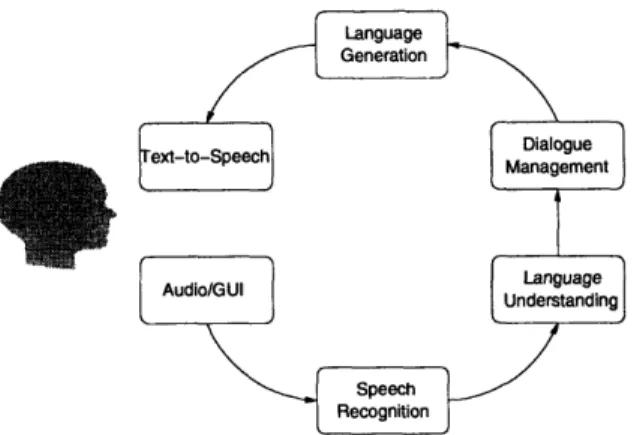
1-1 Typical flow between the components of an SDS. . ... 20
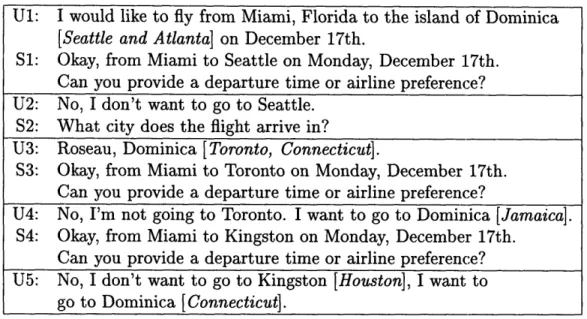
1-2 Example dialogue from the MERCURY flight domain, illustrating a situation where the user (U) is attempting to fly to a city that the system (S) does not know. Words in brackets indicate what the system recognized. . ... 21
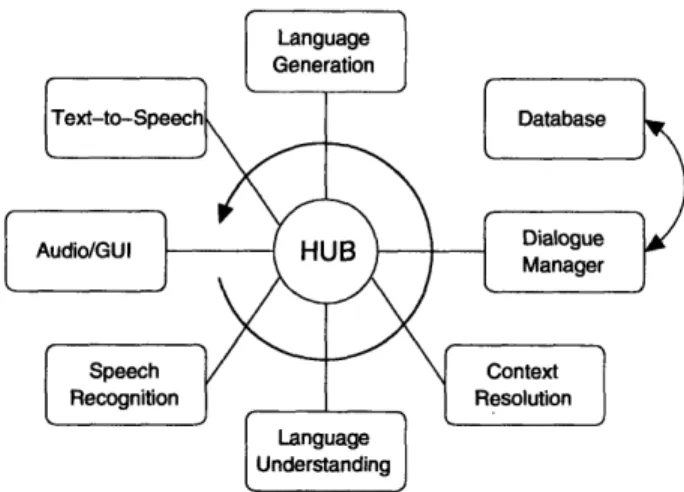
2-1 The GALAXY architecture ... ... 45
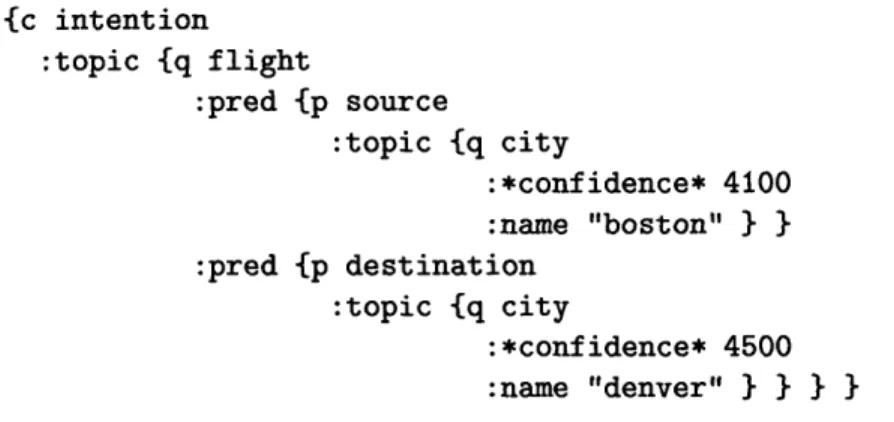
2-2 Semantic frame for I would like a flight from Boston to Denver. ... . 46
2-3 Excerpt from a dialogue control table. ... 49
2-4 Modified GALAXY architecture with dual recognition for error recovery with spelling. ... 51
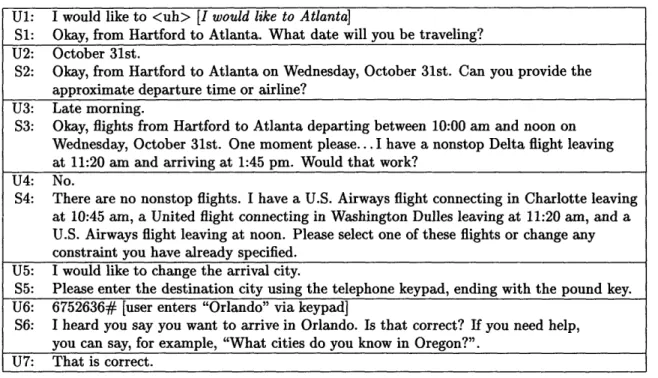
3-1 Example of a dialogue involving a successful entry of a departure city using the telephone keypad, initiated by the system based on perceived confusion. Words in brackets indicate what the system recognized. . ... . . 55
3-2 Example of a dialogue involving a successful entry of an arrival city using the telephone keypad, provoked by a specific request by the user to change the arrival city. Words in brackets indicate what the system recognized. ... 56
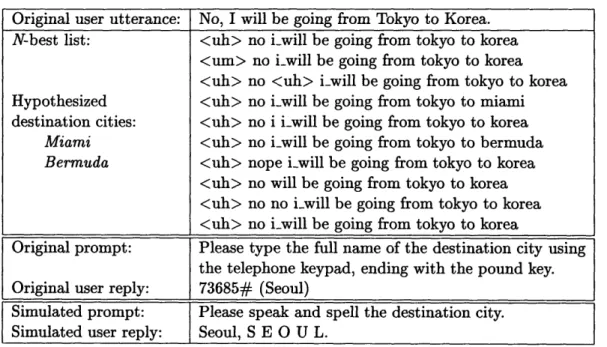
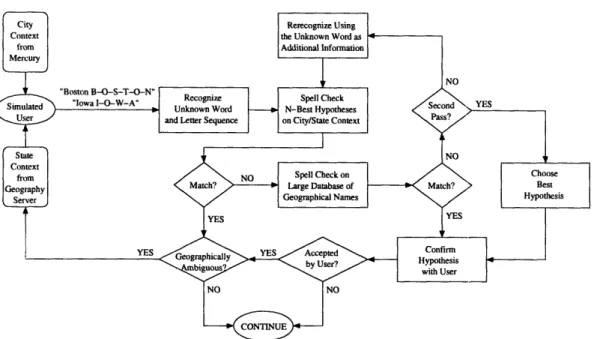
3-3 Preliminary user simulation setup, in which a simulated user continues a real user dialogue from the point of error detection, providing a spoken spelling instead of a keypad entry. ... 60
3-4 Flow chart detailing the two-pass dialogue strategy for recovering from a problematic source or destination. . ... .... 61
4-1 Flow within the dialogue system during a typical dialogue turn with the simulated user. ... .. 71 4-2 Examples of date patterns extracted from a corpus of MERCURY utterances. 72
4-3 An entry from the database of utterance templates. Each unique e-form is associated with a set of corresponding sentences. This e-form contains a total of 58 unique sentence templates. . ... ... 73
5-1 Excerpt from an example attribute model specified in an external file. . . . 82 5-2 Dialogue between a user (U) and a flight reservation SDS (S) ... . 85
6-1 The GALAXY user simulation architecture. . ... . 90
6-2 Flow chart of the dialogue manager's strategy for acquiring values for a set of attributes ... .. 92
6-3 This example demonstrates the simplest dialogue flow for the given system
configuration. In this case, only the date is explicitly requested and con-firmed, because all city and state names were implicitly confirmed due to high confidence ... ... 99
6-4 In this example, both cities are unknown to the system's recognizer and can only be acquired through speak-and-spell mode. The city names are unique in the database, so the state names are implicitly confirmed, and their explicit acquisition is not required... ... 99
6-5 In this example, the system requests a date from the user, but misunderstands the user's response in U3. The user rephrases its utterance in U5 by selecting a new template and plugging in the same date phrase, the thirtieth. The system is then able to acquire the user's date. . ... . 100
6-6 This example demonstrates the behavior of a noncompliant user. Here, non-compliance means that when the system requests a speak-and-spell (SAS) utterance, the user instead rephrases its previous utterance as in U2 and U4. Nevertheless, the system is able to correctly recognize the source and
destination cities, by simultaneously running the main recognizer alongside
the specialized SAS recognizer and observing both outputs. The dialogue is successful after the system acquires the state names and the date. ... 100
6-7 In this example of a failed dialogue, the system correctly acquires source
and destination, but it has trouble obtaining the proper date. The system hypothesizes February ninth (S9), which the user denies. After the user rephrases the utterance (U11), the system hypothesizes the same date, but does not ask about it again, since the value has already been denied. The system abandons the dialogue after having reached the maximum number of attempts for date acquisition... ... ... .. 101
7-1 Example dialogue between a simulated user (U) and the MERCURY system (S). The system hypothesizes Vienna from the user's utterance (U7), and proceeds to implicitly confirm the incorrect city name in S7. ... 105 7-2 Pseudocode describing the manually specified rules used to select an action
in the case of the conflict problem. ... 107 7-3 The rule set learned by JRip to predict the "ideal" response to the
con-flict problem. The numbers in parentheses represent coverage/errors in the training data . . . . 114 7-4 The rule set learned by JRip to predict user compliance in response to a
spelling request from the system. The numbers in parentheses represent
coverage/errors in the training data-note that no errors were made. .... 121
8-1 Snapshot of the webpage seen by users for the data collection system ... 126 8-2 Example data collection session between a real user (U) and the data
collec-tion system (S)... 129 8-3 Out-of-turn user responses and the corresponding system prompts. ... 139 8-4 Example of a split-utterance spelling ... ... . 140 8-5 Example of the learned model's ideal response to the conflict problem. U1
is the user's utterance, H1 is the system's hypothesis, and S1 is the system's response. ... 142
List of Tables
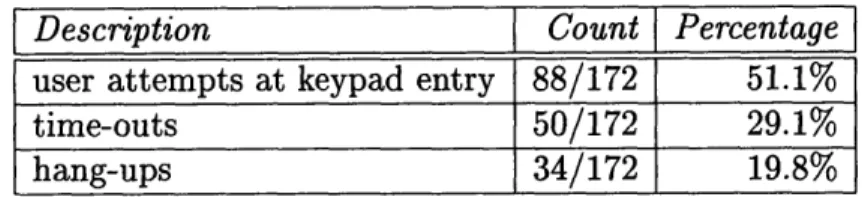
3.1 Summary of users' responses to 172 system prompts to enter a source or destination using the telephone keypad. . ... . 58
3.2 Summary of a total of 88 user attempts at entering a source or destination city or airport name using the telephone keypad after being prompted by the system. ... 58
3.3 Simulation results for 97 speak-and-spell city names showing the number of correct cities hypothesized by the system, after each of two recovery passes. For pass 2, a match was found in the short list or in the geographic database. No match resulted in resorting to the best recognition hypothesis. ... 63
4.1 Recognition results for a test set of utterances, realized as speech via four different methods: original user waveform, DECtalk synthesis, Envoice syn-thesis, and a combination of the two synthesizers (Env&DEC). . ... 74
6.1 Configurations for user simulation experiments. The user spoke a known
(kno) or unknown (unk) Source or Destination. Either city or city&state was
provided in the user's Initial utterance. The system chose whether or not to initiate speak-and-spell (SAS) mode recovery. The user may or may not have been Compliant with a request for a speak-and-spell utterance ... 95
6.2 Results for the simulation configurations in Table 6.1. SuccDialogue is the number of successful dialogues, that is, each dialogue had 100% attribute accuracy. AvgSuccTurns and AvgFailTurns are the average turns per suc-cessful and failed dialogue, respectively. AvgAccuracy is the overall average attribute accuracy per dialogue ... 95
7.1 Confidence threshold spectrum used by the manual rule method to determine the next action in response to the conflict problem. . ... 107
7.2 Example scenarios showing the user's Intended City, the system's Current
Belief and a conflicting Hypothesis. Each scenario triggers a corresponding Ideal Response from the system ... 109
7.3 The 16 features chosen to predict the "ideal" system response in the case of the conflict problem. ... 111
7.4 Results of dialogue analysis for two decision models, Manual and Learned. The numbers represent the averages of 10 runs of 50 dialogues for each model.
A Successful Dialogue is one in which there is 100% attribute accuracy. . . . 116
7.5 Confusion matrix for decision made using the manual decision model. An overall accuracy of 61.7% was obtained. The parenthesized percentages in-dicate the distribution of each action within the total set of either predicted or reference actions. ... 117
7.6 Confusion matrix for decision made using the learned decision model. An overall accuracy of 76.1% was obtained. The parenthesized percentages in-dicate the distribution of each action within the total set of either predicted or reference actions. ... 117
8.1 Results of dialogue analysis for all dialogues (Overall), and dialogues in which the Manual and Learned decision models were used. A Successful Dialogue is one in which there is 100% attribute accuracy. . ... 130
8.2 Statistics for manual versus learned models in terms of the first or second dialogue in a data collection session. The % Dialogues refers to the percentage of first/second manual/learned dialogues. . ... 131
8.3 Confusion matrix for the decision made using the manual decision model. An accuracy of 52.1% was obtained. The parenthesized percentages indicate the distribution of each action within the total set of either predicted or reference actions. ... 133
8.4 Confusion matrix for the decision made using the learned decision model. An accuracy of 84.1% was obtained. The parenthesized percentages indicate the distribution of each action within the total set of either predicted or reference actions. ... 133 8.5 Confusion matrix for the prediction of user compliance to a spelling request.
An accuracy of 96.3% was obtained. . ... ... 135 8.6 Distribution of user response types to a spelling request. . ... . 137
Chapter 1
Introduction
Recent developments in speech technology have given rise to a growing number of speech-enabled applications in our everyday lives. The variety of such applications is vast, ranging from voice dictation software to voice control of a car stereo. One of the more advanced applications of speech technology is the spoken dialogue system (SDS). An SDS is a computer application that supports conversational interaction with a human to perform some task. Such systems have covered a wide range of domains, including call routing for customer service [34], information kiosk com-munication [36], battlefield simulations [77], train schedule information [49], off-line task delegation [71], weather information [91], autonomous mobile robot communica-tion [45], flight reservacommunica-tions [81], leisurely activity informacommunica-tion [75], conference room reservations [10, 9], e-mail access [82, 79], restaurant information [17], and bus sched-ule information [60].
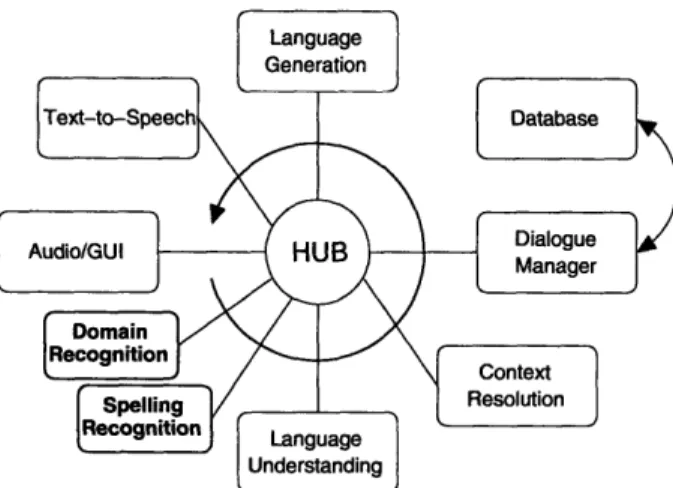
An SDS is the product of many different speech technologies, including audio capture, speech recognition, natural language understanding, dialogue management, natural language generation, and text-to-speech synthesis. Figure 1-1 shows the flow between these components in a typical SDS. A user's speech is passed from an audio server to a speech recognizer, which outputs hypotheses of what the user said. The natural language understanding component, or parser, tries to extract meaning from those hypotheses, creating some semantic representation. The dialogue manager as-sesses that meaning in the context of the dialogue history and outputs a semantic
Figure 1-1: Typical flow between the components of an SDS.
representation of its response. A generation module converts the semantic represen-tation into a natural language sentence, which is presented to the user with the help of a text-to-speech synthesizer.
While the effectiveness of SDSs has improved significantly over the past several years, a critical barrier to widespread deployment remains in the form of communi-cation breakdown at strategic points in the dialogue, often when the user is trying to convey a critical piece of information that the system repeatedly misunderstands. This situation is particularly likely to occur whenever the user is attempting to supply a named entity from a large or open vocabulary set. For example, a weather domain might have information for several thousand cities, but there is no easy way for the system to inform the user about which cities it knows. If the user requests infor-mation for an unknown city, the system will likely misrecognize it as an altogether inappropriate, known city. If the vocabulary is static and the system lacks an explicit model for unknown words, the user's repeated attempts can only lead to failure.
Figure 1-2 shows an example dialogue between a user and the MERCURY flight reservation system [69], in which the user was attempting to travel to Roseau, Do-minica, a city and country that the system did not know. In U1, "the island of Dominica" is misrecognized as "Seattle and Atlanta," while in U3, "Roseau, Do-minica" is hypothesized as "Toronto, Connecticut." Despite the user's denial of these city names, and obvious frustration, the system futilely continues to hypothesize city, state, and country names. Clearly, a more intelligent model would be required to
Ul: I would like to fly from Miami, Florida to the island of Dominica
[Seattle and Atlanta] on December 17th.
Sl: Okay, from Miami to Seattle on Monday, December 17th. Can you provide a departure time or airline preference? U2: No, I don't want to go to Seattle.
S2: What city does the flight arrive in?
U3: Roseau, Dominica [Toronto, Connecticut].
S3: Okay, from Miami to Toronto on Monday, December 17th. Can you provide a departure time or airline preference?
U4: No, I'm not going to Toronto. I want to go to Dominica [Jamaica]. S4: Okay, from Miami to Kingston on Monday, December 17th.
Can you provide a departure time or airline preference? U5: No, I don't want to go to Kingston [Houston], I want to
go to Dominica [Connecticut].
Figure 1-2: Example dialogue from the MERCURY flight domain, illustrating a situation where the user (U) is attempting to fly to a city that the system (S) does not know. Words in brackets indicate what the system recognized.
detect and recover from such situations.
A common approach to help improve the system's behavior in such circumstances is the use of confidence scoring, in which the recognizer provides a score for each word indicating how certain it is that the given word was spoken [42, 86, 38]. A low confidence score could then signal the system to ask the user to confirm the given value. Further improvement could be accomplished by using an explicit unknown word model [7], which could predict that a given word or phrase spoken by the user may be absent from the recognizer's vocabulary and is therefore unrecognizable. In such a case, the system could apologize and suggest that the user propose a nearby larger city; however, a more productive strategy would be to request more information about the city, such as a spelling via speech or the telephone keypad. Armed with this additional information and a large external database of city names, for example, the system could likely identify the intended city name.
A challenging aspect of the above-outlined strategy is the design of the algorithms for error detection and recovery. Confidence scoring and unknown word detection are themselves prone to error; hence the system can never be certain that it does not know the word [44]. A strategy that invokes tedious confirmation subdialogues for
every hypothesized city would surely annoy the user; yet an obtuse unwillingness to acknowledge confusion will lead to communication breakdown and user frustration. The user's behavior, in addition to confidence scoring and unknown word detection, can signal a misrecognition [44]. The system thus needs to make use of multiple cues to decide when to invoke an error recovery subdialogue.
The error detection problem is further complicated when a newly hypothesized value for a given attribute conflicts with the value currently believed by the system. We call this situation the conflict problem, and the dialogue manager must decide how to respond in such circumstances. Many systems simply overwrite the existing value with the new value and continue the dialogue, placing a burden on the user to correct the error if, in fact, an error was made. Ideally, however, the new value should be ignored if it was not intended by the user, implicitly confirmed (e.g., "Okay, to
Chicago. Can you provide a date?") if it was the user's intended city, or perhaps a spelling should be requested if the intended city was actually unknown to the system. One challenging aspect of developing and evaluating such error handling strategies is the fact that it is extremely difficult to collect appropriate user data. Not only is it costly to collect user data in general, but it is also difficult to influence the user's behavior so as to enhance the occurrence of desirable scenarios. For example, depend-ing on the user and the system's extent of knowledge, unknown words may not be a very common occurrence. However, when an unknown word is uttered by a user, the system should have a strategy to address the situation. It then becomes problematic to define an effective evaluation criterion for conditions that are inherently rare, and, in any case, it requires a period of weeks or months to collect sufficient data from real users both for development and for evaluation.
An attractive solution is to employ a simulated user, both to help develop the system and to provide highly controlled evaluation experiments. Increasingly, re-searchers in spoken dialogue systems have been exploiting user simulation to aid in system development [23, 47, 64, 51, 15]. User simulation is beneficial for the initial development of a dialogue system because it eliminates the need for real users, with whom experiments are costly in both time and resources. It can also be challenging to
encourage humans to use such experimental systems. On the other hand, a simulated user can be configured to behave in a predictable manner so that specific dialogue strategies may be tested and further developed. Another notable benefit is that a huge number of simulated dialogues can be generated in the same amount of time required to collect just a few dialogues from real users. Once the strategies of interest have been sufficiently developed with a simulated user, the system, which should be able to more robustly handle problematic user behavior, can then be made available to real users.
The ease with which some dialogue strategies can be developed and incorporated into an SDS depends on the generic nature of the dialogue manager. Traditionally, a separate dialogue manager is designed for each domain, since the complexity and functionality for unique domains often differs. The consequence of this design, how-ever, is the superfluous repetition of functionality shared by various domains. Generic
dialogue management is a framework in which the functionality provided by dialogue
strategies can be utilized across domains. Such an implementation is beneficial for developers, since an array of strategies is immediately available for a new domain, and each strategy will be consistent across the domains that support it.
User simulation and generic dialogue management are invaluable tools for devel-oping and adjusting dialogue strategies. However, it is often the case that rules must be modified by the developer in order to obtain the desired behavior. Manual rule specification can result in systems very robust in handling errors; however, a sig-nificant amount of time is also required to devise and tune the rules. In addition, a developer is likely unable to anticipate rules to handle all possible dialogue situations. An alternative to manual rules is to employ a learning mechanism to automatically determine from data how the system should behave in certain circumstances. Given that user simulation facilitates the generation of a large number of dialogues, while incurring little cost, it has recently been used to provide data from which strategies or decision models can be learned [47, 39]. A system can be developed and tested on such simulated data and then deployed to real users, hopefully resulting in better performance than if the system were not exposed to any pre-deployment testing.
1.1
Thesis Goals and Approach
The intent of this thesis is to provide a framework for developing dialogue strategies by employing user simulation. Specifically, we focus on strategies enabling the dialogue manager to acquire users' intended attribute values that happen to be unknown to the speech recognizer. These unknown values can lead to unpredictable behavior on the part of the system, as well as the user, so it is advantageous for both parties to facilitate the system's acquisition of such values.
Our research is conducted in the flight reservation domain. The acquisition of an unknown city name is accomplished by requesting the spelling of the city from the user, and finding a match in a large off-line database of city names. The development of this strategy required user input, which could have been obtained in three ways: 1) conducting a focused data collection from real users, 2) incorporating the strategy into an existing dialogue system, or 3) utilizing a simulated user. The first way would require significant time and resources, and would likely result in a relatively small amount of data. In addition, the resulting corpus would be static. We did not want to develop the strategy by adding it to an existing system, since unpredictable system behavior could dissuade regular users from accessing the system. Therefore, we chose to employ user simulation, which could provide a large number of unique dialogues, and a dynamic corpus of utterances. The simulated user could be configured to focus on unknown city names, providing opportunities for the system to test its error recovery strategies.
We developed a novel method of utterance generation for user simulation, which exploits an extensive corpus of preexisting user queries, but recombines the utterances using an example-based, template approach. The system incorporates items not in the corpus (e.g., foreign or unknown cities) by splicing in synthetic waveforms. This method allows us to generate realistic utterances by retaining the structural variety in the ways users may pose questions, while introducing in a controlled way cities that would require an error recovery subdialogue to be resolved. Additionally, we can synthesize the spoken spellings necessary to execute the recovery subdialogue. The
strategies could then be developed in the context of these simulated dialogues. Our method of user simulation utilizes speech, which is unlike the approach in the majority of related research [23, 47, 65, 58, 39], which models simulation at the intention level, assuming perfect recognition and natural language understanding. However, some approaches, such as ours, actually desire imperfect recognition. If speech is used, the system is forced to deal with errors that arise from both recognition and understanding. These errors naturally present the system with opportunities to exercise its recovery strategies, as opposed to having the developers introduce simulated errors in a separate step [85].
Another goal was to provide a means by which a newly developed dialogue strategy could immediately be made available for a new domain. Thus, we designed and imple-mented a model of attribute-centric generic dialogue management, in which dialogue interaction properties can be specified for each individual attribute. The properties are specified in an external file, facilitating the rapid modification of dialogue strate-gies in a domain. This design would allow the developer to specify, for example, a separate spectrum of confidence scores for each attribute. For a city name, a high score could trigger an implicit confirmation, a moderate score could trigger an explicit confirmation, and a low score could elicit a spelling or keypad request. For a date, a high score might trigger an implicit confirmation, whereas any other score might cause an explicit confirmation. Such control is especially useful in a simulation envi-ronment where different configurations of the dialogue manager and simulated user must be explored, indicating which strategies might be most successful for certain user behaviors.
The development of dialogue strategies and observation of dialogues often reveals difficult decisions that must be made by the dialogue manager. An additional goal of this thesis was to provide a method by which such decisions could be made more easily. The conflict problem occurs when a newly hypothesized city name conflicts with the system's currently believed value for that attribute. This would seem to imply that the system had misunderstood the earlier hypothesis; however, it is often the case that the new hypothesis is the result of an incorrect recognition. Finding it difficult to
heuristically specify rules guiding the dialogue manager's response in this situation, we decided to have the system learn an appropriate decision. We defined a set of "ideal" actions that the dialogue manager should take upon encountering the conflict problem. These actions were based on the beliefs of the system and the intentions of the user, which are available during simulated dialogues, but must be hand-labeled in a post-processing step for dialogues with real users. Hence, the simulation system enabled the collection of a large number of features and corresponding ideal actions, without requiring any manual annotation. We applied a learning algorithm to this data in an attempt to predict the appropriate action given a set of feature values. Accomplishing the same task with real users would have required time-consuming real user data collection, as well as hand-labeling of the data. The learned model was later tested in dialogues with real users in order to more realistically determine its utility. Results show that it performed significantly better than a corresponding heuristic-driven model.
We explored one more situation in which the dialogue manager was required to make an important decision. The compliance problem arises after the system has asked the user to spell a word. Given the user's response, the dialogue manager must then determine whether the user was compliant (i.e., provided a spelling) or noncompliant
(e.g., repeated the city name without spelling). This decision is significant since both a main domain recognizer and a specialized spelling recognizer will output hypotheses of the user's response to a spelling request; the dialogue manager must decide which hypothesis to trust to make the dialogue continue smoothly. We applied the same simulation/learning technique used for the conflict problem to generate a model to predict a user's compliance. The model was completely developed with a simulated user and subsequently tested in real user dialogues, showing very good performance. The spelling, simulation, and learning techniques that we present here can be used in the development of dialogue strategies for a new dialogue system, or even to enhance the capabilities of an existing system. Furthermore, we show that dialogue decision models developed on a simulated user can show good performance when deployed for real users.
1.2
Background and Related Work
This section discusses background and previous research in the major areas related to the work conducted in this thesis: unknown words and spelling, learning in dialogue management, user simulation, and the acquisition of attribute values.
1.2.1
Unknown Words and Spelling
A common strategy used in human-human dialogue for handling an out-of-vocabulary (OOV) word is for one participant to ask the other to repeat or spell the unknown word. This provides the inquisitor with more detailed information, which can facil-itate an understanding of the word. Several dialogue systems have employed such a strategy in dealing with a confusing or unknown word [6, 66]. We aim to employ such
a spelling strategy in our system.
Chung, Seneff, and Wang conducted research, in which they developed the capa-bility to utilize a pronounced version of a word to greatly enhance the accuracy of a letter recognition task. They successfully integrated this speak-and-spell technology into a personal name enrollment task [16, 70]. The interest of the current thesis is in evaluating whether a similar technique would be useful for the error recovery problem. Place names, such as cities, states, and airports, are prevalent and problematic in any domain where geography plays a dominant role. For example, a weather informa-tion system or a flight reservainforma-tion system must have the city, state, or country names exactly correct in order to be useful. In real user interactions, it is inevitable that some city will be mentioned that is unknown to the system, often being misrecognized as a known city. The dialogue manager must determine whether a poorly scoring hypoth-esized city name is, in fact, a misrecognized but known city, or an entirely unknown word. Such uncertainty must be resolved in a manner that is time-efficient and does not overburden the user.
For example, in the case of a weather information system, very common geographic names would most likely be known to the recognizer (e.g., New York, Moscow). If a user wants to know the weather in his hometown of Menominee, for example, which
is unknown to the recognizer, the system is faced with a problem. If the recognizer is not equipped with an unknown word detector, the closest acoustic match in the recognizer's vocabulary will be chosen as the best hypothesis. The user will then have to proceed through potentially many clarification turns in which the system repeatedly hypothesizes incorrect city names. Since "Menominee" is OOV, the system will never successfully acquire that value.
If, however, a large external database is available (e.g., United States Census data), that the system could consult given a hypothesized spelling of the unknown city, there is hope that the system will find the user's intended city name. Such an approach of access to a much larger vocabulary in spell mode has been successfully applied, for example, by Schramm, Rueber, and Kellner [66]. In the most extreme case, the large external database would be the World Wide Web. One could imagine the system posing a search query on the Web using the hypothesized spelling of the unknown city to obtain, for example, weather information.
While it would be possible to represent several thousand city names explicitly in a recognizer's vocabulary, performance would likely suffer. As the size of the vocabulary increases, so does the perplexity, which is correlated with reduced recognition accu-racy [56]. In addition, the acoustic confusability between words will likely increase with a larger vocabulary, which will lead to either reduced recognition accuracy or extensive disambiguation subdialogues. An alternative is to utilize spelling, which can be slightly more taxing on the user, but can also reduce the need for disam-biguation subdialogues. Spelling also provides the system with the ability to acquire orthographic information about unknown words, which increases a system's potential capabilities significantly.
It should be mentioned that the flexibility afforded to the user in spelling a word creates a new task for the system. Instead of simply looking up a hypothesized word in a lexicon, the system must now remain open to the possibility that the hypothesized word (i.e., sequence of letters) has been misspelled or misrecognized. The recognition accuracy for spoken letters can be quite low, due to acoustic confusability. For in-stance, the members of the E-set (B, C, D, E, G, P, T, V, Z) are well-known for being
confusable to a. recognizer, as discussed in previous studies [53]. A technique, such as spell checking, must be utilized to address this issue. Depending on the robustness of the spell checker, however, the system may or may not be able to determine the intended word from an errorful hypothesis. Additionally, with a large database, a potential misspelling could correspond to multiple data items. In such a case, the system would need to initiate a disambiguation subdialogue to resolve the ambiguity. There are other pragmatic issues to consider in obtaining spelled data from a user whether via keypad or speech. The problem of disambiguating keypad sequences has been addressed using both dictionary-based [20] as well as probabilistic [52] ap-proaches. In both input modes, the user may use abbreviations such as "S T P E T E R S B U R G" for "Saint Petersburg." Another problem is that humans often spell words in creative ways. Some use the military style (e.g., where "alpha" = "A"), while others use example-based spelling (e.g., "B as in 'Boy'"). Some users may include the word "space" to mark the word boundaries of a multi-word sequence, such as "N E W space Y O R K." Some may simply enter a letter sequence containing several meaningful chunks, as in "N E W Y O R K J F K N Y C" for Kennedy Airport in New York City. Many of these issues have been addressed by Schramm, Rueber, and Kellner [66].
Bauer and Junkawitsch [6] describe work which is quite closely related to ours in two respects: 1) they utilize a spoken spelling to disambiguate a large city database, and 2) they employ user simulations to acquire inputs for the spoken spelling. Their strategy is similar to ours in that confidence scoring is used for error detection, and the initial recognizer is configured to support only a small subset of the full city set (1,500 out of 22,000 possible cities in Germany). Their work differs from ours in that the task is isolated city name recognition rather than general language understanding, and their spell-mode recognizer was configured as an isolated letter task, which greatly enhances performance. In a test evaluation of about 1,000 spoken city names, followed optionally by simulated spellings, they obtained an impressive overall recognition accuracy of 96.5%, with spell mode being invoked for about 45% of the city names.
recover from misrecognitions in a continuous spelling task. In their "spell-and-speak" algorithm, a spelling is requested from the user. The hypothesized letter sequences are matched against a reference list of words, from which a finite-state grammar is then dynamically generated. The user is then asked to pronounce the word, which is recognized against the grammar. The system then explicitly confirms the recog-nized value with the user. In their second approach, a letter-based N-gram model is trained on a large number of words, representative of a specific domain. A similar-ity coefficient is then calculated against the words in a list based on the number of shared N-grams. Both algorithms result in near perfect accuracy. This system is es-pecially interesting in that it supports a mixture of any of the following three spelling behaviors: standard spelling with letters only, example-based spelling, and military spelling. However, users most often preferred the standard method of spelling.
Our work differs from that of Oria and Vetek in that our spelling algorithm was developed with a simulated user. In addition, the recovery algorithm was ultimately applied in the context of a task-based dialogue with real users, as opposed to an isolated spelling task. These more realistic circumstances gave rise to a variety of interesting and unanticipated user responses to the spelling request.
1.2.2
Learning in Dialogue Management
The process of developing a dialogue manager for a spoken dialogue system is a tedious process requiring collection and analysis of many dialogue sessions, in order to identify and address various unanticipated situations that may arise. Many dialogue strategies are based on rules, meticulously specified by the developer. An initial set of rules is often rather basic and inadequate, but continued use of the system allows the developer to modify and refine the rules, resulting in a system with good performance over time. An additional benefit is that rules can be specified to handle very specific dialogue situations, which may occur rarely in actual use. The major drawback of the manual method is that a significant amount of time is required to devise and hand-tune the rules. Furthermore, a developer is likely unable to anticipate all possible dialogue situations, in which case, additional massaging of the rules may
be necessary.
An alternative method is to employ a learning mechanism, in which the system automatically obtains rules indicating how to respond in a given situation. The automatic acquisition of such rules by the dialogue manager can save a significant amount of work, possibly handling phenomena that an expert developer may not anticipate. Learning can take advantage of many diverse features, including those that may be specific to a particular system, in order to learn the best action to be performed in a given situation.
Both reinforcement learning and supervised learning have commonly been used in the area of dialogue management. Reinforcement learning is typically used to learn the optimal dialogue policy for a given task [47, 82, 75, 39], while supervised learning has more often been employed for classification tasks, such as predicting problematic dialogues [49, 80, 83] and identifying a given utterance as a user correction [48, 41].
In their work, Singh et al. [75] were able to optimize the performance of the NJFun system by employing reinforcement learning. NJFun is a telephone-based dialogue system providing information on a variety of activities in New Jersey. They focused on two common problems encountered in dialogue policy design: the type of initiative to employ when requesting an attribute, and whether the system should confirm an attribute value once acquired. It may be helpful at times, when a system fails to understand the user, to enter a system initiative mode, in which very specific questions are asked. This approach restricts what the user may say, but it may also more quickly allow the system to acquire the user's intended attributes. Similarly, the choice of whether to implicitly or explicitly confirm a hypothesized value could make the dialogue unnecessarily lengthy. There is little agreement among researchers in the field as to what the optimal strategies should be, which is one reason why learning the optimal dialogue policy is advantageous. The authors collected 311 dialogues, from real users, for which the dialogue policy was determined via exploration at certain choice points. An optimal policy was learned from this data and was tested, showing improved task completion in the test set as compared to the training set. The optimal policy said that the system should employ user initiative at the outset of a dialogue,
and back off to system initiative when repeating a request for an attribute. The policy also generally said to confirm a value with the user at lower confidence values.
Supervised learning approaches to dialogue management are typically applied in the classification of problematic utterances or user corrections. Various features have been used by researchers in such approaches, including discourse features [40], previ-ous system question types [80], user responses to system prompts [44], and prosodic cues [46].
A commonly used tool for classification tasks in dialogue management is the RIP-PER [18] rule induction algorithm, which is briefly summarized here. Further details are available, as reported by Cohen [18]. RIPPER takes as input the names and val-ues of a set of features, a set of class names to be predicted from those features, and a set of training examples, each consisting of a vector of feature values and a class name. RIPPER induces rules on a per-class basis, ordered from lowest to highest fre-quency, leaving the most frequent class as the default rule. Rules are induced, while heuristically maximizing coverage for each rule. The rules are then pruned according to a minimum description length metric. A post-processing step optimizes the rule set further with additional pruning. The algorithm outputs an ordered set of rules that can be used to classify future examples. In order to classify a new example, a linear scan of the rules is performed against the feature values of the new example, and the class corresponding to the first matching rule is selected. If no rules match explicitly, the class for the default rule is chosen.
Litman, Walker, and Kearns [50] adopted a machine learning approach to de-tect poor speech recognition performance. They obtained a corpus of 544 real user dialogues from three dialogue systems: ANNIE [43], a voice dialing and messaging system, ELVIS [82], an e-mail access system, and TOOT [49], a telephone-based sys-tem for accessing on-line train schedule information. Each utterance was hand-labeled as having good or bad speech recognition. A variety of features was extracted from this data and was provided to RIPPER in order to learn a set of rules to detect poor speech recognition. While a standard approach to detecting poor speech recognition typically involves only the confidence score based on acoustic measures, this work
uti-lized features at the acoustic level, the lexical level (i.e., the recognized text string), as well as the dialogue level, including elapsed time, number of dialogue turns, num-ber of cancel requests by the user, numnum-ber of rejected user utterances, and numnum-ber of help requests initiated by the system. Experiments were performed with models trained on several combinations of the features, each showing an improvement over the baseline (always predict good) of 52% accuracy. The best performance of 77.4% was achieved with a model trained on all features, and the rules contained a mixture of acoustic, dialogue, and lexical features.
Levow [48] used supervised learning to distinguish original user inputs from user corrections. She differentiated between corrections in response to rejections, and those in response to misrecognitions. A corpus of 7,752 user utterances was obtained from a field trial of a speech-only interface to computer desktop applications, such as e-mail and weather reports. Acoustic-prosodic features, including utterance duration, pause length, pitch, and amplitude, were used to train a decision tree. Such features have been shown to indicate when a user is getting frustrated [57]. For example, a user might hyperarticulate a word if the system continues to misrecognize it. The features were obtained mostly automatically with some minor hand-adjustment. The author obtained 30.7% accuracy in distinguishing between corrections in response to rejections and those in response to misrecognitions. However, the best performance was obtained in distinguishing original user inputs from user corrections, with a clas-sification accuracy of 75%.
Hirschberg, Litman, and Swerts [41] also explored the automatic identification of user corrections by using prosodic features (e.g., pitch range, loudness, speaking rate), in addition to features from the speech recognizer (e.g., grammar, best hypothesis, acoustic confidence score), experimental features (e.g., system's current initiative), and features of the dialogue history (e.g., turn number, keyword hypotheses). The features were obtained from a corpus of 152 dialogues between humans and TOOT. RIPPER was used to produce a model predicting whether a given utterance was a correction or a non-correction. Various combinations of the features were explored and it was found that using only the recognizer features or only the prosodic features
both resulted in significant improvements over the baseline. The best performance, however, was obtained with a combination of all feature types, reducing the baseline error from 28.99% to 15.72%.
Litman and Pan [49] also used supervised learning to predict poor speech recog-nition, but they utilized the prediction to potentially adapt the dialogue strategies employed by the system. Their corpus contained 120 dialogues between humans and TOOT. Twenty-three features were computed, including acoustic, dialogue-level, and lexical features. RIPPER was used to induce a model to predict poor speech recogni-tion. The best learned classifier involved a single feature that predicted the number of previously misrecognized user utterances; it correctly classified almost 80% of the di-alogues. This predictor was used to signal a communication problem in the dialogue, at which point, the dialogue system could adjust its strategies to be more conserva-tive. Their adaptive system attained 65% accuracy in task success, compared to 23% accuracy for a comparable non-adaptive system.
In their work on detecting communication problems, van den Bosch, Krahmer, and Swerts [80] used the sequence of the six most recent question types (e.g., open question, explicit/implicit verification), and the word graphs corresponding to the associated user responses to learn a model using RIPPER. Training data consisted of 3,739 question-answer pairs from 444 dialogues from a Dutch dialogue system providing train schedule information. The type of each question was hand-labeled. A communication problem was defined as the situation when the system's hypothesis did not match the user's intended value; each intended value was also hand-labeled. The authors defined eight prediction tasks, among them, predicting whether the current utterance will cause a communication problem, based on either the current word graph or the six most recent question types. Another task predicted whether the previous user utterance caused a problem, based on the current and previous word graphs, in addition to the question types. The reasoning behind the latter task is based on the fact that a user's correction can often suggest that the previous utterance was misrecognized by the system. This task attained 91.1% accuracy, a significant improvement over the baseline, in predicting that the previous user utterance caused
a communication problem.
Walker et al. [83] used supervised learning in a classification task to predict whether a dialogue was going to be problematic. Their intention was to make this prediction early on in the dialogue, based, in part, on features from the first two dialogue exchanges. Predicting a problematic dialogue, the system could connect the user to a customer care agent or modify its dialogue strategies accordingly. A corpus of 4,692 dialogues was collected during an experimental trial of the How May I Help
You? [34] spoken dialogue system, and was used both for training and for testing the
predictor. Both automatic and hand-labeled features were provided to the RIPPER rule induction algorithm, which then learned a predictor. An interesting point of this work is that one of the features used to train the problematic dialogue predictor,
auto-SL U-success, was automatically predicted, again using a RIPPER model. This
feature indicates, for each exchange, whether or not the system correctly understood the user's utterance. The feature had been hand-labeled in previous work, but was predicted using only automatic features in this work. The auto-SL U-success predictor obtained 92.4% accuracy on detecting an errorful user utterance, a 29.4% improve-ment over their baseline of 63%. The problematic dialogue predictor achieved a 13.2% increase in accuracy over the baseline (always predict successful dialogue) of 67.1%.
One of the problems for which we adopt a learning approach in this thesis is the conflict problem, in which the dialogue manager must decide what to do when a newly hypothesized city name conflicts with its current belief. While a reinforcement learning approach could be applied to this problem, it would not be appropriate for our other problem of interest, the compliance problem, in which the dialogue manager must predict whether the user provided a spelling or not. Since only supervised learning was appropriate for the compliance problem, we chose to explore a single method of learning, which could be applied to both problems.
Supervised learning approaches, such as those described above, typically obtain their training data from static corpora of real user dialogues, as opposed to simulated dialogues. The approach in this thesis differs from the typical work in that user simulation is employed to provide data for training a model to address the conflict
problem and the compliance problem. Simulation is performed at the spoken level, meaning that both recognition and natural language understanding errors must be handled by the dialogue manager.
1.2.3
User Simulation
Simulation seems to lend itself well to the problem of learning, since a large number of dialogues can be generated without the need for real users. Of course, this would be most useful during the training phase when a great deal of data is required. In order to accurately assess the performance of a learned model, however, the simulated user employed during training should behave as much like a real user as possible. Testing can also be performed with a simulated user; however, again, the simulated user should behave as a real user if an accurate assessment is to be obtained. Mimicking real user behavior throughout a dialogue is no easy task, however. Properties such as persistence, patience, and even goal consistency need to be considered [61].
An assessment of the state-of-the-art approaches to simulated user modeling has been provided by Schatzmann, Georgila, and Young [61]. In their work, the authors emphasize the utility of training a simulated user via supervised learning from an existing corpus of real user dialogues, and then employing that simulated user in a dialogue system, using reinforcement learning to optimize the dialogue policy, a model which was previously applied by Levin, Pieraccini, and Eckert [47]. A benefit of such a simulated user is that a large number of dialogues can be generated and analyzed relatively quickly. It also allows dialogue strategies to be explored that were unseen in the dialogue corpus. The authors summarize the prominent approaches, that aim to stochastically model the behavior of real users. However, they also note that none of the approaches can realistically represent the variety of real user behavior, and that simple statistical tests are adequate to discern simulated from real dialogues.
This thesis employs user simulation for many of the benefits afforded by the tech-nique. The major goal for using a simulated user here is to focus on a specific user behavior or dialogue situation, that may, in fact, be relatively rare in dialogues with real users. Nevertheless, an attempt is made to create simulated utterances that are