Interpretation of clinical data and hypothesis testing with the aid of
self-collected data from physiology laboratory courses: a teaching approach for
medical students
XErik Konrad Grasser and Jean-Pierre Montani
Department of Endocrinology, Metabolism and Cardiovascular System, Faculty of Science and Medicine, University of Fribourg, Fribourg, Switzerland
INTRODUCTION
More than 50 million scientific articles were published between 1665 and 2009 (4), with millions more expected every year (6). This incomprehensible number accounts for scientific articles alone and does not encompass various “pseudo-scien-tific” information and articles that are spread, without any peer review process, by social media and blogs, thereby generating a potential source of misleading information. Therefore, with-out a solid scientific background, it is becoming increasingly difficult to distinguish between useful and misleading informa-tion. Moreover, clinical studies are crucial for advancing med-ical knowledge and improving patient care, where we think that medical students should get the opportunity early to gain experience working and operating with them.
Indeed, medical students are exposed during their studies to an abundance of scientific literature, and, in front of this wealth of information, they should keep a critical eye on the many published studies to ensure that a new approach is safe and useful. However, the understanding of medical students with regard to study design, clinical data gathering, data verifica-tion, and proper use of statistics seems often limited. To familiarize medical students early in their education with the objectives and complexity of clinical research, we have devel-oped in our physiology curriculum a practical and economical way to teach clinical data gathering and hypothesis testing. Therefore, we present here a newly introduced and recently established physiology module for medical students to illus-trate how to 1) scientifically collect, interpret, and treat anthro-pometric, metabolic, and cardiovascular data derived from practical lessons during their physiology courses; and to 2) build and test a clinically relevant hypothesis based on the initial data collected.
Conception and rationale. In our current medical
curricu-lum, which spans over 6 yr in a fully bilingual (French and German) environment and with a frequent use of English, medical students follow classes of physiology over their first 2 yr, the first year of which is devoted to an introduction to systems, general cellular physiology, and the chapters of nerve and muscle, with a small number of corresponding student
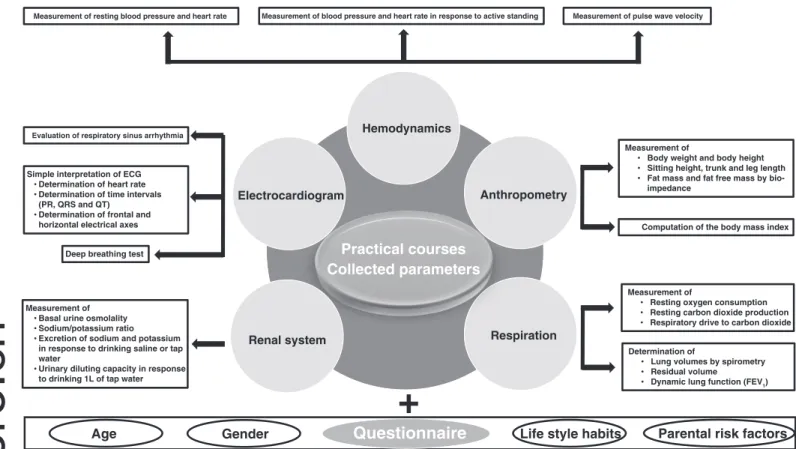
practical courses. The second year, however, constitutes the core of the physiology curriculum, with in-depth study of all of the systems concerning the human body. In parallel to the theoretical lectures and the sessions of problem-based learning, students follow in the course of a full semester various prac-tical sessions devoted to classical physiological experiments. The majority of these experiments are actually performed on the students themselves, with the help of fellow colleagues, and are depicted in Fig. 1. Physiological derivations or even pa-thologies were rarely encountered during the experiments and concerned primarily electrocardiography (“unusual” heart axis and heart rhythm troubles), hemodynamic (high blood pressure and orthostatic dysregulations), and respiration (signs for ob-structive lung diseases). Students were then advised to refer to a member of the faculty who is a qualified medical doctor for further advice.
All of these data, which are collected in our standard curriculum and used for illustrating physiological concepts, can thus be used for the establishment of a large, anonymous clinical database to which the answers from a questionnaire on personal characteristics and lifestyles are added. Our Institu-tional Curriculum Board, which is responsible for the medical curriculum and its teaching activities and developments, au-thorized our proposed data entry, its compilation, and accessi-bility.
Establishing the clinical database. Figure 2 depicts a flow
chart, which condenses and summarizes all of the different stages of our presented practical module called Scientific Thinking and Methodology (STM). Students were briefly in-troduced to the nature and purpose of this practical course during the first lecture of the third semester in September. On their first appearance at the practical course, each student had to pick a unique personal number out of a box and was advised to keep it confidential. Subsequently, students collected self-evaluated data from the various practical physiology courses, i.e., 1) electrocardiogram, auscultation, and pulse wave veloc-ity; 2) basic hemodynamic principles with orthostasis; 3) me-tabolism (with anthropometry); 4) respiration; and 5) renal function testing, from September to December. At the end of the practical courses and after an introductory lecture, each student entered his or her collected data anonymously in a password-protected dedicated database with the aforemen-tioned chosen number. Moreover, this database additionally contained a detailed questionnaire in which, for example,
Address for reprint requests and other correspondence: E. K. Grasser, Dept. of Endocrinology, Metabolism and Cardiovascular System, Faculty of Science and Medicine, University of Fribourg, Chemin du Musée 5, Fribourg 1700, Switzerland (e-mail: [email protected]).
55 1043 4046/19 C i h © 2019 h A i h i l i l S i
1
http://doc.rero.ch
Published in "Advances in Physiology Education 43(4): 557–560, 2019"
which should be cited to refer to this work.
information on lifestyle habits, personal nutrition, and parental cardiovascular risk factors was collected. A total of 111 med-ical students participated in this novel teaching initiative. Of these, 95 (85.6%) students anonymously entered all of the requested data in the STM database, whereas 14 (12.6%) students did not enter any data. Two (1.8%) students partially entered data. However, due to the anonymization of data entry, no consequences arose for those not entering data.
Building and testing a refutable hypothesis. Students were
instructed to 1) collect and work with self-evaluated data; 2) acquire basic statistical knowledge to, first, judge the quality and reliability of the data, and, second, test their preliminary hypothesis; 3) present their results in meaningful tables and/or figures; and 4) discuss/defend their findings. We addressed the issue concerning the credibility of source material (for exam-ple, scientific literature from PubMed versus blogs or forums), during an introductory lecture before opening the database. Students were instructed to rely on peer-reviewed publications for the literature search and had to provide justification for the credibility of their findings. All students were familiarized in the third semester with the necessary statistics to test their initial hypothesis appropriately. Immediately after closing the database, students were asked to form groups by themselves (minimum: 3; maximum: 5 students per group) and to develop a study question that was based on self-collected data from which a refutable hypothesis had to be generated (Table 1 provides a selection of submitted study questions that were subsequently translated to a refutable hypothesis).
We have chosen for our students the form of a poster, with the subheadings introduction, methods, results, and discussion, to solve the problem of working on a self-developed and
clinically relevant hypothesis. Since none of our students had previous experience with a similar teaching approach or the creation of such a poster, we made a self-created poster checklist available to them and advised the students to stick to this defined frame. Moreover, each group received structured feedback (~20 min), which was, together with the checklist, well received by the students. Additionally, and based on the content of their posters, students had to perform an oral presentation in front of their colleagues. Poster and oral pre-sentations took place during a symposium spanning two after-noons, where posters were mounted in a public place. How-ever, we would like to encourage potential interested parties to create more flexibility in terms of the presentation of results, where the instructor could decide, together with the group of students, the manner of presentation (e.g., written report or an oral report), as well as the requirement of statistics needed to generate results.
Assessment of achieved learning. The instructor was advised
to carry out an assessment of achieved learning by the con-duction of a structured feedback session, where each student group arranged a meeting with the instructor as soon as they finished working on their poster. At the beginning of each feedback session, the instructor judged the received poster version and provided a preliminary mark that was not revealed to the students. Each feedback session lasted ⬃20 min and centered on the interpretation of self-collected data and build-ing and testbuild-ing a hypothesis. A comparison between the pre-liminary with the final mark, i.e., derived from the submitted final poster version, was considered as an assessment of achieved learning and yielded an ~20% increase in form of received points.
Practical courses Collected parameters
Electrocardiogram Anthropometry
Respiration
Simple interpretation of ECG
• Determination of heart rate • Determination of time intervals
(PR, QRS and QT)
• Determination of frontal and
horizontal electrical axes
Measurement of
• Body weight and body height • Sitting height, trunk and leg length • Fat mass and fat free mass by
bio-impedance
Measurement of
• Resting oxygen consumption • Resting carbon dioxide production • Respiratory drive to carbon dioxide Hemodynamics
Measurement of resting blood pressure and heart rate Measurement of blood pressure and heart rate in response to active standing Measurement of pulse wave velocity
Evaluation of respiratory sinus arrhythmia
Deep breathing test
Computation of the body mass index
Determination of
• Lung volumes by spirometry • Residual volume
• Dynamic lung function (FEV1)
Renal system
Measurement of
• Basal urine osmolality • Sodium/potassium ratio • Excretion of sodium and potassium
in response to drinking saline or tap water
• Urinary diluting capacity in response
to drinking 1L of tap water
+
QuestionnaireGender Life style habits Parental risk factors
Age
Fig. 1. Parameters and variables collected and assessed by medical students on themselves during and after practical courses in physiology. ECG, electrocardiogram; FEV1, forced expiratory volume in 1 s.
2
Evaluation of the course. To avoid an evaluation bias toward
a higher rating for the evaluation of our proposed teaching approach, we performed the evaluation before the students became aware of their final marks. Students evaluated our practical lecture course as follows (Likert-scale 1–7: 1⫽ total disagreement and 7⫽ total agreement): “The amount of work
I put into the STM was adequate” [median: 5 points; mean: 4.5⫾ 1.8 standard deviation (SD)]; “The STM helps me to build and a test a hypothesis and to solve a clinical problem” [median: 6 points; mean: 5.6⫾ 1.2 (SD)]; “The STM helps me to reflect and critically interpret clinical data and medical literature” [median: 6 points; means: 5.5⫾ 1.2 (SD)].
DISCUSSION
We present here a newly introduced and recently established scientific module for medical students, which allows students to 1) collect and verify self-evaluated clinical data, and to 2) build and test a refutable hypothesis with the aid of self-collected clinical data stored in an anonymous database. Ad-ditionally, the students gained access to a thorough assessment of clinical data and critical use for creating tables and figures, which comply with current scientific standards. Moreover, the students received an early opportunity to work in a team and present self-processed data in a mock scientific symposium.
In our highly connected world, newly generated information becomes available to readers within a fraction of a second, and, as such, lesser time is devoted to ensuring the information is scientifically accurate. Therefore, it is becoming increasingly difficult for medical doctors not only to keep abreast of scientific developments, but more importantly to separate the wheat from the chaff. Moreover, without a sound scientific background, on what basis will a medical doctor distinguish
• Short mention of the STM at the start of the third semester
• Students pick their number as part of the database • Students collect their own data during the courses • Students were generally informed about the nature of
the STM by the responsible instructor • General introductory lecture
• Practical courses during the third semester
• Dedicated STM lecture
September
September until December
December • Defining the learning objectives
• How to conduct poster and presentation including statistics • Purpose and goal of the STM
• Mentioning of the evaluation criteria • Deadlines
• Data entry in the data base
January
• Group building and random assignment to the STM task
February
• Structured feedback to preliminary poster version
April
• Final submission of poster and oral presentation
May
• Poster and oral presentation
Mid-May
Fig. 2. Flow chart that depicts, in a time-dependent fashion (top down), pertinent constituent parts for a practical lecture course entitled, Scientific Thinking and Methodology (STM) (left). Right: a brief explanation and short summaries concerning working steps before entering data in the database.
Table 1. Selection of 10 study questions (translated from
German or French) raised by medical students themselves that were based on self-collected data during physiology courses, which led to a refutable hypothesis
Study Questions
1. Overweight and body mass index: Could it affect the electrical axis of the heart?
2. Do taller people have a higher blood pressure?
3. Is diastolic blood pressure related to anthropometric measurements?
4. Does lifestyle affect blood pressure and heart rate values?
5. Can the medical history of my parents affect my resting heart rate?
6. Are heart rate changes during active standing related to body weight?
7. Does urinary sodium excretion relate to resting blood pressure parameters?
8. Does oral contraception intake relate to resting oxygen consumption?
9. Do anthropometric parameters relate to lung vital capacity?
10. Is there a relation between resting energy expenditure and body composition?
3
between useful and misleading information? Simpkin and Schwartzstein (5) mentioned that, based on their experience, medical students are seeking structure, efficiency, and predict-ability and are disappointed when a “right answer” cannot be supplied, thereby potentially neglecting pertinent information from the patient, which would lay between these two strong poles. They suggested that, instead of speaking about a pa-tient’s diagnosis, students should rather focus and be taught to generate a hypothesis based on all of the patient’s information (5). In such a scenario, the patient’s diagnosis is expected to be in a dynamic and evolving state that resembles the falsification process common to hypothesis testing. However, the under-standing of hypothesis generation and testing seems to be underdeveloped in medical students, even in their final year (1, 2). Indeed, when 25 final-year medical students were asked to write a sentence on “science”, none mentioned the word “hypothesis” (1). When the evaluated students asked Professor Jeremy Hugh Baron about his own concept of science, he answered in five words: “Construct refutable hypothesis: test: publish” (1).
Therefore, we developed in our physiology curriculum a practical and economical way to teach the gathering and interpretation of clinical data where medical students tested a self-developed hypothesis with the aid of self-collected data from physiology laboratory courses. To facilitate the learning of the students, and aside from making analogical problems available, giving adequate feedback is deemed essential con-cerning the students’ attempts at problem solving (3). There-fore, assigned instructors conducted a structured feedback session, using open-ended questions rather than directive state-ments, where particular emphasis was given to the treatment and the processing of data, which we consider as the founda-tion of hypothesis testing. When asking the students later in an anonymized evaluation about the usefulness of the feedback session to their learning, it yielded a mean score of 6.5 points out of 7 (median was 7).
Future directions and next iteration of our study concept.
Although many medical schools have switched from specific physiology lectures to organ or system-oriented modules, our proposed teaching approach remains applicable as long as there are student laboratories with human data acquisition. We think that our concept of working on self-collected data and hypoth-esis testing is flexible and can be adapted to modules where the contributing instructors vary substantially between specialties.
In such a scenario, each group of students could pick up their most favorable and interesting specialty concerning the prac-tical teaching lessons where self-evaluated data were collected. Independent of the undergraduate curricula used (i.e., semes-ter-long courses in physiology or organ system modules), we would like to emphasize the importance of a robust indepen-dent review, in particular for data collection (entry), its com-pilation, and access systems, to ensure highest quality stan-dards.
In an attempt to provide a first-hand experience in basic scientific knowledge, we present a novel educational concept for undergraduate medical students in their earlier years of studies. Our goal was to educate students how to collect and treat all sorts of data derived from practical lectures during their physiology courses and to generate and test a clinically relevant hypothesis based on the initial data collected.
ACKNOWLEDGMENTS
The authors are very grateful to Dr. Cathriona Monnard for improving the English language of our manuscript.
DISCLOSURES
No conflicts of interest, financial or otherwise, are declared by the authors.
AUTHOR CONTRIBUTIONS
E.K.G. and J.-P.M. conceived and designed research; E.K.G. performed experiments; E.K.G. analyzed data; E.K.G. and J.-P.M. interpreted results of experiments; E.K.G. prepared figures; E.K.G. drafted manuscript; E.K.G. and J.-P.M. edited and revised manuscript; E.K.G. and J.-P.M. approved final version of manuscript.
REFERENCES
1. Baron JH. Medical students and history of medicine. J R Soc Med 89: 728, 1996. doi:10.1177/014107689608901237.
2. Baron JH. What should the citizen know about ‘science’? J R Soc Med 96: 509 –511, 2003. doi:10.1258/jrsm.96.10.509.
3. Gick ML. Problem-solving strategies. Educ Psychol 21: 99 –120, 1986. doi:10.1207/s15326985ep2101&2_6.
4. Jinha AE. Article 50 million: an estimate of the number of scholarly articles in existence. Learn Publ 23: 258 –263, 2010. doi:10.1087/ 20100308.
5. Simpkin AL, Schwartzstein RM. Tolerating uncertainty—the next med-ical revolution? N Engl J Med 375: 1713–1715, 2016. doi:10.1056/ NEJMp1606402.
6. Ware M, Mabe M. The STM Report: An Overview of Scientific and
Scholarly Journal Publishing. Oxford, UK: International Association of
Scientific, Technical and Medical Publishers, 2015.
4