Edge Contractions
Esther Galby
Department of Informatics, University of Fribourg, Fribourg, Switzerland [email protected]
Paloma T. Lima
Department of Informatics, University of Bergen, Bergen, Norway [email protected]
Bernard Ries
Department of Informatics, University of Fribourg, Fribourg, Switzerland [email protected]
Abstract
In this paper, we consider the following problem: given a connected graph G, can we reduce the domination number of G by one by using only one edge contraction? We show that the problem is NP-hard when restricted to {P6, P4+ P2}-free graphs and that it is coNP-hard when restricted to subcubic claw-free graphs and 2P3-free graphs. As a consequence, we are able to establish a complexity dichotomy for the problem on H-free graphs when H is connected.
2012 ACM Subject Classification Mathematics of computing → Graph theory
Keywords and phrases domination number, blocker problem, H-free graphs
Digital Object Identifier 10.4230/LIPIcs.ISAAC.2019.21
1
Introduction
A blocker problem asks whether given a graph G, a graph parameter π, a set O of one or more graph operations and an integer k ≥ 1, G can be transformed into a graph G0 by
using at most k operations from O such that π(G0) ≤ π(G) − d for some threshold d ≥ 0. Such a designation follows from the fact that the set of vertices or edges involved can be viewed as ”blocking” the parameter π. Identifying such sets may provide information on the structure of the input graph; for instance, if π = α, k = d = 1 and O = {vertex deletion}, the problem is equivalent to testing whether the input graph contains a vertex that is in every maximum independent set (see [18]). Blocker problems have received much attention in the recent literature (see for instance [1, 2, 3, 4, 5, 7, 8, 9, 11, 12, 13, 15, 16, 17, 18, 19]) and have been related to other well-known graph problems such as Hadwiger Number, Club Contraction and several graph transversal problems (see for instance [7, 17]). The graph parameters mainly considered in the literature so far include the chromatic number, the independence number, the clique number, the matching number and the vertex cover number while the set O is always a singleton consisting of a vertex deletion, edge contraction, edge deletion or edge addition. In this paper, we focus on the domination number γ, let O consist of an edge contraction and set the threshold d to one.
Formally, let G = (V, E) be a graph. The contraction of an edge uv ∈ E removes vertices
u and v from G and replaces them by a new vertex that is made adjacent to precisely those
vertices which were adjacent to u or v in G (without introducing self-loops nor multiple edges). We say that a graph G can be k-contracted into a graph G0, if G can be transformed into G0 by a sequence of at most k edge contractions, for an integer k ≥ 1. The problem we consider is then the following (note that contracting an edge cannot increase the domination number).
© Esther Galby, Paloma T. Lima, and Bernard Ries; licensed under Creative Commons License CC-BY
k-Edge Contraction(γ)
Instance: A connected graph G = (V, E).
Question: Can G be k-contracted into a graph G0 such that γ(G0) ≤ γ(G) − 1?
Reducing the domination number using edge contractions was first considered in [10]. The authors proved that for a connected graph G such that γ(G) ≥ 2, we have ctγ(G) ≤ 3,
where ctγ(G) denotes the minimum number of edge contractions required to transform G
into a graph G0 such that γ(G0) ≤ γ(G) − 1 (note that if γ(G) = 1 then G is a No-instance for k-Edge Contraction(γ) independently of the value of k). Thus, if G is a connected graph with γ(G) ≥ 2, then G is always a Yes-instance for k-Edge Contraction(γ) when
k ≥ 3. It was later shown in [9] that k-Edge Contraction(γ) is coNP-hard for k ≤ 2
and so, restrictions on the input graph to some special graph classes were considered. In particular, the authors in [9] proved that for k = 1, 2, the problem is polynomial-time solvable for P5-free graphs while for k = 1, it remains NP-hard when restricted to P9-free graphs and
{C3, . . . , C`}-free graphs, for any ` ≥ 3.
In this paper, we continue the systematic study of the computational complexity of 1-Edge Contraction(γ) initiated in [9]. Ultimately, the aim is to obtain a complete classification for 1-Edge Contraction(γ) restricted to H-free graphs, for any (not necessarily connected) graph H, as it has been done for other blocker problems (see for instance [8, 18, 19]). As a step towards this end, we prove the following three theorems.
ITheorem 1. 1-Edge Contraction(γ) is NP-hard when restricted to {P6, P4+ P2}-free
graphs.
ITheorem 2. 1-Edge Contraction(γ) is coNP-hard when restricted to subcubic claw-free
graphs.
ITheorem 3. 1-Edge Contraction(γ) is coNP-hard when restricted to 2P3-free graphs.
Note that Theorems 1 and 2 lead to a complexity dichotomy for H-free graphs when
H is connected. Indeed, since 1-Edge Contraction(γ) is NP-hard when restricted to
{C3, . . . , C`}-free graphs, for any ` ≥ 3, it follows that 1-Edge Contraction(γ) is NP-hard
for H-free graphs when H contains a cycle. If H is a tree with a vertex of degree at least three, we conclude by Theorem 2 that 1-Edge Contraction(γ) is coNP-hard for H-free graphs; and Theorem 1 shows that if H is a path of length at least 6, then 1-Edge Contraction(γ) is NP-hard for H-free graphs. Finally, since in [9] 1-Edge Contraction(γ) is shown to be polynomial-time solvable on {P5+ pK1}-free graphs for any p ≥ 0, it follows that 1-Edge
Contraction(γ) is polynomial-time solvable on H-free graphs if H ⊆i P5. We therefore
obtain the following result.
ICorollary 4. Let H be a connected graph. If H ⊆iP5 then 1-Edge Contraction(γ) is
polynomial-time solvable on H-free graphs, otherwise it is NP-hard or coNP-hard.
If the graph H is not required to be connected, we know the following. As previously mentioned, 1-Edge Contraction(γ) is NP-hard (resp. coNP-hard) on H-free graphs when
H contains a cycle (resp. an induced claw). Thus, there remains to consider the case where H
is a linear forest, that is, a disjoint union of paths. Theorems 1 and 3 show that if H contains either a P6, a P4+ P2 or a 2P3 as an induced subgraph, then 1-Edge Contraction(γ) is
NP-hard or coNP-hard on H-free graphs. Since it is known that 1-Edge Contraction(γ) is polynomial-time solvable on H-free graphs if H ⊆i P5+ pK1, there remains to determine
the complexity status of the problem restricted to H-free graphs when H = P3+ qP2+ pK1,
2
Preliminaries
Throughout the paper, we only consider finite, undirected and connected graphs that have no self-loops or multiple edges. We refer the reader to [6] for any terminology and notation not defined here.
For n ≥ 1, the path and cycle on n vertices are denoted by Pn and Cn respectively. The claw is the complete bipartite graph with one partition of size one and the other of size three.
Let G be a graph, with vertex set V (G) and edge set E(G), and let u ∈ V (G). We denote by NG(u), or simply N (u) if it is clear from the context, the set of vertices that are
adjacent to u i.e., the neighbors of u, and let N [u] = N (u) ∪ {u}. The degree of a vertex u, denoted by dG(u) or simply d(u) if it is clear from the context, is the size of its neighborhood
i.e., d(u) = |N (u)|. The maximum degree in G is denoted by ∆(G) and G is subcubic if ∆(G) ≤ 3.
For a family {H1, . . . , Hp} of graphs, G is said to be {H1, . . . , Hp}-free if G has no induced
subgraph isomorphic to a graph in {H1, . . . , Hp}; if p = 1, we may write H1-free instead of
{H1}-free. For a subset V0⊆ V (G), we let G[V0] denote the subgraph of G induced by V0,
which has vertex set V0 and edge set {uv ∈ E(G) | u, v ∈ V0}.
A subset S ⊆ V (G) is called an independent set or is said to be independent, if no two vertices in S are adjacent. A subset D ⊆ V (G) is called a dominating set, if every vertex in
V (G) \ D is adjacent to at least one vertex in D; the domination number γ(G) is the number
of vertices in a minimum dominating set. For any v ∈ D and u ∈ N [v], v is said to dominate
u (in particular, v dominates itself). We say that D contains an edge (or more) if the graph G[D] contains an edge (or more). A dominating set D of G is efficient if for every vertex v ∈ V , |N [v] ∩ D| = 1 that is, v is dominated by exactly one vertex.
In the following, we consider those graphs for which one edge contraction suffices to decrease their domination number by one. A characterization of this class is given in [10]. I Theorem 5 ([10]). For a connected graph G, ctγ(G) = 1 if and only if there exists a minimum dominating set in G that is not independent.
In order to prove Theorems 2 and 3, we introduce the following two problems. All Efficient MD
Instance: A connected graph G = (V, E).
Question: Is every minimum dominating set of G efficient?
All Independent MD
Instance: A connected graph G = (V, E).
Question: Is every minimum dominating set of G independent?
The following is then a straightforward consequence of Theorem 5.
B Fact 1. Given a graph G, G is a Yes-instance for 1-Edge Contraction(γ) if and only if G is a No-instance for All Independent MD.
3
The proof of Theorem 1
In this section, we show that 1-Edge Contraction(γ) is NP-hard when restricted to {P6, P4+ P2}-free graphs.
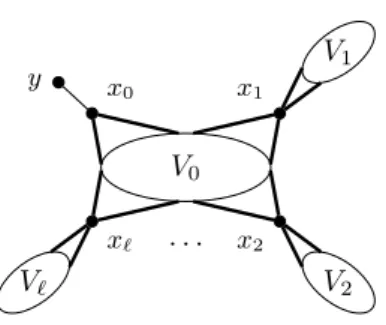
To this end, we give a reduction from Dominating Set. Given an instance (G, `) for Dominating Set, we construct an instance G0 for 1-Edge Contraction(γ) as follows. We denote by {v1, . . . , vn} the vertex set of G. The vertex set of the graph G0 is given by V (G0) = V0∪ . . . ∪ V`∪ {x0, . . . , x`, y}, where each Vi is a copy of the vertex set of G. We
denote the vertices of Vi by vi1, v2i, . . . , vni. The adjacencies in G0 are then defined as follows: V0∪ {x0} is a clique;
yx0∈ E(G0);
and for any 1 ≤ i ≤ `,
Vi is an independent set;
xiis adjacent to all the vertices in V0∪ Vi; vi
j is adjacent to {va0 | va∈ NG[vj]} for any 1 ≤ j ≤ n.
V0 x1 V1 x2 V2 . . . x` V` x0 y
Figure 1 The graph G0 (thick lines indicate that the vertex xiis adjacent to every vertex in V0
and Vi, for i = 0, . . . , `).
B Claim 1. γ(G0) = min{γ(G) + 1, ` + 1}.
Proof. It is clear that {x0, x1, . . . , x`} is a dominating set of G0; thus, γ(G0) ≤ `+1. If γ(G) ≤ ` and {vi1, . . . , vik} is a minimum dominating set of G, it is easily seen that {v0
i1, . . . , v
0
ik, x0} is a dominating set of G0. Thus, γ(G0) ≤ γ(G) + 1 and so, γ(G0) ≤ min{γ(G) + 1, ` + 1}. Now, suppose to the contrary that γ(G0) < min{γ(G) + 1, ` + 1} and consider a minimum dominating set D0 of G0. We first make the following simple observation.
B Observation 1. For any dominating set D of G0, D ∩ {y, x0} 6= ∅.
Now, since γ(G0) < ` + 1, there exists 1 ≤ i ≤ ` such that xi 6∈ D0 (otherwise,
{x1, . . . , x`} ⊂ D0 and combined with Observation 1, D0 would be of size at least ` + 1).
But then, D00 = D0 ∩ V0 must dominate every vertex in Vi, and so |D00| ≥ γ(G). Since
|D00| ≤ |D0| − 1 (recall that D0∩ {y, x
0} 6= ∅), we then have γ(G) ≤ |D0| − 1, a contradiction.
Thus, γ(G0) = min{γ(G) + 1, ` + 1}. C
We now show that (G, `) is a Yes-instance for Dominating Set if and only if G0 is a Yes-instance for 1-Edge Contraction(γ).
Assume first that γ(G) ≤ `. Then γ(G0) = γ(G) + 1 by the previous claim, and if {vi1, . . . , vik} is a minimum dominating set of G, then {v
0
i1, . . . , v
0
ik, x0} is a minimum dominating set of G0 which is not independent. Hence, by Theorem 5, G0 is a Yes-instance for 1-Edge Contraction(γ).
Conversely, assume that G0 is a Yes-instance for 1-Edge Contraction(γ) i.e., there exists a minimum dominating set D0 of G0 which is not independent (see Theorem 5). Then, Observation 1 implies that there exists 1 ≤ i ≤ ` such that xi6∈ D0; indeed, if it weren’t the
and either y or x0. In both cases, D0 would be independent, a contradiction. It follows that
D00= D0∩ V0 must dominate every vertex in Vi and thus, |D00| ≥ γ(G). But |D00| ≤ |D0| − 1
(recall that D0∩ {y, x0} 6= ∅) and so by Claim 1, γ(G) ≤ |D0| − 1 ≤ (` + 1) − 1 that is, (G, `)
is a Yes-instance for Dominating Set.
We next show that G0 is a P6-free graph. Let P be an induced path of G0. First observe
that since V0 is a clique, |V (P ) ∩ V0| ≤ 2. If |V (P ) ∩ V0| = 0, since each Vi is independent
and the same holds for {x0, . . . , x`}, we have that |V (P )| ≤ 3. We now consider the following
two cases.
Case 1. |V (P ) ∩ V0| = 2. Let u, v ∈ V0 be the vertices of V (P ) ∩ V0. Since P is an
induced path, u and v appear consecutively in P , that is, uv ∈ E(P ). Furthermore,
V (P ) ∩ {x0, . . . , x`} = ∅ since u and v are adjacent to all the vertices of {x0, . . . , x`}. If u has another neighbor w ∈ Vi in P , for some i > 0, then since N (w) ⊂ V0∪ {xi}, w can
have no neighbor in P other than u, that is, w is an endpoint of the path. Symmetrically, the same holds for a neighbor of v in P different from u. Hence, we conclude that |V (P )| ≤ 4.
Case 2. |V (P ) ∩ V0| = 1. Let u ∈ V0be the vertex of V (P ) ∩ V0. If V (P ) ∩ {x0, . . . , x`} = ∅,
then it is easy to see that |V (P )| ≤ 3, since any neighbor of u in the path must belong to ∪1≤i≤`Vi and, by the same argument as in Case 1, such a neighbor would have to
be an endpoint of the path. If V (P ) ∩ {x0, . . . , x`} 6= ∅, let xi be a vertex that is in P .
Since uxi ∈ E(G0), we necessarily have that uxi∈ E(P ). Suppose that xi has another
neighbor w in P . Then w ∈ Vi since N (xi) = V0∪ Vi. By the argument used above, w
must then be an endpoint of the path; and since u can have at most two neighbors in {x0, . . . , x`}, we conclude that |V (P )| ≤ 5.
Finally, to see that G0 is also a {P4+ P2}-free graph, it suffices to note that any induced P4
of G0 contains at least one vertex of the clique V0. This concludes the proof of Theorem 1.
4
The proof of Theorem 2
In this section, we show that 1-Edge Contraction(γ) is coNP-hard when restricted to subcubic claw-free graphs. To this end, we first prove the following.
ILemma 6. All Efficient MD is NP-hard when restricted to subcubic graphs.
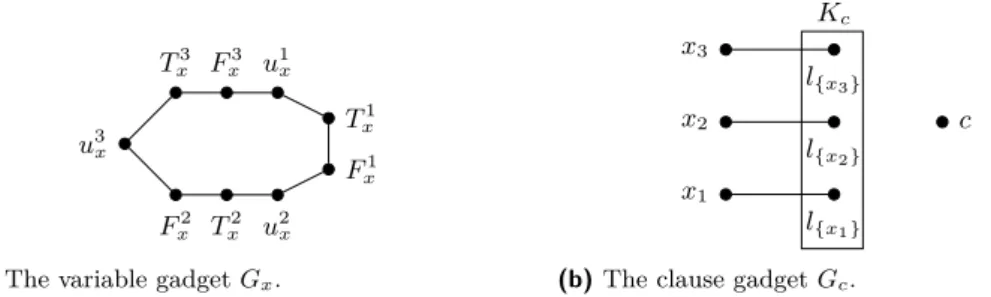
Proof. We reduce from Positive Exactly 3-Bounded 1-In-3 3-Sat, where each variable appears in exactly three clauses and only positively, each clause contains three positive literals, and we want a truth assignment such that each clause contains exactly one true literal. This problem is shown to be NP-complete in [14]. Given an instance Φ of this problem, with variable set X and clause set C, we construct an equivalent instance of All Efficient MD as follows. For any variable x ∈ X, we introduce a copy of C9, which we denote by Gx,
with three distinguished true vertices Tx1, Tx2 and Tx3, and three distinguished false vertices
F1
x, Fx2 and Fx3 (see Fig. 2a). For any clause c ∈ C containing variables x1, x2 and x3, we
introduce the gadget Gc depicted in Fig. 2b which has one distinguished clause vertex c
and three distinguished variable vertices x1, x2 and x3 (note that Gc is not connected). For
every j ∈ {1, 2, 3}, we then add an edge between xj and Fxij and between c and T
i
xj for some
i ∈ {1, 2, 3} so that Fi
xj (resp. T
i
xj) is adjacent to exactly one variable vertex (resp. clause vertex). We denote by GΦthe resulting graph. Note that ∆(GΦ) = 3.
B Observation 1. For any dominating set D of GΦ, |D ∩ V (Gx)| ≥ 3 for any x ∈ X and
F2 x Tx2 u2x F1 x Tx1 u1x Fx3 Tx3 u3x
(a) The variable gadget Gx.
x1 x2 x3 l{x1} l{x2} l{x3} c Kc
(b) The clause gadget Gc.
Figure 2 Construction of the graph GΦ (the rectangle indicates that the corresponding set of vertices induces a clique).
Indeed, for any x ∈ X, since u1x, u2x and u3x must be dominated and their neighborhoods
are pairwise disjoint and contained in Gx, it follows that |D ∩ V (Gx)| ≥ 3. For any c ∈ C,
since the vertices of Kc must be dominated and their neighborhoods are contained in Gc,
|D ∩ V (Gc)| ≥ 1. y
B Observation 2. For any x ∈ X, if D is a minimum dominating set of Gx then either D = {u1
x, u2x, u3x}, D = {Tx1, Tx2, Tx3} or D = {Fx1, Fx2, Fx3}.
B Claim 1. Φ is satisfiable if and only if γ(GΦ) = 3|X| + |C|.
Proof. Assume that Φ is satisfiable and consider a truth assignment satisfying Φ. We construct a dominating set D of GΦas follows. For any variable x ∈ X, if x is true, add
T1
x, Tx2 and Tx3to D; otherwise, add Fx1, Fx2 and Fx3 to D. For any clause c ∈ C containing
variables x1, x2 and x3, exactly one variable is true, say x1 without loss of generality; we
then add l{x1} to D. Clearly, D is dominating and we conclude by Observation 1 that γ(GΦ) = 3|X| + |C|.
Conversely, assume that γ(GΦ) = 3|X| + |C| and consider a minimum dominating set D
of GΦ. Then by Observation 1, |D ∩ V (Gx)| = 3 for any x ∈ X and |D ∩ V (Gc)| = 1 for any c ∈ C. Now, for a clause c ∈ C containing variables x1, x2 and x3, if D ∩ {c, x1, x2, x3} 6= ∅
then D ∩ V (Kc) = ∅ and so, at least two vertices from Kc are not dominated; thus, D ∩ {c, x1, x2, x3} = ∅. It follows that for any x ∈ X, D ∩ V (Gx) is a minimum dominating
set of Gxwhich by Observation 2 implies either {Tx1, Tx2, Tx3} ⊂ D or D ∩ {Tx1, Tx2, Tx3} = ∅;
and we conclude similarly that either {F1
x, Fx2, Fx3} ⊂ D or D ∩ {Fx1, Fx2, Fx3} = ∅. Now
given a clause c ∈ C containing variables x1, x2 and x3, since D ∩ {c, x1, x2, x3} = ∅,
at least one true vertex adjacent to the clause vertex c must belong to D, say Ti x1 for
some i ∈ {1, 2, 3} without loss of generality. It then follows that {Tx11, T
2 x1, T 3 x1} ⊂ D and D ∩ {F1 x1, F 2 x1, F 3
x1} = ∅ which implies that l{x1}∈ D (either x1 or a vertex from Kc would
otherwise not be dominated). But then, since xj for j 6= 1, must be dominated, it follows
that {F1
xj, F
2
xj, F
3
xj} ⊂ D. We thus construct a truth assignment satisfying Φ as follows: for any variable x ∈ X, if {T1
x, Tx2, Tx3} ⊂ D, set x to true, otherwise set x to false. C
B Claim 2. γ(GΦ) = 3|X| + |C| if and only if every minimum dominating set of GΦ is
efficient.
Proof. Assume that γ(GΦ) = 3|X| + |C| and consider a minimum dominating set D of GΦ.
Then by Observation 1, |D ∩ V (Gx)| = 3 for any x ∈ X and |D ∩ V (Gc)| = 1 for any c ∈ C.
As shown previously, it follows that for any clause c ∈ C containing variables x1, x2 and x3,
D ∩ {c, x1, x2, x3} = ∅; and for any x ∈ X, either {Tx1, Tx2, Tx3} ⊂ D or D ∩ {Tx1, Tx2, Tx3} = ∅
vertex in Gx is dominated by exactly one vertex. Now given a clause c ∈ C containing
variables x1, x2 and x3, since the clause vertex c does not belong to D, there exists at
least one true vertex adjacent to c which belongs to D. Suppose to the contrary that c has strictly more than one neighbor in D, say Ti
x1 and T j
x2 without loss of generality. Then,
{T1
xk, T
2
xk, T
3
xk} ⊂ D for k = 1, 2 which implies that D ∩ {F
1 x1, F 2 x1, F 3 x1, F 1 x2, F 2 x2, F 3 x2} = ∅
as |D ∩ V (Gxk)| = 3 for k = 1, 2. It follows that the variable vertices x1 and x2 must be dominated by some vertices in Gc; but |D ∩ V (Gc)| = 1 and N [x1] ∩ N [x2] = ∅ and so, either
x1or x2 is not dominated. Thus, c has exactly one neighbor in D, say Txi1 without loss of
generality. Then, necessarily D ∩ V (Gc) = {l{x1}} for otherwise either x1or some vertex in Kc would not be dominated. But then, it is clear that every vertex in Gc is dominated by
exactly one vertex; thus, D is efficient.
Conversely, assume that every minimum dominating set of GΦis efficient and consider a
minimum dominating set D of GΦ. If for some x ∈ X, |D ∩ V (Gx)| ≥ 4, then clearly at least
one vertex in Gxis dominated by two vertices in D ∩ V (Gx). Thus, |D ∩ V (Gx)| ≤ 3 for any x ∈ X and we conclude by Observation 1 that in fact, equality holds. The next observation
immediately follows from the fact that D is efficient.
B Observation 3. For any x ∈ X, if |D ∩ V (Gx)| = 3 then either {u1x, u2x, u3x} ⊂ D,
{T1
x, Tx2, Tx3} ⊂ D or {Fx1, Fx2, Fx3} ⊂ D.
Now, consider a clause c ∈ C containing variables x1, x2and x3and suppose without loss
of generality that Tx11 is adjacent to c (note that then the variable vertex x1is adjacent to
F1
x1). If the clause vertex c belongs to D then, since D is efficient, T
1 x1 ∈ D and u/ 1 x1, F 1 x1∈ D/
(Tx11 would otherwise be dominated by at least two vertices) which contradicts Observation
3. Thus, no clause vertex belongs to D. Similarly, suppose that there exists i ∈ {1, 2, 3} such that xi∈ D, say x1∈ D without loss of generality. Then, since D is efficient, Fx11∈ D/
and T1
x1, u
2
x1 ∈ D (F/
1
x1 would otherwise be dominated by at least two vertices) which again
contradicts Observation 3. Thus, no variable vertex belongs to D. Finally, since D is efficient, |D ∩ V (Kc)| ≤ 1 and so, |D ∩ V (Gc)| = 1 by Observation 1. C
Now by combining Claims 1 and 2, we obtain that Φ is satisfiable if and only if every minimum dominating set of GΦis efficient, that is, GΦis a Yes-instance for All Efficient
MD. J
ITheorem 7. All Independent MD is NP-hard when restricted to subcubic claw-free
graphs.
Proof. We give a reduction from Positive Exactly 3-Bounded 1-In-3 3-Sat, where each variable appears in exactly three clauses and only positively, each clause contains three positive literals, and we want a truth assignment such that each clause contains exactly one true literal. This problem is shown to be NP-complete in [14]. Given an instance Φ of this problem, with variable set X and clause set C, we construct an equivalent instance of All Independent MD as follows. Consider the graph GΦ= (V, E) constructed in the proof
of Lemma 6 and let Vi= {v ∈ V : dGΦ(v) = i} for i = 2, 3 (note that no vertex in GΦhas
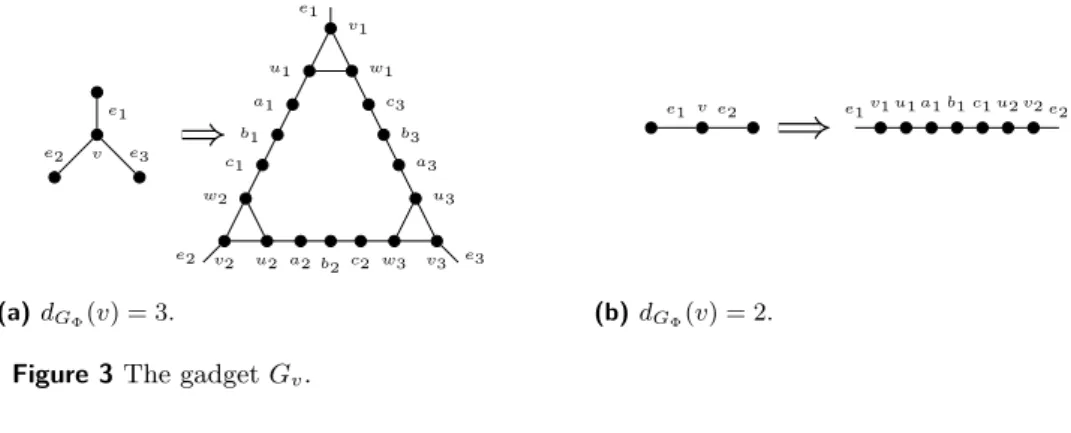
degree one). Then, for any v ∈ V3, we replace the vertex v by the gadget Gv depicted
in Fig. 3a; and for any v ∈ V2, we replace the vertex v by the gadget Gv depicted in Fig.
3b. We denote by G0Φthe resulting graph. Note that G0Φis claw-free and ∆(G0Φ) = 3 (also note that no vertex in G0Φhas degree one). It is shown in the proof of Lemma 6 that Φ is satisfiable if and only if GΦis a Yes-instance for All Efficient MD; we here show that
GΦis a Yes-instance for All Efficient MD if and only if G0Φis a Yes-instance for All
v2 u2 w2 v3 w3 u3 v1 u1 w1 b1 c1 a1 b3 a3 c3 b2 a2 c2 e2 e3 e1 v e1 e2 e3 (a) dGΦ(v) = 3. v e1 e2 e1v1 u1 a1 b1 c1 u2 v2e2 (b) dGΦ(v) = 2.
Figure 3 The gadget Gv.
B Claim 3. γ(G0Φ) = γ(GΦ) + 5|V3| + 2|V2|.
Proof. Let D be a minimum dominating set of GΦ. We construct a dominating set D0 of G0Φ
as follows. For any v ∈ D, if v ∈ V3, add v1, v2, v3, b1, b2 and b3 to D0; otherwise, add v1,
v2and b1 to D0. For any v ∈ V \ D, let u ∈ D be a neighbor of v, say e1= uv without loss
of generality. Then, if v ∈ V3, add a1, c3, w2, u3and b2 to D0; otherwise, add a1 and u2to
D0. Clearly, D0 is dominating and |D0| = γ(GΦ) + 5|V3| + 2|V2| ≥ γ(G0Φ).
B Observation 4. For any dominating set D0 of G0Φ, the following holds.
(i) For any v ∈ V2, |D0∩ V (Gv)| ≥ 2. Moreover, if equality holds then D0∩ {v1, v2} = ∅
and there exists j ∈ {1, 2} such that uj∈ D/ 0.
(ii) For any v ∈ V3, |D0∩ V (Gv)| ≥ 5. Moreover, if equality holds then D0∩ {v1, v2, v3} = ∅
and there exists j ∈ {1, 2, 3} such that D0∩ {uj, vj, wj} = ∅.
(i) Clearly, D0∩ {v1, u1, a1} 6= ∅ and D0∩ {c1, u2, v2} 6= ∅ as u1and u2must be dominated.
Thus, |D0∩ V (Gv)| ≥ 2. Now, suppose that D0∩ {v1, v2} 6= ∅ say v1 ∈ D0 without loss
of generality. Then D0 ∩ {u1, a1, b1} 6= ∅ as a1 must be dominated which implies that
|D0∩ V (G
v)| ≥ 3 (recall that D0∩ {c1, u2, v2} 6= ∅). Similarly, if both u1 and u2 belong to
D0, then |D0∩ V (Gv)| ≥ 3 as D0∩ {a1, b1, c1} 6= ∅ (b1 would otherwise not be dominated).
(ii) Clearly, for any i ∈ {1, 2, 3}, D0∩ {ai, bi, ci} 6= ∅ as bi must be dominated. Now,
if there exists j ∈ {1, 2, 3} such that D0 ∩ {uj, vj, wj} = ∅, say j = 1 without loss of
generality, then a1, c3 ∈ D0 (one of u1 and w1 would otherwise not be dominated). But
then, D0∩ {b1, c1, w2} 6= ∅ as c1must be dominated, and D0∩ {a3, b3, u3} 6= ∅ as a3 must be
dominated; and so, |D0∩ V (Gv)| ≥ 5 (recall that D0∩ {a2, b2, c2} 6= ∅). Otherwise, for any
j ∈ {1, 2, 3}, D0∩ {uj, vj, wj} 6= ∅ which implies that |D0∩ V (Gv)| ≥ 6.
Now suppose that D0∩ {v1, v2, v3} 6= ∅, say v1∈ D0 without loss of generality. If there
exists j 6= 1 such that D0∩ {uj, vj, wj} = ∅, say j = 2 without loss of generality, then c1, a2∈
D0 (one of u2 and w2would otherwise not be dominated). But then, D0∩ {a1, b1, u1} 6= ∅
as a1 should be dominated, and D0 ∩ {b2, c2, w3} 6= ∅ as c2 must be dominated. Since
D0∩ {a3, b3, c3} 6= ∅, it then follows that |D0∩ V (Gv)| ≥ 6. Otherwise, D0∩ {uj, vj, wj} 6= ∅
for any j ∈ {1, 2, 3} and so, |D0∩ V (Gv)| ≥ 6 (recall that D0∩ {ai, bi, ci} 6= ∅ for any
i ∈ {1, 2, 3}). y
B Observation 5. If D0 is a minimum dominating set of G0Φ, then |D0∩ V (Gv)| ≤ 3 for any v ∈ V2 and |D0∩ V (Gv)| ≤ 6 for any v ∈ V3.
Indeed, if v ∈ V2 then {v1, b1, v2} is a dominating set of V (Gv); and if v ∈ V3, then
Now, consider a minimum dominating set D0of G0Φand let D3= {v ∈ V3: |D0∩V (Gv)| =
6} and D2= {v ∈ V2: |D0∩ V (Gv)| = 3}. We claim that D = D3∪ D2 is a dominating set
of GΦ. Indeed, consider a vertex v ∈ V \ D. We distinguish two cases depending on whether
v ∈ V2 of v ∈ V3.
Case 1. v ∈ V2. Then |D0∩ V (Gv)| = 2 by construction, which by Observation 4(i) implies
that there exists j ∈ {1, 2} such that D0 ∩ {vj, uj} = ∅ , say j = 1 without loss of generality. Since v1 must be dominated, v1must then have a neighbor xi belonging to D0, for some vertex x adjacent to v in GΦ. But then, it follows from Observation 4 that
|D0 ∩ V (G
x)| > 2 if x ∈ V2, and |D0∩ V (Gx)| > 5 if x ∈ V3 (indeed, xi ∈ D0); thus, x ∈ D.
Case 2. v ∈ V3. Then |D0∩ V (Gv)| = 5 by construction, which by Observation 4(ii) implies
that there exists j ∈ {1, 2, 3} such that D0∩ {uj, vj, wj} = ∅, say j = 1 without loss
of generality. Since v1must be dominated, v1must then have a neighbor xi belonging
to D0, for some vertex x adjacent to v in GΦ. But then, it follows from Observation 4
that |D0∩ V (Gx)| > 2 if x ∈ V2, and |D0∩ V (Gx)| > 5 if x ∈ V3(indeed, xi∈ D0); thus, x ∈ D.
Hence, D is a dominating set of GΦ. Moreover, it follows from Observations 4 and 5 that
|D0| = 6|D
3| + 5|V3\ D3| + 3|D2| + 2|V2\ D2| = |D| + 5|V3| + 2|V2|. Thus, γ(G0Φ) = |D0| ≥
γ(GΦ) + 5|V3| + 2|V2| and so, γ(G0Φ) = γ(GΦ) + 5|V3| + 2|V2|. Finally note that this implies
that the constructed dominated set D is in fact minimum. C
We next show that GΦ is a Yes-instance for All Efficient MD if and only if G0Φ
is a Yes-instance for All Independent MD. Since Φ is satisfiable if and only if GΦ is
a Yes-instance for All Efficient MD, as shown in the proof of Lemma 6, this would conclude the proof.
Assume first that GΦ is a Yes-instance for All Efficient MD and suppose to the
contrary that G0Φis a No-instance for All Independent MD that is, G0Φhas a minimum dominating set D0 which is not independent. Denote by D the minimum dominating set
of GΦ constructed from D0 according to the proof of Claim 3. Let us show that D is not
efficient. Consider two adjacent vertices a, b ∈ D0. If a and b belong to gadgets Gxand Gv
respectively, for two adjacent vertices x and v in GΦ, that is, a is of the form xi and b is
of the form vj, then by Observation 4 x, v ∈ D and so, D is not efficient. Thus, it must be
that a and b both belong the same gadget Gv, for some v ∈ V2∪ V3. We distinguish cases
depending on whether v ∈ V2or v ∈ V3.
Case 1. v ∈ V2. Suppose that |D0∩ V (Gv)| = 2. Then by Observation 4(i), D0∩ {v1, v2} = ∅
and there exists j ∈ {1, 2} such that uj ∈ D/ 0, say u1 ∈ D/ 0 without loss of generality.
Then, necessarily a1 ∈ D0 (u1 would otherwise not be dominated) and so, b1 ∈ D0 as
D0∩ V (Gv) contains an edge and |D0∩ V (Gv)| = 2 by assumption; but then, u2 is not
dominated. Thus, |D0 ∩ V (Gv)| ≥ 3 and we conclude by Observation 5 that in fact,
equality holds. Note that consequently, v ∈ D. We claim that then, |D0∩ {v1, v2}| ≤ 1.
Indeed, if both v1and v2belong to D0, then b1∈ D0 (since |D0∩ V (Gv)| = 3, D0 would
otherwise not be dominating) which contradicts that fact that D0∩ V (G
v) contains an
edge. Thus, |D0∩ {v1, v2}| ≤ 1 and we may assume without loss of generality that v2∈ D/ 0.
Let xi6= u2 be the other neighbor of v2 in G0Φ, where x is a neigbhor of v in GΦ.
Suppose first that x ∈ V2. Then, |D0∩ V (Gx)| = 2 for otherwise x would belong to D
and so, D would contain the edge vx. It then follows from Observation 4(i) that there exists j ∈ {1, 2} such that D0∩ {xj, yj} = ∅, where yj is the neighbor of xj in V (Gx).
We claim that j 6= i; indeed, if j = i, since v2, xi, yi∈ D/ 0, xi would not be dominated.
But then, xj must have a neighbor tk6= yj, for some vertex t adjacent to x in GΦ, which
belongs to D0; it then follows from Observation 4 and the construction of D that t ∈ D and so, x has two neighbors in D, namely v and t, a contradiction.
Second, suppose that x ∈ V3. Then, |D0∩ V (Gx)| = 5 for otherwise x would belong to D
and so, D would contain the edge vx. It then follows from Observation 4(ii) that there exists j ∈ {1, 2, 3} such that D0∩ {xj, yj, zj} = ∅, where yj and zj are the two neighbors
of xjin V (Gx). We claim that j 6= i; indeed, if j = i, since v2, xi, yi, zi∈ D/ 0, xiwould not
be dominated. But then, xj must have a neighbor tk6= yj, zj, for some vertex t adjacent
to x in GΦ, which belongs to D0; it then follows from Observation 4 and the construction
of D that t ∈ D and so, x has two neighbors in D, namely v and t, a contradiction. Case 2. v ∈ V3. Suppose that |D0 ∩ V (Gv)| = 5. Then, by Observation 4(ii), D0 ∩
{v1, v2, v3} = ∅ and there exists j ∈ {1, 2, 3} such that D0 ∩ {uj, vj, wj} = ∅, say
j = 1 without loss of generality. Then, a1, c3 ∈ D0 (one of u1 and w1 would otherwise
not be dominated), D0 ∩ {c1, w2, u2} 6= ∅ (w2 would otherwise not be dominated),
D0∩ {a3, u3, w3} 6= ∅ (u3would otherwise not be dominated) and D0∩ {a2, b2, c2} 6= ∅
(b2 would otherwise not be dominated); in particular, b1, b3 ∈ D/ 0 as |D0∩ V (Gv)| = 5
by assumption. Since D0∩ V (Gv) contains an edge, it follows that either u2, a2 ∈ D0
or c2, w3 ∈ D0; but then, either c1 or a3 is not dominated, a contradiction. Thus,
|D0∩ V (G
v)| ≥ 6 and we conclude by Observation 5 that in fact, equality holds. Note
that consequently, v ∈ D. It follows that {v1, v2, v3} 6⊂ D0 for otherwise D0∩ V (Gv) =
{v1, v2, v3, b1, b2, b3} and so, D0∩ V (Gv) contains no edge. Thus, we may asssume without
loss of generality that v1∈ D/ 0. Denoting by xi6= u1, w1 the third neighbor of v1, where
x is a neighbor of v in GΦ, we then proceed as in the previous case to conclude that x
has two neighbors in D.
Thus, D is not efficient, which contradicts the fact that GΦis a Yes-instance for All
Efficient MD. Hence, every minimum dominating set of G0Φis independent i.e., G0Φis a
Yes-instance for All Independent MD.
Conversely, assume that G0Φis a Yes-instance for All Independent MD and suppose to the contrary that GΦis a No-instance for All Efficient MD that is, GΦhas a minimum
dominating set D which is not efficient. Let us show that D either contains an edge or can be transformed into a minimum dominating set of GΦcontaining an edge. Since any minimum
dominating of G0Φconstructed according to the proof of Claim 3 from a minimum dominating set of GΦcontaining an edge, also contains an edge, this would lead to a contradiction and
thus conclude the proof.
Suppose that D contains no edge. Since D is not efficient, there must then exist a vertex
v ∈ V \ D such that v has two neighbors in D. We distinguish cases depending on which
type of vertex v is.
Case 1. v is a variable vertex. Suppose that v = x1 in some clause gadget Gc, where c ∈ C
contains variables x1, x2and x3, and assume without loss of generality that x1is adjacent
to F1
x1. By assumption, F
1
x1, l{x1}∈ D which implies that D ∩ {l{x2}, l{x3}, T
1
x1, u
2
x1} = ∅
(D would otherwise contain an edge). We may then assume that Fi
x2 and F j x3, where Fi x2x2, F j
x3x3 ∈ E(GΦ), belong to D; indeed, since x2 (resp. x3) must be dominated, D ∩ {Fi x2, x2} 6= ∅ (resp. D ∩ {F j x3, x3} 6= ∅) and since l{x1} ∈ D, (D \ {x2}) ∪ {F i x2}
(resp. (D \ {x3}) ∪ {Fxj3}) remains dominating. We may then assume that T i x2, T
j x3 ∈ D/
for otherwise D would contain an edge. It follows that c ∈ D (c would otherwise not be dominated); but then, it suffices to consider (D \ {c}) ∪ {Tx11} to obtain a minimum
Case 2. v = uix for some variable x ∈ X and i ∈ {1, 2, 3}. Assume without loss of generality
that i = 1. Then T1
x, Fx3∈ D by assumption, which implies that Fx1, Tx3∈ D (D would/
otherwise contain an edge). But then, |D ∩ {u2
x, Fx2, Tx2, u3x}| ≥ 2 as u2x and u3xmust be
dominated; and so, (D \ {u3
x, Fx2, Tx2, ux2}) ∪ {Fx2, Tx2} is a dominating set of GΦof size at
most that of D which contains an edge.
Case 3. v is a clause vertex. Suppose that v = c for some clause c ∈ C containing variables x1, x2 and x3, and assume without loss of generality that c is adjacent to Tx1i for any i ∈ {1, 2, 3}. By assumption c has two neighbors in D, say T1
x1 and T
1
x2 without
loss of generality. Since D contains no edge, it follows that F1
x1, F
1
x2 ∈ D; but then,/
|D ∩ {x1, x2, l{x1}, l{x2}}| ≥ 2 (one of x1 and x2 would otherwise not be dominated) and
so, (D \ {x1, x2, l{x1}, l{x2}}) ∪ {l{x1}, l{x2}} is a dominating set of GΦ of size at most
that of D which contains an edge.
Case 4. v ∈ V (Kc) for some clause c ∈ C. Denote by x1, x2and x3 the variables contained
in c and assume without loss of generality that v = l{x1}. Since l{x1} has two neighbors in D and D contains no edge, necessarily x1∈ D. Now assume without loss of generality that
x1is adjacent to Fx11 (note that by construction, c is then adjacent to T
1
x1). Then, F
1
x1∈ D/
(D would otherwise contain an edge) and T1
x1, u
2
x1 ∈ D for otherwise (D \ {x/ 1}) ∪ {F
1
x1}
would be a minimum dominating set of GΦcontaining an edge (recall that by assumption,
D ∩ V (Kc) 6= ∅). It follows that T2
x1∈ D (u
2
x1 would otherwise not be dominated) and so, F2
x1 ∈ D as D contains no edge. It follows that |D ∩ {u/
1 x1, F 3 x1, T 3 x1, u 3 x1}| ≥ 2 as u 1 x1 and u3x1must be dominated. Now if c belongs to D, then (D \{u1x1, Fx31, Tx31, u3x1})∪{F3
x1, T
3
x1}
is a dominating set of GΦof size at most that of D which contains an edge. Thus, we may
assume that c /∈ D which implies that u1
x1 ∈ D (T
1
x1 would otherwise not be dominated)
and that there exists j ∈ {2, 3} such that Ti
xj ∈ D with cT
i
xj ∈ E(GΦ) (c would otherwise not be dominated). Now, since u3
x1 must be dominated and F
2
x1 ∈ D, it follows that/ D ∩ {u3
x1, T
3
x1} 6= ∅ and we may assume that in fact T
3
x1 ∈ D (recall that T
2
x1 ∈ D
and so, F2
x1 is dominated). But then, by considering the minimum dominating set
(D \ {u1x1}) ∪ {T
1
x1}, we fall back into Case 3 as c is then dominated by both T
1
x1 and T i xj. Case 5. v is a true vertex. Assume without loss of generality that v = T1
x for some variable x ∈ X. Suppose first that u1
x∈ D. Then since D contains no edge, Fx3∈ D; furthermore,/
denoting by t 6= u1
x, Tx3the variable vertex adjacent to Fx3, we also have t /∈ D for otherwise
(D \ {u1x}) ∪ {F3
x} would be a minimum dominating set containing an edge (recall that T
1
x
has two neighbors in D by assumption). But then, since t must be dominated, it follows that the second neighbor of t must belong to D; and so, by considering the minimum dominating set (D \ {u1
x}) ∪ {Fx3}, we fall back into Case 1 as the variable vertex t is
then dominated by two vertices. Thus, we may assume that u1
x∈ D which implies that/ F1
x, c ∈ D, where c is the clause vertex adjacent to Tx1. Now, denote by x1= x, x2 and
x3 the variables contained in c (note that by construction, x1 is then adjacent to Fx11).
Then, x1 ∈ D (D would otherwise contain the edge F/ x11x1) and we may assume that l{x1}∈ D (we otherwise fall back into Case 1 as x/ 1 would then have two neighbors in D). It follows that D ∩ V (Kc) 6= ∅ (l{x1} would otherwise not be dominated) and since D contains no edge, in fact |D ∩ V (Kc)| = 1, say l{x2} ∈ D without loss of generality.
Then, x2∈ D as D contains no edge and we may assume that F/ xj2 ∈ D, where F/ j x2 is the
false vertex adjacent to x2, for otherwise we fall back into Case 1. In the following, we
assume without loss of generality that j = 1, that is, x2 is adjacent to Fx12 (note that
by construction, c is then adjacent to Tx12). Now, since the clause vertex c belongs to D
by assumption, it follows that T1
x2∈ D (D would otherwise contain the edge cT/
1
x2); and
as shown previously, we may assume that u1x2 ∈ D (indeed, T/
1
x2 would otherwise have
two neighbors in D, namely c and u1
since u1x2 and F
1
x2 must be dominated, necessarily F
3
x2 and u
2
x2 belong to D (recall that D ∩ {x2, Fx12, T
1
x2, u
1
x2} = ∅) which implies that T
3
x2, T
2
x2 ∈ D (D would otherwise contain/
an edge). Now since u3
x2 must be dominated, D ∩ {u
3
x2, F
2
x2} 6= ∅ and we may assume
without loss of generality that in fact, F2
x2∈ D. But then, by considering the minimum
dominating set (D \ {u2
x2}) ∪ {F
1
x2}, we fall back into Case 1 as x2 is then dominated by
two vertices.
Case 6. v is a false vertex. Assume without loss of generality that v = Fx11 for some variable x1∈ X and let c ∈ C be the clause whose corresponding clause vertex is adjacent to Tx11.
Denote by x2 and x3the two other variables contained in c. Suppose first that x1∈ D.
Then, we may assume that D ∩ V (Kc) = ∅ for otherwise either D contains an edge (if l{x1} ∈ D) or we fall back into Case 4 (l{x1} would indeed have two neighbors in D).
Since every vertex of Kc must be dominated, it then follows that x2, x3∈ D; but then,
by considering the minimum dominating set (D \ {x1}) ∪ {l{x1}} (recall that F
1
x1 has two
neighbors in D by assumption), we fall back into Case 4 as l{x2}is then dominated by
two vertices. Thus, we may assume that x1∈ D which implies that T/ x11, u
2
x1 ∈ D and Tx21, u
1
x1 ∈ D as D contains no edge. Now, denote by c/
0 the clause vertex adjacent to
T2
x1. Then, we may assume that c
0∈ D for otherwise we fall back into Case 5 (T/ 2
x1 would
indeed have two neighbors in D); but then, there must exist a true vertex, different from
T2
x1, adjacent to c
0 and belonging to D (c0 would otherwise not be dominated) and by
considering the minimum dominating set (D \ {u2
x1}) ∪ {T
2
x1}, we then fall back into Case
3 (c0 would indeed be dominated by two vertices).
Consequently, GΦhas a minimum dominating set which is not independent which implies
that G0Φalso has a minimum dominating set which is not independent, a contradiction which
concludes the proof. J
Theorem 2 now easily follows from Fact 1 and Theorem 7.
5
The proof of Theorem 3
In this section, we show that 1-Edge Contraction(γ) is coNP-hard when restricted to 2P3-free graphs. To this end, we prove the following.
ITheorem 8. All Independent MD is NP-hard when restricted to 2P3-free graphs.
Proof. We reduce from 3-Sat: given an instance Φ of this problem, with variable set X and clause set C, we construct an equivalent instance of All Independent MD as follows. For any variable x ∈ X, we introduce a copy of C3, which we denote by Gx, with one
distinguished positive literal vertex x and one distinguished negative literal vertex ¯x; in the
following, we denote by ux the third vertex in Gx. For any clause c ∈ C, we introduce a clause vertex c; we then add an edge between c and the (positive or negative) literal vertices
whose corresponding literal occurs in c. Finally, we add an edge between any two clause vertices so that the set of clause vertices induces a clique denoted by K in the following. We denote by GΦthe resulting graph.
B Observation 1. For any dominating set D of GΦand any variable x ∈ X, |D ∩ V (Gx)| ≥ 1.
In particular, γ(GΦ) ≥ |X|.
Proof. Assume that Φ is satisfiable and consider a truth assignment satisfying Φ. We construct a dominating set D of GΦas follows. For any variable x ∈ X, if x is true, add the
positive literal vertex x to D; otherwise, add the negative variable vertex ¯x to D. Clearly, D
is dominating and we conclude by Observation 1 that γ(GΦ) = |X|.
Conversely, assume that γ(GΦ) = |X| and consider a minimum dominating set D of GΦ.
Then by Observation 1, |D ∩ V (Gx)| = 1 for any x ∈ X. It follows that D ∩ K = ∅ and so,
every clause vertex must be adjacent to some (positive or negative) literal vertex belonging to D. We thus construct a truth assignment satisfying Φ as follows: for any variable x ∈ X, if the positive literal vertex x belongs to D, set x to true; otherwise, set x to false. C B Claim 2. γ(GΦ) = |X| if and only if every minimum dominating set of GΦis independent.
Proof. Assume that γ(GΦ) = |X| and consider a minimum dominating set D of GΦ. Then
by Observation 1, |D ∩ V (Gx)| = 1 for any x ∈ X. It follows that D ∩ K = ∅ and since N [V (Gx)] ∩ N [V (Gx0)] ⊂ K for any two x, x0 ∈ X, D is independent.
Conversely, consider a minimum dominating set D of GΦ. Since D is independent,
|D ∩ V (Gx)| ≤ 1 for any x ∈ X and we conclude by Observation 1 that in fact, equality
holds. Now suppose that there exists c ∈ C, containing variables x1, x2and x3, such that the
corresponding clause vertex c belongs to D (note that since D is independent, |D ∩ K| ≤ 1). Assume without loss of generality that x1 occurs positively in c, that is, c is adjacent to
the positive literal vertex x1. Then, x1∈ D since D is independent and so, either u/ x1∈ D
or ¯x1∈ D. In the first case, we immediately obtain that (D \ {ux1}) ∪ {x1} is a minimum
dominating set of GΦcontaining an edge, a contradiction. In the second case, since c ∈ D,
any vertex dominated by ¯x1is also dominated by c; thus, (D \ { ¯x1}) ∪ {x1} is a minimum
dominating set of GΦcontaining an edge, a contradiction. Consequently, D ∩ K = ∅ and so,
γ(GΦ) = |D| = |X|. C
Now by combining Claims 1 and 2, we obtain that Φ is satisfiable if and only if every minimum dominating set of GΦ is independent, that is, GΦ is a Yes-instance for All
Independent MD. There remains to show that GΦ is 2P3-free. To see this, it suffices
to observe that any induced P3 of GΦ contains at least one vertex in the clique K. This
concludes the proof. J
Theorem 3 now easily follows from Fact 1 and Theorem 8.
6
Conclusion
In this work, we establish a complexity dichotomy for 1-Edge Contraction(γ) on H-free graphs when H is a connected graph. If we do not require H to be connected, there only remains to settle the complexity status of 1-Edge Contraction(γ) restricted to H-free graphs when H = P3+ qP2+ pK1, with q ≥ 1 and p ≥ 0.
References
1 Cristina Bazgan, Sonia Toubaline, and Zsolt Tuza. The most vital nodes with respect to independent set and vertex cover. Discrete Applied Mathematics, 159:1933–1946, October 2011. doi:10.1016/j.dam.2011.06.023.
2 Cristina Bazgan, Sonia Toubaline, and Daniel Vanderpooten. Critical edges for the assignment problem: Complexity and exact resolution. Operations Research Letters, 41:685–689, November 2013. doi:10.1016/j.orl.2013.10.001.
3 Cédric Bentz, Costa Marie-Christine, Dominique de Werra, Christophe Picouleau, and Bernard Ries. Blockers and Transversals in some subclasses of bipartite graphs: when caterpillars are dancing on a grid. Discrete Mathematics, 310:132–146, January 2010. doi:10.1016/j.disc. 2009.08.009.
4 Cédric Bentz, Costa Marie-Christine, Dominique de Werra, Christophe Picouleau, and Bernard Ries. Weighted Transversals and Blockers for Some Optimization Problems in Graphs, pages 203–222. Progress in Combinatorial Optimization. ISTE-WILEY, 2012.
5 Marie-Christine Costa, Dominique de Werra, and Christophe Picouleau. Minimum d-blockers and d-transversals in graphs. Journal of Combinatorial Optimization, 22(4):857–872, 2011. doi:10.1007/s10878-010-9334-6.
6 Reinhard Diestel. Graph Theory, volume 173 of Graduate Texts in Mathematics. Springer, Heidelberg; New York, fourth edition, 2010.
7 Öznur Yaşar Diner, Daniël Paulusma, Christophe Picouleau, and Bernard Ries. Contraction Blockers for Graphs with Forbidden Induced Paths. In Algorithms and Complexity, pages 194–207. Springer International Publishing, 2015.
8 Öznur Yaşar Diner, Daniël Paulusma, Christophe Picouleau, and Bernard Ries. Contraction and deletion blockers for perfect graphs and H-free graphs. Theoretical Computer Science, 746:49–72, 2018. doi:10.1016/j.tcs.2018.06.023.
9 Esther Galby, Paloma T. Lima, and Bernard Ries. Reducing the domination number of graphs via edge contractions. In Mathematical Foundations of Computer Science (MFCS) 2019 (to
appear), 2019.
10 Jia Huang and Jun-Ming Xu. Domination and Total Domination Contraction Numbers of Graphs. Ars Combinatoria, 94, January 2010.
11 Chaya Keller and Micha A Perles. Blockers for simple Hamiltonian paths in convex geometric graphs of even order. Discrete & Computational Geometry, 60(1):1–8, 2018.
12 Chaya Keller, Micha A Perles, Eduardo Rivera-Campo, and Virginia Urrutia-Galicia. Blockers for noncrossing spanning trees in complete geometric graphs. In Thirty Essays on Geometric
Graph Theory, pages 383–397. Springer, 2013.
13 Foad Mahdavi Pajouh, Vladimir Boginski, and Eduardo Pasiliao. Minimum Vertex Blocker Clique Problem. Networks, 64:48–64, August 2014. doi:10.1002/net.21556.
14 C. Moore and J. M. Robson. Hard Tiling Problems with Simple Tiles. Discrete Computational
Geometry, 26(4):573–590, 2001. doi:10.1007/s00454-001-0047-6.
15 Farzaneh Nasirian, Foad Mahdavi Pajouh, and Josephine Namayanja. Exact algorithms for the minimum cost vertex blocker clique problem. Computers & Operations Research, 103:296–309, 2019.
16 Foad Mahdavi Pajouh, Jose L. Walteros, Vladimir Boginski, and Eduardo L. Pasiliao. Minimum edge blocker dominating set problem. European Journal of Operational Research, 247(1):16–26, 2015.
17 Daniël Paulusma, Christophe Picouleau, and Bernard Ries. Reducing the Clique and Chromatic Number via Edge Contractions and Vertex Deletions. In ISCO 2016, volume 9849 of LNCS, pages 38–49, 2016. doi:10.1007/978-3-319-45587-7_4.
18 Daniël Paulusma, Christophe Picouleau, and Bernard Ries. Blocking Independent Sets for H-Free Graphs via Edge Contractions and Vertex Deletions. In TAMC 2017, volume 10185 of
LNCS, pages 470–483, 2017. doi:10.1007/978-3-319-55911-7_34.
19 Daniël Paulusma, Christophe Picouleau, and Bernard Ries. Critical vertices and edges in H-free graphs. Discrete Applied Mathematics, 257:361–367, 2019. doi:10.1016/j.dam.2018.08.016.