Formal Aspects of Computing (2007) 19: 159–189
of Computing
Specification and verification challenges
for sequential object-oriented programs
Gary T. Leavens
1, K. Rustan M. Leino
2and Peter M ¨uller
31Dept. of Computer Science, Iowa State University, 229 Atanasoff Hall, Ames, IA 50011, USA. E-mail: [email protected] 2Microsoft Research, Redmond, One Microsoft Way, Redmond, WA 98052, USA. E-mail: [email protected]
3ETH Zurich, ETH Zentrum RZ F2, 8092 Zurich, Switzerland. E-mail: [email protected]
Abstract. The state of knowledge in how to specify sequential programs in object-oriented languages such as Java
and C# and the state of the art in automated verification tools for such programs have made measurable progress in the last several years. This paper describes several remaining challenges and approaches to their solution.
Keywords: Program verification; Specification; Contract; Object-oriented programming; Challenge
1. Introduction
The last few years have shown a renewed interest in formally verifying software. For example, within the last decade, interactive program verifiers have been applied to control software and other critical applications [Abr96, Cha00], software model checking has made strides into industrial applications [BBC+06], and a number of research tools for bug detection have been built using automatic program-verification technology [BRL03, FM04, FLL+02, CK05, MPMU04]. In fall 2005, a large, international group of researchers gathered in Zurich at the Verified Software: Theories, Tools, Experiments conference [HMS05], to explore the next steps in a long-term initiative by Hoare [Hoa03] to advance the science of program construction. Specification and verification of sequential object-oriented software is certainly important to this overall picture.
In this paper, we describe several important specification and verification challenges as we see them today. We draw on our experience with specifying and verifying code using the Java Modeling Language (JML) [LBR99, LBR06, LPC+06] and Spec# [BDF+04, BLS05, LM04], and static checking and verification tools for these [BCD+06, FLL+02, CK05]. While we do not claim that the set of challenges is complete, we hope that these problems will provide a roadmap for problems to attack and a basis for measuring future progress.
Three years ago, Jacobs, Kiniry, and Warnier described several challenge problems for Java program verifi-cation [JKW03]. Here, we group them into the categories used in our paper (plus a category “Others” for the remaining challenges):
A. Data abstraction in specification
1. Specification: numeric models and method calls in specifications B. Frame properties
2. Side effects in expressions
C. Heap data structures 3. Aliasing and field access 4. Class invariants and callbacks 5. Static initialization
D. Control flow
6. Breaking out of a loop 7. Catching exceptions E. Others
8. Bitwise operations
9. Overloading and dynamic method invocation 10. Inheritance
11. Non-termination
The specification challenge of dealing with computer versus infinite arithmetic (A.1) has been addressed in the context of JML [Cha03]. The problem of how to deal with method calls in specifications (A.1) has also seen some work recently [Cok05, DM06, JP06], but still faces open issues regarding frame properties. We discuss these in Sect. 3.1. Side effects in expressions (B.2) as well as aliasing (C.3) are handled by various program logics for object-oriented languages [AL97, Bec00, BS01, Boe99, HJ00, Jac04, JP01, Lei97, OYR04, vO01, vON02, PB05, PHM99, Rey02] and also in ESC/Java [FLL+02, LSS99, CK05] and other tools geared to the verifica-tion of Java-like programs [BCD+06, BRL03]. There has been much work on invariants and callbacks (C.4) [BDF+04, LM04, LN02, MPHL06], which we discuss in more detail in Sect. 4.1. Although some work has also been done on static initialization (C.5) [LM05], we still consider this problem an open challenge, which we discuss further in Sect. 3.2. Both challenges related to control flow (D.6 and D.7) are solved by logics for abrupt termina-tion [BS01, HJ00] or by translating programs to low-level languages such as BoogiePL [BCD+06, DL05, LSS99] before verification. Handling bitwise operations (E.8) is important in practice. To automate verification of bitwise operations, there are various decision procedures [CKS05, XA05], but there is still work to be done on integrating these decision procedures with theorem provers, in particular, on combining them with arithmetic operations. Dynamic method binding (E.9) and inheritance (E.10) are largely handled by the discipline of behavioral sub-typing [Ame91, LD00, LW95, LW94, Mey97], which is incorporated into JML and Spec# using the idea of specification inheritance [DL96, Lea06, LN06, Wil92]. Finally, non-termination (E.11) can be addressed using standard techniques such as loop variants. The problem has also been tackled successfully using model checkers [CPR06].
In summary the challenges presented by Jacobs, Kiniry, and Warnier’s paper are areas where much progress has been made. Still, a number of difficult challenges remain, which are the subject of the present paper.
1.1. Scope and assumptions
Our survey of these challenges is limited to specification and verification techniques for object-oriented lan-guages, such as Eiffel, Java, and C#. Because we draw on our experience with JML and Spec#, we largely ignore concurrency issues and instead concentrate on issues in the specification and verification of sequential code.
Even within the domain of specification and verification techniques for sequential object-oriented programs, there are several different styles of specification and verification. We focus on detailed design specification, i.e., the specification of interfaces of individual program modules, also known as interface specification [GH93, Win87, Win90]. This can be contrasted with requirements specification, which often occurs earlier in the development cycle and is more concerned with the behavior of an entire program and less with the specification of individual modules.
Most interface specification languages use some variation on Hoare’s pre- and postcondition technique [Apt81, Gri81, Hoa69]. A well-known early example of such a language is VDM [Jon90]. The Larch family [GH93, Win87] of interface specification languages exemplifies the approach of writing such pre- and postcon-ditions using a specialized mathematical vocabulary. Specifications operate on abstract values [Hoa72], which
are abstractions of the “concrete” state of the program. Furthermore, the operations used on abstract values are completely mathematical, and thus an excellent fit for formal manipulation (e.g., with theorem provers).
Unfortunately, experience with Larch-style interface specification languages indicates that a mathematical syntax for assertions, such as the Larch Shared Language [GH93], which is different than the programming language’s syntax, is a barrier to use by programmers. Programmers seem more comfortable with an assertion language that is based on the programming language’s own expression syntax. This is the approach followed by Gypsy [AGB+77], Anna [Luc90, LvH85], APP [Ros95], and Eiffel [Mey92, Mey97], and adopted by JML [LCC+05] and Spec# [BLS05].
Several of the challenges we describe in the design of such Eiffel-like interface specification languages stem from this fundamental decision to write assertions using a subset of the expressions in the underlying program-ming language. One of the basic problems is to overcome the mismatch between the programprogram-ming language’s expressions and the needs of automatic theorem provers.
It is essential that verification techniques are modular, that is, that they allow one to reason about a class inde-pendently of its clients and subclasses. Modularity is crucial to verify reusable classes such as library classes and for scalability. Many of our challenges stem from this modularity requirement. They call for modular solutions to problems for which non-modular solutions already exist.
The specification and verification challenges described in this paper are challenges for specification and ver-ification methodology, that is, how to apply existing concepts, formalisms, logics, etc. to specify and verify a program. Therefore, the discussion is somewhat independent of the particular program logic that is used. We believe the discussion applies to all or most of the logics for object-oriented languages, including Hoare-style logics [AL97, Boe99, HJ00, Jac04, JP01, Lei97, vO01, vON02, PHM99], dynamic logics [Bec00, BS01], and separation logic [OYR04, PB05, Rey02].
1.2. Outline
In this paper, we describe challenges in the areas of data abstraction in specification (Sect. 2), frame properties (Sect. 3), reasoning about heap structures (Sect. 4), control flow (Sect. 5), and practical considerations (Sect. 6). We describe each challenge and try to give an idea of why it is not yet solved, by describing a number of solution approaches with their potentials and limitations.
2. Data abstraction in specification
One of the key innovations in JML’s design is the use of a library of modeling types that describe mathematical bags (multisets), sets, sequences, relations, and maps [LCC+05]. These modeling types play the same role in a JML specification as the built-in traits in the Larch Shared Language or the built-in types of VDM: they allow the specifier to describe abstract values of objects using standard mathematical notions. These types are designed to have immutable objects, to better match mathematics. They allow the specification of abstract values, especially for collection classes. For example, the abstract value of ajava.util.Collectioncan be specified using a (specification-only) model field whose type is aJMLEqualsBag. While the hope was that such types would be useful for both runtime assertion checking and static verification, they do not work well with static verification. This leads to our first two challenges.
2.1. Specifying modeling types
If an interface specification language provides several built-in modeling types, a fundamental problem arises in how to specify them in a way that is useful for verification. Modeling types can, of course, be specified using other modeling types, but ultimately some modeling types must be specified in some other way.
Challenge 1 Develop a specification technique for modeling types.
2.1.1. Solution approach 1: Collected algebraic specifications
One approach to solving this challenge is to specify modeling types by mimicing algebraic specification tech-niques [BW82, EM85, GTWW77, GH78, Wan79]. This approach initially seems sensible, because modeling types
Fig. 1. A JML modeling typeModelSetthat is specified using an algebraic specification technique. In JML, annotations are enclosed in special comments that start with an at-sign (@); in such annotations initial at-signs on a line are ignored. They keywordpuresays that the methods of this type have no side effects. Aninvariantdeclares a property that is true in all visible states. The operator==>means implication. The modifiernullableallows the parameter toequalsto be null, contrary to JML’s default
typically have immutable objects. Thus, semantic ideas developed for equational algebraic specifications, such as the initial algebra approach [BW82, EM85, GTWW77] or the final algebra approach [Wan79], could be used to give the mathematical meaning to such a specification. Specifiers can use the technique of sufficient completeness [GH78] to make sure that they have specified a type to the level of completeness desired.
For instance, a data type Set contains laws that relate the operations add and has , such as: (∀ Set s, Element e : has(add(s, e), e)). In a similar way, we can relate the methods of a modeling type. For instance, each instances
of a modeling typeModelSethas to satisfy the law:(\forall Object e; s.add(e).has(e)). In this JML notation, universal quantification starts with\forall. (Such expression keywords start with a backslash to prevent them from being confused with programmer-defined names.)
Fig. 1 shows a specification for ModelSetusing this approach. In this specification, the invariant states several properties of the methods shown in the figure. Such specifications are used for many of the JML modeling types, and in actual practice they are considerably more extensive than shown in Fig. 1.
Unfortunately, this approach is not usable for verification, due to several problems.
A first problem is that the invariant in Fig. 1 quantifies over all objects, making it non-executable and thus unsuitable for runtime assertion checking. With static verification techniques, this invariant’s quantification would mean that every new object created could potentially violate the invariant. It is not clear how to reason efficiently about such invariants. Such additional proof obligations would be non-modular and impractical. In our example, creating a new object in fact cannot violate the invariant. Therefore, we would like to tell the theorem prover not to check every new object against this invariant. However, taking such invariants as axioms instead of as invariants seems dangerous, as it may lead to inconsistencies and would not be checked against the implementation.
A second problem is that the approach shown in Fig. 1 uses theequalsmethod of theModelSettype, whereas standard algebraic specification techniques work with a built-in notion of equality. The use of theequals
method introduces several considerations that are not problems in standard algebraic data type specifications, such as that equality might not be a congruence (reflexive, symmetric, transitive, preserved by the methods). Furthermore, calls to theequalsmethod make theorem proving more difficult (see Sect. 3.1).
2.1.2. Solution approach 2: specifying methods via other methods
It seems possible to solve the problems of the first approach while still using ideas inspired by algebraic specifi-cation techniques, in that methods are specified in terms of their effect on other methods. However, this second approach does not use a single algebraic style specification in an invariant. Instead, it divides the set of methods up into query and non-query methods; no specifications are written directly for query methods, but each non-query method’s behavior is specified by describing how it changes the results of all query methods [Mey97]. (One can also distinguish between primitive and derived query methods, to help abbreviate such specifications [GH78].)
As an example, consider the typeUModelSetin Fig. 2 on the next page. In this example, the meaning of the non-query methodsemptySetandaddare both specified using the query methodhas. The methodhasitself is not directly given a specification.
The main drawback of this approach seems to be that the verification of an implementation of a modeling class may need additional specifications. For example, to verify an implementation of thehasmethod inUModelSet, one would have to write a (private) implementation-dependent specification.
Fig. 2. A JML modeling typeUModelSetthat is specified by giving specifications of various methods in terms of other methods. The keywordensuresstarts a postcondition for the following method. The keyword\resultstands for the result of a (non-void) method
This approach also requires a sound treatment of quantifiers, such as the one in the specification ofemptySet
(see Sect. 2.2), and of method calls in specifications (see Sect. 3.1).
2.1.3. Solution approach 3: translation between modeling types and mathematical theories
Another approach for specifying modeling types in some technique other than that used to specify normal, user-defined types. One possibility is to develop an automatic translation between modeling types and theories of some standard theorem prover (as suggested in [LCC+05]). Such a translation could be defined either from modeling types to mathematical theories or vice versa.
Translating modeling types into mathematical theories allows programmers to write new modeling types and then automatically translate them for static verification. This seems possible, but is non-trivial [Mir04]. First, the resulting data types are typically complicated. For instance, JML’s model classJMLObjectSetfor sets of references cannot simply be mapped to a mathematical set of references.JMLObjectSetcontains several ghost fields, which are independent coordinates in the state space. Therefore, the resulting data type is a tuple, where one component is a mathematical set. This makes working with it tedious. Second, if the modeling type is not final, then programmers can override theequalsmethod in various ways. Therefore, theequalsmethod of a non-final modeling type cannot always be translated to mathematical equality. The same problem occurs when programmers implement their own modeling types andequalsmethods. Third, modeling types may refer to methods of normal program code. For instance, thehasmethod ofJMLValueSetuses theequalsmethod to determine whether the (non-model) argument is in the set. It is not clear how such calls to program code can be expressed in a mathematical theory (without formalizing the whole language semantics as part of the theory).
Translating mathematical theories into modeling types also has shortcomings. First, if programmers want to develop their own modeling types, they would have to specify them in the language of a theorem prover. This is contrary to the basic idea of contract languages, which try to shield programmers from specialized theo-rem prover notation. Second, runtime assertion checking requires that modeling types be executable. However, arbitrary mathematical theories cannot be translated automatically into executable program code.
In summary, it seems that the generality of these translation approaches causes problems. In particular, it is unclear how to verify that the implementations (used by a runtime assertion checker) of such modeling types are correct with respect to the mathematical theories (used by a theorem prover or other static analysis tool).
2.1.4. Solution approach 4: built-in modeling types based on mathematical theories
The problems of the automatic translations between modeling types and mathematical theories can be avoided if the specification language provides a fixed, but carefully chosen set of modeling types together with their trans-lations to mathematical theories. Programmers could then develop new modeling types only by instantiating existing ones. In essence, this approach would harken back to VDM [Jon90], in using a small set of built-in types for specification.
This approach meshes with the very recent work of Charles [Cha06]. In Charles’s work on JML, the Java “native” keyword is reused to declare methods and types that have a correspondence in the prover (Coq). Types declared as native are considered to be value types, that is, not to be subtypes ofObject. Also, the prover has a built-in understanding of how certain Java types (such asObject) correspond to types in the prover (e.g.,
Reference). That is, when translating from JML to the prover’s language, all occurrences of such Java type are replaced by their corresponding prover type. Methods of such native types must also be “native” and are treated as uninterpreted function symbols in the theorem prover. The JML declaration of such native types and
Fig. 3. A JML example that uses a generalized quantifier\num ofin its loop invariant. Details of this expression are explained in the text. methods is accompanied by text in the prover’s native language that axiomatizes the corresponding uninterpreted function symbols. Normal users would not extend the set of such types, and no extra ghost or model fields would be permitted in such types.
This seems like a promising approach to solving the challenge. One problem is defining a set of such “native” types that would satisfy the demands of a wide variety of theorem provers and that would also work for runtime assertion checking. In particular, correctness of the implementations of “native” types with respect to the mathe-matical theories is again an issue. Another problem is figuring out how to use “native” types to specify types such as Java’s collection types, where program code (equals) is supposed to define membership in the collection.
2.2. Quantifiers and comprehensions
It is well known that various generalized quantifiers (such as summations and products) are useful in specifica-tions [Coh90, GS94]. Similarly, mathematicians have long found that set comprehensions are very convenient notational abbreviations. Haskell [HJW+92] and other functional languages also use comprehension notations for lists to great effect.
Generalized quantifiers and comprehensions are equally useful and important in specification languages, where generalized quantifiers are notational shorthands and comprehensions act as literals for modeling types. A prominent example of the utility of comprehension notations is Z [Spi92], in which, for example, set hensions are a central and important feature. JML has a few kinds of generalized quantifiers and set compre-hensions. The example in Fig. 3 shows the use of a generalized quantifier\num_of, which counts the number of integers,j, that both satisfy the range predicate,0 <= j && j < args.length, and the body predicate
args[j].starts\-With("-"). This numerical quantifier is used in a loop invariant. The loop invariant is needed to show thatcountis within the boundaries of theoutarray, which illustrates that quantifiers can be useful even in situations where one’s verification ambitions are limited, like trying only to prove the absence of array index bounds errors; of course, quantifiers and comprehensions are even more useful if one is trying to prove full functional correctness.
Quantifiers and comprehension expressions pose several pitfalls for specification language designers. For example, if quantifiers only quantify over non-garbage objects, then they become sensitive to garbage collection, which causes semantic problems [COB03]. On the other hand, quantifying over non-allocated objects is also problematic. For instance, if the quantifier in the invariant of classModelSet(Fig. 1 on page 162) ranges over all objects including non-allocated objects, then the invariant calls methods with parameter objects that are not allocated. It is unclear what it means if these methods access the state of these parameter objects.
There are also practical difficulties in the implementation of quantifiers for runtime assertion checking, which require either restriction of the language [KC97, Kra98] or recognition of patterns of bounded quantification
Fig. 4. A method,countHits, that could be used to avoid the\num ofquantifier in the previous figure. Therequiresclause specifies its precondition. The use of twoensuresclauses is equivalent to the conjunction of the postconditions they specify.
[Che03, WBL94]. Similar difficulties affect comprehension expressions. However, these difficulties in language design and runtime assertion checking seem fairly well understood.
The remaining challenge is about program verification.
Challenge 2 Develop a verification technique for general quantifiers and comprehensions that is suitable for
automatic verification systems.
This challenge focuses on automatic program verifiers, such as ESC/Java and Boogie. These encode the proof obligations as first-order formulas that are passed to an automatic theorem prover like Simplify [DNS05]. In such automatic first-order provers, common inductive definitions of generalized quantifiers are not readily available.
2.2.1. Solution approach: replace comprehensions by functions
In our example, we could introduce the side-effect free (pure) method shown in Fig. 4 to count the number of elements in the arrayafrom indexfromthat start with"-". We use this method to replace the comprehension in the loop invariant of methodfilteras follows:
/ / @ l o o p _ i n v a r i a n t 0 <= c o u n t & & c o u n t H i t s ( a r g s , i ) = = o u t . l e n g t h - c o u n t ;
However, this solution has some shortcomings. First, it requires a technique for reasoning about method calls in specifications (see Sect. 3.1). Second, specifiers generally have to introduce auxiliary methods with non-trivial (typically recursive) specifications for each quantifier or comprehension, which increases the specification over-head significantly. One possible line of attack might be to develop heuristics that cause the verification-condition generation to introduce suitably axiomatized functions whose parameters are the variables mentioned in the generalized quantifier.
Without a solution to Challenge 2, users would have to choose between automatic theorem proving support and specifications that are rich enough to mention generalized quantifiers and comprehensions.
3. Frame properties
This section presents several challenges related to frame properties. Frame properties say what a method is per-mitted to change during its execution [BMR95]. The perper-mitted modifications are often specified in so-called “modifies clauses” [GH93]. Our JML examples use “assignable clauses” to say what locations a method may assign. For instance, the assignable clause of methodpushin Fig. 5 on the following page permits the method to assign to all fields of its receiver, but nothing else. Assignable clauses are slightly more restrictive than modifies clauses. A method that assigns to a location l and then re-establishes its original value still has to list l in its assignable clause, but since the method in effect does not modify l , l need not be listed in the modifies clause. The challenges presented in this section do not rely on this subtle difference.
3.1. Method calls in specifications
Assertions in Eiffel, JML, and Spec# rely on pure (that is, side-effect free) methods, so-called observers, to support data abstraction. For instance, the BoundedStackinterface in Fig. 5 on the next page contains an
Fig. 5. InterfaceBoundedStackuses the pure methodhasRoomForto provide an implementation-independent JML specification for
push. The notationthis.*inpush’s assignable clause means that all fields ofthis(including the inherited model fieldobjectState
and its data group) are assignable. ClassCalculatoruses aBoundedStackto store a stack of operands. The methodconstOpfetches an operand and pushes it onto the stack. The modifierspec_publicallows the fieldstackto be used in public specifications
Fig. 6. A possible implementation of interfaceBoundedStack. The stack elements are stored in the unused part of the operand array of the
Calculatorobjectcalc. Consequently, modifications ofcalc.nextaffect the capacity of the stack and, therefore, the result of has-RoomFor
observer methodhasRoomFor, wherestack.hasRoomFor(i)yields true if and only ifstackhas room for at leastiadditional elements. This observer is used to provide a specification for methodpushwithout referring to the concrete implementation of the stack. Implementation independence is required by information hiding. Moreover, implementation independence is crucial to supporting subtyping since different subtypes must satisfy a common specification, but may have different implementations (or no implementations at all in the case of abstract classes and interfaces).
Recent papers by Cok [Cok05] as well as by Darvas and M ¨uller [DM06] present encodings of observer meth-ods in program logics. However, they do not explain how to reason about frame properties when the specification uses observer methods.
Existing specification techniques for frame properties [LBR06, LM06, LN02, MPHL03] allow one to describe the fields that are potentially modified by a method execution using an assignable clause. However, assignable clauses do not specify the effects of a method execution on the results of observers. In our example, methodpush
affects the result ofhasRoomForfor some arguments, but this effect is not declared inpush’s assignable clause. Since effects on observers are not covered by assignable clauses, the specification of methodgetOperand
of classCalculatordoes not express whether the result of stack.hasRoomForis potentially affected by the method. In fact, the specification in Fig. 5 does not prevent such an interaction betweengetOperandand
stack.hasRoomFor. ClassStrangeStackin Fig. 6 stores the stack elements in the unused part of the oper-and array of theCalculatorobjectcalc. Consequently, modifications of calc.nextaffect the capacity of the stack and, therefore, the result ofhasRoomFor. If aCalculatorobject c and aStrangeStackobject mutually use each other, then calling c.getOperandmay indeed affect the result of c.stack.hasRoomFor.
Due to its requires clause, methodconstOpmay assumestack.hasRoomFor(1). However, we cannot conclude that this property still holds when it is needed to satisfy the requires clause of the call tostack.push, because that property might have been invalidated by the preceding call togetOperand. Consequently, we cannot prove that the requires clause ofpushis satisfied, which causes the verification ofconstOpto fail. This example illustrates an open challenge.
Challenge 3 Develop a specification and verification technique that allows one to determine the effects of heap
modifications on the results of observer methods.
3.1.1. Solution approach 1: listing modified observers
One approach to this challenge is to require a method’s assignable clause to list all observers that are potentially affected by the method. This can be done in COLD-K [FJ92, Sect. 5.7], where the frame of a procedure specifi-cation lists the variables, including the COLD-K equivalent of observer methods, whose value may be changed by the procedure.
However, this solution is obviously not modular.1 To see why, consider a class Sequence with an ob-server method isEqualTo(BoundedStack b), which states whether the sequence and the stack contain the same values. Methodpushaffects the result of isEqualToby adding an element to the stack, but since classSequencemight have been developed long afterBoundedStack, methodpushcannot be required to declare its effect onisEqualTo.
Besides not being modular, listing modified observers is also too weak since it handles only heap changes through method calls. However, field updates also change the heap and, therefore, potentially affect the result of an observer. Consider a variant of theCalculatorexample, where the implementation ofgetOperandis inlined into the body of the methodconstOp. In this case, it is again not possible to prove thatconstOp’s call topushsatisfies the requires clause ofpushbecause we cannot prove that the assignment to the fieldnextthat now precedes the call topushdoes not affect the result of hasRoomFor.
3.1.2. Solution approach 2: model fields
Model fields [CLSE05, Lei95] are specification-only fields whose value is determined by applying a mapping (a representation function) to the concrete state of an object. Therefore, model fields are similar to observers, but are restricted in two ways. First, model fields do not have parameters. Second, since a model field encodes an abstraction of an object, it is reasonable to require model fields to be confined [LM06, MPHL03]. The value of a confined model field may depend only on the state of the receiver object including the sub-objects of an aggregate object. We assume that the sub-object relation is acyclic and is declared explicitly in programs, for instance, by using ownership annotations [CPN98, LM04]. Observers typically serve a more general purpose than model fields. Therefore, the result of an observer method may depend on the state of all reachable objects. For instance, anequalsobserver may depend on the state of its receiver and on the state of its explicit parameter.
The confinededness of model fields allows one to specify frame properties for model fields in a modular way [LM06, MPHL03]. The modification of an object x potentially affects: (1) model fields of x and (2) model fields of aggregate objects containing x as sub-object. Model fields of group 1 can be listed in assignable clauses. With appropriate alias control, model fields of group 2 cannot be accessed by methods of x and, therefore, do not have to be listed in assignable clauses [LM06, MPHL03]. Note that the modularity problem of theisEqualTo
example above stems from the fact that this observer depends on the state of its explicit argument and is, therefore, not confined.
The similarity between model fields and observers suggests that the existing verification techniques for model fields can be generalized to confined, parameterless observers. Figure 7 shows a variant of the Bounded-Stackexample, where the observerhasRoomForhas been replaced by two confined, parameterless observers
getSizeandgetCapacity. In this example, we treat confined, parameterless observers like model fields, that is, we require them to be listed in the assignable clause of each method that potentially affects their result values. SincegetSizeandgetCapacityare confined, their results depend only on the state of the receiver and its sub-objects. Therepannotation in the declarations of the fieldsstackandoperandsexpresses that the stack and operand array are sub-objects of theCalculatorobject. Since the sub-object relation is acyclic, we know that aCalculatorobject c is not a sub-object of the BoundedStackobject c.stack. Conse-quently, we can prove that an execution of c.getOperanddoes not affect the values of c.stack.getSize
and c.stack.getCapacity. Hence, they need not be listed ingetOperand’s assignable clause, and so we can conclude that the call, inconstOp, togetOperanddoes not invalidate the requires clause ofpush.
Soundness and modularity of existing verification techniques for model fields rely on the confinededness of the model fields, because this allows one to determine whether a heap modification might affect the value 1 COLD-K also uses the third approach, described below, to deal with this modularity problem.
Fig. 7. Alternative JML specification of interfaceBoundedStack. The observersgetSizeandgetCapacityyield the number of elements and the capacity of the stack, respectively. They are parameterless and confined and can, therefore, be treated like model fields. The confined modifier is supported by Spec#, but not by the current version of JML. Listing observers in assignable clauses such as in the specification of
pushis currently not allowed in either Spec# or JML
of a model field. Since heap modification does not affect parameter values, we expect that one can generalize these techniques to confined observers with parameters such ashasRoomFor. This generalization supports, for instance, anequalsobserver that tests for reference equality. Such an observer uses the parameter value, but does not read the state of the explicit parameter. It is, therefore, confined. However, it does not support a version ofequalsthat tests for deep equality, which requires read access to the state of the explicit parameter. Therefore, this approach is promising for many practical applications, but not a complete solution to the challenge.
3.1.3. Solution approach 3: read effects
The solution approach based on model fields requires that observers read only the state of the receiver object and its sub-objects. A verification technique can use this information about the read effect of an observer to determine which heap changes (or write effects) potentially have an impact on the result of an observer. The read effect of a method m is the set of all mutable heap locations that are potentially read by m [GB99]. Analogously, the write effect of m is the set of all heap locations that are potentially modified by m .
In general, one can prove that a method m does not affect the result of an observer o if the write effect of m and the read effect of o are disjoint. While specifications typically describe the write effect of a method in an assignable clause, read effects are usually not specified explicitly.2In the following, we discuss three approaches to using read effects for reasoning about observers.
Mutable state independent observers We call an observer mutable state independent if its result does not depend
on any mutable state. In other words, the read effect of a mutable state independent observer is the empty set. Therefore, the result of a mutable state independent observer cannot be affected by any heap changes, which simplifies reasoning significantly.
Consider classArrayStackin Fig. 8 on the next page, which implements theBoundedStackinterface from Fig. 7. The observergetCapacityis declared (mutable) state independent because it reads only immu-table fields, namelyelems, which is immutable because it is final3, andelems.length, which is immutable because the size of arrays cannot be changed in Java.
SincegetCapacityis mutable state independent, its result cannot be affected by heap changes, in particular, by the execution ofgetOperandsin theCalculatorexample (Fig. 7).
2 However, JML does have an “accessible clause” that allows specification of read effects [LPC+06, Sect. 9.9.10].
3 We assume that an observer is called only on fully initialized receiver objects. Therefore, it is safe to consider final fields as immutable state because their value cannot be mutated after the object is initialized.
Fig. 8. An implementation of interfaceBoundedStack. The observergetCapacityis mutable state independent since it reads only immutable fields. Thestate independentmodifier is supported by Spec#, but not by the current version of JML. In JML the keyword
alsomust be used to start a specification for an overriding method; it says that the given specification is joined with that of the method being overridden.
Mutable state independent methods solve Challenge 3, but only for observers that do not read any muta-ble state, such as many mathematical operations, and observers that operate on immutamuta-ble state, such as most methods of Java’sString class. However, they do not solve the challenge in general. For instance, method
getSizeof classArrayStackis not mutable state independent. Therefore, this approach does not suffice to verify methodconstOpof classCalculator.
Complete specifications of result values The relevant read effect of an observer can be determined if the observer
has a complete specification of its result value, that is, an ensures clause of the form\result == E , where
the expression E refers to parameters, fields, and other observers with complete specifications of their result values. For instance, methodgetSizein Fig. 8 completely specifies the result in terms of the fieldcount. With a complete specification of the result value, a conventional assignable clause is sufficient to determine whether a method affects the result of an observer. In ourCalculatorexample (Fig. 7 on the previous page), the assignable clause ofgetOperanddoes not mentionstack.count. Therefore,getOperandmust leavestack.count
unchanged. From this information and the ensures clause ofgetSizein classArrayStack, we can conclude that the result of this observer is not affected. If classCalculatorwere to use classArrayStackinstead of the interfaceBoundedStack, then one could use the stronger specification ofgetSizeandgetOperandto verify methodconstOp.
The drawback of complete specifications of result values is that they are difficult to write in an implementa-tion-independent way. For instance, in classArrayStack, the ensures clause of getSizeviolates information hiding by mentioning the private fieldcount(hence, in JML,countmust be declared to bespec_public). This ensures clause would have to be expressed using a model field [CLSE05] in the interfaceBoundedStack
(Fig. 7 on the previous page), since the fieldcountcannot be declared in the interface. Furthermore, different subclasses ofBoundedStackmight implement and specifygetSizein different ways. Thus, complete specifi-cations of result values are only a partial solution to Challenge 3 and, in general, require additional support for data abstraction such as model fields.
Explicit effect specifications The approaches discussed so far either work with a very coarse specification of
read effects (confined and mutable state independent observers) or infer read effects from ensures clauses. These approaches are useful for special cases, but do not solve Challenge 3 in general. A more comprehensive solution can be achieved by specifying the read effects of methods explicitly (see [FJ92, Sect. 10.11] [GB99, JP06] for effect specifications).
Explicit specifications of read effects must be implementation independent to support interfaces and infor-mation hiding. Clarke and Drossopoulou achieve that by building an effect system on top of an ownership type system [CD02]. Ownership type systems organize the heap hierarchically. This hierarchy of objects can be used
in effect specifications. For instance, the JML-style effect specification “accessible \under(this)” could express that the method may read the state of its receiver and its sub-objects, that is, that the method is confined. In interfaceBoundedStack(Fig. 7), we could annotategetSizeandgetCapacitywith this read effect. Since theCalculatorobject is not a sub-object of theBoundedStackobject (but vice versa), this read effect allows us to prove that the implementation ofgetOperanddoes not affect the results of these observers.
Data groups [Lei98, LPHZ02] enable more fine-grained effect specifications. A data group is essentially a named collection of heap locations. Listing a data group in a read effect specification allows the method to read all fields in the data group without exposing the names of these fields. Subtyping is supported by allowing subtypes to add new fields to inherited data groups. In our example,getSizecould be declared to read thesizedata group. The implementing class,ArrayStack, would then declarecountto be a member of data groupsize, which givesArrayStack’s implementation ofgetSizethe right to readcount. A linked list implementation of BoundedStackwould put all list nodes into the data group to allowgetSizeto iterate over the list and count the number of elements.
As originally described by Leino [Lei98] (and as currently found in JML), a location may be declared to be a member of more than one data group. Greenhouse and Boyland [GB99] observe that while this is fine for limiting what a method may write (using assignable clauses), it does not give one a sound way to decide on pos-sible interference between methods, which is needed to solve this challenge. For example, in Fig. 5 on page 166, knowing the read effects of hasRoomForand the write effects of getOperanddoes not let one soundly say thatgetOperanddoes not interfere withhasRoomForif one is permitted to add new locations that are in both sets of data groups.
Recent work by Jacobs and Piessens [JP06] shows that explicit effect specifications seem to be the most promising approach to Challenge 3. Specifying read effects might seem cumbersome, but the verification of multi-threaded programs also requires these specifications [Gre03, vPG03], which may justify the additional effort.
3.2. Modification of static fields
Most of the state of an object-oriented program resides in the fields of objects, but there are also situations where some state is shared among all instances of a class. In those situations, one can use global variables, or static fields as Java and C# call them. A problem arises in reasoning about when static fields change.
The program in Fig. 9 on the next page declares an abstract class whose overridablerunmethod performs an operation of some sort. The public methodperforminvokesrun, bracketing the invocation with calls to
now, which retrieves the current time. The class keeps track of the number of operations that have completed since the counters of the class were last reset, and also keeps track of the sum of the times elapsed during those operations. Methodperformends by computing and printing the average time elapsed during an operation.
The correctness of the implementation of performdepends onoperationsbeing non-zero at the time the average is computed, thus avoiding a division-by-zero error. The class invariant states thatoperationsis at least zero, so the increment will makeoperationspositive. The implementation ofperformis therefore correct, provided the second call tonowhas no effect on the static fieldoperations, more specifically that it does not set it to zero. Such an undesired effect could, for instance, occur if an override of nowin a subclass of Operationwould callreset. This shows that method specifications must express which static fields are potentially modified by the method.
The effect of a method on instance fields is described by the method’s assignable clause. However, stipulating that a method also affects only those static fields listed in the method’s assignable clause has a couple of fatal flaws. First, the discipline violates information hiding, because public methods would have to advertise any private static fields that they modify. Second, the assignable clause of a method would become overly verbose, because it would have to include all static fields modified by all transitive callees. The need to declare modifications of both private static fields and static fields modified by transitive callees in assignable clauses is due to potential reentrancy. Consider for instance a methodC.callerthat callsD.middle, which in turn callsC.callee. If
C.calleemodifies a private static field of classC, then this modification has to be advertised toC.caller
and, therefore, must be declared in the assignable clauses of bothC.calleeandD.middle. Dealing with the information hiding problem and the transitivity problem is an open challenge.
Challenge 4 Develop a specification and verification technique that allows one to determine the effects of methods
Fig. 9. A Java class with some static fields. In this example, the correctness of methodperformrelies on the fact that executions ofnowdo not change the value ofoperations. The fieldrunGroupis amodelfield, and hence only usable in specifications. The typeJMLDataGroup
is used in such declarations to declare data groups.
For instance fields, the information hiding problem and the transitivity problem are addressed by data groups [Lei98] and ownership [CPN98]. Our solution approaches are to adapt these concepts to static fields.
3.2.1. Solution approach 1: data groups
As explained in Sect. 3.1.3, data groups allow one to group several heap locations into one named collection. Data groups support information hiding in assignable clauses by the following rule. The license to modify a data group implies the license to modify the variables it contains. For example, in Fig. 9, the fields modified byrun
are specified by the data grouprunGroup. Data groups also allow subclasses ofOperationto introduce more instance fields and declare that these are contained inrunGroup. Thus, the assignable clause of runis both expressive and concise.
One can also attempt to use data groups to solve the information hiding problem for static fields. For example, classOperationcould declare a data group
/ / @ p u b l i c s t a t i c m o d e l J M L D a t a G r o u p s t a t i c G r o u p ;
By declaringoperationsandelapsedTimeto be contained instaticGroup, as in:
p r i v a t e s t a t i c l o n g o p e r a t i o n s ; / / @ i n s t a t i c G r o u p ; p r i v a t e s t a t i c l o n g e l a p s e d T i m e ; / / @ i n s t a t i c G r o u p ;
they no longer need to be declared asspec_publicand the assignable clause ofperformcan be replaced by
/ / @ a s s i g n a b l e s t a t i c G r o u p , r u n G r o u p ;
which does not mention any private fields.
To address the transitivity problem, we must also declare nested containments of data groups. Suppose class
Datedeclares a data groupDate.staticGroupand lists it in the assignable clause of methodgetTime(for instance, because the method updates a cache stored in a static field). Then, in order forperformto own up to modifyingDate.staticGroup, we must arrange for that data group to be contained in Operation.stat-icGroup.
Nesting of data groups is also necessary to handle dynamic method binding. Consider for instance a dynam-ically-bound methodmdeclared in a classC, and a subclassDof Cthat overridesm. Let’s assume thatC.mand
D.massign to static fields of CandD, respectively.C.mlists a data groupC.staticGroupin its assignable clause, but notD’s data groups because in a modular setting,Ccannot be expected to know all of its subclasses. Behavioral subtyping requires thatD.msatisfy the assignable clause ofC.m. Therefore, the only way forD.mto be allowed to modify the static fields inDis by declaringD.staticGroupto be contained inC.staticGroup. To be useful, it must be possible, at verification time, to know that certain data group containments are not pres-ent in a program. For example, in order to determine that the call toDate.getTimein Fig. 9 on the preceding page does not have an effect onoperations, one needs to determine thatDate.staticGroup does not (directly or transitively) containoperations. Assume for instance that our specification technique would allow a classIllegalto declare a data group to containOperation.staticGroupand to be contained inDate. staticGroup. With this declaration,operationswould be transitively contained inDate.staticGroup, but this containment could not be determined in a modular way from the declarations ofOperationandDate. This example shows that a specification discipline needs to restrict where data group containments can be declared: it can either make declarations of the form “data groupgcontainsx” possible as part of the declaration ofg(discipline 1) or make them possible as part of the declaration of x(discipline 2). With discipline 1, one can determine modularly all static fields contained ingby following the containment relation starting fromg. With discipline 2, one can determine modularly all data groups that containxby following the inverse containment relation starting fromx. However, neither of the two declarations in isolation is expressive enough to handle our examples: discipline 1 requires classCto declare thatC.staticGroupcontainsD.staticGroup, but
Ccannot be expected to know all of its subclasses; discipline 2 requires class Dateto declare that Opera-tion.staticGroupcontainsDate.staticGroup, butDatecannot be expected to know all of its clients. Permitting a mix of both disciplines leads to the modularity problem illustrated by classIllegal.
In conclusion, using data groups to specify the modification of static fields cannot be made to fit the require-ments on data groups imposed by sound modular verification.
3.2.2. Solution approach 2: class ordering
For instance fields, the transitivity problem of assignable clauses can be solved using ownership. For example, the Boogie methodology [BDF+04, LM04] allows a method to modify fields of objects directly or transitively owned by the receiver without declaring these fields in the assignable clause. The intuition behind this rule is that owned objects are sub-objects that belong exclusively to their owner. Therefore, client code does not need to know about their modification.
Ownership cannot directly be used for static fields because it prescribes a tree order of exclusive ownership. In contrast, classes are typically global, that is, not exclusively owned by other classes. There is a variation of the Boogie methodology that removes the restriction that entities be ordered by a tree according to the ownership relation. By imposing some further restrictions on what variables may be named in invariants, this variation is able to allow any partial ordering between entities. The variation has been developed in the context of invariants over static fields [LM05] where the entities are classes.
We assume that the edges in the partial order among classes are declared explicitly. Typically, a class C suc-ceeds class D in the order if C is a client of D or if D is a subclass of C . In the former case, the edge is declared in the client C ; in the latter case, it is declared in the subclass D . This shows that the methodology permits a mix of the two disciplines described in Sect. 3.2.1. Soundness is restored by a simple link-time check. This partial order among classes can also help with specifying and verifying frame conditions of static fields.
In this variation of the Boogie methodology, a class is in one of the states mutable , valid , or transitively-valid ( tvalid ). In the context of invariants over static fields, mutable means that the class is in a state in which its static fields may be assigned. If a class is in state valid or tvalid , its invariant is known to hold. The methodology
guarantees the following property at all times: if a class is in state tvalid , then so are all the classes that it succeeds in the class ordering. The typical precondition of a method is that the enclosing class is in state tvalid , which means that the invariant of the enclosing class and all the classes that it succeeds in the class ordering may be assumed to hold.
A possible frame rule that governs the modification of static fields is: a method is allowed to affect the static fields of any class that, in the pre-state of the method, is not in state mutable [LM05]. For example, since class
Operationin Fig. 9 on page 171 is a client of classDate,Operationwould be declared to succeedDatein the class ordering. The precondition ofperformwould say that classOperationis in state tvalid , which then implies that classDateis also in state tvalid . Since methodnowdoes not rely on the invariant ofOperation, it would only require thatDatebe in state tvalid . This allows the implementation ofnowto meet the precondition of Date.getTime, namely thatDateis in state tvalid .
In order to mutate the state of a class, the methodology says that the class has to be in state mutable . Thus,
performwould need to changeOperationinto state mutable before assigning to the fieldsoperationsand
elapsedTime. BecauseOperationsucceeds Date, this has no effect on the state of Date. Now the pro-posed frame condition comes into play: becauseOperationis in state mutable during the executions of now
andDate.getTime, the frame rule says that the static fields of Operationare unchanged. This allows the implementation ofperformto be verified.
But this frame rule is not entirely satisfactory, because it says nothing about the static fields of classes not in state mutable . Imagine that methodnowwould require classOperationto be in state tvalid . Then method
performwould makeOperationmutable only between the calls tonowinstead of during the execution of the whole method body. Consequently,nowwould be allowed to modify static fields ofOperationwithout declar-ing these modifications in its assignable clause, and we could not verifyperform. In this particular example, sincenowis a method of classOperation, one could add a stronger ensures clause to express that it does not modify static fields of Operation. However, this would in general not be possible if the method was declared in a different class. One could imagine making the frame rule stricter, to say that a method in a class C can only ever have an effect on the static fields in classes that C succeeds. However, this does not help if the relative order of two classes is unknown.
3.3. Class initialization
Modern programs often rely on large library components. Reducing the time to load and initialize these libraries is important to improve the responsiveness of the programs. A solution employed by both the Java Virtual Machine and the .NET Common Language Runtime is to support lazy class initialization. This means that a class is not loaded and initialized until its first use. While this feature can improve responsiveness, it complicates reasoning about programs.
Consider the following program snippet:
i n t x = A . a ; i n t y = B . b ; i n t z = A . a ; a s s e r t x = = z ;
whereA.aandB.bare static fields in two classes,AandB. If one expects the reading of static fields to have no side effects, then one would conclude that the assertion will hold. However, given the following class declarations:
c l a s s A { p u b l i c s t a t i c i n t a ; s t a t i c { a = 0 ; } } c l a s s B { p u b l i c s t a t i c i n t b ; s t a t i c { b = 0 ; A . a = 5 ; } }
it is possible, in the presence of lazy class initialization, to arrive at the assertion with local variablesxandz
having the values 0 and 5, respectively. This would happen if classBhas not yet been loaded at the timeB.bis read; the reading ofB.bwill then first invoke classB’s static initializer, which setsA.ato 5.4
We certainly need to allow static initializers to mutate state, but it would be horribly non-modular to have to reason about the possibility of such mutations happening any time something from another class is referenced. What we would like is a specification and verification technique that confines the side effects of class initializers in such a way that one can ignore the specific time at which they actually occur.
Challenge 5 Develop a specification and verification technique for lazy class initialization.
3.3.1. Solution approach 1: limit class initialization invocations
In some programming systems, it may be possible to limit when class initializers are invoked. For example, the .NET Common Language Runtime allows some flexibility in when class initialization takes place. If class initial-izers are invoked only when the program reaches a procedure boundary (call or return), then it may be possible to extend a solution to Challenge 4 to also account for the state being modified as part of class initialization. A solution along these lines would still need to develop restrictions on what state static initializers are allowed to modify.
3.3.2. Solution approach 2: class ordering
Reasoning about eager class initialization, including the eager initialization of dynamically loaded classes and libraries, can be facilitated by a partial order on the classes as described in Sect. 3.2.2. That methodology pre-scribes when it is possible to rely on invariants declared about static fields [LM05]. Perhaps it is possible to use the class ordering to restrict the modifications of static initializers to those static fields declared in predecessor classes. By doing so, it seems possible to regain the property that reading a static field leaves the program’s state unchanged.
Note that it is not sufficient simply to define a rule that a class may only assign to static fields declared in superclasses. For instance, if classBin the example above were declared to be a subclass of A, then the same problem would exist. Also, note that it is not sufficient simply to define a rule that says a class can only assign directly to its own static fields. In the example above, we could replaceB’s direct assignment toA.aby a call to a method inAthat would do the actual assignment toA.a, in which case the problem would still exist.
The two solution approaches we have alluded to here may, at best, hint at some ingredients that may be useful in solving Challenge 5. A full solution remains an open challenge.
4. Heap data structures
Over the last decade, research in program verification has seen tremendous improvements in reasoning about heap structures and aliasing [BN04, LM04, LN02, M ¨ul02, MPHL03, MPHL06, OYR04, PB05, Rey02]. In this section, we discuss two of the remaining challenges, the verification of invariants of complex object structures and the verification of finalizers.
4.1. Invariants of complex object structures
Almost all interesting data structures consist of several interacting objects. The invariant of such a data structure relates the state of several objects, which implies that modifications of these objects potentially affect the invariant. Consequently, a sound verification technique has to generate proof obligations for all methods that modify an object of the data structure to maintain the invariant.
We illustrate invariants of object structures by the implementation of the Composite Pattern [GHJV95] in Fig. 10 on the next page. EachCompositeobject stores references to its direct sub-components in an array. The invariant of aCompositeobject x expresses that the field x .totalcontains the number of components of the 4 This problem has been noted by others. For example, N. G. Fruja mentioned it in his talk at the .NET Technologies workshop in Plze ˇn, Czech Republic, in June 2004.
Fig. 10. An implementation of the Composite pattern. As expressed by the JML invariant inComposite, thetotalfield stores the number of (sub-)components of a component. For simplicity, we omit the invariants that express that each component is correctly linked to its parent. The invariant shown inCompositeuses\sumto express the addition of all component totals
composite tree rooted in x . Therefore, the invariant of x depends on the state of x , the array x .components, and the state of x ’s direct sub-components. Any method that modifies any of these objects potentially violates x ’s invariant. Therefore, the invariant leads to proof obligations for the methods ofComponentand its subclasses, methods ofComposite, and any method that has access to thecomponentsarray. To handle the latter group of methods in a modular way, one has to employ some form of alias control to limit this group, for instance, to the methods ofComposite.
Our example illustrates that reasoning about invariants of object structures has to deal with the complications of subclassing and aliasing, and is, therefore, a rather difficult challenge:
Challenge 6 Develop a specification and verification technique for invariants of complex object structures.
4.1.1. Solution approach 1: ownership-based invariants
Ownership [CPN98] provides encapsulation for object structures, which can be used to verify invariants mod-ularly [LM04, M ¨ul02, MPHL06]. Ownership organizes a data structure hierarchically into an interface object (the owner), which is used by clients to access the data structure, and representation objects, which are accessed only via their owner. An admissible ownership-based invariant of an object x depends only on fields of x and objects owned by x . Therefore, x has full control over any modifications that potentially affect the invariant, and a verification methodology can impose appropriate proof obligations on the methods of x .
Although many object structures are well encapsulated and can be verified using ownership, there are sev-eral practically relevant data structures that expose their objects to clients. For instance, implementations of the Composite pattern typically do not encapsulate the sub-components of a composite. Clients can add components to any composite of the hierarchy, not only to the root composite. Forcing clients to always access a hierarchy through its root r would be highly inefficient because the add operation would have to determine the roots of all sub-hierarchies between r and the composite where the new sub-component should be added. In general, this requires a costly traversal of the hierarchy. Consequently, aCompositeobject does not own its sub-com-ponents, and the invariant of classCompositeis not an admissible ownership-based invariant. The invariant is nevertheless maintained because theaddComponentmethod triggers a bottom-up traversal of the composite structure to re-establish the invariant. In our example, this traversal is done by methodaddToTotal, which adjusts thetotalfields of the (transitive) parent composites.
In summary, ownership-based verification is a powerful technique that is useful for many practical examples, in particular, aggregate objects. However, some heap data structures such as the Composite pattern maintain interesting invariants, but do not follow an ownership discipline [BN04]. Therefore, ownership-based invariants are only a partial solution to Challenge 6.
4.1.2. Solution approach 2: visibility-based invariants
While ownership-based invariants gain their modularity from a strong encapsulation, visibility-based invariants [BN04, LM04, M ¨ul02, MPHL06] gain their modularity from enforcing that all invariants that are potentially affected by a field update are visible in the method that contains the update. Therefore, it is possible to show modularly that these invariants are preserved. In our example, we assume that the classesComponentand Com-positeare declared in the same package and, therefore, mutually visible. In particular,Composite’s invariant is visible in every method that updatesComponent’stotalfield. Therefore, it is possible to generate proof obligations that these methods maintain the invariant.
Visibility-based invariants are useful for data structures that do not follow an ownership discipline. However, they have several severe drawbacks. First, the visibility requirement is often too strict. For instance, visibility-based invariants must not depend on array elements because every method in a program that gets hold of a reference to an array can modify it. Without alias control (such as ownership), the set of such methods generally cannot be determined modularly. Second, the visibility requirement does not support subtyping well. For instance, the invariant of a subclass ofComponentin a different package cannot refer to thetotalfield because this invari-ant is not visible where thetotalfield is declared. If the subclass invariant could refer tototal, then methods inComponent’s package could break this subclass invariant by assigning tototal. However, since the subclass invariant is not visible in these methods, they cannot be required to maintain it. Third, visibility-based invariants increase the number and complexity of proof obligations. For instance, the fact that the composite data structure forms a tree is trivial if composites own their sub-objects (since ownership is a tree order) but has to be specified and verified explicitly if no ownership discipline is applied. Such a specification involves reachability predicates, which are difficult to reason about, especially by automatic theorem provers [DNS05].
Due to these drawbacks, visibility-based invariants are useful to complement ownership-based invariants, but cannot replace them. The invariant of the composite example in Fig. 10 on the page before can be expressed using a combination of ownership (for thecomponentsarray) and visibility (forComponent–Composite). However, this combination still suffers from the second and third drawback. Complex heap structures such as the Composite pattern require new solutions to Challenge 6.
4.2. Finalizers
Finalizers are special methods that are invoked by the runtime system before an unreachable object is de-allo-cated. Their purpose is mainly to free system resources. For instance, thefinalizemethod in Fig. 11 on the next page closes the files used by its receiver object.
Since the runtime environment of languages like Java and C# may invoke the garbage collector in any execution state, programs have no control over the execution of finalizers. This leads to two problems for verification.
First, a finalizer might be invoked in a state in which certain object invariants do not hold. In our example, the constructor of TempStoragethrows an exception if opening the files fails. In this case, the object is never fully initialized and thus its invariant does not hold. However, the finalizer ofTempStoragerelies on the object invariant and, therefore, will abort with a null-pointer exception when a partly-initialized object is destroyed. A verification technique can prevent an application program from calling a method on a partly-initialized object, for instance, by making explicit which object invariant may be assumed to hold [BDF+04]. However, finalizers are called by the runtime system and, therefore, cannot be controlled.
Second, like any other method, a finalizer potentially modifies the heap. Since finalizers might be called in any execution state, a verification technique has to deal with spontaneous heap changes, which is even worse than the heap changes caused by static initializers (see Sect. 3.3).
Dealing with these problems is an open challenge:
Challenge 7 Develop a verification technique for finalizers.
A solution to this challenge is necessary to guarantee that verification is not unsound for programs containing finalizers.
Fig. 11. Thefinalizemethod closes the files used by the receiver object. Although non-null is the default in JML, we include, for emphasis, a declaration that makes this invariant explicit
4.2.1. Solution approach: severe restrictions
Since the runtime system may invoke finalizers in any execution state, reasoning about finalizers is similar to reasoning about multi-threaded programs. However, multi-threading is very general, whereas finalizers are mainly used for the special purpose of freeing system resources. Therefore, a specification and verification technique may impose strong requirements on finalizers that would be too restrictive for multi-threading.
To deal with the first problem, we do not see an alternative to simply not making any assumptions about the heap in finalizers. Any property a finalizer requires has to be checked at runtime. For instance, the method invocations in our example have to be guarded by checks that the corresponding receivers are non-null. In order to allow finalizers to call methods of other objects, which typically require their invariants to hold, it would be helpful to allow programs to explicitly check at runtime whether certain invariants hold.
Concerning the second problem, it seems necessary to allow a finalizer to modify only those objects and system resources that are exclusively used by the object that is being destroyed. In particular, finalizers must not modify global state such as static fields. Techniques such as ownership type systems may be useful for reasoning about the sharing of objects. However, it is unclear how to guarantee that certain system resources are not shared, for instance, how to prevent two objects from creating handlers for the same file.
5. Control flow
Program logics that can handle jumps [BM05, BL05, Ben05, Cri84, HJ00] solve the earlier verification challenges of dealing with unstructured control flow such as abrupt termination of loops and exceptions. However, a remain-ing challenge is to deal with higher-order features, for instance, a filter method that takes a reference to a predicate method that determines whether a data element should be filtered out of a collection. Higher-order features occur in object-oriented programs in the form of objects that act as functions, which we refer to as function objects.
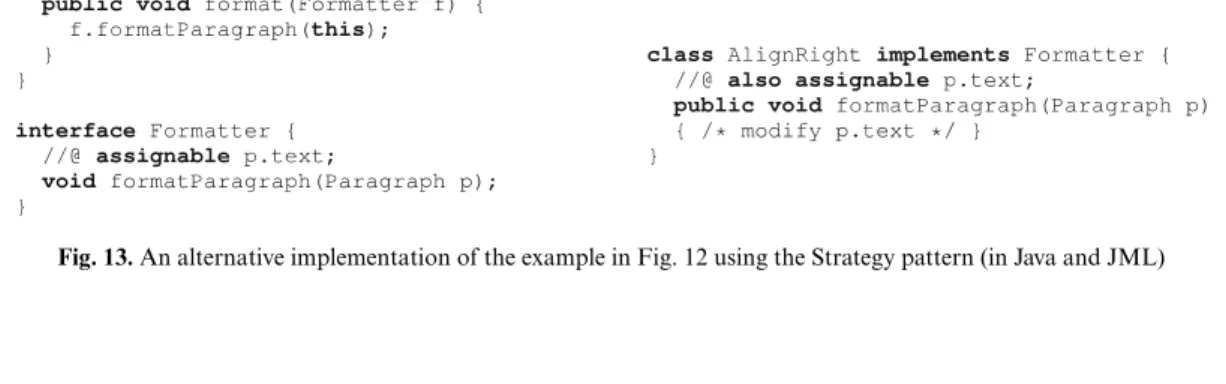
A type-safe way of implementing function objects in object-oriented languages is the Strategy pattern [GHJV95]. This pattern consists of an interface with the signature of the method that should be passed as a function object and subclasses implementing this method. Alternatively, C#’s delegates [ECM05a] and Eiffel’s agents [ECM05b] are language features that provide type-safe function objects. In this section, we discuss how to specify meth-ods that use function objects and how to verify invocations of function objects. We illustrate the challenges by the Strategy pattern and delegates with a single underlying method, but the discussion also applies to multicast delegates and Eiffel agents.
5.1. Specification of methods that use function objects
Fig. 12 on the next page shows a typical application of function objects. In this example, theformatmethod of classParagraphtakes a delegate as an argument. This delegate represents a format algorithm that is applied