Publisher’s version / Version de l'éditeur:
Vous avez des questions? Nous pouvons vous aider. Pour communiquer directement avec un auteur, consultez la première page de la revue dans laquelle son article a été publié afin de trouver ses coordonnées. Si vous n’arrivez pas à les repérer, communiquez avec nous à [email protected].
Questions? Contact the NRC Publications Archive team at
[email protected]. If you wish to email the authors directly, please see the first page of the publication for their contact information.
https://publications-cnrc.canada.ca/fra/droits
L’accès à ce site Web et l’utilisation de son contenu sont assujettis aux conditions présentées dans le site
LISEZ CES CONDITIONS ATTENTIVEMENT AVANT D’UTILISER CE SITE WEB.
Combustion Institute Canadian Section, 2008 Spring Technical Meeting [Proceedings], 2008
READ THESE TERMS AND CONDITIONS CAREFULLY BEFORE USING THIS WEBSITE. https://nrc-publications.canada.ca/eng/copyright
NRC Publications Archive Record / Notice des Archives des publications du CNRC :
https://nrc-publications.canada.ca/eng/view/object/?id=c107d35e-668e-4485-87a2-d731859933ce https://publications-cnrc.canada.ca/fra/voir/objet/?id=c107d35e-668e-4485-87a2-d731859933ce
NRC Publications Archive
Archives des publications du CNRC
This publication could be one of several versions: author’s original, accepted manuscript or the publisher’s version. / La version de cette publication peut être l’une des suivantes : la version prépublication de l’auteur, la version acceptée du manuscrit ou la version de l’éditeur.
Access and use of this website and the material on it are subject to the Terms and Conditions set forth at
Molecular dynamics simulation of thermal accommodation coefficients for LII experiments
Molecular Dynamics Simulation of Thermal
Accommodation Coefficients for LII Experiments
K. J Daun
1, F. Liu
2, and G. J. Smallwood
21
Mechanical and Mechatronics Engineering, University of Waterloo, Ontario, Canada
2
National Research Council of Canada, Ontario, Canada
ABSTRACT
Time-resolved laser-induced incandescence demands precise knowledge of the thermal accommodation coefficient, but little is known about the physics underlying this parameter. This paper presents the results of a molecular dynamics simulation that shows how the thermal accommodation coefficient is influenced by gas molecular mass and gas temperature. The MD results are also used to define scattering kernels that form boundary conditions in DSMC simulations of heat and momentum transfer between soot aggregates and surrounding gas molecules
INTRODUCTION
Accurate particle sizing by time-resolved laser-induced incandescence (TR-LII) requires an accurate model of heat transfer between the energized particles and the surrounding gas. In the majority of low-fluence TR-LII measurements on soot-laden aerosols this occurs mainly by free-molecular conduction, where gas molecules travel between the equilibrium gas and the particle surface without intermolecular collisions. In this regime heat transfer rate depends on the gas/surface collision kinetics specified by the thermal accommodation coefficient, α, defined as
(1)
where Ts is the particle temperature, and Tg,i and Tg,o are the kinetic temperatures of the incident
and scattered gas molecular streams, respectively. In the simplest case of a monatomic gas α can be rewritten in terms of the average translational kinetic energies of incident and scattered gas molecules,
(2)
where vi and vo are the incident and scattered velocities, respectively. Accurate particle sizing
through TR-LII data can only be carried out if the accommodation coefficient is known with certainty. Because the underlying physics of this parameter is poorly understood, the LII community treats the thermal accommodation coefficient more like a calibration constant than a physical parameter; there is almost no consensus of what may constitute a "reasonable" value for this coefficient, or how it may vary with experimental parameters including gas composition and temperature. This paper seeks to elucidate the thermal accommodation coefficient physics by simulating gas-surface scattering in LII using a classical mechanics-based molecular dynamics (MD) simulation. A comparison of the simulated and experimentally-measured α values shows good agreement between the two datasets. These promising results suggest that a broader understanding of the underlying physics of thermal accommodation in TR-LII is within reach.
i g s i g o g T T T T , , , − − = α
[
]
(
s g)
B i i o o g T T k m − ⋅ − ⋅ = 2 2 1 v v v v αMOLECULAR DYNAMICS SIMULATION
Soot aggregates consist of chains of roughly spherical primary particles that in turn contain flat graphite crystallites aligned parallel to the surface. Given the limited potential range between an incident gas molecule and a soot primary particle, free-molecular heat conduction can be modeled as a large number of independent scattering events between incident gas molecules and a graphite half-space having the same temperature as the laser-energized soot. The scattering events are simulated using a classical mechanics-based MD approach in which pairwise potentials are defined between bodies as a function of their relative locations and then differentiated to obtain the forces acting on each atom. Atomic and molecular trajectories are then calculated by integrating the equations of motion over time.
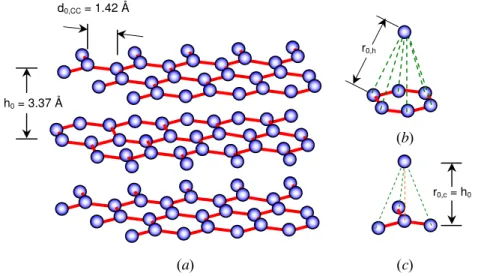
As shown in Fig. 1 (a), covalently-bonded carbon atoms form the graphene sheets, which in turn are held together by comparatively weak Van der Waals forces. The covalent bonds between carbon atoms are represented by a harmonic potential [1],
(3)
where r is the centre-to-centre distance between a C-C pair, r0,CC is the equilibrium bond length,
and kcc is the harmonic potential constant. The Van der Waals forces holding the graphene
sheets together are modeled by the sum of Morse potentials between a carbon atom and its nearest neighbors in the upper and lower graphene sheets [2]. For atoms centered above or below a six-member ring as shown in Fig. 1 (b), the potential is given by
(4)
where ri is the centre-to-centre distance between the carbon atom and the ith carbon atom in the
ring above or below and UhM(r) is a Morse pairwise potential,
(5)
For carbon atoms centered directly above or below another carbon atom, as shown in Fig. 1 (c), the interplane potential is modeled as
(6)
where UcM(r) corresponds to the potential between the carbon atom and the second atom directly
above or below and has the same form as Eq. (5), and the summation terms pertain to the three next-nearest neighbors.
The potential well between the incident gas molecule and the soot surface is modeled as the sum of pairwise Lennard-Jones (L-J) 6-12 potentials between the gas molecule and the carbon atoms,
(7)
( )
(
)
, 2 1 2 ,cc o cc cc r k r r U = −( )
, 6 1∑
= = i i M h h U r U( )
h{
exp[
2 h(
0,h)
]
2exp[
h(
0,h)
]
}
. M h r D a r r a r r U = − − − − −( )
( )
∑
= + = 3 1 i M c i M h c U r U r U( )
4 . 6 12 ⎥ ⎥ ⎦ ⎤ ⎢ ⎢ ⎣ ⎡ ⎟ ⎟ ⎠ ⎞ ⎜ ⎜ ⎝ ⎛ − ⎟ ⎟ ⎠ ⎞ ⎜ ⎜ ⎝ ⎛ = gs gs gs gs gs gs r r r U ε σ σThe L-J model parameters are found by matching experimentally-reported atomic equilibrium distances and dissociation energies between different gas molecules and graphite [3] to values predicted by integrating the L-J potentials over the graphite half-space [2]. The interatomic potential parameters are summarized in Table 1.
Fig. 1: Graphite consists of sheets of (a) covalently bonded carbon atoms in a hexagonal lattice, joined by weak Van der Waals forces. Lattice configurations corresponding to Eqs. (4) and (6) are shown in (b) and (c), respectively.
Table 1: Molecular Dynamics Simulation Parameters
Graphite Potential Gas-Surface Potential [2, 3]
dcc = 1.42 Å Species εgs [meV] σgs [Å]
Harmonic potential for
in-plane covalent bonds [1] kcc = 44.44 meV He 1.53 2.65
Dh = 6.72 meV Ne 2.71 2.78
ah = 1.399 Å-1 Ar 6.27 3.1
r0,c = 3.37 Å Kr 7.61 3.2
Dc = 18.19 meV Xe 9.20 3.3
Morse potential for inter-plane Van der Waals forces [2]
ac = 1.369 Å -1
The molecular dynamics simulation described above forms the kernel of a Markov-Chain Monte Carlo (MCMC) integration for estimating α. At the beginning of the kth trial the carbon atoms are assigned random velocities so that the average speed corresponds to a surface temperature of 3000 K. The atomic trajectories are then solved with velocity-Verlet integration. The graphite surface is first “warmed up” for 40 time steps over which time an Andersen thermostat maintains the desired surface temperature. The thermostat is then turned off and a gas molecule is introduced into the simulation starting from 10·σgs above the graphite sheet, where the forces
between the gas molecule and the carbon atoms are negligible. The initial velocity of the gas molecule is sampled from Maxwell-Boltzmann distributions for an equilibrium gas at Tg = 300
K. The attractive Van der Waals forces between the gas molecule and the carbon atoms accelerate the molecule towards the graphite sheet until it is repelled by the oscillating potential surface; in some cases, a single collision scatters the gas atom, while in other cases it “hops” along the surface until it gains enough energy to escape the potential well. The molecular
h0 = 3.37 Å d0,CC = 1.42 Å (a) (b) (c) r0,c = h0 r0,h
trajectories are tracked until the gas molecule stops decelerating, at which point the accommodation coefficient for the trial is calculated as
(8)
A stable estimate of α is eventually obtained by averaging a large number of αk trials.
RESULTS AND DISCUSSION
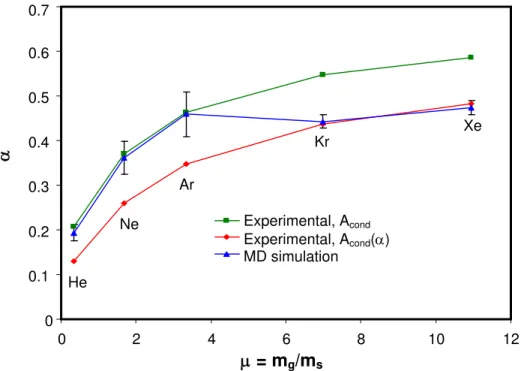
Figure 2 shows the simulated accommodation coefficients with error bars denoting three standard deviations of the mean, corresponding to the average of approximately 1500 independent trials. These results are plotted with two sets of αT measurements derived by
matching the modeled heat transfer rate to TR-LII experimental data for soot of known morphology [4]. One set is calculated by setting the heat transfer area of the soot aggregate equal to its 2-D projected area, denoted Acond in the graph, following the premise that an
approaching soot molecule “sees” a 2-D projection of the soot particle [5]. The second set of data was derived using a slightly larger area, Acond(α), which accounts for gas molecules that
reach “shielded” primary particles at the aggregate interior through scattering and incomplete accommodation with exposed primary particles [6]. The MD-simulated thermal accommodation coefficients lie between these two sets of experimental data, and show the same increasing trend of α with respect to molecular mass, μg.
Fig. 2: Comparison between MD-simulated and experimentally-measured αT values.
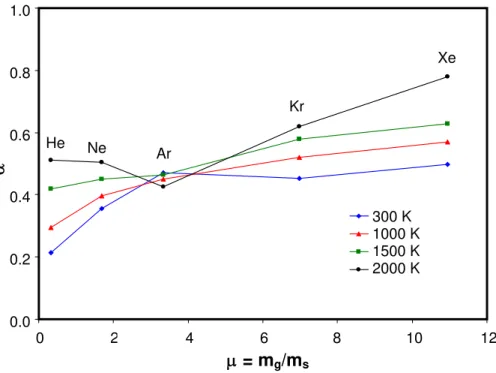
The MD simulation can be used to study other aspects of thermal accommodation in TR-LII experiments. A particularly important issue is how the gas temperature influences α through gas molecular approach velocity, since TR-LII experiments are performed on aerosols ranging from 300 K to 2000 K, and it is not clear how an accommodation coefficient measured at one gas temperature should compare to a value obtained at another temperature. Figure 3 shows that the
0 0.1 0.2 0.3 0.4 0.5 0.6 0.7 0 2 4 6 8 10 12 μ = mg/ms α Experimental, Acond Experimental, Acond(α) MD simulation He Ne Ar Kr Xe
(
)
(
)
. 2 2 1 g s k i k i k o k o g k T T k m − ⋅ − ⋅ = B v v v v αsimulated α values increase with Tg for all species except argon; although these results pertain to
monatomic gases, it does seems consistent with α values reported in the literature for in-flame soot, α = 0.37 [6], and soot extracted from the same flame into nitrogen at ambient temperature,
α = 0.18 [4].
Fig. 3: Influence of aerosol gas temperature on MD-simulated α values.
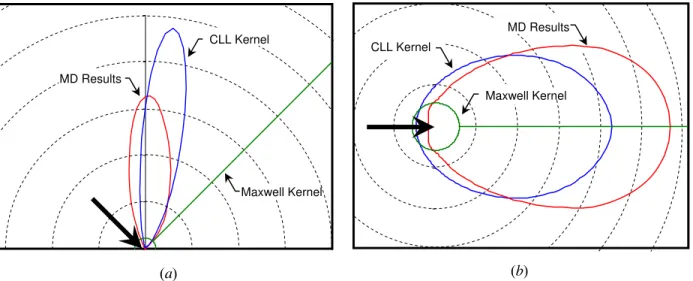
Finally, the MD simulation can be used to investigate the veracity of different scattering kernels that form boundary conditions in DSMC simulations of heat and momentum transfer between soot particles and the surrounding gas (e.g. [6-8]). These kernels define the probability of a gas molecule having an approach velocity, vi, scattering with an exit velocity vo. The Maxwell
kernel has been used in all DSMC simulations involving soot to date; it assumes that incident gas molecules equilibrate and are re-emitted diffusely with velocities sampled from a M-B distribution at Ts with a probability of α, and undergo specular, adiabatic scattering otherwise. A
more sophisticated kernel is the Cercignani-Lampis-Lord (CLL) scattering kernel [9, 10]
(9)
where ξi and ξo are the incident and scattered molecular velocities normalized by the most
probable speed at the surface temperature, (2kBTs/mg)1/2, subscripts n and t denote normal and
tangential components, and αn and αt are corresponding accommodation coefficients, defined so
that α = ½(α,n+α,t). [These parameters are obtained by averaging terms from the MD simulation
similar in form to Eq. (8).] Figure 4 shows the scattering probabilities predicted by the CLL
0.0 0.2 0.4 0.6 0.8 1.0 0 2 4 6 8 10 12 μ = mg/ms α 300 K 1000 K 1500 K 2000 K He Ne Ar Kr Xe
(
)
(
)
(
)
, 1 2 I 1 1 exp 2 , , 0 2 , , 2 , 2 , , ⎟ ⎟ ⎠ ⎞ ⎜ ⎜ ⎝ ⎛ − × ⎥ ⎥ ⎦ ⎤ ⎢ ⎢ ⎣ ⎡ + − − − + − = → n i n o n n t t i t t o n n i n n o t n n o o i R ξ ξ α α α α α ξ α ξ α πα ξ ξ ξ ξ ξkernel are in much better agreement with the MD simulation than the Maxwell kernel for the case of a beam of neon molecules traveling at the most probable speed at 300 K and striking the surface at 45º incidence. These results suggest that DSMC simulations of heat and momentum transfer between soot aggregates and the surrounding gas should be reevaluated using the CLL kernel in place of the Maxwell kernel.
Fig. 4: Directional scattering probability for an incident molecular beam of neon molecules: (a) in the incidence plane, and (b) over all zenith angles.
CONCLUSIONS
This paper presents a molecular dynamics simulation that elucidates the gas-surface scattering that underlies free-molecular heat conduction in time-resolved laser-induced incandescence experiments. The simulated thermal accommodation coefficients agree with experimentally-measured values, which verifies that the interaction between the gas molecule and soot surface can be modeled using classical mechanics. The MD simulation was then used to investigate the effect of gas temperature on α, and finally to compare the accuracy of the Maxwell and CCL scattering kernels. Future work will focus on extending this treatment to polyatomic gases, and applying these results to enhance DSMC simulations involving soot aggregates.
REFERENCES
1. Cohen, L. K., J. Chem. Phys. 99:9652 (1993).
2. Någård, M. B., Andersson, P. U., Marković, N., and Pettersson, J. B. C., J. Chem. Phys. 109: 10339 (1998).
3. Vidali, G., Ihm, G., Kim, H.-Y., and Cole, M. W., Surf. Sci. Reports 12:133 (1991). 4. Daun, K. J., Smallwood, G. J., and Liu, F., J. Heat Trans. (submitted).
5. Snelling, D. R., Liu, F., Smallwood, G. J., and Gülder, Ö. L., Comb. Flame 136:180 (2004). 6. Liu, F., Yang, M., Hill, F. A., Snelling, D. R., and Smallwood, G. J., App. Phys. B., 83:383 (2006).
7. Filippov, A. V., Zurita, M., and Rosner, D. E., J. Colloid Interface Sci., 229:261 (2000). 8. Makowski, D. W., J. Aerosol Sci. 37:242 (2006).
9. Cercignani, C., and Lampis, M., Transp. Theory Stat. Phys 1:101 (1971). 10. Lord, R. G., Phys. Fluids A. 3:706 (1991).
CLL Kernel Maxwell Kernel MD Results (a) Maxwell Kernel CLL Kernel MD Results (b)