arXiv:1805.01832v2 [nucl-ex] 18 Jan 2019
CERN-EP-2018-090 30 April 2018
c
2018 CERN for the benefit of the ALICE Collaboration.
Reproduction of this article or parts of it is allowed as specified in the CC-BY-4.0 license.
Anisotropic flow in Xe–Xe collisions at
√
s
NN= 5.44 TeV
ALICE Collaboration∗
Abstract
The first measurements of anisotropic flow coefficients vnfor mid-rapidity charged particles in Xe– Xe collisions at √sNN= 5.44 TeV are presented. Comparing these measurements to those from Pb–Pb collisions at √sNN= 5.02 TeV, v2is found to be suppressed for mid-central collisions at the same centrality, and enhanced for central collisions. The values of v3are generally larger in Xe– Xe than in Pb–Pb at a given centrality. These observations are consistent with expectations from hydrodynamic predictions. When both v2 and v3are divided by their corresponding eccentricities for a variety of initial state models, they generally scale with transverse density when comparing Xe–Xe and Pb–Pb, with some deviations observed in central Xe–Xe and Pb–Pb collisions. These results assist in placing strong constraints on both the initial state geometry and medium response for relativistic heavy-ion collisions.
1 Introduction
Relativistic heavy-ion collisions are believed to create a Quark–Gluon Plasma (QGP), a state of mat-ter consisting of deconfined color charges. The pressure gradients in the QGP medium convert spatial anisotropies in initial conditions of the collision to momentum anisotropies of produced particles via multiple interactions, a phenomenon referred to as anisotropic flow [1]. The magnitude of anisotropic flow can be characterized by the flow coefficients (vn), which are obtained from a Fourier expansion of the angular distribution of produced particles [2]
dN dϕ ∝ 1 + 2 ∞
∑
n=1 vncos[n(ϕ − Ψn)], (1)whereϕ is the azimuthal angle of the produced particle, n is the flow harmonic, and Ψn is the corre-sponding symmetry plane angle. For the second and third order flow coefficients (v2 and v3), various hydrodynamical calculations have demonstrated the approximate relation [3–7]
vn≈ κnεn, (2)
whereεnis the corresponding eccentricity coefficient, which governs the shape of the initial state. The variableκnencodes the response of the medium, and in particular is sensitive to the shear viscosity over entropy density ratio (η/s) and the lifetime of the system. When values of η/s are finite, this inhibits the development of momentum anisotropies. It has also received a broader interest, as its lower bound is different for perturbative QCD [8] and AdS/CFT [9]. Experimental data from both the Relativistic Heavy-Ion Collider (RHIC) and the Large Hadron Collider (LHC) [10–16], have implied values ofη/s close to the AdS/CFT minimum of 1/4π [9], suggesting that the QGP behaves as a near perfect fluid. However, uncertainties in the modeling of the initial state have prevented the extraction of more precise information [17–19].
The data set from the LHC Xe–Xe run completed in 2017 may provide an opportunity to further constrain η/s. For mid-central collisions, various initial state models predict Xe–Xe collisions at √sNN= 5.44 TeV and Pb–Pb collisions at √sNN= 5.02 TeV have similar values of ε2 at a given centrality [20, 21]. However, at the same centrality the Xe–Xe system size is smaller than Pb–Pb, and the impact of a finite η/s suppresses κ2 by 1/R, where R corresponds to the transverse size of the system [21]. Therefore, ratios of Xe–Xe/Pb–Pb v2 coefficients in the mid-centrality range could be directly sensitive toη/s, with the influence of the initial state largely cancelling out. Furthermore, hydrodynamical calculations have shown that vn/εn increases monotonically with the transverse density 1/S dNch/dη (dNch/dη is the charged particle density and S is the transverse area) across different collision energies and systems [17, 22, 23]. Bothεn and S are quantities that are obtained from an initial state model. A violation of the scaling can be the result of incorrect modeling of the density (S) or the azimuthal geometry (εn). That being the case, such an exercise where one compares vn/εnas a function of 1/S dNch/dη for both Xe–Xe and Pb–Pb collisions can further constrain the initial state. Similar investigations using RHIC data from Cu–Cu and Au–Au collisions led to important refinements in this regard, such as the relevance of initial state fluctuations [24–26] and realization of finite values ofεnfor higher order odd values of n (n≥ 3) [27]. On the other hand, an observed violation of this scaling using experimental data (assuming the initial state predictions are accurate) may reveal deficiencies in the aforementioned hydrodynamical modeling. Addressing how the information from Xe–Xe collisions can shed more light on both the medium response and initial state, is the central goal of this Letter.
2 Analysis details
The two data sets analyzed were recorded by the ALICE detector at the LHC during the Xe–Xe (2017) and Pb–Pb (2015) runs at the center of mass energies of √sNN = 5.44 TeV and √sNN = 5.02 TeV,
respectively. A more detailed description of the ALICE detector and its performance can be found elsewhere [28–30]. Charged-particle tracks at mid-rapidity are reconstructed using the Time Projection Chamber (TPC) [28, 31], the primary tracking detector. Information from the Inner Tracking System (ITS) [28, 32] is used to improve the spatial and momentum resolution of the TPC tracks. This helps to reject the background from secondaries, which originate from weak decays, conversions, secondary hadronic interactions in the detector material, and pile-up. The two innermost layers of the ITS, the Silicon Pixel Detector (SPD), are employed for triggering and event selection. The two V0 counters [28, 33], each containing 32 scintillator tiles and covering 2.8 < η < 5.1 (V0A) and−3.7 < η < −1.7 (V0C), provide information for triggering, event selection, the determination of centrality and the symmetry plane angle [34]. The trigger conditions and the event selection criteria are described elsewhere [29]. An offline event selection is applied to remove beam-induced background (i.e., beam-gas events) and pile-up events, which are rejected using information from the ITS and V0 detectors. Primary vertex information is provided by tracks reconstructed in the ITS and TPC. Only events with a reconstructed primary vertex within 10 cm from the center of the detector along the beam axis (that position is denoted by PVz) are used in the analysis to ensure a uniform acceptance inη. The resulting event sample available for analysis consisted of∼ 1.0M Xe–Xe events in the 0–70% centrality range, and ∼ 67M events for Pb– Pb collisions in the same centrality interval.
The charged tracks at mid-rapidity used to determine the flow coefficients have the kinematic values 0.2 < pT< 10 GeV/c and |η| < 0.8. The track fit uses an SPD hit if one exists within the trajectory, if not, they are constrained to the primary vertex. Such a configuration leads to a relatively flat azimuthal acceptance. Track quality is ensured by requiring tracks to have at least 70 TPC space points out of a maximum of 159 with an averageχ2per degree-of-freedom for the track fit lower than 2. In addition, the distances of closest approach to the primary vertex in the xy plane and z direction are required to be less than 2.4 cm and 3.2 cm, respectively. The charged particle track reconstruction efficiency is estimated from HIJING simulations [35, 36] combined with a GEANT3 [37] transport model.
In order to extract the flow coefficients from charged particles produced in either Xe–Xe or Pb–Pb col-lisions, the Scalar Product [38] and Generic Framework [39, 40] methods are used, which evaluate m particle flow coefficients vn{m}. The vn{m} coefficients characterize flow fluctuations, and are sensitive to correlations not related to the common symmetry planesΨn (“non-flow”), such as those due to reso-nances and jets. The contribution from flow fluctuations was shown to decrease vn{m ≥ 4} and increase vn{2} relative to hvni [41]. In the absence of flow fluctuations and non-flow, vn{m} is independent of m. Both methods feature calculations involving the Qn-vector which is defined as
Qn= M
∑
i
einϕi, (3)
where M is the number of particles used to build the Qn-vector in a single event, andϕi is the azimuthal angle of particle i. For the Scalar Product method, the flow coefficients vn(denoted as vn{2,|∆η| > 2}) are measured using
vn{SP} = hhun,kQ∗nii ,s hQnQA∗ n ihQnQBn∗i hQA nQBn∗i , (4)
where un,k= exp(inϕk) is the unit flow vector of the particle of interest k. The brackets h··· i denote an average over all events, the double bracketshh··· ii an average over all particles in all events, and∗the complex conjugate. The vector Qnis calculated from the azimuthal distribution of the energy deposition measured in the V0A. Its x and y components are given by
Qn,x=
∑
jwjcos(nϕj), Qn,y=
∑
jwjsin(nϕj), (5)
where the sum runs over all channels j of the V0A detector ( j= 1 − 32), ϕj is the azimuthal angle of channel j, and wjis the amplitude measured in channel j. The vectors QAn and QBn are determined from
the azimuthal distribution of the energy deposition measured in the V0C and the azimuthal distribution of the tracks reconstructed in the ITS and TPC, respectively. The large gap in pseudo-rapidity (|∆η| > 2.0) between the charged particles in the TPC used to determine vnand those in the V0A greatly suppresses non-flow effects. The courseϕ segmentation of the V0 leads to a deterioration of resolution for higher order flow coefficients (n≥ 4), and prevents their measurements.
The flow coefficients vn{m} from two- and multi-particle cumulants can also be obtained using the Generic Framework. The calculations using the Qn-vector are generally much more complex than those shown in Eq. 4, and can be found elsewhere [40]. This approach provides a capability for the neces-sary corrections of systematic biases from non-uniform detector acceptance and tracking inefficiencies, and it has been used in other measurements [16, 42, 43]. It can also be used to suppress non-flow by placing anη-gap between various Qn-vectors. The non-flow contribution to vn{m ≥ 4} in this frame-work is strongly suppressed by construction without the use of an η-gap. The newly developed sub-event methods [44, 45], provide additional means of suppressing any residual non-flow contributions for vn{m ≥ 4}. The Generic Framework is used for measurements of vn{2,|∆η| > 1} and vn{m ≥ 4} (including v2{4,3 sub-event}) from charged tracks in the TPC acceptance only.
When constructing Eq. 3 from charged particles to determine vn{m}, particle-wise weights are placed to account for non-uniformities in theϕ acceptance and pTdependent efficiencies. The systematic uncer-tainties for vn{m} have three sources: event selection, track type/selection, and the Qn-vector correction procedure. The event selection contributions were determined by varying the PVzranges, not applying the pile-up rejection criteria, and using a different detector system (ITS) for centrality determination. The track type/selection uncertainties were determined by using tracks with TPC information only or tracks that always have an ITS hit (which changes the contributions from secondary particles), changing the track quality cuts (such as the minimum number of TPC space points), and comparing any differences between determining Qn or un,k from positive or negative only TPC tracks (both charge signs are used to build a flow vector for the final results). Finally, the uncertainties in Qn-vector correction procedure contribution are due to uncertainties in the pTdependent efficiencies. The individual sources of system-atic uncertainty are assumed uncorrelated and are added in quadrature to obtain the overall estimated systematic uncertainties. For the pT-integrated vn{m} coefficients, the total systematic uncertainties are typically 2–3%, and smaller than the marker size in the corresponding figures. The systematic uncertain-ties for the pT-differential coefficients can be larger, and are denoted by boxes in the relevant figures.
3 Results
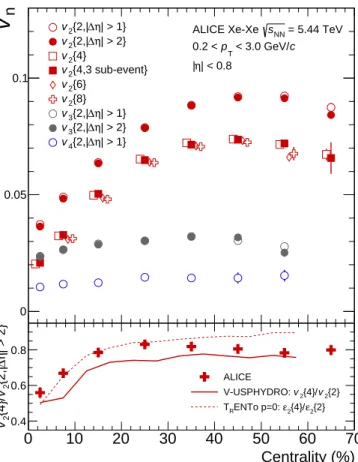
The top panel of Fig. 1 shows two- and multi-particle pT-integrated vn{m} coefficients from Xe–Xe collisions at √sNN= 5.44 TeV as a function of centrality. A stronger dependence of v2 with centrality compared with v3 or v4, also observed in Pb–Pb collisions at LHC energies [13–16], is expected based on simple considerations of how the almond shaped overlap region changes with centrality for A–A col-lisions. Given that near-side non-flow correlations (where the particles involved have similar values ofϕ andη) are expected to be the largest non-flow contribution, the similarities observed for vn{2,|∆η| > 2} and vn{2,|∆η| > 1} indicate non-flow is strongly suppressed by a gap of one unit of pseudorapidity. The extracted values of v2{m ≥ 4} use Qn-vectors without anyη gaps. The v2{4,3 sub-event} results haveη gaps between the Qn-vectors to suppress non-flow. The sub-event regions are−0.8 < η ≤ −0.4, −0.4 < η ≤ 0.4 and 0.4 < η ≤ 0.8. The equivalence with v2{4} (no η separation) demonstrates that such a gap is actually not required for these flow coefficients. Given all those observations regarding non-flow, one can interpret differences between v2{2} and v2{4}, v2{6}, v2{8} to be largely driven by flow fluctu-ations [41]. To quantify these differences, in the bottom panel of Fig. 1, the ratio v2{4}/v2{2,|∆η| > 2} is shown, which is found to decrease for central collisions. The results are compared to a hydrodynamic calculation in the same panel, which uses anη/s = 0.047 to model the medium response [21]. For these hydrodynamic calculations, the TRENTo initial condition model [46] is used to determine the
eccen-0 10 20 30 40 50 60 70 0 0.05 0.1 n
v
v2{2,|∆η| > 1} | > 2} η ∆ {2,| 2 v {4} 2 v {4,3 sub-event} 2 v {6} 2 v {8} 2 v | > 1} η ∆ {2,| 3 v | > 2} η ∆ {2,| 3 v | > 1} η ∆ {2,| 4 v = 5.44 TeV NN s ALICE Xe-Xe c < 3.0 GeV/ T p 0.2 < | < 0.8 η | 0 10 20 30 40 50 60 70 Centrality (%) 0.4 0.6 0.8 | > 2} η∆ {2,|2 v/ {4}2 v ALICE {2} 2 v / {4} 2 v V-USPHYDRO: {2} 2 ε / {4} 2 ε ENTo p=0: R TFig. 1: Top panel: Charged particle vnintegrated over the transverse momentum range 0.2 < pT< 3.0 GeV/c as a function of centrality from Xe–Xe collisions. The various techniques are explained in the text. Only statistical uncertainties are visible (thin vertical lines). Bottom panel: Ratios of v2{4}/v2{2} compared to some theoretical predictions. The hydrodynamic predictions use a shear viscosity over entropy ratioη/s = 0.047 and initial condi-tions from the TRENTo model [21, 46]. For v2{2}, the ALICE measurements implement a |∆η| > 2.0 gap which is not used in the models.
tricities. The justification for using p= 0 is described later in the Letter. The initial condition model implements a129Xeβ2deformation (β2= 0.162), which is predicted for the129Xe nucleus [47], but has never been measured directly. It modifies the Woods-Saxon distribution as follows [48]
ρ(r, θ ) = ρ0
1+ e(r−R0−R0β2Y20(θ))/a, (6)
whereρ0 is the density at the center of the nucleus, R0the nuclear radius, r is the distance away from the center, Y20 is a Bessel function of the second kind, and a is the skin depth. According to Eq. 2, the ratio of flow coefficients v2{4}/v2{2} should be identical to the ratio of initial state eccentricities ε2{4}/ε2{2}. To test this relation, the bottom panel of Fig. 1 also shows the flow coefficient ratios and the eccentricity ratios from the same model. The difference between the two curves shows that Eq. 2 only holds approximately. The hydrodynamic calculations generally predict lower ratios compared to the data, with the largest deviations being in the semi-central region (10–50%).
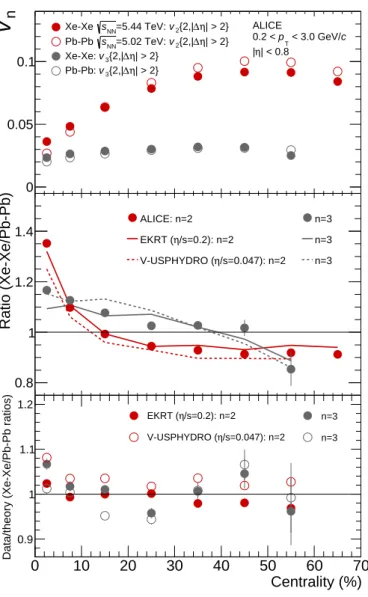
Figure 2 shows comparisons of two-particle pT-integrated vn{2} coefficients from Xe–Xe and Pb–Pb collisions as a function of centrality. The differences between the two systems are typically within 10% except for v2{2} in central 0–5% collisions where the Xe–Xe values are ∼ 35% higher. For the V-USPHYDRO and EKRT models [20, 21] shown, both sets of the used initial condition models
demon-0 10 20 30 40 50 60 70 0 0.05 0.1 n
v
=5.44 TeV: v2{2,|∆η| > 2} NN s Xe-Xe | > 2} η ∆ {2,| 2 v =5.02 TeV: NN s Pb-Pb | > 2} η ∆ {2,| 3 v Xe-Xe: | > 2} η ∆ {2,| 3 v Pb-Pb: ALICE c < 3.0 GeV/ T p 0.2 < | < 0.8 η | 0 10 20 30 40 50 60 70 0.8 1 1.2 1.4 Ratio (Xe-Xe/Pb-Pb) ALICE: n=2 n=3 /s=0.2): n=2 η EKRT ( n=3 /s=0.047): n=2 η V-USPHYDRO ( n=3 0 10 20 30 40 50 60 70 Centrality (%) 0.9 1 1.1 1.2Data/theory (Xe-Xe/Pb-Pb ratios)
/s=0.2): n=2 η EKRT ( n=3 /s=0.047): n=2 η V-USPHYDRO ( n=3
Fig. 2:Top panel: Comparisons of charged particle vn{2} integrated over the transverse momentum range 0.2 < pT< 3.0 GeV/c as a function of centrality from Xe–Xe and Pb–Pb collisions. Middle panel: Ratio of vn{2}(Xe– Xe/Pb–Pb) coefficients. Bottom panel: Double ratio of data and theory. Hydrodynamical model predictions from EKRT [20] and V-USPHYDRO [21] are shown. In all cases, only statistical uncertainties are visible (thin vertical lines).
strate ε2{2}(Xe–Xe)/ε2{2}(Pb–Pb) ∼ 1 for the semi-central range 20–60% (not shown in the figure). However, v2{2}(Xe–Xe)/v2{2}(Pb–Pb) ∼ 0.9 from the data, which might be the result of the viscous ef-fects described in the Introduction. When implementing the hydrodynamical response, both models also show a similar suppression for the smaller Xe–Xe system, albeit with differences of up to∼ 5% compared to the data. On the other hand, despite using different values ofη/s, both models predict similar ratios in the semi-central range. Some assumptions used in each of the models (such as the freeze-out temper-ature) are different, and investigating the impact of those assumptions on v2{2}(Xe–Xe)/v2{2}(Pb–Pb) ratio should be a topic of further theoretical investigations.
Both sets of model predictions (V-USPHYDRO and EKRT) implement a129Xe deformation usingβ2= 0.162. The value of β2is zero for the208Pb nucleus, as it is a double magic nucleus. The deformation for the Xe–Xe V-USPHYDRO predictions contributes ∼ 20% to the observed v2{2} for central collisions (compared with the case where no deformation is implemented), and has no impact on v2{2} for
central-0 2 4 6 8 10 12 14 16 18 20 0 0.05 0.1 n
v
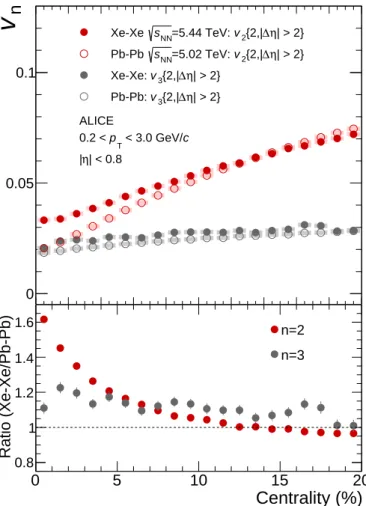
{2,|∆η| > 2} 2 v =5.44 TeV: NN s Xe-Xe | > 2} η ∆ {2,| 2 v =5.02 TeV: NN s Pb-Pb | > 2} η ∆ {2,| 3 v Xe-Xe: | > 2} η ∆ {2,| 3 v Pb-Pb: ALICE c < 3.0 GeV/ T p 0.2 < | < 0.8 η | 0 5 10 15 20 Centrality (%) 0.8 1 1.2 1.4 1.6 Ratio (Xe-Xe/Pb-Pb) n=2 n=3Fig. 3: Top panel: Comparisons of charged particle vn{2} integrated over the transverse momentum range 0.2 < pT< 3.0 GeV/c from Xe–Xe and Pb–Pb collisions for finer centrality bins in central collisions. Statisti-cal and systematic uncertainties are shown as lines and boxes, respectively. Bottom panel: Corresponding ratio of vn{2}(Xe–Xe/Pb–Pb) coefficients.
ities above 15%. Regarding v3{2}, it is generally larger in Xe–Xe, which reflects the fact that the initial conditions from both models show ε3{2}(Xe–Xe) > ε3{2}(Pb–Pb) at a given centrality for the entire centrality range presented. The hydrodynamic predictions for v3{2} are similar for the two models, with maximum deviations of∼ 5 % from the data. The β3deformation for both the Xe and Pb nuclei is zero [47], with both models assuming such a value.
In Fig. 3, similar comparisons are made in finer centrality bins as compared with Fig. 2 for central colli-sions. The transition where Xe–Xe v2{2} becomes larger than the Pb–Pb values occurs for a centrality of ∼ 15%. For 0–1% central collisions, where the overlap geometry is expected to play a minimal role for both systems, v2{2} is ∼ 60% larger for Xe–Xe collisions. In terms of the initial state, this is expected for two reasons. The first relates to the fact that the129Xe nucleus is deformed while the208Pb nucleus is not, and the second relates to the role of initial state fluctuations and the number of sources that con-tribute toεn{2}. It has been previously shown that εn{2} decreases as the number of sources increases for a spherical system [49], and if the number of sources were infinite, thenεn{2} would be zero in this centrality range. Given that a very central Pb–Pb collision is expected to have more sources than a very central Xe–Xe collision, fluctuations would be expected to give rise to larger values ofε2{2} for the latter. The same line of reasoning can explain why v3{2} is observed to be larger in Xe–Xe compared to Pb–Pb in the same centrality interval.
0 2 4 6 8 ) c (GeV/ T p 0 0.1 0.2
|>2}
η∆
{2, |
2v
30-40% 0 0.1 0.2|>2}
η∆
{2, |
2v
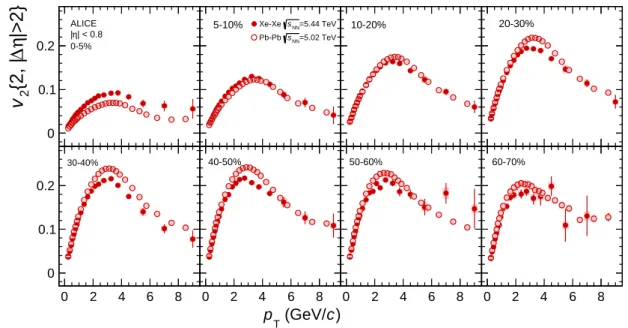
ALICE | < 0.8 η | 0-5% 0 2 4 6 8 ) c (GeV/ T p 0 0.1 0.2 40-50% 0 0.1 0.2 =5.44 TeV NN s Xe-Xe =5.02 TeV NN s Pb-Pb 5-10% 0 2 4 6 8 ) c (GeV/ T p 0 0.1 0.2 50-60% 0 0.1 0.2 10-20% 0 2 4 6 8 ) c (GeV/ T p 0 0.1 0.2 60-70% 0 0.1 0.2 20-30%Fig. 4:The pT-differential v2for charged particles from Xe–Xe collisions at √sNN= 5.44 TeV and Pb–Pb colli-sions at √sNN= 5.02 TeV for various centrality classes. Statistical and systematic uncertainties are shown as lines and boxes, respectively.
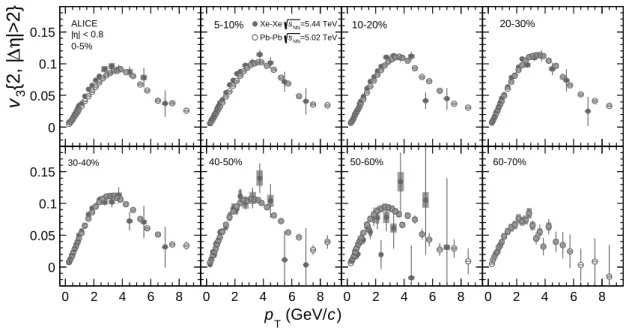
Figure 4 shows comparisons of two-particle pT-differential v2{2,|∆η| > 2} coefficients from Xe–Xe and Pb–Pb collisions in various centrality bins. As mentioned, the larger|∆η| gap measurements use both the TPC and the V0 detectors, which maximizes the number of particles used to build the Qn-vectors. The corresponding reduction in statistical uncertainties is particularly useful for the higher pTmeasurements. As expected, the centrality dependence of v2{2,|∆η| > 2} from Xe–Xe collisions follows that observed in Fig. 1. Compared with Pb–Pb collisions in the semi-central bins, it appears the differences observed in Fig. 2 are larger in the mid-pT region, and this will be investigated more quantitatively. Figure 5 shows the same comparison for pT-differential v3{2,|∆η| > 2} coefficients. The Xe–Xe coefficients are typically larger than from Pb–Pb collisions at a given centrality at low pT, whereas the larger statistical uncertainties for the Xe–Xe coefficients at higher pTmake it difficult to establish whether there are any differences between the two systems.
Figure 6 shows the pT-integrated vn{2}/εn{2} ratios as a function of 1/S dNch/dη in Xe–Xe and Pb–Pb collisions, where S and εn{2} are obtained using various initial state models. The vn{2}/εn{2} ratio provides estimates ofκnas per Eq. 2. As mentioned, when comparing vn/εn from different systems, a violation of the scaling with 1/S dNch/dη (which increases with centrality), maybe indicative of short-comings in the modeling of the initial state (and its fluctuations). Regarding the model parameters used for this exercise, in the transverse plane for a single event, both the eccentricities and areas are calculated in the center of mass frame respectively according to
εn=phr′ncos(nφ′)i
2+ hr′nsin(nφ′)i2
hr′ni , (7)
S= 4πσx′σy′, (8)
which is defined such that the sources that contribute to the eccentricity and area have the propertyhx′i = hy′i = 0, where x′, y′andϕ′, r′are the cartesian and the polar coordinates of the source, respectively. The quantities σx′ and σy′ represent the standard deviations of the source distributions. The event averages
0 2 4 6 8 ) c (GeV/ T p 0 0.05 0.1 0.15
|>2}
η∆
{2, |
3v
30-40% 0 0.05 0.1 0.15|>2}
η∆
{2, |
3v
ALICE | < 0.8 η | 0-5% 0 2 4 6 8 ) c (GeV/ T p 0 0.05 0.1 0.15 40-50% 0 0.05 0.1 0.15 Xe-Xe sNN=5.44 TeV =5.02 TeV NN s Pb-Pb 5-10% 0 2 4 6 8 ) c (GeV/ T p 0 0.05 0.1 0.15 50-60% 0 0.05 0.1 0.15 10-20% 0 2 4 6 8 ) c (GeV/ T p 0 0.05 0.1 0.15 60-70% 0 0.05 0.1 0.15 20-30%Fig. 5:The pT-differential v3for charged particles from Xe–Xe collisions at √sNN= 5.44 TeV and Pb–Pb colli-sions at √sNN= 5.02 TeV for various centrality classes. Statistical and systematic uncertainties are shown as lines and boxes, respectively.
used for Fig. 6 areεn{2} =qhεni2+ σε2n andhSi. The normalization of the area is chosen such that for a Gaussian distribution the average density coincides with Npart/S (Npart is the number of participating nucleons), and was used in a previous ALICE publication [53]. A deformation of β2= 0.18 ± 0.02 for the129Xe nucleus is used [30, 54]. The value was obtained from extrapolating measurements ofβ2 from nearby isotopes (128Xe and130Xe), and theoretical calculations [47, 55, 56], with the uncertainty reflecting the different values obtained from each approach. The box errors in the figure represent the corresponding uncertainties on the ratio. For the Monte Carlo (MC) Glauber and KLN models, the values ofεn{2} and S for a given V0 based centrality class were extracted using a method described in a previous publication [34]. The multiplicity of charged particles in the acceptance of the V0 detector is generated according to a negative binomial distribution, based on the number of participant nucleons and binary collisions from each initial state model. The parameters used for this approach can be found elsewhere [52, 54], and were optimized to describe the multiplicity distribution from the data. Regarding the TRENTo model, following other approaches [21, 46], the multiplicity in the acceptance of the V0 detector was modeled by scaling the entropy production, again to match the multiplicity distribution from the data.
The top left panel shows an investigation of such a scaling with the MC Glauber model [57, 58], which uses nucleon positions as the sources. In particular, for v2{2} in central Xe–Xe and Pb–Pb collisions, this model does not provide a clear scaling, and was already observed for v2 from Au–Au and U–U collisions at RHIC using the same model [59]. The scaling using the MC KLN model (version 32) [51, 60], which assumes gluon sources and uses a Color Glass Condensate approach to determine the gluon spatial distribution, is shown in the top middle panel. The MC KLN scaling appears to work well for v3{2}, but fails for v2{2} with the Xe–Xe points being above Pb–Pb for more central collisions. A sudden rise is also observed for central Pb–Pb collisions. This behavior is in contrast to the MC Glauber nucleon model, where the Xe–Xe points are below Pb–Pb for central collisions. The top right panel investigates the scaling using the TRENTo initial state model [46]. In this model, the distribution of nuclear matter within the collision zone of A–A collisions is controlled by the p parameter, with p= 0 mimicking IP-Glasma initial conditions [61, 62]. The choice of parameter was determined using
0 5 10 15 20
0 0.1 0.2 0.3
MC Glauber: constituent quarks (q=3)
0 0.1 0.2 0.3 0.4
{2}
nε
/
|>2}
η∆
{2, |
nv
ALICE c < 3.0 GeV/ T p 0.2 < | < 0.8 η | MC Glauber: nucleons 0 5 10 15 20)
-2(fm
η
/d
chN
d
S
1/
0 0.1 0.2 0.3MC Glauber: constituent quarks (q=5)
0 0.1 0.2 0.3 0.4 MC KLN Xe-Xe n=2 Pb-Pb n=2 Xe-Xe n=3 Pb-Pb n=3 0 5 10 15 20 0 0.1 0.2 0.3
MC Glauber: constituent quarks (q=7)
0 0.1 0.2 0.3 0.4 ENTo (p=0) R T
Fig. 6:Comparisons of vn{2}/εn{2} integrated over the transverse momentum range 0.2 < pT< 3.0 GeV/c as a function of 1/S dNch/dηin Xe–Xe and Pb–Pb collisions, where S andεn{2} are from various initial state models [46, 50, 51]. The models are explained in the text. The129Xe deformation implemented isβ2= 0.18 ± 0.02, with the box errors representing the uncertainty inβ2. Measurements of dNch/dη(|η| < 0.5) from Xe–Xe and Pb–Pb collisions were obtained from separate studies [30, 52].
Bayesian statistics from a simultaneous fit of charged hadron multiplicity distributions, mean transverse momentum measurements, and integrated flow coefficients vnin Pb–Pb collisions at √sNN= 2.76 TeV [63]. The IP-Glasma approach uses Color Glass Condensate calculations to determine the distribution of gluons in the initial state. This model provides a better scaling compared with the previous two other models. However for central Pb–Pb collisions, a drop is observed for v2{2}/ε2{2}. The drop is also observed in the MC Glauber nucleon model, and appears to be present for the central Xe–Xe data. Such a drop is unexpected from hydrodynamic calculations [17, 23], which show a continuous increase of v2/ε2 with 1/S dNch/dη. It may point to deficiencies in the initial state modeling of the regions in Xe– Xe and Pb–Pb collisions where initial state fluctuations play the largest role in generating second order eccentricities.
The bottom panels show ratios derived from constituent quark MC Glauber calculations, which use quarks contained in nucleons as the sources which contribute to the eccentricity [50]. The parameter q refers to the number of constituent quarks per nucleon. All implementations of quark sources (3, 5, or 7) appear to give a reasonable scaling for v2 and v3, however some deviations are observed in central Xe–Xe and Pb–Pb collisions. The value q= 5 was found to describe the charged particle yields better than q= 3 at LHC energies (assuming the yields should scale with the total number of quarks) [50], and there are hints of a slightly better scaling with q= 5 for v2{2} in central Xe–Xe collisions compared to q= 3. These model implementations again show a drop for central Pb–Pb collisions, which is least pronounced for q= 7. This suggests initial state models need a higher number of sources per nucleon in
0 2 4 6 8 10 0 0.2 0.4 0.6 0.8 {2}2 ε / |>2} η∆ {2, |2 v
Model parameters: MC Glauber constituent quarks (q=3) ~ 4.0 fm R , -2 ~ 10 fm η /d ch N d S Xe-Xe 20-30%: 1/ ~ 4.0 fm R , -2 ~ 10 fm η /d ch N d S Pb-Pb 30-40%: 1/ ~ 3.6 fm R , -2 ~ 8 fm η /d ch N d S Xe-Xe 30-40%: 1/ ALICE | < 0.8 η | 0 2 4 6 8 10 ) c (GeV/ T p 0.7 0.8 0.9 1 1.1 1.2 Ratio (Xe-Xe/Pb-Pb)
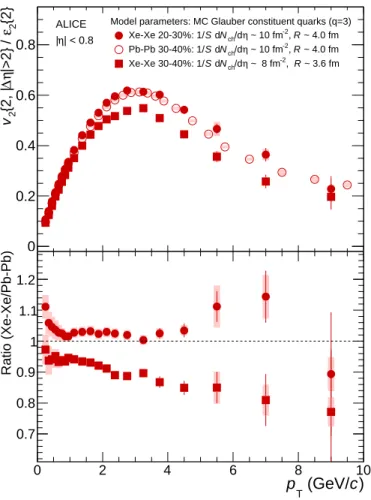
Fig. 7:Top panel: Comparison of pT-differential v2{2}/ε2{2} from Xe–Xe and Pb–Pb collisions for a selection of centrality bins. Statistical and systematic uncertainties are shown as lines and boxes, respectively. Bottom panel: Ratios of the scaled coefficients from the top panel. The Pb–Pb points are interpolated in order to determine the ratio. The circle markers show Xe–Xe 20–30%/Pb–Pb 30–40% while the square makers show Xe–Xe 30–40%/Pb– Pb 30–40%.
order to achieve a continuous increase of v2{2}/ε2{2} for more central Pb–Pb collisions, and a transverse density scaling when comparing Xe–Xe to Pb–Pb.
Finally, in Fig. 7, an investigation of whether the transverse density scaling holds as a function of pT is shown. Two Xe–Xe and Pb–Pb centrality bins with similar transverse densities (1/S dNch/dη ∼ 10 fm−2) are selected, and the pT-differential values of v2{2}/ε2{2} are shown. The pT-integrated values for the constituent quark MC Glauber model chosen (q= 3) are observed to be similar in the left bottom panel of Fig. 6. In that figure, the Xe–Xe centrality bin corresponds to the fourth point going left to right, while the Pb–Pb centrality bin corresponds to the third point. The ratio in the bottom panel of Fig. 7 uses an interpolation of the Pb–Pb data points. The ratio is independent of the initial state model used, as all give very similar values ofε2{2}(Xe–Xe)/ε2{2}(Pb–Pb). Additionally, the transverse sizes (R =pS/π) are very similar, so the previously mentioned viscous corrections should cancel. The influence of radial flow should be very similar ashpTi = 0.710 ± 0.004 GeV/c (Xe–Xe) and hpTi = 0.716 ± 0.004 GeV/c (Pb–Pb) for charged hadrons [64]. The ratio is close to 1 and shows no significant pT dependence. This indicates when such a scaling holds, it does so over the pT range presented. This may show the pT-differential medium response (κ2(pT)) is controlled by the transverse density and size, independent of the collision system. A comparison of the scaled pT-differential coefficients for the same 30–40% centrality bin from Xe–Xe and Pb–Pb collisions is also shown. In this case, the eccentricities are similar
(the differences are within 1%), however the transverse size and density of the Xe–Xe system is smaller. The ratio appears to mildly decrease with increasing pT. Whether this is the result of viscous effects related to the transverse size of the system influencing the mid-pT region more, or a smaller radial flow in Xe–Xe, remains an open question.
4 Summary
The first measurements of anisotropic flow coefficients vnin Xe–Xe collisions at √sNN= 5.44 TeV colli-sions from the ALICE detector at the LHC have been presented. Hydrodynamical predictions reproduce measurements of v2{4}/v2{2} ratios from Xe–Xe collisions to within ∼ 15% (Fig. 1). In semi-central collisions, it is found that the v2{2} coefficient is lower in Xe–Xe collisions at√sNN= 5.44 TeV com-pared with Pb–Pb collisions at √sNN= 5.02 TeV at the same centrality. The v3{2} coefficient is larger, consistent with expectations from hydrodynamical models that reproduce the differences for both sys-tems within∼ 5% (Figs. 2 and 3). The differences for v2{2} are predicted to be driven largely by the hydrodynamical response of the system. For central collisions, v2{2} is found to be larger in Xe–Xe collisions, which agrees with predictions from hydrodynamic models, but the deviations tend to be larger than∼ 5% with respect to these models. The differences between two-particle pT-differential v2{2} co-efficients from Xe–Xe compared to Pb–Pb are found to be larger at mid-pTcompared to low-pT, whereas no such trend is observed for v3{2} within uncertainties (Figs. 4 and 5). The studies of the modeling of the initial state via eccentricity scaling with transverse density (Fig. 6) have demonstrated that both the MC Glauber (constituent quarks) and the TRENTo models provide the most satisfactory descriptions. However, the drop observed for v2{2}/ε2{2} in central Xe–Xe and Pb–Pb collisions is not expected from hydrodynamic calculations. In the case of the MC Glauber implementations, the drop is more pro-nounced for nucleon and constituent quark (q= 3) sources, and may require some improvements in the initial state modeling for the region in Xe–Xe and Pb–Pb collisions whereε2{2} has the largest contri-bution from initial state fluctuations. Finally, for two Xe–Xe and Pb–Pb centrality bins with a similar transverse density and size, it is found that the double ratio [v2{2}/ε2{2}(Xe–Xe)]/[v2{2}/ε2{2}(Pb– Pb)] is largely independent of pT (Fig. 7). This may indicate the pT-differential medium response is controlled by the transverse density and size, independent of the collision system.
Acknowledgements
The ALICE Collaboration would like to thank all its engineers and technicians for their invaluable con-tributions to the construction of the experiment and the CERN accelerator teams for the outstanding performance of the LHC complex. The ALICE Collaboration gratefully acknowledges the resources and support provided by all Grid centres and the Worldwide LHC Computing Grid (WLCG) collaboration. The ALICE Collaboration acknowledges the following funding agencies for their support in building and running the ALICE detector: A. I. Alikhanyan National Science Laboratory (Yerevan Physics Institute) Foundation (ANSL), State Committee of Science and World Federation of Scientists (WFS), Arme-nia; Austrian Academy of Sciences and Nationalstiftung f¨ur Forschung, Technologie und Entwicklung, Austria; Ministry of Communications and High Technologies, National Nuclear Research Center, Azer-baijan; Conselho Nacional de Desenvolvimento Cient´ıfico e Tecnol´ogico (CNPq), Universidade Federal do Rio Grande do Sul (UFRGS), Financiadora de Estudos e Projetos (Finep) and Fundac¸˜ao de Am-paro `a Pesquisa do Estado de S˜ao Paulo (FAPESP), Brazil; Ministry of Science & Technology of China (MSTC), National Natural Science Foundation of China (NSFC) and Ministry of Education of China (MOEC) , China; Ministry of Science and Education, Croatia; Ministry of Education, Youth and Sports of the Czech Republic, Czech Republic; The Danish Council for Independent Research — Natural Sci-ences, the Carlsberg Foundation and Danish National Research Foundation (DNRF), Denmark; Helsinki Institute of Physics (HIP), Finland; Commissariat `a l’Energie Atomique (CEA) and Institut National de Physique Nucl´eaire et de Physique des Particules (IN2P3) and Centre National de la Recherche
Sci-entifique (CNRS), France; Bundesministerium f¨ur Bildung, Wissenschaft, Forschung und Technologie (BMBF) and GSI Helmholtzzentrum f¨ur Schwerionenforschung GmbH, Germany; General Secretariat for Research and Technology, Ministry of Education, Research and Religions, Greece; National Re-search, Development and Innovation Office, Hungary; Department of Atomic Energy Government of India (DAE), Department of Science and Technology, Government of India (DST), University Grants Commission, Government of India (UGC) and Council of Scientific and Industrial Research (CSIR), In-dia; Indonesian Institute of Science, Indonesia; Centro Fermi - Museo Storico della Fisica e Centro Studi e Ricerche Enrico Fermi and Istituto Nazionale di Fisica Nucleare (INFN), Italy; Institute for Innovative Science and Technology , Nagasaki Institute of Applied Science (IIST), Japan Society for the Promo-tion of Science (JSPS) KAKENHI and Japanese Ministry of EducaPromo-tion, Culture, Sports, Science and Technology (MEXT), Japan; Consejo Nacional de Ciencia (CONACYT) y Tecnolog´ıa, through Fondo de Cooperaci´on Internacional en Ciencia y Tecnolog´ıa (FONCICYT) and Direcci´on General de Asuntos del Personal Academico (DGAPA), Mexico; Nederlandse Organisatie voor Wetenschappelijk Onderzoek (NWO), Netherlands; The Research Council of Norway, Norway; Commission on Science and Technol-ogy for Sustainable Development in the South (COMSATS), Pakistan; Pontificia Universidad Cat´olica del Per´u, Peru; Ministry of Science and Higher Education and National Science Centre, Poland; Korea Institute of Science and Technology Information and National Research Foundation of Korea (NRF), Republic of Korea; Ministry of Education and Scientific Research, Institute of Atomic Physics and Ro-manian National Agency for Science, Technology and Innovation, Romania; Joint Institute for Nuclear Research (JINR), Ministry of Education and Science of the Russian Federation and National Research Centre Kurchatov Institute, Russia; Ministry of Education, Science, Research and Sport of the Slovak Re-public, Slovakia; National Research Foundation of South Africa, South Africa; Centro de Aplicaciones Tecnol´ogicas y Desarrollo Nuclear (CEADEN), Cubaenerg´ıa, Cuba and Centro de Investigaciones En-erg´eticas, Medioambientales y Tecnol´ogicas (CIEMAT), Spain; Swedish Research Council (VR) and Knut & Alice Wallenberg Foundation (KAW), Sweden; European Organization for Nuclear Research, Switzerland; National Science and Technology Development Agency (NSDTA), Suranaree University of Technology (SUT) and Office of the Higher Education Commission under NRU project of Thailand, Thailand; Turkish Atomic Energy Agency (TAEK), Turkey; National Academy of Sciences of Ukraine, Ukraine; Science and Technology Facilities Council (STFC), United Kingdom; National Science Foun-dation of the United States of America (NSF) and United States Department of Energy, Office of Nuclear Physics (DOE NP), United States of America.
References
[1] J.-Y. Ollitrault, “Anisotropy as a signature of transverse collective flow,” Phys. Rev. D46(1992) 229–245.
[2] S. Voloshin and Y. Zhang, “Flow study in relativistic nuclear collisions by Fourier expansion of Azimuthal particle distributions,” Z. Phys. C70 (1996) 665–672,
arXiv:hep-ph/9407282 [hep-ph].
[3] H. Holopainen, H. Niemi, and K. J. Eskola, “Event-by-event hydrodynamics and elliptic flow from fluctuating initial state,” Phys. Rev. C83 (2011) 034901, arXiv:1007.0368 [hep-ph].
[4] G.-Y. Qin, H. Petersen, S. A. Bass, and B. Muller, “Translation of collision geometry fluctuations into momentum anisotropies in relativistic heavy-ion collisions,” Phys. Rev. C82 (2010) 064903, arXiv:1009.1847 [nucl-th].
[5] Z. Qiu and U. W. Heinz, “Event-by-event shape and flow fluctuations of relativistic heavy-ion collision fireballs,” Phys. Rev. C84 (2011) 024911, arXiv:1104.0650 [nucl-th].
[6] C. Gale, S. Jeon, B. Schenke, P. Tribedy, and R. Venugopalan, “Event-by-event anisotropic flow in heavy-ion collisions from combined Yang-Mills and viscous fluid dynamics,”
Phys. Rev. Lett. 110no. 1, (2013) 012302, arXiv:1209.6330 [nucl-th].
[7] H. Niemi, G. S. Denicol, H. Holopainen, and P. Huovinen, “Event-by-event distributions of azimuthal asymmetries in ultrarelativistic heavy-ion collisions,”
Phys. Rev. C87no. 5, (2013) 054901, arXiv:1212.1008 [nucl-th].
[8] S. C. Huot, S. Jeon, and G. D. Moore, “Shear viscosity in weakly coupled N = 4 super Yang-Mills theory compared to QCD,” Phys. Rev. Lett. 98 (2007) 172303,
arXiv:hep-ph/0608062 [hep-ph].
[9] P. Kovtun, D. T. Son, and A. O. Starinets, “Viscosity in strongly interacting quantum field theories from black hole physics,” Phys. Rev. Lett. 94 (2005) 111601,
arXiv:hep-th/0405231 [hep-th].
[10] B. B. Back et al., “The PHOBOS perspective on discoveries at RHIC,” Nucl. Phys. A757(2005) 28–101, arXiv:nucl-ex/0410022 [nucl-ex].
[11] STAR Collaboration, J. Adams et al., “Experimental and theoretical challenges in the search for the quark gluon plasma: The STAR Collaboration’s critical assessment of the evidence from RHIC collisions,” Nucl.Phys. A757 (2005) 102–183, arXiv:nucl-ex/0501009 [nucl-ex].
[12] PHENIX Collaboration, K. Adcox et al., “Formation of dense partonic matter in relativistic nucleus-nucleus collisions at RHIC: Experimental evaluation by the PHENIX collaboration,” Nucl. Phys. A757(2005) 184–283, arXiv:nucl-ex/0410003 [nucl-ex].
[13] ALICE Collaboration, K. Aamodt et al., “Higher harmonic anisotropic flow measurements of charged particles in Pb-Pb collisions at √sNN=2.76 TeV,” Phys. Rev. Lett. 107 (2011) 032301, arXiv:arXiv:1105.3865 [nucl-ex].
[14] ATLAS Collaboration, G. Aad et al., “Measurement of the azimuthal anisotropy for charged particle production in √sNN= 2.76 TeV lead-lead collisions with the ATLAS detector,” Phys. Rev. C86(2012) 014907, arXiv:arXiv:1203.3087 [hep-ex].
[15] CMS Collaboration, S. Chatrchyan et al., “Measurement of higher-order harmonic azimuthal anisotropy in PbPb collisions at √sNN= 2.76 TeV,” Phys. Rev. C89 no. 4, (2014) 044906, arXiv:1310.8651 [nucl-ex].
[16] ALICE Collaboration, J. Adam et al., “Anisotropic flow of charged particles in Pb-Pb collisions at √sNN= 5.02 TeV,” Phys. Rev. Lett. 116 no. 13, (2016) 132302,
arXiv:1602.01119 [nucl-ex].
[17] H. Song, S. A. Bass, U. Heinz, T. Hirano, and C. Shen, “200 A GeV Au+Au collisions serve a nearly perfect quark-gluon liquid,” Phys. Rev. Lett. 106 (2011) 192301,
arXiv:1011.2783 [nucl-th]. [Erratum: Phys. Rev. Lett.109,139904(2012)].
[18] U. Heinz and R. Snellings, “Collective flow and viscosity in relativistic heavy-ion collisions,” Ann. Rev. Nucl. Part. Sci. 63(2013) 123–151, arXiv:1301.2826 [nucl-th].
[19] H. Song, Y. Zhou, and K. Gajdosova, “Collective flow and hydrodynamics in large and small systems at the LHC,” Nucl. Sci. Tech. 28 no. 7, (2017) 99, arXiv:1703.00670 [nucl-th]. [20] K. J. Eskola, H. Niemi, R. Paatelainen, and K. Tuominen, “Predictions for multiplicities and flow
harmonics in 5.44 TeV Xe+Xe collisions at the CERN Large Hadron Collider,” Phys. Rev. C97no. 3, (2018) 034911, arXiv:1711.09803 [hep-ph].
[21] G. Giacalone, J. Noronha-Hostler, M. Luzum, and J.-Y. Ollitrault, “Hydrodynamic predictions for 5.44 TeV Xe+Xe collisions,” Phys. Rev. C97 no. 3, (2018) 034904,
arXiv:1711.08499 [nucl-th].
[22] S. A. Voloshin and A. M. Poskanzer, “The Physics of the centrality dependence of elliptic flow,” Phys. Lett. B474(2000) 27–32, arXiv:nucl-th/9906075 [nucl-th].
[23] H. Song and U. W. Heinz, “Multiplicity scaling in ideal and viscous hydrodynamics,” Phys. Rev. C78(2008) 024902, arXiv:0805.1756 [nucl-th].
[24] PHOBOS Collaboration, B. Alver et al., “System size, energy, pseudorapidity, and centrality dependence of elliptic flow,” Phys. Rev. Lett. 98 (2007) 242302,
arXiv:nucl-ex/0610037 [nucl-ex].
[25] PHOBOS Collaboration, B. Alver et al., “Event-by-Event Fluctuations of Azimuthal Particle Anisotropy in Au + Au Collisions at √sNN= 200 GeV,” Phys. Rev. Lett. 104 (2010) 142301, arXiv:nucl-ex/0702036 [nucl-ex].
[26] PHOBOS Collaboration, B. Alver et al., “Non-flow correlations and elliptic flow fluctuations in Au+Au collisions at √sNN= 200 GeV,” Phys. Rev. C81 (2010) 034915,
arXiv:1002.0534 [nucl-ex].
[27] B. Alver and G. Roland, “Collision geometry fluctuations and triangular flow in heavy-ion collisions,” Phys. Rev. C81 (2010) 054905, arXiv:1003.0194 [nucl-th]. [Erratum: Phys. Rev. C82, 039903 (2010)].
[28] ALICE Collaboration, K. Aamodt et al., “The ALICE experiment at the CERN LHC,” JINST 3(2008) S08002.
[29] ALICE Collaboration, B. B. Abelev et al., “Performance of the ALICE Experiment at the CERN LHC,” Int. J. Mod. Phys. A29 (2014) 1430044, arXiv:1402.4476 [nucl-ex].
[30] ALICE Collaboration, S. Acharya et al., “Centrality and pseudorapidity dependence of the charged-particle multiplicity density in Xe-Xe collisions at √sNN= 5.44 TeV,”
arXiv:1805.04432 [nucl-ex].
[31] J. Alme et al., “The ALICE TPC, a large 3-dimensional tracking device with fast readout for ultra-high multiplicity events,” Nucl. Instrum. Meth. A622 (2010) 316–367,
arXiv:1001.1950 [physics.ins-det].
[32] ALICE Collaboration, K. Aamodt et al., “Alignment of the ALICE Inner Tracking System with cosmic-ray tracks,” JINST 5 (2010) P03003, arXiv:1001.0502 [physics.ins-det]. [33] ALICE Collaboration, E. Abbas et al., “Performance of the ALICE VZERO system,”
JINST 8(2013) P10016, arXiv:1306.3130 [nucl-ex].
[34] ALICE Collaboration, B. Abelev et al., “Centrality determination of Pb-Pb collisions at √sNN= 2.76 TeV with ALICE,” Phys. Rev. C88 no. 4, (2013) 044909, arXiv:1301.4361 [nucl-ex]. [35] X.-N. Wang and M. Gyulassy, “HIJING: A Monte Carlo model for multiple jet production in p p,
p A and A A collisions,” Phys. Rev. D44 (1991) 3501–3516.
[36] M. Gyulassy and X.-N. Wang, “HIJING 1.0: A Monte Carlo program for parton and particle production in high-energy hadronic and nuclear collisions,”
[37] R. Brun, F. Bruyant, F. Carminati, S. Giani, M. Maire, A. McPherson, G. Patrick, and L. Urban, “GEANT Detector Description and Simulation Tool,” CERN-W5013 (1994) .
[38] STAR Collaboration, C. Adler et al., “Elliptic flow from two and four particle correlations in Au+Au collisions at √sNN= 130 GeV,” Phys. Rev. C66 (2002) 034904,
arXiv:nucl-ex/0206001 [nucl-ex].
[39] A. Bilandzic, R. Snellings, and S. Voloshin, “Flow analysis with cumulants: Direct calculations,” Phys. Rev. C83(2011) 044913, arXiv:arXiv:1010.0233 [nucl-ex].
[40] A. Bilandzic, C. H. Christensen, K. Gulbrandsen, A. Hansen, and Y. Zhou, “Generic framework for anisotropic flow analyses with multiparticle azimuthal correlations,”
Phys. Rev. C89no. 6, (2014) 064904, arXiv:1312.3572 [nucl-ex].
[41] S. A. Voloshin, A. M. Poskanzer, and R. Snellings, “Collective phenomena in non-central nuclear collisions,” Landolt-Bornstein 23 (2010) 293–333, arXiv:0809.2949 [nucl-ex].
[42] ALICE Collaboration, J. Adam et al., “Correlated event-by-event fluctuations of flow harmonics in Pb-Pb collisions at √sNN= 2.76 TeV,” Phys. Rev. Lett. 117 (2016) 182301,
arXiv:1604.07663 [nucl-ex].
[43] ALICE Collaboration, S. Acharya et al., “Systematic studies of correlations between different order flow harmonics in Pb-Pb collisions at √sNN= 2.76 TeV,” arXiv:1709.01127 [nucl-ex]. [44] J. Jia, M. Zhou, and A. Trzupek, “Revealing long-range multiparticle collectivity in small collision
systems via subevent cumulants,” Phys. Rev. C96 no. 3, (2017) 034906, arXiv:1701.03830 [nucl-th].
[45] P. Huo, K. Gajdoov, J. Jia, and Y. Zhou, “Importance of non-flow in mixed-harmonic multi-particle correlations in small collision systems,” Phys. Lett. B777 (2018) 201–206, arXiv:1710.07567 [nucl-ex].
[46] J. S. Moreland, J. E. Bernhard, and S. A. Bass, “Alternative ansatz to wounded nucleon and binary collision scaling in high-energy nuclear collisions,” Phys. Rev. C92 no. 1, (2015) 011901,
arXiv:1412.4708 [nucl-th].
[47] P. Moller, A. J. Sierk, T. Ichikawa, and H. Sagawa, “Nuclear ground-state masses and deformations: FRDM (2012),” Atom. Data Nucl. Data Tabl. 109-110 (2016) 1–204, arXiv:1508.06294 [nucl-th].
[48] K. Hagino, N. W. Lwin, and M. Yamagami, “Deformation parameter for diffuse density,” Phys. Rev. C74(2006) 017310, arXiv:nucl-th/0604048 [nucl-th].
[49] A. Bzdak, P. Bozek, and L. McLerran, “Fluctuation induced equality of multi-particle eccentricities for four or more particles,” Nucl. Phys. A927 (2014) 15–23,
arXiv:1311.7325 [hep-ph].
[50] C. Loizides, “Glauber modeling of high-energy nuclear collisions at the subnucleon level,” Phys. Rev. C94no. 2, (2016) 024914, arXiv:1603.07375 [nucl-ex].
[51] H.-J. Drescher and Y. Nara, “Eccentricity fluctuations from the color glass condensate at RHIC and LHC,” Phys. Rev. C76 (2007) 041903, arXiv:0707.0249 [nucl-th].
[52] ALICE Collaboration, J. Adam et al., “Centrality dependence of the charged-particle multiplicity density at midrapidity in Pb-Pb collisions at √sNN= 5.02 TeV,”
[53] ALICE Collaboration, J. Adam et al., “Event shape engineering for inclusive spectra and elliptic flow in Pb-Pb collisions at √sNN= 2.76 TeV,” Phys. Rev. C93 no. 3, (2016) 034916,
arXiv:1507.06194 [nucl-ex].
[54] ALICE Collaboration, “Centrality determination using the Glauber model in Xe-Xe collisions at √sNN= 5.44 TeV,”. http://cds.cern.ch/record/2315401.
[55] S. Raman, C. W. Nestor Jr, and P. Tikkanen, “Transition Probability From The Ground To The First-Excited 2+ State Of Even-Even Nuclides,” Atom. Data Nucl. Data Tabl. 78 (2001) 1–128. [56] E. Zoltan and J. Timar, “Nuclear Data Sheets for A = 128,” Nucl. Data Shee. 129 (2015) 191–436. [57] B. Alver, M. Baker, C. Loizides, and P. Steinberg, “The PHOBOS Glauber Monte Carlo,”
arXiv:0805.4411 [nucl-ex].
[58] C. Loizides, J. Nagle, and P. Steinberg, “Improved version of the PHOBOS Glauber Monte Carlo,” SoftwareX 1-2(2015) 13–18, arXiv:1408.2549 [nucl-ex].
[59] STAR Collaboration, L. Adamczyk et al., “Azimuthal anisotropy in U+U and Au+Au collisions at RHIC,” Phys. Rev. Lett. 115 no. 22, (2015) 222301, arXiv:1505.07812 [nucl-ex].
[60] J. L. Albacete and A. Dumitru, “A model for gluon production in heavy-ion collisions at the LHC with rcBK unintegrated gluon densities,” arXiv:1011.5161 [hep-ph].
[61] B. Schenke, P. Tribedy, and R. Venugopalan, “Fluctuating Glasma initial conditions and flow in heavy ion collisions,” Phys. Rev. Lett. 108 (2012) 252301, arXiv:1202.6646 [nucl-th]. [62] B. Schenke, P. Tribedy, and R. Venugopalan, “Event-by-event gluon multiplicity, energy density,
and eccentricities in ultrarelativistic heavy-ion collisions,” Phys. Rev. C86 (2012) 034908, arXiv:1206.6805 [hep-ph].
[63] J. E. Bernhard, J. S. Moreland, S. A. Bass, J. Liu, and U. Heinz, “Applying Bayesian parameter estimation to relativistic heavy-ion collisions: simultaneous characterization of the initial state and quark-gluon plasma medium,” Phys. Rev. C94 no. 2, (2016) 024907,
arXiv:1605.03954 [nucl-th].
[64] ALICE Collaboration, S. Acharya et al., “Transverse momentum spectra and nuclear modification factors of charged particles in Xe-Xe collisions at √sNN= 5.44 TeV,”
A The ALICE Collaboration
S. Acharya138, F.T.-. Acosta22, D. Adamov´a94, J. Adolfsson81, M.M. Aggarwal98, G. Aglieri Rinella36, M. Agnello33, N. Agrawal49, Z. Ahammed138, S.U. Ahn77, S. Aiola143, A. Akindinov65, M. Al-Turany104, S.N. Alam138, D.S.D. Albuquerque120, D. Aleksandrov88, B. Alessandro59, R. Alfaro Molina73, Y. Ali16, A. Alici11 ,54 ,29, A. Alkin3, J. Alme24, T. Alt70, L. Altenkamper24, I. Altsybeev137, M.N. Anaam7, C. Andrei48, D. Andreou36, H.A. Andrews108, A. Andronic141 ,104, M. Angeletti36, V. Anguelov102, C. Anson17, T. Antiˇci´c105, F. Antinori57, P. Antonioli54, R. Anwar124, N. Apadula80, L. Aphecetche112, H. Appelsh¨auser70, S. Arcelli29, R. Arnaldi59, O.W. Arnold103 ,115, I.C. Arsene23, M. Arslandok102,
B. Audurier112, A. Augustinus36, R. Averbeck104, M.D. Azmi18, A. Badal`a56, Y.W. Baek61 ,42, S. Bagnasco59, R. Bailhache70, R. Bala99, A. Baldisseri134, M. Ball44, R.C. Baral86, A.M. Barbano28, R. Barbera30,
F. Barile53, L. Barioglio28, G.G. Barnaf¨oldi142, L.S. Barnby93, V. Barret131, P. Bartalini7, K. Barth36, E. Bartsch70, N. Bastid131, S. Basu140, G. Batigne112, B. Batyunya76, P.C. Batzing23, J.L. Bazo Alba109, I.G. Bearden89, H. Beck102, C. Bedda64, N.K. Behera61, I. Belikov133, F. Bellini36, H. Bello Martinez2, R. Bellwied124, L.G.E. Beltran118, V. Belyaev92, G. Bencedi142, S. Beole28, A. Bercuci48, Y. Berdnikov96, D. Berenyi142, R.A. Bertens127, D. Berzano36 ,59, L. Betev36, P.P. Bhaduri138, A. Bhasin99, I.R. Bhat99, H. Bhatt49, B. Bhattacharjee43, J. Bhom116, A. Bianchi28, L. Bianchi124, N. Bianchi52, J. Bielˇc´ık39,
J. Bielˇc´ıkov´a94, A. Bilandzic115 ,103, G. Biro142, R. Biswas4, S. Biswas4, J.T. Blair117, D. Blau88, C. Blume70, G. Boca135, F. Bock36, A. Bogdanov92, L. Boldizs´ar142, M. Bombara40, G. Bonomi136, M. Bonora36,
H. Borel134, A. Borissov20 ,141, M. Borri126, E. Botta28, C. Bourjau89, L. Bratrud70, P. Braun-Munzinger104, M. Bregant119, T.A. Broker70, M. Broz39, E.J. Brucken45, E. Bruna59, G.E. Bruno36 ,35, D. Budnikov106, H. Buesching70, S. Bufalino33, P. Buhler111, P. Buncic36, O. Busch130 ,i, Z. Buthelezi74, J.B. Butt16, J.T. Buxton19, J. Cabala114, D. Caffarri90, H. Caines143, A. Caliva104, E. Calvo Villar109, R.S. Camacho2, P. Camerini27, A.A. Capon111, F. Carena36, W. Carena36, F. Carnesecchi29 ,11, J. Castillo Castellanos134, A.J. Castro127, E.A.R. Casula55, C. Ceballos Sanchez9, S. Chandra138, B. Chang125, W. Chang7, S. Chapeland36, M. Chartier126, S. Chattopadhyay138, S. Chattopadhyay107, A. Chauvin103 ,115, C. Cheshkov132, B. Cheynis132, V. Chibante Barroso36, D.D. Chinellato120, S. Cho61, P. Chochula36, T. Chowdhury131, P. Christakoglou90, C.H. Christensen89, P. Christiansen81, T. Chujo130, S.U. Chung20, C. Cicalo55, L. Cifarelli11 ,29, F. Cindolo54, J. Cleymans123, F. Colamaria53, D. Colella66 ,36 ,53, A. Collu80, M. Colocci29, M. Concas59 ,ii, G. Conesa Balbastre79, Z. Conesa del Valle62, J.G. Contreras39, T.M. Cormier95, Y. Corrales Morales59, P. Cortese34, M.R. Cosentino121, F. Costa36, S. Costanza135, J. Crkovsk´a62,
P. Crochet131, E. Cuautle71, L. Cunqueiro141 ,95, T. Dahms103 ,115, A. Dainese57, S. Dani67, M.C. Danisch102, A. Danu69, D. Das107, I. Das107, S. Das4, A. Dash86, S. Dash49, S. De50, A. De Caro32, G. de Cataldo53, C. de Conti119, J. de Cuveland41, A. De Falco26, D. De Gruttola11 ,32, N. De Marco59, S. De Pasquale32, R.D. De Souza120, H.F. Degenhardt119, A. Deisting104 ,102, A. Deloff85, S. Delsanto28, C. Deplano90, P. Dhankher49, D. Di Bari35, A. Di Mauro36, B. Di Ruzza57, R.A. Diaz9, T. Dietel123, P. Dillenseger70, Y. Ding7, R. Divi`a36, Ø. Djuvsland24, A. Dobrin36, D. Domenicis Gimenez119, B. D¨onigus70, O. Dordic23, L.V.R. Doremalen64, A.K. Dubey138, A. Dubla104, L. Ducroux132, S. Dudi98, A.K. Duggal98, M. Dukhishyam86, P. Dupieux131, R.J. Ehlers143, D. Elia53, E. Endress109, H. Engel75, E. Epple143, B. Erazmus112, F. Erhardt97, M.R. Ersdal24, B. Espagnon62, G. Eulisse36, J. Eum20, D. Evans108, S. Evdokimov91, L. Fabbietti103 ,115, M. Faggin31, J. Faivre79, A. Fantoni52, M. Fasel95, L. Feldkamp141, A. Feliciello59, G. Feofilov137, A. Fern´andez T´ellez2, A. Ferretti28, A. Festanti31 ,36, V.J.G. Feuillard102, J. Figiel116, M.A.S. Figueredo119, S. Filchagin106, D. Finogeev63, F.M. Fionda24, G. Fiorenza53, F. Flor124, M. Floris36, S. Foertsch74, P. Foka104, S. Fokin88, E. Fragiacomo60, A. Francescon36, A. Francisco112, U. Frankenfeld104, G.G. Fronze28, U. Fuchs36,
C. Furget79, A. Furs63, M. Fusco Girard32, J.J. Gaardhøje89, M. Gagliardi28, A.M. Gago109, K. Gajdosova89, M. Gallio28, C.D. Galvan118, P. Ganoti84, C. Garabatos104, E. Garcia-Solis12, K. Garg30, C. Gargiulo36, P. Gasik115 ,103, E.F. Gauger117, M.B. Gay Ducati72, M. Germain112, J. Ghosh107, P. Ghosh138, S.K. Ghosh4, P. Gianotti52, P. Giubellino104 ,59, P. Giubilato31, P. Gl¨assel102, D.M. Gom´ez Coral73, A. Gomez Ramirez75, V. Gonzalez104, P. Gonz´alez-Zamora2, S. Gorbunov41, L. G¨orlich116, S. Gotovac37, V. Grabski73,
L.K. Graczykowski139, K.L. Graham108, L. Greiner80, A. Grelli64, C. Grigoras36, V. Grigoriev92, A. Grigoryan1, S. Grigoryan76, J.M. Gronefeld104, F. Grosa33, J.F. Grosse-Oetringhaus36, R. Grosso104, R. Guernane79, B. Guerzoni29, M. Guittiere112, K. Gulbrandsen89, T. Gunji129, A. Gupta99, R. Gupta99, I.B. Guzman2, R. Haake36, M.K. Habib104, C. Hadjidakis62, H. Hamagaki82, G. Hamar142, M. Hamid7, J.C. Hamon133, R. Hannigan117, M.R. Haque64, J.W. Harris143, A. Harton12, H. Hassan79,
D. Hatzifotiadou54 ,11, S. Hayashi129, S.T. Heckel70, E. Hellb¨ar70, H. Helstrup38, A. Herghelegiu48, E.G. Hernandez2, G. Herrera Corral10, F. Herrmann141, K.F. Hetland38, T.E. Hilden45, H. Hillemanns36, C. Hills126, B. Hippolyte133, B. Hohlweger103, D. Horak39, S. Hornung104, R. Hosokawa130 ,79, J. Hota67,
P. Hristov36, C. Huang62, C. Hughes127, P. Huhn70, T.J. Humanic19, H. Hushnud107, N. Hussain43, T. Hussain18, D. Hutter41, D.S. Hwang21, J.P. Iddon126, S.A. Iga Buitron71, R. Ilkaev106, M. Inaba130, M. Ippolitov88, M.S. Islam107, M. Ivanov104, V. Ivanov96, V. Izucheev91, B. Jacak80, N. Jacazio29, P.M. Jacobs80, M.B. Jadhav49, S. Jadlovska114, J. Jadlovsky114, S. Jaelani64, C. Jahnke119 ,115,
M.J. Jakubowska139, M.A. Janik139, C. Jena86, M. Jercic97, O. Jevons108, R.T. Jimenez Bustamante104, M. Jin124, P.G. Jones108, A. Jusko108, P. Kalinak66, A. Kalweit36, J.H. Kang144, V. Kaplin92, S. Kar7, A. Karasu Uysal78, O. Karavichev63, T. Karavicheva63, P. Karczmarczyk36, E. Karpechev63, U. Kebschull75, R. Keidel47, D.L.D. Keijdener64, M. Keil36, B. Ketzer44, Z. Khabanova90, A.M. Khan7, S. Khan18,
S.A. Khan138, A. Khanzadeev96, Y. Kharlov91, A. Khatun18, A. Khuntia50, M.M. Kielbowicz116, B. Kileng38, B. Kim130, D. Kim144, D.J. Kim125, E.J. Kim14, H. Kim144, J.S. Kim42, J. Kim102, M. Kim61 ,102, S. Kim21, T. Kim144, T. Kim144, S. Kirsch41, I. Kisel41, S. Kiselev65, A. Kisiel139, J.L. Klay6, C. Klein70, J. Klein36 ,59, C. Klein-B¨osing141, S. Klewin102, A. Kluge36, M.L. Knichel36, A.G. Knospe124, C. Kobdaj113,
M. Kofarago142, M.K. K¨ohler102, T. Kollegger104, N. Kondratyeva92, E. Kondratyuk91, A. Konevskikh63, M. Konyushikhin140, O. Kovalenko85, V. Kovalenko137, M. Kowalski116, I. Kr´alik66, A. Kravˇc´akov´a40, L. Kreis104, M. Krivda66 ,108, F. Krizek94, M. Kr¨uger70, E. Kryshen96, M. Krzewicki41, A.M. Kubera19, V. Kuˇcera94 ,61, C. Kuhn133, P.G. Kuijer90, J. Kumar49, L. Kumar98, S. Kumar49, S. Kundu86, P. Kurashvili85, A. Kurepin63, A.B. Kurepin63, A. Kuryakin106, S. Kushpil94, J. Kvapil108, M.J. Kweon61, Y. Kwon144, S.L. La Pointe41, P. La Rocca30, Y.S. Lai80, I. Lakomov36, R. Langoy122, K. Lapidus143, C. Lara75, A. Lardeux23, P. Larionov52, E. Laudi36, R. Lavicka39, R. Lea27, L. Leardini102, S. Lee144, F. Lehas90, S. Lehner111, J. Lehrbach41, R.C. Lemmon93, I. Le´on Monz´on118, P. L´evai142, X. Li13, X.L. Li7, J. Lien122, R. Lietava108, B. Lim20, S. Lindal23, V. Lindenstruth41, S.W. Lindsay126, C. Lippmann104, M.A. Lisa19, V. Litichevskyi45, A. Liu80, H.M. Ljunggren81, W.J. Llope140, D.F. Lodato64, V. Loginov92, C. Loizides95 ,80, P. Loncar37, X. Lopez131, E. L´opez Torres9, A. Lowe142, P. Luettig70, J.R. Luhder141, M. Lunardon31, G. Luparello60, M. Lupi36, A. Maevskaya63, M. Mager36, S.M. Mahmood23, A. Maire133, R.D. Majka143, M. Malaev96, Q.W. Malik23, L. Malinina76 ,iii, D. Mal’Kevich65, P. Malzacher104, A. Mamonov106, V. Manko88, F. Manso131, V. Manzari53, Y. Mao7, M. Marchisone74 ,128 ,132, J. Mareˇs68, G.V. Margagliotti27, A. Margotti54,
J. Margutti64, A. Mar´ın104, C. Markert117, M. Marquard70, N.A. Martin104, P. Martinengo36, J.L. Martinez124, M.I. Mart´ınez2, G. Mart´ınez Garc´ıa112, M. Martinez Pedreira36, S. Masciocchi104, M. Masera28, A. Masoni55, L. Massacrier62, E. Masson112, A. Mastroserio53, A.M. Mathis103 ,115, P.F.T. Matuoka119, A. Matyja127 ,116, C. Mayer116, M. Mazzilli35, M.A. Mazzoni58, F. Meddi25, Y. Melikyan92, A. Menchaca-Rocha73,
E. Meninno32, J. Mercado P´erez102, M. Meres15, C.S. Meza109, S. Mhlanga123, Y. Miake130, L. Micheletti28, M.M. Mieskolainen45, D.L. Mihaylov103, K. Mikhaylov65 ,76, A. Mischke64, A.N. Mishra71, D. Mi´skowiec104, J. Mitra138, C.M. Mitu69, N. Mohammadi36, A.P. Mohanty64, B. Mohanty86, M. Mohisin Khan18 ,iv,
D.A. Moreira De Godoy141, L.A.P. Moreno2, S. Moretto31, A. Morreale112, A. Morsch36, V. Muccifora52, E. Mudnic37, D. M¨uhlheim141, S. Muhuri138, M. Mukherjee4, J.D. Mulligan143, M.G. Munhoz119,
K. M¨unning44, M.I.A. Munoz80, R.H. Munzer70, H. Murakami129, S. Murray74, L. Musa36, J. Musinsky66, C.J. Myers124, J.W. Myrcha139, B. Naik49, R. Nair85, B.K. Nandi49, R. Nania54 ,11, E. Nappi53, A. Narayan49, M.U. Naru16, A.F. Nassirpour81, H. Natal da Luz119, C. Nattrass127, S.R. Navarro2, K. Nayak86, R. Nayak49, T.K. Nayak138, S. Nazarenko106, R.A. Negrao De Oliveira70 ,36, L. Nellen71, S.V. Nesbo38, G. Neskovic41, F. Ng124, M. Nicassio104, J. Niedziela139 ,36, B.S. Nielsen89, S. Nikolaev88, S. Nikulin88, V. Nikulin96, F. Noferini11 ,54, P. Nomokonov76, G. Nooren64, J.C.C. Noris2, J. Norman79, A. Nyanin88, J. Nystrand24, H. Oh144, A. Ohlson102, J. Oleniacz139, A.C. Oliveira Da Silva119, M.H. Oliver143, J. Onderwaater104, C. Oppedisano59, R. Orava45, M. Oravec114, A. Ortiz Velasquez71, A. Oskarsson81, J. Otwinowski116, K. Oyama82, Y. Pachmayer102, V. Pacik89, D. Pagano136, G. Pai´c71, P. Palni7, J. Pan140, A.K. Pandey49, S. Panebianco134, V. Papikyan1, P. Pareek50, J. Park61, J.E. Parkkila125, S. Parmar98, A. Passfeld141, S.P. Pathak124, R.N. Patra138, B. Paul59, H. Pei7, T. Peitzmann64, X. Peng7, L.G. Pereira72, H. Pereira Da Costa134, D. Peresunko88, E. Perez Lezama70, V. Peskov70, Y. Pestov5, V. Petr´aˇcek39, M. Petrovici48, C. Petta30, R.P. Pezzi72, S. Piano60, M. Pikna15, P. Pillot112, L.O.D.L. Pimentel89, O. Pinazza54 ,36, L. Pinsky124, S. Pisano52, D.B. Piyarathna124, M. Płosko´n80, M. Planinic97, F. Pliquett70, J. Pluta139, S. Pochybova142, P.L.M. Podesta-Lerma118, M.G. Poghosyan95, B. Polichtchouk91, N. Poljak97,
W. Poonsawat113, A. Pop48, H. Poppenborg141, S. Porteboeuf-Houssais131, V. Pozdniakov76, S.K. Prasad4, R. Preghenella54, F. Prino59, C.A. Pruneau140, I. Pshenichnov63, M. Puccio28, V. Punin106, J. Putschke140, S. Raha4, S. Rajput99, J. Rak125, A. Rakotozafindrabe134, L. Ramello34, F. Rami133, R. Raniwala100,
S. Raniwala100, S.S. R¨as¨anen45, B.T. Rascanu70, V. Ratza44, I. Ravasenga33, K.F. Read127 ,95, K. Redlich85 ,v, A. Rehman24, P. Reichelt70, F. Reidt36, X. Ren7, R. Renfordt70, A. Reshetin63, J.-P. Revol11, K. Reygers102, V. Riabov96, T. Richert64 ,81, M. Richter23, P. Riedler36, W. Riegler36, F. Riggi30, C. Ristea69, S.P. Rode50,
M. Rodr´ıguez Cahuantzi2, K. Røed23, R. Rogalev91, E. Rogochaya76, D. Rohr36, D. R¨ohrich24, P.S. Rokita139, F. Ronchetti52, E.D. Rosas71, K. Roslon139, P. Rosnet131, A. Rossi31, A. Rotondi135, F. Roukoutakis84, C. Roy133, P. Roy107, O.V. Rueda71, R. Rui27, B. Rumyantsev76, A. Rustamov87, E. Ryabinkin88, Y. Ryabov96, A. Rybicki116, S. Saarinen45, S. Sadhu138, S. Sadovsky91, K. ˇSafaˇr´ık36, S.K. Saha138, B. Sahoo49, P. Sahoo50, R. Sahoo50, S. Sahoo67, P.K. Sahu67, J. Saini138, S. Sakai130, M.A. Saleh140, S. Sambyal99, V. Samsonov96 ,92, A. Sandoval73, A. Sarkar74, D. Sarkar138, N. Sarkar138, P. Sarma43, M.H.P. Sas64, E. Scapparone54, F. Scarlassara31, B. Schaefer95, H.S. Scheid70, C. Schiaua48, R. Schicker102, C. Schmidt104, H.R. Schmidt101, M.O. Schmidt102, M. Schmidt101, N.V. Schmidt95 ,70, J. Schukraft36, Y. Schutz36 ,133, K. Schwarz104, K. Schweda104, G. Scioli29, E. Scomparin59, M. ˇSefˇc´ık40, J.E. Seger17, Y. Sekiguchi129, D. Sekihata46, I. Selyuzhenkov104 ,92, K. Senosi74, S. Senyukov133, E. Serradilla73, P. Sett49, A. Sevcenco69, A. Shabanov63, A. Shabetai112, R. Shahoyan36, W. Shaikh107, A. Shangaraev91, A. Sharma98, A. Sharma99, M. Sharma99, N. Sharma98, A.I. Sheikh138, K. Shigaki46, M. Shimomura83, S. Shirinkin65, Q. Shou7 ,110, K. Shtejer28, Y. Sibiriak88, S. Siddhanta55, K.M. Sielewicz36, T. Siemiarczuk85, D. Silvermyr81, G. Simatovic90, G. Simonetti36 ,103, R. Singaraju138, R. Singh86, R. Singh99, V. Singhal138, T. Sinha107, B. Sitar15, M. Sitta34, T.B. Skaali23, M. Slupecki125, N. Smirnov143, R.J.M. Snellings64, T.W. Snellman125, J. Song20, F. Soramel31, S. Sorensen127, F. Sozzi104, I. Sputowska116, J. Stachel102, I. Stan69, P. Stankus95, E. Stenlund81, D. Stocco112, M.M. Storetvedt38, P. Strmen15, A.A.P. Suaide119, T. Sugitate46, C. Suire62, M. Suleymanov16, M. Suljic36 ,27, R. Sultanov65, M. ˇSumbera94, S. Sumowidagdo51, K. Suzuki111, S. Swain67, A. Szabo15, I. Szarka15, U. Tabassam16, J. Takahashi120, G.J. Tambave24, N. Tanaka130, M. Tarhini112, M. Tariq18, M.G. Tarzila48, A. Tauro36, G. Tejeda Mu˜noz2, A. Telesca36, C. Terrevoli31, B. Teyssier132, D. Thakur50, S. Thakur138, D. Thomas117, F. Thoresen89, R. Tieulent132, A. Tikhonov63, A.R. Timmins124, A. Toia70, N. Topilskaya63, M. Toppi52, S.R. Torres118, S. Tripathy50, S. Trogolo28, G. Trombetta35, L. Tropp40, V. Trubnikov3, W.H. Trzaska125, T.P. Trzcinski139, B.A. Trzeciak64, T. Tsuji129, A. Tumkin106, R. Turrisi57, T.S. Tveter23, K. Ullaland24, E.N. Umaka124, A. Uras132, G.L. Usai26,
A. Utrobicic97, M. Vala114, J.W. Van Hoorne36, M. van Leeuwen64, P. Vande Vyvre36, D. Varga142,
A. Vargas2, M. Vargyas125, R. Varma49, M. Vasileiou84, A. Vasiliev88, A. Vauthier79, O. V´azquez Doce103 ,115, V. Vechernin137, A.M. Veen64, E. Vercellin28, S. Vergara Lim´on2, L. Vermunt64, R. Vernet8, R. V´ertesi142, L. Vickovic37, J. Viinikainen125, Z. Vilakazi128, O. Villalobos Baillie108, A. Villatoro Tello2, A. Vinogradov88, T. Virgili32, V. Vislavicius89 ,81, A. Vodopyanov76, M.A. V¨olkl101, K. Voloshin65, S.A. Voloshin140,
G. Volpe35, B. von Haller36, I. Vorobyev115 ,103, D. Voscek114, D. Vranic104 ,36, J. Vrl´akov´a40, B. Wagner24, H. Wang64, M. Wang7, Y. Watanabe130, M. Weber111, S.G. Weber104, A. Wegrzynek36, D.F. Weiser102, S.C. Wenzel36, J.P. Wessels141, U. Westerhoff141, A.M. Whitehead123, J. Wiechula70, J. Wikne23, G. Wilk85, J. Wilkinson54, G.A. Willems141 ,36, M.C.S. Williams54, E. Willsher108, B. Windelband102, W.E. Witt127, R. Xu7, S. Yalcin78, K. Yamakawa46, S. Yano46, Z. Yin7, H. Yokoyama79 ,130, I.-K. Yoo20, J.H. Yoon61, V. Yurchenko3, V. Zaccolo59, A. Zaman16, C. Zampolli36, H.J.C. Zanoli119, N. Zardoshti108,
A. Zarochentsev137, P. Z´avada68, N. Zaviyalov106, H. Zbroszczyk139, M. Zhalov96, X. Zhang7, Y. Zhang7, Z. Zhang7 ,131, C. Zhao23, V. Zherebchevskii137, N. Zhigareva65, D. Zhou7, Y. Zhou89, Z. Zhou24, H. Zhu7, J. Zhu7, Y. Zhu7, A. Zichichi29 ,11, M.B. Zimmermann36, G. Zinovjev3, J. Zmeskal111, S. Zou7,
Affiliation notes
iDeceased
iiDipartimento DET del Politecnico di Torino, Turin, Italy
iiiM.V. Lomonosov Moscow State University, D.V. Skobeltsyn Institute of Nuclear, Physics, Moscow, Russia ivDepartment of Applied Physics, Aligarh Muslim University, Aligarh, India
vInstitute of Theoretical Physics, University of Wroclaw, Poland
Collaboration Institutes
1 A.I. Alikhanyan National Science Laboratory (Yerevan Physics Institute) Foundation, Yerevan, Armenia 2 Benem´erita Universidad Aut´onoma de Puebla, Puebla, Mexico
3 Bogolyubov Institute for Theoretical Physics, National Academy of Sciences of Ukraine, Kiev, Ukraine 4 Bose Institute, Department of Physics and Centre for Astroparticle Physics and Space Science (CAPSS),
Kolkata, India
5 Budker Institute for Nuclear Physics, Novosibirsk, Russia
6 California Polytechnic State University, San Luis Obispo, California, United States 7 Central China Normal University, Wuhan, China
![Fig. 6: Comparisons of v n { 2 } / ε n { 2 } integrated over the transverse momentum range 0.2 < p T < 3.0 GeV/c as a function of 1/S dN ch /d η in Xe–Xe and Pb–Pb collisions, where S and ε n { 2 } are from various initial state models [46, 50, 51]](https://thumb-eu.123doks.com/thumbv2/123doknet/14113890.466762/10.892.129.761.134.572/comparisons-integrated-transverse-momentum-function-collisions-various-initial.webp)