HAL Id: cel-01354317
https://cel.archives-ouvertes.fr/cel-01354317v2
Submitted on 26 Oct 2016HAL is a multi-disciplinary open access
archive for the deposit and dissemination of sci-entific research documents, whether they are pub-lished or not. The documents may come from teaching and research institutions in France or abroad, or from public or private research centers.
L’archive ouverte pluridisciplinaire HAL, est destinée au dépôt et à la diffusion de documents scientifiques de niveau recherche, publiés ou non, émanant des établissements d’enseignement et de recherche français ou étrangers, des laboratoires publics ou privés.
MANY-BODY ASPECTS OF THE VACUUM
PROBLEM
Frédéric Schuller, Michael Neumann-Spallart, Renaud Savalle
To cite this version:
Frédéric Schuller, Michael Neumann-Spallart, Renaud Savalle. MANY-BODY ASPECTS OF THE VACUUM PROBLEM. DEA. France. 2016, pp.42. �cel-01354317v2�
1
MANY-BODY ASPECTS OF THE VACUUM PROBLEM
revised and enlarged version
Frédéric Schuller1, Michael Neumann-Spallart2 and Renaud Savalle3
1) Laboratoire de Physique des Lasers – Institut Galiée
2) Groupe d’Etude de la Matière Condensée, CNRS/Université de Versailles/Université de Paris-Saclay, France
Page 2 ACKNOWLEDGEMENTS
Particular thanks go to Prof. Gillian Peach and to Prof. Cynthia Kolb Whitney for reading and improving the manuscript.
Page 3
CONTENTS
1. PARTICLES AND FIELDS
2. SYMMETRY TRANSFORMATION RELATIONS 3. THE DIRAC FIELD
4. PROPAGATORS
5. INTERACTING FIELDS: THE RADIATIVE ELECTRON MASS SHIFT
6. THE ELECTRON-ELECTRON SCATTERING (M LLER) AMPLITUDE and its YUKAWA ANALOG 7. VACUUM POLARIZATION
Page 4
INTRODUCTION
The title of this lecture refers to the analogy between strongly interacting many-body systems and elementary particle physics in the context of Quantum Field Theory (QFT). In fact, many-body physics has just adopted the methods of Quantum Field Theory, created at first to deal with the properties of elementary particles. Anyway, the common denominator between these two branches of theoretical physics is the Green’s function or propagator, which is the key for solving specific problems.
Here we are not concerned with the general subject of elementary particle physics, we are mainly concentrating on the vacuum, its excitations and its interaction with electron and photon fields.
In a first introductory part we recall the basic facts of second quantization of the Klein-Gordon and the Dirac field and discuss the resulting consequences.
Then we define propagators for the Dirac and photon fields and use them to treat
interactions of these fields with the vacuum. More specifically we study electron and photon self energies.
We do not concern ourselves in general with collisions between elementary particles, although this is one of the main subjects met in Quantum Field Theory. As an exception we consider however electron-electron scattering because of its connection with vacuum polarization.
Note finally that we rely mainly on the book of M.E.Peskin and D.V.Schroeder [3] as far as basic concepts and notations are concerned.
1.PARTICLES AND FIELDS
It is the aim of this section to recall how, in relativistic quantum physics, negative energy states are avoided by adopting the field viewpoint. For this purpose we chose as the simplest possible case that of an uncharged particle obeying the Klein-Gordon equation. The essential arguments developed here then apply equally to the case of more general systems.
Negative energy states, causality.
In quantum mechanics we associate a particle with a wave function ( ) depending on time and space coordinates t and x respectively. The wave functions are solutions of a differential equation known as the Schrödinger equation. In a heuristic way this equation can be derived by replacing the energy and momentum of the particle by operators, according to the relations
and
Page 5 (1.1) . /
In the relativistic case we start from the relation
and obtain, after inserting the relevant differential operators (1.2) . /
This relativistic version of the Schrödinger equation is called the Klein-Gordon equation. It is important to note that in contrast to the non relativistic eq.(1.1) the Klein-Gordon equation contains the second time derivative meaning that it allows for negative energy solutions. Using from now on natural units
, , we write explicitly (1.3) . / Setting ( ) ( ) Eq. (1.3) reduces to (1.4) ( ) where we have used .
For plane wave solutions with , we then have the energy relations (1.5a) ( )
(1.5b) √
Hence there are negative energy solutions. The question arises whether these solutions cannot be discarded as non physical. But in that case we would not have a complete set of basis functions since these solutions are part of it. In actual calculations this could yield erroneous results. Furthermore, in a less obvious way, omitting these solutions leads to a violation of the principle of causality as we shall demonstrate now.
Consider the amplitude ( ) ⟨ | | ⟩ for the evolution of a free particle from an initial to a final position during the time interval . Discarding negative energy states this amplitude would be
(1.6) ( ) ⟨ | √ | ⟩ ∫ ⟨ | ⟩ √ ⟨ | ⟩ Inserting the wave functions
(1.7) ⟨ | ⟩ ( ) ; ⟨ | ⟩ ( ) we have
(1.8) ( ) ( ) ∫ ( ) √
Using polar coordinates as follows:
( ) | | ; we arrive after integration over at the expression (1.9) ( ) | |∫ ( | |) √
Page 6
For simplicity we set | |. With a convergence factor √ , inserted the value of this integral is known [1]. Setting its value is proportional to the Bessel function
[ ( ) ] up to a rational function of and . For large values of its argument the
Bessel function reduces essentially to the exponential ( ) [2] , leading for to the result
(1.10) √
Given this factor in the expression of ( ) we have a non-zero amplitude outside the light cone, thus violating the principle according to which space like separated events cannot be causally connected. Consequently violation of the causality principle occurs if only positive energy functions are taken into account.
There are however other shortcomings contained in the relativistic particle theory. One could argue that any positive energy state must be unstable since after some time the particle would fall into a lower energy state, in the same way as an atomic electron in an excited state falls into the ground state after some short lifetime. In the case of fermions this can be prevented by assuming, following Dirac, that all negative energy states are occupied already. This situation is due to the fact that, according to the Pauli principle, each state can only receive one electron. The completely filled negative states constitute the Dirac sea. Moreover, this picture has led Dirac to the prediction of the positron, i.e. a positively charged electron, appearing as a hole in the Dirac sea when by some process an electron is removed from it.
It is however possible to give a less artificial description of relativistic quantum particles by adopting the field viewpoint which will be presented now.
Lagrangian field method
We consider a field function depending on the time-space vector ( ) with components , α=0,1,2,3. Distinguishing between contra- and covariant components,
respectively, we further have and a similar relation with
(
, the metric tensor As usual, Greek indices belong to the Minkowski four- space, Latin ones to ordinary space, with .
In analogy with classical mechanics, we introduce a Lagrange function, having here the character of a density, given by the expression ( ) , where we have set
.
Note also the complementary relation . We now define an action integral over a region Ω bordered by a closed surface ∑(Ω) , as follows:
(1.11) ( ) ∫ ( )
Page 7 (1.12) ( ) ∫ 2 3 and using the identities
. / . / ; we arrive at
(1.13) ( ) ∫ 2. / . /3
The last term in the parenthesis can be seen as the four-divergence of a four-vector proportional to . Therefore with Gauss’s theorem it can be transformed into a surface integral over the border ∑(Ω). Since the Lagrange method postulates at the surface, this term disappears. On the other hand, if the action integral has to be an extremum, must vanish for any value of . This leads to the familiar Euler-Lagrange equations
(1.14) or more explicitly
(1.15)
. / .
These equations apply to classical fields, e.g. one component of the electromagnetic vector potential, as well as to wave functions in particle quantum mechanics.
As an example let us therefore consider the Klein-Gordon wave function. Setting
(1.16) *( ) + we write and hence
* + . / yielding with the Klein-Gordon equation (1.17) . /
The Hamiltonian.
In order to establish a link with classical mechanics, we first conceive the space coordinates as a countable set, each element occupying an infinitesimal space segment .
Considering the classical expression of the Hamiltonian (1.18) ∑ ̇
with the canonical variable obeying the relation (1.19) ̇
we have the correspondence ̇ ̇ ; ̇ defining the canonical variable (1.20) ̇ .
With these definitions we obtain for the classical relation (1.18) the following equivalent expression:
Page 8 (1.21) ∑ ( ̇ )
Switching now to the limit of continuous space coordinates, this result takes the form (1.22) ∫ { ( ) ̇( ) ( )} ∫ ( )
where represents the Hamiltonian density (1.23) ( ) ( ) ̇( )
with ( ) the canonical momentum given by (1.24) ( ) ̇ .
Let us consider as an example the Klein-Gordon case.
According to eq.(1.16) the Lagrange density can be written as (1.25) ( ̇ ( ) ) .
We then have ( ) ̇ and hence
(1.26) ( ) ̇ ̇ ( ) ( ̇ ( ) ) .
Second quantization.
Simply speaking, a given wave function is quantized if it is replaced by an operator. This is familiar in quantum electrodynamics where e.g. one component of the vector potential is replaced by photon creation and annihilation operators. A similar procedure can be applied to quantum mechanical wave functions and in this latter case one then talks of second quantization, since the wave functions are already obtained by a first quantization procedure. Note however that the term second quantization is not universally accepted. Here we consider again as an example the Klein-Gordon case, which constitutes the simplest one, as it concerns spinless particles like K or π mesons.
Let us first switch from space to p space by introducing the following transformations: (1.27a) ( ) ∫( ) ( ) .
(1.27b) ( ) ∫( ) ( )
(1.27c) ̇( ) ( ) ∫( ) ( ) The Hamiltonian density then takes the form (1.28)
( ) ∫
( ) ∫
( ) ( ) * ( ) ( ) ( ) ( ) ( )+ Since we want to quantize the system by replacing wave functions with operators in the Schrödinger picture, we disregard in this expression.
Integrating over the space coordinates, we thus arrive at the following expression for the Hamiltonian in terms of functions in p space:
(1.29) ∫ ( ) ∫( ) { ( ) ( ) ( ) ( )} with
Page 9 To obtain eq.(1.29) we have made use of the relation ∫ ( ) ( )
The parenthesis inside the integral of eq.(1.29) reminds one of the Hamiltonian ( ) of a harmonic oscillator.
In the latter case quantization is achieved by introducing creation and destruction operators , according to the relation
√ ( ) ; √ ( )
with the commutator , -
We therefore try in eq.(1.29) the substitutions (1.31a) ( ) √ ( )
(1.31b) ( )
√ ( )
The parenthesis inside the integral in eq. (1.29) is then found to be given by the expression * + ( )
Since complete summation over p takes place, we can disregard the minus signs of the indices and write
* + ( ) ( [ ]*
We thus obtain for the Hamiltonian the following result (1.32) ∫( ) . [ ]/
According to general rules of quantum physics, the commutation relation for canonical variables takes the following form in the present case:
(1.33) , ( ) ( )- ( ) .
Inserting into the commutator the transformation relations given by eq.’s (1.27a,c) we write (1.34) , ( ) ( )- ∫( ) ∫( ) , ( ) ( )-
Substituting for ( ) ( ) the expressions given by eq.’s (1.31a,b) we obtain after a lengthy but straightforward calculation
(1.35) , ( ) ( )- {[ ] [ ]}
Adopting the trial rule
(1.36) [ ] ( ) ( )
Eq. (1.35) reduces to
(1.37) , ( ) ( )- ( ) ( )
Substituting this result into eq.(1.34) we recover the commutation relation of eq.(1.33). This confirms the validity of the trial rule of eq.(1.36).
In the field equations developed above the number of particles concerned is not specified. Let us now be more specific by introducing single particle states | ⟩ assumed to constitute an orthonormal set in a given inertial frame. Acting with the Hamiltonian of eq.(1.32) on one
Page 10
of these states, e.g.| ⟩, and using eq.(1.36) for the commutator, we obtain the formal expression
(1.38) | ⟩ | ⟩ .∫( ) / ( )| ⟩
The second term on the r.h.s. of this equation contains the infinite quantity ( ) and moreover it involves an infinite sum over energies . Mostly this term can be considered as some sort of ground state energy which cannot be detected experimentally and thus can be ignored.
In order to establish the time dependence of the operators and one has to replace them by Heisenberg operators according to the relation
( ) and similarly for ( ) .
Starting from the expressions (1.31a,b) we evaluate the corresponding Heisenberg operators of and as follows:
Acting on an eigenstate | ⟩ of , according to eq.(1.38), the infinite zero-point energy term cancels in the operator product since it is a c number. We are thus
left with the expression
| ⟩ | ⟩
using | ⟩ | ⟩ | ⟩ Similarly we have
| ⟩ | ⟩
Hence the requested operator equations are (1.39a) ( )
(1.39b) ( )
With eq.(1.31b) the quantized form of eq.(1.27a) becomes (1.40) ( ) ∫( )
√ (
)
where eq.’s (1.39a,b) have been used.
Introducing the Lorentz invariant scalar product
in four space, with and =t , we obtain for the quantized field the expression
(1.41) ( ) ∫( ) √ ( ) .
Causality again.
As mentioned earlier, two points x,y with space like separation ( ) are not causally connected. This means that in this case, which corresponds to the region outside the light cone, the commutator , ( ) ( )- must vanish.
Starting from eq. (1.41) the commutator is given by the expression ( ) , ( ) ( )- ∫( ) ( ( ) ( ))
where the operator commutation rule of eq. (1.36) has been used. In order to obtain zero for this quantity, the inversion transformation ( ) has to be applied to the
Page 11
second integral. However, this is only legitimate if this transformation leaves the value of the integral invariant. This we shall discuss now. First set ( ) , with ,
. Then we have
(1.43) ( ) ;
Now we define a space like surface [3] (1.44) ;
Without loss of generality we can restrict ourselves to the plane ( ) where the surface of eq.(1.44) appears as the curve
(1.45) see Fig.1
Now take a particular point ( ) on this curve and rotate the coordinate frame in both terms of eq.(1.42) from ( ) to ( )
One then has the relations
(1.46) ;
√
Hence the transformed quantities are , , ,
yielding the following result in terms of rotated quantities:
( ) ( )
Now the cumbersome factor has disappeared and the transformation leaves the value of the second integral unchanged, since in this integral one can change the sign of the integration variable without affecting its value. The fact that for any point on a given curve the corresponding coordinate rotation can be made, and that this is true for any curve, proves the statement that the commutator vanishes at any point outside the light cone. Inside the light cone, i.e. for time like separations, the commutator does not vanish so that in this region points can be causally connected. It is however interesting to note that the corresponding commutator is invariant with respect to proper Lorentz transformations as shown e.g. in ref. [3].
Page 12 Fig. 1
Note finally, that in many calculations the infinite energy of the vacuum state is eliminated by performing normal ordering of operators. It consists in reshuffling operator products in such a way that destruction operators always stand on the right of creation operators. Generalizations [4].
Particles obeying the Klein-Gordon equation do not bear any electric charges. In order to treat charged particles, complex wave functions have to be introduced into the theory. Even more profound modifications are necessary in the case of electrons according to the Dirac theory. Here, due to the presence of spin, wave functions are represented by spinors consisting of four functions as components of a vector. An even more striking difference occurs if second quantization is performed. In this case, the fermion character of the particle is taken into account in postulating anti-commutation rules for the field operators instead of the commutation rules pertaining to bosons.
However, the general idea of avoiding negative energy states by means of second
quantization, already applied to the Klein-Gordon case, remains essentially the same in this and other situations.
Page 13
2.SYMMETRY TRANSFORMATION RELATIONS
An essential feature of relativistic particles and fields is their behaviour with respect to transformations of the Lorentz group.
Transformation operators
We recall that the elements of this group are three rotations in the xy, xz, and yz planes around the z, y and x axis respectively, completed by three pseudo- rotations belonging to the xt, yt and zt planes respectively. These transformations can be viewed as an infinite succession of infinitesimally small rotations which generate a representation of the group. Designating the rotation operator with respect to the plane as , and the
corresponding rotation parameter as , then an infinitesimal transformation is generated
by the operator
( ) . /
yielding for the finite Lorentz transformation operator the expression ( ) . / .
Recalling that the familiar expression for rotations in ordinary space can be generalized to Minkowski space as
(2.3) ( ) , ,
we can generate a four dimensional representation of the proper Lorentz group by acting with this operator on the vector ( ). Using the relations
(2.4) , we consider the example , all other equal zero. Eq.(2.1) then yields the matrix
(2.5) ( ,
This matrix thus corresponds to a rotation by an infinitesimal angle in the xy plane as can be shown by multiplying the matrix by the vector ( ).
As a second example we consider the Lorentz boost in the direction by setting with all others equal zero. Then the relation
(2.6) , = with substituted into eq.(2.1) leads to the result
(2.7) ( ,
Note that the factor ½ in eq.(2.1) disappears because in both examples two equal terms are accounted for. Note also that by multiplying the matrices of eq.’s (2.5) and (2.7) by the column vector . / one recovers the usual relations for the corresponding infinitesimal rotations and Lorentz boosts.
Page 14
Applying a Lorentz transformation as expressed by the operator of eq.(2.2) to wave functions ( ), one obtains the following change:
(2.8) ( ) ( )
The criterion for the corresponding wave equations to be valid is their Lorentz invariance. This property can be established by proving that the Lagrange density, from which a given wave equation is derived, is a Lorentz scalar. We shall now demonstrate this point in the particular case of the Klein-Gordon equation.
We cast the Lagrange density of eq.(1.16) in the form (2.9) 2 ( ) 3
with only one type of differential operator. With the transformation of eq.(2.8), i.e. (2.10) ( ) ( )
the scalar property of is obvious. We therefore focus on the quantity ( ) and write (2.11) ( ) . ( )/ ( ( )) 0( ) 1 [( ) ]
where we have omitted on the r.h.s. the argument of the functions. Note also that the horizontal shift of the lower indices on matrix elements allows us to distinguish between line and column indices. Since matrix elements are c-numbers, their product can be treated separately. It is sufficient to do this in the limit of infinitesimal rotations. The more abstract general treatment can be found in the literature e.g. in ref.[3] .
According to eq.’s (2.1) and (2.2) we write
(2.12) ( ) ( ) . / ( )
With the defining relation (2.13)
Treating only the change introduced by the transformation and given the fact that is an infinitesimal quantity, we consider the expression
(2.14)
In the first term the indices and are eliminated yielding with , no summation
whereas for the second term we find with , no summation
Hence the final result
(2.15) no summation
Suppose now that and belong both to ordinary space i.e. then the elements are both equal to , but as shown by eq.(2.5), we have and the sum in eq.(2.15) is zero. In the opposite case of Lorentz boosts with e.g. , we have
and whereas, according to eq.(2.7)
and the sum is again zero.
This proves the statement that Lorentz transformations do not affect the Lagrangian density function, except for the argument of the wave functions, and hence it is a Lorentz scalar. The resulting Euler-Lagrange equation, i.e. the wave function, has therefore a Lorentz invariant form.
Page 15
The proof given here for infinitesimal variations is generally valid, since finite
transformations involve an infinite succession of infinitesimal ones. As already mentioned, more formal proofs are found in the literature, but we thought it instructive to approach the problem by explicit calculations as well.
Spinors.
Having treated as an example the case of a structureless particle obeying the Klein-Gordon equation, we are now moving to the case of the electron, where in addition to space coordinates spin variables have to be considered, together with the existence of an electric charge.
Introducing spin functions , with the + - signs indicating spin variables +1/2,-1/2
in a given frame, the wave function in four space can be written in the form (2.16)
Considering components etc. as elements of a vector in spin space, we can also write (2.17) ( , ( * , ( * ( *
Where the functions etc depend on both the space and the spin variable. The column vector of eq.(2.17) is known as a spinor.
Its Lorentz transformation can be expressed as follows: (2.18) ( )
where it is understood that the operator acts only on spin states.
We now define operator matrix elements by introducing for the limiting expression
(2.19) . /
with being the usual rotation and boost parameters.
We now recall that spin functions transform under rotations in ordinary space according to the Pauli spin matrices with
(2.20) . / . / . /
Then clearly, ordinary space rotations occur according to the relation (2.21) ( * (
* ( * 4 5 i j k in normal order
Remark: normal order means that i j k are all different and that starting with 1 2 3 an odd number of permutations introduces a minus sign. One may ensure this property
automatically by multiplying with a quantity known as the -tensor.
The question now arises, what happens in the case of Lorentz boosts? Without entering into details, we only state the answer given by Dirac’s theory according to the relation
Page 16
Hence the matrices of eq.’s (2.21) and (2.22) constitute a four-dimensional representation of the Lorentz group known as the Dirac- Pauli representation.
The Weyl representation.
The Dirac-Pauli representation is reducible since its matrices can be brought into diagonal form by a unitary transformation involving the matrices
(2.23) √ . / √ . / With these matrices we have
(
* =( *
and hence
(2.24) ( *
whereas the matrices remain unaffected.
Designating as left and right handed spinors and the spinors which now replace and , we have instead of eq.’s (2.21),(2.22) the relations
(2.25) ( * 4 5 and ( * 4 5
Taking as an example the values , with particular figures for and all
other equal 0, eq.’s(2.19) and (2.25) then yield the equation
(2.26) ( * ( 4 5 4
5+ ,
showing that the functions and , called Weyl spinors, transform independently from
each other.
Clearly, these relations can be generalized for arbitrary rotation and boost parameters described by vectors and respectively. This leads to the transformation relations (2.27a) . /
(2.27b) . /
Hence the Weyl spinors , constitute the basis for two-dimensional representations of the Lorentz group, instead of the reducible four-dimensional representation of the Dirac-Pauli basis.
In order to explain the designations of as left and right handed spinors, we consider the fact that they are eigenstates of the helicity operator ̂ (
* with eigenvalues for left and + for right handed spinors.
As an example the spinors introduced in section 3 are right handed for those of
eq.’s(3.13a,3.15a) and left handed for those of eq.’s(3.13b,3.15b). This can be shown by applying the helicity operator with to these spinors.
Page 17
Connection with wave equations.
The wave equation for spinors is Dirac’s equation, which can be derived from the Lagrange density
(2.28) ̅( ) , ̅
as the corresponding Euler-Lagrange equation applied to , with the result (2.29) ( ) ( ) .
Note that for and similar products Feynman has introduced the slash notation / . The matrices entering the Lagrange density are of vital importance, since in choosing them in an appropriate way, one meets the condition that has to be a Lorentz scalar, necessary for the corresponding wave function to be valid. As a consequence, there is clearly a connection between these matrices and the Lorentz transformation properties of the spinors. The corresponding relations are derived in many textbooks and will be given here only in their final form. According to Dirac, the following equations hold:
(2.30) , - (2.31) , -
where the + index indicates an anticommutator. Note that later in this text the anticommutator will be designated by the symbol * +.
Given the fact that the matrices are different in the Dirac and the Weyl representation, one would expect a similar difference in the matrices. Substituting in eq.’s (2.30),(2.31) the special values , , one obtains
(2.32) and ( )
Making the guess that is equal in both the Dirac and the Weyl representation, i.e. for
(
* Dirac and ( * Weyl
one obtains the result (2.33) (
* By setting
(2.34) ( ) . / Dirac (2.35) ( ) . / Weyl one then obtains the following relations:
( * 4
5
The Dirac equation, given in its general form by eq.(2.29), then takes in the case of the Weyl representation the form of the following two coupled equations:
(2.36a) ( ) (2.36b) ( ) written in matrix form as
Page 18 (2.37) ( ( ) ( ) + ( +
As can be seen from these equations, the mixing of the two Lorentz group representations and occurs because of the mass term in the Dirac equation.
Noether currents.
Let us now consider some continuous symmetry transformations on the wave functions, which leave the Lagrangian density invariant. In the infinitesimal limit we then write (2.38) ( ) ( )
The corresponding change in the Lagrange density ( ) is then represented by the expression
(2.39) ( ) ( ) With the obvious relation
(2.40) ( ) we then have
(2.41) ( ) Using the identity
( ( ) * ( ( )* ( )
the second term on the r.h.s. of eq.(2.41) can be rewritten with the result (2.42) ( ( ) * { ( ( )*}
Now the second term of this equation, set equal to zero, represents the Euler-Lagrange equation as given by eq.(1.14). For , according to the invariance condition of the Lagrange density, we then write
(2.43) ( ( ) *
Introducing Noether currents by the defining relation (2.44) ( ( ) *,
eq.(2.43) involves the four-divergence of this quantity for which we thus have (2.45)
Integrating this expression over the entire ordinary space, and applying Gauss’ theorem to the corresponding three-divergence, with vanishing contribution at the infinite surface, we are left with the expression
(2.46) ∫ .
Hence the space integral ∫ is a conserved quantity.
In order to interpret this quantity, let us consider the Dirac equation. The corresponding Lagrange density function is given by eq.(2.28). This equation is invariant under the phase transformation , or in infinitesimal form
Page 19
(2.47)
For Noether’s current we then have, according to eq.(2.44) (2.48) ̅ ( )
and
(2.49)
where we have used the fact that in any representation ( ) . As can be seen, represents the probability density, which multiplied by the electron charge, constitutes the charge density. Hence eq.(2.46) expresses the fact that the electric charge of the electron is a conserved quantity.
3.THE DIRAC FIELD
As an entrance door to the Dirac field let us consider free particle solutions of the Dirac equation (2.29). These solutions can be viewed as superpositions of plane waves of the form (3.1) ( ) ( ) with
Plugging this expression into eq.(2.29), yields the equation (3.2) ( ) ( )
This equation is most easily solved in the rest frame, where only the component is different from zero, so that we have
(3.3) ( ) ( ) . / ( )
where for the Weyl expression (2.35) has been used. Introducing two-component spinors , the solution is (3.4) ( ) √ ( *
where the factor √ has been chosen for future convenience.
Let us now look for a more general solution with two components and and becoming
(3.5) ( )
This solution can be obtained by performing a Lorentz boost on the previous one, which in infinitesimal form can be written as
(3.6) ( * 0 . /1 . /
This relation can be deduced by analogy from the matrix of eq.(2.7) noticing that all spatial directions are equivalent whereas the infinitesimal parameter , called rapidity, replaces the previous .
For finite values of we therefore have
Page 20
The second expression on the r.h.s. is obtained by expanding the exponential and noticing that even powers of the matrix . / yield the unit matrix, whereas odd ones leave this matrix unchanged.
Now we apply the same boost to the amplitude ( ) of eq.(3.1) and write (3.8) ( ) √ ( *
From the infinitesimal operator as given by eq.(2.24) with I = 3, we deduce the relevant Lorentz transformation operator
(3.9) 0 . /1
Considering the matrix . / , with ( ) the unit matrix, an even power of the matrix in the exponent of eq.(3.9) yields the unit matrix, whereas an odd one yields this same matrix. The series expansion of the exponential operator of eq.(3.9) therefore leads to the following matrix expression:
(3.10) . / . / . / . /
Explicitating and adding all matrices, a lengthy but straightforward calculation yields the following diagonal matrix
(3.11) √ ( √ √ √ √ )
where the relation
(3.12) . / . / √ √ has been used.
We now go back to eq.(3.8) and calculate the amplitude ( ) for two special spinors . / and . / , corresponding to spins oriented in the positive and negative direction respectively. The matrix of eq.(3.11) then immediately yields the results (3.13a) u(p)=( √ . / √ . /) (3.13b) u(p)=( √ . / √ . /)
So far we have put the minus sign on the exponent of the defining relation given by eq.(3.1). Consider now the case of a plus sign with
(3.14) ( ) ( )
We choose however to maintain and hence . Despite this choice this case corresponds to the negative energy solutions which constitute the famous Dirac sea. This is
Page 21
only apparent if e.g. the Hamilton density is calculated. At this stage we take it only as a known fact.
We are not repeating a calculation similar to the previous one, but indicate only the relations replacing eq.’s(3.13a,b). For these special situations one finds
(3.15a) v(p)=( √ . / √ . /) (3.15b) v(p)=( √ . / √ . /)
Defining as usual ̅ and ̅ , it is instructive to calculate the products ̅ , ̅ and ( )
.√ ( ) √ ( )/ ̅ .√ ( ) √ ( )/ With given by eq.(13a) we thus obtain (3.16) ̅ √ =2m ,
A similar calculation for the case of eq.(3.15b) yields the result (3.17) ̅
For the case of an arbitrary spin orientation axis we introduce the notations with designating the two opposite spin directions. Then the relations (3.16), (3.17) have to be completed as follows:
(3.18) ̅ (3.19) ̅ . Furthermore we have the relations
(3.20) ( ) ( ) , ( ) ( ) The Hamiltonian.
Starting from the expression (2.28) of the Lagrangian density ̅( ) ̅
and from the expression of the conjugate variable ̇ ,
the Hamiltonian density is given, according to eq.(1.23) by the expression ̇
More explicitly we then have with ̇ and ( ) (3.21) ̇ ( ) ,
In the expression of the term ̇ thus cancels the first term in eq.(3.21) and we are left with the result
(3.22) ( ) Involving the single particle Hamiltonian
Page 22
(3.23)
The amplitudes ( ) and ( ) of eq.’s (3.1) and (3.14) are eigenfunctions of this Hamiltonian with eigenvalues and – respectively. To see this, multiply the Dirac equation (2.29) by
and write
(3.24) ( ) remembering that ( ) .
This equation can be expressed in the form (3.25) ( )
Replacing by the free-particle expressions of eq.’s (3.1) and (3.14) we then have (3.26a) ( )
(3.26b) ( )
Introducing these expressions into eq.(3.25) yields the eigenvalue relations stated above (3.27) ( ) ( ) , , ( ) ( )
with Hence the amplitudes ( ) correspond to negative energy solutions which constitute the famous Dirac sea. As in the Klein-Gordon case, this inconvenience is circumvented by means of a fully quantized treatment.
Second quantization.
In replacing the wave function ( ) by an operator, we first consider the time-independent Schroedinger operator ( ) which, in analogy with eq.(1.40), we write in the form
(summation rule with s=1,2) (3.28) ( ) ∫( ) √ ( ( ) ( ) ) or equivalently (3.29) ( ) ∫( ) √ . ( ) ( )/
Defining an empty state| ⟩ it is understood that we must have | ⟩ | ⟩
Introducing the total Hamiltonian ∫ we obtain using eq.(3.22) in the Schoedinger picture
(3.30) ∫
After substituting the expression (3.29) and its adjoint we write (3.31) ∫ ∫ ( )
√ √
( )
. ( )
( )/ ( ( ) ( ))
Inverting the order of integration, we take advantage of the relation ∫ ( ) ( ) ( )
and notice that, according to eq.(3.20), the cross terms in the product of the integrand in eq.(3.31) disappear. We are thus left with the expression
(3.32) ∫( ) ( ( ) ( ) ( ) ( ))
Page 23
Eliminating the amplitudes by means of the relations (3.18), (3.19), we thus arrive at the final expression
(3.33) ∫( ) ( )
At this stage it has to be reminded that in the present case of fermions the operators obey anti-commutation relations, which in contrast to the boson relations (1.37), are of the form (3.34) { } ( ) ( )
This relation allows us to deal with the embarrassing negative energy term in the integrand of eq.(3.33).
Writing by means of the rule stated by eq.(3.34)
(3.35) ) ∫( ) ( ) ∫
we have cast the negative energy into an infinite constant term which can be ignored if the origin of the energy scale is shifted adequately.
A next step consists in interchanging the order of and .This is a trick justified in detail in ref.[3]. Here we indicate only that it has to do with the fact that in the one-particle case, according to the Pauli principle, we have | ⟩ so that by interchanging , | ⟩ | ⟩we recover the fundamental relation | ⟩ .
Normal ordering
A procedure of eliminating negative energy terms in the Hamiltonian consists in what is called normal ordering. It means that all operator products are reshuffled in such a way that annihilation operators stand always on the right of creation operators. These operations are symbolically expressed by the letter in front of the products.
Applying this convention to the expression (3.22), supposed second quantized, we thus write (3.36) ∫ * ̅( ) +
Where ̅ are time-dependent Heisenberg operators given by the expressions, similar to eq.(3.28) and its conjugate
(3.37a) ( ) ∫( ) √ ( ( ) ( ) ) (3.37b) ̅( ) ∫( ) √ ( ̅ ( ) ̅ ( ) )
Here the time dependence of the operators has been absorbed into the exponential factors. Moreover, the interchange discussed above, has been taken into account.
A calculation similar to that developed above, with only the cross terms contributing, then leads to the expression
(3.38) ∫( ) ( ) ∫( ) ( )
This is exactly the result obtained previously if in eq.(3.35) the infinite negative energy term is ignored and if the operator and state changes discussed there, are accomplished. Thus clearly normal ordering merely integrates these facts.
Page 24
4.PROPAGATORS
The retarded Green’s function.
Let us first consider propagation amplitudes given by the expressions (4.1.a) ⟨ | ( ) ̅ ( )| ⟩ ∫( ) ∑ ( ) ̅ ( ) ( ))
(4.1b) ⟨ | ̅ ( ) ( )| ⟩ ∫( ) ∑ ( ) ̅ ( ) ( ))
These expressions are obtained by using the fact that in the product of the wave functions of eq’s (3.37a,b) only cross terms contribute. This is because in the other terms annihilation operators are on the right and therefore eliminate these terms in the mean values of eq.’s (4.1a,b). Furthermore the operator relation (3.34) has been accounted for.
We now evaluate the spin sums appearing in eq.’s (4.1a,b). Using eq.’s (3.13a,b) and (3.15a,b) we obtain the following tensor products:
̅ = ( √ √ ) (√ √ ) ( , where the relation √ ( ) has been used.
A similar calculation yields ̅ (
,
For the spin sum we therefore arrive at the result
(4.2) ∑ ̅ ̅ ̅ ( ) It is now an easy matter to show that this matrix is identical with the expression
or by extension . Consequently we obtain
(4.3a) ∑ ̅
with after a similar calculation (4.3b) ∑ ̅ ( )
Making these replacements in the expressions (4.1a,b) and adding them afterwards, we obtain an anticommutator of the form
(4.4) ⟨ |* ( ) ̅ ( )+| ⟩ ∫( ) .( ) ( ) ( ) ( )/ with and hence
Page 25
We now want to link the above commutator to an integral in four space. For this purpose we introduce a quantity defined by the relation
(4.6) ( ) ∫( ) ( ) ( ) ∫
( ) ( )∫
( ) ( ( )
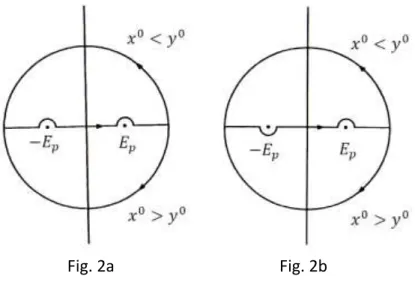
where has now become an integration variable. The integral can be evaluated by considering a closed circuit in the complex plane with two singularities at as shown on Fig.2a. The corresponding residua are
for ( ) ( ) ( ) for ( ) ( ) ( )
for the lower clockwise circuit, corresponding to , we therefore obtain for the integral the value
(4.7) ∮ ∑ ( ( )
( )
( ) ( )+
whereas for the upper circuit, corresponding to , the integral is zero.
Inserting the value given by eq.(4.7) into the complete integral given by eq.(4.6) we can, without loss of generality, replace in the second term by and in this way we obtain for
(4.8a) ( ) ∫( ) .( ) ( ) ( ) ( / and for
(4.8b) ( )
Comparing with eq.(4.4) we thus find (4.9) ( )⟨ |* ̅ ( )+| ⟩
where ( ) is the Heaviside step function.
Going back to eq.(4.6) we notice that the denominator can be written as
. One can also prove that ( ) so that in the end we have
(4.10) ∫( ) ( )
( )
( )
Written in the form
(4.11) ∫( ) ̃ ( )
this quantity can be regarded as the Fourier transform of (4.12) ̃ ( )
( )
or in Feynman slash notation (4.12’) ̃ ( *
Page 26
This expression is known as the Dirac propagator. Its Fourier transform represented by eq.(4.10) is a Green’s function of the Dirac operator defined in eq.(2.29). To see this, we first notice that for plane wave states this operator can be written as . Acting with it on the expression given by eq.(4.10) the denominator cancels and we obtain
(4.13) ( ) i∫( ) ( ) ( ) thus proving the Green’s function relation stated above.
Note however that the integral in eq.(4.10) can be evaluated along different paths. The way chosen so far yields the particular expression (4.9), called the retarded Green’s function. This is because it is only non zero during the time period .
The Feynman propagator.
A different path for evaluating the integral of eq.(4.6) is that shown on Fig.2b. Designating by ∮( ) the lower circuit, i.e. and by ∮( ) the upper one, i.e. , the theorem of residua then yields, instead of eq.(4.7) the following two contributions:
(4.14a) ∮( ) ( ) ( ) ( )
(4.14b) ∮( ) ( ) ( ) ( )
Inserting these expressions into eq.(4.6) we obtain the Feynman Green’s function (4.15a) ∫( ) ( ) ( )
(4.15b) ∫( ) ( ) ( ) where again in the second line .
Comparing these expressions with eq.(4.4) we see that we have (4.16) { ⟨ | ( ) ̅ ( )| ⟩
⟨ | ̅ ( ) ( )| ⟩ This can also be written as
(4.17) ⟨ | ( ) ̅ ( )| ⟩
where is the time ordering operator which ensures that the earlier time always stands on the right, with the additional condition of a minus sign if the operators are interchanged. In the Feynman case the integration paths can be slightly modified with respect to those of Fig 2b if we replace eq.(4.10) by the expression
(4.18) ∫( ) ( )
( )
( )
With the denominator equal to , the singularities are now shifted away from the real axis to so that this axis is now entirely part of the integration paths.
Page 27
Fig. 2a Fig. 2b
Interpreting eq.(4.18) as a Fourier integral we thus obtain for the Feynman propagator the expression
(4.19) ̃ ( )
( )
or in slash notation (4.19’) ̃ ( *
These expressions are basic elements in Many-Body type calculations. The photon propagator.
In analogy with eq.’s (4.16) and (4.17) representing the Feynman propagator in the Dirac case, we define a photon propagator by the relations
(4.20) {⟨ | ( ) ( )| ⟩ ⟨ | ( ) ( )| ⟩
Corresponding to the time-ordered product (4.21) ⟨ | ( ) ( )| ⟩
Here ( ), ( ) are operators of the quantized vector potential according to the expression
(4.22) ( ) ∫( )
√ ∑ ( ( )
( ) )
The quantities ( ) and are polarization vectors labeled by the index in a chosen basis. Let us first consider the product
(4.23) ∫( ) ∫( )
√ √ ∑ ∑ ( ) ( )
Postulating the rule
(4.24) ( ) ( )
Page 28 (4.25) ∫( ) ( ) ( )
with
(4.26) ( ) ∑ ( ) ( )
The value of the quantity ( ) depends on the choice of a particular gauge. In the case of
the Lorentz-Feynman gauge this value reduces to the metric tensor , as shown in
standard textbooks.
As in the Dirac case we now link the expression (4.25) to an integral in 4 dimensional space of the following form:
(4.27) ∫( ) ( ) ∫( ) ( )∫ ( )
Performing the integration over along the paths indicated on Fig2b we obtain the two expressions
(4.28a) ∫( ) ( ) (4.28b) ∫( ) ( )
Comparing this with eq.(4.20) we see that the two integrals correspond to the expressions defining the propagator . Finally, as in the Dirac case, the expressions (4.28a,b) can be
obtained by replacing the integral (4.27) by the modified expression (4.29) ∫( )
( )
Setting we therefore obtain the expression for the propagator in momentum space
(4.30) ̃
as the final result for the photon propagator in the Lorentz-Feynman gauge.
5.INTERACTING FIELDS: THE RADIATIVE ELECTRON MASS SHIFT
Introduction.
Consider an electron in the form of a point charge –e, then the surrounding static electric field possesses the energy
(5.1) ∫ . / ∫
with the Sommerfeld fine structure constant. Recall that throughout this treatise we use natural units setting
Page 29
In order to make the integral in eq.(5.1) finite, a lower cut-off radius has to be introduced yielding the value for the energy
(5.2)
In this way the energy tends linearly towards infinity with the cut-off parameter . Applying in a naïve manner Einstein’s relation or in our units , we see that the
electromagnetic mass of the electron appears as a linearly diverging quantity.
Attempts have been made to improve things by applying the formalism of quantum field theory to this problem. In this treatise we present a slightly renewed version of these calculations. As a result the linear divergence of the semi-classical theory is brought to the form of a logarithmic one however with no quantitative solution at the end.
The propagators.
Preliminary remark: as is customary in quantum field theory we designate vectors and indices in 4 dimensional Minkowski space by ordinary letters and l.c. greek letters (e.g. ) respectively and the corresponding objects in 3 dimensional Euclidean space by bold letters and l.c. latin letters (e.g. i=1,2,3), respectively. Moreover, summation over repeated indices is assumed and furthermore are Dirac’s gamma matrices
We now consider an electron moving freely through vacuum and define a correlation function by the expression
(5.3) ⟨ | ( ) ̅( )| ⟩
where ( ) and ̅( ) ( ) are operators replacing in second quantized theory the usual wave functions.
In expression (5.3) the Dyson operator stands for the time ordered product.
The presence of ground states | ⟩ instead of zero electron states | ⟩ indicates that we are considering interaction of the moving electron with the surrounding electromagnetic vacuum field.
The easiest way for evaluating the correlation function (5.3) consists in applying Feynman rules according to the Feynman diagram of the figure below which shows that the electron-vacuum interaction can be conceived as the emission and reabsorption of a virtual photon visualized by the wavy line.
Page 30 Fig. 3
The elements of this diagram correspond to Feynman propagators in momentum space given by the expressions
(5.4) ( * , ( *
for the electron of mass m in momentum state p and k respectively and the propagator expression
(5.5) ( ) for the photon.
In this way during the process the total momentum of the system is conserved at every step. In addition the expressions
(5.6) ,
describing the electron-photon interaction have to be inserted at the vertices.
In these expressions the Feynman slash notation abbreviates the sums and , whereas is the metric tensor represented by a 4 dimensional diagonal matrix with
, etc .
Assembling these relations, known as the Feynman rules, we see that the above diagram corresponds to the product
(5.7) ( *( ) ( * ( ) ( *
where the relation has been used. Noticing that in both the Weyl and the Dirac
representation the sum is equal to 4 times the unit matrix, we condense the expression (5.7) into the form
(5.8) ( *( ( )) ( *
Page 31 (5.9) ( ) ( ) ∫( ) ( * ( )
after adding an integration over all possible intermediate 4 momenta.
The index on indicates that the application of the above diagram represents in fact a limitation to second order of a perturbation expansion. An extension to all orders under special conditions will be discussed below.
The integration procedure.
Before starting the integration in the expression for we use Feynman’s trick based on the identity
∫ * ( )+
Comparing with eq.(5.9) we thus write the integral in the form (5.10) ∫ ∫( ) *,( ) - ( )( )+
Following a common procedure we now change variables according to the relation (5.11)
Then the parenthesis in the denominator of the integrand takes the form (5.12) ( )( )
An essential simplification arises if we restrict ourselves to the zero’th order contribution in with
(5.13)
The integral in (5.10) then reduces to (5.14) ∫ ∫( ) * ( )( ) +
Separating the part from the space part and extending the integral over components from to , the term in the numerator does not contribute and we are left with the expression
(5.15) ∫ ( ) ∫( ) ∫ *( ) ( ) +
Page 32 (5.16) ∫ ( )∫( ) , ( ) -
Setting and introducing an upper limit cut-off we replace the expression (5.16) by the following integral
(5.17) ∫ ( )∫ | |, ( ) -
Introducing the dimensionless variable | | we also have (5.18) ∫ ( )∫ , ( ) -
with the limiting expression
(5.18’) ∫
where we have assumed that the cut-off value is large as compared to unity. Plugging this result into eq.(5.9) we thus arrive at the final expression
(5.19) Renormalization.
Let us suppose that the change in the correlation function represented by the resulting expression (5.19) can be reproduced by renormalizing the mass in the free electron propagator, i.e. by adding a correction to the initial mass. Assuming this correction sufficiently small we then consider the expansion
(5.20) ( ( ) * ( *. /
Equating the correction term with the expression (5.8) with the expression (5.19) for inserted, we have
(5.21) ( , * - ( * ( *
Approximating on the r.h.s. ( )( ) by its dominant part ( ) eq.(5.21) yields the result [6,7]
Page 33
This is the result derived in the literature by various methods, showing that the fully quantized theory reduces the linear convergence of the classical expression (5.2) to a logarithmic one.
Discussion.
There seems to be no indication how to estimate the cut-off parameter Clearly the logarithmic divergence makes the mass shift less sensitive to the value of this parameter. Moreover it can be argued that a large mass shift should show up in experiments.
Nevertheless, in order to get a number out of the calculations, one could for instance consider the fact that the proton mass constitutes a natural upper limit on the mass scale of conventional particles. Identifying it with would lead to the result:
a number that seems realistic. Naturally this estimation has to be taken merely as an example among others that one could imagine.
However, despite the fact that the true numerical value of the electromagnetic electron mass shift is as yet unknown, its correct qualitative evaluation, as reviewed in this section undoubtedly constitutes an important fact.
Appendix.
Evaluation of the integral
(5.A1) ∫ ,( ) ( ) - ∫ ,( ) ( ) -Setting ( ) we write
(5.A2) ∫ ( ) With the change of variables (5.A3) ( ) √ The integral in (5.A2) takes the form (5.A4) ∫√ ( )
Where we have deliberately not specified the integration limits. Introducing the identity
( )
we ignore the principal value which in a more detailed treatment can be proven to yield zero. With the delta function inserted the expression (5.A4) then reduces to
(5.A5) √
Performing the derivation as indicated in eq.(5.A2) and replacing the intermediate parameter by its value leads to the desired result
Page 35
6.THE ELECTRON-ELECTRON SCATTERING (M LLER) AMPLITUDE and its YUKAWA ANALOG
Consider scattering involving two particles and introduce a scattering matrix in the form (6.1)
where the second term describes the scattering process.
Assuming that the particles have incident momenta and respectively and outgoing momenta and , momentum conservation demands that matrix elements of satisfy the relation
(6.2) ⟨ | | ⟩ ( ) , ( )- Where is the scattering
amplitude which is of interest here. In the fully quantized theory interaction takes place by means of the exchange of a virtual particle of momentum q.
We specialize now to the case of two colliding electrons schematically represented by the Feynman diagram below.
Fig. 4 We write the Hamiltonian of the system in the form (6.3)
where is the part belonging to the free electrons and that of the interaction during
the scattering. In second quantized Dirac theory this latter part is given by the expression (6.4) ∫ ̅
with ̅, the electron field operators in the Heisenberg picture and the vector potential operator of the electromagnetic field present in the system.
The relevant contribution here is the second order term in the perturbation expansion of the matrix involving the quantity .
Given the interaction Hamiltonian of eq.(6.4) this term contains the time-ordered product (6.5) ( )∫ ( ̅ ) ( )( ) ∫ ( ̅ ) ( )
with the familiar time ordering operator. Note that a factor 1/2 from the exponential expansion is left out since it is compensated for by adding identical expressions with and interchanged. In order to evaluate the above product we apply Wick’s theorem *3+ reducing it to a product of the contracted e-m field operators with the remaining factors put into normal order. Thus we write
(6.6) ∫ [( ̅ ) ( ̅ ) ] ( ) ( )
Substituting into the parenthesis the expressions derived in section (3) for ̅ and we obtain an operator product of the form
(6.7) ∫( ) ̃ ∫( ) ̃ √ ̃√ ̃ ̃ ̃ ̅( ̃ ) ( ̃) ̃ ̃ ∫( ) ̃ ∫( ) ̃ √ ̃√ ̃ ̃ ̃ ̅( ̃ ) ( ̃) ̃ ̃
Page 36
At this stage we suppress for simplicity spin labels on the operators and functions. Putting in the expression (6.7) the operators in normal order we make the replacement (6.8) ̃ ̃ ̃ ̃ ̃ ̃ ̃ ̃
We now take matrix elements between states (6.9a) | ⟩ √ √ | ⟩
(6.9b) ⟨ | √ √ ⟨ ⌋
Together with the preceding sequence of eq.(6.8)this generates the new operator sequence (6.10) ̃ ̃ ̃ ̃
We now make use of operator commutation relations which yield the equations (6.11) ⟨0│ ̃│0⟩ ( ) ( ̃ ) similarly for ̌ etc i.e. 4 equations
Now after integrating in eq.(6.7) over the variables ̃ ̃ ̃ ̃ the and factors disappear and we are left with the expression
(6.12) ( ) ( ) ( ) ( ) ( ) ( )
Going back to eq.(6.6) and recalling that the contraction of vector potential operators is equivalent with the propagator expression
(6.13) ( ) ( ) ∫( ) ( ) we obtain the matrix element in the form
(6.14) ( ) ̅( ) ( ) ̅( ) ( ) ∫( ) ∫ ( ) ∫ ( )
Identifying the integrals as ( ) times delta functions so that ( ) , the expression (6.14) reduces to
(6.15) ( ) ( ) ̅( ) ( ) ̅( ) ( )( ) , ( )-
Comparing this expression with the defining relation (6.2) we find for the electron-electron scattering amplitude the formal expression
(6.16) ( ) ̅( ) ( )( ) ̅( ) ( ) The non-relativistic limit.
In the non relativistic limit where it is assumed that the kinetic energy of the electrons is small as compared to , i.e. to , the spinors derived in section 3 reduce to the simple form
(6.17) √ ( * , √ ( ) with equal to . / ( ) or . / ( ) Then for we have
(6.18) ̅ , ̅ with and, in the Weyl representation,
Page 37 . / (
* ( *
The products in eq.(6.16) are
(6.19a) ̅( ) ( ) ( ) ( ) ( ) ( * (6.19b) ̅( ) ( ) ( ) ( * ( *
Furthermore we have in this approximation with (6.20) ( ) | |
Thus the amplitude of eq.(6.16) reduces to (6.21) ( ) ( ) | | ( )
Now clearly, labeling the spins by in the term and by in the term, the products reduce to the Kronecker symbol and respectively, meaning that the spin is
conserved during the process. therefore Ignoring the spin labels and setting we
write for the scattering amplitude (6.22) ( ) | |
Consider now the electrostatic potential ( ) of the system and its Fourier transform defined by the relation
(6.23) ( ) ∫ ( ) ( ) In the case of a Coulomb potential (6.24) ( )
An elementary integration yields the result (6.25) ( ) | |
Comparing this result with eq.(6.22) one sees that the amplitude factor is proportional to the Coulomb potential in the representation. This shows that it is equivalent to the
ordinary quantum mechanical solution of the scattering problem in the Born approximation. For the sake of completeness we indicate the link between the amplitude and the
differential cross section . In the center of mass frame the following relation holds: (6.26) ( )
Substituting for the expression (6.22) we thus obtain (6.27) . /
Note that up to a numerical factor this expression is equal to the celebrated Rutherford formula which applies to scattering of a particle in a static Coulomb field.
The Yukawa potential
An approach similar to that leading to the Coulomb potential, treated in terms of the
exchange of a photon between two electrons, has been proposed by Yukawa in 1935 for the interpretation of nuclear forces. Here the interaction takes place between heavy particles of
Page 38
mass , i.e. nucleons, and for the binding the photon is replaced by a massive particle of mass much smaller than called meson.
The calculation can be deduced from the previous one by replacing the photon propagator by the meson propagator with the four momentum of the meson and the electro-magnetic interaction replaced by a quantity designed as . The result which replaces that of eq.(6.16) is then
(6.28) ̅( ) ( ) ̅( ) ( ) In the non-relativistic limit one finds
(6.29) | | ( ) with | | | |
Connecting in this limit the scattering amplitude to the potential ( ) in the representation one has
(6.30) ( ) | |
with in the representation (6.31) ( ) ∫( ) | |
Setting | | ; | | | | , the integral can be done easily, leading to the result
(6.32) ( ) .
This attractive potential is short ranged as compared with the Coulomb potential. The presence of the exponential factor yields for this range the value , which is of the order of 1 fm if for the meson mass is inserted.
Although the Yukawa model has been replaced since by more evolved concepts, it still provides insight into the nature of nuclear forces.
Page 39
7.VACUUM POLARIZATION
The photon self energy.
Consider a photon propagating freely in vacuum. If its interaction with the vacuum field is taken into account, a situation represented by the Feynman diagram below will be present. During the propagation there will be emission/absorption of a virtual electron/positron pair at one vertex and afterwards the inverse process will occur at the other vertex.
Fig. 5
The difference with respect to the case without interaction involves a tensor which in second order will be written as ( ) with the four momentum of the photon. For this tensor, by applying Feynman rules, in [3] the following expression has been derived: (7.1) ( ) ∫( ) ( ) ( )
( ( ) )
( )(( ) )
Applying, as in the electron case, the Feynman trick and setting afterwards (7.2)
one arrives at the expression
(7.3) ( ) ∫ ∫( ) ( ) ( ( ) )( ( ) ) where terms linear in have been omitted.
In [3] a Wick rotation has been applied to this integral with the result (7.4) ∫ ∫( ) ( ) ( ( ) )
( )
with
(7.5) ( )
This integral is ultraviolet diverging . It can be simplified by using the tensorial relation (7.6) ( ) ( ) ( )
involving the scalar quantity ( ) Comparing for eq.’s(7.6) and (7.4) we obtain for this quantity the expression
(7.7) ( ) ∫ ∫( ) ( )
( )
Assuming now , making in (7.5) the approximation and performing the integration over we find
(7.8) ( ) ∫( )
( )