HAL Id: tel-01931244
https://hal.laas.fr/tel-01931244v2
Submitted on 4 May 2021HAL is a multi-disciplinary open access archive for the deposit and dissemination of sci-entific research documents, whether they are pub-lished or not. The documents may come from teaching and research institutions in France or abroad, or from public or private research centers.
L’archive ouverte pluridisciplinaire HAL, est destinée au dépôt et à la diffusion de documents scientifiques de niveau recherche, publiés ou non, émanant des établissements d’enseignement et de recherche français ou étrangers, des laboratoires publics ou privés.
interactive robot
Harmish Khambhaita
To cite this version:
Harmish Khambhaita. Human-aware space sharing and navigation for an interactive robot. Artificial Intelligence [cs.AI]. Université Paul Sabatier - Toulouse III, 2017. English. �NNT : 2017TOU30399�. �tel-01931244v2�
THÈSE
THÈSE
En vue de l’obtention duDOCTORAT DE L’UNIVERSITÉ DE TOULOUSE
Délivré par : l’Université Toulouse 3 Paul Sabatier (UT3 Paul Sabatier)Présentée et soutenue le 03/10/2017 par :
Harmish KHAMBHAITA
Human-aware space sharing and navigation for an interactive robot
JURY
Alberto SANFELIU Professeur d’Université Rapporteur
Anne SPALANZANI Maître de Conférences Rapporteur
Luis MERINO Professeur Associé Examinateur
Amit Kumar PANDEY Head Principal Scientist Examinateur
Thierry SIMEON Directeur de Recherche Examinateur
Rachid ALAMI Directeur de Recherche Directeur de thèse
École doctorale et spécialité :
MITT : Domaine STIC : Intelligence Artificielle
Unité de Recherche :
Laboratoire d’analyse et d’architecture des systèmes (LAAS)
Directeur de Thèse :
Rachid ALAMI
Rapporteurs :
Abstract
The methods of robotic movement planning have grown at an accelerated pace in recent years. The emphasis has mainly been on making robots more efficient, safer and react faster to unpredictable situations. As a result we are witnessing more and more service robots introduced in our everyday lives, especially in public places such as museums, shopping malls and airports. While a mobile service robot moves in a human environment, it leaves an innate effect on people about its demeanor. We do not see them as mere machines but as social agents and expect them to behave humanly by following societal norms and rules. This has created new challenges and opened new research avenues for designing robot control algorithms that deliver human-acceptable, legible and proactive robot behaviors.This thesis proposes a optimization-based cooperative method for trajectory-planning and navigation with in-built social constraints for keeping robot motions safe, human-aware and predictable. The robot trajectory is dynamically and con-tinuously adjusted to satisfy these social constraints. To do so, we treat the robot trajectory as an elastic band (a mathematical construct representing the robot path as a series of poses and time-difference between those poses) which can be deformed (both in space and time) by the optimization process to respect given constraints.
Moreover, we also predict plausible human trajectories in the same operating area by treating human paths also as elastic bands. This scheme allows us to optimize the robot trajectories not only for the current moment but for the entire interaction that happens when humans and robot cross each other’s paths. We carried out a set of experiments with canonical human-robot interactive situations that happen in our everyday lives such as crossing a hallway, passing through a door and intersecting paths on wide open spaces. The proposed cooperative planning method compares favorably against other stat-of-the-art human-aware navigation planning schemes.
We have augmented robot navigation behavior with synchronized and responsive movements of the robot head, making the robot look where it is going and occasionally diverting its gaze towards nearby people to acknowledge that robot will avoid any possible collision with them. At any given moment the robot weighs multiple criteria according to the social context and decides where it should turn its gaze. Through an online user study we have shown that such gazing mechanism effectively complements the navigation behavior and it improves legibility of the robot actions.
Finally, we have integrated our navigation scheme with a broader supervision system which can jointly generate normative robot behaviors such as approaching a person and adapting the robot speed according to a group of people who the robot guides in airports or museums.
Résumé
Les méthodes de planification de mouvements robotiques se sont développées à un rythme accéléré ces dernières années. L’accent a principalement été mis sur le fait de rendre les robots plus efficaces, plus sécurisés et plus rapides à réagir à des situations imprévisibles. En conséquence, nous assistons de plus en plus à l’introduction des robots de service dans notre vie quotidienne, en particulier dans les lieux publics tels que les musées, les centres commerciaux et les aéroports. Tandis qu’un robot de service mobile se déplace dans l’environnement humain, il est important de prendre en compte l’effet de son comportement sur les personnes qu’il croise ou avec lesquelles il interagit. Nous ne les voyons pas comme de simples machines, mais comme des agents sociaux et nous nous attendons à ce qu’ils se comportent de manière similaire à l’homme en suivant les normes sociétales comme des règles. Ceci a créé de nouveaux défis et a ouvert de nouvelles directions de recherche pour concevoir des algorithmes de commande de robot, qui fournissent des comportements de robot acceptables, lisibles et proactifs.Cette thèse propose une méthode coopérative basée sur l’optimisation pour la planification de trajectoire et la navigation du robot avec des contraintes sociales intégrées pour assurer des mouvements de robots prudents, conscients de la présence de l’être humain et prévisibles. La trajectoire du robot est ajustée dynamiquement et continuellement pour satisfaire ces contraintes sociales. Pour ce faire, nous traitons la trajectoire du robot comme une bande élastique (une construction mathématique représentant la trajectoire du robot comme une série de positions et une différence de temps entre ces positions) qui peut être déformée (dans l’espace et dans le temps) par le processus d’optimisation pour respecter les contraintes données. De plus, le robot prédit aussi les trajectoires humaines plausibles dans la même zone d’exploitation en traitant les chemins humains aussi comme des bandes élastiques. Ce système nous permet d’optimiser les trajectoires des robots non seulement pour le moment présent, mais aussi pour l’interaction entière qui se produit lorsque les humains et les robots se croisent les uns les autres. Nous avons réalisé un ensemble d’expériences avec des situations interactives humains-robots qui se produisent dans la vie de tous les jours telles que traverser un couloir, passer par une porte et se croiser sur de grands espaces ouverts. La méthode de planification coopérative proposée se compare favorablement à d’autres schémas de planification de la navigation à la pointe de la technique.
Nous avons augmenté le comportement de navigation du robot avec un mou-vement synchronisé et réactif de sa tête. Cela permet au robot de regarder où il va et occasionnellement de détourner son regard vers les personnes voisines pour montrer que le robot va éviter toute collision possible avec eux comme prévu par le planificateur. À tout moment, le robot pondère les multiples critères selon le contexte social et décide de ce vers quoi il devrait porter le regard. Grâce à une étude utilisateur en ligne, nous avons montré que ce mécanisme de regard complète
efficacement le comportement de navigation ce qui améliore la lisibilité des actions du robot.
Enfin, nous avons intégré notre schéma de navigation avec un système de su-pervision plus large qui peut générer conjointement des comportements du robot standard tel que l’approche d’une personne et l’adaptation de la vitesse du robot selon le groupe de personnes que le robot guide dans des scénarios d’aéroport ou de musée.
Contents
Abstract i
Résumé iii
1 Introduction 1
1.1 Human-Aware Navigation Planning . . . 3
1.2 Challenges for Socially Compliant Navigation . . . 4
1.3 Contributions Summary . . . 5
1.3.1 Contributions to Navigation Planning . . . 6
1.3.2 Contributions to Normative Social Behavior . . . 7
1.3.3 Publications . . . 7 1.3.4 Dissertation Outline . . . 9 2 Related Work 11 2.1 Robot Navigation . . . 11 2.1.1 Path Search . . . 12 2.1.2 Obstacle Avoidance . . . 13
2.2 Modelling Pedestrian Motion . . . 17
2.2.1 Proxemics . . . 17
2.2.2 Social Forces . . . 18
2.3 Integrating Human-Awareness . . . 19
2.3.1 Robot as a Social Agent . . . 21
2.3.2 Learning from Human Motion . . . 24
2.3.3 Legibility . . . 26
2.3.4 Normative Behaviors . . . 26
2.4 Summary . . . 27
3 Reactive Human-Aware Navigation 29 3.1 Human-Aware Navigation Framework . . . 29
3.1.1 Planning . . . 30
3.1.2 Human Motion Prediction . . . 32
3.1.3 Simulation . . . 33
3.1.4 Visualization . . . 35
3.2 Evaluating Directional Cost Model . . . 36
3.2.1 The Directional Cost Model . . . 38
3.2.2 Velocity Adaptation . . . 39
3.2.3 User Study Setup . . . 40
3.2.4 User Study Results . . . 44
3.2.5 Analysis of Robot Behavior . . . 47
4 Cooperative and Proactive Human-Aware Navigation 51
4.1 An Adaptive and Cooperative Navigation Planner . . . 52
4.1.1 A Case for Cooperation . . . 53
4.1.2 Elastic Bands for Navigation . . . 58
4.1.3 Optimizing Robot Trajectories . . . 59
4.1.4 Social Constraints . . . 66
4.1.5 Software Framework . . . 69
4.1.6 Experiments . . . 71
4.2 Assessing the Social Criteria for Collaborative Navigation . . . 77
4.2.1 Comparison Methodology . . . 77
4.2.2 Experiments with Canonical Co-Navigation Situations . . . . 80
4.2.3 Effect of Different Social Criteria on Robot Behavior . . . 85
4.2.4 Insights . . . 88
4.3 Summary . . . 88
5 Head-Body Coordination during Navigation 91 5.1 The Modality of Gaze . . . 92
5.1.1 Where Do We Look When We Steer . . . 92
5.1.2 Related Work in Robot Gaze Behavior Planning . . . 93
5.1.3 Why Robots Need Better Head/Gaze Behavior? . . . 94
5.1.4 Parameters for Gaze Control . . . 95
5.1.5 Deciding Where to Look . . . 96
5.2 Approach . . . 97
5.2.1 Framework for Effective Robot Gaze Behavior . . . 98
5.2.2 Behavioral Functions . . . 99
5.2.3 Implementation Details . . . 102
5.2.4 Synchronization of Head and Body Motion . . . 103
5.3 Evaluation through User Study . . . 104
5.3.1 User Study Design . . . 104
5.3.2 Study Procedure . . . 107
5.3.3 Results . . . 110
5.3.4 Limitations . . . 112
5.4 Summary . . . 114
6 Normative Navigation Behaviors 115 6.1 Approaching a Person . . . 116
6.1.1 Modelling Approach Task . . . 116
6.1.2 Learning Path for Approaching . . . 117
6.1.3 Learning Costmap for Approaching . . . 119
6.1.4 Experiments . . . 120
6.2 Speed Adaptation while Guiding . . . 121
6.2.1 Methodology . . . 121
6.2.2 Experiments . . . 124
Contents vii
7 Conclusions and Outlook 127
7.1 Conclusions . . . 127 7.2 Summary of Contributions . . . 130 7.3 Outlook . . . 131
Chapter 1
Introduction
Contents
1.1 Human-Aware Navigation Planning . . . . 3
1.2 Challenges for Socially Compliant Navigation . . . . 4
1.3 Contributions Summary . . . . 5
1.3.1 Contributions to Navigation Planning . . . 6
1.3.2 Contributions to Normative Social Behavior . . . 7
1.3.3 Publications . . . 7
1.3.4 Dissertation Outline . . . 9
Meet Spencer . A strapping but gentle robot, recently recruited by KLM, is patiently waiting near Gate B18. The flight from Vilnius is about to land, albeit with a delay of half an hour from the scheduled time. While other KLM staff prepare for welcoming the arriving passengers, Spencer and its co-worker robots are recharging their batteries. It is really busy at Amsterdam airport Schiphol, chances are high that some transfer passengers will lose their way during the transfer. “‘Spencer! kom hier alsjeblieft.”, calls Suzanna from the gate-desk. Spencer quickly responds by looking at her, nods in agreement and starts approaching her. During the approach Spencer constantly monitors Susanna’s posture and adjusts its own approaching trajectory such that it remains visible to her. Stopping in front of Susanna, Spencer greets her with “Hoi!”. “Kun je de familie gaan naar Munchen begeleiden?” she asks. “Jazeker”, Spencer acknowledges. It figures out that the next flight to Munich is leaving from gate C17 in 40 minutes and moves near the gate to make itself
(a) (b)
Figure 1.1 – Social service robots. (a) Spencer preparing to guide passengers at Amsterdam airport Schiphol. (b) Pepper helping and entertaining customers in a shopping mall. (Image credits: (a) www.spencer.eu, (b) www.mummer-project.eu)
noticeable to the arriving passengers. Apart from cordial facial expression and sturdy trunk, Spencer sports a portable tablet size touch-screen display on its front torso, which now shows a message for catching attention of Praßler family.
Soon after, the airplane lands and Praßler family rushes out of the gate, bit stressed about where to find the gate C17. Surprised by Spencer’s welcome message, the family stops at the robot. Spencer greets the family and kindly offers them guidance inside the airport. It is primarily looking at mother, as it thinks she is the one who is going to decide. She gladly accepts the offer, so Spencer asks them to scan their boarding pass through the built-in bar-code reader. Meanwhile, Spencer had already calculated a quickest route to gate C17 which should take about 25 minutes. The family feels reassured as Spencer has already informed the KLM staff at gate C17 who will wait for them to reach.
Initially Spencer was moving fast, however, soon it sees that the children are not able to keep up with the pace so it slows down a bit. While smoothly marching through the airport swamped with rushing people, Spencer constantly keeps an eye on the Praßler family making sure they are still following. A long corridor connects pier-B with pier-C where temporarily parked trolley carts are narrowing down the moving space. Once Spencer sees a group of people running from the opposite side, it quickly moves behind the park trolleys to let them cross as they seem to have greater urgency. Praßler family thought it was a smart move by Spencer, who swiftly avoided a traffic-jam situation.
The youngest kid of the family wanted to visit toilets, so Spencer promptly made a small detour to the nearest lavatory. After the short break they resume their walk towards the departure gate. Entering the pier-C Spencer sees a long queue at an earlier gate. Rather then going around the queue, Spencer politely asks to make some space so they can pass through. Reaching timely at gate C17, the Praßler family thanks Spencer who has to soon start its next guiding mission.
At all times when moving Spencer remains very reactive to its surroundings, proactively responds to unexpected situations and makes sure it does not block anybody’s way. Moreover, it takes extra care in explicitly making its movement readable by humans and showing where it is about to drive using its head movement. Passengers say that they can easily read where Spencer is going and whether Spencer has noticed them, thanks to its active and attentive face.
Now, Meet Pepper. A dwarfish but competent robot, new attraction at the Ideapark shopping mall in Lempäälä. Pepper has earned a designated working space near the welcome-desk. It’s festival season and a small group of friends is looking for shoe-shops at the mall-map near the entrance. Pepper steps towards the group to tell them about current special-offers at the mall. The group makes some space for Pepper to join them and it subtly complies. Pepper helped the group to find the shop they were looking for and showed them way to reach there.
Later in the day an elderly woman asks Pepper “Hei, onko täällä apteekki?”. “Tule mukaani!”, Pepper aids her by taking her to the nearby pharmacy shop. Bustling shopping mall is not easy to traverse, so Pepper remains on rather straight
1.1. Human-Aware Navigation Planning 3
path towards the pharmacy while constantly updating its speed to let the passersby placidly cross its path. At the same time, it also keeps a comforting distance from the elderly woman whom Pepper is helping.
Everyday Pepper helps dozens of visitors finding their way around the mall. Approaching and joining a group of people to start a conversation, negotiating its way around open spaces as well as densely crowded corridors are some of the daily activities of Pepper. Unlike Spencer, Pepper usually involves in short and specialized interactions. Still, like Spencer, Pepper shows proactive motion that follow social norms and uses modality of gaze to make itself better understandable to the people.
Both Spencer and Pepper are among the new breeds of social service robots. They go far beyond safe-motion paradigm, which, of course, is essential for any robot that is going to run in a human-centric environment. They studiously devise their movements to maximize human comfort and comprehension. Instead of just reacting to the circumstances, they show anticipatory and change-oriented behavior. Embedded social norms govern their demeanor while they co-exist and co-operate with humans in public places.
The level of autonomy, intelligence and sociability what we just described with airport and shopping mall scenarios is not a far-fetched dream. Robotics hardware research have already yielded compliant and fail-safe actuators as well as highly accurate and real-time human-motion capture sensors. On the other hand, studies of human social psychology have determined how pedestrian navigate in public places and what are the underlying physical factors that govern human interactions. What needed is novel planning techniques that adopt these sociological findings to design robot behaviors that resemble human awareness and proactivity. Therein we find the motivation for this thesis: Attaining safe, natural and legible robot navigation behavior in public places along with multi-modal interaction.
1.1
Human-Aware Navigation Planning
A service robot is “a robot that performs useful tasks for humans”, defines the International Organization for Standardization [ISO 2012]. It also defines a personal service robot as “a service robot for personal use by lay persons”. To do the useful task the robot needs to interact with lay persons in various ways, exchange information and respond to their actions. Which means, the robot should perceive its environment, create an action-plan and act, generally known as the iterative sense-plan-act method. While sensing of human posture and actions as well as robot’s own place in its surroundings is itself an independent domain of research, in this thesis our focus is on the planning and acting phases.
While planning the robot generally has an occupancy-grid-map of its operating environment. The path-planning algorithms plan a shortest path that is not passing through any grid-cell marked as occupied. And during the acting phase the robot calculates drive-velocities that keep the robot on previously computed path and satisfy any kinodynamic constraints imposed by the drive mechanism. Now, for
human-aware planning the robot could incorporate human presence either during path planning by temporarily marking grid-cells around human position as occupied or shortly deviating from pre-computed path that make it avoid colliding with the human during the acting phase. For either case, there are certain challenges arise considering the dynamic and unpredictable nature of human motion, which we will summarize in the next section.
1.2
Challenges for Socially Compliant Navigation
The first challenge in human-aware navigation is to accurately detect and track humans. Nowadays, there are a variety of sensors used for detecting and classifying humans such as laser-scanners, color and depth sensing cameras, optical motion-capture systems and others. Data from different sensors is generally fused to calculate a person’s position, orientation and velocity which is than passed to the navigation planning modules. In this thesis we have used off-the-shelf human tracking software, however, augmented them with velocity calculation subroutines. An associated challenge is to predict destinations for each tracked persons in the environment as well as to predict their short-term future trajectories. Precise prediction of immediate human trajectories can greatly aid the robot navigation planning system and lead to better path conflict management.
Almost all navigation planning schemes include either a cost-grid for representing the robot operating environment or use some constraint based optimal path planning algorithm, or both. Defining what makes up a good cost or constraint is the key challenge here. For claiming the robot navigation behavior as socially compliant, a navigation scheme has to capture the most pertinent criteria for calculating these costs or constraints. Furthermore, deciding which costs are most pertinent to which scenario is still an open question that begs for further investigation. Studies of pedestrian navigation behaviors are certainly useful in this regards and thus the criteria we use in our work for optimally planning the robot trajectories are directly inspired from the research on human locomotion in public places.
Robots that run in shared spaces need to respond fast to the changes in their surroundings. In the iterative planning process the last calculated trajectory could become invalidated as soon as the environment changes, particularly when the change is not what predicted by the robot. There are multiple reasons for this change: a previously unknown obstacle suddenly appears in front of the robot, a tracked-human does not move as predicted by the robot, robot encounters different terrain forcing it to move slowly, and so on. The challenge is then to re-plan the trajectory within some bounded time such that the robot behavior looks smooth and continuous. Therefore the trajectory planning algorithm must function with real-time constraints.
Another challenge for social compliance is producing the robot behaviors that people are easily and quickly able to understand, that is, making the robot behavior legible. Legibility is sometimes in conflict with geometrical optimality of the robot
1.3. Contributions Summary 5
path, however, it improves fluency of human-robot cooperative motion and perceived safety by humans [Kruse 2014]. Hence, the robot navigation scheme has to strike a balance between legibility and path optimality.
While explicit signaling and cues to the actual robot intension increases legibility, it is different from predictability. Predictability requires an observer to envisage the expected future state, and it is determined by other factors than the robot internal state [Dragan 2013a] such as robot goal and its past movements. Sudden changes in robot direction or speed endangers predictability. Therefore, a robot has to consider applying hysteresis in its decision-making process.
In summary, here are the main challenges that one needs to solve while designing socially acceptable and desirable robot navigation behaviors.
• Precise perception of human motion.
• Finding most effective and pertinent costs/constraints for human-awareness. • Timely response to environmental changes.
• Improving predictability and legibility of the robot behavior.
1.3
Contributions Summary
This goal of this thesis is to advance the human-aware navigation research by crafting cooperative and proactive navigation behavior for social robots that move and help humans in public places. We aim to close the gap between state-of-the art robot navigation frameworks and the hypothetical scenarios discussed earlier with Spencer and Pepper robots. As discussed in previous section, it requires to solve a number of challenges and advancements in several research areas including perception, mapping, localization, navigation, natural language processing, supervision and user-interface to fully synthesize such robot behaviors. Nevertheless, we stay focused on navigation planning, plan execution and motion planning of robot gaze.
Figure 1.2 shows a plausible architecture and different software modules required for human-aware navigation planning. In fact, this architecture is a generalization of the robot system architecture we have developed and used within the European projects SPENCER (Social situation-aware perception and action for cognitive robots)1 and MuMMER (MultiModal Mall Entertainment Robot)2.
The figure also shows contributions of this thesis with respect to affected software modules. Most of the contributions fall into the robot trajectory controller the path planning modules. With additional contributions to online behavior adaptation, learning normative behaviors and evaluation through user studies. We have also contributed to the aspects of simulation and visualization of the robot behavior as supportive contributions.
1http://spencer.eu/
2
User Studies through Evaluation Simulation Vizualization Behaviors Normative Learning Task Planning and Supervision ... Reader Barcode Screen Touch Language Natural User Interface Adaptation Online Behavior Processings Social Signal Human-Aware Navigation Human-Path Prediction Trajectory Controller Path Planner People Trakcing Group Detection Human Tracking SLAM Mapping / Localization Perception Actuators Controllers Sensors Drivers
Figure 1.2 – A software architecture for human-aware navigation. The software modules shown in green are where this thesis makes major contributions. Modules with minor contributions are shown in yellow and modules in blue are the software components which we improved to support main contributions. The dashed line separates information flow. The communication is continuous in terms of software messages for the components below the dashed line, where the components above this line generally communicates using service requests.
1.3.1 Contributions to Navigation Planning
This thesis features two main contributions in navigation planning. First is modeling and implementing robot navigation in human environments as a cooperative activity. And second is the refined analysis of the constraints and criteria for such an activity. We propose a cooperative and proactive navigation framework using an optimal planning scheme. The framework composes a set of mathematical constraints that model safety for nearby humans, social conventions for path and velocity planning as well as legibility of robot behavior along with usual kinematic constrains required by the robot drive mechanism. The fundamental idea of this framework is to combine planning of robot trajectories and prediction of plausible human trajectories within the same optimization framework while utilizing the same environmental map that robot perceives through its sensors. Thus our planning scheme incorporates estimation of others’ behavior within the planning step. With this design the
1.3. Contributions Summary 7
framework is able to produce robot behavior that is similar to what humans would do in identical situations.
We have introduced time-to-collision and directional constraints in this framework in addition to the typical safety constraints. We argue that with these constraints our planning scheme produces socially compliant robot behavior in a multitude of tasks that require tight human-robot co-operation such as traversing through hallways, passing through doors, crossing paths with humans as well as navigating in large semi-crowded areas. We also compare results with other state-of-the-art human-aware planning schemes and demonstrate the advantages of our framework in terms of quality of the generated trajectories and sociability of the robot. Additionally, we have carried-out a user study that shows how the directional constraint improves the legibility and perceived comfort by the participants in a human-robot path crossing scenario.
We have developed and extensively used a pedestrian movement simulator to test and validate navigation planning algorithms. Numerous software modules that support the main contributions were also developed during the course of this thesis such as laser-scanner data filters, motor drivers for Spencer head mechanism, improvements and re-implementation of some of the previous work that is compatible to the middleware used by Spencer and Pepper robots, low-level subroutines for collision checking and others.
1.3.2 Contributions to Normative Social Behavior
Acting socially is not enough, a robot also need to communicate its activity to the people in its vicinity, which affects the legibility of the robot behavior. For improving legibility with its gaze, this thesis proposes a novel method to control the head movements while the robot is navigating. We treat the gaze-control problem as multi-criteria decision-making problem and solve it with analytic hierarchy process. A video-based user-study has validated the effectiveness of the proposed head-control procedure.
A method to dynamically adapt the robot speed according to the walking speed of a group of people for a guide robot and a machine learning based algorithm to approach humans in a socially appropriate way are among the minor contributions of this thesis.
1.3.3 Publications
The work presented in this thesis is partly based on following prior publications. Harmish Khambhaita and Rachid Alami. “Viewing Robot Navigation in Human
Environment as a Cooperative Activity”. In: Proc. International Symposium on
Harmish Khambhaita and Rachid Alami. “Assessing the Social Criteria for Human-Robot Collaborative Navigation: A Comparison of Human-Aware Navigation Planners”. In: Proc. IEEE International Symposium on Robot and Human
Inter-active Communication (RO-MAN). Aug. 28–Sept. 1, 2017.
Harmish Khambhaita and Rachid Alami. “A Human-Robot Cooperative Navigation Planner”. In: Proc. Companion of the ACM/IEEE International Conference on
Human-Robot Interaction (HRI). Mar. 6–9, 2017, pp. 161–162. isbn:
978-1-4503-4885-0.
Harmish Khambhaita, Jorge Rios-Martinez, and Rachid Alami. “Head-Body Motion Coordination for Human Aware Robot Navigation”. In: Proc. International
Workshop on Human-Friendlly Robotics (HFR). HFR. Sept. 29–30, 2016.
Omar A. Islas Ramírez, Harmish Khambhaita, Raja Chatila, Mohamed Chetouani, and Rachid Alami. “Robots Learning How and Where to Approach People”. In: Proc. IEEE International Symposium on Robot and Human Interactive
Communication (RO-MAN). Aug. 2016, pp. 347–353.
Michelangelo Fiore, Harmish Khambhaita, Grégoire Milliez, and Rachid Alami. “An Adaptive and Proactive Human-Aware Robot Guide”. In: Proc. Seventh
International Conference on Social Robotics (ICSR). Oct. 26–30, 2015, pp. 194–
203.
Rudolph Triebel, Kai Arras, Rachid Alami, Lucas Beyer, Stefan Breuers, Raja Chatila, Mohamed Chetouani, Daniel Cremers, Vanessa Evers, Michelangelo Fiore, Hayley Hung, Omar A. Islas Ramírez, Michiel Joosse, Harmish Khamb-haita, Tomasz Kucner, Bastian Leibe, Achim J. Lilienthal, Timm Linder, Manja Lohse, Martin Magnusson, Billy Okal, Luigi Palmieri, Umer Rafi, Marieke van Rooij, and Lu Zhang. “SPENCER: A Socially Aware Service Robot for Passen-ger Guidance and Help in Busy Airports”. In: Proc. Conference on Field and
Service Robotics (FSR). Ed. by S. David Wettergreen and D. Timothy Barfoot.
June 24–26, 2015, pp. 607–622. isbn: 978-3-319-27702-8.
Séverin Lemaignan, Marc Hanheide, Michael Karg, Harmish Khambhaita, Lars Kunze, Florian Lier, Ingo Lütkebohle, and Grégoire Milliez. “Simulation and HRI Recent Perspectives with the MORSE Simulator”. In: Proc. International
Conference on Simulation, Modeling, and Programming for Autonomous Robots (SIMPAR). Ed. by Davide Brugali, Jan F. Broenink, Torsten Kroeger, and
Bruce A. MacDonald. Oct. 20–23, 2014, pp. 13–24. isbn: 978-3-319-11900-7. Thibault Kruse, Alexandra Kirsch, Harmish Khambhaita, and Rachid Alami.
“Evalu-ating Directional Cost Models in Navigation”. In: Proc. ACM/IEEE International
Conference on Human-Robot Interaction (HRI). HRI. Mar. 3–6, 2014, pp. 350–
1.3. Contributions Summary 9
1.3.4 Dissertation Outline
The next chapter (Chapter 2) will introduce generic concepts of human-aware navigation and present an extensive literature review for the same. This chapter will also introduce a planning framework and additions software components that we have developed during the course of the this thesis to support the main contributions. Chapter 4 will present the prominent contribution of the thesis, namely the cooperative and reactive navigation planning system. Tests in real environments with real robots in everyday path crossing situations help assess its capabilities and confirm its effectiveness. We also compare the proposed cooperative planner with other state-of-the-art human-aware navigation systems in canonical interactive situations. Moreover, we will present the results of a user-study that encouraged the use of directional constraint for cooperative planner.
In Chapter 5 we give details of robot gaze control method that augments navigation planning system in improving legibility of the overall robot behavior. We discuss the reasoning behind proposing the gaze control as multi-criteria decision-making problem and how given social context can be used to weigh these criteria. This chapter provides details of two behavioral functions look-at-path and glance-at-human and synchronization of these functions for fluent and competent gaze behavior of a robot during navigation.
Chapter 6 focuses on techniques for producing normative robot behaviors. Specif-ically, we introduce a method for adapting the robot speed during collaborative actions such as guiding a person in large indoor environments as well as a machine learning based method for approaching people in socially acceptable fashion. Chapter 7 concludes the thesis with brief discussion on most important outcomes and gives an outlook on the future work.
Chapter 2
Related Work
Contents 2.1 Robot Navigation . . . . 11 2.1.1 Path Search . . . 12 2.1.2 Obstacle Avoidance . . . 132.2 Modelling Pedestrian Motion . . . . 17
2.2.1 Proxemics . . . 17 2.2.2 Social Forces . . . 18
2.3 Integrating Human-Awareness . . . . 19
2.3.1 Robot as a Social Agent . . . 21 2.3.2 Learning from Human Motion . . . 24 2.3.3 Legibility . . . 26 2.3.4 Normative Behaviors . . . 26
2.4 Summary . . . . 27
Our interest lies in creating interactive robots that seamlessly share their work-spaces with humans. When waking among people a robot has to collaborate its actions while observing social conventions, and it is suppose to offer multi-modal interaction. As such, this thesis draws on the work from the fields of human-robot interaction, motion planning, optimization to proxemics theory, social psychology and pedestrian dynamics. This chapter introduces most relevant concepts and related work.
We will first summarize algorithms and planning methods for robot navigation. Following that, we summarize models for describing how people move and cooperate in shard spaces. Third section of this chapter will combine ideas from robot naviga-tion and pedestrian models to introduce various human-aware planning techniques proposed in the literature.
2.1
Robot Navigation
Planning for navigating requires choosing next motor commands which move the robot closer to its goal in an iterative process. As characterized in the airport navigation scenario in Chapter 1, for moving between two locations the robot Spencer has to come up with some path to follow in the airport map and it has to avoid any obstacles that it encounters while moving on this path. Thus, the iterative
process of planning is usually divided in two stages: path planning and obstacle
avoidance. In other words, the robot has to calculate a path for its long-term goal
and plan for short-term deviations from the long-term path to avoid colliding with previously unknown obstacles.
The well-known and versatile framework move_base [MarderEppstein ]1 of the robot operating system (ROS)2for navigation also implements this two-stage strategy. It differentiates between global planning for generating a path from the start position to the goal position in arbitrarily large environment, and local planning for avoiding immediate obstacles by locally modifying the robot trajectory. We have extensively used this framework as it follows modular software development approach that allows us to gradually replace planning modules and test human-aware navigation planning scheme. In the next sections we give a rundown of widely used path searching and obstacle avoidance algorithms.
2.1.1 Path Search
At both stages of planning discussed above, the robot has to create a model of its operating environment. Standard practice for path planning is to create an occupancy-grid map that separate traversable and non-traversable areas and find a traversable path from start to goal using search algorithms such as A∗ [Hart 1968] or Dijkstra’s algorithm [Dijkstra 1959]. For the obstacle avoidance part, the robot augments the occupancy map with current sensor observations to plan immediate trajectory that makes the robot move both near to the previously calculated path and far from the detected obstacles. Here the planning process also involves searching a collision-less trajectory that for a short time deviates the robot from its path, eventually moving the robot back to its original path. There are several other algorithms proposed in the literature that overcome some of the difficulties with
A∗, such as R∗ [Likhachev 2008] which scales better for larger search spaces, D∗ Lite [Koenig 2002] and LLS − LRT A∗[Koenig 2009] that can plan paths in real-time,
RT R∗ [Cannon 2012] for dynamic situations, and others.
Another method for path planning, referred as sampling based planners, find possible paths by randomly adding points to a tree of configurations. Rapidly exploring random tree (RRT ) [LaValle 2006] and probabilistic roadmaps planner (P RM ) [Kavraki 1996] are sampling based popular algorithms to efficiently search the configuration space to find a path between starting and goal configurations.
RRT is generally considered as single query algorithms, as it grows the tree from
the start point until one of its branch hit the goal point. Whereas P RM is referred to as multi query algorithm, as it create the tree by randomly sampling points in the space and connecting them by conditioning on robot kinematics. The advantage of RRT over A∗ is in the planning time, RRT algorithms are significantly faster than A∗-like algorithms. Furthermore, RRT allows to use other distance measure than the Manhattan or Euclidean distance between two configurations. Since the
1http://wiki.ros.org/move_base
2
2.1. Robot Navigation 13
introduction of RRT , it quickly became popular among motion planning community and several researchers have provided extensions to it. The RRT∗ [Karaman 2011] and LQR − RRT∗ [Perez 2012] variant are asymptotically optimal extensions to the standard RRT algorithm.
Another variant RRTX [Otte 2015] is able to quickly re-plan a path by refining and repairing the same search-graph, thus it can also be used for dynamic obstacle avoidance. Thus the differentiation between path planning and obstacle avoidance algorithms is not a strict one, however obstacle avoidance algorithms mostly works on sub-space around the robot to keep the iterative process fast enough and make the overall robot motion smoother.
What important is the trajectory calculated by the planner should satisfy kino-dynamic requirements of the robot motion controller. The kinokino-dynamic problem involves finding a trajectory from one point with some initial velocity to the goal point with some end velocity in minimum-time. [Donald 1993] provides one of the first approximation algorithms to solve the kinodynamic motion planning problem. Their method reduces the motion planning problem to a graph search problem where the graph containing point-velocity tuples. They consider bounded velocity, bounded acceleration and obstacles as constraints. [Webb 2013] gives a kinodynamic variant of RRT∗ algorithm and [Palmieri 2014] discusses an extend function specifically designed to suit kinodynamics of a wheeled robot.
2.1.2 Obstacle Avoidance
Typically the planning frameworks perform continuous re-planning of the robot path to cope up with dynamic situations. This means, the re-planning treats each situation as static snapshot of what is unfolding in the world and plans robot paths only for that particular snapshot, without any consideration of what might change in the very next snapshot. This scheme sometime suffers from issues of confusing behaviors where the robot path oscillates around moving humans [Kruse 2014] and leads the robot to entangled situations (figure 3.8 shows an example of such erratic behavior). Furthermore, re-planning the whole path from start (or current) position of the robot to the goal position might be computationally expensive often not necessary.
Several obstacle avoidance methods proposed in the literature tries to alleviate computational cost by reducing the area in which they plan the robot path. Therefore, these methods take the global path computed by a path planning algorithm as input and only modify small part of this path to avoid any previously unknown obstacles. Obstacle avoidance methods also work iteratively, albeit they are designed to run at higher frequency such that overall robot behavior remain reactive enough. The elastic bands [Quinlan 1993] and the dynamic window approach [Fox 1997] are examples of well-known obstacles avoidance algorithms used for mobile robot navigation.
Additionally, the obstacle avoidance methods also takes care that the trajectories they generate or the velocity commands they apply to the robot motor controller
Figure 2.1 – The elastic band approach for obstacle avoidance. As an obstacle moves the elastic band changes to balance the repulsive force of the obstacle and contractive internal force. (Image modified from [Quinlan 1995])
are within the limits of the robot drive mechanism. Therefore, these methods are also knows as local planners in the move_base framework.
Elastic Band
Elastic band is a well-studied approach for dynamic obstacle avoidance that only locally modifies the robot path to keep a safe distance from previously unknown obstacles [Quinlan 1993]. The original idea of elastic band approach is to represent the robot path as a series of “bubbles”, whose radii depend on how far the center of the bubble is from an obstacle. As an obstacle approaches the robot, it applies a repulsive force to these bubbles and cause them move away from them. This process in turn elastically modifies the robot path to balance the repulsive force of the obstacle and internal contraction force of the bubble-band. The iterative process of elastic band can add and remove these bubbles to keep the whole path fully covered by overlapping bubbles. Figure 2.1 shows how these bubbles and the robot path changes as an obstacle approaches the robot.
However, the modified path often does not satisfy the kinodynamic constraints of the robot. Therefore, a general scheme is to use a controller module that takes the output path (elastic band) and generates feasible trajectories that the robot can follow [Khatib 1997].
Recent proposal of timed elastic band evades this problem by explicitly considering temporal information [Rösmann 2012; Rösmann 2013]. Thus, it augmented with a series of time-difference values between each successive poses, instead of a purely geometric path. This timed elastic band can deform both in its shape, that means changing the 2D positions of the poses, or it can deform in time, that means adjusting the robot velocity between two consecutive poses. Timed elastic band makes it easy to take kinodynamic and nonholonomic constraints into account, formalizing the optimization problems as a non-linear least squares problem. This timed elastic band is then optimized by the graph optimization software g2o [Kümmerle 2011]. This approach directly gives kinodynamically possible trajectories that a robot can start executing. Figure 2.2 shows example trajectories generated by this approach. In their recent work, the authors have extended the approach to optimize the timed
2.1. Robot Navigation 15
Figure 2.2 – Paths generated by the timed elastic band approach for obstacle avoidance. This approach modifies the global path such that it avoid obstacles and it gives kinodynamically possible trajectories for the robot driving mechanism.
elastic band for multiple homotopy classes [Rösmann 2015]. Dynamic Window Approach
The dynamic window approach (DWA) [Fox 1997] is another widely used approach for dynamic obstacle avoidance. The dynamic window represents admissible transla-tional and rotatransla-tional velocities for a robot when it is moving in an environment with obstacles. A velocity (linear and angular) is chosen from this dynamic window that maximizes certain objective function. This objective function includes a measure of progress towards a goal location, the forward velocity of the robot and distance to the next obstacle in the environment.
This approach is able to generate smooth trajectories in multitude of situations. As a result, an implementation of DWA based local planner comes pre-installed with the move_base framework. We have adopted this approach for test with the Spencer robot (for details see Section 3.1) with a velocity adaptation approach that we tested being effective in human-robot path crossing scenario with a user study (for details see Section 3.2).
The trajectory rollout algorithm [Gerkey 2008] is similar and widely used obstacle avoidance algorithm, since it is one of the pre-installed algorithms available in the move_base framework. It uses local predictive controller that encodes robot’s kinodynamic constraint, including finite acceleration and non-zero turning radius. The controller samples control points from the vehicle’s control space and predicts possible trajectories with discrete-time simulation up to the planning horizon. The trajectories calculated from sampled control points are evaluated with a multi-objective criteria that encodes several component of the planner’s cost structure. The best trajectory is chosen to move the robot at each iteration, where the iterative process runs at about 10 hertz frequency. The approach is different from the DWA in which search space it operates, trajectory rollout algorithm searches in the space of feasible controls instead of searching the space of feasible trajectories. The predicted trajectory is a sequence of 5-dimensional (x, y, θ, ˙x, ˙y) states with a discrete-time
Temporal Planning
Although here we are discussing as part of obstacle avoidance method, temporal planning is more a technique for scheduling. Temporal planning can augment the path panning to help avoid unknown obstacles by maintaining multiple path possibilities for moving from start to goal positions, and invalidating some of these possible path configurations if an obstacle obstructs them. [Kushleyev 2009] introduce a temporal planning algorithm that first predicts how a detected obstacle is going to move with some uncertainly for certain time horizon, thus being a local planning technique. The prediction information helps to create and maintain a graph structure of motion primitives (called time-bounded lattice) for given time horizon. This technique reduces oscillations in robot behaviors and avoids robot being stuck in some local minima due to obstacles. [Phillips 2011] is an improved variant of this approach that aims to reduce the search space by using safe and unsafe time intervals (a time period for configurations without or with collision).
Another approach is to divide search space into regions based on possibility of collision [Vemula 2016]. The time dimension is only considered for regions where collisions may occur, and plan in low-dimension state space elsewhere. The time scaled collision cone based approach [Gopalakrishnan 2014] aims to reduce the computational cost by only computing homotopic trajectories based on predicted trajectories of obstacles and evaluating a symbolic formulae over it.
The time horizon for temporal planning should at least allow robot to smoothly avid the obstacle. Increasing the time horizon, however, leads to combinatorial explosion of search space and often it becomes unsuitable for real-time solutions. Multi-Robot Collison Avoidance
When there are multiple robots in the environment, they need to avoid colliding with each other as well. Reciprocal n-body collision avoidance [Berg 2009] is a method to simultaneously avoid obstacles of multiple robots. One can consider humans as just another robot and act using this method, assuming that humans will also follow similar scheme. However, such a scheme may not be suitable for socially acceptable navigation since it assumes that each agent has perfect sending and is able to infer the exact shape, position and velocity of other agents in the environment, which is not usually the case due to uncertainty of human motions.
When a mobile robot encounters people, with a simple planning scheme, it would treat them as any other obstacle. This mostly leads to asocial robot behavior, not what people expect or demand from a social service robot. For example equipped with a naïve obstacle avoidance algorithm the robot can pass uncomfortably near to humans, it neither follows social norms such as passing others by moving to the right nor does it care if its actions are legible. Therefore, we need to embed the social compliance directly in the navigation planning architecture. In this thesis we have not only developed novel techniques for socially compliant trajectory planning but also addressed the issue of legibility of robot behavior by supplementary gaze
2.2. Modelling Pedestrian Motion 17
behavior. But before we can say that our robot navigates in socially correct way, we ought to understand how pedestrians move in public places.
2.2
Modelling Pedestrian Motion
Pedestrian behaviors, nonverbal communication, human psychology, crowd behaviors are among the fields of research that can help understand what affects the decision-making process in humans while they are navigating in social environments. In this section we look into some of these research that is particularly relevant to human-aware robot navigation.
2.2.1 Proxemics
People, when interacting, usually respect the personal space of each other. The theory of proxemics introduced by [Hall 1966], formalizes this personal space as a region surrounding a person from about 0.45 to 1.2 meters. People often feel uncomfortable or threatened when others, especially a robot, invade personal space. The two experiments of [Torta 2013] verifies the comfortable distance for a robot to approach a person. In the first experiment a person is sitting on a chair and the robot approaches the person from different directions (with angles −75◦, −30◦, 0◦, 30◦ and 75◦), and the person stops the robot when it reaches a comfortable distance. The person was standing for the second experiment while the robot approached at same angles as the first experiment. They concluded that for approaching a person the distance preferred by humans is larger than the communication distance suggested by [Hall 1966], being 182 cm while the person is sitting and 173 cm while the person is standing. The authors further defined the best robot distance for approaching a person as a quadratic function depending on the distance and direction, for both sitting and standing postures. [Sardar 2012] performed a similar user study where a robot invaded a standing person’s personal space by approaching them at two different speeds and compared them against another person invading the personal space. They observed that the participants displayed more compensatory behavior when a robot invaded their personal space. These results suggest that in HRI we might need to consider larger safety distances compared to human-human interaction scenarios and be aware of the fact that humans will respond differently when a robot invades their personal space compared to other human being.
The survey of [RiosMartinez 2014] discusses other social spaces configurations such as information processing space (IPS): space in which all objects are considered as potential obstacles when a pedestrian is planning their paths, activity space: a space defined by current human activity such as taking a photograph and affordance space: the space in which humans may move or stay to interact with an object (for example information screens). For a robot to behave in socially normative manner, it also need to detect and avid such spaces around humans. This survey further discusses the concepts of O-space and F-formations [Kendon 1990]. These concepts
are useful for describing interactive configuration of multiple persons, such as taking in a group, joining a group, guiding.
2.2.2 Social Forces
To describe pedestrian movements [Helbing 1995] have proposed the social force
model (SFM). The social force model considers a person as a particle moving in
open space where several forces acting upon them decide their next movement. These forces include an attractive force towards a goal, a repulsive force from other pedestrians and a third force describing acceleration towards their desired velocity. Additionally, the social force model have shown to describe also certain self-organizing crowd dynamics such as lane formation or effects at bottleneck [Helbing 2011]. Some extension to the social force model are also proposed in literature, CP-SFM is an extension that explicitly predicts time and place of the next collision to avoid it [Zanlungo 2011].
The social force model was recently refuted in favor of power law relation between pedestrian movements and their projected time to a potential future collision [Karamouzas 2014]. In this paper, the authors use statistical analysis to measure the interaction energy between pedestrians. They apply this analysis to two large datasets of pedestrian motions, one in outdoor environment (an area of about 8 to 10 meter) with 1146 trajectories and second dataset of a bottleneck situations (of 1 and 2.5 meter) with 354 trajectories of pedestrians. For statistical analysis they define a pair distribution function as the observed probability for two pedestrian to have relative separation divided by the expected probability density for two non-interacting pedestrians to have the same separation. Their finding suggest that this pair distribution function can be accurately parametrized by a single variable that describes how imminent potentially upcoming collisions are, that is, time-to-collision.
In either case, social force model or time-to-collision, there seems to exist simple mathematical model to fully describe the causal links between continuous primitive-movement-actions of people in public spaces. It is, however, advisable to use different collision avoidance methods for individual level and crowd level motions [Park 2013].
Another way to understand spatial human motions is qualitative trajectory calculus [Van de Weghe 2004]. [Hanheide 2012] augments this framework by including direction of moving agents. They use signs of movement of two agents with respect to each other and with respect to the reference line which passes through both agents in their representation of quantitative relations. Using these relations as state for a Markov Decision Process (MDP), they were able to model path crossing behavior of humans in a corridor.
While planner motions are explicit form of interaction, humans also use implicit motion through their gaze and gestures to convey auxiliary information about their future actions [Kruse 2015]. Gaze or head direction is predominantly used to convey walking direction [Castiello 2003; Kitazawa 2010]. This modality of gaze has been largely ignored in human-aware navigation literature. On the other hand we are
2.3. Integrating Human-Awareness 19
witnessing more and more mobile robots equipped with a head or gaze module, which will force us to find useful ways of integrating control of robot gaze within the robot navigation frameworks.
If we look carefully, the research on human movements has two categories: how we behave while being stationary and how we navigate. Theory of proxemics [Hall 1966] and F-formations [Kendon 1990] fall into the category of understanding static behavior, while the social force model [Helbing 1995] and other research on how humans avoid collision belongs to the category of dynamic behavior. In Section 3.1 we also use this observation to treat moving and static humans differently in our human-aware navigation framework.
2.3
Integrating Human-Awareness
It is clear that social navigation-planning schemes have to treat humans differently than ordinary obstacles. The research on pedestrian movements is a starting point for designing socially acceptable behaviors for a mobile robot. At the very least a mobile robot needs to keep a safe distance from people and avoid entering into their personal space. Consequently some of the earlier work in human-aware navigation mainly concentrates on generating paths that keep a safe distance from humans. To do so, the theory of proxemics [Hall 1966] have been widely adopted by robotics researchers.
The human-aware navigation planner (HANP) described by [Sisbot 2007] is one of the first attempts to purposely integrate human-awareness within the navigation-planning algorithm. It already provide safe paths considering not only proxemics distance but also other social criteria like visibility and hidden zones around static humans in the environment. The proposed algorithm inflates area around humans with artificial costs in the robot’s metal model of the environment, that is the occupancy-grid map. Specifically, it generates social costs in a grid-map structure around humans to facilitate A∗-like graph-search algorithms [Hart 1968] to find paths that minimize such social costs. This grid-map is result of a weighted-sum of mainly three component functions. Reasoning behind these component functions being safety: planning the robot path that avoids invading personal space of humans as defined by the proxemics theory, visibility: it is better for the robot to make itself visible to the human for most part of their trajectory, and hidden zones: robot should not move very near behind, for example, a wall such that it can shock humans. This strategy causes the path planning algorithm to plan paths that are farther from humans compared to other obstacles. Since these social costs are added around instantaneous position of humans in the map, for dynamic situation their strategy is to continuously re-plan the paths. The robot navigation planner we discuss in the next chapters also make use of the safety criteria while planning the robot trajectories.
The survey of [Kruse 2013] describes human-aware navigation as the intersection between research on human robot interaction (HRI) and robot motion planning. The
Figure 2.3 – A possible architecture showing modules involved in human-aware navigation planning. The arrows show main data flows, many more connections are possible. (Image taken from [Kruse 2013])
motion planning algorithms deal with finding a shortest path that allow the robot to move from one configuration to another without colliding with obstacles given a workspace and obstacles in the workspace. While in HRI, the assumption is that the shortest or most energy-efficient path is not necessarily the most desirable. Instead the intention is to find a path that is also sufficiently safe, comfortable, natural and legible to humans in the area. The authors classified literature that deal with human-aware motion in mainly two categories, first approach is to represent desirable path attributes (like proxemics of [Hall 1966]) as cost-functions for global path-planning, another approach is to interleave prediction of human motion and planning of robot motion to identify potentials for joint efforts in collision avoidance. They have identified functionalities that are relevant as research items in human-aware navigation, shown in figure 2.3.
As the figure 2.3 shows, the literature in human-aware navigation suggest to modify one of the four functionalities of this general navigation framework: pose selection, path planning, behavior selection and local planning. A complete approach also needs to make a set of predictions for each alternative decision that the robot can make as its decision will directly influence human’s decision. Therefore, the authors classify prediction as also one of the core functionalities of a human-aware navigation planning. An important observation made by the authors is that in HRI the shortest or most energy-efficient path is not necessarily the most desirable, instead HRI aims to find a path that is safe, sufficiently comfortable, natural and legible.
A way to deal with the dynamics of human environments is to use some methods that can predict probable human paths for short-term future and already take it into account while planning the robot path. The reliability of any prediction method
2.3. Integrating Human-Awareness 21
quickly degrades in time, and there are necessarily many occasions of unexpected human motions even more so when a robot moves nearby. Therefore, even with rather reliable prediction, re-planning during execution is inevitable. It requires to develop planning methods that scale well.
2.3.1 Robot as a Social Agent
An acclaimed approach used by the human-aware robotics researchers is social
force model [Helbing 1995]: a method to describe crowd dynamics. These methods
predict a class of homotopically distinct trajectories for humans and design a planner that, from human demonstrations, can learn navigation policies for robot to move on human-like trajectories [Kuderer 2012]. However, it may require re-learning of the model parameters for specialized or constrained situations such as crossing long corridors or passing through a door. The robot navigation planners explained in [Ferrer 2013] uses the social force model to cope with uncertain human motions by planning the robot paths itself as if the robot is an agent that also follows the social force model.
A further improvement that uses an extended social force model with a sampling based planner to make the robot motions proactive while respecting kinodynamic constraints of the robot [Ferrer 2014b; Ferrer 2015]. In this approach, the robot acts as an agent following the social force model, which computes kinodynamically feasible acceleration for the robot at each iteration (with some damping factor to reduce oscillations). The scheme for computing acceleration using RRT works as following:
• Several goals are randomly sampled on a circle around the robot whose radius defines the local planning horizon.
• Position of these random goals on the circle depends on the density of humans around the robot. When no human is present the sampling is biased towards the global path direction.
• Then the RRT tree propagates towards the sampled random goals, human positions are also propagated according to the SFM.
• The best path is the one that results into least amount of total social work carried out by the humans and robot as well as the linear and angular distance from the local goal for every added vertex. The social work takes into account the steering force and social-forces due to nearby humans and obstacles. Thus, this approach interweaves prediction of human positions and planning of robot path in to the planning process which, we believe, is an essential design choice for any good human-aware navigation planner. Figure 2.4 shows operating of extended social force model based planner of [Ferrer 2014b] with a simulated PR2 robot and a person.
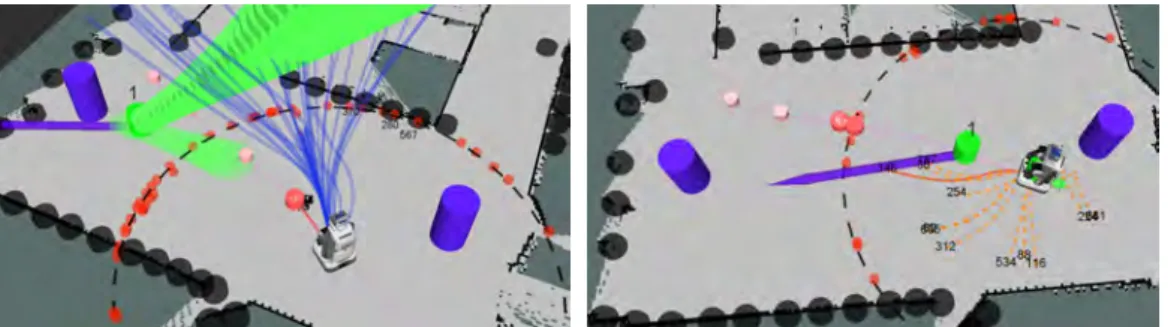
Figure 2.4 – Paths generated by the extended social force model based local planner. Green cylinder shows human positions and dashed circle around the robot depict the planning horizon for the local planner. Image on the left also shows predicted human positions, where time is plotted on the vertical axis and uncertainty in human motion is represented by the radius of the flat green cylinders. Image on the right shows different trajectories of RRT tree in dashed orange lines, trajectory with solid red line is what robot eventually selects to follow.
[Shiomi 2014] have used the CP-SFM [Zanlungo 2011] to plan robot motion in crowded environments. The authors also claim that by adjusting parameters of their algorithm the system can be collision free in the pedestrian density of interest and provides noiseless trajectories. They have tested the usefulness of the proposed algorithm with two filed trials, first where human moves from a to b and the robot moved from b to a in a straight line of about 20 meter. In the second field test, robot moved from point a to b and then b to a (about 20 meter in distance) autonomously, and the people can move freely in this areas. In both cases the robot behavior was judged, when human passed by in 5 meter range, unsafe if human have to move quickly and safe otherwise. They compared their proposed method against time varying dynamic window approach [Seder 2007], where the proposed method turns out significantly more acceptable by the participants.
The planning schemes based on the social force model works fine in large or open spaces where the robot have enough latitude to move away from predicted human paths. However, as we will see in Section 4.2, it performs rather poorly in constrained situations.
In a similar approach by [Bordallo 2015], the robot navigation planner uses counterfactual reasoning to calculate probabilities over a possible set of navigational goals. Using such probability set, this approach predicts human motion towards most probable goal and generates locally optimal motions for multiple robots.
The RiskRRT approach [RiosMartinez 2011; Spalanzani 2012] integrates proba-ble collision risk while exploring the RRT tree. For assessing the risk of collision it makes predictions on future path of an obstacle (generally a human) using Gaussian process models [Tay 2007]. Since the robot cannot know when and where will it encounter a human, the robot maintains an RRT tree as it moves in the environment. When the robot detects a human and predicts its trajectory, it can quickly switch a new branch of the RRT tree such that any collision with the detected human is
2.3. Integrating Human-Awareness 23
Figure 2.5 – Paths generated by the RiskRRT based local planner.
avoided. Additional advantage of this method is that it can also incorporate the social costs like the notion of risk of disturbance in the risk matrix used for growing the RRT tree. In a way this method is similar to the temporal planning methods we discussed in Section 2.1.2.
The RiskRRT based planning have shown to effectively navigate around hu-mans in simulation as well as real world settings [Garzón 2013]. Figure 2.5 shows how RiskRRT generates a tree for social navigation. Although being effective in populated environments, this method may also make the robot oscillate based on the planning horizon and obstacles at the boundary of the planning horizon.
Concerning the ability for the robot to plan not only for itself but also for its human partner, [Alili 2009; Lallement 2014] have developed a task planner called HATP planner (Human Aware Task Planner ). The HATP planning framework extends the traditional hierarchical task network planning domain representation and semantics by making them more suitable to produce plans which involve humans and robots acting together toward a joint goal. HATP is used by the robot to produce human-robot shared plans which are then used to anticipate human action, to suggest a course of action to humans, or possibly to ask help from the human if needed.
This effectively enriches the interaction capabilities of the robot by providing the system with what is in essence a prediction of the human behavior. This prediction is also used by the robot execution controller to monitor the engagement of the human partner during plan achievement. Another key property is to produce plans that would be possibly preferred by the human partner. For instance, HATP includes cost-based plan selection as well as mechanisms called social rules to promote plans that are considered as suitable for human-robot interaction. The question they tackle is where to perform the task and how to balance between the efforts of the human and the robot [Mainprice 2012; Waldhart 2015].
Similarly, the planner we propose in Chapter 4 manages explicitly one elastic band per agent and plans for all. A number of social constraints have been specially devised to produce plans that would be possibly preferred by the human encountering the robot. The robot and the human bands tightness are different in order to force

![Figure 2.6 – IRL states used for learning robot navigation strategy from pedestrian datasets by [PérezHigueras 2014]](https://thumb-eu.123doks.com/thumbv2/123doknet/14556577.726108/36.892.273.717.167.439/figure-states-learning-navigation-strategy-pedestrian-datasets-pérezhigueras.webp)