Development and Evaluation of a Near Infrared
Cerebral Oximeter for Congenital Heart Disease
Renee N. Kreeger, MD, Cincinnati Children’s Hospital Medical Center, Cincinnati, Ohio; Chandra Ramamoorthy, MBBS, FFA (UK),
Stanford University Medical Center/Lucile Packard Children’s Hospital, Palo Alto, California; Susan C. Nicolson, MD, The Children’s Hospital of Philadelphia, Philadelphia, Pennsylvania; Warwick A. Ames, MBBS, FRCA, Duke University Medical Center, Durham, North Carolina; et al.
Summary of presentation as presented by Renee N. Kreeger, MD, at the Society of Thoracic Surgeons meeting in Ft. Lauderdale, Florida, January 30, 2012. PurPose
Cerebral hypoxia-ischemia remains a not infrequent complica-tion in children with congenital heart disease (CHD) before, dur-ing and after cardiothoracic interventions. Near-infrared spectros-copy (NIRS), a non-invasive optical technology, can be utilized at the bedside to monitor brain oxygenation and detect hypoxia-ischemia. The purpose of this multi-center study was to calibrate and validate a novel NIRS device for CHD.
sTuDY Device
The study sensor, EQUANOX™ Advance™ 8004CB sensor
(adhesive and non-adhesive), utilizes a dual-emitter/dual-detector sensor architecture which has been shown to more effectively eliminate signal contamination due to surface and shallow tissue variability to better isolate the targeted tissue bed.1 Spacing
be-tween the emitter/detector components is 12.5 mm, thus the dis-tance from each emitter to the nearest detector is 12.5 mm and the distance from each emitter to the farther detector is 25.0 mm. (FIGURE 1). Rather than require multiple sensors or including age into the algorithm, EQUANOX Advance 8004CB incorpo-rates Nonin’s proprietary Dynamic Compensation algorithm to account for the variability in light absorption characteristics of the developing brain tissue of the child. This methodology allows for adjustment based on each individual subject’s development rather than relying on an age-based algorithm representing an excessive-ly broad-ranged group.
FiGure 1: eQuANoX Advance 8004cB sensor
MeThoDs
After parental consent and IRB approval, 100 children aged <12 years and <40 kg with CHD undergoing cardiac catheteriza-tion were enrolled into a two phase study. In Phase I (calibra-tion phase), arterial and jugular bulb venous blood were obtained for co-oximetry simultaneously with NIRS signals to calibrate
an algorithm for NIRS regional cerebral saturation (rScO2) to
a weighted average cerebral saturation (SavO2= 0.7 SjO2 + 0.3
SaO2). In Phase II, (validation phase), arterial and jugular bulb
ve-nous samples to calculate SavO2 were compared with NIRS rScO2
from the device algorithm. Correlation, bias, precision, and Arms
between SavO2 and rScO2 were determined by linear regression
and Bland-Altman analysis.
resulTs
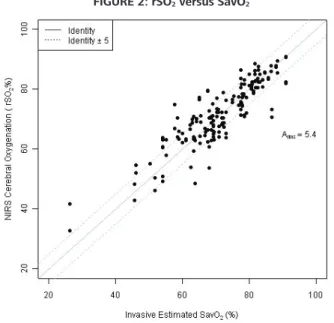
Of 100 subjects, 86 met criteria for inclusion in the analysis. There were 7 neonates, 44 infants, and 35 children; of these, 54.7 % were female, 79.1% Caucasian, and 40.7% with cyanotic dis-ease. SaO2 and rScO2 ranged from 34.4 to 100% and 34 to 92%,
respectively. There were no differences in these data between calibration and validation phases. The Arms, bias, precision, and
correlation coefficient were 5.4%, 0.5±5.38%, 5.39%, and 0.88 respectively. (FIGURE 2) Age, skin color, and hematocrit did not affect these values.
FiGure 2: rso2 versus savo2
coNclusioNs
The Nonin EQUANOX Regional Oximeter System with EQUANOX Advance8004CB sensor accurately measures the ab-solute value of cerebral saturation in children over a wide range of oxygenation levels, and may offer advantages in the detection of tissue hypoxia-ischemia in CHD over other devices.
©2012 Nonin Medical, Inc. P/N 8772-001-03
www.noninequanox.com
1Davie S, Grocott H. The impact of extra cranial contamination on NIRS measurements of regional cerebral oxygen saturation: a comparison of three different cerebral oximeters. Society of
Cardiovascular Anesthesiologists 33rd Annual Meeting. Savannah, GA. May 3, 2011. Poster session.
Front View Back View
12.5 mm 12.5 mm