HAL Id: tel-01673805
https://tel.archives-ouvertes.fr/tel-01673805
Submitted on 1 Jan 2018HAL is a multi-disciplinary open access archive for the deposit and dissemination of sci-entific research documents, whether they are pub-lished or not. The documents may come from teaching and research institutions in France or abroad, or from public or private research centers.
L’archive ouverte pluridisciplinaire HAL, est destinée au dépôt et à la diffusion de documents scientifiques de niveau recherche, publiés ou non, émanant des établissements d’enseignement et de recherche français ou étrangers, des laboratoires publics ou privés.
martensitic transformation of NiMnSb meta-magnetic
multi-functional alloys
Chunyang Zhang
To cite this version:
Chunyang Zhang. Crystallographic study on microstructure and martensitic transformation of NiMnSb meta-magnetic multi-functional alloys. Materials. Université de Lorraine, 2017. English. �NNT : 2017LORR0030�. �tel-01673805�
AVERTISSEMENT
Ce document est le fruit d'un long travail approuvé par le jury de
soutenance et mis à disposition de l'ensemble de la
communauté universitaire élargie.
Il est soumis à la propriété intellectuelle de l'auteur. Ceci
implique une obligation de citation et de référencement lors de
l’utilisation de ce document.
D'autre part, toute contrefaçon, plagiat, reproduction illicite
encourt une poursuite pénale.
Contact : [email protected]
LIENS
Code de la Propriété Intellectuelle. articles L 122. 4
Code de la Propriété Intellectuelle. articles L 335.2- L 335.10
http://www.cfcopies.com/V2/leg/leg_droi.php
UNIVERSITÉ DE LORRAINE NORTHEASTERN UNIVERSITY
DISSERTATION
Presented at
Université de Lorraine and Northeastern University
Chunyang ZHANG 章春阳
To obtain the doctor’s degree of
University of Lorraine and Northeastern University
SPECIAL FIELD: Engineering SciencesOPTION: Materials Science
Crystallographic study on microstructure and martensitic transformation of
NiMnSb meta-magnetic multi-functional alloys
Defended on March 28th, 2017 in front of the jury:
Leo KESTENS Professor Ghent University, Belgium Reviewer & Jury member Yinong WANG Professor Dalian University of Technology, China Reviewer & Jury member Yudong ZHANG Doctor HDR Université de Lorraine, France Supervisor
Xiang ZHAO Professor Northeastern University, China Supervisor
Claude ESLING Professor Université de Lorraine, France Invited
Laboratoire d'Étude des Microstructures et de Mécanique des Matériaux, LEM3
I
Abstract
NiMnSb based Heusler type alloys, as a novel multi-functional material has attracted considerable attention due to their multiple properties, such as magnetic shape memory effect, magnetocaloric effect, exchange bias effect, magnetoresistance effect. To date, many aspects of the NiMnSb alloys, such as crystal structure, microstructure, magnetic properties and mechanical properties etc., have been widely investigated. However, many fundamental issues of this family of materials have not been fully revealed, which largely restricts the development of this new kind of multi-functional materials.
In the present work, a thorough investigation has been conducted on ternary NiMnSb alloys in terms of crystal structures of austenite and martensite; microstructural and crystallographic features of martensite; martensitic transformation orientation relationship (OR) and its correlation with variant organization; transformation deformation characteristics and self-accommodation of transformation strain.
The work confirmed that the austenite of NiMnSb alloys possesses a cubic L21 crystal structure belonging to the space group Fm3m (No. 225). The martensite has a four-layered orthorhombic (4O) structure with space group Pmma (No. 051). The lattice constants of the Ni50Mn37Sb13 and Ni50Mn38Sb12 martensite are aM = 8.5830 Å, bM = 5.6533 Å and cM = 4.3501 Å, and aM = 8.5788 Å, bM = 5.6443 Å and cM = 4.3479 Å, respectively.
The microstructure of the 4O NiMnSb modulated martensite possesses a hierarchical organization feature. Martensite fine lamellae are first organized into broad plates. Each plate possesses 4 distinct twin related variants A, B, C and D forming type I twins (A and C; B and
D), type II twins (A and B; C and D) and compound twins (A and D; B and C). The variant
interfaces are defined by the corresponding twinning planes. The complete twinning elements for each twin relation are fully determined. The plates are further organized into sub-colonies and sub-colonies into plate colonies. The neighboring plates in one sub-colony and plate colony share one common plate interface orientation. Plate colonies with different oriented plate interfaces finally take the whole original austenite grain.
II
The Pitsch OR, specified as {011}A // {221}M and <011>A // <122>M, is the effective OR
between the cubic austenite and the 4O modulated martensite. Under this OR, a maximum of 24 distinct variants can be produced. The 24 variants are organized into 6 distinct variant colonies, 12 distinct sub-colonies and finally 6 distinct plate colonies. The twinning plane of type I twin and the intra-plate plate interfaces all correspond to the same family of {011}A
planes of austenite.
The formation of martensite variant colonies can be both form intragranular and intergranular during the phase transformation. The sandwich structured variant colony is the basic microstructural unit of the martensite. This structure is composed of twin related variants and possesses the full compatible inner variants interfaces and invariant habit planes. The deformation manner of the twin related variants result in the high occurrence frequency of the type II twins and affects the morphology of the sandwich colonies. The wedge-shaped structure is composed of two compatible sandwiches and conjoined by a midrib plane with a small atomic misfit. All these results indicate that the martensitic transformation is self-accommodated and the microstructure is determined by the self-accommodation of the microstructural constituents. The aim of this work is to provide fundamental crystallographic and microstructural information of NiMnSb alloys for interpreting their magnetic and mechanical characteristics associated with the martensitic transformation and further investigations on property optimization.
Keywords: NiMnSb multi-functional alloys; Twin relationship; Martensitic transformation;
III
Résumé
Les alliages NiMnSb, matériaux multifonctionnels nouveaux, ont attiré une attention en raison de leurs multiples propriétés, telles que l'effet de mémoire de forme, magnétocalorique, de biais d'échange, de magnétorésistance. Jusqu'à présent, de nombreux aspects des NiMnSb, tels que structure cristalline, microstructure, propriétés magnétiques et mécaniques ont été étudiés. Cependant, de nombreuses questions fondamentales de ces matériaux n'ont pas été entièrement révélées, ce qui limite leur développement.
Une étude a été menée sur les alliages ternaires NiMnSb en termes de structures cristallines de l'austénite et de la martensite; Caractéristiques microstructurales et cristallographiques de la martensite; La relation d'orientation (OR) de transformation martensitique et sa corrélation avec l'organisation des variantes; Les caractéristiques de déformation de la transformation et l'auto-accommodation de la déformation de transformation.
Le travail a confirmé que l'austénite possède une structure cristalline L21 cubique, groupe spatial Fm3m (No. 225). La martensite a une structure orthorhombique modulée (4O) à quatre couches, groupe spatial Pmma (No. 051). Les constantes de réseau de martensite de Ni50Mn37Sb13 et Ni50Mn38Sb12 sont aM = 8.5830 Å, bM = 5.6533 Å et cM = 4.3501 Å, et aM = 8.5788 Å, bM = 5.6443 Å et cM = 4.3479 Å.
La microstructure de la martensite 4O NiMnSb modulée possède une caractéristique d'organisation hiérarchique. Les lamelles fines de martensite sont d'abord organisées en larges plaques. Chaque plaque possède 4 variantes apparentées aux jumeaux A, B, C et D formant des jumeaux de type I (A et C, B et D), de type II (A et B, C et D) et des macles composéés (A et D;
B et C). Les interfaces des variantes sont définies par les plans de maclage correspondants. Les
éléments de maclage sont entièrement déterminés pour chaque relation de maclage. Les plaques sont ensuite organisées en sous-colonies et les sous-colonies en colonies de plaques. Les plaques voisines d'une sous-colonie et d'une colonie de plaques partagent une interface de plaque commune. Des colonies de plaques avec différentes interfaces de plaques ayant différentes orientations occupent finalement l'ensemble du grain d'austénite original.
IV
La OR de Pitsch, spécifiée comme {011}A // {221}M et <011>A // <122>M, est l'OR
effective entre l'austénite cubique et la martensite 4O modulée. Sous cette OR, un maximum de 24 variantes distinctes peuvent être produites. Les 24 variantes sont organisées en 6 colonies de variantes distinctes, 12 sous-colonies distinctes et enfin 6 colonies de plaques distinctes. Le plan de maclage de type I et les interfaces intra-plaques correspondent tous à la même famille de plans {011}A de austénite.
La formation des colonies de variantes martensitiques peut être à la fois intragranulaire et intergranulaire pendant la transformation de phase La colonie de variantes structurée en sandwich est l'unité micro-structurale de base de la martensite. Cette structure est composée de variantes de relation macles et possède des interfaces de variantes internes totalement compatibles et les plans d'habitat invariants. Les caractéristiques de déformation des variants en relation de macles conduisent à la fraction de volume élevée de macles de type II et affecte la morphologie des colonies en sandwich. La structure en forme de coin est composée de deux sandwichs compatibles et reliés par un plan de nervure médiane avec une petite incompatibilité atomique. Tous ces résultats indiquent que la transformation martensitique est auto-accommodée et la microstructure est déterminée par l'auto-accommodation des constituants microstructuraux.
Ce travail vise à fournir des informations cristallographiques et micro-structurales fondamentales des alliages NiMnSb pour l'interprétation de leurs caractéristiques magnétiques et mécaniques associées à la transformation martensitique et des recherches complémentaires sur l'optimisation des propriétés.
Mots-clés: Alliages multifonctionnels NiMnSb; Relation de macle; Transformation
martensitique; Relation d'orientation; Cristallographie; Tenseur gradient de déformation; Auto-accommodation.
V
摘要
NiMnSb 系列合金作为一种新型的多功能合金因其多重的优越能性,如磁形状记忆 效应,磁热效应,交换偏执效应以及磁阻效应,受到了人们广泛的关注。直至目前,有 关该材料的晶体结构,微观组织,磁性能以及机械性能等方面的研究均有广泛的报道。 然而有关该材料的许多基本知识还未得到完整的解决,这极大的限制了对该材料研究的 进展。 在本论文工作中选用了三组元 NiMnSb 合金为研究对象,对其马氏体相与奥氏体相 晶体结构、马氏体相的微观组织与晶体学特征、马氏体相变取向关系及变体组织特征以 及相变应变的变形特征与自协调性等问题进行了深入的研究。 研究结果表明,NiMnSb 合金的奥氏体相具有立方 L21晶体结构,对应的空间群为Fm3m (No. 225)。马氏体相具有四层调制的正交晶体结构(4O),对应空间群为 Pmma
(No. 051)。Ni50Mn37Sb13与 Ni50Mn38Sb12合金马氏体相的晶格参数分别为 aM = 8.5830 Å,
bM = 5.6533 Å,cM = 4.3501 Å 以及 aM = 8.5788 Å,bM = 5.6443 Å,cM = 4.3479 Å。 该调幅马氏体相的微观组织在构成上具有很强的层次性。呈现出细板条形状的马氏 体变体首先构成马氏体宽板条,即马氏体变体团。在每个宽板条内存在四种晶体学取向 上彼此独立的 A、B、C 和 D 马氏体变体。四种变体两两间具有孪生取向关系,可构成 I 型(变体对 A:C 及 B:D)、II 型(变体对 A:B 及 C:D)及复合型(变体对 A:D 及 B:C) 孪生三种不同的孪生关系。不同变体间的界面与它们所对应的孪晶界面重合。上述三种 类型孪晶的孪生要素已被全部解析。随后,马氏体宽板条又可构成马氏体亚板条团,而 亚板条团可进一步组成板条团。在同一亚板条团及板条团中,相邻的两两马氏体板条间 具有相同的板条间界面。最终,具有不同取向的板条间界面的板条团组成了原始奥氏体 晶粒。 在该合金的马氏体相变过程中,具有立方结构的母相奥氏体与具有正交调幅结构的 马氏体间遵循着 Pitsch 取向关系,即{011}A // {221}M、<011>A // <122>M。在该取向关 系下,每个原始奥氏体晶粒中可产生 24 种取向独立的马氏体变体。这 24 种变体可继续 构成 6 种独立的变体团、12 种独立的亚板条团,最终形成 6 个独立的板条团。I 型孪生 的孪晶面及板条间界面均对应于奥氏体的{011}A面。
VI 在马氏体相变过程中,马氏体变体团分别可在晶粒内及晶界处产生。新生成的马氏 体相以三明治结构的变体团作为基本的微结构单元。该种结构有具有孪生关系的马氏体 变体对组成。其内部的变体间界面与外围的同奥氏体交接的惯习面在原子尺度上是完全 兼容的。具有孪生关系的变体对的变形特点决定了在该材料微观组织中 II 型孪生占据主 要地位,且其也可对三明治结构变体团的形貌特征产生影响。楔形变体团是由两个完全 兼容的三明治变体团组合而成。连接两三明治变体团的是一具有较小原子错配度的中脊 面,且该面对应于奥氏体的{011}A面。上述结果表明马氏体相变是自洽的,其微观组织 是由相互自洽的各组分所组织而成。 本论文的所有研究工作提供了 NiMnSb 合金的详尽的、基本的晶体学及微观组织特 征信息,为深入理解该材料中与马氏体相变密切相关的磁性能及机械性能以及进一步的 性能优化提供了帮助。 关键词:NiMnSb 多功能合金;孪生关系;马氏体相变;取向关系;晶体学;变形矩阵;自洽。
VII
List of the frequently-used abbreviations
4O Four-layered orthorhombic
η1 Twinning direction
γ Magnitude of shear
Af Austenitic transformation finish temperature
As Austenitic transformation start temperature
BSE Backscattered electron
DSC Differential scanning calorimetry
EBSD Electron backscatter diffraction
HEB Exchange bias field
K1 Twinning plane
MEB Exchange bias magnetization
Mf Martensitic transformation finish temperature
Ms Martensitic transformation start temperature
MCE Magnetocaloric effect
MFIS Magnetic-field-induced strain
MSMA Magnetic shape memory alloys
MSME Magnetic shape memory effect
ND Neutron diffraction
OR Orientation relationship
RC Refrigeration capacity
SAED Selected area electron diffraction
SEM Scanning electron microscope
SMA Shape memory alloy
SME Shape memory effect
TCA Curie temperature of austenite
IX
Contents
Abstract... .. I Résumé... III 摘要... ... V
List of the frequently-used abbreviations ... VII
Chapter 1 Literature review ... 1
1.1 General introduction ... 1
1.2 State-of-the-art of NiMnSb multi-functional alloy systems ... 2
1.2.1 Crystal structure of NiMnSb alloys ... 3
1.2.2 Microstructure of NiMnSb alloys ... 7
1.2.3 Multiple performance of NiMnSb alloys ... 9
1.3 Martensitic transformation crystallography ... 22
1.3.1 Development of the martensitic transformation crystallography ... 22
1.3.2 Brief introduction of the nonlinear elasticity theory of martensitic transformation and microstructure construction ... 23
1.4 Content of the present work ... 26
Chapter 2 Materials and experiments ... 29
2.1 Materials preparations and heat treatments ... 29
2.2 Experimental details ... 29
2.2.1 Forward and reverse martensitic transformation temperature measurements ... 29
2.2.2 Determination of crystal structures ... 30
2.2.3 Microstructural and crystallographic characterizations ... 30
Chapter 3 Basic crystallographic calculations ... 31
X
3.2 Stereographic projection ... 32
3.3 Mean orientation ... 34
3.4 Misorientation ... 35
3.5 Twin relationship and twinning elements ... 36
3.6 Trace analysis method ... 40
3.7 Orientation relationship ... 40
3.8 Martensitic transformation crystallography ... 42
3.8.1 Bain distortion ... 42
3.8.2 Sandwich-like microstructure, habit plane and deformation gradient tensor ... 43
3.8.3 Wedge model and interface mismatch ... 44
Chapter 4 Crystal structure and crystallographic characteristics of martensite in Ni50Mn38Sb12 alloy ... 47
4.1 Introduction ... 47
4.2 Experimental ... 47
4.3 Martensitic transformation and crystal structure of martensite ... 48
4.4 Microstructural features ... 51
4.5 Orientation relationships between martensite variants and variant interfaces ... 53
4.6 Summary ... 57
Chapter 5 Martensitic transformation OR and martensite variant organization of Ni50Mn38Sb12 alloy ... 59
5.1 Introduction ... 59
5.2 Experimental ... 59
5.3 Microstructure of Ni50Mn38Sb12 martensite ... 60
5.4 Crystallographic characterization of Ni50Mn38Sb12 martensite ... 61
5.5 Determination of martensitic transformation OR ... 65
5.5.1 Crystal structure and structure simplification ... 65
XI
5.6 Correlation between martensitic transformation OR and martensite variant
organization ... 69
5.7 Summary ... 72
Chapter 6 Self-accommodation character of martensitic transformation and its impact on microstructure ... 73
6.1 Introduction ... 73
6.2 Experimental ... 73
6.3 Results ... 74
6.3.1 Martensitic transformation temperatures and crystal structures of Ni50Mn37Sb13 ... 74
6.3.2 Microstructure ... 76
6.4 Discussion ... 81
6.4.1 Sandwich-like martensite and habit plane ... 81
6.4.2 Dimension characters of sandwich structured variant colony ... 101
6.4.3 Selection of variant combination in variant colony ... 104
6.4.4 Selection rule of neighboring sandwich structured variant colonies to form wedge-shaped martensite and midrib plane ... 105
6.5 Summary ... 117
Chapter 7 Conclusions and perspectives ... 119
7.1 Conclusions ... 119
7.2 Perspectives ... 122
References... 123
Publication list ... 133
I: Publications in international journals ... 133
II: Contributions to International Conferences ... 133
1
Chapter 1 Literature review
1.1 General introduction
Multi-functional materials, as supporting materials for the development of many scientific domains, such as information technology, energy science, aerospace science and technology and so on, are highly valued by the governments and widely investigated by researchers in the past decades. Generally, this kind of materials can produce some specific functions by an external stimulation, such as light, electric current, magnetic field, stress and heat. Among these materials, the shape memory alloys (SMAs) as a new kind of multi-functional materials have attracted great attention with its advantageous mechanical properties. The first discovery of the shape memory effect (SME) was in an Au - 47.5 at. % Cd alloy in 1951 [1] by studying the movement of the boundaries between the B2 cubic austenite and the B19 orthorhombic martensite [2] during the martensitic transformation. Later, the same effect was discovered in a Ni-Ti alloy in 1963 [3]. Since then, SMAs such as NiTi-based (NiTiCu [4-7], NiTiFe [8, 9], NiTiNb [10, 11], NiTiPd [12, 13], etc.), Cu-based (CuAlNi [14-16], CuZnAl [17, 18], etc.), Fe-based (FeMnSi [19], FePt [20], etc.) alloys, which are confirmed to have potential applications in automotive [21] and aeronautic [22, 23] industries, have been developed rapidly. Among these materials, the Ni-Ti based SMAs are regarded as the best ones since they have high strain (up to ~ 8 % [24]). However, the SME of these kind of materials is originated from the reversible martensitic transformation that is driven by a temperature field. Thus, the working frequency is very low, which greatly restricts the development and applications of these materials.
To overcome this disadvantage, magnetic shape memory alloys (MSMAs) were developed in recent years. The common MSMAs contain NiMn-based (NiMnGa [25-28], NiMnIn [29-31], NiMnSn [32, 33], NiMnSb [34-36], NiMnAl [37]), NiFeGa [38, 39], CoNiGa systems [40] and so on. Among these MSMAs, the NiMnX (X = Ga, In, Sn, Sb) alloy systems have been considered to be the most promising ones. Different from the traditional SMAs, these materials can associate the martensitic transformation with their magnetic properties. Thus, the MSMAs
2
with their magnetic transition temperature at the vicinity of martensitic transformation can realize phase transformation under an external magnetic field incentivisation. The magnetic shape memory effect (MSME) was first detected by applying an external magnetic field to a Hustler type Ni2MnGa alloy in 1996 (~ 0.2 % strain along the [001] direction) [41]. Later,
investigations on enhancing the strain and stress of these materials are widely carried out. To date, the highest magnetic field induced strain of the NiMnGa alloys has amounted up to 12 %, which is detected in a quinary Ni46Mn24Ga22Co4Cu4 alloy [42]. Moreover, the work frequency
of NiMnGa alloys has reached up to kHz [43, 44]. Such an excellent MSME is originated from the rearrangement of the martensite variants through interface movements driven by the external magnetic field. However for the other MSMAs systems, the NiMnX (X = In, Sn, Sb) alloys, the origin of the MSME is quite different from NiMnGa alloys. In these alloys, the magnetism of austenite is much higher than that of martensite, so the martensitic transformation experiences a considerable magnetism drop. Hence, a magnetic induced reverse martensitic transformation phenomenon can be detected in these alloys [30]. When the materials are prestrained before reverse martensitic transformation, the reversible phase transformation under a magnetic field cycle can realize a shape change cycle, hence shape memory effect. In addition, the sharp change of the magnetism accompanying the martensitic transformation also results in many different magnetic effects, such as the magnetocaloric effect (MCE) [45-47], magnetoresistance effect [48-50], and kinetic arrest effect [51]. Moreover, since the martensitic transformation of the NiMnX (X = In, Sn, Sb) alloys is detected in the off-stoichiometric (Mn rich) Heusler type alloys [34], the interaction between the Mn-Mn atoms also leads to an ferromagnetism and antiferromagnetism interaction [52-54] below the Néel temperature. All these novel properties of these materials provide them with great potential as magnetic shape memory materials, magnetic refrigeration materials and magnetic recording materials. Hence, investigations on these materials have been widely carried out in the past decade and these materials also became one of the most promising multi-functional materials.
3
This thesis selects the ternary NiMnSb alloys systems as the research materials. According to the chemical composition of the reported alloys and their specific magnetic properties, the investigations of NiMnSb alloys can be divided into two parts: one is the half-Heusler type NiMnSb alloy and the other is the off-stoichiometric Heusler type Ni(2-x)Mn(1+x+y)Sby (0 < x, y
< 1) alloys. Since the first discovery of the NiMnSb alloy as a half-metallic ferromagnets in 1980s [55], researchers have mainly focused on preparing the half-metallic ferromagnetic NiMnSb thin films using magnetron sputtering and studying the magneto-optical, magnetic and resistivity properties [56-58]. The specific electronic structure of this material makes it valuable candidate materials in the domains of spintronics, spin-electron device and microelectronics. Later in 2004, the martensitic transformation was found in the off-stoichiometric Heusler type Ni50Mn37Sb13 alloy [34], this granted it special value as MSMA. In addition, with the multiple
magnetic properties mentioned above [47, 50, 54] discovered in this kind of alloys, more and more researchers pay attention to these materials. To date, almost all of the investigations on this kind of materials are on the magnetic properties, and few are on the crystal structures, magnetic structures or martensitic transformation features. Next, the research results on the off-stoichiometric, Mn rich Heusler type NiMnSb alloys will be overviewed in details.
1.2.1 Crystal structure of NiMnSb alloys
As is known, the crystal structures of the constituent phases as basic information of a material is of great importance for many related investigations, such as microstructure, crystallographic features, mechanical properties and so on. The conventional examination methods consisting of the X-ray diffraction (XRD), the neutron diffraction (ND) and the transmission electron microscope (TEM) selected area electron diffraction (SAED) have been applied to investigate the crystal structures of NiMnSb austenite and martensite in the past decade. It is clear that the high temperature austenite processes a cubic L21 structure, whereas for martensite, its structure varies with the composition. Both modulated and non-modulated structures have been reported in ternary NiMnSb alloys with different compositions. In addition, different structures have been reported for some alloys with the same composition. Hence, the crystal structure of NiMnSb martensite is complicated and the reports on it are not consistent.
4
As the basis of crystallographic analysis as well as the related physical properties, the detailed crystal structure information is essential.
1.2.1.1 Crystal structure of austenite
Like other NiMn-based (NiMnGa, NiMnIn and NiMnSn) alloys, the high temperature phase – austenite, was confirmed to possess an L21 (space group: No. 225, Fm3m) cubic crystal structure, which has been demonstrated by XRD [36, 59-76] and ND [77-79] measurements. Using the L21 structure information of Ni2MnSb austenite reported in [60] for lattice parameters
and in [77] for atomic position information as an example, the crystal structure of austenite with stoichiometric composition is illustrated in Fig. 1.1.
Fig. 1.1 Illustration of a unit cell of Ni2MnSb austenite.
It can be seen in Fig. 1.1 that the L21 structure is highly ordered with a high symmetry. It can be represented by 4 interpenetrating face-centred cubic sublattices: Mn atoms at the 4a (0, 0, 0) positions, Sb atoms at the 4b (0.5, 0.5, 0.5) positions, Ni atoms at the 8c (0.25, 0.25, 0.25) positions and Ni atoms at the 8c (0.75, 0.75, 0.75) positions. When the composition is Mn rich,
i.e. off-stoichiometric, the excess Mn atoms will occupy the 4b position of Sb atoms in
Ni2Mn(1+x)Sbx (0 < x < 1) type alloys, and 4b and 8c positions of Sb and Ni atoms in Ni (2-x)Mn(1+x+y)Sby (0 < x, y < 1) type alloys. However the structure is still of L21 cubic type [77-79].
1.2.1.2 Crystal structure of martensite
Different from the explicit structure of austenite, the crystal structure of the low– temperature martensite is under clarification. In the past decade, the crystal structure of NiMnSb
5
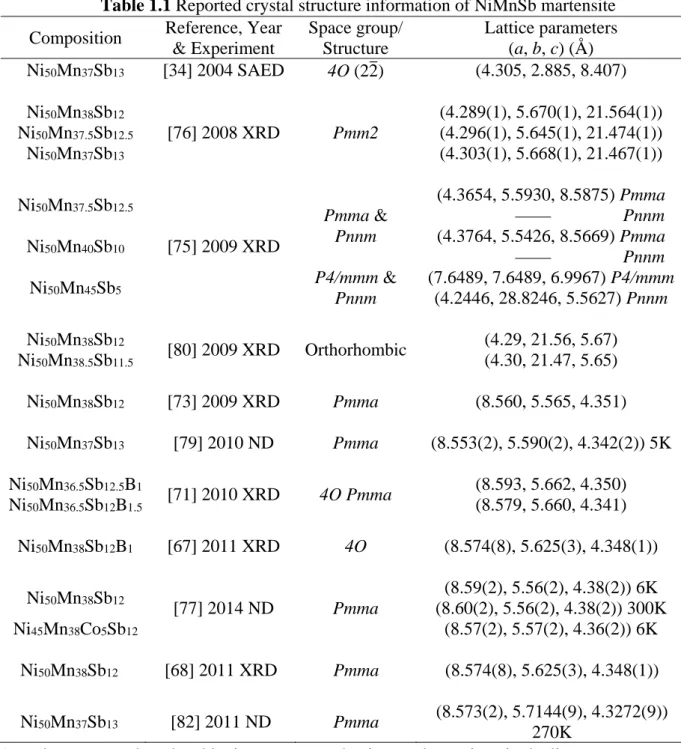
martensite have been investigated using XRD [59, 61, 67-69, 71, 73-76, 80, 81], ND [77, 79, 82] and SAED [34]. All the reported experimental results show that the martensite phase possesses an orthorhombic crystal structure. The results are summarized and shown in Table
1.1.
Table 1.1 Reported crystal structure information of NiMnSb martensite
Composition Reference, Year & Experiment Space group/ Structure Lattice parameters (a, b, c) (Å) Ni50Mn37Sb13 [34] 2004 SAED 4O (22) (4.305, 2.885, 8.407) Ni50Mn38Sb12 [76] 2008 XRD Pmm2 (4.289(1), 5.670(1), 21.564(1)) Ni50Mn37.5Sb12.5 (4.296(1), 5.645(1), 21.474(1)) Ni50Mn37Sb13 (4.303(1), 5.668(1), 21.467(1)) Ni50Mn37.5Sb12.5 [75] 2009 XRD Pmma & Pnnm (4.3654, 5.5930, 8.5875) Pmma —— Pnnm Ni50Mn40Sb10 (4.3764, 5.5426, 8.5669) Pmma —— Pnnm Ni50Mn45Sb5 P4/mmm & Pnnm (7.6489, 7.6489, 6.9967) P4/mmm (4.2446, 28.8246, 5.5627) Pnnm Ni50Mn38Sb12 [80] 2009 XRD Orthorhombic (4.29, 21.56, 5.67) Ni50Mn38.5Sb11.5 (4.30, 21.47, 5.65) Ni50Mn38Sb12 [73] 2009 XRD Pmma (8.560, 5.565, 4.351) Ni50Mn37Sb13 [79] 2010 ND Pmma (8.553(2), 5.590(2), 4.342(2)) 5K Ni50Mn36.5Sb12.5B1 [71] 2010 XRD 4O Pmma (8.593, 5.662, 4.350) Ni50Mn36.5Sb12B1.5 (8.579, 5.660, 4.341) Ni50Mn38Sb12B1 [67] 2011 XRD 4O (8.574(8), 5.625(3), 4.348(1)) Ni50Mn38Sb12 [77] 2014 ND Pmma (8.59(2), 5.56(2), 4.38(2)) 6K (8.60(2), 5.56(2), 4.38(2)) 300K Ni45Mn38Co5Sb12 (8.57(2), 5.57(2), 4.36(2)) 6K Ni50Mn38Sb12 [68] 2011 XRD Pmma (8.574(8), 5.625(3), 4.348(1)) Ni50Mn37Sb13 [82] 2011 ND Pmma (8.573(2), 5.7144(9), 4.3272(9)) 270K ‘——’ represents the related lattice parameters having not been given in the literature.
Among the above investigations, the crystal structure of Ni50Mn37Sb13 martensite was
6
obtained, they suggested that it has a four-layered orthorhombic (4O, where ‘O’ stands for orthorhombic) (22) crystal structure. In addition, they pointed out that the modulation direction is along the a-axis and one martensite unit cell contains two sub cells arranged along the c-axis. For explicitly, we refer the direction or axis along which the sub cells stack as the stacking direction or axis. Later, Khan et al. carried out a thorough investigation on the crystal structure of Ni50Mn(25+x)Sb(25-x) alloys using XRD [76]. They found that when x ≥ 13, the alloys possess
a modulated orthorhombic structure with space group Pmm2 (No. 025). However they thought that one martensite unit cell contains more sub cells and the stacking direction is along the c-axis, which can be seen from the given lattice parameters in Table 1.1. In 2009, Aksoy et al. studied the effect of changing Sb-concentration on phase composition and the corresponding crystal structure of Ni50Mn(50-x)Sbx alloys using XRD (Co Kα radiation) [75]. The results
revealed that for x ≤ 12.5, the alloys were in martensite state. By XRD pattern simulation, they found that the martensite phase of Ni50Mn37.5Sb12.5 and Ni50Mn40Sb10 alloys possesses a mixed
orthorhombic structures, one being 4O with space group Pmma (No. 051) (stacking direction:
c-axis) and the other is seven-fold (7-fold) [75] modulated orthorhombic structure with space
group Pnnm (No. 058) (stacking direction: b-axis). Moreover, they also studied the crystal structure of Ni50Mn45Sb5 alloy and found a 7-fold orthorhombic and L10 tetragonal (space group:
P4/mmm (No.125)) mixed structure. It was the first time that an L10 structure is reported for the NiMnSb martensite. Similarly, Dubenko et al. also reported such an orthorhombic structure with the b-axis as the stacking direction, like the 7-fold orthorhombic structure [75] discovered in Ni50Mn38Sb12 and Ni50Mn38.5Sb11.5 alloys [80]. For the 4O structure, Rao et al. also held a
different opinion from that of Aksoy et al. on the stacking direction [73]. From the XRD patterns obtained at different temperatures of Ni50Mn38Sb12, they observed the changes of the
diffraction peaks during the heating process (reverse martensitic transformation process) and concluded that the stacking direction is along the a-axis. This structure was later confirmed in some other ternary and quaternary NiMnSb alloys [61, 68, 71, 77, 79, 82]. However, Najak et
al. thought that this structure should be a ten-layered modulated orthorhombic but not 4O.
It can be seen that, owing to the presence of structural modulation, there exist controversies over the modulation period, the direction and the space group. The alloys with the same or
7
similar compositions were reported to possess different crystal structures in different studies. Since the crystal structure information is prerequisite for crystallographic orientation analyses, it is necessary to obtain accurate crystal structure information of these alloys.
1.2.2 Microstructure of NiMnSb alloys
It is known that the properties of the NiMnX (X = In, Sn, Sb) alloys, especially the shape memory effect, are closely related to the microstructure features of the parent austenite and the product martensite. As a kind of multi-functional material, the improvement of the properties are extremely important and of significance. Hence, a thorough investigation of the microstructure characteristics of NiMnSb alloys is essential. However, the study is at the beginning state.
Rao et al. were the very first to conduct such study. With the help of scanning electron microscope (SEM), they observed the microstructures of Ni50Mn38Sb12 martensite for the first
time [73]. The backscattered electron (BSE) micrograph of martensite is shown in Fig. 1.2. They observed that the Ni50Mn38Sb12 martensite has a surface relief and is composed of large
amount of thin plates (~ 5 μm wide) with different stretch directions. They believed that these martensite plates should be twin related.
8
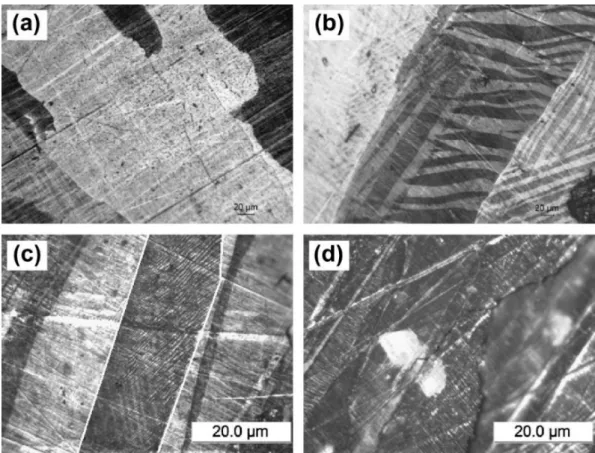
Fig. 1.3 Optical microscope images taken at room temperature for: (a) Ni45Co5Mn38Sb12 taken
before temperature cycling, (b) Ni48Co2Mn38Sb12 taken before temperature cycling, (c)
Ni48Co2Mn38Sb12 taken with higher magnification and (d) Ni48Co2Mn38Sb12 taken after
temperature cycling [83].
Nayak et al. studied the effects of repeated martensitic transformation on thermal and magnetic properties in NiCoMnSb alloys [83]. They used the optical microscope (OM) to observe the original microstructures of Ni45Co5Mn38Sb12 austenite and Ni48Co2Mn38Sb12
martensite before temperature cycling as shown in Fig. 1.3(a) and Figs. 1.3(b) and (c). Similar to the microstructure features of the ternary NiMnSb martensite, the NiCoMnSb martensite also consists of large amount of broad plates with different widths and orientations. Within the broad plates, many fine lamellae can also be observed. After the temperature cycling, the martensite phase still presents the plate-like microstructure. However, many microcracks are generated along the boundaries between the neighboring broad plates, as shown in Fig. 1.3(d). This resulted from the poor mechanical properties of this material. They pointed out that the appearance of these microcracks plays an important role in increasing the resistivity of this material.
9
To sum up, both the OM and SEM observations demonstrated that the martensite of NiMnSb alloys possesses a plate-like microstructure. In addition, twin relationships between neighboring fine lamellae have been speculated. However, all these investigations are confined to morphological observation. Due to the absence of the detailed crystal structure information, further crystallographic information of NiMnSb martensite e.g. twin type, twinning elements, twin interface planes, variants distribution, etc. is not available, imposing difficulty in interpreting the microstructure-related properties of these alloys. Hence, the corresponding studies is necessary and can provide fundamental information for these alloys, which will be useful for further investigations on properties optimization of NiMnSb alloys.
1.2.3 Multiple performance of NiMnSb alloys
As magnetic materials, the occurrence of many magnetic responses in NiMnSb alloys always accompanies the structural and magnetic transitions. Generally, in NiMnSb alloys, there exist one first-order and two second-order phase transformations: martensitic transformation (from high-temperature austenite to low-temperature martensite), paramagnetism-ferromagnetism transition in austenite and paramagnetism-antiparamagnetism-ferromagnetism transition in martensite, corresponding to three characteristic temperatures: martensitic transformation temperature, Curie temperature and Néel temperature, respectively. The MSME, MCE, exchange bias effect and magnetoresistance effect are all closely related to these transformations. Since these properties make the materials potential candidates as magnetic shape memory, magnetic refrigeration and magnetic recording materials, many investigations have been carried out on properties optimization and enhancement.
1.2.3.1 Magnetic shape memory effect
In NiMnSb alloys, the MSME is originated from the magnetic-field-induced strain (MFIS). Since the parent austenite is a high-magnetism phase, the application of an external magnetic field could stimulate the reverse martensitic transformation in these alloys. The relationship between the intensity change of the external magnetic field ∆ and the drop of the phase transformation temperature ∆ can be associated with the following Clausius–Clapeyron relation [30]:
10
∆T ∆
∆ ∆ . (1.1)
Here ∆ and ∆ are the differences of the magnetization and entropy between austenite and martensite. Obviously, these two parameters are two decisive factors to the magnetic driving capability. Hence, the alloys whose Curie temperature of austenite (TCA) is higher than the martensitic transformation temperature are more favorable as the MSMAs.
Fig. 1.4 Recovery strain at 290 K induced by a magnetic field for Ni50Mn37Sb13 polycrystalline
alloy [36].
To date, the investigations of the MSME in NiMnSb alloys are not numerous. Du et al. studied the recovery strain induced by the magnetic field in a polycrystalline Ni50Mn37Sb13 alloy
[36]. Fig. 1.4 shows the strain versus magnetic field curves for Ni50Mn37Sb13 polycrystalline
alloy (without prestrain). It can be seen that, a 15 ppm recovery strain was obtained under a 1.2 T magnetic field, and ~ 4 ppm strain was detected in the removing process of the magnetic field. Higher recovery strain could be acquired by increasing the intensity of the external magnetic field, since the recovery strain has not reached saturation at 1.2 T. Hence, a reversible, two-way MSME was detected in this alloy.
Yu et al. investigated large temperature and MFIS in polycrystalline NiMnInSb alloys [35].
Figs. 1.5(a) and (b) show the temperature and magnetic field dependence of the spontaneous
11
of the Sb concentration, a ± 1.7 % spontaneous phase transformation strain was obtained during the cooling and heating processes for Ni50Mn36In8Sb6 alloy, which has been largely enhanced
compared with the Sb-free Ni50Mn36In14 alloy (∓ 0.08 %). By applying a magnetic field to the
Ni50Mn36In8Sb6 alloy at 295 K (in martensite state), a magnetic-field-induce reverse martensitic
transformation and a large strain (up to 1.7 % at 9 T magnetic field) was detected as shown in
Fig. 1.5(b). In the removing process of the magnetic field, no reversible length change was
detected. These results indicate that the magnetic field induced MSME is not reversible. It happens only during the magnetic-field-induced reverse martensitic transformation.
Fig. 1.5 (a) Temperature dependence of the spontaneous phase transformation strain for
Ni50Mn36In(14-x)Sbx (x = 0, 2, 4, 6) alloys and (b) field dependence of the strain for
polycrystalline Ni50Mn36In8Sb6 alloy that measured along the direction of sample solidification
during arc melting [35].
To date, a reversible, two-way MSME has been detected in ternary Ni50Mn37Sb13
polycrystalline alloy. With the doping of Sb element, the spontaneous phase transformation strain of polycrystalline NiMnIn alloys was largely enhanced. In addition, a large strain that is originated from the magnetic-field-induced reverse martensitic transformation was also detected in this alloy. Although large MFIS are frequently reported in NiMnGa alloys systems, the excellent MSME is only achieved in single crystal. As is known, the cost of single crystal preparation is much higher than polycrystalline alloy preparation. The shape and size of the single crystal alloy is also largely restrained. Moreover, the price of Ga element, as well as In and Sn elements, is much more expensive than Sb. All these factors determine that the
12
polycrystalline NiMnSb alloys should be a promising candidate as cost-economic and performant MSMAs.
1.2.3.2 Magnetocaloric effect and magnetic refrigeration
The MCE is a thermal-magnetic property of magnetic materials. It represents a temperature change under an actuating magnetic field. To characterize this property, one conventional way is to calculate the maximum entropy change (∆Sm) of the material under an applied magnetic field around the Curie temperature or martensitic transformation temperature with the help of the measured isothermal magnetization curves and the integrating Maxwell relation:
∆ , . (1.2)
Then, with the obtained ∆ , curve, the refrigeration capacity (RC) can be calculated by integrating the curve over the full width at half maximum using the following equation:
∆ . (1.3)
It should be emphasized that, this RC is composed of two parts: one is the hysteresis loss and the other is the effective RC. Hence, to acquire the effective RC, the hysteresis loss need to be calculated by integrating the measured Isothermal hysteresis loops.
Fig. 1.6 shows an illustration of the MCE in NiMnX (X = In, Sn, Sb) alloys [45]. Here we
consider an adiabatic magnetization process. When an external magnetic field is applied to the paramagnetic martensite, the magnetic moments will be aligned in the field direction. Then the magnetic entropy will be reduced and the material will be heated and release heat to the environment, as shown by the top figures in Fig. 1.6. If the magnetic field is applied near the martensitic transformation temperature, it will induce reverse martensitic transformation. As the transformation involves entropy increase from martensite to austenite, under an adiabatic circumstance, the material will be cooled down, as shown by the figures in the middle of Fig.
1.6. The net MCE is a summation of these two MCEs: the MCE from magnetic spin alignment
13
is a temperature decrease of the material. Hence, the material will absorb heat from the environment and generate a magnetic refrigeration effect.
Fig. 1.6 Contributions from the magnetic and structural part for a first-order magnetic transition
to the magnetocaloric effect (MCE) [45].
The investigation of MCE for NiMnSb alloys systems was conducted in ternary Ni50Mn(37+x)Sb(13-x) (x = 0, 0.5, 1) polycrystalline bulk alloys for the first time in 2007 [47]. A
∆Sm of 19.1 J·(kg·K)-1 and 8.9 J·(kg·K)-1 were obtained at 297 K by applying a 5 T and 2 T external magnetic fields for Ni50Mn38Sb12 alloy. In addition, the RC of Ni50Mn37Sb13 alloy was
also studied. Results show that it possesses a ~ 32 J·kg-1 for RC, while the hysteresis loss is ~ 13 J·kg-1. Hence, the effective RC is ~ 19 J·kg-1. Obviously, the large hysteresis loss in Ni50Mn(37+x)Sb(13-x) system is an obstacle for its use as a competent magnetic refrigeration
material.
The MCE for ternary Ni50Mn(50-x)Sbx (x = 13, 14, 15) alloys were studied by Du et al. and
14
Ni50Mn37Sb13 alloy at 287 K with a 5 T magnetic field. Compared with the reported results by
Khan et al. [47], such a ∆Sm is much lower thus this material could not be a promising magnetic refrigeration material.
Later, Feng et al. made a thorough investigation on MCE in the temperature regions of martensitic transformation and paramagnetism-ferromagnetism transition in austenite for Ni (50-x)Mn(38+x)Sb12 (x = -1, 0, 1, 2) alloy system [72, 85]. The temperature dependences of entropy
change are shown in Fig. 1.7. It can be seen that the entropy change of martensitic transformation possesses a positive value, while turns to negative for the paramagnetism-ferromagnetism transition in austenite. The ∆ Sm reaches 21.9 J·(kg·K)-1 at 279 K for Ni49Mn39Sb12 with a 5 T magnetic field, which is the highest one among all the reported results
in ternary NiMnSb alloys. In addition, for Ni49Mn39Sb12 alloy, with a 1 T magnetic field, the
∆Sm also reaches 6.15 J·(kg·K)-1 and with only 0.9 J·kg-1 hysteresis loss. Hence, this alloy demonstrates promising potential as room-temperature magnetic refrigeration material.
Fig. 1.7 Magnetic entropy changes in the temperature regions of (a) martensitic transformation
[85] and (b) magnetic transition in austenite [72] for Ni(50-x)Mn(38+x)Sb12 (x = -1, 0, 1, 2) alloys
with a magnetic-field change from 0 to 5 T.
Although ternary NiMnSb polycrystalline alloys have an excellent MCE compared with NiMnIn and NiMnSn polycrystalline alloys [46, 86], the ∆Sm is still low. Alloying, as one of the most efficient way to enhance the ∆Sm, has been widely studied by researchers in recent years. Element doping using Cu [69], Fe [66], B [67], Co [74, 87] and so on to ternary NiMnSb
15
alloys are studied recently. All the results show that the ∆Sm have a certain increase compared with the parent ternary NiMnSb alloys, especially for Co doping.
Nayak et al. studied the MCE of forward [87] and reverse [74] martensitic transformation in NiCoMnSb alloys for the first time. The ∆Sm detected in a Ni45Co5Mn38Sb12 polycrystalline
alloy with a 5 T magnetic field at ~ 260 K is 68 J·(kg·K)-1. Compared with the one reported in the parent Ni50Mn38Sb12 alloy (17.7 J·(kg·K)-1 at 273 K with a 5 T magnetic field) [47], the
value has been largely enhanced. In addition, the effective RC of this alloy is 74 J·kg-1, also
much larger than the one observed before [47]. Since Co has a lager magnetic moment compared with the replaced Ni, Co doping is an efficient way to enhance the value of ∆Sm.
Effect of pressure on martensitic transformation and MCE for NiCoMnSb alloy was also studied by the group of Nayak et al. [88]. The results indicated that pressure can stabilize the martensitic state, i.e. increase the martensitic transformation start temperature. The martensitic transformation start temperature has increased by 28 K for Ni45Co5Mn38Sb12 under an 8.5 kbar
pressure, while by 25 K for Ni46Co4Mn38Sb12 under a 9 kbar pressure. In addition, the pressure
can also decrease the ∆Sm. For Ni45Co5Mn38Sb12 alloy, the ∆Sm increased first from 41.1 J·(kg·K)-1 (without pressure) to 46 J·(kg·K)-1 (with a 1.1 kbar pressure), and then decreased to
32.5 J·(kg·K)-1 (with a 8.5 kbar pressure). For Ni
46Co4Mn38Sb12, the ∆Sm decreased from 32.3 J·(kg·K)-1 (without pressure) to 16.5 J·(kg·K)-1 (with a 9 kbar pressure) continuously. The
decrease in MCE can be attributed to the weakening of the martensitic transformation, which results in smaller difference in the magnetization between austenite and martensitic and causes a reduction in the ∂M ∂T⁄ H value.
16
Fig. 1.8 (a) ∆Sm as a function of temperature in Ni50−xCoxMn40Sb10 (x = 9, 9.5); (b) isothermal
magnetization curves and hysteresis losses around the martensitic transformation temperature for Ni41Co9Mn40Sb10 alloy [89].
Moreover, they also studied the MCE in Ni50-xCoxMn40Sb10 (x = 9, 9.5) alloy [89].
Although the ∆Sm is very small, 9.2 J·(kg·K)-1 and 8.2 J·(kg·K)-1 for x = 9 and 9.5 respectively, the MCE peak is quite broad, i.e. has an excellent RC, as shown in Fig. 1.8(a). In addition, the hysteresis loss is very low, as displayed in Fig. 1.8(b). Thus, a remarkable 106 J·kg-1 effective RC is finally obtained in Ni41Co9Mn40Sb10 alloy.
Based on the reported high ∆Sm in NiCoMnSb alloys system, Roshnee et al. and Sahoo et
al. investigated the effect of Ga, Si [90] and Ge [81, 91] substitutions on the MCE, respectively.
A ∆Sm of 70 J·(kg·K)-1 was detected in the Si-doped alloy, Ni46Co4Mn38Sb11Si1 alloy, at 273.5
K under a 5 T magnetic field. It is the highest entropy change that has been detected in NiMnSb-based polycrystalline bulk alloys, so far. For Ga and Ge substitutions, the ∆Sm is decreased compared with the corresponding parent alloy. However, a remarkable MCE peak broadening phenomenon was observed for Ga substitution, which is considered to be contributive to the RC in this alloy.
The MCE of NiMnSb alloys in other states like ribbon and thin films are also investigated. For an annealed Ni46Co4Mn38Sb12 ribbon, a ∆Sm = 32.5 J·(kg·K)-1 was acquired [92], which has a 3.5 J·(kg·K)-1 increase compared with the bulk sample that possesses the same
composition [74]. A 23 mJ·(cm3·K)-1 and a 15.2 mJ·(cm3·K)-1 ∆ S
17
Ni49.8Mn32.97Al4.43Sb12.8 [59] and Ni50Mn36.3Sb10.4Al3.3 [93] thin films, respectively. All these
results have enriched the MCE investigations in NiMnSb alloys.
Although an excellent MCE and RC have been detected in NiMnSb alloys, there still exists deficiency with respect to the other types of NiMn-based Heusler alloys [94-97]. This mainly results from the relatively low ∆Sm, the narrow MCE peak and the high hysteresis loss in these materials. In addition, decreasing the high actuating magnetic field is also necessary, not only to reduce the cost but also to increase the practicability. Hence, property optimization is still needed for the practical applications of these alloys.
1.2.3.3 Exchange bias effect
Exchange bias effect was first discovered at the surface of a Co (core) – CoO (shell) clad material in 1956 [98]. This effect can be described as a shift of the hysteresis loop as displayed in Fig. 1.9. It can be seen that after the specimen is cooled under a magnetic field (the so-called field cooling) to a certain temperature, the hysteresis loop at this temperature shifts toward the negative magnetic field direction in the figure. The exchange bias field (HEB) is defined by the
shift of the hysteresis loop, as shown Fig. 1.9. For the specimen that is cooled without the magnetic field (the so-called zero field cooling), a double shifted loop [66] can be observed which indicates the existence of the antiferromagnetic region and the exchange bias effect in this material [66].
Fig. 1.9 Hysteresis loops at 5 K for Ni50Mn36Fe2Sb12 alloy after zero field cooling (ZFC) and
field cooling (FCC). The definitions for the exchange bias field (HEB) is indicated in the figure
18
For a ferromagnetism and antiferromagnetism concomitant system, when it is cooled down from a temperature between Curie temperature and Néel temperature under a magnetic field to a temperature lower than Néel temperature, the exchange bias effect will occur. This effect is originated from a unidirectional magnetic anisotropy at the interface of the ferromagnetic and antiferromagnetic couplings. The pinning effect of the antiferromagnetic region to the adjacent ferromagnetic region is the origin of the hysteresis loop shift. Potential technological applications of the materials as permanent magnet materials and high density recording media can be achieved by this effect [99].
In NiMnSb alloys, the exchange bias effect was first studied by Khan et al. in 2007 [100]. The experiment was conducted in polycrystalline bulk Ni50Mn25+xSb25-x (12 ≤ x ≤ 13.5) alloys.
A maximum shift of the hysteresis loops, i.e. the HEB, up to 248 Oe was detected in
Ni50Mn38.5Sb11.5 alloy at 5 K under a 5 T cooling field. Later, Rao et al. investigated the
exchange bias effect in Ni50Mn50-xSbx (12 ≤ x ≤ 14) alloys. A 230 Oe HEB was obtained in
Ni50Mn38Sb12 alloy at 10 K under a 5 T cooling field, which is a little lower than the one reported
in Ni50Mn38.5Sb11.5 alloy. In 2012, Wang et al. studied the effect of temperature on HEB in
Ni50Mn36Sb14 alloy [101]. With a 5 T cooling field, a 223 Oe HEB was obtained at 5 K, then it
rose to 413 Oe at 55 K, which is the highest HEB that has been reported in ternary NiMnSb
alloys, and finally dropped to 39 Oe at 95 K. In addition, they also carried out an investigation on the exchange bias effect through zero field cooling from different remanent states in this alloy [102] and obtained a maximum of 270 Oe HEB with a 2.437 emu·g-1 remanence.
As a promising magnetic recording material, a high HEB and a high blocking temperature
are essential to the material. In order to obtain a higher HEB, elements like Co [68, 103], Fe [66],
Al [61, 63], Ge [63], Cr [50] etc. are doped into the ternary NiMnSb alloys. Results show that the doping of these elements can enhance the HEB [50, 63, 66, 68]. Moreover, the doping of Al
can also increase the blocking temperature of the alloy [63]. However, the maximum HEB
obtained was only 480 Oe, which was detected in a Ni45Mn38Co5Sb12 alloy at 3 K under a 5 T
cooling field [68]. In 2011, Nayak et al. prepared powder Ni50-xCoxMn38Sb12 (x = 0, 5) alloys
using the ball milling method. This time with a same cooling magnetic field and also at 3 K temperature, a huge HEB up to 3200 Oe for Ni50Mn38Sb12 alloy was detected, just as shown in
19
Fig. 1.10 [104], which is ~ 13 times larger than the one reported in bulk sample with the same
composition.
Fig. 1.10 Magnetization isotherms measured at 3 K after field cooling the sample in different
fields. The inset shows the cooling field dependence of HEB and exchage bias magnetization
(MEB) at 3 K [104].
To increase the blocking temperature, Akkera et al. prepared a NiMnSb (ferromagnetism) / CrN (anti-ferromagnetism) heterostructure deposited by magnetron sputtering which can even show the exchange bias effect at the Néel temperature of CrN (270 K) [64]. Although the maximum HEB = 148 Oe was detected at 10 K temperature, a 10 Oe HEB can still be detected at
295 K, which proposed a new approach to develop a room temperature NiMnSb based magnetic recording material.
Besides the bulk sample, the exchange bias effect in ribbon [62, 92] and thin films [54] of NiMnSb alloys were also investigated. The maximum HEB = 610.83 Oe was obtained in a
Ni50Mn36.3Sb10.4Al3.3 thin film at 10 K [54], a little higher than the bulk sample but also much
lower than the one reported in the powder sample.
To summarize, a considerable HEB has been acquired in NiMnSb alloys. However, the
material possessing a high blocking temperature together with a high HEB is still not found. As
is known, in NiMnX (X = In, Sn, Sb) Heusler type alloys, all the Mn atoms on normal Mn sites have a ferromagnetic interaction, while the excess Mn atoms occupying the X sites are coupled through antiferromagnetic interaction to the surrounding Mn atoms. The antiferromagnetic
20
interaction between the Mn atoms will be enhanced with the decreasing of the distance between Mn atoms at X sites and the normal sites. Hence, a thorough investigation of the crystal and magnetic structures of these alloys is essential and of significance to understand the exchange bias effect and further investigations on property optimization.
1.2.3.4 Magnetoresistance effect
Magnetoresistance is a physical quantity to describe the variation of the electrical resistivity of a material under an external magnetic field. In NiMnX (X = In, Sn, Sb) alloy systems, during the martensitic transformation, the alloy will undergo a magnetostructural transformation from the high symmetry austenite to a low symmetry martensite, which results in the variation of the band structure. This may lead to a density change near the Fermi level and finally displays as a sharp electrical resistivity change near the martensitic transformation temperature [105] as shown in Fig. 1.11.
Fig. 1.11 Temperature variation of electrical resistivity for 0 and 10 T in Ni41Co9Mn39Sb11 alloy
[106].
Moreover, the external magnetic field also can lead to an reverse martensitic transformation. Thus a considerable MR, as demonstrated in Eq. (1.4), can be acquired in the temperature region of martensitic transformation.
Magnetoresistance 0
0 (1.4)
The magnetoresistance effect in NiMnSb alloy system was first studied in 2007 by Yu et
21
polycrystalline bulk alloy between 230 ~ 250 K under a 13 T magnetic field. The discovery of such a large magnetoresistance in NiCoMnSb alloy attracted the attention of the researchers. Many approaches have been carried out later with an aim to increase the magnetoresistance value. Part of the reported magnetoresistance are listed in Table 1.2. However, the magnitude obtained by Yu et al. [106] has not been surpassed.
Table 1.2 Part of the reported magnetoresistance in NiMnSb alloy systems.
Composition Reference Magnetic field Temperature Magnetoresistance Ni41Co9Mn39Sb11 [106] 2007 13 T 230 ~ 250 K > 70 % Ni43Co7Mn38Sb12 [87] 2010 5 T ~ 100 K 34 % Ni50Mn37Fe1Sb12 [66] 2011 5 T 293 K 10 % Ni50Mn36Fe2Sb12 289 K 21 % Ni50Mn35Fe3Sb12 210 K 4 % Ni45Co5Mn38Sb12 [81] 2012 5 T ~ 290 K 38 % Ni45Co5Mn38Sb11Ge1 ~ 260 K 39 % Ni45Co5Mn38Sb9Ge3 ~ 250 K 10 % Ni50Mn36Cr1Sb13 [50] 2013 5 T ~ 320 K ~ 12 % Ni50Mn37Sb13 as-spun ribbon [62] 2013 5 T ~ 225 K 4 % Ni50Mn37Sb13 annealed ribbon ~ 240 K 13 % Ni50Mn37Sb13 bulk ~ 270 K 20 % Ni46Co4Mn38Sb12 as-spun ribbon [92] 2013 5 T 295 K 10 % Ni46Co4Mn38Sb12 as-spun ribbon 286 K 14 % Ni46Co4Mn38Sb12 bulk ~ 290 K 28 %
It can be seen that, the magnetoresistance listed above were all obtained under a large magnetic field (≥ 5 T). Although the maximum magnetoresistance amounts to 70 %, the high external magnetic field is still an obstacle for practical applications. Hence, investigations on decreasing the external magnetic field and increasing the magnetoresistance of NiMnSb based alloys are still in need.
22
1.3 Martensitic transformation crystallography
1.3.1 Development of the martensitic transformation crystallography
Martensitic transformation is a solid to solid phase transformation, which can be observed in many materials, e.g. metals, alloys and ceramics [107]. During the transformation there is no diffusion or rearrangement of atoms. Hence, it is also called a displacive first-order phase transformation.
In SMAs (containing MSMAs), this transformation plays an important role in the thermomechanical and thermomagnetic properties of these alloys. During the martensitic transformation, the material always transforms from a high-temperature, high symmetry parent austenite phase to a low-temperature, low symmetry product martensite phase with an abrupt change of the crystal structure. Actually, there is a temperature interval in which the two phases can coexist. The misfit of the crystal lattice between the two phases will bring out the elastic strain. Hence, it is essential to reduce the strain during the nucleation and growth processes of martensitic transformation.
Martensitic transformation crystallography, as an important research field of martensitic transformation, can reveal the change of crystal structure and the physical mechanism of the phase transition.
In 1924, Bain proposed a phase transformation mechanism based on an investigation of the martensitic transformation from body-centered cubic austenite to body-centered tetragonal martensite in high-carbon steel [108]. This mechanism is based on condition of the minimum atomic displacements during phase transformation, which is called Bain distortion or Bain model nowadays. Although Bain distortion is not an invariant plane strain, it is still the fundamental of martensitic transformation crystallography.
In the early 1950s, researchers realized that the martensitic transformation is an invariant plane strain, which possesses an invariant (undistorted and not rotated) phase interface, i.e. the habit plane, together with a special orientation relationship (OR) between the two phases. With the help of matrix calculations and Bain model, two independent theories, W-L-R theory (proposed by Wechsler, Leiberman and Read in 1953 [109]) and B-M theory (proposed by
23
Bowles and Mackenzie in 1954 [110-113]) were proposed to describe the deformation of martensitic transformation, respectively, which formed the early phenomenological theories of martensitic transformation. Although the deformation were described differently in mathematics in the two theories, they are equivalent.
Later in 1987, with the consideration of elastic strain energy, the knowledge of nonlinear elasticity theory and continuum theory were combined with the phenomenological theories of martensitic transformation and finally generated the so-called nonlinear elasticity theory of martensitic transformation by Ball and James [109, 114]. One of the achievements of this theory is to predict/construct the microstructure of martensite just based on the lattice parameters of the two phases. In addition, with the help of crystallographic calculations, information like twin relationships between martensite variants, the twinning elements, the habit planes and OR between austenite and martensite and other interfaces in martensite can also be resolved by applying this theory.
1.3.2 Brief introduction of the nonlinear elasticity theory of martensitic
transformation and microstructure construction
The content of this part are summarized based on the following references: [107, 114-123]. Before the introduction, some basic hypothesizes and theorems are needed to be clarified first. The first one is the Cauchy-Bron hypothesis [124]. This hypothesis says that with a given deformation gradient tensor F, any lattice vectors of the original state ro will be transformed to
a new lattice vector rd of the deformed state, which can be described with the equation as below:
. (1.5)
With this hypothesis, the atomic motion is associated with the macroscopic motion. The equation indicates that the deformation of martensitic transformation is considered to be linear and homogeneous.
The second one is the kinematic compatibility condition. Actually, this theory indicated that the construction of the microstructure in martensite phase is based on a minimization of the energy. As we all know, the interfaces between two different oriented regions can be coherent, semi-coherent and incoherent. Among these three types, the coherent interface obviously has
24
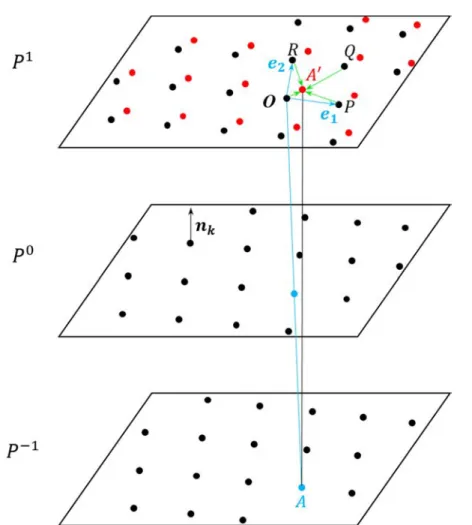
the minimum interfacial energy. Hence, when a body is deformed differently along each side of a plane, as illustrated in Fig. 1.12, this plane could be a coherent interface after the deformation if and only if the two given deformation gradients, F and G, satisfy the following condition:
⨂ . (1.6)
Here, a represents a vector on the plane and n is the normal vector of the plane.
Fig. 1.12 Illustration of the kinematic compatibility condition. F and G are two deformation
gradients of the two regions Ω1 and Ω2 which are separated by a plane with normal vector n
(transformed to m after the deformation) [107].
The third one is the description of the martensitic transformation deformation. In this theory, the deformation of martensitic transformation F is considered to be composed of two parts: a first pure stretch distortion U and a subsequent pure rigid rotation R. Hence, the deformation gradient can be expressed as below:
. (1.7)
It is worth mentioning that the pure stretch distortion U represents the Bain distortion. Hence, the rotation R is imperative to keep an invariant plane strain and a minimization of the energy during the phase transformation.
The last one is the polar decomposition theorem. This is a mathematic theorem describes that for a given positive definite matrix L, there exists a unitary matrix M and a Hermitian matrix
N such that
. (1.8)
In physics, the positive definite matrix, unitary matrix and Hermitian matrix can be used to describe deformation, extension and rotation. Hence, for any deformation, it can be
25
decomposed to a pure stretch distortion and a pure rotation. Hence, Eqs. (1.7) and (1.8) are equivalent.
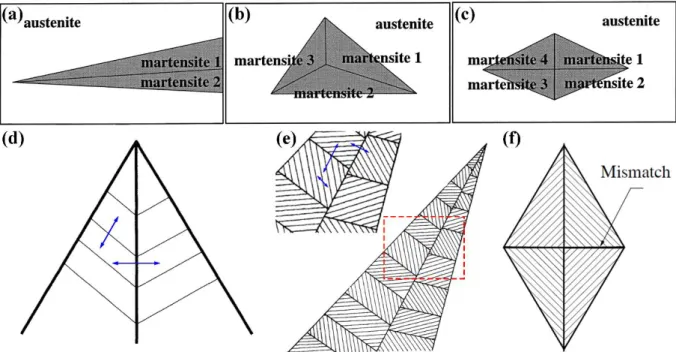
In the study of martensitic transformation and the transformed microstructures, three typical types of martensite named wedge-shaped, triangle-shaped and diamond-shaped can be generated at the beginning stage of the phase transformation, as illustrated in Figs. 1.13(a) ~ (c). According to the introduction of the theory, the habit planes between austenite and martensite as well as the interfaces between different martensite variants should be coherent, to minimize the interfacial energy. However, this situation is sensitive to the lattice parameters of the parent and product phases. Hence, more complicated microstructures such as a twin within a twin [107] (as displayed in Figs. 1.13(d) and (f)) and a twin within a twin within a twin [118] (as displayed in Fig. 1.13(e)) were found in some alloys. Generally, the lattice parameters of the two phases cannot make all the observed interfaces coherent. Therefore, the atoms in the vicinity of some interfaces between martensite variants will have a small mismatch, i.e. an incoherent interface as marked in Fig. 1.13(f), to keep a coherent habit plane.
Fig. 1.13 Illustrations of different shaped martensite that forms at the beginning stage of the
martensitic transformation: (a) wedge-shaped, (b) triangle-shaped, (c) diamond-shaped, (d) and (e) wedge-shaped with fine lamellae twins and (f) diamond-shaped with fine lamellae twins [107, 118-120]. The twin related variants in Figs. 1.13(d) and (e) are marked with blue arrows.
26
Thus, with these tools the microstructure construction work can be effectuated. During the construction process, the first step is to calculate the deformation gradient of Bain distortion and add a rotation to judge if a single variant can satisfy an invariant plane strain, i.e. can obtain a coherent phase interface with the austenite with the help of the kinematic compatibility condition. If it could, then investigations on the compatibility of the interfaces between different variants with the given models can be continued. If not, more complicated microstructures and calculations should be taken into account and carried out. Compatibilities on the interfaces of different variant combinations, and between different variant combinations and the parent austenite are needed to be considered.
As summarized, the crystal structure information is a decisive factor to the morphology of martensite. The organization of the phases and martensite variants, characterizations of different interfaces between martensite variants, deformation gradient tensors of different martensite variants and even their ORs all can be resolved with the help of the nonlinear elasticity theory [125] of martensitic transformation and the lattice parameters of the corresponding phases. In addition, the phase transition path, volume distortion and the misfit between the two phases which can affect the phase transition resistance can also be studied with this theory. For NiMnSb alloys, the magnetic properties are closely associated with the martensitic transformation. The practical applications of these properties require repeated phase transitions of materials. A high phase transition resistance will be disadvantageous to their applications. Hence, a thorough investigation through crystallographic analysis of the microstructural configuration in NiMnSb alloys is essential, which can provide fundamental information of these materials and be useful for further compositional regulation and control and the subsequent magnetic and mechanical properties optimization of these materials.
1.4 Content of the present work
As a novel multi-functional material, many aspects of the Heusler type NiMnSb alloys, such as crystal structure, microstructure, magnetic properties and mechanical properties etc., have been widely investigated in the past thirteen years. However, many fundamental issues of this material have not been fully revealed, which largely restricts the development of this new
![Fig. 1.2 Backscattered electron (BSE) micrograph of Ni 50 Mn 38 Sb 12 martensite [73]](https://thumb-eu.123doks.com/thumbv2/123doknet/14599699.730980/23.892.256.641.733.1017/fig-backscattered-electron-bse-micrograph-ni-mn-martensite.webp)
![Fig. 1.4 Recovery strain at 290 K induced by a magnetic field for Ni 50 Mn 37 Sb 13 polycrystalline alloy [36]](https://thumb-eu.123doks.com/thumbv2/123doknet/14599699.730980/26.892.281.610.330.660/fig-recovery-strain-induced-magnetic-field-polycrystalline-alloy.webp)
![Fig. 1.6 Contributions from the magnetic and structural part for a first-order magnetic transition to the magnetocaloric effect (MCE) [45]](https://thumb-eu.123doks.com/thumbv2/123doknet/14599699.730980/29.892.178.718.182.678/contributions-magnetic-structural-order-magnetic-transition-magnetocaloric-effect.webp)
![Fig. 1.7 Magnetic entropy changes in the temperature regions of (a) martensitic transformation [85] and (b) magnetic transition in austenite [72] for Ni (50-x) Mn (38+x) Sb 12 (x = -1, 0, 1, 2) alloys with a magnetic-field change from 0 to 5 T](https://thumb-eu.123doks.com/thumbv2/123doknet/14599699.730980/30.892.109.785.597.880/magnetic-temperature-martensitic-transformation-magnetic-transition-austenite-magnetic.webp)
![Fig. 1.10 [104], which is ~ 13 times larger than the one reported in bulk sample with the same composition](https://thumb-eu.123doks.com/thumbv2/123doknet/14599699.730980/35.892.274.618.207.500/fig-times-larger-reported-bulk-sample-composition.webp)