HAL Id: hal-03082746
https://hal.archives-ouvertes.fr/hal-03082746
Submitted on 19 Mar 2021
HAL is a multi-disciplinary open access
archive for the deposit and dissemination of
sci-entific research documents, whether they are
pub-lished or not. The documents may come from
teaching and research institutions in France or
abroad, or from public or private research centers.
L’archive ouverte pluridisciplinaire HAL, est
destinée au dépôt et à la diffusion de documents
scientifiques de niveau recherche, publiés ou non,
émanant des établissements d’enseignement et de
recherche français ou étrangers, des laboratoires
publics ou privés.
Distributed under a Creative Commons Attribution - NonCommercial| 4.0 International
PME primo-exportatrices
Pierre-Xavier Meschi, Antonin Ricard, Ernesto Tapia Moore
To cite this version:
Pierre-Xavier Meschi, Antonin Ricard, Ernesto Tapia Moore. Conditions pré-Internationalisation et
performance des PME primo-exportatrices. M@n@gement, 2020, �10.37725/mgmt.v24i1.4507�.
�hal-03082746�
Pre-Internationalization and Performance Conditions of
First-Time Exporting SMEs
Pierre-Xavier Meschi
1,2, Antonin Ricard
1*, and Ernesto Tapia Moore
31Department of Strategy, Aix-Marseille Univ, CERGAM, IAE Aix-Marseille, Aix-en-Provence, France 2Department of Strategy, Skema Business School, Nice, France; 3Department of Management,
Kedge Business School, Marseille, France
Abstract
This article aims to determine whether pre-internationalization conditions improve the performance of first-time exporting small and medium-sized enterprises (SMEs). Two pre-internationalization conditions are discussed here: firm performance and age at internationaliza-tion. Building on the aspiration-level performance model of March and Shapira (1992) with sequential internationalization and international new-ventures approaches, this article develops two research hypotheses proposing an effective alignment with pre-internationalization performance and age at internationalization. These research hypotheses are examined using a panel database of 522 French SMEs that began export operations for the first time in 2014. The statistical results partially support our first hypothesis by showing that early-inter-nationalizing SMEs with a lower performance relative to their peers significantly increase their post-internationalization performance. Contrary to what we predicted in our second hypothesis, we observe that late-internationalizing SMEs, which deliver a much higher per-formance than their historical aspirations, significantly reduce their post-internationalization perper-formance.
Keywords: Aspiration-level performance model; Early internationalization; First-time exporting SME; Internationalization process; Late
internation-alization; Social and historical aspirations
Handling Editor: Rachel Bocquet; Received: 6 November 2018; Accepted: 31 March 2020; Published: 19 March 2021
Introduction
What are the conditions favoring a firm’s internationalization success? This is an essential question for any firm eager to internationalize for the first time. In response to this question, early internationalization process research underscored the importance of conditions prior to the decision to internation-alize (Johanson & Vahlne 1977; Wiedersheim-Paul, Olson, & Welch, 1978). As noted by Wiedersheim-Paul et al., (1978, p. 54), “the forces that have encouraged a firm to actively seek export markets are likely to continue and to support an expansion of export activity.” More specifically, pre-internation-alization conditions mitigate the ‘shock of entry’ (Carr, Haggard, Hmieleski, & Zahra, 2010; Johanson & Vahlne 1990) experi-enced by firms during their first international steps. This shock leads to organizational changes that may negatively affect the firm’s subsequent performance, especially when the firm does not possess the reserves of resources to accommodate unan-ticipated complications (Sui & Baum, 2014).
Despite this earlier research, the key pre-internationaliza-tion period has been neglected by extant literature, focusing on the post-decision phases instead. In developing the ‘interna-tionalization readiness’ concept, Tan, Brewer, and Liesch (2007) focus interest once more on the importance of firms’ pre-in-ternationalization situations.
Beyond what Wiedersheim-Paul et al. (1978) labeled ‘pre-export behavior,’ the notion of behavior resides within the incremental approach developed by Johanson and Vahlne (1977, 2009) in which the authors cite Cyert and March’s (1963) behavioral theory of the firm. When applied to the internationalization process, Johanson and Vahlne’s approach allows us to infer that firms’ pre-internationalization condi-tions should be understood as the driving forces that will influence the outcome of the said process. Specifically, March and Shapira’s (1992) aspiration-level performance model suggests that firms adopt distinct behaviors depending on how much their performance deviates from their aspirations.
A firm whose performance surpasses its aspirations— overperformance—will engage in incremental changes asso-ciated with limited risk-taking. In contrast, a firm whose performance falls short of its aspirations—underperfor-mance—will take risks and favor the exploration of new opportunities and markets.
This behavioral dichotomy directly reflects the two approaches dominating theoretical streams in international business which, independently offer a different perspective of firms’ internationalization processes: the sequential approach (Johanson & Vahlne, 1977, 1990, 2009) and the international new venture (INV) approach (Oviatt & McDougall, 1994, 2005). These two approaches are partially opposed (Bandeira-de-Mello, Ghauri, Mayrhofer, & Meschi, 2015; Lamotte & Colovic, 2015). According to the sequential approach, firms must accumulate experience and initiate organizational learn-ing in foreign markets connected with each of their inputs before implementing new international initiatives. This approach highlights that firms must first assimilate the knowl-edge necessary for the next phase of internationalization and supposes that firms initiate internationalization later in their lifecycle. According to the INV approach, some firms prefer to internationalize earlier in their lifecycle. Two different rationales govern these approaches: internal preparation and maturation, uncertainty minimization and experiential learning for the sequential approach; search for first-mover advantage, exploita-tion of economies of scale at the global level, and the “exploita-tion of brief windows of opportunity” (Prashantham & Young, 2011, p. 275) for the INV approach.
By showing that underperformance leads firms to adopt early internationalization, regardless of inherent risks in the tar-geted foreign markets, Lin (2014) allows to (partially) confirm that March and Shapira’s (1992) aspiration-level performance model explains the internationalization behavior of firms. However, the literature linking the aspiration-level performance model to the firm’s internationalization process (Ref & Shapira, 2017; Schwens et al., 2018) points out that Lin’s (2014) results should be extended through the analysis of firms engaged in an internationalization process. The absence of a direct link between internationalization speed and performance, observed by Schwens et al. (2018), suggests going beyond Lin’s (2014) internationalization behavior analysis. Indeed, we posit here that superior performance can be explained by the interaction between internal forces (a firm’s internationalization readiness) and external forces (a firm’s aspiration level) occurring in the pre-internationalization phase (Fiegenbaum, Hart, & Schendel, 1996). When these two forces align, the firm is better prepared to face the international expansion shock (Miles, Snow, & Pfeffer 1974), enhancing post-internationalization performance. In con-trast, misalignment of these forces leads to poor strategy exe-cution and eventually, deterioration of the firm’s performance (Heracleous & Werres, 2016).
In this article we examine the interaction effect between two pre-internationalization forces—performance relative to aspirations and age at internationalization—on post-interna-tionalization performance of first-exporting firms. To test this interaction effect, we rely on a panel database comprising 522 French small and medium-sized enterprises (SMEs) that began export operations for the first time in 2014. We analyzed the post-internationalization performance of these first-time exporting SMEs over a 5-year period.
This article comprises five sections. First, building on the sequential approach on the one hand and the INV approach on the other, we develop arguments allowing to formulate our research hypotheses. Our two hypotheses predict the exis-tence of effective alignment between pre-internationalization performance and age at internationalization. In the second sec-tion we provide details of our panel data, variables, and econo-metric estimation procedure. We present our main statistical results in the third section. In the fourth section we check the robustness of the results. In the fifth and last section we discuss the results, considering the limitations and possible extensions of this research.
Literature review and hypotheses development
Sequential (Johanson & Vahlne, 1977, 2009) and INV (Oviatt & McDougall, 1994) approaches dominate research on the internationalization process. These two approaches tend to be opposed, at least regarding internationalization timing and pace: the first presents internationalization as the outcome of a slow and incremental process while the second focuses on early, accelerated, and significant internationalization. Hybrid approaches have subsequently emerged in extant litera-ture, adding moderating elements to the two original approaches (Ciravegna, Lopez, & Kundu, 2016; Håkanson & Kappen, 2017; Hennart, 2014; Hough & Ogilvie, 2005; Marchand & Vieu, 2018; Ricard & Zhao, 2018). If this recent research nuances some established results, Lin’s (2014) article also shows that pre-internationalization conditions produce significant differences in the behavior of internationalizing firms. The more recent hypotheses result from the premise that the two main approaches in the extant literature reflect distinct internationalization behaviors, explained by differ-ences in pre-internationalization conditions. These develop-ments are presented in the first two subsections, which are structured as follows: the first subsection analyzes coherence between March and Shapira’s (1992) model and the sequen-tial approach; the second subsection uses this same model and combines it with the INV approach. These hypotheses are then formulated in a third subsection on the basis of the exis-tence of effective alignments between pre-internationalization conditions and the performance of firms engaging in the pro-cess of internationalization.
The sequential approach and March and Shapira’s (1992) model
The sequential process describes firms initiating international-ization at a later stage of their lifecycle. It can take a long time—from inception to the first international steps (Johanson & Vahlne, 1977)—for firms to ensure that the resources and knowledge essential for internationalization are developed. Consequently, the slow pace of this internationalization pro-cess constrains the internationalization level of those firms, at least during the first phases of expansion (Chen & Yeh, 2012; Dominguez, Mayrhofer, & Obadia, 2017; Kontinen & Ojala, 2011). Firms would, in this case, internationalize incrementally, following a succession of adaptation periods after changes in the environment. Moderate growth ensues and ensures suffi-cient accumulation of the resources and experiential knowl-edge required for better international performance (Eriksson, Johanson, Majkgård, & Sharma, 1997, 2000). By favoring a slower pace of internationalization, firms overcome the pitfalls of limited resources and lack of international knowledge, which executives view as major risks (Figueira-de-Lemos, Johanson, & Vahlne, 2011; Tan et al., 2007). Slower internation-alization therefore improves the firms’ post-internationaliza-tion performance.
This rationale of limited change and risk minimization directly echoes March and Shapira’s (1992) aspiration-level performance model, which explains a firm’s behavior in rela-tion to the gap between the firm’s performance and its aspirations.
When firms outperform their aspirations they often opt to limit their efforts and risk-taking in their future actions, some-times confining their operations to their existing activities. Firms need to accumulate sufficient experience and expertise before effecting change (Shinkle, 2012). Once firms have accu-mulated a critical mass of such knowledge and commitment prior to making changes (Da Rocha, De Mello, Pacheco, & De Abreu Farias, 2012), they can act decisively. This is a prerequi-site for successful internationalization.
The INV approach and March and Shapira’s (1992) model
Firms’ behavior sometimes corresponds to the sequence described in the sequential approach. However, Rennie (1993) was the first to note that certain firms did not follow that process but rather internationalized early, quickly, and massively. Oviatt and McDougall (1994, p. 31) clarified this phenomenon and indicated that, from inception, INVs expect to “derive sig-nificant competitive advantages from extensive coordination among multiple organizational activities, the locations of which are geographically unlimited.” Here, internationalization is driven by the first-mover advantage (Puig, González-Loureiro,
& Ghauri, 2014), global economies of scale, frugal use of inter-nationalization resources, and “exploitation of short windows of opportunity” (Prashantham & Young, 2011, p. 275). Plenty of research focusing on INV performance shows that firms fol-lowing the INV approach are to some extent more effective than those not following this approach (Lu & Beamish, 2001, 2004, 2006; Meschi, Ricard, & Tapia Moore, 2017).
One of the drivers behind such behavior is risk-taking (Lin & Mercier-Suissa, 2018; Sleuwaegen & Onkelinx, 2014). Lin (2014) explains that firms initiate this type of behavior when they underperform relative to expectations. When experienc-ing low growth and margins relative to their local competitors, firms will tend to tolerate riskier behavior in their search for new activities and ways to be more competitive (Cyert & March, 1963). The senior managers of these underperforming firms will question the current strategy and seek growth opportunities outside their traditional markets (Iyer & Miller, 2008), preferring sales growth to risk minimization (Stremersch & Tellis, 2004). Sometimes seen as a symptom of poor resource allocation (Iyer & Miller, 2008), such performance gaps between competitors incite firms to seek alternative solutions, including new sources of growth in distant geographical areas (Baum, Li, & Usher, 2000; Wennberg & Holmquist, 2008). Derived from the behavioral theory of the firm (Cyert & March, 1963), March and Shapira (1992) describe this type of behavior as ‘problemistic search.’
Internationalization readiness, and pre- and post-internationalization performance
Following March (1988), one of the key determinants of a firm’s behavior is how closely its performance is anchored to its level of aspirations (defined as performance relative to aspi-rations). Fiegenbaum et al.’s (1996) theoretical article suggests that the link between firm performance and level of aspiration stems from the alignment between a firm’s internal and exter-nal elements. In other words, the coherence between the aspi-ration-level performance model (external) and the choice of sequential or INV approaches (internal) conditions a firm’s performance.
First, if the sequential approach is viewed as prescriptive, March and Shapira’s (1992) aspiration-level performance model mostly describes the firms’ behavior. Fiegenbaum et al. (1996) develop the descriptive dimension of this model and suggest that alignment between the internal and external ele-ments of a firm leads to superior performance. Combining the sequential approach and the aspiration-level performance model allows one to identify a favorable alignment of pre-inter-nationalization conditions, which associates late international-ization with performance that surpasses aspirations. Coherent, pre-decisional, internal (e.g., choosing an internationalization process) and external (e.g., level of aspiration) driving forces are
“mutually reinforcing” (Fiegenbaum et al., 1996, p. 230) and lead to superior performance. Such alignment makes sense for members of the organization, for whom the goals of and moti-vations behind the process of international expansion become logical and consensual: essential conditions for increasing a firm’s performance (Fiegenbaum et al., 1996; Heracleous & Werres, 2016). Miles et al.’s (1974) ‘internal fit’ concept surfaces here as a prerequisite for superior performance.
Second, strong coherence between the INV approach and the aspiration-level performance model explains firms’ early internationalization. Consistent with Fiegenbaum et al. (1996), aligning the choice of early internationalization (internal) and performance below aspirations (external) leads to increasing a firm’s performance. This alignment also makes sense for the organization members, and ensures the firm’s success (Fiegenbaum et al., 1996).
In contrast, in the event of misalignment, organization mem-bers struggle to understand organizational objectives and therefore tend to be less committed to them (Beer, Voelpel, Leibod, & Tekie, 2005). This behavior produces a vicious circle in which strategies are poorly implemented, eventually leading to bankruptcy (Heracleous & Werres, 2016).
The preceding three paragraphs allow us to argue that the interaction between pre-internationalization performance rel-ative to aspirations and age at internationalization has a signifi-cant impact on the performance of the first international steps. On this basis we can formulate two research hypotheses. Each hypothesis corresponds to a specific alignment between per-formance relative to aspirations and age at internationalization, which leads to superior performance during the post-interna-tionalization phase:
Hypothesis 1a: In the context of pre-internationalization
performance below aspirations, early-internationalizing firms will perform better than late-internationalizing ones.
Hypothesis 1b: In the context of pre-internationalization
performance above aspirations, late-internationalizing firms will perform better than early-internationalizing ones.
Table 1 below presents our research hypotheses, depending on the state of alignment/misalignment between pre-interna-tionalization performance relative to aspirations and age at internationalization.
Research method
Panel database of first-time exporting SMEs and dependent variable
We tested both our hypotheses with a sample comprising 522 French SMEs. These SMEs began export operations for the first time in 2014. We created this sample by collecting data on SMEs from the French Foreign Trade Ministry (Direction
Générale des Douanes et Droits Indirects) and DIANE databases.
The combination of these two databases—the temporal con-straints of the DIANE database (which provided only nine years of historical data from 2010 through 2018) and the vari-able measurement (see the next section: Independent varivari-able and sample partition variables)—led us to focus on 2014. This was the only year allowing a 9-year window covering both the 3-year period of study for pre-internationalization perfor-mance (for more on measuring perforperfor-mance relative to histor-ical aspirations, see Ref & Shapira, 2017) and the 5-year period of study for post-internationalization performance (for more on internationalization performance, see Beleska-Spasova & Glaister, 2010, or Lin, Liu, & Cheng, 2011).
We first aggregated all the French SMEs’ export operations from the French Foreign Trade Ministry database from 19941
through 2017. Among the 584,194 French firms having exported at least once between 1994 and 2014, we then selected those that exported for the first time in 2014. On this basis we obtained a first sample of 13,501 firms. We then reduced the sample to those SMEs with headquarters in France and complied with the European categorization of SMEs (i.e., firms employing fewer than 250 people, with a yearly turnover of less than €50 million2). This screening
pro-cess resulted in a sample of 6,858 French SMEs. Using the DIANE database, we collected descriptive (creation year, legal form, industry, etc.) and financial data (turnover, assets, profit, etc.) for these 6,858 SMEs. After excluding firms with missing data, our final sample consisted of 522 first-time exporting SMEs. These SMEs operate in several industries, some of which are well represented in our sample: consulting, information technology and software, engineering, and the machinery and equipment trade.
Our dependent variable is post-internationalization
perfor-mance. We use the return on assets ratio (net profit/assets) to
measure this variable. To fully capture the internationalization impact on performance, we calculated this ratio over a 5-year period (from t to t + 5), with the starting year corresponding to when firms initiated their internationalization (year t). As mentioned, it can take years for firms to go from inception to implementing internationalization operations. Several years of hindsight are thus necessary for observers to assess the impact—positive or negative—of the choices made in this context. Our choice of this 5-year window is consistent with several empirical papers on export performance, all of which agree that such a window is sufficient to make a reliable eval-uation of export performance (Beleska-Spasova & Glaister, 2010; Carr et al., 2010; Gankema, Snuif, & Zwart, 2000; Lin, 2012; Lin, Liu, & Cheng, 2011; Rasheed, 2005; Wagner, 2004). 1. The database was created that year.
2. EC Recommendation 2003/361/EC of 6 May 2003; OJEU 20 May 2003,
This measurement of the dependent variable, applied to our sample of 522 firms, yielded a panel of 2,279 firm-year observations. This figure correspond to a database of 522 firms followed over five years for which we removed 331 firm-year observations reflecting missing data in the DIANE database or bankruptcies occurring before the end of the observed period in the panel.
Independent variable and sample partition variables
The independent variable in this research is the age at
interna-tionalization of first-time exporting firms. We measured this
variable by calculating the number of years between a firm’s creation and first internationalization steps (logarithmically transformed).
We used performance relative to aspirations (P/A) as a par-tition variable for our sample, distinguishing performance below aspirations (negative P/A) of first-time exporting SMEs from those delivering performance above aspirations (positive
P/A). We measured performance relative to aspirations in two
ways: performance relative to social aspirations (or P/SA) and
performance relative to historical aspirations (or P/HA). These
two measures of performance relative to aspirations were used to divide the sample into two subsamples.
Performance relative to social aspirations (P/SA) is obtained by
calculating the difference between the performance of a firm
i (Pi) and its social aspirations (SAi) for the year preceding its first export operations (t-1). Consistent with Lin, Chen, Hsu, Liu, and Wang (2012), Miller and Chen (2004), Rowley, Greve, Rao, Baum, and Shipilov (2005), and Lin (2014)—all of whom specif-ically measured this variable in the context of internationaliza-tion—we used the return on assets ratio (net profit/assets) as a performance indicator. We measured the level of social aspi-rations of each firm i of the sample by calculating the average performance of its reference group (Pg). Each reference group contained 20 French firms selected from the DIANE database in two steps: First, we collected firms operating in the same industry as firm i, using the first two digits of the European industry classification (NACE). Next, within each industry, we selected 20 firms with the closest turnover to firm i.
Selecting a reference group is a delicate step in the process of measuring a firm’s level of social aspirations (Ref & Shapira, 2017) as the categorization criteria (strategic choice, size, country of origin, etc.) of such a reference group varies from one firm to another. Here, consistent with much of the litera-ture on SMEs, we considered size and industry as two signifi-cant categorization criteria for this type of firm (Degryse, De Goeij, & Kappert, 2012; Löfving, 2016; Vaona & Pianta, 2008). The industry criterion is key as SMEs often specialize in one industry or business activity. Size is also key as it frequently conditions the amount of resources SMEs can allocate to the internationalization process.
The performance relative to social aspirations (P/SA) variable was estimated as
(P/SA)it-1 = Pit-1 – Pgt-1
Performance relative to historical aspirations (P/HA) is
mea-sured by calculating the difference between the performance of a firm i at t-1 (Pit-1) and its historical aspirations for success (HAi). Specifically, consistent with Lin (2014) and Ref and Shapira (2017), we estimated the level of historical aspirations for any firm i of the sample by calculating its average perfor-mance for the 3 years prior to t-1 (Pi(t-2 to t-4)).
The performance relative to historical aspirations (P/HA) variable was estimated as
(P/HA)it-1 = Pit-1 – Pi(t-2 à t-4)
As indicated above, measuring the performance relative to
historical aspirations (P/HA) variable requires four years of
per-formance history (from t-1 to t-4). Consequently, this mea-surement process excludes young firms with only a short record of historical performance. Thus, performance relative to historical aspirations is estimated for only 455 firms in our sample (= 2,029 firm-year observations).
Control variables
To account for the influence of several individual, organiza-tional, financial, and internationalization-specific factors on Table 1. Conceptual representation of hypotheses
Age at internationalization Pre-internationalization performance relative to aspirations
Performance below aspirations Performance above aspirations Early internationalization Favorable impact on post-internationalization
performance (Hypothesis 1a)
Unfavorable impact on post-internationalization performance (Hypothesis 1b)
firms’ post-internationalization performance, we included the following control variables in our statistical analysis:
CEO duality (binary variable coded 1 when the CEO is also
chairperson and part of the shareholding structure and 0 otherwise), joint-stock structure (binary variable coded 1 for firms with a joint-stock structure and 0 for a limited liability structure), female CEO (binary variable coded 1 for a female CEO and 0 for a male CEO), CEO age (in years, logarithmi-cally transformed), cash flow (measured with the firm’s oper-ating cash flow in euros, logarithmically transformed) and
export countries (measured by combining the number of
export countries).
We also examined industry and year effects on post-interna-tionalization performance by including two series of binary coded variables. To control for industry effects, we used the first digit of the SME’s NACE code (European industry classifica-tion) and coded 10 different industry variables. Each of these industry variables was then binary coded (1 when the firm operates in this industry and 0 otherwise). We proceeded in the same way to control for the effect of each year of the panel (2014–2018).
Some control variables were treated as time-varying covari-ates (CEO age, cash flow and export countries) while time-in-variant covariates were estimated only for the year prior to the first export operations.
Econometric estimation procedure
We ran a linear panel regression with a random effects model to test our two hypotheses statistically. A random effects model was preferred to the fixed effects model for one reason: the random effects model is more appropriate when it includes a majority of time-invariant (independent and control) covariates. Next, we performed a Hausman specification test, which confirmed our choice of a random effects model.
Statistical results
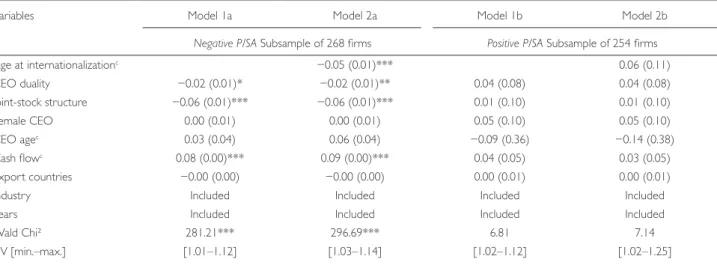
Tables 2 and 3 present the descriptive statistics and correla-tion matrix for the different variables (dependent, indepen-dent, score, and control). There are no serious problems of collinearity between variables, which is confirmed by the inflation of variance (IVF) tests performed on the correlation matrix variables (see Table 3) and whose maximum observed value does not exceed the recommended threshold of 4 (see Tables 4 and 5).
Tables 4 and 5 are used to test the hypotheses for two subsamples created with the performance relative to social
aspirations (P/SA) variable, and for the two subsamples
cre-ated with the performance relative to historical aspirations (P/HA) variable. Both tables present different random effects
regression models. Models 1a and 1b of each table include only control variables. Models 2a and 2b test the direct effect of age at internationalization on firms’ post-internationaliza-tion performance.
Only Models 1a and 2a of Table 4, and 1b and 2b of Table 5 display high statistical significance (p < 0.001). More specifically, Table 4 shows that the direct effect of age at internationaliza-tion is significant (p < 0.001) only for the subsample of firms with negative P/SA. Also, this effect is negative, indicating that in a pre-internationalization, underperformance (performance below aspirations) context, an early-internationalizing firm’s performance will be superior to that of a late-internationalizing one (and vice versa).
Table 5 shows that the direct effect of age at international-ization is significant (p < 0.001) yet limited to the subsample of firms with positive P/HA. This significant effect is negative, indi-cating that in a context of pre-internationalization performance above aspirations an early-internationalizing firm’s perfor-mance will be superior to that of a late-internationalizing one (and vice versa).
The significant and negative effect of age at internationaliza-tion, occurring in two distinct contexts (negative P/SA in Table 4 and positive P/HA in Table 5), partially supports Hypothesis 1a but does not support Hypothesis 1b.
Extending the significant results of Tables 4 and 5, and in accordance with Lin’s (2014) measurement of aspiration variables, we tested both the interaction effect between age at internationalization and P/SA in the negative P/SA subsam-ple, and the interaction effect between age at international-ization and P/HA in the positive P/HA subsample. These additional tests show whether the observed significant effects for age at internationalization remain identical or are modified according to high or low levels of negative P/SA and positive P/HA.
Table 2. Descriptive statistics
Variables Mean. (std. dev.)
Return on assets 0.02 (0.78) P/SAa 0.02 (0.51) P/HAb 0.01 (0.35) Age at internationalization 13.90 (12.82) CEO duality 0.25 (0.43) Joint-stock structure 0.16 (0.37) Female CEO 0.16 (0.36) CEO age 48.53 (10.36) Cash flowc 326.02 (3675.77) Export countries 0.80 (2.68) n = 2,279 firm-year observations.
aPerformance relative to social aspirations. bPerformance relative to historical aspirations. ck€.
Table 6 shows that the only significant interaction effect (p < 0.001) is observed in the negative P/SA subsample (see Model 1). We produced Figure 1 to interpret this signif-icant interaction effect between age at internationalization and P/SA: We distinguish low (early) and high (late) levels of age at internationalization and P/SA variables by taking their mean value minus (plus) one standard deviation for low levels (for high levels).
Figure 1 provides additional details regarding the partial support of Hypothesis 1a: It highlights that the hypothesized
superiority of the alignment between early- and pre-interna-tionalization performance below aspirations over that of late- and pre-internationalization performance below aspirations is supported only in the case of firms with strongly negative P/SA. For firms with slightly negative P/SA, Figure 1 shows an oppo-site result to that predicted in Hypothesis 1a: The alignment between late- and pre-internationalization performance below aspirations results in higher post-internationalization perfor-mance than that combining early- and pre-internationalization performance below aspirations.
Table 3. Correlation matrix
Variables 1 2 3 4 5 6 7 8 9 1. Return on assets ― 2. Age at internationalizationc 0.04* ― 3. P/SAa 0.00 0.04* ― 4. P/HAb 0.01 −0.06** 0.15*** ― 5. CEO duality 0.02 0.05** −0.02 0.06** ― 6. Joint-stock structure −0.00 0.03† −0.01 −0.03 −0.08*** ― 7. Female CEO −0.00 −0.08*** −0.00 −0.05** −0.10*** −0.06** ― 8. CEO agec −0.00 0.16*** −0.07*** 0.01 0.07*** 0.04* 0.00 ― 9. Cash flow 0.03† 0.24*** 0.02 0.01 0.06** 0.27*** −0.11*** 0.07*** ― 10. Export countries 0.00 −0.09*** −0.00 0.00 −0.06** 0.05** −0.05** −0.02 0.04* n = 2,279 firm-year observations.
aPerformance relative to social aspirations.
bPerformance relative to historical aspirations (for this variable, the sample is reduced to 2,029 firm-year observations). cLogarithmic transformation.
† p < 0.1; * p < 0.05; ** p < 0.01; *** p < 0.001.
Table 4. Random effects regression models – direct effect of age at internationalization (performance relative to P/SA subsamples)a,b
Variables Model 1a Model 2a Model 1b Model 2b
Negative P/SA Subsample of 268 firms Positive P/SA Subsample of 254 firms
Age at internationalizationc −0.05 (0.01)*** 0.06 (0.11) CEO duality −0.02 (0.01)* −0.02 (0.01)** 0.04 (0.08) 0.04 (0.08) Joint-stock structure −0.06 (0.01)*** −0.06 (0.01)*** 0.01 (0.10) 0.01 (0.10) Female CEO 0.00 (0.01) 0.00 (0.01) 0.05 (0.10) 0.05 (0.10) CEO agec 0.03 (0.04) 0.06 (0.04) −0.09 (0.36) −0.14 (0.38) Cash flowc 0.08 (0.00)*** 0.09 (0.00)*** 0.04 (0.05) 0.03 (0.05) Export countries −0.00 (0.00) −0.00 (0.00) 0.00 (0.01) 0.00 (0.01)
Industry Included Included Included Included
Years Included Included Included Included
Wald Chi² 281.21*** 296.69*** 6.81 7.14
FIV [min.–max.] [1.01–1.12] [1.03–1.14] [1.02–1.12] [1.02–1.25]
n = 1,144 firm-year observations for the subsample of firms with negative P/SA and n = 1,135 firm-year observations for the subsample of firms with positive P/SA.
aPositive coefficients indicate that an increase in the value of independent and control variables increases the firm’s return on assets, and vice versa. bDefault standard errors are shown in brackets.
cLogarithmic transformation.
As regards control variables, Models 1a and 2a of Table 4 and Models 1b and 2b of Table 5 show that CEO duality,
joint-stock structure, and cash flow variables have a significant impact
on post-internationalization performance. Consequently, in the context of firms with negative P/SA or positive P/HA, post-internationalization performance will be better if the manager is neither the chairperson nor part of the sharehold-ing structure (for limited liability companies), and if the cash flow available is high.
Statistical robustness check
To check the robustness of the results presented above, and considering the high probability that the firm’s choice of early
-0.3 -0.25 -0.2 -0.15 -0.1 -0.05 0 Early Late Post-internationalization performance (return on assets) Age at internationalization Slightly negative P/SA Strongly negative P/SA
Figure 1. Graphical representation of the interaction effect between
age at internationalization and P/SA for the subsample of firms with negative P/SA
Table 6. Random effects regression models – interaction effects (negative
P/SA and positive P/HA subsamples)a,b
Variables Model 1 Model 2
Negative P/SA Positive P/HA
Age at internationalizationc −0.07 (0.01)*** −0.14 (0.03)***
P/SA 0.11 (0.02)***
Age at internationalizationc × P/SA −0.27 (0.01)***
P/HA −0.26 (0.15)†
Age at internationalizationc × P/HA 0.31 (0.18)†
CEO duality −0.02 (0.01)** −0.04 (0.01)** Joint-stock structure −0.06 (0.01)*** −0.07 (0.01)*** Female CEO −0.00 (0.01) 0.00 (0.02) CEO agec 0.06 (0.04) 0.04 (0.07) Cash flowc 0.09 (0.00)*** 0.11 (0.00)*** Export countries −0.00 (0.00) 0.00 (0.00)
Industry Included Included
Years Included Included
Wald Chi² 316.60*** 285.47***
n = 1,144 firm-year observations for the subsample of firms with negative P/SA and n = 1,009 firm-year observations for the subsample of firms with
positive P/HA.
aPositive coefficients indicate that an increase in the value of independent
and control variables increases the firm’s return on assets, and vice versa.
bDefault standard errors are shown in brackets. cLogarithmic transformation.
† p < 0.1; * p < 0.05; ** p < 0.01; *** p < 0.001.
Table 5. Random effects regression models – direct effect of age at internationalization (performance relative to P/HA subsamples)a,b
Variables Model 1a Model 2a Model 1b Model 2b
Negative P/HA Subsample of 230 firms Positive P/HA Subsample of 225 firms
Age at internationalizationc 0.27 (0.15)† −0.11 (0.02)*** CEO duality 0.06 (0.09) 0.08 (0.09) −0.04 (0.01)** −0.05 (0.01)** Joint-stock structure 0.01 (0.14) 0.02 (0.14) −0.08 (0.01)*** −0.07 (0.01)*** Female CEO 0.07 (0.10) 0.08 (0.10) 0.01 (0.02) 0.00 (0.02) CEO agec −0.02 (0.45) −0.16 (0.46) −0.08 (0.07) 0.02 (0.07) Cash flowc 0.04 (0.06) 0.00 (0.06) 0.11 (0.00)*** 0.11 (0.00)*** Export countries 0.00 (0.01) 0.00 (0.01) 0.00 (0.00) 0.00 (0.00)
Industry Included Included Included Included
Years Included Included Included Included
Wald Chi² 6.73 10.12 262.27*** 282.71***
FIV [min.–max.] [1.04–1.13] [1.04–1.19] [1.01–1.13] [1.03–1.25]
n = 1,020 firm-year observations for the subsample of firms with negative P/HA and n = 1,009 firm-year observations for the subsample of firms with
positive P/HA.
aPositive coefficients indicate that an increase in the value of independent and control variables increases the firm’s return on assets, and vice versa. bDefault standard errors are shown in brackets.
cLogarithmic transformation.
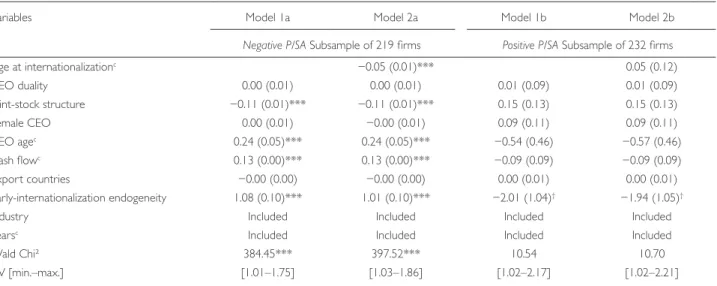
or late internationalization, is itself an endogenous decision (Mudambi & Zahra, 2007; Sui & Baum, 2014) (i.e., resulting from internal [individual, organizational, financial] and external [industry] factors), we sought to control whether our results in Tables 4 and 5 could be affected by endogeneity bias.
Following the procedure proposed by Mudambi and Zahra (2007) for exporting firms, we first estimated a Probit model using early internationalization as the dependent variable (binary coded variable: 1 for firms with early internationaliza-tion and 0 for those with late internainternationaliza-tionalizainternationaliza-tion). Consistent with empirical papers on this issue (Crick, 2009; Knight & Cavusgil, 2004; Kuivalainen, Sundqvist, & Servais, 2007; Sullivan Mort & Weerawardena, 2006; Zucchella, Palamara, & Denicolai, 2007), we used a 3-year threshold following inception to dis-tinguish between early-internationalizing SMEs (<3 years after inception) and late-internationalizing SMEs (>3 years after inception). We then introduced independent variables into this Probit model, pertaining to internal and external factors, that are likely to influence the decision of early or late internation-alization: CEO duality, joint-stock structure, female CEO, CEO age,
cash flow, and industry. As with the other independent variables, CEO age and cash flow were estimated for the year prior to
the first export operations.
Finally, with this Probit model, we were able to predict the probability of selecting the early-internationalization choice for each firm in the sample and introduced this predicted proba-bility into the different random-effects regression models (see
early-internationalization endogeneity variable in Tables 7 and 8).
The results in Tables 7 and 8 remain unchanged regarding the significant and negative effect of age at internationalization for the subsample of firms with negative P/SA (see Model 2a in Table 7). However, the significant and negative effect of age at internation-alization observed for the subsample of firms with positive
P/HA loses statistical significance when the endogeneity score
is included in the regression model (see Model 2b in Table 8).
Discussion
We examined the relevance of the aspiration-level perfor-mance model within the context of internationalizing SMEs, focusing on the internationalization process. Performance, associated with the two main approaches (sequential and INV) to internationalization, is analyzed using pre-internationaliza-tion performance relative to aspirapre-internationaliza-tions.
Our results lead us to conclude that early-internationaliz-ing SMEs with pre-internationalization performance below social aspirations (negative P/SA) significantly increase their post-internationalization performance. The superiority of this alignment between early- and pre-internationalization under-performance is reinforced when under-performance relative to social aspirations is particularly adverse (see Figure 1).
We also observed that late-internationalizing firms with pre-internationalization performance above historical aspira-tions (positive P/HA) significantly reduce their post-interna-tionalization performance, thus not supporting our second research hypothesis (Hypothesis 1b).
Table 7. Random-effects regression models – direct effect of age at internationalization with endogeneity test (P/SA subsamples)a,b
Variables Model 1a Model 2a Model 1b Model 2b
Negative P/SA Subsample of 219 firms Positive P/SA Subsample of 232 firms
Age at internationalizationc −0.05 (0.01)*** 0.05 (0.12) CEO duality 0.00 (0.01) 0.00 (0.01) 0.01 (0.09) 0.01 (0.09) Joint-stock structure −0.11 (0.01)*** −0.11 (0.01)*** 0.15 (0.13) 0.15 (0.13) Female CEO 0.00 (0.01) −0.00 (0.01) 0.09 (0.11) 0.09 (0.11) CEO agec 0.24 (0.05)*** 0.24 (0.05)*** −0.54 (0.46) −0.57 (0.46) Cash flowc 0.13 (0.00)*** 0.13 (0.00)*** −0.09 (0.09) −0.09 (0.09) Export countries −0.00 (0.00) −0.00 (0.00) 0.00 (0.01) 0.00 (0.01) Early-internationalization endogeneity 1.08 (0.10)*** 1.01 (0.10)*** −2.01 (1.04)† −1.94 (1.05)†
Industry Included Included Included Included
Yearsc Included Included Included Included
Wald Chi² 384.45*** 397.52*** 10.54 10.70
FIV [min.–max.] [1.01–1.75] [1.03–1.86] [1.02–2.17] [1.02–2.21]
n = 1,002 firm-year observations for the subsample of firms with negative P/SA and n = 1,063 firm-year observations for the subsample of firms with positive P/SA.
aPositive coefficients indicate that an increase in the value of independent and control variables increases the firm’s return on assets, and vice versa. bDefault standard errors are shown in brackets.
cLogarithmic transformation.
Several comments can be made based on these results. First, it seems that the pre-internationalization performance situation is critical only for SMEs engaging in an international-ization process for the first time. In addition, this ‘targeted’ impact differs according to the type of aspirations (social or historical) in these first-time exporting SMEs: The impact of the pre-internationalization performance situation is only sig-nificant for both the performance below social aspirations and the performance above historical aspirations (consider-ing the weaker statistical robustness of this last result). Different pre-internationalization conditions then lead to the same higher post-internationalization performance trend observed across the subsample of early-internationalizing SMEs. Thus, early-internationalizing SMEs experiencing lower profit and growth than their direct local competitors follow the same post-internationalization performance trend as those with higher profit and growth relative to their perfor-mance history.
These different situations can be combined coherently and render a profile of firms likely to generate superior per-formance within the framework of their first international endeavor: (1) these are young firms, some of which are characterized by strong precocious internationalization (implemented in the first 3 years from inception); (2) others, recognizable by a slightly longer pre-internationalization preparation period (i.e., firms with at least three years of
performance history allowing to estimate their performance relative to historical aspirations), enjoy a favorable variation in their performance over time, which however, lags behind their peers. In these SMEs, internationalization is most likely considered a strategic lever, allowing them to accelerate their performance and rival their direct local competitors. For the early-internationalizing SMEs, it seems that March and Shapira’s (1992) ‘problemistic search’ behavior, coupled with international risk-taking, produces the expected posi-tive effects during the internationalization process. Our results also show that a longer preparation time to develop ‘internationalization readiness’ (Tan et al., 2007) is key for young firms with some maturity to ensure post-internation-alization success.
Finally, our results show that late-internationalizing and underperforming firms are highly likely to deliver poor post-in-ternationalization performance. For firms already established in their industry, internationalization appears to be triggered by local competitive difficulties and represents an interna-tional solution to domestic difficulties. Such decisions are often made in haste, with insufficient resources, and in response to cyclical growth and profitability difficulties in domestic markets. The outcome is lower internationalization readiness coupled with greater propensity for risk-taking at the international level. The high level of risk involved in such behavior questions the strategic relevance of such an Table 8. Random effects regression models – direct effect of age at internationalization with endogeneity test (P/HA subsamples)a,b
Variables Model 1a Model 2a Model 1b Model 2b
Negative P/HA Subsample of 201 firms Positive P/HA Subsample of 198 firms
Age at internationalizationc 0.25 (0.16) −0.04 (0.02)† CEO duality 0.01 (0.10) 0.03 (0.10) −0.01 (0.01) −0.01 (0.01) Joint-stock structure 0.24 (0.19) 0.24 (0.19) −0.13 (0.01)*** −0.12 (0.01)*** Female CEO 0.09 (0.12) 0.10 (0.12) 0.01 (0.02) 0.00 (0.02) CEO agec −0.60 (0.57) −0.67 (0.57) 0.12 (0.07)† 0.15 (0.07)† Cash flowc −0.15 (0.11) −0.18 (0.11) 0.14 (0.00)*** 0.14 (0.00)*** Export countries −0.00 (0.01) 0.00 (0.01) 0.00 (0.00) 0.00 (0.00) Early-internationalization endogeneity −2.95 (1.31)* −2.72 (1.32)* 1.10 (0.13)*** 1.03 (0.14)***
Industry Included Included Included Included
Yearsc Included Included Included Included
Wald Chi² 11.73 10.12 306.03*** 308.64***
FIV [min.–max.] [1.06–1.83] [1.06–1.91] [1.02–2.06] [1.03–2.17]
n = 927 firm-year observations for the subsample of firms with negative P/HA and n = 927 firm-year observations for the subsample of firms with
positive P/HA.
aPositive coefficients indicate that an increase in the value of independent and control variables increases the firm’s return on assets, and vice versa. bDefault standard errors are shown in brackets.
cLogarithmic transformation.
internationalization process. Instead of embarking on a ran-dom quest for growth and margins in foreign markets, these firms should instead concentrate their limited resources and efforts on their local market and conduct a strategic evalua-tion of their competitive underperformance.
Figure 1 shows that unfavorable post-internationalization performance is accentuated for strongly underperforming firms, highlighting their fragility. Those firms, weakened and destabilized in their domestic markets, perceive international-ization as a last chance necessity. Moreover, the entry shock (Carr et al., 2010; Johanson & Vahlne, 1990) experienced during a first international initiative will further weaken the post-internationalization performance of such SMEs.
On the basis of our results, we can make some theoretical contributions to international business research focusing on pre-internationalization conditions. First, the significant and positive effects reported for early-internationalizing firms in two different contexts of performance relative to aspirations allow us to enrich the INV approach developed by Oviatt and McDougall (1994, 2005). Their work emphasizes the importance of seeking a first-mover advantage (Puig et al., 2014), achieving global economies of scale, making frugal use of resources in foreign markets, and exploiting “short win-dows of opportunity” (Prashantham & Young, 2011, p. 275), suggesting that these are the main internationalization deter-minants of INVs. Our research on pre-internationalization performance conditions complements this list of determi-nants. Specifically, the pivotal role of pre-internationalization performance observed in our results, suggests that younger firms (willing to engage in an internationalization process) must integrate an additional dimension into their deci-sion-making: their performance relative to their peers. This argues in favor of new internationalization decision-making models.
Second, our results extend Lin’s (2014) work on the exis-tence of an alignment between performance below aspira-tions and early internationalization by showing that this alignment does indeed exist for first-time exporting SMEs (1), and produces a favorable effect on post-internationaliza-tion performance (2). Beyond the said alignment, integrating March and Shapira’s (1992) aspiration-level performance model to the internationalization process allows us to observe that the other distinctive alignment presented by Lin (2014) (between performance above aspirations and late internationalization) did not have any significant effect (nega-tive or posi(nega-tive) on post-internationalization performance. These different elements partially confirm the relevance of the framework combining the aspiration-level performance model and internationalization process and emphasize the need to integrate pre-internationalization performance with this framework.
Third, our results, and the non-significant outcomes in par-ticular, also encourage us to partially question the propositions made by Fiegenbaum et al. (1996). It appears that, under cer-tain conditions, coherence between a firm’s internal and exter-nal elements does not necessarily predict performance. Relating to first international movers, we observed that coher-ence between a favorable pre-internationalization perfor-mance, measured from the aspiration-level performance model (external element), and the sequential approach to internationalization process (internal element) does not yield superior performance.
The results obtained in this research can also have direct implications for SME managers, consultants specializing in export operations, and (public and private) export agencies. By showing that the level of pre-internationalization perfor-mance, analyzed in tandem with age at internationalization, significantly influences post-internationalization performance, managers will be better informed when deciding to initiate international activities. More specifically, our results provide a rough outline for pre-internationalization diagnosis and alert SME managers and their consultants to the importance of aligning pre-internationalization conditions of performance, age (at internationalization), and (internationalization) readi-ness. It should be noted that the pre-internationalization con-ditions of performance, age, and readiness analyzed in this research constitute key criteria for export agencies to better select SMEs looking for new markets and opportunities.
We highlight two main limitations of this research, which constitute avenues for improvement and future investigation. First, our research focuses on a single year (2014) when ana-lyzing internationalization of SMEs, relative to their perfor-mance. There is a risk that our results are biased by this temporal choice, even though we have controlled for a certain number of individual, organizational, and finance-specific fac-tors in the different random-effects regression models we used. The choice to focus on 2014 resulted from time con-straints related to the data available in the French Foreign Trade Ministry and DIANE databases. Extending the study to a broader window of several years would provide additional validity to our results by controlling for the effect of the year of first internationalization.
Second, our choice of age at internationalization as a variable distinguishing the two studied approaches (sequential and INV) to internationalization is open to debate. Chetty, Johanson, and Martín Martín’s (2014) article suggests other time-based measures, such as the speed or the extent of internationaliza-tion. We controlled for the extent of internationalization using the export countries variable, which does not seem to have a significant impact on the post-internationalization performance of first-time exporting SMEs. However, this deserves dedicated research, which would allow us to augment our results.
References
Bandeira-De-Mello, R., Ghauri, P., Mayrhofer, U. & Meschi, P.-X. (2015). South-South and South-North expansion strategies: What are the the-oretical and empirical implications for research in management?. M@n@
gement, 18(1), 1–7. doi: 10.3917/mana.181.001
Baum, J. A. C., Xiao Li, S. & Usher, J. M. (2000). Making the next move: How experiential and vicarious learning shape the locations of chains’ acqui-sitions. Administrative Science Quarterly, 45(4), 766–801. doi: 10.2307/ 2667019
Beer, M., Voelpel, S. C., Leibod, M. & Tekie, E. B. (2005). Strategic manage-ment as organizational learning: Developing fit and alignmanage-ment through a disciplined process. Long Range Planning, 38(5), 445–465. doi: 10.1016/j. lrp.2005.04.008
Beleska-Spasova, E. & Glaister, K. (2010). Geographic orientation and performance. Management International Review, 50(5), 533–557. doi: 10.1007/s11575-010-0052-1
Carr, J. C., Haggard, K. S., Hmieleski, K. M. & Zahra, S. A. (2010). A study of the moderating effects of firm age at internationalization on firm survival and short-term growth. Strategic Entrepreneurship Journal, 4(2), 183–192. doi: 10.1002/sej.90
Chen, C.-I. & Yeh, C.-H. (2012). Re-examining location antecedents and pace of foreign direct investment: Evidence from Taiwanese investments in China. Journal of Business Research, 65(8), 1171–1178. doi: 10.1016/j. jbusres.2011.07.032
Chetty, S., Johanson, M. & Martín Martín, O. (2014). Speed of international-ization: Conceptualization, measurement and validation. Journal of World
Business, 49(4), 633–650. doi: 10.1016/j.jwb.2013.12.014
Ciravegna, L., Lopez, L. E. & Kundu, S. K. (2016). The internationalization of Latin American enterprises—Empirical and theoretical perspectives.
Journal of Business Research, 69(6), 1957–1962. doi: 10.1016/j.jbusres.
2015.10.141
Crick, D. (2009). The internationalisation of born global and international new venture SMEs. International Marketing Review, 26(4/5), 453–476. doi: 10.1108/02651330910971986
Cyert, R. M. & March, J. G. (1963). A behavioral theory of the firm. Prentice-Hall.
Da Rocha, A., De Mello, R. C., Pacheco, H. & De Abreu Farias, I. (2012). The international commitment of late-internationalizing Brazilian entrepreneurial firms. International Marketing Review, 29(3), 228–252. doi: 10.1108/02651331211229741
Degryse, H., De Goeij, P. & Kappert, P. (2012). The impact of firm and industry characteristics on small firms’ capital structure. Small Business
Economics, 38(4), 431–447. doi: 10.1007/s11187-010-9281-8
Dominguez, N., Mayrhofer, U. & Obadia, C. (2017). Les antécédents de l’échange d’information dans les réseaux d’entreprises exportatrices.
M@n@gement, 20(5), 463–491. doi: 10.3917/mana.205.0463
Eriksson, K., Johanson, J., Majkgård, A. & Sharma, D. D. (1997). Experiential knowledge and cost in the internationalization process. Journal of
International Business Studies, 28(2), 337–360. doi: 10.1057/palgrave.
jibs.8490104
Eriksson, K., Johanson, J., Majkgård, A. & Sharma, D. D. (2000). Effect of vari-ation on knowledge accumulvari-ation in the internvari-ationalizvari-ation process.
International Studies of Management and Organization, 30(1), 26–44.
doi: 10.2307/40397467
Fiegenbaum, A., Hart, S. & Schendel, D. (1996). Strategic reference point theory. Strategic Management Journal, 17(3), 219–235. doi: 10.1002/ (sici)1097-0266(199603)17:3<219::aid-smj806>3.0.co;2-n
Figueira-de-Lemos, F., Johanson, J. & Vahlne, J.-E. (2011). Risk management in the internationalization process of the firm: A note on the Uppsala
model. Journal of World Business, 46(2), 143–153. doi: 10.1016/j. jwb.2010.05.008
Gankema, H. G. J., Snuif, H. R. & Zwart, P. S. (2000). The internationalization process of small and medium-sized enterprises: An evaluation of stage theory. Journal of Small Business Management, 38(4), 15–27.
Håkanson, L. & Kappen, P. (2017). The « Casino Model » of international-ization: An alternative Uppsala paradigm. Journal of International Business
Studies, 48(9), 1103–1113. doi: 10.1057/s41267-017-0113-9
Hennart, J.-F. (2014). The accidental internationalists: A theory of born glo-bals. Entrepreneurship Theory and Practice, 38(1), 117–135. doi: 10.1111/ etap.12076
Heracleous, L. & Werres, K. (2016). On the road to disaster: Strategic mis-alignments and corporate failure. Long Range Planning, 49(4), 491–506. doi: 10.1016/j.lrp.2015.08.006
Hough, J. R. & Ogilvie, D. (2005). An empirical test of cognitive style and strategic decision outcomes. Journal of Management Studies, 42(2), 417–444. doi: 10.1111/j.1467-6486.2005.00502.x
Iyer, D. N. & Miller, K. D. (2008). Performance feedback, slack, and the timing of acquisitions. Academy of Management Journal, 51(4), 808–822. doi: 10.5465/AMR.2008.33666024
Johanson, J. & Vahlne, J.-E. (1977). The internationalization process of the firm – A model of knowledge development and increasing foreign mar-ket commitments. Journal of International Business Studies, 8(1), 23–32. doi: 10.1057/palgrave.jibs.8490676
Johanson, J. & Vahlne, J.-E. (1990). The mechanism of internationalisation.
International Marketing Review, 7(4), 11–24. doi: 10.1108/0265133
9010137414
Johanson, J. & Vahlne, J.-E. (2009). The Uppsala internationalization process model revisited: From liability of foreignness to liability of outsidership.
Journal of International Business Studies, 40(9), 1411–1431. doi: 10.1057/
jibs.2009.24
Knight, G. A. & Cavusgil, S. T. (2004). Innovation, organizational capabilities, and the born-global firm. Journal of International Business Studies, 35(2), 124–141. doi: 10.1057/palgrave.jibs.8400071
Kontinen, T. & Ojala, A. (2011). International opportunity recognition among small and medium-sized family firms. Journal of Small
Business Management, 49(3), 490–514. doi: 10.1111/j.1540-627X.
2011. 00326.x
Kuivalainen, O., Sundqvist, S. & Servais, P. (2007). Firms’ degree of born-globalness, international entrepreneurial orientation and export performance. Journal of World Business, 42(3), 253–267. doi: 10.1016/j. jwb.2007.04.010
Lamotte, O. & Colovic, A. (2015). Early internationalization of new ven-tures from emerging countries: The case of transition economies.
M@n@gement, 18(1), 8–30. doi: 10.3917/mana.181.0008
Lin, S.-H., Chen, Y.-J., Hsu, A.-C., Liu, Y.-C. A. et al. (2012). Foreign direct investment behavior: Problemistic or slack search. African Journal of
Business Management, 6(28), 8250–8260. doi: 10.5897/AJBM10.1627
Lin, S.-H. & Mercier-Suissa, C. (2018). Comment les Born Global chinoises identifient-elles et développent-elles des opportunités de croissance à l’international? Cas de la perspective de l’orientation entrepreneuriale.
Finance Contrôle Stratégie, NS-2, 1–23. doi: 10.4000/fcs.2272
Lin, W.-T., Liu, Y. & Cheng, K.-Y. (2011). The internationalization and perfor-mance of a firm: Moderating effect of a firm’s behavior. Journal of
International Management, 17(1), 83–95. doi: 10.1016/j.intman.2010.
12.004
Lin, W.-T. T. (2012). Family ownership and internationalization processes: Internationalization pace, internationalization scope, and international-ization rhythm. European Management Journal, 30(1), 47–56. doi: 10.1016/j.emj.2011.10.003
Lin, W.-T. T. (2014). How do managers decide on internationalization processes? The role of organizational slack and performance feed-back. Journal of World Business, 49(3), 396–408. doi: 10.1016/j.jwb. 2013.08.001
Löfving, M. (2016). Homogeneity of manufacturing choices in subcon-tractor SMEs. Journal of Manufacturing Technology Management, 27(2), 261–286. doi: 10.1108/JMTM-03-2014-0024
Lu, J. W. & Beamish, P. W. (2004). Network development and firm perfor-mance: A field study of internationalizing Japanese firms. Multinational
Business Review, 12(3), 41–61. doi: 10.1108/1525383X200400015
Lu, J. W. & Beamish, P. W. (2006). SME internationalization and performance: Growth vs. profitability. Journal of International Entrepreneurship, 4(1), 27–48. doi: 10.1007/s10843-006-8000-7
Lu, J. W., Beamish, P. W. (2001). The internationalization and perfor-mance of SMEs. Strategic Management Journal, 22(6–7), 565–586. doi: 10.1002/smj.184
March, J. G. (1988). Variable risk preferences and adaptive aspirations.
Journal of Economic Behavior & Organization, 9(1988), 5–24.
doi: 10.1016/0167-2681(88)90004-2
March, J. G. & Shapira, Z. B. (1992). Behavioral decision theory and organi-zational decision theory. In M. Zey (Ed.), Decision making (pp. 273–303). Newbury Park, CA: Sage.
Marchand, M. & Vieu, M. (2018). Chemins d’internationalisation des multi-nationales émergentes: vers une extension des modèles théoriques d’internationalisation. Finance Contrôle Stratégie, NS-2, 1–20. doi: 10.4000/ fcs.2421
Meschi, P.-X., Ricard, A. & Tapia Moore, E. (2017). Fast and furious or slow and cautious? The joint impact of age at internationalization, speed, and risk diversity on the survival of exporting firms. Journal of International
Management, 23(3), 279–291. doi: 10.1016/j.intman.2017.01.001
Miles, R. E., Snow, C. C. & Pfeffer, J. (1974). Organization-environment: Concepts and issues. Academy of Magagement Review, 13(3), 244–264. doi: 10.1111/j.1468-232X.1974.tb00581.x
Miller, K. D. & Chen, W.-R. (2004). Variable organizational risk preferences: Tests of the March-Shapira model. Academy of Management Journal,
47(1), 105–115. doi: 10.2307/20159563
Mudambi, R. & Zahra, S. A. (2007). The survival of international new ven-tures. Journal of International Business Studies, 38(2), 333–352. doi: 10.2307/4540423
Oviatt, B. M. & McDougall, P. P. (1994). Toward a theory of international new ventures. Journal of International Business Studies, 25(1), 440–459. doi: 10.1057/palgrave.jibs.8490193
Oviatt, B. M. & McDougall, P. P. (2005). Defining international entrepreneur-ship and modeling the speed of internationalization. Entrepreneurentrepreneur-ship
Theory and Practice, 29(5), 537–554. doi: 10.1111/j.1540-6520. 2005.00097.x
Prashantham, S. & Young, S. (2011). Post-entry speed of international new ventures. Entrepreneurship: Theory and Practice, 35(2), 275–292. doi: 10.1111/j.1540-6520.2009.00360.x
Puig, F., González-Loureiro, M. & Ghauri, P. N. (2014). Internationalisation for survival: The case of new ventures. Management International Review,
54(5), 653–673. doi: 10.1007/s11575-014-0209-4
Rasheed, H. S. (2005). Foreign entry mode and performance: The moder-ating effects of environment. Journal of Small Business Management,
43(1), 41–54. doi: 10.1111/j.1540-627X.2004.00124.x
Ref, O. & Shapira, Z. (2017). Entering new markets: The effect of perfor-mance feedback near aspiration and well below and above it. Strategic
Management Journal, 38(7), 1416–1434. doi: 10.1002/smj.2561
Rennie, M. W. (1993). Global competitiveness: Born global. McKinsey
Quarterly, 4, 45–52.
Ricard, A. & Zhao, Y. (2018). Processus d’internationalisation et perfor-mance: Apport de la théorie Springboard au paradigme Uppsala.
Finance Contrôle Stratégie, NS-2, 1–23. doi: 10.4000/fcs.2317
Rowley, T. J., Greve, H. R., Rao, H., Baum, J. A. C. & Shipilov, A. V. (2005). Time to break up: Social and instrumental antecedents of firm exits from exchange cliques. Academy of Management Journal, 48(3), 499–520. doi: 10.5465/AMJ.2005.17407914
Schwens, C., Zapkau, F. B., Bierwerth, M., Isidor, R. Knigth, G. & Kabst, R. (2018). International entrepreneurship: A meta–analysis on the interna-tionalization and performance relationship. Entrepreneurship Theory and
Practice, 42(5), etap.12280. doi: 10.1111/etap.12280
Shinkle, G. A. (2012). Organizational aspirations, reference points, and goals: Building on the past and aiming for the future. Journal of Management,
38(1), 415–455. doi: 10.1177/0149206311419856
Sleuwaegen, L. & Onkelinx, J. (2014). International commitment, post-entry growth and survival of international new ventures. Journal of Business
Venturing, 29(1), 106–120. doi: 10.1016/j.jbusvent.2013.01.001
Stremersch, S. & Tellis, G. J. (2004). Understanding and managing interna-tional growth of new products. Internainterna-tional Journal of Research in
Marketing, 21(4), 421–438. doi: 10.1016/j.ijresmar.2004.07.001
Sui, S. & Baum, M. (2014). Internationalization strategy, firm resources and the survival of SMEs in the export market. Journal of International
Business Studies, 45(7), 821–841. doi: 10.1057/jibs.2014.11
Sullivan Mort, G. & Weerawardena, J. (2006). Networking capability and international entrepreneurship. International Marketing Review, 23(5), 549–572. doi: 10.1108/02651330610703445
Tan, A., Brewer, P. & Liesch, P. (2007). Before the first export decision: Internationalisation readiness in the pre-export phase. International
Business Review, 16(3), 294–309. doi: 10.1016/j.ibusrev.2007.01.001
Vaona, A. & Pianta, M. (2008). Firm size and innovation in European manu-facturing. Small Business Economics, 30(3), 283–299. doi: 10.1007/ s11187-006-9043-9
Wagner, H. (2004). Internationalization speed and cost efficiency: Evidence from Germany. International Business Review, 13(4), 447–463. doi: 10.1016/j.ibusrev.2004.05.001
Wennberg, K. & Holmquist, C. (2008). Problemistic search and interna-tional entrepreneurship. European Management Journal, 26(6), 441–454. doi: 10.1016/j.emj.2008.09.007
Wiedersheim-Paul, F., Olson, H. C. & Welch, L. S. (1978). Pre-export activity: The first step in internationalization. Journal of International Business
Studies, 9(1), 47–58. doi: 10.1057/palgrave.jibs.8490650
Zucchella, A., Palamara, G. & Denicolai, S. (2007). The drivers of the early internationalization of the firm. Journal of World Business, 42(3), 268–280. doi: 10.1016/j.jwb.2007.04.008